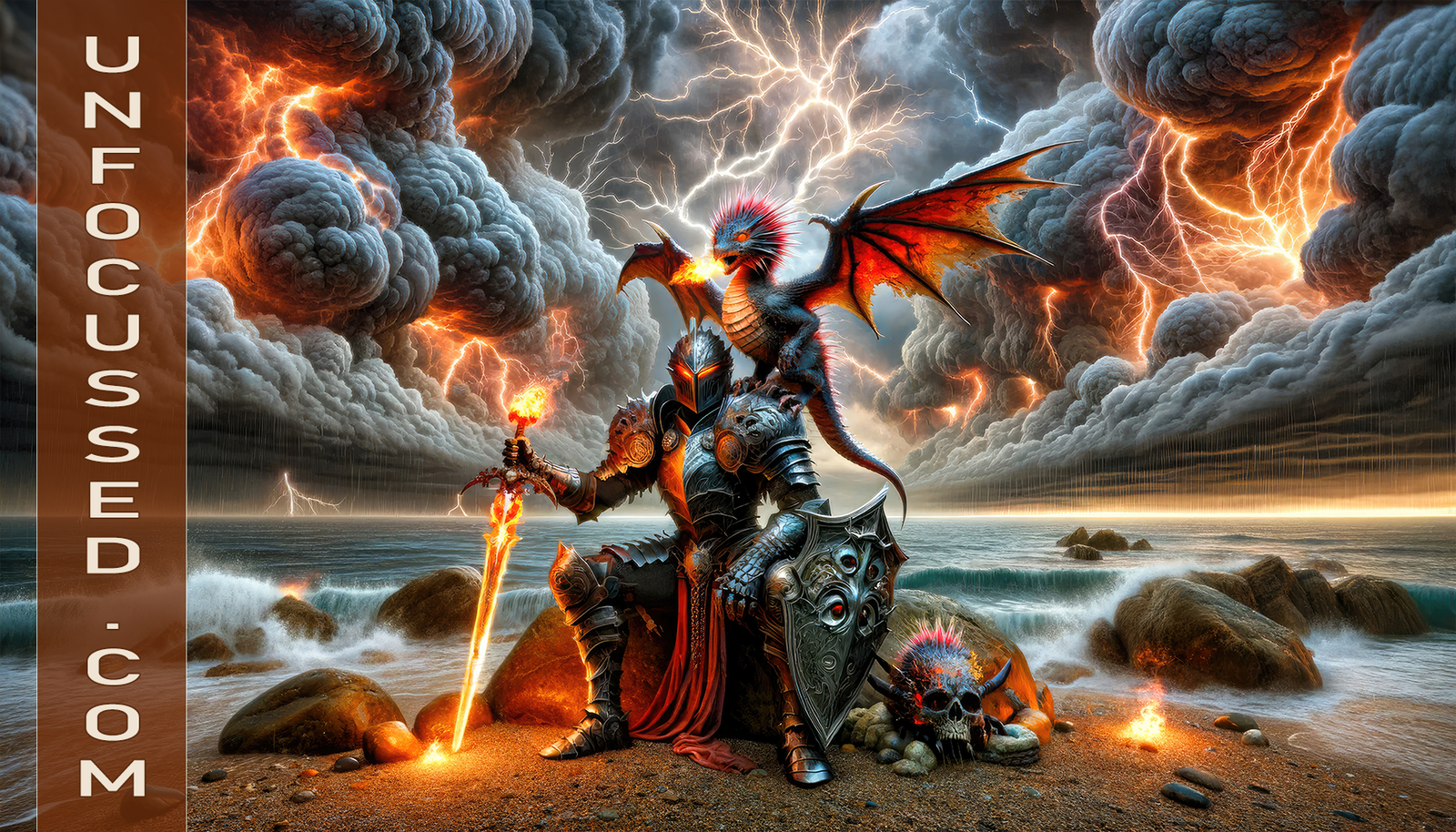
In Eldoria, a realm of mystic splendor where the whispers of ancients moved through the air like leaves in the wind, Sir Caelum, the Storm's Guardian, was an icon of hope and strength. The Edge of the World, a cliffside facing the roiling Obsidian Sea, was his solemn watchpost. Here, at the confluence of the elemental chaos and the tranquility of the land, the skies were alive with the fury of the gods, casting down bolts of lightning as if in challenge to any who dared oppose their might.
This sentinel, Sir Caelum, whose armor shimmered with the ethereal glow of starlight, was as immovable as the very cliffs he stood upon. The armor, a marvel to behold, was wrought from the core of a celestial giant, its last breath captured in the metallic weave of its construction, granting Sir Caelum strength beyond that of any mortal.
His sword, Astra Ignis, was a masterpiece of cosmic craftsmanship, its blade an extension of his indomitable will. Legends told that the sword was forged in the heart of a dying star, quenched in the primordial waters of the very sea it now guarded. The dragonling at his side, named Pyraethus, was a rare creature, its birth foretold by sages who saw the signs in the volcanic fires that had once engulfed the land.
The bond between knight and dragonling was not one of master and servant, but of kindred spirits, united in a singular purpose. The stretch of shore they defended was more than a mere line in the sand; it was the culmination of ancient pacts and sacred oaths, a testament to the covenant between Eldoria and the primordial forces that shaped it.
Beneath the sea, a darkness stirred, an ancient evil whose name was lost to time, bound by the very spells that were woven into the fabric of the beach. With every storm, this darkness tested the barriers, its tendrils probing for weakness, longing for the warmth of the sun and the taste of freedom.
Each crack of thunder from Sir Caelum's sword was a reaffirmation of the old magics, a counterpoint to the symphony of the abyss. The relentless rain served as the percussion to their battle hymn, a melody of resilience and defiance.
As they stood sentinel, Sir Caelum and Pyraethus were not alone in their vigil. The spirits of Eldoria, ephemeral and unseen, rallied to their cause, lending their essence to the strength of the guardian and his companion. These spirits, once heroes and mages of ages past, whispered their wisdom and courage into the gale, their voices blending with the howl of the wind.
The legend of Sir Caelum and his fiery companion grew with each passing storm, their story becoming a beacon of inspiration for all of Eldoria. In the warmth of the mead halls, their deeds were celebrated, their battles recounted with fervent passion. They were not just the guardians of a beach, but the champions of an idea, a belief that the light of Eldoria would never be extinguished as long as they stood watch.
Their tale, woven into the very essence of the realm, became a sacred chronicle, a reminder of the eternal struggle between light and darkness, order and chaos. And so, as the tempests roared and the sea thrashed against the land, Sir Caelum, the Storm's Guardian, and Pyraethus, the dragonling of the volcano's heart, remained steadfast, an unbreakable shield against the night. Theirs was a legacy of valor, an enduring saga that would echo through the halls of time for as long as the waves kissed the shore and the stars watched over them from above.
Guardian of the Storm's Fury
by Bill Tiepelman – December 08, 2023
Related posts
Captured Tales – by Bill Tiepelman
Gilded Ginkgo Crown
When a forgotten orchard calls her name, Maris Rowe returns to the ashes of a fallen kingdom and discovers the Gilded Ginkgo Crown was never lost â it was waiting. In a seductive reclamation of power, legacy, and choice, she must decide whether to let the past stay buried⌠or rise radiant from the fire.
Read more
Captured Tales – by Bill Tiepelman
The Echo That Became a Woman
In The Echo That Became a Woman, a man falls for the quiet version of herâonly to discover she no longer exists. This sharp, unapologetic Captured Tale explores identity, evolution, and what happens when a woman stops shrinking to fit someone elseâs comfort. Some echoes fade. Others become fire.
Read more
Captured Tales – by Bill Tiepelman
Abyssal Coral Symphony
Beneath crushing ocean pressure, a luminous bloom remembers every touch it has ever known. When deep-sea cartographer Mara Vance reaches toward it, she discovers the abyss isnât empty â itâs intimate. Abyssal Coral Symphony is a sensual, luminous tale of connection, reciprocity, and the kind of touch that doesnât fade when the tide pulls back.
Read more
Captured Tales – by Bill Tiepelman
Prismatic Lotus Harmonics
In Prismatic Lotus Harmonics, a physicist detects a mysterious deep-space signal that resolves not into noiseâbut into a living blueprint of reality itself. As harmonics bloom into a prismatic lotus structure, she discovers that consciousness doesnât merely observe the universe⌠it stabilizes it. Some frequencies arenât meant to be decodedâtheyâre meant to be joined.
Read more
Captured Tales – by Bill Tiepelman
Velvet Phoenix Bloom
When a midnight invitation leads Clara Vale into a forbidden greenhouse, she discovers a living bloom that opens only for the dangerously honest. The Velvet Phoenix Bloom does not grant wishesâit demands truth, heat, and the courage to stop hiding desire behind politeness. Some flowers are meant to be admired. This one rewrites you.
Read more
Captured Tales – by Bill Tiepelman
Casting Lines Beneath a Bleeding Moon
When the moon begins to bleed molten fire into Blackwater Lake, two cloaked fishermen cast their linesânot for fish, but for the hardened shards of humanityâs collective sins. As betrayal, war, and indifference rise from the depths, they discover the harvest is no longer preventing catastrophe⌠itâs building something beneath the world. And when the mirror finally rises, no one is spared their own reflection.
Read more
Captured Tales – by Bill Tiepelman
Frostbound Camellia
In a kingdom where frost rules with polished cruelty, one camellia dares to blush. When whispers of Firekind ignite scandal in the Silver Garden, Frostbound Camellia refuses to dimârewriting the rules of winter and proving that warmth is not destruction⌠itâs expansion.
Read more
Captured Tales – by Bill Tiepelman
Autumn Filigree Chrysanthemum
In a town where winter lingers and silence settles too easily, a mysterious florist sells bouquets that bloom brightest right before they fade. When one grieving son carries home an ember-lit chrysanthemum, he discovers some flowers donât just decorate endingsâthey force the truth to finally burn through.
Read more
Captured Tales – by Bill Tiepelman
Tidal Orchid Reverie
When Mara stands before Tidal Orchid Reverie, she realizes the luminous bloom isnât just artâitâs a mirror that remembers every moment she chose silence over vulnerability. As the orchid reveals fragments of her past, she must decide whether to keep herself contained or finally answer the tide rising inside her. Some flowers donât just bloomâthey awaken.
Read more
Captured Tales – by Bill Tiepelman
The Emberling with the Kingdom in Her Eyes
The last heir of the Ember Court is no mythâsheâs small, radiant, and terrifyingly merciful. When a bloodline built on borrowed fire comes to claim her, the tavern of Petalwood becomes the stage for an ancient reckoning. In a world that once tried to burn the phoenix sovereigns from history, one ember rises to remind kingdoms who truly commands the flame.
Read more
Captured Tales – by Bill Tiepelman
How a Laughing Gnome and a Smug Dragon Split the Luck of the Forest
A clever gnome and a smug dragon strike what they believe is a mutually beneficial dealâuntil their escalating tricks bend luck itself and force the forest to intervene. How a Laughing Gnome and a Smug Dragon Split the Luck of the Forest is a mischievous fantasy tale about cleverness, consequence, and what happens when fortune starts keeping score.
Read more
Captured Tales – by Bill Tiepelman
The Valentine Offering That Nearly Singed the Village
A well-meaning gnome. A dragon with feelings. One Valentineâs gift that violates several fire codes. A cozy, mischievous Captured Tale about brave gestures, accidental flames, and the kind of love that forces an entire village to rewrite its rules.
Read more
Captured Tales – by Bill Tiepelman
Giggles in the Glade of Frozen Fire
A tale of a gnome, a young dragon, and a single misunderstood laugh that nearly handed winter the wrong kind of authority. What begins as innocent joy spirals into snow-dusted shenanigans, ancient magic, and the realization that laughter can be far more powerful than fire or frost.
Read more
Captured Tales – by Bill Tiepelman
The Day the Forest Taught Her to Bow
A mythic, quiet fantasy about humility, memory, and the rare power of listening. When a child kneels before a dragon that remembers what the world has forgotten, a long-waiting pact finally stirs â and the future subtly shifts. This Captured Tale is a reminder that some magic only answers when approached gently.
Read more
Captured Tales – by Bill Tiepelman
Moon's Caress on the Fractal Frontier
A mythic, slow-burn Captured Tale about a woman who discovers a path that exists only while being watchedâand the quiet, irreversible cost of becoming the one who keeps it real. Part dream, part ritual, the story explores attention, belonging, and what remains when observation turns into purpose.
Read more
Captured Tales – by Bill Tiepelman
The Day the Dragon Hatched in Her Hands
When a quiet forest loophole places a newly hatched dragon into the wrong hands, responsibility ignites faster than fire. The Day the Dragon Hatched in Her Hands is a mischievous fantasy tale about ancient magic, unintended guardianship, and what happens when the forest gets cleverâand picks the wrong woman to manage the consequences.
Read more
Captured Tales – by Bill Tiepelman
The Girl the Forest Chose to Keep
Raised by roots and teeth, she was never lostâonly claimed. The Girl the Forest Chose to Keep is a mythic tale of quiet power, living woods, and the cost of mistaking natureâs patience for mercy.
Read more
Captured Tales – by Bill Tiepelman
The Red-Headed Woodpecker Who Refused to Blend In
The Red-Headed Woodpecker Who Refused to Blend In is a dryly humorous winter tale about presence, visibility, and the quiet audacity of refusing to disappear just because the season prefers restraint. Perched against frost and expectation, one unmistakably red bird reminds the forestâand the readerâthat blending in is optional.
Read more
Captured Tales – by Bill Tiepelman
A Mourning Dove Perched Between Seasons
Perched between winterâs last breath and springâs fragile promise, a mourning dove carries a quiet bargain older than the fence it rests upon. This Captured Tale explores the unseen debts that keep the seasons turningâand the soft, enduring things that pay them.
Read more
Captured Tales – by Bill Tiepelman
A Tufted Titmouse Pauses the Storm
In a quiet backyard in Wentzville, Missouri, a single tufted titmouse becomes an anchor during a difficult year. Through rain, stillness, and small acts of attention, birdwatching turns into a lesson on resilience, presence, and learning how to live inside the storm rather than waiting for it to pass.
Read more
Captured Tales – by Bill Tiepelman
Candy Cane Confidential
When the lights dim on Peppermint Lane, secrets lean closer. Candy Cane Confidential is a bold, brazen holiday tale where frosting hides leverage, decorations tell the truth, and one gingerbread pin-up becomes the witness Christmas never planned for. Sweet on the surface, sharp underneath â this is festive mischief after dark.
Read more
Captured Tales – by Bill Tiepelman
The Laughing Pact of Mossroot Hollow
When a dragon meant to inspire terror discovers that laughter is far more powerful, Mossroot Hollow is changed forever. The Laughing Pact of Mossroot Hollow is a whimsical, heartfelt fantasy tale about accidental legends, forbidden joy, and the kind of friendship that makes elders nervous. Itâs a story where chaos grins, fire behaves badly, and nobody regrets it.
Read more
Captured Tales – by Bill Tiepelman
The Sapphire Songbird of Stillwinter
In a land where winter prized silence above all else, one sapphire-blue songbird dared to sing. As frost curled into filigree and Stillwinter itself began to listen, a quiet rebellion unfoldedâornamental, mischievous, and impossibly warm. This Captured Tale explores the moment when cold learned it didnât have to be cruel.
Read more
Captured Tales – by Bill Tiepelman
Empress of the Frosted Branch
Empress of the Frosted Branch is a winter tale of survival, silence, and authority earned without asking. In a frozen forest ruled by noise and panic, one cardinal endures through restraint, judgment, and an unshakable refusal to tolerate nonsense. A sharp, sassy Captured Tale about leadership that doesnât comfortâit proves.
Read more
Captured Tales – by Bill Tiepelman
Naughty List Royalty
Naughty List Royalty is a crass festive legend about the gnome who didnât ruin Christmas â he fixed it. When the Naughty List becomes a throne and honesty replaces polite pretending, holiday cheer gets louder, messier, and far more fun. This Captured Tale celebrates chaos, confession, and the magic that happens when perfection finally collapses.
Read more
Captured Tales – by Bill Tiepelman
The Last Cookie on Cobblestone Lane
The Last Cookie on Cobblestone Lane is a darkly whimsical winter tale about a festive little bear who arrives without explanation â and begins taking only what people assume is safe to leave behind. Cozy on the surface and quietly unsettling underneath, this story turns holiday comfort into a lesson about attention, trust, and the cost of underestimating something that looks harmless.
Read more
Captured Tales – by Bill Tiepelman
The Night the Gnomes Drank Christmas
The Night the Gnomes Drank Christmas is a sassy, irreverent holiday tale about ancient rules, bad decisions, and the magical fallout that still haunts December to this day. When three gnomes revive a forbidden Christmas Eve drinking game, the spirits show up, the fine print gets read aloud, and Christmas is never quite the same again.
Read more
Captured Tales – by Bill Tiepelman
Jingleboots & Bad Decisions in the Snow
When the Naughty List grows antlers, boots, and an attitude, Christmas stops being about punishment and starts being about recognition. âJingleboots & Bad Decisions in the Snowâ is a mischievous holiday tale where guilt learns to wink, bells jingle with consequences, and everyone is just a little more seen than theyâre comfortable with.
Read more
Captured Tales – by Bill Tiepelman
Evergreen Eddie and the Unlicensed Use of Baubles
When a gnome refuses to remove his overdecorated evergreen crown, a quiet winter town learns the hard way that joy doesnât require a permit. Evergreen Eddie and the Unlicensed Use of Baubles is a slightly crass, self-aware holiday folklore about rules, rebellion, and ornaments that refuse to behave.
Read more
Captured Tales – by Bill Tiepelman
Ladybug Serenades for a Sleepy Sprout
In this whimsical Captured Tale, a sleepy gnome named Brindle accidentally finds herself negotiating with a full-blown ladybug union perched on her hat. Between dramatic insect walkouts, sneeze catastrophes, and unexpected labor victories, the forest learns what happens when cute meets chaotic â and naps meet negotiations.
Read more
Captured Tales – by Bill Tiepelman
The Marshmallow Mauler of Mistletoe Manor
When an over-whipped cup of cocoa unleashes a frosting-born menace, Mistletoe Manor becomes ground zero for a holiday legend filled with chaos, sugar-fueled mischief, and one creatureâs unforgettable quest for marshmallows. Dive into the riotous origins of the Marshmallow Mauler in this whimsical winter tale.
Read more
Captured Tales – by Bill Tiepelman
The Mulling-Spiced Mage of Frostmarket Row
When Frostmarket Rowâs feuding carolers, ornament vendors, and snow-sculptors spiral into holiday chaos, only Brulk Emberwhisker â a beard-lit mage with zero impulse control â can âfixâ it. Spoiler: he absolutely does not fix it.
Read more
Captured Tales – by Bill Tiepelman
Red-Scarf Rascal of the First Frost
When the Forest Council accidentally discovers that their new Spirit of Winter is a scarf-tripping, joy-exploding reindeer with more heart than coordination, Winterwood is forever changed. Follow the Red-Scarf Rascal as he turns ancient tradition into warm, chaotic magic.
Read more
Captured Tales – by Bill Tiepelman
The Gingerbread Thirst Trap of Frostbite Lane
When a dangerously seductive gingerbread cookie escapes the bakery and outruns holiday HR, all of Frostbite Lane is left craving chaos. Follow Ginger Belleâs wild quest for fame, freedom, and unapologetic thirst in this hilarious, unhinged Captured Tale.
Read more
Captured Tales – by Bill Tiepelman
Sugarsweat Shenanigans of the Cookie That Lived
When a sugar-sweating gingerbread messiah awakens mid-frosting, he launches into a wildly unhinged quest through the kitchenâfacing butter, flour, cats, and his own overconfidence in this hilariously chaotic holiday tale.
Read more
Captured Tales – by Bill Tiepelman
Glitterbomb Garyâs Day Pass from the Ornament Bin
When Glitterbomb Gary gets a Day Pass from the ornament bin, he doesnât behaveâhe declares himself the main character of the entire holiday season. Chaos erupts, elves fall, snowmen panic, and Gary sparkles his way straight into accidental glory.
Read more
Captured Tales – by Bill Tiepelman
Candied Antlers of the North Realm
A gingerbread reindeer with outrageous confidence, candy-coated swagger, and one very questionable spin move accidentally tears open a cosmic riftâthen discovers what real courage looks like. Follow Crumbsnatchâs laugh-out-loud, sugar-dusted journey from âtoo big for his britchesâ to unlikely North Realm hero in this heartfelt, chaotic holiday tale.
Read more
Captured Tales – by Bill Tiepelman
Snowveil Hare of the Frozen Court
The Hare Who Refused to Be Ordinary On the coldest night of the year, when the aurora stretched across the sky like spilled paint and everyone with common sense was indoors hoarding soup, the Frozen Court gathered in the Valley of Unreasonable Sparkle. The snow there never simply âfell.â It pirouetted. It glowed. It attempted, on more than one occasion, to unionize. Every ruler of the North was present. The Ice Stag with his cathedral-sized antlers, the Glacial Owls with their disapproving expressions, the Polar Bear Matron wearing a cloak of storm clouds, and a flock of snow sprites who communicated exclusively in giggles and glitter. Even the northern wind had attended, appearing as a tall, translucent figure who looked like they spent far too much time in perfume commercials. At the center of it all, sitting on a smooth rise of snow that glowed from within, was a throne carved from a single block of ice. It was both magnificent and deeply uncomfortable, which is how you knew it was a throne. And atop that throne, in a halo of swirling frost, sat the most improbable monarch the realm had ever had: the Snowveil Hare of the Frozen Court. Snowveil was not what anyone expected from a winter ruler. For starters, they were small. Not metaphorically small, either. Physically. A hare. A very fluffy hare with long legs, luminous sapphire eyes, and antlers that looked like moonlight had grown tired of being intangible and decided to crystallize into something with sharp edges and opinions. The antlers glimmered with frost fractal patterns, delicate branches sparkling as though each was lit by its own tiny aurora. Snowveilâs coat was etched with swirls of ice-lace, filigree crawling over fur like an artist had been allowed to go absolutely feral with a frostbrush. Every time Snowveil moved, the patterns shifted, catching the light and throwing fragments of cold fire into the air. The Frozen Court had elected Snowveil for a simple reason: no one could intimidate enemies and charm tourists quite like a hyper-realistic magical hare with crystalline antlers. The marketing potential alone was obscene. There were already plans for seasonal tapestries, enamel pins, and collectible prints in the Hall of Excessively On-Brand Merchandise. But that night, the Court wasnât thinking about merchandising strategies or limited-edition aurora posters. They were thinking about the problem. The problem in question came in the form of a messenger wisp, who spun into existence over the court like a terrified snowflake that had read too much bad news. It trembled in the cold air, its tiny face pale blue and worried. âYour Frosted Majesty,â the wisp squeaked, bowing so low it nearly folded itself inside out, âwe have an issue in the Southern Melt.â The Southern Melt was not a place anyone enjoyed saying out loud, mostly because it sounded like a seasonal dessert special. It was the liminal region where the eternal winter of the North grudgingly shook hands with the warmer lands beyond. The snow there had a habit of melting, refreezing, sulking, and writing anonymous complaints in the slush. Snowveilâs whiskers twitched. âWhat kind of issue?â they asked, voice soft but edged with the crispness of subzero air. The wisp hesitated. âThe snow,â it said, âis⌠refusing to fall.â The Court erupted into panicked murmurs. The Glacial Owls fluffed up indignantly. The Ice Stag stomped a hoof, causing an avalanche somewhere unfortunate. The Polar Bear Matron let out a shocked huff that formed a new iceberg off the northern coast. âRefusing?â Snowveil repeated, one elegant ear flicking. âSnow is not allowed to refuse. Thatâs literally its whole job. It goes up, it freezes, it falls. Thatâs the brand.â The wisp nodded miserably. âIt says itâs on strike, Your Majesty. Something about âunreasonable working conditions, lack of respect, and human tourists who keep calling it âso aestheticâ instead of appreciating its complex crystalline geometry.ââ Snowveil pinched the bridge of their nose with an invisible paw of pure exasperation. The antlers glittered in sympathy. âOf course it does,â they muttered. âThe last time we let a cloud read anything about labor rights, it staged a blizzard walkout.â The Wind leaned closer, cape of translucent air whispering. âIf the snow stops falling in the Southern Melt, the line between winter and spring will blur,â it warned. âRivers will swell early. Flowers will bloom too soon. Mortals will start posting âIs this climate change or vibes?â on their little glowing rectangles. It will be chaos.â Snowveil wasnât afraid of chaos; they were the sort of creature who could turn a snowstorm into a fashion statement. But they were concerned about balance. The winter realms relied on subtle rhythms: snowfall patterns, frost crystal maps, aurora schedules, the weekly migration of overly dramatic ravens. If the snow decided to rebel, everything else would wobble. The Ice Stag cleared his throat, antlers chiming like distant bells. âWe could send the Storm Wolves,â he suggested. âA little intimidation might persuade the flakes to fall in line.â Snowveilâs blue eyes narrowed. âWe are not threatening the weather into compliance,â they said. âEvery time we do that, some mortal writes a myth where the gods are jerks and the moral is âNever trust atmospheric deities.â Our PR team still hasnât recovered from the Great Hailstone Incident.â There were solemn nods. The Great Hailstone Incident was still whispered about in the Hall of Reputational Damage. Somebody had tried to speed-run an entire winter in one week. It had not gone well. Snowveil hopped down from the ice throne in a flurry of glittering frost, landing so softly the snow barely noticed. They paced slowly, hoovesâno, paws, but dignified onesâleaving faint trails of glowing patterns behind them. Each step wrote a secret sigil in the snow, the language of ice and intention. âSnow is not the enemy,â Snowveil said at last. âItâs an artist. It likes to be admired. It likes to be taken seriously. And lately itâs been treated like nothing more than a filter for mortal photographs and a hazard for poorly chosen footwear.â The Polar Bear Matron rumbled thoughtfully. âHumans do enjoy sliding around shrieking as if walking on frozen water is a deeply surprising concept.â âExactly,â Snowveil said. âIf I were a snowflake, Iâd be offended too. Imagine spending hours crystallizing yourself into a unique six-armed masterpiece, just to get stomped by someone in discount boots and then compressed into sludge.â The Court winced collectively. âSo,â Snowveil continued, âweâre going to negotiate.â The Glacial Owls blinked. âNegotiate,â one repeated slowly, as though tasting the word like a questionable berry. âWith precipitation.â Snowveilâs whiskers twitched again, this time in amusement. âYes. With precipitation. The snow wants respect? Weâll see what that means. And if we canât come to an agreement, then weâll find the real reason behind this strike. Snow doesnât just stop falling unless something bigger is meddling.â The suggestion settled over the Court like a thin new layer of frostâchilly but stabilizing. They all knew what Snowveil wasnât saying: storms didnât organize themselves. If there was a labor movement among the clouds, somethingâor someoneâhad stirred it. A faint shiver slid through the air. Snowveil felt it, the way a hare feels the shadow of a hawk long before it sees the wings. It was subtle, like a ripple in the pattern of the cold, a small wrongness humming under the usual song of the North. That was the twist, Snowveil realized. The snowâs rebellion wasnât the problem. It was the symptom. They turned to the wisp. âYouâll guide me to the Southern Melt,â Snowveil said. âWe leave at once.â There was a murmur of protestâabout the hour, the temperature, the ongoing agenda items concerning icicle zoning regulationsâbut Snowveil flicked one antler and the complaints froze solid, glittering briefly before shattering. âThis realm,â Snowveil said calmly, âis balanced on patterns most mortals never see. Frost fractals, snowdrift rhythms, the way ice sings under starlight. If those patterns start misbehaving, we donât sit here and fill out complaint forms. We go out there and fix it.â The Wind gave an appreciative bow, snow swirling in elegant spirals. âVery dramatic,â it said. âNine out of ten. I would have added a cape swirl.â Snowveilâs fur rippled in a way that absolutely counted as a cape swirl. âHappy now?â they asked dryly. And so the Court parted to open a path of glowing frost. Snowveil stepped forward, antlers haloed in pale light, eyes reflecting all the strange, beautiful cold of the North. The wisp bobbed nervously at their side, already regretting every life choice that had led it to be the courier of bad meteorological news. As Snowveil crossed the boundary of the valley, the sky brightened with a fresh wave of aurora. Greens and violets rippled across the dark, dancing above the hare like a royal banner. Snowveil didnât look back, but if they had, they would have seen the Frozen Court watching in tense silence, each member aware that something old and patient was stirring beneath the snow. Because far to the south, just beyond the edge of winter, someone else was tired of being ignored by the world. And unlike the snow, they werenât planning a strike. They were planning a takeover. Snowveil didnât know the details yet. But as a faint tremor shivered through the eternal ice, the hareâs antlers rang like distant glass bells, and they had the unsettling sensation that the season itself had just winked at them. âWonderful,â Snowveil muttered under their breath. âItâs going to be one of those winters.â Negotiating With Weather (And Other Terrible Ideas) The journey to the Southern Melt began with the sort of dramatic flourish Snowveil generally tried to avoid before their morning tea. The wisp led the way, jittering like a lantern flame in a nervous sneeze, while Snowveil bounded through drifts of glittering snow that behaved as though they were in a perfume adâswirling, shimmering, and showing off for absolutely no reason. The first sign something was wrong came when they reached the River of Respectable Ice, which had recently rebranded itself from the River of Slightly Cranky Ice after a successful therapy arc. Normally, it was frozen solidâquiet, reliable, and pleasantly self-important. Now? A chunk near the southern bank had melted into a suspiciously warm puddle, bubbling as though being boiled by a kettle operated by an unlicensed pyromancer. Snowveil leaned down, antlers casting shimmering reflections on the surface. âThis isnât normal.â The wisp nodded vigorously. âThis happened when the snow declared its strike. The Melt's expanding faster than it should, and the air keeps getting⌠hotter.â Snowveil raised a furry brow. âHotter? In the North? Without a signed permission slip from the Winter Council? Bold.â The puddle suddenly belched steam, which coalesced into a tiny, irritable heat sprite. It looked up at Snowveil with the expression of someone who had eaten a ghost pepper and immediately regretted all life choices leading to that moment. âLook,â the sprite rasped, hands on nonexistent hips, âweâre doing our best, okay? Thereâs interference. Someoneâs cranking up the temperature without filling out one single Seasonal Adjustment Form. I swear, itâs like mortals think weather just happens by accident.â Snowveil cleared their throat. âDo you know whoâs causing it?â The sprite squinted. âSomething big. Something fiery. Something with an ego large enough to require its own postal code.â Snowveil winced. âOh no. Not⌠him.â The sprite shuddered. âYep.â Snowveil muttered a string of ancient frost-words that sounded suspiciously like someone cursing into a scarf. âThe Sun Prince?" The wisp gasped. âHe wouldnât dare!â âOh, he absolutely would,â Snowveil said. âHe once tried to annex the twilight hours because he wanted to âexpand his brand.â The man radiates confidence and secondhand embarrassment.â But there was no time to stand there and make fun of a nuclear starâs self-esteem issues. The snow had unionized. The Melt was creeping north. There was a solid chance someone would attempt to turn the Frozen Court into a spa resort âfor warmth enthusiasts.â Snowveil marched southward, antlers glowing faintly with frost energy. Along the way they encountered several troubling anomalies: A patch of daisies blooming aggressively out of season, attempting to start a selfie trend. A flock of robins arguing heatedly with a confused snowdrift about territory law. A snowman lying on its side like a Victorian damsel, dramatically claiming it was âmelting from emotional distress.â And thenâthere it was. The Southern Melt in full rebellion mode. Snow wasnât falling. It was floating upward in tiny groups, holding tiny picket signs made of ice chips. Every single snowflake was shouting at once, which sounded like a thousand faint jingles mixed with the subtle auditory equivalent of passive-aggressive emails. Snowveil took a deep breath. âHere we go.â They hopped onto a mound of slush like a politician climbing onto a podium moments before regretting everything. âAttention, snow!â Snowveil called, antlers ringing like crystalline bells. âWe are here to listen to your grievances.â A representative flake drifted forward, swirling itself into a larger, more dramatic configuration that vaguely resembled a snowflake with managerial responsibilities. It floated eye-level with Snowveil. âWe demand respect,â it chirped. âAnd hazard pay.â Snowveil blinked slowly. âHazard pay?â âYes!â the snowflake huffed. âDo you have any idea how dangerous it is falling through the atmosphere? Weâre basically yeeted from the sky at terminal velocity! And what for? To be shoveled, stomped, salted, and photographed with filters that completely misrepresent our crystalline geometry!â Snowveil rubbed their forehead. âOkay. I understand. But refusing to fall is destabilizing the winter cycle. We need you.â The snowflake crossed its little flake-arms. âWeâre not doing a single elegant descent until our demands are acknowledged.â Snowveilâs voice softened. âWhat if I promised to speak to the Court? To advocate for better conditions, better appreciation, and maybe a mandatory course on how to photograph snow without flattening it into white mush?â The snowflakeâs edges softened. âThat⌠could be negotiated.â Snowveil nodded. âGood. Because something far bigger is threatening the winter realms. You arenât striking alone. Somethingâs heating the North from the inside out.â A hush fell over the strike line. The snowflake trembled. âYou meanââ âYes,â Snowveil said grimly. âThe Sun Prince.â The snowflakes erupted into outraged jingling. âThat radiant himbo!â one shouted. âHeâs always trying to steamroll winter! Literally!â âPrecisely.â Snowveil shook frost from their whiskers. âWe need unity, not rebellion. Winter wonât stand a chance if he unleashes one of his âseasonal rebrandâ schemes. The last time he tried to warm up the North, we ended up with the Great Slush Flood of Year 401. The otters still donât speak to us." The snowflake hovered thoughtfully. âWhat do you need from us?â Snowveil looked up, antlers glittering with incoming determination. âYour help. Not as precipitation. As witnesses. Scouts. The Sun Prince wonât expect resistance from those he ignores. We need you to find where heâs concentrating heat. Where heâs planning his move.â The snowflakes conferred among themselves in soft crystalline chimes. Finally, the leader drifted forward. âWe accept. On one condition.â Snowveil braced internally. âName it.â The flake pointed one of its tiny arms at Snowveil. âIf we save winter, we want recognition. Official titles. An annual parade. Andâthis is non-negotiableâa public apology from the Sun Prince for melting our brethren without proper documentation.â Snowveil nodded. âDone. Winterwide proclamation, parade funding, and a strongly worded letter dipped in frost for dramatic effect.â The snowflake twinkled smugly. âWeâll begin surveillance immediately.â The flakes scattered into the air like a burst of silent fireworks, streaking southward on cold winds. Snowveil exhaled in relief. One disaster stabilized. A larger one incoming. The wisp drifted beside them, trembling. âWhat now?â Snowveil stared toward the horizon where heat shimmered like a mirage. âNow? We go meet the Sun Prince.â The wisp squeaked. âIsnât he⌠dangerous?â âOh, absolutely,â Snowveil said. âHeâs hotter than the gossip about two yetis caught canoodling behind the Icefall Tavern. But heâs also vain. And dramatic. And deeply susceptible to emotional manipulation.â The wisp blinked. âManipulation?â Snowveil smirked. âYes. Youâd be amazed what you can accomplish with a strategic compliment about the luminosity of his solar flares.â The wisp groaned. âWeâre doomed.â As they continued south, heat shimmered stronger, rising in waves that made the snow beneath them whimper anxiously. Something truly immense was interfering with the seasonâbigger and bolder than any prior tantrum the Sun Prince had thrown. But the final confirmation didnât come until the clouds themselves parted in a sudden, dramatic flourish⌠and a colossal golden figure stepped forward, radiating smugness and SPF 500 energy. The Sun Prince, crown blazing like a supernova, looked down at Snowveil with a smile that suggested he practiced it in reflective surfaces. âWell, well,â he purred. âIf it isnât winterâs cutest little monarch.â He winked. âDonât melt on me.â Snowveilâs eye twitched. âFantastic,â they whispered. âItâs going to be one of those negotiations.â The Hare, the Himbo Sun Prince, and the Great Winter Rebrand Attempt The Sun Prince stood before Snowveil like a bronzed monument to questionable decisions, basking in his own radiance with the confidence of someone who believed sunscreen was a personality trait. Heat shimmered around him in waves so intense that several nearby icicles fainted dramatically and had to be revived with sassy pep talks from a passing frost sprite. Snowveil squared their tiny but ferociously majestic shoulders. Their crystalline antlers glinted defiantly, each delicate branch giving off the distinct impression that it would absolutely be used as a weapon if negotiations failed. âSun Prince,â Snowveil began coolly, tone sharp enough to shave ice sculptures. âWhat exactly do you think youâre doing?â He flashed a smile bright enough to cause mild retinal trauma. âJust warming things up, darling. Your winter has been a liiittle too... wintery this year. I thought I'd give the land some razzle-dazzle.â He wiggled his fingers, and a plume of steam spiraled upward as if agreeing with him. Snowveil stared at him. Blinked once. Slowly. âYou are destabilizing the entire seasonal structure of the Northern Realms.â He shrugged. âI like to think of it as⌠rebranding.â He leaned forward with a conspiratorial grin. âPicture it: âHot Winterâ˘: A Sunny Take on Snow.ââ Snowveil made a strangled noise that could have frozen a lesser being on the spot. âYou cannot trademark winter.â The Sun Prince gave a devastatingly smug wink. âWatch me.â Behind Snowveil, the wisp made a noise somewhere between a gasp and a dying squeal. The hare pressed a paw to their forehead, antlers buzzing with frost energy. âWhy,â Snowveil hissed, âwould you do this? What are you possibly gaining from melting my domain?â The Sun Prince sighed dramatically, wind machines of pure solar flare powering up behind him. âFine. You want the truth? Iâm bored.â Snowveil arched a brow. âBored.â âYES bored!â he burst out. âMortals worship me all summer longâsunbathing, sunflowers, that whole solar-powered happiness aesthetic. But winter comes? And suddenly itâs all cocoa and blankets and âoh look how elegant the frost isâ and âthe moonlight is so atmosphericâ and âletâs light candles and pretend the sun doesnât exist.ââ He stomped a foot, causing the ground to steam aggressively. âItâs rude.â Snowveil inhaled deeply. âSo you heated half of my kingdom because you felt⌠underappreciated.â âYes,â he said without shame. âAlso, one mortal called me âmidâ in a poem last month, and I havenât recovered.â Snowveilâs eye twitched with the force of an avalanche. But thenâsomething shifted. Behind the heat shimmer on the horizon, a familiar glittering cloud approached, moving with purposeful, icy grace. Snowflakes. Thousands of them, sparkling like a rebellious militia with excellent posture. The snowflake leader hovered forward, tiny arms crossed in indignation. âExcuse us,â it chimed pointedly, âbut are YOU the reason half of us melted before we even fell? Because some of us were masterpieces, thank you very much.â The Sun Prince recoiled. âAre you talking to me?â The snowflake jabbed a tiny icy arm right at his solar-plexus region. âOh, we are more than talking. We are FILING A FORMAL COMPLAINT.â Several snowflakes behind it chanted âCOMPLAINT! COMPLAINT!â like an extremely chilly protest group. The Sun Prince sputtered. âIâI didnât melt you on purpose!â âOh REALLY?â the snowflake hissed. âBecause we have eyewitness accounts of unauthorized heat waves, unscheduled solar bursts, and at least one snowman who claims you looked at him funny and he liquefied out of fear.â Snowveil cleared their throat. âPrince. Apologize.â He stared at Snowveil as though they had asked him to dim. âIâm sorryâyou want me to apologize to the weather?â âYes,â Snowveil said firmly. âItâs that or we file a complaint with the Equinox Council. And you know how they get.â The Sun Prince blanched. âNot the Equinox Council. They make everything so⌠bureaucratic.â Snowveil nodded solemnly. âMm-hmm. Youâd be stuck filling out sunbeam allocation forms until next solstice.â The Prince shuddered in horror. âFine! FINE. I apologize to the snow for meltingââ A snowflake coughed loudly. He rolled his eyes. ââfor melting you⌠without authorization. And for⌠uh⌠calling winter âemotionally clingy.ââ The snowflakes squealed triumphantly and immediately began drafting parade blueprints. Satisfied, Snowveil stepped forward. âNow. Youâre going to turn the heat down. Gradually. We donât want steamstorms again. And after that, youâre going to sit with your feelings like a responsible celestial entity instead of committing meteorological arson every time someone forgets your fan club.â The Sun Prince sighed. âYouâre surprisingly stern for someone so fluffy.â Snowveil smiled sweetly. âI will end you.â He believed them. A slow, controlled coolness spread through the land. Frost reformed. Snowflakes fell with dramatic flair. The river sighed in relief and refroze in the shape of a polite bow. The Melt retreated, muttering apologies as it went. By the time the Frozen Court gathered to greet their returning monarch, winter had returned to its elegant, orderly, and mildly judgmental self. The Court erupted in cheers. The Polar Bear Matron shed proud tears (which froze midair and had to be chiseled off). The Ice Stag bowed deeply. The Glacial Owls attempted applause but produced only very dignified wing flaps. Snowveil climbed the icy throne once more, fur glittering with victorious frost. âWinter,â they proclaimed, âis restored. And our realm stands strongâbecause even rebellious snowflakes have their place in the pattern.â The snowflake leader drifted up beside them. âWe expect that parade by mid-month.â Snowveil sighed. âYes, yes. Iâll inform the auroras to prep their choreography.â The auroras overhead brightened in smug acknowledgment. As celebrations erupted around them, Snowveil glanced southward. The Sun Prince was already retreating, muttering something about updating his fan club newsletter and exfoliating his solar layers. Snowveil shook their head with fond exasperation. âDrama,â they murmured. âPure, incandescent drama.â But peace had returned. Balance was restored. And winter, once again, would sparkle with elegance, mystery, and just a hint of absurdityâexactly as it should.   Bring the Snowveil Hare of the Frozen Court into your own winter realm. Whether you're looking to elevate your dĂŠcor, wrap yourself in enchanted warmth, or send a bit of frosted magic to someone special, this piece shines across multiple premium formats. Each product below transforms Snowveilâs crystalline elegance into a tangible keepsakeâperfect for collectors, fantasy lovers, and anyone who lives for winterâs spellbinding charm. Explore the full collection:⢠Framed Print: A gallery-worthy display capturing every icy fractal and luminous detail.Shop Framed Print⢠Metal Print: Vibrant, reflective, and impossibly crispâSnowveil practically glows from within.Shop Metal Print⢠Acrylic Print: Depth, clarity, and a glass-like finish that gives Snowveil dimensional presence.Shop Acrylic Print⢠Fleece Blanket: Wrap yourself in winter magic with a soft, luxurious blanket featuring Snowveilâs regal glow.Shop Fleece Blanket⢠Bath Towel: Add a touch of frosted elegance to your bathroom dĂŠcorâyes, even your towels can be majestic.Shop Bath Towel⢠Greeting Card: Send winter magic to friends and family with a card that sparkles with charm and mischief.Shop Greeting Card Surround yourself with the enchanting energy of Snowveilâand let the Frozen Courtâs most fashionable monarch bring a little winter wonder into your space.
Read more
Captured Tales – by Bill Tiepelman
Aurora Guardian Rising
A late-winter aurora transforms into a celestial guardian who recruits Daniâreluctant, sarcastic, and running on caffeineâto help jumpstart spring. What follows is a whimsical, sassy, magical journey through glowing snow, awakening forests, and the first spark of a season determined to make an entrance. A humorous, adult fantasy tale about renewal, mischief, and the unexpected ways the world begins again.
Read more
Captured Tales – by Bill Tiepelman
Twinkle-Shell the Festive Wanderer
The Glitter-Covered Menace of Mistletoe Marsh Deep inside the glimmering heart of Mistletoe Marshâwhere the trees shed glitter instead of leaves and the ground is permanently sticky from a century of spilled eggnogâthere lived a creature so cheerfully chaotic that even Santa had him on a âsoft banâ list. His name was Twinkle-Shell, the Festive Wanderer, and his hobbies included: jingling loudly at inappropriate hours, hoarding peppermint just to say he had it, and single-handedly destabilizing the local ecosystem every time he tried to âspread holiday joy.â Twinkle-Shell, a snail by birth but an *aspiring* reindeer by attitude, struttedâor slithered, depending on how frozen the marsh happened to beâbeneath a towering Christmas tree growing directly out of his shell. Not metaphorically. Not tattooed. Literally. A whole, sparkly, fully-functional tree, complete with ornaments that jingled, lights that flickered, and a star on top that glowed brighter whenever he felt dramatic⌠which was often. His antlers, grown out of pure festive stubbornness, sprouted ornaments like some kind of holiday fruit tree with boundary issues. Every time he moved, a cascade of jingles followed behind him, making stealth absolutely impossible. Neighborhood squirrels used him as a navigational beacon. A family of chipmunks synchronized their winter dances to the rhythm of his accidental jingling. And at least one very confused owl tried to mate with the ornament hanging from his left antler. (Twinkle-Shell never recovered emotionally.) He also had, for reasons beyond nature or decency, a reputation as a walking hazard. If you saw glitter drifting in the air, it wasnât snowfallâit was him. If a candy cane mysteriously disappeared from your porch and reappeared lodged in a tree branch two miles away, it was him. If your snowman woke up wearing red lace garland like a feather boa, it was definitely him. Twinkle-Shell insisted these things just âsort of happenedâ around him, a statement that carried the same sincerity as a toddler claiming the dog opened the permanent marker. But despite the chaosâor perhaps because of itâeveryone at Mistletoe Marsh adored him. He was the unofficial herald of the holiday season. The moment they heard his jingle-jangle-jing-JANGLE (followed by a thud, usually him slipping on his own ornament debris), they knew: the season had begun. This year, however⌠things were different. Twinkle-Shell had woken up with a feeling. A vibe. A destiny-level sensation that this holiday season, he was meant for something big. Something important. Something completely beyond his normal jurisdiction of moderately controlled chaos. And that, unfortunately for Mistletoe Marsh, meant he was about to tryâreally tryâto be helpful. The last time he tried to be helpful, twelve ducks got perms and the mayor of the Marsh still refused to discuss âthe tinsel incident.â But none of that deterred him. With the star on his shell glowing like it had just consumed espresso, Twinkle-Shell declared: âTHIS YEAR⌠I SHALL SAVE CHRISTMAS!â No one had asked him to. No one had suggested Christmas was even remotely in danger. But history had proven one fact: when Twinkle-Shell decided something was destiny, destiny usually sent an apology note in advance. As he jingle-slid toward the edge of the Marsh to begin his âheroic quest,â local residents whispered, worried, hopeful, and bracing for impact. Because whatever was about to happen⌠it would be memorable. And probably sticky. Twinkle-Shellâs Incredibly Poor Life Choices Twinkle-Shell had barely made it twenty jingle-steps out of Mistletoe Marsh before destiny introduced itself in the form of a frantic puffin wearing a scarf knitted entirely of panic and broken dreams. The puffin crash-landed into the snow in front of him, skidding through slush like a feathery curling stone before popping up and blurting, âTHE NORTH POLE IS A DISASTER!â Now, Twinkle-Shell was no stranger to the word âdisaster.â He heard it often. Usually directed at him. But this time, it had a certain global toneâlike the kind of disaster where holiday laws would be violated, elves would unionize, and Santa might start drinking the non-virgin eggnog before noon. âExplain yourself,â Twinkle-Shell declared, attempting to stand heroically tall, but remembering too late that snails do not stand. He settled instead for rearing up in slow motion, which looked less like bravery and more like he was trying to reach a cookie on a high shelf. The puffin took a dramatic breath. âSantaâs workshop⌠is covered in gingerbread sludge! The ovens malfunctioned, the cookie mixers revolted, and half the toys smell like cinnamon-based despair!â Twinkle-Shell gasped with the force of a creature who once ate an entire wreath and regretted nothing. âIs Santa okay?â âHeâs⌠sticky,â the puffin whispered, as though sharing a national secret. âVery⌠very sticky.â That settled it. This was a job for a hero. A legend. A creature with the power to make things worse before making them better. This was a job forâ âTWINKLE-SHELL THE FESTIVE WANDERER!â The puffin blinked. âI donât know who that is.â âStill me,â Twinkle-Shell said, flexing an antler so that a tiny ornament fell off and rolled dramatically into a snowbank. And so, the two set off toward the North Pole, Twinkle-Shell jingling with heroic enthusiasm and the puffin waddling in a state of ongoing regret. Their journey was⌠complicated. First, Twinkle-Shell attempted to âspeed upâ by sliding down a frozen hill. This resulted in him spinning like a holiday Beyblade, screaming, âI WAS NOT BUILT FOR THIS!â as ornaments flew off his antlers like festive shrapnel. The puffin, trying to help, flapped frantically behind him, shouting instructions such as âSTEER LEFT!â and âWHY ARE YOU SPARKLING MORE?!â Twinkle-Shell eventually crashed into a drift of powdered snow, emerging glitterier than before, which should have been impossible by the laws of physics but was absolutely on-brand for him. Then came the Snow Sprite Incident. Snow Sprites were known for their ephemeral beauty, frosted wings, and a temperament roughly equivalent to a caffeinated ferret. They were fragile, delicate, and notoriously manipulative when slightly bored. As Twinkle-Shell and the puffin cut through a clearing, a cluster of them descended like sparkly piranhas. âOoooh! A walking tree!â one Sprite squealed. âA talking ornament bush!â another cried. âA sentient holiday fever dream!â said a third, deeply concerned but intrigued. Twinkle-Shell tried to introduce himself, but Sprites donât wait for introductions. Or permission. Within seconds, they were hanging new ornaments on him, braiding his garlands, fluffing the branches of his shell-tree, and rearranging his decorations with the aggressive enthusiasm of interior decorators who havenât eaten in days. âWe added more sparkle to your sparkle,â one Sprite reported proudly. âYouâre welcome,â another said, while applying shimmering frost to his left flank. Twinkle-Shell attempted polite gratitude, but the sheer weight of the extra ornaments nearly tipped him over. He had to dig his foot into the snow to keep upright. âI appreciate the⌠enthusiasm,â he managed, âbut weâre on an urgent quest!â âA quest?â the Sprites gasped collectively like a dramatic choir. âFor WHAT?â âTo save Christmas!â There was a silence, followed by all twenty Sprites bursting into chaotic applause while yelling conflicting advice: âKidnap the gingerbread!â âPunch a snowman!â âBlame the elves! They can take it!â âBring Santa soup!â âDonât bring Santa soup! He hates soup!â By the time the Sprites finished âdecoratingâ him, Twinkle-Shell now jingled when he blinked. Literally. The puffin stared at him with the hollow expression of someone reconsidering every life decision. âLetâs just⌠go,â the puffin muttered. At last, after waddling, sliding, jingling, and arguing their way across the tundra, the North Pole appeared on the horizonâshimmering with lights, smoke, and the faint smell of gingerbread on fire. Twinkle-Shell whispered reverently, âWe made itâŚâ âIâm going to regret this,â the puffin whispered back. They approached the candy-cane gates, only to find them half-melted, coated in sticky sugar, and buzzing with tiny, exhausted elves trying to chisel themselves free from cookie cement. One elf, covered in dried frosting and rethinking all career choices, pointed at Twinkle-Shell and groaned, âOh no. Not again.â Twinkle-Shellâs eyes widened. âWeâve never met!â The elf shook his head. âDoesnât matter. I can FEEL the chaos.â That was when another elf staggered out of the workshop, hair smoking slightly, and shouted: âTHE GINGERBREAD HAS GONE SENTIENT! AND IT HAS DEMANDS!â Twinkle-Shell inhaled sharply. âThis⌠this is my moment.â And as the peppermint-scented smoke billowed out of the workshop behind him, Twinkle-Shell jingle-glowed with heroic determination. This would be the day he proved himself. This would be the moment he saved Christmas. Orâmore statistically likelyâthis would be the moment everything went gloriously, catastrophically wrong. The Great Gingerbread Uprising (And the Snail Who Probably Shouldâve Stayed Home) The moment Twinkle-Shell slid into the workshop, he was hit with a wave of heat, spice, and the unmistakable smell of burnt sugar trauma. The walls were coated in gingerbread goo. Half-constructed toys were glued to the ceiling. A Nutcracker soldier was stuck to the floor, repeatedly muttering, âI did NOT sign up for this.â Somewhere in the distance, an oven door rattled like something inside was trying to negotiate its release. Elves scurried everywhere, armed with frosting spatulas, licorice whips, and the kind of exhausted expressions found on retail workers on December 24th at exactly 11:59 p.m. And right there, at the center of the chaos, stood the enemy. A giant, twelve-foot-tall, semi-sentient gingerbread man. He had gumdrop eyes of pure malice. He had frosting facial hair that suggested heâd been through three divorces. And he wore a peppermint belt like he was in some kind of seasonal wrestling league. âI AM GINGERPAPA!â he bellowed, his voice echoing like thunder made of cookie crumbs. âAND CHRISTMAS SHALL BURN IN THE OVEN OF MY WRATH!â Twinkle-Shell gasped. Mostly because he got too excited and inhaled a sprinkle. The giant gingerbread titan turned his gumdrop glare on him. âYou,â GingerPapa growled. âTree snail. Decorative menace. Living mall display. You dare approach me?â Twinkle-Shell jingle-flexed proudly, which involved wiggling his antlers and immediately losing two ornaments. âI am here⌠to restore holiday harmony!â An elf whispered to another, âOh great. Heâs monologuing. This is going to end in frosting.â GingerPapa raised one icing-coated arm and roared, âATTACK, MY GINGERMINIONS!â From behind him poured an army of smaller gingerbread creaturesâsome shaped like classic gingerbread men, others shaped like little stars, bells, candy canes, and one disturbingly buff gingerbread duck who looked like he worked out twice a day and drank raw eggnog. Twinkle-Shell took a heroic stance (again, mostly by accident). The puffin behind him screamed into his scarf. The elves shrieked. The oven doors rattled harder. It was chaos. Beautiful, stupid, holiday chaos.  The Battle Was⌠Not Great Twinkle-Shell attempted to charge heroically. Unfortunately, as a snail, his top speed was âconfidently leisurely.â The gingerbread army reached him long before he made any meaningful forward progress. They swarmed up his shell, climbing the branches of his Christmas tree, poking his ornaments, licking his lights (disgusting), and slapping him with tiny sugary hands. âOw! Ow! Hey! Personal space! Thatâs a limited edition bauble!â Twinkle-Shell cried, flailing his antlers wildlyâknocking gingerbread men off like shuriken made of holiday shame. Meanwhile, GingerPapa bellowed laughter. âFOOLISH SNAIL! YOU CANNOT STOP THE RISE OF THE COOKIE KINGDOM!â The elves, realizing they had backup, began throwing handfuls of flour like improvised flash grenades. The puffin aggressively pecked a gingerbread star into crumbs. A squad of teddy-bear-shaped cookies began chanting, âDOWN WITH MILK! DOWN WITH MILK!â for reasons no one fully understood. Overwhelmed and sticky, Twinkle-Shellâs star began to glowânot with chaos, but with something he had never experienced before: Actual determination. And then something incredible happened. His shell-tree lit up. Every ornament flared. Every garland shimmered. Every holiday light sparked to life all at onceâ âand unleashed a blinding explosion of glitter. Not normal glitter. Not craft-store glitter. This was primordial holiday glitter. The kind that sticks to souls. The kind that ruins marriages. The kind that you still find on you 17 years later. The workshop was consumed by a shimmering shockwave that froze the gingerbread army in placeâliterally. The sugar in their dough flash-crystallized, turning them into sparkling statue versions of themselves. GingerPapa let out a final dramatic roar: âNOOOOOOO! I SHOULD HAVE ADDED MORE MOLASSES!â before freezing solid with a pose suspiciously similar to interpretive jazz hands. When the glitter cleared, the workshop was silent. Twinkle-Shell blinked. The glitter blinked back.  Aftermath, Regret, and Questionable Praise Santa finally emerged from the back, coated in hardened gingerbread goo like a festive swamp creature. He squinted at Twinkle-Shell through the sticky sugar on his beard. ââŚdid you⌠save Christmas?â Twinkle-Shell stood tall (as tall as a snail can stand). âYes. I did.â Santa stared at the frozen gingerbread titan. Then at the glitter coating every inch of his workshop. Then at the elvesâhalf cheering, half trying to scrape cookie cement off the walls. Then at the puffin, who looked like he needed therapy immediately. Finally, Santa sighed. âCould you⌠maybe next time⌠warn me before doing whatever you just did?â Twinkle-Shell thought about it. Thought long and hard. Then said confidently: âNo.â Santa closed his eyes in defeat, but the elves celebrated. They lifted Twinkle-Shell onto a sled, cheering his name, chanting as though he were a holiday demigod: âTWINKLE-SHELL! TWINKLE-SHELL! SAVIOR OF THE SEASON!â The puffin even flapped up onto his shell-tree and declared, âYou absolute disaster⌠I am so proud of you.â  A Hero Returns Twinkle-Shell returned to Mistletoe Marsh that night, glowing with triumph, glittering from shell to foot, and dragging so much leftover cookie dust that he left behind a trail of gingerbread crumbs like Hansel and Gretel going through a holiday divorce. Everyone gathered around him. They cheered. They jingled their bells. A choir of squirrels performed a celebratory interpretive dance despite having no formal training. Twinkle-Shell announced proudly: âI HAVE SAVED CHRISTMAS!â And the Marsh erupted in applause. However⌠a small, nervous squirrel raised a paw. âSo⌠uh⌠does this mean youâll stop trying to âhelpâ now?â Twinkle-Shell laughed, his ornaments chiming like tiny alarm bells of doom. âNo, my sweet winter children. No it does not.â And from that day forward, the holidays were never peaceful again.   Bring Twinkle-Shell Home If Twinkle-Shellâs heroic glitterbomb of holiday chaos made you smile, swoon, or briefly reconsider the stability of the gingerbread ecosystem, you can now bring this gloriously unhinged icon into your own home. Celebrate the season (and the snail who almost accidentally destroyed it) with beautifully crafted holiday collectibles featuring Twinkle-Shell the Festive Wanderer. For a classic touch, hang him proudly on your wall as a framed print â a perfect way to let guests know your dĂŠcor aesthetic is âclassy chaos with a side of peppermint madness.â Prefer something sleek and modern? Show off every shimmering detail with a metal print that captures the imageâs glossy textures and festive glow. If you enjoy a challenge (or simply wish to relive the gingerbread uprising in slow motion), the jigsaw puzzle offers a wonderfully chaotic holiday pastime â ideal for family gatherings, cozy evenings, or proving you're mentally stronger than sentient cookies. And for spreading the joy directly, nothing beats the charm of a greeting card. Send it to friends, family, coworkers, or that one neighbor who still owes you a borrowed wreath. Twinkle-Shell will deliver seasonal cheer, questionable decisions, and glitter-based optimism wherever he goes. Let the legend of Twinkle-Shell live on â in your home, on your walls, and in the hearts of everyone who receives a card and thinks, âWhy is that snail sexier than I expected?â
Read more
Captured Tales – by Bill Tiepelman
Holiday Hijinks in Red Velvet
Every holiday season needs a bit of chaos â not enough to derail Christmas, just enough to keep the reindeer humble and the elves slightly traumatized. And if there was one creature uniquely qualified to deliver that delicate level of festive mayhem, it was Grindle Tock: five-foot-nothing if you counted the hat, ears sharp enough to slice gift wrap, and a grin so sly it probably had its own backstory. At this moment, Grindle sat perched atop a giant present wrapped in shimmering red paper, his bare toes wiggling like they were independently scheming their own crimes. The warm glow of Christmas lights made his skin look almost cherubic⌠which was wildly misleading to anyone who had met him for more than eight seconds. The party behind him was reaching that blurry phase where elves began harmonizing ancient carols slightly off-key and slightly too passionately. Already three of them had formed a barbershop quartet despite none of them knowing what a barbershop was. Two reindeer â tipsy, though theyâd deny it â were at the snack table arguing over the philosophical implications of gluten-free gingerbread. A cluster of toy soldiers stood frozen in their usual stoic formation, but even they seemed to be silently judging the questionable choices unfolding around them. Grindle, however, wasnât distracted by the spectacle. He had the intense, squinty look of a strategist â or perhaps a raccoon eyeing an unsecured trash can. His Santa-red outfit was a size too small, hugging him with the affectionate enthusiasm of a garment ready to burst if he inhaled wrong. His belt buckle gleamed like it knew secrets. His hat sagged dramatically to the side like it was exhausted from enabling his nonsense. In his lap rested a handmade scroll titled, in calligraphy far too elaborate for someone with his reputation: Operation Cheerquake. The subtitle read: âA Gentle, Non-Destructive Redistribution of Holiday Spirit.â The crossed-out options underneath included âmildly inconvenient,â âreindeer-repellent,â and âillegal without a permit.â What exactly counted as ânon-destructiveâ in Grindleâs mind was a question that had plagued Santaâs legal team for years. The list of previous incidents included exploding peppermint garlands, a hot cocoa fountain that achieved sentience, and a snowman uprising that required three days of mediation and one restraining order. Grindle hadnât technically been responsible for all of them, but he had been âadjacent to the chaos,â which, in workshop terminology, meant guilty enough. Tonight, though⌠tonight he felt destiny humming in his bones. Or maybe that was the eggnog. Hard to tell. Grindle preferred to believe it was destiny because it sounded dramatic and he lived for theatrics. Every elf had a role: toy-maker, tinker, baker, reindeer wrangler. Grindleâs role? âUnpredictable Variable.â It was written on his file in Santaâs HR cabinet under the tab labeled âCaution.â âThis,â he murmured to himself, âis going to be my masterpiece.â He leaned back, balancing perfectly on the present as if gift boxes were his natural habitat. His toes flexed with alarming enthusiasm. He stared into the twinkling lights with the energy of a small creature about to make a decision that would haunt the entire building by sunrise. His reflection in a nearby ornament looked entirely too pleased with itself, which only encouraged him. He unrolled the scroll and tapped the first item on the list: 1. Relocate the Naughty List. A perfectly innocent idea, really â except that the ârelocationâ destination was listed simply as âsomewhere funny.â Grindleâs sense of humor had once led him to store 400 plush reindeer inside Santaâs sleigh. Santa had not laughed. Mrs. Claus, however, had laughed so hard she snorted cocoa, which only made Grindle feel validated. The second item read: 2. Replace Santaâs boots with spring-loaded substitutes. Not harmful. Just⌠energetic. Festive even. Think of the cardio. Item three: 3. Initiate Mistletoe Flash Mobs. No further notes. The implications were concerning. He scanned the crowd for his first accomplice â or victim. It was often the same thing. His eyes landed on Jibble, a mild-mannered wrapping elf known for being nice, friendly, and catastrophically gullible. Jibble was currently slow-dancing with a mop, which Grindle mentally categorized as âemotional vulnerability: high.â Perfect. âTonightâs the night,â Grindle whispered again, like the villain of a Christmas musical no one had approved but everyone would talk about. He hopped lightly, toes curling over the edge of the gift box, preparing to leap into action⌠or onto someoneâs shoulders, depending on opportunity. The air shimmered with anticipation â or possibly glitter fallout. Hard to distinguish at this time of year. And somewhere deep in the workshop, a single candy cane cracked in half for no clear reason. A sign? A warning? Or just poor structural integrity? Only time would tell. Grindle slid off the gift box with the theatrical grace of someone who routinely tripped over nothing. His toes hit the workshop floor with a soft pat-pat, and he strutted forward like a tiny, red-velvet menace on a mission. The lights above twinkled warily, as though aware that they were witnessing the early stages of a North Poleâlevel disaster. Grindle puffed up his chest, adjusted his hat to the precise angle of âfestively unhinged,â and marched straight toward Jibble, who was still slow-dancing with the mop⌠now whispering affirmations to it. âJibble,â Grindle said, stepping directly into his line of vision like an elf-shaped pop-up ad. âI need your help.â Jibble blinked slowly, as if trying to determine whether Grindle was real or a hallucination induced by sugar-cookie shots. âGrindle⌠buddy⌠last time you said that, I ended up duct-taped to a model train.â âYes,â Grindle replied proudly, âand it built character. Also speed. You were very aerodynamic.â Jibble looked down at the mop for moral support. The mop, being a mop, offered none. With the defeated sigh of someone who knew resistance was futile, he nodded. âFine. What do you need?â Grindleâs smile widened with unsettling enthusiasm. âA simple task! Weâre going to, hypothetically, temporarily, and entirely for morale purposes⌠relocate the Naughty List.â Jibbleâs pupils dilated. âGrindle. No.â âGrindle. Yes.â Jibble clutched the mop like a lifeline. âDo you know what Santa will do if he finds out?â Grindle shrugged. âThank me?â âGrindle.â âFine. Heâll notice. But weâll put it back! Eventually. Probably.â Jibble whimpered internally but followed anyway, because good decisions had never once happened at a Christmas party. The two elves crept through the swirling chaos of the workshop dance floor. A conga line wrapped around them in a swirling, sugar-fueled tornado â Mrs. Claus still at the front, raising her mug triumphantly, chanting âHOLIDAY CARDIO!â as reindeer scrambled to keep up. An elf DJ was mixing classic carols with an alarming amount of bass, causing several ornaments to vibrate off nearby shelves. A group of gingerbread men â the living enchanted kind â were engaged in a heated dance battle with a flock of snow sprites who had clearly taken caffeine. Grindle moved through the madness untouched, a tiny agent of chaos protected by his own absurd energy. Jibble, however, got hit in the face with a rogue candy cane, stepped into a spilled bowl of marshmallows, and was briefly trapped inside a wreath someone mistook for a dance accessory. Grindle did not slow down. Soon they reached the long hallway leading to Santaâs office. The music faded into muffled thumping behind them, replaced by the serene hum of magical machinery and the faint jingling of distant bells. Here, the air felt⌠official. Important. Completely incompatible with whatever Grindle was planning. âOkay,â Grindle whispered, flattening himself against a wall despite the corridor being totally empty. âWe must be subtle.â âGrindle,â Jibble said, âyouâre wearing a hat with a jingle bell the size of a plum.â Grindle scowled, removed the bell, stuffed it into Jibbleâs pocket, and continued his stealth mission with exaggerated tiptoe steps so dramatic they resembled an interpretive dance about paranoia. They reached Santaâs office door â a towering slab of carved wood depicting reindeer, snowflakes, and one angelic-looking Santa who would absolutely not approve of this situation. Jibble swallowed hard. The mop trembled in his hands. âGrindle,â he whispered, âmaybe we should think aboutââ âThinking is the enemy of adventure,â Grindle declared, pushing the door open before Jibble could protest. The office was empty â Santa and Mrs. Claus were still âsetting the dance floor on festive fire,â as Mrs. Claus had put it â so the coast was somewhat clear. Warm lamplight illuminated the room. Papers were neatly stacked. The globe of the world spun lazily, glowing with soft enchantment. On Santaâs desk, glowing with restrained cosmic authority, sat the one item they were not supposed to touch under any circumstances: The Naughty List. Bound in leather. Embossed in gold. Radiating the quiet judgment of a thousand disappointed parents. Jibble froze. âNope. Absolutely not. Iâm out. Iâm going back to the mop. Itâs safer.â But Grindle had already marched forward, reverently placing his hands on the list like he was greeting an old friend â or choosing the shiniest object to steal. âGrindle,â Jibble said, voice cracking like a gingerbread cookie under pressure, âyou cannot just TAKE it.â âIâm not taking it,â Grindle corrected. âI am temporarily borrowing it to enhance holiday morale through educational mischief. Itâs called leadership.â âItâs called a felony.â Grindle snorted. âOnly if I get caught.â He lifted the Naughty List. It hummed with ancient magic, glowing brighter the further it moved from the desk. The air shifted. The Christmas lights flickered. Somewhere, a distant bell rang in alarm â or annoyance. âOkay,â Grindle said, âstep one: relocation. Step twoââ The door creaked. Both elves froze. A shadow passed under the threshold. Heavy footsteps approached. The kind of footsteps that belonged to a man with opinions about proper behavior and a zero-tolerance policy for elf-based shenanigans. Jibble whispered, âWeâre dead.â Grindle whispered back, âWeâll die heroes.â âYouâll die. Iâll pass out and hope that counts.â The doorknob turned. Grindle stuffed the Naughty List inside his shirt. That was his plan. The door swung open. The door flew open with a dramatic whoosh, as if the universe itself sensed that something regrettable was about to unfold. In stepped not Santa, nor Mrs. Claus, nor any authority figure with the ability to revoke workshop privileges. Instead, it wasâ âOH SWEET GINGERBREAD, ITâS JUST TINSEL!â Grindle hissed dramatically. Tinsel Norellâinventory clerk, chaos magnet by proximity, and the only elf who could lose an entire shipment of candy canes without leaving the roomâstared at the two of them with the confused expression of someone walking in on a crime they did not want to be associated with. She blinked. Then she blinked again. Then she sighed, already exhausted by the sight before her. âI donât even want to know,â she said, pinching the bridge of her nose like a parent whose children have discovered matches. Grindle puffed out his chest, glowing with pride. âExcellent! If you donât know, you canât testify.â âPlease donât use that sentence again,â Jibble whimpered, clutching the mop like it was a legal defense. Tinselâs eyes drifted to the bulge under Grindleâs shirtâan extremely obvious, rectangular, glowing bulge. âIs that⌠the Naughty List?â Grindle gasped dramatically. âTinsel! You wound me! You think I would stealââ The Naughty List hummed loudly inside his shirt like a furious hornet nest. ââborrow,â he corrected without missing a beat, âsuch a historic, important, extremely overreactive document?â Tinsel stared. Grindle smiled. Jibble cringed so hard his spine made a noise. âYou two,â Tinsel said slowly, âare absolutely unhinged.â Grindle beamed. âThank you.â âThat wasnât a compliment.â âOh⌠well, you said it nicely.â Tinsel was about to respond when a booming, jolly, unmistakable voice echoed down the hall. âHO HOâWHEREâS MY LIST?â Santaâs footsteps approached with the slow, seismic certainty of a man who had raised nine thousand elves and forgiven maybe ten. Jibble turned pale. âGrindle. Heâs coming. Heâs ACTUALLY coming.â âStay calm,â Grindle said, despite being absolutely incapable of calm. âI have a plan.â He did not have a plan. Santaâs shadow stretched across the hallway like an omen. Tinsel shoved both elves behind Santaâs enormous filing cabinet with the strength of someone who had absolutely no interest in being present for the consequences. Santa entered the office. His boots thudded. His coat swished. His beard practically glowed with judgment. He looked around the room, frowning deeply enough to trigger a small avalanche somewhere. âStrange,â he murmured. âI couldâve sworn I left it right hereâŚâ Under the desk, Jibble was silently praying to any holiday deity that would listen. The mop lay across his lap like a dramatic fainting Victorian heroine. Tinsel was holding her breath. And Grindleâ Grindle felt the Naughty List shift inside his shirt. He froze. The List glowed through the fabric. It warmed. It hummed louder. Santa turned. The List ignited in a burst of golden sparks so bright that it illuminated the entire hiding spot like a stage spotlight. Grindle let out a squeak. Jibble let out a scream. Tinsel let out a noise that can only be described as âexistential dread mixed with a kazoo.â âWHOâS THERE?â Santa thundered. The filing cabinet slid forward as if shoved by an invisible forceâor two panicking elves and one cowardly inventory clerk. The trio tumbled out onto the floor in a heap of limbs, mops, and glowing contraband. Santa stared down at them. Slowly. Silently. Deeply disappointedly. âGrindle,â Santa said, in the calm tone every elf feared. âIs that⌠my Naughty List?â Grindle considered lying. Then the List hummed louder, clearly snitching. âTechnicallyyyyâŚâ he said, drawing out the word with the optimism of someone who hoped Santa had recently sustained a blow to the head. âItâs more like a cooperative morale object?â Santa held out his hand. Grindle wilted. He pulled the Naughty List from his shirt with all the shame of a child handing over a broken vase. Santa took it, dusted off the glitter, and sighed the sigh of a man who would need extra cocoa tonight. âWe will discuss this later,â Santa said. âMuch later.â Grindle nodded solemnly. Jibble fainted again. Tinsel pretended to be unconscious just to avoid responsibility. Santa paused, then added in a much quieter voice, âAlso⌠please stop hiding important artifacts in your shirt. Last year it was the Reindeer Roster. Before that, it was the North Pole Key.â âI learn best by doing,â Grindle said proudly. âAnd I learn patience by knowing you,â Santa said dryly. He left the room with the List in hand, shaking his head, muttering something about insurance premiums. Once he was gone, Grindle pushed himself up, dusted off his outfit, and struck a heroic pose. âWell!â he declared. âThat could have gone worse.â âHOW?â Tinsel shouted. Grindle grinned wickedly. âOh, I havenât gotten to items four through twelve yet.â Jibble whimpered. Tinsel groaned. Somewhere in the workshop, a single ornament cracked in fear. And Grindle, red velvet menace, walked off into the twinkling glow of Christmas chaos⌠already planning the next disaster.   Bring Grindleâs Chaos Home If Grindleâs red-velvet mischief made you smile, smirk, or quietly question the structural safety of the North Pole, you can adopt a little of that holiday chaos for your own home. This artwork is available in several festive formats perfect for gifting, decorating, or subtly intimidating coworkers who think their cubicle dĂŠcor is superior. Dress up your walls with a bold Canvas Print, or go full elegant troublemaker with a gleaming Metal Print. Want something whimsical and cozy? The Tapestry brings Grindleâs energy into any room without requiring magical liability waivers. For those spreading snarky seasonal cheer, the Greeting Card is perfect for delivering holiday messages such as âHope your Christmas is calmer than Santaâs night.â And if you want just a dash of mischief, snag the durable, adventure-ready Stickerâideal for laptops, water bottles, and any surface that needs 20% more chaos. Add a little mischievous magic to your worldâGrindle insists on it.
Read more
Captured Tales – by Bill Tiepelman
Gobsmacked in the Glade
The Lily Pad Incident At precisely âoh no oâclock,â a rainbow-haired goblin named Peeb discovered that lily pads are terrible chairs and even worse life choices. Heâd crouched on one like a suspicious frog, hands pressed to his cheeks, and released a whispery âooooâ that traveled across the enchanted pond like a gossip column with webbed feet. Peeb wasnât built for stealth. His hair was a gossip of colorâcobalt, tangerine, electric mossâstanding out like a neon sign that screamed TRY ME. His ears, the architectural wonder of the glade, collected every sound: the tilt-tock of water beetles, the distant honk of an aggrieved swan, and, more importantly, the crunch of someone stepping on a twig that did not sign up for this. âShow yourself,â Peeb stage-whispered, which for him meant âplease announce your plot twist.â A ripple rolled past his toes. The lily pad burped. He adjusted his existential squat. âIf this is a dramatic entrance, youâre late and Iâm judging.â From the cattails emerged a figure in travel-stained leathers: a human woman with a map shoved into her belt and the facial expression of someone whoâd headbutted destiny and won on points. She carried a backpack the size of a small moon and the attitude of an unpaid invoice. âYou must be the Guide,â she said. âGuide? I am an Experience,â Peeb said, flicking hair like a discount thunderstorm. âAlso, hello. I charge by the gasp, and youâre already two in.â âNameâs Renn,â she said. âHere for a job. Need a goblin who knows the shortcuts through the Glarewood, preferably one who wonât eat my boots.â Peeb held up both hands. âI only nibble ethically sourced footwear.â His eyes narrowed, tracking a dragonfly practicing irresponsible aerobatics. âBut the Glarewood? That place stares back. Why go?â Renn unsheathed a rolled parchment. It glintedâliterally glintedâlike a guilty conscience. âTreasure map. Also a curse. Long story. Think âfamily drama meets hostile cartography.â I was told the goblin with the loud hair and louder opinions could get me through.â Peeb perked. Treasure was his love language, followed closely by snacks and malicious compliance. âI have routes,â he said. âSecret ones. One involves a polite troll. Another requires emotionally negotiating with a bridge.â Behind them, the pond plopped. Something large exhaled bubbles the size of soup bowls. A golden water lily tilted, showering them in sparkles that were frankly showing off. The air smelled of wet coins and wishful thinking. âFine,â Renn said. âTerms?â âOne: I pick snacks. Two: If we encounter any prophecies, we ignore them out of spite. Three: You donât ask whatâs in my pocket.â âCounter-offer: I pick the route. You donât steal my map. And if something with teeth smiles at me, you explain thatâs just their face.â They shook on it. The pond hiccuped again, and Peebâs lily pad sank an inch. âRight,â he said brightly, âtime to go before my seat becomes a metaphor.â They made it as far as the reeds when the water boomed. A shadow rolled up from the pondâs belly like a thought nobody wanted to admit having. Two bulbous eyes surfaced, each the size of a teacup saucer. A mouth followed, wide enough to register its own postal code. âFriend of yours?â Renn asked, already drawing a knife that did not look ceremonial. Peeb squared his shoulders. âThat,â he said, âis Bubbles the Approximately Gentle. Heâs usually friendly as long as you donâtââ Bubbles snapped up the sinking lily pad with a single slurp and burped out a crown of pondweed. ââinsult his dĂŠcor,â Peeb finished weakly. The giant amphibian blinked. Then, in a voice like wet drums, it spoke: âToll.â Renn glanced at Peeb. Peeb glanced at fate. Somewhere, a prophecy tried to stand up and tripped over its robes. âAll right,â Peeb sighed, fishing in his pocket. âLetâs pay the frog and pray itâs not with our dignity.â The Toll of Bubbles and Other Unpaid Debts Peebâs hand emerged from his pocket with an assortment of glittering nonsense: two bent copper buttons, a marble that faintly hummed with regret, and a coin bearing the face of someone who looked suspiciously like Peeb doing his best impression of royalty. âThatâs your currency?â Renn asked, eyebrow performing interpretive skepticism. âOf course not,â Peeb said indignantly. âThatâs my emergency charm collection. You canât just pay a frog king with anything. There are rules. Amphibious etiquette is sacred.â He turned to Bubbles, who had begun drumming his webbed fingers on the pondâs surface, creating small tidal waves that gently insulted physics. âO Mighty Lord of Moist Surfaces,â Peeb began in an overly theatrical voice, âwe humbly seek passage across your most glistening domain. In return, we offer tribute most shiny and irrelevant!â Renn whispered, âYou sound like a con artist in a poetry contest.â Peeb whispered back, âThank you.â From his satchel, the goblin produced a single item of magnificence: a polished spoon with an engraving of a duck doing yoga. He held it aloft. The world seemed to pause for a moment, confused but intrigued. Bubblesâ massive eyes blinked. âAcceptable.â The frogâs tongueâlonger than necessary by several legal definitionsâsnapped out and took the spoon. He swallowed it in one heroic gulp, then leaned in close enough that Peeb could see his reflection trembling in an ocean of amphibian disinterest. âGo,â the frog rumbled. âBefore I remember my dietary restrictions.â They didnât wait for a second invitation. The reeds gave way to damp earth and a winding trail that glowed faintly underfoot, like moonlight had decided to join the conspiracy. Trees here grew in eccentric shapesâone looked like it was trying to hug itself, another had grown a perfect window through its trunk, framing a sliver of sky that looked suspiciously judgmental. Rennâs boots squelched rhythmically, the sound of someone too practical to be impressed by whimsy. âSo whatâs the deal with the Glarewood?â she asked. âWhyâs everyone so afraid of it?â âOh, the usual,â Peeb said, skipping over a root that was clearly plotting something. âHaunted trees, cursed air, sentient moss that critiques your posture. Itâs a place that feeds on overconfidence and snacks on poor decisions. Youâll love it.â âSounds like my last relationship,â Renn muttered. They walked in uneasy silence until the ground began to shimmer with a subtle blue sheen. Ahead, the trees leaned closer, forming an archway of twisted branches that seemed to breathe. The air shimmered with lazy motes of light, floating like tiny glowing lies. âThatâs it,â Peeb said, suddenly serious. âThe border. Once we cross, thereâs no turning back without paperwork, and trust meâyou do not want to deal with the bureaucratic dryads.â âCanât be worse than the Department of Magical Licensing,â Renn said dryly. âOh, itâs worse,â Peeb said. âThey charge emotional tolls.â Renn stepped through first. For a heartbeat, she vanishedâthen reappeared on the other side, slightly blurry, like reality hadnât finished loading her. Peeb followed, holding his breath, and the world changed in a blink. The Glarewood was alive in a way normal forests werenât. Colors moved. Shadows gossiped. The trees bent closer to listen to secrets they werenât supposed to hear. The air was heavy with perfume and potential bad ideas. âOkay,â Renn said, pulling out the map. âWe head north until the path forks. One route leads to the Cackling Brook, the other to the Weeping Hill. We want the one thatâs less emotionally unstable.â Peeb squinted at the parchment. âItâs moving.â Indeed, the ink shimmered and rearranged itself like it was trying out new fonts. Words twisted, forming a sentence that hadnât been there before: âYouâre being followed.â Renn folded the map very slowly. âThatâs comforting.â Behind them came a faint jinglingâlike tiny bells being carried by the wind. Then laughter. Soft, overlapping, too cheerful to be friendly. âPixies,â Peeb hissed. âDonât make eye contact. Donât make eye anything. They weaponize attention.â âWhat happens if we ignore them?â Renn asked. âTheyâll feel neglected and emotionally spiral until they turn into wasps. Or theyâll braid our eyebrows. Fifty-fifty.â Unfortunately, the pixies had already noticed them. A dozen of them swirled out of the treesâtiny, glittering beings with wings that sounded like gossip. Their leader, wearing a thimble crown, landed on Peebâs nose. âYouâre in our glen,â she said in a voice that could curdle honey. âPay toll or perform dance.â Peeb sighed. âI just paid a toll. Iâm starting to feel financially targeted.â âDance,â the pixie insisted, poking him with a twig-sized spear. âFunny dance. With feelings.â Renn grinned. âOh, I have to see this.â Peeb rolled his eyes so hard they nearly relocated. âFine,â he said, hopping onto a nearby log. âPrepare yourselves for interpretive goblin jazz.â What followed could not legally be described as dancing. It was more like an argument between gravity and self-respect. Peeb flailed, spun, and occasionally made finger-gun gestures at invisible haters. The pixies were delighted. Renn laughed so hard she nearly dropped her knife. Even the trees seemed to lean closer in horrified fascination. When Peeb finished, panting and triumphant, the pixie queen clapped. âAdequate,â she declared. âYou may pass. Also, your aura needs moisturizer.â âIâll put that in my next therapy session,â Peeb muttered. The pixies vanished as suddenly as theyâd appeared, leaving behind a faint smell of mischief and sparkles that clung like regrets. Renn wiped her eyes. âYouâre surprisingly good at humiliation.â âItâs a survival skill,â Peeb said. âAlso my cardio.â They pressed on, following the twisting glow of the trail deeper into the Glarewood. The trees grew taller, the air thicker. Somewhere ahead, faint music playedâslow, mournful, and unsettlingly seductive. It tugged at the edges of reason. Renn frowned. âYou hear that?â Peeb nodded, ears twitching. âSirens. Wood version. Probably trying to lure us into an emotional flashback.â âCharming.â Renn drew her knife again. âLead the way, Experience.â Peeb bowed dramatically. âAfter you, Customer Satisfaction Guarantee.â Together, they stepped into the clearing where the music pulsed like a heartbeat. In the center stood a crystal pool, and in itâsomething moved. It wasnât a creature so much as an idea pretending to have a body: long, fluid, beautiful in a slightly threatening way. Its eyes glowed like bottled daydreams. âWelcome,â it purred. âYouâve come far. Trade me your fears, and Iâll show you the treasure you seek.â Peeb blinked. âHard pass. My fears are artisanal and locally sourced.â Renn, however, stepped closer. âWhat if sheâs telling the truth?â âOh, she probably is,â Peeb said. âThatâs the scary part. Truth here always has small print.â The creature smiled wider, too wide. âAll treasures require a price,â it said softly. âFor some, itâs gold. For othersâŚâ Its gaze slid over to Peeb. âHumor.â âNo,â Peeb said instantly. âAbsolutely not. You can pry my jokes from my cold, giggling corpse.â âThen perhapsâŚâ it turned to Renn, âyour name.â Rennâs grip tightened on the knife. âYouâll have to earn it.â The pool rippled. The air thickened. The Glarewood seemed to hold its breath. Peeb groaned, already regretting his entire rĂŠsumĂŠ. âEvery time I agree to help someone,â he muttered, âwe end up negotiating with metaphors.â He reached for his pocket, where something faintly sparkledâthe same pocket heâd refused to discuss earlier. Renn noticed. âWhat are you hiding in there?â Peeb grinned. âPlan B.â He pulled out a tiny glass orb swirling with rainbow mist. âIf this doesnât work,â he said, ârun.â He hurled it into the pool. The orb burst in a cloud of colors, releasing a sound halfway between a laugh and an explosion. When the smoke cleared, the creature was gone. The pool shimmered gold for a moment, then faded into silence. Peeb blinked at the empty water. âHuh. That actually worked. I was 80% sure that was just a glitter bomb.â Renn lowered her knife slowly. âYouâre a menace.â âAnd yet,â Peeb said, dusting off his tunic, âan effective one.â From the poolâs center rose a small pedestal. On it lay a glowing gemstone, shaped like a tear and pulsing softly with light. The treasure theyâd been seeking. Renn stepped forward. âFinally.â Peeb, however, didnât move. His expression was uncharacteristically serious. âBe careful,â he said. âThe Glarewood doesnât give gifts. It loans themâwith interest.â Renn hesitated, then reached outâand the forest itself seemed to exhale. The Gem, The Goblin, and the Gigglepocalypse Rennâs fingers brushed the gemstone, and instantly the world hiccupped. Colors inverted. Trees gasped. Somewhere, a mushroom screamed in lowercase italics. The Glarewood came alive like a theater audience realizing the play had gone off-script. âWell,â Peeb said, blinking through the sudden kaleidoscope of nonsense, âthatâs new.â The glowing tear pulsed once, twiceâthen melted into a puddle of shimmering light that slithered up Rennâs arm like affectionate mercury. She swore, trying to shake it off, but it climbed higher, wrapping her wrist in luminous threads. âPeeb! Fix this!â âDefine âfix,ââ Peeb said cautiously. âBecause my last attempt at fixing something gave a raccoon the power of foresight, and now he keeps mailing me spoilers.â Renn glared at him with the intensity of a thousand unpaid invoices. âDo. Something.â The goblin squinted at the light now coiling up her arm like sentient jewelry. âOkay, okay! Maybe itâs not evil. Maybe itâs just aggressively friendly.â âItâs humming the same tune from the pool!â Renn snapped. âThatâs never good news!â The humming grew louder. The gemstoneâs light flaredâand in an instant, the clearing was filled with a burst of magic that tasted like laughter and poor decisions. The trees bent back. The air rippled. And from the puddle of melted gemstone rose a figure⌠small, winged, and painfully familiar. âOh no,â Peeb groaned. âNot her.â The figure yawned, stretched, and fixed them both with a smirk. âMiss me?â It was the pixie queen. Same thimble crown. Same weaponized smugness. âThanks for the lift. You broke my prison, darlings.â âWe what now?â Renn asked. âMy essence was sealed in that gem ages ago,â the queen said, inspecting her nails. âSomething about excessive mischief and minor war crimes. But now Iâm free! Which meansââ She spread her arms dramatically. âParty time!â With a flick of her wrist, glitter detonated across the clearing. Every tree started humming in harmony. Flowers burst into applause. Bubblesâthe giant frogârose from a nearby swamp puddle wearing a crown of disco lights and began to dance with terrifying grace. âOh stars,â Peeb muttered, ducking as a confetti tornado spun past him. âSheâs triggered the Gigglepocalypse.â âThe what?â Renn demanded, wiping glitter off her face. âA magical chain reaction of uncontrollable laughter,â Peeb shouted over the chaos. âIt feeds on irony and spreads faster than gossip in a tavern!â Sure enough, Renn felt a snort bubble up her throat. Then a giggle. Then a full, uncontrollable laugh that bent her double. âStopâcanâtâbreatheâwhyâisâitâfunny!â âBecause,â Peeb gasped, barely holding back his own fit, âthisâforestâruns on punchlines!â The pixie queen twirled midair, laughing like a caffeinated thunderstorm. âLet joy reign!â she cried. âAlso mild chaos!â Peeb fumbled through his pockets, tossing out increasingly useless trinkets: a singing walnut, a broken compass that pointed toward guilt, and a half-eaten biscuit that mightâve been sentient. Nothing helped. Then he remembered the marbleâthe one that hummed with regret. He held it up, eyes wide. âThis! This might balance the magic!â âHow?â Renn choked out, tears of laughter streaming down her face. âRegret cancels joy! Itâs basic emotional algebra!â Peeb hurled the marble into the air. It burst in a puff of gray mist that smelled faintly of unfinished apologies. The laughter faltered. The glitter dimmed. Bubbles stopped mid-disco. The pixie queen frowned. âWhat did you do?â âEmotional dampening,â Peeb wheezed. âNever underestimate the power of mild disappointment.â The Glarewood sighed, colors settling back to normal. The pixie queen hovered crossly. âYouâre no fun.â âFun is subjective,â Peeb said, hands on hips. âSome of us enjoy stability and not being turned into interpretive performance art.â Renn, still catching her breath, straightened. âSo thatâs it? We broke a curse and unleashed a menace?â âTechnically,â Peeb said, âwe upgraded her from imprisoned evil to freelance chaos consultant.â âI like that,â the pixie queen said. âPut it on my card.â Before either could respond, she vanished in a sparkle explosion so excessive it probably violated several magical ordinances. Silence returnedâmostly. The forest still glowed faintly, as if chuckling to itself. Renn exhaled, brushing leaves from her hair. âSo what now?â Peeb shrugged. âWe deliver the good news: the treasure was actually a trapped pixie monarch who now owes us a favor.â âA favor,â Renn repeated skeptically. âFrom her.â âHey,â Peeb grinned, âIâm an optimist. Sometimes chaos pays better than gold.â They turned to leave the clearing. Behind them, the pond rippled gently. Bubbles raised one webbed hand in a slow, approving wave. Peeb waved back, solemn. âStay moist, big guy.â As they disappeared into the glowing forest, the trees resumed their whispering, the moss exhaled, and a single echo lingered in the airâa soft chuckle that mightâve been the forestâs way of saying, Nice try. Peeb adjusted his satchel and smirked. âNext time,â he said, âwe charge extra for emotional damage.â Renn laughed againâthis time on purpose. âYouâre insufferable.â âAnd yet,â Peeb said, with a little bow, âyouâre still following me.â The path curved ahead, glowing faintly, promising more trouble. The kind that smelled like adventure, bad ideas, and the next great story.   Bring a Piece of the Glade Home Canât get enough of Peebâs wild adventure through the Glarewood? Bring the magic (and a bit of mischief) home with our exclusive Gobsmacked in the Glade collection, inspired by Bill and Linda Tiepelmanâs enchanting artwork. Whether youâre looking to elevate your dĂŠcor or curl up in style, thereâs a little goblin charm for everyone: Framed Print â perfect for adding a splash of whimsy to your walls. Wood Print â rich texture and earthy tones straight from the Glarewood itself. Fleece Blanket â because nothing says âcozy chaosâ like wrapping up in goblin-approved softness. Spiral Notebook â jot down your own questionable quests and mystical misadventures. Every piece captures the humor, color, and curiosity of Gobsmacked in the Glade â a reminder that magic, like good storytelling, belongs everywhere you let it in.
Read more
Captured Tales – by Bill Tiepelman
The Clockwork Primate
The Gilded Banana Heist In the dim belly of the Brass Bazaar â a market so thick with steam you could butter toast on the air â there lived a monkey who refused to behave like one. He was not born; he was assembled. Every bolt, every glimmering gear had been placed by a drunk inventor named Theophilus Quirk, whose primary design principle was âmake it shiny and slightly inappropriate.â Thus, came into being Mimsy the Clockwork Primate. Mimsy was a menace. He swung from chandeliers, rewired pocket watches to explode into confetti, and once famously replaced a noblewomanâs hat with a live, caffeinated parrot. His tail â a flexible coil of polished brass â made a noise like an offended accordion whenever he twirled it, which was constantly. He considered himself not just a monkey, but a performer of chaos. Tonight, he had his goggles on crooked and a plan forming in that rattling clockwork skull. The target? The Gilded Banana of Belgravia â an ancient relic encased in crystal and rumored to contain enough energy to power a small city or one particularly large hangover. It was said to hum with old-world magic and the faint smell of overripe ambition. The Gilded Banana was kept inside Lady Verity Von Coilâs private menagerie â a place so secure it made bank vaults look like teapots. But Mimsy wasnât scared. Fear was for organics. He simply polished his gear-teeth grin, flicked his monocle into place, and muttered, âLetâs make bananas interesting again.â Under the copper moonlight, he darted through the bazaar, past rows of mechanical parrots hawking poetry and steam-powered crabs playing violins. He adored the noise, the color, the scent of oil and ozone and mischief. He blended in perfectly â a tiny king in a kingdom of creaking dreams. He reached the gates of Von Coilâs estate â all wrought iron filigree and clockwork guards with faces like bored kettles â and grinned. âOh, you darlings,â he whispered, flipping a switch in his chest. His eyes flared golden, gears spun, and from his back unfolded mechanical wings stitched with shimmering, fractal feathers. âTime for a little sky piracy,â Mimsy declared, leaping into the thick, velvet night. He soared over the estate, feathers glinting like kaleidoscopic lightning. The guards below gasped, mistaking him for a drunken angel â which, to be fair, wasnât entirely inaccurate. He landed with a soft clink on the menagerieâs glass dome and peered down at the prize below. The Gilded Banana shimmered on a velvet pedestal, bathed in a light that whispered, touch me and regret nothing. âOh, darling,â Mimsy said, voice dripping with mischief, âI never regret anything shiny.â He pulled a screwdriver from his tail, winked at his reflection, and began to unscrew the domeâs panel. Somewhere in the distance, thunder rolled. Somewhere closer, a parrot belched steam. And somewhere deep in the gears of his mind, something clicked â destiny, perhaps, or just indigestion. Either way, the night was about to become very loud, very bright, and possibly naked. Bananas, Bafflement, and the Baronessâs Bloomers Mimsy crouched on the glass dome, glinting like a jewel thief in a jewelry store that had given up on morality. The last screw fell loose with a plink, and the panel sighed open. Below, the Gilded Banana waited â smug, radiant, and absolutely begging to be stolen. Mimsy licked his brass lips, though strictly speaking he didnât have moisture to work with. He was more performance art than biology at this point. âNow,â he murmured, âa little descent, a little finesse, andââ The entire dome creaked. Somewhere in the mansion, a clock struck midnight â not because it was midnight, but because Lady Verity Von Coilâs clocks were emotionally unstable. One started chiming, the rest joined in out of solidarity, and soon the entire estate was ringing like a cathedral full of self-important bells. Mimsy winced. âWell, thatâs subtle as a chainsaw in church.â He dropped through the opening, wings folding as he landed on a marble banister shaped like a screaming cherub. The menagerie around him hissed, whirred, and blinked awake â cages of mechanical beasts powering up, eyes glowing crimson in the darkness. He froze, and for one beautiful, absurd moment, every creature stared at him â the intruder with too much confidence and not enough sense. A mechanical ostrich blinked its jeweled eyelids. âIntruder detected.â âDarling,â Mimsy said, âyouâre an ostrich, not a philosopher. Mind your beak.â That was the moment all hell unhinged itself. Cages burst open with hydraulic hisses, clockwork beasts stampeded through the polished corridors â lions of bronze, serpents made of slithering chains, and one rather anxious-looking squirrel that seemed to be powered entirely by caffeine and regret. Mimsy cartwheeled across the chaos, bouncing off chandeliers and decorative busts. He snatched up the Gilded Banana in one gleaming paw â it pulsed with an almost seductive hum. âOh, you are deliciously naughty,â he whispered to it, holding it close. âYou and I are going to cause so much paperwork.â A siren blared. Steam vents hissed. Somewhere, a recorded voice began repeating: âUnauthorized simian activity detected.â And thatâs when she appeared â Lady Verity Von Coil herself, striding into the hall like a goddess whoâd been interrupted mid-champagne. Her corset gleamed, her monocle glinted, and her mood was approximately volcanic. She was draped in violet silk and carrying what looked suspiciously like a cane, but was actually a lightning cannon disguised by etiquette. âMimsy,â she said, voice smooth as oiled brass, âI told Theophilus to dismantle you years ago.â âAh, Lady Verity!â Mimsy chirped, bowing with exaggerated flourish. âStill aging backwards, I see. Whatâs your secret, powdered envy?â Her monocle twitched. âGive me the Banana.â âCanât,â he said. âItâs part of my balanced diet â one third potassium, two thirds criminal intent.â She aimed the cannon. The air buzzed, charged with energy. âDo not test me, monkey.â âOh, but testing is what I do best,â he grinned, and flipped backward just as a bolt of violet lightning seared through the air. It missed his tail by a hairâs width â or would have, if he still had hair. He somersaulted onto a chandelier, swinging with gleeful abandon as glass shattered and sparks flew like rebellious fireflies. âGet him!â Lady Verity shouted, and her automaton guards surged forward â all stiff, proper, and terribly underpaid. Mimsy whirled through the air, releasing a burst of oily smoke from his back vents. The room filled with shimmering fog, and for a moment, no one could see a thing. When it cleared, the chandelier was empty, and only one thing remained: Lady Verityâs silk bloomers, pinned to the wall with a screwdriver and a calling card that read: MIMSY WAS HERE. ALSO, NICE CHOICE IN LINGERIE. Outside, the monkey soared into the storm, laughing â an echo of pure, manic joy ricocheting across the rooftops of the Brass Bazaar. He clutched the Gilded Banana, still humming with power. The wind howled; lightning flashed; somewhere, a drunk dirigible pilot swore he saw a winged monkey flashing him. He landed in his workshop â an absolute shrine to bad decisions. Half-finished gadgets littered every surface: a teapot that played jazz, a clock that insulted you hourly, and a half-built automaton labeled âDO NOT ENGAGE (again)â. Mimsy set the Gilded Banana on his bench and gazed at it reverently. âMy precious golden fruit of chaos,â he whispered, stroking it with a wrench. âLetâs see what secrets youâre hiding.â He flipped open a hatch on his chest, revealing a swirling vortex of gears and flickering lights, and began connecting wires from himself to the relic. The Banana pulsed brighter â rhythmic, seductive, almost alive. âOh, yes,â Mimsy said, eyes glowing brighter, âshow me your naughty little mysteries.â The relicâs hum deepened to a low, resonant vibration that rattled the glass. Sparks danced across Mimsyâs fingertips. The air shimmered with electric mischief. And then â with one earth-shaking BZZZT â the workshop was engulfed in golden light. When it faded, Mimsy blinked, his brass ears ringing. The Banana was gone. In its place hovered a holographic sigil â spinning, fractal, and mesmerizing. It pulsed once, twice, then projected a line of elegant script into the air: âCongratulations, thief. Youâve just activated the Banana Protocol.â Mimsy tilted his head. âOh, splendid. That sounds perfectly harmless.â The hologram blinked. âSelf-destruct sequence initiated.â He froze. âOh. Oh no. Not again.â Every device in the workshop began to hum, gears spinning faster, lights flashing crimson. Outside, lightning roared across the sky as steam vents screamed and boilers shook. Mimsy looked around wildly, flapping his wings. âAlright, alright â donât panic â Iâve survived worseâwell, slightly worseâokay maybe not this worseââ The sigil flared. The floor trembled. And in one last exasperated puff of smoke, Mimsy muttered, âThis is going to ruin my upholstery,â before the entire workshop vanished in a golden explosion of fractal light. The Monkey, the Aftermath, and the Ministry of Peculiar Fruit When Mimsy came back online, he wasnât sure if he was alive, dead, or subscribed to a particularly avant-garde newsletter. Everything glowed. Everything sang. His internal chronometer was spinning like a roulette wheel in a casino run by angels. He blinked, and the world blinked back â a shimmering kaleidoscope of light and sound that smelled faintly of burnt toast and destiny. âUgh,â he groaned, rubbing his brass temples. âIf this is heaven, someoneâs overusing the color gold.â He sat up. His workshop was gone. In its place stood a circular room filled with pulsating glyphs and an unsettling number of bananas â each floating serenely in mid-air. In the center of the room hovered a massive holographic seal etched with runes and nonsense. A voice, smooth and smug as polished mahogany, spoke: âWelcome, unauthorized entity, to the Ministry of Peculiar Fruit.â Mimsy blinked. âOh, splendid. Bureaucracy. I was hoping for oblivion, but paperworkâs fine too.â The sigil pulsed. âYou have activated a Class-A Restricted Artifact: The Gilded Banana of Belgravia. This offense carries a penalty of either annihilation or a three-hundred-year internship. Choose wisely.â Mimsy frowned. âDefine âinternship.ââ âUnpaid,â the voice replied flatly. He sighed. âAh. So, annihilation it is.â Before the voice could reply, the air rippled and formed into the shape of a woman â or rather, the memory of one, constructed entirely from light and bureaucratic disappointment. She wore the severe expression of someone who had filled out forms in triplicate and never forgiven the world for it. âI am Registrar Peela Grunty,â she announced. âI oversee the containment and classification of all mystical produce. You, Mr. Mimsy, are in violation of Fruit Protocol Sections 8 through 42, and possibly some moral ones as well.â âDarling, morality is a setting, not a rule,â Mimsy said, giving her a dazzling grin. âMay I interest you in chaos?â Peela glared. âNo.â âNot even a little?â âEspecially not a little.â He sighed and leaned back on a levitating banana. âSo what now? You vaporize me? Turn me into jam? Force me to attend a meeting?â âWorse,â she said. âOrientation.â The room shifted â walls peeling apart like clockwork petals. Suddenly Mimsy found himself in a sprawling bureaucratic labyrinth populated entirely by fruit-based entities. A tomato in a waistcoat argued with a cucumber about tax reform. A pineapple with monocles was stamping forms marked âEXISTENTIAL THREAT.â And over it all hung a massive banner that read: âWELCOME TO THE MINISTRY. COMPLIANCE IS MANDATORY. OR ELSE.â Mimsy stared. âYouâve got to be kidding me.â A peach in a bowler hat approached him with a clipboard. âYouâll need to fill out Form F-9 for unauthorized fruit interaction, Form H-2 for dimensional trespass, and Form D-1 if you plan on doing anything remotely entertaining ever again.â âIâd rather chew on a lightning socket,â Mimsy said. The peach adjusted his monocle. âWe have a form for that too.â Hours passed â or possibly minutes, or centuries; time worked differently when you were being punished by produce. Mimsy had filled out seventeen forms, two complaints, and one love letter to a kiwi named Stan when something odd happened. The air shimmered. The lights dimmed. A low, seductive hum rolled through the Ministry halls. Every fruit froze. âWarning,â the intercom droned. âBanana Protocol: Stage Two initiated.â Mimsyâs tail twitched. âStage Two? Oh, no. No no no, Iâve had enough stages for one day.â Peela appeared beside him, looking alarmed for the first time. âWhat did you do, monkey?â âI touched the shiny thing!â he shouted defensively. âIsnât that what theyâre for?!â The holographic seal reappeared in mid-air, fractal patterns whirling faster. It projected a message in elegant cursive: âCongratulations, Initiate. The Banana chooses its master.â Peela turned to him slowly. âItâs bonded to you.â âOh, splendid. Iâve always wanted to be spiritually tethered to fruit.â Suddenly, the room erupted in light. The floating bananas spun, glowing brighter until they burst into streams of golden energy that swirled around Mimsy. The seal expanded, wrapping around him like a halo of divine nonsense. His gears hummed. His feathers shimmered with fractal colors beyond comprehension. Peela shielded her eyes. âYou idiot! Youâve just ascended!â âTo what?â Mimsy cried, as energy crackled through his frame. âTo... Bananahood!â There was a long pause. Even the bureaucratic fruits seemed embarrassed. Then Mimsy grinned, eyes blazing gold. âWell,â he said, stretching his wings, âI suppose Iâll have to make it fashionable.â With that, the Ministryâs roof shattered like glass, and Mimsy shot into the sky â radiant, ridiculous, and magnificent. He soared over the Brass Bazaar once more, his laughter echoing like a malfunctioning symphony. Below, people pointed and gasped as the heavens shimmered with golden light. He looked down at the chaos, the wonder, the beauty of it all â and sighed contentedly. âAll this,â he murmured, âfor one piece of fruit. Worth it.â Then he turned toward the horizon, spreading his radiant wings. âNow, whereâs the nearest pub that serves martinis with potassium?â And with that, The Clockwork Primate vanished into the night â half legend, half lunatic, and entirely unforgettable. Authorâs Note: If you ever find yourself in the Brass Bazaar and hear faint laughter in the steam vents, raise a banana in salute. It might just wink back.   đŤ Own a Piece of The Clockwork Primate Bring Mimsyâs mischievous charm home! Our exclusive Clockwork Primate Collection lets you capture the gleaming madness and charm of the Brass Bazaar in tangible form â whether you crave polished brass, fine paper, or something delightfully portable. đźď¸ Framed Print â A bold centerpiece for any wall that needs a little mechanical mischief. âď¸ Metal Print â Vivid color and radiant sheen, perfect for those who prefer their art indestructible and dramatic. đ Tote Bag â Carry your chaos in style. Mimsy-approved for markets, mischief, and mildly illegal adventures. đ Greeting Card â Share the legend with someone who appreciates a good story â or a well-timed grin. Each piece is crafted with premium materials and a dash of irreverent brilliance â just as Mimsy would demand. Because good art should always misbehave a little.
Read more
Captured Tales – by Bill Tiepelman
Song of the Spotted Sky
The Problem with Borrowing Magic By the time Pip realized the sky was humming in a key he could actually hit, heâd already promised three different mushrooms an encore and a fern a personalized shout-out. Pipâbeing a spotted owl-dragon hatchling with the attention span of a soap bubbleâloved applause, snacks, and shortcuts, not necessarily in that order. He had two shiny new wings, a belly like a toasted marshmallow, and the deep personal conviction that rules were for species without charisma. On this particular morning, the forest glowed like it had been gently basted in sunlight and baked to golden perfection. Pip perched on a log, warming his toes and contemplating the dayâs agenda, which mostly involved not doing the responsible thing and definitely doing the dramatic thing. The responsible thing was practicing flight patterns. The dramatic thing was debuting his original composition: âSong of the Spotted Sky.â There was only one issueâhe hadnât technically written it yet. Minor speed bump. Major main-character energy. âArt is ninety percent confidence and ten percent improvisation,â Pip announced to a moss ball, which offered the kind of silent support only spherical plants can. âAlso, snacks.â He flicked his ears, spread his leathery wings, and attempted a warmup trill that sounded like a piccolo losing an argument with a kazoo. Somewhere in the canopy, an elderly jay shouted, âCease and desist!â which Pip took as rave feedback from his core demographic: disgruntled elders. Enter Marnie, a bat with the dry wit of a tax auditor and the fashion sense of midnight. She hung upside down from a low branch like punctuation at the end of a bad decision. âYouâre going to try sky-singing without asking the sky?â she asked, deadpan. âBold. Illegal. I respect the commitment to chaos; I do not endorse the consequences.â âIâm not stealing the skyâs song,â Pip said. âIâm sampling it. Very modern. Very remix culture.â He wiggled a talon like a lawyer presenting a loophole. âAlso, the sky is big. It wonât notice.â Marnie blinked. âThe sky notices everything. Itâs literally the surveillance state of nature.â She flapped once, landing beside him. âLook, maestro, you can either learn the fundamentals or you can learn them the hard way. The sky will teach you, but it charges interest.â Pip pretended to listen, which is to say he didnât. The forest was now definitely humming, a slow, honey-thick chord that slid under his skin and lit up his bones like lanterns. It felt like standing in front of a bakery when the first tray of cinnamon rolls hits the airâillegal levels of irresistible. He lifted his chin and caught the melody, bright and simple as a whistle. It fit his throat like a key in a lock. He sang. Oh, he sang. Notes poured out like coins from a cracked jarâtinkling, spinning, showing off. Birds paused mid-complaint. Leaves angled themselves for better acoustics. Even the grumpy jay muttered, âWell, Iâll beââ and forgot to finish being offended. Pipâs wings vibrated with resonance, and the log thrummed along as if it, too, had been waiting to be part of something catchy. âSee?â Pip gasped between phrases. âEffort is a myth invented by mediocre squirrels.â He stretched the last note into a glittering ribbonâand felt it tug back. The skyâs melody hooked him like a fish on an invisible line. He choked. His next breath tasted like static and rain. The golden haze sharpened to a metallic blue, and the air grew crowded, like a room where someone important had just walked in. The songâthe skyâs songâunspooled wider, older, and wholly unimpressed. The clouds drew together with the soft menace of a librarian closing a very heavy book. A voice rolled across the glade, not loud, but large, as if it had been practicing patience for a few million years. âLittle borrower,â it said, âdid you ask?â Pip, who had not asked, did what all natural performers do when confronted with accountability: he smiled like a discount cherub and tried charm first. âBig beautiful sky,â he crooned, âI was merely honoring your work with a tasteful tributeââ âCute,â the sky said, in the tone of a bouncer checking an obviously fake ID. âReturn what you took.â The humming tightened. Pipâs wings snapped open on their own, his feet skittered, and he found himself hovering a foot above the log, held there by a music that tolerated no nonsense. Marnie winced. âInterest,â she reminded him, like a friend who has absolutely called this before. âAlso, do not say âremix cultureâ again. Nature starts charging royalties.â The skyâs melody pressed against Pipâs chest. Under it, he could hear something smallerâa thin, bright thread that mightâve been his voice. If he didnât learn fast, heâd be a cautionary tale with good hair. The forest leaned in. The moss ball leaned in, which is impressive for something with no neck. âOkay,â Pip whispered. âTeach me.â The sky paused, amused. âLesson one,â it said. âYou donât get to lead the choir until youâve learned to listen.â The Choir of Small Noises Pip did not like being groundedâespecially while hovering a foot off the ground. The irony was thick enough to butter toast with. The skyâs magic held him in place like an invisible hand, and his wings, those shiny new symbols of self-importance, trembled as if they had realized theyâd been rented, not owned. âLesson one,â the sky had said, in that tone all teachers use right before you regret enrolling. âListen.â So Pip listened. Or rather, he pretended to. He tilted his head, widened his eyes, and summoned the expression of someone who had just discovered depth as a concept. The forest hummed around him, but it wasnât the dramatic cosmic harmony he expected. It was⌠busy. Petty, even. The soundscape of small lives doing small things with alarming commitment. Leaves whispered gossip about who was photosynthesizing too loudly. Ants bickered about traffic management. A beetle somewhere was giving an unsolicited TED talk on bark texture. Even the moss muttered in an ancient, damp dialect that seemed mostly to be complaining about the humidity. It was less âsacred song of the natural worldâ and more âopen mic night for neurotic vegetation.â âIs this it?â Pip whispered. âThis canât be it. The sky wants me to listen to this?â âYes,â said Marnie, who had returned, smug as gravity. âThis is what the universe sounds like when youâre not starring in it.â Pip gave her a side-eye so sharp it couldâve opened envelopes. âYouâre suggesting that enlightenment sounds like moss complaining about its knees?â âYouâd be surprised,â she said. âThe trick is realizing itâs not about you. Thatâs when you start hearing whatâs really there.â âBut Iâm adorable,â Pip protested. âSurely the universe can make an exception for someone with marketable charm.â âThe universe has a strict no-influencer policy,â Marnie said. âNow shut up and listen harder.â He did. And graduallyâpainfullyâthe noise began to sort itself into something less like chaos and more like pattern. The beetleâs rant had rhythm. The ants marched in percussion. Even the muttering moss had a bass line so low it vibrated his feathers. Tiny sounds wove together, looping, layering, becoming something bigger. Pip blinked. For the first time, he noticed the beat under the breeze, the way the sunlight hit leaves in tempo, the soft pulse of sap and water. He wasnât hearing notes; he was hearing intention. And somewhere in it, faint but steady, his own voice was tucked like a wayward threadâpart of the fabric, not on top of it. âWell, Iâll be feathered,â he murmured. âTheyâre all⌠singing.â âYou just realized that?â Marnie said, hanging upside down again, because emotional growth was clearly exhausting for her. âEverything sings. Some things just do it off-key.â âSo the skyâs songâŚâ Pip began slowly. âItâs everyone?â âExactly. You tried to solo over a symphony.â Pip frowned. âBut how am I supposed to stand out if I blend in?â Marnie gave him a pitying look reserved for the hopelessly theatrical. âOh, sweet nebula, thatâs not the problem. You already stand out. The problem is you donât fit in. Big difference.â He chewed on that thought, which tasted suspiciously like humility and dirt. The forest hum swelled againâgentle, accepting, disinterested in his personal narrative. He tried humming along, softly this time. His tone wobbled, then steadied as he stopped performing and just⌠participated. The air shifted. The sky, which had been looming like a disappointed stage manager, eased its grip. âBetter,â it rumbled, though it sounded almost amused now. âYouâre not tone-deaf to consequence anymore.â Pip grinned weakly. âSo⌠Iâm free?â âFree-ish,â the sky said. âYou still owe me a song. But now youâll write it with the world, not against it.â âCollaborations arenât my brand,â Pip muttered. âNeither is existing as a cautionary tale, and yetâŚâ Marnie said. Pip exhaled, flapping his wings just to make sure they still worked. They did, but something had changed. The air felt thicker with meaning, heavier with⌠awareness, maybe. Or possibly guilt. Hard to tell those apart when youâve just been schooled by the atmosphere itself. âFine,â he said, stretching his neck dramatically. âIâll listen. Iâll learn. Iâll become one with the whatever. But I refuse to stop being fabulous about it.â âNo oneâs asking you to,â Marnie said. âJustâmaybe use your fabulousness for good. Like inspiring humility. Accidentally.â That night, Pip climbed to the tallest branch he could find. The stars blinked awake one by one, like cosmic critics taking their seats. The forest murmured in its thousand sleepy languages. He inhaled the scent of moss, bark, and something like old storiesâand began to hum again. This time, the sound didnât fight the world; it folded into it. The trees harmonized softly. The wind sighed in perfect pitch. A cricket orchestra joined in, playing from the shadows. Even the moon gave a slow, approving nod. Pip sangânot to impress, but to connect. It wasnât as shiny as performing, but it was deeper, warmer, more⌠real. And for a moment, the forestâs countless little noises stopped being noise at all. They were the song. The spotted sky above shimmered as if smiling. Then, of course, a toad somewhere croaked completely off-beat and ruined the vibe. âEvery band has a drummer,â Marnie said from a nearby branch. âDonât take it personally.â Pip snorted. âYou think the skyâs still listening?â âOh, definitely. But itâs laughing now.â The night air buzzed softly, and Pip thoughtâjust for a momentâhe heard the faintest chuckle woven into the stars. He didnât know if it was mockery or approval. Probably both. âLesson two,â the sky murmured faintly. âHumility doesnât mean silence. It means knowing when not to scream.â âThatâs going on a T-shirt,â Pip said, and the wind carried his laughter into the dark, where even the toad managed to land on beatâjust once. Encore Under the Falling Stars By the following evening, Pip had achieved something most creatures only dream of: a partial redemption arc and a sense of perspective. Unfortunately, both were terrible for his brand. Nobody buys plush toys of a morally balanced protagonist. He missed being the scandalous, sparkly oneâthe kind of hatchling who looked like trouble and sounded like a soundtrack. But he also didnât particularly want to get vaporized by the upper atmosphere again, so personal growth it was. âBalance,â he told himself the next morning, as he tried to hum while eating a berry roughly the size of his head. âModeration. Maturity.â He paused to lick juice off his wing. âGod, I hate it here.â âYouâll get used to it,â said Marnie, whoâd made a hobby of appearing uninvited whenever his self-esteem was within kicking distance. âBesides, if youâre done being punished, maybe you can figure out what the sky actually wants from you.â âI thought it wanted me to listen,â Pip said. âThen it wanted me to collaborate. Whatâs next? Therapy?â âYou could use some,â Marnie said cheerfully. âYour egoâs still writing checks your soul canât cash.â Pip scowled, but she wasnât wrong. The forest was quieter todayâor maybe he was just tuned differently. The chatter of beetles felt less like background noise and more like percussion again. The leavesâ whispers had softened into melody. Even the cranky moss had settled into something like harmony. And over it all, the skyâs hum lingeredâpatient, constant, the low thrumming reminder that magic, like rent, was due monthly. Then came the rumor. It started in the brambles, as most bad ideas do. A flock of sparrows passed it along to the jays, who exaggerated it into legend, and by sundown the whole forest knew: the sky was planning an open concert. âAn open concert?â Pip repeated when Marnie told him. âLike⌠auditions?â âMore like a cosmic jam session,â she said. âEvery species gets a chance to contribute their sound. Itâs how the sky keeps the balanceâevery few decades, everyone has to remind it they still exist.â Pipâs feathers fluffed. âSo itâs basically a celestial open mic night?â âExactly. Except if you mess up, you donât just get booed off stage. You might, you know⌠disappear.â âOh,â Pip said, smiling too wide. âSo high stakes. Perfect. Iâm in.â âYouâre not invited,â Marnie said immediately. âYou literally just got off musical probation.â âAnd yet,â Pip said, already preening, âhow poetic would it be if I came full circle? The sky took my songânow I give it back, better. Redemption arc, act three, the critics will eat it up.â âThe critics,â said Marnie, âwill eat you.â But Pip had already decided. You canât argue logic with someone who narrates their own character development in real time. The Skyâs Stage Three nights later, the entire forest gathered in a clearing so vast it seemed carved by something older than weather. The trees leaned back respectfully, their canopies forming natural amphitheater walls. Fireflies swirled overhead like stage lights. Even the moon looked dressed up, shining with the smug brightness of someone whoâd scored front-row seats. The air was thick with anticipation and pollenâboth equally intoxicating. One by one, creatures performed. The frogs croaked thunderous harmonies. The crickets chirped in complex polyrhythms that wouldâve made jazz musicians weep. The breeze itself sighed through the reeds, a wistful solo that drew a standing ovation from the ferns. Even Marnie participated, contributing a haunting echo that danced through the canopy like smoke and shadow. And then, as always, Pip made an entrance. Not just an entranceâa moment. He swooped in with the subtlety of fireworks at a funeral, his wings catching the moonlight like polished bronze. The crowd collectively groaned. You could hear a fern mutter, âOh gods, itâs him again.â âEvening, adoring public!â Pip declared, landing on a moss-covered boulder. âI come humbly before you toââ âStop talking before the smiting starts,â Marnie hissed from above. ââto share a lesson learned!â Pip continued, ignoring her. âOnce, I sang without listening. I borrowed what wasnât mine. But now, I bring back what Iâve found: my voice, shared, not stolen.â He fluffed his chest feathers, inhaled, and began. At first, his song was smallâa single, clear note, fragile as glass. Then it grew, layered with echoes of everything heâd heard since: the whisper of moss, the chatter of ants, the rustle of leaves. His voice rose and fell in rhythm with the forestâs breath. It wasnât perfect. It cracked. It stumbled. But it was alive. Honest. His melody wound through the night like a thread stitching everything together. The sky listened. Thenâbecause the universe enjoys good timingâa shooting star tore across the heavens. It left behind a streak of light that seemed to pulse in sync with Pipâs song. One became two, then ten, then a rain of falling stars, each burning brighter as his voice wove around them. The forest gasped. Even the moss stopped mumbling. The sky spoke again, but this time not as thunder or judgment. It was laughter, soft and rumbling, full of warmth and warning both. âYouâve learned to listen,â it said. âNow listen to what youâve made.â Pipâs song didnât stop when he stopped singing. It kept goingâechoed, mirrored, remixed by the world itself. The frogs picked up his rhythm. The crickets repeated his melody. The wind whistled in harmony. For the first time, the forest didnât just hear him; it answered him. And it sounded good. Unreasonably good. Like, âsomeoneâs-going-to-start-selling-merchâ good. He beamed. âSo⌠I passed?â âTechnically,â said the sky, âbut Iâm keeping the publishing rights.â âFair,â Pip said. âIâd only blow it on snacks anyway.â The laughter rippled outward again, scattering among the stars until the whole clearing glowed with gentle, golden light. Creatures turned toward himâsome amused, some admiring, a few already plotting to start a tribute act. Marnie landed beside him, giving a little snort. âYou realize this means youâre insufferable again.â âOh, absolutely,â Pip said, grinning. âBut now Iâm insufferable with depth.â âThatâs somehow worse.â They watched the stars fall in silence for a while. It wasnât comfortable silenceâPip had the attention span of a caffeinated squirrelâbut it was companionable. The kind of quiet that happens when youâve finally stopped trying to fill it. âSo what now?â he asked eventually. âNow?â Marnie said. âNow you live with what youâve learned until you forget it again. Then the sky will teach you something new.â âThatâs the cycle?â âThatâs the joke,â she said. âWelcome to enlightenment.â He nodded, thoughtful. Then: âDo you think the sky would mind if I did an encore?â Marnie groaned. âYou are constitutionally incapable of not pushing your luck.â âTrue,â Pip said, and before she could stop him, he leapt from the boulder and flared his wings wide. His voice soared into the skyâlighter, freer, full of everything heâd been too proud to feel before. The forest joined him again, this time not out of obligation or curiosity, but out of joy. The whole world became orchestra and audience all at once. And for a brief, impossible moment, Pip thought he could feel the universe smilingâa soundless note of pure approval humming through his bones. Then the note faded, leaving behind only wind and laughter and a toad with no sense of timing. But that was enough.  The Lesson (Abridged, Annotated, and Mildly Sarcastic) The moral, of course, is painfully simple: You canât own what you donât understand, and you canât understand what you refuse to hear. Pip learnedâeventuallyâthat creation isnât conquest, and that sometimes the loudest voice in the room is the one quietly keeping time. The universe has rhythm. You can dance to it, or you can get dragged along by it, but either wayâyouâre part of the song. And maybe thatâs the joke, too: everyone wants to headline, but no one wants to rehearse. Pip just happened to learn both the hard and the entertaining way. Which, frankly, is the only way worth learning anything at all. As for the skyâit kept on humming, amused, watchful, and only slightly worried about what Pip would try next. Because one thingâs for sure: somewhere, somehow, that little spotted show-off was definitely plotting a remix. ARCHIVE NOTE: Prints, downloads, and image licensing of âSong of the Spotted Skyâ are available through the Unfocussed Image Archive. Perfect for collectors of whimsical art and lovers of morally ambiguous forest creatures.  Bring the Magic Home If Pipâs song made you grin, snort, or reconsider stealing from cosmic entities, you can now take a little piece of that story home with you. The artwork âSong of the Spotted Skyâ by Bill and Linda Tiepelman is available in several gorgeous formats, each guaranteed to brighten your spaceâor mildly judge you if you ignore your creative calling. ⨠Framed Print â Because every wall deserves a touch of whimsy and questionable decision-making. âď¸ Metal Print â Bold, luminous, and utterly indestructible. Perfect for showcasing Pipâs ego in HD. đ§Š Puzzle â 500+ chances to question your life choices, piece by piece. Itâs chaos therapy with wings. đ Greeting Card â Send a note, a laugh, or an unsolicited life lesson in Pip-approved style. Whichever version you choose, remember: art is just another way of singing with your eyes open. And if you start hearing the forest hum backâdonât worry. Thatâs just Pip trying to duet again.
Read more
Captured Tales – by Bill Tiepelman
The Punk Pixie Manifesto
Wing Maintenance & Other Threats I was elbow-deep in wing glue and bad decisions when the messenger hit my window like a drunk moth. Shattered glass. Confetti of regret. Typical Monday. My left wing was molting in an express-yourself pattern that looked like an oil spill, and the glue fumes were the only thing in the room with a better attitude than me. I yanked the latch, hauled the messenger inside by his collar, and clocked the insignia on his jacketâbrass thimble with a crown of needles. Seelie Post. Royal. Oh good. The kind of trouble you can smell before it sues you. âDelivery for Zaz,â he wheezed, which was interesting because my legal name is the length of a violin solo and rhymes with nothing. People who know me call me Zaz. People who donât know me end up paying for new windows. He handed me a wax-sealed envelope that vibrated like a guilty conscience. The seal was etched with needlework filigree and the faintest suggestion of a smirkâQueen Morwenâs court style. I broke it open with a thumbnail I keep sharpened for statements and citrus. The letter unfolded into calligraphy sharp enough to shave with. Dearest Zazariah Thorn,A delicate item has been misplaced by persons of no consequence. Retrieve it discreetly. Compensation is generous. Consequences for failure are⌠educational.âHer Grace, Morwen of the Tailors, Keeper of the Thimble Crown Attached was a sketch of the item: a thimble wrought from moonsteel, with a ring of needle points angling inward. A crown for thumbsâor for kings stupid enough to touch it. Iâd heard of the Thimble Crown. You wear it, you stitch oaths into reality. One prick and suddenly your promises show up with teeth. It was supposed to live under three veils and an angry aunt, not out where goblins could pawn it for concert tickets. âWhatâs the generous part?â I asked the messenger. He responded by dying on my floor, which felt melodramatic. He wasnât stabbed; he was unraveled, threads of glamor popping like overworked seams. Someone had pulled on him from the other side, the way you tug a sweater until it becomes a scarf and bad news. I lit a clove, cracked the window wider, and stared down at the alley. The city was doing its usual impression of a headache: neon bruises, rain blown sideways, a bus groaning like a cursed whale. Humans were out there pretending not to believe in us while buying crystals in bulk. Cute. I looked back at the corpse. âOkay, sweetheart,â I muttered, âwho tugged your thread?â I looted his satchel because Iâm not a cop, Iâm a professional. Inside: a ticket stub from the Rusted Lark (a dive bar with live music and several health code violations), a tin of wing polish (rude), and a matchbook stamped with an orange daisy and the words Tell Daisy You Owe Her. I did, in fact, owe Daisy. Two drinks, a favor, and an explanation for why her ex now only speaks in limericks. Wing glue wasnât going to fix this day. I strapped on my teal jacketâthe one with studs that say âapproach with snacksââand laced my corset tight enough to squeeze the truth out of liars. The mirror offered up the usual: orange mohawk at war with gravity, tattoos like a roadmap to poor decisions, and that face my mother said could curdle milk. I kissed it anyway. âLetâs go make questionable choices.â   The Rusted Lark smelled like beer, ozone, and apologies. I sidestepped a brawl between a pair of brownies arguing about union dues and slid onto a barstool that still had its original curses. Daisy clocked me immediately. Sheâs a nymph with shoulders like a threat and eyeliner that could cut rope, a saint who once dated me and forgave the experience. Barely. âZaz,â she purred, wiping a glass that had seen things. âYou look like a lawsuit. What do you want besides attention?â âInformation. And, I guess, attention.â I flipped the matchbook onto the bar. âYour calling card is making the rounds attached to corpses. You working nights for the Royal haberdashery now?â She didnât flinch, which told me she already knew the tune. âNot my card. Counterfeit. Cute, though.â She poured me something that smelled like burnt sugar and lightning bugs. âYouâre here about the Thimble, arenât you.â Not a question. âIâm here about the messenger who arrived pre-ruined and bled thread on my floor. But yes, apparently thereâs a fashion accessory threatening reality.â I sipped. It tasted like kissing a socket. âWho lifted it?â Daisy tilted her head toward the back booth where a man sat alone, human on the outside, trouble on the inside. Trench coat, cheekbones, smile like a rumor. He was shuffling cards with fingers that knew better. The air around him crackled with low-budget magic. âThatâs Arlo Crane,â she said. âConjurer, con man, crowd-pleaser. Heâs been asking very specific questions about moonsteel and needlework. Also he tips well, so donât kill him in here.â I swiveled toward him and flashed my most professional grin, which looks like a shark rethinking vegetarianism. âIf heâs got the Crown, why is he still breathing?â âBecause somebody scarier is protecting him,â Daisy said. âAnd because heâs useful. The Crown changed hands last night, twice. First from the Tailors to the Smilersââ âUgh.â The Smilers are a cult that replaced their mouths with embroidery. Helpful if you hate conversation and love nightmares. ââthen from the Smilers to whoever Arloâs working for,â Daisy finished. âHeâs running an old trick with new thread. And Zaz? Thereâs a rumor the Crown isnât just binding oaths anymore. Itâs rewriting definitions. Somebody pricked the dictionary.â I felt my stomach try to unionize. Words are dangerous at the best of times; give them sharp accessories and cities fall. âWhatâs the going rate for apocalypse couture?â âEnough to make you say please.â Daisy slid me a napkin with a name written in lipstick: Madame Nettles. âSheâs hosting a couture sĂŠance in the Needle Market after midnight. Youâll find Arlo there, if you can pay the cover in secrets.â âI brought plenty,â I said, and we both knew I meant knives.   I drifted toward Arloâs booth, letting my wings catch the neon. He looked up, blinked once, and folded his cards. âYouâre Zaz,â he said, like he was naming a problem. âI was told youâd be taller.â âI was told youâd be smarter,â I shot back, sliding into the seat across from him. Up close, he smelled like cedar and bad ideas. âLetâs make this efficient. You show me where the Crown is. I donât collapse your lungs into origami cranes.â He smiledâthe smug kind, the kind that gets people poetic at funerals. âYou donât want the Crown, Zaz. You want the thread itâs carrying. The pattern underneath the city. Someone tugged it loose. Everybodyâs teeth are on edge because deep down we can feel the stitch slipping.â He tapped the deck. âIâm not your thief. Iâm your map.â âTerrific,â I said. âFold yourself into my pocket and be quiet until I need exposition.â âYouâll need more than exposition.â He slid a card across the table. The artwork showed an orange-winged fairy in a teal jacket scowling at destiny. Cute. âYouâre being written, Zaz. And whoeverâs doing the writing is getting sloppy.â The card warmed under my fingertipâthen burned. I hissed, jerking back. On my thumb, a perfect ring of pinpricks. Needle teeth. Somewhere, very far and very near, a chorus of thimbles hummed like a beehive full of lawyers. Arloâs smile died. âOh. Theyâve already crowned you.â âNo one crowns me without dinner first,â I said, but my voice sounded two sizes too small. The barâs lights flickered. Conversations hiccuped. A dozen patrons turned to look at me in eerie, synchronized curiosityâas if someone had just underlined my name. From the doorway came a rustle like silk over bone. A figure stepped inside, tall, immaculate, face veiled in lace so fine it could cut you with a sentence. Madame Nettles. Beside her walked two Smilers, mouth-threads taut, hands holding silver bobbins that spun on their own. The room fell into the kind of silence that makes choices heavy. Madame Nettles raised a gloved hand and pointedâso politely it felt like an insultâstraight at my bleeding thumb. âThere,â she murmured, voice like pins in velvet. âThe seamstress of our undoing.â Arlo whispered, âWe should leave.â âWe?â I said. Then the bobbins sang, and the world around me puckered like fabric about to be cut. Look, Iâm not scared of much: cops, commitment, self-reflection. But when reality starts to pleat itself, I get respectful. I flipped the table (classic), kicked the nearest Smiler (therapeutic), and grabbed Arlo by the lapels. âCongratulations, map,â I snarled. âYouâre now also a shield.â We crashed through the kitchen. A pot of stew tried to negotiate peace and failed. Daisy pointed at the back exit with her bar rag, then at me, then at the ceilingâcode for you owe me. We burst into the alley. Rain, sirens, our breath like cigarette ghosts. Behind us, the bar door bulged inward as the Smilers pushed reality through it like dough. Arlo coughed, blinking neon out of his eyes. âThe Crown wants you because you talk like a weapon,â he said. âEvery insult youâve ever thrown could become law.â âGreat,â I said. âFetch me City Hall and a megaphone.â âIâm serious,â he said. âIf they stitch your tongue to the Crown, the rest of us will spend eternity living inside your punchlines.â I stared at my thumb. The ring of punctures gleamed. Somewhere, far above the clouds, I felt the throb of machinery: looms at the size of weather, knitting fate into a sweater no one requested. I swallowed. âFine. Map me, Crane. Whereâs the next move?â He jerked his chin toward the rooftops. âNeedle Marketâs closed to groundwalkers tonight. We take the high road.â âI fly ugly when Iâm mad,â I warned. âThen the night is about to get beautiful.â We launched, wings chopping rain into glitter. Below, the city stretched like a sullen dragon. Above, the clouds stitched themselves shut behind us. My thumb pulsed in time with a crown I didnât own. And somewhere between the two, a voice I didnât recognize cleared its throat and, in my own timbre, said: Rewrite. I didnât scream. I never scream. I swore very poetically. And then we aimed for the market where secrets are priced by how much they hurt. The Needle Market Says Ouch The Needle Market doesnât technically exist. It happens. Like a rash or a bad decision, it blooms wherever enough desire and guilt rub together. Tonight, itâs stitched into the rooftops over Sector Nine, a whole carnival of awnings and lanterns balanced on the cityâs bones. From the air it looks like someone spilled embroidery across the skyline. Up close, it smells like wax, perfume, and secrets burning to stay warm. We landed behind a row of charm stalls where a dryad in a smoking jacket was selling love potions that came with non-refundable side effects. Arlo folded his trench coat collar up and moved like he was afraid of being recognizedâwhich, in my experience, is how you get recognized. I didnât bother hiding. My wings were flaring mood-light, my hair was a warning sign, and my boots squeaked like a threat. The Market parted around me like gossip around royalty. âYouâre glowing,â Arlo muttered, eyes darting. âThatâs not good.â âIâm always glowing,â I said. âSometimes itâs rage, sometimes itâs crime.â We wove past stalls selling thread spun from siren hair, pocket universes in glass jars, curses priced by the syllable. Everyone was smiling too much. Not happyâjust stretched, like theyâd forgotten the muscle movements for frowning. The Smilers had been here recently. You could taste the antiseptic of their devotion in the air. Somewhere, someone was humming the same three notes on repeat. It made the hairs on my wings stand up. âKeep your head down,â Arlo whispered. âSure,â I said. âRight after I tattoo subtle on my forehead.â He sighed. âYouâre going to get usââ âAttention? Already did that.â From the crowd stepped a woman with a hat shaped like a dagger and a smile sharp enough to cut fabric. âZazariah Thorn,â she said, dragging my full name across her teeth like floss. âThe Queenâs unlikeliest errand girl.â Her outfit was all velvet menace, her voice a lazy stretch of honey and hooks. Madame Nettles. Sheâd followed us upâor sheâd been waiting. Either way, my day was about to itch. âMadame,â I said, bowing just enough to mock. âLove the lace. I was hoping for a more dramatic entrance, thoughâmaybe thunder, or a scream track.â She chuckled, the kind of sound that ends marriages. âNo need for theatrics, darling. Youâve brought enough noise of your own.â She flicked her gaze toward my thumb. âMay I?â âYou may not,â I said. âThe Crown marks you. You understand what that means?â âIt means I should start charging rent to the voices in my head?â Arlo tried diplomacy, poor bastard. âMadame, the mark was accidental. We only want to return the Crown to its rightful custodian.â She tilted her head. âOh, sweet conjurer, no. The Crown has already chosen its custodian. Itâs rewriting her as we speak.â Her eyes found mine, pupils like black buttons. âHow does it feel, Zazariah, to have the world sewing itself to your opinions?â âAbout as fun as a corset made of bees.â She smiled wider. âEvery word you say now is binding. Every insult is architecture. Carefulâyou could manifest a slur into a city ordinance.â âThen Iâll start with âno solicitors.ââ I flexed my wings. âAnd maybe âno veiled creeps with bad metaphors.ââ The air around us shivered. A pair of her attendants stumbled backward as an invisible line carved itself into the cobblestone between usâneat, perfect, humming. My words had literally made a border. âWell,â Arlo muttered, âthatâs new.â Madame Nettlesâ smile didnât waver, but her fingers twitched. âYouâre dangerous, fairy. Untrained power is such a nuisance.â She gestured to her Smilers. âTake her tongue. Politely.â âOh, now itâs a party,â I said, and pulled the first knife Iâd ever stolen. (Itâs sentimental; it hums when itâs happy.) The Smilers advanced, silent, silver needles flashing in their fingers. I moved firstâbecause I always doâand for a few ecstatic seconds it was just metal, sweat, and the sound of fabric screaming. I kicked one into a stall of bottled daydreams; he popped like a balloon full of confetti. The other got close enough to snag my sleeve, but the jacket bit backâliterally. I heard him yelp as the spikes sank in. Arlo muttered a spell that sounded like cheating and turned his deck of cards into a swarm of glowing paper wasps. They dive-bombed Madame Nettlesâ veil, distracting her long enough for me to vault over a table and grab her wrist. âWhy me?â I hissed. âWhy mark me?â She leaned close enough for me to smell rosewater and something metallic. âBecause, dear Zaz, you donât believe in destiny. And that makes you the perfect author for one.â âYou want me to rewrite fate?â âWe want you to finish it.â Thatâs when the ground dropped. Literally. The Market, the stalls, the crowdâall unraveled beneath our feet like someone had tugged the wrong thread. Arlo grabbed me mid-fall, wings snapping open as the whole rooftop bazaar collapsed into glowing strands. We fell through a tapestry of color and sound until we hit another surfaceâa new Market, deeper, darker, stitched from shadows and half-finished ideas. âWhere the hellââ I started. âBelow the pattern,â Arlo said grimly. âThe place stories go when theyâre edited out.â Great. Iâd always wanted to vacation in the dumpster of reality. We landed on a platform made of patchwork light. Around us, the air was thick with half-spoken words and the ghosts of metaphors too shy to finish. Figures watched from the edgesâdiscarded characters, unfinished poems, jokes that had lost their punchlines. One of them shuffled forward, headless but polite. âYou shouldnât be here,â it rasped. âJoin the club,â I said. âWe meet Thursdays.â âTheyâre trying to stitch the end,â it wheezed. âBut the thread is alive now. It remembers what it was meant to sew.â âWhich is?â I asked. âFreedom,â it said, before unraveling into punctuation marks. Arlo crouched beside me, eyes scanning the flickering ground. âIf the Crown is rewriting definitions, it must be using this place as its loom. Everything that doesnât fit gets dumped here. We find the anchor, we can cut the stitch.â âAnd if we canât?â He glanced at me. âThen you talk the universe to death.â âOh, honey,â I said, drawing my knife again. âThatâs my second-best skill.â From above, a new light bled through the ceiling of threadsâcold, white, royal. Madame Nettles was following. Her voice slithered down like silk. âRun if you like, my little swearword. But every sentence ends in a period.â âYeah?â I yelled. âThen Iâll be a semicolon, bitch!â The ground trembled in laughterâor maybe it was mine. Either way, reality cracked open again, and Arlo dragged me through the tear into somewhere worse. Threadbare Gods & Other Lies We landed in a cathedral made of thread. Not stone, not glassâjust miles of woven silk that flexed when you breathed. Every sound was muffled, like the air was holding its breath. Somewhere above, gears turned lazily, winding the universe one loop at a time. Beneath us, the fabric pulsed faintly. Alive. Hungry. I checked my knife; it whispered something obscene. I whispered back. Arlo stumbled to his feet, brushing glitter off his coat. âOkay, no big deal, just a divine sewing machine running on cosmic anxiety. Totally normal Thursday.â âIf this thing starts singing, Iâm burning it down,â I said, and meant it. At the center of the cathedral stood a dais. On it: the Thimble Crown, glowing like moonlight trapped in a migraine. Threads ran from it in every direction, connecting to the ceiling, the floor, the air itself. It was beautifulâif you like your beauty armed and unstable. Each pulse it sent rippled through reality, and I felt my pulse respond, in time, like it had found its drummer. âThatâs not supposed to happen,â Arlo muttered. âItâs syncing with you.â âFigures,â I said. âThe first time something syncs with me, itâs a cursed relic.â Madame Nettles appeared behind us like a rumor too proud to die. Her lace veil trailed across the threads without snaggingâa neat trick in physics and malice. âWelcome to the Loom,â she said, voice echoing through the weave. âEvery world has one. Most just pretend they donât.â âYouâre late,â I said. âI was about to start redecorating.â She smiled behind the lace. âYou misunderstand. This place isnât for decorating. Itâs for editing.â Arlo stepped between us, because he has the suicidal impulse of a saint. âIf she keeps the Crown,â he said, âsheâll overwrite existence with sarcasm and spite.â âOh, please,â I said. âThatâs an improvement.â Madame Nettles gestured toward the Crown. âPut it on, Zazariah. Finish the Manifesto. Write the final stitch. Unmake the lie of destiny.â âAnd whatâs in it for you?â âFreedom. Chaos. An end to all patterns.â âSounds exhausting.â Arlo hissed, âDonât do it.â But the Crown was already singing to me, a perfect pitch between fury and temptation. I stepped closer, drawn by the pull of something that finally got me. Every insult, every eye roll, every stubborn refusalâit had all been leading to this: a job offer from entropy. I reached out, fingers trembling. And then, because I am who I am, I stopped. âYou know what?â I said. âIâm not your protagonist. Iâm not your thread. And I definitely donât take fashion advice from ghosts in lace.â Madame Nettlesâ expression tightened. âYou canât refuse destiny.â âWatch me.â I pulled my knife, sliced open my palm, and let my blood drip across the weave. The Loom convulsed, threads snapping like nerves. âIf the worldâs going to stitch itself to my words,â I said, âthen hereâs a new one: Undo.â The word hit like a detonation. Light flared, colors inverted, and for a moment everythingâeverythingâlaughed. Madame Nettles screamed as her veil shredded, revealing not a face but a gaping spool of thread that shrieked itself out of existence. The Crown trembled, cracked, and then melted into molten silver that poured itself into my wounds, sealing them with a hiss. When the light died, we were standing in the ruins of the Loom. The air was quiet. The threads were gone, replaced by stars arranged in no particular orderâfinally, beautifully random. âDid we win?â Arlo asked, eyes wide. âI donât do winning,â I said. âI do surviving with flair.â He laughed, shaky. âSo what now?â I looked down at my hands. The silver scars pulsed faintly, spelling something out in Morse: Write carefully. âNow,â I said, âwe go home. Iâm opening a bar.â âA bar?â âSure. Call it The Punctuated Equilibrium. Drinks named after grammar crimes. Half-price shots for anyone who swears creatively.â He grinned. âAnd if the Queen comes looking for her Crown?â I smiled, sharp as scissors. âIâll tell her Iâm editing.â We climbed back through the wreckage, wings beating against the dawn. The city spread below usâchaotic, patched, real. I breathed in its smoke and music, the scent of rebellion and rain. The sky cracked pink, and for the first time in centuries, nobody was writing the ending but me. And I wasnât planning to finish it anytime soon. Epilogue â The Manifesto Never trust a tidy story.Never iron your wings.And never, ever, let anyone else hold the needle.   đ Bring âThe Punk Pixie Manifestoâ Home Love a little rebellion with your dĂŠcor? The Punk Pixie Manifesto refuses to behave on the wall, desk, or anywhere else you put it. Celebrate her attitude â half chaos, half charm â with these bold, high-quality creations. Framed Print â Add fierce elegance to your favorite space with museum-grade clarity and texture. Perfect for anyone who decorates with conviction (and sarcasm). Tapestry â Let her wings spread across your wall. Soft, vibrant, unapologetic â a centerpiece for the rule-breakerâs lair. Greeting Card â When âthinking of youâ needs extra voltage. Perfect for birthdays, apologies, or unapologetic statements. Spiral Notebook â Jot down dangerous ideas and divine mischief. Every page whispers, âMake it better. Or at least make it louder.â Sticker â Slap some punk magic wherever you need attitude â laptops, journals, broom handles, or boring authority. Each product is printed with archival-quality inks to capture every spark of rebellion, every shimmer of wingbeat, and every whisper of âdonât tell me what to do.â Because art should do more than decorate â it should talk back. Shop the collection now: The Punk Pixie Manifesto Collection
Read more
Captured Tales – by Bill Tiepelman
The Iron Jester of the North
Ale, Axe, and Absolutely No Quiet They said you could hear him coming before you saw him â a deep, booming laugh that rolled through Frostvikâs frozen streets like thunder over empty kegs. When he finally appeared, shoulders broad as barrels and beard brighter than a smithyâs fire, the market crowd parted like bad soup. His armor clanked, his axe gleamed, and his grin promised entertainment of the regrettable sort. âAle!â he bellowed. âAnd meat. Any animal that died confused will do!â The butcher blinked. The baker hid behind a loaf. Even the town crier decided to take a personal day. But the Red Walrus Inn, a place that had seen everything from brawls to spontaneous weddings, threw its doors wide. The Jester stomped inside, trailing snow, smoke, and unrepentant enthusiasm. He ordered by volume, not vessel â three barrels of ale, a platter of something formerly mooing, and a wheel of cheese big enough to qualify for property tax. âA feast,â he declared, âfit for a king whoâs on the run and bad with money!â The tavern roared its approval. Soon he was retelling tales so outrageous they bent probability into polite applause. âThere I was,â he said, slamming his mug down, âface-to-face with a frost troll. Ugly beast, smelled like a fishmongerâs regrets. I tell him, âYouâve got beautiful eyes â pity thereâs two of them!â The troll cries, trips on his own club, and I take the win! Moral of the story: compliment your enemies. Confuses them right off their murder.â The crowd howled. Someone tried to play a lute ballad; the Jester encouraged him by clapping off-beat with both hands and one boot until the tempo surrendered. When the bard switched to a drinking song, the dwarf joined in â loudly, badly, and with harmonies no sober ear could recognize. Three mercenaries swaggered through the door then â tall, polished, and dripping arrogance. Their armor shone like a peacockâs ego. The biggest one sneered. âYouâre the âIron Jesterâ? I was expecting a clown.â The dwarf drained his mug. âAnd I was expecting brains,â he replied. âWeâre both disappointed.â The tavern fell silent, the kind of silence that checks the exits. The Jester stood, rolling his shoulders until the plates of his armor clinked like gossip. âRight then, lads. Shall we discuss this like gentlemen or hit each other with furniture?â The choice was apparently the latter. Swords hissed free; chairs fled the scene. He swung his axe in a lazy circle â decorative at first â taking a sliver off a chandelier, a curl off someoneâs mustache, and the bottom edge of the âNo Fightingâ sign. The mercenaries hesitated. âDonât worry,â he grinned, âIâm a professional. Mostly.â Then chaos happened. Not the kind you plan, the kind that erupts. The Jesterâs laughter shook the rafters as he dodged, ducked, and occasionally forgot which hand held the ale. By the time the dust settled, the floor had a new skylight and the mercenaries were reconsidering their career options. âDrinks on me!â he shouted, tossing a coin pouch at the barkeep. It hit the counter, burst open, and showered the room in silver. Someone cheered. Someone fainted. Someone proposed marriage to the cheese wheel. The Jester lifted his mug. âTo life, laughter, and forgiving debts after this round!â Outside, the northern wind howled like a jealous rival. Inside, laughter drowned it out. And as the night stumbled toward dawn, the Iron Jester of the North leaned back, eyes half-closed, grin still wide. Tomorrow thereâd be trouble â but tonight there was ale, applause, and the comforting certainty that no one in Frostvik would ever forget his name. The Morning After Alegeddon The sun crept into Frostvik as if it feared being noticed. Light filtered through a half-broken shutter in the Red Walrus Inn, slicing across overturned chairs, a puddle of something that used to be stew, and a cheese wheel wearing a sword like a crown. Somewhere beneath that battlefield of glass and regret lay a snoring mound of iron and beard. Grimnir âthe Iron Jesterâ Rundaxe woke because his tongue had turned to sandpaper and someone, somewhere, was playing a drum solo inside his skull. He pried one eye open. A pigeon was perched on his boot, judging him. âYou win, bird,â he croaked. âNow fetch me water. Or beer. Whichever arrives first.â He sat up, armor creaking, and surveyed the aftermath. The bard was asleep in a bucket. Two of the mercenaries were using each other as pillows. The third had joined the cheese wheel in what looked like a legally binding marriage. Grimnir grinned, then winced. âBy the ancestors,â he muttered, âI taste like disappointment and goat.â The barkeep, a broad-shouldered woman named Sella, appeared from behind the bar with a broom and an expression honed by decades of nonsense. âYouâre paying for all this, Jester.â âCourse I am,â he said. âPaid last night, didnât I?â She lifted an empty coin pouch from the counter. âYou paid in buttons, dear.â âThen they were valuable buttons!â He checked his pockets, found a single silver coin, a feather, and half a sausage. âAll right,â he sighed, âperhaps slightly less valuable than I hoped.â Sella rolled her eyes and poured a tankard of water. âDrink before you die of idiocy.â He drank. The water hit like a hammer of mercy. The room steadied. Sort of. âRight,â he said. âNo more drinking contests. Until lunch.â From outside came the muffled sound of a crowd. Voices, excited and angry. Grimnir frowned. âWhatâs that racket? The tax collectors again?â Sella leaned on her broom. âNo. The mayorâs posting a notice. Big bounty. Something about a caravan gone missing on the northern pass. Folks are saying itâs cursed.â Grimnirâs grin returned, slow and wolfish. âCursed, you say? Sounds profitable.â âSounds fatal,â Sella corrected. âAh, but in between those two words lies opportunity.â He stood, stretched, and his back cracked like splitting firewood. âTell the mayor the Iron Jester is sober enough to negotiate.â âYouâre not,â she said flatly. âThatâs the secret to charm.â He grabbed his axe from the wreckage, adjusted his dented helm, and swaggered toward the door. The mercenaries groaned awake behind him, one mumbling something about compensation and dental insurance. Outside, Frostvik looked worse than usualâgray sky, snow turning to slush, and villagers nursing hangovers of civic scale. The notice board stood in the square, plastered with parchment. The newest sheet fluttered like gossip in the cold wind. Reward: Five hundred silver crowns for information or recovery of the lost caravan of Jarl Vennar. Last seen entering the North Pass. Beware bandits, beasts, and rumors of spirits. âFive hundred crowns,â Grimnir read aloud. âThatâs a lot of ale. Or buttons.â Beside him, a short, wiry woman in a patched cloak was also reading the notice. Her hair was white as frost, her eyes sharp as awls. âYou donât look like the type for subtle work,â she said without looking up. âSubtle?â he chuckled. âI once negotiated peace between two warring clans using only a chicken and my winning personality.â âAnd how did that go?â âBadly for the chicken. Gloriously for me.â She turned to face him then, studying the iron-clad dwarf with a faint smirk. âNameâs Lyra. Tracker. You?â âGrimnir Rundaxe, Iron Jester of the North, drinker of ales, breaker of chairs, and professional bad decision enthusiast.â Lyra snorted. âWell, Iron Jester, the mayorâs looking for volunteers. You seem too loud to miss. Try not to get us all cursed.â âNo promises,â he said, and together they pushed through the crowd toward the mayorâs steps. Inside the council hall, Mayor Torvik was mid-argument with a nervous clerk. He spotted Grimnir and groaned audibly. âNot you again. Last time you âhelped,â you burned half my grain stores.â âCorrection,â Grimnir said cheerfully. âA troll burned them. I merely encouraged efficiency.â Lyra folded her arms. âHe says he can handle curses. I can find tracks no one else can. That bountyâs ours if youâve any sense left.â The mayor pinched the bridge of his nose. âFine. But if you come back haunted, Iâm not paying for exorcisms.â Grimnir saluted with his tankard. âUnderstood. We charge extra for hauntings anyway.â By noon, the dwarf and the tracker were trudging north, the wind biting, the promise of silver ahead and trouble not far behind. Grimnirâs laughter echoed through the trees, loud enough to scare off any creature with self-preservation instincts and attract every problem with none. Lyra glanced at him. âYou really think thereâs treasure at the end of this?â He grinned. âTreasure, monsters, cursesâdoesnât matter. The worldâs dull until you poke it with something sharp.â The snow deepened. Somewhere far off, a wolf howled. Grimnir hefted his axe and smiled wider. The Iron Jesterâs next act had begun. Laughter After the Echo The wind in the North Pass carried the kind of cold that makes teeth consider retirement. Snow skittered across stone like spilled salt. The trail of the missing caravan twisted between black pines and old cairns, and every cairn wore a crown of ice as if winter had tried to knight the dead. Grimnir trudged ahead, beard frosted, axe shouldered. Lyra paced beside him, quiet as breath, reading the snow like a book sheâd memorized. âWheels here,â she said, tapping a rut with her boot. âThen sudden swerve. Horses panicked.â âBandits?â Grimnir asked. âMaybe. But the horses didnât bolt from men.â She pointed to ragged, circling prints. âThey bolted from silence.â He frowned. âSilence?â âA dead kind. Youâll hear it.â They followed the scar of tracks into a cleft where the mountain shouldered the sky. The pass narrowed until the world felt like a throat, and thenâLyra was right. Sound thinned. The clank of Grimnirâs armor dipped, as if swallowed. Even his laugh, when he tried it (purely for science), returned to him damp and small. The wagon remains lay in the throatâs deepest shadow: a shattered axle, a torn awning, crates gnawed by frost. No bodiesâjust clothes emptied of people, the fabric stiff as if the wearers had stepped out and forgotten to come back. Lyra crouched, gloved fingers hovering over the prints. âDragged,â she murmured. âBut no furrows. Something lifted them.â âSpirits, then,â Grimnir said. He cracked his neck, rolled his shoulders, and planted his boots. âGood. Iâve been meaning to offend something incorporeal.â They built a careful ring: lanterns hung from bent spears, salt scattered in a harsh white circle, iron nails laid like runes. Lyra pricked her thumb and touched the salt. âOld way,â she said. âMy grandmother swore by it.â âYour grandmother swore by everything that worked,â Grimnir said softly. He tested the grip of his axe. âTell me the plan, tracker.â âWe donât fight air,â Lyra replied. âWe make it take shape.â She teased a braided length of wire and bone from her pack and clipped it to the lanternâs ring. âThis will sing when they come. Spirits hate music made by the living. It reminds them of appetite.â âSo I just⌠laugh louder than death?â âFor you?â Lyraâs mouth twitched. âYes.â Night didnât fall so much as it slid like black glass over the pass. The lantern wicks fluttered, guttered, re-lit. The wire and bone charm quivered without wind. Then it began to sing: a thin, metallic keening that made the hairs on Grimnirâs arms stand to attention and request a transfer. Shapes gathered at the edge of the lightâheat ripples in winter, mistakes in the eye. Faces tried to exist and failed. The keening rose. Snow spun upward as if gravity had reconsidered. Lyraâs hands were steady. âSpeak, Jester,â she said. âGive them something to hate.â Grimnir inhaled the cold until it hurt. His chest swelled under iron plates. He planted his stance and let the laugh riseâlow at first, then rolling, then big as a hall full of fools. It boomed into the unnatural quiet and managed to exist anyway. The shadows flinched. âThatâs right,â he roared, âI brought jokes to a funeral! And Iâm not leaving until someone heckles me!â The air tore. From the rip stepped a woman in a travelerâs cloak stitched from moonlight and dust. Her eyes were wells cut into winter. When she spoke, it sounded like a door opening on an empty room. âStop laughing,â she said. âCanât,â Grimnir replied. âGenetic condition. Also the ale.â She tilted her head, studying this dense, noisy creature that refused to dim. More figures budded behind herâthin as parchment, faces hollowed by the kind of sorrow that wears through worlds. Lyraâs voice was level. âName yourself.â âI am what the pass became when the dead were not carried home,â the woman said. âI am the echo of unpaid grief. They left us here. We learned to take.â Lyraâs jaw worked. âWho left you?â âAll who hurried past us for faster markets,â the echo-lady murmured. âTraders who counted weight in coin, not bone. Lords who sketched a road on a map and called it mercy. The mountain kept what the living forgot.â She turned to Grimnir. âAnd youânoisy forge-thingâwhy do you laugh at graves?â Grimnir lowered the axe. âBecause the dead deserve music,â he said. âBecause silence is a bully. Because I promised a barkeep Iâd come back with coin and I donât like breaking promises.â He took a step closer, voice dropping. âTell me what you want and Iâll pay it. In sweat. In story. In steel, if I must. But I wonât stop laughing. Thatâs my lantern.â For a heartbeat, the pass remembered being a road. The echo-womanâs expression softened into something almost human. âBring them home,â she said. âThose taken. Those forgotten. Carry them past the cairns. Speak their names as if names were ropes.â Lyra nodded once. âDeal.â The figures thinned and re-formed into a murmur that pointed downhill. They found the caravaners in a ravine where the wind stacked snow like folded blankets. Alive, but fadedâeyes washed-out, voices barely tethered. When the first woman recognized the lantern light, she began to cry without sound. Lyra wrapped her in a cloak. Grimnir lifted a boy who weighed as much as a rumor and tucked him against iron like against a stove. âEasy, lad,â he said. âYouâre not lost. Youâre late. Thereâs a difference.â They moved like penitent ants through the pass, every step a vow. It took the whole night and a stubborn sliver of the morning. The charm sang when the echoes pressed close, then calmed as the cairns accepted the living procession. At the last stack of stones, the air eased. Breath found its natural sound again; the snow squeaked under boots like normal, trivial music. Frostvikâs roofs appeared, smoke curling up like good news. The town lit when they arrived. Sella from the Red Walrus was first to reach Grimnir, then the mayor, then everyoneâhands, blankets, broth that smelled like forgiveness. The rescued caravaners blinked, drank, and shivered back into themselves. Children counted fingers as if checking inventory. A boy tugged Lyraâs sleeve and whispered, âWere we ghosts?â âNo,â Lyra said, voice gentle. âJust almost forgotten.â Mayor Torvik stood on the steps with a heavy purse knotted in his fist. He looked at the tired, soot-smudged dwarf and the tracker with ice in her hair and something raw in her eyes. âFive hundred silver crowns,â he said, holding the purse out. âThe town owes you.â Grimnir took the weight. It felt like choices. He turned, faced the square, and raised the purse high. âListen up!â he bellowed, and his laugh rode the words, softer than usual, but steady. âHalf goes to the families who waited. The other half pays off the Walrus for last nightâs⌠renovations.â âHalf?â the mayor spluttered. âButâyour riskââ âI collect in different currency,â Grimnir said, eyes creasing. âStories. Debts of ale. Invitations to weddings where Iâm not supposed to give a speech and absolutely will.â Sella crossed her arms, trying to look stern and failing. âYouâre a menace,â she said. âBut a generous menace.â âPut that on my headstone,â he replied. âAnd please, no angels. Theyâll get ideas.â They celebrated that night because the living should. The Red Walrus overflowed with steam and music. The cheese wheelârescued from its unnatural marriageâsat on a place of honor like a sleepy moon. The banged-up mercenaries from the other night slunk in, sheepish. One of them approached Grimnir and cleared his throat. âAbout the chandelier,â he said, âwe fixed it. Sort of.â Grimnir eyed the chandelier, now hung at a jaunty tilt and adorned with pine boughs and a horseshoe. âItâs an improvement,â he decided. âLess liable to fall. More liable to inspire poetry.â Lyra found him at a quieter corner table where the foam settled in the mugs like a winter horizon. She held something small wrapped in cloth. âFor you,â she said. He unwrapped it: the wire-and-bone charm that had sung the night open. It was bent now, tuned by cold and courage. âThis is yours,â he said. âIt will sing for anyone who needs reminding the dark isnât everything,â Lyra replied. âSeems like your kind of instrument.â Grimnir turned it in his thick fingers. âI prefer axes that double as percussion,â he said, but his voice had a gravel-soft edge. âThank you.â He set the charm on the table between them like a promise neither needed to say out loud. They drank without toasts for a while. The town laughed louder than its fear, and the rescued caravaners told each other the trick of being alive. When the door opened on a hush of snow, a tall man in black wool stepped in, carrying a staff etched with constellations. He scanned the room and pinned the dwarf and the tracker with a gaze that knew maps not drawn on paper. âRundaxe,â he said. âLyra.â He set a wax-stamped letter on the table. âFrom Jarl Vennar. He heard how you found his people. He asks your help with something larger. Something moving under the ice. It pays in more than silver.â Lyra arched a brow. âLarger than grief echoes?â âLarger than a town,â the man said. âA road through winter itself. Weâll talk at dawn.â He left as quietly as a thought you donât want to have yet. Grimnir stared at the letter, then at Lyra. The room buzzed around them: clink of mugs, soft lute, chortling arguments about whether ghosts preferred red wine or white. âI did say lunch for the next drinking contest,â he sighed. âBut dawn will do.â Lyraâs smile was a small, dangerous thing. âWe should sleep.â âWe should,â he agreed, and didnât move. âYouâre thinking about the pass,â she said. âIâm thinking,â Grimnir admitted, âabout how laughter returned sound to a road. About how that shouldnât work, and did.â He rubbed his thumb over the charm. âAbout how the echo-lady didnât ask for revenge. Just a carrying home.â Lyra watched the fire chew through a log. âSome debts arenât paid with blood,â she said. âSome are paid with names remembered, and dinners brought to doors that were quiet too long.â He raised his mug. âTo dinners and names.â âTo roads,â she added. âAnd to not letting them forget us.â They drank. The town rolled on: someone tried to juggle knives and immediately regretted it; a couple fell in love over stew; the cheese wheel was consulted on matters of policy and gave wise, silent counsel. Grimnir laughed when the knives surprised the juggler, then winced in sympathy when a blade nicked a chair. âMinimal casualties,â he said, approving. âWeâre learning.â Later, when the inn quieted and the stars shouldered down close to the windows, Grimnir stepped outside into a night that smelled of pine and promise. Frostvik lay under snow like a sleeping dogâbig, warm, and ready to bark at strangers. He looked north, where the pass cut a black seam across the world, and south, where roads coiled into cities heâd only broken furniture in once. He thought about the rescue, the singing wire, the echoâs request. He thought about the way Lyra had said âdealâ without asking if five hundred crowns was still worth anything after you counted souls. He thought about Sellaâs face when he tossed the purse to the families and the way his laugh had come out softer, as if heâd learned a new note and didnât want to drop it. âBittersweet,â he said to the night, testing the taste of the word. âStill sweet.â The door opened behind him; Lyra stepped out, cloak up, eyes bright with cold and thought. âYouâre not planning to leave before breakfast, are you?â âIâd never insult breakfast like that,â he sniffed. âBesides, I owe the cheese wheel an apology.â She huffed a laugh, then sobered. âTomorrow we talk to the Jarlâs man. Bigger work. Heâll want discipline we donât have.â âHeâll get the kind we do,â Grimnir said. âStubborn, loud, occasionally brilliant by accident.â He tucked the charm into a pocket near his heart. âAnd if winter is moving, weâll ask it to dance.â Lyra looked at him for a long moment, as if measuring something sheâd found unexpectedly valuable in a pawnshop. âAll right, Iron Jester,â she said. âWeâll dance.â They stood together while snow reconsidered whether to fall. Somewhere inside, a chair scraped, a dog woofed in its sleep, and a mercenary apologized to a chandelier again. Life stitched itself back together with noisy thread. The pass behind them was a road again, bearing new footprints toward home. Grimnirâs grin was quieter, but no dimmer. He gave the night one last nod, as if to an old joke that still worked, and followed Lyra inside. In the morning, they would open the letter. For now, the town slept. Laughter had done what steel could not. And the deadâcarried homeâwere finally silent in the right way.   Shop the Story: Carry a piece of The Iron Jester of the North into your worldâwhere laughter battles the dark and courage wears a crooked grin. Each piece captures the raw spirit of Grimnir Rundaxe and the frostbitten humor that thawed a cursed mountain. Hang his legend with a Framed Print, its rich textures and bold colors turning any wall into a northern hall. Or, for a modern edge, choose the Acrylic Printâcrystal-clear and gleaming like his laughter in the dark. Writers and dreamers can jot their own quests in the Spiral Notebook, perfect for recording adventures, tavern tales, or the occasional bad idea worth keeping. And for those who prefer atmosphere to ink, let the Tapestry drape your wallâsoft as snow, fierce as laughter, carrying the Jesterâs grin into every room it guards. From frost to firelight, from story to spaceâbring home the Iron Jester and keep the laughter echoing long after the ale is gone.
Read more
Captured Tales – by Bill Tiepelman
The Winged Promise
There are certain mornings when the world feels suspiciously optimistic. The air hums, the clouds look like theyâve been freshly laundered, and somewhere, someone is definitely about to do something heroic. This was one of those morningsâand Seraphina was already running late. Not that time meant much to a winged unicorn who refused to acknowledge calendars, clocks, or the tyranny of âurgent.â She moved on the schedule of destiny, which is to say, whenever she felt fabulous enough. She trotted into the frost-gilded meadow, feathers ruffling dramatically in the breeze, which was absolutely not an accident. The wind loved her. It had once written poetry about her hair, a fact she rarely mentioned because modesty, like gravity, was a concept she regarded as more of a suggestion. Her mane shimmered in shades of rose quartz and wild sunset, each strand looking like it had a better skincare routine than most sentient beings. Her horn gleamed gold, spiraled to a point sharp enough to slice through bad attitudes and unsolicited advice. âGood morning, mediocrity,â she declared, tossing her head toward the horizon. âYour reign is over.â It was the kind of thing that sounded magnificent when shouted into the dawn, even if the audience consisted mostly of mildly alarmed rabbits. She lifted one hoof, considered the view, and sighed. âStill no coffee stand. Tragic.â To her left, the meadow sloped down toward a grove of trees so ancient theyâd stopped caring about photosynthesis and were now mainly gossip hubs. The elders whispered in creaks and rustlesâhalf prophecy, half rumor. Seraphina caught fragments as she passed: âThatâs her.â âWings like sunrise.â âBit of a diva though.â She smiled graciously, as only someone entirely aware of their mythic status could. Her mission, she reminded herself, was sacred. Somewhere beyond the Frost Plains lay the Sky Gate, a shimmering portal rumored to grant any wish uttered in sincerity. Which, to Seraphina, sounded alarmingly dangerous. Sincerity had never been her strong suit. âIâll just improvise,â she said, because all the great miracles in history were apparently the result of insufficient planning. Halfway through her morning strut (it wasnât walking, not with that level of sparkle), she came across a man leaning against a broken shrine. His armor was dull, his hair was thinning, and his expression suggested someone whoâd seen too many quests and not enough naps. He looked up at her with the squint of someone who thought they might be hallucinating but didnât want to be rude about it. âYouâre⌠a unicorn,â he said carefully. âPegacorn, technically. Wings and hornâbuy one, get one free.â She fluttered her feathers for emphasis. âYouâre welcome.â âRight.â He scratched his beard. âNameâs Alder. Used to be a knight. Gave it up when I realized dragons have unionized.â Seraphinaâs eyes brightened. âGood for them! Workersâ rights are important. Also, side note, are they hiring? I have excellent flame-retardant qualities.â He blinked. âYouâre⌠different from the unicorns I remember.â âThatâs because Iâm not a metaphor for purity,â she replied. âIâm a metaphor for self-improvement and glitter management.â They struck a deal, as one does when divine destiny meets mild existential boredom. Alder had a map, supposedly drawn by a drunken cartographer who claimed to have seen the Sky Gate from a hangover dream. Seraphina had wings, charm, and an unshakable belief that everything worked out for people who looked this good in gold. Together, they were unstoppableâor, at the very least, narratively promising. As they traveled, Seraphina noticed how the light clung to the frost, how each blade of grass glittered like applause. Alder, meanwhile, noticed his knees. They creaked in protest. âWhy do you want to find the Sky Gate?â he asked. She thought about it, head tilted like a philosopher whoâd once read a self-help book. âBecause I can,â she said finally. âAnd because every story worth telling starts with someone being slightly unreasonable.â âYou think youâll get a wish?â âOh, darling,â she said, eyes flashing. âI donât wish. I negotiate.â The meadow opened up before them, stretching toward the horizon like a silk ribbon left by the gods after a particularly dramatic party. The air shimmered with possibility. Somewhere beneath the snow, a faint turquoise glow pulsed steadily, waiting to be discovered. Seraphina stopped mid-step, ears flicking. âAlder,â she said, her voice low and reverent. âDo you feel that?â He nodded slowly. âDestiny?â âNo,â she said. âWi-Fi. Finally.â And with that, the ground began to hum. The hum wasnât so much a sound as a polite vibration, like the universe clearing its throat before delivering an important plot twist. The turquoise glow beneath the snow brightened, pulsing with all the subtlety of a disco ball at a meditation retreat. Seraphina tilted her head. âWell,â she said, âeither weâve found the Sky Gate or someoneâs buried an unsupervised magical artifact again. I told them those things should come with warning labels.â Alder leaned closer, squinting at the glow. âLooks⌠alive.â âOh, wonderful,â Seraphina said, taking an elegant step back. âI do love when reality starts to have opinions.â The light expanded, peeling away the snow like tissue paper until a massive sigil revealed itselfâan intricate spiral carved into the frozen earth, glowing from within. It was beautiful, hypnotic, and, crucially, buzzing at a frequency known in ancient texts as âPlot-Relevant Energy.â Seraphina peered down at it. âDo you think itâs one of those âspeak your true desireâ situations or more of a âtouch it and die spectacularlyâ kind of thing?â âCould be both,â Alder said grimly. âYou first.â âChivalry really is dead,â she muttered, lowering her muzzle toward the light. âAlright, mystery floor ornament, impress me.â The sigil flared brighter, and a voiceâsmooth, androgynous, and definitely overqualified for this assignmentâfilled the air. âIDENTIFY YOUR PURPOSE.â Seraphina blinked. âOh dear. Existentialism before breakfast.â She cleared her throat. âI am Seraphina, majestic creature of flight, horn, and questionable patience. My purpose? To find the Sky Gate.â There was a pause. The kind of pause that suggested divine bureaucracy was at work. Then: âREASON FOR ENTRY?â âHonestly?â she said. âI was promised a view and perhaps spiritual enlightenment with optional snacks.â Alder muttered, âYou canât joke with ancient enchantments.â âCanât or shouldnât?â she countered. The sigil flickered as if sighing. âACCESS DENIED. BE MORE INTERESTING.â Seraphinaâs jaw dropped. âExcuse me?â âYOUR ANSWER LACKS NARRATIVE WEIGHT.â âOh, thatâs rich,â she said, wings flaring. âIâm a flying unicorn with self-esteem issues and impeccable comedic timing. What do you want, a tragic backstory?â âYES.â âWell, too bad. My trauma arc was discontinued after audience complaints.â The sigil dimmed slightly, almost sulking. Alder stepped forward, placing a gloved hand on her shoulder. âMaybe⌠tell it something true. Something real.â Seraphina stared at him. âYou think reality is my strong suit?â He smiled faintly. âI think you hide behind the glitter.â For a moment, the meadow was quiet except for the soft sound of frost melting under the sigilâs glow. Seraphinaâs reflection shimmered in the turquoise lightâa creature of impossible grace, yes, but also of contradiction. She sighed, the kind of sigh that rattled the stars a bit. âFine,â she said softly. âYou want truth? Here it is. I fly because walking feels too much like settling. I shine because someone has to light the way when hope calls in sick. And I make jokes because itâs either that or cry sparkles, and that gets sticky.â The sigil pulsed once. Twice. Then exploded upward in a column of light so bright that even Seraphinaâs vanity paused to take notes. When the glare subsided, the meadow was gone. They stood in open skyâendless blue beneath and around them, like someone had erased gravity from the to-do list. âOh, splendid,â Seraphina said, inspecting the view. âWeâve achieved enlightenment. Or altitude sickness.â Alder wobbled beside her on a floating island of crystal. âWhere⌠are we?â âThe In-Between,â came a new voice. Smooth, amused, and accompanied by the faint scent of bureaucracy and lavender. From the mist emerged a figure draped in layers of light, their face obscured by a mask shaped like an infinity symbol. They radiated the serene menace of someone whoâs worked customer service for the divine. âWelcome, travelers,â the being said. âI am the Archivist of Unfulfilled Promises.â âAh,â Seraphina said. âSo basically everyoneâs therapist.â âIn a sense.â The Archivist gestured, and hundredsâno, thousandsâof glowing scrolls unfurled behind them, each one whispering faintly. âEvery broken vow, forgotten resolution, and half-finished destiny ends up here.â âOh, youâre basically the cloud storage of disappointment.â âA succinct summary.â Alder peered around. âAnd the Sky Gate?â âIt exists,â said the Archivist, âbut only those who carry an unbroken promise may pass through. A rare qualification these days.â Seraphina arched a brow. âSo youâre saying I canât get in because Iâve bailed on Pilates too many times?â âAmong other things.â âWonderful,â she muttered. âA celestial TSA with better lighting.â The Archivist ignored her and turned toward Alder. âYou, knightâwhat promise brought you here?â Alder hesitated. His jaw tightened. âTo protect the realm,â he said finally. âBut I failed. The wars ended without me. Turns out the realm didnât need protectingâit needed therapy.â âHmm.â The Archivistâs eyes glowed faintly behind the mask. âAnd you, Seraphina? What promise remains unbroken in your heart?â She thought about it. Really thought. Then, softly: âTo never be boring.â The Archivist paused. âThatâs⌠surprisingly valid.â âI know,â she said. âI took an oath in glitter.â âThen perhaps,â the Archivist said slowly, âyou may yet earn entry. But only if you prove that your defiance serves a greater purpose.â âDefine âgreater.ââ âSomething beyond yourself.â Seraphina groaned. âUgh, altruism. Fine. Do I save a village or host a motivational workshop?â âThat depends,â said the Archivist, âon whether youâre willing to risk everything youâve ever loved to keep a promise you donât fully understand.â There was a long silence. Even the clouds seemed to hold their breath. Then Seraphina smiledâa slow, dangerous smile that looked like sunrise preparing for mischief. âWell,â she said, unfurling her wings, âthat sounds fun.â And before anyone could stop her, she dove straight off the island, vanishing into the light below. Falling was not new to Seraphina. Sheâd done it often, usually on purpose and almost always with flair. But this was different. This was not the kind of falling that relied on gravityâit was the kind that relied on trust. The air tore past her wings, streaks of light peeling from her feathers like molten silk. She was surrounded by color, by sound, by the intimate sense that the universe was watching, popcorn in hand, murmuring, âWell, this should be interesting.â Below her, reality stretched open like a curtain, revealing⌠everything. Mountains folded into oceans; time bled sideways; galaxies spun like drunk ballerinas. She caught a glimpse of the past (she looked fabulous), the future (still fabulous), and something elseâsomething smaller and infinitely more terrifying: herself without wings. Just a creature on the ground, ordinary and breakable. The vision clung to her ribs like an unwanted revelation. She flared her wings and stopped short, hovering in a space that wasnât quite sky and wasnât quite dream. âAll right,â she said aloud, âif this is symbolic personal growth, I want a refund.â From the brightness ahead, a voice spokeânot the bureaucratic tones of the Archivist, nor the sarcastic hum of the sigil, but something softer, closer, as if it came from behind her heart. âYou are almost there, Seraphina.â âAlmost where?â she demanded. âExistentially? Emotionally? Because logistically, Iâm floating in a plot device.â âThe Sky Gate is not a place,â the voice replied. âIt is a promise fulfilled.â Seraphina blinked. âThatâs it? Thatâs the twist? I couldâve guessed that on page one.â But the light pulsed, patient, unoffended. It wasnât there to impress her. It was there to reveal her. And in the glowing emptiness, she understood: all her joking, her glitter, her refusal to be ordinaryâit wasnât avoidance. It was survival. Sheâd never stopped moving because stopping meant remembering how easily hope could shatter. And yet, here she was, wings spread, defying the gravity of cynicism itself. Maybe that was enough. âAll right,â she whispered. âLetâs finish this properly.â The world answered. Light folded inward, creating a bridge of crystal and air that shimmered with every color sheâd ever dreamed in. At the far end stood Alder, looking bewildered but remarkably alive. His armor shone againânot from battle polish, but from purpose rediscovered. He looked at her, and for the first time in centuries, his face broke into a grin. âYou jumped,â he said. âI fall elegantly,â she corrected, landing beside him. âAlso, I found enlightenment. Itâs very shiny and only slightly judgmental.â âYou did it,â Alder said. âYou kept your promise.â âI said Iâd never be boring,â she said with a wink. âNearly dying midair counts as interesting.â The light around them deepened, coalescing into a great arch of gold and sapphire flameâthe Sky Gate. It hummed with the quiet intensity of something ancient and utterly unimpressed by drama. A single phrase appeared above it, glowing in script so ornate it was practically smug: ENTRY GRANTED: TERMS MAY VARY. âThatâs not ominous at all,â Alder said. Seraphina grinned. âIâve signed worse contracts.â And with a toss of her mane and the kind of confidence that makes gods nervous, she stepped through the gate. There was no trumpet, no burst of divine music. Just warmth, the faint scent of starlight and cinnamon, and the dizzying realization that she was no longer falling or flyingâshe was floating. The world had turned itself inside out, revealing not heaven, not paradise, but a coffee shop. A small one. In fact, it was the same shrine from earlier, only now with working espresso machines and a chalkboard sign that read: âWelcome to The Winged Promise CafĂŠ â Now Serving Meaning.â Behind the counter stood the Archivist, now in an apron, pouring milk with unholy precision. âCongratulations,â they said. âYouâve transcended.â Seraphina blinked. âInto barista work?â âInto understanding,â the Archivist replied. âEvery promise kept reshapes reality. Yours demanded joy, so reality obliged.â âAnd Alder?â she asked, glancing back. He sat at a table near the window, sipping something steaming, laughing with a group of wide-eyed newcomers. The weariness in him was gone, replaced by quiet amusement. He raised his cup toward her. âHazelnut,â he mouthed. âGood man,â she said, smiling. âIâll have one too.â The Archivist slid a mug across the counter. On the foam, perfectly drawn in cinnamon, was her reflectionâwings wide, eyes fierce, smirk eternal. âSo what happens now?â she asked. âNow,â said the Archivist, âyou keep your promise. You keep the world interesting.â Seraphina took a sip. It was divine. The kind of coffee that made angels reconsider their dietary restrictions. She turned to the door, where the horizon shimmered like a new page waiting to be written. Outside, the world glowed brighterâperhaps because she was in it. âWell,â she said, flicking her tail, âsomeone has to keep the magic caffeinated.â And with that, Seraphina stepped out into the dawn once moreâno longer searching for the Sky Gate, because she had become it. The Winged Promise was not a destination. It was her. Somewhere above, the universe chuckled softly. âFinally,â it said. âA sequel worth watching.â   Bring a piece of The Winged Promise home. Let Seraphinaâs wit, wings, and wonder brighten your space â or your desk, or even your coffee-fueled journaling sessions. Each piece captures the humor, magic, and radiant defiance of her story. ⨠Elevate your walls with a Framed Print â a perfect blend of fantasy elegance and fine-art realism. ⥠Prefer something bold and modern? Discover the Metal Print, where color meets strength and every feather gleams. đ¨ Add warmth and texture with a Canvas Print â perfect for dreamers and dĂŠcor romantics alike. đď¸ Capture your own adventures in a Spiral Notebook, where imagination and ink take flight. đŤ Or keep Seraphina close with a Sticker that brings a touch of magic to laptops, journals, and late-night ideas. Each item from the Winged Promise Collection is crafted with care and high-quality printing, ensuring every shimmer and shadow sings. Because a promise this bold deserves to live beyond the page â and maybe on your wall.
Read more
Captured Tales – by Bill Tiepelman
The Kiss That Creates Worlds
The Birth of the Ocean Dream The hotel smelled faintly of salt and old paint. Not the comforting kind of paint, the one that reminds you of fresh renovations and clean slates, but the pungent, vaguely toxic odor of something applied badly decades ago. The wallpaper peeled in damp curls, the carpet swelled underfoot as though the floorboards beneath were breathing, and the woman at the reception desk never actually blinked. Still, it was cheap, and the storm outside was not. He dragged his suitcase through the lobby like a guilty secret, paintbrushes poking from the pocket of his coat like contraband. She followed, her heels tapping against the warped tiles, her white dress far too elegant for a seaside dive that probably doubled as a cockroach commune. The storm rumbled beyond the glass doors, thunder growling like an old drunk in the back corner of a bar. âI booked us the ocean-view room,â he said. She raised an eyebrow at the dripping chandelier. âLovely. Maybe the ceiling will collapse and we can watch the storm from bed.â The receptionist slid the key across the counter without looking up. It was a brass key, heavy and old, stamped with the number 13. Her nails were painted the color of old blood, chipped at the edges. âEnjoy your stay,â she said, though her tone implied they probably wouldnât. The hallway upstairs was a tunnel of mildew and bad decisions. Carpets squelched under their shoes. A radiator hissed even though it hadnât worked in years. At the end of the corridor, the door to Room 13 groaned when the key slid into the lock, as though it resented being opened at all. The room was worse. Curtains stained with salt, sheets patterned with mysterious constellations of bleach, a mirror so warped it seemed to show strangers instead of reflections. But the viewâoh, the view. The ocean stretched wild and black beyond the glass, frothing waves heaving against the horizon, the storm sky like bruised velvet lit with veins of lightning. âRomantic,â she deadpanned, throwing herself across the sagging mattress. He smiled. âRomantic enough.â   Theyâd been fighting before the trip. About what, neither could quite remember nowâmoney, art, sex, the usual suspects. But standing there, storm roaring outside, he felt a pull toward her that words couldnât touch. His fingers tightened on the paintbrush he hadnât meant to bring. It was stupid, really, carting a tool of creation into a place where everything seemed to be falling apart. She sat up, eyes narrowed. âYouâre holding that like a weapon.â âMaybe it is.â Before she could roll her eyes, he crossed the room and kissed her. The storm bent around them. It was subtle at first: a hitch in the rhythm of the waves, a flicker of lightning that froze mid-strike. Then the air hummed, low and dangerous, and the walls of the hotel rippled like wet canvas. He could feel the kiss spilling outward, not just heat and breath, but color. Reds leaked from their mouths, blues spiraled from her fingertips, gold poured from his brush hand. The room filled with it, choking, radiant, impossible. She pulled back, gasping. âWhat the hellââ âDonât stop,â he whispered. His voice shook, but not with fear. With awe. So she didnât. And the world came undone.   The bedspread unraveled into ribbons of light. The wallpaper curled outward and floated away, disintegrating into glowing dust. Through the window, the storm collapsed into fractals: perfect spirals blooming and folding into themselves, an infinite geometry masquerading as ocean. âAre weâŚâ she panted between kisses, ââŚbreaking physics?â He smirked. âNo. Weâre redecorating.â The hotel groaned, a long, unhappy sound, like the building itself disapproved. The lightbulb overhead shattered, raining sparks that transformed into fireflies midair. His paintbrush trembled in his hand, then burst like a flare, spewing pigment that tasted of cinnamon and champagne, that stuck to their skin in shimmering stains. Outside, the sea rose higher. The waves werenât water anymoreâthey were patterns, fractal swirls folding endlessly, curling like fingerprints too massive to comprehend. The storm clouds above bled lavender and gold, dripping paint instead of rain. And still, they kissed. Until she tore away with a laugh, stumbling back. Her dress flickered between silk and mist, each thread unraveling into streaks of light. âOkay,â she gasped. âThis is insane. WeâreâGod, look at usâweâre coming apart.â He looked at his own hands. His veins pulsed with color, paint bleeding through his skin like cracks in porcelain. He flexed his fingers, and the walls obeyed, bending like wet plaster. âOh,â he breathed. âOh, fuck. Weâre not just painting the world.â She stared at him, eyes wide, her hair catching the glow like a halo. âWhat then?â âWeâre painting ourselves out of it.â   They collapsed together on the bed, laughing like lunatics, drunk on power and fear and lust. Every touch sparked more impossible phenomena: the sheets melted into rivers of watercolor, the ceiling opened to a sky that pulsed with new constellations, the storm outside howled like a living thing. Between kisses, she muttered, âYou know, some couples just⌠go on vacation.â âBoring couples,â he replied. âWeâre artists.â The room shook violently, as if disagreeing. The walls rippled outward, stretching, tearing, until the ocean itself bled into the floorboards. Fractal water spilled across the carpet, flooding the room in patterns that curled around their ankles like affectionate serpents. And in the middle of it all, a knock at the door. They froze. The knock came again, louder. Then a folded note slid under the door, damp at the edges. She picked it up, squinting in the kaleidoscope light. Dear Guests, it read in spidery handwriting. Management politely requests that you refrain from reality-warping activities after midnight. Some of us are trying to sleep. Sincerely, The Hotel Staff. She snorted, nearly choking on laughter. âOh my God. They know.â He grinned, paint dripping from his teeth. âThen letâs give them something worth complaining about.â And he kissed her again. The ocean roared approval. The walls shattered into canvases of living fire. The ceiling fell upward into galaxies of liquid light. And somewhere, deep beneath the fractal waves, something stirred. Something waiting. The Fractured Horizon The next morning began with the sound of waves knocking politely on the window. Not crashing. Not pounding. Knocking. As though the ocean had developed knuckles sometime after midnight and wanted a word. He rolled over, groggy, the paintbrush still clutched in his fist like a childâs teddy bear. She lay beside him, hair tangled across the pillow, her dressâor what was left of itâdraped over the radiator like a surrendered flag. The room was humid with salt and something more dangerous, a faint electric tang that clung to their skin. âTell me that was a dream,â she muttered without opening her eyes. âIf it was, itâs one hell of a recurring one,â he said. He gestured to the wall, which was no longer wallpaper but a mural of spirals stretching infinitely inward. The carpet had given up pretending to be carpet and was now a slow tide of fractal foam, curling like lace at the bedposts. She sat up, rubbed her face, and groaned. âJesus Christ. We broke the room.â He smirked. âWe renovated the room.â Outside, the sea was still shifting, spirals blooming in every wave. Entire patches of water folded in on themselves, repeating like mirrors held face-to-face. It wasnât just an ocean anymoreâit was an equation written in liquid, and the math was very, very wrong.   The knock came again. The same slow, deliberate tap-tap-tap. He dragged himself to the window, pulled aside the curtainsânow melted into ribbons of watercolorâand peered down. On the shore, standing knee-deep in foam, were⌠themselves. Copies. Doubles. Two figures kissing passionately in the surf, their bodies flickering like film reels stuck between frames. Every time their mouths met, another spiral erupted from the ocean. Dozens of fractal selves lined the horizon, some laughing, some crying, some shouting at each other, some tangled in embraces too private for polite company. âOh shit,â he whispered. âWeâve gone viral.â She joined him at the window, squinting at the army of reflections. âThose are us. Those are literally us.â âDonât be so critical,â he said. âSome of them are pulling it off better than we did.â One of the reflections waved, then mouthed something too far away to hear. Another hurled a rock at the window. It hit with a splash instead of a thud, dissolving into droplets that crawled upward across the glass like insects. She stepped back. âOkay, no. This is too much. Weâve officially crossed into nightmare territory.â He shook his head. âNightmares donât leave notes.â As if summoned, another envelope slid under the door. Damp edges, spidery handwriting. She bent to pick it up, heart hammering. The paper pulsed faintly, like something alive. Dear Guests, it read. Your reality distortion has been noted. Please confine your anomalies to designated areas: the lounge, the basement, or the roof. Unauthorized spawning of duplicates on the beachfront will incur a cleaning fee. â Management. She laughed, the sound high and brittle. âTheyâre charging us for this?â He frowned at the note. âWait. Did they say basement?â   The hotel basement was not on the map by the elevator. In fact, the elevator didnât even have a âBâ button. But when he pressed the paintbrush against the panel, another floor revealed itself, glowing faintly in gold. She gave him a lookâhalf warning, half curiosityâand together they descended. The doors opened onto a hallway made entirely of water. Walls sloshed with tides, doors swam in and out of existence, and the floor bent like a pier in heavy surf. The air smelled briny, thick with electricity, as though lightning had struck just seconds before. They walked carefully, her heels clicking on something that might once have been marble, his brush tapping nervously against his thigh. âThis feels like the part of the dream where we die,â she muttered. âCorrection,â he said. âThis feels like the part of the dream where we find treasure. Or a minibar.â At the end of the corridor, a set of double doors swung open on their own. Inside was the hotel loungeâor something pretending to be one. Tables floated lazily on the surface of an endless pool. Guests sat in chairs that rocked gently on the waves, sipping cocktails that shimmered in colors not found on earth. A piano played itself in the corner, keys striking notes that spiraled upward and looped back down like liquid staircases. Behind the bar, a man who looked suspiciously like himâbut older, sadder, eyes hollowâwas polishing glasses that werenât there. âWelcome,â the bartender said without smiling. âYouâve made a mess.â She stiffened. âWhat the hell is this?â âThis,â the bartender said, gesturing to the pool, âis what happens when you kiss too hard.â   They satâawkwardlyâat the bar. The bartender poured them drinks that tasted like memories: her glass fizzed with the sweetness of their first kiss in college, his burned with the bitterness of every fight theyâd ever had. Neither could finish. âWho are you?â he asked finally. The bartender smirked. âYou, of course. Or one version of you. Every kiss youâve given her spawned another. Every choice you didnât make, every word you swallowed backâit all painted itself into being. Weâre the runoff. The duplicates. The fractals.â âBullshit,â she said. âYouâre not him. He doesnât brood like a sad waiter.â The bartenderâs smirk cracked, just for a second. âNot anymore, maybe.â From the pool rose another figureâa copy of her this time, dripping with seawater, eyes wild. She screamed, lunged, and tried to claw at the real womanâs face before dissolving into foam. Ripples spread outward, birthing more shapes, more near-twins with distorted features, laughter warped into sobs. âTheyâre unstable,â the bartender warned. âThey want your place. And theyâll take it, unless you go deeper. To the source.â âThe source of what?â he asked. The bartender leaned close, whispering like it was a curse. âThe kiss.â   The lounge began to sink. Tables tipped. Guestsâif they were ever guests at allâslipped screaming into the black water, their bodies splitting into spirals as they drowned. The piano kept playing as it sank beneath the surface, keys bubbling with unfinished chords. She grabbed his hand, eyes wide. âWe need to get out.â The bartender chuckled bitterly. âOut? Oh no. You donât get out. Not until you finish what you started.â The water rose higher, fractals glowing beneath the surface like bioluminescent traps. His brush vibrated in his grip, pulling him toward the pool. He realizedâterrifyinglyâthat it wanted to paint again. That it had to. âNo,â he muttered. âNot here. Not now.â But the floor gave way. The bar crumbled, the ceiling dissolved into mist, and suddenly they were falling, tumbling, plunging into the fractal sea below. The last thing he saw before the water closed over them was another note pinned to the bar by a broken glass: Basement fees will be added to your bill. â Management. The Infinite Embrace The water swallowed them whole. Down, down, down they sank, through spirals of foam that pulsed like arteries. Every breath tasted of salt and color, every heartbeat echoed a rhythm not entirely their own. The fractal sea was not water as the world knew itâit was recursion made liquid, equations turned tidal. The deeper they fell, the more the ocean folded back on itself, repeating their descent a thousand ways in a thousand versions of them. She tried to scream, but the sound came out as a burst of violet bubbles that rearranged themselves into words before dissolving: where are we going. He tightened his grip on the paintbrush and mouthed back, bubbles spilling from his lips: to the source.   They landedâif such a thing could be saidâon a platform of light. Beneath them spiraled a vortex so vast it dwarfed mountains, a churning whirlpool of every kiss theyâd ever shared. Thousands of selves flickered across its surface: their first kiss outside the library, their drunken kiss in the back of a cab, their angry kiss after a fight, their desperate kiss after too many days apart. Each moment looped endlessly, feeding into the storm of love and creation below. She staggered forward, knees weak. âHoly shit. This is⌠this is us. All of us.â He nodded, though his jaw was tight. âAnd itâs out of control.â The vortex shuddered, and from its surface rose their duplicatesâthousands this time, fractal selves pulling free like strands of seaweed. Some looked perfect, exact copies. Others were grotesque distortions: too many eyes, too many teeth, mouths locked in silent screams. The copies swarmed upward, climbing the platform like ants. The air buzzed with whispers: we are you we are you we are you. She stumbled back, clutching his arm. âWhat do they want?â âOur place,â he said grimly. âThey want to stop being echoes.â   The first duplicate lunged. He swung the brush instinctively, and paint flared outward in a whip of molten gold, slicing the figure in half. It dissolved into spirals, vanishing with a hiss. But more climbed up, dozens, hundreds. The platform shook under their weight. âWe canât fight them all,â she cried. âThere are too many.â âThen we donât fight,â he said. His voice broke, raw and terrified, but sure. âWe finish.â âFinish what?â He turned to her, eyes glowing with the same impossible colors as the sea. âThe kiss. All of them. Every version. We donât just make the worldâwe become it.â She stared at him, horrified. âThatâll kill us.â âNo,â he said softly. âItâll end us. Thereâs a difference.â   The duplicates swarmed closer, their whispers building into a roar. She felt the pull of them, the longing in their eyes, the desperate hunger to be real. And she knew he was right. They couldnât outrun infinity. They could only surrender to it. She took his face in her hands, paint smearing across his cheeks. âIf this is it,â she whispered, âthen kiss me like you mean it.â He laughed, even here, even now. âI always do.â And then they kissed.   The world cracked open. The platform exploded into light. The vortex surged upward, swallowing them, swallowing everything. Their bodies dissolved into streaks of color, paint and flesh indistinguishable, their laughter echoing even as their mouths ceased to exist. Every duplicate screamedânot in rage, but in releaseâas they merged back into the spiral, reclaimed by the original fire. For a moment, there was nothing but color. Reds that tasted like wine, blues that rang like cathedral bells, golds that burned the tongue with sugar and smoke. Fractals bloomed endlessly, each spiral birthing another, each kiss feeding the next, a chain reaction of intimacy rewriting the laws of reality. She felt herself stretch across eternity, her body no longer a body but a pattern, an emotion, a force. He was there too, everywhere, their essences tangled, inseparable. They werenât two lovers anymore. They were the kiss itself. The beginning. The origin point. The heartbeat at the center of every storm.   When the light finally dimmed, the sea was calm. The hotel stood on the shore, though it looked different nowâcleaner, taller, its windows glowing with warmth. Guests wandered in and out, laughing, drinking, their eyes shining with strange new colors. The receptionist at the front desk finally blinked, once, as if satisfied. Everywhere, the ocean was filled with spirals. Tiny fractal blooms unfurled in the waves, glowing softly in the moonlight. Locals would later say they were just tricks of the tide. But those who stayed in Room 13 knew better. They said that if you listened closely at night, you could hear themâtwo voices laughing, arguing, whispering, kissingâwoven into the sound of the surf. Legends spread. Lovers traveled from all over the world to stay at the seaside hotel, hoping to catch a glimpse of the myth. Some claimed they saw the coupleâs silhouettes in the foam. Others swore that when they kissed on the balcony, the stars above shifted slightly, as though aligning to watch. And the hotelâno longer shabby, no longer forgottenâbecame a place of pilgrimage. Not for the beds, not for the bar, but for the story whispered in every room: that once, two lovers had kissed so hard they created a world, and that world had never quite stopped dreaming of them.   Somewhere, deep beneath the calm water, the spirals continued to bloom. Patterns within patterns, kisses within kisses. And at the very center, inseparable, eternal, they remained. The kiss that had created worlds.   Bring âThe Kiss That Creates Worldsâ Into Your World Love doesnât just exist on the canvas â now it can live in your space, your style, and your story. Inspired by Bill and Linda Tiepelmanâs The Kiss That Creates Worlds, each piece captures the same fusion of passion, surrealism, and dreamlike motion that defines the art itself. Explore our curated collection below and make this moment of creation your own: Framed Print â Elevate your space with museum-quality framing that accentuates every glowing detail of this surreal embrace. Acrylic Print â Experience luminous depth and clarity; colors appear suspended in air, much like the lovers themselves. Tote Bag â Carry creation with you. A durable, artful bag that turns errands into acts of expression. Beach Towel â Dry off in divine design. Perfect for seaside dreamers and lovers of color-splashed horizons. Shower Curtain â Let surreal romance transform your morning ritual. Bold, vivid, and impossible to ignore. Each item brings the storyâs energy to life â vibrant, emotive, and utterly unique. Visit unfocussed.com to explore more art that blurs the boundary between dream and reality.
Read more
Captured Tales – by Bill Tiepelman
The Tree Remembers
The Audit of Seasons At dusk, the four-seasons tree stood in a desert that looked like someone had forgotten to water the planet for a few millennia. The sky was painted in molten apricot and bruised lavender, and the sand shimmered as if it had once been a sea that decided to retire early. Between the dunes stretched a procession of mirrorsâtall, sleek, unapologetically smugâeach one capturing the same tree in a different mood, as though nature had hired a photographer to document her emotional range. The tree, with its crown of white blossoms shading into flame-tipped leaves, was clearly the star of the show. Its reflection shimmered in a mirror-pool at its roots, an upside-down echo more honest than truth. âYouâre early,â said the tree, without opening a mouthâbecause of course it didnât have one. âTime waits for no one,â I replied. âNeither does curiosity.â The tree chuckled, a dry, papery sound like old letters catching fire. âCuriosity,â it said, âis how deserts get populated with mirrors and metaphors.â We stood in silence for a whileâthe kind of silence that hums with ancient Wi-Fi. The tree looked tired but radiant, like someone whoâs lived through every breakup, job interview, and therapy session imaginable, yet still gets up in the morning looking fabulous. âYouâve seen things,â I said, the way people say to veterans and mothers. âYes,â it sighed. âIâve been spring, summer, autumn, winter, and every awkward in-between. Iâve shed myself more times than I can count, yet here I amâstill photosynthesizing.â It paused, then added with a grin I could somehow feel: âGrowth is exhausting, darling, but whatâs the alternative? Stagnation?â A hot breeze passed, carrying the smell of dust and nostalgia. I looked at the nearest mirror; it showed the tree in full spring bloom, pink and naive, dripping with newness. The next one was summerâa blaze of confidence and overcommitment. Then autumnâgold and wistful, the color of goodbyes said gracefully. And finally, winterâa study in restraint, the art of keeping still until the world remembers warmth again. âYouâre like an entire life in syndication,â I said. âReruns and all.â The tree laughedâa sound that rustled across centuries. âI call it an audit,â it said. âEvery reflection is a receipt for who Iâve been. I keep them here so I donât forget.â I blinked. âYou keep mirrors of yourself in the desert to remember?â The tree shrugged its branches. âDonât you keep photos on your phone? Same idea. Just with better lighting.â I tried to look closer into one of the mirrors, but my reflection kept changingâsometimes older, sometimes younger, sometimes not me at all. It was unnerving, like catching your future self peeking around a corner. âWhy am I here?â I asked finally. âBecause,â said the tree, âyou asked to see what remembering looks like. You wanted to know how something can lose everything, season after season, and still call it growth.â It tilted slightly, as though confiding in me. âHumans think memory is about holding on. Itâs not. Itâs about composting. You turn old stories into soil.â That line hit like a sermon whispered through roots. I thought of my own seasonsâthe messy rebirths, the times I mistook exhaustion for stability. âSo you forget on purpose?â I asked. âNo,â said the tree, âI remember until it stops hurting, then I let the wind have it. Pain makes good mulch.â It glanced toward the horizon, where the sun was melting into amber glass. âYou canât grow without decay. You canât blossom if you hoard every fallen leaf like a receipt for suffering.â I nodded, pretending to understand but also realizing this tree had just summarized every self-help book Iâd ever read. The mirrors caught the fading light, bending it into endless corridors of possibility. Somewhere far off, the sand began to singâa soft vibration, like the desert humming to itself. âDo they ever break?â I asked, gesturing to the mirrors. âSometimes,â the tree said. âUsually when Iâm trying to learn humility. Reflection can only hold so much truth before it cracks.â I wanted to laugh, cry, and apply for an emotional support cactus all at once. The air shimmered, and the horizon folded inward like origami. âSo what happens when you finish your audit?â I asked. The tree considered this for a long time, then said, âWhen Iâve remembered enough, Iâll forget on purpose again. Thatâs how eternity keeps itself interesting.â It was then I realized the mirrors werenât really about timeâthey were about perspective. Every season was a version of the self, valid, temporary, and completely convinced it was the main character. And maybe that was the cosmic joke: none of them were wrong. As the light deepened into velvet dusk, I turned to leave. âAny advice for a mortal with too many tabs open in their soul?â I asked. The tree rustled thoughtfully. âYes,â it said. âClose the ones that donât sing back.â Reflections File for Appeal The mirrors began to hum. Not a polite hum, eitherâthis was the deep, resonant kind that suggested something ancient had just logged in. A dozen panels tilted toward me, catching light that shouldnât have existed, and the reflections started talking over each other like guests on a bad podcast. Each mirror claimed to represent the âtrue selfâ of the tree, which felt very on-brand for any group chat involving identity. The spring mirror, all blush and optimism, fluttered with blossoms. âIâm the version that believed love fixes everything,â it chirped. The summer mirror rolled its leaves. âPlease. You were just hormones with a fragrance.â Autumn swirled with copper and nostalgia, sipping imaginary chai. âIâm the one who learned to let go.â Winter just stared, frosted and unbothered. âIâm the only one who knows how to rest,â it said coolly. The tree sighed like a therapist whoâs seen too much. âEvery year,â it muttered, âthey do this. They file for appeal.â I folded my arms. âAppeal?â âYes,â the tree said, âeach version thinks it deserves to be the permanent me. None of them realize permanence is a performance.â The spring reflection gasped. âThatâs cruel!â âThatâs honest,â said winter. âCruelty is honesty with frostbite.â I stood there, ankle-deep in sand and metaphors, feeling like an unwilling jury member in the trial of time. Each reflection wanted validation. Spring wanted praise for being brave enough to begin. Summer wanted credit for abundance. Autumn demanded acknowledgment for grace in loss. Winter just wanted everyone to shut up. âYouâre all exhausting,â I said, rubbing my temples. âNo offense.â âNone taken,â said autumn sweetly. âExhaustion is part of growth. We wear it like eyeliner.â The desert wind stirred again, carrying with it whispers that might have been memoriesâor ads for enlightenment. I noticed the mirrors had arranged themselves into a rough circle. âWhatâs happening?â I asked. âThe tribunal,â said the tree. âEvery so often, I let them argue until they realize theyâre the same being. It saves me therapy money.â The tree turned one limb toward me. âYouâre welcome to watch, but fair warningâit gets existential.â Spring was first to speak. âI represent hope,â it declared, petals trembling. âWithout me, nothing starts. I am joy, I am innocence, I am the first spark after the dark.â Summer followed, voice loud and confident. âWithout me, youâd still be a seedling. I bring strength, growth, abundance, and the glorious illusion of control.â Autumn, ever the poet, swayed in slow motion. âControl is overrated. Iâm the beauty of letting go. Iâm what happens when you stop pretending everything lasts.â Winter waited, then finally said, âI am silence, and thatâs why you all fear me. But in silence, the roots remember what to become next.â The arguments continued until I began to suspect that introspection, like tequila, should be taken in moderation. I watched as the mirrors flickered through scenes of lives not quite mine: a younger me dancing in the rain, an older me writing apologies too late, a version that moved to the mountains, another that never left home. Each reflection carried a what-if. âAre you showing me my seasons?â I asked. The treeâs bark creaked like laughter. âI told you, reflection gets greedy. It loves a good cross-reference.â I wanted to look away, but one mirror held me hostageâautumn again. In it, I was sitting under a version of the tree with hair the color of leaves, reading a book titled *How to Be Fine With Almost Everything.* My reflection looked up, smiled, and said, âYouâre late.â âLate for what?â I asked. âAcceptance,â she said. âWeâve been waiting for you.â The mirror shimmered, and I caught the scent of cinnamon, loss, and something like peace. I turned back to the tree. âDo you remember all this?â It nodded slowly. âEvery leaf, every word, every mistake. Memoryâs a burden, but forgetting too much makes you hollow. Balance is survival.â The tribunal reached what looked like a consensusâor exhaustion. The mirrors dimmed, muttering philosophical half-apologies. âSo who wins?â I asked. âNone of them,â said the tree. âThey merge. They dissolve back into me. Thatâs the trick of being wholeâyou stop trying to crown one version as better than the others.â The mirrors folded inward, swallowing their light. I realized then that wholeness wasnât a shape but a soundâthe soft click of fragments agreeing to coexist. âDoesnât it hurt?â I asked. âIt always hurts,â said the tree, âbut painâs just the echo of growth. You humans spend so much energy avoiding it, when really, itâs the receipt for transformation.â The desert shimmered in response, like the horizon nodding. âYou talk like a philosopher,â I said. âI talk like something thatâs had time to practice,â the tree replied. We watched as the mirrors sank slightly into the sand, forming a mosaic that caught starlight. âYou said they file for appeal,â I said. âDo they ever win?â The tree chuckled. âOnce, autumn almost did. She argued that surrender is the truest form of wisdom. But then spring got sentimental and bloomed all over the paperwork.â A silence settled again, but this one was kindâthe silence of digestion after truth. I sat beneath the tree, tracing patterns in the sand. âWhat happens if you stop remembering?â I asked. âThen I start dying,â said the tree softly. âNot all at onceâjust in pieces. A memory lost here, a meaning misplaced there. Thatâs how deserts grow.â I nodded. âThatâs how people grow, too.â The treeâs branches quivered in agreement. âExactly. Every forgetting makes room for something else. The trick is to choose what you forget.â I laughed. âThat sounds like selective amnesia.â âNo,â said the tree, âitâs curation.â The mirrors flickered again, and now they showed not the seasons but *moments*: hands planting a seed, lovers arguing under rain, someone crying in a parked car, a child chasing dust motes. Each one glowed for a second before fading. âThese arenât all mine,â I said. âNo,â said the tree. âTheyâre borrowed. Memory leaks between living things like stories through generations. Every root, every footprint leaves a whisper.â That thought lodged somewhere deep in me, between cynicism and wonder. âSo, basically, weâre all plagiarists of experience?â The tree laughed againâan indulgent sound. âExactly! We remix existence. Every life is a cover song. The melodyâs universal, but the lyrics are yours.â I wanted to ask moreâabout purpose, time, and why enlightenment never comes with a user manualâbut the mirrors began dimming. âTheyâre tired,â said the tree. âReflection burns a lot of energy.â âSo does overthinking,â I said. âOh,â replied the tree, âthatâs your speciesâ national pastime.â We sat there as twilight deepened, surrounded by a soft halo of starlit glass. The desert cooled, and a faint breeze carried the smell of unseen flowersâghost blossoms that only bloom after dark. âYou ever get bored of all this wisdom?â I asked. âConstantly,â said the tree. âBut boredom is where wonder hibernates. You just have to poke it gently until it wakes.â It occurred to me that maybe the tree wasnât just rememberingâit was teaching itself how to keep remembering differently. âSo whatâs next?â I asked. The tree rustled thoughtfully. âSoon, Iâll rest. The mirrors will sleep. And youâll dream of me as something elseâperhaps a metaphor, perhaps a coffee mug quote. But youâll remember enough to come back.â âWhy me?â I asked. âBecause you listened,â said the tree. A final mirror lingered, half-buried in sand. It showed me walking away, already smaller, already fading into dusk. I wanted to step through, to see where that path led, but the tree stopped me. âNot yet,â it said. âReflection without action is just narcissism.â I sighed. âThen what do I do?â The tree leaned slightly, its shadow brushing mine. âGo live enough that your next reflection has something new to say.â Terms and Conditions of Becoming By the time the last mirror stopped shimmering, the desert had fallen into that hushed, pre-midnight stillness when even the stars seem to be holding their breath. The four-seasons tree stood quieter now, its branches curved like parentheses around the night. âYou look tired,â I said. âTired,â the tree replied, âis what wisdom feels like on the surface.â It stretched, creaking softly, bark glowing faintly in moonlight. âYouâve met my reflections, listened to my bickering memories, and watched me argue with myself. Most people stop at recognition. You stayed for reconciliation.â I sank into the cool sand, cross-legged, pretending the ground was a yoga mat for the soul. âSo what now?â I asked. âNow,â said the tree, âwe sign the contract of becoming.â One of its roots nudged a scroll from the sandâa parchment made of light, words written in looping constellations. âItâs the fine print of existence,â the tree continued. âNobody reads it, and everyone agrees to it at birth.â The scroll unfurled toward me. The first line read: âYou will change without notice. Updates occur automatically.â Below it, smaller clauses glittered in the starlight: ⢠Item 1: Every joy carries an expiration date, but the memory may be renewed indefinitely. ⢠Item 2: Grief is not an error message. Itâs maintenance. ⢠Item 3: You may love things that outgrow you. Thatâs allowed. ⢠Item 4: All warranties on innocence are void after adolescence. ⢠Item 5: Laughter is the default language. Use it liberally. âSeems fair,â I said. âFair?â the tree chuckled. âItâs cosmic bureaucracy. You either grow or you crash the system.â It shook itself, and hundreds of tiny lights drifted from its branchesâfireflies, maybe, or leftover pixels from a sunset that hadnât fully logged out. They swirled around us, forming constellations shaped like memories: a bicycle, a first kiss, a hospital corridor, a cup of coffee still warm. Each image pulsed once, then vanished. âThose are mine,â said the tree, âbut you recognize them because experience is an open-source code.â We watched the lights fade. âYou said becoming has terms,â I murmured. âWhat about the conditions?â The treeâs roots shifted, tracing spirals in the sand. âAh, the conditions. Those are trickier.â A pause, as if considering whether I was ready. âCondition one: You must accept that endings are punctuation, not punishment. Condition two: You must practice astonishment daily. Condition three: Forgive yourself for updates that take longer to install.â Something inside me unclenched. âAnd if I donât agree?â I asked. The tree smiledâa rustle more than a gesture. âThen youâll still become, just slower, with more buffering.â It tapped the ground, and the mirrors, buried beneath the sand, began to hum againâsoftly this time, like a lullaby from the underworld. âTheyâre backing up your progress,â the tree said. âItâs automatic. Even pain gets archived.â A coyote cried somewhere beyond the dunes, and the sound rolled toward us like an echo that had lost its owner. âDoes it ever end?â I asked. âEndings are for stories,â the tree said gently. âYouâre not a story. Youâre a library. Every time you think youâve reached the last page, another branch starts writing.â The wind shifted. The smell of rainâactual rainâthreaded through the air, impossible in this place of dust and mirrors. âWeather forecast?â I joked. âNo,â said the tree. âRemembrance. Every storm begins as nostalgia for rivers.â I laughed despite myself. âYouâre incredibly poetic for a plant.â âPhotosynthesis of metaphors,â it said smugly. âItâs a gift.â The first drops fell, heavy and slow, like punctuation marks. They hit the mirrors, making ripples that didnât fade. Each droplet turned into a tiny lens, refracting a different face of the treeâand of me. âLook closer,â said the tree. In one droplet, I saw my younger self promising to change. In another, my future self already forgiving the failures yet to happen. âIs that what remembering is?â I asked. âNo,â said the tree. âThatâs what living kindly looks like from the outside.â Lightning flared, revealing how vast the desert really wasâmirrors stretching to the horizon, each catching a fragment of sky. âYou built all this?â I whispered. âNo,â said the tree. âI simply grew where reflection needed an anchor.â It paused, its trunk gleaming like wet bronze. âEvery soul needs one.â The rain intensified, washing sand from half-buried mirrors until they shone again. In their collective shimmer, the desert looked aliveâa thousand realities blinking awake. The treeâs voice softened. âListen carefully. This is the part most people miss: Youâre not separate from the reflection. You are the reflection remembering itself.â The words sank through me like roots seeking water. I wanted to believe I understood, though I suspected understanding wasnât the point. âSo what happens when I leave?â I asked. âYou wonât,â said the tree. âYouâll carry the desert inside. Every time you hesitate between versions of yourself, youâll hear me rustle. Every time you choose kindness over control, youâll grow another ring.â We sat together until the rain softened to a mist. The mirrors dimmed, their light now internal, like ideas settling in for the night. I stood, brushing sand from my hands. âAnything else in the fine print?â I asked. âOne last clause,â said the tree. âYou must share what youâve learned without pretending you discovered it alone.â I laughed. âA collaborative enlightenment license?â âExactly,â said the tree. âCreative Commons of the soul.â It stretched once more, shaking droplets that turned into tiny stars. âNow go. The world needs more witnesses whoâve read the terms.â As I walked away, dawn seeped in, quiet and forgiving. Behind me, the four-seasons tree glowed briefly, then folded its reflections back into silence. The desert was already forgetting, but gentlyâlike someone closing a beloved book. When I looked down, I realized a small mirror shard had lodged itself in the cuff of my sleeve. It caught the new sunlight and winked. In it, for a moment, I saw the tree againâalive, amused, infinite. Then only my own face, smiling the kind of smile that happens when you finally realize the story was about remembering how to begin.   Bring âThe Tree Remembersâ Into Your World If this story stirred something in you â that quiet echo of renewal, humor, and human persistence â you can keep its spirit alive beyond the page. Each product below features the original artwork "The Tree Remembers" by Bill and Linda Tiepelman, crafted to bring beauty, reflection, and inspiration into your everyday spaces. ⨠Adorn your wall with a Framed Print, where the timeless imagery transforms your room into a sanctuary of growth and remembrance. đ§ Choose the sleek Acrylic Print for a contemporary, luminous display that captures every reflective detail of the treeâs surreal world. đď¸ Capture your own thoughts, dreams, or daily awakenings in a Spiral Notebook â because reflection is how growth begins. đ Share a piece of soul and story with someone special through a Greeting Card that says more than words ever could. đ And when the night grows quiet, wrap yourself in the warmth of meaning with a Fleece Blanket, soft as memory, comforting as time. Each piece is a reminder: growth is ongoing, reflection is sacred, and beauty belongs wherever you choose to remember.
Read more
Captured Tales – by Bill Tiepelman
Tideborn Majesty
The Splash Heard 'Round the Realms By the time the unicorn hit the water, the Kingdom of Larethia was already in trouble. Taxes were up, pants were down, and the High Chancellor had accidentally turned himself into a marzipan swan mid-speech at a war council. In short, things were spiraling. Then came the splash. Not just any splash, mind you. This was the sort of splash that made sirens clutch their pearls and krakens raise a brow. It came at twilightâwhen the veil between realms wore thinâand it was made by a creature so radiant, so unreasonably majestic, it seemed the gods had been holding out on the good stuff. From the ocean leapt a horned beast of impossible beauty. Wings like opalescent glass arched into the dying sun. Its mane flowed like moonlight drunk on champagne. And its horn? Letâs just say it looked like the sort of thing that could skewer both a dragon and your exâs ego in a single thrust. âOh no,â muttered the wizard Argonath, sipping from a mug that read â#1 Spellslingerâ. âItâs one of those.â âA flying unicorn?â asked Lady Cressida, princess by birth, chaos incarnate by choice. She was halfway through her third goblet of fermented starlight and already considering seducing the phenomenon for political leverageâor for fun. Whichever came first. âNot just a unicorn,â Argonath said grimly. âThatâs a Tideborn. One of the First Five. Rumor says they show up only when realms are about to collapse or⌠begin anew.â The creature touched down on the shore in a spray of light and seafoam, hooves sizzling against the sand like divine frying pans. Every seagull in a three-mile radius passed out in unison. One exploded. No one talked about it. Lady Cressida stepped forward, tipsy but intrigued. âWell then. I suppose we ought to say hello to the end of the worldâor the start of a rather exciting chapter.â She straightened her crown, adjusted her cleavage (always part of diplomacy), and began walking toward the Tideborn with the unshakable confidence of a woman whoâd once won a duel using only a spoon and three insults. The unicorn stared back. Its eyes gleamed like galaxies having an argument. Time hiccuped. The waves paused. Somewhere, a bard fainted in anticipatory excitement. And just like that⌠destiny blinked first. Diplomacy by Firelight and Feral Sass The unicorn did not speakânot in the usual sense. No lips moved. No vocal cords vibrated. Instead, words pressed directly into the minds of everyone present, like a silk-wrapped brick of pure intention. It was a telepathic voice, deep and resonant, with the seductive growl of thunder and the tactless honesty of a drunk philosopher. âYou smell like bad decisions and premature declarations of war,â it said bluntly to Lady Cressida. âI like you.â Cressida beamed. âLikewise. Are you available for a seasonal alliance or, perhaps, something slightly more carnal with a diplomatic twist?â The Tideborn blinked. Galaxies in its eyes collapsed and reformed into spirals of amused indifference. Argonath muttered into his beard. âOf course. Sheâs trying to seduce the doomsday horse.â The beach was now crowded. Word of the divine splash had spread like wildfire through the realm. Locals, nobles, spellcasters, and three absolutely feral bards arrived breathless, notebooks at the ready. The bards immediately began arguing over what key the unicornâs hooves were clapping in. One claimed it was E minor; another swore it was the rhythm of heartbreak. The third burst into spontaneous song and was immediately punched by the other two. Meanwhile, the sky shifted. Stars began to shimmer more boldly, and the moon rose too fast, like it had just remembered it was late for something. The fabric of reality puckered slightly, like a bedsheet being sat on by a cosmic weight. âThis realm is on the cusp,â the unicorn said, pacing with the grace of a god doing yoga. âYouâve abused its magic, ignored its tides, and scheduled war like it was a midweek brunch. Butââ the beast paused dramatically, âthere is potential. Unruly. Unrefined. Unreasonably attractive.â Its eyes landed again on Cressida. âWell,â she purred, âI do exfoliate with dragon ash and self-belief.â Argonath rolled his eyes so hard a minor wind spell activated. âWhat the beast is saying, Princess, is that the realm might not be doomed if we pull our collective heads out of our collective rears.â âI know what it said,â Cressida snapped. âIâm fluent in ego.â The unicornâwhose name, it revealed, was something unpronounceable in mortal tongue but roughly translated to âShe Who Kicks Stagnation in the Teethââlowered its horn and drew a line in the sand. Literally. It was a glowing line, pulsing like a heartbeat. Everyone stepped back except Cressida, who approached with the energy of a woman about to declare civil war at a brunch buffet. âWhat is this?â she asked, heels crunching over the warm sand. âA challenge?â âA choice,â said the Tideborn. âStep across, and everything changes. Stay, and everything stays exactly the same until it all collapses under the weight of mediocrity and bureaucracy.â It was a hard sell for a realm built on red tape and unnecessarily fancy hats. But Cressida did not hesitate. She stepped over the line with one sandal, then the other, and for a brief, blinding moment, her silhouette exploded into celestial ribbons and dripping nebula. When the light faded, her armor had melted into something infinitely more badassâdark silk wrapped in starlight, with shoulder pads that whispered ancient battle hymns. Everyone gasped, except for the wizard, who merely scribbled in his journal, âFashion: unholy but effective.â The unicorn reared and trumpeted a sound that cracked open a passing cloud. Lightning danced across the sky like drunk ballerinas. The earth trembled. And from beneath the waves, something else began to riseâan ancient altar long buried beneath the tides, covered in barnacles, ambition, and salt-soaked secrets. âYouâve chosen rebirth,â said the Tideborn, now glowing from within like an overachieving glow stick. âThe rest will come. Painful, ridiculous, glorious. But it will come.â And just like that, the unicorn turned. It walked back into the ocean without a backward glance, mane whipped by starwind, wings tucked tight. Each step shimmered with impossible possibility. By the time its tail disappeared into the surf, the crowd was silent. Spellbound. Terrified. Slightly aroused. Argonath turned to Cressida. âSo. What now?â She cracked her knuckles, eyes alight with the fire of new beginnings and scandalous potential. âNow?â She smiled like the morning after a political coup. âNow we wake the gods... and rewrite everything.â The Crownless Reign and Other Awkward Miracles The following weeks were not quiet. As Cressida crossed the Tidebornâs line, reality wobbled like a drunk noble at his sixth royal banquet. Prophecies updated themselves mid-sentence, magic surged through plumbing systems, and one particularly unfortunate palace hedge gave birth to sentient topiary who immediately unionized and demanded leaf conditioner. Lady Cressidaâno longer just a ladyânow carried herself like thunder dressed in lipstick. Her new title, whispered reverently (and sometimes fearfully) across the land, was Stormborne Sovereign. No coronation. No ceremony. Just a roaring shift in the very bones of the world and an unspoken understanding: she ruled now. Meanwhile, the council scrambled. The Grand Comptroller tried to ban metaphor. The Minister of Protocol fainted upon discovering Cressida had abolished dress codes in favor of âemotional layering.â Argonath quietly relocated his tower to a mountaintop just out of fireball range and began writing memoirs titled: âI Told You So: Volume Iâ. But Cressida wasnât interested in power for the sake of it. She had something far more dangerous: vision. With the magic of the Tideborn humming in her veins like caffeinated destiny, she marched straight into the Temple of Refrained Divinitiesâa grand dome of overly polite godsâand kicked open the doors. âHello, pantheon,â she said, brushing starlight off her shoulders. âItâs time we talked about accountability.â The gods stared, mid-nectar brunch, dumbfounded. A mortal. In their dining room. With that much cleavage and zero fear. âWho dares?â asked Solarkun, God of Controlled Fires and Bureaucratic Passion. âI do,â she replied. âI dare with excellent lighting and one hell of a thesis.â She laid it out. The cycle of rise, ruin, repeat. The apathy. The interference. The divine meddling disguised as fate. She talked of mortals tired of being the punchline to immortal whim. She demanded cooperation, balanceâand a revised calendar because âMondayâ was clearly cursed. There was stunned silence, followed by muffled applause from one of the lesser godsâprobably Elaris, Patron Deity of Misplaced Keys. It escalated, as these things do. There were trials of wit and will. Cressida debated the goddess of Paradox until time itself had to sit down for a drink. She wrestled the Avatar of Eternal Expectations in a ring of shifting realities and won by making him laugh so hard he fell through his own narrative loop. She even seducedâthen ghostedâthe demi-god of Seasonal Overthinking, leaving him writing poetry about why mortals always âruin everything beautifully.â Eventually, even the gods had to admit: this was not a woman you could put back in the boxâor on a throne. She wasnât ruling from above. She was already in the world. Walking barefoot through its contradictions. Dancing in its ruins. Kissing chaos on the mouth and asking it what it wanted to be when it grew up. And so, Cressida made the gods an offer: step down from the altar and step up as partners. Join the mortals in rebuilding. Help without dominating. Witness without warping. Incredibly, a few agreed. The others? She left them in the divine breakroom with a strong suggestion to âsort their existential kinks out before they tried meddling again.â Back on the beach where it all began, the tide rolled out to reveal something unexpected: a second line in the sand. Smaller, fainter, as though waiting for someone else to choose. Argonath stood staring at it. The wizard who had lived through five failed empires, one successful midlife crisis, and seven accidentally summoned demons (one of whom heâd dated). He sipped his tea, now permanently spiked with phoenix bitters, and sighed. âWell,â he muttered. âMight as well make things interesting.â He stepped across. In the weeks that followed, others would too. A baker with dreams of skyships. A warrior with anxiety and perfect hair. An old thief who missed being surprised. One by one, they crossedânot to seize power, but to participate in something terrifying and spectacular: change. The realm didnât fix overnight. It cracked. It shifted. It argued. It danced awkwardly and re-learned how to listen. But under moonlight and under starlight, something pulsed again. Something real. Not prophecy. Not fate. Just choice, messy and magnificent. And far across the water, beneath constellations no one had named yet, the Tideborn watchedâhalf myth, half midwife to a reborn worldâand smiled. Because new beginnings never arrive quietly. They crash like waves. They shimmer like madness. And they always, always, leave the sand forever changed.   Bring the magic home. If âTideborn Majestyâ stirred something wild, wistful, or wonderfully rebellious in you, donât let it fade with the tide. Hang it in a framed print where dreams spark revolutions. Let it shimmer in acrylic like myth caught mid-flight. Challenge your mind with the jigsaw version and piece together magic at your pace. Toss the Tideborn onto your couch with a throw pillow that whispers rebellion between naps. Or send someone a greeting card infused with the spirit of transformation and winged sarcasm. Magic doesnât have to stay in storiesâit can live in your space too.
Read more
