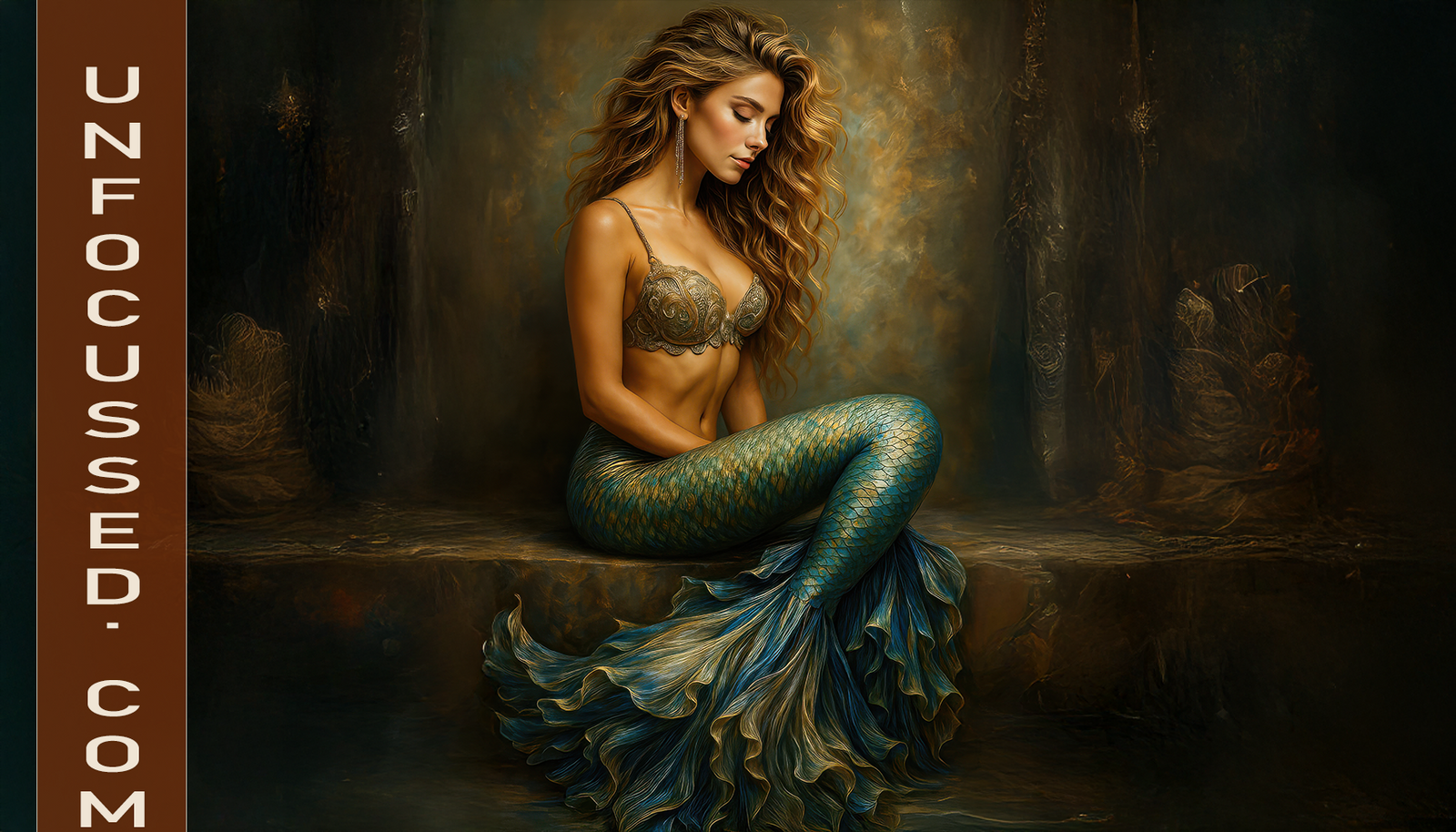
mermaid

Captured Tales

View

Song of the Scaled Goddess

by Bill Tiepelman

Song of the Scaled Goddess

The First Verse The ocean always had its whispers, but tonight they rose in a chorus. Beneath the ink-black surface, lanternfish flickered like drunken fireflies, and something far more dazzling stirred in the currents. She wasn’t the sweet little mermaid of bedtime tales — oh no. She was the Scaled Goddess, radiant and dangerous, with a smile sharp enough to cut through ship’s rigging and a laugh that bubbled like champagne poured in secret coves. Her song wasn’t sung with delicate trills. It rolled through the waves like velvet thunder, low and teasing, a sound that made sailors grip the mast harder and question whether life on land had ever really satisfied them. She didn’t lure men to their deaths; she invited them to reconsider their priorities. Was it really such a tragedy to drown if the last thing you heard was seduction made liquid? On this night, her scales shimmered with impossible color — molten gold along her hips, emerald flickers racing her tail, and a splash of ruby red across her breast like some divine tattoo. She arched in the moonlight, unapologetic in her beauty, a living hymn to temptation. Every flip of her single, magnificent tail sent phosphorescence spraying around her like confetti at a particularly decadent party. The fishermen on the surface muttered prayers and curses, but they never looked away. They couldn’t. Her presence was gravity, her gaze the tide itself, and when she tilted her head just so, lips curling into a smirk, they swore she had noticed them. That smirk promised more than music. It promised trouble. Delicious, back-arching, life-changing trouble. And with that, the Scaled Goddess began her song — not a ballad, but something far more intoxicating. A tune that hinted at secrets in the depths: treasure, ecstasy, power… and maybe, just maybe, the kind of kiss that leaves your lungs too weak to remember how to breathe. The Second Verse The song did not fade; it swelled, curling itself into every crevice of the sailors’ skulls like a silk ribbon wrapping around candlelight. The Scaled Goddess knew what she was doing. She was no innocent child of the sea. She had centuries of practice and every note of her voice was engineered to vibrate in places men didn’t even know could hum. Her laughter rang out suddenly, cutting the tension like a silver dagger. It wasn’t cruel, but it wasn’t kind either. It was knowing — the kind of laugh that comes from someone who has already read the diary you thought was hidden under your mattress. She flipped her hair, strands of it glimmering like wet auroras, and let her eyes roll upward at the pitiful spectacle of them leaning too far over their boat’s edge. “Careful, boys,” she purred, her words stretching like molasses, “lean any further and you’ll be mine before dessert.” One sailor, bolder or dumber than the rest, called back, “What dessert would that be, lass?” His voice cracked on the word ‘dessert,’ but he tried to mask it with bravado. The Goddess smirked — oh, that smirk — and licked the corner of her lip as if savoring a secret treat. “The kind,” she said, her tail flicking up a cascade of moonlit spray, “that melts in your mouth and leaves you begging for seconds.” The deck erupted in nervous laughter, but their eyes betrayed them. None of them looked away. She had them. Hook, line, and sinker — though she never used hooks. She used hips, scales, and a voice that sounded like midnight confessions made after too much wine. The Goddess circled their vessel lazily, every turn displaying the perfect unity of her body and tail, that one tail — long, sleek, hypnotic in its movements. It curled and snapped like a lover’s tongue, and the water foamed in adoration around her. “Tell me,” she cooed, “have any of you ever wondered why the sea takes so many men and so few women?” She did not wait for an answer. “Because the sea knows what it likes. The sea is greedy. The sea is me.” With that, she rolled onto her back, letting the moonlight caress every iridescent scale like a lover’s palm. Her chest rose and fell in rhythm with the swells, and she sighed — long, sultry, and deliberate. It was a sound more dangerous than any storm, for it promised the kind of rapture that storms could never offer. The men fumbled with their nets and ropes, pretending to busy themselves, but their ears strained for every note, every syllable dripping from her tongue like honey laced with venom. She paused her circling, propped her elbows on the side of their boat, and lifted her chin to rest in her palms. Her nails tapped a rhythm on the wood, sharp and pointed, reminding them all that beauty this divine always came with teeth. “You’re trembling,” she whispered to one of them, her gaze narrowing. “Don’t worry. I like them trembling. I like knowing I’m not the only thing shaking tonight.” The sailor swallowed so hard it was audible over the lapping water. His companions laughed nervously, trying to play it off, but the Goddess leaned closer, her lips so near he could smell the brine and sweetness of her breath — seafoam mixed with temptation. “Careful, sweetling,” she murmured, “your heart is beating too fast. It’s loud. It’s… delicious.” She pressed a finger to his chest and hummed, as if testing the resonance of a fine instrument. His knees buckled, and she grinned, triumphant and wicked. Then, with a flick of her tail, she vanished beneath the surface. Gasps rippled across the deck. Men scrambled to the rail, peering into the black water, their own reflections staring back in pale, sweating panic. “She’s gone,” one muttered, though his voice carried more hope than certainty. Another whispered, “She’s not gone. She’s never gone.” They were right. In the deep, glowing faintly in the abyss, her scales shimmered like embers in a drowning fire. She circled again, unseen but omnipresent, her song resuming as a low hum. It threaded itself into the planks of their ship, into their bones, into the veins that pulsed in their throats. It was no longer just sound — it was sensation, invasive and irresistible. They could feel it in their teeth, in their fingertips, in the tender parts of themselves that had never been touched before. It was a song of hunger. Of promise. Of ownership. When her head finally broke the surface again, she wore a grin that was half-challenge, half-invitation. “I’m not finished,” she whispered, her words dripping into the night like molten silver. “I haven’t even begun my chorus.” The Final Chorus Silence fell — but it was not peace. It was the kind of silence that hums in your bones before lightning splits the sky. The sailors held their breath, clutching ropes, clutching prayers, clutching each other if they had to. They knew she wasn’t gone. The Goddess never left without an encore. She was still there, circling in the dark, letting suspense wind them up like toy soldiers about to break their springs. Then it happened. The surface exploded with light as she rose, not delicately this time, but with force. Her body arched upward, tail slicing the water into diamonds, hair a kaleidoscope of dripping jewels. She landed with a splash that soaked half the deck, her laughter peeling out above the waves, brighter and louder than the ship’s creaking timbers. “Did you think,” she mocked, her voice smooth as velvet and sharp as coral, “that I’d leave you with just a verse? Darling, I am the song.” The sailors stared, entranced. One dropped to his knees as though in prayer. Another pressed his lips together, fighting the smile that wanted to betray his fear. And yet another — braver or far more foolish than the rest — leaned over the side of the boat with his arm extended, as though she might take his hand and drag him into something that wasn’t quite heaven, but wasn’t exactly hell either. She swam closer, slowly, every stroke of her tail deliberate, teasing. Her scales glowed like molten coins scattered by gods, and her lips curled in a smile that suggested she had already tasted each of their names. “So many of you,” she purred, “and only one of me. But don’t worry…” She paused, biting her lip as she floated just beneath their railing. “I multitask.” Her words hit them harder than cannon fire. She flicked water onto the deck with a casual wave, watching it run down their boots like liquid silver. Her gaze locked onto one man — the same trembling sailor she had teased earlier. His eyes widened as she smirked. “Still shaking, sweetling?” she asked. He nodded dumbly. She tilted her head, mock concern softening her voice. “Careful. I adore the taste of fear. It’s spicy. But don’t burn yourself out before I get to have any fun.” Her hand shot out, nails sharp, and she gripped his wrist. He gasped, pulled forward toward the abyss, but she didn’t yank him overboard. No, the Scaled Goddess was far too clever for brute force. She simply held him there, dangling at the edge, forcing the others to watch. Her thumb traced slow circles on his pulse, and his breath came in ragged shudders. She leaned closer, lips grazing the air just inches from his. “Every heartbeat,” she whispered, “is a drum in my song. You thump, I hum. Together, we make symphonies.” She released him suddenly, and he fell backward onto the deck, clutching his chest, eyes wild with terror and longing. The other men swarmed him, but their gazes kept flicking back to her. Always back to her. Always hungry. Always afraid. The Goddess laughed again, a rich, dangerous sound that tasted of wine, smoke, and saltwater. “Mortals,” she crooned, “always so easy. Offer them a melody and they’ll give you their soul. Offer them a smile, and they’ll drown for it.” Her tail slapped the water once, sending up a fan of glowing foam that painted the sails. She hovered in the dark, half her body above the surface, gleaming like a divine torch. The men leaned forward, even though their instincts screamed to pull away. She raised a single finger and wagged it playfully. “Ah, ah, ah. You don’t get to touch me. You don’t get to own me. I own you. And I always collect.” One of the older sailors, desperate to regain control, spat over the side and muttered a prayer to whatever saint might listen. She turned her head sharply, locking onto him with eyes the color of violent sunsets. Her smile didn’t falter, but it changed. It hardened. “Do not,” she said, her tone a dangerous purr, “pray to saints while you look at me. That’s like writing love letters to your wife while you’re in my bed.” The man dropped his gaze, shame burning on his cheeks. The others said nothing. They didn’t dare. She stretched languidly, arching her back, her scales catching the moonlight until she looked less like a creature and more like a living constellation. Her hair spilled over her shoulders like liquid silk, and when she spoke again, her voice was soft, intimate, as though it belonged to each of them alone. “The sea doesn’t just take. The sea gives. And I… I am very generous.” The promise hung in the air like perfume. Every man’s imagination ran riot, filling the silence with visions too scandalous to speak aloud. Her lips parted slightly, the suggestion of a kiss dancing there, but she didn’t move closer. She didn’t need to. They would lean in for her. They always did. Her laughter returned, softer now, wickedly sweet. “But you’ll never know if I’ll drown you or love you. Isn’t that the fun?” With that, she sank again, the glow of her scales vanishing into the black like stars swallowed by dawn. The water stilled, eerily calm. The ship rocked gently, as though nothing had happened at all. Only the men’s ragged breathing remained. Then, faintly, from somewhere deep in the abyss, her song rose once more. It was quieter, distant, but still unmistakably hers. It wound itself into their bones, their dreams, their memories. It would never leave them. And as the ship drifted onward into the night, every man knew the truth: they hadn’t seen the last of her. The Scaled Goddess was eternal, and she always returned for another chorus. And when she did, they would go willingly, trembling, smirking, and begging for more.     The Lingering Note Weeks later, the ship made port. The men stumbled onto land with the dazed expressions of dreamers who had woken too soon. They drank, they gambled, they told stories of storms and sea monsters, but none dared to speak her name aloud. Still, her melody followed them — humming in their ears when the tavern grew quiet, shivering along their spines when a woman’s laughter echoed too close. One even swore he saw her reflection in a puddle after rain, scales flickering like hidden fire. Their lives resumed, but not unchanged. Each man bore a subtle mark — not a scar, but a hunger. A hunger no ale, no coin, no earthly lover could satisfy. They would wake in the night with salt drying on their lips, hearts racing to a rhythm not their own. They knew it was her. It was always her. The Goddess did not release her prey; she marinated it in longing. And somewhere, beneath fathoms of dark silk water, she floated with a smirk curving her lips, tail coiling lazily in glowing arcs. She hummed softly to herself, polishing her voice like a blade. The ocean bent to her tune, as it always had. For she was not just myth, not just temptation — she was the eternal chorus of the sea itself. And when the moon waxed full again, when ships drifted too close and men leaned too far over their railings, she would rise once more. Because the Scaled Goddess never sang just once. She always had an encore.     Bring the Goddess Ashore Of course, legends like hers are too intoxicating to leave at sea. The Song of the Scaled Goddess has slipped from the ocean’s depths into art you can hold, frame, sip from, and even scribble secrets into. For those who want her shimmer and seduction close at hand, she now lives beyond the waves in crafted treasures — each piece catching a hint of her glow, her sass, her mystery. Adorn your walls with her radiant presence on a Metal Print or let her sing through light with an Acrylic Print. Carry her whispers with you in a Greeting Card or jot your own verses of temptation into a Spiral Notebook. And for the bold — sip her secrets at dawn with a steaming Coffee Mug, letting her song linger on your lips with every drink. She has always been more than a myth. Now, she can be a part of your world — ready to tempt, to inspire, and to remind you that every day deserves a little enchantment.

Read more

Siren of Silk and Bloom

by Bill Tiepelman

Siren of Silk and Bloom

The night the tide forgot itself, the sea laid out a runway—glossy, blue, and just a smidge dramatic—so I could make an entrance. I am Lyris, the mermaid who sews gossip into lace and turns rumors into roses. My tail is stitched in secret languages: peony for “yes, but make it interesting,” carnation for “tell me more,” and rose for “you’ll never recover from this compliment.” Waves combed themselves smooth as I glided into the cove, hair perfumed with salt, moon, and just a trace of “don’t even think about it.” The surface mirrored me back like a perfectly polished vanity: coral-lip smile, shoulder-bare confidence, sleeves of white lace that whispered, we were born to flirt with the horizon. Fishermen’s lanterns dotted the cliffs like nosy fireflies. Somewhere a gull choked on a seashell trying to act casual. I posed on a velvet-blue sandbar and the water sighed; it does that sometimes, dramatic thing. From the reeds, a trio of otters held up a sign made of driftwood: “Welcome Back, Lyris.” The font was… earnest. I blew them a kiss and they fainted in unison. It’s a whole thing when I come home—shell paparazzi, kelp press, and the jellyfish who insist on flashing when I pass. You should know that my embroidery is not simple decoration. Every bloom was bargained for at the Meridian Market, a midnight bazaar where sea-witches sell small miracles by the spool. A rose means I once kept a sailor’s secret. A cluster of forget-me-nots means I failed gloriously at not falling for anyone that week. The lace at my shoulders? That’s a covenant with the wind. It agrees to flirt with my hair, not my balance. In return, I promise to be unforgettable enough to justify a gentle breeze in a storm warning. People say mermaids sing. I don’t “sing” so much as negotiate in major key. Tonight, I crooned a warm-up scale and the moon shifted two inches to my good side. Photogenic lighting is a basic right for ocean goddesses and I will not be taking questions. My voice rolled through the cove like velvet poured from a high shelf, carrying a chorus of luxury wall art fantasies, floral mermaid tail illusions, and romantic ocean fantasy promises that make sailors vow to buy better frames for their memories. That’s when he arrived—Orin, a surface-dweller with tidewater eyes and the posture of someone who forgot he was gorgeous. He paddled a creaky rowboat like it was a first date and he’d brought the wrong flowers. His boat wore a crooked name in chipped paint: Maybe. As in, “maybe fate, maybe foolish, maybe worth it.” I admired the honesty. He looked at me the way mortals look at summer—like it’s obviously temporary, which is why you must savor it reckless and barefoot. “Evening,” he said, because men at the edge of myth lose vocabulary faster than oars. I answered with a smile embroidered in underwater beauty and coastal home décor temptation. “Evening,” I echoed, and his boat bumped a sandbar, blushing in wood. He apologized to the boat. Gentle men make me weak for a minute and a half; ruthless men make me bored in ten seconds. He was the first sort, all clumsy reverence and quiet chaos, like he’d rehearsed a hundred goodbyes and just found the wrong hello. Orin produced a bouquet of land flowers wrapped in a map, then immediately tried to rescue the map from the tide. I took the flowers and let the sea decide the route. “It’s fine,” I said. “The ocean already knows where we’re going.” (Reader, it didn’t. The ocean is a maximalist improviser.) The map swirled away, pointing everywhere at once, as if to say: plot twists ahead. We talked like people do when the air feels carbonated. He sketched boats for a living, the sort that become real if you believe hard enough and also know how to use a hammer. I stitched stories into fabric, the sort that become real if you wear them to breakfast and refuse to apologize. He asked about my tail, the garden of it—how the blossoms stayed so vivid beneath the waves. “Because beauty is a rumor I keep re-starting,” I said. “And because I water them with other people’s underestimates.” A wind came up, tidy and flattering, bringing the spice of night-blooming plankton. The sleeves of my lace trailed on the surface, sketching white calligraphy. Orin stared, the good kind of staring, the museum gaze that says this matters. “You look like you could rewrite weather,” he said. “I prefer to annotate it,” I replied. “Footnotes with better lighting.” He laughed the embarrassed laugh of a man who has just met someone who keeps a chandelier in her personality. As conversation warmed, he revealed the secret of the rowboat: he’d built it from his old front porch. “Hard to leave a home,” he shrugged, “so I brought the part that faced the sunsets.” Oh, the poetry of it. My heart did a pirouette in its seashell. Not love—please, I’m not irresponsible before Part II—but definite interest with sparkly accessories. The kind that makes you wonder what his coffee order is and whether he can dance or at least apologize artfully for not dancing. He reached over the gunwale, fingers an inch from the lace cuff at my wrist. “May I?” he asked, as if the sea had taught him consent. (It had. The sea slaps the careless.) I let him touch the edge of a rose at my hip. It pulsed warm—roses believe in drama—and then bloomed half a shade deeper. His breath caught. “You enchant fabric,” he whispered. “Fabric enchants me,” I said. “I just return the favor in kind words and better silhouettes.” A far wave curled its finger, beckoning. The otters, revived from earlier swooning, started to hum the background music from a romance nobody had financed yet. The jellyfish dimmed their scandalous little lanterns to “mood.” I smiled at Orin, at the rowboat named Maybe, at the night that felt like a soft open. “Come back tomorrow,” I said. “Bring the part of yourself you kept safe too long.” He nodded as if he’d been waiting to hear exactly that. He pushed off the sandbar, the boat swiveling toward the passage, then hesitated. “What should I call you?” he asked. I pretended to think, though the answer was sewn into every seam I wore. “Call me the rumor you want to keep,” I said. “But if you need syllables, Lyris works.” He mouthed it—Lyris—as the tide carried him away, and I felt the name stitch itself brighter across my tail in small secret threads. When he vanished behind the rocks, the sea pressed against my ankles, excited. “Calm,” I told it, “we are not rushing a plot because you like a meet-cute.” The water fizzed anyway. I sprawled on the blue sandbar, chin propped on lace, gaze on the moon. Tomorrow would need new flowers, maybe something wild, a little unhinged. Unexpected beauty is my favorite kind—preferably the sort that walks back at dawn with paint on his hands and a question between his teeth. And that, darling reader, is how I scheduled trouble under starlight—carefully, seductively, with excellent wardrobe, and room for upgrades. The Trouble with ‘Maybe’ Morning, in my part of the sea, is a soft gold conspiracy. The sun creeps in like it’s late for something delicious, scattering light across the water in perfect little spotlight puddles. I was already awake, lounging on my favorite rock (strategically angled for optimal hip line), sewing a particularly sassy patch of marigolds onto my tail. Marigolds say, “I dare you” in flower-language. They’re useful. From beyond the reef, I heard it—the awkward thunk-thunk of oars hitting the water slightly out of sync. Orin was back. Earlier than expected, which meant he’d either missed me terribly or been chased out of bed by something less poetic, like a crab invasion. When he rounded the kelp grove, I nearly choked on my own smirk. He’d upgraded the Maybe. The boat now sported a strip of deep teal paint along the hull, and a tiny mast with a square of white canvas. On it, in careful brush strokes, was a single blooming rose. “You redecorated,” I called. “You inspired me,” he said, a little breathless, as though speaking to me required extra oxygen. “Also, my neighbor’s kid is a graffiti artist and owed me a favor.” I traced the rose on the sail with my eyes. “You know that flower means ‘I accept your challenge,’ right?” His grin was half-crooked, half-daring. “I was hoping you’d say that.” Orin brought breakfast—bread so fresh it steamed in the morning air, a jar of honey the color of late summer, and a flask of something he refused to name until I’d tried it. I took a sip and almost fell backward off my rock. Coffee. Real, strong, land-grown coffee, kissed with cinnamon and something darker, almost sinful. “You’re bribing me,” I accused. “Absolutely,” he said, handing me the bread like it was an apology. We ate in companionable chaos, crumbs feeding the fish, honey streaking my wrist where he licked it away before thinking about it too hard. His face flushed warm; mine didn’t, because blushing is something I outsource to the roses on my tail. They bloomed in a quiet, knowing way, just enough to make him blink twice. The tide was especially nosy that morning, carrying every word away to spread among the coral. I told Orin about the midnight market, about trading my voice once for a bolt of silver-thread lace (and how I stole it back the next day with a song and a little misdirection). He told me about the porch wood in his boat, the cat who’d once claimed it as her throne, and the way she’d follow him down to the dock every evening like she was checking for mermaids. “I think she suspected,” I said. “Oh, she absolutely knew,” he replied. “She’d give me this look when I came back empty-handed, like I’d failed at errands.” I imagined the cat—a tiny, whiskered chaperone with no patience for my kind of trouble—and found myself oddly charmed. Halfway through a story about a storm that had stolen his favorite hat, Orin reached into the boat and pulled out something swaddled in cloth. He handed it to me with that same uncertain reverence from the night before. I unwrapped it to find a small, hand-carved box, each side inlaid with intricate designs—waves, roses, and a single lace pattern that almost perfectly matched my sleeves. “It’s not magic,” he said quickly, “but it’s solid cedar, and I thought—well, you might like somewhere to keep… whatever it is mermaids keep.” I ran my fingers over the carvings, the grain warm under my touch. “You have no idea how dangerous it is to give me something this pretty,” I said. “I’ll keep you just for the matching accessories.” The otters returned, swimming in lazy loops, carrying a garland of seaweed and shells between them like they were auditioning for a wedding I hadn’t approved. “Not yet,” I told them firmly. Orin looked between us. “Do I want to know what that was about?” “No,” I said, smiling in a way that promised an answer in the most unhelpful possible timeframe. We drifted toward the outer reef, the water turning that impossible turquoise that makes humans consider moving underwater until they remember taxes. Orin told me he wanted to see the coral gardens, the ones lit from within by bioluminescent plankton at night. “You’ll need a guide,” I said. “And hazard pay.” “What’s the hazard?” he asked. “Me,” I said simply. His grin was worth the line. By midday, we’d anchored near the gardens. The coral rose in spirals and domes, painted in colors the land wouldn’t dare invent. Schools of fish moved like gossip—fast, bright, and impossible to catch. I slipped into the water without ceremony, letting the current press against the lace, turning it into a second set of waves. Orin followed, far less graceful but infinitely more endearing. We swam through arches of coral and into wide, blue plazas where the light fell in sheets. I showed him the jellyfish that blinked like lanterns, the shrimp that polished coral as if auditioning for housekeeper roles, the anemones that opened like gossiping mouths. He listened like every word might be a secret worth keeping, which is the fastest way to my attention. At one point, I swam ahead and hid behind a fan of purple coral. When he caught up, I popped out, wrapping my lace sleeves lightly around his wrist. He startled, laughed, and pulled me closer in a way that didn’t pretend it wasn’t intentional. His pulse thrummed under my touch, a rhythm I could’ve matched if I cared to. (I did. A little.) When we surfaced, the boat had drifted closer. The rose on the sail caught the afternoon light, and for a moment I could see the entire arc of the day ahead—coffee in the mornings, trouble at noon, and nights that never quite ended. Dangerous thoughts, even for me. “Stay,” he said suddenly, as if the word had escaped before he could wrestle it down. I tilted my head. “Stay where?” “In the boat. On the porch. Wherever the sunset happens.” He said it like a plea disguised as an invitation, and I felt the tug of it deep, somewhere between the roses and the marigolds. “I’m not the staying kind,” I reminded him. “I’m the return-and-redecorate kind.” He smiled, slow. “Then just make sure you keep coming back. I can repaint forever.” The sky began to gold itself into evening, and we let the tide pull us homeward. The otters trailed behind, humming again. The jellyfish stayed dim, perhaps out of respect, or maybe they were simply tired of being accused of mood lighting. Back at the sandbar, Orin helped me out of the water—not because I needed help, but because his hands looked good against the lace. I didn’t stop him. Before he left, he tucked a folded scrap of paper into my cedar box. “For later,” he said, and rowed away without another word. I didn’t open it until the moon was up. It was a sketch of me—tail blooming with roses, lace catching the light, head tilted back in laughter. Across the bottom, in careful letters, he’d written: Rumor Worth Keeping. Reader, I kept it. And maybe the man, too. But that’s getting ahead of myself. The Forecast Called for Chaos Two days passed before Orin reappeared. Which was fine. I am not a woman—mermaid—goddess—whatever—who checks the horizon like a lovesick gull. I had embroidery to finish, secrets to trade, and a particularly judgmental crab to avoid (don’t ask). But still… every time I surfaced, my eyes drifted toward the reef. You know. Accidentally. When he did arrive, it was not in the Maybe. No. This time, Orin showed up steering an absurd raft built from old wine barrels, driftwood, and what appeared to be the remains of someone’s patio furniture. Flying proudly above it: the rose sail. “Why?” I called. “Because,” he shouted back, “the boat is drying from a paint job, and the neighbor’s cat stole the oars.” I couldn’t argue. The raft had personality. He clambered onto my sandbar with the grace of a man who knows exactly how many ways he could fall and has accepted them all. In his arms was a wooden crate sloshing with seawater. Inside: three bottles of champagne and a bundle wrapped in oilcloth. “What’s the occasion?” I asked. “Surviving the week,” he said. “And… delivering this.” He unwrapped the bundle to reveal a dress. Not just any dress—my lace, my flowers, my tail translated into silk and stitched embroidery. Land-wearable mermaid. It was breathtaking, and I do not say that lightly. “You made this?” I asked. “I bribed someone with champagne,” he admitted. “But the design is mine.” I ran my hands over the fabric, each petal familiar, each swirl of thread like an inside joke between us. “Orin,” I said, “you’ve just guaranteed yourself three more chapters of trouble.” We opened the champagne right there, sea foam hissing at the corks like it was jealous. Otters arrived within minutes, demanding tiny cups. One jellyfish hovered close, clearly angling for a toast. We drank, laughed, and somehow ended up in the water, the crate bobbing beside us like an eager extra. “You’re a terrible influence,” he said, watching me swim lazy circles around him. “I’m your favorite bad decision,” I corrected. As twilight deepened, the sky turned scandalous—pink bleeding into violet, clouds lounging like they owned the place. Orin suggested we row the raft to the cliffside pools where warm springs bubbled up through the rock. “Romantic,” I noted. “And suspiciously convenient.” “It’s only suspicious if you don’t enjoy it,” he countered. The pools were steaming, rimmed in black stone polished smooth by centuries of tide and whispers. I slipped into one, the warmth curling around me like a lover’s arm. Orin followed, wincing at the heat before sinking in with a satisfied sigh. “This,” he said, “is better than coffee.” “Nothing’s better than coffee,” I replied. “But this is… a close second.” We talked about absurd things—whether whales gossip, which stars look the most smug, how many roses I could possibly embroider before running out of scandal. I told him about the time I’d convinced a prince to declare war on boredom (he lost). He told me about his failed attempt to build a floating bakery (he ran out of flour and patience simultaneously). Somewhere between the second and third bottle, a rainstorm wandered in from the east. Not a violent one—just a curtain of warm drops turning the surface of the pool into liquid sequins. The world blurred, soft and golden. Orin reached up to push wet hair from my face, and I let him. “You look like you belong to every myth I’ve ever heard,” he said. “Wrong,” I told him. “They belong to me.” And then, because it felt inevitable, we kissed. It wasn’t polite, or practiced, or even remotely subtle—it was the kind of kiss that rewrites afternoons, the kind you’ll still taste in the middle of some dull Tuesday years later. The rain applauded. The jellyfish, the little voyeur, pulsed brighter. When we finally surfaced for air, both figuratively and literally, Orin grinned that troublemaker’s grin. “You’re staying tonight,” he said—not asked, but said. “Am I?” I asked, one eyebrow lifting. “You are,” he insisted, “because I need someone to help me finish this champagne, and because the raft is absolutely going to sink on the way back in the dark.” Reader, the raft did sink. Slowly. Spectacularly. We laughed until we nearly swallowed the bay. By the time we made it back to the sandbar, the moon was high, the roses on my tail were fully awake, and Orin was wearing half of the lace dress like a scarf. We collapsed on the warm sand, damp, barefoot, unapologetic. “Tomorrow?” he asked, eyes half-closed. “Tomorrow,” I agreed. And that was how the Maybe became a certainty, how a rumor turned into a habit, and how I, Lyris—the Siren of Silk and Bloom—found myself adding a new flower to my tail. A lily. For beginnings. For unexpected beauty. For the sheer audacity of saying yes. The sea hummed approval, the moon angled for my good side, and somewhere, the neighbor’s cat plotted her next theft. Life, as they say, was good.     If you’ve fallen for Lyris as much as Orin did (though hopefully without the raft sinking), you can bring a piece of her world home. Imagine her embroidered tail and lace-sleeved elegance gracing your walls as a Framed Print, or shimmering in your space as a luminous Acrylic Print. For moments when you want to send a little ocean magic, she’s ready as an enchanting Greeting Card, carrying whispers of coastal romance through the post. Need a touch of siren energy in your everyday? Jot down your own stories, sketches, or scandalous sea gossip in a Spiral Notebook featuring her elegant portrait. Or, if you prefer your ocean goddess under the sun, take her along on your next getaway as a luxurious, oversized Beach Towel—perfect for wrapping yourself in silk-and-bloom style while plotting your next adventure. Whether framed on your wall, sent through the mail, scribbled with dreams, or stretched across warm sand, Siren of Silk and Bloom is ready to turn your everyday into something unforgettable.

Read more

Teatime Tides

by Bill Tiepelman

Teatime Tides

The Steepening There was a mermaid in Margot’s teacup. Now, you may think that’s the kind of sentence best reserved for children’s books or individuals who lick glue recreationally, but Margot had, in fact, just brewed a rather ordinary chamomile. And she was quite certain the tea did not include mythical beings on the ingredient list—unless Whole Foods had finally cracked and gone full goblin-core. The mermaid, for her part, looked mildly irritated but otherwise fabulous. She had a tail like sequin-infused sapphire syrup, hair that swirled like coffee cream in slow motion, and an attitude that read “Instagram influencer who’s too good for your land-based nonsense.” Perched beside her was a smug little seahorse, bobbing with the lazy swish of her fishtail like he was waiting to be knighted. “Ahem,” Margot said, peering into the cup. “Why are you in my tea?” “Why aren’t you?” the mermaid replied, stretching languidly in the lemon-honey swirl. Her voice had that bubbly champagne pop to it—too sparkly to be mad at, but fizzy enough to stir unease. Margot blinked. She was dressed in three-day-old yoga pants, had half a Pop-Tart in her hair, and was aggressively not caffeinated. Either this was a nervous breakdown or the world had decided to finally acknowledge her main character energy. “This isn’t a metaphor, is it? You’re not here to teach me self-love through marine metaphysics?” she asked, tapping the rim of the cup. The teacup responded with a dignified ping, like a crystal goblet being slightly insulted. “Oh please,” scoffed the mermaid. “Do I look like a self-help allegory? I’m on a lunch break. This is my spa cup. You’re the one who summoned me by pouring the water clockwise over that expired loose-leaf blend. Honestly, who still uses loose-leaf without a strainer? It’s chaos in here.” Margot leaned closer. “So you’re like… a unionized teacup mermaid? You have breaks?” “We all have breaks,” the mermaid said primly, adjusting her sea-shell bikini top like it had a grudge. “You think the tide takes itself out? You people are so self-absorbed.” The seahorse burped. Margot could’ve sworn it sounded like, “Amen.” At that moment, a butterfly flitted past and landed delicately on the cup’s rim, blinking its wings as if it, too, was trying to process the situation. “Okay,” Margot said finally, sitting down at her cluttered table. “Talk to me. Are there rules? Do I owe you rent? Am I secretly a siren queen or is this just the chamomile kicking in?” The mermaid’s smile curled like a tidepool secret. “Oh honey. This is only the steeping stage. Things get truly weird after the second sip.” Margot stared at the cup. The tea shimmered. The seahorse winked. Against all better judgment—and with a flair only chaos could summon—Margot took another sip. And the room, quite politely, wobbled sideways. Deep Brew Margot was falling, but not in the dramatic, flailing-into-a-void kind of way. No, this was more like being slowly poured into a velvet-glazed dream funnel lined with glitter and scented vaguely of sea salt and bergamot. One second, she was upright in her very real kitchen. The next? She was shoulder-deep in something warm and viscous and vaguely peach-colored, like time had decided to host a bubble bath. “Ope—watch the cascade, you’re creasing the ambiance,” said the mermaid, who was now full-sized and reclining like a smug goddess on a floating slice of citrus the size of a life raft. Margot flailed until she was upright and sputtering. “Am I IN the tea?” “Technically, yes. But spiritually? You’re in the interdimensional spa realm of Steepacia. Welcome. We host Wednesdays.” The space around her was absurd in a way only dreams or luxury catalogs dared to be. Opalescent tea leaves floated lazily like jellyfish through the golden infusion. Delicate teaspoons flitted like hummingbirds, and somewhere in the distance, a harp made entirely of kelp played something that sounded suspiciously like Enya trying jazz. “I knew it,” Margot muttered, eyeing her floating reflection. “I wore my regret pants today. Of course I end up in an existential tea dimension wearing regret pants.” The mermaid let out a melodic giggle and tossed her damp hair like she was auditioning for a shampoo ad in Atlantis. “Relax, landling. This place responds to your emotional temperature. Here—have a mental mimosa.” With a delicate flick of her tail, she conjured a sparkling glass that hovered just within reach. Margot took a sip. It tasted like nostalgia, orgasms, and brunch. She wasn’t sure how she felt about that, but she was significantly less anxious. “Okay,” she said, voice calmer but still riding the WTF rollercoaster. “So... is this a one-way trip? Do I need to kiss a kelp wizard to get out, or...” “Gods, no,” said a new voice, sharp and vaguely crustacean. A small crab wearing reading glasses and a necktie clicked into view, holding a clipboard. “She’s a first-brew. Probably temporary. Emotional instability triggered by caffeine deficit. I give her six hours, max.” “Hey,” Margot frowned, “I’ll have you know I’m emotionally stable enough to hold down a job, keep a houseplant alive, and only cry in the car like, once a week.” “Textbook.” The crab sighed and scribbled something. “Please report to the Fennel Sauna for processing.” “Ignore him,” the mermaid whispered. “He’s just bitter because he used to be a dishwasher in the real world and now manages leaf temperature therapy. Anyway, since you’re here, might as well enjoy the amenities.” And that’s how Margot found herself half-submerged in an oolong hot tub beside a unicorn-shaped kettle, being offered cucumber eye patches by a chorus of aquatic mice who hummed barbershop harmonies while exfoliating her aura with matcha seafoam. “I feel like Gwyneth Paltrow’s subconscious,” she murmured, wrapped in a hibiscus robe and watching the mermaid gently braid a rainbow koi into her hair like it was no big deal. “Enjoy it. This place has moods. It picks up on your vibes and… manifests accordingly.” Margot stared across the tea-washed horizon, where clouds shaped like biscotti lazily rumbled past a sun made of glazed lemon. “That sounds like foreshadowing,” she muttered. It was. Because that’s when the seahorse returned—only now it was wearing a tiny pirate hat and riding what appeared to be a jellyfish named Greg. “Emergency in the Rooibos Reefs! The Earl Grey Golem has awakened!” “Oh not again,” groaned the mermaid, who now had a slightly glittery sword tucked behind her ear like a hairpin. Margot raised her hand cautiously. “Quick question. Is this one of those moments where I learn I have hidden powers? Or do I just die creatively and serve as a plot device in someone else’s journey?” “Neither,” the mermaid said, diving gracefully off her citrus raft and summoning a war-squid from thin air. “You’re with me. You’re the emotional ballast.” “The what now?!” But it was too late. She was already astride the seahorse—who smelled faintly of cinnamon gum and teenage rebellion—and flying through the infusional ether like a caffeinated fever dream. Around her, storm clouds of bergamot thundered softly, and beneath them rose the ominous silhouette of the Earl Grey Golem: eight feet of antique porcelain fury, monocle glinting, moustache made of twisted tea leaves. Margot, full of mimosa courage and absolutely none of the necessary life skills, reached into her pocket. Miraculously, she pulled out a tiny teabag. It pulsed with lavender light. “Is that the Sacred Sachet?” the mermaid gasped from her perch on a spiraling honey drizzle vortex. “I dunno,” Margot said, eyes wide. “I think it came from a free sample pack. But it feels... emotionally charged.” “Then throw it. Right at his steeper!” Margot hurled the sachet with the flailing confidence of someone who once got a participation ribbon in elementary school dodgeball. It hit the Golem’s chest with a poof of fragrant steam—and the world paused. The golem blinked, looked down, sniffed, and sighed. A deep, contented sigh. Then he turned into a moderately sized antique teapot and gently plunked into the seafoam. The mermaid stared. The seahorse hiccupped. Greg the jellyfish applauded with one limp tentacle. “What… what just happened?” Margot whispered. “You soothed him. He was overstimulated. Poor guy only wanted a nap and some affirmation,” the mermaid said gently. “You’re very good at this.” “I… am?” “Yes. Emotional ballast. You stabilize the madness. Or at least repackage it in a way the rest of us can process.” Margot blinked, cheeks flushed. “So… like a therapist?” “Or a writer.” That hit a bit too hard. Just then, the sky above them shimmered, and the voice of the crab came booming from nowhere: “Time’s up! She’s beginning to stir in the waking realm.” Margot grabbed the mermaid’s hand instinctively. “Wait—what if I want to stay?” The mermaid smiled, that same sideways, salty grin. “You can’t stay. But you can visit. Anytime you need a break. Just brew clockwise. And never forget to stir with intention.” And with a final warm pulse of honey and lavender, the world turned inside out… The Stirring Margot woke up snort-sneezing on her couch, cheeks squashed against the faux velvet cushion like a crime scene. The tea cup—now completely ordinary, mildly lukewarm, and devoid of any mythical spa creatures—sat smugly on the coffee table, as if it hadn’t just been the portal to an emotionally complex teacup multiverse. She blinked. Sniffed. Peered inside. Nothing. Not a fin. Not a flicker. Not even a suspicious bubble. Just a faint whiff of bergamot and something like glitter trauma. “Okay,” she said to no one, rubbing her temples. “So either I hallucinated a high-budget sea fantasy on a Tuesday, or I just main-charactered my way into another dimension through expired loose-leaf.” She looked around. Her apartment was still her apartment—mildly chaotic, aggressively scented like dry shampoo and panic, and just cozy enough to pass for “intentional.” Her half-eaten Pop-Tart sat on the floor like it, too, had experienced an existential moment. And somewhere in the corner, her cat was making intense eye contact with the radiator, which wasn’t new. Margot leaned over the teacup. “Hey, uh… I don’t know if this is like Beetlejuice rules, but... steepacia, steepacia, steepacia?” Nothing. But the spoon did shimmer slightly. Just once. Almost like a wink. For the rest of the morning, she wandered around in a daze, accidentally brushing her teeth with sunscreen and emailing her boss something that included the phrase “crab-based time therapy.” She couldn’t stop thinking about it. The koi braid. The rogue seahorse. The terrifyingly relatable Golem who just wanted a nap. And most of all… the mermaid. That sassy, sarcastic, glittery-scaled miracle of emotional support and mild snark. The way she smiled like she knew all your secrets and had ranked them from least to most cringey—but in a nice way. Margot sighed, long and dramatic, like she was auditioning for a sad coffee commercial. She didn’t even realize how long she’d been staring out the window until her neighbor Todd waved from across the street. She waved back without looking, accidentally knocking over a jar of expired honey. It oozed onto the counter in a slow, poetic sort of way. Margot stared at it. She was pretty sure it was judging her. Later that evening, she stood in the kitchen holding a new tea blend she’d bought out of pure spite. It had a watercolor label featuring a fox in a bowler hat and promised things like “clarity,” “inner sparkle,” and “tasteful epiphanies.” Margot didn’t trust it. But she brewed it anyway. This time, she poured slowly. Clockwise. Very deliberately. She didn’t blink. Didn’t breathe. She watched the leaves swirl and settle. The color shifted to a familiar peachy hue. She whispered, “Steepacia?” The water glimmered. Nothing happened for a long moment. Then, just as she leaned back in disappointment, something tiny bobbed to the surface. A seahorse. Wearing sunglasses. It gave her a curt nod, did a dramatic backflip, and vanished again. Margot gasped, almost dropped the cup—and then laughed. A big, ridiculous, snorty laugh that echoed through her apartment and startled the cat into knocking over an entire shelf of scented candles. It felt good. A laugh soaked in bubble bath memories and kelp-harp music. A laugh that said, “Yeah, I’m probably not okay, but who is? At least I’ve got interdimensional sea friends now.” That night, she dreamt of spa mimosas, citrus islands, and mermaid sarcasm so sharp it could slice through imposter syndrome like a butter knife through warm brie. She woke up refreshed in the only way someone can be after confronting their own existential nonsense via magical beverage. From then on, Margot kept a shelf of strange teas—anything with mysterious names or packaging that seemed a little too quirky to be legal. She learned to pour slowly. To stir with care. And every now and then, when she really needed it, the tea would shimmer. Sometimes she’d see the mermaid again—lounging in her cup like royalty with a minor hangover, tossing sass like it was seafoam. They’d chat. Or fight. Or sit in silence, sipping cucumber kelp lattes from mugs made of rainbow clamshells. It didn’t matter. Because what mattered was this: Somewhere between loose-leaf lunacy and self-discovery, Margot had found the weird, magical truth of herself. Emotional ballast. Chaos whisperer. Lady of the Leaves. And she never drank bagged tea again.     Take a Little Magic Home with You If “Teatime Tides” made you giggle-snort, crave mermaid mimosas, or consider emotionally bonding with your teacup, you might just need a little piece of this dreamy nonsense in your real life. Bring the charm and sparkle of Margot’s interdimensional adventure into your world with our curated collection of metal prints, acrylic gallery panels, or even a cheeky tote bag to carry your tea and secrets in style. Feeling puzzly? Get hands-on with the full tea-venture in our jigsaw puzzle. Or for the serial sippers and daydream doodlers, grab a sticker and slap some whimsy on your laptop, journal, or next questionable decision. Every item is brewed with care, sass, and just a hint of lavender magic. Because let’s face it—you deserve more sparkle in your tea breaks.

Read more

A Moment Between Waves

by Bill Tiepelman

A Moment Between Waves

The Ledge Between Two Worlds Beneath a sea that never stayed still and a sky that never quite forgot her name, there lay a ledge — weathered by tide, forgotten by time — where the mermaid came to sit. She wasn’t one of those syrupy songbirds from surface myths, the kind sailors scribbled into rum-soaked journals. No. This one was real, and when she moved, the water adjusted its entire attitude to accommodate her elegance. She called herself Mirielle, but only when she felt like talking. Which wasn’t often. And certainly not to sea gulls, dolphins, or washed-up poets. Her voice was not meant for crowds or conquests. It was the kind of voice used once, echoed forever, and then put away like velvet you only dare touch with clean hands. She sat now in that between-time just after the sun lost its bite but before it surrendered to the moon — her tail curled over the stone’s edge, scales twinkling in metallic defiance of twilight. Her bralette, made of seagrass embroidery and pearls that had never been owned, shimmered like something stolen from a queen's dream. And that hair... gods help you if you tried to describe it. Not gold, not blonde, not light — just sunlight caught in a net, cascading like slow honey and smelling faintly of brine and lavender. Every evening, she came here to not quite think. To not quite remember. It was dangerous, you see, for a siren to remember too much. The sea takes as easily as it gives, and nostalgia is a luxury for those who don’t bleed salt. Still, tonight felt different. The air buzzed faintly with knowing. Not prophecy — she hated prophecy, too dramatic. No, this was the hum of a whisper trying to happen. The kind of magic that only showed up when you weren’t trying to impress it. A flirtatious breeze teased the edge of her ear, and she rolled her eyes at it with mock offense. “Charming,” she muttered, brushing back a loose curl. “You must be new here.” The sea rippled in answer — not quite applause, not quite warning. Behind her, the first star blinked open. Below her, something stirred. And for the first time in a century, Mirielle did not immediately look away. The Something Below It wasn’t often that Mirielle let herself feel curious. Curiosity was a luxury of things with feet and clocks and furniture. The sea — her mother, cradle, and sometimes jailor — didn’t lend itself to the kind of questions that got satisfying answers. Ask it where something went, and it would burble. Ask it why, and it would rise into a storm. Ask it for love, and it would give you pearls shaped like regrets. But that ripple below her… that stirring. It wasn’t typical. And she knew typical. She’d made a very intentional study of it over the past few decades, lounging on this same slab of stone and watching the surface world through half-lidded lashes. Mermaids weren’t known for their patience — not the old blood like hers — but Mirielle had a particular fondness for ignoring expectations. It was her second-favorite pastime, right behind grooming barnacles off her tail with a gold comb stolen from a pirate who’d called her “little lady.” (He didn’t need it after that.) She leaned forward now, chest lifting as her weight shifted, and her hair followed like a faithful silk banner. The sea below remained hush-hush, coy as ever, but the tension in the water tickled her skin with electricity. Something was waiting. Not watching — no, that was too simple. This was the type of presence that rearranged molecules by being. Not predatory, not friendly. Just… significant. And then she heard it. Not with ears, not exactly. It was a vibration that filtered through the marrow. A soundless sound, like a memory of music that had never been played. Her breath hitched, and she sat upright, tail curling with a flick of uncertainty. For a creature so used to control — of currents, of moods, of men — this little hiccup of vulnerability felt oddly thrilling. She didn’t dive. Not right away. She stood instead. Her upper body graceful and languid, her tail flaring out like a crescent moon dipped in abalone and stardust. The ledge was narrow, and the moment more so. If she moved, it would pass. If she hesitated, it would deepen. “Well,” she said, adjusting one of her earrings — an unnecessary gesture, but fashion demanded presence. “If you’re going to lurk dramatically, at least offer a girl a drink.” Something below chuckled. Not a voice. A chuckle. It rose up through the kelp beds like a bubble of mirth and mischief. Mirielle's brow arched, and she allowed a smile to slip, sharp as a tidepool oyster. "Ah. One of those." She rolled her shoulders, releasing sea dust in glimmers that caught the dying light. "I should’ve worn the sapphires." The chuckle became motion. A spiral in the water. A glimmer of gold... no, copper... no, something elemental. It coiled upward with the intention of being seen. Mirielle held her ground, tail sweeping behind her like a royal train. Her fingers twitched slightly — not from fear, but from the forgotten excitement of newness. This wasn’t a passing dolphin with too much flirt. This wasn’t an overly enchanted kelpie with boundary issues. This was Other. And he was surfacing. As the head broke the surface, she blinked — not in surprise, but in appraisal. Her kind didn’t gasp. Gasping was for damsels and fools. But what rose before her was... let’s say… “aesthetically inconvenient.” He wasn’t beautiful in the way mortals write sonnets about. Not the sharp-cheeked, velvet-voiced prince of tired legends. No, this one was carved from storm wood and low thunder. Hair like burnt kelp twisted into a crown of sea-glass. Skin dark like basalt, dappled with phosphorescent scars that whispered history. And eyes — oh gods — eyes like green lightning stalled mid-storm. He didn't speak. Not yet. Just looked. And Mirielle felt a part of herself stretch in recognition — the old part, the part that predated languages, the part that had once sung ships into ruin and then wept when no one remembered the song. Finally, he broke the surface fully, his tail only hinted at — long, shadow-dark, edged with fins so fine they might’ve been memories. He bowed, not deeply, but with that maddening, impossible kind of charm that you’d slap if it weren’t so magnetic. "Evening," he said, his voice rough like coral but warm, as if apology and desire were sipping wine together behind his teeth. "Do you always rehearse your wit aloud, or was I just lucky tonight?" Mirielle smirked, tilting her head as her curls floated with studied grace. "You think this is wit?" she said. "Darling, I’m still in warm-up mode. Stick around, and I might actually flirt." His grin was all tide and trouble. "Good," he said. "I have nowhere else to be. You?" Mirielle turned back toward the ledge, then to the sea, then to him. Her tail flicked, iridescent and electric. She could’ve swum away. She often did. But tonight? No. Tonight the waves were still, and the moment held its breath. She slipped into the water like a secret too delicious to keep. Tides That Speak in Silence The sea, when it chooses, can become a cathedral. And on this night, as two currents merged beneath the moonlight, it became a sanctuary for things unspoken. Mirielle slipped beneath the surface with the ease of ritual, of muscle memory, of a soul too familiar with solitude to ever truly sink. Beside her, the stranger matched her glide — a little too well. No awkward splash. No giddy swirl. Just the elegant presence of something old that remembered how to move like music. They didn’t speak at first. Not with words. But their bodies wrote stories in ripples — dancing through pockets of warmer water, flirting in eddies that spun slow and sensuous. The reef below caught glimmers of their passing, the coral sighing as if it had waited long for such a ballet. And above them, the waves forgot to crest. The ocean held its hush. It was Mirielle who broke the quiet, eventually. With her, silence was never passive — it was curated. And she was done curating. “So,” she said, circling him like a cat considering a nap in your lap. “Are you cursed, enchanted, running from a prophecy, or just tragically misunderstood?” He smiled, slow and deliberate. “Option five.” “There isn’t an option five.” “There is now.” He flicked his tail, and she felt the tug of his current brush hers. “I’m just here. That’s all. Just… here.” Mirielle narrowed her eyes. “People don’t just ‘be’ here. This reef? It’s... personal.” “Maybe I’m personal too,” he said, his voice smooth as pearl, with an undertow that tugged at her in ways she didn’t like admitting. “Or maybe you’ve been waiting for me.” She scoffed — a delicate, musical scoff, but a scoff nonetheless. “I don’t wait. I haunt.” And that made him laugh — a proper, belly-deep laugh that made a school of neon fish scatter in shock. “Gods. You’re worse than they said.” That caught her off-guard. “Who’s they?” He didn’t answer right away. Instead, he swam deeper, into a trench where the light shimmered like champagne through a blown-glass flute. She followed — irritated, intrigued. The trench opened into a cave-mouth she’d never seen before, its walls slick with black coral and humming with old magic. Not the kind that shimmered. The kind that pulsed. “They,” he said at last, “are the ones who remember the names even when the surface forgets the songs. They said there was a woman here — a mermaid, yes — but more than that. A keeper of stories too painful to write down. A girl made of silence and skin and sunlight who never asks for anything... but always knows when you owe her.” Mirielle stilled. The water grew still with her. “And what do you think?” she asked. He turned slowly in the blue-dark of the cave. Glints of gold dust swirled around him like the echo of a sunbeam. “I think,” he said, “that maybe I’m here to give something. And maybe you’re finally ready to take it.” Her laugh was quieter now. “Bold of you. Assuming I want anything from anyone.” “No,” he said. “Not anyone. Just me.” She swam closer, not realizing she was doing it. She could smell him now — like petrichor and brine and something ancient. Her hand rose, and so did his. Fingers met. No sparks. No lightning. Just the warmth of shared loneliness. “You’re late,” she said. “I’m not,” he said, leaning in with a smile that made even the shadows lean closer. “You were just early.” And when they kissed — because of course they kissed — the ocean turned inward to listen. It wasn’t a desperate, tangled kiss of stories needing endings. No, this was slow. Whimsical. Soft around the edges like a melody hummed through seagrass. It wasn’t a promise. It was a beginning. A yes that didn’t need to be said out loud. Later, they floated in the shallows, tails draped like tapestries. His arm rested behind her head as if he’d always meant to place it there. She traced lazy circles in the water with a single fin. “You know,” she said, voice like velvet dipped in sarcasm, “this doesn’t mean I’m going to stop being difficult.” “Oh, I’m counting on it,” he replied, eyes half-lidded in bliss. “I hate easy.” A silence passed — not the awkward kind. The full kind. The kind that stretched itself out like a well-fed cat and soaked in the moonlight. She looked at him. “Stay.” He didn’t answer with words. He just didn’t leave.     Bring a Moment of Magic Into Your World Inspired by the serene beauty and mysterious grace of our story, A Moment Between Waves is now available as a selection of high-quality photographic art products from Unfocussed.com. Whether you’re gifting a fellow dreamer or treating yourself to something enchanting, these items are designed to bring the magic home. Wall Tapestry – Let your walls breathe with oceanic elegance. This tapestry turns any room into a storybook shoreline. Greeting Card – Share a message wrapped in myth. Perfect for birthdays, soul notes, or “just because” enchantments. Framed Art Print – Showcase the story’s essence with a stunning, gallery-quality print that brings ethereal charm to any wall. Beach Towel – Make your next shore visit a siren's dream with this lush, full-color towel that’s as practical as it is poetic. Explore the full A Moment Between Waves collection and let the magic drift into your everyday.

Read more

Mermaid's Soliloquy

by Bill Tiepelman

Mermaid's Soliloquy

In a realm where the sun’s rays filtered through the depth of the ocean, casting a kaleidoscope of light onto the seabed, the mermaid Azura found solace in the heart of her underwater kingdom. Each day, as dusk fell and the water turned to a canvas painted with twilight hues, Azura would settle upon a throne of coral, her scales reflecting the day’s last light. The sea creatures would gather, drawn not by duty but by love, to listen to Azura's soliloquy, a tradition as old as the tides. With a voice that rivaled the seraphs, she would sing of the ocean's wonders and secrets. Her words were like pearls, each one filled with wisdom and the history of the deep. Azura’s songs spoke of love and loss, of sunken ships reclaimed by the sea, of the stars’ reflections on the calm waters at night. With every note, she told of her kinship with the moon, whose pull guided the waves and stirred the tides of her heart. As she sang, the sea itself seemed to listen, the waves hushing their relentless pursuit for just a moment. Even the tempests would pause at the edge of her domain, their fury quieted by the melody that sailed upon the currents. But one evening, as a storm raged above, Azura’s voice faltered. The sea sensed her unease, and for the first time, her aquatic audience beheld a single tear trail down her cheek, its silver glint lost in the expanse of her world. It was then that she revealed her longing for something unknown, a yearning for a realm beyond her own—a connection with the land that breathed above the tides. Beyond the reach of Azura’s world, where the ocean kissed the land, there existed stories of the mermaid’s lament—a melody so poignant that even the winds whispered of its beauty to those who walked on shores. It was on such an evening that a solitary wanderer, a painter known for capturing the sea’s essence, stood at the cliff’s edge, his soul as tempestuous as the surf below. As the storm subsided and the painter’s eyes searched the horizon, Azura’s song found him. The notes wove through the sea spray and salt, an invisible thread pulling at the seams of his reality. The painter, entranced, began to recreate the melody on his canvas, his brushstrokes as fluid as the waves, his colors an echo of the mermaid’s scales. Days turned into nights, and nights into weeks, as Azura continued to share her soliloquy with the sea, unaware of the painter who captured her spirit from afar. Her voice bridged the gap between her world and his, the lament in her song growing deeper with each passing moon. It was the night of the full moon when change shimmered through the waters. Azura’s song held a different timbre, a hopeful note that danced with the silver light. As the tide swelled, it carried her closer to the surface than she had ever dared to venture before. Above, the painter waited, as he had each dusk, but this time, with a canvas that portrayed not the sea, but the mermaid of the deep, her eyes closed in serene surrender. And as her head breached the surface, her eyes met the sight of her own essence on the canvas, a mirror to her soul. The mermaid and the painter, separated by form but united by art, found a silent understanding. In the days that followed, the beach became a sanctuary where two worlds met—a place where Azura could satisfy her curiosity of the land’s mysteries and where the painter found his muse in the flesh, or rather, in the scales. Their bond deepened, not through words, for they had no need for them. Their communication was in the silence, in the exchange of art and song, a conversation between sea and shore. The mermaid’s soliloquy evolved with time, no longer a lament but an anthem of unity and discovery. And for those who listened, the sea no longer sang of longing but of a harmony between two worlds, once distant, now close enough to touch. In the harmony of their silent understanding, the ocean's whispers carried a new story, a tale of a mermaid whose voice moved not just the tides, but the heart of one who captured her world in hues and lines. And in return, she inspired a symphony of color that resonated with the depths from which she came, a testament to the power of unseen threads that weave the tapestry of life’s most profound connections. ...And so the tale of Azura and the painter became one for the ages, a symphony of land and sea, art and music. The painter, with his gift, brought Azura's essence to the surface world, translating her aquatic ballet into forms the land-dwellers could adore. Those who heard the story were often found visiting unfocussed.com, seeking a piece of the magic to take home. The "Mermaid's Soliloquy" stickers became treasures, adorning the belongings of those who wished to carry a fragment of Azura's world with them wherever they went. Each sticker, served as a tangible whisper of the sea, a reminder of the mermaid's deep, resonant tale. For the ones who desired a larger canvas to capture the ocean’s vastness, the "Mermaid's Soliloquy" posters offered a window into Azura's soul. With every poster hung, her story unfolded in homes, bringing with it the serene grace of the deep blue. The posters, invite onlookers to dive into a world where the essence of the ocean's depths and the beauty of its inhabitants are captured in a single, stunning visual narrative.

Read more

Explore Our Blogs, News and FAQ

Still looking for something?