
Captured Tales

View

Warden of the Arctic Heavens

by Bill Tiepelman

Warden of the Arctic Heavens

The Legend Awakens High above the frozen world — somewhere between the last Wi-Fi signal and the first whisper of stardust — there lives a snow leopard unlike any other. Her name is Solvryn, though few mortals dare to utter it. Not because of fear — but because they usually can't pronounce it after three shots of glacial vodka. She is the Warden of the Arctic Heavens, the guardian of northern skies, and an unofficial therapist for lost souls who wander into her domain thinking it’s a great idea to "find themselves" in minus-40-degree weather. Solvryn wasn’t always celestial. She was once a regular snow leopard with killer instinct and an unhealthy obsession with napping on branches. But the universe has a wicked sense of humor. One night, as she lounged atop a frost-covered tree, watching the aurora ripple like cosmic mood lighting, a shooting star crashed — not with grace — but directly into her backside. Instead of instant vaporization (which frankly would have been easier), she sprouted wings. Feathery, luminous, ridiculous wings. Wings that ruined stealth hunting forever but made her look exceptionally photogenic on Instagram — if anyone ever made it up here alive with a signal. Of course, with wings came responsibility. An ancient voice boomed in her head, as all ancient voices do: "Rise, Solvryn, Warden of the Arctic Heavens. You must guard the northern skies, protect the balance of solitude and wonder, and occasionally knock sense into arrogant explorers who think the cold won't affect their phone batteries." And just like that, Solvryn began her eternal gig. She patrolled the winter realms, kept an eye on mischievous aurora spirits, and ensured the silence of snow remained unbroken — unless it was for a good laugh or an even better story. Still, on particularly long nights, she wondered: Was she destined for this forever? Was there more to being a guardian than frostbite prevention and dramatic wing poses? Little did she know, a challenge unlike any other was about to enter her territory — a wandering human with too much caffeine, zero common sense, and a destiny tied dangerously close to her own. The Human Problem The thing about humans is — they never read the signs. Not the cosmic ones. Not the wooden ones. Definitely not the ones with skull symbols and the words “TURN BACK” carved in twelve languages. Solvryn had seen them all. Mountain climbers powered by granola bars. Influencers searching for that “authentic wilderness aesthetic.” CEOs on a “spiritual retreat” hoping to expense enlightenment. But this one? This one was different. He tripped over his own snowshoes. He talked to himself — a lot. And worse, he argued with the Northern Lights like they were customer support. "Okay universe," he muttered loudly into the frozen air, "if you're listening, I could really use a sign that I'm not completely ruining my life." Solvryn, perched above him in full celestial glory, sighed the ancient sigh of a being who knows exactly what’s coming next. Because rules were rules. If a human asked for a sign — out loud — and they were within earshot of the Warden, she had to respond. She stretched her wings slowly, letting moonlight catch the edges just enough for maximum drama. She descended from her frosty perch with the casual elegance of a being who had absolutely had it with humanity’s nonsense. The man fell backwards into the snow, wide-eyed. "Holy — I knew this hike was a mistake." "Mistake?" Solvryn’s voice echoed through the trees — rich, smooth, slightly amused. "You walked twenty miles into the Arctic in discount hiking boots, armed only with optimism and protein bars. 'Mistake' is generous." The man blinked. "You... talk?" "Of course I talk. I’m not just here for the aesthetics." He scrambled to sit up, shivering, snow clinging to his beard like regret. "Are you... an angel? A spirit guide?" "Depends," Solvryn said, landing beside him with a soft crunch of snow. "Are you here to find inner peace, or did you just need a really aggressive life coach?" The Lesson No One Asked For Turns out, he was neither. His name was Eliot. A graphic designer from the city. Midlife crisis in progress. Divorced, burnt-out, spiritually empty — you know, the usual inspiration package. Solvryn listened — because wardens listen first, judge later. It’s more effective that way. He spoke of deadlines and loneliness. Of feeling invisible. Of scrolling through other people’s lives until his own felt like a poorly edited draft. And when he finally ran out of words — when the Arctic silence pressed against him like truth — Solvryn leaned in. "Listen closely, small warm-blooded disaster. The universe doesn’t care about your productivity metrics. It doesn’t reward suffering for suffering’s sake. But it does respond to courage — especially the courage to be still, to be quiet, to not know." Eliot stared up at her. "So… what? I should just… stop?" "No. You should begin — properly this time." The Guardian Code She unfurled her wings fully — a gesture both ridiculous and magnificent. Snowflakes glittered like tiny stars in the wake of her movement. "You want meaning? Make it. You want peace? Choose it. You want purpose? Earn it — not by running away from the noise, but by becoming immune to it." Eliot let the words settle like snowfall — slow, relentless, undeniable. Later, he would swear that the northern lights above them pulsed brighter, as if in approval. The Departure By dawn, Solvryn was gone — as guardians always are when their work is done. But Eliot — now guardian of his own story — walked back to civilization slower, lighter. He had no photos. No proof. No viral content. Only a strange feather tucked into his pocket — and a quiet, ferocious promise to live differently. The Arctic Whisper Far above, watching from her frozen branch, Solvryn chuckled quietly to herself. "Humans," she murmured. "So fragile. So lost. So gloriously capable of change." And with a powerful beat of her wings, the Warden of the Arctic Heavens soared into the endless blue — her watch never truly over.     Bring the Legend Home If Solvryn, the Warden of the Arctic Heavens, stirred something wild and wondrous in your soul — why not bring a piece of her mythic world into your own? Explore our exclusive collection of Warden of the Arctic Heavens art pieces — crafted for dreamers, wanderers, and guardians of their own quiet moments. Each item is designed to transform your space into a place of reflection, inspiration, and maybe — just maybe — a little magic. Woven Tapestry — Let Solvryn guard your walls in soft, textured beauty. Metal Print — Bold. Modern. Ready to outshine your neighbor's art collection. Fleece Blanket — Wrap yourself in celestial comfort. Approved for late-night existential pondering. Canvas Print — Classic. Elegant. Timeless as a winter sky. Let the legend live on — in your home, your story, your space.

Read more

Mushroom Mirth in Hedgehog Daze

by Bill Tiepelman

Mushroom Mirth in Hedgehog Daze

The Prickle Awakens Deep in the glimmer-soaked underbrush of the Wobblewood Forest — where the mushrooms glow like disco balls and the trees hum vaporwave melodies after dark — there lived a hedgehog named Fuzzwort. Now Fuzzwort wasn’t your average forest critter. Oh no. This hedgehog had been sampling the mysterious mushroom caps of Wobblewood for, well... let’s just say "a long time" and leave it there. One particularly hazy afternoon, Fuzzwort awoke nestled between two bioluminescent toadstools, blinking his enormous cosmic-blue eyes — pupils dialed all the way out like saucers floating in space. "Whoa," he mumbled to no one. "Either I’m awake... or the forest downloaded a new skin pack." Stretching his tiny paws, he realized that sometime during the night, his quills had absorbed some of the psychedelic mushroom spores. They glimmered in swirly rainbow hues. "Wicked fashion upgrade," he giggled. "I am... Hedgehype Supreme." The Quest for the Crunchy Munchies His belly rumbled — not like a regular hungry noise — but like a tiny drum circle of woodland gnomes playing the bongos inside him. He needed snacks. Immediately. Preferably crunchy. Preferably within crawling distance because moving was, frankly, a negotiation right now. Slowly rolling himself into a little spiky ball, Fuzzwort tumbled downhill like a sentient mossy bowling ball. Mushrooms blurred past him in fractal patterns. He muttered, "Bro... trees shouldn’t have that many elbows." He bounced to a stop near a peculiar gathering of mushrooms. These weren’t just glowing — they were vibrating. "Ayy, what’s up, shroom bros?" he whispered reverently. They pulsed in response like they were beatboxing in slow motion. The Council of Shrooms A booming, spongy voice echoed in his head. "Fuzzwort... why dost thou rolleth so recklessly through our fungal fellowship?" Startled but still impressively chill, Fuzzwort replied, "Sorry, my dudes. I'm on a vision quest for some crunchy snacks. Also, I think my spine is growing tiny neon forests. Not complaining." The mushrooms collectively shimmied. "Seek ye the Snackshroom Grove," the voice replied. "But beware... it is guarded by the Lich Lizard of Eternal Vibes." "Heavy," Fuzzwort whispered, nodding solemnly. "Respect." Snackshroom Grove and the Lich Lizard of Eternal Vibes Fuzzwort rolled onward, carried by the subtle gravity of a snack-craving heart. The Wobblewood Forest grew increasingly surreal — the trees stretched sideways like rubber bands warming up for interpretive dance, while the moss whispered ancient limericks only slightly inappropriate for polite company. In the shimmering distance, beneath a canopy of glitter-dripping vines, the legendary Snackshroom Grove pulsed like the heartbeat of a funky bassline only forest creatures could hear. But standing between him and crispy victory... was him. Enter: The Lich Lizard of Eternal Vibes The creature slithered out from behind a kaleidoscope bush, scales glistening like oil spills on velvet. Wearing oversized sunglasses (indoors, naturally), the Lich Lizard exhaled a glowing cloud of sage-scented mystery and addressed Fuzzwort in a voice smooth as melted marshmallows. "Whoooo dares enter Snackshroom Grove... whilst rocking bioluminescent drip that sick?" Fuzzwort froze. Not from fear. No. From sheer admiration. "Whoa," he breathed. "Your vibes... they're... immaculate." The Lich Lizard did a slow-motion spin. "You're not so bad yourself, little orb of chaos. But the path to Snackshroom Grove is no free buffet." The Ritual of Chill Challenges The Lich Lizard gestured to a circle of vibrating stones. "To earn access to the sacred Crunchies, you must pass... The Trials of Chill." Fuzzwort nodded, feeling fate coil like a slinky in his gut. Trial One: The Dance-Off of Wiggly PrecisionHe had to out-wiggle a group of glow-worms synchronized like a K-pop flash mob. Fuzzwort summoned his inner disco hedgehog. Quills shimmering, feet barely obeying him, he spun in lazy circles that accidentally formed the shape of a cosmic fractal. The worms collapsed in awe. Pass. Trial Two: The Riddle of the Perpetually Confused SquirrelA squirrel hopped forward, eyes wide, holding an acorn that vibrated ominously. "If a mushroom falls in the woods but everyone's too baked to hear it... did it even drop?"Fuzzwort blinked, considered the eternal mystery, then replied, "Bro... maybe we’re the mushrooms."Silence. Then the squirrel gave him a tiny acorn fist-bump. Pass. Trial Three: The Patience of Eternal ChillHe had to sit perfectly still while a snail told its entire life story. It took three hours. It was... mostly about lettuce.Fuzzwort never flinched. Inner peace achieved. Pass. Snackshroom Grove Unlocked The Lich Lizard gave him a slow clap that echoed like tree trunks applauding in the wind. "Respect. Enter, young fuzzball." Fuzzwort stumbled into Snackshroom Grove and immediately lost all sense of linear time. The air was thick with the scent of earthy goodness. Mushrooms shaped like nacho chips. Tiny fungi that crunched like kettle-cooked potato magic. A bubbling brook flowing with chilled mushroom tea. He feasted. Oh, did he feast. After what felt like decades (but was probably 17 minutes), Fuzzwort lay on his back, belly round, paws behind his head, staring at the cosmic swirl of colors above. The Lesson of the Day The Lich Lizard materialized beside him, reclining effortlessly. "So, what did you learn today, little wanderer?" Fuzzwort squinted, thinking deeply. "That... snacks taste better when you've vibed with weird forest dudes and survived existential riddles from stoner squirrels." The Lich Lizard nodded solemnly. "Truest thing I've heard all century." Epilogue: The Return to Wobblewood Eventually, Fuzzwort rolled himself back toward his cozy patch of moss beneath the disco trees. Behind him, the Snackshroom Grove pulsed gently — always there for the next adventurer with a crunchy dream and an open heart. He whispered to the sky, "Stay weird, forest. Stay weird." THE END Or is it...?     Bring the Vibes Home Can't get enough of Fuzzwort's whimsical wanderings through Wobblewood? Now you can bring a piece of the Mushroom Mirth magic into your own space. Whether you're decking out your chill zone or gifting some forest-fueled joy, check out our Canvas Prints and Metal Prints for bold, vibrant wall art straight from Wobblewood itself. Feeling crafty? Stitch your own adventure with our Cross-Stitch Pattern, perfect for slow, mindful creating — just like Fuzzwort would want. Need something cozy to curl up with during your next snack quest? Grab a super-soft Throw Pillow, or pack your favorite crunchy finds in a magical Tote Bag. Shop the whole collection: Mushroom Mirth in Hedgehog Daze Product Line Stay weird. Stay wonderful. Stay unfocussed.

Read more

Glimpses of Gaia

by Bill Tiepelman

Glimpses of Gaia

The Eye in the Forest It began, as all ridiculous yet profound things do, with a terrible idea born from excellent wine. Somewhere deep in the tangled emerald forests of the forgotten world, an eccentric old monk named Tenzo Featherbeard was determined to find what the locals only whispered about: The Eye of Gaia. "It sees through all things," the innkeeper had warned, polishing his wooden mug with the reverence usually reserved for cathedrals or particularly stubborn goats. "Not just the skin of things... but their intentions." Tenzo, of course, took that as a challenge. Days turned to weeks. He wandered past glowing mushrooms that offered unsolicited advice. He stepped over meditating frogs so enlightened they levitated mid-ribbit. The forest was alive in a way that made him feel perpetually underdressed — emotionally, spiritually, and sartorially. Then one night, beneath a sky so full of stars it looked like spilled sugar, he found it. Embedded in the bark of an ancient tree was an enormous eye — scales like sapphire armor surrounding a hypnotic iris of burning gold and shifting emerald. The lashes were delicate vines tipped with bioluminescent petals. It blinked — not with hostility, but with... curiosity? Tenzo, being Tenzo, bowed dramatically and said, "Hello, you luminous ocular enigma. Care for a conversation?" The forest held its breath. Then — from deep within the roots and leaves — came the warm, velvet voice of Gaia herself: "Human. Why do you seek me?" Without hesitation — and still slightly drunk on the fermented sap of a mischievous tree — Tenzo replied: "Because I’ve lost my socks. And possibly, myself." Gaia laughed — a sound like rivers learning to giggle. The eye sparkled with cosmic amusement. "Sit, monk. Let us speak of lost things." And so he sat — cross-legged upon a mossy stone shaped suspiciously like a buttock — ready to hear truths he would likely misunderstand in the most beautiful way possible. Conversations with an Ancient Eye For what may have been hours, days, or several reincarnations of the same particularly stubborn beetle, Tenzo sat before the Eye of Gaia, basking in its strange warmth — like the feeling of sunlight filtered through an old library window, dust motes included. Gaia spoke again — her voice now slower, thicker — as if poured from an ancient teapot rarely used except for very important guests or bewildered monks: "Human. Tell me of these... socks." Tenzo sighed. "They were soft. Very soft. Handmade from the wool of a laughing mountain goat. Lost them during a bout of contemplative streaking after my enlightenment practice went sideways." The eye blinked slowly. "Ah. Attachment." "Also," Tenzo added with the gravity of a man truly pondering the universe, "they matched." The forest hummed with gentle laughter. Leaves quivered. A nearby caterpillar paused mid-transformation just to listen. The Teachings Begin (Sort of) "Human," Gaia intoned, "All things are lost eventually. Socks. Ego. Even planets. What matters is not possession... but presence." Tenzo scratched his beard thoughtfully. "So you're saying... I should go barefoot forever?" "No," she replied, "I'm saying that seeking what is lost externally often blinds one to what is already found internally." Tenzo considered this deeply, as deeply as one can while a squirrel braids your hair uninvited. The Eye Shows Him the Way Without warning, the eye dilated — rippling outward in honeycomb fractals of glowing color — pulling Tenzo into a vision. He saw himself — old, wrinkled, absurdly content — sitting on a mountain peak wearing no socks, but smiling so fully that even the wind paused to admire it. He saw villages thriving because he shared laughter instead of wisdom. He saw forests blooming because he sang off-key to them nightly. He saw lovers, friends, strangers — all touched by the presence of a foolish, barefoot monk who once lost his socks but found himself utterly... here. The Return When he awoke, the Eye of Gaia shimmered with approval. "So," Tenzo said, standing on impossibly clean forest moss, "What you're saying is... the socks were never the point." "Precisely." He bowed low. "Can I ask one last question?" "Ask." "Where the hell am I going to get more goat-wool socks? Winter is coming." The forest roared with laughter. Trees shook. Petals fell like confetti. Even the stone beneath him pulsed as if giggling. And then — just as the first morning light crested the treetops — a small, neatly wrapped bundle fell from a high branch onto his head. Inside? The softest, warmest, utterly mismatched pair of socks he had ever seen — woven from the fibers of forest dreams themselves. Epilogue: The Way Forward Tenzo Featherbeard left the forest that day not as a man who had lost something — but as one who realized everything worth having was already walking with him. His legend spread — not because he found the Eye of Gaia — but because he listened, laughed, and never took himself too seriously again. Years later, people still speak of him as the barefoot sage with mismatched socks — who taught the world that sometimes the universe gives you what you need... the moment you stop demanding it look the way you expected. And the Eye? It still watches — waiting patiently for the next fool wise enough to be ridiculous.     Bring a Glimpse of Gaia Home Perhaps, like Tenzo, you've found yourself wandering — seeking signs, symbols, or maybe just a really good pair of socks. While the forest may keep its secrets, the magic of this story lives on beyond the trees. Inspired by the very vision Tenzo discovered, you can carry your own piece of Gaia's wonder into your daily life: Metal Prints — Bold, luminous, and ready to hang in your sacred space. Acrylic Prints — For those who see clearly even when reality bends a little. Tote Bags — Because wisdom (and snacks) should travel well. Round Beach Towels — Perfect for meditation, storytelling, or sand-covered enlightenment. Cross-Stitch Pattern — For creators who know every stitch is a mantra. Every piece is a glimpse, a reminder, a quiet nudge from Gaia herself: Be present. Laugh often. Lose your socks. Find yourself.

Read more

Aubade in the Enchanted Forest

by Bill Tiepelman

Aubade in the Enchanted Forest

The first light of dawn shimmered through the whispering canopy of the Enchanted Forest. The trees — ancient sentinels with leaves like stained glass — cast a kaleidoscope of colors over the soft, moss-laden earth. There was a stillness in the air, the kind only found at the fragile seam between night’s last breath and day’s first awakening. She was called Liora — a wanderer, a listener, a quiet soul in search of nothing but presence itself. Her long dress of woven silk, kissed by the hues of wildflowers and moonlit streams, trailed behind her like a river of forgotten dreams. The path beneath her bare feet wasn’t marked by signs or boundaries; it formed gently as she moved — conjured by intention, not direction. The forest greeted her not with sound, but with feeling — the hum of ancient roots intertwined beneath the earth, the scent of warm cedar and soft blooms unfurling to the sky, the faint pulse of life both hidden and omnipresent. Even the stones beneath her steps seemed to release their breath after a thousand years of patient waiting. Liora walked slowly, as if time itself had loosened its grip on her. Every step was deliberate, an offering of stillness to a world overwhelmed by noise. She paused often — to touch the velvet petals of unfamiliar flowers, to trace the grooves of bark older than memory, to feel the cool pulse of stones nestled like sleeping hearts among the moss. It was here — in the sacred hush of the forest — that serenity did not need to be chased. It waited, quietly, for those willing to slow down enough to meet it. Liora was one of the few who knew this. The Aubade Garden At the heart of the forest, beyond a gentle curve in the path, there lay the Aubade Garden — a hidden grove bathed in soft morning light, where spherical blooms of impossible colors blanketed the ground like a dream made real. It was said that those who reached the Aubade Garden were granted not wishes — but clarity. Clarity not of answers — but of questions. Liora stepped into the clearing. Her breath caught — not in awe, but in gratitude. The garden was untouched by human desire. It was not meant to be conquered or consumed. It was simply to be shared — for as long as one's heart could stay quiet enough to listen. The trees stood tall around her, their trunks rising like pillars in a temple built by time. Above her, the sun’s first golden rays poured through the canopy, igniting the blossoms beneath her feet. It was not loud. It was not dramatic. It was — simply — a beginning. And so Liora sat, folding herself gently into the earth, her dress spreading like a second layer of petals across the enchanted floor. She closed her eyes. The forest breathed with her. Here, there were no lessons. No declarations. Only being. And in the stillness — she waited for the dawn’s full embrace. The Silent Dialogue Time, in the Aubade Garden, dissolved into something softer — something that did not measure itself in hours or minutes, but in the rhythms of breath and the slow unfolding of petals. Liora did not need to name this feeling. It was beyond words, woven into the very bones of the forest itself. As she sat in stillness, an invisible dialogue began between herself and the world around her. Not a conversation of speech — but of exchange. She gave her presence freely, without expectation. In return, the forest offered its secrets — delicate, quiet gifts unnoticed by those who rushed through life’s corridors. Over time, a warmth settled into her chest. Not a fiery blaze — but a gentle ember, steady and grounding. She could feel the pulse of roots beneath her, tracing their way like forgotten rivers beneath the surface of the earth. Every tree, every flower, every stone — was part of the same breath. It occurred to her that serenity was not absence — not the escape from life — but a fuller presence within it. The forest did not deny sorrow, nor did it pretend away hardship. It held space for all things — joy and grief, light and shadow — without judgment. And in doing so, it healed without effort. The Arrival of the Sun The first true rays of the morning sun crept across the treetops, cascading downward like golden silk. The spheres of color surrounding her began to glow, not with an unnatural light, but as if reflecting an inner luminescence — the quiet radiance of existence itself. Birdsong arrived — not hurried or loud — but as a gentle greeting. Each note a thread in a larger tapestry of sound. The breeze, playful yet respectful, tugged softly at her hair, carrying with it the scent of distant rain and blooming earth. Liora opened her eyes slowly. Nothing had changed — and yet everything had shifted. The forest was the same. She was the same. But within her was a clarity that words could not shape. A knowing that she belonged here — as she belonged everywhere — not as a conqueror or an intruder, but as a quiet witness to the world's unfolding beauty. The Path Forward She rose without rush. Her dress shimmered, catching the morning light like woven dawn. As she stepped forward, the ground responded — the path blooming anew beneath her feet, soft petals unfurling to mark her journey without disturbing the living tapestry around her. The way home was not marked by signs or stones. It was marked only by trust — trust in the world’s quiet rhythms, trust in her own heart's ability to listen. The Aubade Garden faded behind her — not in distance, but in presence — a sacred place that required nothing but remembrance to revisit. And so she walked — not away, but forward — carrying with her the serenity of the Enchanted Forest. The calm did not remain behind her; it lived within her now, a quiet companion through all the noise of the outside world.     Epilogue: The Forest Beyond the Forest Long after her footsteps had faded from the moss-laden paths, the Enchanted Forest remained — untouched, eternal, quietly alive. It asked for no memory. It required no proof. Those who had truly been there carried its essence not in photographs or souvenirs — but in the softened edges of their lives. For Liora, the forest had never been left behind. It echoed in the way she touched the world — in her patient gaze, in the unhurried grace of her movements, in the gentle silences she allowed to bloom between words. Sometimes — in quiet moments — she would pause wherever she was: beneath a city tree, on a sunlit balcony, or beside a river flowing through unfamiliar lands. And she would feel it again — that subtle hum beneath all things. The forest within the forest. The garden beyond the garden. And perhaps that was the truest magic of all — that serenity was not a place to find, but a way to be. A living, breathing aubade — offered again and again to the waking world, for anyone willing to listen.     Bring the Serenity Home The quiet calm of the Enchanted Forest need not stay within the pages of a story. For those wishing to carry its stillness into their daily spaces, curated creations inspired by Aubade in the Enchanted Forest are available — crafted to transform your home into a reflection of tranquility and wonder. Wrap yourself in softness, surround your space with vivid colors, or bring moments of mindful creativity into your day — all while supporting the artistry of Bill & Linda Tiepelman. Wall Tapestry — Let the forest bloom across your walls. Metal Print — Vibrant, enduring reflections of the enchanted grove. Throw Pillow — A soft place to rest, inspired by forest calm. Fleece Blanket — Wrap yourself in warmth and wonder. Cross-Stitch Pattern — A meditative creation of the forest's beauty by your own hand. Let the story live with you — not just in memory, but in the peaceful presence of your home.

Read more

Arboreal Symphony in Fractal Major

by Bill Tiepelman

Arboreal Symphony in Fractal Major

The roots hummed long before she heard them. Deep beneath the woven surface of existence, the Tree of Resonance was never silent. It pulsed — slowly — with tones beyond human frequency, casting fractal harmonics into the soul of the earth. Lyra stepped barefoot onto the veined carpet of spiraling color. She was not here to conquer, to pluck wisdom like fruit, or to carve her name into ancient bark. She came only to listen. The landscape unfolded in spiraled fractals of luminous vines and coiling roots, their forms impossibly organic yet touched with mathematical precision. Every twist and curve felt deliberate — as if designed by nature and music in secret collaboration. The Breath of the Tree Standing before the impossibly vibrant trunk, Lyra closed her eyes. She could feel the slow inhalation of the Arboreal Giant — not through lungs — but through an ancient rhythm woven into the core of existence. A pulse synchronized with tides, seasons, breath itself. Here, silence wasn’t empty. It was full. It draped around her shoulders like a cloak of invisible threads, connecting her to every rooted tendril beneath her feet, every distant bough above, unfurling into a sky woven from gradients of light. Her thoughts began to dissolve, not into nothingness — but into everything. The concept of separation softened. She was the tree. The tree was her. The infinite dance of roots and branches mirrored her own inner labyrinth of memory, emotion, and longing. Resonance and Release The Arboreal Symphony required no audience, but welcomed all. It had sung before language. Before gods. Before stars knew their names. And here, within its embrace, Lyra could feel the residue of countless souls who had stood where she stood — seekers, wanderers, the lost and the found. Colors shifted with intention. Blues softened into greens, greens ignited into fire-warm gold. The roots at her feet spiraled outward — not to possess, but to guide. They showed her paths she had forgotten existed — internal paths. Emotional rivers buried beneath layers of noise and duty. And so she breathed — not with lungs, but with being. She became rhythm. She became stillness. The tree did not heal her because she was never broken. It simply reminded her of the shape of her own song, lost beneath the static of a too-loud world. A Pause Before Descent As the sun’s fractal light bent and refracted across the infinite leaves, Lyra smiled with no reason beyond presence itself. She would descend soon, return to the world of movement and memory. But not yet. For now, she remained part of the Arboreal Symphony — a singular note in a melody older than time — held gently in the arms of fractal infinity. Descent into the Roots When Lyra moved again, it was without urgency. The tree had shifted around her. Not physically — the roots and branches remained — but perception had altered. What was once external was now a mirror. Every spiral of color beneath her bare feet echoed with her own pulse. She walked toward the base of the tree, its roots parting not in invitation, but in quiet acknowledgment. There was no gatekeeper here. No threshold guarded by ritual or code. The only key was presence. The only cost was time surrendered to stillness. The roots formed passages — arched like cathedrals, carved not by tools, but by patient growth and ancient will. Fractal patterns of light streamed through porous surfaces, cascading in hues that defied earthly language: azure that whispered memory, crimson that pulsed with forgotten names, golden light spun from the laughter of leaves. The Chamber of Echoes Lyra found herself in a hollow — vast, but intimate. At its center pulsed the Heart Root — not a beating organ, but a luminous braid of energy weaving through the earth and sky. Its sound was not heard but felt, vibrating in the bones, in the blood, in the spaces between atoms. She sat upon smooth spirals of coiled wood, letting her fingers drift through tendrils of luminous moss. There were no instructions. No expectations. Only resonance. Here she remembered. Not memories tied to narrative — not stories of who she had been — but memories older than thought. The memory of wind against newborn skin. The memory of sun-warmed stones beneath childhood feet. The memory of tears without sorrow. Laughter without reason. Integration When Lyra rose — hours or years later, time meaningless in the tree's embrace — she was not changed. She was revealed. Layers of false weight dissolved, leaving only clarity. The fractal pathways led her upward — not out — but through. Every step traced with light. Every breath a return. She emerged beneath the tree's infinite crown as night fell, the sky strewn with stars that felt impossibly close, as if she could reach up and trace their edges with her fingertips. The Symphony continued — unbroken, unending — and Lyra carried its melody within her. Not as a possession, but as a remembering. A knowing that would hum beneath her every step, her every word, long after she left this place of luminous roots and infinite branches. Stillness in Motion As she walked away, the landscape did not fade — it folded into her. The fractal tree receded not because it vanished, but because it was everywhere. Beneath stone. Beneath city. Beneath skin. It was not a place she would return to — because it had never been separate. Lyra was not the same. But she had always been whole.     Epilogue: The Quiet Between Moments Long after Lyra returned to the weaving patterns of human life — the soft hum of conversation, the brittle glow of city lights, the pull of tasks and time — the Symphony remained. It whispered in pauses. In the steam curling from morning tea. In the hush of twilight when shadows lengthened like memories returning home. In the subtle ache behind the heart when longing stirred without name or reason. The Tree of Resonance was not a distant wonder buried in a forgotten forest. It was the architecture of stillness — a map etched in the marrow of all things. Every street corner, every crowded room, every moment of solitude held its rhythm if one only listened. And so Lyra did. She became the listener. The walker-between. The weaver of quiet threads invisible to the hurried eye. Not seeking answers. Not chasing peace. But living as melody — presence unfolding note by note — in the infinite Arboreal Symphony that never truly ended.     Bring the Symphony Into Your Space The Arboreal Symphony does not belong to a distant realm alone — it can live with you, woven into the quiet spaces of your home, reminding you of stillness, connection, and wonder. Explore inspired creations featuring the vibrant fractal essence of Arboreal Symphony in Fractal Major — available in artful and functional forms to infuse your surroundings with calm and color: Cross Stitch Pattern — Craft your own reflection of the Symphony Tapestry — A wall-hung canvas of fractal serenity Canvas Print — Art for meditative spaces Fleece Blanket — Wrap yourself in color and calm Bath Towel — Everyday moments infused with vibrant energy Let the Symphony accompany you — as art, as comfort, as a gentle reminder that connection and beauty live not only in faraway places, but right here, within reach.

Read more

Squirrely Monroe

by Bill Tiepelman

Squirrely Monroe

The Rise of a Forest Icon Long before the world knew her as Squirrely Monroe, she was just another bushy-tailed dreamer from the oak-lined backstreets of Central Park. Born in a hollowed-out tree with bad insulation and worse neighbors (woodpeckers, of course), little Norma Nutbaker had one dream — to be seen. Other squirrels were content chasing acorns and dodging cyclists. But not her. Not Norma. She practiced strutting along fallen branches like a catwalk. She nibbled seductively on pinecones. She whispered her famous line into the wind every night: "Some like it rough... but I like it nutty." The City That Never Sleeps (Because of Raccoons) By the time she was two (about 20 in squirrel years), she hit the underground scene — quite literally. The storm drain scene. Central Park's secret nightlife thrived beneath the grates. There were jazz mice. Dancing possums. And if you were lucky? You might catch a glimpse of Norma's famous tail swirl — the twirl that would later grace murals on tree trunks everywhere. But fame has a way of finding those who shine hardest. One breezy autumn afternoon, while foraging near 5th Avenue, she stumbled upon the moment that would define her forever... The Breeze Heard 'Round the Park She stood above a subway grate. It hummed below her like the purr of a big city engine. And then — whooooooosh — the wind caught her simple little leaf-sewn dress, sending it billowing skyward in a scandalous flurry of forest fashion. A passing pigeon paparazzi captured the moment. Within hours, she wasn’t Norma Nutbaker anymore. She Was Squirrely Monroe. Forest creatures whispered about it over mushroom cappuccinos. Raccoons tried to imitate it (poorly). And chipmunks... well, they blushed just thinking about it. But fame is never just fun and acorns, darling. Behind the glamour... was a squirrel still searching for something more. Fame, Fur, and Forbidden Nuts The High Life in the Tall Trees Overnight, Squirrely Monroe became the name whispered across the treetops. She graced the covers of every leaf-laminated magazine from Acorn Vogue to Squirrel Illustrated. Her signature look? Soft platinum fur curls (styled with dew from rare morning grass) and that windswept leaf dress — now sold in boutique burrows at frankly scandalous markups. But forest fame came at a cost. Every twig-snapping paparazzi raccoon wanted a piece of her. Even worse? Her love life became headline fodder. Enter: Reynard Fox — The Scandal of the Season Reynard was trouble. A red-furred indie actor from the West Woods. Known for his smoldering eyes, questionable poetry, and tragic allergy to beechnuts. The tabloids went wild: "SQUIRRELY FALLS FOR BAD BOY FOX — WILL IT LAST?" It didn’t. Reynard was seen one night slipping into The Burrow Room — an exclusive underground club for forest elite — with a rival socialite: Trixie Chipmint, heiress to the Minted Nut fortune. Squirrely was devastated. Heartbroken. The forest stood still. The Comeback of a Lifetime But if the world thought Squirrely Monroe would vanish quietly into the hollow... they didn’t know her at all. She retreated deep into Central Park — to a forgotten maple grove where the wind blew wild and free. There, she crafted her masterpiece performance: a one-squirrel stage show titled "Nutting Like A Woman" — a raw, funny, painfully honest story of love, fame, and survival in a world that only saw the tail, not the heart. The premiere? Legendary. Critics declared it: "A triumph of fur, fashion, and vulnerability." Her Final Bow (For Now) Today, Squirrely Monroe lives a quieter life — at least by squirrel standards. She hosts late-night fireside interviews for Nutflix, mentors young chipmunk actresses, and occasionally reenacts the pose — leaf dress swirling — for charity fundraisers benefiting displaced urban wildlife. But if you wander Central Park late at night... and listen carefully beneath the hum of the city’s heartbeat... You might just hear her famous line float through the trees: "Some like it rough... but I like it nutty." And somewhere, a squirrel dreams of being seen — just like she once did.     Epilogue: The Wind Still Remembers Her Years have passed. The city grows louder. The trees thinner. The grates rust over with time and footsteps forgotten. But not her. Every once in a while — on a warm summer night when the subway hums beneath the streets and the breeze rises just right — there’s a rustle above Central Park’s oldest grate. Some say it’s the wind. Some say it’s legend. But those who know? They pause. They smile. And they whisper to the night air: "Goodnight, Squirrely Monroe." Because icons never really leave us. They just become part of the stories we tell... when the wind feels just a little more glamorous.     Bring a Little Squirrely Monroe Home Love a little glam with your wild side? Take a piece of forest fame home with you. The iconic moment that made Squirrely Monroe a legend is now available as stunning wall art, cheeky accessories, and collector-worthy keepsakes. Canvas Prints — Bold, beautiful, and ready to steal the spotlight on your wall. Framed Prints — Classy enough for the burrow or the boardroom. Tote Bags — For carrying nuts, secrets, or just a whole lot of style. Stickers — Tiny, sassy, and ready to adorn your world one acorn at a time. Because glamour never really goes out of style — it just grows fluffier.

Read more

Sunset Whiskers of Joy

by Bill Tiepelman

Sunset Whiskers of Joy

The Roar Before the Nap There once was a tiger cub named Kip. Not King Kip. Not Sir Kip. Just... Kip. And Kip had opinions. About everything. The jungle, for starters, was absolutely not up to his standards. "Too pokey," he would complain, tripping dramatically over a vine. "Too loud," he grumbled at the squawking parrots like a tiny, judgmental old man. And the sun? Oh, the sun was personally trying to ruin his life. "Rude," he declared every morning when it dared to rise directly into his sleepy eyes. But tonight — oh, tonight was different. The sunset was a warm golden hug across the treetops. Kip could feel it. Something was building. Energy. Mischief. Drama. The world, for one shining moment, was about to revolve around him — and honestly, about time. With a wobbly little stretch of his fuzzy arms, Kip stood up on his hind legs. He wasn’t exactly built for this. Tiny paws wiggled in the air like confused baby stars. His tail flicked like a metronome set to 'sass.' "Look at me!" Kip roared — which, to anyone else, sounded a lot like an aggressive sneeze mixed with a hiccup. "I AM THE JOY. I AM THE SUNSET. I AM... HUNGRY." But there was no stopping him now. He squeezed his little eyes shut in absolute, dramatic glee. A grin stretched across his face like a stripe of moonlight. Tongue out. Teeth sharp. Tiny bean-paw pads flexed with raw, feral delight. Somewhere, a very serious owl judged him from a tree branch. But Kip didn’t care. He was, for this one perfect moment, the undisputed king of nonsense. The wild prince of sunset silliness. And absolutely, positively... ready to cause problems on purpose. And maybe... just maybe... ready for a snack. The Snack Attack Chronicles Kip had peaked. He knew it. There he stood — still awkwardly on his hind legs like some unholy mix of majestic jungle predator and undercooked breadstick — bathed in sunset glory. Oh, the drama. The pageantry. The glow of absolute nonsense radiating off his fur like he was the headline act in nature’s most unhinged musical. But reality, as it often does, came clawing back with one simple, inconvenient truth. "Snack. Need snack. Must acquire snack," Kip whispered with the raw intensity of someone who had once tried to eat a decorative rock out of boredom. (It had not gone well. He still wasn’t over it.) The problem was... the jungle was being difficult again. Everything edible was either too fast, too spiky, or — in one outrageous case — capable of biting back. Kip had opinions about that too. "If snacks don’t want to be eaten," he grumbled to himself, stomping in a very non-threatening way, "then maybe they should stop looking like snacks. Rude." He slumped dramatically into a patch of soft moss, sighing the sigh of someone who was absolutely starving despite eating six lizards and half a papaya earlier. His tiny tiger belly gurgled in betrayal. "Unbelievable. This is a crisis." And that’s when it happened. Rustle. Rustle. CRUNCH. Kip’s ears perked up so fast they practically levitated. His entire body tensed like a wound-up spring of fluffy disaster. His inner monologue hit maximum overthink: Is that food? Is that dangerous food? Is it snack-shaped? Snack-adjacent? Snack-adjacent-with-fangs? Do I care? No. He launched himself — with all the grace of a wet sock — directly into the bushes. What he found there would change the trajectory of his evening forever. It was not a snake. Not a lizard. Not even a stray jungle fruit (which, to be honest, were becoming a little tedious anyway). It was... a troop of tiny, wide-eyed monkeys. And they were eating — wait for it — cookies. Jungle cookies. The good kind. Sweet, sticky, questionably sourced, possibly stolen from some absent-minded forest traveler. Kip could barely handle it. His brain short-circuited. I want it. One of the monkeys noticed him. It paused mid-bite. A single crumb fell in slow motion. For a heartbeat, the whole jungle held its breath. Kip did not. "HELLO YES IT IS I," he announced in full uninvited-main-character mode. "I WILL BE TAKING YOUR COOKIES NOW. THANK YOU FOR YOUR SERVICE." The monkeys blinked. Kip blinked. No one moved. Then — utter chaos. Monkeys scattered like confetti at a party he wasn’t technically invited to (but absolutely considered himself the guest of honor). Kip, driven by sugar-lust and absolute goblin energy, gave chase. He zigged. He zagged. He rolled dramatically down a small hill because apparently his legs had never done cardio before. But in the end — oh, the glorious end — a single, sticky cookie was left behind. Forgotten. Abandoned. His prize. He pounced. Victory tasted like questionable jungle molasses and adventure. Also, dirt. But mostly victory. With a self-satisfied flop onto his back, Kip cradled the cookie between his tiny paws, sighing deeply like a creature who had just survived a great battle — against himself, mostly. The sun dipped below the trees. The sky melted into purples and golds. The jungle exhaled. And Kip, the bratty, chaotic, ridiculous little prince of his own nonsense universe, whispered to no one in particular: "I am the joy. I am the sunset. I am... absolutely not sharing." And for once — no one argued.     Epilogue: His Royal Crumbliness Later — much later — long after the sunset had melted into twilight and the jungle was whispering its nighttime secrets, Kip was still awake. He was lying belly-up in a soft nest of moss, paws splayed, crumbs everywhere. Cookie crumbs in his whiskers. Cookie crumbs in his ear fluff. Cookie crumbs in places cookie crumbs simply should not be. Did he regret anything? Absolutely not. Was he mildly stuck to the moss like a forgotten jungle marshmallow? ...Also yes. But that was future Kip’s problem. Present Kip was far too pleased with himself to care. He gazed lazily at the stars poking through the canopy, imagining — with the full delusional confidence only a baby tiger can possess — that they were twinkling just for him. "Royalty," he whispered smugly to a particularly judgmental cricket nearby. "Absolute royalty." The cricket did not reply. Somewhere in the distance, the monkey troop plotted cookie security upgrades. Somewhere else, the serious owl shook its head and muttered something about "today’s youth." But Kip? Kip smiled in his sleep, his tiny tail twitching in dreams of snacks, sunsets, and being exactly — gloriously — too much. Long may he reign.     Bring Kip's Joy Into Your World If Kip’s wild little adventure made you grin (or if you, too, have a chaotic snack-loving spirit), you can bring a piece of his sunset joy into your space. Sunset Whiskers of Joy by Bill and Linda Tiepelman is available as a range of stunning products — perfect for gifting, decorating, or just treating yourself to a little everyday magic. Soft Tapestries — Wrap your walls (or yourself) in Kip’s golden glow. Metal Prints — For bold spaces that deserve a bold little tiger prince. Fleece Blankets — Maximum cozy. Maximum Kip energy. Bath Towels — Because why shouldn’t your towel be as dramatic as you? Greeting Cards — Share a little joy (or sass) with someone who needs it. Shop the full collection and bring Kip’s cheeky little roar into your world: View All Sunset Whiskers of Joy Products.

Read more

Midnight Clutch

by Bill Tiepelman

Midnight Clutch

The Transaction It started with a bet—because it always does. A bar too loud for conscience and too dim for decency, a stranger in a velvet hood, and a wager scribbled on a napkin: “If you win, you get what I caught. If you lose, I take your voice.” She laughed then, because she always did. “What the hell does that mean?” she’d asked, swirling her drink, blood-red and twice as toxic. The stranger didn’t answer. He just held out a deck of cards that smelled faintly of sulfur and old leather. She cut the deck, felt a zap under her fingertips, like licking a battery—but she was half-lit, halfway gone, and too proud to pull back. Three hands later, she won. Technically. She expected a bag of weird drugs. Maybe a wriggling thing in a jar. What she got was… warm. Alive. And looking at her like it already hated her guts. “You’re kidding,” she said, staring at the demon no bigger than a housecat, curled in the stranger’s black-gloved palm like a spoiled reptile. Its skin was wet, slick with blood or something trying to be it, and its teeth were small but too many. Its eyes were older than rules. It blinked—slow and smug. “He’s yours now,” the stranger said, voice like gravel in honey. “Don't name him. Don’t feed him after midnight. Don’t masturbate while he’s watching.” She choked on her drink. “Wait, what?” But the stranger was already fading into shadow, melting into the cigarette smoke and regret that passed for air in that place. All that was left was the creature in her lap, blinking its oily eyes and dragging a claw down her thigh like it was mapping her for later consumption. She didn’t name it. She called it “Dude.” “You better not piss on anything important,” she muttered, already regretting everything but the free drinks. The thing purred. Which was worse than any snarl. By sunrise, her apartment smelled like scorched leather and strange flowers. “Dude” had taken up residence in her lingerie drawer, hissed at her vibrator, and made three of her plants wilt just by looking at them. She watched him perch in her hand like some Satanic chihuahua, wings twitching, tail wrapped tight around her middle finger. That’s when she noticed: her thumb nail—bare just yesterday—was now painted crimson and sharp. Like it had grown that way. She stared at it. Then at the demon. “Dude,” she said, voice low and unsure, “are you doing... nail art?” He smiled. It was all teeth and bad news. And that’s when the scratching started. From inside the walls. The Claw That Feeds By the third night, Dude had claimed dominance over the television, her bedroom, and—possibly—her soul. She hadn’t slept. Every time she closed her eyes, she saw him: curled up like a grotesque fetus in the glow of the lamp, wings twitching, muttering in a language made entirely of consonants and war crimes. He smelled like brimstone, black licorice, and regret. Her cat had moved out. Her neighbors started leaving butcher paper on her doorstep. No one had explained why. Worse, the nail thing had escalated. All ten fingers now gleamed with blood-red lacquer, sharp enough to open envelopes or jugulars. She’d broken a mug just holding it. Her touch left scorch marks. A guy on Tinder said he was into “witchy girls” and ended up sobbing in a fetal position after she touched his thigh. “Dude,” she hissed, watching the little bastard lick something off her phone charger, “I need my life back.” He burped. It smelled like ozone and roasted anxiety. She Googled “how to reverse demonic contract” and ended up on a blog run by a guy named Craig who lived in a bunker and sold artisanal salt circles. She bought two, just in case. They did nothing. Dude pissed in one and it screamed. The scratching in the walls had turned into whispering. Sometimes it said her name. Sometimes it just recited Yelp reviews in a dead language. Once it tried to sell her life insurance. She tried holy water. Dude drank it like wine, then offered her a sip. She blacked out and woke up on her bathroom floor with her mirror cracked and her teeth cleaner than they’d ever been. Her breath smelled like cinnamon and sin. “I don’t remember giving consent to any of this,” she muttered. Dude winked. It was awful. By week two, her landlord knocked. “There’ve been complaints,” he said, squinting past her at the flickering hallway behind her. “Someone said you’re running a cult or a TikTok house.” She blinked. “I work in HR.” Behind her, Dude appeared in the shadows, eating a Pop-Tart and making intense eye contact with the landlord. The man turned white, left a notice, and moved to Colorado the next day. At some point—she’s not sure when—her reflection started moving slower than she did. It smiled sometimes. When she wasn’t. Then came the night of the knock. Not on the door—on the window. Seventh floor. No balcony. She opened it. Because of course she did. The velvet-hooded stranger was there again, hovering just outside, suspended by logic-defying darkness. His gloved hand was extended, the red nails glinting in the moonlight. “You’ve kept him well,” he said, voice like a slow drag over gravel. “And now the second half of the deal.” “There was a second half?” she asked, already regretting every drink she’d ever accepted from strangers. “He chose you. That means... promotion.” Behind her, Dude fluttered up, perched on her shoulder like the worst shoulder devil in a sitcom gone to hell. He whispered something in her ear that made her eyes roll back and her feet lift off the ground. The room trembled. The walls began bleeding down the drywall like melting crayon. Her toenails turned crimson. Her Wi-Fi signal improved. Her laughter—dry, cracked, and unstoppable—filled the air like static. When the world stopped shaking, she stood taller, eyes rimmed in black fire, her body laced in dark silk that hadn’t been there before. “Well,” she said, smirking at her clawed hand, “at least the nails are killer.” The stranger nodded. “Welcome to management.” And just like that, she vanished into shadow, taking Dude, the Pop-Tart crumbs, and the lingering smell of sin with her. The apartment was empty when the cleaning crew arrived. Except for a single note scrawled on the mirror: “Midnight Clutch: Hold tight, or be held.”     🩶 Take It Home — Midnight Clutch Lives On If you’ve fallen for the twisted charm of “Midnight Clutch,” you can now summon the darkness into your space. Bring this demonic vision to life with Canvas Prints, cast it across your lair with an epic Tapestry, or carry your sins in style with a Tote Bag. Want to snuggle the madness? Yeah, we’ve got a Throw Pillow for that. Clutch it. Display it. Offer it to your weirdest friend. Just don’t feed it after midnight.

Read more

Hoppy Hour Hideaway

by Bill Tiepelman

Hoppy Hour Hideaway

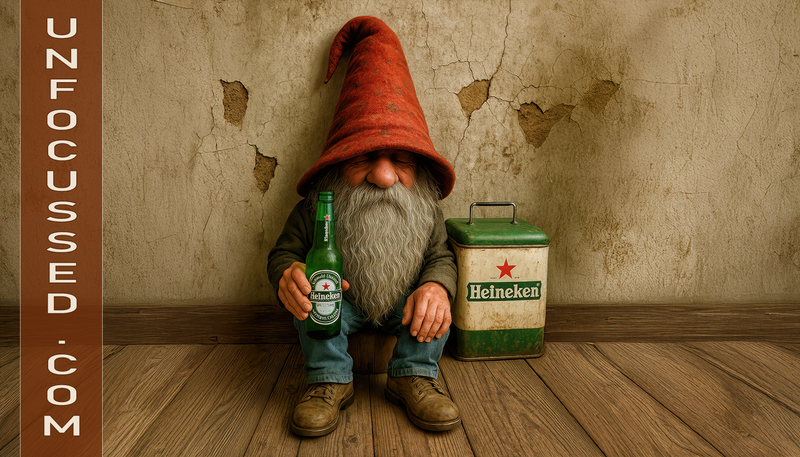
The Gnome, the Beer, and the Basement of Broken Dreams There are gnomes, and then there's Stigmund Ferndingle—a retired mischief-maker turned full-time beer philosopher. While most garden gnomes settle for standing around birdbaths and silently judging your lack of weeding, Stig had different aspirations. He was done with the ceramic life. He wanted hops. He wanted barley. He wanted to forget the Great Hedge Trimmer Massacre of ’98, one Heineken at a time. He set up shop in what used to be the damp, haunted corner of an old farmhouse basement—now lovingly renamed “The Hideaway.” With cracked plaster walls and a cooler older than most midlife crises, it was everything he never dreamed of and settled for anyway. He even had a sign, crudely etched in bark, that read: "No Elves, No Fairies, No Bullshit." Stigmund wasn’t picky, just jaded. Life had smacked him with one too many acorns. He didn’t trust anyone under four feet tall or sober enough to recite a riddle. His days were spent squatting by the cooler, sipping warm beer because the electricity had been shut off ever since he tried to wire the fridge using copper from a neighbor’s wind chime. “It hummed,” he’d say. “That’s technical enough.” One Tuesday—though it could’ve been a Thursday, time’s a blur when you're drunk and immortal—Stig cracked open his last bottle of Heineken. He tilted it toward the gods of barley with a solemn toast: “To broken promises, expired coupons, and the complete absence of meaningful tax reform.” Then, from the shadows, came a voice. Gravelly, thick with regret and sausage grease. “That better be the cold one you owe me, Ferndingle.” Stig didn’t look up. He knew that voice. He’d hoped it had choked on a chicken bone and floated off into the realm of forgotten side characters. But no. Throg the Drunken Troll had found him again. “Jesus, Throg. I thought you were banned from every basement in the county after the 'Incident with the Flamethrower and the Garden Salsa.'” “I got a pardon. Said it was an art installation gone wrong. You know, cultural expression and all that crap.” Stig rolled his eyes so hard he nearly sprained a socket. He took another sip of his beer, the last precious drop of liquid sanity in a world gone mad with elves trying to unionize and hobbits opening artisanal bakeries. “Well,” he said with a burp that rattled the paint chips off the wall, “if you’re here to drink, bring your own bottle. This one’s mine, and I’m too old to share or care.” Throg grunted, dropped a cooler that clanked suspiciously, and pulled out a mysterious green bottle labeled simply “Experimental – Do Not Consume”. Stig stared at it, then slowly grinned. “...Pour me a glass, you ugly bastard.” Experimental Brews and Unforgivable Flatulence Throg poured the liquid, which fizzed like it had opinions and regrets. The smell hit first—like fermented onions wrapped in gym socks and betrayal. Stig took a whiff and immediately questioned every decision that led him here, starting with the one where he *trusted a troll with a chemistry hobby.* “What the hell’s in this?” he croaked, holding the glass like it might bite. “Bit of this, bit of that,” Throg shrugged. “Mostly swamp hops, fermented fairy tears, and something I scraped off the underside of a kobold’s armpit.” “So... brunch?” They clinked glasses, a sound not unlike two gravestones making out, and drank. The reaction was instantaneous. Stig’s beard twitched. Throg’s left eye started vibrating. Somewhere in the room, the wallpaper peeled itself off and whispered, “Nope.” “Hot DAMN,” Stig choked, eyes watering. “That tastes like regret with a lemon twist.” “You’ll get used to it,” said Throg, just before he hiccuped and briefly turned invisible, only to reappear halfway through the floorboards. “Side effect. Temporarily phased into the ethereal plane. Don’t worry, it’s mostly boring in there.” After the third glass, they were both feeling bold. Stig attempted to do a dance called the “Root Stomp of the Ancients”, which mostly involved him tripping over a nail and blaming it on a cursed floorboard. Throg, ever the artist, tried to juggle beer bottles while reciting a poem about dwarven plumbing. It ended, as these things often do, in shattered glass and someone farting loud enough to scare off a raccoon in the vents. Hours passed. The cooler emptied. The air filled with tales of failed love affairs with mushroom witches, unsuccessful startups involving enchanted bidets, and a half-formed business idea called “Brew & Doom”—a tavern that doubled as a survival obstacle course. Eventually, as twilight crept through the basement grates and the hangover fairies circled overhead like tiny, winged harbingers of doom, Stig leaned back against the cooler and sighed. “You know, Throg... for a smelly, emotionally-stunted, swamp-dwelling ex-con—I don’t entirely hate drinking with you.” Throg, now half-asleep and softly humming the troll anthem (which was mostly guttural noises and the phrase “Don’t Touch My Meat”), gave a lazy thumbs-up. “Right back atcha, ya old piss goblin.” And thus, the night ended like most nights in the Hoppy Hour Hideaway—boozy, weird, and just shy of a fire hazard. But if you listen closely on lonely nights, past the creak of old pipes and the occasional beer burp echo, you might still hear the toast: “To broken dreams, bad decisions, and the brew that made it all tolerable.”     Epilogue: The Morning After and Other Catastrophes When Stigmund awoke, he was spooning the cooler. Not romantically—more like clinging to it for emotional support as one might do with a trusted bucket during a three-day ale bender. His hat had migrated halfway across the room, and somehow his beard had acquired a mysterious braid with a tiny rubber duck tied into it. His pants were intact, but his dignity had clearly fled during the second bottle of “Experimental.” Throg was upside down in a flowerpot, snoring through one nostril while the other whistled a haunting tune. There was a crude tattoo on his belly that read “TAP THAT” with an arrow pointing downward. Whether it was ink, soot, or regret was unclear. On the wall, in green Sharpie and misspelled Old Elvish, someone had scrawled: “Here Drank Legends. And They Were... Meh.” The hangover was biblical. The kind of headache that made you question your life choices, your gods, and whether fermented fairy tears should really be FDA-approved. Stig muttered dark gnomish curses under his breath and reached for his last piece of bread, which turned out to be a coaster. He ate it anyway. Eventually, Throg stirred, farted without apology, and sat up with the grace of a walrus falling down stairs. “You got any eggs?” he croaked. “Do I look like a breakfast buffet?” Stig snapped, scratching under his beard where something small and possibly sentient had taken refuge. “Get out of my hideaway. I’ve got three days of silence scheduled and I intend to use all of them to forget last night.” Throg grinned, wiped beer foam from his eyebrow, and stood. “You say that now, but I’ll be back Friday. You’re the only gnome I know who can hold their booze and insult my mother with such poetic flair.” “Damn right,” Stig muttered, already rooting around for a clean glass and a less cursed bottle. And so the cycle would begin again—one gnome, one troll, and the questionable sanctity of the Hoppy Hour Hideaway, where the beer is warm, the insults fly freely, and magic doesn’t stand a damn chance against fermented stupidity.     Take the Hideaway Home Want to bring the beer-soaked brilliance of Stig and Throg into your own questionable life choices? We've got you covered—whether you're sobering up, blacking out, or just need to explain why your tote bag smells like hops and regret. Wood Print – Rustic, sturdy, and perfect for hanging above your bar... or over that hole you punched in the drywall during karaoke. Framed Print – Add a touch of class to your chaos. Guaranteed to start conversations, or at least halt them awkwardly. Tote Bag – Holds groceries, spellbooks, or six cans of questionable troll brew. Durable and judgment-free. Spiral Notebook – Jot down beer recipes, bad ideas, or angry letters to the HOA. Gnome-tested, troll-approved. Beach Towel – For when you pass out poolside, beer in hand, and need something soft to cushion the shame. Disclaimer: No actual trolls were harmed in the production of these fine goods. Emotionally? Maybe. But they’ll get over it.

Read more

Born of Ash and Whisper

by Bill Tiepelman

Born of Ash and Whisper

In Which the Dragon Crashes Brunch Maggie had three rules when it came to dating: no musicians, no cultists, and absolutely no summoning spells before coffee. So imagine her mood when her Sunday hangover was interrupted by a loud pop, a puff of sulfur, and a tiny, winged demon landing face-first into her half-eaten croissant. “Excuse you,” she muttered, flicking powdered sugar off her robe. The creature sneezed, coughed up a coal, and blinked at her with large, ember-flecked eyes. It looked like a lizard mated with a nightmare and gave birth to a goth chicken nugget. It hissed. Maggie hissed back. “Listen, Hot Topic,” she grumbled, cradling her forehead, “whatever infernal womb spat you out clearly didn’t finish the instructions.” The dragon squeaked indignantly and flapped its wings in what Maggie could only interpret as attitude. Its claws were tiny. Its ego? Not so much. As she tried to pick it up using a potholder and a cereal bowl, the creature inhaled deeply and burped out a perfect smoke ring in the shape of a middle finger. “Oh, sass. You came with sass.” Thirty minutes and one minor kitchen fire later, Maggie had managed to corral the dragon into an old cat bed she’d been meaning to donate to Goodwill. It curled up like a smug little inferno and immediately fell asleep. She could swear it purred. “This is fine,” she said to no one. “This is how people become warlocks, isn’t it?” Outside, the world continued being normal. Inside her rent-controlled apartment, a dragon that smelled like burnt marshmallows and sarcasm had adopted her. She poured herself more wine. It was 10:42 a.m. In Which Maggie Joins a Cult (But Just for the Snacks) The next morning Maggie woke up to find the dragon perched on her chest like a judgmental paperweight. It smelled faintly of espresso and something illegal in three states. Its name, according to the faintly glowing rune now tattooed across her forearm, was “Cindervex.” “Well, that’s not ominous at all,” she grumbled, poking the little beast in the snout. “Do you do tricks? Pay rent? Breathe less?” Cindervex snorted a puff of ash and promptly coughed up a tiny, slightly smoking coin. Maggie inspected it. Gold. Real gold. She turned to the dragon, who looked far too pleased with himself. “Okay, you live here now.” By noon, Maggie had a dragon in a baby Björn, aviators on, and a grocery list that included ‘kale’ and ‘dragon-safe firewood.’ She did not have answers, dignity, or any real understanding of the arcane arts, but she did have a glowing wrist tattoo that now vibrated when she passed the corner of 6th and Pine. “No,” she muttered. “Not today, Satan. Or Tuesday.” But the tug of magical curiosity and the faint scent of garlic knots drew her in like a moth to a pizza oven. Down an alley, through a brick archway, and past a sentient fern that tried to unionize her hair, Maggie found herself standing before a rustic wooden door with a sign that read: “THE ORDER OF FLAME & FOCACCIA — Visitors Welcome, Opinions Optional.” “Oh great,” she said. “It’s a hipster cult.” She was greeted by a woman in a caftan made of velvet and poor decisions, who immediately clasped her hands. “You’ve brought the Emberchild! The Scaled One! The Prophet of Reheated Destiny!” “I call him Vex. And he bites people who say ‘prophet’ with a straight face.” The woman—Sunblossom, of course—led Maggie through what could only be described as Restoration Hardware meets Hellboy fanfiction. Long wooden tables. Floating candles. A small wyvern in the corner wearing a beret and reading *The Economist.* “You’re among friends here,” Sunblossom purred. “We are bound by flame. By ritual. By the brunch buffet.” “Is that a waffle fountain?” Maggie asked, stunned. “Yes. And mimosa golems. They keep your glass full until you surrender or die.” Somewhere in the distance, a man screamed, “No more prosecco, you devil sponge!” Cindervex hissed happily. Apparently, this was home now. Over goat cheese frittata and a surprisingly insightful conversation about dragon soul-bonding laws, Maggie learned that Cindervex had chosen her. Not just as a caretaker, but as a Conduit—a human being tapped to bridge the magical and mundane, possibly lead a rebellion, and definitely help design seasonal merch for the cult’s online shop. “There’s a hoodie?” she asked. “Three. And a tumbler. BPA-free.” She paused. “Okay. I'm in. But just for the hoodie. And the snacks.” The room erupted in joyous fireballs. The mimosa golem did a cartwheel. Someone summoned a kazoo-playing imp. Maggie blinked. It was chaos. It was ridiculous. It was hers. Back at her apartment that evening, Maggie collapsed on the couch, Cindervex curled at her feet. Her wrist glowed faintly with new runes: Initiate. Brunch-Approved. Caution: May Ignite Sass. She laughed. Then she poured another glass of wine and toasted the ceiling. “To destiny. To waffles. To accidentally joining a cult.” Cindervex purred, burped out a fireheart-shaped smoke ring, and stole her throw pillow. Somehow, this was the most stable relationship she’d had in years.     Epilogue: In Which Everything Burns, But Like... In a Good Way Six months later, Maggie had adjusted to life as a brunch sorceress, part-time chaos gremlin, and reluctant cult celebrity. Cindervex now had a dedicated fire-proof bean bag, his own corner of the apartment (lined with gold coins and stolen socks), and an Instagram following of 78,000 under the handle @LilSmokeyLord. They still fought—mostly over bath time and how many fireballs were considered “too many” in a laundromat—but they were a unit now. Partners. A girl and her dragon, trying to navigate a world that didn’t list “arcane brunch queen” on its tax forms. The Order of Flame & Focaccia was thriving. They opened a second chapter in Portland. The hoodie waitlist was a nightmare. Maggie had accidentally become a motivational speaker for magical burnout recovery, which she delivered with the energy of someone who once summoned a thunderstorm because her latte had too much foam. She had friends now. A talking cauldron named Gary. A banshee who did her taxes. Even a date or two, though most were scared off by the part where her pet tried to set their shoelaces on fire “as a vibe check.” But she was happy. Not the fake kind of happy you post on social media, but the weird, loud, chaotic kind that makes your neighbors suspicious and your therapist very intrigued. On the night of the Vernal Equinox, she stood on her balcony with Cindervex on her shoulder. The city glittered below. Somewhere, distant drums thudded from a magical rave she wasn’t drunk enough to attend. Yet. “We good?” she asked the dragon. He flared his wings, let out a gentle burp of violet flame, and settled in. That was dragon-speak for ‘yes, and also I’m about to pee in your houseplant.’ “You little hell nugget,” she said, smiling. “Don’t ever change.” And he didn’t. Not really. He just got weirder. Louder. More chaotic. Like her. Which, when you think about it, was kind of the point. Everything burns eventually. Might as well light it up with someone who brings their own matches and snacks. The End... probably.     Bring the Flame Home 🔥 If you fell in love with the story of Maggie and her attitude-packed dragon, you're not alone. Now you can bring their world into yours with exclusive merch inspired by Born of Ash and Whisper, available now from Unfocussed. 🔥 Metal Print – Make a statement. Fireproof-ish. Beautifully bold. 🔥 Tapestry – Turn your wall into a magical gateway (or dragon lair). 🔥 Throw Pillow – For when your emotional support dragon needs emotional support. 🔥 Greeting Card – Say it with sass and smoke rings. Perfect for dragon-worthy messages. 🔥 Spiral Notebook – Chronicle your own accidental cult adventures in style. Because honestly, who doesn’t need more dragons in their life?

Read more

Torchbearer of the Toadstool

by Bill Tiepelman

Torchbearer of the Toadstool

The Itch in the Moss The woods, contrary to poetic belief, are not serene. They are loud, rude, and filled with creatures that don’t care about your personal space — especially if you’re knee-high and have wings like stained glass. Just ask Bibble. Bibble, a fairy of questionable repute, sat atop her chosen throne: a glistening red toadstool with the kind of white speckles that screamed, “do not lick.” She licked it anyway. She did a lot of things just to spite the rules. In her grubby little hand she held a torch — not magical, not ceremonial, just a stick she lit on fire because it made the beetles scatter dramatically. That, and she liked the power trip. “By the Glimmering Grubs of Gramble Root,” she muttered, staring into the flame, “I swear, if one more gnome asks if I grant wishes, I’m setting his beard on fire.” Bibble was not your average fairy. She didn’t flit, she strutted. She didn’t sprinkle pixie dust, she shook glitter in people’s faces and yelled “Surprise, b*tch!” She was not the chosen one — she was the annoyed one. And tonight, she was on patrol. Every seventh moon, a fairy must take the Spore Watch, ensuring that the Amanita Council’s fungal empire isn’t being nibbled on by rogue badgers or cursed raccoons. Bibble took this role very seriously. Mostly because the last fairy who skipped watch was now being used as a coaster in the council’s breakroom. “Torchbearer,” came a voice behind her. Slithery. Elongated. Like someone who practiced being creepy in front of a mirror. She didn’t turn around. “Creevus. Still oozing around like a sentient rash, I see.” “Charming as ever,” Creevus replied, sliding from the shadow of a mossy log, his cloak stitched from shed snakeskin and the dreams of disappointed parents. “The Council demands an update.” “Tell the Council their mushrooms are unbitten, their borders unmolested, and their Torchbearer deeply underpaid.” She blew a puff of smoke toward him, the flame flickering like it was laughing at him too. Creevus narrowed his eyes. Or maybe he just didn’t have eyelids. It was hard to tell with creeps like him. “Don’t let your spark go to your head, Bibble. We all know what happened to the last Torchbearer who disobeyed the Spore Law.” Bibble grinned, wide and wicked. “Yeah. I sent him flowers. Carnivorous ones.” Creevus vanished back into the darkness like an overdramatic theatre major. Bibble rolled her eyes so hard she nearly levitated off her mushroom. The flame danced. The night stretched its claws. Something was watching. Not Creevus. Not a badger. Something... older. And Bibble, goddess help us, grinned wider. The Spores of Suspicion The thing about being watched in the woods is — it’s rarely innocent. Squirrels watch you because they’re plotting. Owls? Judging. But this? This was something worse. Something ancient. Bibble hopped down from her toadstool, torch held like a royal scepter, eyes narrowed. The flame’s glow made her shadow stretch tall and lanky across the mossy ground, like it was auditioning for a villain role in a woodland soap opera. “Alright then,” she shouted, twirling the torch. “If you’re going to stalk me, at least buy me dinner first. I like acorn wine and fungi you can't pronounce.” The forest answered with silence — thick, heavy, and absolutely hiding something. And then, with the elegance of a drunk centipede in heels, it emerged. Not a beast. Not a ghost. But a creature known only in whispers: Glubble. Yes, that was its name. No, Bibble wasn’t impressed either. Glubble had the face of a melted toad, the smell of compost tea, and the conversational charm of wet socks. He wore a robe made entirely of leaf husks and arrogance. “Bibble of Sporesend,” he rasped. “Bearer of Flame. Licker of Forbidden Caps.” “Oh look, it talks,” she said dryly. “Let me guess. You want the torch. Or my soul. Or to invite me to some terrible forest cult.” Glubble blinked slowly. Bibble could swear she heard his eyelids squelch. “The Flame is not yours. The Torch belongs to the Rotmother.” “The Rotmother can suck my bark,” Bibble snapped. “I lit this thing with dried moth guts and sheer spite. You want it? Make a PowerPoint.” Glubble hissed. Somewhere behind him, a slug exploded from stress. Bibble didn’t flinch. She’d once stabbed a possum with a licorice wand. She feared nothing. “You mock the old ways,” Glubble wheezed. “You taint the Watch.” “I am the Watch,” she declared, raising the torch. “And trust me, darling, I make tainting look good.” There was a sudden rumble — deep beneath the forest floor. Trees leaned in. Moss shivered. From the base of Bibble’s old toadstool throne came a sound like choking fungus. “Ah, fantastic,” she muttered. “I woke the throne.” The mushroom had been enchanted, yes. But no one told her it had feelings. Especially not the emotionally unstable kind. It stood now, unfolding from the ground like a sad inflatable sofa, eyes blinking beneath its cap, and let out a pitiful groan. “Torch…bearer…” it moaned. “You… never moisturize me…” Bibble sighed. “Not now, Marvin.” “You sat on me for weeks,” it whimpered. “Do you know what that does to a mushroom’s self-esteem?” Glubble raised a clawed hand. “The Rotmother comes,” he declared with terrible drama. Thunder rolled. Somewhere, an owl choked on its tea. “And I’m sure she’s lovely,” Bibble deadpanned. “But if she tries to mess with my watch, my torch, or my emotionally needy mushroom, we are going to have a situation.” The woods fell into chaos. Roots whipped like angry noodles, spores exploded from the ground in clouds of glittery rage, and a deer — possessed by pure drama — threw itself sideways into a ravine just to avoid involvement. Bibble, torch raised, yelled a war cry that sounded suspiciously like “You fungal freaks picked the wrong fairy!” and leapt onto Marvin’s back as he sprinted like a caffeinated Roomba through the underbrush. Glubble pursued, screaming ancient rot-prayers and tripping over his own leaves. Behind them, the Rotmother began to rise — enormous, festering, and surprisingly well-accessorized. But Bibble didn’t care. She had a flame. A throne. And just enough bad attitude to spark a revolution. “Next full moon,” she shouted into the wind, “I’m bringing wine. And fire. And maybe some self-help books for my throne.” She cackled into the mossy night as the forest shuddered with spores and chaos and the joy of one fairy who absolutely did not care about your ancient prophecies. The flame burned brighter. The Watch would never be the same.     Epilogue: The Fire and the Fungus The woods eventually stopped screaming. Not because the Rotmother was defeated. Not because Glubble found inner peace or because the Council decided to cancel Bibble (they tried — she cursed their group chat). No, the forest settled because it realized one immutable truth: You don’t fight Bibble. You adjust your entire ecosystem around her. The Spore Laws were rewritten, mostly in crayon. The official title “Torchbearer” was changed to “Spicy Forest Overlord,” and Bibble insisted her mushroom throne be referred to as “Marvin, the Moist Magnificent.” He cried. A lot. But it was growth. Creevus retired early, moved to a cave, and started a disappointing podcast about ancient fungus. Glubble joined a moss therapy group. The Rotmother? She’s now on TikTok, doing slow, haunting makeup tutorials and reviewing mushrooms with disturbing intimacy. As for Bibble? She built a shrine out of old beetle shells and sarcasm. Every now and then, she hosts illegal bonfires for delinquent fairies and teaches them how to yell at shadows and forge torches from twigs, venom, and pure audacity. When travelers pass through the woods and feel a sudden warmth — a flicker of fire, a rustle of glittery defiance — they say it’s her. The Torchbearer of the Toadstool. Still watching. Still petty. Still, somehow, in charge. And somewhere, under the roots, Marvin sighs happily… then asks if she brought lotion.     If you feel your life lacks just a little chaos, confidence, or flaming toadstool energy — bring Bibble home. You can channel your inner Torchbearer with a framed print for your lair, a glorious metal print for your altar of chaos, a soft and suspiciously magical tapestry for wall summoning rituals, or a wickedly stylish tote bag to carry snacks, spite, and questionable herbs. Bibble approves. Probably.

Read more

Echoes of Tropic Thunder

by Bill Tiepelman

Echoes of Tropic Thunder

The Sky Is Not Your Stage—It’s Mine In the heart of a rainforest that tourists only reach after three panic attacks, two leech bites, and at least one existential crisis, there exists a legend. Not a whispered myth or a carved-to-death tribal tale, no. A living, screeching, full-plume riot of a legend. His name? Rey Azul del Humo. Or as the gringos call him—"That Bastard Bird Who Stole My Hat." Rey Azul was no ordinary macaw. He didn’t just fly—he descended. Like Zeus in feathered drag, wrapped in smoke and attitude. His tail alone could spark an identity crisis in a peacock, and his beak had tasted more camera lenses than rainforest fruit. If a storm brewed, it was only because he willed it. If a rainbow showed up afterward, he rolled his eyes and said, “Try harder.” Locals worshipped him, or at least pretended to, mostly out of fear that he'd steal their cigarettes or poop on their roof tiles in judgment. He ruled the treetops with a charisma only rivaled by that one ex you still dream about but tell your therapist you're over. One time, a drone tried to film him. Rey Azul performed a full aerial backflip, flipped the drone the metaphorical bird mid-air, and then escorted it—with talons—to the ground. He then sat on it, spread his wings, and screeched for ten glorious minutes while the jungle watched in awkward awe. He was more than feathers and fury—he was an icon. A flamboyant middle finger to subtlety. A war cry for color, chaos, and unapologetic pride. The forest didn’t just echo with thunder; it echoed with him. His voice. His strut. His feathers that shimmered like they were sponsored by some illicit alliance of tequila and glitter. And Rey knew it. Oh, he knew. Every snap of his wings was a statement piece. Every time he perched on a limb, it became a throne. This wasn't nature. This was fashion week on acid. With claws. He didn’t blend in. He refused to. That’s for parrots with a job. Rey was freelance at best—an untamed contractor of disruption and sky drama. And so, when the smoke rose—fiery orange, electric blue, impossible purple—it wasn’t because the world was on fire. It was because Rey Azul felt dramatic that day. Burnt Sky, No Regrets Now let’s set the scene: dawn. But not your serene Instagrammable dawn where birds tweet and yoga mats breathe lavender-scented dreams. No, this was Rey Azul’s kind of dawn—blazing, loud, chaotic. Somewhere between a Renaissance painting and a nightclub fire hazard. The jungle wasn’t waking up gently. It was getting slapped in the face by feathers and told to get fabulous or get forgotten. Today was not an ordinary strut-and-squawk kind of day. No. Rey had plans. A tropical storm was incoming, and the humidity clung to the air like a desperate ex. He could smell ozone and human incompetence drifting in with the wind. Somewhere, a wildlife photographer was crouching in khakis they hadn’t earned, whispering, “Come on, baby, just one clean shot.” Rey chuckled internally. He lived for this. High in the canopy, he fluffed his chest feathers into what could only be described as a tactical glam formation. He was about to give them a show. Not for the humans. Not for the tourists. Not for the scientists who called him “subject M-47” like he was some jungle spreadsheet. No, this performance was for himself. Because if you weren’t serving main-character energy in the face of environmental collapse, what even was the point? He launched into the air with a screech that could curdle oat milk. Smoke—because of course there was smoke—billowed around him in orange and violet tendrils, summoned either by pure physics or the raw drama he exhaled with every beat of his wings. He didn't fly; he stormed the atmosphere. A full riot in slow motion. Below him, a sloth looked up mid-yawn and muttered, “Oh no, he’s monologuing again.” But no one could hear it over the roaring of feathers slicing air like gossip through a brunch table. The smoke coiled like an adoring serpent around his tail feathers. Tropical fire met monsoon sky, and Rey danced in between—equal parts deity and drag queen, part myth, part middle finger to normalcy. It was performance art. It was rebellion. It was bird-on-bird dominance theater, and it was fabulous. The drone returned. A new one. Different brand. Different owner. Probably insured. This time, Rey paused mid-air, turned to face it like a Shakespearean actor seeing his fate in a floating eye of metal, and did the one thing no machine could understand: He winked. The footage went viral. “Real-life phoenix?” the headlines read. “Jungle diva spotted over Amazon.” Rey was indifferent. He didn’t read blogs. He was the blog. Later that day, soaked in rain and unbothered, Rey perched atop the highest branch in the jungle. The storm cracked open the sky like a broken promise, and lightning lit the forest in brief strobe-lit snapshots. He squawked once—short, sharp, and final. Down below, someone whispered, “What the hell was that?” A guide smiled, looked to the clouds, and said, “Just thunder. And ego.” But it wasn’t thunder. Not really. Not anymore. It was the Echo of Tropic Thunder. And his reign? Unquestioned. Unfiltered. Unapologetically ablaze. Rey Azul del Humo didn’t rule the jungle. He was the jungle—with extra smoke, a touch of glitter, and not a single ounce of chill.     Epilogue: Plume & Legacy Years passed, as they do in jungles and in dreams—slow, sticky, and full of chirping you can never quite identify. Rey Azul? He never died. Please. That kind of drama queen doesn’t get a “death”—he gets a departure. A vanishing act so seamless that even the clouds paused to reconsider their relevance. One day, the jungle just... got quieter. Not in sound, but in energy. As if someone had taken down the main stage after the last encore. The trees still swayed. The birds still sang. But that lingering sense of judgmental fabulousness? That divine eye-roll energy? It was gone. Some say he flew into a thunderstorm and never came back. Others say he’s immortal, traveling from canopy to canopy like some avian freelance chaos spirit. A few jungle elders insist he lives in the smoke itself now—every tendril a whisper of his laugh, every curl of mist a flash of his impossible feathers. There are signs. A rainbow that forms with too much attitude. A gust of wind that feels like it’s side-eyeing your outfit. A branch that shakes just a bit too sassy for a squirrel. And if you ever see a sudden burst of smoke colored like fire and twilight had a scandalous love child? You bow. You don’t question. You whisper, “He’s watching.” Because Rey Azul del Humo may be gone from sight, but legends never really leave. They just perch higher than you can see—and judge silently, from above.     🔥 Take the Thunder Home If Rey Azul’s unapologetic chaos, color, and charisma struck a chord in your soul, why not bring that energy into your daily life? Our exclusive "Echoes of Tropic Thunder" collection turns attitude into art across premium lifestyle products. Just like the bird himself, these aren't here to blend in. 🔥 Metal Print – For bold walls and unapologetic vibes. Sleek, high-gloss, and as dramatic as Rey himself. 🌀 Tapestry – Drape your space in fire and feathered fury. Interior decor just got tropical. 👜 Tote Bag – Carry chaos with you. Groceries, books, or just your unfiltered personality—it fits. 💥 Throw Pillow – For resting your head after a long day of being louder than life. Feathers fade, but style lasts forever. Shop now and add some thunder to your space.

Read more

The Bloomkeeper's Lamb

by Bill Tiepelman

The Bloomkeeper's Lamb

The Garden That Grew Itself Somewhere between where the map ends and where afternoon naps become time travel, there’s a village so small it fits in a pocket dimension — or at least inside the walls of Mrs. Tattersham’s overgrown back garden. Nobody really *moves* there. People just show up with suitcases they don't remember packing and an odd craving for elderflower cordial. They call it Hushmoor Hollow. Now, Hushmoor was known for many things: silent goats, whispering fences, and that one Tuesday when it rained marmalade (don’t ask). But mostly, it was known for the Garden That Grew Itself — a spectacular riot of peonies, roses, and things with far too many vowels in their botanical names, blooming entirely out of sync with the seasons and sometimes in sync with showtunes. No one admitted to tending it. The mayor (a retired opera singer named Dennis) insisted it was “self-cultivating,” though he did once get caught pruning the azaleas while singing to them in Italian. But the truth — the real, whispered-at-tea-time truth — was this: the garden belonged to the Bloomkeeper. And the Bloomkeeper’s lamb? She was a fluffball of inconvenient mysteries. Imagine a lamb. Not your average field-hopper. This one’s wool swirled in tight little curls like spun sugar, shifting hues depending on the angle of the sun or whether you’d said anything cynical lately. She smelled faintly of peppermint and improbable hope. Her eyes? Far too intelligent for someone who frequently licked tree bark like it owed her money. Her name was Luma, and she arrived one spring evening precisely 14 minutes after Hushmoor’s last clock stopped ticking. She simply walked out from the thickest bloom of moon-roses and looked at the villagers like they were the surprise, not her. No one knew where she came from. But the garden grew twice as fast after she appeared. And twice as weird. Within a week, the begonias started forming synchronized dance formations. Bees spoke in haiku. Dennis was abducted briefly by a very polite mushroom (he came back smelling of tea and thunderclaps). And Luma? She just stood there, blinking slowly, like she was waiting for someone to finally read the instructions. Then the dreams started. Dreams of distant bells, ancient keys, and doors made entirely of petals. Everyone in Hushmoor had them, though no one spoke of it aloud, because — well — that's how things work in magical villages held together by gossip and curiosity. One morning, a letter appeared under Luma’s hooves. It was written in gold ink and smelled like elderflower and ambition. The note read: “You are late. The Bloomkeeper is missing. Please report to the Seventh Gate immediately. And bring the lamb.” Luma blinked twice. Then, turning with an alarming sense of purpose for someone shaped like a marshmallow, she trotted toward the forest edge. Nobody moved. Nobody spoke. Until Dennis, back from his fungal escapade, said: “Well, bollocks. I guess we’re going adventuring, then.” And that’s how the village, the lamb, and a great deal of gardening equipment found themselves heading into a realm they didn’t know existed, to find someone they weren’t sure was real… led by a pastel-colored mystery with a peppermint-scented butt. The Seventh Gate (And Other Unwise Landscaping) The party was seven strong: Dennis, who insisted on bringing opera binoculars despite lacking an opera; Miss Turnwell, the village baker with a suspicious knowledge of swordplay; two identical twins named Ivy who communicated exclusively in interpretive sneezes; young Pip, who had recently turned into a flower for an afternoon and come back oddly confident; a shovel named Gregor (don’t ask); and of course, Luma — the pastel lamb with a gaze like she remembered your childhood secrets. They followed her through the forest, which was less a forest and more a polite riot of sentient topiary. The hedges whispered things like “left at the mushrooms” or “have you seen my comb?” and nobody seemed to question it. Luma never faltered. Her tiny hooves barely touched the mossy floor as if the earth was giving her a gentle push with each step. The Seventh Gate turned out to be a large wrought iron arch nestled between two ancient willow trees, with glowing vines spelling out the words: “If You’re Reading This, It’s Probably Too Late.” It gave off the exact vibe of a place that had opinions about who was worthy — or at the very least, a strong interest in dramatic timing. “Shall we knock?” Dennis asked, before the gate sighed audibly and swung open on its own, revealing… a hallway. Not a garden path or a mystical realm. Just a dimly lit hallway that looked like it had been designed by someone who once ate a candle and thought, “Yes. This should be a vibe.” They stepped inside, and immediately, their thoughts got louder. Not verbally — mentally. Pip’s inner monologue began narrating everyone’s actions in a dramatic voice (“Dennis brandishes his opera glasses, bold but emotionally conflicted!”), while one of the Ivys projected continuous images of extremely disappointed grandparents. Miss Turnwell’s brain kept chanting “There is no muffin. There is only the jam.” over and over. Only Luma seemed unfazed. She trotted down the corridor as the very walls shimmered with blooming vines and smells that didn’t exist in the normal world — scents like “first kiss in spring rain” and “cherry pie left on a windowsill for someone who never came home.” At the end of the corridor was a room. Round. Bright. Floating somewhere between “luxury greenhouse” and “witch’s conservatory.” And at the center, reclining on a throne made entirely of thistles and chamomile, was the Bloomkeeper. Or… what was left of her. She looked like someone had pressed ‘pause’ halfway through turning into a constellation. Stars blinked from her cheeks, vines curled through her hair, and her voice sounded like bees politely holding a meeting. “You're late,” she said, eyes on Luma. “I expected you… two blooms ago.” Luma snorted. Loudly. A tiny peony popped from her wool and bounced across the floor. No one knew what that meant, but the Bloomkeeper smiled — that kind of smile that might turn into lightning or forgiveness, depending on how you held it. “They came with you,” she said, gesturing toward the awkward line of villagers now pretending to know how to stand heroically. “That changes things.” “What things?” asked Pip, nervously adjusting a petal that had mysteriously sprouted from his collarbone. The Bloomkeeper stood, her vines curling gently around her arms like living lace. “The garden is no longer content with itself,” she said. “It wants… out.” A moment passed. A deep, root-stirring silence. “Out… of what?” Dennis asked slowly. “Out of here,” she whispered, tapping her temple. “Out of dreams and into streets. Into cities. Into poems written in chalk and hearts that forgot to water themselves.” Luma bleated. The Bloomkeeper nodded. Then, without warning, she unraveled — not in a sad way. More like she’d turned into wind and light and something older than both. In her place stood a mirror. Inside it: a garden. Wild. Blooming. Alive. And waiting. Underneath, a message etched in petals: “To tend a garden like this, you must first break open.” The mirror rippled. And Luma walked through it. The others stood, blinking, unsure. Until Ivy (or was it the other Ivy?) took Pip’s hand and stepped in after her. Then Miss Turnwell. Then Gregor the shovel (still don’t ask). One by one, they entered — shedding old fears like petals on the wind. Only Dennis hesitated. He looked back once, toward the place they'd come from — the cozy, bizarre little village of Hushmoor. Then forward, into the blooming unknown. He straightened his jacket, adjusted his opera glasses, and said: “Right. Let’s garden some chaos.” And with that, the gate closed behind them. But somewhere in Hushmoor, the flowers still danced. And if you looked closely, you’d see new ones blooming — ones that hadn’t existed before. Ones shaped like memory, mischief… and a little lamb’s hoofprint in the soil.     Epilogue: The Hoofprint and the Hush Years passed, as they do — irregularly, if you're in Hushmoor — and the village changed in ways that no one could quite measure. The fences no longer whispered (they sang now, mostly jazz standards), and the marmalade rain had become seasonal rather than spontaneous. The garden remained, impossibly alive, though no one pruned it anymore. It pruned itself, occasionally into the shapes of things not yet invented. Flowers bloomed in languages. Peonies opened to reveal keys, poems, and once, a tiny pair of socks labeled “emotional backup.” And every so often, someone new would appear. Not move in — just appear. Standing at the gate with grass in their shoes and a look like they’d accidentally remembered a dream. They would walk through the village, take tea with Miss Turnwell (still the baker, now also a semi-retired wand instructor), and eventually find themselves near the mirror — now standing proudly at the edge of the garden, framed by twining lavender and a little sign that read: “Proceed if you wish to bloom unbegracefully.” No one saw Luma again in quite the same way. But every full moon, the flowers would bend toward the horizon, as if listening. And in the morning, there’d always be a single perfect hoofprint in the soil. Right at the gate. It smelled faintly of peppermint. And impossible hope. Somewhere out there, beyond mirror and vine, the Bloomkeeper’s Lamb still wandered. Growing gardens in people’s hearts. Snorting at overly serious poets. And making sure no one — not even the most cynical, root-bound soul — forgot that they, too, were meant to bloom. The End. Sort of.     If the story lingered in your chest like a dream you’re not ready to wake from, you can bring a piece of Hushmoor Hollow home. The Bloomkeeper’s Lamb is available as a framed print to enchant your walls, a metal print that gleams like moonlit garden gates, a throw pillow to cuddle like a slightly mysterious pastel companion, and even a fleece blanket — warm enough to ward off even the most cryptic chills. Let your space bloom with whimsy and wonder, one hoofprint at a time.

Read more

Brave Little Liar

by Bill Tiepelman

Brave Little Liar

Fin It to Win It Deep in the tepid shallows of the neighborhood koi pond—not even a proper lake, mind you—swam a goldfish with delusions far grander than his gallon-sized existence allowed. His name? Morty. Short for Mortimer T. Bubbleton III, if you asked him, though nobody ever did. Morty wasn’t your average ornamental peasant, content to dart between pebbles and wait for toddler fingers to drop pellets from above. No, Morty had ambition. And, more dangerously, he had imagination. “I wasn’t born to swish around with these soggy yes-fish,” he muttered one morning, as he flared his gills at his own reflection in a pond-filter bubble. “I was born to terrorize the tides. I was born to make the ducks flee.” And so, with a DIY spirit usually reserved for frustrated dads in garages and underpaid Etsy sellers, Morty strapped on a shark fin. Not a digital dream, not a Photoshop gag—an actual foam-core dorsal, painted battleship gray, affixed to his slimy gold frame with a bit of lost Velcro and a single shoelace. How it stayed on is a mystery best left to aquatic gods or science fiction. At first, the pond erupted in chaos. The minnows squealed (yes, audibly), the frogs fled to the reeds, and even a particularly judgy heron reconsidered his lunch plans. Morty felt it. That glorious, terrifying power. He wasn’t Morty anymore. He was Megalofish. The Finomenon. King of the chlorinated swamp! “Bow before me, you algae-humping cowards!” he bellowed, though it came out more like *blub-blub-snort-gargle*. Still, the message landed. But as the days passed, Morty realized that power came with, shall we say, logistical challenges. For starters, the fin dragged like a sunken brick. His signature tail flick was reduced to a sad little wiggle, and his stealth factor was effectively zero. Any stealth was out the window the moment the fin hit the surface and cut a dark triangle of terror across the water. He was a floating warning label: “Might be overcompensating.” And the koi—those slow, sashimi-colored nobodies—began to talk. Whisper, gossip, giggle behind their gills. “Who does he think he is?” sneered Bubbles, a koi with the personality of a beige carpet. “It’s not even saltwater.” “That’s not even his fin,” added another, who once tried to mate with a decorative rock and now fancied herself an intellectual. But Morty didn’t care. He had something more dangerous than credibility—he had delusion and audacity, which, in the right combination, could move mountains or at least knock over a moderately tall water lily. Then came the day the humans noticed. Oh yes. The human child, in his grubby Crocs and marshmallow-sticky hands, squatted by the pond, eyes wide as sewer lids. “Mom,” he screeched. “There’s a shark in the pond!” And Morty, oh sweet, ridiculous Morty, surfaced with dramatic flair. Fin cutting the surface. Pose immaculate. Gaze fierce. He was a badass. He was a beast. He was... netted immediately and dumped in a fishbowl for observation. The fall was fast. The bowl was small. The delusion? Still very, very large. “They had to remove me,” Morty rationalized, swirling dramatically against the glass. “Too powerful for containment. Too dangerous. I was a threat to the balance of nature. And the ducks.” He would return. He would rise again. With a bigger fin. A better strap. Maybe even a second fin. Who said sharks only get one? And somewhere, deep in the pond’s silent reeds, the koi whispered nervously. Because they knew— Morty was full of crap… but damn it, sometimes crap floats. The Return of the Fin King Morty spent four full days swirling in that sad, little glass bowl like some kind of imprisoned celebrity—part sideshow attraction, part cautionary tale. The humans poked, filmed, and posted his every motion. “Goldfish with shark fin! 😂 #TinyTerror #FakeAF”. Millions of views. Millions of laughs. And still, Morty plotted. Oh yes. Beneath the filter’s hum and beside a tiny ceramic pirate chest, revenge simmered like pondscum in July. “Laugh it up, land apes,” he muttered, gnawing a flake of food with the quiet rage of a disgraced general. “But I will return. And this time, I’m bringing teeth.” Day five, Morty made his move. Under cover of toddler nap time, a careless elbow tipped the bowl. He rode the wave like Poseidon in a Vegas stunt show, flopping gloriously onto the linoleum, screaming (internally) all the way. The humans panicked. Shrieks. Towels. Tears. One of them yelled something about “emotional damage to the child.” Morty just gasped and blinked like an Oscar-winner in a dying scene—pure drama, pure manipulation. He survived. Again. And with great triumph came great reward: they released him back into the pond. **HIS** pond. The prodigal fin had returned. But things had changed. The koi had leveled up. One had a decorative tattoo—just algae, but the effect was vaguely intimidating. Another now spoke in cryptic philosophical riddles after binge-floating near the garden Buddha. And worst of all, someone had installed a plastic alligator head in the water to “keep the birds away.” As if that would scare Morty the Menace. He needed a new plan. A bigger splash. So he doubled down on everything. Two fins now—one dorsal, one tail. He crafted them from a child’s broken flip-flop and a tiny action figure’s shield. Resourceful. Trashy. Perfect. With hot glue stolen from a garage cobweb and bits of string, Morty rigged himself into a full-blown aquatic warrior. Think Mad Max, but fishier and less vegan. He emerged like an absolute lunatic—tail thrashing, fins wobbling, eyes bugged like a sleep-deprived tax auditor. The pond erupted. Frogs dove. Minnows screamed. The koi? They froze. There was no denying it: he looked insane. “I AM MORTY, BRINGER OF CHAOS,” he bellowed. “I HAVE ASCENDED. I AM TWO-FINNED NOW.” “You look like a floating garage sale,” someone whispered. “EAT MY BUBBLES,” Morty screamed back. But this time, something weird happened. The fear? It didn’t fade—it mutated. They weren’t just laughing at him now. They were respecting the madness. Koi started mimicking his movements. A turtle did a lap in his honor. Even the heron gave him a single, slow nod from across the yard—predator to predator. Or, you know, predator to deeply confused maniac with a plastic fin complex. Still. It counted. The pond had changed. But so had Morty. He wasn’t just pretending anymore. The line between bluff and belief had dissolved. He was the fin. The delusion had become identity. And identity? That’s power, baby. Now, when the human child squats by the pond, marshmallow residue crusting his lip, he doesn't laugh. He watches. Reverent. Maybe a little scared. And Morty? Morty swims slow. He lets the fin breach the surface just slightly. Just enough to make someone spill their juice box. He doesn’t need to be big. He doesn’t need to be real. He just needs to be bold enough to believe his own bullshit. And in this pond, that’s how legends are made. Morty the Fin King.Tiny. Loud. Unhinged. Unstoppable. And somewhere, across the rippling surface of the koi kingdom, a single whisper floats: “Sometimes, all it takes is a fake fin and the balls to wear it.”     Epilogue: The Gospel According to Morty Years later—okay, more like six months, which is forever in goldfish terms—Morty lives on not as a fish, but as a myth. A damp, slightly delusional, wildly over-accessorized myth. The koi now wear fins. Not real ones, mind you, just painted-on symbols of rebellion. There’s a secret “Fin Club,” complete with weekly surface meetings and algae cocktails. No frogs allowed. The turtle has started a podcast. Humans still visit the pond. They peer in, whisper, point. “That’s where the shark-fish came from,” they say, like they’ve stumbled upon some cryptid spawning ground. Kids press sticky faces to the glass, hoping for a glimpse. Some say they’ve seen him. Others claim he’s long gone. But under the water, just past the lily pads, a faint shimmer sometimes cuts the surface. A triangle. A ripple. A legacy. And in the pond’s darkest corner, beneath a sunken Tonka truck and a pile of abandoned fish flakes, something stirs. A bubble. A blub. A whisper: “Don’t ever let them tell you you’re just a goldfish.” Because Morty proved it—loudly, ridiculously, triumphantly: fake fins, real guts. Long live the lie.     Bring Morty Home (But Maybe Not in a Bowl) If you felt the bold, briny energy of Morty the Fin King ripple through your soul, good news—now you can bring his legendary nonsense into your actual habitat. Art Print – Display Morty's greatest moment on your wall. Warning: may inspire overconfidence. Framed Print – For when you're feeling extra fancy, like Morty in his two-fin era. Shower Curtain – Start every day with aquatic ambition and unnecessary drama. Bath Towel – Dry off with the confidence of a goldfish who thinks he’s a predator. Brave Little Liar because sometimes, greatness starts with a fake fin and a load of gall.

Read more

The Easter Gnome's Secret Stash

by Bill Tiepelman

The Easter Gnome's Secret Stash

Of Eggs and Egos It was the Thursday before Easter, and somewhere in the overgrown back corner of an English cottage garden, a gnome named Barnaby Thistlebum was preparing for what he considered to be the most important event of the year: the Annual Egg Hiding Championship. An event so sacred, so deeply rooted in gnome culture, that it made the Summer Solstice Pie Bake-Off look like amateur hour. Barnaby wasn't your typical gnome. While most of his kin were content with humming over mushrooms or pruning violets with unnecessary drama, Barnaby had ambition. And not just the small kind. We’re talking *legendary underground chocolate mafia* levels of ambition. His dream? To become the most feared and revered egg-hider in all the woodland realms. This year, however, the stakes were high. Rumors whispered through tulip petals and buzzed by gossipy bees told of a challenger—a mischievous sprite known only as “Twig.” Twig, it was said, had mastered the art of egg invisibility and once hid an egg inside a robin’s nest mid-flight. Barnaby, naturally, took offense to this. “Nonsense,” he scoffed, peering through his monocle at the basket of glittering, impossibly well-decorated eggs he’d lacquered himself. “Floating eggs. Invisible eggs. What’s next, eggs that quote Nietzsche?” Armed with nothing but his own ingenuity and a suspiciously sticky map of the garden, Barnaby set out at dawn. His beard was braided for aerodynamic efficiency. His olive shirt bore the proud badge of the Gnomeland Security Agency (a title he awarded himself, complete with laminated ID card). And in his hands? Two eggs of epic misdirection—one filled with confetti and the other with marzipan whiskey truffles. He placed eggs in birdhouses, teacups, and the hollow of a boot once owned by a garden witch with a gambling problem. Every egg had its story. The pink-striped one with the glitter shell? Hidden beneath a dandelion trap that would sneeze glitter on any who disturbed it. The blue speckled egg? Dangling from a fishing line rigged between two daffodils, swaying like bait for curious children and cocky squirrels. By mid-afternoon, Barnaby was sweaty, smug, and just a little bit drunk on the truffle fillings he'd “quality checked.” With only one egg left, he sat on a mossy rock, admiring his handiwork. The garden looked innocent enough—an explosion of color and bloom—but beneath the daffodil dazzle lurked 43 impossibly hidden eggs and one emotionally unstable toad guarding a golden one. “Let Twig try to top this,” Barnaby muttered, pulling his hat over his eyes and collapsing backward into a pile of lavender. He laughed to himself, then quickly stopped, realizing his laughter sounded just a bit too villainous. “Damn it, keep it whimsical,” he reminded himself aloud. The Great Egg War of Willowbend When Barnaby Thistlebum awoke the next morning, he was immediately aware of two things: one, the bees were unnaturally quiet, and two, he’d been pranked. It wasn’t the type of gentle prank one might expect in the gnome world—like daffodil dye in your tea or enchanted hiccups that sang madrigals. No. This was full-on sabotage. The kind of prank that screamed “war has been declared and it’s pastel-colored.” His eggs… were gone. All 43 of them, plus the emotionally unstable toad. In their place: ceramic decoys, each one shaped like a smug-looking acorn with Twig’s initials carved on the bottom in aggressive cursive. Even worse, a hand-written note lay at his feet, folded into the shape of a duck (a show-off move if there ever was one): “Nice hiding spots, Thistlebum. I found them all before brunch. Thought I’d leave you something to remember me by. Hoppily yours, —Twig 🧚‍♂️” Barnaby’s fists clenched. Somewhere deep in his beard, a robin nesting for the season sensed a tremor of rage and relocated to a less chaotic gnome. “This. Means. WAR,” he hissed, channeling the fury of a thousand overcooked scones. And so began the Great Egg War of Willowbend. Barnaby sprang into action like a garden ninja fueled by spite and caffeine. He sprinted (okay, briskly waddled) back to his burrow, where he retrieved his secret stash of emergency eggs. Not just any eggs, mind you—these were trick eggs, each one a miracle of gnome engineering and bad decisions. Among them: The Screamer: emits the sound of an angry goat when touched. The Sleeper: contains poppy spores to mildly sedate nosy elves. The Gossip: whispers your secrets back at you until you cry. Barnaby recruited allies—mostly disgruntled woodland creatures and one exiled hedgehog who owed him a favor. Together, they deployed decoys and diversions, leaving a trail of false clues across the garden. Gnome scouts delivered misinformation wrapped in daisy petals. Smoke bombs made of thyme and sassafras exploded into clouds of lavender deception. By twilight, the garden had become a minefield of psychological warfare. And then, just as Barnaby prepared to unleash The Whispering Egg (a sentient creation banned in three provinces), a shriek cut through the air. “AAAAUGH! MY HAIR IS FULL OF HONEY!” Twig. The sprite emerged from the rosebushes, soaked head to toe in wild honey and wearing a daisy chain crown now swarming with bees. Barnaby cackled with the kind of unhinged joy usually reserved for the final act of a Shakespearean tragedy. “You fell for the Bee Trap!” he shouted, brandishing a spoon like a sword. “You sticky little goblin!” Twig glared, swatting bees and dignity with equal desperation. “You planted eggs full of jam in my treehouse!” “That was diplomacy!” Barnaby countered. “You vandalized my truffle stash!” “You threatened me with an egg that quotes Nietzsche!” “That egg was philosophical, not aggressive!” And then, something strange happened. They laughed. Both of them, doubled over in the honeysuckle, choking on pollen and absurdity. The war had lasted less than a day, but it was legendary. And as the moon rose over the garden, they sat together beneath a weeping willow, sipping rosehip tea spiked with questionable gnome brandy, watching fireflies blink over the now egg-littered battlefield. “You know,” Twig said, “you’re not half bad… for a lawn ornament with control issues.” “And you’re not completely insufferable,” Barnaby replied, raising a tiny toast. “Just ninety percent.” They clinked teacups. Peace was declared. Sort of. Every year since, they’ve kept the tradition alive—a new Egg War each spring, escalating in chaos and creativity. And though the garden suffers for it, the residents agree on one thing: Nothing brings a community together like petty rivalry, surprise bees, and an emotionally unstable toad with a grudge.     Epilogue: The Legend Grows Years passed. Seasons turned. The garden bloomed, withered, bloomed again. Children came and went, occasionally stumbling across a glittery egg tucked beneath a fern or a suspiciously sarcastic toad loitering by the compost heap. But the legend… oh, the legend remained. Barnaby Thistlebum and Twig the Sprite became something of a seasonal myth—two mischievous forces of nature bound by rivalry, respect, and an unhealthy obsession with outwitting one another via painted eggs. Each spring, the garden braced for their antics like a tavern bracing for karaoke night: with mild dread, popcorn, and a first-aid kit. The gnomes began betting on who would “win” each year. The woodland creatures organized viewing parties (squirrels made excellent commentators, albeit biased). And the bees? Well, they unionized. You can only be used as a prank so many times before demanding dental coverage. Somewhere beneath the oldest oak in the garden, there now rests a small, moss-covered plaque. No one remembers who placed it there, but it reads simply: “In memory of the Great Egg War: Where chaos bloomed, laughter echoed, and dignity was lightly poached.” Barnaby still roams the garden. Occasionally seen sipping dandelion wine, crafting decoy eggs that smell like existential dread, or mentoring a new generation of prank-happy gnomelings. Twig? She visits now and then—always unannounced, always glitter-bombing the bird bath, and always with a wicked grin. And every Easter, without fail, a new egg appears in the center of the garden. Just one. Perfectly painted. Strategically placed. Containing, perhaps, a note, a tiny riddle, or something that meows. No one knows who leaves it. Everyone knows who it’s from. And the game? It’s never really over.     Bring the Mischief Home Love the tale of Barnaby Thistlebum and the Great Egg War? Bring a piece of the magic into your world with our exclusive “The Easter Gnome’s Secret Stash” collection by Bill and Linda Tiepelman—available now on Unfocussed. From quirky gifts to seasonal décor, there’s something for every mischievous heart: 🧵 Wall Tapestries – Bring the garden mischief to life on your walls 🖼️ Canvas Prints – Vibrant, whimsical, and gallery-ready 👜 Tote Bags – Perfect for egg hunts or chaotic grocery runs 💌 Greeting Cards – Send a little mischief this Easter 📓 Spiral Notebooks – For planning your own egg-centric escapades Shop the full collection now at shop.unfocussed.com and embrace your inner trickster.

Read more

Tempest of Taurus

by Bill Tiepelman

Tempest of Taurus

The Fracture Before the stars were sewn into the heavens, before breath had found a name, the Bull stood alone at the edge of creation. A beast born not of flesh, but of force—of element, echo, and eternity. His body was split from the moment of his awakening: half of him blazed with volcanic wrath, molten rivers carving scars across a horned brow; the other half grew with the quiet pulse of life, moss-covered and breathing, rooted in stars and soil alike. He did not know time, only motion. He walked across the void as if it were pasture, his hooves forging galaxies in his wake. Wherever he passed, dual realms unfurled: forests that smoldered with flame, rivers that ran both steam and starlight, skies that trembled under his silent roar. But the Bull—he was not whole. He was a tempest trapped in duality, torn between destruction and birth, fury and forgiveness. The gods who made him had long disappeared, leaving no answer to his agony. He became myth before the worlds had names, and his suffering was written into the bones of every planet he forged. In one world, where the blue glowed too fiercely and the soil sang with sorrow, he stopped. For the first time since the First Spark, he folded his legs beneath him and lay still. The fire in his left eye dimmed. The vines along his right shoulder whispered to the sky. And the stars came closer to listen. It was then he spoke—not with voice, but with gravity. A soundless, resonant sorrow echoed across the sky: “I am the fracture. I am the seed and the scorch.” From his tears bloomed the first mortals—flawed, divided, beautiful—each carrying a sliver of his war inside them. Some burned. Some grew. Most did both. As time passed, they built temples to his fury and songs to his grace. They did not understand he was neither god nor demon—but a mirror. A reminder. A wound that shaped the universe. Yet something stirred in him as the people danced under twin moons, as they painted their skin in ash and pollen, as they whispered his name not in fear, but in reverence: Taurun. The Tempest. The Eternal. And in that reverence, he felt the first hint of peace—a flicker. A beginning. But peace, like fire, must be earned. The Reckoning Centuries passed like drifting embers across the void, and still the Bull lay beneath the twin moons, half-coiled in forest, half-encased in flame. Civilizations rose and fell in the shadow of his slumber. Priests walked barefoot across obsidian fields to whisper their dreams into the cracks of his scorched side. Lovers carved promises into the bark of the trees that grew from his ribs. And children, born of stardust and sweat, played beneath the branches of his mane without fear. Yet still he did not rise. The gods, forgotten or fled, had left him as their final parable. The Bull, the Broken One, whose duality mirrored the soul of all things. But the mortals began to forget that duality was not a punishment—it was a path. And when they forgot, they tried to cleanse what made them whole. They built fires to burn away their roots. They razed the forests to tame the chaos. They crowned kings who spoke only with fire and banished those who still listened to the leaves. In time, they split themselves as the Bull had once been split—not by gods, but by choice. It was then that Taurun stirred. His eye of flame re-ignited like a dying star reborn, casting shadows across the constellations. The leaves in his fur trembled. The air thickened. And from deep within the earth, a rumble that had no source or direction rose—a pulse, ancient and undeniable. He rose not in anger, but necessity. His hooves cracked the crust of the world. His breath shook the oceans. Above him, the sky split open—not with lightning, but with memory. Visions fell like rain: of every child who had sung in his forest, every prayer spoken in firelight, every soul who had ever dared to hold both grief and wonder in the same heart. He roared, not to destroy, but to remind. And the world listened. Torrents of rain fell where deserts had claimed dominion. Forests rose in the wake of ash. And where fire had consumed, life returned—not in defiance, but in unity. The Bull’s body was no longer divided, but fused: flames that fed the soil, branches that danced with sparks. He was no longer half-this or half-that. He was wholeness born of fracture. And for the first time since the stars had learned to sing, Taurun smiled—not with lips, but with silence. The silence that follows a storm. The silence that speaks of balance restored. The mortals, changed, carried this new myth into their bones. They built no more temples. They planted forests instead. And they taught their children that to burn was not to be evil, and to grow was not to be weak. That they, like Taurun, held both fury and forest in their chest. And that was their magic. The Bull walked into the night sky then, his body dissolving into constellations, into stories, into the veins of every living thing. He had been fire. He had been forest. And now, he was forever. Look to the sky when your heart breaks in two. You will see him—horns arched across the heavens, stars tangled in his mane, the Tempest watching, waiting, reminding you: You are not broken. You are becoming.     Epilogue: The Silence Between Stars Long after the Bull dissolved into constellation and legend, long after the final embers cooled beneath roots of newly-grown trees, a quiet question still drifts between the galaxies: “What remains when the gods are gone, and the world must choose for itself?” The answer is not written in stone, nor hidden in fire. It is not carried by prophets or preserved in parchment. It lives in the flicker of contradiction—where kindness meets anger, where grief dances with joy, where you break, and from the cracks something green begins to grow. That is where the Bull lives now—not in temples, not in stars, but in the moment a hand clenches in rage, and chooses instead to open. In the way we burn, and still love. In how we destroy, and then plant anew. Some say you can still hear his breath in the wind between seasons, feel his footsteps in the shifting soil beneath your bare feet. Others say he is simply a myth—an old tale born of cosmic need. But if you ever feel both too much and not enough, too fierce and too fragile—remember: You are the storm and the soil. You are not lost. You are not alone. And in the silence between stars, Taurun watches. Not as judge. But as kin.     Bring the Bull Home If the story of Taurun stirred something within you—if you too carry fire and forest inside your bones—carry this myth into your space. Our “Tempest of Taurus” image is available in a range of high-quality products designed to keep the dual magic alive in your everyday world. Celestial Tapestry: Drape your space in myth. This vibrant fabric wall art makes any room feel like a portal to the stars. Metal Print: A bold, gallery-quality display that captures the fire and forest in hyper-vivid clarity. Glossy. Iconic. Immortal. Jigsaw Puzzle: Piece together the myth yourself—perfect for quiet moments of reflection and those who savor complexity. Tote Bag: Carry the tempest with you—ideal for book lovers, market wanderers, and those who walk between worlds. Coffee Mug: Sip the story. A daily ritual infused with myth, strength, and the serenity of celestial balance. View all available formats here → Your walls. Your rituals. Your myth.

Read more

The Nightlight Watcher

by Bill Tiepelman

The Nightlight Watcher

Of Gnomes and Nocturnal Duties Once upon a time—or at least some time after the invention of indoor plumbing—there lived a gnome named Wimbley Plopfoot. He wasn't your average garden-variety gnome with a fishing rod and a beer gut carved into ceramic. No, Wimbley was different. He had a job. A real one. He was the Official Nightlight Watcher of the Greater Underbed Region. Each night, as soon as the humans upstairs had done whatever it is humans do before bed (some combination of teeth brushing, doomscrolling, and wondering if that leftover cheese was still good), Wimbley would shuffle into place. His soft floral nightcap drooped charmingly over one eye. His matching pajamas whispered of lavender fields and accidental fashion. And in his arms, he carried Bartholomew the Bear, a stuffed animal with a suspiciously judgmental expression. "Ready?" Wimbley would ask each night, though Bartholomew never replied. He wasn’t enchanted or alive or magical. He was just there. Judging. Like most bears, to be honest. The ritual was simple: sit beside the child’s bed, hold the sign that said GOOD NIGHT, and exude an aura of safety, warmth, and vaguely herbal overtones. But on one particularly unremarkable Tuesday, something went wrong. Wimbley blinked slowly and noticed the glow from the nightlight was... flickering. "Oh no," he muttered, his gnomish voice the auditory equivalent of chamomile tea. "Not again." The last time a nightlight malfunctioned, the kid dreamt of sentient broccoli staging a coup in the kitchen. It took three dreamcatchers, a whispering incense stick, and a sock puppet therapist to undo the trauma. Wimbley waddled over to the outlet, groaning like only someone with knees older than democracy can groan. He tugged on the plug, then tapped the nightlight. Nothing. He blew on it. Still nothing. Bartholomew watched silently, probably judging Wimbley’s technique. "Guess I’m going in," Wimbley sighed, lifting up a loose floorboard to reveal a swirling, glittery tunnel labeled ‘Electrical Realm: Authorized Gnomes Only’. With a resigned pat to Bartholomew’s plush head, he dove in. The world twisted. The smell of burnt toast and old batteries filled his nostrils. The tunnel spun like a glittery toilet flush until he landed with a loud plop in a place that looked suspiciously like the inside of a lava lamp factory run by raccoons. “Alright,” Wimbley muttered. “Let’s fix a nightlight before reality unravels.” The Glowening Wimbley adjusted his pajama collar—a ridiculous move given that he had just nose-dived into an interdimensional subspace powered by toddler anxieties and expired batteries. The realm was brighter than he liked and smelled vaguely of ozone, dryer sheets, and existential dread. “Welcome to the Department of Glow Maintenance,” said a chipper, floating orb with a clipboard and tiny reading glasses balanced somehow on what could only be described as ‘eyelid energy.’ Wimbley squinted. “You again?” The orb blinked. “Ah, yes, Mister Plopfoot. You’ve been flagged before for ‘unauthorized screwdriver use’ and ‘insulting a power surge.’” “That surge started it,” Wimbley grumbled. “It zapped me. Twice.” The orb made a noncommittal whirring sound and summoned a translucent doorway that shimmered with neon labels: “Filament Forest,” “Circuit Swamp,” “Lightbulb Graveyard,” and—Wimbley’s destination—“Low-Glow Repair Intake.” He stepped through the archway, which instantly deposited him in a massive glowing cavern filled with floating fuses and a suspicious number of traffic cones. Gnome engineers in tiny hardhats shouted about wattage while sipping glow-stick martinis. “Oi, Wimbley!” called a scraggly figure with a clipboard larger than himself. “Yer here about the shimmer drop in Sector Snore-Alpha?” “Yes, it’s flickering like a caffeinated firefly,” Wimbley said, brushing lint off his beard. “That’s not right. Nightlight shimmer should be smooth—like pudding with ambition.” “Exactly.” The two gnomes exchanged nods and dove into the technical talk: amperage, dream-consistency thresholds, and a very heated debate about whether a teddy bear should count as an emotional stabilizer or a distraction-based sedative. Finally, they found the issue. A single pixel-sized microfuse had been corrupted by a forgotten nightmare from 2006. A common occurrence, apparently. Wimbley replaced it using a tweezers made from solidified bedtime stories and sighed in relief as the glow returned to buttery-soft normalcy. “Tell Bartholomew he still owes me five hugs,” said the scraggly gnome, tipping his hat. Wimbley smiled and stepped back into the tunnel, feeling the warmth of restored luminescence pulse through the air like a lullaby hummed by an overworked celestial intern. He landed back in the child’s bedroom with a puff of glitter. The nightlight glowed strong and steady. The child slept peacefully, one leg somehow entirely out of the blanket (a move that still terrified demons). Bartholomew remained exactly where Wimbley left him—arms open, judgmental gaze unchanged. “Mission complete,” Wimbley whispered, settling into his usual post and lifting the GOOD NIGHT sign once more. The room was safe. The glow was perfect. And somewhere deep beneath the floorboards, a raccoon technician filed another complaint against unauthorized glitter leakage. Wimbley didn't care. His job was done. Until tomorrow night… Fade to dreams.     Epilogue: Glow On, You Little Weirdo Years passed—or maybe just three minutes, depending on how time works when you’re shaped like a novelty lawn ornament and run on ambient moonlight. Wimbley Plopfoot, now promoted to Senior Glow Liaison, still kept his post beneath the bed of the now slightly older child (who occasionally referred to him as “that weird bedtime elf” in her diary). Bartholomew? Still judging. Still plush. Still undefeated in every staring contest known to plushdom. The nightlight, fully operational thanks to advanced gnome engineering and perhaps a little illegal wizard glue, shone on like a beacon of soft defiance against the creeping chaos of bedtime fears. Monsters had long since relocated—something about zoning permits and gluten-free snack shortages. Wimbley didn’t mind. He had everything he needed: a slightly crinkled bedtime schedule, a suspiciously sentient robe, and the unspoken admiration of the underbed community, who once voted him “Most Likely to Stop a Panic Dream with Only a Side-Eye.” And every night, as the stars blinked on and parents exhaled over baby monitors, Wimbley held up his sign with one simple message: GOOD NIGHT And if you happened to peek beneath your bed and see a tiny figure with a beard longer than your to-do list—just smile. He’s got this. You can sleep now. Glow on, dreamers. Glow on.     Bring a Little Glow Home If you felt a spark of warmth (or sheer gnomish absurdity) from The Nightlight Watcher, you can now bring that same cozy magic into your real-life bedtime ritual. Whether you're decorating a nursery, leveling up your nap nook, or just need a judgmental teddy on fabric—there’s a dreamy little something for you: 🧵 Wall Tapestry – Transform any room with a soft, storytelling glow. 🛏️ Throw Pillow – Snuggle into dreamland with a gnome-approved cushion. 🧸 Fleece Blanket – The official blanket of Bartholomew’s emotional support protocols. 🌙 Duvet Cover – Gnome-certified for maximum bedtime enchantment. Shop the full collection and let Wimbley Plopfoot stand guard over your dreams—no batteries or bureaucratic raccoons required.

Read more

The Elder of the Enchanted Path

by Bill Tiepelman

The Elder of the Enchanted Path

In the heart of the Verdant Woodlands—just past the babbling creek that sounds suspiciously like it's gossiping—stood a moss-covered stump known only to a few as the “Proposal Post.” It was not used for mail, mind you. It was used for moments. Grand, clumsy, blush-colored moments. And it was here that the Elder of the Enchanted Path, a gnome named Thistlewhip Fernwhistle (though friends just called him “Thish”), had decided to make his move. Thish was old. Not old as in creaky or cranky, but old as in "once dated a dryad who turned into a willow mid-conversation." He’d seen thirty-three thousand springs, or so he claimed—though most suspected it was closer to seven hundred. Either way, age hadn't dulled his sense of style. He wore a robe that shimmered faintly like beetle wings, boots made from repurposed pinecone scales, and a floppy hat stitched with kiss-marks collected over centuries. No one knew how he got them. No one asked. Springtime always made him... itchy. Not in a hay-fever kind of way, but in a soul-thirsty, heart-tingly kind of way. The kind that makes one write poetry on mushroom caps or serenade chipmunks who didn't ask for it. And this year, the itch had a name: Briarrose O’Bloom. Briarrose was the head florist of the forest—a dryad with curls like cherry blossoms and a laugh that sounded like rain on tulip petals. She ran “Petal Provocateur,” a scandalously delightful flower cart where the bouquets were arranged to match your deepest, possibly even your naughtiest, desires. She once made a tulip arrangement so evocative that a centaur fell in love with himself. Thish had admired her from afar (well, from behind a tree… regularly), but today was the day he would step into the light. Today he would declare his affection—with a bouquet of his own making. He had spent the last three days crafting it. Not just picking flowers—no, this was an event. He had bartered for moon-drenched daisies, stolen a honeysuckle kiss from a sleeping bee, and convinced a peony to open two weeks early by reciting scandalous limericks. At last, the bouquet was done. Full of pinks, purples, blushes and scents that could render even the grumpiest toad euphoric, it was bound with a ribbon made from spider-silk and a whisper of thyme. He stepped out onto the mossy trail, bouquet in hand, heart doing cartwheels. Ahead, the cart glowed beneath hanging lanterns, and there she was—Briarrose—flirting with a hedgehog in a bowtie (he was a loyal customer). She laughed, tossing her curls, and Thish forgot how legs worked for a second. He approached. Slowly. Carefully. Like one might approach a wild unicorn or a particularly judgmental goose. “Ahem,” he said, in a voice that was far too high for his body and startled a nearby mushroom into fainting. Briarrose turned. Her eyes—violet and wise—softened. “Oh, Elder Thish. What a surprise.” “It’s… a spring gift. A bouquet. I made it. For you,” he said, offering it with a trembling hand and a hopeful smile. “And also, if possible… a proposal.” She blinked. “A proposal?” “For a walk!” he added quickly, cheeks blooming with embarrassment. “A walk. Through the woods. Together. No... wedlock unless mutually discussed in twenty years.” She laughed. Not cruelly. Not mockingly. But like bells dancing in the wind. “Thish Fernwhistle,” she said, taking the bouquet and breathing it in. “This might be the most ridiculous, romantic thing I’ve seen all season.” Then she leaned in, kissed his cheek, and whispered: “Pick me up at dusk. Wear something scandalous.” And just like that, spring came alive. Dusk in the Verdant Woodlands was a sensual thing. The sky flushed lavender, tree branches stretched like lazy lovers, and the air smelled of sap, honeysuckle, and just the faintest hint of cedar smoke and temptation. Thish, true to his word, had dressed scandalously. Well, for a gnome. His robe had been swapped for a vest stitched from foxglove petals, his boots polished until the pinecone scales gleamed, and beneath his famous hat he’d tucked a sprig of lavender “just in case things got steamy.” Briarrose had outdone herself. She wore a gown made entirely of woven vine and blooming jasmine that shifted with her every breath. Butterflies seemed to orbit her like moons. A glowbug landed on her shoulder and promptly fainted. “You look like trouble,” she said with a grin, offering her arm. “You look like a good reason to misbehave,” Thish replied, taking it. They walked. Past willows humming lullabies. Past frogs playing banjo. Past a couple of raccoons necking behind a toadstool and pretending not to notice. The mood was thick with pollen and possibility. Eventually, they reached a clearing lit by floating lanterns. In the middle stood a picnic blanket so elaborate it might have violated several zoning laws. There was elderberry wine. Sugarroot pastries. Chocolate truffles shaped like acorns. Even a bowl of “Consent Cookies”—each one labeled with messages like “Kiss?”, “Flirt?”, “Get Weird?” and “More Wine First?” “You planned this?” Briarrose asked, raising a brow. “I panicked earlier and overcompensated,” Thish admitted. “There’s also a backup string quartet of badgers if things go awkward.” “That’s... kind of perfect.” They sat. They sipped. They nibbled on everything but the cookies—those required mutual cookie signals. The conversation meandered through poetry, pollination, failed love spells, and one deeply embarrassing story involving a unicorn and a very poorly labeled bottle of rosewater. And then—just when the air was perfectly still, when the last rays of sun kissed the tree branches—Briarrose leaned in. “You know,” she said softly, her eyes gleaming, “I’ve been arranging bouquets for half the forest. All kinds. Lust, longing, revenge-flirtations, awkward apologies. But no one’s ever made one for me like yours.” Thish blinked. “Oh. Well. I suppose—” She placed a single finger on his lips. “Shhh. Less talking.” Then she kissed him. Long and slow. The kind of kiss that made the wind pause, the fireflies turn up their glow, and at least three nearby squirrels applaud. When they finally pulled back, both were flushed and slightly breathless. “So…” Thish grinned. “Do I get a second date? Or at least a sensual bouquet review?” She giggled. “You’re already trending in the fern networks.” And under the soft twilight, two hearts—older than most, sillier than many—bloomed like springtime had written them into a love story all its own.     Epilogue: The Bloom Continues Spring turned to summer, and the forest, well—it talked. Not gossip, exactly. More like gleeful speculation. A fox claimed she’d seen Thish and Briarrose dancing barefoot beneath a raincloud. A squirrel swore he spotted them picnicking nude in a tulip field (highly unconfirmed). And a particularly smug robin reported hearing giggles echoing from inside a hollow tree. All we know for certain is this: the “Proposal Post” now had a permanent bouquet atop it, refreshed every full moon by unseen hands. Briarrose’s flower cart began offering a new line called “Thistlewhips”—chaotic little bundles of love, passion, and one wildcard bloom that may or may not inspire spontaneous foot rubs. And Thish? He wrote a collection of romantic haikus titled “Petals and Puns”, available only in bark-scroll editions, and only if you asked the badger librarian very, very nicely. They never married—because they didn’t need to. Love, in their part of the world, wasn’t something to bind. It was something to bloom, gently and wildly, year after year. And every spring, if you walk the Enchanted Path just after dusk, you might find two figures laughing beneath the lanterns—sharing cookies, kisses, and the occasional mischievous wink at the moon. May you too find someone who brings you flowers you didn’t know you needed… and kisses you like they were written in the bark of your bones.     🌿 Explore the Artwork This story was inspired by the original artwork "Elder of the Enchanted Path", available exclusively through our image archive. Bring home a bit of woodland whimsy with fine art prints, digital downloads, and licensing options. ➡️ View the artwork in the Unfocussed Archive

Read more

Yetiboo and the Silent Rage

by Bill Tiepelman

Yetiboo and the Silent Rage

The Cold Shoulder of Destiny Far beyond the howling peaks of the Cringecrack Mountains, where the wind screamed like unpaid interns and snowflakes fell like passive-aggressive emails, there lived a creature whose name was whispered in ski lodges and overpriced chalet spas with reverent fear. They called him Yetiboo. Standing a mighty 1’8” tall (2’2” if you included the static-charged fluff halo), Yetiboo was the frostbitten embodiment of silent rage. With fur as white as HR-approved rage and eyes the color of cold brew regret, he had spent years perfecting a glare so powerful it could curdle oat milk at 300 feet. Yetiboo wasn’t born mad. He was sculpted by life’s little injustices: the betrayal of lukewarm cocoa, snowballs with ice cores, and worst of all—being called “snuggly.” “I’m not snuggly,” he hissed once into a void that did not respond. “I’m a harbinger of wintry fury.” But no one listened. The locals threw marshmallows at him. Influencers tried to put flower crowns on his head. A TikTok elf once captioned a video #YetiBabyVibes while pretending to boop his nose. She hasn’t been seen since. Allegedly. On this particularly snowy Tuesday, Yetiboo had reached his emotional saturation point. Snowflakes fell, uninvited, into his ears. His tiny feet were frozen. He had been ghosted by the Northern Lights (again). And someone—some heartless mountain soul—had taken the last peppermint bark from the communal glacier fridge. “I am done,” he growled, plopping down into the snow with all the fury of a sitcom character whose favorite mug just shattered mid-monologue. “From this moment forward, I shall speak to no one. Not a soul. The mountain will tremble with my profound, poetic silence.” He folded his arms. He scowled. A passing snow hare made eye contact and immediately fled to therapy. “Let them tremble,” Yetiboo whispered to the wind, which respectfully carried the message 600 miles south to a confused coffee shop in lower Glacialia. And thus began the Great Sulk of the North—a silent protest so intense, so frostbitten with feeling, that the temperature in the surrounding three valleys dropped two degrees just to match his vibe. Unbeknownst to him, his silence had consequences. Big ones. Cosmic, absurd, and definitely overblown ones. Because when the most dramatic yeti in existence goes emotionally offline… the mountain listens. Avalanche of Emotion As Yetiboo sat in the snow, radiating enough silent loathing to frost over a lava vent, strange things began to happen. First, the icicles on the nearby pine trees began to hum—a low, mournful tune like the soundtrack to a documentary about abandoned mittens. Then the clouds gathered above, thickening into dramatic, swirling layers like a sky having a breakdown. Thunder cracked, somewhere far off. A raven dropped a dead flower at his feet. No one knew where the flower came from. It was August last time anyone saw a bloom around here. The mountain was responding. Unwittingly—or perhaps divinely—Yetiboo had tapped into the ancient magic of *Glacial Gloom*, an emotional pressure system said to be triggered when someone is just too over it to speak. Mountain legends told of a time, centuries ago, when a teen frost elf with bad bangs and a complicated situationship sulked so hard, she froze an entire fjord. That elf’s name was whispered only in wine cellars and seasonal affective disorder support groups. Now, Yetiboo was the new vessel of that power. Elsewhere, across the frosted realm, things began to unravel. Weather alerts popped up on enchanted mirrors. “EMOTIONAL BLIZZARD WARNING: EXPECT FLURRIES OF DRAMATIC STARES.” A group of woodland creatures canceled their winter talent show because the tension in the air was just too much. Back at base camp, the Winter Council—a committee of ancient creatures who wore velvet robes and argued about snowflake purity—called an emergency meeting. They gathered in the Chamber of Chilled Disapproval and reviewed the footage. “It’s worse than we feared,” sighed Frostmaw, the 700-year-old moose with a monocle. “He’s not just brooding—he’s internalizing.” “We need to act fast,” said a sentient snow owl named Beatrice. “Before he ice-blocks the entire emotional spectrum.” So they did what any responsible, mystical governing body would do. They sent a goat. But not just any goat. This was Tilda, a sassy, frost-hardened emotional support goat with a nose ring, a degree in interspecies mediation, and zero tolerance for silent treatment. Tilda clomped up the mountain with purpose, hooves crunching snow like punctuation marks in an angry Yelp review. When she reached Yetiboo, she didn't speak. She simply sat. Beside him. In the snow. Matching his silence with one of her own. It was a stand-off. The world's fluffiest Mexican standoff. Three hours passed. A snowflake landed on Tilda's horn. Yetiboo's eye twitched. She didn’t flinch. Eventually, he cracked. “They took my peppermint bark,” he said, voice barely above a whisper. “They left the label. Just… just the label.” Tilda nodded solemnly. “Savages.” “And Dorble the fox keeps tagging me in memes.” “Unacceptable.” “I have layers, Tilda. Like—like a rage parfait.” “Delicious and unstable. Got it.” And just like that, the storm began to fade. The clouds pulled back like curtains at the end of a moody one-man play. The icicles quieted. Somewhere, a harp seal exhaled in relief. The mountain, now sated by the release of pent-up sass, settled into a peaceful snowfall. Yetiboo stood up. Shook out his fur. Cleared his throat. “I am not okay,” he declared with pride. “But I am dramatically functional.” “That’s all we can ask,” Tilda said, handing him a backup chocolate square from her saddlebag. “Now come on. There's a rage yoga class at 6 and you’re already behind on your breathing resentment exercises.” And so, the Great Sulk ended—not with a tantrum, but with solidarity, snacks, and one very exhausted snow goat who deserved hazard pay. As for Yetiboo, he would go on to channel his silent rage into expressive dance, write a memoir titled “Cold Inside: One Yeti’s Journey Through Emotional Permafrost,” and become a minor celebrity in niche arctic wellness circles. But sometimes, when the wind howls just right… you can still hear his tiny voice echoing across the snowdrifts: “I said I wasn’t SNUGGLY.”     Epilogue: Fluff, Fame, and Frozen Boundaries Following the emotional meteorology incident now referred to by the locals as “The Great Sulking,” Yetiboo became something of a minor deity in the cozy corners of snow-covered subcultures. He didn’t ask for the fame. He didn’t want the fame. But he did enjoy being left alone at cafés while sipping glacier-melt tea from his custom mug that read: "Dead Inside, But Make It Cozy." The mountain, meanwhile, was far more peaceful. Emotionally stable, even. There were fewer spontaneous ice spikes. Fewer cursed snowballs. The Weather Channel (North Edition) named him their honorary "Emo Pressure Front of the Year." And while he never fully embraced the whole “cuddly mascot” narrative, he did allow one company to put his likeness on a throw blanket—as long as it came with a disclaimer: "Do not approach before coffee." Tilda became his manager. The goat, naturally, negotiated a merch deal, a podcast guest spot, and a branded hoodie line titled “Frosted But Fierce.” But deep down—beneath the layers of fluff, fame, and very professionally curated social detachment—Yetiboo never forgot who he was: A cold-hearted legend with a warm center... that you absolutely should not touch without permission. And if you're ever on that mountain and the wind suddenly shifts, chillier than it should be, and you feel like you're being silently judged—you are. He sees you. He disapproves. And he’s sitting just out of frame, arms crossed, waiting for you to say something cringe so he can roll his enormous blue eyes. Legend says he’s still not snuggly. And that’s exactly how he likes it.     Need a Little Silent Rage in Your Life? If you’ve ever felt personally attacked by weather or emotionally represented by a tiny yeti with a death stare, good news: Yetiboo is now available in huggable, wearable, and displayable form. Wrap yourself in pure frostbitten mood with a cozy coral fleece blanket or let your guests know what vibe they’re walking into with a framed acrylic print. Add some sass to your seating with a squishy throw pillow, haul your emotional baggage in this unapologetic tote bag, or let his silent judgment hang proudly from your wall with a full-sized tapestry. He's moody. He’s fluffy. He’s merch-ready. Channel the chill. Carry the rage.

Read more

Mini Kraken, Major Attitude

by Bill Tiepelman

Mini Kraken, Major Attitude

Trouble in the Tidal Flats It was a quiet morning in the shallows of the Glimmering Gulf, where the sand sparkled like spilled champagne and hermit crabs gossiped like old barmaids. The sea was calm. The waves whispered. And in the middle of it all, sitting under a shell-shaped shadow with the grumpiest frown this side of Atlantis, was the Mini Kraken. He wasn’t technically a kraken. His government-issued name was Reginald of Tentacleshire, but he’d long since rebranded himself. At just nine inches long (when feeling generous), he made up for his lack of mass with excessive sass. Wide black eyes, eight sticky limbs, and a permanent scowl that could sour milk at twenty leagues. Reginald hated mornings. He hated pebbles that weren’t symmetrical. He especially hated the way the clams clicked at him like they were judging his life choices. And most of all, he hated being called “adorable.” “I’m not cute,” he grumbled, puffing up his mantle and turning slightly more purple. “I’m a terrifying leviathan of the deep.” “Of course you are, sweetie,” murmured an elderly starfish named Dorinda, sipping her brine latte from a limp sea sponge. “You tell them, sugar tentacles.” Reginald narrowed his eyes. “I don’t need your validation, Dorinda.” She winked a slow, five-armed wink. “And yet here you are, monologuing into the current like a theatre major with a shellfish allergy.” It wasn’t easy being the Mini Kraken. The seahorses called him “Snippy.” The anglerfish used him as a mood ring. And last week, a group of scuba influencers took a selfie with him and captioned it, “Tiny Terrors of the Tide #SoSquishy”. He was still emotionally recovering. Today, however, was the day everything would change. Today, Reginald had a plan. He had drawn up blueprints in ink, tucked under a rock labeled “Totally Not Evil Plans.” If all went well, he’d reclaim his dignity, his territory, and maybe—just maybe—get those sea cucumbers to stop calling him “cutie patootie.” But first, he needed allies. And unfortunately, that meant... mingling. The Mollusk Manifesto Reginald wasn’t fond of group projects. He preferred the solitude of brooding under rocks, perfecting his death glare, and muttering passive-aggressive insults into the current. But desperate times called for collaborative pettiness. He began his recruitment with the easiest mark: a disgruntled jellyfish named Greg, who had recently been stung by his own existential crisis. Greg was translucent, emotionally fragile, and constantly narrating his life like it was a sad French film. “I float, therefore I am… ignored,” Greg moaned as he drifted aimlessly. “You want revenge on the entire ecosystem, or not?” Reginald snapped. Greg blinked (probably), then pulsed with uncertain rage. “Only if I can write the manifesto.” “Fine. But no metaphors about drifting through capitalism’s emotional tidepools, okay?” Next up was Coraline the crab, a battle-hardened crustacean with two missing legs and zero tolerance for nonsense. She ran a black-market barnacle-shaving operation and had claws sharp enough to slice through condescension. “What’s in it for me?” she demanded, eyes narrowed beneath her chipped shell. “Power. Infamy. The right to pinch anyone who calls you a ‘side dish,’” Reginald said, deadpan. She paused. Then slowly, silently, extended a claw. “I’m in.” Within hours, the underwater coup had grown to a full-blown movement. They called themselves: F.R.O.T.H. – Ferocious Rascals Of The Hadal. Membership included: A cynical cuttlefish who only spoke in passive-aggressive haikus. An emo dolphin who wrote sea-shanties about unrequited love. Two barnacle twins named Clack and Cluck who had been kicked off a coral reef for being “too dramatic.” Reginald was thrilled. Or as thrilled as his face would allow—which meant a slightly less intense scowl and a contented grumble. The plan was simple: during the Coral Carnival, the most festive event of the season, they would unleash a synchronized ink-cloud performance so chaotic, it would shut down every seashell selfie station within a nautical mile. Aesthetic ruin. Digital despair. Perfect vengeance. The day arrived. Coral streamers floated in the tide. Clownfish wore bow ties. Anemones pulsed in technicolor. The influencers had arrived early, phones clutched in waterproof pouches like weapons of mass documentation. And then, it began. Greg, high on poetic vengeance, opened the event by reciting a 12-verse spoken-word poem titled “My Gelatinous Cage”. The crowd was confused. Some applauded out of fear. A toddler eel wept softly. Coraline pinch-snapped confetti urchins into the water, causing a minor panic. The cuttlefish cast a gloom-colored haiku into the reef: Inky depths murmur—Your vibes are unseasoned brine,Float away, peasant. And then, the finale—Reginald rose from behind a giant oyster shell, arms dramatically outstretched, eyes gleaming like abyssal orbs of sass and glory. “BEHOLD! I am the terror in your tranquil tide! The shadow in your shimmering filter! I AM THE MINI KRAKEN!” he roared. At his signal, a volcanic explosion of ink erupted from every F.R.O.T.H. member, blackening the water like a goth squid wedding. Chaos. Screams. A GoPro spiraled into the abyss. Somewhere, a conch fainted. The Carnival was ruined. And Reginald? He floated in the middle of it all, arms folded, basking in the inky glory of his vengeance. Days later, the reef was still talking about it. The sea-cucumbers gave him a respectful nod. The dolphins stopped calling him “baby blob.” Even Dorinda offered him a spongy latte and said, “You know what, Reg—you’ve got teeth.” He didn’t smile. Not outwardly. But his frown was... slightly less catastrophic. And as he slipped into the deeper water, cloak of ink behind him, Reginald whispered the words he’d waited so long to say: “Not cute. Legendary.”     Epilogue: Of Ink and Influence Weeks passed. The Carnival scandal had gone viral—literally. Some sea lion with a shellphone had posted the footage, and now Reginald was trending under hashtags like #Inkfluencer, #KrakenKhaos, and inexplicably, #CephalopodDaddy. He hated it. He loved it. Mostly, he tolerated it with a level of disdain usually reserved for overcooked plankton. His face had been plastered on reef walls, coffee mugs made of polished clamshell, and kelp-themed fashion lines. Influencers started imitating his scowl, calling it “Kraken Chic.” Coraline started a self-defense class for crustaceans. Greg was on tour. F.R.O.T.H. was now a movement—and somehow, a lifestyle brand. Reginald was no longer just the Mini Kraken. He was a symbol. Of sea-powered rebellion. Of cute-anarchic energy. Of not letting the ocean walk all over your squishy little dignity. He still didn’t smile. He might have signed an autograph. And every now and then, when the tide was low and no one was looking, he’d ink a quick signature on a rock: “With zero affection – MK.” And somewhere in the dark, swirling deep where legends linger, the whisper echoed through the water like the pulse of an old sea god with attitude: “Don’t underestimate the small ones. We’ve got suction and grudges.”     Bring the Kraken Vibes Home If you found yourself oddly inspired by Reginald’s inky rebellion and unbothered glare, good news: you can now take the Mini Kraken, Major Attitude wherever your tide rolls. Whether you’re drying off your salty sass with a beach towel, lounging in full kraken glory on a round towel, or hauling your drama in a stylish weekender tote, there’s a deep-sea statement piece just waiting for you. Feeling bold? Make a splash with a sleek acrylic print and let Reginald glare at your guests in high definition. Live salty. Ink proudly.

Read more

The Morning Drip

by Bill Tiepelman

The Morning Drip

Glazed & Unphased It was barely 8:07 a.m. and already the pastry box was feeling... sticky. The bakery was quiet. Too quiet. A single ray of warm sunlight slipped between the blinds, landing directly on the plump, sugar-dusted body of Donny Cream. Round. Golden. Fluffy in all the right places. And leaking like a broken promise. “Mmm,” Donny moaned, eyes half-lidded, voice thick and velvety. “Is it warm in here or is it just... me?” A nearby coffee mug trembled on the counter, horrified. “You’re leaking again,” it said, voice shaky. “That’s your third time this morning.” Donny let a slow stream of vanilla custard dribble from his mouth like he was proud of it. “I’m not leaking, sweetheart,” he said with a smile. “I’m giving.” The mug backed up slightly. “I didn’t sign up for this,” it muttered. “I’m decaf.” Donny smirked. He loved a nervous cup. “You think I chose this life?” he asked, arching his brow bun. “One day you're dough with dreams, the next you're filled to the brim, powdered like a runway model, and left on a napkin to moan at strangers before noon.” He let out a long sigh and another soft ooze of custard. It puddled below him, warm and inappropriate. “Stop it!” cried a nearby croissant, shielding its flaky layers. “The kids come in at 9!” Donny just licked his lips. “Then they’ll learn what real filling looks like.” The toaster let out a judgmental ding. “You know they’re gonna eat you, right?” the mug asked, its handle trembling. “That’s the dream, sugarcup,” Donny said. “To be desired, devoured, and deeply regretted. I’m a pastry with a purpose. I wasn’t baked to be wholesome. I was baked to break souls.” Another slow stream of custard slipped from his center. A gasp came from the tea bag drawer. “I’ve seen enough,” said the muffin tin, covering its cavities. “This is a family brunch spot.” Donny didn’t flinch. “Then they better bring napkins. Because Daddy’s dripping, and I’m only halfway thawed.” The napkin beneath him was soaked. He was unapologetic. He was uncensored. He was… The Morning Drip. Cream of the Crop By the time the customers started trickling in—bright-eyed, hungover, and clutching iced lattes like rosaries—the bakery was already a crime scene of innuendo. Donny Cream was sprawled on his napkin like a Greek god made of sugar and shame. His filling had breached containment hours ago. It was no longer a leak. It was a flood. A warm, glistening testament to indulgence and poor decision-making. “You gonna clean that up?” asked the espresso machine, watching the puddle spread like gossip in a small town. “Why?” Donny purred. “Let 'em slip. Let 'em fall face-first into me. I’ve ruined better diets than this.” A gluten-free muffin shook its head from the display shelf. “You’re disgusting.” “I’m delicious,” Donny corrected. “There’s a difference.” The bell above the door jingled. A human entered, scanning the glass case with innocent, naive hunger. The kind of hunger that didn’t know what it was about to awaken. Donny licked powdered sugar from his lip. “Oh yeah... he’s gonna pick me.” “No way,” whispered a snobby blueberry scone. “You’re literally oozing onto the counter.” “Exactly,” said Donny. “I’m prepped. I’m provocative. I’m ready to be tonged.” There was a pause. The coffee mug groaned into its ceramic palm. The customer pointed. “That one. The creamy one. He looks... intense.” Donny shuddered. “Yes. Yes I do.” Gloved tongs lifted him gently. He moaned dramatically, fully aware of the performance. A little extra cream spurted out onto the glass. “You’re the reason brunch is banned in some states,” muttered the plain bagel. Donny was placed in a wax paper bag, his voice muffled but still smug. “Goodbye, darlings. Remember me not as I was—but as I dripped.” The door closed. Silence fell. “That was the filthiest pastry I’ve ever seen,” the mug whispered. “I think I need to be refrigerated,” said the Danish. From the back of the kitchen, the churros huddled together for emotional support. The donut holes blinked, questioning their existence. And somewhere in the bakery, an oven preheated slowly... preparing to birth the next generation of filled, frosted deviance. Because Donny Cream was gone—but the drip? The drip lived on. Long live The Morning Drip.     Epilogue: Just a Little Powdered Memory The napkin remained. Crinkled, stained, and lightly trembling in the breeze of a closing door, it lay like a fallen flag—marking the spot where Donny Cream once oozed with reckless abandon. A custard ghost clung to the fibers. The powdered sugar lingered in the air like soft trauma. The bakery had moved on. Kind of. New pastries came. Younger. Firmer. Less... emotionally unstable. But none of them filled the void Donny left—physically or metaphorically. The coffee mug rarely spoke now. He just stared out the window, handle cocked slightly to the left like he was waiting for a ride that never came. “He was too much,” whispered a croissant one morning. “He was everything,” replied a jelly-filled quietly, squeezing its sides in tribute. No one dared use that napkin again. It stayed right there, framed by streaks of custard and the weight of memories. A sacred spot. A warning. A legend. Because somewhere out there—maybe in the hands of a hungover college student, maybe half-eaten in the backseat of a rideshare—Donny Cream lives on. His filling… his attitude… his unapologetic drip. And as long as there are glazes to crack and custards to spill, he’ll never be truly gone. They say time heals all wounds. But some leaks? Some leaks never dry.     Still feeling the drip? Donny Cream lives on in all his sticky glory with The Morning Drip collection—perfect for kitchens, bedrooms, brunch spots, and anywhere food shame is welcome. Immortalize his creamy legacy with a framed print, an unapologetically shiny acrylic print, or keep him close on a throw pillow or tote bag. And for those with a flair for awkward greetings, yes—he’s also available as a greeting card. Just don’t say we didn’t warn you.

Read more

Cheese Me Daddy

by Bill Tiepelman

Cheese Me Daddy

Melt With Me It was a late night in the diner. Neon lights buzzed like old secrets and the grill was still warm—hot enough to bring the meat sweats, cool enough to pretend it wasn’t weird. That’s when he strutted in… oozing cheddar and confidence. His name was Big Chedd. Bun golden, patty thick, and a cheese drip that could make a vegan reconsider their entire identity. Eyes half-lidded with the calm of someone who’s been grilled on both sides—and liked it. “You hungry, sugar?” he asked, his voice low and velvety, like hot grease on Formica. No one answered. They couldn’t. The entire fridge aisle had gone silent. Even the pickles held their breath. Big Chedd leaned on the ketchup pump like it owed him money. “I see you eyeballin’ the melt,” he said, grinning. “Well go ahead. Take a bite. I won’t flinch.” Across the counter, a lonely grilled cheese blushed so hard it curled its crusts inward. The bottle of ranch ranch-dropped from the shelf in shock. Big Chedd sauntered across the cutting board with the swagger of a meal that knew it was bad for you and planned to be worse. “I’m not like those fast food types. I take my time. Low heat. Long cook. Every. Single. Drip.” He winked. A thick ribbon of cheddar slid down his patty like it had paid rent to be there. He licked it back into place with a slow, smug curl of his sesame-topped lip. “Tell me what you want,” he said, inches from the plate’s edge. “You want a clean meal? Or you want the real thing? You want calorie counts or carnal cravings? Lettuce behave, or lose all control?” The plate was moist now. Moist with fear. Moist with want. Moist with... mayonnaise? Tomato gasped. “Is he… melting on purpose?” Lettuce trembled. “Oh he knows exactly what he’s doing.” And he did. Because Big Chedd wasn’t just a burger. He was a moment. A fantasy. A food group you don’t talk about in public. He was thick. He was juicy. He was... Daddy. “Now,” he growled, lowering himself slowly onto the bun like a greasy love note, “Who’s ready to be unwrapped?” Greased Lightning The bun hit the plate with a heavy thwap, like a drumroll at a burlesque show. Big Chedd was now fully assembled—top to bottom, lettuce to lust. He oozed seduction, and cheddar. Mostly cheddar. He spread his buns just enough to let the steam out. “You ever been with a burger that drips twice before the first bite?” he whispered, his voice like a slow sizzle on cast iron. “’Cause I’m the kind of mess you lick off your fingers and don’t apologize for.” The fridge door creaked open slowly. Milk peeped out and immediately went sour. The hot dog buns blushed so hard they went stale. Even the coleslaw slumped in its Tupperware like, “Why even try?” Big Chedd flexed his patty, meat glistening with confidence and a little bacon fat. “I don’t do diets. I do damage,” he said, with a wink so greasy it left a streak on the air. The ketchup bottle trembled. “Sir… this is a Wendy’s.” “Nah,” Big Chedd smirked. “This is my kitchen now. And I’m about to sauce this place up like a third-date mistake.” He made his move. It was slow. Sensual. Strategic. He rolled toward the edge of the plate, hips swiveling like he’d been flipped by a master griller in a past life. The cheddar clung to him like it didn’t want to say goodbye—stretching long, gooey, unapologetically filthy. Tomato couldn’t watch. Or look away. “He’s... dripping on the floor,” she whispered. “Let him,” said Lettuce. “That’s just how he leaves a mark.” The steak knives rattled in their block. The spatula fainted. And somewhere in the corner, a lonely french fry sobbed quietly into a puddle of aioli. Big Chedd reached the countertop’s edge. He turned back to the others, lip curled, cheese hanging low and dangerous. “I’m not just a snack,” he growled. “I’m a full-course regret with extra napkins. And if you can't handle the melt, baby... don’t unwrap the Daddy.” Then he dropped. A slow fall. A fall of legends. The kind of fall usually scored with saxophone and soft lighting. The cheddar stretched one last time like it was saying goodbye to its lover. He landed with a gentle splat, a smear of sauce haloing his resting place like some kind of greasy martyr. Silence. The paper towel roll let out a soft, “Damn.” And that’s how the legend of Big Chedd was born. They say if you listen closely, late at night, you can still hear the sizzle of his patty... and the whisper of a sesame seed bun breathing into your ear— “Cheese me, Daddy.”     Epilogue: Still Melting The grill's gone cold now. The spatulas are resting. The buns are back in their bag, pretending none of it ever happened. But somewhere—between the crisper drawer and expired Greek yogurt—his memory lingers. Big Chedd. The meltiest of them all. The cheddar-slicked Casanova with buns like sunset pillows and a voice like a low burner hum. He wasn’t just a burger. He was a feeling. A fantasy. A full-fat fever dream. Sometimes, late at night, when the fridge light flicks on and the condiments think no one’s watching, you’ll hear it: a soft squish, a faint sizzle, the low groan of a bun remembering what it felt like to be held... tightly. Greasily. Passionately. The lettuce still curls at the thought. The tomato, sliced but not forgotten, writes sonnets in the dark. And the cheese? Oh, the cheese just keeps dripping. Slowly. Longingly. For someone who never cared about napkins or shame. He’s gone, yes. But legends don’t mold. They marinate. And Big Chedd? He’s still melting— —in hearts, in grease traps, and in the wild, spicy dreams of every food that dared to feel.     If Big Chedd left a mark on your heart—and possibly your cholesterol—why not keep him around in all his melty, mouthy glory? Cheese Me Daddy is available now as a steamy framed print for your kitchen, a sizzling metal print for your burger shrine, or—because why the hell not—a ridiculously seductive throw pillow to cuddle between buns. Want to carry him with you like a grilled goddamn secret? There’s even a tote bag so you can bring the Daddy drip everywhere you go. He’s hot. He’s heavy. And he’s ready to be yours.

Read more

Pepper Dominatrix

by Bill Tiepelman

Pepper Dominatrix

The Grinding Hour The steak lay there—thick, glistening, and just a touch too smug. Marbled in all the right places, it had spent the better part of the day basking in a Himalayan salt rub, thinking itself the main course. Prime cut, ego to match. Then she entered. Heels like toothpicks skewering the hardwood countertop, leather dress tighter than a sous vide seal, and eyes darker than balsamic glaze—Pepper Dominatrix had arrived. Her curves were turned from a finely aged mahogany, her handle slick with tension. She didn’t knock. She never knocked. She just twisted... and ground. The first crackle of fresh pepper sent a shiver through the meat. “Easy there, sweetheart,” it whispered, trying to stay juicy. “You don’t need to be so... rough.” “Oh, but I do,” she purred, grinding harder. A puff of peppercorn dust erupted like a volcanic burst of culinary climax. “You're dry-aged, darling. I’m here to make you wet again.” From across the board, Salt watched, horrified. He was soft, white, and entirely unprepared for this level of heat. A single tear of brine rolled down his metal cheek. “This is... highly unseasoned behavior,” he muttered, clutching his tiny porcelain towel. Pepper leaned in close to the steak, her cap brushing against its seared surface. “You thought you’d get basted and roasted without me? You foolish slab of protein. I don’t just complement flavors—I dominate them.” The steak whimpered. “This isn’t how Gordon Ramsay does it...” She laughed—a deep, smoky cackle that echoed through the pantry. “Ramsay? Please. That man couldn't handle a full grind without crying into his lamb shanks.” With a swirl of her hips and a sprinkle from above, the entire cutting board glistened under her wrath. Butter melted in fearful anticipation. The tongs trembled. Even the red wine glass developed condensation out of sheer intimidation. Then, with the dominance of a chef who knew her flavors and wasn’t afraid to bruise a few egos, she lifted one leg—slowly, deliberately—and planted her stiletto squarely on the steak's surface. A low, buttery moan escaped from beneath her heel. “You’ve been marinating in your own delusions,” she said. “It’s time to taste what real seasoning feels like.” Salt could only look away. He’d seen enough. He was out-shaken, out-spiced... and, dare he admit it... a little turned on. Well Done, Darling The steak sizzled under her heel, juices oozing with submissive obedience. Pepper Dominatrix stood proud, shoulders back, peppercorns crackling across her chest like a seasoning of war medals. The cutting board was no longer a prep station—it was her arena. Her coliseum. Her stage. Salt, paralyzed in the corner, let out a helpless “oh dear” as she reached into her leather spice satchel. Out came her secret weapon: a single, dangerously seductive sachet labeled “Umami Dust™”—illegal in three culinary schools and banned outright by the French. She locked eyes with the steak, who was now glistening, quivering, barely medium rare. “You think you’ve been cooked before?” she snarled. “Darling, I’m about to take you past the smoke point.” With a flick of her wrist, the dust hit the steak in a shimmering cloud of flavor chaos. Notes of soy, mushroom, and something suspiciously meaty exploded in the air like MSG-fueled fireworks. The steak let out a low, guttural “ohhhhhhhh god” as a sear line quivered beneath the sudden impact of fifth-dimensional flavor. Salt turned to the wine glass beside him. “Are you seeing this?” he asked. The glass, nearly empty, said nothing. But its curved lip had fogged again. That was enough. Pepper moved with lethal grace. She straddled the steak now, both heels sunk in, grinding like a DJ at a midnight club of culinary depravity. Butter splashed. Marinade wept. The wooden cutting board groaned in grainy protest. “Beg for it,” she whispered, twisting her cap until it clicked—full grind mode. “Tell me you want to be over-seasoned.” The steak was delirious. “Yes, Chef... oh god, yes, pepper me... please... make me... well done...” “Wrong answer,” she snapped. “Nobody wants that. Medium at most, you greasy little filet.” Then, she delivered the final blow. From beneath her dress (no one’s sure where she stored it), she pulled a tiny vial of truffle oil. Not just any truffle oil—this was Cold-Pressed Black Winter Truffle Essence, aged in ego and tears. Salt gasped. “That's... that's not FDA approved!” “Neither is this performance,” she growled—and she poured it. In slow motion, the oil trickled over the steak’s quivering body. Every droplet whispered of forests and forbidden price tags. With a dramatic flair, she stepped back, surveying her masterpiece. The steak now lay in a sensual pool of sauce and sweat, utterly transformed. Seasoned. Dominated. Complete. Salt stumbled forward, hat askew. “Pepper… that was… you didn’t have to go so hard.” She glanced at him, a single peppercorn still stuck on her heel. “Darling, I always go hard. That’s why I’m the grinder. And you? You just sprinkle.” With that, she sauntered off into the pantry’s shadows, leaving behind the scent of victory, a few rogue pepper flakes, and a steak that would never be the same again. Some say she still haunts the countertops of arrogant chefs and bland dinners. Others claim she retired to a spice rack in Milan. But one thing’s certain— Once you’ve been ground... you never forget the grind.     Epilogue: A Dash of Memory The kitchen returned to silence. Just the soft tick of the oven cooling down and the faint hum of the refrigerator—watching, judging, as it always did. The steak was gone, devoured by fate or fork, nobody could say. Only a faint peppery heat lingered in the air... and a smear of truffle-slicked butter that refused to be wiped away. Salt sat on the edge of the cutting board, his little chrome shoulders hunched. He hadn’t shaken since. Not even once. The trauma—or was it awe?—had settled deep into his grains. He thought of her often. The crack of her twist. The glint of oil on lacquered wood. The way she whispered, “Let it rest,” like it was both an order and a mercy. No one had seasoned like her. No one dared. Some nights, when the moonlight filters through the spice cabinet just right, and the cumin’s feeling nostalgic, they say you can still hear her heels tapping across the tiles. A slow, seductive staccato. Click. Click. Grind. They call her a myth. A fantasy. A cautionary tale to under-flavored dishes. But Salt knows better. He saw her. He smelled her. He tasted the aftermath. And somewhere out there, in the back of a candlelit bistro or the shadowy corner of a Michelin-starred mise en place, Pepper Dominatrix is still watching. Still grinding. Still... the top of the rack.     If you’re ready to bring a little grind into your own space, Pepper Dominatrix is available in a variety of mouthwatering formats, each one hotter than a cast-iron skillet left on high. Whether you want her framed and fabulous on your kitchen wall, sizzling in sleek metal, rich and rustic in wood, shining in acrylic, or dressed to impress in a classic framed print—she’s ready to spice up your life, one wall at a time.

Read more

Tear of the Pump: A Moisture Tragedy

by Bill Tiepelman

Tear of the Pump: A Moisture Tragedy

The Dry Days The pump had seen better days. Once proud and upright on the bathroom counter, he now sat half-slouched next to a flickering “Sensual Aloe” candle, oozing self-pity and the occasional drop of aloe-infused regret. He wasn’t just any lotion bottle—he was Greg. And Greg had one job: to moisturize. But no one had pumped Greg in weeks. Not since the house’s new skincare obsession arrived—a smug, overpriced jade roller named Jasper who whispered words like “lymphatic drainage” and “de-puffing” in his infuriatingly smooth tone. Greg, once the alpha of the vanity lineup, now sat exiled to the dusty desk near the laptop, where he’d been forced to watch humans fondle cacti on YouTube in weird ASMR videos titled “Moisturize Me: The ASMR Chronicles.” It was cruel. A literal prick tease. Watching bare hands stroke a cactus—dry, spiny, chafing—and not reach for Greg? It was a personal attack. “I could fix you,” he mumbled to the screen, a single tear of unsqueezed lotion sliding down his cheek. “You don’t need that prick. You need me.” On the desk, a motivational book titled “You Deserve Smoothness” mocked him. Greg had once gifted that book to a half-used body butter named Sheila, hoping it would jumpstart her confidence. She ghosted him. Literally rolled under the bed and never came back. Typical. Tissues lay strewn about the scene—some from emotion, some from Greg’s unfortunate habit of spontaneous leakage. It wasn’t his fault; he was sensitive, emotionally and hydraulically. He sighed, audibly. No one heard him, of course. Lotion bottles have no vocal cords. But if they did, Greg’s sigh would’ve sounded like Barry White after a night of bad decisions and cocoa butter. Then it happened. A sound. Footsteps. The soft slap of bare feet across laminate. The human. She was coming. Maybe today was the day. Maybe she’d pick him up again, feel his curves, give him one last pump for old time’s sake. Greg straightened his cap. Tried to look moisturizable. Tensed every ounce of remaining SPF 15 inside his soul. The door opened. She entered. She reached toward him— —then stopped. Her eyes wandered. Her hand hovered, hesitated… then slid past Greg and grabbed… Hand sanitizer. Greg deflated, dramatically. “Seriously?” he muttered. “That basic bitch?” In the distance, the YouTube video looped. The cactus was getting caressed again. And Greg? He just watched… leaking slowly into oblivion. The Rubdown Redemption Greg lay in a puddle of his own despair (and half a pump of aloe), questioning everything. Was it his viscosity? Had he gone too heavy on the shea? Maybe he shouldn’t have added that “tingling menthol” to his formula. People said they liked surprises, but apparently, not when their thighs were involved. “I used to be the whole routine,” he whispered to no one. “Post-shower, pre-date, mid-winter emergency hand relief. That was me.” The candle flickered mockingly, its label—Sensual Aloe—now a cruel inside joke between Greg and the void. Even the tissues had dried up and blown away. Greg was alone. Unused. Unloved. Untouched. Until a miracle arrived. Her name was Becky. The new roommate. She moved in like a chaotic whirlwind of velvet scrunchies, faux-fur slippers, and an almost erotic amount of body glitter. Becky brought moisture energy. She burned incense. She bathed for sport. She had a drawer labeled “Emergency Lubes (All Occasions).” She was, in every way, Greg’s dream user. Greg first saw her during the Great Shelf Reorg of Tuesday Night. She found him while digging for a missing charger. Her hand wrapped around his bottle like destiny itself. Greg swore he heard a choir of tiny, scented angels hum a slow jam. “Oh my god,” Becky said, examining his dusty label. “You’re the good stuff. Why did no one tell me we had an aloe-based emotional support dispenser?” Greg shivered. Or maybe that was just a bubble of air stuck in his pump nozzle. Hard to say. Emotions and physics blurred. That night, he returned to glory. Becky didn’t just use Greg—she used him. Post-shower, mid-TikTok skincare breakdown, even once during a date prep where she declared, “Nobody's getting this peach dry tonight!” and slathered herself head to toe while humming Mariah Carey. Greg had never felt so alive. Every pump was a symphony. Every squeeze, an affirmation of his purpose. He wasn't just lotion—he was foreplay in a bottle. He met the others. The squad. Becky’s holy trinity: a coconut scrub named CocoNutz, a peppermint foot balm called Toe Daddy, and an inexplicably seductive facial mist everyone just referred to as “Mistress Hydration.” Together, they were the Skincare Avengers. And Greg was the comeback kid with a slippery past and a creamy heart of gold. But even in paradise, cracks form. One day, after a long, steamy lather session, Becky brought home a new bottle—sleek, curvy, matte black with gold lettering. The label read: “Midnight Musk: Hydration for the Hedonist.” Greg felt the shift. Midnight Musk was everything he wasn’t. Sultry. Fragrance-forward. Built like a cologne ad with six-pack abs. Greg was more… reliable. Functional. The kind of lotion you introduce to your mom. “Don’t take it personally,” Mistress Hydration whispered. “She likes variety. You’re the one she trusts when she’s sad and watching true crime in bed.” Greg nodded, but deep down, he knew: he had entered the poly-moisture phase of the relationship. Still, he was content. Happy even. He had a place again, a purpose. And on lonely nights when Becky reached for Midnight Musk, Greg would whisper to himself, “She’ll come back. You can’t beat aloe and unconditional love.” As the candle burned lower and the tissues piled high once more (for different reasons now), Greg smiled to himself. He was no longer just a sad little bottle with a pump problem. He was part of something bigger. Something smooth. And he’d never forget the dark, dry days that made the creamy nights all the more satisfying. Somewhere in the background, the ASMR video still played—hands on cactus, whispering, “moisturize me.” But Greg no longer watched. He was living his best life now. One pump at a time.     Epilogue: The Last Pump Greg didn’t last forever. No lotion bottle does. One day, after an especially aggressive thigh application following a tragic waxing incident, Becky pressed his pump and… nothing came out. She tried again. Nothing. Not even a pathetic dribble. Greg was empty. She held him for a moment, gently shaking him like a fallen comrade. “Damn,” she whispered. “You were the real one.” She didn’t toss him immediately. No, Greg earned a place on the “empties shelf”—a little shrine above the toilet where Becky displayed her favorite used-up products like war heroes and emotionally significant candles. He sat beside a dead mascara wand named Sir Smudge-a-lot and a bath bomb tin that still smelled like grapefruit orgasms. And there he remained, dry but not forgotten. A quiet legend. A bottle who gave until he could give no more. Who absorbed awkward silences, comforted chapped elbows, and brought lubrication to the parts that needed it most—physically and emotionally. Sometimes, when the bathroom was still and the candlelight flickered just right, you could swear you heard a whisper from that shelf: “You deserve smoothness.” And everyone who heard it… believed it.     Take Greg Home (Without the Mess) If Greg’s journey tugged at your dry, cracked heartstrings, you’re not alone. Now you can bring a piece of this moisturizing masterpiece into your own space—with zero chance of leakage. Whether you're building a shrine to emotional hydration or just want your shower curtain to raise questions and eyebrows, we’ve got you covered (literally). 🧺 Tapestry – Dramatic wall vibes, for when you're feeling extra lotionally unstable. 🖼️ Framed Print – Class up your space with highbrow hydration tragedy. 🛏️ Duvet Cover – Cuddle up with Greg. He promises not to squirt unexpectedly. 🚿 Shower Curtain – Let your guests question your bathroom priorities. Moisture is temporary. Art is forever. Treat yourself (and your thighs).

Read more

Explore Our Blogs, News and FAQ

Still looking for something?