
The Widow, the Ticket, and the Weather With Opinions
By the time the storm rolled over Hollow Bend, the town had already agreed it was being dramatic.
This was not because the storm lacked menace. It had all the proper features: black-bellied clouds stacked like bruised royalty, wind that slapped shutters with personal resentment, and lightning that kept flashing over the mountains as if the sky were trying to find something it had misplaced. Rain slicked the cobblestones outside the station until every lantern flame looked doubled, stretched, and slightly drunk.
Still, Hollow Bend was not the sort of town to be impressed by weather simply because it had made an effort.
“Bit theatrical,” said Mrs. Dapple from beneath her oilskin hood, watching a bolt of lightning split the dark behind the copper roof of the train station.
“That one looked like my second husband’s temper,” said Mr. Lark, who had never married but enjoyed the authority of imaginary experience.
“Your second husband was a wheelbarrow,” said Mrs. Dapple.
“And temperamental as sin.”
The two of them stood near the station lamps, pretending not to be waiting for the same thing everyone else was pretending not to be waiting for. In Hollow Bend, pretending was a community art. People pretended they did not hear voices in the water pump, pretended the old bakery did not sigh whenever someone bought store-bought bread, and pretended that the copper locomotive known as Engine 27 did not return once a year at midnight to collect lost things from the valley.
It was considered rude to stare at a miracle before it had properly arrived.
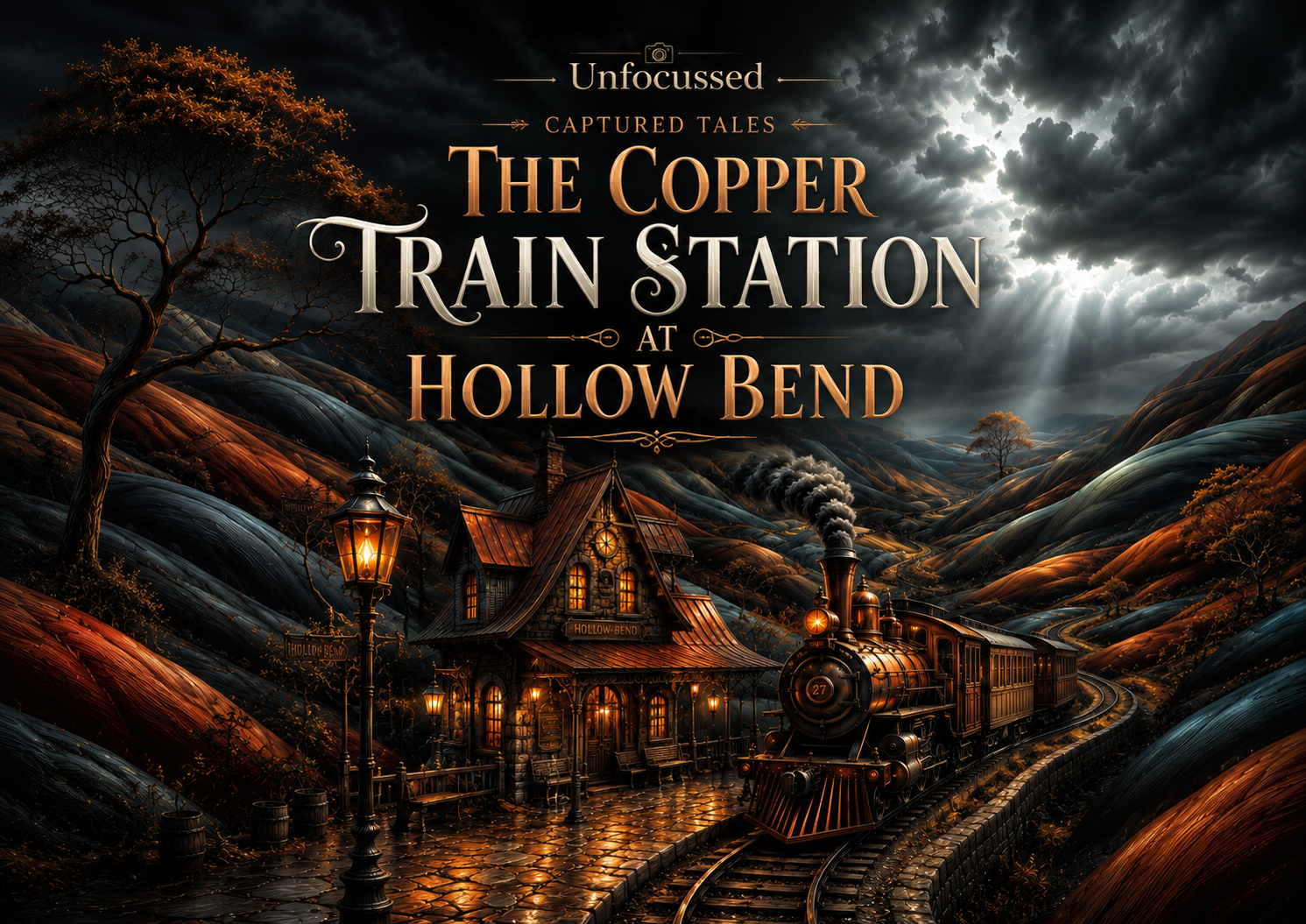
The station itself sat glowing at the bend in the rails like a stubborn ember in the throat of the mountains. Its stone walls were black with rain, its copper roof shining in warm streaks beneath the lamps. The sign above the platform read HOLLOW BEND in letters that had survived five mayors, seven scandals, one goat uprising, and a failed attempt to rename the town “New Pleasantford,” which everyone agreed sounded like a place where happiness went to be taxed.
Inside the station, the clock above the ticket window ticked toward midnight with the smugness of something that knew more than anyone else in the room.
Mabel Thorne hated that clock.
She hated smug objects in general. Mirrors that made decisions. Kettles that whistled judgmentally. The grandfather clock in her parlor that refused to tick during arguments unless she was losing. But the Hollow Bend station clock had always been the worst of them. It ran slow for funerals, fast for weddings, and backward whenever the town council discussed budgets, which Mabel privately considered its only redeeming quality.
She sat on the third bench from the ticket window, gloved hands folded over a wicker basket in her lap, and gave the clock the same look she gave men who explained soup to her.
Unimpressed. Prepared. Potentially armed.
Mabel had been a widow for nine years, six months, and one aggressively unnecessary Tuesday. Her late husband, Silas Thorne, had died during a storm much like this one, though Mabel had never cared for that version of the story. People said Silas had gone walking along the old rail line and been taken by a landslide. People also said ducks were harmless and Mayor Whitlock’s daughter had “a gift for theater,” so clearly people were capable of enormous nonsense.
There had been no body. No hat. No boots. No silver flask, though Mabel had later found that under the floorboards with a note reading For emergencies, anniversaries, and visits from your mother. There had only been a muddy stretch of track, a snapped walking stick, and Silas’s pocket watch stopped at exactly 12:07.
Mabel had buried an empty coffin because that was what respectable people did when grief turned up without paperwork.
But she had never believed Silas was gone in the ordinary way.
That was why, when the ticket appeared that morning in her sugar tin, she did not scream. She did not faint. She did not summon Reverend Bellwether, who had a kind heart but perspired heavily around omens. She simply lifted the small copper-edged slip between two fingers, read the words printed on it, and said, “Oh, now he remembers how to send notice.”
The ticket read:
Midnight Fare to Elsewhere
Passenger: Mabel Thorne
Claim: Silas Thorne
Platform: Hollow Bend
Baggage Limit: One regret, one question, and no poultry
Mabel had stared at the last line for quite some time.
She owned no poultry. She had once owned a rooster named Captain Filth, but Captain Filth had vanished after attacking a tax assessor and was still considered a local hero. The baggage warning felt personal anyway.
So she had packed accordingly.
In her basket were two cheese pasties wrapped in cloth, three ginger biscuits, a small jar of pickled onions, a handkerchief, a brass hatpin sharp enough to settle theological disputes, a flask of blackberry cordial that had never once contained only cordial, and a folded letter she had written to Silas Thorne every year since he disappeared. She had not brought regret. Regret was bulky, and Mabel disliked traveling with anything that wrinkled.
Across from her, Stationmaster Juniper Bell pretended to polish the ticket counter with a rag that had long since surrendered. Juniper was thirty-two, wore her hair in a black braid down her back, and had inherited the station from her grandfather, who had inherited it from a woman no one could remember but whose portrait occasionally changed outfits. Juniper took her work seriously, which in Hollow Bend meant she wore a uniform, carried a whistle, and knew when to lie convincingly to outsiders.
“You don’t have to go,” Juniper said, not looking up.
Mabel sniffed. “I am aware. I have spent my life not doing things I don’t have to do. Gardening. Smiling at men in waistcoats. Attending poetry evenings after someone says, ‘This one’s a bit experimental.’”
Juniper set the rag down. “Elsewhere isn’t a place people visit for curiosity.”
“I’m not curious.”
“You brought a basket.”
“I’m hungry.”
“You brought your best hatpin.”
“I may be hungry near a fool.”
Juniper’s mouth twitched. “Mrs. Thorne.”
“Mabel, if you’re going to warn me about supernatural consequences. Mrs. Thorne if you’re about to ask for a donation to repair the platform roof.”
The station shuddered as thunder rolled over the valley. One of the lamps flickered blue, thought better of it, and returned to amber.
Juniper lowered her voice. “The Midnight Fare doesn’t return everyone who boards.”
“Most trains don’t return anyone who boards. That’s rather the point of travel.”
“That isn’t what I mean.”
“I know what you mean.” Mabel looked toward the rain-streaked windows. Beyond the glass, the rails curved out of the station and vanished into the dark hills, shining like two black ribbons pulled tight through the valley. “But I have spent nearly ten years listening to people tell me Silas is dead, lost, gone, remembered, at peace, watching over me, or waiting in a better place. I have endured casseroles from women who cook grief into lumps. I have nodded through sermons delivered by men who think loss becomes tidy if they use enough metaphors about doors.”
Her fingers tightened on the basket handle.
“If there is a train willing to take me somewhere less infuriating than uncertainty, I intend to board it.”
Juniper watched her for a long moment. Outside, the rain hammered harder against the platform roof.
“What if Silas doesn’t want to be claimed?” she asked.
Mabel’s expression sharpened.
“Then he can explain that to my face like a man with functioning kneecaps.”
Juniper made a small sound that may have been a laugh and may have been fear wearing a hat.
At eleven forty-seven, the first impossible passenger arrived.
He came through the station door without opening it, which was generally frowned upon but not unheard of during Midnight Fare weather. He was a thin man in a moth-eaten frock coat, carrying an umbrella that dripped dust instead of rain. His mustache curled upward at both ends in a manner that suggested he had been deeply annoying before death and had seen no reason to improve.
“Is this the waiting room for Elsewhere?” he asked.
Juniper lifted a ledger. “Name?”
“Percival Grint.”
She ran her finger down the page. “Lost item?”
“My dignity.”
Juniper paused. “Circumstances?”
“Accordion accident.”
“Platform two.”
Percival Grint drifted away, muttering that the accordion had been poorly maintained and the goat had come from nowhere.
Mabel watched him pass. “That man is not getting his dignity back.”
“No,” Juniper agreed. “But the train lets them try.”
After him came a young woman in a wedding gown hemmed with river mud, looking for a promise she had dropped in 1912. Then a boy with silver freckles arrived to claim a laugh he had lost after his father died. Then a baker from three towns over came for a recipe stolen by his great-aunt and hidden in a dream. Hollow Bend residents began filling the station in cautious clusters, some living, some dead, some difficult to categorize without insulting them.
Nobody sat beside Mabel.
This was partly because she had arranged her basket and umbrella in a way that suggested the bench was full, and partly because Mabel had once ended a church raffle dispute by saying, “I know where everyone’s skeletons are, and two of them still owe me money.” The town had respected her personal space ever since.
At eleven fifty-three, Mayor Whitlock entered wearing his ceremonial sash over a raincoat, proving once again that authority and taste had never been properly introduced.
“Good evening, citizens,” he announced.
“No,” said at least four people.
The mayor cleared his throat. “As your elected representative, I am here to ensure that tonight’s annual supernatural railway occurrence proceeds in an orderly fashion, with due regard for civic—”
The station clock struck once, though it was not yet midnight.
The mayor stopped speaking.
Everyone looked at the clock.
The minute hand twitched.
Juniper paled.
Mabel leaned forward. “That clock had better not be starting something it cannot finish.”
The clock struck again.
Outside, far down the valley, a whistle sounded.
It was not loud at first. It slipped through the storm like a secret being told from mountain to mountain. Low, mournful, coppery, with a strange bright edge that raised the hairs on every living arm in the station and made every ghost stand a little straighter.
The room went silent.
Even Mayor Whitlock had the good sense to shut up, which several residents later agreed was the evening’s first true miracle.
The whistle came again, closer this time.
Juniper moved to the platform doors. Her hand rested on the brass latch, but she did not open it yet. “Tickets ready,” she said.
People began patting pockets, sleeves, bodices, hatbands, and in one case a suspiciously lively beard. Copper-edged tickets appeared from purses, coat linings, old wounds, closed fists, and memories. Mabel took hers from the inner pocket of her coat.
It had warmed against her body.
The letters seemed darker now, as though the ink had soaked itself in the storm.
Claim: Silas Thorne
Something inside her chest moved. Not softened. Mabel did not soften without written consent. But something shifted, old and buried and tired of being well-behaved.
She remembered Silas standing in their kitchen in shirtsleeves, flour on his jaw because he had tried to bake bread as an apology for something he refused to name. She remembered him laughing in the garden, hands muddy, face tipped toward the rain. She remembered the night before he vanished, when he had stood at the bedroom window watching lightning over the hills and said, “There are some roads that don’t stay where they’re put.”
She had told him not to get poetic before bed because it led to either melancholy or trousers on the floor.
He had smiled, but he had not laughed.
That was the part she remembered most.
The not laughing.
The platform lamps outside flared high, their amber flames turning copper-red. Steam rolled past the windows, thick and black-edged, pressing against the glass like breath from some great iron beast.
Juniper opened the doors.
Engine 27 slid into Hollow Bend Station as if it had been forged from thunder and bad intentions.
Its copper boiler gleamed beneath the storm, wet and hot and alive with reflected lantern light. Black smoke poured from its stack and curled into the low clouds, where it twisted into shapes Mabel chose not to recognize. The headlamp burned like a single golden eye. Along the side of the engine, the number 27 glowed in dull red metal, as though heated from within.
The train’s carriages stretched behind it along the curve of the track, each one lit by small windows. Figures moved inside. Some were seated. Some stood too still. Some pressed pale hands to the glass.
The engine hissed.
The station answered with a groan from its old beams.
Then the conductor stepped down.
He was tall, though not in a way that made measurement seem useful. His uniform was dark green with copper buttons, his gloves black, his cap pulled low over eyes that reflected lamplight without revealing their color. A silver chain crossed his waistcoat, and from it hung a watch shaped like a tiny closed door.
He looked at the gathered passengers and smiled.
It was a polite smile.
That made it worse.
“Good evening,” he said. His voice carried through the storm without effort. “Passengers for Elsewhere, present your tickets. Claimants must understand that what is lost may be changed, what is found may not be kept, and what is owed may collect interest.”
Mrs. Dapple whispered, “That last bit sounds like my bank.”
The conductor’s gaze moved over the platform and found Mabel.
She did not look away.
He approached her with the smooth patience of someone who had never once been hurried by a mortal woman and was about to have an educational evening.
“Mrs. Mabel Thorne,” he said.
“Widow Thorne, if we’re being accurate. Mabel, if we’re being tolerable.”
His smile deepened by a fraction. “You intend to claim Silas Thorne.”
“I intend to have a conversation with Silas Thorne. Claiming may follow, depending on his answers and general condition.”
“He has been in Elsewhere a long time.”
“Yes, well, he always did take ages in shops.”
The conductor tilted his head. “You are not afraid?”
Mabel gave him a look that had curdled milk, ended flirtations, and once made a lawyer apologize to a chair.
“Young man, I have cleaned chamber pots, raised three sons, survived a winter with my sister-in-law, and attended a town meeting where seventeen adults debated the moral character of a scarecrow. Fear and I know each other. We are not close.”
Behind her, someone made an appreciative noise.
The conductor held out his gloved hand.
Mabel placed the ticket in it.
The copper edge flashed bright as a struck match. The conductor looked down, and for the first time, his expression changed. Not much. But enough.
Juniper saw it too. “Is there a problem?”
“No,” said the conductor.
“That was a problem-shaped no,” Mabel said.
He returned the ticket to her. “Your claim is valid.”
“How generous of reality to agree with me.”
“But unusual.”
“I am not charging extra for that.”
The conductor stepped aside and gestured toward the nearest carriage. Its door opened with a sigh, spilling warm golden light across the wet platform.
Passengers began boarding one by one. Percival Grint clutched his dignity ticket and tripped over nothing. The bride in the muddy gown lifted her skirts and stepped inside without a sound. The boy with silver freckles looked back only once before disappearing into the glow.
Mabel stayed where she was for a moment.
The storm raged over Hollow Bend. The mountains hunched dark around the valley. The station lamps burned brave and small against the rain. Through the carriage windows, she saw reflections of faces she did not know, landscapes that did not match the valley, and, for one heartbeat, a kitchen table she had not seen in nearly ten years.
At that table sat a man with flour on his jaw.
Mabel’s breath caught.
Then the image vanished.
“Mrs. Thorne?” Juniper said softly.
Mabel adjusted her hat, lifted her basket, and squared her shoulders.
“If my house burns down while I’m gone, tell Mrs. Dapple she may rescue the blue teapot but not the lace curtains. She has always coveted them with unchristian intensity.”
Juniper swallowed. “I’ll keep an eye on things.”
“And don’t let the mayor organize a memorial. He rhymes under pressure.”
“I won’t.”
Mabel nodded once and stepped onto the train.
The carriage smelled of rain, coal smoke, old velvet, and something sweetly rotten, like flowers left too long in a room after bad news. Rows of polished wooden seats lined the aisle. Brass lamps swung from the ceiling. Each seat had a small nameplate fixed above it, engraved in neat black letters.
Mabel walked down the aisle, passing names she recognized from town records, gossip, and tombstones.
Agnes Bell: Lost courage.
Tom Wicker: Lost dog, possibly wolf, answer unclear.
Mayor Alton Whitlock: Lost public trust.
She snorted. “Optimistic.”
At the end of the carriage, she found her seat.
The nameplate read:
Mabel Thorne: Claiming Silas Thorne.
Beneath it, in smaller letters that had not been there when she first looked, another line slowly etched itself into the brass.
Warning: Subject may not be deceased.
Mabel stared at it.
Behind her, the carriage door closed.
The whistle screamed.
And from the seat across the aisle, a little girl with rainwater dripping from her braids looked up and said, “Oh good. You’re here for the man who lied to the dead.”
Mabel lowered herself into her seat, set her basket carefully on her lap, and removed one ginger biscuit.
“Then,” she said, breaking it cleanly in half, “he had better hope they were forgiving.”
The Place Where Misplaced Things Go to Sulk
The little girl with the dripping braids had the expression of someone who knew several terrible secrets and had been waiting a long time to ruin someone’s evening with them.
Mabel Thorne had known children like that. Mostly her own.
“The man who lied to the dead,” Mabel repeated, holding half a ginger biscuit between two fingers. “That is either a very serious accusation or the title of a dreadful village play.”
The girl blinked rainwater from her lashes. She looked no older than nine, though death had a way of making age unreliable. Her boots did not touch the floor. A thin ribbon hung loose at her collar, dark blue and soaked through, and her skin had the pale softness of candle wax left too close to a window.
“It’s what they call him,” the girl said.
“Who are ‘they’?”
She pointed vaguely toward the rear of the train.
Mabel glanced back. The carriage behind hers was connected by a narrow glass door, beyond which shadows moved in the amber light. Some were shaped like people. Some were shaped like people who had made very poor choices in life and continued making them afterward for consistency.
“The dead,” the girl said.
“That does narrow it down aboard this train, but not in a comforting way.”
The girl’s mouth twitched.
Mabel offered her the other half of the biscuit. “Name?”
“Elsbeth Vale.”
“Mabel Thorne.”
“I know.” Elsbeth accepted the biscuit, though when she bit into it, no crumbs fell. “Everyone knows.”
“I have worked hard for that.”
The train gave a deep shudder. Outside the window, Hollow Bend Station began to slide away. Mabel saw Juniper Bell standing beneath the platform lamps, one hand pressed to her chest, face pale in the copper light. Beyond her, Mayor Whitlock lifted a hand as if offering a formal civic farewell, then immediately ruined the dignity of it by slipping on wet cobblestones and grabbing Mrs. Dapple’s shoulder.
Mrs. Dapple shoved him off with the practiced efficiency of a woman removing a spider from a teacup.
Then the station vanished behind steam.
The world outside the window changed.
At first, it was only the valley at night. Wet rails gleamed beneath the engine. The storm strobed across the hills in white flashes, revealing the rust-orange slopes and black trees of Hollow Bend. Mabel could still see the road curling along the ridge, the small lamps of cottages, the crooked steeple of the church where Reverend Bellwether regularly lost theological arguments to mildew.
Then the hills folded.
It happened without drama, which made it worse. The landscape simply bent inward, like paper creased by unseen hands. The road lifted into the air. The church steeple turned sideways. The river rose in a silver ribbon and threaded itself through the clouds. For one breathless moment, Mabel saw Hollow Bend from every direction at once: above, below, behind, remembered, regretted.
Then the train plunged through a wall of rain.
On the other side, there was no storm.
There was only Elsewhere.
Mabel leaned toward the window despite herself.
Elsewhere was not a land, not properly. It was a great valley of things misplaced by the living and the dead, spread beneath a sky the color of old pewter. Hills rose in soft, impossible shapes, stitched with roads that began nowhere and ended in sighs. Trees grew with keys instead of leaves. Rivers carried buttons, coins, letters, names, and little folded maps to places that had never existed. Lanterns drifted over the fields like thoughtful fireflies. Far in the distance, a mountain turned slowly in its sleep.
Along the track, entire orchards of umbrellas bloomed upside down.
Mabel watched a flock of lost gloves migrate across the plain, flapping their fingers.
“Ridiculous,” she said.
Elsbeth nodded. “Yes.”
“I didn’t say I disliked it.”
The girl’s ghostly mouth curved. “No one does at first.”
The train rocked around a bend, and the carriage lamps dimmed to a deep honey glow. Nameplates above the seats began to rattle softly. One by one, the engraved claims shifted.
Percival Grint: Lost dignity.
The brass plate flickered.
Percival Grint: Lost dignity, trousers, and public favor.
From two rows ahead, Percival made a wounded noise. “The trousers were implied.”
“They were not,” said a woman in the next seat. “I was there.”
Mabel looked up at her own nameplate.
Mabel Thorne: Claiming Silas Thorne.
Beneath it still glowed the warning:
Subject may not be deceased.
As she watched, a third line appeared, etched slowly and deliberately into the brass.
Claim contested.
Mabel’s biscuit paused halfway to her mouth.
“By whom?” she demanded.
The nameplate offered no answer.
“Cowardly bit of metal.”
Elsbeth hugged her knees. “Elsewhere contests everything eventually. It doesn’t like giving things back.”
“Then Elsewhere has poor manners and a hoarding problem.”
“That too.”
A bell rang from the front of the train, not bright like a station bell, but low and thick, as though struck underwater. The conductor’s voice drifted through the carriages.
“Passengers are reminded not to reach through the windows, accept gifts from memories, or attempt conversation with any former versions of themselves encountered along the route. They are notoriously persuasive and usually underdressed.”
A man several seats back groaned. “That happened once.”
“Twice,” said his wife.
“You were meant to be asleep.”
“You were meant to be faithful.”
Silence fell with the heaviness of furniture being moved in another room.
Mabel nodded approvingly. “Good for her.”
The train passed through a field of lost songs. They rose from the grass as the engine roared by, hundreds of half-remembered tunes fluttering against the windows. Lullabies, tavern ballads, hymns, courting songs, songs hummed by mothers who had forgotten the words but not the babies. One tune pressed itself to Mabel’s glass, soft and lilting.
She knew it.
Silas had sung it under his breath when he mended fences, always pretending not to know he sang off-key. Mabel had once told him his voice was what happened when a hinge gained confidence.
The song trembled against the window.
Mabel touched the glass.
It fled.
She withdrew her hand quickly and folded it back over the basket.
“Where is he?” she asked.
Elsbeth looked at her biscuit. “Silas?”
“No, the wheelbarrow’s second husband. Yes, Silas.”
The girl hesitated.
“Child,” Mabel said, “I have raised sons, buried friends, outlived enemies, and once negotiated a church supper seating arrangement during a feud involving three sisters and one immoral ham. Do not mistake me for someone who enjoys being eased toward bad news.”
Elsbeth swallowed, though Mabel suspected she no longer needed to.
“He’s at the Terminus.”
“Is that good?”
“No.”
“Useful answer. Lacking in garnish.”
“The Terminus is where the hardest things are kept.”
“Such as?”
“Names no one speaks anymore. Homes that stopped waiting. Promises people made while dying. Last looks. First lies.”
“And Silas?”
Elsbeth nodded.
Mabel stared out the window. Elsewhere rolled by in silver-gray distances and amber sparks. It was beautiful in the way a locked chest was beautiful: all polish, hinges, and suspicion.
“What did he lie about?” Mabel asked.
Elsbeth did not answer immediately.
The train entered a cut between two steep hills made entirely of stacked books. Their covers were blank. Their pages fluttered open in the wind, filled with sentences that vanished before Mabel could read them.
“Those are lost endings,” Elsbeth said quietly. “Stories people never finished. Letters they couldn’t send. Apologies they rehearsed until death got bored waiting.”
“Death lacks patience?”
“Not usually. But even Death has limits around stubborn men.”
Mabel’s eyes narrowed. “You’re avoiding the question.”
“Yes.”
“At least you’re honest.”
“I’m dead. It saves time.”
Mabel almost smiled.
Almost.
The carriage door at the front opened, and the conductor entered.
Conversation dimmed. Even the nameplates stopped rattling. He moved down the aisle with his hands folded behind his back, copper buttons gleaming. The lamps swung as he passed, bowing toward him slightly, which Mabel thought was unnecessary and likely to encourage his ego.
He stopped beside her seat.
“Mrs. Thorne.”
“We discussed names.”
“Mabel.”
“Better. Slightly.”
His gaze flicked to Elsbeth. “Miss Vale, you are not assigned to this carriage.”
Elsbeth straightened. “I know.”
“Then perhaps you should return to your seat.”
Mabel lifted her basket. “She is sharing my provisions.”
“Ghosts do not require provisions.”
“Men do not require ceremonial buttons, but here we are.”
A strangled cough came from somewhere behind them.
The conductor’s polite smile returned, crisp as folded paper. “Your claim is contested.”
“So the brass tattled.”
“The rules of Elsewhere are older than the rails, and more stubborn than grief.”
“That sounds like something embroidered on a pillow by a woman no one invites twice.”
“You may find humor less useful at the Terminus.”
“Then I shall use it wastefully beforehand.”
The conductor studied her. The lamps reflected in his eyes, but still did not reveal their color.
“Silas Thorne entered Elsewhere alive,” he said.
Mabel went very still.
Elsbeth looked down at her biscuit.
Somewhere in the carriage, Percival Grint whispered, “Oh, that’s not good.”
“No one asked you, Accordion,” Mabel said without looking away from the conductor.
Percival shrank into his seat.
The conductor continued. “A living soul may pass through Elsewhere, but it may not remain without consequence. Silas remained.”
“Why?”
“That is the question you are permitted to ask him.”
“I am permitted to ask him as many questions as I please.”
“You may ask. Elsewhere may not allow answers.”
Mabel’s voice cooled. “I do not care for this place.”
“Most claimants don’t, once it starts being honest.”
“You said he lied to the dead.”
“I did not.”
“The child did.”
Elsbeth raised one hand a little. “I did.”
The conductor’s jaw tightened. “Silas Thorne committed an offense against the order of this realm.”
“Did he kill someone?”
“No.”
“Steal something?”
“Not in the simple sense.”
“That phrase is beloved by people hiding the expensive version of a problem.”
The conductor took the ticket from her nameplate and turned it over. On the back, new writing burned into the copper edge.
Debt outstanding.
Mabel read it twice.
“Whose debt?”
“His.”
“Then send him a bill.”
“We did.”
“To my sugar tin?”
“To you.”
Her eyes sharpened. “I am not his purse.”
“No,” the conductor said. “You are his anchor.”
The train burst out of the book-hills into open country. The sky over Elsewhere had darkened to a bruised violet. Ahead, far across the valley, Mabel saw a city of platforms and copper roofs rising from the mist. Tracks streamed toward it from every direction: straight tracks, twisted tracks, tracks that looped into the air, tracks that vanished into mirrors, tracks that appeared to be made of bone, though Mabel decided not to inspect that thought closely.
At the center of the city stood a clock tower with no hands.
“The Terminus,” Elsbeth whispered.
The conductor handed Mabel back her ticket.
“At the Terminus, you may enter the Hall of Claims. If Silas Thorne agrees to be returned, and if his debt can be settled, you may take him back to Hollow Bend before dawn.”
“And if he does not agree?”
“Then you may return alone.”
“And if the debt cannot be settled?”
The conductor’s smile disappeared.
“Then Elsewhere keeps what it is owed.”
Mabel looked at Elsbeth. The girl had gone very quiet.
“Which is?” Mabel asked.
The conductor tucked his hands behind his back. “The truth.”
Mabel laughed once. It was not a pleasant laugh. It had edges.
“My husband vanished for nearly ten years, left me to bury an empty coffin, and now I’m told a haunted railway has been collecting interest on truth? That is the sort of arrangement men invent when they’re allergic to accountability.”
“You will find accountability abundant in Elsewhere.”
“Good. I’ve brought a basket.”
The conductor bowed slightly and moved on.
As he reached the next row, the wife who had earlier exposed her husband’s former-version problem raised her hand.
“Conductor?”
“Yes, Mrs. Fen?”
“If someone’s lost item is ‘common sense,’ and they refuse to claim it, may I claim it on their behalf?”
Her husband stiffened.
The conductor glanced at the man, then back at her. “Not unless it was legally shared property.”
“We’ve been married forty-one years.”
“Then you may file a grievance at Window Nine.”
“Thank you.”
Her husband whispered, “Clara.”
“You had your chance, Edwin.”
Mabel liked Clara Fen immediately.
The train began to slow as it approached the Terminus. Outside, the ground changed from pale grass to cobblestones, then to platforms crowded with lost things and those who had come to claim them. There were men chasing hats that clearly did not wish to be caught, women holding jars of fireflies that blinked in the patterns of old addresses, children reaching for toys that grew older the closer they came.
A line of bar tabs shuffled past on tiny paper legs.
Mabel watched one leap into a fountain to avoid a red-faced man in a waistcoat.
“Coward,” she muttered, though she respected the instinct.
They passed a platform marked UNPAID DEBTS, MORAL AND OTHERWISE. It was packed.
Beside it stood another marked VANISHED LOVERS. That one was also packed, though with considerably better hats.
A third platform read MAYORS NO ONE TALKS ABOUT.
Mabel leaned closer to the window.
On the platform stood six men in sashes, two women in feathered hats, and one goat wearing a chain of office.
“I knew it,” she said.
Elsbeth followed her gaze. “Knew what?”
“Captain Filth didn’t vanish. He went into politics.”
The goat looked up as the train passed and winked.
Mabel chose to take this as confirmation and not affection.
Engine 27 pulled into the Terminus beneath a roof of black glass veined with copper light. Steam billowed across the platform. Bells rang. Doors opened. The carriages exhaled passengers into the strange, bustling half-world of Elsewhere.
Mabel stepped down carefully, her boots landing on polished stone that felt warm through the soles. The air smelled of coal smoke, rain, ink, old wool, roses, dust, and the faint metallic tang of secrets kept too long.
Above her, signs swung from iron chains:
CLAIMS
RETURNS
UNANSWERED QUESTIONS
OBJECTS THAT BITE
REGRETS, LIGHTLY USED
DO NOT FEED THE ALMOSTS
The station was crowded beyond reason. A woman argued with a clerk over a missing summer. A soldier stood holding both of his hands in a wooden box, looking grateful and horrified. A young man wept over a small blue marble. An elderly ghost demanded to speak to management because the afterlife had misplaced her favorite insult.
“It was a good one,” she insisted. “Had teeth in it.”
Mabel moved through the crowd with the efficient impatience of a woman navigating a market the day before a snowstorm. People shifted aside. Ghosts shifted aside faster.
Elsbeth followed close behind.
“Why are you coming with me?” Mabel asked.
“I know the way.”
“So does the conductor.”
“He knows the rules.”
“And you?”
Elsbeth looked up at the signs. Her face seemed smaller under the vast copper roof. “I know what they cost.”
Mabel accepted that.
They crossed the main concourse toward the Hall of Claims. The doors were enormous, carved with scenes of people losing things in spectacularly human ways: a man tossing a ring into a river and regretting it immediately; a woman dropping a letter into a fire with theatrical resolve and then trying to grab it back; a boy turning away from a friend in anger; a king misplacing an entire country by being smug near a map.
At the base of one door, someone had carved a man standing on a railway line in a storm.
Mabel stopped.
The man’s coat whipped around him. His head was turned as if he had heard someone call his name. In one hand, he held a lantern. In the other, a pocket watch.
Silas.
The carved face was small, but she knew the tilt of it. Knew the stubborn brow, the nose broken once in youth and twice by pride, the mouth that had charmed her before she learned to distrust charm on principle.
Mabel touched the carving.
It was warm.
The door groaned open.
The Hall of Claims stretched before them, long and high and lined with counters. Clerks sat behind brass grates, each with ink-black fingers and expressions of eternal disappointment. Shelves climbed the walls into darkness, packed with boxes, jars, ledgers, birdcages, mirrors, shoes, teeth, vows, maps, clocks, and little bundles tied with string.
Everywhere, people waited.
At Window Three, a man was trying to reclaim his youth and being told it had already been checked out by his grandson. At Window Twelve, a ghost argued that her lost patience had been missing since 1874 and surely qualified as antique property. At Window Seventeen, a woman received a jar containing her first kiss, opened it, sniffed, and said, “Absolutely not, I had better taste than this.”
The clerk said, “Records indicate otherwise.”
Mabel admired the clerk’s bravery.
Elsbeth led her to a counter beneath a sign reading CONTESTED CLAIMS AND UNFORTUNATE REVELATIONS.
“Promising,” Mabel said.
The clerk behind the grate was a narrow person of uncertain age with spectacles perched at the end of a nose sharp enough to slice pastry. Their hair was pinned into a bun with three quills. Their nameplate read MISS OR MR. VELL, DEPENDING ON TONE.
“Ticket,” Vell said without looking up.
Mabel slid it under the grate.
Vell examined it, then examined Mabel over the spectacles.
“Mabel Thorne.”
“So it says.”
“Claiming Silas Thorne.”
“Also included in the reading materials.”
“Subject alive.”
Mabel’s throat tightened despite her best efforts. “Apparently.”
“Subject retained under Article Seven of the Unfinished Passage.”
“I did not bring my law spectacles.”
“A living traveler who enters Elsewhere and interferes with rightful claims may be held until balance is restored.”
“What did he interfere with?”
Vell reached beneath the counter and produced a ledger so large it landed with a sound that made nearby claimants flinch. Dust rose from its cover in a puff of tiny gray faces that sneezed and disappeared.
They opened the ledger.
“Silas Thorne arrived nine years, six months, and one aggressively unnecessary Tuesday ago.”
Mabel frowned. “That is exactly how I count it.”
“Elsewhere appreciates precision.”
“Elsewhere has been reading my diary?”
“Elsewhere reads everything that is not nailed down, and several things that are.”
Vell turned a page. “Upon arrival, Silas Thorne sought to retrieve a lost road.”
“A road?”
“Yes.”
“People can lose roads?”
Vell looked over the spectacles again. “People lose themselves. Roads are considerably easier.”
Mabel thought of Silas at the bedroom window, lightning in his eyes.
There are some roads that don’t stay where they’re put.
Her jaw tightened. “What road?”
“The Hollow Road.”
Elsbeth made a small sound.
Mabel turned to her. “You know it?”
The girl nodded. “Everyone here knows it.”
Vell tapped the ledger. “The Hollow Road once connected Hollow Bend to Elsewhere by foot. It allowed the living and dead to pass too easily between realms. It was sealed generations ago after a series of unpleasant incidents involving inheritance disputes, premature hauntings, and one deeply inappropriate harvest festival.”
“How inappropriate?” Mabel asked despite herself.
“A pumpkin was elected coroner.”
“That’s politics, not scandal.”
“The pumpkin won by blackmail.”
Mabel paused. “Carry on.”
“Silas Thorne discovered that the road was resurfacing during storms near Hollow Bend. He entered Elsewhere to close it.”
Mabel stared at the ledger.
For a moment, the station noise dulled around her. Clerks argued, claimants wept, bells rang, but all of it seemed to sink underwater.
“Why would he do that?” she asked.
Vell’s expression did not change. “Records indicate he believed the road would open beneath his home.”
Mabel’s fingers curled around the counter edge.
“Our home.”
“Yes.”
“And he came alone?”
“Yes.”
“Without telling me?”
“Yes.”
Her voice dropped. “That absolute cabbage-brained martyr.”
Elsbeth’s eyes widened.
Vell dipped a quill into black ink. “Would you like that entered into the official record?”
“In capital letters.”
Vell wrote it down.
Mabel inhaled slowly through her nose. It did not help. “You said he lied to the dead.”
Vell turned another page.
“After entering Elsewhere, Silas Thorne encountered a procession of claimants attempting to return through the Hollow Road into the living valley.”
“Dead claimants?”
“Some dead. Some lost. Some neither. Several inadvisable.”
“And?”
“He told them the road led home.”
“But it didn’t?”
“It led deeper into Elsewhere.”
Mabel went still.
Elsbeth looked away.
Vell continued, voice dry and even. “By misleading them, he prevented the Hollow Road from opening into Hollow Bend. He also trapped forty-seven claimants beyond their assigned passage, unlawfully redirecting the dead under false pretenses.”
Mabel’s mouth went dry.
“He saved the town.”
“Yes.”
“And damned himself?”
“That language is imprecise.”
“I am not currently concerned with precision.”
“Then yes.”
For the first time since boarding the train, Mabel felt something inside her falter.
Not break. She had broken before and learned that people expected gratitude if they noticed. This was different. This was the ground in her memory shifting under the weight of a truth she had not asked for but had chased anyway.
Silas had not left her.
He had not died in the ordinary way.
He had done something brave, stupid, secretive, infuriating, and exactly like him.
Mabel closed her eyes.
“I am going to kill him,” she said.
Vell checked the ledger. “That may complicate retrieval.”
“Only emotionally.”
Elsbeth whispered, “He didn’t just lie to them.”
Mabel opened her eyes.
The girl’s face had gone paler than before. The blue ribbon at her collar trembled though there was no wind in the Hall of Claims.
“Elsbeth,” said Mabel carefully.
“I was one of them.”
The words landed softly.
Too softly.
Mabel looked from Elsbeth to the ledger. “You were on the road.”
The girl nodded.
“You were trying to return home.”
“I was trying to find my mother.”
Mabel’s anger changed shape. It did not vanish. Anger rarely did, if it had good posture. But it bent, curved around the child in front of her, and became something sharper and more careful.
“And Silas told you the road led home.”
Elsbeth’s eyes shone with water that might have been rain and might not. “He said if we followed him, we would see the people we loved again.”
Mabel said nothing.
“Some of them believed him because he was alive. Living voices carry differently here.” Elsbeth looked down at her hands. “We followed him into the Deep Platforms. The road closed behind us. Some of the dead forgave him when they learned what would have happened if we crossed into Hollow Bend. Some didn’t.”
“And you?” Mabel asked.
Elsbeth’s biscuit had vanished from her fingers. “I don’t know.”
Vell cleared their throat with the air of a clerk who found feelings disruptive to paperwork.
“Silas Thorne’s current debt consists of forty-seven misdirected claims, one sealed road, and one withheld truth.”
Mabel looked up. “What withheld truth?”
Vell’s quill paused.
“That portion is restricted until the claimant meets the subject.”
“I dislike you.”
“Many do. Please initial here.”
A small form slid under the grate.
Mabel did not take it. “Where is he?”
“Deep Platform Seven.”
A murmur rippled through the nearby clerks. Even the woman at Window Seventeen stopped insulting her first kiss.
Vell closed the ledger. “You may see him. You may ask him one question that Elsewhere must permit him to answer truthfully.”
“One?”
“One.”
“That is a sadistic number.”
“It is traditional.”
“Tradition is frequently sadism with candles.”
Vell slid the form closer. “After the question, Silas Thorne must decide whether to return. If he refuses, your ticket expires. If he agrees, the debt must be settled before dawn.”
“How does one settle forty-seven misdirected claims?”
“By returning them to their rightful passage.”
“And if that passage is sealed?”
“Then it must be reopened.”
Elsbeth sucked in a breath.
Mabel understood at once.
“The Hollow Road.”
Vell nodded.
“If we reopen it, won’t it threaten Hollow Bend again?”
“Likely.”
“Your workplace has a customer service problem.”
“You may file a complaint at Window Nine.”
“I suspect Window Nine is where hope goes to decompose.”
“Also accurate.”
Mabel picked up the form. It was titled:
Temporary Authorization to Visit a Living Man Who Has Been Kept Too Long in a Place That Enjoys Technicalities
“This title is doing too much,” she said.
Vell handed her a quill.
She signed.
The ink flashed copper-red, then sank into the paper like blood into cloth.
Somewhere beneath the Hall of Claims, a gate unlocked.
Elsbeth stepped closer to Mabel. “You don’t have to go down there.”
“People keep saying that to me tonight. It’s becoming tedious.”
“Deep Platform Seven changes people.”
“So does marriage.”
“It shows you what you lost.”
Mabel looked toward the far end of the hall, where a stairway descended between two iron lamps. The steps were narrow, dark, and slick with condensation. A sign above them read:
AUTHORIZED CLAIMANTS ONLY. NO REFUNDS. NO HEROICS WITHOUT PROPER FOOTWEAR.
Mabel glanced down at her boots.
“Adequate.”
Vell stamped her ticket. “You have until the first gray of dawn. Do not accept substitutions. Do not trade your name. Do not follow any voice that calls you sweetheart unless it can correctly identify your preferred method of making soup.”
“Silas always put too much pepper in everything.”
“Then beware pepper.”
Mabel tucked the ticket into her coat.
Elsbeth reached for her sleeve but stopped short. “I’ll come with you.”
“You don’t have to.”
The girl gave her a faint look.
Mabel sighed. “Yes, yes. Tedious.”
Together they crossed the Hall of Claims and descended the stairs.
The air changed after the first turn. The warmth of the Terminus faded. The lamps grew fewer, each flame burning low and blue. The walls were made of brick, then stone, then packed earth threaded with roots that whispered as Mabel passed. The sounds of the Hall faded overhead until all she could hear was the tap of her boots, the distant drip of water, and Elsbeth’s silent presence beside her.
After seven flights, they reached a tunnel.
Tracks ran through its center, black and gleaming.
A small platform waited beyond, lit by a single copper lamp.
Deep Platform Seven.
It was smaller than Mabel expected. No crowd, no clerks, no signs beyond a tarnished plaque nailed crookedly to a post. The platform faced a dark stretch of track that seemed to run into nothing at all. Along the wall stood shelves filled with lanterns, each one containing a tiny moving scene.
Mabel approached one.
Inside the glass, a younger version of herself stood in her kitchen, laughing despite trying not to. Silas was on his knees, retrieving a dropped spoon, making some foolish comment that had clearly pleased him. Mabel watched her own younger face turn away to hide a smile.
She remembered that day.
She had forgotten that smile.
Her throat tightened.
She turned to the next lantern. Silas mending the fence. Silas sleeping in a chair with a book on his chest. Silas storming out after an argument, then standing outside the door for ten minutes because pride had carried him away but not far enough. Silas touching the side of her face the night before he vanished, almost saying something, then kissing her forehead instead.
“Oh, you coward,” Mabel whispered.
The track hummed.
Elsbeth stepped back.
From the dark tunnel beyond the platform came a slow scrape of wheels.
A small railcar emerged, pushed by no engine. It was made of copper and black wood, with one bench and one lantern. Sitting on that bench, hunched forward with his elbows on his knees, was a man in a worn brown coat.
His hair had gone mostly gray.
His beard was rough.
His hands were clasped around a silver pocket watch stopped at 12:07.
Mabel knew him before he lifted his head.
Silas Thorne looked older, thinner, and tired in a way sleep could not touch. But his eyes were the same. Warm hazel. Too gentle when he was guilty. Too soft when he looked at her.
He stood as the railcar stopped.
For nine years, six months, and one aggressively unnecessary Tuesday, Mabel had imagined what she would do when she saw him again. She had imagined slapping him. Embracing him. Screaming. Laughing. Demanding answers. Throwing something heavy and domestic.
In the end, she did none of those things.
She stood on the platform with her basket over one arm and said, very calmly, “You look terrible.”
Silas laughed once, brokenly.
Then his face crumpled.
“Mabel.”
Her name in his voice nearly undid her.
Nearly.
She tightened her grip on the basket.
“Do not say my name like punctuation. I have questions.”
He stepped off the railcar, stopping several feet away as if afraid to come closer.
“You shouldn’t be here.”
“And you should have been dead or home. Since everyone is disappointing everyone, let us not pretend you are chairing the moral committee.”
He closed his eyes.
“I tried to get back.”
“Try harder retroactively.”
A sound caught in his throat that might have been a laugh and might have been grief. He looked past her and saw Elsbeth.
The color drained from his face.
“Elsbeth.”
The girl lifted her chin. “Hello, Mr. Thorne.”
Mabel watched him absorb the greeting like a blade.
“I’m sorry,” he said.
Elsbeth’s expression hardened. “That’s not the same as fixing it.”
“No,” he whispered. “It isn’t.”
Mabel stepped between them slightly, not to protect Silas from the child, but because the shape of the moment had too many wounds in it and someone needed to stand upright.
“I am permitted one question,” she said.
Silas looked at her. “Only one?”
“Apparently Elsewhere is run by bureaucrats with a passion for emotional constipation.”
He almost smiled.
She did not.
The almost died.
“Then ask,” he said.
Mabel had thought she knew the question.
Why did you leave me?
Why didn’t you tell me?
Why did you lie?
Do you want to come home?
Are you still mine?
Each one rose in her chest, sharp and desperate. Each one felt too small. A single question was a cruel little cup for nearly ten years of thirst.
She looked at Silas. At his tired eyes, his trembling hands, the pocket watch stopped at the hour he disappeared. Then she looked at Elsbeth, the dead child with the blue ribbon, still waiting for an answer no one had given her.
Mabel drew a slow breath.
“What truth did you withhold?”
Silas went still.
The platform lamp flared.
The shelves of memory-lanterns rattled. The track hummed underfoot. Somewhere far above, the Terminus bell struck once, though it was not yet dawn.
Silas’s eyes filled with such pain that for one wild moment Mabel wished she had asked something easier, something selfish, something that would not make the world lean in to listen.
But it was too late.
Elsewhere had accepted the question.
Silas looked at Elsbeth.
Then at Mabel.
“The Hollow Road wasn’t opening beneath our house,” he said.
Mabel’s heart stopped.
Silas swallowed.
“It was opening because of me.”
The platform darkened.
The tunnel behind him filled with distant voices.
Forty-seven of them.
Calling his name.
Silas stepped back as the rails began to glow copper-red beneath his boots.
“And if I leave Elsewhere,” he said, “the road comes with me.”
Behind Mabel, Elsbeth whispered, “They’ve found us.”
The dark at the end of the tunnel moved.
The Road That Demanded a Better Apology
The dark at the end of the tunnel did not rush forward.
That would have been too merciful.
It gathered.
It thickened between the rails, folding itself into shapes that remembered hands, faces, shoulders, hats, grief, and unfinished business. Voices rose inside it — not screams, not yet, but murmurs layered one atop another until the tunnel sounded like a church supper after someone mentioned inheritance.
Silas Thorne stood on the glowing copper rails, pale and shaking, with forty-seven wronged souls calling his name from the dark.
Mabel Thorne set her basket on the platform.
Elsbeth Vale took one step back.
“Mabel,” Silas said, “you need to leave.”
She turned on him with such immediate violence of expression that even the memory-lanterns on the wall dimmed to avoid involvement.
“Do not,” she said, “begin your first proper conversation with me in nearly ten years by assigning me an errand.”
“It isn’t safe.”
“Neither is marriage, apparently, yet here we are.”
The voices grew louder.
Thorne.
Liar.
Living man.
Road thief.
You promised.
Elsbeth’s wet braids trembled against her shoulders. “They’re angry.”
“They have cause,” Mabel said.
Silas flinched.
“Do not look bruised,” she snapped. “I haven’t even started.”
The first of the forty-seven stepped into the platform light.
He had been a large man once, perhaps still was in the way ghosts kept the outline of themselves. His coat was torn, his face gray as old ash, and both his hands were wrapped in strips of cloth marked with names. Behind him came others: a woman carrying a cracked porcelain bowl, twin boys with hollow eyes, an old soldier with no shadow, a young mother clutching a shawl, a man with flowers growing through his waistcoat, and dozens more, each bearing the exhausted fury of those who had been denied even the dignity of arriving where they meant to go.
They filled the tunnel mouth.
Forty-seven claimants.
Forty-seven misdirected souls.
Forty-seven reasons why Silas Thorne’s noble sacrifice had still been, in the most practical sense, a disaster with cheekbones.
The large man pointed at Silas. “You said the road led home.”
Silas swallowed. “I know.”
“You said if we followed you, we would see our people.”
“I know.”
“You lied.”
Silas bowed his head.
Mabel looked at him sharply. “No. Absolutely not.”
Silas blinked at her.
“Do not stand there silently accepting condemnation like a damp saint in a penny dreadful. It’s unattractive, and worse, unhelpful.”
The large ghost stared at her. “Who are you?”
Mabel turned to him. “His wife.”
A ripple moved through the dead.
Someone muttered, “That poor woman.”
“I heard that,” Mabel said.
“Then I stand by it,” the ghost replied.
Mabel considered him for one second, then nodded. “Fair.”
Silas took a breath. “I lied to you.”
The platform quieted.
“I lied because the Hollow Road was opening into Hollow Bend,” he said. “If you had crossed through, you wouldn’t have gone home. Not truly. You would have spilled into the living valley carrying every ache, debt, hunger, and unfinished claim Elsewhere had laid upon you. The town would have split under it. The living would have seen what they weren’t meant to see. The dead would have clung to what they weren’t meant to keep. And the road...”
The rails beneath him pulsed brighter.
“The road would have stayed open.”
The young mother clutched her shawl. “So you tricked us.”
“Yes.”
“To save your town.”
“Yes.”
“And what were we to you?”
Silas’s face tightened.
Mabel watched him.
For all his softness, Silas had always had a talent for withholding the part that mattered. He would confess to burning the pie but not to being afraid of hunger. He would admit to breaking the gate but not to spending three nights repairing it because his father’s voice still lived in his bones. He could say I’m sorry with sincerity and still tuck the whole wound behind his back like a bill he hoped no one would notice.
Not this time.
“Say it properly,” Mabel said.
He looked at her.
Her voice did not rise. “You owe them the part that makes you look worst.”
The silence after that was brutal.
Then Silas nodded.
“You were the price,” he said to the forty-seven.
Elsbeth went very still.
“I knew if I turned you away, some would fight me. If I told you the truth, some would run for the road anyway. So I lied. I led you deeper into Elsewhere. I thought trapping you here was better than letting the road open.”
The large ghost’s cloth-wrapped hands curled into fists.
“I made myself judge,” Silas said, voice breaking. “I had no right. I saved one place by stealing passage from forty-seven souls who trusted me because I was alive.”
The tunnel seemed to exhale.
For a moment, even Elsewhere stopped rustling through its own pockets.
Mabel folded her arms. “That was better.”
Silas gave a ragged laugh. “Was it?”
“No. But it was less cowardly.”
Elsbeth stepped forward, small and dripping and fierce. “You told me I would see my mother.”
Silas could barely look at her. “I know.”
“I waited.”
“I know.”
“Every year I thought maybe you would fix it.”
His eyes filled. “I tried.”
“You tried alone.”
Mabel made a sharp sound. “A family specialty, apparently.”
Silas turned toward her. “The road was tied to me. My grandfather was a keeper. His mother before him. They thought the old bloodline had thinned out, but when the storm came that night, I heard it calling from under the rails. I knew what it was. I knew if I told you, you’d follow me.”
“Correct.”
“I couldn’t risk losing you.”
“So you left me to lose you instead?”
He looked destroyed.
Mabel stepped closer, her boots ringing on the platform stone.
“Silas Thorne, I have loved you through poverty, pride, burnt bread, three separate roof leaks, and your belief that pepper is a personality. But do not mistake love for permission to make all my choices for me.”
The memory-lanterns flickered brighter.
The forty-seven watched.
Somewhere far above them, bells began to ring in the Terminus.
Elsbeth looked toward the stairs. “Dawn is coming.”
The rails flashed copper-red.
From the darkness beyond the claimants, a line appeared.
At first it was no wider than a crack in stone. Then it widened into a seam of amber light running between the rails. Cobblestones emerged from beneath the platform, slick with rain that had not fallen here. A road unfolded from the tunnel floor like a long, dark ribbon remembering itself.
The Hollow Road.
It smelled of wet leaves, old iron, chimney smoke, and home.
Mabel felt it before she understood it. A tug in the chest. A sudden ache behind the ribs. The road did not call with words. It called with almosts.
The almost of Silas coming home before the funeral.
The almost of opening the door and finding him soaked, guilty, alive.
The almost of every morning she had woken and forgotten for one breath that he was gone.
The road was made of that.
No wonder it was dangerous.
Silas stumbled as the road brightened. “It’s following the claim.”
“Your claim?” Mabel asked.
He shook his head.
Elsbeth looked at Mabel. “Yours.”
Mabel’s ticket warmed inside her coat.
The large ghost stepped toward the road. “If it opens, we can pass.”
“Into Hollow Bend,” Silas said. “Into the living valley.”
The young mother’s eyes blazed. “You do not get to stop us twice.”
“No,” Silas said. “I don’t.”
Mabel heard it in his voice: surrender. Not peace. Not wisdom. Just a man so worn by guilt that he was ready to let the worst happen if it meant no longer being the one who prevented it.
That, Mabel decided, would not do.
She had not come all this way, endured bureaucratic hauntings, political goats, emotional rail travel, and one supernatural conductor with excessive buttons just to watch her husband collapse into consequences without adult supervision.
“Enough,” she said.
The word cracked across the platform.
The Hollow Road dimmed slightly, as if surprised to be interrupted.
Mabel removed her ticket from her coat. The copper edge glowed hot enough to cast light across her glove.
“Conductor!” she shouted.
No one appeared.
She looked upward, toward the ceiling of earth and roots. “I know you can hear me. Men with dramatic hats always lurk when paperwork is about to become interesting.”
For three seconds, nothing happened.
Then the conductor stepped out of the stairwell.
Behind him came Vell from the Hall of Claims, carrying a ledger, three quills, and an expression of bureaucratic starvation. Clara Fen was there too, apparently having followed because no one had successfully told her not to. Behind Clara trotted a goat wearing a tarnished chain of office.
Mabel stared.
The goat stared back.
“Captain Filth,” she said.
The goat inclined his head with mayoral arrogance.
Vell cleared their throat. “Former Mayor Filth is present as witness for matters involving Hollow Bend civic boundaries.”
Mabel closed her eyes briefly. “Of course he is.”
Clara Fen leaned toward her. “Window Nine was useless, but the goat knew a shortcut.”
“Naturally.”
The conductor looked at the unfolding road. For the first time, his composure slipped into something like alarm.
“This passage must be contained.”
“Yes,” Mabel said. “Thank you for arriving at the obvious with your whole chest.”
Vell opened the ledger. “The claimant has one valid ticket, one answered question, one unsettled debt, and approximately six minutes before pre-dawn instability.”
“Then write quickly.”
Vell’s eyes sharpened. “Write what?”
Mabel held up the ticket. “A transfer.”
Silas stiffened. “No.”
“I have not explained it yet.”
“I know that tone.”
“Then enjoy the suspense.”
She turned to the conductor. “You said I am his anchor.”
“Yes.”
“And the road follows anchors, claims, and withheld truths.”
Vell’s quill hovered. “In simplified terms.”
“I am a simple woman currently surrounded by complicated idiots. We’ll use simple terms.”
The large ghost growled, “We are done waiting.”
Mabel faced him. “And you deserve passage. Not invasion. Not another lie. Not a stampede into a town full of people who already struggle with basic zoning.”
The ghost glared, but he listened.
Mabel pointed toward the glowing road. “If that road opens into Hollow Bend uncontrolled, you may reach the living world, yes. And then what? You think grief will behave politely because you arrive with purpose? You think the living will hand over what you want and not clutch back? You think a mother, lover, debtor, enemy, or fool will see a dead face at the window and say, ‘Ah, closure, how tidy’?”
No one answered.
“No. They will scream. They will bargain. They will deny. They will follow you. And then Elsewhere and Hollow Bend will tear each other open like two women fighting over the last decent hat at a funeral.”
Clara Fen nodded. “I’ve seen that happen. Ugly business.”
Mabel turned back to Vell. “The road needs a mouth. Give it one.”
Vell’s quill twitched. “Clarify.”
“The train station.”
The conductor went still.
Silas whispered, “Mabel.”
“Hollow Bend already has rails. It already has a clock with delusions of prophecy, a stationmaster with sense, and a town population that can ignore the impossible if given enough gossip to chew on. Anchor the Hollow Road beneath the copper station. Let Engine 27 govern passage. Scheduled. Ticketed. Witnessed. No sneaking under houses. No popping up in kitchens. No dead relatives in pantries unless properly invited.”
Vell began writing.
The conductor said, “The station is not built for such a burden.”
“The station has survived mayors, floods, goat politics, and a roof repair conducted by men who measured with confidence instead of tools. It is sturdier than it looks.”
Captain Filth bleated.
“Former Mayor Filth concurs,” Vell said.
The conductor frowned. “For the road to transfer, it requires a living claimant’s offering.”
Mabel’s eyes narrowed. “There it is. The expensive clause.”
Vell looked over their spectacles. “Your ticket allowed one regret.”
“I did not pack one.”
“Incorrect,” Vell said. “You carried it in the usual place.”
Mabel did not ask where.
She knew.
The Hollow Road brightened, and the platform changed around her.
For one breath, she was no longer in Elsewhere. She was back in her house on the morning after Silas vanished. Rain scraped the windows. Mud marked the floorboards. His coat peg was empty. The kitchen smelled like cold ash and tea gone bitter. She stood by the table with both hands braced on the wood, listening to men outside say there was nothing to be done.
And beneath the grief, beneath the fear, beneath the rage, there it was.
Her oldest regret.
Not that she had failed to save him.
Not that she had loved him.
Not even that she had let him keep secrets, because Mabel was honest enough to know a person could not pry open every locked room inside another human being without becoming a burglar.
Her regret was smaller.
Meaner.
It was that the last thing she had said to him before sleep was, “Don’t track mud on the quilt.”
Ten years of wishing she had said I love you instead.
Ten years of hating herself for a sentence no marriage should have to make sacred.
Silas saw her face change.
“Mabel, no.”
She looked at him. “Did you know?”
His eyes filled. “Yes.”
“Of course you did.” Her voice trembled, but only once. “You carried yours too, didn’t you?”
He nodded.
“What was it?”
“That I kissed your forehead instead of telling you the truth.”
“Well,” she said after a moment, “that was worse than mud.”
He laughed through tears.
The Hollow Road pulsed beneath them.
Mabel removed one glove. She did not know why until she did it. Elsewhere had rules, and some of them lived in the bones. She pressed her bare hand to the glowing ticket.
It burned.
She held on.
“I give the road my regret,” she said. “Not my love. Not my anger. Not my memories. Those are mine, and any realm that tries to pocket them will discover why Silas never once asked me to hold his tools unless he was prepared to lose the argument.”
Vell wrote faster.
Mabel’s voice steadied. “I give the regret of a poor last sentence. I give the wish to rewrite what was already said. I give the ache that made me believe love could be undone by one ordinary moment.”
The ticket flared copper-white.
Silas reached for her, then stopped, afraid to interfere.
Mabel looked at him and said, clearly, “I loved you before the mud. I loved you after it. I loved you while calling you every name a respectable widow can use before breakfast.”
“Mabel,” he whispered.
“And I am still furious.”
“I know.”
“Good. Keep up.”
The regret left her.
It did not vanish like smoke. It lifted from somewhere behind her ribs, small and hard and gray, a pebble she had mistaken for part of her own heart. For one moment it hovered above her palm. Then the Hollow Road drank it down.
The platform shook.
Far above, the Terminus bells rang wildly.
The copper rails twisted, not physically, but in the way dreams twist when someone finally names the thing hiding under them. The glowing road pulled away from Silas’s feet. He gasped and dropped to one knee, one hand clutching his chest as if something rooted in him had been torn free.
Mabel moved to him at once.
“Don’t you dare die after I came all this way,” she snapped.
He coughed. “Trying not to.”
“Try with more posture.”
The road unspooled down the tunnel, then curved upward, through stone, through station, through distance. Mabel saw it in flashes: black cobbles running beneath the copper roof at Hollow Bend, threading under the rails, curling around the old station clock, settling below the platform like a sleeping serpent that had reluctantly agreed to office hours.
Vell stamped the ledger so hard sparks flew.
“Transfer accepted.”
The conductor exhaled. “That should not have worked.”
Mabel helped Silas stand. “A phrase commonly heard after I finish something properly.”
The large ghost stepped toward the road again. It no longer led outward in one wild direction. It had divided into forty-seven narrow paths, each glowing with a different light.
One smelled of lavender and woodsmoke.
One rang faintly with church bells.
One carried the sound of waves.
One held the quiet warmth of a hand reaching back.
The young mother began to sob.
The old soldier removed his cap.
Elsbeth stared at a small path near the edge of the platform. Its light was soft blue, the color of her ribbon. At the far end stood a woman in a plain dress, one hand over her mouth, weeping without sound.
Elsbeth made a broken noise.
“Mama?”
The woman opened her arms.
Elsbeth ran.
For the first time since Mabel had met her, the child’s boots struck the ground like a living girl’s. She flew down the blue-lit path, braids streaming behind her, and the woman caught her with such force that the whole road shimmered.
Mabel looked away.
Not because she did not want to see.
Because some tenderness deserved not to be stared at by women pretending they had dust in their eyes.
One by one, the forty-seven claimants took their passages.
Some went silently. Some cursed Silas first. One slapped him, which Mabel allowed because it seemed spiritually efficient. Another thanked him and looked angry about it. The large ghost stood before him last.
“I do not forgive you,” he said.
Silas nodded. “I know.”
“But I understand the shape of what you did.”
“That is more than I deserve.”
“Yes.”
The ghost turned to Mabel. “Your town had better be worth the trouble.”
Mabel thought of Hollow Bend: the crooked steeple, the gossiping benches, Juniper’s station lamps, Mrs. Dapple’s unchristian interest in lace curtains, Mayor Whitlock’s sash, the bakery that sighed at inferior bread, and Captain Filth’s brief but historic rise to office.
“It isn’t,” she said. “But it’s ours.”
The ghost laughed once, deep and surprised, then stepped into his road and disappeared.
The platform emptied.
The dark receded.
Elsbeth lingered at the end of the blue path, still holding her mother’s hand. She looked back at Mabel and Silas.
For a moment, she was not ghostly at all.
Just a little girl with wet braids and a biscuit crumb at the corner of her mouth.
“I’m still angry,” she called.
Silas bowed his head. “You should be.”
“But I’m going home.”
Mabel’s chest ached.
“Take a biscuit for the road,” she said, and lifted one from the basket.
The biscuit vanished from her fingers and appeared in Elsbeth’s hand.
The girl smiled.
Then she and her mother walked into the blue light, and the path folded shut behind them.
Deep Platform Seven went quiet.
Vell closed the ledger. “Debt substantially settled.”
Silas lifted his head. “Substantially?”
“There remains one unpaid balance.”
Mabel’s eyes narrowed. “Careful.”
Vell adjusted their spectacles. “Silas Thorne withheld truth from his lawful anchor, abandoned a domestic partnership without notice, allowed an empty coffin to be buried, and caused nearly a decade of emotional, civic, and casserole-related disruption.”
Clara Fen sucked in a breath. “Casserole-related disruption is serious.”
“Severe,” Vell agreed.
Silas looked at Mabel. “What is the balance?”
The conductor answered. “Return is permitted, but not absolution.”
Mabel snorted. “I could have told you that for free.”
Vell slid a final paper from the ledger. “Silas Thorne may leave Elsewhere under supervision of claimant Mabel Thorne. He must serve as Hollow Bend Station’s appointed Roadkeeper for the duration of his natural life, assisting Stationmaster Juniper Bell with all scheduled Midnight Fares, lost claims, and related supernatural rail incidents.”
Silas blinked. “Station work?”
Mabel smiled for the first time in a way that made him nervous.
“Community service suits you.”
Vell continued. “He must also provide a full verbal accounting to his spouse, without evasive metaphor, before being permitted back into the marital bedroom.”
Clara Fen clapped once. “Excellent clause.”
Silas turned red.
Mabel held out her hand for the paper. “I’ll enforce that personally.”
“I assumed,” Vell said.
The conductor produced his watch shaped like a tiny closed door. It opened with a soft click. Inside, instead of hands, a pale line of dawn stretched across darkness.
“Engine 27 departs now.”
Captain Filth bleated and trotted up the stairs, chain of office swinging.
Mabel watched him go. “Is the goat returning with us?”
“Former mayors are difficult to prevent,” Vell said.
“That explains so much about government.”
Silas swayed slightly.
Mabel caught his arm. His sleeve was real beneath her fingers. Thin, worn wool. Warm body underneath. Alive.
Not a memory.
Not a lantern.
Not an almost.
Alive.
For a moment, neither of them moved.
Then Silas whispered, “I’m sorry.”
Mabel looked at him. “You will need better words than that.”
“I know.”
“Many more of them.”
“I know.”
“Arranged in useful order.”
“I will try.”
She squeezed his arm, not gently, but not cruelly either.
“Good.”
They climbed the stairs from Deep Platform Seven together, followed by Clara Fen, who was muttering ideas for her own husband’s corrective paperwork. The Hall of Claims had changed while they were below. The counters still bustled. Clerks still stamped forms with the grim joy of minor gods. But some of the shelves were empty now, and above Window Nine, a sign had appeared reading:
GRIEVANCES, MIRACLES, AND MARITAL AMENDMENTS
Mabel suspected this was her fault.
She was not sorry.
Engine 27 waited beneath the black glass roof, copper body glowing in the pre-dawn dark. Steam curled around its wheels. The passengers returning to Hollow Bend gathered on the platform, fewer than before, quieter than before, each carrying something reclaimed or something surrendered.
Percival Grint stood proudly with one hand on his hip.
Mabel looked him over. “Did you recover your dignity?”
“Partially,” he said.
Clara Fen glanced down. “And your trousers?”
Percival’s expression collapsed. “Under appeal.”
“Window Nine?” Mabel asked.
“Window Nine.”
They boarded.
This time, Mabel and Silas sat together.
Not touching at first.
Her basket sat between them like a chaperone with snacks and opinions. Silas eyed it.
“Are those cheese pasties?”
“They were.”
“Were?”
“You lost pasty privileges somewhere between secret martyrdom and road-based catastrophe.”
He nodded solemnly. “Fair.”
After a moment, she took one out and handed it to him anyway.
He accepted it like a holy relic.
“Thank you.”
“Do not mistake feeding for forgiveness.”
“I won’t.”
“Good. It’s mostly logistics. You’re thin as a broom handle.”
He smiled faintly.
The train lurched forward.
Elsewhere slid past the windows: the fields of lost songs, the orchards of umbrellas, the rivers carrying buttons and names, the platform of vanished lovers, the goat’s former political district. The city of the Terminus receded into mist. The clock tower with no hands turned once, slowly, as though watching them go.
As they passed the field of lost songs, the tune Silas used to sing rose again and pressed itself to the glass.
This time, he heard it.
His face crumpled.
Mabel reached across the basket and took his hand.
Only for a moment.
Long enough.
The song followed them until the rain returned.
Hollow Bend appeared through the storm just as dawn began to loosen the sky.
The copper station stood shining beneath the last of the night, its roof wet and warm with lantern light. The platform lamps burned steady. Juniper Bell waited by the doors, wrapped in her dark coat, face pale from a night spent imagining every possible disaster and several impolite ones.
Behind her stood half the town.
Mrs. Dapple clutched Mabel’s blue teapot.
Mayor Whitlock wore his sash over his nightshirt, which answered several questions no one had asked and raised worse ones.
Mr. Lark held an umbrella upside down.
Reverend Bellwether appeared to be praying, sweating, or both.
Engine 27 pulled into Hollow Bend Station with a sigh that shook rain from the platform roof.
The doors opened.
Mabel stepped down first.
Juniper ran to her. “You came back.”
“Obviously.”
Juniper looked past her.
Silas stepped onto the platform.
The entire town went silent.
Then Mrs. Dapple dropped the teapot.
Mabel caught it without looking. “Careful. You were on thin ice already.”
Mrs. Dapple stared at Silas. “You’re alive.”
Silas opened his mouth.
Mabel held up one finger. “Before anyone starts fainting, sermonizing, accusing, composing ballads, or asking rude medical questions, the situation is as follows: Silas Thorne has returned under supernatural supervision, Hollow Bend Station is now responsible for a regulated passage to Elsewhere, the old road is not to be approached, summoned, flirted with, or used as a shortcut to avoid hill traffic, and anyone who brings me a casserole will be considered hostile.”
Mayor Whitlock stepped forward. “As mayor, I feel this requires an emergency council session and perhaps a commemorative plaque.”
From beneath the train, Captain Filth trotted onto the platform wearing his chain of office.
The mayor froze.
The goat looked at him.
Mabel smiled thinly. “There may be a jurisdictional challenge.”
“That goat is not legally mayor,” Whitlock said.
Captain Filth bleated.
Juniper, who had recovered enough to examine the station doors, whispered, “Mabel.”
The old station clock began to chime.
Once.
Twice.
Three times.
Then it stopped, considered the matter, and chimed thirteen more times out of spite.
The floor beneath the platform glowed faintly copper. Not wildly. Not hungrily. Just enough to show a line of dark cobblestone newly embedded between the rails, curving under the station and vanishing beneath the ticket office.
A new sign appeared above the far platform.
ELSEWHERE — BY SCHEDULED FARE ONLY
Beneath it, smaller letters etched themselves into the wood:
NO POULTRY. GOATS BY CIVIC EXEMPTION.
Mabel looked at Captain Filth. “You negotiated that, didn’t you?”
The goat sneezed.
Juniper stared at the glowing platform, then at Silas. “Roadkeeper?”
Silas nodded. “Apparently.”
She studied him for a long moment. “Can you repair signal lamps?”
“Yes.”
“Can you handle ledgers?”
“Poorly, but with effort.”
“Can you lie convincingly to outsiders?”
Mabel answered for him. “Too convincingly. We’ll be redirecting that talent into tourism.”
Juniper nodded. “Report tomorrow at eight.”
Silas looked exhausted. “Tomorrow?”
“You’ve had nearly ten years off,” Juniper said.
Mabel beamed at her. “I always liked you.”
The crowd began to murmur, then buzz, then erupt into the full-bodied chaos of Hollow Bend absorbing new information. Some people cried. Some shouted. Reverend Bellwether attempted a prayer of thanksgiving and accidentally blessed the goat. Mayor Whitlock tried to regain authority by standing on a crate, but the crate had once belonged to the station and did not support him politically or physically.
Silas stood beside Mabel, taking it all in — the station, the mountains, the rain, the town he had saved badly and lost completely and returned to by the stubborn grace of a woman who had brought snacks to the underworld.
“I don’t deserve this,” he said softly.
Mabel followed his gaze.
Dawn spilled over Hollow Bend in thin gold ribbons. The storm clouds lifted from the hills. The copper roof of the station caught the light and glowed like a promise that had been tarnished, scrubbed, dented, cursed at, and kept anyway.
“No,” she said. “You don’t.”
He nodded, eyes lowered.
Then she added, “But deserving is overrated. Repair is better.”
He looked at her.
She handed him the basket.
“Carry this.”
His mouth curved, careful and hopeful. “Yes, Mabel.”
“And do not look pleased. You are sleeping in the guest room until your full verbal accounting achieves useful order.”
“Yes, Mabel.”
“And you will apologize to Juniper, the town, the dead, the station, and possibly the goat.”
“Yes, Mabel.”
“And if you ever again decide to protect me by removing my ability to choose, I will personally mail you back to Elsewhere in pieces small enough to qualify as lost buttons.”
Silas smiled then, properly. Tired, tearful, and alive.
“Yes, Mabel.”
She took his arm.
Not because all was forgiven.
Not because grief had vanished.
Not because love made fools innocent or consequences polite.
She took his arm because the road behind them had been settled, the road ahead was going to be difficult, and Mabel Thorne had never believed in letting a man walk home unsupervised after he had proven himself capable of misplacing an entire decade.
Together, they crossed the platform.
Behind them, Engine 27 gave one final whistle. The sound rolled through Hollow Bend, over the wet roofs, up the rust-colored hills, into the thinning storm, and down into the copper bones of the station.
From that morning on, Hollow Bend treated the impossible with slightly more paperwork.
Once a year, when the sky turned black over the mountains and the station lamps burned copper-red, Engine 27 returned for the Midnight Fare to Elsewhere. Juniper Bell checked tickets. Silas Thorne kept the road in order. Captain Filth supervised civic exemptions. Mayor Whitlock objected annually and was ignored with tradition-grade efficiency.
And Mabel Thorne sat on the third bench from the ticket window with a basket in her lap, watching passengers arrive with lost things, broken things, foolish things, and questions they were terrified to ask.
Sometimes she gave them biscuits.
Sometimes she gave them warnings.
Sometimes, when a traveler looked especially full of noble silence, she leaned forward and said, “Whatever you are hiding, say it now. The dead have excellent hearing, the roads have poor boundaries, and wives, as a rule, will find out.”
The station clock behaved better after that.
Mostly.
And beneath the copper roof at Hollow Bend, where the rails curved into mist and lantern light warmed the rain-slick stones, the Hollow Road slept with one eye open — not tamed exactly, not harmless, but watched over by a town too nosy to be conquered, a station too stubborn to collapse, and a widow who had given up one regret but kept every ounce of her opinion.
Which, in the end, was more than enough to keep the road in line.
Most nights.
On the others, there were biscuits.
And paperwork.
And Mabel.
That usually settled it.
Bring the stormlit mischief of The Copper Train Station at Hollow Bend home with artwork that feels like it was pulled straight from the rails between Hollow Bend and Elsewhere. The glowing copper locomotive, moody mountain valley, and lantern-lit station make a striking centerpiece as a metal print, framed print, or acrylic print for anyone who enjoys their wall art with a little thunder, mystery, and suspiciously well-organized supernatural transit. For a more hands-on journey, the scene is also available as a puzzle, perfect for piecing together every glowing window, twisting rail, and judgmental storm cloud. You can also send a little Hollow Bend weirdness through the mail with a greeting card, or curl up beneath the atmosphere itself with a cozy fleece blanket while pretending you would absolutely survive the Midnight Fare.

 The Emerald Stair of the Sleeping Fern
 The Honey-Lipped Budnewt Who Couldn’t Swallow the Evidence
 The Amethyst Moth Shrine of Palebranch