
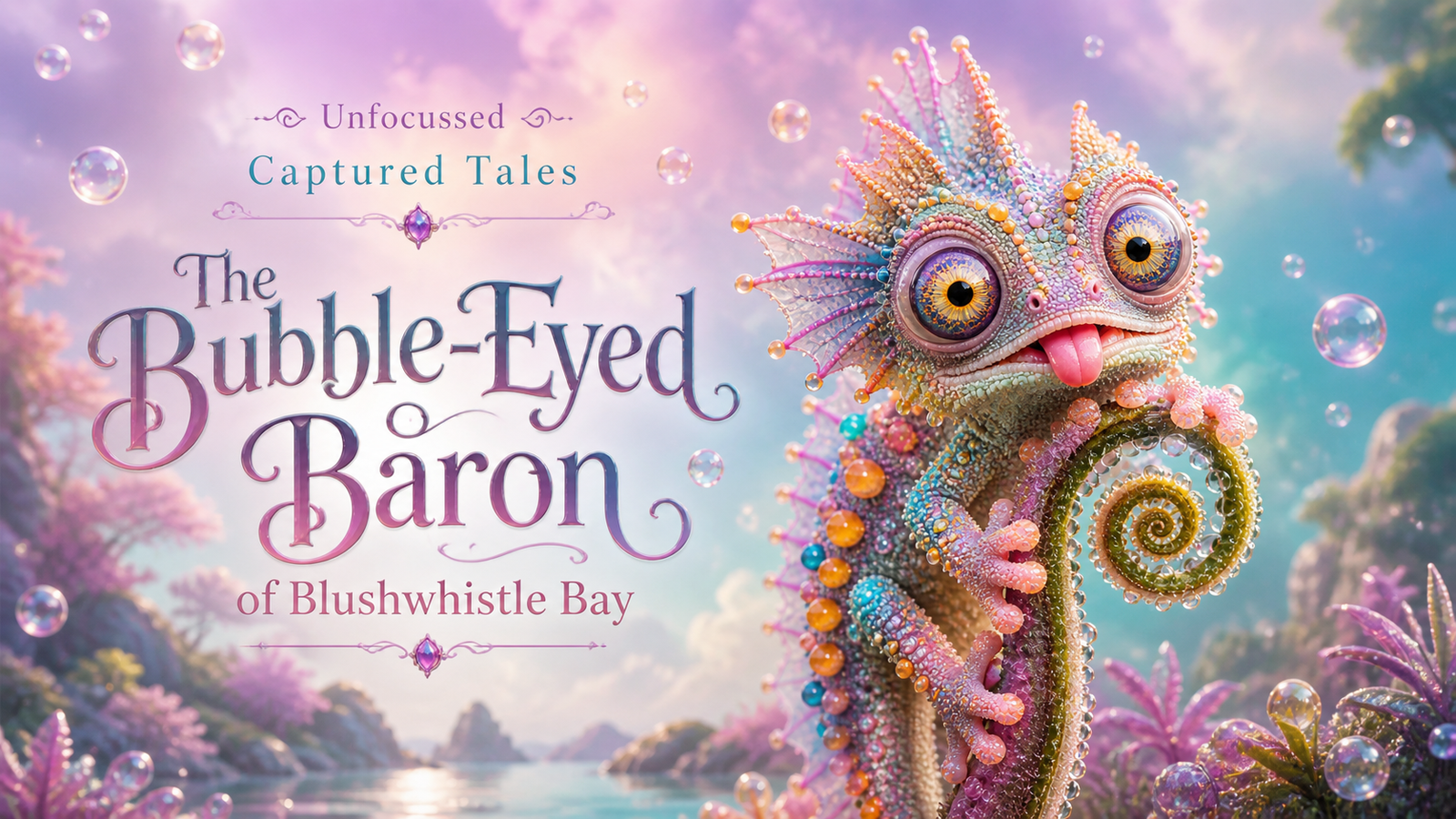
The Opening Ceremony of Poor Decisions
Every spring, when the mist over Blushwhistle Bay turned lavender at dawn and the spiral reeds began to uncurl like gossiping old women leaning over a fence, the creatures of the lagoon prepared themselves for the most important, dramatic, unnecessary, and emotionally unstable event of the year.
Courtship Season.
Not migration. Not nesting. Not the annual molt, which everyone pretended was dignified despite leaving half the bay looking like damp upholstery.
No.
Courtship Season was when every fluttering, crawling, hopping, slinking thing within three mossy ridges of the bay decided it was time to become irresistible. The frogs polished their throat sacs until they shone like inflated smugness. The finches practiced melodies so complicated they made themselves dizzy. The beetles lacquered their shells with berry wax. The snails left shimmering trails in elaborate cursive, which no one could read but everyone agreed looked expensive.
And then there was Baron Bubblesworth Glimmerpip III.
Known across Blushwhistle Bay as The Bubble-Eyed Baron, he was a creature of such startling visual confidence that even his enemies admitted he looked like something important had happened near him.
He was small, pastel, and aggressively ornamental. His scales shimmered in shades of aqua, blush, violet, and soft gold, each beadlike bump catching the morning light as if he had been handcrafted by a fairy with too much time, too much glitter, and no adult supervision. His eyes were enormous, spiraled, glossy things that reflected the world back at itself with such intensity that more than one cricket had accidentally apologized to him without knowing why.
His tongue, however, was a problem.
Not medically. Physically, it worked beautifully. Too beautifully, in fact. It was swift, pink, enthusiastic, and possessed of a personality that often arrived before his common sense could put on trousers.
The Baron loved his tongue.
Blushwhistle Bay feared it.
He had once used it to catch a passing blossom petal during a memorial service, thinking it would look poetic. Unfortunately, the petal had belonged to the funeral wreath of Elder Grubnock’s third cousin, and the resulting silence had lasted eleven days.
Another time, he had attempted to taste-test a glowing mushroom during a dinner party and spent the rest of the evening sincerely complimenting everyone’s bones.
Worst of all, last summer he had tried to impress a visiting marsh diva by flicking a dewdrop from the tip of a reed into the air and catching it mid-sparkle. This might have worked, had the dewdrop not contained a sleeping gnat, two pollen mites, and what was later described by witnesses as “a suspicious swamp fleck.” The Baron had swallowed it anyway, because pride is just stupidity wearing a cape.
But this year, according to the Baron, would be different.
This year, he would not be remembered as the decorative lunatic who licked first and asked questions when swelling occurred.
This year, he would become a romantic legend.
He stood at sunrise atop his favorite curled spiral stem, posed against the glowing bay mist, and gazed into a hanging droplet as though it were a royal mirror.
“Today,” he declared, “the Bay shall witness elegance.”
A passing beetle paused, considered him, and kept walking.
“They shall witness refinement.”
A marsh fly landed on his left eyebrow ridge.
“They shall witness passion, restraint, mystery, and the devastating power of a well-timed glance.”
The fly sneezed.
The Baron’s tongue snapped out on instinct.
There was a small, moist plip.
The fly was gone.
The Baron froze.
His eyes widened even further, which should not have been biologically possible but somehow was.
“That,” he whispered to himself, “was breakfast. Not behavior.”
He adjusted his posture, lifted his chin, and tried to look like a creature who had not just eaten part of his own dramatic monologue.
Below him, Blushwhistle Bay shimmered awake.
It was a glorious place, especially in spring. The water was a milky turquoise, threaded with gold where sunlight touched the ripples. Pink reeds swayed along the banks, their curled tips beaded with dew. Clusters of bubbleblossoms floated in the shallows, each translucent petal blushing with pearl and violet. Tiny fish with jeweled fins zipped between lily stems, while sugar-wing moths rose from the moss in lazy spirals.
The air smelled of warm nectar, wet stone, pollen, and romantic panic.
From every direction came the sounds of preparation.
A choir of moon-throated frogs warmed up in increasingly aggressive harmony.
Two dragonflies argued over wing polish.
A family of pearl-backed skinks rehearsed synchronized tail flicks near the old driftwood arch.
And in the center of the bay, atop a broad lily platform known as the Blushing Stage, the Courtship Council was assembling the ceremonial decorations.
The Council was made up of three elders, none of whom had successfully courted anyone in years, which naturally made them experts.
There was Elder Plume, a long-legged marsh bird with severe lavender feathers and the voice of a disappointed aunt.
There was Auntie Glop, a squat, jade-colored frog whose throat pouch inflated whenever she sensed nonsense, which meant she spent most of spring looking like a judgmental balloon.
And there was Master Twindle, an ancient snail with a silver shell, a magnificent mustache of moss, and the ability to make any announcement take seventeen minutes longer than necessary.
Together, they governed the seasonal rites: displays, dances, declarations, feather arrangements, respectable strutting zones, and the official list of substances no one was allowed to lick before sunset.
The Baron had been responsible for half the list.
He preferred not to dwell on that.
Instead, he focused on his reflection in the dewdrop.
“Regal,” he murmured.
He angled his body left.
“Alluring.”
He raised one forefoot delicately.
“Dangerous, but in a tasteful way.”
Then he smiled.
It was not, strictly speaking, a charming smile. It was the sort of smile that suggested he had recently heard about seduction from a drunk moth behind a fern. His tongue peeked out slightly between his lips, giving the whole expression a damp little flourish.
“No,” he said quickly, tucking it back in. “Mystery. We are doing mystery.”
The reason for all this effort had a name.
Lady Lumae of the Glasspetal Glade.
She had arrived three days earlier on a drifting fan leaf, accompanied by two attendants, one luggage beetle, and a scent of wild honeysilk that made half the bay forget whatever they had been doing. She was slender, luminous, and terrifyingly composed, with translucent fins along her neck that glowed rose-gold when she laughed. Her scales were pale mint and pearl, her eyes narrow and clever, her tail curled in the precise shape of someone who had rejected many suitors and enjoyed the paperwork.
The Baron had seen her only once, from across the lily market.
He had been purchasing fermented pollen biscuits, an activity he considered modest and intellectual. She had glided past a stall of dew figs, paused to inspect a basket of moonberries, and smiled politely at a vendor.
The Baron had immediately dropped all six biscuits into the mud.
Then, because his body had apparently declared itself independent from his dignity, he bowed so deeply that his forehead stuck to a patch of syrup moss.
Lady Lumae had looked at him.
Not laughed.
Not recoiled.
Just looked.
A calm, unreadable, devastating look.
The Baron had spent the next two days interpreting it in seventeen increasingly flattering ways.
By dawn on the third day, he had decided she was clearly intrigued.
Possibly enchanted.
Maybe intimidated by the force of his sensual authority.
Auntie Glop, when asked for her opinion, had said, “She probably wondered why you were licking moss off your forehead.”
The Baron had chosen to disregard this as jealousy.
Now, with Courtship Season officially beginning at noon, he had only a few hours to prepare the grand romantic debut that would secure Lady Lumae’s admiration, silence his critics, and finally prove to Blushwhistle Bay that he was not merely pretty nonsense with legs.
He was noble nonsense.
There was a difference.
The Baron descended from his spiral perch with a flourish, gripping the curled stem as he spiraled downward in what he hoped appeared athletic and sensual.
Halfway down, one foot slipped on dew.
He rotated twice, made a noise like a startled squeaky hinge, and landed in a puff of pollen.
A pair of young newts watching from a nearby mushroom burst into laughter.
“Rehearsal,” the Baron snapped, dusting himself off. “That was a private rehearsal.”
“For falling?” one newt asked.
“For resilience.”
“Looked sticky.”
“Your mother looks sticky.”
The newts gasped with delight and ran off to repeat this to everyone.
The Baron closed his eyes.
“Elegance,” he reminded himself. “Refinement. Mystery. Less commentary about mothers.”
His first stop was the grooming pool beneath the pearlroot arch, where the most vain creatures of the bay gathered to polish, preen, and emotionally weaponize their reflections.
The pool was already crowded.
Orbin the fire-bellied frog was inflating and deflating his throat sac in front of three unimpressed minnows.
Madame Vessa, a damselfly with silver wings, was having opal dust brushed onto her antennae by a trembling apprentice beetle.
Two rival geckos stood tail-to-tail, comparing the glossiness of their spots with open hostility.
Everyone was pretending not to watch everyone else.
The Baron marched in as though entering a palace.
Conversation dipped, then resumed in whispers sharp enough to shave moss.
“There he is.”
“Is that the one from the mushroom dinner?”
“My cousin said he complimented her femur.”
“He has nice eyes, though.”
“Nice eyes won’t save you from that tongue.”
The Baron pretended not to hear.
He climbed onto a smooth grooming stone and inspected himself in the water.
Honestly, he looked magnificent.
Ridiculous, but magnificent.
His eyes gleamed like enchanted marbles. His cheeks were dotted with tiny pearlescent scales. Along his back, candy-colored bumps rose in a delicate ridge, shifting from turquoise to pink to violet. His curled tail coiled behind him with natural theatrical flair. Even the dew clinging to his skin seemed intentional, like jewelry rather than moisture.
“Not bad,” said Madame Vessa, drifting nearby.
The Baron tried to appear humble, an expression he had never practiced and did not naturally understand.
“One does what one can with ancient bloodlines and excellent pores.”
Madame Vessa tilted her head. “Ancient bloodlines?”
“The Glimmerpips have held noble territory in Blushwhistle Bay for seven generations.”
“You live in a curled weed.”
“A hereditary curled weed.”
“Didn’t your father lose it in a beetle wager?”
“Temporarily.”
“For eleven years?”
The Baron leaned closer to his reflection and adjusted a droplet on his cheek.
“History is often jealous of greatness.”
Madame Vessa smirked. “Lady Lumae is scheduled for the noon promenade, you know.”
The Baron went perfectly still.
“I know many things.”
“Do you?”
“Some of them intimately.”
“That sentence made me uncomfortable.”
“Good. Mystery.”
Madame Vessa’s wings hummed with amusement. “You’re going to attempt a display.”
“I am going to offer the bay a tasteful demonstration of controlled romantic magnetism.”
“So yes.”
“With dignity.”
“How unfortunate for dignity.”
The Baron looked at her through the reflection. “You doubt me.”
“I know you.”
“This season, I am changed.”
“You ate a fly during a speech this morning.”
“You cannot prove that was not planned.”
“It screamed.”
“Briefly.”
Auntie Glop’s voice boomed from behind them. “Baron.”
The entire grooming pool quieted.
The Baron turned slowly.
Auntie Glop sat on a moss mound near the entrance, round, green, and morally prepared to ruin someone’s morning. Her throat pouch was already half inflated.
“Auntie,” the Baron said, bowing with theatrical respect. “You look radiant. Like a wise emerald with digestive concerns.”
Her pouch inflated another inch.
“Do not start with me.”
“I was complimenting you.”
“That was not a compliment. That was word salad wearing perfume.”
Several creatures snickered.
The Baron’s cheeks flushed lavender.
Auntie Glop hopped closer. “The Council has been informed that you intend to participate in the opening courtship display.”
“Informed by whom?”
She stared.
Behind her, the two young newts waved.
“Snitches,” the Baron muttered.
“We are not forbidding you,” Auntie Glop said, “despite compelling arguments from public safety.”
“How generous.”
“However, we are reminding you of certain guidelines.”
The Baron sighed. “I know the guidelines.”
“You will not lick any ceremonial flowers.”
“Fine.”
“You will not lick any guests.”
“That was one time, and the Duke of Mossmere had jam on his shoulder.”
“You will not lick any part of the Blushing Stage.”
“Why would I lick the stage?”
Auntie Glop’s silence was brutal.
The Baron looked away.
“It had sugar resin on it.”
“You will not perform the fan-tail shimmy within six inches of anyone’s face.”
“That rule is personal.”
“Yes.”
“Against me.”
“Also yes.”
“Unfair.”
“Necessary.”
The Baron puffed himself up. “I am not some reckless juvenile ruled by impulse.”
At that exact moment, a glowing pollen mote drifted past his nose.
His tongue twitched.
Every creature at the grooming pool watched it happen.
The Baron clenched his jaw.
The pollen mote floated closer, golden and soft, bobbing in the air like a tiny edible moon.
His eyes crossed slightly.
Auntie Glop whispered, “Don’t.”
The Baron whispered back, “I am not.”
The mote drifted toward his cheek.
His tongue emerged one delicate millimeter.
Madame Vessa murmured, “Oh, this is sad.”
The Baron slammed both forefeet over his mouth.
The pollen mote landed on his nose.
There was a long silence.
His entire body trembled with restraint.
Auntie Glop leaned in. “Control.”
The Baron nodded sharply.
The pollen mote slid downward.
It touched his upper lip.
His pupils expanded like twin moons over a bad decision.
Then, with the intensity of a soldier marching into battle, he lowered his feet, closed his mouth, and breathed through his nostrils.
The mote fell away untouched.
The grooming pool erupted in reluctant applause.
The Baron lifted his chin.
“You see?” he said, voice shaking. “I am a fortress.”
Auntie Glop looked almost impressed.
Then Orbin the frog whispered, “A very horny-looking fortress.”
The applause turned into choking laughter.
The Baron spun around. “Say that again, throat balloon.”
“I said what I said.”
“Your neck looks like a wet purse.”
Orbin inflated with outrage.
Auntie Glop groaned. “Baron.”
“No, no, I’m finished being mocked by amphibian luggage.”
Orbin hopped forward. “At least my courtship call doesn’t sound like a spoon falling into custard.”
The Baron gasped. “That was one performance.”
“It echoed.”
“The acoustics were against me.”
“Birds left.”
“They were moved.”
“They were fleeing.”
The Baron’s pride, already fragile and overdecorated, began wobbling dangerously.
“This year,” he announced, “I will perform a display so breathtaking that Lady Lumae herself shall pause mid-promenade, clutch her luminous fins, and whisper, ‘There stands a creature of passion, breeding, and exceptional tongue discipline.’”
Madame Vessa raised one delicate leg. “Does anyone whisper that last part?”
“They will after today.”
Auntie Glop shut her eyes. “Sweet swamp mud, give me strength.”
But the Baron was now fully aflame with purpose.
He leapt from the grooming stone onto a nearby reed, tail curling behind him, eyes shining with dangerous sincerity.
“Laugh while you can,” he declared to the gathered creatures. “By moonrise, Blushwhistle Bay shall sing of my romantic triumph.”
A young newt called, “Or your arrest!”
“Possibly both!” another shouted.
The Baron pointed one tiny jeweled foot at them. “History favors spectacle.”
“So does gossip,” Madame Vessa said.
He ignored her and marched out of the grooming pool with as much dignity as a pastel reptile covered in dew and emotional instability could manage.
His plan had three stages.
First, presentation.
Second, song.
Third, the Grand Spiral Tongue Flourish.
Admittedly, the third stage was controversial.
The Baron had invented it the night before while staring at his reflection in a puddle and feeling particularly dangerous. It involved climbing the central spiral reed beside the Blushing Stage, unfurling his tail, widening his eyes to maximum dazzle, and flicking his tongue in a graceful arc around a suspended dewdrop without touching it.
If performed correctly, the dewdrop would tremble, catch the sunlight, and shower the stage in a thousand glittering sparks.
If performed incorrectly, he would either swallow the dewdrop, slap himself in the face, or accidentally violate one of Auntie Glop’s new laws.
Greatness required risk.
Also, possibly witnesses with short memories.
On his way to the rehearsal grove, the Baron passed the market, where vendors were preparing for the day’s festivities.
The bay market was a riot of color and smell: dew figs stacked in blue ceramic shells, rose-pollen cakes cooling on flat stones, garlands of nectar bells, tiny jars of glowworm honey, and velvet moss wraps filled with spiced grub paste.
The Baron tried not to look at the spiced grub paste.
He failed.
His stomach gave a traitorous little gurgle.
“No,” he told himself. “Seduction first. Grubs later.”
A vendor waved a fragrant skewer of candied midges. “Breakfast, Baron?”
“I am fasting for romance.”
“Dangerous.”
“Powerful.”
“Makes some creatures stupid.”
“I arrived that way.”
The vendor nodded. “Fair.”
Near the dew fig stall, the Baron spotted Lady Lumae’s attendants arranging a small parasol made from a white mushroom cap.
His heart slammed into his ribs.
She was nearby.
Somewhere close.
Possibly watching.
Possibly already overcome by his aura.
He immediately attempted to lean casually against a reed.
The reed bent.
He slid.
Recovered.
Turned the slide into a bow.
No one applauded, but a beetle dropped a plum.
He accepted this as omen.
Then he heard her voice.
Soft. Clear. Amused.
“Is that him?”
The Baron’s entire nervous system stood up and saluted.
He looked toward the moonberry stall.
Lady Lumae stood beneath the parasol, luminous in the morning light. Her fins glowed faintly, delicate and rosy along the edges. Her long curled tail rested like a question mark against the moss. She was speaking to Madame Vessa, who had apparently flown ahead because gossip had wings and no moral burden.
Madame Vessa glanced at him.
Then back at Lady Lumae.
“That depends,” she said. “Which rumors have you heard?”
Lady Lumae smiled.
The Baron forgot how legs worked.
He knew he needed to act. This was the moment before the moment. A true noble would seize it with grace.
He lifted his chin, narrowed his enormous eyes into what he believed was smoldering intensity, and began to approach.
Unfortunately, because his eyes were narrowed, he did not see the plum.
The beetle’s fallen plum sat directly in his path, glossy, purple, and waiting like destiny’s dumb little trap.
His front foot landed on it.
The plum burst.
The Baron shot forward.
His body slid across the moss, spun once, clipped a basket of moonberries, and came to rest in front of Lady Lumae with his cheek pressed against a flat stone and a smear of purple fruit across his mouth.
The market went silent.
Lady Lumae looked down at him.
The Baron opened one eye.
This, he knew, was a crossroads.
One path led to shame.
The other led to reinvention.
He chose reinvention.
Without getting up, he said, “I have arrived.”
A moonberry rolled off his head.
Lady Lumae’s mouth twitched.
“So I see.”
“Baron Bubblesworth Glimmerpip III,” he said, trying to bow while horizontal. “At your service.”
“Lady Lumae.”
“I know.”
“Do you?”
“Only in the deeply respectful sense that everyone has been talking about you and I have been pretending not to listen.”
She laughed then.
Not cruelly.
Not loudly.
Just enough.
The Baron felt his soul leave his body, put on a silk robe, and begin composing poetry.
He pushed himself upright, purple juice still shining around his mouth like evidence.
“My apologies for the entrance. I was demonstrating velocity.”
“Were you?”
“Romantic velocity.”
“That sounds medically risky.”
“Only for the untrained.”
She looked him over, eyes glinting. “And are you trained?”
Every reasonable answer fled.
The Baron smiled.
His tongue slipped out and collected a bit of plum juice from his cheek.
Madame Vessa made a tiny choking sound.
Auntie Glop, somewhere across the market, bellowed, “BARON.”
The Baron froze mid-lick.
Lady Lumae’s fins brightened.
“Ah,” she said. “So that part is true.”
He slowly retracted his tongue.
“Depends which part.”
“The part about you being unable to resist tasting consequences.”
The Baron straightened.
“Consequences are often misunderstood.”
“And fruit?”
“Fruit is rarely innocent.”
Lady Lumae studied him with an expression he could not read, which of course meant he immediately interpreted it as fascination.
“Will you be performing today?” she asked.
The question struck him like sunlight through stained glass.
“Indeed,” he said. “A display of unprecedented restraint, elegance, and emotional architecture.”
“Emotional architecture?”
“Load-bearing charm.”
She laughed again, and this time it was brighter.
The Baron nearly blacked out from triumph.
“I look forward to it,” Lady Lumae said.
Then she turned and glided away beneath the parasol, her attendants following, her tail curling behind her like a signature.
The Baron watched her go.
Madame Vessa hovered beside him.
“Well,” she said, “that could have gone worse.”
“She laughed.”
“At you.”
“Near me.”
“Because of you.”
“Exactly.”
Madame Vessa looked at the plum juice on his face. “You are frighteningly resilient.”
“I am beloved by fate.”
“Fate just threw you into fruit.”
“A flirtatious shove.”
Auntie Glop arrived then, puffed with concern and irritation. “What happened?”
The Baron touched his chest. “Chemistry.”
“It looks like produce assault.”
“Love is messy.”
“So are you.”
“She said she looks forward to my performance.”
Auntie Glop’s eyes narrowed. “What performance?”
The Baron said nothing.
Madame Vessa slowly drifted backward.
Auntie Glop’s throat pouch expanded. “Baron.”
“A tasteful display.”
“Define tasteful.”
“There may be a dewdrop.”
“No.”
“A spiral reed.”
“Absolutely not.”
“A flourish.”
“I will tackle you myself.”
“There is no need for violence.”
“There will be if your tongue becomes a public hazard.”
The Baron drew himself up, purple-mouthed and magnificent. “Auntie Glop, with all due respect, I refuse to live small simply because greatness makes others nervous.”
“Greatness does not usually require a cleanup crew.”
“Mine does.”
She stared at him for a long moment.
Then, in the voice of someone watching a bridge catch fire from both ends, she said, “Fine.”
The Baron blinked. “Fine?”
“Perform.”
Madame Vessa whispered, “Oh, no.”
Auntie Glop pointed one webbed toe at him. “But if you injure anyone, offend a guest, lick a structural object, or start another fungal incident, I will personally assign you to three months of algae inventory.”
The Baron shuddered.
Algae inventory was where joy went to be counted slowly.
“Agreed,” he said.
“And no surprise substances.”
“Define substances.”
“Anything that sparkles, oozes, glows, hums, pulses, sweats, sings, or has a warning label.”
“You remove much of life’s poetry.”
“Good.”
Auntie Glop hopped away, muttering something about insurance.
The Baron turned back toward the Blushing Stage, which now gleamed in the distance beneath archways of pink reed and hanging bells.
Noon was approaching.
The opening promenade would soon begin.
Lady Lumae would be there.
The Council would be there.
The whole bay would be there.
And Baron Bubblesworth Glimmerpip III, noble heir to a disputed curled weed and frequent victim of his own mouth, would finally rise above mockery.
He would perform the Grand Spiral Tongue Flourish.
He would prove that passion could be controlled.
That beauty could be disciplined.
That a creature could be both wildly decorative and mostly trustworthy.
All he had to do was climb the reed, hold the pose, sweep his tongue around the dewdrop without touching it, and avoid doing anything so spectacularly stupid that it became part of bay law.
The Baron smiled.
For one glorious second, confidence filled him from nose to tail.
Then a nearby vendor called, “Last chance for candied midges!”
His tongue twitched.
The Baron slapped a foot over his mouth.
“Not today,” he whispered. “Today we are romance.”
Above the bay, the ceremonial bells began to ring.
And all across Blushwhistle Bay, creatures turned toward the stage, unaware that the most questionable courtship display in recent memory was about to begin.
The Grand Spiral Tongue Flourish
By the time the ceremonial bells finished ringing, Blushwhistle Bay had gathered itself into a trembling, glittering bundle of hormones, vanity, and poor decisions wearing decorative pollen.
The Blushing Stage floated at the center of the lagoon, broad and pink and polished to a dangerous shine. It had been built from the fused petals of ancient bubbleblossoms, reinforced with pearlroot fibers, and waxed every year by a team of beetles who took their jobs far too seriously. Around it, lily pads formed a natural amphitheater, each one crowded with creatures trying to look casual while secretly evaluating everyone else’s reproductive marketing strategy.
The frogs had arrived in full throat.
The skinks shimmered in family formations.
The damselflies hovered in elegant clusters, pretending they were above gossip while actively manufacturing most of it.
Even the snails had come early, which in snail culture meant they had started traveling three days before anyone invited them.
At the front of the stage, beneath a canopy of pink reeds and hanging nectar bells, the Courtship Council sat in a row of ceremonial judgment.
Elder Plume looked severe enough to curdle dew.
Auntie Glop looked inflated enough to qualify as weather.
Master Twindle sat in solemn silence, which everyone knew meant he was preparing a speech so long it would require snacks.
Baron Bubblesworth Glimmerpip III stood behind a curtain of dangling moss, watching the audience through a small gap and trying very hard not to throw up confidence.
He had cleaned the plum juice from his face.
Mostly.
A faint purple stain still curved along one corner of his mouth, making him look either roguishly kissed by fruit or recently involved in a jam-related crime.
He had polished each beadlike scale until his pastel body gleamed in bands of aqua, lavender, pearl, blush, and gold. Tiny dewdrops clung to his ridged back like jewels. His enormous eyes reflected the whole bay in spiraling fragments, giving him the unsettling appearance of a creature who had seen every possible future and chosen the dumbest one on purpose.
“You look damp,” Madame Vessa said from beside him.
The Baron did not turn. “I look luminous.”
“You look like a candy escaped a bath.”
“Luminous candy.”
“With anxiety.”
“All great performers have anxiety.”
“Most great performers don’t require a written tongue waiver.”
The Baron glanced toward the stage entrance, where Auntie Glop had indeed placed a damp leaf signed by him in berry ink. It listed the following conditions:
I, Baron Bubblesworth Glimmerpip III, hereby acknowledge that my tongue is my own responsibility and that any licking-related consequences occurring during the Courtship Display shall not be blamed upon the Council, the Stage, the weather, fate, ghosts, pollen drift, seductive dewdrops, or alleged ancestral instincts.
He had objected to “seductive dewdrops,” but Auntie Glop had simply stared until he signed.
“It is an oppressive document,” he said.
“It is a public safety miracle.”
He inhaled slowly through his nostrils.
From where he stood, he could see Lady Lumae seated on a pale lily pad near the front. She looked devastatingly calm beneath her mushroom-cap parasol. Her attendants sat behind her, both arranged like delicate punctuation marks. Her translucent fins glowed faintly rose-gold in the filtered sun, and her tail curled neatly beside her.
She was watching the stage.
Possibly waiting for him.
Possibly wondering whether the stories were true.
Possibly preparing to flee.
All three possibilities filled him with electricity.
“She came,” he whispered.
Madame Vessa followed his gaze. “Everyone came.”
“For me.”
“For the event.”
“I am the event.”
“You are a pending incident.”
The Baron smiled. “History uses many words before settling on legend.”
Madame Vessa’s wings flickered. “Please don’t say things like that right before climbing something.”
Onstage, Elder Plume lifted her long beak, and the murmuring audience softened into silence.
“Creatures of Blushwhistle Bay,” she announced, her voice slicing cleanly through the warm spring air, “welcome to the Opening Promenade of Courtship Season.”
A ripple of applause moved across the lily pads.
Auntie Glop’s throat pouch expanded ceremonially.
Master Twindle nodded so slowly that several gnats aged into adulthood during the motion.
“Today,” Elder Plume continued, “we celebrate beauty, courage, restraint, and the sacred traditions by which our community expresses admiration without causing unnecessary injury.”
Several creatures glanced toward the moss curtain.
The Baron straightened. “Why is everyone looking over here?”
Madame Vessa said, “Because unnecessary injury has a favorite face.”
“As always,” Elder Plume said, “participants shall be judged not only on brilliance of display, but on sincerity, grace, respect for boundaries, and compliance with all applicable licking restrictions.”
The audience chuckled.
The Baron closed his eyes.
“Fame is a burden.”
“So are lawsuits,” Madame Vessa said.
The first performance began with the moon-throated frogs.
They took the stage in a gleaming green line, each throat sac polished to a mirror shine. Orbin stood in the center, broad and smug, with his belly spots oiled to maximum provocation.
At Elder Plume’s signal, they inhaled.
Then they sang.
It was, unfortunately, impressive.
Their voices rose in layered pulses, deep and warm, vibrating through the lilies and across the water. The harmonies rolled like thunder under glass. The crowd swayed. Several moths fainted into the moss. Orbin inflated his throat until it shimmered like a heroic wet lantern.
The Baron watched with narrowed eyes.
“Overcompensation,” he muttered.
Madame Vessa hovered beside him. “For what?”
“Everything.”
The frogs finished with a final synchronized croak that sent tiny rings across the bay. Applause erupted.
Lady Lumae clapped politely.
Orbin bowed directly toward her.
The Baron’s left eye twitched.
“He bowed at her.”
“She is in the audience.”
“He used throat.”
“He is a frog.”
“A vulgar throat display.”
“It was literally the frog portion.”
Orbin exited past the moss curtain and flashed the Baron a grin. “Try not to lick the applause on your way out.”
The Baron smiled sweetly. “Try not to store soup in your neck.”
Orbin’s grin vanished.
Madame Vessa whispered, “Growth would have been silence.”
“Growth is overrated.”
Next came the pearl-backed skinks. They performed a tail-flicking formation so precise that even Elder Plume looked vaguely pleased, which for Elder Plume was equivalent to weeping openly. Their tails flashed silver, coral, and gold as they moved in rings around one another, forming patterns that symbolized devotion, harmony, fertility, and possibly a very complicated knot.
The audience applauded again.
Then came a pair of courting snails who traced mirrored spirals in shimmering slime while Master Twindle narrated the historical significance of every curve.
By the seventh curve, half the crowd had entered a mild trance.
By the twelfth, one beetle asked whether death was always this moist.
By the seventeenth, Auntie Glop interrupted on grounds of seasonal mercy.
After the snails, Madame Vessa herself performed an aerial dance with six other damselflies. Their wings caught the sunlight, scattering silver sparks over the stage. They dipped, spun, crossed, rose, and vanished through sprays of mist so elegantly that the Baron briefly forgot to resent her.
When she returned backstage, applause still ringing behind her, he gave a small nod.
“Adequate.”
She bowed. “May your delusions comfort you.”
He swallowed.
His turn was next.
Auntie Glop waddled backstage with the solemn expression of someone carrying both authority and indigestion.
“Baron.”
“Auntie.”
“Last warning.”
“Unnecessary.”
“No licking anything alive.”
“Agreed.”
“No licking anything structural.”
“Understood.”
“No licking anything ceremonial.”
“Define ceremonial.”
Her throat pouch inflated.
“I withdraw the question.”
She looked him over. Beneath the irritation, there was something almost like concern.
“Listen to me, Bubblesworth.”
The Baron stiffened. “You know I prefer Baron.”
“And I prefer a spring without paperwork. We all suffer.”
He sighed.
Auntie Glop lowered her voice. “You do not have to turn yourself inside out to be noticed.”
“I am not turning myself inside out.”
“You are about to climb a slippery reed and perform tongue choreography in front of half the marsh.”
“That is outward-facing.”
“You know what I mean.”
For a moment, the Baron said nothing.
Through the curtain, he could see Lady Lumae again. She sat poised and unreadable, glowing softly. She looked like a secret wrapped in silk.
“She expects greatness,” he said.
“Does she?”
“She said she looked forward to my performance.”
“That could mean many things.”
“Yes. Passion. Intrigue. Anticipation. Arousal of the spirit.”
“Or basic politeness.”
The Baron winced as if struck.
Auntie Glop softened. “You are already memorable.”
“That is not always good.”
“No,” she admitted. “Sometimes it requires mops.”
He looked down at his jeweled feet.
“I do not want to be a joke today.”
Auntie Glop’s pouch deflated slightly.
The words surprised even him. They had come out smaller than intended, less polished and far less smug. For one breath, he was not the Bubble-Eyed Baron, heir to a questionable weed and master of fruit-based reinvention. He was simply a tiny, ridiculous creature who had spent too many seasons being laughed at for arriving loudly, slipping often, and wanting desperately to be admired before he understood how to be known.
Auntie Glop looked at him for a long moment.
“Then don’t perform like a joke,” she said. “Perform like yourself.”
“Myself is frequently the problem.”
“Only when you pretend it isn’t.”
The Baron blinked.
That sounded uncomfortably wise.
He hated when Auntie Glop did that. It made arguing less fun.
Before he could respond, Elder Plume’s voice rang out from the stage.
“Our next participant requires little introduction, though several signed forms.”
The audience rustled.
A few creatures giggled.
The Baron inhaled.
“Please welcome Baron Bubblesworth Glimmerpip III.”
There was applause.
Some of it was sincere.
Some of it had the crackling energy of spectators watching someone carry a cake down stairs.
The Baron stepped through the moss curtain.
Sunlight hit him.
The bay glittered.
For one dazzling instant, he felt exactly as magnificent as he looked.
He crossed the Blushing Stage slowly, each small foot placed with deliberate care. His curled tail lifted behind him in an elegant arc. Dew shimmered along his back. His enormous eyes reflected hundreds of faces, all watching him.
He did not slip.
He did not lick.
He did not insult anyone’s mother.
A promising start.
He reached the center of the stage and bowed.
There was a murmur from the crowd.
Lady Lumae leaned slightly forward.
The Baron’s heart began beating in three separate languages.
To his right stood the central spiral reed, tall and curling upward beside the stage. At its highest curve hung the perfect dewdrop: round, clear, trembling, and bright enough to catch the whole noon sun.
It was beautiful.
It was forbidden-looking.
It was exactly the sort of thing his tongue considered a personal invitation.
He stared at it.
The dewdrop stared back, metaphorically, which somehow made it worse.
Auntie Glop watched from the Council seat, pouch slowly swelling.
The Baron stepped toward the reed.
The crowd hushed.
He placed one foot on the curling stem.
Then another.
The reed flexed under his weight, slick with moisture and waxy from spring growth. He climbed with careful grace, his tiny claws gripping the surface, tail curling behind him as a counterbalance.
Halfway up, he heard Orbin whisper from the front lily pad, “Don’t fall, sparkle butt.”
The Baron froze.
Every elegant instinct in his body evaporated.
His first impulse was to turn and say something unforgivable about Orbin’s ancestry, throat, and general resemblance to a damp coin purse.
His second impulse was to fling his tongue outward and snatch the decorative berry pin from Orbin’s chest purely to establish dominance.
His third impulse, quieter but new, was to keep climbing.
He chose the third.
It nearly killed him.
Not physically. Spiritually.
But he climbed.
The audience noticed.
Auntie Glop noticed.
Lady Lumae noticed.
The Baron reached the high curve of the reed and settled into position beneath the dewdrop. From there, he could see all of Blushwhistle Bay spread around him: lavender mist along the reeds, turquoise water glowing beneath lily pads, the stage bright below, and hundreds of faces lifted toward him.
He lifted his tail.
He widened his eyes.
The spirals within them caught the sun and flashed blue, gold, and violet.
A soft gasp passed through the crowd.
The Baron held still.
For once, silence worked for him.
Then he began the display.
He swayed gently with the reed, letting his body follow its natural curve. His scales rippled in pastel light. The jeweled bumps along his back shimmered like tiny lanterns. He turned slowly, presenting first one side, then the other, each movement deliberate. His tail curled and unfurled in graceful loops, echoing the spiral of the reed.
The crowd quieted into admiration.
No laughter.
No snickers.
No emergency bells.
The Baron felt something unfamiliar bloom in his chest.
Not vanity.
Well, not only vanity.
Something steadier.
He was doing it.
He was actually doing it.
Lady Lumae watched with her head tilted, fins glowing brighter now.
The Baron lifted his chin.
Now came the song.
This was the part he had worried about.
Historically, his courtship calls had been described as “wet cutlery,” “a kettle full of regret,” and, once by an elderly turtle, “the noise my husband made before the end.”
But the Baron had practiced.
In private.
Far from witnesses.
He inhaled.
The entire bay inhaled with him.
Then he sang.
The first note wobbled.
Not badly.
Just enough to suggest the sound was still considering its career options.
A few creatures shifted.
The Baron steadied himself and continued.
The second note rose clearer. The third found a soft trill. The fourth surprised even him, ringing gently through the reed and over the stage. It was not the thunderous beauty of the frogs or the elegant shimmer of damselfly wings. It was smaller, stranger, bright and warbling, with little sparkling breaks between tones.
It sounded like sunlight trying to squeeze through bubbles.
It sounded, against all odds, like him.
The bay listened.
Even Orbin shut his damp little mouth.
The Baron sang of curled reeds and pearlroot shadows, of spring mist and moonberry stains, of wanting to be seen without having to become someone smoother, quieter, or less likely to lick plum off his own face under pressure. He sang without words, but somehow the feeling traveled.
Lady Lumae’s expression softened.
Auntie Glop’s pouch deflated almost completely.
Madame Vessa, hovering near the curtain, whispered, “Well, damn.”
The Baron reached the final note and held it as the reed swayed beneath him.
The dewdrop trembled above his head.
Sunlight burned inside it.
Now came the Grand Spiral Tongue Flourish.
The crowd leaned forward.
Auntie Glop’s pouch re-inflated so fast it made a rubbery squeak.
The Baron focused on the dewdrop.
The trick was simple in theory.
Extend the tongue.
Sweep around the drop.
Do not touch it.
Let the motion stir the air just enough to spin the droplet on its stem, scattering light across the bay.
A gesture of discipline.
A symbol of desire restrained.
A poetic demonstration that he could admire something beautiful without immediately putting it in his mouth.
Frankly, the symbolism was doing a lot of work.
He opened his mouth.
His tongue emerged slowly, pink and glossy in the sunlight.
The audience went utterly still.
He began the arc.
Left side first.
Smooth.
Controlled.
Excellent.
The tongue swept upward, curving around the dewdrop with impossible precision. Air shifted. The droplet trembled.
The crowd gasped.
The Baron continued the motion.
Half circle.
Three-quarter circle.
Almost complete.
He could feel the moisture of the dewdrop without touching it. Its coolness hovered at the edge of sensation. His tongue tingled with temptation. Every instinct screamed, snatch it.
He did not.
He held control.
The dewdrop spun.
Light exploded from it.
For one breathtaking second, the entire bay filled with sparkles. Gold, lavender, aqua, rose, and pearl scattered across every face, every lily pad, every reed. The water flashed like liquid jewels. Lady Lumae’s fins glowed bright as dawn.
The Baron had done it.
He had absolutely, undeniably done it.
The audience erupted.
Applause crashed across the bay.
Even Elder Plume looked mildly alive.
Auntie Glop stared, stunned.
Madame Vessa cheered.
The Baron withdrew his tongue with perfect grace and lifted one tiny jeweled foot in triumph.
This, he thought, was the moment.
This was the turning point.
This was where legend began.
Then the reed snapped.
Not dramatically at first.
There was a small sound.
A delicate crick.
The kind of sound that only becomes important when followed by disaster.
The Baron looked down.
The reed bent.
The audience’s applause faltered.
Auntie Glop stood. “Don’t move.”
The Baron, seized by panic, moved.
The reed whipped sideways.
He launched.
For a fraction of a second, Baron Bubblesworth Glimmerpip III flew over Blushwhistle Bay in a glittering arc of pastel nobility, legs spread, eyes enormous, tail spiraling behind him, mouth open in a silent expression of ancestral betrayal.
Then he hit the ceremonial nectar bell canopy.
The canopy did not appreciate this.
It collapsed.
Nectar bells burst.
Sticky golden syrup rained across the stage.
The Baron bounced off a hanging reed hoop, ricocheted into the Blushing Stage, slid across its polished petal surface, and came spinning toward the Council seats like a decorative wheel of consequences.
Master Twindle had just enough time to say, “Oh, bother,” before the Baron clipped the edge of his silver shell.
The snail spun gently in place.
Auntie Glop lunged to stop the Baron.
Unfortunately, the stage was now slick with nectar.
Her feet slid.
She shot forward, collided with Elder Plume’s legs, and both of them toppled into the ceremonial garland basket.
The basket flipped.
Garlands flew.
Frogs shouted.
Skinks scattered.
Damselflies rose in a sparkling panic.
Orbin tried to leap heroically aside, landed in syrup, and stuck belly-first to the stage with a noise that would later be described as “deeply personal.”
The Baron finally came to rest upside down in a bowl of rose-pollen cakes.
Silence fell.
A single cake slid off his forehead.
Somewhere in the back, a young newt whispered, “Worth it.”
The Baron blinked.
The world was inverted.
His body was coated in nectar.
His tail was tangled in garland.
One foot was stuck in a cake.
And Lady Lumae, luminous, composed Lady Lumae, had risen from her lily pad and was staring directly at him.
The Baron swallowed.
There were several ways to handle this.
Apologize.
Remain silent.
Play dead.
He chose none of them.
Still upside down, dripping syrup, he said, “I meant to finish lower.”
For half a heartbeat, no one moved.
Then Lady Lumae laughed.
Not a polite laugh.
Not the small amused laugh from the market.
A real laugh.
Bright, helpless, ringing across the stage until her fins shimmered with light. She covered her mouth, failed to stop laughing, and had to sit back down on her lily pad.
The sound broke the spell.
The audience burst into laughter too.
Not cruelly.
Not entirely, anyway.
It rolled across the bay, warm and wild. The frogs laughed. The skinks laughed. The damselflies laughed. Even Elder Plume, still wearing a garland like an offended funeral hat, made a small strangled sound that might have been mirth trying to escape through bureaucracy.
Auntie Glop peeled herself from the stage and glared at the Baron.
“You signed a form.”
“The form did not mention flight.”
“It should not have needed to.”
Orbin groaned from his syrup prison. “My belly is sealed to the stage.”
The Baron lifted his head. “At last, your talent emerges.”
“I hate you.”
“Understandable.”
Auntie Glop pointed at him. “Do not lick the nectar.”
The Baron froze.
Until that moment, he had not considered it.
Now he could feel it everywhere: warm, sweet, golden syrup coating his scales, dripping near his mouth, pooling along the edge of the cake bowl.
The entire bay watched him.
His tongue twitched.
Auntie Glop whispered with deadly calm, “Bubblesworth.”
The Baron’s eyes widened.
He clenched his jaw.
The nectar trickled down his cheek.
It touched the corner of his mouth.
His tongue pushed against his lips from inside like a criminal testing a door.
Do not, he commanded himself.
Do not.
Do not become an amendment.
Lady Lumae was still watching him, laughter fading now into curious attention.
The Baron inhaled through his nose.
He lifted one sticky foot and wiped the nectar from his mouth onto the side of the cake bowl.
The audience gasped.
Auntie Glop’s pouch deflated.
Madame Vessa whispered, “He resisted syrup.”
“I saw,” said a beetle, awestruck.
“After impact,” another added.
“Still counts.”
The Baron, still upside down, raised his chin as much as physics allowed.
“I remain,” he said, “a fortress.”
This time, no one immediately mocked him.
Which was honestly suspicious.
Then Lady Lumae stepped gracefully from her lily pad onto the edge of the syrup-slick stage. Her attendants gasped, but she waved them back.
She crossed toward him with careful steps, luminous fins glowing softly.
The Baron attempted to right himself.
He failed.
One leg kicked uselessly in the air.
“I would stand,” he said, “but I am engaged in advanced repose.”
Lady Lumae stopped beside the cake bowl and looked down at him.
There was syrup on his nose.
A garland around his tail.
Rose-pollen crumbs stuck to his back.
He had never looked less seductive in his life.
Or more honest.
Lady Lumae smiled.
“That was quite a performance.”
The Baron braced himself. “Yes. The landing was interpretive.”
“Clearly.”
“The reed betrayed me.”
“I suspected treason.”
His heart fluttered.
She was playing along.
Either that, or head trauma had made him optimistic.
“You did something unexpected,” she said.
“I often do.”
“No,” she said. “Not the crash.”
“Ah.”
“Before that. The flourish.”
The Baron blinked syrup from one eye.
“You saw it?”
“Everyone saw it.”
“Before the... decorative collapse?”
“Yes.”
Her smile softened.
“It was beautiful.”
The Baron forgot how to breathe.
He had imagined compliments before. Many times. Usually while alone, staring into reflective puddles and giving award speeches to himself. He had imagined praise for his eyes, his posture, his ancient lineage, his scale pattern, his ability to make an entrance even when fruit was involved.
But this was different.
She had seen the part before the disaster.
The part he had meant.
The part that was not a joke.
“Thank you,” he said, and for once he did not add anything stupid.
Auntie Glop made a quiet noise nearby, as if witnessing a miracle that annoyed her.
Lady Lumae extended one delicate foot.
“May I help you out of the cakes?”
The Baron considered dignity.
Then he considered gravity.
“Please.”
With Lady Lumae’s help, and only minor additional sliding, he managed to roll out of the bowl and onto his feet. He stood before her sticky, crumb-coated, and trembling with adrenaline.
The audience remained quiet now, listening.
Orbin was still stuck to the stage, but had stopped complaining long enough to glare.
Lady Lumae looked at the Baron’s garland-tangled tail.
“You know,” she said, “in Glasspetal Glade, courtship displays are much more restrained.”
“How dull.”
“Very.”
“No collapsing infrastructure?”
“Rarely.”
“No syrup incidents?”
“Only at funerals, and even then we whisper.”
The Baron stared at her.
She stared back.
Then they both laughed.
It started quietly, but grew until his jeweled shoulders shook and her fins flashed like sunrise. Around them, the bay laughed again too, this time not because he had failed, but because the whole scene had become ridiculous in a way everyone could share.
And for the first time in a very long while, the Baron did not feel like the laughter was only pointed at him.
He felt inside it.
Part of it.
Sticky, embarrassed, but somehow not destroyed.
Then Master Twindle cleared his throat.
The sound was slow, wet, and ominous.
“According to tradition,” the ancient snail said, still rotating very gradually from the earlier impact, “when a courtship performance results in applause, structural compromise, and mutual laughter between interested parties, the participant may request a promenade.”
Auntie Glop stared at him. “That is not a tradition.”
Master Twindle blinked. “It is now adjacent to one.”
Elder Plume, removing garland from her neck, muttered, “I am too tired to object.”
The audience stirred.
A promenade.
The formal walk around the lagoon path.
It was not a proposal. Not a pairing. Not even a commitment beyond the afternoon.
But it was public.
It meant interest.
It meant possibility.
The Baron looked at Lady Lumae.
His throat went dry.
He had planned speeches for this too.
Of course he had.
He had prepared six possible promenade requests, ranging from poetic to smoldering to one that included the phrase “our destinies entwined like tasteful moss,” which even he now suspected was a crime.
But with her standing before him, bright-eyed and amused, all the speeches scattered like startled gnats.
So he said the truth.
“Lady Lumae,” he began, “I am sticky, mildly bruised, and almost certainly banned from reeds by sunset.”
Her smile widened.
“But if you would be willing,” he continued, “I would be honored to walk with you after the stage is no longer a hazard.”
The bay held its breath.
Lady Lumae looked him over slowly.
Then she said, “On one condition.”
“Anything.”
“Do not try to impress me on the walk.”
The Baron opened his mouth.
Closed it.
This was a more difficult condition than she knew.
“Define impress.”
She raised one brow.
“No stunts.”
“Reasonable.”
“No dramatic climbs.”
“Cruel, but fair.”
“No declarations involving bloodlines.”
“My ancestors will be disappointed.”
“And no licking anything unless it is clearly food and offered willingly.”
Auntie Glop shouted, “Put that in writing!”
The Baron ignored her.
He bowed to Lady Lumae, this time slowly, carefully, and without sticking his forehead to anything.
“Agreed.”
Lady Lumae extended her tail slightly, touching its curled tip to his in the formal gesture of accepted promenade.
A murmur swept across the audience.
Madame Vessa pressed both front legs to her chest. “Well, look at that. The disaster got a date.”
Orbin grunted from the syrup. “This bay rewards nonsense.”
The Baron glanced at him. “And yet you remain single.”
Several frogs made choking noises.
Lady Lumae covered a smile.
Auntie Glop slapped one webbed hand over her eyes. “There it is.”
The Baron straightened, triumphant despite the nectar dripping from his chin.
For a moment, he thought the worst was over.
He had performed beautifully.
He had crashed memorably.
He had resisted syrup.
He had secured a promenade with Lady Lumae.
Blushwhistle Bay had laughed, yes, but with warmth.
Against all odds, Courtship Season had not destroyed him.
Then a sharp voice rang out from the far edge of the lagoon.
“Well. This explains the smell of desperation.”
The laughter died.
Every head turned.
At the end of the lily path, beneath a black orchid parasol, stood a sleek emerald creature with silver spots, narrow golden eyes, and the kind of perfect posture only achieved by villains, ballet teachers, and people who have never slipped on fruit.
Lady Lumae went very still.
The Baron noticed immediately.
The newcomer stepped onto the first lily pad, followed by two silent attendants in dark fern cloaks.
“Lord Vauntleroy,” Lady Lumae said, her voice suddenly cool.
The Baron looked from her to him.
“You know this polished twig?”
Lord Vauntleroy smiled without warmth.
“And you must be the local entertainment.”
The Baron’s sticky scales prickled.
“Depends who’s paying.”
Vauntleroy’s gaze swept over him: the crumbs, the garland, the syrup, the absurdly enormous eyes.
“How charming,” he said. “Glasspetal Glade sends its regards, Lady Lumae. And its reminder.”
The air changed.
Even Auntie Glop stopped muttering.
Lady Lumae’s fins dimmed slightly. “This is neither the time nor the place.”
“Courtship Season seems exactly the time,” Vauntleroy replied. “And public embarrassment appears to be the local custom, so perhaps the place is perfect as well.”
The Baron stepped forward, nearly slipped, recovered, and pretended the recovery was intentional.
“Careful,” he said. “You are standing very close to becoming unpopular.”
Vauntleroy looked at him as one might look at a bug deciding to become weather.
“And what are you?”
The Baron lifted his chin.
“Baron Bubblesworth Glimmerpip III.”
Vauntleroy smiled. “Of the disputed weed?”
A collective oooooh rippled through the crowd.
The Baron’s eye twitched.
Madame Vessa whispered, “Low blow. Accurate, but low.”
Vauntleroy continued, “I had heard Blushwhistle Bay was rustic, but I did not expect Lady Lumae to entertain proposals from sugared amphibious jewelry.”
“I am not amphibious,” the Baron snapped.
“That was your objection?” Auntie Glop muttered.
Lady Lumae stepped between them. “Lord Vauntleroy, leave.”
“Gladly,” he said. “Once the matter is settled.”
He turned toward the crowd.
“By arrangement of the Glasspetal Elders, Lady Lumae is expected to promenade this season with a suitor of appropriate refinement, lineage, and dignity.”
His eyes slid back to the Baron.
“Clearly, there has been confusion.”
The Baron felt the warmth of the crowd shift into something uncertain.
There were murmurs now. Questions. Whispers.
Lady Lumae’s jaw tightened.
“No arrangement has been accepted by me.”
Vauntleroy bowed. “Not yet.”
The Baron’s sticky foot slowly unstuck from the stage with a rude little sound.
It was not an elegant noise, but it helped him think.
He looked at Lady Lumae.
Then at Vauntleroy.
Then at the crowd.
He had spent the morning wanting to impress a lady.
He had spent the noon becoming a public dessert accident.
But now something sharper stirred beneath his absurdity.
Because he knew that look on Lady Lumae’s face.
Not fear exactly.
Not shame.
Exhaustion.
The look of someone who had traveled all the way to another bay just to breathe freely, only to have old expectations arrive wearing a smug mouth and expensive spots.
The Baron did not know much about restraint.
He knew less about politics.
But he knew, deep in his ridiculous jeweled bones, that no one deserved to have their laughter interrupted by a decorative bully.
He stepped beside Lady Lumae.
Not in front of her.
Beside her.
That seemed important.
“Lord Vauntleroy,” the Baron said, “you appear to have mistaken yourself for an invitation.”
The crowd murmured louder.
Vauntleroy’s smile thinned.
“Careful, little Baron.”
“No.”
The Baron surprised himself with the word.
It came out clean.
Simple.
No flourish.
No insult about anyone’s mother.
No tongue.
Just no.
Lady Lumae glanced at him.
Vauntleroy’s eyes narrowed.
The Baron continued, “I have been careful all day. I have not licked anything structural, ceremonial, alive, glowing, humming, or legally ambiguous. I performed a flawless dewdrop flourish before being attacked by substandard vegetation. I resisted syrup under extreme conditions. Frankly, I have shown heroic restraint.”
Auntie Glop muttered, “Let’s not overreach.”
“So I am done being careful with pompous swamp perfume in a lizard suit.”
Madame Vessa whispered, “And there goes restraint.”
Vauntleroy stepped closer. “You think yourself worthy of challenging me?”
The Baron looked him up and down.
Vauntleroy was taller, sleeker, cleaner, and entirely too dry.
“No,” the Baron said. “But I think you came here expecting everyone to agree that dignity is the same as ownership, and that mistake is uglier than Orbin’s neck pouch under moonlight.”
“Hey!” Orbin shouted, still stuck.
Lady Lumae’s fins brightened again.
Vauntleroy’s attendants exchanged uneasy looks.
The crowd leaned in.
Lord Vauntleroy lifted his chin. “If Blushwhistle Bay honors tradition, then allow tradition to decide.”
Elder Plume stiffened. “What tradition?”
Vauntleroy smiled. “The Trial of Three Displays.”
A hush dropped over the lagoon.
Master Twindle’s eyes widened. “Ancient.”
Auntie Glop frowned. “Stupid.”
“Often both,” Twindle said.
Lady Lumae looked furious. “No.”
Vauntleroy ignored her. “Three displays. Grace, voice, and restraint. Winner earns the right to request the season’s first formal promenade.”
The Baron blinked. “Request? She already accepted mine.”
“A syrup-soaked accident is hardly a formal display.”
The audience objected loudly at that.
Apparently they could insult the Baron themselves, but outsiders had to earn the privilege.
Lady Lumae stepped forward. “I am not a prize.”
“Of course not,” Vauntleroy said smoothly. “You may refuse any request. But surely even you would not object to clarity.”
The Baron felt anger tighten in his chest.
It was a strange anger, not hot and flailing like embarrassment, but focused.
Vauntleroy had built a cage from manners and called it tradition.
And everyone could see it, but no one quite knew how to kick it over without seeming rude.
Luckily, the Baron had been rude since birth.
He turned to Lady Lumae.
“Do you want me to tell him where to tuck his Trial?”
Her mouth twitched despite herself.
“A little.”
“Good.”
He faced Vauntleroy. “Lord Twigshine, your Trial is denied.”
The crowd gasped.
Vauntleroy’s smile vanished. “You cannot deny tradition.”
“Watch me.”
“Coward.”
The word landed hard.
The Baron felt it ripple through the crowd. He felt old laughter behind it. Old stories. Old spills. Every time he had been ridiculous instead of brave. Every season he had hidden behind spectacle because spectacle at least let him choose the shape of the joke.
Vauntleroy saw the flicker and pressed.
“Perhaps you know you would lose.”
The Baron looked at Lady Lumae again.
She gave the faintest shake of her head.
Not because she doubted him.
Because she did not want this.
And that, at last, made the answer simple.
“I might lose,” the Baron said.
The crowd quieted.
“In fact, I probably would. You look like you were assembled from etiquette and expensive fish scales. I am, at this moment, wearing cake.”
Someone laughed softly.
“But this is not about whether I can out-dance your polished backside or sing prettier than your imported throat. This is about you walking into our bay and pretending Lady Lumae’s afternoon belongs to whoever performs best under rules she did not choose.”
He stepped closer, syrup stretching briefly from one foot to the stage.
“That is not courtship. That is pageantry with a leash.”
Lady Lumae stared at him.
The crowd went utterly still.
Even Auntie Glop looked stunned.
The Baron swallowed, suddenly aware that he had said something sincere in public and could not stuff it back into his mouth.
Vauntleroy’s expression hardened.
“You vulgar little fool.”
“Frequently.”
“You think a few jokes and a messy display make you noble?”
“No. I think nobility is what you do when no one is laughing.”
He paused.
That sounded good.
Possibly too good.
He made a mental note to reuse it later with better posture.
Vauntleroy’s silver spots darkened. His attendants shifted behind him. The lagoon seemed to hold its breath.
Then Lady Lumae stepped forward.
“I choose my own promenade,” she said.
The words were soft, but they carried.
“I came to Blushwhistle Bay because I was tired of being arranged like a centerpiece. I am not interested in being won, claimed, displayed, or politely cornered by family expectation dressed as tradition.”
Her fins flared bright rose-gold.
“And if I choose to walk with a sticky, ridiculous Baron who makes me laugh and somehow understands boundaries better while covered in dessert than you do while polished, that is my choice.”
The bay erupted.
Cheers, whistles, croaks, wingbeats, shell taps, and scandalized gasps collided into a roar.
The Baron stood beside her, stunned and glowing inside his own embarrassment.
“Sticky, ridiculous Baron,” he whispered. “I will treasure that.”
Lady Lumae murmured, “Do not make it weird.”
“Too late internally.”
Vauntleroy’s eyes flashed.
For one second, it looked as though he might lunge.
But then Elder Plume stood.
She was still draped in garland. Her feathers were sticky with nectar. Her dignity had taken several direct hits and was operating on spite alone.
“Lord Vauntleroy,” she said, “Blushwhistle Bay honors no tradition that removes consent from courtship.”
Auntie Glop rose beside her. “Also, you insulted our local idiot.”
The Baron looked offended. “Local noble idiot.”
“Fine,” Auntie Glop said. “Our local noble idiot.”
The crowd cheered louder.
Vauntleroy’s mouth tightened until it nearly disappeared.
Master Twindle slowly lifted one eyestalk. “Furthermore, the Trial of Three Displays was retired seventy-two seasons ago after the third restraint challenge resulted in fourteen pregnancies, two lawsuits, and a fire.”
Auntie Glop snapped, “We agreed not to bring up the fire.”
“History requires discomfort,” Twindle said.
Vauntleroy looked around the bay and understood, perhaps for the first time, that he was not commanding a room.
He was alone on a lily pad, overdressed for a battle of personalities.
“This is beneath me,” he said.
The Baron nodded. “Most things are when your head is that far up your own boghole.”
The crowd exploded.
Auntie Glop shouted, “Baron!” but she was laughing too hard to give it teeth.
Vauntleroy turned sharply, his black orchid parasol snapping overhead. His attendants followed as he retreated across the lily path, rigid with humiliation.
At the edge of the lagoon, he paused and looked back.
“This is not over.”
The Baron waved one sticky foot. “Then bring towels next time.”
Vauntleroy vanished into the reeds.
The bay erupted again.
This time, the cheering was not for the flourish.
Not for the crash.
Not even for the insult, though that would absolutely be repeated by sundown.
It was for the strange, shining fact that Courtship Season had briefly become something better than performance.
It had become choice.
Messy, public, syrup-coated choice.
Auntie Glop hopped over to the Baron and Lady Lumae.
She looked at the Baron.
Then at Lady Lumae.
Then at the wreckage of the stage.
“I need a nap,” she said.
“I need a bath,” said Lady Lumae.
“I need applause,” said the Baron.
Auntie Glop smacked him lightly with a garland.
“You need supervision.”
Orbin groaned from the stage. “Can someone unstick me?”
The Baron leaned toward Lady Lumae. “Would it be rude to begin the promenade while he remains trapped?”
Lady Lumae considered this.
“Yes.”
“Shame.”
“But not unforgivable.”
He looked at her.
She smiled.
And there it was again: not politeness, not performance, not the distant admiration he had imagined while staring at himself in puddles.
Something warmer.
Something shared.
Something that saw the disaster and stayed for the joke.
They helped unstick Orbin, which required three beetles, two reeds, and one sound no one wished to identify.
The stage crew began scraping nectar from the petals. Elder Plume restored order with the ferocity of a bird who would be having words with several committees. Master Twindle began drafting a historical account of the incident before anyone could stop him. Madame Vessa circulated among the crowd, already improving the story for maximum social damage.
And at last, when the Blushing Stage was no longer actively endangering municipal dignity, Lady Lumae turned to the Baron.
“Shall we?”
The Baron looked down at himself.
Sticky. Crumbed. Garlanded. Bruised.
But standing.
Chosen.
Not as the most refined creature in the bay.
Not as the most graceful.
Not even as the least likely to cause paperwork.
As himself.
He offered his curled tail beside hers.
“With pleasure,” he said.
Then, before taking the first step, he glanced at Auntie Glop.
“Am I allowed to lick anything on the promenade?”
Auntie Glop’s throat pouch inflated with such speed that two nearby gnats were blown backward.
Lady Lumae laughed.
The Baron grinned.
And together, they stepped off the stage into the glowing path around Blushwhistle Bay, while behind them the crowd cheered, gossiped, cleaned, exaggerated, and began composing songs about the day the Bubble-Eyed Baron flew through a nectar canopy, told off a smug lord, and somehow made romance look like a public safety violation with a happy ending.
The Promenade of Sticky Nobility
There are many kinds of silence in the world.
There is the soft silence of dawn fog resting over sleeping reeds. There is the sacred silence that follows a perfect song. There is the tense silence before a storm, the awkward silence after someone says something unforgivably honest at dinner, and the highly specific silence created when a frog is being peeled off a ceremonial stage with the assistance of three beetles and a butterleaf spatula.
Blushwhistle Bay had known all of these.
But as Baron Bubblesworth Glimmerpip III and Lady Lumae of the Glasspetal Glade stepped onto the lagoon promenade path together, the bay discovered a new silence altogether.
The silence of everyone pretending not to stare while absolutely staring their little eyeballs dry.
The promenade path wound around the lagoon in a glittering loop of moss, polished pebble, lily-root bridges, and curling reeds. By tradition, couples walked it after a successful courtship display, allowing the interested parties to speak privately while the entire community maintained the deeply fictional belief that they were not watching from shrubs.
Today, that fiction was suffering.
Dragonflies hovered behind reed clusters.
Newts ducked beneath lily pads and immediately forgot their tails were visible.
Three snails had arranged themselves behind a mushroom cap in what they clearly believed was camouflage, despite the mushroom being half their size and nowhere near the same color.
Madame Vessa followed at a distance she would later describe as “respectful observation,” which was damselfly for “gossip reconnaissance.”
And Auntie Glop watched from the edge of the stage, still sticky, still suspicious, and already mentally drafting a new rule about promenades, proximity, and the unauthorized involvement of tongues.
The Baron walked beside Lady Lumae with what he hoped was elegance.
In practice, it was more of a careful peel-step, peel-step, because syrup still clung to his feet and every few paces the moss made a tiny sound like someone politely opening a jar.
Plip.
Schlup.
Plip.
Lady Lumae glanced down.
The Baron lifted his chin. “The path applauds me.”
“It sounds like the path is trying to let you go.”
“A common reaction to intense charisma.”
She smiled, and the soft glow along her fins brightened at the edges.
The Baron tried not to stare.
This required effort. Not because he lacked subtlety, though he absolutely did, but because Lady Lumae seemed made of everything that forced attention to behave badly. Her pale mint scales shimmered like moonlight through shallow water. Her tail curled with natural precision. Her rose-gold fins moved gently when she breathed, catching stray flashes of sun from the bay.
She had composure, wit, and the extraordinary ability to stand near him after he had crash-landed in dessert.
That last quality alone suggested either courage, madness, or exceptional taste.
The Baron hoped for taste.
“You are very quiet,” Lady Lumae said.
The Baron blinked. “I am creating mystery.”
“Are you?”
“Yes.”
“It looks painful.”
“Mystery often is.”
“You may speak normally.”
“That has rarely helped me.”
She laughed softly. “Try.”
He looked ahead at the path curving beneath a tunnel of pink reeds. Dew hung from each reed tip, trembling in the warm air like little glass bells. Beyond them, the turquoise lagoon reflected the sky in soft broken pieces. Somewhere behind them, a beetle dropped a cleaning bucket and swore with impressive creativity.
The Baron took a breath.
“I am sorry Lord Vauntleroy followed you here.”
Lady Lumae’s smile faded, but not sharply. More like a lantern dimming because the wind had found it.
“That was not your fault.”
“No, but I insulted him.”
“That part was your fault.”
“Yes.”
“I appreciated it.”
“Good, because I have more.”
“I suspected.”
They walked beneath the reed tunnel. As they passed, droplets stirred overhead, catching the light. The Baron kept his tongue firmly inside his mouth with the discipline of a monk guarding a bakery.
Lady Lumae noticed.
“Are you all right?”
“Perfectly.”
“You are staring at those dewdrops as though they owe you money.”
“We have history.”
“You do not need to suffer for my benefit.”
“I signed a document.”
“Auntie Glop does seem thorough.”
“She has been waiting years to legally describe me as a risk factor.”
Lady Lumae smiled, then glanced back toward the stage, where the crowd had resumed a louder, messier version of normal. “She cares about you.”
“Yes. Aggressively.”
“That is one way to care.”
“In Blushwhistle Bay, affection often arrives with a warning label.”
They came to a small arching bridge made from pearlroot, its surface smooth and pale. Tiny blue flowers grew along its sides. Beneath it, minnows flickered through the shallow channel like living flecks of stained glass.
The Baron stepped onto the bridge carefully.
His left foot stuck.
He kept walking.
His body stretched slightly.
Lady Lumae stopped. “Baron.”
“I am aware.”
“Your foot.”
“Has become emotionally attached to the bridge.”
“Should I help?”
“No. I can manage.”
He tugged.
The foot did not move.
He tugged harder.
His cheeks puffed.
His eyes bulged, which again felt like nature overcommitting to a theme.
The foot released with a wet thwip, launching him forward.
Lady Lumae caught him by the shoulder before he could faceplant into a decorative fern.
For one frozen second, they were very close.
The Baron’s nose hovered inches from hers.
His heart, never especially reliable, abandoned basic rhythm and began composing percussion.
Lady Lumae’s eyes held his.
They were not as enormous as his, but they were sharp and bright, flecked with pale gold. He saw amusement there, yes, but not mockery. Something curious. Something assessing. Something that made him feel seen in a way that had nothing to do with spectacle.
“Careful,” she said.
The Baron’s voice came out softer than expected. “I am trying.”
“I know.”
That should not have meant as much as it did.
But it did.
Lady Lumae released him gently, and they continued over the bridge.
Behind a patch of cattails, someone whispered, “Did they almost kiss?”
Someone else whispered, “No, he nearly became fern paste.”
Madame Vessa hissed, “Details matter, children.”
Lady Lumae pretended not to hear.
The Baron did not pretend. He turned his head toward the cattails.
“I can see your tails.”
Three newts screamed and vanished into the water.
Lady Lumae laughed again, more relaxed this time.
“Do they always follow promenades?”
“Only the interesting ones.”
“And are we interesting?”
“I was airborne less than an hour ago.”
“Fair.”
The path opened into the Glowmoss Garden, a quiet curve of shore where moss spread in soft cushions across rounded stones. Tiny blossoms shaped like bells drooped from slender stems, glowing faintly from within. This was the traditional midpoint of the promenade, where couples often paused to exchange compliments, small tokens, or carefully crafted lies about how long they had admired one another.
The Baron had prepared for this.
Unfortunately, most of his prepared compliments had become unusable now that Lady Lumae had asked him not to impress her.
He mentally reviewed them anyway.
Your fins glow like forbidden dawn.
Too much.
Your presence renders lesser creatures ornamental.
Probably insulting to others, though accurate.
If beauty were nectar, I would violate several agreements.
Absolutely not.
He glanced at her.
She was watching him with suspicious amusement.
“You are composing something,” she said.
“No.”
“Yes.”
“Maybe.”
“Is it dramatic?”
“Mildly.”
“Is it about my fins?”
“Not exclusively.”
“Baron.”
He sighed. “You told me not to impress you.”
“I told you not to try.”
“That distinction feels dangerous.”
“Good.”
He looked at her, and there was something playful in her expression now. Not the polite smile from the market. Not the public defiance from the stage. This was quieter, private despite the dozens of hidden witnesses holding their breath in shrubbery.
So he tried honesty again.
It had worked once, which made it suspicious, but perhaps not useless.
“You make me want to be less ridiculous,” he said.
Lady Lumae tilted her head.
His stomach sank.
“No,” he added quickly. “That came out wrong. Not less ridiculous entirely. That would be tragic. The bay would lose infrastructure, color, and at least six recurring jokes.”
“Obviously.”
“I mean... you make me want to be ridiculous on purpose. Not because I am scrambling. Not because I am trying to make everyone laugh before they can decide whether to laugh at me. Just because joy is allowed to have bad posture.”
Lady Lumae’s expression changed.
The glow along her fins softened.
The Baron stared at the moss between them.
“That was probably still dramatic.”
“Yes.”
“Damn.”
“But not in the way I meant.”
He looked up.
She stepped closer, her tail curling neatly beside his.
“I have spent a long time around creatures who are polished on purpose,” she said. “Every movement measured. Every word approved by tradition before it leaves the mouth. Every smile arranged to please someone not even in the room.”
She glanced back toward the far reeds where Lord Vauntleroy had disappeared.
“It becomes exhausting, being admired as a symbol. People look at you and see alliance, status, breeding, expectation. They forget there is anyone inside the decorative shell.”
The Baron, who was himself extremely decorative and had spent much of life using that as both shield and weapon, felt the truth of it settle into him.
“So you came here.”
“Blushwhistle Bay has a reputation.”
“That sounds alarming.”
“It is known for being... less refined.”
“Ah.”
“Messier.”
“Also fair.”
“Strange.”
“Now you are flirting.”
Lady Lumae smiled. “Maybe.”
The Baron’s brain ran directly into a wall.
He opened his mouth.
No words arrived.
His tongue, sensing vacancy in leadership, attempted to peek out.
He slapped his mouth shut.
Lady Lumae’s eyes sparkled. “Well done.”
“Thank you. It was close.”
“I saw.”
They sat together on a low moss stone, side by side, looking out over the lagoon. The stage crew had nearly restored order at the Blushing Stage. Orbin, freshly unstuck, was being dusted with dry pollen by two irritated frogs. Auntie Glop was arguing with Master Twindle, probably over whether “adjacent tradition” counted as anything other than snail nonsense. Elder Plume appeared to be interrogating the broken spiral reed.
The Baron watched his home with new eyes.
It was ridiculous.
Chaotic.
Loud.
Improper.
Covered, in places, with nectar.
But when Lord Vauntleroy had tried to shame him, the bay had bristled. When Lady Lumae spoke for herself, the bay had cheered. When disaster happened, they had laughed, cleaned, complained, and made room for joy anyway.
It was not refined.
It was alive.
“I used to think I wanted everyone to stop laughing,” the Baron said.
Lady Lumae looked at him.
He shrugged one sticky shoulder. “Now I think I only wanted to stop feeling alone in it.”
She did not answer immediately.
Then, very gently, she touched the tip of her tail to his.
It was the same formal gesture from the stage, but softer now. No audience required. No tradition announcing itself. Just contact.
The Baron became very still.
His heart did something embarrassing but silent.
“You are not alone in it,” she said.
He turned toward her.
The moss glowed faintly beneath them. The reed shadows swayed. Somewhere nearby, a hidden damselfly made a tiny emotional noise and tried to disguise it as a cough.
Lady Lumae leaned a little closer.
The Baron did not move.
He did not flourish.
He did not turn the moment into performance.
He did not say anything about destiny, forbidden dawn, or emotionally architectural fins.
He simply waited.
And because he waited, Lady Lumae smiled.
“May I?” she asked.
The Baron blinked. “May you what?”
“Kiss you.”
His pupils expanded so dramatically that, for one terrifying second, Lady Lumae could see her entire reflection in each eye.
“Oh,” he said.
It was not his finest verbal work.
But it was honest.
“Yes,” he added quickly. “Yes. Absolutely. Very yes. Respectfully yes. Legally yes. No paperwork required unless Auntie has ambushed the shrubbery.”
From somewhere behind a fern, Auntie Glop shouted, “I heard that.”
Lady Lumae laughed, then leaned in and kissed him softly.
It was not a dramatic kiss. Not the kind sung about by frogs with overdeveloped throat sacs or painted in dew murals by lovesick beetles. It was small, warm, and sweet with the faint taste of rose-pollen cake and nectar he had absolutely not licked on purpose.
For the Baron, it was earth-shattering.
Not because it was grand.
Because it wasn’t.
It was real.
When she pulled back, he sat frozen, eyes enormous, mouth closed with heroic restraint.
Lady Lumae studied him. “Are you all right?”
“I am experiencing several weather systems.”
“Internally?”
“Mostly.”
“Good.”
Behind the fern, a muffled sob escaped Madame Vessa.
Auntie Glop hissed, “Stop making it weird.”
“I am an artist,” Madame Vessa whispered back.
“You are a winged rumor.”
The Baron turned toward the fern. “I can still see you.”
Several creatures scattered, pretending they had all independently needed to inspect distant moss.
Lady Lumae shook her head, smiling. “Your bay is terrible at privacy.”
“We consider privacy suspicious.”
“Clearly.”
They rose from the moss stone and continued the promenade. The path curved toward the far side of the lagoon, where reeds grew taller and the water deepened into shades of blue and violet. Here the festival noises faded behind them, replaced by the buzz of insects, the lap of water against roots, and the occasional distant croak of someone exaggerating the stage collapse already.
The Baron felt lighter.
Still sticky.
But lighter.
He had survived the display. He had won no formal contest, claimed no prize, conquered no rival by ancient nonsense rules. Instead, he had defended a choice, accepted help out of a cake bowl, and been kissed because he waited instead of lunged into the moment like a tongue with legs.
This, he suspected, was growth.
Annoyingly subtle, but growth.
They had nearly completed the promenade when the water beside the path rippled.
Lady Lumae stopped.
The Baron turned.
A sleek silver beetle emerged from beneath a lily pad, water rolling from its polished shell. It wore a tiny band of black orchid fiber around one foreleg.
Vauntleroy’s mark.
The beetle bowed stiffly.
“Lady Lumae.”
The Baron stepped closer. “Careful. I have had an emotional afternoon and am not afraid to become unreasonable.”
The beetle ignored him and extended a folded leaf sealed with dark wax.
Lady Lumae did not take it.
“What is this?”
“A message from Lord Vauntleroy.”
“He can keep it.”
The beetle’s antennae twitched. “It concerns Glasspetal Glade.”
Lady Lumae’s expression tightened.
The Baron saw it: the mask trying to return. The careful stillness. The old weight settling back over her shoulders.
He hated it immediately.
“Read it,” she said.
The beetle opened the leaf and cleared its tiny throat.
“By declaration of Lord Vauntleroy of the Silverfen Line, witnessed by the attendants of Glasspetal Glade, Lady Lumae is invited to return before moonrise to settle the matter of her seasonal obligation in accordance with family expectation and traditional—”
The Baron made a loud gagging sound.
The beetle paused.
Lady Lumae’s mouth twitched despite herself.
“Continue,” she said.
The beetle frowned and read on.
“Should she refuse, Lord Vauntleroy will formally petition the Glasspetal Elders to revoke her independent travel permissions, withdraw her family bloom-rights, and declare her unsuitable for future diplomatic pairings.”
The air went cold.
The Baron did not understand every phrase, but he understood enough.
Travel permissions.
Bloom-rights.
Diplomatic pairings.
Every word sounded polished, civilized, and rotten underneath.
Lady Lumae’s fins dimmed nearly to pearl.
The Baron looked at the beetle. “Is there a section where he crawls into a bog and becomes compost?”
The beetle folded the leaf. “There is no such section.”
“Editorial failure.”
Lady Lumae stared out over the water. “He would do it.”
“Can he?” the Baron asked.
“Not alone. But with enough pressure, enough public embarrassment, enough claims that I behaved improperly...”
She looked back toward the stage.
“Today gave him material.”
Something heavy dropped into the Baron’s stomach.
“Because of me.”
“No.”
“Because you chose me publicly after I crashed through a canopy and insulted his boghole.”
“Because he cannot tolerate being refused.”
The beetle bowed again. “A response is expected.”
The Baron turned toward it. “Here is a response. Tell Lord Vauntleroy that Baron Bubblesworth Glimmerpip III says—”
Lady Lumae touched his shoulder.
He stopped.
Her expression was calm again, but not in the old polished way. This calm was deliberate. Chosen.
“Tell Lord Vauntleroy,” she said, “that I will respond before moonrise.”
The beetle placed the folded leaf in Lumae’s waiting hand, bowed, and slipped back into the water.
For a moment, neither of them spoke.
The distant festival carried on behind them, unaware that the afternoon had tilted.
The Baron looked at Lady Lumae. “You are not going back with him.”
“No.”
“Good.”
“But I may have to go back to Glasspetal Glade.”
His chest tightened. “To face the Elders.”
“Yes.”
“Alone?”
She looked at him.
“I have always faced them alone.”
The Baron’s scales prickled.
From across the lagoon, the Courtship Festival rang with laughter, music, and the clatter of repairs. His home, ridiculous and loud and protective in its own chaotic way, shimmered beneath the afternoon sun.
He thought of Auntie Glop’s aggressive care.
Madame Vessa’s gossip sharpened into loyalty.
The crowd bristling when Vauntleroy insulted one of their own.
The way Blushwhistle Bay had made room for embarrassment without turning it into exile.
And then he thought of Lady Lumae standing before polished Elders who saw her as bloom-rights, pairings, and obligations instead of a living creature who laughed at syrup disasters and asked before kissing.
The Baron straightened.
“Not this time.”
Lady Lumae’s eyes searched his. “Baron...”
“Bubblesworth.”
She blinked.
He swallowed. “You may call me Bubblesworth. If we are going to walk into a nest of decorative tyrants together, titles seem silly.”
Her fins glowed softly again.
“Together?”
“If you want.”
“This is not your fight.”
“I am beginning to suspect that is how bullies keep winning.”
He looked toward the stage, where Auntie Glop had finally spotted them standing too still and was already hopping over with suspicious urgency.
“Besides,” he added, “I have recently discovered I am excellent at ruining formal occasions.”
Lady Lumae laughed, but there was emotion under it now.
“That may be useful.”
“I can also resist syrup.”
“Heroic.”
“And I know at least six insults for Vauntleroy I have not used yet.”
“Only six?”
“I did not want to seem overeager.”
Auntie Glop arrived, panting slightly. “Why do you both look like someone put taxes in the punch?”
The Baron turned. “We have a problem.”
“Of course we do. I briefly felt peace.”
Lady Lumae explained the message.
As she spoke, Auntie Glop’s pouch inflated, but not with comic outrage this time. It became slow, round, and dangerous.
By the time Lady Lumae finished, Auntie Glop looked less like a judgmental balloon and more like a weaponized emerald.
“Absolutely not,” she said.
Lady Lumae blinked. “Pardon?”
“Absolutely. Not.”
“It is complicated.”
“Most nonsense is, once cowards hire scribes.”
The Baron beamed. “That was beautiful.”
Auntie Glop pointed at him. “Do not make me regret caring.”
“Too late?”
“Frequently.”
She turned back toward the stage and let out a croak so sharp it silenced the entire festival.
Every creature in Blushwhistle Bay looked over.
Auntie Glop lifted herself onto a mossy stone.
“Council!” she shouted. “Emergency gathering at the Glowmoss Garden. Bring parchment, witnesses, and someone sober enough to write neatly.”
Master Twindle called from the stage, “Define sober.”
“Not you!”
The bay erupted into motion.
Within minutes, the Glowmoss Garden filled with creatures: Elder Plume, Master Twindle, Madame Vessa, Orbin, the skinks, beetles, moths, newts, frogs, snails, and half a dozen busybodies who insisted they were there for moral support but had clearly brought snacks.
Lady Lumae stood beside the Baron while Auntie Glop explained the threat.
The reaction was immediate.
Outrage.
Croaking.
Wing buzzing.
Snail disapproval, which mostly looked like slow blinking but carried tremendous weight.
Orbin, still dusted in pollen from the unsticking process, puffed his throat. “He cannot just drag her back.”
The Baron nodded. “Correct, wet purse.”
Orbin glared. “I am agreeing with you.”
“And I am growing.”
“Badly.”
Elder Plume stepped forward, stern and shining with residual syrup. “Lady Lumae, does Glasspetal law truly allow such a petition?”
Lady Lumae looked uncomfortable. “Technically, yes. If a member of a recognized line is deemed reckless, dishonorable, or damaging to diplomatic arrangements, the Elders can restrict travel and suspend bloom-rights until a formal review.”
“Bloom-rights?” Madame Vessa asked.
“Access to family lands, seasonal income, ceremonial standing.”
Auntie Glop made a noise of pure disgust. “So they put a leash on your life and call it heritage.”
Lady Lumae looked down. “Something like that.”
Master Twindle lifted one eyestalk. “Does the review allow outside testimony?”
Lady Lumae hesitated. “In theory.”
The Baron’s eyes widened. “Oh, good. I am excellent in theory.”
Auntie Glop groaned.
Elder Plume ignored him. “Then Blushwhistle Bay will provide testimony.”
Lady Lumae looked around at the assembled creatures. “You barely know me.”
Madame Vessa hovered closer. “We know enough.”
Orbin nodded. “You laughed when the Baron fell in cake.”
The Baron frowned. “That is your character evidence?”
“It shows taste.”
“I accept.”
A young newt piped up, “And she told the shiny mean one she picks her own promenade.”
“That too,” said Elder Plume.
Auntie Glop climbed onto a higher stone. “We cannot decide Lady Lumae’s life for her. That would make us Vauntleroy with worse posture.”
Several creatures murmured in agreement.
“But if she chooses to answer those polished thistlebrains,” Auntie continued, “she will not answer alone. Blushwhistle Bay will send witnesses.”
Master Twindle nodded solemnly. “A delegation.”
The Baron stepped forward. “I volunteer.”
“We assumed,” said Auntie Glop.
“As romantic support.”
“As supervised cargo.”
“Both can be true.”
Elder Plume said, “I will go as Council witness.”
Madame Vessa lifted a leg. “I will go as social observer.”
Auntie Glop snorted. “You mean gossip artillery.”
“Names are flexible.”
Orbin hopped forward. “I’ll go.”
The Baron stared at him. “Why?”
“Because I dislike you, but I dislike him more.”
“That may be the sweetest thing you have ever said.”
“Do not lick the moment.”
“I will not.”
Lady Lumae looked overwhelmed. Her fins flickered between pale pearl and warm rose.
“You would all walk into Glasspetal Glade for me?”
Auntie Glop’s expression softened in that gruff way that suggested tenderness had broken into her house and she was annoyed by the mess.
“For you,” she said. “And for the principle.”
“And because Vauntleroy called us rustic,” Madame Vessa added.
“That too,” said Elder Plume coldly.
The Baron looked at Lady Lumae. “Mostly for you.”
She met his gaze, and for a moment the garden quieted around them.
Then Master Twindle cleared his throat. “We should depart before moonrise if we wish to arrive in time for dramatic confrontation.”
Auntie Glop nodded. “Agreed.”
The Baron glanced down at his sticky body. “Should I bathe first?”
Every creature stared at him.
“What?” he said. “I am willing to confront tyranny covered in syrup, but I feel we should discuss optics.”
Lady Lumae smiled slowly.
“Actually,” she said, “do not bathe yet.”
The Baron blinked. “That sentence has awakened several questions.”
“Glasspetal Glade values polish above all things. They expect clean lines, clean words, clean displays. They will expect me to arrive ashamed.”
Her eyes moved over him: the crumbs, the garland, the streaks of nectar, the plum stain that had somehow reappeared near his mouth like a recurring villain.
“Let them see exactly what I chose instead.”
The Baron’s mouth opened slightly.
Auntie Glop whispered, “Oh, I like her.”
Madame Vessa looked ready to explode from narrative satisfaction.
Orbin croaked, “That is disgusting and powerful.”
The Baron swallowed.
“Lady Lumae,” he said, “are you suggesting that I attend a formal Glasspetal review as a syrup-coated symbol of self-determination?”
“Yes.”
His enormous eyes shimmered.
“That may be the most romantic thing anyone has ever said to me.”
“Again,” she said softly, “do not make it weird.”
“I am making every effort.”
The delegation prepared quickly, which in Blushwhistle Bay meant chaotically but with snacks.
Elder Plume gathered official Council feathers and a scroll of witness authority. Auntie Glop demanded a travel satchel full of emergency parchment, salve, and what she called “anti-nonsense supplies.” Madame Vessa recruited two damselflies to carry message threads back to the bay if things escalated. Orbin polished his throat sac because, in his words, “if we are going to insult nobility, we should bring volume.”
The Baron stood while three beetles re-secured his accidental garland into something that looked almost intentional. A moth dusted his shoulders with dry gold pollen to keep the syrup from dripping too freely. Someone tied a tiny ribbon of blue reed around his tail.
By the time they finished, he looked less like a dessert accident and more like a ceremonial dessert accident.
“How do I look?” he asked.
Auntie Glop said, “Like evidence.”
“Excellent.”
Lady Lumae stepped beside him, her fins glowing steady now. Not bright with performance. Not dimmed by fear. Steady.
She looked at the group assembled around her.
“Thank you,” she said.
No one made a joke.
Not even the Baron.
That, more than anything, seemed to move her.
Then the delegation set off along the northern reed path toward Glasspetal Glade.
The path climbed away from Blushwhistle Bay, winding through mossy stones and pale fern groves. Behind them, the lagoon glowed in the lowering sun, full of creatures waving, calling encouragement, and immediately arguing over how the story should be told if everyone died of etiquette.
The Baron walked beside Lady Lumae at the front.
Auntie Glop hopped behind them with grim determination.
Elder Plume strode like judgment on stilts.
Madame Vessa flew overhead, practicing scandalized expressions.
Orbin brought up the rear, muttering about chafing.
As they neared Glasspetal Glade, the world changed.
The wild color of Blushwhistle Bay softened into pale symmetry. Reeds gave way to tall glasspetal flowers, their translucent blooms arranged in perfect rows. The water channels were narrow and clear, bordered by white stones polished smooth. Every leaf seemed trimmed. Every vine curled with permission. Even the insects flew quietly, as though noise had been taxed.
The Baron looked around, horrified.
“Where is the mess?”
Lady Lumae smiled faintly. “Hidden.”
“Unnatural.”
Auntie Glop squinted at a row of identical flowers. “This place gives me a rash in my personality.”
Elder Plume said, “Maintain dignity.”
“I brought a syrup lizard,” Auntie replied. “Dignity is already improvising.”
They entered the central glade just as the moon began rising pale over the flower canopy.
Glasspetal Elders waited on a raised platform of white root and polished stone. There were five of them, all slender, elegant, and arranged as if painted by someone terrified of asymmetry. Behind them stood Lord Vauntleroy, immaculate beneath his black orchid parasol, wearing the expression of a creature certain the universe had finally remembered to be proper.
Several Glasspetal residents gathered around the edges of the clearing, whispering behind delicate fans.
Lady Lumae slowed.
The Baron felt it.
The old pressure.
The invisible hands of expectation reaching for her shoulders.
He touched his tail lightly to hers.
“Together,” he whispered.
She breathed in.
Then stepped forward.
The Eldest Glasspetal, a pale silver creature with eyes like frozen dew, looked down from the platform.
“Lady Lumae. You were expected alone.”
Lady Lumae lifted her chin. “I chose witnesses.”
Vauntleroy smiled. “You chose spectacle.”
The Baron stepped into the moonlight beside her.
Syrup glistened on his scales. Gold pollen shimmered over the garland tangled around his tail. His giant eyes reflected the perfect glade in warped, colorful spirals.
A ripple of shock moved through the gathered residents.
Someone whispered, “Is he... sticky?”
The Baron bowed grandly.
“Only where it matters.”
Auntie Glop muttered, “We practiced not saying things.”
Vauntleroy’s face tightened. “This is the creature?”
Lady Lumae looked at the Elders, then at Vauntleroy, then back at the Baron.
“Yes,” she said. “This is the creature.”
And in that perfect glade, beneath the rising moon, with polished tradition glaring down from its platform and Blushwhistle Bay standing behind her in all its ridiculous loyalty, Lady Lumae smiled.
“Now,” she said, “let us review exactly what everyone thinks they are entitled to decide for me.”
The Matter of Who Belonged to Whom
The Eldest Glasspetal regarded her for a long moment.
“Your family has obligations.”
“Then name them,” Lumae said. “Plainly. Without using the word tradition as a cloth to cover whatever is underneath.”
Behind her, Master Twindle carefully unrolled his parchment. It traveled across two polished stones and stopped against Orbin’s foot.
“How much testimony did you bring?” the frog whispered.
“I have not reached the date.”
Vauntleroy stepped forward. “This display proves precisely why supervision is necessary.”
Lumae turned to him. “Because I refused you?”
“Because you have allowed yourself to be influenced.”
“I was influenced when you threatened my home. I was influenced when you sent a messenger to interrupt a walk I had chosen. I am standing here because I would like that influence entered into the record.”
She held out the dark-sealed leaf.
For once, something in Glasspetal Glade arrived looking exactly as unpleasant as it was.
The Eldest read it. Beside him, another Elder leaned closer. Their expressions remained composed, but the silence changed. It was no longer the silence of important creatures waiting to be obeyed. It was the silence of important creatures discovering there were witnesses to the thing they had hoped to call a misunderstanding.
“Lord Vauntleroy may petition,” the Eldest said at last. “He cannot issue such restrictions himself.”
“I know,” said Lumae. “That is why I came to hear whether you intend to issue them for him.”
The Baron felt a magnificent insult climb toward his mouth.
It concerned parasols, ancestral breeding, and an unfortunate shortage of places to insert either.
He swallowed it.
This was Lumae’s question. He would not cover it with his own noise.
Elder Plume stepped forward when Lumae glanced back and nodded.
“I witnessed her refusal,” the bird said. “I also witnessed Lord Vauntleroy propose a retired contest after she had already chosen her companion. Blushwhistle Bay declined to participate.”
“A sentimental interpretation,” Vauntleroy said.
“An eyewitness account,” said Elder Plume. “You may dislike the witness. The account will survive.”
Master Twindle began recording that with considerable satisfaction.
Vauntleroy looked at the Baron. “And you expect us to believe this creature offers her a suitable future?”
The Baron opened his mouth.
Then he looked at Lumae.
She lifted one brow.
Not a command. Not permission. A small, familiar invitation to try being honest.
“I offered her a walk,” he said. “I am hoping she will want another. I have not acquired her future.”
Auntie Glop exhaled so hard a nearby fan fluttered.
“There,” she muttered. “A complete sentence without a public emergency.”
Lumae smiled at him before facing the platform again.
“I am not asking you to approve Bubblesworth instead of Vauntleroy. I am asking you to stop making approval the price of being allowed to choose. My family lands are not a reward for pleasing a suitor. My travel is not his consolation prize.”
The glade remained quiet.
At the edge of the clearing, one of the residents lowered her fan. Another did the same. Nobody cheered. Glasspetal was not yet that kind of place. But they were listening without hiding their faces, which was a small and dangerous beginning.
The Elders withdrew a few paces to confer.
Vauntleroy followed.
“The petition concerns your conduct as well,” the Eldest told him. “You will wait.”
It was not a spectacular humiliation. No one fell into a cake.
The Baron found it surprisingly nourishing anyway.
Lumae’s tail brushed his.
“Thank you,” she whispered.
“For the sentence?”
“For leaving room for mine.”
He nodded. This, apparently, was another form of restraint nobody had thought to put on the waiver.
When the Elders returned, their dignity had rearranged itself around the available evidence.
“The petition is denied,” the Eldest announced. “Lady Lumae’s travel and bloom-rights remain unchanged. No pairing has been accepted on her behalf. Lord Vauntleroy has no authority to require her attendance or promise her cooperation.”
“In writing,” Lumae said.
The Eldest paused.
Auntie Glop opened her satchel.
“We brought parchment.”
They waited while the decision was written, read aloud, and witnessed. Lumae requested one correction where the scribe had written that she was permitted to decline. The final version recorded that she had declined.
Master Twindle obtained a copy. Elder Plume witnessed it. Madame Vessa watched every stroke with the expression of someone receiving an extravagant personal gift.
Vauntleroy said nothing.
For a creature who had arrived with so many expectations, he left with a remarkably small audience.
Glasspetal Glade did not become a different place that night. Its flowers still stood in obedient rows. Its Elders still disliked being questioned. There would be further conversations, and Lumae knew some of them would be difficult.
But she left with her rights intact, her refusal recorded, and no obligation to turn the evening into anybody else’s wedding announcement.
That was enough for one moonrise.
On the northern reed path, the delegation gradually spread out. Elder Plume and Master Twindle argued over where to store the duplicate. Orbin complained that principled solidarity had involved far too much walking. Auntie Glop handed him a snack and told him to suffer with his mouth occupied.
Lumae stopped beside Bubblesworth beneath a crooked fern.
“I would like another walk,” she said.
The Baron brightened.
“Tomorrow?”
“Tomorrow. After you bathe.”
“A reasonable condition.”
“And somewhere without an audience.”
Behind the fern, Madame Vessa made a tiny disappointed sound.
Lumae looked directly at it.
“Especially that audience.”
The fern departed in a hurry.
Bubblesworth offered his tail beside hers, and together they continued toward the untidy lights of home.
By breakfast, Auntie Glop had posted a new notice beside the repaired stage.
Reeds will be inspected before use. Promenades require agreement. Applause does not constitute either.
The Baron read it twice.
“I feel represented,” he said.
Then he went to meet Lumae.
Clean, this time.
Mostly.
Bring a little Sugarwild home
Bring home The Bubble-Eyed Baron of Blushwhistle Bay, the gloriously sticky little legend whose jewel-toned stare, pastel scales, and questionable courtship confidence practically demand wall space. This whimsical artwork is available as a canvas print, metal print, tapestry, throw pillow, puzzle, and greeting card, perfect for anyone who appreciates fantasy creatures with sparkle, sass, and the emotional stability of a sugared dragonfly. Whether displayed boldly on your wall or gifted to someone who needs more ridiculous magic in their life, the Baron is ready to bring Blushwhistle Bay’s finest disaster-romance energy into the real world.

 The Wink That Got Away With Everything
 The Dewdrop He Swore He Could Handle
 Sir Petalgrip and the Fold He Should’ve Respected