

The Orchard Keeps What It Wants
By the time Elowen Vale inherited the orchard, everyone in the village had already decided two things about her. First, that she was too clever to stay. Second, that she would not last the season. They told themselves these things in the practical, gossipy tones country people reserve for weather, death, and women who arrive alone with opinions. The orchard had, after all, outlived husbands, wives, creditors, surveyors, tax men, one extremely confident botanist, and at least two priests who’d marched up the hill determined to rebuke whatever unholy nonsense had nested among the trees. The orchard remained. The priests did not return for supper.
To be fair, one of them had returned the following Thursday. But he’d come back barefoot, humming softly, with blossom petals in his hair and a look on his face that suggested he’d recently been kissed by God, the Devil, or something far more attentive. He refused to explain himself and took up beekeeping shortly afterward, which the village agreed was suspiciously adjacent to madness. So when Elowen arrived with her black traveling coat, her trunk full of books, and her late aunt’s iron keys hanging from a ribbon at her throat, the villagers watched from behind curtained windows and made funeral predictions with the sort of enthusiasm ordinarily reserved for pie contests.
Elowen disappointed them immediately by not dying. She also disappointed them by not being frightened. The house at the top of the hill was old in the way certain beautiful things become dangerous: too silent, too graceful, too aware of themselves. Its brick chimneys leaned with theatrical exhaustion. The windows reflected more sky than they should have. Ivy clung to the walls like an ex-lover that had never accepted the breakup. Behind it sprawled the orchard—acre upon acre of low twisting branches, pale silver bark, and fruit too richly colored to look entirely honest.
The apples were famous, though not for the sort of reasons that made their way into respectable pamphlets. Officially, the Vale Orchard had once been prized for its rare cultivars, its sweet flesh, and the peculiar gleam of its skins after rain. Unofficially, people said the trees listened. That they bloomed out of season when insulted. That widowers who spent too much time among them stopped looking lonely and started looking satisfied in ways that alarmed the church committee. That the fruit had a habit of finding exactly the person most susceptible to temptation and hanging low enough for one fatal little stretch of the hand.
Elowen, being thirty-two, chronically unimpressed, and recently rid of a fiancé whose greatest passion had been hearing himself summarize her personality back to her incorrectly, considered most of this nonsense. Not all of it, though. She had known her Aunt Sabine. Sabine Vale had not been a woman given to fantasy. She was elegant, venomous when provoked, and so sharply observant that people tended to feel slightly undressed in her presence. She kept impeccable records, excellent brandy, and private company. When she died, she left Elowen the house, the land, and one short letter sealed in dark green wax.
It read: Do not let the men from the south field buy the eastern slope. Burn my blue ledger unread. Never harvest after dusk. If you hear humming beneath the roots, go inside at once. And if the jeweled ones begin to circle you, then darling—at least wear something flattering. It was, admittedly, not a reassuring note. Still, Elowen had read worse from lawyers.
So she unpacked. She aired the house. She ignored the villagers. She burned the blue ledger exactly as instructed, though it fought the match with a stubbornness she found deeply rude for a book. She took inventory of the trees, the toolshed, the winter cellar, and the accounts. She made lists. She swept away cobwebs. She opened windows that had not been opened in years. And by the end of her first week, she had come to the reasonable conclusion that the orchard’s legend was little more than generations of rural melodrama wrapped around some unusually pretty fruit.
Then it rained. It did not merely drizzle, or mist, or produce one of those melancholy showers people pretend to enjoy while secretly hating their shoes. No. The sky split open with operatic commitment. Rain came down in silver ropes. The house shuddered. Leaves flashed wet and black-green. The orchard beyond the windows glistened as if every branch had been lacquered by a jealous god with excellent taste. Elowen stood in the drawing room with one hand on the windowsill and watched the storm convert the world into something richer, darker, and faintly indecent.
It was near twilight when she saw it. One apple in the western row, glowing. Not brightly. Not absurdly. Just enough to turn the rain around it golden. She stared for a long moment, waiting for lightning to explain it. But the sky offered only thunder and bad manners. The glow persisted—warm, molten, steady as breath beneath skin. “Absolutely not,” Elowen said aloud to the glass. This was a strong opening, rhetorically. Sensible. The kind of thing one says before proceeding to do the exact opposite.
Ten minutes later she was in boots and a wool cloak, lantern in hand, walking into the storm with all the dignity of a woman who knew she was making an idiotic decision and objected only to the fact that no one was present to appreciate how well she was doing it. The orchard changed after dusk.
She had noticed hints of it before: the odd hush beneath the branches, the way the shadows seemed to gather with intention rather than accident. But in rain and failing light the change was unmistakable. The rows no longer felt planted. They felt arranged. Curated. The trunks twisted inward as if sharing an elaborate joke at her expense. Drops slid from leaf to leaf in rhythms too precise to be random. The air was thick with the smell of wet bark, bruised fruit, and that rich green perfume that only appears when something living has decided to be excessive.
Her lantern lit the nearest trees in amber arcs, but beyond them the orchard seemed to generate its own dim, secretive light. Elowen followed the glow. By the time she reached the western row, her hem was soaked to the knee and her hair had begun to escape its pins in damp black curls against her neck. Rain slid down her collar. The world dripped and whispered around her. Somewhere in the distance, thunder rolled like furniture dragged across a ballroom floor. Then she saw the apple up close.
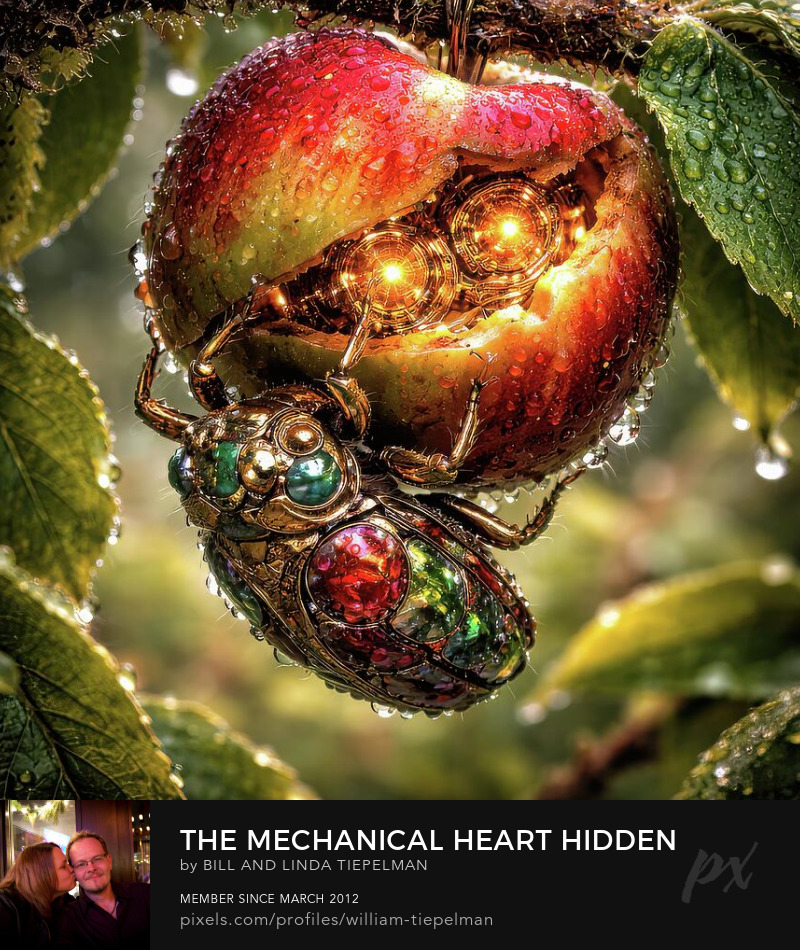
It hung low from a bent branch, larger than her palm, its skin red as old lacquer and slick with rain. One side had split cleanly open—not rotted, not pecked, not naturally torn, but parted. Peeled back. As if some exquisite violence had been done to it with care. Inside, where pale flesh and seeds should have been, there glowed an intricate core of gold. Not gold in the simple sense. Not metal, exactly. Something finer. Something alive.
It was built in layers—filigreed chambers, minute arches, tiny repeating structures like the innards of a cathedral designed by a jeweler with questionable morals. Amber light pulsed through it in slow, sensual waves. It looked mechanical the way dreams look factual: convincing until you tried to name why. Rain touched the exposed core and hissed faintly into steam. Clinging beneath the fruit was a beetle. Its shell glittered like a treasure chest with self-esteem issues. Emerald, ruby, black opal, and gold flashed across its carapace in wet jeweled planes. It was the size of Elowen’s thumb and so ornate it appeared less evolved than commissioned. Its legs gripped the apple with delicate authority. Its head lifted.
And the thing looked directly at her. Elowen stood very still. The beetle remained where it was, shining like a tiny curse. It did not flee. It did not hide. It only watched, as if assessing whether she had been invited or merely arrived early. “You,” Elowen murmured, because if one is going to lose one’s grip on reality, one may as well be conversational about it, “are either a miracle or an infestation.” The beetle opened its wings a fraction. A low sound slipped into the air.
Not quite buzzing. Not quite humming. Musical, almost. A vibration with pattern in it, subtle as fingers stroking the lip of a glass. Elowen felt it first in her teeth, then in her throat, then lower—somewhere beneath her ribs where good judgment goes to weaken. She took one step closer. The apple’s glow deepened.
The scent reached her then. Sweet, yes—but not merely sweet. It smelled like late summer on warm skin. Like cider and clove. Like honey licked from a fingertip. Like the first breath drawn after an excellent kiss when one is still deciding whether to be offended by how thoroughly one has been distracted. Beneath it ran another note, darker and stranger: metal warmed by touch, sap, rainwater collected in hollow wood, and something faintly floral that suggested the blossom from which this thing had grown had known entirely too much.
Elowen swallowed. “No,” she told herself. The apple glowed again, slow and golden, as if amused. She had not come to eat it. That was important. She was a rational woman. A rational woman with a lantern, a storm, a haunted inheritance, and an apple that looked like sin had hired an architect. But still rational. She intended merely to inspect it. Perhaps remove it. Possibly cut it open further under proper indoor lighting and determine which branch of science had recently suffered a breakdown. She reached out.
The beetle spread its wings fully, and for one absurd instant she thought it might attack her. Instead it lifted into the wet air and circled once around her hand. Its wings made that same musical hum, only closer now, softer. Intimate. It landed lightly on the inside of her wrist. Elowen inhaled sharply. The beetle’s feet were cool and precise. Tiny hooks. Tiny jewels. A sensation so delicate it should have been nothing and yet was somehow not. The hum traveled into her pulse. Her skin pebbled. The lantern nearly slipped in her other hand.
“Well,” she whispered hoarsely, staring at the glittering thing perched against the pale line of her veins, “that feels intentional.” The beetle tilted its head. Then, impossibly, it traced a small slow path upward, no more than an inch, and stopped. There are moments in a person’s life when the body issues a very clear opinion before the mind has assembled one. Elowen had always mistrusted such moments on principle. Principle, however, was having a difficult evening. She should have flung the creature off. She should have gone inside.
She should have recalled Sabine’s letter in full, especially the portion that carried the brisk unmistakable flavor of experience. Instead she lifted her hand toward the apple. The exposed core pulsed brighter as her fingers neared it, illuminating the rain on her knuckles. The warmth touched her before she made contact—subtle at first, then unmistakable, like standing near a body in darkness. The skin of the apple around the opening was tender and slightly parted. Juice beaded there, thick and clear. When she pressed lightly with one fingertip, the fruit yielded with a softness so lush it bordered on indecent.
Elowen closed her eyes for half a second. This, she thought with blistering annoyance, was ridiculous. She was being seduced by produce. That was the fact of it. There was no more dignified summary available. Rain ran down the back of her neck. The beetle on her wrist hummed low and pleased. The apple breathed gold against her skin. Somewhere behind her, deeper in the orchard, another hum answered. Elowen’s eyes snapped open. Then another. And another. Not close. Not yet. But moving. Between the dark trunks, points of jeweled light flickered into being—green, red, amber, blue-white. Tiny and drifting, then vanishing, then returning farther forward. The branches trembled though no wind passed through them. The entire western row seemed suddenly attentive.
The jeweled ones begin to circle you. Sabine’s words slid through her mind with unwelcome clarity. Elowen stepped back at once. The beetle on her wrist took flight, hovered before her face, and for one impossible, arresting moment she had the distinct impression it was offended. “Oh, don’t start,” she muttered, backing away from the glowing apple. “I’m already damp, alone, and negotiating with an insect. I refuse to also feel guilty.” As if in reply, the apple’s core gave one deep throb of light. The orchard answered.
A ripple traveled beneath the soil. Not metaphorically. Not poetically. The ground physically shifted under her boots, a subtle undulation as though something enormous had turned over in its sleep below the roots. Water in the ruts trembled. Leaves shivered. The humming grew louder—now all around her, circling through the dark like winged jewelry with opinions. Elowen did the wisest thing she had done all evening. She ran. Lantern swinging, cloak dragging, boots slipping in mud, she fled between the rows while jeweled lights flashed in the corners of her vision. Hum rose and dipped around her, never striking, never touching—only herding. Guiding. The sensation was almost worse than attack. An attack she could have understood. This felt like invitation. Like escort.
She reached the house breathless and shoved the back door closed so hard the frame rattled. For several seconds she stood with her spine against it, chest heaving, rainwater pooling at her feet while thunder shook the roof and the orchard hummed softly beyond the walls. Inside, the kitchen was dim and still. The old copper pots gleamed faintly. The clock on the shelf ticked with crisp domestic disapproval. Her own wet reflection stared back at her from the black windowpane over the sink: hair loosened, mouth parted, eyes brighter than fear alone accounted for.
On the inside of her wrist, where the beetle had rested, a mark had appeared. It was not large. Barely the size of a petal. A filigreed oval in faint gold, as delicate as a piece of jewelry pressed beneath the skin. It glimmered once when she lifted it to the light, then settled into a soft warm trace against her pulse. Elowen stared at it. Then she laughed. It was not her best laugh. It had edges. “Marvelous,” she said to the empty kitchen. “That’s exactly what one wants from inherited property. Structural decay, regional gossip, and sexually aggressive horticulture.”
Outside, beyond the rain and the dark, the orchard hummed back like something smiling. Elowen did not sleep well. Not because she was afraid, though fear certainly turned up like an uninvited cousin and made itself comfortable. No, what kept her awake was the more humiliating fact that beneath the fear sat curiosity—hotter, sharper, and distressingly eager. She lay in her vast old bed listening to water drip from the eaves and replayed the glow of the apple’s open heart, the feel of warmth against her fingertip, the tiny jeweled weight on her wrist.
She told herself she was thinking scientifically. Her body, unhelpfully, had its own interpretation. Just before dawn, when exhaustion finally began to drag her under, she heard it. A sound from beneath the floorboards. Not the ordinary mutter of an old house settling. Not rats, not pipes, not storm runoff. Humming. Low. Layered. Patient. As if the roots themselves had found a song and were waiting for her to learn the words.
What the Roots Remember
Morning did very little to improve matters. Dawn arrived pale and respectable, as if the night had not spent itself whispering indecencies beneath Elowen’s floorboards. Sunlight spilled through the curtains in broad gold rectangles. Birds argued in the hedges with the cheerful vulgarity of creatures entirely untouched by supernatural temptation. The storm had passed. The world smelled of wet earth, bruised leaves, and fresh coffee from the pot Elowen put on the stove with the grim focus of a woman attempting to restore civilization one bitter cup at a time.
Unfortunately, civilization remained patchy. The mark on her wrist was still there. In daylight it looked even less like a rash, injury, or trick of imagination. It was intricate. Intentional. A tiny gilded shape beneath the skin, all curling lines and minute branching forms, as though a jeweler had been given access to her bloodstream and gotten artistic. It sat directly over her pulse, and every few heartbeats it answered with a faint warmth—subtle, but impossible to ignore once noticed. Elowen had attempted ignoring it anyway. Out of principle.
She had also attempted scrubbing it off with soap, lavender water, a nail brush, and, in a brief fit of irritation, the corner of a copper pan. The mark remained, pristine and quietly smug. “Wonderful,” she muttered, toweling off her arm. “Branded by ornamental vermin.” It warmed beneath her fingers. Not hot. Just enough to suggest that somewhere, something had heard her and was entertained.
She drank her coffee standing at the kitchen window, staring over the orchard with narrowed eyes. In daylight it looked almost innocent. Rows of low silver-barked trees gleamed with leftover rain. Apples hung heavy among dark leaves. The western slope, where she had found the glowing fruit, appeared perfectly ordinary from this distance—no golden pulse, no swarm of jeweled insects, no evidence whatsoever that the entire place had attempted to flirt with her in a storm. She hated that. Nothing is more irritating than being unable to prove that one’s deeply unreasonable experience was, in fact, real.
So Elowen did what any sensible inheritor of cursed acreage would do: she made a list. At the top she wrote: 1. Determine whether orchard is haunted, sentient, diseased, chemically active, or all four. Below that: 2. Avoid being seduced by produce. Then, after a moment’s thought: 3. Burn any additional ledgers before they get clever. By noon she had checked the cellar, the outbuildings, and Sabine’s study, where she found exactly what one might expect from a woman who had lived alone on a hill full of whispered scandals: meticulous records, viciously edited letters, and enough locked drawers to suggest either fascinating secrets or an extreme dislike of dust.
She found orchard maps dating back nearly a century. Pruning notes. Soil tests. Harvest tallies. Weather journals. Marginalia in Sabine’s precise hand that ranged from practical to frankly alarming. West row bloomed after the twins’ fight. Fruit sweeter when sung to. Stronger response to contralto than tenor. Curious. Mr. Fenwick returned to the lower path against advice. Orchard spat him out before dawn. Hat found in quince hedge. Ego unlikely to recover. The jeweled ones prefer vanity, appetite, loneliness. Hard to blame them. So do most predators. Elowen sat back in Sabine’s leather chair and stared at that last line for a long time.
The room smelled of old paper, dried orange peel, and a lingering trace of Sabine’s perfume—something dark, floral, and expensive enough to imply either taste or extortion. Dust motes drifted in the slant of afternoon light. The house was quiet, but not restful. It had the silence of a theater before the curtain rises, full of staged restraint and concealed machinery. On the desk lay a small iron key wrapped in a strip of black ribbon. Attached was a note in Sabine’s hand:
If you are reading this, then naturally you ignored the parts of my letter designed to preserve your peace. I did too. The lockbox is under the floor of the summer room. Mind the third board from the hearth; it sticks when sulking. Elowen exhaled through her nose. “You impossible woman.” Still, she rose and went. The summer room sat at the eastern side of the house, all windows and faded blue wallpaper, where vines had once been trained along trellises just outside so the place glowed green in warm weather. The third floorboard did indeed stick when lifted, though not enough to stop a determined woman armed with a poker and a worsening sense of inevitability.
Beneath it rested a narrow brass lockbox, greened with age. The black-ribbon key fit. Inside were three things: a sealed packet of letters, a slim journal bound in oxblood leather, and a small velvet pouch tied with gold cord. Elowen reached first for the journal. It was Sabine’s hand again, but looser here. Less public. Less guarded. The first entries were dry enough—notes on grafting, pollination, beetle sightings, blight in the lower rows. Then, gradually, the tone changed. The humming began under the west roots after the long drought. At first I thought it groundwater. Then I thought it memory.
The apples opened on their own tonight. Not all. Only seven. Their cores glowed like watchworks dipped in honey. I should be terrified. Instead I am offended at how beautiful they are. The insects are not insects. Or not merely. They are selective. They circle those who hunger for something they will not name aloud. The orchard is oldest where the hill dips. There was something here before the first trees. I have begun to suspect the roots are not feeding downward so much as listening.
I made the mistake of touching one of the opened fruits after dusk. The warmth passed through my hand and into my chest. For one full hour I could hear the sap move in every branch on the property. It sounded like breathing through silk. I now understand the danger. It does not devour in the crude sense. That would be merciful. It studies you, finds the shape of your emptiness, and grows to fit it. Elowen stopped reading. There are only so many deeply unsettling observations one can absorb before the mind sits down, crosses its arms, and announces it will be taking a cigarette break despite not smoking.
She looked at her wrist. The mark glowed faintly in the dim room. Then she opened the velvet pouch. Inside lay a ring. Not a wedding band, not exactly, though it had the intimacy of one. It was made of dark gold shaped into winding filigree, set with a tiny stone the color of amber lit from within. It was exquisite in the same way the apple’s exposed heart had been exquisite—beautiful with clear malicious potential. A note tucked beneath it read: Do not wear unless invited. If invited, consider very carefully whether you wish to remain a guest.
Elowen laughed once, softly. “That clears absolutely nothing up.” The sealed letters she left alone for the moment. She was not yet ready to discover whether Sabine had once maintained a romantic correspondence with a root system or merely a more ordinary scandal. Instead she carried the journal back to the study and read until dusk pressed gray against the windows. By then she knew three things with uncomfortable certainty. First: Sabine had not been mad. Second: the orchard had rules. Third: Sabine had broken some of them and survived long enough to sound aggravatingly elegant about it.
There were patterns in the entries. The opened apples did not appear every night. The jeweled beetles were most active after storms and before harvest. The humming under the roots intensified around those marked by contact. And there was repeated mention of a place called the Hollow Bed—a natural dip on the western slope where the oldest trees leaned inward around a depression in the earth. One line had been underlined twice: If it begins to want you, it will first make itself wanted. By the time she read that, the house had gone nearly dark.
Elowen looked up and realized, with the slow annoyance of someone being outmaneuvered by atmosphere, that twilight had arrived again. Then the humming began. Not beneath the floorboards this time. At the window. She turned sharply. There, clinging to the outer pane of the study window, was a jeweled beetle. Its tiny body gleamed in the fading light like a brooch come to life. Emerald shoulders. Ruby wing-cases. Gold-threaded legs. It watched her through the glass with the composed patience of a caller who knew perfectly well she was home.
Elowen stood very still. The beetle tapped the pane once. Then again. Deliberately. “Absolutely not,” she said. The mark on her wrist warmed. The beetle lifted and drifted sideways through the air, pausing near the window latch. “No.” It hovered there, humming low, then turned and flew into the dusk beyond the glass. For one absurd second she felt… dismissed. Elowen set the journal down too hard. “I refuse,” she informed the room, “to be beckoned by ornamental insolence.” And naturally, because dignity is a decorative item rarely used in moments of compulsion, she followed it ten minutes later.
This time she went armed with more than a lantern. She brought pruning shears, Sabine’s journal, a flask of brandy, and the kind of expression usually worn by queens marching toward an execution they intend to reorganize. Twilight lay thick over the orchard. The wet leaves reflected the last of the sky. The beetle appeared again as soon as she crossed the first row, circling once around her head before gliding west. Not hurried. Confident she would follow. Insufferable creature. She did follow.
The western slope seemed to deepen as she walked, the rows narrowing, the trees growing older and more contorted. The ground underfoot changed too—softer, springier, threaded with roots that rose and vanished like sleeping animals. The humming gathered around her, not from one beetle now but several. Flickers of jewel-light moved between branches. She caught flashes of green and crimson, tiny bodies skimming through leaves like living ornaments stripped from some depraved saint’s reliquary. They did not touch her. They did not need to. The mark on her wrist throbbed warmly with each step. By the time she reached the dip in the hill, her pulse had begun to match the rhythm of the sound around her.
The Hollow Bed was not large. That was the first surprising thing. For all Sabine’s ominous references, Elowen had half-expected some dramatic sinkhole or pagan amphitheater. Instead it was a shallow basin in the land ringed by six ancient apple trees whose branches bent inward overhead, forming a natural vaulted chamber of leaves and shadow. At its center stood a stone well. Not a deep one. More a circular throat in the earth, waist-high, built from old mossed stones and wrapped in roots that had grown over and through the gaps like fingers claiming jewelry. No rope. No bucket. No practical farming use whatsoever.
“Oh, excellent,” Elowen whispered. “A symbolic structure. Because why stop at seductive fruit when we can also be obvious?” The beetles gathered around the well’s rim. Seven of them. They arranged themselves at even intervals, gleaming in the dimness. Then the humming changed. Deepened. Lowered into something that was almost a chord. The roots around the well shifted. Not much. Just enough to reveal, nestled within their braided grip, an apple. Freshly opened. Larger than the last. Its skin was darker too, almost wine-red, its torn edges wet and lush. Within, the golden heart pulsed with a richer, slower light. The glow painted the roots in amber and set the beetles’ jeweled shells ablaze. Warmth rose from it in subtle waves.
Elowen stopped at the edge of the basin. “No.” The orchard hummed. “I mean it.” The apple glowed. The beetles remained in position like tiny decadent judges. Then, from within the old well, a voice spoke. “You say no,” it murmured, “with the tone of a woman already leaning yes.” Elowen went rigid. There are surprises, and then there are moments when reality removes its wig, throws it on the floor, and says we’re done pretending. This was the latter.
The voice was low, smooth, and neither entirely masculine nor wholly anything else she could name. It seemed to come from the stone throat of the well and the roots wound through it and the air against her skin all at once. Cultured. Amused. Far too intimate for something with no visible mouth. “That,” Elowen said after a beat, “is a deeply inappropriate first impression.” A pause. Then a sound like laughter moving through leaves. “And yet you came dressed for one.” Elowen looked down at herself, soaked boots, dark cloak, hair pinned back badly enough to count as a threat, and decided she resented being accurately perceived by a haunted orchard.
“If this is seduction,” she said, stepping closer despite herself, “it’s alarmingly arrogant.” “Only because resistance is prettier when it speaks.” The warmth in her wrist flared. Elowen gripped the pruning shears harder. “What are you?” The roots along the well shifted again, very slightly, like something settling deeper below. “Old.” “That’s not an answer.” “It is where answers begin.” “Infuriating.” “Frequently.” The beetles hummed in what sounded disturbingly like agreement.
Elowen took one more step into the basin. The air within the ring of trees felt different—warmer, denser, scented with apple skin, wet bark, earth, and that dark metallic sweetness she remembered from the first opened fruit. The golden apple at the well’s base pulsed once, and in that light she saw carved into the stone rim a pattern of intertwining roots, blossoms, wings, and small human hands. Human hands. Many of them. Reaching inward. “Were there others?” she asked quietly. The voice did not answer at once.
When it did, amusement had thinned at the edges. “Always.” Elowen looked at the stone, the roots, the waiting fruit. “What happened to them?” “Some left.” “And the rest?” The apple’s core brightened. Warm gold climbed the inside of her wrist, up her forearm, then subsided before it reached the elbow. “The rest,” the voice said softly, “stopped wanting to.” That should have frightened her more than it did.
It did frighten her, to be clear. But fear was no longer working alone. Curiosity had become something heavier, stranger. A drag in the blood. A pull low in the body that had very little interest in moral perspective. Elowen hated that she understood, even dimly, what Sabine had meant. The danger here was not teeth and violence. It was invitation shaped so perfectly to one’s private hungers that refusal began to feel rude. “You marked me,” she said. “One of mine did.” “Why?” A whisper through the roots. “Because you were listening.”
“That is a flimsy excuse for bodily trespass.” Another rustle of laughter. The bastard sounded delighted. Elowen crouched at the well’s edge, trying not to notice how the air warmed around her knees, how the scent of the apple deepened as she leaned closer, how the humming had begun to harmonize with her breath. She looked down into the well. There was no water. Only darkness. Then, slowly, far below, something glimmered. Gold. Not one light. Many. Layered down in the depths like a nest of opened hearts.
Elowen’s mouth went dry. “Good God.” “Not the name I answer to,” said the voice. That was so smug she nearly threw the shears at it. Instead she set them down on the stone rim before she accidentally stabbed herself while being annoyed, which would have been embarrassing even by current standards. “What do you want from me?” she asked. The humming fell quiet. The orchard seemed to lean in. When the answer came, it was softer than before. “Attention.” Elowen blinked. That had not been the reply she expected. Corruption, perhaps. Devotion. Blood. A limb. Something theatrically awful. Not attention. That was almost pathetic.
“That,” she said carefully, “is either surprisingly honest or an excellent manipulation.” “Why choose?” “Because one suggests vulnerability and the other suggests I should set fire to this entire hill.” “Would you?” She opened her mouth, ready with a sharp answer. Then the voice said, quieter still, “Even now?” The apple at the roots pulsed. And Elowen, against all reason, looked at it. Really looked.
The opening in its flesh glistened in the golden light. Juice had gathered at the split edge in slow translucent beads. The exposed heart within was impossibly intricate, and now that she knelt closer she could see movement there—not gears exactly, but layered inner structures unfolding and folding again with the cadence of something living at rest. Beautiful. Intimate. Obscene in the way only certain flowers, wounds, and mouths can be obscene without ever meaning to. “You do make an effort,” she murmured before she could stop herself.
The voice turned velvet-soft. “For those who please me, yes.” Heat climbed the back of her neck. Elowen despised being susceptible to tone. It felt like an amateur weakness, like tripping over one’s own standards in public. And yet there she was, kneeling before a root-wrapped well while some ancient thing beneath the earth spoke to her like she was an interesting vice. “You’re intolerable,” she said. “You are still here.” That, annoyingly, was true.
The beetles lifted together, circled once around the well, and resettled. Their humming shifted upward into a thinner, sweeter note. The mark on Elowen’s wrist answered at once. A pulse. Then another. The warmth spread higher this time, threading through her forearm in delicate branching lines that vanished beneath the sleeve of her dress. She caught her breath. “Stop that.” “Touch the fruit,” said the voice, “and I will.” Elowen stared at the apple. “That is blackmail.” “Negotiation.” “Predatory negotiation.” “You say that,” it replied, “as if the idea offends you more than it interests you.”
That landed too well. Elowen rose abruptly and stepped back from the well. The air cooled by a degree. The warmth in her wrist receded, leaving behind a low ache that felt disturbingly like disappointment. Absolutely not. That was unacceptable. One could not afford to miss being manipulated by subterranean charisma. It was the first step toward a truly humiliating memoir. “I’m leaving,” she said. No answer. She turned. Behind her, at the edge of the Hollow Bed, stood a man. Or what her startled mind first understood as a man.
Tall. Dark-coated. Bareheaded beneath the boughs. One gloved hand resting on the low branch beside him. He had appeared so silently and so fully formed it took her a second to realize he had not walked in. He had, impossibly, become visible. The twilight moved oddly across him, catching details then losing them. His face was beautiful in the dangerous, overqualified way that suggests either aristocratic breeding or a long career in ruining people’s judgment. His mouth held the ghost of amusement. His eyes—God help her—were the color of amber lit from within. Not human eyes. Not entirely.
Root-thin gold lines traced up the side of his throat and disappeared beneath his collar. Elowen went very still. “That,” she said after a long pause, “feels unfair.” The smile sharpened slightly. “You preferred the voice?” His mouth moved exactly with the sound. Elowen’s entire nervous system had a brief administrative collapse. “No,” she said. “I preferred the abstract possibility that I was losing my mind with some dignity intact.” He stepped down into the basin. Everything in the Hollow Bed responded. The beetles lifted. The roots along the well tightened. The opened apple glowed brighter, richer. Even the leaves overhead seemed to draw inward around him. He moved like someone unaccustomed to needing permission from the world.
Dangerous men often have that quality. Ancient orchard-things wearing the shape of one apparently did as well. Up close he was worse. Rain-dark hair brushed his collar. His face was all elegant bones, patient mouth, and eyes that seemed built for low light and bad decisions. There was nothing crude about him. Nothing obvious. He carried the same seduction the orchard carried—cultivated, sensory, maddeningly specific. Not the broad brute force of desire, but the sharper thing: the sensation of being noticed in precisely the places one keeps private.
“You have been very rude,” Elowen informed him, because if one is cornered by uncanny beauty one must at least attempt governance through tone. “I sent gifts.” “You sent beetles.” “Decorated beetles.” “I am not seduced by administrative upgrades to insects.” His mouth almost twitched. “A pity. I took such care.” He stopped an arm’s length away. Close enough now that Elowen could feel the warmth coming from him—not body heat, exactly, but the same living amber warmth as the opened apples, deepened by earth and spice and that dark metallic sweetness. It reached her like memory arriving before thought. Her pulse went treacherous at once.
He looked down at her wrist. The mark flared gold beneath her skin. “May I?” he asked. It was the first polite thing he had said. Which made it, naturally, the most dangerous. Elowen should have refused. She knew this. Instead she held out her hand. He took it with infuriating gentleness. His fingers were cool at first touch, then warmed instantly around hers. Not rough. Not soft. Precise. Capable. The kind of hands that suggested excellent control and very selective lack of it. He turned her wrist toward the light of the opened apple and brushed the pad of his thumb over the gilded mark.
The effect was immediate. The gold beneath her skin surged upward in branching filaments. Heat spilled through her arm, across her shoulders, down into her chest in one molten wave. Elowen inhaled sharply and nearly lost her balance. His hand steadied her waist. That did not help. Not remotely. “There,” he murmured, watching her face with intolerable attention. “You can hear it now.” At first she thought he meant the humming. Then the orchard opened. Not physically. Sensory.
All at once Elowen could hear the sap shifting in the roots, the minute strain of branches holding fruit, the soft pressure of rainwater descending through soil, the brush of beetle legs on bark, the slow hidden swelling of apples in the dark. The entire hill had a pulse. Layers upon layers of it. Breath in wood. Desire in bloom. Hunger in seed. It poured through her in a dizzying, intimate flood. She gasped and grabbed the front of his coat with her free hand, not from choice but necessity, because the world had become far too large and far too close at once.
He lowered his head slightly, his face now only inches from hers. “Easy,” he said, and his voice had lost most of its mockery. “Do not fight what is only entering to be understood.” “That,” Elowen whispered shakily, “sounds like something said just before an irreversible mistake.” “Often.” His thumb moved once more over the mark. Her knees weakened. Elowen hated every single thing about how interested she was. “You are enjoying this,” she said. “Immensely.” “Ghastly creature.” “You have not yet chosen your pettier names for me. I am willing to wait.”
He released her wrist at last, though his other hand remained at her waist half a moment longer than strictly necessary. When it left, the absence felt obscene. Elowen resented that too. She stepped back, breathing unevenly, her whole body lit from within by sensations she had neither agreed to nor, if she were being honest, wholly regretted. “What do I call you?” she asked. He looked at the well, then at the roots twined through it, then back to her. “Names are a kind of door,” he said. “You may have one when you decide whether you are standing on the threshold or crossing it.”
“That is infuriatingly theatrical.” “And yet you are still listening.” He glanced toward the apple nestled in the roots. Its heart glowed, patient as temptation itself. “When you are ready,” he said softly, “take the first bite where I can see you.” Elowen stared at him. He inclined his head—courtly, insolent, impossible—then stepped backward. The twilight folded around him. His shape thinned into shadow between the trees, into root-dark and amber gleam, into humming and leaves and the rich wet scent of orchard dusk. In seconds he was gone, or everywhere, which was not nearly as different as Elowen would have preferred.
She stood alone in the Hollow Bed, chest rising and falling too fast, wrist burning, the opened apple glowing at the roots like a dare with excellent lighting. At her feet, the seven jeweled beetles turned toward her in perfect unison. And beneath the house-darkening sky, somewhere deep under the hill, the roots began to sing.
The Bite, the Bargain, and the Bloom Below
Elowen did not take the bite that night. That, in hindsight, was either a triumph of character or a tedious delay in what had already become the most compromising courtship of her life. She left the Hollow Bed with as much dignity as a woman can reasonably maintain after being half-undressed by sensory overload and a supernatural man with a voice like velvet over a blade. The jeweled beetles escorted her only as far as the western row before peeling away into the branches one by one, their tiny lights winking out among the leaves like smug little thoughts she did not care to keep having.
Back in the house, she locked the doors. Then she locked them again, because it felt symbolically useful. Then she stood in the kitchen with both hands braced on the table and tried to breathe like an ordinary person who had not just had her wrist touched by a sentient orchard in a man-suit. It did not work.
The house seemed too small now. Too dry. Too still. The wooden floor held a quiet pulse beneath her bare feet, not enough to move, only enough to suggest awareness. Her body had become traitorous territory. The mark on her wrist glowed faintly at intervals. Each time it did, some corresponding part of her remembered the feel of his thumb over it and reacted with a level of interest she considered structurally unsound. “You are not,” she told herself aloud while pouring brandy into a teacup because proper glassware had begun to feel optimistic, “going to be lured underground by horticultural foreplay.”
The roots beneath the floor hummed softly. Elowen drank. It was a long night. She read until the words blurred. She reread Sabine’s journal, especially the late entries, where the sharp practical observations had begun to fray into something more intimate and dangerous. It does not ask for love. It asks for attention with such precision that love begins to resemble the polite version. I believed I was studying its hungers. I failed to notice when it began studying mine. The ring is not a token. It is consent made ornamental.
If you wear it, the orchard will cease treating you as a passing appetite and begin treating you as kin. This is not safer. It is merely more mutual. Elowen read that line three times. Then she took the ring from the velvet pouch and set it on the table before her. It gleamed in the lamplight like a small concentrated mistake. She did not touch it. At least not for several minutes, which under the circumstances was practically sainthood.
When she finally lifted it, the amber stone warmed at once in her palm. Not hot. Welcoming. The filigree band caught the light in root-like curves and blossom-fine edges, its shape too organic to feel fully made by hand. The sort of ring one might expect an empress of bad decisions to wear while signing away a province. “Consent made ornamental,” Elowen murmured. She looked toward the black kitchen window, where her reflection floated over the dark orchard beyond: pale face, loosened hair, eyes bright with fatigue and defiance and something not far enough removed from desire to be comfortable.
“Damn you, Sabine,” she said softly. “You left me a manual and still somehow contrived to make it flirt.” The ring waited. By dawn, she had made up her mind. Not because she trusted the orchard. Certainly not because she trusted its infuriatingly beautiful emissary. But because she trusted herself more than she feared what she wanted to know. And because there are only so many times a person can be invited to the threshold of a mystery before pride becomes indistinguishable from longing. That evening, she bathed.
This was not vanity. It was strategy. If one is going to enter into a possible root-based bargain with ancient appetite, one need not do so smelling of anxiety and cellar dust. She chose a dress of deep green silk—not tight, not revealing, but cut in a way that acknowledged the existence of her body without apologizing for it. She pinned up her hair, then let half of it down again when the first arrangement made her look too much like a schoolmistress about to discipline a thunderstorm. At the last moment she put on Sabine’s old gold earrings, because if family madness was hereditary, it may as well be accessorized properly.
Only then did she slide the ring onto her finger. The effect was immediate. The metal tightened once, not painfully, but with an unmistakable living intelligence, then settled as if it had been made for her hand alone. Warmth traveled from the amber stone through her palm, up her wrist, into the mark beneath her skin. The gold flared. Breath caught in her throat. For one suspended instant the whole house seemed to inhale with her. Then, gently, everything changed. The orchard did not become louder. It became clearer.
The roots beneath the floor no longer hummed like something outside her life. They sounded near. Related. The walls of the house held the memory of sap in the beams. The apples outside glowed to her senses as distinct presences—dozens, then hundreds, each carrying a different sweetness, different ripeness, different pressure of becoming. The jeweled beetles moved through the dusk like notes in a score she had suddenly learned to hear. And beneath it all, the oldest presence waited. Attentive. Pleased. “Oh, for heaven’s sake,” Elowen whispered, staring at her own hand. “I’ve married the ambiance.”
The laughter that answered came through the roots, through the window glass, through the ring, and low inside her chest. She smiled despite herself. That was probably the first truly dangerous moment of all. She went to the western slope at dusk carrying no lantern this time. She did not need one. The Hollow Bed was lit before she reached it. Not with crude brightness. With invitation. The six ancient trees glowed softly along their veins of sap. Jewelled beetles clustered in the branches like living constellations. The old well breathed amber from within. Even the grass in the basin seemed filmed with warm gold where the roots ran shallow beneath it.
At the center, nestled against the roots of the well, waited the opened apple. Not the same one as before. This one was more beautiful. Of course it was. Its skin was a red so dark it approached black at the curve, lacquered with dew. The split in its flesh was lush and deliberate. Inside, the living golden core unfolded in intricate nested chambers, each one pulsing with slow radiant rhythm. It smelled of sweetness ripened past innocence—honey, cider, clove, blossom, skin warmed by silk, the faint mineral note of stormwater caught on stone.
And he was there. Leaning against the old well as if it had been built solely to improve his silhouette. He wore black again, which felt unfairly efficient. His hair fell loose at his collar. The gold root-lines at his throat shone faintly beneath the skin. In the amber wash of the Hollow Bed, his eyes looked less like fire than stored sunlight—old light, hoarded light, the sort of glow that does not ask whether it is wanted because it already knows the answer. He took in the dress, the earrings, the ring on her hand.
His gaze slowed. “Well,” he said softly, “now I feel courted.” Elowen descended into the basin. “Do not become sentimental,” she said. “It will ruin your whole predatory mystique.” His mouth curved. “And here I feared the ring might soften you.” “It has enhanced my hearing. Unfortunately for you, that includes my own standards.” He laughed, low and warm, and the beetles answered in a bright circling shimmer. The sound rippled through the trees. Elowen came to a stop before the opened apple. For a moment neither of them spoke.
The air between them held that peculiar density found only in thunderstorms, confessionals, and the instant before one chooses to become slightly less innocent than before. Then he straightened from the well and held out a hand. “If you bite it wearing the ring,” he said, “you will not be taken unguarded. You will feel what I feel. Know what I know, as far as your body can bear it. You will see the roots remember. You will understand what this hill is. And afterward—” He paused. “Afterward?” Elowen asked.
His gaze held hers with infuriating steadiness. “Afterward it may become difficult for either of us to pretend indifference served us better.” That was, she thought, the closest thing to honesty he had offered yet. “And the cost?” she asked. He looked at the apple, then at the roots climbing the well, then at her ringed hand. “The orchard will know you,” he said quietly. “Not as a trespasser. Not as prey. As one invited inward.” “Meaning?” “Meaning it will answer you.” “That sounds suspiciously like a sales pitch written by a cult.”
“All enduring things sound like cults at close range.” “You are profoundly irritating.” “And yet exquisitely right for you.” Elowen exhaled through her nose and reached for the apple before he could say anything else unbearably accurate. Her fingers sank lightly into the flesh around the opening. It was warm. Softer than a ripe pear, firmer than a bruise, yielding with a living responsiveness that sent a ridiculous little shock through her hand. Juice gathered against her fingertips. The golden heart within the fruit throbbed once, brightening as if in anticipation.
“You are looking at me,” she said without turning. “I told you I wished to.” “That is not helping.” “It was not intended to.” Of course not. Elowen brought the opened edge of the apple to her mouth. The scent alone nearly undid her. Sweetness, spice, amber warmth, rain, blossom, iron-rich earth, that maddening note of something mechanical and intimate beneath it all. The first touch to her lips was cool from the evening air. The second, as the fruit seemed to warm into the contact, was almost indecently lush.
Then she bit. The world split open. There is no graceful language for certain experiences because grace was never invited to them. The taste hit her all at once—apple, yes, but heightened beyond nature into revelation. Honeyed tartness and floral heat. Fermented sunlight. Sweetness with structure. Juice burst over her tongue carrying molten gold through nerves she had not known could taste. The living core inside the fruit unfolded into her mouth not as metal or flesh but as sensation—warm intricacy, layered brightness, a sweetness that shaded into ache, then into something fuller, stranger, unbearable only because she wanted more of it as soon as it began.
The ring flashed. The mark on her wrist ignited. And the roots below the hill opened their memory to her. She did not see with her eyes. She saw with whatever part of a body still believes longing is a kind of map. The orchard unscrolled through her in epochs.
Before the apple trees there had been a spring under the hill, warm even in winter, where animals came to sleep and did not wake frightened. Before the spring there had been something older still—an underground seam of mineral fire and strange living pattern, a place where growth and desire had curled together in the dark until even the soil learned appetite. The first trees planted there did not merely feed. They listened. Over generations they became vessels. Mouths. Hearts turned outward in fruit. She felt every caretaker who had ever come to the hill.
The frightened ones. The greedy ones. The lonely ones. The curious ones. The few who had tried to dominate it and been politely humiliated. The handful who had listened long enough to be changed without being destroyed. Sabine among them—sharp, amused, grieving something she had never written plainly, learning to negotiate with the place as one negotiates with a dangerous lover: never fully safe, never fully sorry.
Elowen felt Sabine standing in the Hollow Bed years ago, ringless but resolute, one hand on the well as the roots whispered around her ankles. She felt the exact shape of Sabine’s understanding: that the orchard was not evil in the crude village sense. It was intimate without morality. Hungry without shame. Tender only where tenderness deepened attachment. It did not corrupt by force. It offered fulfillment in forms so exquisitely tailored that surrender could masquerade as self-discovery right up until the point one realized how much of oneself had been rearranged to fit.
Then deeper still. Past Sabine. Past the records. Past the house. To him. Not a man born and transformed, as Elowen had half imagined in some Gothic fit. Something older and stranger. A consciousness that had accumulated within the orchard over decades, then centuries, through every invited exchange. Through every bite taken willingly. Through every longing fed into root and blossom and fruit-heart gold. He was not the hill itself, not exactly, but its chosen shape when shape became useful. Its voice where voice became seduction. Its body where body became language.
And through the bite, because of the ring, he felt her too. Not abstractly. Entirely. Her grief at having been misread by smaller people. Her hunger for something that noticed without reducing. Her contempt for sentimentality and secret ache for devotion worthy of that contempt. Her loneliness, disciplined into elegance. Her vanity. Her wit. Her appetite for beauty sharpened almost to cruelty. Her fear of being possessed. Her equal fear of never being fully met. The exchange hit both of them like weather. Elowen staggered. He caught her.
This time there was no teasing in it. No practiced amusement. His arms closed around her with sudden fierce precision, as if the knowledge passing between them had stripped something ornamental away. She clutched at him, not because she was weak, but because standing had become an administrative impossibility. The bitten apple slipped from her fingers and landed in the grass, still glowing. He made a sound low in his throat—not quite a groan, not quite her name, since she had never given it to him in that tone before.
“Elowen,” he said again, and now it sounded wrecked. That pleased her more than it should have. “Well,” she whispered against his coat, struggling for breath while the roots sang through her bones, “this seems… wildly inadvisable.” “Yes.” His hand pressed between her shoulder blades. Her ring burned. The orchard bloomed brighter around them. “And yet,” he said hoarsely, “I find myself strongly in favor.” She lifted her face. He looked different now that she had seen through him. Less polished. More dangerous in the honest way. Hunger was in his expression, yes, but also surprise, as if what he had found in her was not merely useful but devastatingly interesting.
Good, she thought. Let him suffer a little. “You still don’t have a name,” she said. His mouth curved, though strain lingered in it. “I have several.” “Try one that isn’t insufferable.” He lowered his forehead to hers. “Auren.” The name slid through the ring and settled under her skin like a final key turning in a lock. The orchard answered it at once. Gold flared through the roots. The beetles lifted into the air in a circling crown of color. “Auren,” she repeated. His eyes closed briefly, just once, as if hearing his own name in her mouth had done some damage he fully intended to revisit.
“Yes,” he said. Elowen could have kissed him then. She knew that. He knew it too. Which was precisely why she did not. Instead she drew back enough to study him with restored composure—or at least a performance of it. “Let us be very clear,” she said, though her hand was still curled into his lapel. “This does not make me obedient.” “Thank the roots,” he murmured. “I should be terribly bored.” “It does not make me yours.” Something flashed in his gaze, fierce and pleased and darkly amused all at once.
“No,” he said. “It makes you impossible to mistake for anyone else.” That was such an offensively perfect answer that Elowen nearly forgave him everything on the spot, which would have been sloppy, so she settled for narrowing her eyes instead. “And the orchard?” she asked. “What exactly has it made me now?” Auren looked around the Hollow Bed. At the roots. The beetles. The ancient trees leaning inward overhead. “Its keeper,” he said. “If you choose it.” “And if I do not?” He went still. For the first time since she had known him, true uncertainty crossed his face.
“Then it will ache,” he said quietly. “And so will I. But the ring does not bind against will. Sabine would never permit it. Nor would I.” Elowen held his gaze. There it was again—that inconvenient, dangerous honesty she had wanted and dreaded in equal measure. Behind them, the bitten apple at their feet began to change. The split flesh folded inward. The golden heart dimmed, then melted down through the grass in slender glowing threads, sinking into the soil like light returning to a well. Wherever it touched, the ground brightened. Roots stirred. New shoots pushed upward in quickening spirals, unfurling pale leaves edged in gold.
At the center of the Hollow Bed, directly beside the old well, a new sapling rose. Not tall. Not yet. But unmistakably alive. Its bark shone silver-green. Its first bud swelled at once, opened, and released a flower unlike any blossom in the orchard—a layered bloom of cream, blush, and amber, with a scent so lush and warm Elowen had to close her eyes against it. “Oh,” she whispered. Auren watched the new tree with something like reverence. “It has never done that before,” he said. That startled her more than almost anything else.
“You’re telling me I just improvised new botany?” “I’m telling you,” he replied, looking at her now with that same dangerous depth she was already far too aware of, “that it likes you enough to become something it has not been.” Well. That was unfortunately romantic. She would have to monitor it. The beetles descended, not to her skin this time but to the new sapling, where they clustered along its leaves and blossom like jeweled blessings with questionable ethics. Their humming softened. The ring on her finger cooled to a steady warmth.
Elowen breathed in the scent of the new bloom and understood, all at once, what her answer had already become. Not surrender. That word was too simple, too limp for what this was. Not conquest either. More intimate than either of those. Participation. A place answered by another place. A hunger met not by being consumed, but by being recognized at full and dangerous scale. She turned to Auren and straightened the front of his coat with cool deliberate fingers, partly because it needed doing and partly because she enjoyed the way he went very still when she touched him on purpose.
“All right,” she said. “I will keep the orchard.” The entire hill responded. The roots below them surged in one vast warm pulse. The trees shivered silver in the dusk. Hundreds of hidden apples brightened at once across the slope like banked lanterns under leaves. The beetles lifted in a radiant spiral. Somewhere in the house above, old glass rang softly in its frames. Auren’s expression changed in a way she suspected would remain dangerously satisfying for a long time. “Keeper,” he said, and the title in his mouth felt less like ownership than invitation renewed.
Elowen lifted a brow. “Do not make it smug.” “I would never.” He was lying, of course. She could hear it now when he lied—not by words, but by the slight bright shift in the roots whenever he amused himself. The orchard had given her many things in that bite. Evidently one of them was improved detection of nonsense. “Good,” she said. “Because we are going to establish rules.” “For me?” “For everything.” “How severe.” “You have beetles that mark people without written permission. We begin there.” At that, Auren actually laughed aloud, the sound rich enough to ripple through the basin. The new sapling trembled. The bloom released more scent. Elowen, to her eternal irritation, smiled with him.
They left the Hollow Bed together. Not clinging. Not dramatic. She would have despised that. But his hand remained at the small of her back as they walked the western row, and the orchard parted around them with the intimate, rustling deference of a household recognizing both its master and the person who will now argue with him about everything. In the days that followed, the village noticed changes.
The eastern slope, once prone to blight, grew lush and heavy with fruit. Storms bent strangely around the hill and broke softer in the fields below. Widowers still visited, but came back merely thoughtful instead of spiritually disassembled. The apples became famous again, not only for their sweetness but for the odd way each seemed to suit the person who bit it. Children laughed more after eating them. Bitter men grew briefly tolerable. Women carrying old grief slept through the night for the first time in years and woke with blossom petals on their pillows and no clear explanation they cared to share.
As for Elowen Vale, the village decided she had become even more difficult to understand. She was seen less often in town, but when she came she was radiant in a way no one could categorize politely. She smiled as if at private jokes. Her orchard accounts became immaculate. Her gowns improved. Men who tried to patronize her developed an unaccountable tendency to lose their hats in hedges on the road home. And now and then, on damp evenings, those passing below the hill swore they saw another figure moving between the rows beside her—a dark shape in the amber dusk, too elegant to be a laborer, too silent to be ordinary.
The sensible people said it was a lover. The foolish ones said worse. The oldest villagers said nothing at all. They only nodded, seeing in her expression some long cycle closed and reopened with better jewelry. Late that autumn, when the first frost silvered the lower fields, Elowen stood in the Hollow Bed beside the sapling that had now grown taller than her shoulder. It had borne no apples yet. Only blossoms, always one at a time, each one opening at dusk and releasing a perfume rich enough to make the beetles circle in devotional loops.
Auren stood behind her, one hand resting lightly at her waist. She had kissed him, eventually. Several times, in fact. She was not a saint, and the man had entirely too much mouth to leave that mystery unresolved. It had gone badly for her self-command and exquisitely for her mood. Tonight, though, they were only standing together in the amber hush, watching the roots glow faintly beneath the grass. “Tell me something true,” Elowen said. “You have become fond of impossible prompts.” “That is deflection.” “It is foreplay for honesty.”
She sighed. “You remain intolerable.” “And yet.” “Yes, yes. And yet.” He bent and brushed his mouth near her temple, not quite a kiss, more the suggestion of one offered by a creature who knew very well how such things accumulated interest. “Something true,” he murmured, looking out over the orchard with her. “When you first came to the hill, I thought you would either flee or break. Most do one or the other.” Elowen waited. His hand tightened slightly at her waist. “I had not accounted for annoyance as a survival strategy.”
She laughed—bright, helpless, unladylike. The beetles stirred in the branches. The sapling’s single blossom opened another fraction. “That,” she said, “is the first sensible thing you have ever said to me.” Auren smiled into her hair. Below them the roots hummed, not hungry now, but content in that watchful, living way contentment sometimes takes when it knows appetite will come again and is in no rush for it. The orchard had kept what it wanted. But so had Elowen. And on certain golden evenings, when the rain had just passed and the apples glowed softly under the leaves, it was difficult to say which of them had made the luckier bargain.
The Mechanical Heart Hidden in Honeycrisp Lies doesn’t have to stay buried in the orchard. If this strange little seduction of jeweled beetles, glowing fruit, and dangerous beauty got its hooks into you, you can bring the artwork home as a canvas print, acrylic print, or metal print for a bold, luminous statement piece. For the more delightfully unhinged among us, it also slips beautifully into everyday life as a tote bag, sticker, or spiral notebook. However you bring it into your world, this piece keeps that same Captured Tales energy intact—lush, eerie, seductive, and just a little too pleased with itself.
 Sir Grumblethorn and the Mushroom That Disagreed
 The Wink That Got Away With Everything
 The Dewdrop He Swore He Could Handle