
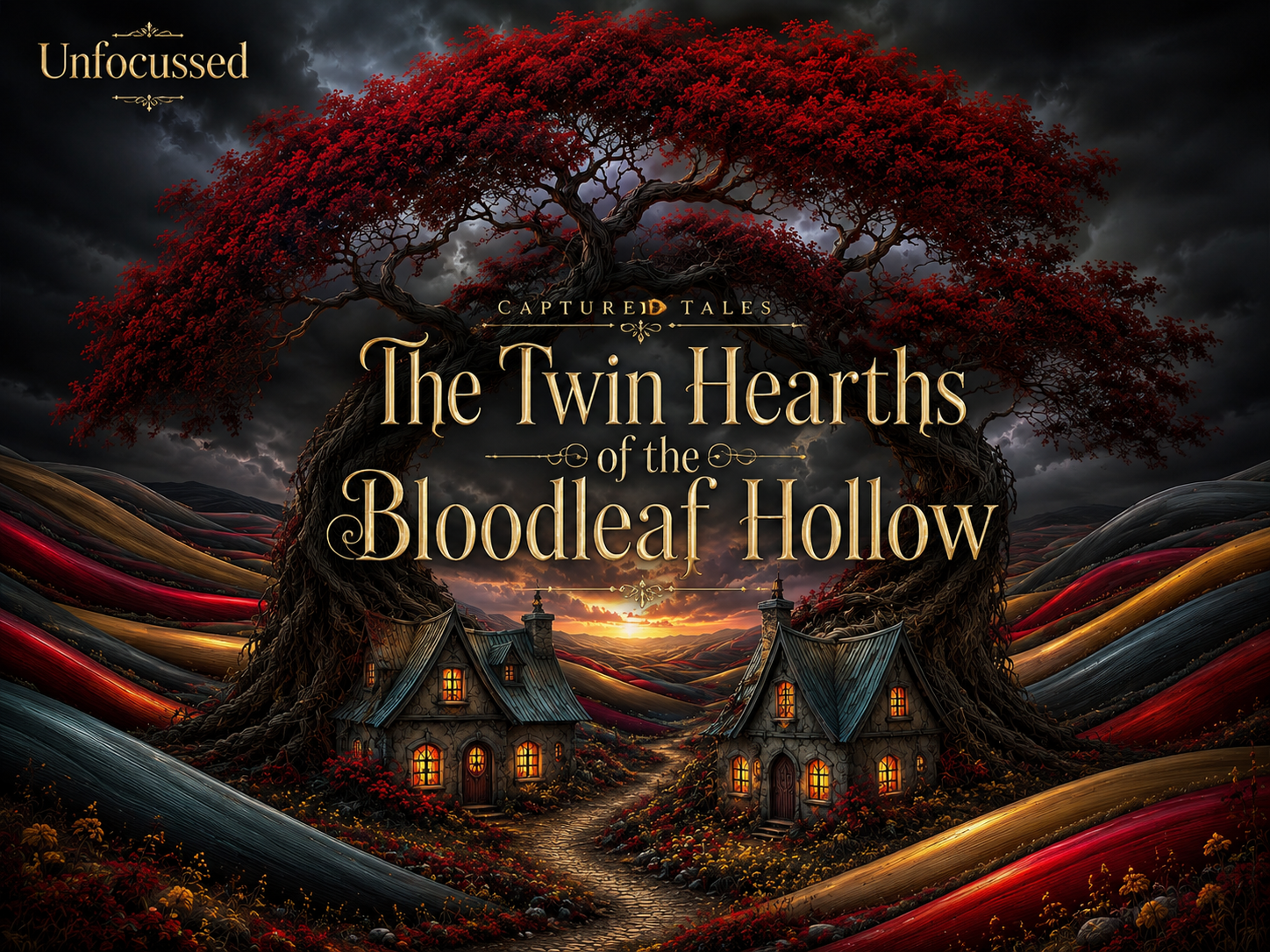
The Grudge Beneath the Crimson Boughs
In Bloodleaf Hollow, where the hills rolled like bolts of velvet left out in a storm and the trees grew red enough to make respectable people nervous, there stood two cottages beneath one impossible arch.
The arch was not built by masons, carpenters, or any other poor soul who had ever charged by the hour. It was made of two ancient bloodleaf trees whose trunks twisted upward from opposite sides of a narrow cobblestone lane, curved toward one another, and braided together high above the rooftops like old lovers refusing to admit they were touching. Their bark was dark and ridged, wrinkled with centuries of weather and secrets. Their leaves burned crimson all year, even in winter, even under frost, even when the rest of the valley looked like an old sock someone had left in a snowbank.
Locals said the trees had been there before the village.
Older locals said the village had been built because of the trees.
The oldest locals, who could be trusted only after tea and not at all after elderberry cordial, said the trees had once been people.
No one agreed on the story. Everyone agreed on one thing: you did not lie beneath the Bloodleaf Arch. Not because lightning would strike you, or your tongue would turn purple, or your chickens would begin reciting poetry at breakfast, though all of those things had allegedly happened at least once. No, the real reason was far worse.
The arch remembered.
It remembered whispered promises. It remembered wedding vows. It remembered threats made in anger, apologies swallowed in pride, and the embarrassing little noises people made when they thought no one else was around. It remembered every secret passed under its branches, and it had the irritating habit of dropping leaves at exactly the wrong moment.
Especially during arguments.
And because Bloodleaf Hollow was a village full of stubborn people with warm kitchens, dramatic feelings, and no shortage of things to be nosy about, the arch was busy.
But no one kept it busier than the two women who lived beneath it.
On the left side of the lane stood Briarwhick Cottage, a squat stone house with a steep slate roof, amber windows, and a front garden arranged with such aggressive precision that even the bees approached in alphabetical order. Its door was painted a deep wine red, polished weekly, and decorated with a brass knocker shaped like a fox who looked as if he knew exactly who had eaten the missing jam tarts.
Briarwhick belonged to Maribelle Mosswick.
Maribelle was seventy-two, though she considered that number rude and preferred “weathered to perfection.” She had silver hair coiled into a bun sharp enough to intimidate loose threads, eyes the color of storm glass, and a walk that suggested she had never once asked permission from a floorboard. She baked with the intensity of a battlefield commander, gardened as though negotiating with hostile nations, and wore aprons embroidered with cheerful sayings that became threatening when read in her tone of voice.
Her favorite apron said, Kindness Costs Nothing.
Everyone in Bloodleaf Hollow knew that when Maribelle wore that one, someone was about to pay dearly.
Across the lane stood Thimblethorn Cottage, slightly taller, slightly crooked, and entirely convinced it was more interesting than its neighbor. Its roof leaned charmingly to one side, its chimney smoked in lazy curls, and its window boxes overflowed with flowers that refused to obey color theory, village tradition, or basic decency. The front door was blue-black, with a moon-shaped handle and a tiny bell that rang even when no one touched it.
Thimblethorn belonged to Ottilie Greaves.
Ottilie was seventy-three, and unlike Maribelle, she announced her age whenever possible, usually while doing something that made younger people question their life choices. She had wild white curls, dark eyes bright with mischief, and a laugh that could ruin a funeral if given the chance. She brewed teas no one could identify, stitched quilts full of rude symbolism, and grew roses that bloomed in colors nature had clearly not approved.
Her favorite shawl was violet, fringed, and scandalously soft.
Maribelle called it “a curtain with delusions.”
Ottilie called Maribelle “a prune in pearl earrings.”
This had been going on for fifty-six years.
The rivalry began, depending on whom one asked, with a pie, a ribbon, a man, a goose, or a very unfortunate incident involving a church picnic and three jars of pickled onions. Bloodleaf Hollow never settled the matter, mostly because both women told a different version, and both versions were too entertaining to discard.
According to Maribelle, Ottilie had sabotaged her blackberry custard tart at the Autumn Hearth Fair of 1970 by distracting the judges with jokes, theatrical flourishes, and what Maribelle called “an entirely unreasonable amount of charm.”
According to Ottilie, Maribelle had lost fair and square because her tart had the emotional range of a damp biscuit.
According to Abel Fenrush, who had judged the contest and still lived with the haunted expression of a man who had been forced to choose between two dangerous desserts, both tarts had been excellent, but Ottilie’s had “a certain liveliness.”
Maribelle had never forgiven the word liveliness.
In the decades that followed, the rivalry matured like a wine left too near the stove. It grew sharper, stranger, and considerably more flammable.
They competed over gardens.
Maribelle planted neat borders of foxglove, marigold, and silver thyme. Ottilie let moonvine crawl wherever it pleased and once trained a rosebush to spell “TRY HARDER” across the fence in pink blossoms.
They competed over baking.
Maribelle’s breads were legendary, golden-crusted and fragrant enough to bring grown men weeping to the lane. Ottilie’s pastries were lighter, wilder, and occasionally illegal depending on how strictly one interpreted the village guidelines around enchanted nutmeg.
They competed over festival decorations, hearth blessings, jam consistency, roof moss, gossip accuracy, and who could appear most unbothered when the other received a compliment.
They competed over grief, too, though neither would have admitted it.
Maribelle’s husband, Ewan, had died twenty-one years earlier after a lifetime of gentle incompetence and one final attempt to fix a roof tile in slippers. Ottilie’s wife, Celia, had passed nine years after that, leaving behind seven trunks of embroidered linens, seventeen unfinished arguments, and a recipe box no one but Ottilie was allowed to touch.
After each loss, the village expected the rivalry to soften.
It did not.
If anything, it became more dependable.
Every morning, Maribelle opened her curtains exactly at seven and looked across the lane with the solemn duty of a lighthouse keeper spotting pirates. Every morning, Ottilie appeared at her own window in a dressing gown that looked stolen from a wealthy ghost and raised her teacup in a salute just irritating enough to count as a crime.
“Still alive, then?” Maribelle would call.
“Still pretending that bun suits you?” Ottilie would call back.
And Bloodleaf Hollow, hearing this exchange from kitchens, lanes, bedrooms, and chicken coops, would sigh with relief.
The world remained intact.
But on the first morning of the Crimson Month, when the clouds gathered thick over the valley and the ribbon hills dulled beneath a sky the color of old pewter, Maribelle opened her curtains and did not see Ottilie.
She saw instead a crack.
It ran along the inner curve of the Bloodleaf Arch, high above the lane where the two trees joined. A dark seam in the bark, jagged and wet-looking, as though the wood had split in its sleep. Around it, several crimson leaves had turned black at the edges.
Maribelle froze with one hand on the curtain.
She was not a woman prone to freezing. She considered freezing a theatrical habit, suitable for fainting brides and men asked to explain where they had put something. But the sight of that crack took the breath from her chest.
The Bloodleaf Arch did not crack.
It bent in storms. It groaned in winter. It dropped leaves on liars, drunkards, and once on Mayor Puckle during a speech about “fiscal clarity,” which had ended the speech and improved the budget. But it did not crack.
Across the lane, Thimblethorn’s curtains remained closed.
Maribelle stared at them.
“Lazy woman,” she muttered.
Then, after a pause, “Probably dead.”
The words came out harsher than expected. They landed poorly in the quiet kitchen.
Maribelle tightened the belt of her robe, marched to her stove, and lit the kettle with unnecessary force. The flame jumped, startled. While the water heated, she kept glancing out the window at the crack. The seam seemed larger every time she looked.
Which was impossible.
And deeply inconsiderate.
By the time the kettle whistled, Maribelle had made three decisions: first, she would not panic; second, she would inform the village council with calm authority; and third, she would absolutely not cross the lane to check on Ottilie Greaves like some trembling maiden in a penny dreadful.
Five minutes later, she was crossing the lane with a basket of scones.
“Not concern,” she told the arch as she passed beneath it. “Civic responsibility.”
A single crimson leaf drifted down and landed in her basket.
Maribelle looked up. “Don’t start.”
The arch creaked.
Thimblethorn’s bell rang before she touched it.
“Show-off house,” Maribelle said.
From inside came a muffled thump, a curse, and Ottilie’s voice shouting, “If that’s the tax clerk, I died beautifully.”
Maribelle relaxed so suddenly she nearly hated herself for it.
“It’s me,” she called.
There was a pause.
Then the sound of several objects being moved quickly and one object being kicked under furniture.
“That’s worse,” Ottilie said.
The door opened.
Ottilie Greaves stood there wrapped in her violet shawl, hair wild around her face, cheeks flushed, eyes bright, and one hand suspiciously behind her back. She looked very much alive, which irritated Maribelle almost as much as it comforted her.
“You’re late to the window,” Maribelle said.
“And you’re early to my doorstep. Should I fetch a priest or a witness?”
“You should fetch a comb.”
“You brought scones.”
“I brought evidence.”
Ottilie glanced into the basket. “Of what? A personality trying to escape through flour?”
Maribelle pushed past her into the cottage. “The arch has cracked.”
Ottilie’s expression changed.
Not dramatically. Ottilie did drama when drama suited her, which was often, but this was different. The teasing vanished from her eyes. Her hand slipped from behind her back, revealing a small glass vial filled with something dark red and faintly glowing.
Maribelle saw it.
Ottilie saw Maribelle see it.
Both women immediately pretended neither had seen anything at all.
“Tea?” Ottilie asked.
“Not if it’s your usual swampwater.”
“Chamomile.”
“That’s what you said at Solstice and Harold Binns spent three hours apologizing to his shoes.”
“Harold Binns had a lot to answer for.”
Despite herself, Maribelle sat at the little round table near the hearth. Thimblethorn’s kitchen was warmer than hers, though she would have swallowed a spoon before admitting it. Copper pots hung from a beam. Dried herbs dangled in bundles. The windowsills were crowded with mismatched bottles, candles, and tiny clay figures that looked like they might move when unobserved.
On the hearth, a fire burned low and blue at the edges.
Maribelle narrowed her eyes. “Your fire is doing that thing again.”
“It’s not doing a thing. It’s expressing itself.”
“Fire should not have self-esteem.”
Ottilie set the vial on the counter with too much casualness. “And you should not enter homes like an invading duchess.”
“I knocked.”
“The bell rang. You glared.”
“Same thing.”
Ottilie busied herself with the kettle. “Where is the crack?”
“Inner curve. Above the lane. Leaves blackening around it.”
The kettle slipped slightly in Ottilie’s hand.
Maribelle noticed. Of course she noticed. Maribelle noticed everything except when she was being sentimental, which she avoided by keeping busy and judging people.
“You know something,” she said.
“I know many things. For example, I know your scones are better when you use cold butter and stop treating the dough like it owes you money.”
“About the arch.”
Ottilie placed the kettle on the stove. “You know something too.”
“I know the tree is cracked.”
“No. You know why that matters.”
A gust of wind pressed against the cottage windows. The crimson leaves outside rustled like skirts in a crowded ballroom. For a moment, neither woman spoke.
Then Maribelle looked toward the hearth, where the blue-edged flame shifted and popped.
“It holds the hollow,” she said quietly.
Ottilie did not answer.
“That’s what Ewan believed,” Maribelle continued. “He said the roots go under both cottages. Under the lane. Under half the village, maybe more. He said the arch was not just two trees. It was a binding.”
Ottilie poured tea into two cups. “Celia said the same.”
Maribelle looked up sharply.
Ottilie slid a cup toward her. “Don’t look so shocked. Our spouses did speak to one another when we weren’t using them as border guards.”
“Ewan never mentioned that.”
“Celia didn’t mention half of what she knew. She liked being mysterious. It made her unbearable at parties and magnificent in bed.”
Maribelle choked on air.
Ottilie smiled sweetly. “Careful, dear. At your age, a blush could become structural.”
“At my age, I know when someone is deflecting.”
“At your age, you should also know when tea is getting cold.”
Maribelle took the cup. She sniffed it.
“It’s chamomile,” Ottilie said.
“That’s what worries me.”
She sipped. It was, to her surprise, actual chamomile. Warm, floral, and harmless. This was so suspicious that she immediately set the cup down.
Ottilie sat across from her. The firelight softened her face, making the lines around her mouth and eyes seem less like age and more like proof of a life that had laughed hard, cried privately, and made several questionable decisions on porches after midnight.
Maribelle hated noticing that.
She also hated that Ottilie looked tired.
Not theatrically tired. Not “I stayed up making scandalous marmalade” tired. Truly tired. The kind that settled under the skin.
“What is in the vial?” Maribelle asked.
Ottilie’s eyes moved to the counter.
“Nothing.”
“It is glowing.”
“Many nothings glow.”
“Name three.”
“Fireflies. Bad mushrooms. Men after two compliments.”
Maribelle gave her a look.
Ottilie sighed. “Bloodleaf sap.”
The kitchen seemed to grow smaller around the words.
“From the arch?”
“From my side of the roots.”
“Your side?”
“Don’t start.”
“I will absolutely start. Why are you drawing sap from the roots?”
“Because the roots are bleeding.”
Maribelle went still.
Ottilie’s fingers tightened around her cup. “It began three nights ago. Beneath my pantry floor. I heard dripping. Thought it was the old pipe, or the ghost mouse, or possibly guilt. Lifted the board and found sap coming through the root seam.”
“You didn’t tell me.”
“We are not exactly bosom companions.”
“No, but we are unfortunately adjacent.”
“And you would have accused me of causing it.”
“Did you?”
Ottilie leaned back. “There it is.”
“Did you?”
“No, Maribelle. I did not wound the ancient magical tree holding our village together just to inconvenience your morning.”
“You once trained ivy to grow over my weather vane.”
“It improved the silhouette.”
“It made the rooster look pregnant.”
“And people came from three valleys over to see it.”
Maribelle pressed her lips together. A lesser woman would have laughed. She was not a lesser woman.
Unfortunately, a small sound escaped her nose.
Ottilie’s grin flashed. “There she is.”
“There who is?”
“The woman who still has a sense of humor under all that starch.”
“My starch has kept this village respectable.”
“Your starch has frightened children and confused laundry.”
Outside, thunder rolled across the ribbon hills.
The fire shifted again, blue tongues curling higher along the logs. Ottilie looked toward it, and the teasing drained from her face.
“The sap isn’t the only sign,” she said.
Maribelle followed her gaze. “What else?”
Ottilie stood and crossed to a narrow shelf beside the hearth. From it she took a small wooden box carved with leaves. It was old, polished smooth by handling, and bound with a strip of faded red thread.
Maribelle recognized it immediately.
Her heart gave one hard, unpleasant thud.
“Where did you get that?”
Ottilie paused. “Celia.”
“That was Ewan’s.”
“It was both of theirs.”
“No.”
“Yes.”
Maribelle stood too quickly, her chair scraping the floor. “That box sat on Ewan’s desk for forty years.”
“And before that, it sat in Celia’s mother’s keeping.”
“Impossible.”
“You do love that word when something is merely inconvenient.”
“Ottilie.”
The sharpness in Maribelle’s voice made the cottage bell tremble by the door.
Ottilie’s expression softened, though not enough to be called pity. She knew better than to offer Maribelle pity. Maribelle would have hurled it back with interest.
“I didn’t steal it,” Ottilie said. “Celia gave it to me after Ewan died. She said he had wanted her to keep it safe until the arch showed signs of failing.”
Maribelle stared at the box.
Ewan had been a gentle man, soft-handed despite years of roof repairs, fond of pears, terrible at cards, and quietly brave in ways that annoyed her after his death because she kept discovering them too late. He had hummed while making tea. He had folded his socks badly. He had once spent an entire afternoon rescuing a beetle from a rain barrel and then denied naming it Captain Buttons.
He had also kept secrets.
Apparently rather large ones.
“Open it,” Maribelle said.
Ottilie hesitated.
“Open it, or I will,” Maribelle warned.
“And risk splinters? At your age?”
“Ottilie.”
“Fine.”
She untied the red thread.
The moment the box opened, the fire snapped bright gold, the cottage windows rattled, and every loose spoon in the kitchen leapt exactly half an inch before clattering back down. From outside came a deep groan, low and wooden and alive.
The Bloodleaf Arch.
Maribelle and Ottilie looked at one another.
For once, neither had anything clever to say.
Inside the box lay three things: a folded letter, a small iron key blackened with age, and a ring of bark carved into the shape of a heart.
Not a pretty heart. Not the neat, romantic sort painted on Valentine cakes by people with too much sugar and too little experience.
This heart was rough, uneven, stubborn-looking.
Maribelle thought it looked familiar.
Ottilie reached for the letter, unfolded it, and went silent.
“Read,” Maribelle said.
“You won’t like it.”
“I rarely do.”
Ottilie looked up. “It’s addressed to both of us.”
Maribelle’s throat tightened.
“Both?”
Ottilie turned the letter so she could see.
There, in Ewan’s careful handwriting, were the words:
For Maribelle and Ottilie, when the arch begins to break and the two of you finally have no choice but to stop being ridiculous.
Maribelle stared.
Ottilie made a soft sound. It might have been a laugh. It might have been grief. With Ottilie, the two often wore the same hat.
“He did know you well,” she said.
“Read the rest.”
Ottilie took a breath and began.
My dear impossible women,
Maribelle closed her eyes briefly.
If you are reading this, then the Bloodleaf Arch has begun to fail. I wish I could tell you this is because of age, weather, or some ordinary rot that can be solved with ladders and a man pretending he knows what he is doing. But the arch has never been ordinary, and neither have the two cottages beneath it.
Briarwhick and Thimblethorn were built as twin hearths, each rooted into one side of the old binding. Their fires feed the arch. Their keepers tend it, whether they know it or not. For generations, the hollow has survived because two homes kept warmth on either side of the lane.
Ottilie paused.
Maribelle looked toward the hearth, then out the window toward her own cottage. Her kitchen fire would still be burning low. She banked it every morning, every night, through every season. Not superstition. Habit.
At least, that was what she had believed.
Ottilie continued.
The binding does not require friendship. This is fortunate, considering the two of you have treated friendship like a contagious rash since 1970. But it does require balance. Two hearths. Two keepers. Two hearts willing to remain, even when remaining hurts.
Maribelle’s jaw tightened.
There will come a time when the hollow asks something of you. Not obedience. Not sacrifice in the grand tragic sense, because I know you both and neither of you could be trusted with a dignified martyrdom. You would argue over who looked better while dying.
Ottilie snorted.
Maribelle whispered, “Ewan.”
It will ask honesty.
The room seemed to hush around that word.
The arch was formed from a vow, long ago, between two who loved one another badly, stubbornly, and too late. Its strength comes from warmth freely given, but it weakens under withheld truth. Secrets sour in the roots. Regret hardens in the bark. Pride, left long enough, becomes a wedge.
If the crack appears, you must take the key beneath the lane, into the root chamber. There you will find the first hearthstone. Speak the truth you have avoided most. Both of you. No half-truths. No clever insults disguised as confessions. No blaming the goose.
Ottilie looked up. “The goose?”
Maribelle’s face became very still. “Continue.”
Ottilie’s smile returned, dangerous and delighted. “Oh, we are circling back to the goose.”
“Read.”
If you refuse, the arch will continue to split. The fires will dim. The hollow will loosen from its roots, and the hills will take back what was borrowed from them.
I am sorry I did not tell you sooner. I am sorry Celia and I kept this between us. We thought we were protecting you. We were also, if I am being honest, cowards.
With love, frustration, and enduring faith that neither of you is as heartless as you pretend,
Ewan
Beneath his name, in another hand, was a shorter note.
Ottilie’s voice changed before she read it. Softer. Thinner.
And from Celia: For the love of all things holy and otherwise, stop wasting time. You two have made an art of circling what matters. Art is lovely. Circling is for vultures and men looking for clean socks. Go beneath the lane. Tell the truth. Save the hollow. Then maybe have tea without weaponizing it.
The silence afterward was enormous.
Outside, the storm pressed closer. Rain began to fall, light at first, tapping against the windows with polite little fingers. Then harder. The crimson leaves shivered overhead.
Maribelle sat down slowly.
Ottilie folded the letter with care, her fingers lingering over Celia’s note.
“Well,” Ottilie said at last, voice unsteady beneath the attempt at brightness. “That was rude of the dead.”
Maribelle did not trust herself to answer.
She looked toward the iron key in the box.
It was small, dark, and plain. Not the sort of key that opened jewel chests or secret towers. It looked more like something that belonged to a cellar, or a gate, or the kind of door sensible people pretended not to notice.
“Beneath the lane,” Maribelle said.
Ottilie nodded. “Under the arch.”
“Root chamber.”
“Apparently.”
“Truth.”
Ottilie sighed. “The cruelest magic.”
Maribelle looked at her. “What truth have you avoided most?”
Ottilie’s eyebrows rose. “Buy me dinner first.”
“This is serious.”
“So was that answer.”
Maribelle almost smiled.
Almost.
Then another groan rolled through the cottage, deeper than before. The walls trembled. The blue-edged fire guttered, shrinking low in the hearth. Outside, something cracked loud enough to make both women stand.
They rushed to the window.
A branch high in the arch had split. Not fallen, but opened along its length like a wound. Blackened leaves tore loose in the wind and spun down into the lane.
Across from them, Briarwhick Cottage’s windows flickered.
Maribelle gripped the windowsill. “My fire.”
Ottilie grabbed the key and shoved it into her shawl pocket. “Then we go now.”
“In this storm?”
“No, Maribelle, we’ll wait until the ancient binding collapses at a more convenient hour. Perhaps after lunch, when doom pairs better with soup.”
Maribelle turned sharply. “Do not take that tone with me.”
“Which one?” Ottilie snapped. “The one where I’m frightened, or the one where I’m pretending not to be because you already have that job covered?”
The words struck harder than either expected.
Maribelle opened her mouth.
Closed it.
Ottilie’s face shifted, regret flashing across it.
Then the cottage bell rang once, though no one stood at the door.
Both women looked toward it.
A crimson leaf slid under the threshold.
It skittered across the floor, pushed by no visible wind, and stopped at Maribelle’s feet. Its edges were black. Its veins glowed faintly gold.
Words burned into the leaf one by one.
COME BEFORE PRIDE FINISHES WHAT TIME BEGAN.
Ottilie leaned over Maribelle’s shoulder. “Well. That feels pointed.”
Maribelle picked up the leaf. It was warm.
“The arch is getting mouthy,” she said.
“It learned from the best.”
For once, Maribelle did not argue.
They prepared quickly, though not without commentary. Ottilie insisted on bringing a lantern, two vials of bloodleaf sap, a packet of salt, and a flask she claimed was medicinal. Maribelle insisted on returning to Briarwhick for her heavy boots, her storm cloak, and a tin of biscuits because “terror on an empty stomach leads to poor decisions.”
Ottilie said Maribelle had made plenty of poor decisions fully fed.
Maribelle said Ottilie would know, having been one of them.
That shut them both up for exactly seven seconds.
When they stepped outside together, the storm had swallowed the lane.
Rain sheeted down in silver ropes. The cottages glowed behind them, twin pockets of warmth beneath the monstrous red canopy. The hills beyond rolled into darkness, their stripes of gold, charcoal, and crimson dulled beneath the weather. Thunder dragged itself over the valley like furniture across an upstairs room.
The Bloodleaf Arch loomed above them.
By daylight, it was beautiful. By stormlight, it was alive in a way that made beauty feel like a warning. The trunks rose on either side of the lane, twisted and muscular, their roots gripping the earth around the cottages. The crack along the inner curve pulsed faintly gold, then dark, then gold again.
Maribelle stood on one side of the lane.
Ottilie stood on the other.
For a moment, neither moved beneath the arch.
“You know,” Ottilie said, rain dripping from her curls, “if this kills us, I’m telling Celia you were bossy at the end.”
“If this kills us, I’m telling Ewan you wore that shawl.”
Ottilie looked down at herself. “He liked this shawl.”
Maribelle stepped under the arch. “Ewan was kind to the afflicted.”
Ottilie followed, muttering, “Prune in earrings.”
“Curtain with delusions.”
“Biscuit tyrant.”
“Moonvine strumpet.”
Ottilie stopped. “That one was almost flattering.”
“Keep walking.”
The lane beneath the arch was slick with rain and fallen leaves. At its center, where the cobblestones curved slightly inward, the ground trembled. Maribelle and Ottilie stood over the spot, lantern light wavering between them.
“Well?” Maribelle said.
Ottilie pulled the iron key from her pocket. “There’s no lock.”
“Perhaps you wave it.”
“Do I look like someone who waves keys at stones?”
Maribelle gave her a long look.
Ottilie lifted the key. “Fine, but if this works, I refuse to be mocked for competence.”
She waved the key.
Nothing happened.
Maribelle folded her arms.
“Not a word,” Ottilie said.
“I was merely enjoying the silence after the wave.”
Ottilie crouched and held the key closer to the cobbles. The iron warmed in her hand. A thin gold line appeared between two stones.
Then another.
Then a circle of light spread across the lane, outlining a hidden hatch beneath the cobblestones.
Maribelle inhaled sharply.
Ottilie looked up, rain running down her face, eyes bright with fear and triumph.
“There,” she said. “A lock.”
The key turned in empty air.
With a sound like the hollow exhaling, the cobblestones sank and shifted aside, revealing a narrow stairway descending into darkness beneath the Bloodleaf Arch.
Warm air rose from below, smelling of soil, smoke, old leaves, and something sweeter beneath it.
Memory, perhaps.
Or magic.
Or trouble that had been marinating for generations.
Maribelle looked down the stairs. “I hate this.”
Ottilie lifted the lantern. “I know.”
“I hate that you know.”
“I know that too.”
They stood shoulder to shoulder at the opening, close enough that their sleeves brushed. Neither moved away.
Above them, the great arch groaned again. Crimson leaves spiraled down into the rain. One landed on Maribelle’s shoulder. One landed in Ottilie’s hair.
Maribelle reached over and plucked it free before thinking.
Ottilie went still.
So did Maribelle.
For a heartbeat, the storm, the arch, the years, the rivalry, the grief, the gossip, the pies, the roses, the insulted scones, the stolen glances, and every truth left unsaid seemed to gather between them like breath before a kiss neither woman had the courage to name.
Then Maribelle cleared her throat and held out the leaf.
“You had debris.”
Ottilie took it. Her fingers brushed Maribelle’s.
“And you had manners. How alarming.”
“Temporary condition.”
“Best not let it spread.”
Maribelle turned toward the stairs. “After you.”
“Because you’re generous?”
“Because if something eats you, I’ll have warning.”
Ottilie smiled, though her hand shook slightly around the lantern. “Still sweet on me after all these years.”
Maribelle descended the first step. “Do not make me regret saving the village.”
“You already regret most things before they happen.”
“And I am usually correct.”
Together, bickering because silence would have been too honest too soon, Maribelle Mosswick and Ottilie Greaves descended beneath the Bloodleaf Arch.
Behind them, the twin cottages glowed in the storm.
Above them, the crimson trees held their cracked embrace.
And deep below the lane, in the hidden root chamber where old vows waited and pride had no place to hide, something woke with a low golden pulse.
The Root Chamber and the Unholy Goose
The stairs beneath the Bloodleaf Arch were not the sort of stairs one descended with dignity.
They were too narrow for confidence, too slick for pride, and too old for anyone with knees that had opinions. Each step curved downward through the earth in a tight spiral, carved not from stone but from roots braided together so tightly they formed a dark wooden passageway. Golden light pulsed faintly beneath the surface, moving through the grain like blood through veins.
Maribelle Mosswick went first, because she had suggested Ottilie should go first and then immediately decided she did not trust Ottilie to notice danger unless it arrived wearing a feather boa and carrying scandal.
Ottilie followed with the lantern held high, though the lantern was largely unnecessary. The walls glowed around them, warm and low, illuminating packed soil, tiny white root hairs, embedded stones, and the occasional object swallowed by the earth over the years.
A bent spoon.
A child’s marble.
A brass button.
A wedding ring.
Maribelle slowed when she saw the ring. It rested half-buried in a knot of root, dark with age but still shining at the edge.
Ottilie nearly bumped into her. “If you stop without warning, I’m going to become part of your spine.”
“There’s a ring.”
Ottilie leaned around her shoulder. “Oh.”
“Do you suppose someone lost it?”
“No, Maribelle. I imagine someone carefully wedged it into a magical root staircase for the convenience of future spelunking widows.”
Maribelle glared over her shoulder. “I am trying to be appropriately solemn.”
“It’s not your strongest area.”
“And what is yours?”
“Making entrances. Making jam. Making certain people sweat through their moral superiority.”
“You have never made me sweat.”
Ottilie smiled. “Liar.”
A crimson leaf dropped from nowhere and landed on Maribelle’s boot.
Both women stared at it.
Maribelle lifted her chin. “That was not a lie. That was historical editing.”
The roots around them gave a low, unimpressed creak.
Ottilie laughed softly. “The tree has standards.”
“The tree is nosy.”
They continued downward.
With every step, the storm above faded. The rain became a muffled hush. The thunder turned into a distant furniture-moving complaint. In its place came another sound: a slow, steady beat from deep below.
Not quite a drum.
Not quite a heartbeat.
Something older than both.
Maribelle felt it through the soles of her boots. Ottilie felt it too, because she stopped making clever remarks for nearly a full minute, which was enough to worry anyone familiar with her condition.
At last, the stairway opened into a chamber.
It was round, wide, and impossibly high, far larger than the space beneath the lane should have allowed. The ceiling rose in a dome of twisted roots, glowing gold between dark seams. Crimson leaves grew from the walls despite the lack of sunlight, trembling gently as though stirred by a breeze from another century.
At the center of the chamber stood a stone.
Not a pedestal. Not an altar. A hearthstone.
It was broad and flat, shaped like a rough oval, its surface split down the middle. One half glowed with amber warmth. The other half had gone dull and gray, threaded with black cracks. Around it, two shallow channels curved outward through the floor in opposite directions, one leading toward Briarwhick Cottage, the other toward Thimblethorn.
The twin hearths.
Maribelle knew it before she understood it.
Ottilie stood beside her, lantern forgotten at her side. “Well,” she whispered. “That’s not ominous at all.”
“The left side is darker,” Maribelle said.
“The left side leads to your cottage.”
Maribelle shot her a look.
Ottilie lifted one hand. “Observation. Not accusation.”
“You sounded pleased.”
“I can be observant and pleased.”
“The right side is cracked too.”
“Yes, but with flair.”
Maribelle stepped closer to the hearthstone. Heat rose from it, but not enough to burn. It smelled of woodsmoke, rain, baked bread, and a dozen winters survived by stubbornness and soup.
She extended a hand.
Ottilie caught her wrist before her fingers touched the stone.
Maribelle turned sharply. “Excuse me.”
Ottilie’s grip remained firm. “Read the room before fondling ancient magic.”
“I was not fondling.”
“You were reaching with intent.”
“That is how hands work.”
Ottilie nodded toward the far wall.
There, almost hidden among the roots, words had begun to glow.
THE HEARTHSTONE WARMS WHAT IS GIVEN.
The letters burned gold for a moment, then faded. Another line appeared beneath them.
THE HEARTHSTONE CHOKES ON WHAT IS WITHHELD.
Maribelle frowned. “Dramatic thing.”
“You should respect drama. It’s the only reason half the village remembers your jam.”
“My jam is remembered because it is excellent.”
“Your jam is remembered because you once accused a judge of having underdeveloped taste buds in front of his mother.”
“His mother agreed with me.”
A third line appeared.
SPEAK TRUE, OR LEAVE THE ROOTS TO ROT.
Both women fell silent.
The pulse in the chamber deepened. The black crack in the dull half of the hearthstone widened a little, and from somewhere above came a faint answering groan from the Bloodleaf Arch.
Ottilie swallowed. “So. Truth.”
Maribelle folded her arms. “Apparently.”
“You first.”
“Absolutely not.”
“You came down first.”
“That was leadership, not confession.”
“I am older.”
“By eleven months, and you use it like a crown.”
“A crown suits me.”
“It would slide off. Too much hair.”
Ottilie looked at the hearthstone, then at Maribelle. “We could stand here all night and sharpen our tongues until the hollow falls into a pit.”
“You say that as though you would not enjoy the sharpening.”
“I would enjoy it immensely. That is not the point.”
Maribelle looked away first.
It was a small defeat, but in a rivalry older than some bridges, small defeats were recorded internally with ink, stamps, and quiet resentment.
The hearthstone pulsed again.
On the wall opposite them, the roots shifted.
At first, Maribelle thought the chamber was cracking. Then the golden light gathered inside the braided roots and spread outward, forming a shimmering oval on the wall. Images swam inside it, blurred and dark, until they sharpened into a scene neither woman had seen in decades.
The Autumn Hearth Fair of 1970.
“Oh, hell,” Ottilie said.
Maribelle stared.
The memory-wall glowed brighter. There was the village green as it had been fifty-six years ago, strung with lanterns and paper leaves. There were the old contest tents, the cider barrels, the prize table covered in ribbons. There was Mayor Puckle’s father arguing with a goat. There was Abel Fenrush, younger and less haunted, standing behind the baking table with a judge’s badge pinned to his waistcoat.
And there they were.
Maribelle at sixteen, standing stiffly beside her blackberry custard tart, dark hair pinned back, chin high, apron spotless, eyes full of focus and terror.
Ottilie at seventeen, all curls and laughter, wearing a bright green blouse and entertaining the gathered crowd with quick jokes and extravagant gestures that drew attention away from the judging table.
Young Ottilie leaned across the table, smiling at Abel.
Young Maribelle watched from the side, face carefully blank.
Older Maribelle’s jaw tightened. “There.”
Ottilie sighed. “Maribelle.”
“You see?”
“I see myself being charming.”
“You see yourself cheating.”
“With my jokes?”
“With your entire performance.”
Ottilie glanced sideways. “That is the nicest accusation you’ve ever made.”
The memory continued.
Abel tasted Maribelle’s tart. His eyebrows rose. He nodded, impressed. Young Maribelle’s eyes shone for half a second before she hid it. Then he tasted Ottilie’s pastry, laughed at something she said, and placed the blue ribbon beside her plate.
The memory blurred.
Young Maribelle turned away quickly.
But the image followed her.
It showed what the fairgoers had not seen: Maribelle slipping behind the cider tent, pressing one hand to her mouth, fighting tears with the furious determination of someone who had already decided crying was an inefficient use of moisture.
Young Ewan found her there.
Not yet her husband. Just Ewan Vale, lanky, kind-eyed, holding two cups of cider and wearing the expression of a boy who had never known what to do with a crying girl but would stand nearby until instructions arrived.
In the memory, he said something too softly for the chamber to carry.
Young Maribelle shook her head.
Then, from the other side of the tent, young Ottilie appeared.
She saw Maribelle.
She saw the tears.
She saw Ewan.
Her face changed.
The bright fairground laughter slipped away. Something uncertain moved in its place. She took one step forward, then stopped.
Young Maribelle looked up and saw her.
For one long moment, the two girls stared at each other.
Then young Ottilie lifted the blue ribbon in one hand, gave an exaggerated little curtsy, and said something with a wicked smile.
The memory restored the words perfectly.
Try not to look so wounded, Mosswick. It was only a tart.
Young Maribelle’s face hardened.
Older Maribelle closed her eyes.
Ottilie inhaled.
The memory faded.
The root chamber returned.
For once, Ottilie did not look amused.
“I had forgotten I said that,” she whispered.
“I hadn’t.”
“No. I suppose not.”
Maribelle turned toward the hearthstone. “There. Truth enough? She was cruel, I was offended, and the village has benefited from the resulting excellence of my baking ever since.”
The chamber did not respond.
The dull side of the hearthstone remained dull.
Ottilie’s mouth tightened. “That is not truth. That is minutes from a committee meeting.”
“Fine. You were cruel. I was hurt.”
Still nothing.
Ottilie looked at her. “Why?”
“Why was I hurt?”
“Yes.”
“Because you humiliated me.”
“No.”
Maribelle’s eyes flashed. “Do not tell me what I felt.”
“I’m asking what you have avoided.”
The chamber pulse grew louder.
Maribelle folded her arms more tightly. “I wanted the ribbon.”
Ottilie waited.
“I wanted to win.”
Ottilie kept waiting.
“I wanted people to see I could make something beautiful.”
Her voice cracked slightly on the last word, which annoyed her deeply.
A faint amber glow warmed the left edge of the hearthstone.
Ottilie saw it. So did Maribelle.
“There,” Maribelle said. “Done.”
The glow flickered, then dimmed again.
Ottilie raised one eyebrow.
“Do not eyebrow me,” Maribelle said.
“That was a starter truth.”
“There are categories now?”
“Oh, darling, there are always categories. There are truths you can say while buttering toast, truths you say after wine, and truths that make old magical architecture unclench.”
“I refuse to discuss architecture clenching.”
“Then tell the bigger truth.”
Maribelle turned away. “I wanted you to see it.”
The words came quietly.
Ottilie stilled.
The hearthstone glowed a little brighter.
Maribelle stared at the root wall, refusing to look at her. “The tart. I wanted you to see it. Not Abel. Not the judges. Not the village. You.”
Ottilie said nothing.
“You made everything look effortless,” Maribelle continued, the words stiff and unwilling, as though each had to be dragged from behind her ribs. “You laughed, and people turned. You wore that ridiculous blouse, and the entire fair leaned in your direction. I had spent three days on that tart. Three days because I thought perhaps if it was perfect, you would stop making jokes long enough to notice.”
“Maribelle.”
“And when you won, I thought, fine. She is livelier. She is prettier. She is easier to love. Then you found me crying and made it worse because I decided I would rather hate you than admit I cared that much about your opinion.”
The chamber warmed.
The left channel leading toward Briarwhick Cottage filled with amber light. It ran along the floor like fire under glass.
Ottilie’s expression had gone very soft.
Maribelle hated it.
“Do not look at me like that,” she said.
“Like what?”
“Like I am a wounded bird.”
“You are more of a wounded badger.”
“Better.”
Ottilie stepped closer. “I did notice the tart.”
Maribelle laughed once, sharply. “Please.”
“I did. It was beautiful.”
“You called it stiff.”
“I was seventeen and terrified.”
“Of my tart?”
“Of you.”
The right side of the hearthstone gave a faint pulse.
Maribelle looked at Ottilie then.
Ottilie stared at the stone, as if hoping it might confess on her behalf. It did not. Ancient magic, apparently, enjoyed making elderly women do their own emotional labor.
“Of me?” Maribelle asked.
Ottilie let out a breath that trembled at the edges. “You were so composed. So exact. So certain of what you wanted, even when you were pretending not to want anything at all. I could never tell if you despised me or if you simply found me messy.”
“You were messy.”
“Yes. But magnificently.”
Despite herself, Maribelle huffed.
Ottilie smiled faintly, then the smile faded. “I saw you with Ewan behind the tent. I thought you had gone to him because he was kind and safe and sensible, and I was just some loud girl in a scandal blouse who made people laugh but never made anyone stay.”
“You thought I preferred Ewan?”
“Didn’t you?”
Maribelle opened her mouth.
No answer came.
The root chamber listened with shameless intensity.
Ottilie looked away. “I said the cruel thing because I was jealous. And because I was young enough to think cruelty looked like power.”
The right channel brightened.
“Jealous of Ewan?” Maribelle asked.
Ottilie gave her a look. “Of Ewan. Of the tart. Of anyone and anything that got your attention without having to perform for it.”
Maribelle’s hand went to her throat, fingers brushing the collar of her cloak.
Above them, the roots hummed.
“You never said,” Maribelle whispered.
“Neither did you.”
“I married Ewan.”
“I married Celia.”
They stood with the names between them, not as accusations, but as hearths of another kind. Warm. Sacred. Gone.
Maribelle looked down. “I loved him.”
Ottilie nodded. “I know.”
“I truly did.”
“I know.”
“Not as a consolation.”
“No.”
“Not because you were unavailable.”
Ottilie’s smile was sad. “I know that too.”
Maribelle looked at her. “Did you love Celia?”
Ottilie’s eyes shone. “Like weather loves a coastline. Badly behaved, constant, and always shaping something.”
Maribelle nodded.
The hearthstone glowed brighter, but the black crack remained.
A new line of words appeared across the root wall.
ONE TRUTH OPENS THE DOOR. ANOTHER MUST ENTER.
Ottilie groaned. “Needy thing.”
“It has been under the lane for generations. Perhaps it is socially starved.”
The memory-wall shimmered again.
Maribelle stiffened. “Oh no.”
Ottilie tilted her head. “What?”
“If this is the goose, I am leaving.”
The chamber brightened.
The memory appeared.
It was, inevitably, the goose.
Bloodleaf Hollow’s Midsummer Picnic, 1974.
The village green shimmered in warm sunlight. Tables stood beneath bunting. Children ran between blankets. Someone had set up a fiddle. Someone else had set up a barrel of cider stronger than advertised. At the center of the scene stood a large white goose wearing a blue ribbon around its neck and the expression of a creature who had seen humanity and found it lacking.
“Gideon,” Ottilie breathed.
Maribelle’s face soured. “That bird was a demon with feathers.”
“He liked me.”
“He chased Reverend Pell into a pond.”
“Reverend Pell had it coming.”
“He was baptizing someone.”
“Exactly. Gideon loved ceremony.”
The memory shifted to a picnic blanket near the edge of the green. Young Maribelle sat with Ewan, who was trying to open a jar of pickled onions and losing. Young Ottilie lounged nearby with Celia, who was dark-haired, graceful, and watching the entire village as if quietly embroidering its secrets into her mind.
The four of them were younger then. Not innocent exactly—Bloodleaf Hollow did not produce much innocence, only people who could hide mischief in better clothing—but softer at the edges. Ewan laughed when the jar finally gave way and sprayed vinegar across his sleeve. Celia offered him a napkin. Ottilie made a comment. Maribelle, despite herself, laughed.
The sound froze the older women.
Young Maribelle laughing openly was a rare artifact. The chamber treated it as such, letting the sound linger.
“You used to laugh like that,” Ottilie said quietly.
“I still laugh.”
“You weaponize breath through your nose.”
“It counts.”
The memory continued.
Gideon the goose waddled into view, drawn by food, malice, or destiny. He snatched a pickled onion from Ewan’s plate. Ewan tried to retrieve it. Gideon objected. Celia attempted diplomacy. Ottilie laughed so hard she spilled cider down her blouse. Maribelle reached for the goose with the stern confidence of a woman who believed all creatures could be reasoned with if properly addressed.
Gideon bit her.
Older Ottilie covered her mouth.
“Do not,” Maribelle warned.
Ottilie’s shoulders shook.
“Do not laugh at ancient trauma.”
“He bit you on the backside.”
“I am aware of the location.”
In the memory, young Maribelle yelped, stumbled forward, and fell directly into Ottilie’s lap.
Ottilie failed entirely at not laughing.
“Oh, this is a generous chamber,” she wheezed.
“It is a perverted chamber.”
Young Maribelle scrambled up, red-faced and furious. Young Ottilie clutched at her, half trying to help, half too amused to function. Celia was laughing into Ewan’s shoulder. Ewan had tears in his eyes from trying not to laugh and failing honorably.
Then came the part everyone in the village remembered: Gideon stole the basket of pickled onions, charged across the green, tangled himself in Mayor Puckle’s mother’s skirt, and caused the collapse of three tables, one fiddle stand, and a decorative tower of plum cakes.
Bloodleaf Hollow had never fully recovered.
But the memory did not stop there.
It followed young Maribelle as she stormed away from the picnic, humiliated. She went behind the old cider shed, pressing one hand to the bite mark and muttering words no respectable girl would admit knowing.
Young Ottilie followed.
The older Ottilie’s laughter faded.
In the memory, young Ottilie held a clean cloth and a jar of salve.
Don’t be dramatic, young Maribelle snapped.
I’m not the one who just got goosed by an actual goose, young Ottilie replied.
Leave.
Turn around.
Absolutely not.
I’ve seen worse.
Not of mine.
Tragic, really.
Older Maribelle shut her eyes. “The chamber is indecent.”
Older Ottilie whispered, “Shh.”
In the memory, young Maribelle finally turned, stiff with embarrassment. Ottilie’s teasing softened. She dabbed salve onto the bite with surprising gentleness. Maribelle flinched. Ottilie apologized under her breath.
Then there was silence.
A different silence.
Young Maribelle looked over her shoulder.
Young Ottilie looked up.
The air between them changed.
No one moved. No one joked. The fair sounds dimmed behind them. Young Ottilie’s fingers lingered at Maribelle’s hip. Young Maribelle’s face was flushed, but not only from anger.
They were close enough to make one foolish decision.
They did not make it.
Instead, Celia’s voice called from the green.
Ottilie stepped back.
Maribelle turned away.
The moment passed into the great overcrowded attic of things never discussed.
The memory faded.
In the root chamber, neither woman spoke.
Ottilie rubbed her thumb along the lantern handle. Maribelle stared at the hearthstone as though it had personally undressed her in public.
At last, Maribelle said, “I had forgotten that.”
Ottilie’s voice was very gentle. “No, you hadn’t.”
Maribelle swallowed.
The hearthstone waited.
“I was angry,” Maribelle said.
Ottilie gave her a look.
“Humiliated.”
The stone did nothing.
“Bitten.”
Still nothing.
“Fine,” Maribelle snapped. “I was disappointed.”
The left side pulsed.
Ottilie did not move.
Maribelle stared at the stone. “I thought you might kiss me.”
The words landed heavily, even though she spoke them softly.
Ottilie closed her eyes.
Amber light surged through the left channel, running all the way to the chamber wall.
“And when you didn’t,” Maribelle continued, each sentence scraping something raw inside her, “I told myself I had imagined it. Then I told myself you had toyed with me. Then I told myself you were careless with everyone, because that was easier than admitting I had wanted something I had no name for.”
Ottilie opened her eyes.
“I almost did,” she said.
The right side of the hearthstone glowed.
Maribelle looked at her.
Ottilie laughed once, without humor. “I wanted to. Saints, I wanted to. You were furious and beautiful and smelling faintly of vinegar and goose violence. It was a confusing moment for a young woman with poor impulse control.”
Despite everything, Maribelle’s mouth twitched.
Ottilie stepped closer to the hearthstone. “But Celia called. And I loved her already, though I hadn’t admitted that either. And Ewan loved you with his whole gentle, sock-folding heart. So I stepped back. Not because I felt nothing.”
“Because you felt too much.”
Ottilie nodded.
The chamber warmed further, but the crack in the hearthstone remained. Smaller now, perhaps, but still there. Dark. Stubborn.
Maribelle frowned. “What else does it want?”
The wall answered.
TRUTH IS NOT MEMORY ALONE.
The letters faded.
TRUTH IS CHOICE.
Ottilie sighed. “Of course it is.”
“I dislike being educated by shrubbery.”
“Technically roots.”
“I dislike being corrected by you more.”
But her voice lacked its usual bite.
The chamber shifted again. This time, no memory appeared. Instead, the roots around the hearthstone drew apart, revealing a low passage beyond the chamber. At the end of it, something glowed red.
The pulse grew stronger.
Ottilie lifted the lantern. “We’re not done.”
“No,” Maribelle said. “Apparently we have only been emotionally tenderized.”
“I told you this place was rude.”
They moved into the passage.
It sloped gently downward, narrower than the chamber but less cramped than the stairs. Roots formed the walls here too, though these were older and thicker, knotted together in shapes that suggested faces if one looked too long. Maribelle chose not to look too long. Ottilie looked too long immediately.
“That one resembles Harold Binns,” she said.
“Most knots resemble Harold Binns. It is his primary contribution to the world.”
The red glow ahead strengthened. The air grew warmer, but not comfortingly so. This was not kitchen warmth. This was fever warmth. The smell of smoke sharpened into something charred.
Then the passage opened into a second cavern.
This one was not round.
It was long and low, like a root cellar built for giants. Along both walls were shelves formed from living wood. On those shelves sat hundreds of small glass jars, each filled with a tiny flame.
Some flames burned bright gold.
Some flickered weakly.
Some were blue, green, violet, or rose-pink.
A few had gone black.
Maribelle drew in a breath. “What are they?”
Ottilie approached one carefully. A label had grown from the shelf beneath it, formed from raised bark letters.
Agnes Pell. Kept warmth for thirty-eight winters.
The next read:
Tomas Reed. Returned after pride. Forgiven by fire.
The next:
Celia Greaves. Hearthkeeper of Thimblethorn. Loved fiercely. Hid too much.
Ottilie stopped.
The jar above Celia’s name held a flame the color of deep violet. It burned low but steady, curling gracefully inside the glass.
Ottilie lifted one hand but did not touch it.
Maribelle stood beside her.
For a long moment, she said nothing. Then, quietly, “It suits her.”
Ottilie nodded, eyes bright.
Across the cavern, Maribelle saw another label.
She knew before she reached it.
Ewan Mosswick. Hearthkeeper of Briarwhick. Gentle hands. Brave silence. Terrible socks.
Maribelle pressed her lips together.
The flame in Ewan’s jar was warm amber, soft and steady. It leaned toward her as she approached, and she had to place a hand over her mouth.
Ottilie came to stand nearby, giving her just enough space to pretend she had not noticed the tears.
“Terrible socks,” Ottilie said gently.
Maribelle nodded. “Abysmal.”
“Celia once said he folded them like he was apologizing to them.”
A wet laugh escaped Maribelle before she could stop it.
The amber flame brightened.
“He loved you,” Ottilie said.
“I know.”
“He knew, too.”
Maribelle turned. “Knew what?”
Ottilie’s eyes flicked toward her, then away.
“Ottilie.”
“He knew there were things in you that did not belong to him.”
Maribelle’s face tightened. “That sounds unkind.”
“It wasn’t. He said it kindly.”
“When?”
Ottilie looked toward Ewan’s flame. “After the Winter Lantern Supper. The year before he died. You had argued with me over wreath placement for twenty minutes.”
“Your wreath blocked the bell rope.”
“My wreath improved the bell rope.”
“It looked like the door had grown a beard.”
“A festive beard.”
Maribelle almost smiled, then remembered the topic. “What did Ewan say?”
Ottilie folded her hands in front of her. “He said, ‘She shines sharper when you’re near.’”
Maribelle went very still.
Ottilie continued, softer. “I told him I didn’t know what he meant. He said, ‘Of course you do. You’re both just too stubborn to use honest words when insults are available.’”
Maribelle looked at Ewan’s flame until it blurred.
“He never said that to me.”
“Perhaps he thought you already knew.”
“I didn’t.”
“Perhaps he hoped you would figure it out before the trees had to drag us underground like naughty children.”
Maribelle wiped at her cheek with irritated dignity. “He overestimated us.”
Ottilie smiled sadly. “Everyone did.”
Beyond Ewan and Celia’s jars, the cavern narrowed toward a third opening. But between them and that opening stood a wooden gate grown from roots. Its center was marked with two hand-shaped hollows.
Above it, glowing bark letters read:
WARMTH FREELY GIVEN OPENS WHAT PRIDE HAS BARRED.
Maribelle looked at the hollows. “It wants our hands.”
Ottilie inspected them. “I would prefer a written agreement.”
“Coward.”
“Absolutely. I have survived this long by respecting ominous hand holes.”
The chamber behind them groaned. Somewhere far above, the Bloodleaf Arch cracked again. This time the sound traveled through the roots like a bone splitting.
The jars trembled on their shelves.
Several weak flames guttered.
Ottilie’s face sharpened. “We don’t have time.”
Maribelle stepped toward the gate and placed her right hand into one hollow.
Nothing happened.
She looked at Ottilie. “Well?”
“You look like a woman testing a mousetrap with her palm.”
“I am not thrilled.”
Ottilie joined her and placed her left hand into the second hollow.
The roots closed gently around their wrists.
Ottilie sucked in a breath. “Oh, I hate that.”
“Do not yank.”
“I wasn’t yanking. I was emotionally withdrawing.”
Golden light ran from Maribelle’s hand into the gate. Violet-red light ran from Ottilie’s. The two streams moved toward each other but stopped just short of meeting.
The root letters changed.
NAME THE WARMTH.
Maribelle frowned. “What warmth?”
Ottilie looked at her. “It means us.”
“I am aware.”
“Are you?”
“Do not start.”
“We are literally attached to a magic gate, Maribelle. Starting seems inevitable.”
The roots tightened slightly.
Maribelle winced. “Fine. I have tolerated you.”
The gate did nothing.
Ottilie glanced at her. “A rousing beginning.”
“I have admired you.”
The golden stream moved closer to the violet-red.
Ottilie’s expression shifted.
Maribelle stared at the gate as if eye contact with wood might be easier than eye contact with Ottilie. “I have admired you for longer than I have disliked you. Sometimes at the same time, which has been exhausting.”
The light strengthened.
Ottilie swallowed. “I have missed you.”
Maribelle’s head turned.
Ottilie kept her eyes on the gate. “Not because you went anywhere. That would have been simpler. You lived thirty-seven steps away and still managed to be unreachable when it mattered. Or perhaps I did. Perhaps we took turns.”
The violet-red stream stretched closer.
“I missed the girl behind the cider tent,” Ottilie continued. “I missed the woman who laughed before she decided laughter needed discipline. I missed the friend I never quite had because I kept turning every doorway into a stage and every soft thing into a joke.”
The two streams of light touched.
The gate shuddered but did not open.
Maribelle’s voice was barely above a whisper. “I was afraid if I stopped arguing with you, there would be nothing left between us.”
Ottilie looked at her then.
“There,” Maribelle said, almost angrily. “That is the warmth. The argument. The competition. The morning insults. The festival sniping. It was contact. It was a way to keep you in my life without asking you to stay.”
The gate glowed brighter.
Ottilie’s eyes filled. “You could have asked.”
“Could I?”
Ottilie’s mouth trembled.
She looked down at their trapped hands, then back at Maribelle. “I don’t know.”
The honesty of that answer struck deeper than comfort would have.
The roots around their wrists loosened.
The gate opened.
Not with a creak, but with a sigh.
Beyond it lay a small chamber lit by a red glow so vivid it seemed almost liquid. The warmth that spilled out was intense but not painful. It smelled of every hearth in Bloodleaf Hollow at once: stew, smoke, bread, wet wool, candle wax, old wood, and the faint medicinal tang of someone’s questionable tonic.
At the center of the chamber was a heart.
Not flesh. Not stone. Wood.
A massive wooden heart, grown from the joined roots of the two bloodleaf trees. It hung suspended in a cage of living branches, pulsing slowly with red-gold light. Around it, hundreds of root fibers extended outward like threads, each leading upward toward the village.
The first hearthstone had been only part of the binding.
This was the heart of the hollow.
And it was splitting.
A black fissure ran from the top of the wooden heart to its center. Sap glowed in the wound, thick and dark red, dripping slowly into a basin below. Each drop struck with a sound like a clock.
Ottilie raised one hand to her mouth. “Oh.”
Maribelle stepped forward. “Can we mend it?”
Words appeared across the branches encircling the heart.
TWO HEARTHS KEPT WARM.
Another line formed.
TWO KEEPERS REMAINED.
Then:
ONE MUST CHOOSE THE OTHER BEFORE DAWN.
Maribelle stared. “Choose?”
Ottilie’s face had gone pale.
The branches shifted, and a final line appeared, slower than the rest.
NOT IN MEMORY. NOT IN RIVALRY. IN LIFE.
The chamber fell silent except for the dripping sap.
Maribelle felt suddenly cold despite the heat. “What does that mean?”
Ottilie did not answer.
“Ottilie.”
“I think it means one of us must leave her hearth.”
“No.”
“Or join them.”
Maribelle turned sharply. “Join?”
Ottilie gestured toward the twin channels of roots leading upward. “Two hearths kept the arch alive because two homes held warmth in balance. But the binding is splitting because the warmth has become divided without being shared. We have kept our fires. We have kept our homes. We have kept our distance.”
“And the solution is what? Move in together like two scandalous old hens?”
Ottilie, despite herself, let out a cracked laugh. “The village would combust.”
“The village deserves it.”
The wooden heart pulsed.
Above them, faintly, they heard the storm intensify.
Ottilie looked toward the dripping wound. “Maybe not move in. Maybe choose trust. Partnership. A shared hearth blessing. Some old rite Celia forgot to mention because she was too busy being cryptic and gorgeous.”
“Ewan also neglected the details.”
“Men.”
“He was very good with gutters.”
“Still.”
Maribelle stepped closer to the wooden heart. “What happens if we do not choose before dawn?”
The branches did not form words this time.
Instead, the red glow dimmed, and the chamber showed them.
The vision opened around them like fog.
They saw the Bloodleaf Arch splitting in two, each tree pulling away from the other. They saw the cobblestone lane crack down its center. They saw Briarwhick Cottage’s windows go dark, then Thimblethorn’s. They saw the rolling ribbon hills around the village begin to move—not like hills, but like great sleeping beasts shifting beneath a blanket.
They saw homes sink.
Gardens fold.
Lanterns wink out.
The village green split open around the old fairground where girls once argued over tarts and almost kissed behind cider sheds.
Bloodleaf Hollow did not explode. It unraveled.
As though it had only ever been stitched to the world by warmth, stubbornness, and two women too proud to call love by its name.
The vision vanished.
Maribelle gripped the edge of the basin to steady herself.
Ottilie reached for her without thinking, then stopped before touching.
Maribelle saw the hesitation.
“Don’t,” she said.
Ottilie withdrew. “Fine.”
“I meant don’t stop.”
Ottilie looked at her.
Maribelle’s face was flushed, though whether from heat, terror, or the inconvenience of vulnerability, even she did not know. “If you are reaching, reach.”
Ottilie placed a hand gently on her back.
It was not dramatic. It did not mend the heart. It did not cause golden light to burst from the roots, though Maribelle privately felt the roots had missed a fine opportunity.
It was simply warm.
That made it worse.
“I don’t know how to do this,” Maribelle said.
“Save the village?”
“Let someone in without immediately criticizing their curtains.”
Ottilie’s thumb moved once against her cloak. “Start small.”
“Your curtains are still terrible.”
“Smaller.”
Maribelle took a breath. “Your hand is helpful.”
Ottilie’s eyes softened. “There we are.”
The wooden heart pulsed a little brighter.
Then the entire chamber shook.
A sound tore through the roots from above—a splintering crack followed by a roar of wind. The red glow flashed violently. Several root threads snapped loose from the wooden heart and writhed in the air before shriveling black.
Ottilie grabbed Maribelle’s arm. “We need to go back.”
Maribelle looked at the heart. “We haven’t fixed it.”
“No, but if the arch collapses while we’re underground, we’ll be very emotionally honest corpses.”
Another crack rang through the chamber.
Words burned across the branches, jagged and urgent.
DAWN IS TOO LATE IF THE HEARTHS GO COLD.
Maribelle’s blood chilled.
“My fire was flickering,” she said.
Ottilie’s face changed. “Mine too.”
The branches formed one final command.
RETURN. KEEP BOTH FIRES. CHOOSE BEFORE THE LAST LEAF FALLS.
From above came the sound of leaves ripping loose in the storm.
Not a few.
Hundreds.
Maybe thousands.
The chamber filled with the distant hiss of falling crimson.
Ottilie seized the lantern. “Move.”
They ran.
Neither of them ran well, exactly. Age had opinions. Knees had grievances. Cloaks tangled. Ottilie cursed the roots, her boots, the storm, and at one point a long-dead village founder by name. Maribelle barked instructions with the authority of a woman who had once organized a bake sale during a chimney fire and considered this only slightly worse.
They passed the shelves of flame jars as several flickered low.
Celia’s violet flame wavered.
Ewan’s amber flame bent hard toward the gate, as if urging them onward.
Maribelle saw it and ran faster.
Back through the gate. Back through the passage. Back into the first root chamber.
The hearthstone was glowing brighter than before, both sides lit now, but the central crack still smoked black.
Ottilie stumbled near it.
Maribelle caught her around the waist.
For one breathless second, they were pressed together, both panting, both rain-damp, earth-streaked, and far too aware that old women could still have bodies inconvenient enough to remember things.
Ottilie looked at Maribelle’s mouth.
Maribelle looked at Ottilie looking.
The hearthstone gave an impatient pulse.
“Not now,” Maribelle snapped at it.
Ottilie laughed despite the terror. “Did you just scold ancient magic for poor timing?”
“It was being suggestive.”
“It has taste.”
“It has a structural crisis.”
They pulled apart and hurried toward the stairs.
The climb was worse than the descent. The air shook with every crack from above. Roots groaned around them. Soil rained from the ceiling in dry little bursts. At one point, Ottilie slipped, and Maribelle hauled her up with surprising strength.
“You’ve been hiding muscle under those aprons,” Ottilie gasped.
“Bread dough does not knead itself.”
“Saints preserve me.”
“Keep climbing.”
They emerged beneath the Bloodleaf Arch into a world gone red.
The storm had torn open the canopy. Crimson leaves whirled through the lane like sparks from a burning sky. The great crack in the arch had spread, glowing gold at its edges, black at its center. One massive branch hung split above the cottages, trembling in the wind.
Briarwhick’s windows flickered weakly.
Thimblethorn’s had dimmed to a dull amber.
All along the lane, villagers had gathered despite the storm, clutching shawls, lanterns, children, pets, and one very offended hen. They stared at the arch in horror.
Mayor Puckle stood in his nightcap, looking as useful as a damp napkin.
“What’s happening?” he shouted over the wind.
Maribelle and Ottilie looked at each other.
There were several possible answers.
The ancient binding has cracked because we have spent half a century turning affection into competitive jam.
The village may collapse if we do not choose one another before the last leaf falls.
Our dead spouses left us homework.
The goose was relevant.
None of these seemed ideal for a public address.
So Maribelle lifted her chin and shouted, “Go home and light every hearth in the village!”
Ottilie added, “And if you have grudges, put them down or I’ll come collect them myself!”
The villagers stared.
Ottilie’s hair whipped around her face. “Move, you damp turnips!”
That worked.
Bloodleaf Hollow scattered into motion. Doors flew open. Lanterns bobbed through rain. Children were bundled inside. Hearths were stirred, stoked, and lit. Smoke began rising from chimneys across the village, pulled sideways by the wind.
But the twin cottages still flickered.
Maribelle grabbed Ottilie’s hand.
Ottilie looked down at their joined fingers, then up.
“Briarwhick first,” Maribelle said.
“Thimblethorn is dimmer.”
“Briarwhick’s channel was darker.”
“Thimblethorn’s fire is older.”
“Ottilie.”
“Maribelle.”
They stood in the storm, both ready to argue while the world cracked overhead.
Then a huge crimson leaf struck Maribelle directly in the face.
She peeled it off slowly.
Words burned across it.
BOTH, YOU IDIOTS.
Ottilie burst out laughing.
Maribelle stared up at the arch. “That is unnecessary language.”
The arch groaned.
Ottilie squeezed her hand. “Both.”
Maribelle looked from Briarwhick to Thimblethorn.
Thirty-seven steps apart.
A lifetime apart.
No time left.
“Both,” she said.
They ran to the center of the lane, directly beneath the splitting arch, and stood between the two cottages with the storm raging around them and the last leaves tearing loose overhead.
Maribelle reached one hand toward Briarwhick.
Ottilie reached one hand toward Thimblethorn.
Their other hands remained clasped between them.
The lane beneath their feet began to glow.
From Briarwhick, a thin line of golden fire stretched across the wet cobblestones.
From Thimblethorn, a violet-red line answered.
The two lights moved toward their joined hands.
Above them, the Bloodleaf Arch split wider.
The branch overhead gave way.
Villagers screamed.
Maribelle looked at Ottilie.
Ottilie looked back.
The falling branch blotted out the stormlit sky.
And between their clasped hands, for one brilliant instant, the two hearthfires met.
The Hearth That Chose Both
The branch came down like an old god losing patience.
It split from the Bloodleaf Arch with a roar that swallowed the storm, its crimson leaves whipping loose in a cyclone of red and black and gold. Villagers screamed from doorways. Lanterns swung wildly in the rain. Somewhere, a hen made a noise so offended and operatic that, under less apocalyptic circumstances, Ottilie would have applauded.
Maribelle did not move.
Ottilie did not move either.
Their hands remained clasped between them, knuckles slick with rain, fingers locked with the fierce, bewildered grip of two women who had spent fifty-six years refusing to admit they were holding on.
From Briarwhick Cottage, Maribelle’s hearthfire poured down the cobblestone lane in a ribbon of gold. From Thimblethorn, Ottilie’s fire answered in violet-red, bright and wild and laughing at the rules of physics like it owed them money.
The two flames met in their joined hands.
For one impossible instant, the entire lane lit from beneath.
The falling branch stopped.
Not gently.
It halted with a thunderclap three feet above their heads, suspended in a net of fire woven from gold and violet-red. Leaves spun around it, caught in the glowing web. Rain hissed into steam. The cracked wood trembled, straining downward, as if the old tree had dropped a burden too heavy for even magic to forgive.
Maribelle looked up.
“Well,” she said, voice thin but steady. “That would have flattened us.”
Ottilie, whose curls were plastered to her forehead and whose violet shawl had become a tragic wet rag with delusions of elegance, looked up as well.
“At least we would have died dramatically.”
“You would have died dramatically. I would have died annoyed.”
“That is your version of dramatic.”
The branch groaned overhead.
The fiery net flickered.
Around them, the villagers watched in stunned silence as the two old women stood beneath the suspended limb, hands locked, hair soaked, faces lit by impossible fire.
Mayor Puckle stepped halfway from behind a rain barrel. “Should we do something?”
“Yes,” Maribelle snapped without looking away from Ottilie. “Stop asking questions you are emotionally unqualified to answer.”
Ottilie added, “And keep those hearths burning!”
The villagers scattered again, grateful for instructions and terrified of being called damp turnips a second time.
The fire between the cottages surged, then dimmed.
Above them, the branch dropped an inch.
Ottilie’s fingers tightened around Maribelle’s. “This isn’t enough.”
“I noticed.”
“The fires met.”
“Also noticed.”
“But the heart said choose before the last leaf falls.”
Maribelle looked toward the arch.
Hundreds of crimson leaves still clung to the branches, but the storm was stripping them fast. They spun down around the lane, around the rooftops, around the villagers’ chimneys, each one flashing red before vanishing into the wet dark.
The last leaf was no longer a poetic deadline.
It was falling toward them one gust at a time.
“Choose what?” Maribelle said.
Ottilie’s eyes searched hers. “You know.”
“I know many things.”
“Maribelle.”
“I know how to make bread rise in a cold kitchen. I know which side of Mayor Puckle’s mouth twitches when he’s lying. I know Mrs. Crake waters down her cider and Reverend Pell has been wearing the same funeral socks since 1989.”
“This is a fascinating inventory, but not helpful.”
“I know how to tend my fire. I know how to keep my house. I know how to survive.”
The suspended branch sank another inch.
The fiery net strained.
Maribelle’s voice lowered. “I do not know how to rearrange a life at seventy-two because a tree has decided my emotional avoidance is a structural hazard.”
Ottilie’s face softened, even as rain ran down her cheeks like tears she had not yet chosen to spend.
“I don’t either,” she said.
That answer, small and honest, did more than any confident declaration could have done.
Maribelle looked at their hands.
For decades, she had known Ottilie’s hands only from across tables, across fences, across ribbons, across flour-dusted counters and village disputes. Hands that waved too much when telling stories. Hands that decorated everything. Hands that stole the last tart at harvest dinners. Hands that had once dabbed salve onto a goose bite with such gentleness that Maribelle had spent half a century pretending she did not remember.
Now those hands were cold and wet and trembling against hers.
Not theatrical trembling.
True trembling.
Ottilie Greaves, who could flirt with thunderstorms and insult men into better posture, was afraid.
Maribelle stepped closer.
The fire between them brightened.
“I choose you,” Maribelle said.
Ottilie inhaled sharply.
The arch gave a long, shuddering creak.
But the branch did not rise.
“No,” Ottilie whispered. “Say it properly.”
“I just did.”
“You said it like you were selecting a respectable cabbage.”
“I did not.”
“You absolutely did. A fine cabbage, perhaps. Firm. Dependable. Emotionally armored.”
“Ottilie, there is half a tree hanging over our heads.”
“Then stop romancing me like produce.”
Maribelle stared at her.
Then, outrageously, she laughed.
It burst out of her, sudden and bright, cutting through the rain and fear and years like a match struck in a cellar. It was not a polite laugh. Not a sharp little nose-breath. Not a weaponized puff of superiority. It was the laugh from the memory behind the cider shed. Open. Startled. Alive.
The lane glowed brighter.
Ottilie smiled through tears. “There she is.”
Maribelle shook her head, still laughing, then drew a breath that seemed to pull half her past into her lungs.
“Fine,” she said. “Properly.”
The wind tore at her cloak. Leaves struck her shoulders. The villagers watched from glowing windows and half-open doors. Briarwhick stood behind her, warm and orderly and full of everything she had built to survive grief. Thimblethorn stood across from it, crooked and bright and full of everything she had spent years pretending not to want.
Maribelle held Ottilie’s hand tighter.
“I choose you,” she said again, voice stronger. “Not as memory. Not as rivalry. Not as the woman across the lane who irritates me into feeling awake. I choose you in the morning, when you raise that ridiculous teacup at me. I choose you at festivals, when you cheat with your blouse and call it charm. I choose you in kitchens, in storms, in front of every nosy soul in this hollow, and beneath this damned tree that apparently had to threaten municipal collapse before either of us developed sense.”
The gold flame surged.
Maribelle’s eyes shone, but she did not look away.
“I loved Ewan,” she continued. “I will love him until I am ash and bad handwriting in someone’s recipe box. But my love for him was never a cage. He knew that better than I did. So did Celia. So did this obnoxious arch, apparently.”
Above them, a cluster of leaves stopped falling and hung motionless in the air.
Ottilie’s mouth trembled.
Maribelle swallowed.
“I choose whatever years are left. Not because I am lonely. Not because the village needs saving. Not because ancient magic has poor boundaries. I choose you because I have spent too long making arguments out of longing, and I am tired of pretending a grudge is warmer than your hand.”
The fiery net strengthened.
The branch lifted slightly.
Ottilie’s face crumpled in a way she would have called unattractive if it had belonged to anyone else. On her, it was magnificent. Wet, wild-haired, stunned, and more honest than any version of herself Maribelle had ever seen at a fair, at a funeral, or across the lane with a teacup raised in combat.
“That,” Ottilie whispered, “was much better than cabbage.”
Maribelle’s laugh shook again through her chest. “Your turn.”
Ottilie looked suddenly terrified.
“Oh, don’t go pale now,” Maribelle said. “You have used words recreationally for decades.”
“Yes, but rarely the useful ones.”
“Start small.”
Ottilie breathed in, rain and firelight catching in her lashes.
Then she turned, not just to Maribelle but to the whole lane, the cottages, the arch, the villagers peering shamelessly through curtains and around doorframes. Her voice, when it came, carried like a bell.
“I choose you, Maribelle Mosswick.”
The violet-red flame leapt.
Ottilie continued before fear could drag her backward.
“I choose you when you are impossible, which is most days before breakfast. I choose you when you fold napkins like the fate of civilization depends on corners. I choose you when your bun could frighten military men. I choose you when you bake bread so good it makes the village forgive your personality for nearly twenty minutes.”
From somewhere near the bakery, someone shouted, “That bread is excellent!”
“Quiet!” Maribelle and Ottilie snapped together.
The villager vanished.
Ottilie’s smile flickered, then softened.
“I choose the girl I was afraid to kiss because she mattered too much. I choose the woman who loved her husband honestly, and the widow who kept breathing even when grief made breathing rude. I choose the neighbor who gave me reasons to open my curtains. I choose the rival who made me sharper, louder, braver, and occasionally so furious I reorganized an entire pantry just to avoid missing her.”
Maribelle’s eyes widened. “You reorganized your pantry?”
“Alphabetically by emotional association.”
“That is deranged.”
“You were under B for beautifully infuriating.”
“Proceed.”
Ottilie laughed through her tears.
Then her voice dipped into something deeper.
“I loved Celia,” she said. “Fiercely. Messily. With every ribbon and foolish joke and late-night cup of tea I had in me. Loving you does not undo loving her. It honors what she knew and what she tried, in her infuriatingly elegant way, to leave for me to understand.”
The roots beneath the lane hummed.
“I choose you in life,” Ottilie said. “Not as a secret. Not as a joke. Not as an almost from behind a cider shed. I choose you with the years we have left, whether they are many or few, whether we spend them saving villages or arguing about curtains or giving every gossip in Bloodleaf Hollow something to choke on.”
The violet-red flame joined the gold fully now, winding around their clasped hands, climbing their arms without burning.
Ottilie stepped closer.
“And I choose,” she said, eyes locked on Maribelle’s, “to stop pretending I only crossed the lane for arguments.”
The last word trembled into the storm.
Then, from high above, one final crimson leaf loosened from the very peak of the Bloodleaf Arch.
It fell slowly.
Every eye in the hollow lifted to watch it.
The branch still hung over Maribelle and Ottilie, suspended in fire. The arch still cracked and groaned. The cottages still flickered behind them. Dawn was a pale rumor somewhere beyond the storm-dark hills.
The last leaf spun down through rain and steam, red as a heart, blackened at the edges, glowing faintly gold along its veins.
It drifted between the two women.
Maribelle raised her free hand.
Ottilie raised hers too.
The leaf landed across both palms.
Words burned into it, brighter than before.
THEN JOIN THE HEARTHS.
The letters flared.
The lane split open.
Not violently, this time. The cobblestones between Briarwhick and Thimblethorn shifted apart in a long, graceful seam, revealing a channel of living root beneath. Golden fire ran from one cottage. Violet-red fire ran from the other. They met in the center, directly beneath the women’s joined hands, and sank into the roots like water into thirsty earth.
The twin cottages shuddered.
Maribelle turned toward Briarwhick.
Every window blazed gold.
Ottilie turned toward Thimblethorn.
Every window flared violet-red.
Then the two lights crossed the lane.
A ribbon of warm gold curled from Briarwhick’s chimney and drifted toward Thimblethorn. A ribbon of violet-red smoke rose from Thimblethorn and curled toward Briarwhick. The two streams met beneath the arch, twisted together, and poured upward into the cracked boughs.
The suspended branch trembled.
The fiery net tightened around it.
Slowly, impossibly, the broken limb rose.
Not back into place exactly. The split wood did not pretend it had never been wounded. Instead, red-gold light filled the fracture, sealing it with a glowing seam. The branch settled into a new curve, stronger for having broken honestly.
The great crack in the arch began to close.
From root to trunk to bough, golden fire traveled through the bark. Blackened leaves brightened. Fresh crimson unfurled from bare twigs. The storm wind faltered, confused, as though it had arrived for a tragedy and found itself attending a scandalous late-life recommitment ceremony.
The villagers emerged from their homes one by one.
No one spoke.
Even Mayor Puckle managed silence, though it visibly strained him.
The Bloodleaf Arch gave one final groan.
Then it bloomed.
Every branch erupted in crimson leaves, thousands of them, glowing from within like lanterns. The canopy spread over the lane, over the twin cottages, over the villagers huddled in the rain. The storm broke apart above it. Clouds split. A shaft of dawn light poured through, catching the wet rooftops, the cobblestones, the rolling ribbon hills beyond.
Rain turned to glitter.
The hollow held.
For three breaths, Bloodleaf Hollow stood in wonder.
Then Mrs. Crake burst into tears.
Harold Binns dropped his lantern.
Reverend Pell whispered something that might have been a prayer or might have been, “Well, I’ll be damned,” which in his line of work could go either way.
Mayor Puckle removed his nightcap, looked from the glowing arch to Maribelle and Ottilie, and said, “Does this mean the village council should update the property records?”
Ottilie turned very slowly.
Maribelle turned with her.
Mayor Puckle took one step backward.
“Later,” he squeaked.
Maribelle looked at Ottilie. Ottilie looked at Maribelle.
Their hands were still clasped.
Neither let go.
“Well,” Ottilie said softly. “The village is saved.”
“So it appears.”
“The arch has opinions.”
“Many.”
“The cottages seem to have become… involved.”
Across the lane, Briarwhick’s red door swung open.
At the same time, Thimblethorn’s blue-black door opened too.
A line of glowing root rose from the cobblestones between them, then flattened into what looked suspiciously like a narrow covered walkway beginning to form across the lane.
Maribelle stared. “Absolutely not.”
Ottilie’s eyes widened with delight. “It’s building us a bridge.”
“It is vandalizing municipal stonework.”
“It is matchmaking with infrastructure.”
“It is presumptuous.”
The arch dropped a single leaf onto Maribelle’s head.
Ottilie plucked it free and read the glowing words.
TRY GRATITUDE.
Maribelle snatched it from her. “I will not be bullied by foliage.”
Ottilie grinned. “You have been bullied by foliage all night.”
“Under protest.”
The villagers began to laugh then, softly at first, then harder. Not mocking laughter. Relieved laughter. The kind that rises after terror has failed to finish the job. It moved through the lane, from doorstep to doorstep, under the glowing red canopy.
Maribelle realized they were all looking at her and Ottilie.
She lifted her chin, recovering what dignity could be salvaged from being soaked, emotionally exposed, and publicly chosen beneath a magical tree.
“There will be no commentary,” she announced.
Ottilie raised a finger. “There may be tasteful commentary.”
“There will be no commentary.”
“What about applause?” asked Mrs. Crake, still crying.
“Brief applause,” Maribelle allowed.
The hollow applauded.
It began politely, because Bloodleaf Hollow had survived on manners, tea, and weaponized curiosity for generations. Then it grew warmer. Louder. Someone whistled. Someone else sobbed. Harold Binns tried to clap while retrieving his lantern and nearly fell into a hydrangea.
Ottilie bowed.
Maribelle did not bow, but she did incline her head with the expression of a woman accepting tribute from an unruly but salvageable nation.
Then Ottilie leaned closer and murmured, “You know they’re going to talk about this for years.”
“They have been talking about us for years.”
“Yes, but now they’ll think they were right.”
Maribelle looked at the villagers, then at the glowing arch, then at the absurd little root-bridge continuing to grow between their cottages.
“Let them choke on accuracy,” she said.
Ottilie’s laugh was so bright that several crimson leaves shivered overhead.
By sunrise, the storm had cleared.
The ribbon hills beyond Bloodleaf Hollow glowed in stripes of wet gold, deep red, moss green, and blue-gray shadow. The sky stretched pale and clean above the valley, embarrassed by its earlier behavior. Smoke rose from every chimney in the village. Hearths burned. Windows gleamed. The great Bloodleaf Arch stood whole above the lane, though a luminous seam remained where the crack had been.
No one called it a scar.
Not exactly.
In Bloodleaf Hollow, scars were not considered failures. They were records. They showed where something had broken, survived, and become too interesting to ignore.
The new root-bridge between Briarwhick and Thimblethorn finished forming just after breakfast.
It was narrow, elegant, and infuriatingly charming. It arched gently over the cobblestone lane, connecting the two front gardens by way of a small covered walkway woven from living roots, crimson leaves, and tiny amber lights that winked on and off like fireflies with gossip to spread. It had railings. It had steps. It had the audacity to look as though it had always belonged there.
Maribelle stood before it with her hands on her hips.
Ottilie stood beside her holding a mug of tea.
“It’s lovely,” Ottilie said.
“It is unnecessary.”
“It has lanterns.”
“So does a funeral procession.”
“It has a roof.”
“So does a privy.”
“It leads from my garden to yours.”
Maribelle paused.
Ottilie sipped her tea, wisely saying nothing.
Maribelle frowned at the bridge. “The left railing is uneven.”
“That means you like it.”
“It means the left railing is uneven.”
“You’re going to polish it.”
“I am going to correct it.”
“With affection.”
“With sandpaper.”
Ottilie smiled into her mug.
By midmorning, the village had gathered for what Mayor Puckle insisted on calling an emergency council debrief, though everyone else understood it was an excuse to stand around the lane and stare at the bridge. There were questions, of course.
There were many questions.
Bloodleaf Hollow was made of questions the way other villages were made of bricks.
What had happened under the arch?
Had the cottages always been magical?
Was the village in danger again?
Would there be forms?
Had Maribelle and Ottilie truly saved everyone by holding hands?
Had there been kissing?
This last question was asked by Mrs. Crake, who was seventy-nine, shameless, and holding a notebook.
Maribelle turned the full force of her stare upon her.
Mrs. Crake did not flinch. She had sold candles through three recessions and one moth plague. Fear had retired from her household years ago.
“For historical accuracy,” Mrs. Crake said.
Ottilie leaned forward. “Not yet.”
The entire lane exploded.
Maribelle made a sound that would have curdled milk.
“Ottilie.”
“What? It was accurate.”
“It was inflammatory.”
“History often is.”
Reverend Pell coughed into his sleeve. Harold Binns dropped a biscuit. Mayor Puckle began sweating in the manner of a man unexpectedly present for romance.
Maribelle raised both hands. “Enough.”
The villagers quieted, though not completely. There remained a background hum of whispered delight.
Maribelle stood beneath the arch with Ottilie at her side, the two cottages glowing behind them. For a moment, she looked toward Briarwhick, at the orderly windows and the red door and the garden she had tended through every season of her widowhood. Then she looked toward Thimblethorn, at the crooked roof and wild flowers and moon-handled door that had watched her from across the lane for most of her life.
“The arch weakened,” she said. “Because the binding beneath the hollow requires warmth. Not merely firewood. Not merely habit. Truth. Care. Connection.”
The villagers listened.
Ottilie watched Maribelle with quiet pride.
“For generations,” Maribelle continued, “the twin hearths have helped keep Bloodleaf Hollow rooted. Briarwhick and Thimblethorn were built for that purpose, though most of us forgot the details, misplaced the instructions, or married people who thought leaving cryptic letters was a suitable estate plan.”
There were murmurs at that.
Ottilie lifted her mug. “To Ewan and Celia. Wonderful people. Terrible communicators.”
Several villagers raised their cups, lanterns, or biscuits.
Maribelle allowed the interruption because it made her throat ache.
Then she went on.
“The arch has been mended. But the hollow must not return to old habits simply because disaster had the courtesy to pause. We will tend our hearths. We will speak more plainly. We will settle grudges before they become load-bearing.”
Mayor Puckle raised one finger. “Is there a proposed schedule for grudge settlement?”
“Yes,” Maribelle said. “Immediately after you apologize to your sister for the inheritance spoon.”
Mayor Puckle went pale. “How did you know about the spoon?”
A crimson leaf fell directly into his nightcap.
The village gasped.
Ottilie grinned. “The arch is taking requests.”
From that day forward, Bloodleaf Hollow changed.
Not all at once. Villages do not transform overnight, no matter how many magical trees threaten them. People are still people. They forget. They sulk. They borrow tools and return them in insulting condition. They say “I’m fine” while radiating enough resentment to wilt lettuce.
But the arch became less patient.
Whenever someone lied beneath it, a crimson leaf dropped.
Whenever someone avoided an apology, the cobblestones warmed under their feet.
Whenever someone pretended they had no feelings about an obvious feeling, the branches creaked in a tone that sounded suspiciously like Ottilie clearing her throat.
This proved helpful, humiliating, and extremely good for village morale.
Mrs. Crake reconciled with her brother after twenty-two years of silence over a disputed candle mold shaped like a goose.
Mayor Puckle returned the inheritance spoon and cried so hard his sister forgave him just to make the noise stop.
Harold Binns admitted he had watered down the cider at last year’s harvest supper because he feared people only liked him drunk. The village responded by liking him sober, which startled him so badly he became briefly interesting.
Reverend Pell apologized to Gideon the goose’s descendants for several uncharitable sermons regarding poultry.
The geese accepted nothing.
They were geese.
As for Maribelle and Ottilie, Bloodleaf Hollow watched them with the ravenous attention of people who had been handed a living legend and intended to season it heavily.
At first, the two women behaved almost exactly as before.
Every morning, Maribelle opened her curtains at seven.
Every morning, Ottilie appeared at her window in some garment that looked stolen from either a duchess or a morally flexible lampshade.
“Still alive, then?” Maribelle called.
“Still pretending that bun isn’t a municipal weapon?” Ottilie called back.
The village sighed happily.
But now, after the insults, one of them crossed the bridge.
Sometimes Maribelle brought bread.
Sometimes Ottilie brought tea.
Sometimes they sat in Briarwhick’s kitchen, where the napkins were folded correctly and the spoons knew their place. Sometimes they sat in Thimblethorn, where the spoons were wherever Ottilie had last used them and at least one chair had strong opinions about visitors.
They argued about everything.
They argued about jam labels, compost, the moral character of nutmeg, whether moonvine was a flower or a social disease, and whether Maribelle’s aprons counted as threats in textile form.
But the arguments changed.
They became doors instead of walls.
A sharp remark could still fly across a room, but now it often landed near laughter. A correction might still arrive with Maribelle’s full authority, but Ottilie could answer it by touching her wrist, and Maribelle would sometimes—only sometimes—soften before reaching for another weapon.
Neither woman became gentle in the way people expected old women in stories to become gentle.
They did not sit quietly in rocking chairs, glowing with wisdom and lavender water.
They remained dangerous.
Maribelle could still discipline an entire room with one eyebrow.
Ottilie could still turn a harmless village meeting into a moral circus with three sentences and a strategically timed shawl adjustment.
But tenderness moved into the spaces between them.
It arrived in small, aggravating ways.
Ottilie began leaving violets on Maribelle’s windowsill, tucked into chipped teacups, tied with red thread.
Maribelle pretended this was clutter and arranged them properly.
Maribelle began baking an extra loaf every Thursday, claiming her oven had “miscalculated.”
Ottilie accepted the bread without comment, then returned the basket lined with embroidered cloths featuring increasingly suggestive vegetables.
Maribelle objected to the carrots.
Ottilie said art was meant to provoke.
The arch dropped no leaves during this exchange, which both women interpreted as permission.
One month after the storm, the village held the Autumn Hearth Fair.
It was the first fair since the arch had mended, and Bloodleaf Hollow approached it with the solemnity of a religious observance and the appetite of people who had nearly been swallowed by hills and felt they deserved pastries.
The green was strung with lanterns. The cider barrels were tested for honesty. The prize table stood beneath bunting, covered in ribbons bright enough to start old rivalries humming.
Maribelle entered a blackberry custard tart.
Ottilie entered a pastry with sugared pears, bloodleaf honey, and just enough enchanted nutmeg to make the judges describe their childhoods in unusual detail.
The village braced itself.
Abel Fenrush, now ancient, silver-whiskered, and still haunted by the word liveliness, had been asked to judge.
He refused.
“I have survived war, fever, marriage, shingles, and the winter of the exploding turnips,” he said. “I will not judge those two again.”
So the village appointed a panel of five.
This was a mistake.
Maribelle’s tart was flawless. The crust was golden and delicate, the custard smooth, the blackberries bright and tart enough to make the tongue sit up straight. It was a masterpiece of discipline and beauty.
Ottilie’s pastry was outrageous. It flaked apart like a secret, oozed honey at the edges, and left each judge looking slightly younger and more guilty.
The panel deliberated for thirty-four minutes.
During that time, Maribelle and Ottilie stood side by side near the baking table.
“Your crust is showing off,” Ottilie said.
“Your pastry is flirting with the judges.”
“It learned from me.”
“It has your restraint.”
“None at all?”
“Precisely.”
Ottilie leaned closer. “Are you nervous?”
“No.”
A crimson leaf dropped onto Maribelle’s tart.
She looked up at the arch visible beyond the green. “Traitor.”
Ottilie laughed. “You are nervous.”
“I am invested.”
“You want to win.”
“Of course I want to win.”
“Good.”
Maribelle looked at her. “Good?”
Ottilie’s smile was warm and wicked. “I like you wanting things.”
The words should have been simple.
They were not.
Maribelle looked away first, but she did not harden. Not fully.
When the judges returned, Mayor Puckle climbed onto a small wooden platform with the ribbons in hand.
“After careful consideration,” he announced, “and a regrettable amount of emotional disclosure from Judge Wimple regarding his mother, the panel has reached a decision.”
The village leaned in.
Maribelle’s chin lifted.
Ottilie’s fingers brushed hers, hidden in the folds of their skirts.
Mayor Puckle cleared his throat. “This year’s blue ribbon for baking excellence goes to…”
He paused.
The entire village made a threatening noise.
“Maribelle Mosswick.”
Applause erupted.
Maribelle went still.
For one suspended second, she was sixteen again, waiting for someone to see the beautiful thing she had made.
Then Ottilie whooped so loudly that a cider barrel jumped.
Maribelle turned, startled.
Ottilie grabbed her by the shoulders. “You glorious biscuit tyrant.”
“Unhand me in front of the custard.”
“Never.”
And before Maribelle could object, prepare, or issue a formal statement regarding public conduct, Ottilie kissed her.
It was not scandalous by the standards of anyone who had spent time near Ottilie Greaves.
It was not improper by the standards of anyone with a functioning heart.
But it was public.
It was warm.
It was fifty-six years late and exactly on time.
The village gasped.
Mrs. Crake dropped her notebook.
Harold Binns whispered, “Finally,” with the weary relief of a man who had apparently been emotionally invested since 1983.
Mayor Puckle looked at the ribbon in his hand and seemed briefly unsure whether to pin it on Maribelle, Ottilie, or the moment itself.
Maribelle did not shove Ottilie away.
That was the first miracle.
The second was that she kissed her back.
Not for long. Not extravagantly. Maribelle still had standards, and also custard nearby.
But enough.
Enough that the Bloodleaf Arch, watching from the end of the lane, released a shower of crimson leaves over the fairground like confetti.
Every leaf bore the same glowing word.
FINALLY.
Maribelle broke the kiss, looked at the leaves, and said, “That tree is vulgar.”
Ottilie rested her forehead against Maribelle’s. “That tree is correct.”
“It could be both.”
“So can we.”
Maribelle considered this.
Then she took the blue ribbon from Mayor Puckle’s limp hand and pinned it to her own apron.
Her apron that day read, Made With Love.
Ottilie had laughed when she saw it that morning.
Maribelle had pretended not to know why.
Now she looked down at the embroidered words, then at Ottilie.
“Do not make a comment,” she warned.
Ottilie’s eyes sparkled. “I would never.”
A crimson leaf dropped onto Ottilie’s shoulder.
Maribelle plucked it off and read it.
LIAR.
Maribelle handed it to her. “The arch has concerns about your integrity.”
Ottilie tucked the leaf into her bodice. “The arch can buy me dinner.”
Maribelle’s ears turned pink.
The village cheered again.
And life, which had always been stubborn in Bloodleaf Hollow, went on.
Winter came.
Snow settled over the ribbon hills, softening their colors but never dimming the crimson canopy. The root-bridge between Briarwhick and Thimblethorn grew tiny red berries that Ottilie claimed were romantic and Maribelle claimed were a slipping hazard. The cottages burned warm on either side of the lane, though now their hearthfires often changed color depending on who had last won an argument.
Gold meant Maribelle.
Violet-red meant Ottilie.
Rose-gold meant neither had won but both were pleased with the contest.
The village learned to read the chimneys and mind its own business poorly.
On cold evenings, Maribelle and Ottilie sat together beneath the arch with blankets over their knees and tea steaming between them. Sometimes they spoke of Ewan and Celia, not as ghosts to be tiptoed around but as beloved companions who had known them better than they had known themselves.
Sometimes they spoke of the past.
Sometimes they did not.
Silence, they discovered, could be warm when no one was using it as a weapon.
One evening, as snow drifted through the red leaves, Ottilie brought out the old wooden box from beneath Thimblethorn’s hearth. Inside were Ewan’s letter, Celia’s note, the iron key, and the rough bark heart.
The bark heart had changed.
It was still uneven. Still stubborn-looking. But the crack down its center had filled with a thin seam of gold and violet-red light.
Maribelle held it in her palm.
“It looks like us,” Ottilie said.
“Misshapen?”
“Mended.”
Maribelle traced the glowing seam with one finger. “Still misshapen.”
“Yes, darling. That is where the charm lives.”
Maribelle looked at her over the heart. “You are a ridiculous woman.”
Ottilie smiled. “And yet?”
Maribelle sighed, as though deeply burdened by affection. “And yet.”
Above them, the Bloodleaf Arch rustled approvingly.
Years later, when children asked about the twin cottages beneath the crimson trees, the elders told many versions of the story.
Some said the arch had nearly fallen because the village forgot how to keep its promises.
Some said the two cottages had been built for lovers separated by pride, and that only two greater fools could mend what the first had broken.
Some said the whole thing began with a tart.
Others insisted it began with a goose.
Mrs. Crake, who eventually wrote the most popular account and charged three coins per copy, argued that it began with a look behind a cider shed and took fifty-six years to become everyone else’s business.
Maribelle objected to this version.
Ottilie bought twelve copies.
But the truest version was known only to the arch, the hearths, and the two women who crossed the root-bridge every morning with insults on their tongues and warmth in their hands.
The truth was this:
Bloodleaf Hollow did not survive because two women stopped arguing.
It survived because they finally understood what the arguing had been.
A thread.
A spark.
A stubborn little bridge between two guarded hearts.
It survived because grief did not end love, and age did not end longing, and pride, though persistent, was no match for a hearth that had been tended all along.
It survived because one woman who folded napkins like a military campaign and another who wore shawls with criminal intent finally stood beneath a breaking tree and chose the life still waiting for them.
And from that day on, whenever someone in Bloodleaf Hollow claimed it was too late to say the thing, mend the wound, cross the lane, or knock on the door, the arch would drop a crimson leaf at their feet.
On it, in glowing gold, would be a single word.
Begin.
The Twin Hearths of the Bloodleaf Hollow brings its crimson canopy, glowing cottage windows, and stormlit village magic into a piece that feels equal parts fairytale refuge and beautifully stubborn old secret. The artwork is available as a warm, storybook-style framed print, sleek metal print, and richly textured wood print for anyone who wants those bloodleaf trees glowing on the wall like they know every secret in the room. For cozier chaos, it also makes a gorgeous fleece blanket, while the puzzle, greeting card, and spiral notebook let the hollow wander into gifts, quiet evenings, and the kind of notes one should probably not write beneath a judgmental magical tree.

 Sir Grumblethorn and the Mushroom That Disagreed
 The Wink That Got Away With Everything
 The Dewdrop He Swore He Could Handle