
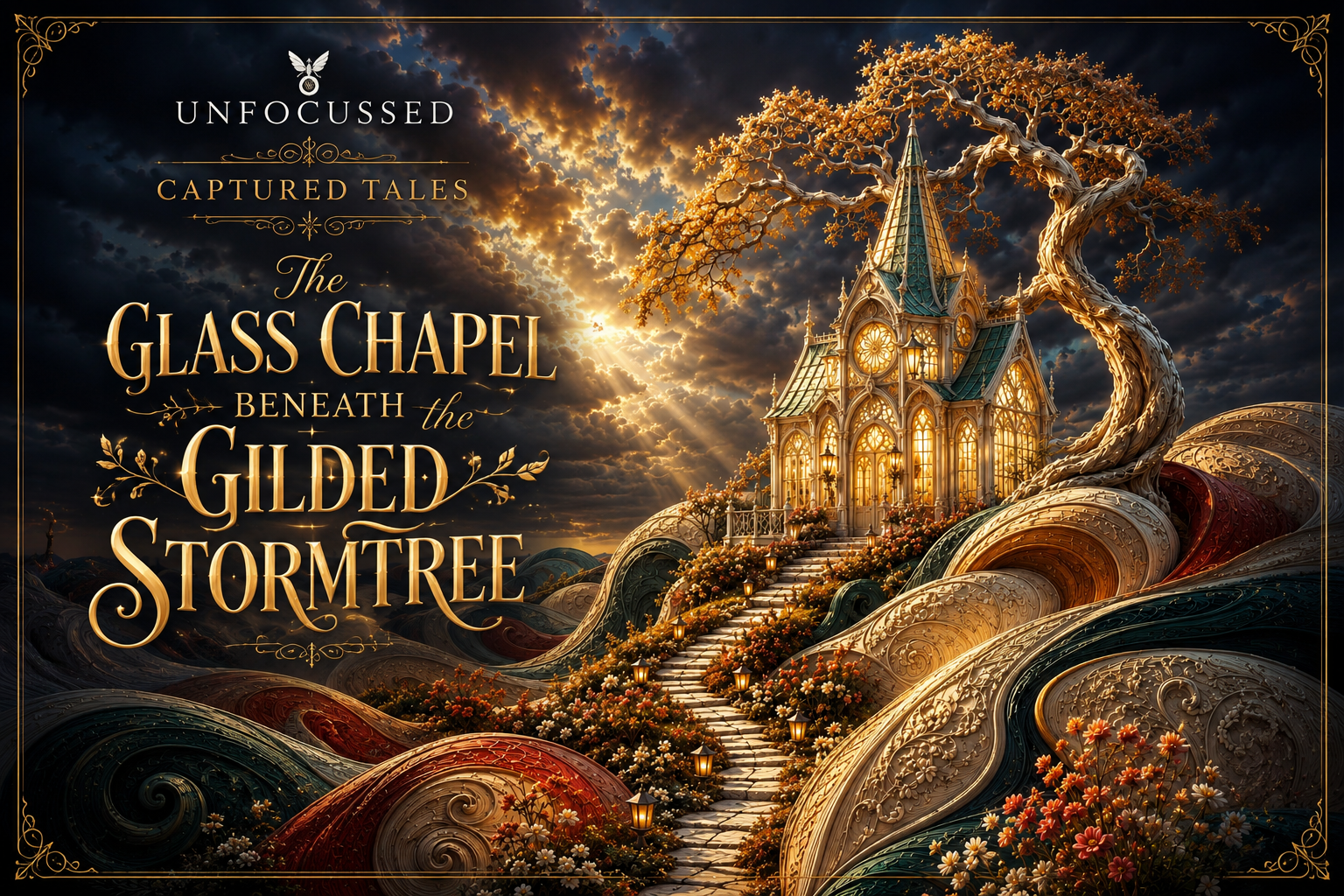
The Vow She Sharpened Like a Knife
By the time Lavinia Thornvale arrived at the Glass Chapel Beneath the Gilded Stormtree, she had already ruined three reputations, weaponized a guest list, and convinced half the valley that she was marrying for love.
This was, of course, absolute nonsense.
Lavinia was marrying for revenge.
Not the messy sort, either. Not the hair-pulling-in-a-market-square kind of revenge favored by tavern brawlers, goat thieves, and people named Beryl who owned too many chickens. No, Lavinia believed revenge should be polished. Pressed. Perfumed. Served on silver trays by waiters wearing gloves and expressions of professional dread.
And if revenge could be arranged beneath a cathedral of glass, under a legendary golden-leafed stormtree, in front of every noble, merchant, busybody, ex-lover, social climber, and emotionally fragile aunt in three counties?
Even better.
The chapel rose before her like a holy thing that had accidentally wandered into a fairy tale and decided to charge admission. Its glass walls shimmered with soft amber light, catching the storm-tossed sky in every pane. Golden windows glowed from within as if the building itself had swallowed the sunset and was trying not to burp. Above it all towered the ancient Stormtree, its pale trunk curling like sculpted bone, its gilded leaves trembling in the wind with the smug authority of something that had witnessed eight hundred years of terrible decisions made in formalwear.
The path leading to the chapel was lined with flowers in cream, rose, peach, and wine-red, blooming with indecent enthusiasm despite the thunderheads gathering overhead. The hills around the chapel curled in ornate waves, as if the land had dressed itself for the occasion and then immediately regretted the shoes.
Lavinia stepped from her carriage.
Every conversation in the courtyard died.
That pleased her.
She wore a gown of ivory silk threaded with gold, fitted so precisely that half the guests inhaled in admiration and the other half inhaled because they were wondering how she intended to sit. Her sleeves fell in lace-tipped points. Her bodice glittered like frost on a blade. A veil trailed behind her, long enough to qualify as its own weather system, carried by two exhausted flower girls whose faces suggested they had already seen too much of adulthood.
Her hair had been arranged into an elegant crown of dark curls, pinned with gold leaves to echo the Stormtree above. The effect was intentional, expensive, and only a little threatening.
“She looks radiant,” whispered Lady Pemberhush from beside a marble urn.
“She looks dangerous,” whispered her husband.
“Those are often the same thing after thirty,” Lady Pemberhush replied.
Lavinia smiled as she crossed the courtyard, though not warmly. Warmth was for bread, baths, and people without a plan. Her smile was the sort that made guilty men check their pockets, their secrets, and occasionally their pulse.
Her mother, Maribelle Thornvale, swept toward her in a cloud of lavender satin and maternal panic.
“Darling,” Maribelle hissed, kissing the air near both of Lavinia’s cheeks. “You are late.”
“I am precisely as late as I intended to be.”
“That is not how time works.”
“It is when people are waiting to stare at you.”
Maribelle glanced nervously toward the chapel doors, where guests were gathering beneath lanterns of stained glass. “Your groom has arrived.”
“How inconveniently loyal of him.”
“Lavinia.”
“Mother.”
“You will behave today.”
“Define behave.”
Maribelle pressed two fingers to her temple. “No public humiliation.”
“None?”
“No.”
“Not even tasteful public humiliation?”
“There is no such thing.”
Lavinia tilted her head. “That is where your generation lacked imagination.”
Maribelle closed her eyes, probably praying, possibly dissociating. Around them, guests continued to pretend not to listen while leaning so hard toward the conversation that one elderly duke nearly toppled into a hydrangea.
It had taken Lavinia six months to arrange this wedding, and every decision had been made with the careful cruelty of a jeweler cutting a diamond.
The guest list included her former fiancé, Lord Cassian Vale, who had abandoned her one year prior for a widow with excellent cheekbones and a vineyard. It included Cassian’s new bride, the aforementioned widow, who wore rubies too early in the day and smiled like she had invented suffering for other people. It included the gossip columnist from The Briarwick Bell, the entire Ladies’ Benevolent Society for Moral Superiority, three bankrupt counts, one bishop with a wandering eye, and Lavinia’s cousin Ophelia, who could not keep a secret if it were stapled to her tongue.
Most importantly, it included the Harrowmere family.
And at the altar, waiting inside the chapel, stood Tobias Harrowmere.
Lavinia’s groom.
Her chosen instrument.
Her beautifully inconvenient complication.
When she had first selected Tobias, it had been for practical reasons. He was handsome enough to irritate Cassian. Wealthy enough to silence her creditors. Respectable enough to soothe her mother. Connected enough to scandalize all the right people when she inevitably revealed, at the reception, that Cassian Vale had not merely abandoned her but had done so after attempting to steal her dowry through an absurdly dramatic investment scheme involving enchanted orchard land, counterfeit beehives, and one allegedly prophetic donkey.
The donkey had been wrong about everything except Cassian.
Tobias Harrowmere, meanwhile, had entered the arrangement with surprising calm.
He knew Lavinia did not love him.
He knew she had selected him like one might select a ceremonial dagger: attractive, sharp, and likely to draw blood in public.
He knew about Cassian, the dowry, the gossip, the revenge.
Worst of all, he had agreed anyway.
“Everyone deserves one spectacularly petty day,” he had told her during their third meeting, over tea in her mother’s parlor. “Some people get birthdays. Some get coronations. You, apparently, require a legally binding theatrical strike.”
“And you do not object?” Lavinia had asked.
“To being handsome bait in a social trap? Not particularly.”
“That is either admirable or deeply concerning.”
“I contain multitudes.”
He had smiled then, warm and crooked, as if he found her plan amusing but not frightening. That had annoyed her.
Everything about Tobias annoyed her at first. His calm. His patience. His habit of actually listening when she spoke, which was frankly manipulative. His refusal to be intimidated by her. His tendency to bring her tea exactly the way she liked it after learning her preference once. Once. That was the behavior of a man either dangerously observant or raised by witches.
He also had laugh lines.
Lavinia distrusted laugh lines.
They suggested a person had made peace with joy, and she considered that suspicious.
“Are you ready?” Maribelle asked.
Lavinia looked toward the chapel doors. Through the glass, she could see movement inside: candles flickering, guests finding seats, musicians adjusting instruments, and Tobias standing near the altar beneath a carved arch of gold and flowering vines.
Even from a distance, he looked infuriatingly composed.
He wore a dark green formal coat embroidered in bronze thread, the color chosen specifically because it made his eyes look like forest moss after rain. Lavinia had not chosen it for that reason. The tailor had mentioned it. Several times. Loudly. In front of her.
Now Tobias turned slightly, as though he sensed her watching.
Across the glowing interior, their eyes met.
He smiled.
Not broadly. Not smugly. Just enough.
A small, steady smile meant only for her.
Lavinia’s stomach did something unacceptable.
She straightened immediately.
“I hate this place,” she said.
Her mother blinked. “You chose it.”
“That does not mean it has permission to be effective.”
A rumble of thunder rolled across the hills.
The gilded leaves of the Stormtree shivered overhead, whispering against one another in a sound almost like laughter.
Lavinia looked up.
“Do not start,” she told the tree.
The nearest branch dipped.
A single golden leaf fell and landed directly in her bouquet.
Her mother gasped. “A blessing.”
“A warning,” Lavinia said, plucking it out.
The leaf curled in her fingers, warm as skin. Across its surface, faint lines of light shimmered and formed three words before fading:
Try honesty, dear.
Lavinia stared at it.
Then she crushed the leaf in her fist.
“Absolutely not.”
The chapel bell rang once.
Then again.
Then, very rudely, a third time, though the ceremony was only supposed to begin after two.
The guests murmured. Birds startled from the branches. Somewhere inside, an organ coughed out three confused notes.
Maribelle went pale. “Why did it ring three times?”
Lavinia narrowed her eyes at the chapel. “Because this venue is a dramatic bitch.”
“Lavinia.”
“It is. Look at it. Glass walls. Golden windows. Storm tree. It practically arrived wearing eyeliner.”
The wind lifted her veil, sending it rippling behind her like a ghost with a grudge. At the entrance, the officiant appeared: Father Brindle, a small, round man whose expression suggested he had performed enough weddings at the chapel to know when the architecture was about to get involved.
“Lady Lavinia,” he called, voice trembling only slightly. “The chapel is ready.”
“Is it?”
“As ready as it gets.”
That was not comforting.
Lavinia handed her bouquet to one of the flower girls, then took it back immediately because the child looked like she might faint under its emotional symbolism.
“Remember,” Maribelle whispered as they approached the doors, “dignity.”
“I have dignity.”
“You have vengeance in a corset.”
“Multitasking is a virtue.”
The chapel doors opened.
Warm light spilled across the path.
Inside, the Glass Chapel was even more absurdly beautiful than Lavinia remembered, which irritated her because beauty was harder to stay angry inside. The vaulted ceiling rose in clear panes framed by golden ribs, showing the churning clouds overhead. Every flash of lightning turned the interior silver for a heartbeat. Flowers climbed the columns in lush spirals. Candles hovered in glass globes, bobbing gently as though eavesdropping. The aisle stretched ahead beneath her feet, scattered with petals that seemed to glow faintly from within.
Every guest turned.
Lavinia stepped forward.
The musicians began the processional, a stately melody with just enough tremble to suggest the violinist had either nerves or unpaid gambling debts.
She walked slowly, savoring each face.
There was Lady Morwynn Vale, Cassian’s new wife, wearing rubies and a smile sharp enough to slice wedding cake. There was Cassian himself, stiff-backed and handsome in the exhausting way of men who believed mirrors existed as moral support. He watched Lavinia with a carefully neutral expression, but his jaw twitched.
Good.
Let it twitch.
Let the whole smug face tremble loose and fall into his soup later.
Lavinia continued down the aisle.
On the left sat the Thornvale relatives, all pretending their branch of the family tree had not spent generations making disastrous romantic choices and calling it passion. On the right sat the Harrowmeres, who looked relaxed, wealthy, and genetically blessed in a way that made Lavinia suspect they had made a deal with something antlered.
Near the front, Tobias’s younger sister, Juniper, winked at her.
Lavinia did not wink back. Brides did not wink. Brides floated, glided, and occasionally plotted.
Then Tobias came fully into view.
He stood beneath the altar arch with his hands folded, his expression open and unreadable in the candlelight. Not smug. Not nervous. Not trapped.
Simply present.
It was extremely rude of him.
Men selected for revenge were supposed to remain symbolic. They were not supposed to look at you as though they could see all the blades you were carrying and had brought a blanket anyway.
Lavinia reached the altar.
Tobias offered his hand.
She took it.
His fingers were warm.
“You came,” he murmured.
“Obviously.”
“You look beautiful.”
“I know.”
His mouth twitched. “Still accepting compliments with the grace of a thrown brick.”
“Still giving them like a man asking to be emotionally taxed.”
Father Brindle cleared his throat. “Shall we begin?”
“Please,” Lavinia said. “Before the building develops further opinions.”
A candle popped above them.
Several guests flinched.
Father Brindle opened his book, which was bound in white leather and embossed with the symbol of the chapel: a tree, a flame, and two rings locked together like they had argued and decided to stay out of spite.
“Dearly beloved,” he began, “we are gathered beneath glass, gold, root, and storm to witness the joining of two hearts—”
The chapel gave a soft creak.
Father Brindle paused.
“—or at least,” he amended carefully, “two legally consenting persons.”
The creak stopped.
Lavinia’s eyes narrowed.
“Coward,” she whispered.
“Experienced,” Father Brindle whispered back.
The ceremony continued.
At first, everything behaved. The candles floated. The glass shimmered. The guests dabbed at their eyes during the blessing, though most of them were simply excited to be near scandal in formal clothes. Tobias recited his first vow beautifully, his voice steady and low.
“Lavinia,” he said, looking directly at her, “I promise to stand beside you in storms of weather, temper, rumor, and consequence. I promise not to fear the sharp edges that helped you survive. I promise to listen when you speak, to answer honestly when you ask, and to bring tea when you pretend not to need comfort.”
The chapel went very still.
Lavinia felt every eye turn toward her.
She hated him a little for that vow.
Not because it was bad.
Because it was good.
Good in a way that made her own prepared vows feel suddenly theatrical, brittle, and mean.
Her vows were tucked inside her sleeve, written in a delicate hand on cream paper edged with gold. They were elegant. Perfectly phrased. Designed to appear romantic while containing three subtle insults toward Cassian, one public reference to financial betrayal, and a devastating metaphor about men who mistake borrowed lanterns for their own inner light.
It was excellent work.
Possibly the finest social assassination ever hidden inside matrimonial language.
And now Tobias had ruined the mood by being sincere.
The bastard.
Father Brindle turned to her. “Lady Lavinia, your vows.”
She slid the paper from her sleeve.
The chapel lights brightened.
Cassian shifted in his seat.
Lavinia saw it.
So did Lady Morwynn.
So did half the front row, because subtlety at a wedding is merely gossip waiting for permission.
This was the moment.
Her revenge had been built for this aisle, this altar, this crowd. With the right words, she could gut Cassian’s polished reputation while appearing too graceful to hold the knife. By supper, the valley would know what he had done. By tomorrow, the newspapers would have it. By next week, his investors would run like rabbits from a tax collector.
All she had to do was read.
She looked at Tobias.
He was not smiling now.
He was watching her with that same steady, infuriating softness. Not stopping her. Not judging her. Not even asking her to choose differently.
Just seeing her.
The paper warmed between her fingers.
The words began to shift.
Lavinia looked down sharply.
Her vows rearranged themselves.
The golden ink twisted across the page like drunken ants at a parade.
“No,” she whispered.
The paper now read:
Tobias, I did not come here expecting kindness. I came here with a grudge in my bodice and a guest list full of ammunition.
Lavinia’s eyes widened.
Father Brindle leaned away from her, slowly, like a man giving a cannon room to express itself.
She tried to fold the paper.
It unfolded itself.
She tried to crush it.
It stiffened into a small, elegant rectangle of betrayal.
The chapel bell rang once.
Inside.
There was no bell inside.
The guests gasped.
“Read it,” whispered the Stormtree.
The voice moved through the glass, the gold, the petals, the bones of the chapel itself. It was old, feminine, amused, and far too interested in everybody’s business.
Lavinia lifted her gaze toward the ceiling.
“I will burn you down,” she said softly.
A golden leaf drifted from nowhere and landed in her hair.
Try it in that dress.
Tobias covered his mouth with one hand.
“Are you laughing?” Lavinia hissed.
“No.”
“You are absolutely laughing.”
“Only internally.”
“I can see your shoulders.”
“They are emotionally expressive.”
Father Brindle cleared his throat again, this time with the haunted delicacy of a man who knew he would be mentioning this in confession later. “Lady Lavinia?”
Every face in the chapel waited.
Cassian looked pale now.
Lady Morwynn looked delighted, which made Lavinia want to bite something expensive.
Maribelle had both hands clasped in prayer and appeared to be negotiating directly with any god currently accepting urgent bridal requests.
Lavinia stared at the rewritten vows.
Her plan trembled.
Not collapsed.
Not yet.
She could refuse. She could improvise. She could turn this around. She could still slice Cassian open with grace and metaphor. She could still make this wedding useful.
Then Tobias squeezed her hand.
Only once.
Not pleading.
Not restraining.
Just there.
Warm.
Steady.
A nuisance of a man.
Lavinia inhaled.
The storm outside pressed close to the glass.
The chapel waited like a gossip with front-row seats.
And against every sensible instinct she possessed, Lavinia began to read.
“Tobias,” she said, voice crisp enough to cut ribbon, “I did not come here expecting kindness.”
A ripple moved through the guests.
Someone whispered, “Oh, this is going to be good.”
Lavinia ignored them.
“I came here with a grudge in my bodice and a guest list full of ammunition.”
Father Brindle made a small choking sound.
Tobias looked down at their joined hands, smiling now in spite of himself.
“I chose this chapel because it was beautiful enough to make cruelty look refined,” Lavinia continued, the enchanted words glowing brighter as she spoke. “I chose this crowd because many of them deserve indigestion. I chose this day because I believed I could turn a wedding into a weapon and call it justice.”
Cassian stood halfway from his seat. “This is outrageous.”
The chapel doors slammed shut.
Cassian sat back down.
Quickly.
“But then,” Lavinia read, fighting the urge to strangle the paper with her teeth, “there was you.”
The words softened.
So did her voice, damn it.
“You, who knew the worst of my plan and did not flinch. You, who never mistook my sharpness for emptiness. You, who made room for my anger without asking it to become prettier first.”
The chapel had gone silent.
Even the gossip columnist had stopped writing, which suggested either emotional investment or a hand cramp from joy.
Lavinia swallowed.
She looked at Tobias.
His smile had faded again.
Now he looked startled.
Vulnerable.
Hopeful, the idiot.
“I do not know whether I love you,” Lavinia read.
Aunt Hyacinth fainted dramatically into a pew.
No one helped her. She did this often.
“But I know,” Lavinia continued, “that when I imagined this day without you in it, the revenge felt smaller. I know that when you laugh, I become irritated in a way that suggests investment. I know that you remember how I take my tea, and I hate that I noticed. I know that part of me came here to punish a man who made me feel foolish, and another part of me is terrified because you make me feel seen.”
Her throat tightened.
Absolutely unacceptable.
She blinked hard and glared at the paper, as if intimidation could dry tear ducts.
“So I promise you this,” she read. “Not softness. Do not get ambitious.”
A few guests laughed.
Tobias did too, quietly.
“Not obedience, because I was not raised in captivity. Not perfection, because frankly, that sounds tedious and difficult to accessorize.”
More laughter now.
Even Maribelle made a sound somewhere between a sob and a hiccup.
“I promise you honesty, when I can bear it. Loyalty, when you deserve it. Fury, when the world comes for you. Tea, if you are gravely ill or unusually charming. And if this marriage becomes a mistake, I promise it will at least be an interesting one.”
The golden ink dimmed.
At the bottom of the page, one final line appeared.
Lavinia read it silently first.
Her cheeks warmed.
“Absolutely not,” she whispered.
The chapel bell rang again.
Father Brindle leaned over. “It is usually best not to argue with the last line.”
“How often does this happen?”
“More than you would hope. Less than the chapel deserves.”
Tobias tilted his head. “What does it say?”
Lavinia folded the page.
It unfolded.
She folded it again.
It slapped her wrist.
The guests collectively leaned forward.
“Fine,” she snapped.
She lifted her chin, stared directly into Tobias’s eyes, and read the final line.
“And if you kiss me like a man who intends to survive me, Tobias Harrowmere, I may consider forgiving you for making this complicated.”
The chapel erupted.
Gasps. Laughter. Applause. A scandalized wheeze from the bishop. One enthusiastic “Finally!” from Juniper Harrowmere.
Tobias stared at Lavinia as if she had just handed him a lit candle and a map to a treasure he had not dared to search for.
“That was not in my original draft,” she said.
“I assumed.”
“If you look smug, I will leave.”
“I am far too moved to be smug.”
“Your mouth is suspicious.”
“It often is.”
“Careful.”
Father Brindle, visibly sweating, raised both hands. “We will now proceed to the exchange of rings before anyone else says anything memorable.”
But the chapel was not finished.
Of course it wasn’t.
A low groan shuddered through the glass walls.
The golden vines carved into the altar began to glow. Outside, the Stormtree shook, its branches scraping across the sky. Thunder cracked so loudly that several guests ducked, and from the vaulted ceiling, thousands of tiny golden leaves appeared, suspended in the air like sparks.
Then the leaves began to spin.
At first, they formed a circle above Lavinia and Tobias.
Then a spiral.
Then words.
Large, shining, impossible words hovering over the altar for every guest to see:
ONE VOW WAS TRUE.
The guests murmured.
Lavinia’s stomach dropped.
The leaves shifted again.
ONE VOW WAS BOUGHT.
Cassian went rigid.
Lady Morwynn slowly turned to look at him.
The chapel lights dimmed.
The final words formed above the aisle, bright as lightning:
ONE LIAR STILL OWES THE BRIDE.
For one delicious, terrible moment, nobody breathed.
Then every eye in the chapel turned toward Lord Cassian Vale.
Lavinia looked at the Stormtree through the glass ceiling.
The tree’s golden leaves shimmered smugly.
She should have been furious.
She was furious.
But beneath the fury, beneath the embarrassment and chaos and inconvenient tenderness blooming in her chest like a flower with poor boundaries, there was another feeling.
Recognition.
The chapel had not stolen her revenge.
It had sharpened it.
And now, with Tobias still holding her hand, with the guests watching Cassian squirm, and with the Glass Chapel glowing around her like a holy courtroom run by a flamboyant menace, Lavinia Thornvale realized her wedding day had only just begun.
The Reception of Questionable Honesty
There are very few sounds more satisfying than the collective silence of well-dressed liars realizing the room has developed teeth.
Lavinia had imagined this moment for months. She had pictured Cassian Vale exposed beneath candlelight, his reputation split open like a rotten peach, his polished charm finally revealed as the sort of cheap varnish that bubbles near heat. In her mind, she had always been the one holding the match.
Instead, the chapel had stolen her thunder.
Literally.
Another crack of stormlight burst above the glass ceiling, illuminating Cassian in his pew with such theatrical precision that the man might as well have been sitting under a celestial accusation lamp. His face had gone pale, then red, then a rather intriguing grayish shade Lavinia would have called “bankrupt mushroom.”
Lady Morwynn Vale stared at him with the serene, lethal calm of a woman who had just discovered her expensive husband came with unpaid emotional termites.
The guests stared too.
All of them.
Even Aunt Hyacinth, who had recently fainted, lifted one eyelid from the pew cushion to make sure she was not missing anything useful.
The golden leaves still hovered above the aisle, rearranging themselves into those damning words again and again:
ONE LIAR STILL OWES THE BRIDE.
“Well,” Tobias murmured beside Lavinia, “that is direct.”
“It lacks subtlety,” Lavinia said.
“You were going to compare him to a borrowed lantern.”
“Yes, but elegantly.”
“Of course.”
“People would have appreciated the craft.”
“I am certain several would have clapped politely while not understanding it.”
She cut him a look. “Are you comforting me or critiquing my vengeance?”
“I contain multitudes.”
“You keep saying that as if it helps.”
“It helps me.”
Father Brindle stood frozen between them with the rings trembling in his palm. He looked from Lavinia to Tobias, then to the hovering accusation, then to Cassian, then back to the rings, as though wondering whether completing the marriage ceremony during an active magical indictment counted as professional negligence.
“Should I continue?” he asked faintly.
“Yes,” Lavinia said.
“No,” Cassian barked.
Everyone turned toward him.
Cassian stood now, smoothing the front of his coat with shaking hands. He had always been beautiful in a tedious way—golden hair, sharp jaw, blue eyes polished by generations of inherited entitlement. Lavinia once thought him dazzling. Now he looked like a dessert fork trying to pass itself off as a sword.
“This is absurd,” Cassian declared. “We are all being manipulated by a building.”
The chapel gave a low, offended groan.
One of the floating candles drifted toward Cassian and spat a tiny bead of wax onto his shoulder.
He flinched.
Lavinia smiled.
“Careful, Cassian,” she said. “The building appears sensitive.”
“You planned this.”
“I planned many things. I assure you, being upstaged by architecture was not among them.”
“You are making a spectacle.”
“Darling,” Lavinia said, letting the endearment slice cleanly through the room, “you are the spectacle. I merely dressed nicely for it.”
A ripple of laughter passed through the pews.
Cassian’s mouth tightened. “I owe you nothing.”
The chapel windows flashed gold.
The leaves above the aisle scattered, then reformed into new words.
HE OWES HER SEVENTEEN THOUSAND CROWNS, THREE ORCHARD DEEDS, AND AN APOLOGY WITH EYE CONTACT.
The room exploded.
Gasps. Whispers. A strangled laugh from Juniper Harrowmere. The gossip columnist dropped his pencil, then snatched it from the floor with the desperate urgency of a man witnessing history in lace gloves.
Lady Morwynn’s rubies caught the light as she turned fully toward her husband.
“Cassian,” she said softly, “what orchard deeds?”
“Irrelevant ones,” he replied too quickly.
“That is not a reassuring category.”
“This is slander.”
The chapel bell rang once.
A stained-glass panel behind the altar brightened, and within its colored panes appeared a vision: Cassian seated at a polished desk, signing documents with Lavinia’s dowry seal beside him. Another image flickered in beside it: Cassian shaking hands with a man in a green velvet hat near a row of suspiciously identical beehives. A third image showed the allegedly prophetic donkey standing beside an orchard gate, wearing a garland and looking deeply tired of human finance.
The donkey brayed through the glass.
Several guests screamed.
“Is that donkey testifying?” Tobias asked.
“Apparently.”
“He has presence.”
“He had terrible investment advice.”
“Nobody is perfect.”
Cassian pointed at the vision. “Illusions can be fabricated.”
The donkey in the glass turned its head toward him.
Then, with magnificent timing, it lifted its tail.
The stained glass politely went opaque before completing the thought, but the room understood the testimony.
Juniper applauded.
“That animal deserves a legal robe,” she said.
Father Brindle took one step backward. “I would like to clarify that the chapel has not previously used livestock evidence in my presence.”
“First time for everything,” Tobias said.
Lavinia watched Cassian’s composure fray, thread by thread. This should have satisfied her completely. She should have felt triumphant, clean, restored. The revenge she had built like a palace had arrived with stained glass, thunder, and donkey-backed documentation.
But something had changed.
It was not mercy. Lavinia did not trust mercy before supper.
It was perspective.
The sight of Cassian squirming no longer filled the whole room inside her. There was room now for other things. Tobias’s hand around hers. Her mother’s wet-eyed relief. The absurd chapel breathing around them. The knowledge that she had walked into this place expecting to perform pain and had accidentally said something true in front of everyone with earrings.
How annoying.
Truth always had the worst timing.
Cassian took a step into the aisle. “Lavinia, surely you are not going to allow this circus to continue.”
“Allow?” Lavinia repeated.
A dangerous little hush fell.
Tobias’s thumb brushed once over her knuckles, subtle as a matchstrike.
Lavinia smiled.
“Cassian,” she said, “I am standing in a magical glass chapel beneath a judgmental tree while your crimes are being narrated by enchanted foliage and a spectral donkey. At this point, I am not allowing the circus. I am simply enjoying the parade.”
Lady Pemberhush made a sound of delighted scandal. Her husband whispered, “That one goes in the scrapbook.”
Cassian’s gaze flicked around the room, searching for allies. He found only spectators. Worse, entertained spectators. Nobility loved morality, but only after they had confirmed the scandal was happening to someone else.
“Tobias,” Cassian said, changing tactics with the oily grace of a man slipping on his own ethics, “surely you do not wish to begin your marriage with this sort of public ugliness.”
Tobias considered him.
“I suppose that depends.”
Cassian relaxed half an inch. “On what?”
“Whether the ugliness pays interest.”
Lavinia looked at Tobias.
He was calm. Still warm. Still steady. But there was steel in him now, bright and quiet. She had seen hints of it before—in negotiations with caterers, in conversations with her mother, in the way he once corrected a nobleman who interrupted her three times at dinner and made the man apologize before dessert.
Tobias was kind.
She had mistaken that for softness.
That had been careless.
And, regrettably, attractive.
Cassian laughed once, too sharp. “You cannot possibly mean to involve yourself.”
“I am standing beside the woman you cheated, during what appears to be my own wedding, in a chapel currently holding receipts. I would argue I am involved.”
“This is none of your business.”
“You are interrupting my vows.”
“Your vows?”
“Yes.” Tobias’s smile was mild. “And I was rather enjoying them.”
Lavinia’s cheeks warmed again.
She despised her cheeks. Treacherous little lanterns.
The Stormtree’s branches scraped softly across the roof, producing a sound suspiciously like applause.
Father Brindle lifted the rings again, perhaps sensing that if he did not regain control soon, the ceremony might evolve into a financial tribunal with refreshments.
“Perhaps,” he said, voice quivering but determined, “we may complete the exchange of rings and address outstanding debts immediately afterward.”
The chapel lights dimmed in thought.
Then the hovering leaves shifted.
ACCEPTABLE. BUT HURRY. THE CAKE IS LISTENING.
“The cake?” Maribelle whispered from the front pew.
Lavinia closed her eyes. “Of course the cake is listening.”
“Why would the cake listen?”
“Mother, at this point I am more concerned with what it knows.”
Father Brindle rushed onward. “The rings, please.”
Juniper produced them from a small velvet box and handed them over with barely contained glee. “This is the best wedding I have ever attended.”
“You are nineteen,” Tobias said.
“And yet I know quality.”
The rings were simple gold, engraved on the inside with a vine pattern and the date. Lavinia had chosen them because they were elegant and inoffensive. Now, as Father Brindle lifted hers, the metal glowed faintly and added a tiny inscription around the outer band.
Lavinia leaned in to read it.
Try not to stab him unless warranted.
She looked up at the ceiling. “You are pushing your luck.”
The chapel creaked smugly.
Tobias looked at his ring and laughed under his breath.
“What does yours say?” Lavinia asked.
He angled it toward her.
Good luck, brave idiot.
Despite herself, Lavinia laughed.
It escaped her before she could stop it—a bright, startled thing that did not sound like strategy or scorn. Tobias looked at her as if the sound had struck him somewhere vulnerable.
That was unfair.
A man should not be allowed to look at a woman that way in public. It was practically indecent. Worse than ankles. More dangerous than poetry.
“Lady Lavinia,” Father Brindle said, with the intense focus of a man determined to finish before the dessert course filed a complaint, “do you accept this ring as a symbol of the vows spoken here today?”
Lavinia stared at the ring.
She had imagined this moment differently. In her plan, the ring had been a prop. A pretty golden hinge on which the trap would swing shut. She would marry Tobias, expose Cassian, reclaim what was owed, and eventually decide whether marriage suited her once the dust, debt, and gossip settled.
Now the ring felt heavier.
Not like a chain.
Like a choice.
Horrible things, choices. Always arriving overdressed and demanding sincerity.
She looked at Tobias.
He did not lean closer. Did not plead. Did not perform wounded nobility for the crowd. He simply waited.
“Yes,” Lavinia said.
Only one word.
But the chapel warmed around it.
Tobias slid the ring onto her finger.
It fit perfectly.
Of course it did.
This damn day had become symbolically aggressive.
Father Brindle turned to Tobias. “Lord Tobias, do you accept this ring as a symbol of the vows spoken here today?”
“I do,” Tobias said.
He did not hesitate.
Lavinia slid the ring onto his finger, and for one wild second, she wanted to hold his hand afterward not because witnesses expected it, but because she liked how it felt.
That was dangerous.
Worse, it was inconvenient.
Worst of all, it was true.
Father Brindle’s relief was visible from the back row. “By glass, gold, root, and storm, by witness of those gathered and those meddling unseen—”
“Meddling is such a harsh word,” whispered the Stormtree.
Father Brindle did not pause. “—I pronounce you bound in marriage.”
The chapel exhaled.
There was no other word for it. The glass walls shimmered. The candles flared. The flowers along the columns opened wider, releasing a scent of rose, rain, and something sparklingly sharp beneath, like champagne with an opinion.
“You may kiss,” Father Brindle said, then added under his breath, “if the building permits.”
Lavinia turned to Tobias.
“Do not make a meal of this,” she warned.
“We are still in front of the cake.”
“Tobias.”
“Understood.”
He stepped closer.
For all his humor, there was caution in the movement. He lifted one hand, giving her every chance to retreat, and when she did not, he touched her cheek with a gentleness that made her furious in a strangely pleasant way.
“You are impossible,” she whispered.
“I am consistent.”
“Worse.”
Then he kissed her.
Not like a man claiming victory.
Not like a groom performing for guests.
He kissed her like someone receiving a secret and promising not to mishandle it.
The room disappeared for a moment.
Not fully. Lavinia was still aware, distantly, of applause, thunder, Juniper wolf-whistling until her mother slapped her arm, and Aunt Hyacinth declaring from the pew cushion that she had recovered just in time. But all of it blurred at the edges.
There was Tobias.
His hand at her cheek.
The warmth of him.
The ridiculous, terrifying fact that she wanted to kiss him again.
When they separated, Tobias looked almost as startled as she felt.
Good.
Let him suffer too.
The chapel burst into golden light.
Flowers rained from nowhere. The candles spun overhead. The Stormtree shook so fiercely that gilded leaves scattered across the glass ceiling like coins tossed by a drunk god.
The guests erupted into cheers.
Then the cake screamed.
It was not a long scream.
More of a sharp, offended shriek from the reception hall beyond the side doors.
Every head turned.
Lavinia sighed. “I knew it.”
Father Brindle removed his spectacles and rubbed his eyes. “The cake usually does not scream until the cutting.”
“Usually?” Tobias asked.
“This chapel attracts complicated frosting.”
The side doors flew open.
A young server appeared, pale as linen, his tray held protectively against his chest.
“My lady,” he gasped. “The reception hall is—”
A crash sounded behind him.
Then a chorus of outraged voices.
Then a deep, wet splattering sound that no elegant wedding should produce unless the soup had entered politics.
“The reception hall is what?” Maribelle demanded.
The server swallowed.
“Awake.”
Lavinia looked at Tobias.
Tobias looked at Lavinia.
Then both looked toward Cassian, who had begun edging suspiciously toward a side exit.
The chapel doors slammed shut again.
“Oh good,” Lavinia said. “The building has selected a hobby.”
The newlyweds entered the reception hall to find the cake standing on its own table.
Standing was the only word.
It had been a five-tier masterpiece of buttercream, gold leaf, sugared flowers, and ornamental vines. Now those vines had uncurled. Frosting roses blinked open like tiny eyes. A seam had formed in the middle tier and widened into what could only be described as a mouth, though no baker alive would admit to such a thing without being heavily bribed.
On the wall behind it, the seating chart had rearranged itself.
Instead of tables named after flowers, the chart now displayed categories:
HONEST PEOPLE
LIARS
LIARS BUT FUNNY
ROMANTIC COWARDS
PEOPLE WHO OWE THE BRIDE MONEY
AUNTS WHO FAINT FOR ATTENTION
Aunt Hyacinth gasped from behind them. “I have a condition.”
“Yes,” Lavinia said. “Dramatic timing.”
At the center of the hall, several guests stood frozen beside tables that had shifted away from them. Chairs scraped across the floor on their own, rearranging guests with ruthless social insight. Lord Pemberhush had been placed under HONEST PEOPLE, while Lady Pemberhush sat under LIARS BUT FUNNY, which she seemed to accept with pride.
Cassian’s name glowed under PEOPLE WHO OWE THE BRIDE MONEY.
Then it blinked.
And grew larger.
Lady Morwynn’s name hovered uncertainly between LIARS and ROMANTIC COWARDS, before finally sliding into a new category that appeared just for her:
WIVES WHO SHOULD CHECK THE ACCOUNTS
Lady Morwynn stared at it.
Then she smiled.
It was not a warm smile.
It was the kind of smile that made accountants suddenly believe in prayer.
“Cassian,” she called.
He stopped moving toward the door.
“Yes, my dove?”
“Do not dove me unless you wish to become birdseed.”
Juniper clutched Tobias’s sleeve. “Can we have all future family events here?”
“Absolutely not,” Tobias said.
“But look at it.”
“That is exactly why.”
Lavinia moved toward the cake.
The cake’s frosting mouth pursed.
“Do not scream again,” she told it.
The cake produced a low hum.
On its top tier, sugar letters formed:
CUT THE LIES FIRST.
“Charming,” Lavinia said. “Even dessert has become metaphorical.”
Tobias came to stand beside her. “Should we be concerned that the cake has an agenda?”
“At least it has structure. More than can be said for half this guest list.”
Maribelle swept into the hall, her lavender satin trembling with maternal outrage. “I paid an obscene amount for that cake.”
The cake turned toward her.
Its frosting mouth opened.
“Do not you dare,” Maribelle snapped.
The cake closed its mouth.
Lavinia stared.
“Mother.”
Maribelle lifted her chin. “I have negotiated with caterers. I fear nothing made of butter.”
For the first time all day, Lavinia looked at her mother with genuine admiration.
“Respect,” Tobias murmured.
“Indeed.”
Father Brindle entered the hall last, saw the seating chart, saw the cake, saw the chairs sorting guests by moral category, and muttered, “I should have become a beekeeper.”
At the far side of the hall, Cassian stood beneath his glowing category while trying to peel his name from the wall with a butter knife.
Each time he scraped at the letters, they brightened.
PEOPLE WHO OWE THE BRIDE MONEY
CASSIAN VALE
CASSIAN VALE
CASSIAN VALE
“It’s multiplying,” Juniper said, delighted.
“Stop scraping,” Lady Morwynn said.
“I am attempting to remove slander.”
“You are decorating it.”
The gossip columnist stood nearby, writing so fast smoke might have risen from his pencil if the chapel had not already occupied the dramatic effects budget.
Lavinia watched Cassian and felt an old ache stir. Not love. That had died long ago, though it had left behind some stains. This was humiliation remembered. The memory of believing someone, trusting him, shaping a future around his promises, only to discover he had viewed her devotion as a financial instrument with nice hair.
Her hand tightened around her bouquet.
Tobias noticed.
Of course he did.
“You do not have to make this public if you no longer want to,” he said quietly.
She looked at him.
“He made it public when he let the town think I had been too proud to keep him.”
“Then public it is.”
“You say that as if you are not concerned.”
“I am concerned.”
“About?”
“Whether there will still be cake after justice.”
She nearly smiled.
“Your priorities are appalling.”
“My blood sugar is involved.”
Lavinia looked back toward Cassian. The room buzzed around him, hungry for confrontation. Months ago, she would have given them a performance. She would have turned the moment into art. A devastating toast. A raised glass. A perfect line delivered with surgical poise.
But the chapel had already stripped the wallpaper off the lie.
She no longer needed to perform.
She needed to collect.
“Cassian,” she said.
Her voice carried without effort. The hall quieted.
The cake hummed expectantly.
Cassian turned, still gripping the butter knife.
It was not his finest look.
“Lavinia,” he said, lowering his voice into the wounded register he used whenever cornered. “You cannot truly intend to humiliate me like this.”
“No,” she said. “Humiliation is merely the garnish.”
Tobias coughed into his fist.
“I intend for you to repay what you stole.”
Cassian’s eyes darted to Lady Morwynn, then to the guests. “This is not the time.”
“You are standing beneath a glowing category titled People Who Owe the Bride Money while holding a butter knife at a sentient reception. I cannot imagine a better time.”
The cake gave one approving burble.
Lavinia continued, “You will return the seventeen thousand crowns. You will restore the three orchard deeds. You will issue a written apology, witnessed and sealed, admitting that I did not break our engagement through pride, cruelty, instability, or any of the other little rumors your friends sprinkled around town like rat poison in perfume bottles.”
Several guests suddenly found their napkins fascinating.
“And,” Lavinia said, letting her smile sharpen, “you will do it before the first course.”
Cassian laughed again, but it came out thin. “Impossible.”
The Stormtree groaned outside.
The reception hall windows brightened.
Across the nearest glass pane appeared another vision: Cassian opening a hidden compartment behind a portrait, removing a locked box, and counting coin stacks with the focused tenderness of a man who loved money because money did not ask where he had been.
Below the image, glowing script appeared:
THE FUNDS ARE CURRENTLY IN HIS TOWNHOUSE BEHIND THE PAINTING OF HIS GREAT-GRANDFATHER, WHO WAS ALSO A RAT.
Lord Pemberhush leaned toward his wife. “I met the great-grandfather.”
“Was he a rat?”
“Not literally.”
“Disappointing.”
Cassian stared at the window, speechless.
Lady Morwynn crossed the room with terrifying grace. “Behind the great-grandfather?”
“Morwynn—”
“The painting I asked you to remove because its eyes follow me?”
“It is a family heirloom.”
“It is an ugly man in a wig guarding stolen money.”
“That is a harsh interpretation.”
“It is about to become evidence.”
The room murmured with pleasure.
Lavinia had to admit, Lady Morwynn was handling betrayal beautifully. There was a poise to it. A polish. Lavinia respected good work, even from women who wore rubies before noon.
“Lady Morwynn,” Lavinia said.
Morwynn looked at her.
For a moment, the two women regarded each other across the wreckage of Cassian Vale’s charm.
“I believe we have both been inconvenienced by the same man,” Lavinia said.
Morwynn’s smile was cold enough to preserve fish. “It appears so.”
“Would you care to assist in resolving the matter?”
Morwynn removed one glove finger by finger. “I thought you would never ask.”
Cassian looked from one woman to the other and finally understood that he had not been cornered.
He had been bracketed.
It was much worse.
Tobias leaned toward Lavinia. “Should I be frightened?”
“Not unless you have stolen from either of us.”
“I once took an extra biscuit from Juniper’s plate.”
Juniper gasped. “I knew it.”
“Then yes,” Lavinia said. “Be mildly frightened.”
Father Brindle, perhaps desperate to impose structure on a room actively rejecting it, raised his voice. “Shall we adjourn to the signing table? The chapel may provide documentation.”
The seating chart rearranged itself again.
SIGNING TABLE appeared over the long table where the guest book had been placed.
The guest book snapped open.
A quill rose from its ink pot.
The cake spat one sugared flower onto the floor.
Everyone stared.
“Was that agreement?” Tobias asked.
“I think that was impatience,” Lavinia said.
Cassian did not move.
Lady Morwynn took his arm with the tenderness of a falcon gripping lunch.
“Walk,” she said.
He walked.
They approached the signing table with Lavinia and Tobias behind them, followed by Father Brindle, Maribelle, Juniper, the gossip columnist, and approximately every guest who could pretend they were not hovering for gossip while obviously hovering for gossip.
The quill dipped itself in ink.
At the top of a blank page, words wrote themselves:
CONFESSION, RESTITUTION, AND APOLOGY OF LORD CASSIAN VALE, WHO REALLY SHOULD HAVE KNOWN BETTER
“That title seems prejudicial,” Cassian said.
The quill added:
AND YET HERE WE ARE
Lavinia pressed her lips together.
Tobias failed to hide his laugh.
“You find this amusing?” Cassian snapped.
“Yes,” Tobias said.
“At least he is honest,” Juniper added.
The quill began writing, listing each debt in exact figures, each deed by legal description, each rumor requiring correction. The document was precise, merciless, and written in a hand so lovely it felt almost rude.
When it finished, the quill hovered before Cassian.
He stared at it.
“Sign,” Lady Morwynn said.
“You cannot possibly support this.”
“Cassian, I am deciding whether to support this or turn you into a cautionary household budget.”
He signed.
The moment the ink dried, the chapel bell rang.
Outside, a branch of the Stormtree dipped toward the reception hall window. From its golden leaves fell three small keys, which passed through the glass as if through water and landed on the table.
Attached to them was a tag.
TOWNHOUSE. STUDY. RAT PAINTING.
Lady Morwynn picked them up. “How thoughtful.”
Cassian sank into a chair.
The glowing seating chart moved his name from PEOPLE WHO OWE THE BRIDE MONEY to PEOPLE WHO HAVE BEGUN TO MAKE BETTER CHOICES UNDER DURESS.
“Progress,” Tobias said.
“Do not encourage him,” Lavinia replied.
The first course was served shortly afterward, because caterers possessed a survival instinct rivaled only by rats and minor nobility. Soup appeared. Wine flowed. Chairs stopped rearranging unless someone lied too loudly, in which case the offender’s seat scooted two inches backward as a warning.
The reception found a strange rhythm.
Guests ate and whispered. Cassian sat beside Lady Morwynn in the strained silence of a man mentally inventorying hiding places. Father Brindle drank three glasses of water and stared into the middle distance. Maribelle argued quietly with the cake about portion sizes and appeared to be winning.
Lavinia sat beside Tobias at the head table, newly married and deeply suspicious of her own happiness.
“You are brooding,” Tobias said.
“I am thinking.”
“With your murder eyebrows.”
“My eyebrows are elegant.”
“Elegantly homicidal.”
She glanced at him. “You are very bold for a man wearing a ring that called him an idiot.”
“Brave idiot.”
“A distinction without dignity.”
“Dignity is overrated. It wrinkles badly.”
She took a sip of wine to avoid smiling.
Tobias watched her with infuriating accuracy.
“Are you disappointed?” he asked.
“In the wine? No. It has competence.”
“In the revenge.”
She looked toward Cassian.
He was no longer shining in her mind like a wound demanding attention. He looked smaller now. Not harmless, exactly, but reduced. A man revealed as a man, not a myth, not a heartbreak, not the keeper of her humiliation.
“I expected it to feel cleaner,” she said.
“It rarely does.”
“You sound experienced.”
“I have three sisters.”
“Ah. Battlefield credentials.”
“Extensive.”
She set down her glass. “I thought exposing him would give me back what he took.”
“Did it?”
“Some of it.”
“And the rest?”
She looked at her ring.
The inscription glowed faintly, rude and golden.
“The rest may require less audience.”
Tobias said nothing for a moment. Then, quietly, “Whenever you are ready.”
That was the trouble with him.
He did not push where other men had shoved. He did not demand that she become grateful for his patience. He simply placed it beside her like a cloak and let her decide whether to wear it.
Lavinia hated how much she wanted to.
Before she could answer, the room darkened.
Not fully. The candles remained lit, but their flames turned blue. The windows clouded with stormlight. The cake stopped humming. Even the chairs went still.
A hush passed through the hall.
The Stormtree outside groaned.
This time, the sound did not feel mischievous.
It felt old.
Warning old.
Father Brindle stood abruptly. “Oh no.”
Lavinia turned toward him. “That is not a phrase one likes from clergy.”
“The chapel has accepted the marriage,” he said.
“Yes, we gathered that from the floral assault.”
“And it has exposed a debt.”
“Efficiently.”
“But the Stormtree does not wake fully for unpaid money.”
Tobias straightened. “Then why is it awake?”
Father Brindle looked toward the glass doors leading back to the chapel. “Because one of the vows made here before yours was broken badly enough to leave a curse.”
The reception hall chilled.
Lavinia’s fingers tightened around her napkin.
“Whose vow?” she asked.
The golden leaves outside began to fall upward.
Up from the ground.
Up past the windows.
Up into the storm-dark sky.
Then, across every pane of glass in the reception hall, a single name appeared in glowing script.
THORNVALE.
Lavinia went still.
Her mother made a small sound.
Not surprise.
Fear.
Lavinia turned slowly toward Maribelle.
“Mother?”
Maribelle’s face had gone white beneath her powder.
The Stormtree whispered through the walls, its voice no longer playful, no longer teasing. It moved through the hall like roots cracking stone.
A bride came once before.
The glass doors swung open by themselves.
Beyond them, the chapel glowed blue.
A vow was made.
The wind rose.
The flowers along the tables bowed their heads.
A vow was broken.
All eyes turned toward Maribelle Thornvale.
Lavinia stood.
The chair behind her slid back as if the room itself had made space.
“Mother,” she said again, softer now, sharper. “What is this?”
Maribelle opened her mouth.
No words came.
The cake, wisely, remained silent.
Then the chapel bell rang.
Once.
Twice.
Three times.
And from the aisle of the Glass Chapel, where no one had been standing a moment before, came a woman in a wedding dress made of rain, gold leaves, and grief.
She was translucent. Beautiful. Furious.
And she had Lavinia’s eyes.
The Stormtree’s Favorite Kind of Trouble
The ghost stood in the chapel aisle like a memory that had finally lost patience.
She wore a wedding gown woven from rainlight and old sorrow, its hem dissolving before it touched the floor. Golden leaves clung to her veil. Blue stormfire glimmered beneath her translucent skin. Her dark hair floated around her face as though she stood underwater, and when she lifted her chin, every candle in the reception hall bent toward her like flame recognizing royalty.
Lavinia stared at her.
The ghost stared back.
Same eyes.
Not similar. Not vaguely familial in the way relatives claimed after two glasses of wine and a desperate need to make conversation. The same. Thornvale eyes: dark, direct, inconveniently expressive, and apparently hereditary enough to survive death, betrayal, and formalwear.
“Well,” Juniper whispered somewhere behind Tobias, “that family resemblance came in wearing boots.”
No one laughed.
Even Juniper did not look offended by the lack of appreciation. The room had moved beyond comedy for the moment, which seemed rude, considering how much everyone had paid for champagne.
Lavinia turned slowly toward her mother.
Maribelle Thornvale had gone utterly still. Her hands were clasped at her waist, white-knuckled against lavender satin, and all the brisk maternal authority she had wielded against caterers, seating charts, and sentient cake had drained from her face.
“Mother,” Lavinia said, “who is she?”
Maribelle swallowed.
The ghost answered first.
“I am Seraphina Thornvale.”
Her voice rolled through the chapel and reception hall together, as if both rooms had become one listening body. It was not loud, but it carried the weight of thunder that had learned manners.
Several guests gasped.
Lady Pemberhush clutched her pearls. Lord Pemberhush leaned closer to his wife and whispered, “Wasn’t there a Seraphina in the old scandal?”
“There are always Seraphinas in old scandals,” Lady Pemberhush whispered back. “Try to keep up.”
Seraphina’s gaze slid toward them.
Their chairs scooted backward two inches.
They shut up.
Lavinia took one step forward. Tobias moved subtly beside her—not blocking her, not guiding her, simply remaining near enough that she could choose him as support without having to ask. A newlywed husband with emotional intelligence was frankly unfair. Someone should regulate that.
“Seraphina Thornvale,” Lavinia said. “My ancestor?”
“Your great-grandmother’s sister.”
“The one who drowned?”
The ghost smiled.
It was not pleasant.
“That is the version your family preferred.”
Maribelle closed her eyes.
Lavinia looked at her again. “You knew.”
“I knew pieces.”
“That is what people say when the pieces are shaped like knives.”
“Lavinia—”
“No.” Lavinia’s voice sharpened. “No careful mother voice. No social smoothing. No lavender satin fog. A ghost with my eyes just walked into my wedding reception wearing weather and accusation. I would like the family history without decorative lies.”
The cake gave a tiny approving hum.
Maribelle shot it a glare so fierce the top tier leaned away.
Seraphina drifted closer, and wherever she passed, petals on the floor turned blue. “I came to this chapel as a bride eighty-seven years ago. I married Alistair Vale beneath this tree.”
Every head turned toward Cassian.
Cassian, who had been trying very hard to look uninvolved while sitting beneath a chart that had only recently stopped calling him financially slippery, went stiff.
“Vale?” Tobias said.
“Of course,” Lavinia murmured. “Naturally. Because apparently today’s theme is hereditary disappointments in excellent coats.”
Lady Morwynn looked at Cassian with renewed interest. “Your family again?”
“I am not responsible for eighty-seven years ago,” Cassian said.
The seating chart flickered.
His name briefly slid toward MEN WHO SHOULD TALK LESS.
He shut his mouth.
Seraphina continued. “Alistair promised before the Stormtree that he would love me honestly, protect what was mine, and never use my heart as a ladder.”
“Specific vow,” Juniper whispered.
“Good vow,” Tobias replied quietly.
“Did he break it?” Lavinia asked.
The ghost’s veil stirred though no wind entered the hall. “He married me for access to Thornvale land. Beneath these hills are springs that feed half the valley. Old water. Deep water. Bound water. My dowry included the rights to them.”
Father Brindle crossed himself.
That seemed unhelpfully ominous.
“After the wedding,” Seraphina said, “Alistair tried to transfer the rights to his family. I refused. He forged documents. I exposed him. He swore he loved me. Then he swore I had gone mad. By winter, I had vanished from Thornvale House, and the story became simple enough for cowards to repeat.”
Lavinia’s throat tightened. “They said you drowned.”
“They said many things. Drowning was the kindest.”
The storm outside pressed against the glass.
The Stormtree’s branches creaked above the chapel, no longer amused but grieving. Golden leaves struck the panes one by one, soft as fingertips.
Maribelle covered her mouth.
“You knew enough,” Lavinia said to her.
“My grandmother told me the old story when I was a girl,” Maribelle whispered. “Not all of it. Never all. Only that Seraphina came here for a wedding and that the Thornvales and Vales had been cursed by what happened after.”
“And you did not think to mention that before inviting Cassian Vale to my wedding?”
“I thought it was old superstition.”
“Mother, we are standing in a chapel that just bullied a cake into civic participation.”
“I see that now.”
“Do you?”
The question came out colder than Lavinia intended, but not colder than she felt.
For months, she had believed her revenge was personal. Cassian cheated her, lied about her, treated her future like a purse left unattended at a party. Now, under the blue glow of the awakened chapel, the story widened around her. Her humiliation had roots. Old ones. Deep ones. Roots wrapped around vows, money, land, water, and women being called unstable whenever they became inconveniently accurate.
That made her anger feel less like a private flaw.
It made it feel ancestral.
And possibly armed.
Tobias touched her elbow lightly. “Breathe.”
She inhaled before she could resent the suggestion.
Damn him. Useful man.
Seraphina’s eyes moved to Tobias. “You are not Vale.”
“No,” Tobias said. “Harrowmere.”
“And yet you stand beside a Thornvale bride.”
“Gladly.”
“Do you know what that costs?”
He glanced at Lavinia, then back to the ghost. “I am learning.”
“And if she is sharp?”
“Then I will avoid unnecessary bleeding.”
“If she is angry?”
“Then I will ask whether she needs an ally, an alibi, or tea.”
Lavinia looked at him.
He did not look proud of himself. He looked honest.
Insufferable.
Seraphina studied him for a long moment.
Then she smiled faintly. “Better.”
“Better than what?” Tobias asked.
“Vale men.”
Lady Morwynn raised her glass. “Hear, hear.”
Cassian made a sound of protest, but it died under the collective glare of several women, one ghost, one bride, one wife, and a cake that had developed feminist leanings.
“Why now?” Lavinia asked Seraphina. “Why wake now?”
“Because your vow was almost false.”
Lavinia stiffened.
“Almost,” Seraphina repeated. “Not entirely. You came with revenge, yes. You came with performance. But beneath it was a truth you were too proud to name.”
“There are many things I am too proud to name.”
“Yes. It appears to be a family tradition.”
Juniper whispered, “Ghost burn.”
Tobias quietly coughed.
Seraphina lifted one translucent hand, and the air between them filled with images.
Lavinia saw herself at the altar, paper shaking in her hand. Tobias waiting. Cassian watching. Her mother praying. The chapel bending close around them.
Then the vision shifted.
Seraphina stood in the same place decades before, alive and flushed with hope, her hand in Alistair Vale’s. He was handsome in the same polished, tiresome way as Cassian: the kind of handsome that made women write poetry until the bills arrived.
Young Seraphina smiled at him as though she had not yet learned what charm could hide.
Lavinia felt something twist in her chest.
“The Stormtree records vows,” Seraphina said. “Not words. Truth. It knows when a promise is made with a whole heart, a half heart, or no heart at all.”
The vision darkened.
Alistair stood over a desk, signing documents by candlelight.
A woman sobbed in another room.
A door locked.
A storm rose.
Then Seraphina, older, desperate, furious, running toward the chapel in the rain.
“I came back here,” the ghost said. “I asked the tree to witness that I had been wronged.”
“And did it?” Lavinia asked.
Seraphina’s gaze went distant. “It did. But I was too wounded to ask for justice. I asked for silence.”
The chapel dimmed.
“Silence?” Tobias said.
“I wanted the spring rights hidden where no liar could claim them. I wanted my shame buried. I wanted the world to forget I had ever loved a man foolishly enough to let him ruin me.”
“That was not foolishness,” Lavinia said sharply.
The words surprised her.
Seraphina looked at her.
Lavinia stepped closer. “He lied. He stole. He punished you for noticing. That is not your foolishness. That is his rot.”
The ghost’s face changed.
Only slightly.
But the grief in it cracked open.
For the first time, she looked less like a curse and more like a woman who had been waiting eighty-seven years for someone to say the obvious thing out loud.
“Yes,” Lady Morwynn said softly.
Maribelle began to cry.
Lavinia did not look away from Seraphina. “Who killed you?”
The room stopped breathing again.
Seraphina lowered her hand.
“No one,” she said.
The answer landed strangely.
“No one?” Lavinia repeated.
“Alistair locked me away, yes. He called me mad, yes. He took my letters, my keys, my witnesses. But I escaped. I came to the chapel in the storm. I begged the tree to hide the spring rights and my name from every greedy hand.”
Her voice softened.
“The tree answered. It bound the rights to Thornvale blood and honest vow. No Vale could claim them. No thief could transfer them. No marriage made in deceit could unlock them.”
Cassian slowly sank lower in his chair.
Lavinia noticed.
“Cassian,” she said.
He froze.
“What did you think my dowry contained?”
“I—”
“Carefully.”
The cake opened one frosting eye.
Cassian swallowed. “There were rumors.”
Lady Morwynn’s smile turned glacial. “What rumors?”
“About old water rights. Land titles. Mineral claims. Springs beneath the western hills.”
“So you did not simply try to steal my dowry,” Lavinia said.
“I made inquiries.”
“You forged transfers.”
“Preliminary documents.”
The seating chart flashed.
MEN WHO THINK ADJECTIVES FIX CRIMES
Lavinia almost admired the chapel’s range.
Seraphina looked at Cassian with ancient contempt. “Blood remembers its habits.”
Cassian stood abruptly. “This is ridiculous. I will not be judged by a ghost because of a family story older than half this room’s upholstery.”
“Sit down,” Lady Morwynn said.
“No.”
“Cassian.”
“No.” His panic had curdled into recklessness. “I have signed your humiliating little document. I have endured magical slander, livestock visions, and that obscene seating chart. I will not sit here while a dead Thornvale woman invents curses to make my family villains.”
The hall grew cold.
Father Brindle whispered, “Oh, poor choice.”
The cake whispered back, somehow, “Very poor.”
Lavinia turned slowly toward Cassian. “Did the cake just speak?”
“Focus,” Tobias murmured.
“I am focused. I am simply noting escalation.”
Cassian continued, which proved he had inherited not only greed but a remarkable allergy to survival instinct.
“You are all enjoying this because it makes a satisfying story,” he said. “Poor Lavinia, wronged by the wicked Vale. Poor ghost bride, betrayed by the wicked Vale. Poor Morwynn, married to the wicked Vale. How convenient for all of you.”
Morwynn’s expression did not move.
That was somehow worse.
Cassian pointed at Lavinia. “You wanted revenge, and now you hide behind ghosts and trees because you cannot admit that this is what you are. Bitter. Proud. Impossible to love unless a man enjoys being punished for breathing incorrectly.”
The words struck their mark.
Not because Lavinia believed him fully.
Because once, she had.
That was the cruel trick of old wounds. They did not require fresh truth, only familiar pressure.
The room blurred at the edges.
Then Tobias stepped forward.
Not dramatically. Not with chest-thumping male outrage, which would have been tedious and likely to wrinkle his coat. He moved with quiet purpose and stood between Lavinia and Cassian just enough to redirect the room’s focus without taking away her space.
“You are confusing difficult with undeserving,” Tobias said.
Cassian scoffed. “And you are confusing novelty with love.”
“No,” Tobias said. “I am recognizing courage in a woman who survived public humiliation without becoming small enough to comfort the men who caused it.”
Lavinia’s breath caught.
“She is proud,” Tobias continued. “Thank every star for that. She is sharp because dull things are easier to break. She is angry because she was wronged and had the good sense not to call it grace. And if you found her impossible to love, Cassian, that says less about Lavinia than it does about the limits of your equipment.”
A gasp went through the room.
Juniper whispered, “Emotionally or—”
“Juniper,” Tobias said without turning.
“Fine.”
Lavinia stared at her husband.
Her husband.
That word had started the day as a legal convenience. Now it had the audacity to feel like shelter with windows.
Cassian’s face twisted. “How noble.”
Lavinia touched Tobias’s sleeve.
He glanced at her, and she stepped beside him.
Not behind.
Beside.
“Thank you,” she said quietly.
Tobias nodded.
Then Lavinia looked at Cassian.
“I am bitter,” she said.
The room stilled.
“Sometimes. I am proud, often. Impossible, according to several relatives and one seamstress who lacked stamina. But I am not unlovable because you lacked the spine to love anything that did not flatter you.”
The Stormtree’s leaves trembled.
“And I did want revenge,” she continued. “I wanted it badly. I wanted you embarrassed. Exposed. Reduced. And you know what is truly irritating?”
Cassian said nothing.
“You were not worth half the effort.”
Lady Pemberhush whispered, “Oh, exquisite.”
Lavinia stepped closer. “You will repay every crown. You will restore every deed. You will correct every rumor. Then you will leave my life with whatever dignity the chapel allows you to scrape from the floor.”
The seating chart added:
LIKELY NOT MUCH.
“And as for your family’s old crimes,” Lavinia said, glancing toward Seraphina, “those are not mine to punish alone.”
Seraphina’s ghost lifted her head.
Maribelle stepped forward, tears on her cheeks. “They are ours.”
Lavinia looked at her mother.
Maribelle’s voice shook, but she did not retreat from it. “The Thornvales buried Seraphina’s story because it embarrassed us. Because it frightened us. Because it was easier to call her tragic than wronged. That was cowardice dressed as respectability.”
Seraphina watched her.
“I am sorry,” Maribelle said. “For every generation that let silence sit at the table and call itself manners.”
The chapel warmed.
The blue light softened to gold at the edges.
Seraphina’s expression trembled.
“An apology with eye contact,” Lavinia murmured.
Tobias leaned close. “Runs in the family.”
“Do not ruin this by being sweet.”
“I would never.”
“You frequently would.”
Seraphina turned toward the chapel doors. “The vow must be completed.”
Father Brindle perked up in terror. “Another vow?”
“Not theirs,” Seraphina said. “Mine.”
The floor beneath them glowed.
Golden lines spread from the reception hall into the chapel, winding down the aisle like roots made of light. The guests stumbled backward as the lines formed a path to the altar. The Stormtree outside lowered one massive branch until it touched the glass roof, and where bark met pane, the glass became transparent as water.
Above them, the tree’s heartwood glowed.
Seraphina drifted down the aisle.
Lavinia followed without being asked.
Tobias followed her.
So did Maribelle, Lady Morwynn, Father Brindle, Juniper, and finally the rest of the guests, because nothing binds people together like fear of missing the important bit.
Cassian remained near the reception hall entrance.
A chair slid into the back of his knees and forced him to sit.
The cake, from the other room, whispered, “Stay.”
“I hate it here,” Cassian muttered.
The seating chart flashed from behind him:
GOOD.
At the altar, Seraphina turned to face them all.
“I asked this tree for silence,” she said. “It gave me protection, but protection without truth becomes a locked room. My name became a warning. My love became a shame. My anger became a curse.”
The golden roots pulsed beneath the floor.
“I release the silence.”
The chapel shook.
Every window filled with images: Seraphina laughing beneath the Stormtree before betrayal; Seraphina reading letters by candlelight; Seraphina arguing over documents; Seraphina running through rain; Seraphina placing her hands against the tree and demanding that no thief profit from her pain.
Then new images appeared.
Generations of Thornvale women. Some stern, some laughing, some tired beyond words. Women who signed accounts, tended land, raised children, buried secrets, swallowed insults, survived dinners with men who deserved soup in their laps. Women who had carried fragments of Seraphina without knowing the shape of the whole.
Maribelle sobbed openly now.
Lavinia reached for her hand.
Her mother took it.
The contact was awkward at first. They were not women who held hands easily. They were women who expressed love through criticism, logistics, and emergency pins hidden in sleeves. But the handclasp held.
Seraphina looked at Lavinia. “You made a vow today that was messy, vain, angry, frightened, and true.”
“That sounds like an insult wearing formal shoes.”
“It is a blessing.”
“Ah.”
“Do you accept what belongs to you?”
Lavinia frowned. “The orchard deeds?”
“More.”
“The spring rights?”
“More.”
Lavinia glanced at Tobias.
He looked as confused as she felt, which was comforting in the unhelpful way of shared ignorance.
“What belongs to me?” she asked.
Seraphina lifted both hands.
The Stormtree split the light.
Not the trunk itself, but the glow within it—a seam of gold opening like dawn through bark. From that light descended a small object, spinning slowly as it passed through the glass roof without breaking it.
It was a key.
Not large. Not jeweled. An old iron key wrapped in a thread of gold root.
It landed in Lavinia’s palm.
The moment it touched her skin, the chapel filled with the sound of water.
Deep water.
Hidden water.
Springs beneath hills, flowing through stone, waiting behind old vows and older doors.
Lavinia saw them in her mind: caverns under the chapel, pools bright with reflected gold, roots drinking from ancient veins in the earth. She saw documents sealed in a chest below Thornvale House. She saw boundary stones marked with symbols no lawyer had bothered to learn because lawyers, as a group, preferred words they could invoice.
She saw the truth.
The Thornvale springs had never belonged to a husband, a thief, or a family name used as bait.
They belonged to the woman who claimed them honestly.
Today, horribly, publicly, inconveniently, that woman was her.
“Oh,” Lavinia said.
Tobias leaned closer. “Good oh or dangerous oh?”
“Expensive oh.”
“Ah.”
Seraphina smiled. “The springs are yours to steward. Not sell. Not hoard. Steward. Their water feeds the valley. Their magic feeds the chapel. Their truth feeds the tree.”
“No pressure,” Juniper whispered.
Lavinia closed her fingers around the key.
It was warm.
Heavy.
Real.
“And the curse?” Maribelle asked.
Seraphina’s gaze softened. “Not broken by apology alone.”
“Of course not,” Lavinia said. “That would be too efficient.”
“It breaks when a Thornvale bride makes a true vow and keeps it by choice, not fear.”
Every eye moved to Lavinia and Tobias.
Lavinia looked at him.
“Well,” she said, “that is inconveniently specific.”
“We do seem to be involved.”
“You may still escape through a window.”
“The windows are judgmental.”
“True.”
“Also,” Tobias said quietly, “I do not want to escape.”
There it was again.
That plain honesty, arriving without armor.
Lavinia had spent so much of her life preparing for hidden blades that she hardly knew what to do with open hands.
“You should,” she said.
“Probably.”
“I am difficult.”
“Documented.”
“Sharp.”
“Useful.”
“Vindictive.”
“Occasionally efficient.”
“I may never become soft.”
“Good,” Tobias said. “I did not marry a pillow.”
A laugh broke from her.
Small, startled, dangerously fond.
“You are absurd.”
“Also documented.”
“And brave.”
His expression changed.
“Only with you,” he said.
That was too much.
Not unpleasant too much.
Worse.
Meaningful too much.
Lavinia looked down at the key, then at the ring on her finger, then at the ghost of Seraphina Thornvale waiting beneath the golden stormlight.
She had come to this chapel with revenge sharpened behind her teeth. She had expected one public victory to restore her. But restoration, it turned out, was messier than exposure. It required truth. Inheritance. A mother’s apology. A dead woman’s grief. A husband’s patience. A cake with legal instincts.
It required deciding what to do after the knife had done its work.
Lavinia inhaled.
“Then I make this vow,” she said.
The chapel stilled.
No one spoke.
Even the cake, from the reception hall, behaved itself.
“I vow to keep what was entrusted, not because silence demands it, but because truth deserves better caretakers. I vow that Seraphina Thornvale’s name will be spoken in my house without shame. I vow that no Vale, thief, suitor, investor, enchanted donkey broker, or aggressively charming man with suspicious paperwork will claim what belongs to Thornvale blood by deceit.”
The Stormtree glowed brighter.
Lavinia turned to Tobias.
“And I vow,” she continued, her voice quieter now, “to try honesty with you before I reach for armor. Not always. Do not get greedy.”
A few guests laughed softly.
Tobias’s eyes shone.
“I vow to let you stand beside me without mistaking your kindness for a trap. I vow to tell you when I am wounded instead of simply becoming more decorative and dangerous. I vow to offer tea when you are gravely ill, unusually charming, or irritatingly correct.”
“Generous,” Tobias whispered.
“Extravagantly.”
She took his hand.
“And if this marriage becomes a mistake, I vow we will make it honestly. Loudly. With excellent tailoring. And no borrowed lanterns.”
Tobias laughed, but his grip tightened.
The chapel bell rang once.
Not sharp this time.
Clear.
Warm.
Like a note struck inside the ribs of the world.
Seraphina closed her eyes.
The storm outside broke.
Rain fell, sudden and silver, streaking down the glass walls. The Stormtree lifted its branches into it, gilded leaves trembling as if washed after nearly a century of dust. Beneath the floor, water roared through hidden channels. The golden roots dimmed, then settled into the stone, no longer restless.
The ghost began to fade.
“Wait,” Lavinia said.
Seraphina opened her eyes.
“Did you love him?” Lavinia asked.
The question seemed to pass through the chapel like wind through old lace.
Seraphina looked toward one of the windows, where the last image of Alistair Vale shimmered faintly before dissolving.
“Yes,” she said.
“Do you regret it?”
Seraphina was silent for a long moment.
“I regret what I mistook for love. I regret what he did with my trust. I regret the silence that followed.” She looked back at Lavinia. “But I do not regret that my heart was capable of giving. His theft does not make my gift shameful.”
Lavinia felt the words settle into her.
Not gently.
Truth rarely did anything gently. It entered like a guest who knew where the good silver was kept.
“Thank you,” Lavinia said.
Seraphina smiled, and this time it was almost warm.
“Try to be happy,” the ghost said.
Lavinia frowned. “That feels vague and difficult.”
“Most worthwhile things are.”
“Do ghosts always become philosophical at the end?”
“Only the tasteful ones.”
Then Seraphina turned to Maribelle.
“Speak of me,” she said.
Maribelle nodded through tears. “I will.”
“Not as tragedy.”
“No.”
“As warning, if you must. As witness, if you can. As a woman, always.”
Maribelle pressed a hand over her heart. “Always.”
Seraphina’s form loosened into rainlight and gold leaves. The veil dissolved first. Then the gown. Then her face, her Thornvale eyes lingering a moment longer than the rest.
At last, she became a shower of golden sparks that rose toward the Stormtree and vanished into its branches.
The chapel exhaled again.
This time, the sound was peace.
For roughly six seconds.
Then the cake screamed from the reception hall.
Everyone jumped.
Lavinia closed her eyes. “What now?”
A server rushed in. “The cake says it refuses to be cut until Lord Cassian apologizes properly.”
“Of course it does,” Tobias said.
Father Brindle sighed. “The frosting has standards.”
They returned to the reception hall to find Cassian standing before the cake like a man negotiating with a dessert-based tribunal. Lady Morwynn stood behind him with the signed confession in one hand and the townhouse keys in the other. She looked refreshed in the way some women did after deciding exactly how much trouble they intended to become.
The cake’s sugar letters now read:
EYE CONTACT.
Cassian looked at Lavinia.
Then at the cake.
Then back at Lavinia.
“Lady Lavinia,” he said stiffly, “I apologize for misusing your trust, attempting to redirect funds and property that were not mine, and allowing false impressions of your character to circulate.”
The cake rumbled.
“And?” Lady Morwynn said.
Cassian’s jaw tightened. “And for being a coward.”
The cake considered this.
A frosting rose opened.
The sugar letters changed.
ACCEPTABLE. PORTIONS MAY COMMENCE.
The guests applauded.
It was not clear whether they applauded the apology, the cake, or the promise of dessert. Probably dessert. Humanity had limits.
Maribelle, who had regained enough composure to resume command, immediately took charge of distribution. “Thin slices for the third table; they have been greedy with the wine. Larger slice for Father Brindle; he has earned it. None for Cassian until after the first delivery of funds is confirmed.”
“Mother,” Lavinia said, “that seems harsh.”
Maribelle looked at her.
Lavinia smiled. “I approve.”
The reception resumed, though it could no longer pretend to be normal. Chairs occasionally corrected posture. The seating chart kept adding small moral footnotes. The flowers on the centerpieces leaned toward whichever conversation was most interesting. The cake, once cut, proved delicious and only mildly opinionated.
Lady Morwynn sat beside Lavinia during dessert.
For a while, neither woman spoke.
Then Morwynn said, “I did not know.”
Lavinia looked at her. “I believe you.”
“I enjoyed winning him.”
“I know.”
Morwynn’s lips curved faintly. “I suppose I won poorly.”
“Happens to the best-dressed of us.”
Morwynn glanced toward Cassian, who sat cake-less and miserable beneath a seating chart that had labeled him PENDING IMPROVEMENT. “I will be annulling something by morning.”
“Your marriage?”
“Possibly. Or his access to my accounts. I like to start practical.”
Lavinia lifted her glass. “To practical vengeance.”
Morwynn touched her glass to Lavinia’s. “And better men.”
Both women looked toward Tobias, who was currently trying to convince Juniper not to ask the cake whether it had opinions about inheritance law.
“That one seems decent,” Morwynn said.
“Annoyingly.”
“Handsome, too.”
“Do not encourage him.”
“Does he need encouragement?”
Lavinia watched Tobias laugh as Juniper said something outrageous enough to make Father Brindle choke on cake. His laugh was warm, unguarded, and entirely too easy to imagine across breakfast tables, carriage rides, arguments, storms, and mornings when revenge was no longer the main thing holding her upright.
“No,” Lavinia said softly. “I suspect he came that way.”
Later, after documents had been sealed, Cassian had been escorted to a carriage by his deeply displeased wife, and the guests had gathered enough scandal to survive several winters, Lavinia found Tobias outside beneath the Stormtree.
The rain had stopped.
The clouds had broken into deep blue, and the last light of evening glowed across the hills. The glass chapel shone behind them, warm and golden, no longer accusatory but smugly satisfied. Flowers along the path lifted their rain-bright faces. The Stormtree’s gilded leaves shimmered overhead, freshly washed and quietly radiant.
Tobias stood with his hands in his pockets, looking up at the branches.
“Making friends?” Lavinia asked.
“Trying not to be judged.”
“Impossible. It is a tree at a wedding venue. Judgment is its entire personality.”
A branch dipped slightly.
Tobias nodded to it. “Fair point.”
Lavinia came to stand beside him.
For a moment, they watched the chapel in silence.
“Are you all right?” he asked.
“No.”
He nodded.
“But,” she added, “I think I may be becoming all right in a more interesting direction.”
“That sounds promising.”
“It sounds exhausting.”
“Often the same thing.”
She glanced at him. “You were very noble earlier.”
“I apologize.”
“You should.”
“I will try to be more scandalous going forward.”
“Please do not overcorrect. I have standards.”
He smiled.
There it was again. That small smile meant only for her.
This time, her stomach’s little betrayal did not frighten her as much.
It still annoyed her.
But some annoyances, she was learning, could become beloved if left unsupervised.
“Tobias,” she said.
“Lavinia.”
“I do not know how to be happily married.”
“Good.”
She blinked. “Good?”
“Means we can make it up instead of copying terrible people.”
That was a dangerously sensible answer.
She looked back at the chapel. “There will be arguments.”
“Obviously.”
“I will be unreasonable.”
“Frequently?”
“Brave idiot.”
He grinned. “Sorry. Yes. You may be unreasonable.”
“You will be irritatingly patient.”
“I will try to make it sexy.”
“Do not say things like that beneath a sacred tree.”
The Stormtree dropped one golden leaf directly onto Tobias’s shoulder.
Across it, words shimmered:
I HAVE HEARD WORSE.
Lavinia snatched the leaf and threw it into the grass. “Nosy shrub.”
Tobias laughed.
Then, carefully, he took her hand.
Not because witnesses watched.
Not because vows required it.
Because the evening was quiet, and the storm had passed, and they were standing at the edge of the first honest thing either of them had built together.
Lavinia let him.
After a moment, she held on.
“I suppose,” she said, “we should return before my mother starts organizing the ghost testimony into a family archive.”
“Too late.”
“What?”
“I saw her asking Father Brindle whether the chapel keeps transcripts.”
Lavinia groaned. “Of course she did.”
“The gossip columnist also asked if he could title the article The Bride, the Debt, and the Screaming Cake.”
“Absolutely not.”
“What would you prefer?”
Lavinia looked up at the Glass Chapel Beneath the Gilded Stormtree. Its windows glowed like captured sunset. Its spires pierced the clearing sky. Beneath the ancient tree, gold leaves whispered above them in a language of vows, warnings, and the occasional rude comment.
“Something elegant,” she said.
“Naturally.”
“Something romantic.”
“Unexpected.”
“Something that does not mention cake.”
From inside the reception hall, the cake shrieked indignantly.
Lavinia sighed.
Tobias kissed her hand.
“Perhaps,” he said, “we should let the cake have a subtitle.”
She looked at him with grave suspicion. “You are going to be a terrible influence.”
“I hope so.”
And there, beneath the gilded leaves and the freshly cleared sky, Lavinia Thornvale Harrowmere did something she had not planned, scheduled, weaponized, or rehearsed.
She smiled.
Not dangerously.
Not politely.
Not like a woman sharpening revenge behind her teeth.
She smiled because the day had been absurd and painful and magnificent, because the past had opened its locked mouth and finally told the truth, because Cassian Vale had been humbled by a cake, because her mother had apologized, because a ghost had blessed her, because a sentient chapel had bullied her into honesty, and because Tobias Harrowmere was still holding her hand as if he intended to be there for the next storm too.
The Stormtree rustled overhead.
A final golden leaf fell between them.
This one bore no warning.
No insult.
No meddlesome advice.
Only two words, written in warm gold:
Begin well.
Lavinia picked it up.
She tucked it into the bodice of her gown, right where her revenge had once lived.
Then she turned toward the glowing chapel, her husband beside her, her inheritance in her pocket, and a reception full of scandal, dessert, and relatives waiting beyond the doors.
“Come along,” she said. “Before the cake gives an interview.”
Tobias offered his arm.
She took it.
Together, they walked back into the light.
The Glass Chapel Beneath the Gilded Stormtree brings all the glowing drama of Lavinia’s wildly inconvenient wedding day into a piece of artwork that feels equal parts sacred, romantic, and “the cake definitely knows too much.” The luminous chapel, gilded tree, stormlit sky, and winding floral path are available as a canvas print, framed print, and acrylic print for anyone who wants their walls to look blessed, cursed, or at least very well-lit. For a softer touch of enchanted chaos, it also appears as a tapestry, throw pillow, and duvet cover, because apparently even your bedding deserves a sentient venue with opinions. And for those who enjoy assembling their scandal one piece at a time, there’s a puzzle and greeting card ready to carry the glow, gossip, and gilded storm straight into someone else’s day.

 Sir Grumblethorn and the Mushroom That Disagreed
 The Wink That Got Away With Everything
 The Dewdrop He Swore He Could Handle