
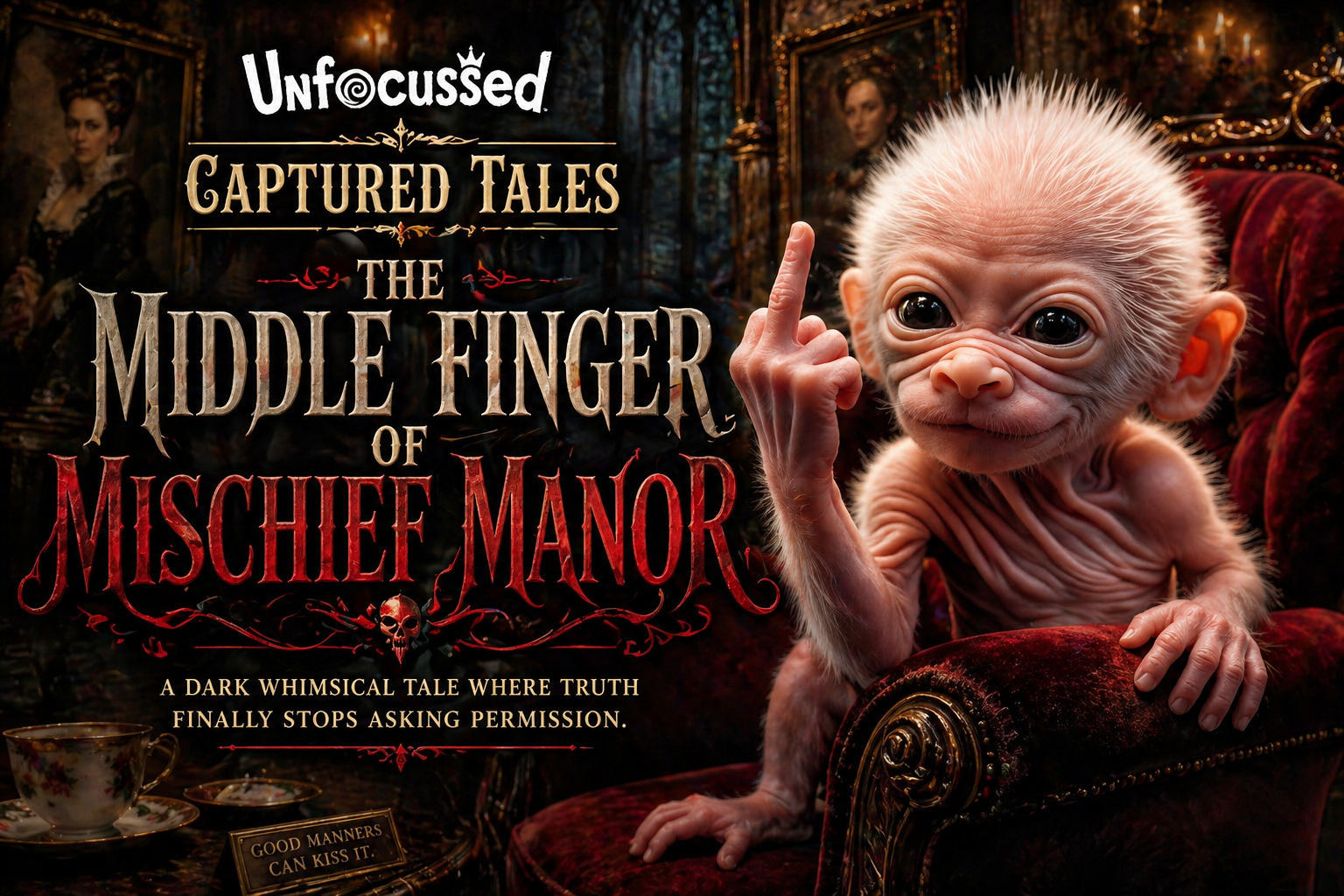

The Child in the Velvet Chair
There had once been a time when Mischief Manor was known by another name. In those days, before the ivy thickened like old gossip along the stone walls and before the crows took to roosting on the chimneys as though waiting for a spectacle, it had been called Bellweather House. The name was embroidered into napkins, engraved into silver trays, and spoken with the sort of clipped reverence reserved for bloodlines that had not yet learned how ridiculous they were. Bellweather House had been a monument to properness.
It stood at the top of a lonely hill in the northern reaches of the county, all pale stone, tall windows, and black iron fencing, with gardens pruned to mathematical perfection and a staff trained so rigorously in etiquette that some said the maids could curtsy in their sleep. The Bellweathers themselves had built a dynasty not on war or trade or even charm, but on social precision. They hosted dinners in which no fork was misplaced, no laughter rose above the acceptable register, and no guest ever dared reveal what they truly thought.
At Bellweather House, truth was never spoken plainly if it could instead be glazed in butter and served on porcelain. “How lovely to see you,” meant I had hoped your carriage might overturn in the ravine. “You’re looking well,” meant You’ve either taken a younger lover or found a better embalmer. “We must do this again soon,” meant Over my cooling corpse. And yet all of it was delivered with perfect smiles, backs straight as bayonets, and the serene conviction that manners could perfume any rot. The house approved of this for a while.
It must be said, because people rarely did, that Bellweather House had always been a little alive. Not alive in the vulgar way of barking dogs or noisy children or husbands who chewed too loudly, but in subtler ways. Its floorboards sometimes sighed at dawn. Its chandeliers flickered when someone lied with excessive confidence. On bitter nights, the long central corridor groaned not from cold, but from disapproval. It listened. It absorbed. It remembered. Old houses do, particularly when generations of vanity have seeped into the mortar. For nearly two hundred years, Bellweather House fed itself on restraint.
Then it began to starve. By the autumn of the year in question, the family’s famed civility had soured into something theatrical and airless. Lord Aldwyn Bellweather, the current master of the estate, was a man whose spine appeared to have been forged from dining-room rules. He had a handsome, severe face and the emotional range of a lacquered cabinet. His wife, Lady Euphemia, possessed a voice like sugared razors and the uncanny talent of making even kindness sound like a legal threat. Their daughter, Miss Honoria, had perfected the family smile so completely that servants sometimes left rooms feeling they had been stabbed and thanked for it.
No one in the house shouted. No one broke things. No one did anything so common as rage in public. Instead, they waged exquisite wars through pauses, glances, seating arrangements, and the tactical withholding of jam. The servants endured it the way servants always endure impossible households: by becoming invisible when necessary and indispensable when convenient. They moved through the Manor like quiet thoughts. They polished silver until it reflected their exhaustion. They carried trays through drawing rooms thick with perfume and resentment. They changed linens in chambers where married people slept with all the warmth of adjacent tombs.
And among them all, like the last uncracked pillar in a crumbling chapel, was Mr. Thaddeus Vale, the butler. Mr. Vale had served Bellweather House for forty-three years. He had served under two lords, one dowager who believed death itself should wait in the foyer until announced, and a cousin from Bath whose scandals had required the burial of three ledgers, a violin, and something that may once have been a bishop’s hat. Mr. Vale had seen enough human foolishness to conclude that breeding simply meant arrogance with better tailoring.
He was a tall, narrow man in late age, with silver at his temples and the sort of composure that made people straighten unconsciously in his presence. He had hands steady enough to pour tea during earthquakes and a face trained into an expression of serene neutrality so absolute that one might have mistaken him for a saint if not for his eyes. His eyes gave him away. They were the eyes of a man who had spent decades witnessing idiocy in expensive rooms and had ceased being impressed by anyone wearing silk.
Mr. Vale knew every draft in the Manor, every weak hinge, every ancestor’s portrait by the sound of its frame settling after midnight. He knew which floorboards betrayed drunken footsteps and which hid letters under rugs. He knew which guests would flirt with maids, which would steal spoons, and which were somehow worse because they believed themselves deeply moral. He also knew that the house had become restless.
It began in small ways. An extra teacup would appear on breakfast trays though no one had set it there. Curtains in the west parlor were found tied into knots that resembled obscene gestures if one looked at them too long. The library ladder glided of its own accord to shelves containing books on curses, inheritance, and divine punishment. A portrait of the third Bellweather matriarch—an appalling woman even in oils—was twice discovered facing the wall. “Damp,” Lord Aldwyn said when informed. “Mice,” said Lady Euphemia. “Catholics, perhaps,” suggested Honoria, though whether she meant it as wit or accusation remained unclear.
Mr. Vale said nothing. He had found, over the years, that truth was often wasted on people whose main hobby was preserving illusion. Then came the dinner. It was the Harvest Supper, an annual ordeal disguised as hospitality, during which local gentry, faded clergy, and neighboring landowners gathered at Bellweather House to eat game birds and compare one another unfavorably through compliments. Candles filled the dining hall with amber light. The silver gleamed. The crystal sang when touched. The menu had been planned with military precision and plated with the kind of anxious artistry usually associated with final confessions.
Lady Euphemia wore plum silk and diamonds that looked sharp enough to draw blood. Lord Aldwyn’s cuffs were starched to a degree suggesting emotional repression as textile science. Honoria sat between a magistrate’s son and a widowed colonel, both of whom mistook her vacant smile for encouragement and would later discover it was merely the expression she wore when imagining other people’s funerals. The first course passed without incident, unless one counted the vicar choking briefly on a fish bone while Lady Euphemia continued speaking as though he were part of the centerpiece.
The second course was pheasant with quince. The third never arrived. Instead, somewhere beneath the polished civility of the house, there came a sound. Not loud. Not dramatic. Not the thunderous declaration of a ghost in some cheap provincial legend. It was a laugh. Very small. Very clear. And entirely wrong. Conversation stopped. Forks hovered. One lady in sea-green satin blinked as if trying to determine whether she had imagined it or finally succumbed to the mushrooms. Again it came. A tiny, breathy, delighted sort of laugh. Like the sound a cherub might make just before setting a chapel on fire.
Lord Aldwyn set down his knife. “Mr. Vale.” “My lord.” “What,” said Aldwyn, each word polished to a dangerous sheen, “was that?” Mr. Vale, who had already heard the house creaking in a new and interested way, replied, “I cannot yet say, sir.” The laugh came a third time, now from somewhere beyond the dining hall doors. Then the west corridor chandelier extinguished itself. Half the ladies gasped. The colonel swore under his breath. The vicar clutched his napkin as if it had acquired spiritual purpose. Lady Euphemia smiled the brittle smile she reserved for public emergencies. “I’m certain it is nothing.”
Anyone with working ears could tell it was absolutely not nothing. Mr. Vale signaled to a footman. Two of them went to investigate. The doors opened. The corridor beyond lay dim and honey-colored in the low spill of wall sconces. The runner carpet stretched away like a tongue. Portraits watched from both sides with their ancestral sneers. At the far end, just before the turning toward the old nursery wing, something moved. Very small. Very pale. Then vanished. The younger footman made an involuntary noise usually heard when a man realizes he has stepped onto something that used to be another kind of something.
“After it,” snapped Aldwyn. Mr. Vale would later consider that command one of the lesser errors of the evening. The search that followed unstitched the household. Servants moved in pairs with candles and lanterns. Doors were opened. Cabinets inspected. Under tables, behind drapes, beneath beds, within linen presses, inside the music room harpsichord for some reason, though Mr. Vale privately suspected that particular footman had simply panicked and begun checking reality at random. No child was found. No intruder. No animal larger than the groundskeeper’s one-eyed cat, who regarded the entire operation with such contempt that Mr. Vale briefly wondered if the beast knew more than it intended to share.
The guests, after an hour of strained reassurance and several watery attempts at laughter, were sent home in damp carriages. Lady Euphemia announced that the matter would not be discussed further. Lord Aldwyn declared the disturbance the probable result of local boys attempting a prank. Honoria observed that local boys were seldom subtle enough to manifest inside locked corridors but was ignored with family efficiency. By midnight, Bellweather House had settled into the kind of silence that is not peace but waiting.
Mr. Vale performed his final rounds as was his custom. He checked the silver room, the side entrances, the library hearth, the western gallery windows. Outside, mist clung low over the gardens. Inside, candlelight trembled along paneled walls and made the house seem longer than architecture strictly allowed. Somewhere above, old beams creaked softly, like joints stretching after years of stillness. He had just reached the great drawing room when he noticed the door standing ajar. Mr. Vale was certain he had closed it earlier. He paused on the threshold.
The drawing room was the proudest chamber in Bellweather House, designed for display rather than comfort. It was all gilded molding, velvet drapery, carved walnut, and upholstery so expensive it seemed hostile to ordinary bodies. The moon shone faintly through the tall windows, mixing with the low amber glow of the dying fire. Portraits loomed from the walls like judgment in decorative frames. And there, in Lady Bellweather’s favorite crimson velvet chair, sat the child. At first glance, it appeared almost too improbable to be frightening.
It was small—smaller than a toddler, perhaps, though it sat with an ease and deliberateness no human infant possessed. Its skin was pale pink, almost translucent in places, folded delicately around its face and limbs like something still deciding what shape it preferred. A soft frosting of white fur covered its head and shoulders, fine as cobweb silk. Its eyes were enormous, black, luminous, and unblinking. They caught the firelight without reflecting warmth. It was not dressed. It did not seem to care. It sat like a miniature emperor who had arrived early to inspect the collapse of a dynasty.
One tiny hand rested against the chair arm. The other was raised. The middle finger was extended. Not wildly. Not theatrically. Just… presented. Casual. Certain. A gesture so calm and deliberate it ceased to be vulgar and became, somehow, ceremonial. Mr. Vale stared at it for a long moment. The child stared back. Then it smiled. It was not a broad smile. Not a grin. Not the gummy joy of harmless infancy. It was a minute upward shift at the corner of its mouth, as if it had just heard the opening note of a joke that would end with a village burning and found itself pleased by the setup.
“Good evening,” said Mr. Vale, because forty-three years of service had made civility a reflex strong enough to survive madness. The child’s finger remained aloft. Its smile deepened by a fraction. Mr. Vale had expected fear to feel sharper. More dramatic. Instead, what crept through him was a cold recognition. Not of the thing itself, precisely, but of its purpose. Bellweather House had spent generations swallowing honest emotion and dressing it up in linen. The family had polished themselves into gleaming frauds. Every grudge had been perfumed. Every cruelty cushioned. Every ugly thought tucked neatly behind silver smiles.
And now here sat something very small and very ancient, making the rudest gesture known to mankind with all the gravity of divine correction. It was absurd. It was blasphemous. It was, Mr. Vale suspected, completely deserved. “You should not be here,” he said, though the statement lacked conviction even to his own ears. The child tilted its head. The logs in the fireplace shifted with a soft crack. From somewhere above the ceiling came the faint creak of settling wood, followed by a series of tiny thumps along the hallway outside, as though doors throughout the upper floor had just unlatched themselves one by one.
The Manor was listening. Worse. The Manor was delighted. Mr. Vale took one measured step into the room. The air changed at once, growing warmer near the chair and colder at his back. His skin prickled. The hair along his arms lifted beneath the cloth of his sleeves. The portraits seemed, in that instant, less like paintings than witnesses refusing to intervene. “If you are some trick,” he said quietly, “I would recommend concluding it. The family is ill-suited to surprises.” The child blinked once. Then it laughed.
The sound was soft and bell-like and genuinely amused, which somehow made it far worse. Without lowering its raised hand, it patted the velvet cushion beside it as if inviting him to sit. Mr. Vale did not sit. “No,” he said. The child’s expression turned almost pitying. Then, with astonishing delicacy, it wagged the lifted finger once—no, not wagged. Corrected. As one might correct a servant’s posture or a student’s pronunciation. The message was unmistakable. Not no. Oh, no no no.
Mr. Vale would never later be able to explain why he remained so calm. Perhaps because terror was wasted on things that fed on theatre. Perhaps because he had spent his entire adult life among the Bellweathers and had simply run out of fresh forms of alarm. Or perhaps because, deep under his professionalism, under his discipline and pressed collars and careful silences, there lived a tired and hidden part of him that wanted someone—something—to finally tell the whole damned house exactly where it could go. He drew himself straighter.
“What are you?” The child regarded him with those enormous eyes. Then, slowly, its smile sharpened. Behind him, somewhere in the corridor, a grandfather clock began to strike midnight. One. Two. Three. By the fourth chime, the fire had burned brighter without being touched. By the sixth, every portrait in the room seemed subtly altered—not moving, exactly, but changed in emphasis. Mouths meaner. Eyes cleverer. One ancestor’s smirk newly visible. By the eighth, the velvet curtains stirred though the windows were latched. By the tenth, Mr. Vale became aware of whispering.
Not from the child. From the walls. From the chair legs. From the silver-framed mirrors. Not words he could make out, but the shape of language returning after long suppression, bubbling up through the house like water through cracked stone. The clock struck twelve. The child lowered its hand at last. And in a voice impossibly small, sweet as sugared milk and old as insult itself, it spoke its first word. “Finally.” Then every door on the upper floor flew open.

The Unraveling of Politeness
By morning, Bellweather House had begun to misbehave. Not in ways that could be easily named or disciplined, which would have been preferable. No—its rebellion was subtle, deliberate, and increasingly personal. The sort of misbehavior that did not shout, but whispered just loudly enough to be heard by the wrong person at the worst possible moment. Mr. Vale noticed it first at breakfast.
The table had been laid precisely as always. Silver aligned. Porcelain gleaming. Napkins folded into shapes that suggested both elegance and unnecessary aggression. Lord Aldwyn sat at the head, newspaper open, expression already irritated by the existence of the day. Lady Euphemia stirred her tea with the restrained fury of a woman who believed the universe was perpetually on the verge of disappointing her. Miss Honoria buttered toast with surgical indifference. Everything was, at first glance, correct. Then the toast spoke. “Dry,” it said. Not loudly. Not even clearly. Just a faint, breathy utterance that seemed to emerge from the plate itself, carrying with it a tone of deep and personal offense.
Lord Aldwyn paused mid-fold of his paper. “Did anyone…” he began. “No,” said Lady Euphemia sharply. Honoria bit into her toast. Chewed. Swallowed. “It is dry,” she said calmly. “That is not the point,” snapped Euphemia. “It rarely is,” Honoria replied. The silverware rattled faintly. Not enough to be blamed on anything so crude as trembling—but enough. Mr. Vale stood at his post, hands clasped behind his back, and pretended this was still a household governed by reason. It was not. By luncheon, the mirrors had begun to participate.
Lady Euphemia paused before the long hallway glass and, for the first time in decades, saw something she had not approved. Not age—not exactly. She had long ago negotiated terms with time. No, what the mirror offered was honesty. The faint narrowing of her mouth. The tightness at her eyes. The ghost of every insult she had ever delivered dressed as kindness. For a moment—just a moment—her reflection looked like a woman exhausted by the performance of perfection. She struck the mirror. It did not break. It smiled.
Not broadly. Not mockingly. Just enough. That was when the first scream came from the upper floor. It belonged to a maid who had opened a wardrobe and found it filled—not with dresses—but with neatly folded slips of paper. Each one bearing a single sentence written in a looping, elegant hand. She had read only the top one before dropping the stack. I hate you for how easily you pretend to be kind. The others, when later examined, contained similar sentiments. Precise. Personal. Uncomfortably accurate. The house, it seemed, had begun taking dictation.
Mr. Vale did not need to be told where the child was. He found it again in the drawing room, precisely where he had left it, as though it had not moved in the slightest and yet had somehow moved everywhere at once. The velvet chair seemed… pleased to host it. The fire burned brighter than necessary. The portraits watched with something approaching anticipation. The child looked at him as he entered. This time, it did not raise its hand. It simply observed. “You are busy,” said Mr. Vale.
The child blinked slowly. Then it reached out—just a tiny motion—and tapped the arm of the chair. From somewhere deep in the house came a cascade of noises. Doors opening. Voices rising. The unmistakable sound of Lady Euphemia declaring that this nonsense would cease immediately followed closely by the unmistakable sound of it not ceasing at all. “You are undoing them,” Mr. Vale said. The child tilted its head. Then, softly, it spoke. “They did it first.” The voice was unchanged—sweet, delicate, entirely at odds with the weight of its meaning.
Mr. Vale felt something tighten in his chest. “You speak as though you have been here before.” The child’s smile returned. It did not answer. It did not need to. The house answered for it. Upstairs, Honoria’s voice rang out—not in polite tones, but sharp and raw. “You don’t love me,” she said. Silence followed. Then Lord Aldwyn’s reply, stripped of all polish. “Of course I don’t.” The words hung in the air like broken glass. Mr. Vale closed his eyes briefly. There it was. Not new. Not surprising. Simply… uncovered.
When he opened them again, the child was watching him with something that might almost have been curiosity. “This will destroy them,” he said. The child’s expression softened—not with pity, but with something colder. “They are already destroyed,” it replied. Another crash echoed from the upper floor. A door slammed hard enough to rattle the chandeliers. Somewhere, glass shattered—not from force, but from strain, as though it had grown tired of holding itself together. Mr. Vale exhaled slowly. “And the rest of us?” he asked. The servants. The staff. The quiet ones who endured and adapted and survived between the cracks of the Bellweather façade.
The child considered him. Then, in a gesture so small it might have been missed, it lowered its gaze briefly—not in submission, but in acknowledgment. “You will see,” it said. It was not reassurance. It was invitation. Mr. Vale had spent his life maintaining order within disorder. Polishing chaos until it reflected something respectable. But as he stood in that room—watching the house breathe differently, hearing truths spill like long-held breath—he began to understand that what was happening was not destruction. It was release. Messy. Uncontrolled. Possibly catastrophic.
But honest. Behind him, the drawing room doors creaked open of their own accord. Lady Euphemia stood there. She looked… wrong. Not physically. Not yet. But her expression had fractured. The perfect composure she had worn for decades had cracked along invisible seams, and through those seams something far less refined pressed outward. Her gaze fell upon the child. For a moment, neither moved. Then she spoke. “What,” she said, her voice trembling with a fury she no longer bothered to disguise, “is that?” The child looked at her.
And smiled. Then, very deliberately, it raised its hand once more. And extended its middle finger. Lady Euphemia stared at it. And for the first time in her impeccably curated life… She did not have a polite response. The silence stretched. Then it broke. “I hate this house,” she said. The words spilled out of her like something forced through a narrow opening. “I hate these rooms. I hate these people. I hate the way we sit and smile and rot from the inside out—” She stopped. Because she could not stop.
The truth had found its way in. And it was not leaving. The house shuddered—just once—like a body finally releasing a held breath. The child lowered its hand again. And laughed. Not cruelly. Not kindly. Just… knowingly. Mr. Vale stood very still. Because he understood, now, what had arrived in Bellweather House. Not a demon. Not a ghost. Something far worse. Something necessary. Truth. And truth, he realized, did not knock. It walked in, sat down, and made itself at home.

The House That Spoke Honestly at Last
By nightfall, Bellweather House had forgotten how to pretend. The transformation was not sudden—no thunderclap, no grand collapse—but a steady, irreversible unraveling of everything that had once held it together. Words were no longer filtered. Thoughts no longer dressed themselves for company. The air itself felt different, less perfumed, more… breathable. And yet, for those who had lived within its walls for years, it was like learning to survive in a world without skin. Nothing was buffered. Nothing was softened. Nothing was hidden. Lady Euphemia had taken to pacing the upper gallery, muttering things she had once reserved for the privacy of her mind. Not all of them cruel—though many were—but all of them unvarnished.
“I never wanted this life,” she confessed to no one and everyone at once. “I wanted… something else. Something with noise. Something that didn’t feel like a performance I could never leave.” The walls listened. And for once, they did not judge. Lord Aldwyn had retreated to his study, where he sat at his desk staring at ledgers he no longer pretended to understand. He spoke rarely, but when he did, it was with a startling bluntness that stripped him of the authority he had spent a lifetime constructing.
“I don’t know who I am without this,” he admitted to the empty room. “And I suspect I never did.” The house creaked softly in response—not mockery, not sympathy. Just acknowledgment. Honoria had not stopped speaking since midday. Years of restraint had burst from her in a relentless, spiraling torrent of truths—about her parents, about the guests, about the endless parade of meaningless conversations that had defined her existence. She laughed, she cried, she contradicted herself, she spoke until her voice went hoarse and then continued anyway, as though silence itself had become intolerable.
“I don’t even know what I like,” she said at one point, slumped against the banister. “I only know what I’m supposed to like.” No one corrected her. No one could. Because the moment demanded honesty. And honesty, once unleashed, does not accept revision. Below, in the servants’ quarters, something unexpected was happening. Laughter. Real laughter. Not the careful, muffled kind that lived behind closed doors and lowered voices—but open, unguarded, occasionally rude laughter that filled the small stone rooms with something dangerously close to joy. Freed from the constant strain of maintaining invisibility within a household built on illusion, the staff found themselves… lighter.
Not entirely unburdened—years of habit do not vanish in a single day—but changed. “Well,” said Mrs. Greeley, the head housekeeper, as she poured herself a generous and entirely unauthorized glass of brandy, “I’ve been thinking it for twenty years, so I may as well say it now.” She took a sip. “That woman has the personality of a locked drawer.” The room erupted. Mr. Vale stood at the edge of it all, watching. He had not laughed. Not yet. But something in him had shifted. Something long held in place by duty and discipline had loosened, just slightly, like a knot finally recognizing it had been tied too tightly.
He knew where he needed to go. The drawing room awaited. It always did. The child was there, of course. Still seated in the crimson velvet chair, as though it had been carved into the house itself. The fire burned low now, casting long shadows that stretched across the floor like ink spilled in deliberate patterns. The portraits loomed closer than before, not physically, but in presence—watching not as judges, but as witnesses to something they had long been denied. Mr. Vale entered quietly. The child looked up.
No gesture this time. No raised hand. Just that same small, knowing smile. “It is done,” said Mr. Vale. The child tilted its head. “No,” it said gently. “It has begun.” Mr. Vale considered this. “And what happens now?” The child slid down from the chair. It moved with surprising grace for something so small, its bare feet making no sound against the polished wood. It walked—not toward the door, not toward the fire—but toward him. It stopped just within reach. Looked up. And for the first time, it lowered its gaze slightly—not in submission, but in something almost resembling respect.
“You decide,” it said. The words were simple. The meaning was not. Mr. Vale felt the weight of them settle into him, not as a burden, but as a possibility. For forty-three years, he had upheld the illusion of Bellweather House. Maintained it. Protected it. Ensured that every polished surface reflected exactly what it was meant to reflect. But now… The illusion was gone. And what remained was something raw, uncertain, and undeniably real. He looked at the child. At its strange, delicate form. Its vast, unreadable eyes. The faint echo of mischief that clung to it like a scent. It was not kind. It was not cruel. It simply was.
A catalyst. A correction. A mirror that did not lie. Mr. Vale drew a slow breath. Then, to his own quiet surprise, he smiled. Not the practiced, neutral curve he had worn for decades. A real one. Small. Slightly crooked. Entirely his own. “Very well,” he said. The child’s eyes brightened—not with triumph, but with recognition. It stepped back. And then—just once, for old time’s sake—it raised its tiny hand. And extended its middle finger. Mr. Vale looked at it. Considered it. Then, after a pause long enough to make the moment properly absurd…
He returned the gesture. The house shuddered—not with fear, not with strain, but with something dangerously close to delight. The fire flared. The walls seemed to expand, just slightly, as though making room for something new. Somewhere above, Lady Euphemia began laughing—a sharp, startled sound that turned, slowly, into something freer. In the servants’ quarters, someone uncorked another bottle. In the study, Lord Aldwyn closed his ledger and, for the first time in his life, did not open it again. And in the drawing room, beneath the watching eyes of generations who had never dared speak plainly…
Bellweather House became something else. Not perfect. Not proper. But honest. At last. The child lowered its hand. Its work, for now, complete. Though as it settled once more into the velvet chair, its smile suggested one undeniable truth. There were many more houses like this. And it had all the time in the world.
If The Middle Finger of Mischief Manor spoke to that quiet, rebellious part of your soul—the one that’s tired of smiling politely while thinking something far less appropriate—you can bring a piece of that beautifully defiant chaos into your own space. This artwork captures the exact moment civility cracks and truth slips through with a smirk, now available as a framed print, metal print, or wood print for a bold statement on your wall. Prefer something a little softer—or sneakier? Wrap your space in mischief with a tapestry, send a perfectly inappropriate message with a greeting card, or keep a tiny reminder of unapologetic honesty close with a sticker. However you display it, just know—this little creature isn’t just décor… it’s a mood.

 The Emerald Stair of the Sleeping Fern
 The Honey-Lipped Budnewt Who Couldn’t Swallow the Evidence
 The Amethyst Moth Shrine of Palebranch