The River That Remembered Fire
By sundown, the river beneath the old stone bridge had begun glowing again.
Not the gentle kind of glow that made sensible villagers say things like, “Oh, how pretty,” before returning home to butter bread, scold children, and pretend they had not just witnessed something deeply unsettling. No, this was the other kind. The kind that moved under the water like molten coals. The kind that turned the stones orange from below and made the shadows twitch like they had remembered an unpaid debt.
And because the people of Emberwyn Hollow had been raised with excellent manners and absolutely terrible emotional habits, they all stood at a very safe distance and agreed not to discuss it.
“Probably sunset,” said Old Brindle, who had not looked directly at the sun in seventeen years and was currently facing east.
“Minerals,” muttered Mistress Cale, the village baker, whose expertise began with yeast and ended wherever science became inconvenient.
“Might be foxes,” offered Thom Bick, because Thom blamed foxes for everything from missing hens to his second divorce.
No one believed any of them, of course. Emberwyn Hollow had many faults, including gossip, stubbornness, and an alarming number of people willing to wear mustard-colored wool in public, but stupidity was not one of them. They knew what it meant when the river glowed.
The river was remembering.
And memory, in Emberwyn Hollow, was not considered polite.
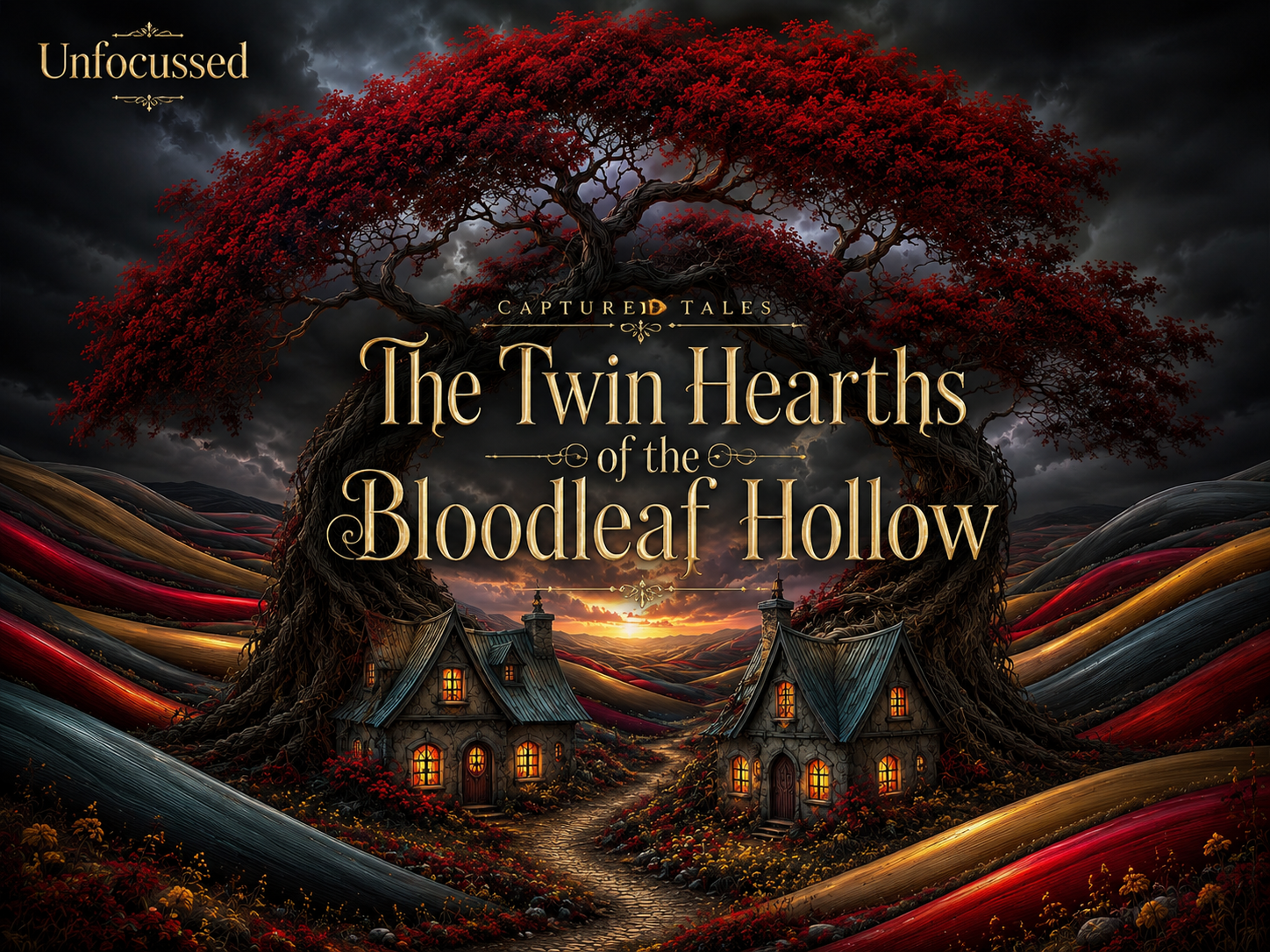
The village sat in a valley so strange that travelers often stopped on the ridge just to stare at it, then immediately invented reasons not to descend. The hills rolled in great ribboned waves of crimson, slate blue, charcoal, and gold, as though some enormous god had taken bolts of cloth, flung them across the earth in a dramatic mood, and then wandered off before smoothing anything down. Wildflowers grew in patches of red and blue beside the footpaths. The clouds gathered low and theatrical over the valley, always looking moments away from delivering either rain or judgment.
At the heart of it all stood the crimson tree.
Its trunk was pale and twisted, ribbed like old bone, yet strong enough to hold centuries of storms. Its branches reached over the path and bridge in crooked, elegant arcs, draped with leaves the color of blood-warm autumn, garnet wine, and secrets told too late. No one in the village remembered planting it. No one had ever seen it bloom. No one cut it, climbed it, carved initials into it, or dared hang lanterns from its branches during festival season after what happened to the fiddler in 1843.
Depending on which version of the story you believed, the fiddler had either vanished, been turned into a beetle, or returned three days later with no eyebrows and a sudden interest in monastic silence.
Children were told not to touch the tree.
Adults were told the same, only with more swearing.
Beneath the crimson tree, the path curved toward the old bridge, and beneath the bridge ran the river that everyone pretended was ordinary unless it became aggressively obvious that it was not.
On that particular evening, it was being aggressively obvious.
At the edge of the gathered crowd stood Mara Vey.
She was not the loudest person in Emberwyn Hollow, nor the bravest, nor the most liked, though she maintained that “most liked” was a rigged category usually won by people who smiled too much and had suspiciously clean window boxes. Mara was quiet in the way deep wells were quiet. People mistook it for emptiness until they leaned too far over the edge and realized there was more below than they cared to measure.
She was thirty-eight, though depending on the day and the quality of village conversation, she felt anywhere between twenty-one and already dead. Her dark hair was tied back with a strip of faded blue cloth. Her boots were muddy. Her shawl had one corner permanently singed from a lantern incident she refused to explain. She lived alone at the edge of the village in a small stone house with a crooked chimney, a drawer full of unfinished letters, and one orange cat named Bishop who treated her emotional repression as both a personal disappointment and a source of entertainment.
Mara had not come to the river because of curiosity.
Curiosity was for people who had not yet learned that most mysteries, once solved, required paperwork, apology, or grieving.
She had come because the emberlight had reached her window before sunset, licking across her kitchen floor in a bright, flickering line. Bishop had sat in the glow, looked at her with the flattened expression of a creature who knew destiny had arrived and found it badly timed, then vomited on her rug.
So Mara had done what any reasonable woman would do when summoned by supernatural light and feline judgment.
She put on her boots, cursed twice, and went outside.
Now she stood among the others as the river brightened beneath the bridge. The water flowed black at the edges but burned at its center, not with flame exactly, but with something older and more patient. It looked as if the riverbed had filled with embers from a thousand hearths. No smoke rose. No steam hissed. The glow pulsed gently, almost like breathing.
The bridge above it had begun to crack.
That was the part no one wanted to mention.
The Ember Bridge had stood longer than the village. Its stones were dark and weathered, its arch sturdy, its railings made from rough timber posts joined by rope. Every generation had repaired the little things: a loose stone here, a rotting plank there, a rail replaced after a goat named Mr. Wuffles made an ambitious and poorly researched attempt at flight.
But the crack now splitting the center stone was not ordinary damage.
It glowed from within.
A thin line of amber light ran across the bridge like a vein opening under skin.
“That’s not sunset,” Mara said.
Everyone turned to look at her with the wounded irritation of people whose shared denial had just been interrupted.
Old Brindle sniffed. “Could still be minerals.”
“In the bridge?”
“Ambitious minerals.”
Mara gave him a look.
Old Brindle found something very important to inspect on his sleeve.
The wind shifted. The crimson leaves above them stirred. Not rustled. Stirred. There was intention in it, a slow gathering of sound. The tree’s branches curled against the storm-dark sky like fingers flexing after a long sleep.
A murmur moved through the villagers.
Mara felt the old unease settle between her shoulder blades.
The last time the river had glowed, she had been sixteen years old.
Back then, the valley had suffered a drought so cruel that the wells gave up their reflections. The river had shrunk to a thin black thread under the bridge, and the village elders had gathered beneath the crimson tree to perform what they called a remembrance. No one had explained it clearly to the children. Adults never did when fear was involved. They dressed it up in ceremony and candles, then called it tradition, as if that made the trembling less obvious.
Mara remembered standing beside her older brother, Rowan, who had smelled of smoke, hay, and the peppermint sweets he stole from the apothecary. He had been nineteen, broad-shouldered and restless, with a laugh that made people forgive him before he had even finished misbehaving.
“Don’t look so worried, Mouse,” he had whispered to her.
“Don’t call me Mouse.”
“Then stop squeaking at danger.”
“I do not squeak.”
“You squeak with your eyebrows.”
She had elbowed him. He had grinned. The elders had begun chanting. The river had glowed. And by morning, Rowan was gone.
The official story was that he had left the valley to seek work, adventure, or trouble, depending on who was telling it and how much cider they had consumed. Mara had never believed that. Rowan had packed nothing. He had not taken his boots. He had left his coat hanging by the door and his half-carved wooden bird on the windowsill.
Most damning of all, he had left without saying goodbye.
Rowan Vey would abandon chores, debts, and every solemn occasion that required clean trousers, but he would never abandon a goodbye.
Not to her.
For twenty-two years, Mara had carried that certainty like a coal tucked beneath her ribs. It had burned at first, then dimmed, then settled into the kind of steady heat a person could build a life around if she was careful never to touch it directly.
Now the river glowed with the exact same light.
And the bridge was cracking.
A voice spoke from behind her.
“It is beginning again.”
Mara turned.
Gran Elspeth stood at the back of the crowd, leaning on a blackthorn cane. She was the oldest person in Emberwyn Hollow by at least twenty years, though she claimed age was “a rude little number invented by cowards and doctors.” Her face was lined as folded parchment, her silver hair braided over one shoulder, and her eyes were sharp enough to skin truth from bone.
People stepped aside for her, partly from respect and partly because the last man who had failed to move quickly enough received a cane to the ankle and a lecture about spatial awareness.
“Beginning what?” Mara asked.
Gran Elspeth looked toward the bridge.
“The remembering.”
A few villagers groaned softly, not because they doubted her, but because Gran Elspeth had a lifelong habit of being correct in the least comforting way possible.
“And what exactly is it remembering?” asked Mistress Cale.
Gran Elspeth’s mouth tightened.
“Everything we buried.”
The crowd went still.
Even the wind seemed to pause, as if it had been waiting for someone to say the ugly part aloud.
Mara looked from Gran Elspeth to the river. “Buried where?”
“Under it.”
Old Brindle made a strangled noise. “That’s metaphorical.”
Gran Elspeth gave him a glance. “No.”
“Ah.”
“Not metaphorical, then.”
“No.”
“Lovely.”
The river pulsed brighter.
The crack in the bridge widened by the smallest measure, but everyone heard it. A thin, sharp sound like a teacup splitting.
Several villagers backed away.
Thom Bick whispered, “Foxes would not do this.”
“No, Thom,” said Mara. “Foxes would not crack a bridge with ancestral trauma.”
He frowned. “You say that, but foxes are crafty bastards.”
Gran Elspeth lifted her cane and pointed toward the distant cottage beyond the bridge.
It sat alone in the fold of the valley, small and dark against the stormlit hills. Two windows glowed amber, though no one had lived there in Mara’s lifetime. Smoke curled from the chimney in a thin silver ribbon, despite the fact that the chimney had collapsed during a storm twelve years earlier and nobody had bothered to repair it because nobody sane crossed the bridge after dusk.
“The keeper’s house is lit,” Gran Elspeth said.
Mara stared at it.
Something inside her went cold.
“Who is the keeper?”
Gran Elspeth did not answer at once. That was how Mara knew the truth would be unpleasant. People answered quickly when they had pleasant truths. They decorated them with little smiles and phrases like “nothing to worry about.” Unpleasant truths required silence first, as if they had to be carried carefully from the dark.
“The first oath,” Gran Elspeth said at last. “The last witness. The one who tends what the river cannot forget.”
“That is not an answer,” Mara said.
“It is an old answer.”
“Old answers are just riddles with dust on them.”
Gran Elspeth’s eyes flicked toward her. “Then perhaps you should dust faster.”
Mara almost laughed. Almost. But the emberlight was crawling now over the stones beneath the water, bright enough to paint the underside of the bridge gold. The crimson tree leaned over them, every branch black against the bruised sky, every leaf trembling though the air had gone still.
Then the river spoke.
Not in words.
Not at first.
It began as a sound beneath the water, low and layered, like many voices humming through stone. The villagers clutched shawls, caps, baskets, and one another. Someone whispered a prayer. Someone else whispered a swear, which Mara had always suspected reached the divine faster.
The sound rose.
Mara felt it in her teeth.
In her palms.
In the coal beneath her ribs.
Then, from the glowing water, a shape lifted.
It was not a body. Not exactly. It was light shaped like memory: a shoulder turning, a hand reaching, the suggestion of a face half-formed by ember and current. It shimmered beneath the bridge, broke apart, gathered again.
The crowd gasped.
Mara stopped breathing.
Because for one impossible second, she saw Rowan.
Not as he would be now, older and changed by years, but as he had been on the night he vanished. Nineteen. Grinning. Hair falling into his eyes. One hand raised as though he had just turned back to say something clever.
Then the current pulled through him, and he dissolved into sparks.
Mara staggered forward.
Gran Elspeth caught her arm with surprising strength.
“Do not step into it.”
“That was him.”
“Yes.”
The word struck harder than any denial could have.
Mara turned on her. “You knew?”
Gran Elspeth held her gaze.
“I knew the river took someone that night.”
“Someone?” Mara’s voice sharpened. “His name was Rowan.”
“I know his name.”
“Then say it like he was a person and not a footnote in one of your dusty old doom riddles.”
A ripple of discomfort moved through the crowd. Emberwyn Hollow loved gossip, but it preferred grief to remain tidy. Mara’s grief had always been tidy. Folded. Put away. Labeled in a drawer no one opened.
Now the drawer had burst into flame.
Gran Elspeth’s face softened, and that was almost worse.
“Rowan Vey was taken by the river during the last remembrance. Not because the river wanted him. Because the village gave too much and named too little.”
Mara stared at her.
“What does that mean?”
The old woman looked to the others. “It means we have been cowards.”
Nobody argued. A few looked tempted, but Gran Elspeth’s cane had range and historical precedent.
She continued. “Long before Emberwyn Hollow had a name, this valley burned. Not with ordinary fire. With rage. With mourning. With all the things people carried but would not speak. The first settlers found the river black and dry, the hills scorched, the tree bare. They made a bargain beneath its branches. When grief grew too heavy, when anger threatened to tear families apart, when love became loss and no one knew how to survive it, they would bring those feelings here. They would name them. Offer them. Let the river carry the heat away.”
Mara looked at the glowing current.
“That sounds almost merciful.”
“It was,” Gran Elspeth said. “At first.”
“Let me guess. People ruined it.”
“People do have a gift.”
Despite herself, Mara huffed a bitter laugh.
Gran Elspeth’s expression darkened. “Over time, the naming stopped. The offering became habit. Then ceremony. Then superstition. People came here not to release what hurt them, but to hide it. Shame. Betrayal. Regret. Unspoken love. Unforgiven dead. They buried it beneath the water and walked away lighter, thinking themselves healed.”
The river flared.
“But buried fire is still fire,” Gran Elspeth said. “And eventually, it remembers how to burn.”
A gust of wind tore through the valley. The crimson tree shuddered, scattering leaves across the path. They did not fall gently. They spun like sparks from a forge, bright and wild, striking the stones and vanishing into ash.
The bridge cracked again.
This time, a small stone broke loose from the arch and fell into the glowing river. It vanished without a splash.
The crowd erupted into panicked noise.
“Back!” shouted someone.
“The bridge is failing!”
“Everyone away from the edge!”
“I told you it was foxes!” cried Thom Bick, possibly from pure emotional commitment.
Mara did not move.
She could not stop staring at the place where Rowan’s shape had appeared. The air around her seemed distant now, the shouting muffled beneath the roar of memory. Twenty-two years of silence pressed against her from the inside.
She remembered the night before Rowan vanished. The two of them sitting on the roof of their house because he had claimed the stars were “less judgmental from up there.” He had told her he planned to leave the valley one day. Not forever, he had said. Just long enough to see if the rest of the world was as foolish as Emberwyn Hollow or if their village had achieved something exceptional.
She had pretended not to care.
She had been sixteen. Proud. Afraid. Already learning the local art of swallowing feelings whole.
“Go then,” she had told him. “Fall in a ditch somewhere grand.”
He had laughed, but she remembered the flicker behind it. The hurt. Small but real.
“I’d write,” he had said.
“I wouldn’t read it.”
“Liar.”
She had said nothing.
And the next night, he was gone.
For twenty-two years, Mara had told herself she regretted many things, but that conversation was not one of them. It had been sibling nonsense. Sharp-edged affection. The kind of bickering love wears when it does not want to stand naked in the room.
But now, with the river glowing and Rowan’s ember-ghost dissolving beneath the bridge, the truth rose inside her like smoke.
She had never forgiven herself for letting her last words to him be a dare to disappear.
Gran Elspeth’s hand remained on her arm.
“Mara.”
“What does the river want?”
The old woman’s grip tightened.
“A name.”
“Whose?”
Gran Elspeth looked toward the bridge, then the cottage beyond it.
“The first hidden thing. The first fire buried without truth. The one that turned the river from witness to prison.”
Mara swallowed. “And where is it?”
“At the source.”
The crowd had quieted again. Everyone had heard.
Mara followed Gran Elspeth’s gaze past the bridge, past the glowing cottage, toward the far folds of the valley where the ribboned hills narrowed into shadow. No one went there. The path beyond the cottage climbed into the old gorge, where the river began beneath black stones and roots. It was said the water there ran uphill when it felt spiteful, which was often.
“Someone must follow the ember river,” Gran Elspeth said. “Before the bridge breaks completely.”
“And if no one does?” asked Mistress Cale.
The old woman did not look away from Mara.
“Then everything buried beneath it comes back at once.”
Silence.
A very large, very uncomfortable silence.
In the distance, thunder rolled over the valley like a cart full of bones.
“Define everything,” Old Brindle said weakly.
Gran Elspeth’s expression was grim. “Every grief. Every rage. Every betrayal. Every farewell refused. Every confession swallowed. Every love denied because someone was too proud, too frightened, too married, or too convinced that emotional honesty was something best left to poets and drunkards.”
Mara glanced at the villagers.
Several people suddenly found the ground fascinating.
Mistress Cale turned red.
Thom Bick looked toward Widow Merrow, who looked toward the butcher, who looked toward the church roof, which had no involvement but seemed embarrassed anyway.
“That,” Mara said, “would be a spectacular mess.”
“It would end the valley,” Gran Elspeth said.
“I meant socially, but yes, death and destruction also seem inconvenient.”
The old woman’s eyes softened again. “You saw Rowan.”
Mara’s jaw tightened.
“Yes.”
“Then the river has already chosen who must go.”
A bitter laugh escaped Mara before she could stop it.
“Of course it has. Why would ancient magic choose someone emotionally prepared when it could pick the woman with unresolved family trauma and a cat with digestive vengeance?”
Gran Elspeth gave her a dry look. “Ancient magic is rarely considerate.”
“It could try.”
“It will not.”
“Lazy, then.”
The old woman almost smiled.
Then the bridge groaned.
The sound rolled across the valley, deep and aching. The crack widened another inch. Emberlight spilled through it, painting the villagers’ faces gold and red. The river surged below, and within it Mara saw flashes—hands clasping, doors closing, a woman weeping into an apron, a man burying a ring beneath stones, a child calling after someone who never turned back.
The water was full of lives.
Full of pain.
Full of all the things Emberwyn Hollow had hidden because speaking them would have required courage, and courage was much less popular than tradition.
Mara looked at the bridge.
Then at the crimson tree.
Then at the distant cottage, its warm windows shining beneath the storm.
And finally, at the river.
For twenty-two years she had avoided this place whenever she could. She had crossed the bridge only in daylight, never pausing, never looking down. She had built a life out of work, routine, silence, and the careful maintenance of not falling apart in public.
She had mistaken survival for peace.
The river glowed brighter, and beneath its surface, a spark drifted upward. It hovered above the water, small and trembling. Mara knew without knowing how that it had come from Rowan. Not his soul, perhaps. Not exactly. But something of him. A laugh. A promise. The warmth of his hand on her shoulder when she was little and afraid of storms.
The spark floated toward her.
Gran Elspeth stepped back.
Mara lifted her hand.
The spark touched her palm.
It did not burn.
It hurt.
Which was worse.
Heat rushed through her, and with it came a memory so vivid she nearly dropped to her knees.
Rowan’s voice, close beside her in the dark:
“If I ever leave, Mouse, you’ll know where to find me.”
She had forgotten that.
No. Not forgotten.
Buried.
Mara closed her hand around the fading spark.
When she opened her eyes, the whole village was watching.
She hated that. Profoundly. With passion. If the valley survived, she planned to make everyone uncomfortable about it later.
“Fine,” she said.
Old Brindle blinked. “Fine?”
“Fine, I’ll go.”
Mistress Cale pressed a hand to her mouth.
Thom Bick looked horrified. “Across the bridge?”
Mara glanced at him. “No, Thom. I thought I’d tunnel under the cursed fire river with a spoon.”
“No need to be sharp.”
“There is every need.”
Gran Elspeth studied her. “You understand what waits beyond the bridge?”
“No.”
“You understand the danger?”
“Also no.”
“You may not return unchanged.”
Mara looked toward the place where Rowan had appeared.
“I’m already not unchanged.”
The old woman nodded once.
From somewhere in the crowd, a child began to cry softly. His mother hushed him, though her own face was wet. Mara looked away. She could face a cursed river, apparently, but not public tenderness. Everyone had limits.
Gran Elspeth reached into the pocket of her long coat and drew out a small object wrapped in red cloth.
“Take this.”
Mara accepted it. Inside the cloth lay a key.
It was old iron, blackened at the teeth, with a bow shaped like a leaf from the crimson tree. Warmth pulsed faintly through it.
“What does it open?” Mara asked.
“The door that admits you.”
“Wonderful. Another dust-riddle.”
“The cottage first,” Gran Elspeth said. “The keeper will know whether the river will let you pass to the source.”
“And if the keeper says no?”
“Then argue.”
Mara looked at her.
Gran Elspeth shrugged. “You have always been gifted at it.”
Despite everything, Mara smiled.
Just a little.
Then she tucked the key into her pocket, adjusted her singed shawl, and stepped toward the bridge.
The crowd parted.
No one cheered. Emberwyn Hollow was not that sort of place, and Mara was grateful. Cheering would have made the whole thing feel too heroic, and she did not feel heroic. She felt furious, afraid, and underdressed for mythic responsibility.
At the foot of the bridge, she paused beneath the crimson tree.
The trunk loomed beside her, pale and ancient, its bark twisting in deep grooves that looked almost like faces if stared at too long. Mara did not stare too long. She had enough problems without accidentally making eye contact with a tree.
A leaf broke free from a branch above and drifted down.
It landed on her shoulder.
The moment it touched her, she heard a whisper.
Not Rowan.
Not Gran Elspeth.
Something older.
Name what burns.
Mara went still.
Behind her, the villagers waited.
Before her, the bridge glowed, cracked and trembling over the ember river.
Name what burns.
She could have named grief. That would have been true.
She could have named regret. Also true.
She could have named Rowan, but some instinct told her the river did not want the dead used as shorthand for the wounds of the living.
So Mara drew a breath that felt too large for her chest and spoke the one thing she had spent twenty-two years refusing to say.
“I miss him.”
The river stilled.
Every ember beneath the bridge seemed to lift its head.
Mara’s voice broke, but she continued.
“I miss my brother. I miss him every day. I miss him when I wake. I miss him when the roof leaks because he was better with repairs and worse with ladders. I miss him when someone laughs too loud in the tavern. I miss him when I see peppermint sweets. I miss him so much I turned it into anger because anger made me feel less pathetic.”
The crowd behind her was silent.
Mara wiped at her face, annoyed to discover it was wet.
“And I am tired,” she said, softer now. “I am so damn tired of pretending silence is strength.”
The crimson tree exhaled.
There was no other word for it. Its branches loosened, leaves shivering in a warm wind that came from nowhere. The crack in the bridge dimmed, not gone, but quieter. The ember river parted its glow into a narrow golden path beneath the arch, reflecting upward like lanternlight.
The bridge would hold.
For now.
Mara stepped onto the first stone.
Heat rose through the soles of her boots. The bridge trembled, but did not break. She took another step, then another. The river moved below her, whispering with voices she could almost understand.
Halfway across, she looked down.
In the emberlight, she saw Rowan again.
This time he did not dissolve at once. He stood beneath the surface as though behind glass, his expression no longer teasing. His mouth moved.
Mara gripped the railing.
“What?” she whispered.
The river carried his voice up through stone and flame.
Not the source.
Her heart lurched.
“What do you mean?”
Rowan’s shape flickered.
Not where it begins.
The bridge groaned beneath her.
“Rowan!”
His hand lifted, pressing against the underside of the current.
Where it was first hidden.
Then he vanished.
The river surged. The bridge shuddered. Mara stumbled forward, catching herself against the railing as sparks flew up from the water like fireflies. For one wild moment she thought the whole arch would collapse and drop her into the burning memory of the valley, which would be an extremely inconvenient way to discover whether ancient grief came with breathable pockets.
But the stone held.
Mara ran the last few steps and reached the far side just as thunder cracked open above the hills.
Rain began to fall.
Not water.
Ash.
Soft gray flakes drifted from the clouds, settling on Mara’s hair, her shawl, the path ahead. The cottage windows glowed brighter through the haze, warm and watchful.
Behind her, across the bridge, the villagers looked small and distant beneath the crimson tree.
Gran Elspeth raised her cane once.
Mara raised a hand back.
Then she turned toward the cottage.
The path wound between ribboned hills, their colors darkening under the storm. The ember river ran beside her, no longer merely glowing but murmuring, carrying flashes of buried things in its current. She saw a woman’s face turned away from a cradle. A soldier’s bloodied sleeve. Two men holding hands in the shadow of a barn, then letting go when footsteps approached. A mother burning a letter before reading the last page. A child watching a father leave and deciding, in that instant, never to beg anyone to stay.
Mara walked faster.
The river remembered everything.
And somewhere ahead, in a cottage that should have been abandoned, waited the keeper of what the valley had refused to name.
By the time Mara reached the gate, the ash-rain had thickened. The little cottage stood crooked but intact, its roof patched with moss, its chimney breathing silver smoke. Warm light spilled from the windows. A row of red leaves had been placed along the doorstep like offerings.
On the door hung a brass knocker shaped like a mouth.
Mara stared at it.
“Absolutely not,” she said.
The mouth opened.
“Absolutely yes,” it replied.
Mara closed her eyes. “I have had a difficult evening.”
“Everyone who comes here has had a difficult evening,” said the knocker. “That is rather the point.”
“Are you the keeper?”
The brass mouth sniffed, which was impressive for something without a nose. “I am the threshold.”
“Of course you are.”
“Name what you seek.”
Mara touched the iron key in her pocket.
Rowan’s warning moved through her again.
Not where it begins. Where it was first hidden.
She looked back at the ember river, glowing through the ash-rain, carrying the valley’s pain toward a source that might not be a source at all.
Then she faced the door.
“I seek the first fire,” she said.
The brass mouth went still.
Inside the cottage, something heavy fell.
A chair scraped.
Footsteps approached.
The door opened.
An old woman stood on the other side, though old in a way that made age seem less like years and more like weather. Her hair was black at the roots, white at the ends, and braided with crimson leaves. Her eyes glowed faintly amber. She wore a wool dress the color of storm clouds and an apron stained with soot, flour, and possibly several centuries of poor decisions.
She looked Mara up and down.
Then she sighed.
“Well,” said the keeper, “you’re late.”
Mara stared at her.
The keeper stepped aside, revealing a room full of firelight, hanging herbs, shelves of sealed jars, and a hearth in which no wood burned—only a bed of bright, breathing embers.
“Come in, Mara Vey,” she said. “Your brother has been making a nuisance of himself for twenty-two years, and I am thoroughly tired of pretending he is not your family’s problem.”
Mara’s hand tightened around the key.
Outside, the ember river roared.
And behind her, far across the valley, the first stone fell from the bridge.
The Keeper’s House of Things Unsaid
The keeper’s cottage was much larger on the inside than any cottage had a right to be.
Mara noticed this immediately, because she had lived long enough in a small house to know the sacred mathematics of rooms, corners, rooflines, and where one could reasonably expect a wall to happen. The cottage had ignored all of that. From the outside, it had looked like a crooked little dwelling with two windows, one chimney, and the general posture of a thing that had survived storms by insulting them personally. Inside, it opened into a long, firelit chamber with rafters disappearing into shadow, shelves climbing higher than ladders could reach, and doorways that seemed to lead not into other rooms, but into weather.
One doorway held the sound of rain. Another breathed cold blue mist. A third showed, for one unsettling second, a field of red leaves blowing upward instead of down.
“Do not stare into the left-hand pantry,” said the keeper, closing the door behind Mara. “It encourages the jam.”
Mara looked at her.
“The jam?”
“Regret preserves badly.”
“That tells me nothing and somehow too much.”
The brass mouth on the door muttered, “She says that to everyone.”
The keeper snapped her fingers at it. “Be useful or be silent.”
“I am a threshold, not a servant.”
“You are a mouth screwed to a door.”
“And yet I have standards.”
Mara slowly turned her head from the keeper to the door and back again. “I’m going to need one of you to be less impossible.”
“No,” said the keeper and the brass mouth together.
Outside, the ember river roared. The sound moved through the cottage floorboards in a steady pulse, as if the house itself had a heart buried underneath it. Ash tapped at the windows like soft gray fingers. Through the glass, Mara could see the bridge in the distance, lit by veins of orange fire, its arch trembling beneath the storm.
Another stone fell.
Even from inside the cottage, she heard it vanish into the current.
The keeper did not flinch.
She was smaller than Mara had first thought, though that did nothing to make her less intimidating. Her shoulders were narrow, her hands knotted with age, and her face carried the expression of someone who had spent centuries being disappointed by human beings and had not yet decided whether to laugh, weep, or throw a kettle at the wall. Her apron was dusted with flour. Her sleeves were rolled to the elbow. A burn scar curled from her left wrist to her thumb like a vine made of old lightning.
“Sit,” she said.
“No.”
The keeper paused.
“No?”
“No.” Mara lifted her chin. “You know my name. You know my brother. You said he has been making a nuisance of himself for twenty-two years. I would like an explanation before I sit politely in your creepy memory cottage and drink whatever haunted broth you’re brewing.”
From the hearth, a small iron kettle gave an offended hiss.
“It is tea,” said the keeper.
“That’s what haunted broth would say.”
The keeper studied her. Then, slowly, one corner of her mouth lifted.
“Vey blood,” she said. “Always mouth first, wisdom eventually.”
Mara’s fingers tightened around the old iron key in her pocket. “You knew my family.”
“I knew the first of them.”
“Then you are older than you look.”
“Careful.”
“Or you look younger than you are.”
“Better.”
The keeper crossed to the hearth. No logs burned there. Instead, a bed of embers glowed in the firebox, each coal a different shade of gold, red, blue, or white. They shifted softly against one another, breathing heat without smoke. Above them hung the kettle, blackened and round, its spout curved like a beak.
The room smelled of cinnamon, soot, dried rosemary, and rain on stone. It also smelled faintly of old letters, though Mara had no idea how she knew that.
“My name,” said the keeper, “is Elda Ashenroot. I tend the hearth of what has been named and the shelves of what has not. I keep the house between the river and the road. I sweep up after cowards, comfort the brave, and occasionally threaten the dead with a spoon when they refuse to behave.”
Mara stared at her.
“You threaten the dead with a spoon?”
“Not the cooperative ones.”
The kettle hissed again.
Elda took two cups from a shelf and filled them. The tea came out dark red, glowing faintly at the edges.
Mara did not move.
“And Rowan?” she asked.
The keeper’s expression changed. Not softened exactly. It deepened. Like a door opening onto a room where grief had been sitting for a very long time.
“Your brother,” Elda said, “is not dead in the ordinary way.”
Mara felt the floor tilt beneath her.
“That is a vile sentence.”
“Most true ones are.”
“Say it plainly.”
The keeper set one cup on the table and pushed it toward her. “He was taken into the river during the last remembrance. The river should have carried him through, stripped the heat from what he carried, and returned what was whole. Instead, he lodged in it.”
“Like debris?”
“Like a promise.”
Mara’s anger faltered. That was worse than debris. Debris could be removed with a hook. A promise required pain, interpretation, and usually some jackass saying things like destiny.
“Why?” she asked.
Elda sat at the table and wrapped both hands around her cup. “Because he would not let go of one thing.”
“What thing?”
The keeper looked at her over the rim of the tea.
“You.”
Mara hated the answer so much that for a moment she said nothing. Her throat closed. Her hand remained in her pocket, gripping the key until the metal bit into her palm.
“No,” she said finally.
“Mara—”
“No. Do not turn this into some tidy little tragedy where he vanished because he loved me too much. I have spent twenty-two years carrying enough guilt to bend my spine crooked. I will not take another armload because a magical tea hag with glowing cookware says it with atmosphere.”
The brass mouth on the door whispered, “She’s good.”
Elda did not look away from Mara. “I am not blaming you.”
“It sounds very blame-adjacent.”
“Then listen harder.”
Mara bristled.
The keeper leaned forward, and the firelight caught in her amber eyes.
“Rowan was not taken because you loved him, or because you argued, or because your last words to him were sharp. Love is not a trap. Grief is not a crime. The river does not punish people for being human, though humans, in their endless talent for drama, often insist on punishing themselves on its behalf.”
Mara looked down.
The tea in the cup reflected the room, but not her face.
Elda continued, quieter now. “Rowan was taken because he heard what the village refused to hear. During the remembrance, when everyone came to pour unnamed sorrow into the river and call it tradition, he heard the first fire beneath it all. He followed it.”
Mara lifted her eyes. “Why would he do that?”
“Because someone had to.”
“That sounds exactly like something he would say before doing something stupid.”
“It was stupid.”
Mara blinked.
“Also brave,” Elda added. “Those often share trousers.”
A laugh escaped Mara. It was short, cracked, and not quite sane, but it was a laugh. The kind that arrived when grief tripped over absurdity and briefly forgot to be dignified.
Then the hearth flared.
One ember rose from the firebed.
It floated above the coals, bright and trembling, then stretched into the shape of a hand. A shoulder. A face half-made of light.
Mara stood so quickly her chair scraped backward.
Rowan appeared in the hearth.
Not fully. Not as flesh. His outline flickered with flame, his edges pulled thin by currents she could not see. His hair moved as if underwater. His eyes, though, were exactly his. Warm, amused, and carrying the infuriating suggestion that the entire situation was both terrible and mildly entertaining.
“Mouse,” he said.
Mara’s breath broke.
For twenty-two years she had imagined what she would say if she saw him again. She had composed speeches while washing dishes, while walking home in rain, while lying awake with Bishop snoring on her feet. Some speeches were tender. Many were furious. Several involved the phrase you absolute bastard delivered with excellent theatrical timing.
Now all of them vanished.
What came out was, “You look awful.”
Rowan grinned.
“You always did know how to make a man feel missed.”
Mara covered her mouth with one hand.
He was there.
He was not there.
He was nineteen years old and ember-thin, standing inside a hearth in a cottage tended by an immortal woman who apparently bullied dead people with cutlery. He was the brother who had stolen sweets, patched roofs badly, teased her through thunderstorms, and vanished before morning with no coat, no boots, and no goodbye.
“Rowan,” she whispered.
His smile softened.
“Hello, Mara.”
That undid her more than Mouse had.
She reached toward him.
Elda caught her wrist.
“Do not touch the hearth.”
Mara jerked against her grip. “Let go.”
“If you touch him here, you will burn through every memory you have of him at once.”
Mara froze.
Rowan’s expression tightened. “She’s not exaggerating. I tried touching a spoon once.”
Elda’s nostrils flared. “You possessed the spoon.”
“Briefly.”
“You made it sing tavern songs for three days.”
“It had a lovely voice.”
“It was a spoon.”
“Some of us bloom late.”
Mara let out a sound halfway between a sob and a laugh. “You are dead, trapped, and still a menace.”
“I prefer consistent.”
Elda released Mara’s wrist, and Mara sank slowly into the chair.
The hearth crackled, though no wood burned.
For a moment, none of them spoke. Rowan watched her with the bright, aching patience of someone who had waited too long and was afraid to waste even one second. Mara studied his face, trying to memorize what memory had already preserved, afraid that if she blinked he would dissolve back into the river.
“Why didn’t you come home?” she asked.
The question came out smaller than she intended. Smaller and younger. Sixteen years old again, standing in a doorway at dawn, staring at an empty hook where his coat should have been.
Rowan’s flame flickered.
“I tried.”
“Not hard enough.”
She regretted it as soon as she said it, but Rowan did not look wounded. He only nodded, once, as if she had handed him a truth he recognized.
“I know.”
“Don’t agree with me. I’m angry.”
“You can be angry and right.”
“That is inconveniently mature of you.”
“I’ve had time.”
Mara swallowed hard.
Rowan looked toward the window, where ash drifted past the glass. “The river took me under the bridge. At first I thought I was drowning. Then I thought I was dreaming. Then I heard them.”
“Who?”
“Everyone.”
The word pressed into the room.
Rowan’s glow dimmed. “Every hidden thing the village had poured into the river. Grief with no name. Anger with no mouth. Love strangled before it became a confession. Shame dressed up as duty. I heard all of it. It was like standing inside a thousand locked rooms while everyone inside pounded on the doors.”
Mara’s fingers curled around the cup of tea, though she still had not drunk from it.
“And the first fire?” she asked.
Rowan nodded.
“That was beneath everything else. Older. Hotter. It was not shouting. It was waiting.”
“For what?”
“A Vey.”
The old key warmed in Mara’s pocket.
Elda closed her eyes, as if that answer had confirmed something she hoped was wrong.
Mara turned to her. “Why a Vey?”
“Because the first bridge was built by one,” said the keeper.
“Our family built the Ember Bridge?”
“The first one. Not the stone arch you know now. That came later, laid over the bones of the old crossing. But yes. Your bloodline placed the first stones. Your bloodline sealed the first hidden thing beneath them.”
“And no one thought to mention this at family gatherings?”
Rowan lifted a flaming finger. “To be fair, our family gatherings were mostly Aunt Selma insulting potatoes.”
“The potatoes deserved some of it.”
“Some.”
Elda tapped the table with one nail. The sound was sharp enough to cut through their fragile humor.
“Your ancestor was Eben Vey,” she said. “A mason, oath-maker, and fool of impressive endurance. He built the first crossing after the valley burned.”
Mara looked at the glowing tea. “What burned?”
“The settlement before Emberwyn Hollow. It had another name then. A softer one.”
“What was it?”
Elda’s jaw tightened.
“Names matter here.”
“I have gathered that.”
“Then understand me when I say this: I cannot speak that name until the first hidden fire is opened. It was buried with the rest.”
Mara leaned back and rubbed her forehead. “Of course it was. Why would this valley bury one horrible truth when it could bury the whole damn vocabulary?”
The brass mouth on the door said, “Efficient, really.”
“No one asked you,” Mara snapped.
“Thresholds observe.”
“Thresholds can get stuffed.”
“A common attitude among people who trip over them.”
Elda cleared her throat.
“After the burning,” the keeper said, “the survivors were full of grief and blame. Too full. They turned on one another. Accusations became feuds. Feuds became blood debts. The valley would have emptied itself into graves if the first bargain had not been made beneath the crimson tree.”
Mara looked toward the window. Even through ash and distance, she could see the shape of the tree across the river, its red crown thrashing beneath the storm.
“The tree was there then?”
“Bare,” Elda said. “White as bone. No leaves. No birds. Its roots held the riverbank together after the fire. The survivors gathered there because nothing else remained standing.”
“And they made the river carry what they couldn’t.”
“They named their grief, and the river cooled it. They named their rage, and the river drew the poison from it. They named their dead, and the tree put out its first red leaves.”
Mara pictured it despite herself: a blackened valley, a bone-white tree, people standing under ruined branches with ash on their faces, speaking names into a wounded river.
It was beautiful.
It was terrible.
It was exactly the kind of thing people would eventually ruin by getting lazy.
“But someone lied,” Mara said.
Elda’s eyes lifted to hers.
“Yes.”
The hearth dimmed.
Rowan’s shape thinned for a moment, and Mara’s heart lurched.
“What’s happening?”
“The bridge is losing hold,” said Elda. “When another stone falls, the river pulls harder. Rowan cannot stay long.”
Mara turned to him. “Tell me what you found.”
Rowan’s expression sharpened with urgency. “Not the source.”
“I heard you on the bridge.”
“Good, because I had to shout through ancestral sludge and possibly Thom Bick’s entire first marriage.”
“That explains the smell.”
“Right?”
Elda made an impatient sound.
Rowan continued. “The first fire is not at the river’s beginning. That’s what it wants people to think when they go looking like heroes with dramatic cloaks and underdeveloped plans. The source is just water. Cold, smug water. The first fire was hidden where everyone crosses and nobody looks.”
Mara went still.
“The bridge.”
Rowan nodded.
“The keystone.”
The iron key in her pocket pulsed.
Mara drew it out. The leaf-shaped bow glowed faintly now, red light moving through its black metal veins.
“Gran Elspeth gave me this.”
Elda’s expression soured. “Of course she did.”
“That sounded judgmental.”
“It was intended to.”
“You know her?”
“I know all keepers of silence.”
Mara frowned. “Gran Elspeth is a keeper?”
“Not of the river. Of the village’s version of itself.”
That landed with weight.
Mara thought of Gran Elspeth beneath the crimson tree, old and severe, saying the village had been cowards. She had said it like confession, not accusation.
“She knew about Rowan.”
“She suspected,” said Elda. “Knowing requires looking straight at the thing. Elspeth has spent many years glancing sideways.”
Mara’s anger rose hot and familiar. “She let me believe he left.”
“The whole village let you believe he left.”
The words struck like a slap.
Rowan’s fire flickered. “Mara—”
“No.” She stood again, chair legs scraping. “No, I want that sentence to sit in the room and feel ugly. They let me believe he left. They watched me search. They watched my mother stop setting his place at the table. They watched me become the woman they now avoid because grief made me inconvenient at market.”
Her voice shook.
She hated that too.
“They knew the river glowed. They knew something happened. And they chose a story that made him look careless because that was easier than admitting the valley eats whatever people refuse to say.”
The hearth flared high.
For a moment, every jar on every shelf trembled.
There were hundreds of them, Mara realized. No, thousands. Glass jars of every shape and color lined the walls, each sealed with wax, cloth, bone, ribbon, rusted nails, or locks of hair. Some glowed faintly. Some were dark. Some rattled. One near the ceiling whispered, “Tell her,” in a voice that sounded like wind under a door.
Elda looked at the jars, then at Mara.
“Good,” the keeper said.
Mara blinked through sudden tears. “Excuse me?”
“That is anger with a name.”
“It feels like I might throw a table.”
“Then name the table first.”
Rowan coughed, which, from a half-dead ember ghost, sounded like sparks popping. “She’s very strict about furniture.”
Mara pressed both hands to the edge of the table and forced herself to breathe.
“I am angry,” she said.
The jars stilled.
Outside, the river quieted by a fraction.
Elda nodded. “At whom?”
“Everyone.”
“Lazy.”
“Do not critique my rage.”
“Then sharpen it.”
Mara glared at her. “Fine. I am angry at the village. I am angry at Gran Elspeth. I am angry at the elders who stood by that river and chose silence because truth would have made them responsible. I am angry at my mother for folding sorrow into housework until there was no room left for questions.”
The tea in her cup brightened.
Mara’s chest tightened.
“I am angry at Rowan,” she whispered.
Rowan’s face softened.
She looked at him, and the anger wavered under love, but did not vanish. For once, she did not swallow it.
“I am angry you followed some ancient burning thing instead of coming home. I am angry you got yourself trapped being brave and stupid. I am angry you left me with a goodbye I never got to say.”
Rowan nodded.
“I know.”
“And I am angry at myself,” Mara said, voice breaking. “For believing anger meant I had stopped loving you.”
The room went very still.
The ember in the hearth nearest Rowan turned white.
Then, somewhere high on the shelves, a jar cracked.
A thin ribbon of black smoke slipped from it and drifted down through the air. Elda rose, caught it in one hand, and pressed it into the hearth. The embers consumed it with a soft sigh.
“What was that?” Mara asked.
“Something unnamed becoming less dangerous.”
“Mine?”
“Partly.”
“Partly?”
Elda looked toward the window, toward the distant village. “Truth travels poorly through silence, but it travels.”
Rowan’s outline brightened for a moment. “You always were better at setting things on fire than you admitted.”
Mara wiped at her face with the back of one hand. “I swear, if your ghostly wisdom turns smug, I will find a way to haunt you back.”
“That’s my girl.”
The tenderness of it nearly ruined her again.
Elda pushed the cup of tea closer. “Drink.”
“Is it safe?”
“No.”
Mara stared.
“Safe is for soup,” said the keeper. “This is necessary.”
“That may be the worst sales pitch I’ve ever heard.”
“Drink it or continue guessing your way through sacred disaster. I am not your mother.”
“Clearly. My mother would have added guilt and a biscuit.”
“There are biscuits.”
“Haunted?”
“Only one.”
“Which one?”
“It knows what it did.”
Mara, against all reasonable instinct, drank the tea.
Heat rushed over her tongue, down her throat, into her chest. It tasted like cinnamon, rainwater, smoke, and the exact feeling of reading an old letter too late. The room swayed. The shelves stretched upward. The firelight deepened, and the jars along the walls brightened one by one until Mara could see shapes inside them.
A red jar held a woman’s unscreamed fury.
A blue jar held a child’s question no one answered.
A green jar held envy, sour and wriggling.
A clear jar held a laugh that had been buried because it happened at a funeral and everyone had been too offended to admit it was necessary.
One squat brown jar near the table contained a tiny storm cloud repeatedly muttering, “Foxes.”
Mara pointed at it. “Is that Thom?”
“Several generations of Bicks,” Elda said. “They are very committed to being wrong.”
The tea pulled Mara’s sight farther.
Beyond the jars, beyond the walls, she saw the river beneath the cottage. Not outside it. Beneath it. Inside it. Around it. The cottage was not beside the ember river after all. It was anchored in the narrow place where memory came to be sorted. Named things became warmth in the hearth. Unnamed things went into jars. Things too old, too stubborn, or too heavily lied about sank back into the current.
The first fire was beneath them all.
A red-black glow far below the floor.
Waiting.
Mara set the cup down with unsteady hands. “How do I open the keystone?”
Elda’s face turned grave. “You do not open it from above.”
“Please say there is not a below.”
“There is always a below.”
“That sounded expensive.”
“It is worse. Honest.”
Rowan grimaced. “She means the undercurrent.”
Mara looked at him. “The undercurrent?”
“The part of the river where the buried things move.”
“And you know this because?”
“I have spent twenty-two years being dragged through it whenever the village hosts an emotional disaster and calls it weather.”
Mara turned to Elda. “Is there a path?”
The keeper nodded toward the back of the cottage. “Through the ash cellar.”
“Of course.”
“You will take the key. You will take a lantern from the hearth. You will go under the river and come up beneath the bridge. There is a lock in the underside of the keystone. Eben Vey placed it there when the first stone was laid.”
“What happens when I open it?”
Elda did not answer.
Mara laughed once, without humor. “You people and your pauses.”
“The first hidden thing will wake.”
“That sounds survivable only in the most technical sense.”
“It may speak.”
“May?”
“It may scream.”
“Less good.”
“It may offer you a version of the truth that flatters your pain.”
Mara frowned. “What does that mean?”
Elda stepped closer. “It means not every truth is whole. Anger tells truth, but not all of it. Grief tells truth, but not all of it. Shame tells truth with its hands over its own eyes. When the first fire wakes, it will want a witness. It may also want a weapon.”
Mara looked toward Rowan.
“Did you see it?”
His face flickered.
“Only a piece.”
“Tell me.”
He hesitated.
Mara’s voice sharpened. “Rowan.”
He looked at her then, really looked, and the old teasing left him.
“I saw a woman at the old bridge. Young, maybe twenty. She had our eyes.”
Mara’s stomach tightened.
“Vey.”
“Yes. She was holding something wrapped in cloth. Everyone around her was shouting. Eben Vey stood beside her with blood on his hands—not fresh, I don’t think. Stone cuts. Mason’s hands. He kept saying, ‘Hide it, Liora. For the valley. For peace.’”
The name moved through the room like a spark catching dry grass.
Liora.
Every jar on the shelves trembled.
The crimson leaves braided in Elda’s hair stirred though there was no wind.
Mara whispered, “Liora Vey.”
The hearth flared so bright the room flashed white.
Outside, the river screamed.
Not roared.
Screamed.
The sound ripped through the cottage, rattling cups, cracking plaster, slamming unseen doors open and shut. The brass mouth on the front door cursed in a language that sounded like hinges dying dramatically.
Rowan’s shape nearly vanished.
Mara lunged toward the hearth, then stopped herself just in time.
“Rowan!”
His outline fought to hold. “I’m here.”
Elda seized the kettle and poured tea straight onto the embers. Steam exploded upward, smelling of rosemary and lightning. The hearth settled, though the river outside continued to howl.
The keeper turned on Rowan. “You reckless boy.”
“She needed the name.”
“Names are doors.”
“Then maybe stop building houses full of them.”
“I should have spooned you harder.”
“You tried.”
Mara slammed both palms onto the table. “Enough. Who is Liora?”
Elda’s face had gone pale beneath its weathered lines.
“The first hidden fire.”
“A person?”
“A person. A wound. A witness.”
“What happened to her?”
The keeper looked toward the floor.
“That is what the keystone holds.”
Mara’s breath came fast. “And the thing wrapped in cloth?”
Rowan’s glow dimmed. “I don’t know. Every time I got close, the river pulled me apart.”
“Lovely.” Mara snatched the iron key from the table. “Then we open it.”
Elda blocked her path before she reached the rear doorway.
For an old woman, she moved like flame.
“Not yet.”
“Move.”
“You are not ready.”
“No one is ready for any of this. That seems to be the valley’s entire governing philosophy.”
“You need an anchor.”
“I have the key.”
“The key opens stone. It does not bring you back.”
Mara glanced at Rowan. “He can anchor me.”
Rowan looked stricken.
Elda shook her head. “He is part of what you are entering. He cannot be the rope tied outside.”
“Then you.”
“I cannot cross into the undercurrent. I tend the threshold. I do not enter what I keep.”
“Convenient.”
“Punishment rarely is.”
That stopped Mara.
Elda looked away, and for the first time she seemed not ancient or sharp or impossible, but tired.
Deeply, devastatingly tired.
“You asked who I am,” the keeper said. “I told you my name as it is now. Elda Ashenroot. Keeper of the house. Tender of the hearth. But before this cottage took me, before the river made me useful, I had another name.”
Mara’s skin prickled.
The keeper touched the burn scar on her wrist.
“I was Elda Vey.”
The room seemed to contract around the name.
Mara stared at her. “You’re family?”
“So distantly that blood has become more symbol than relation, but yes.”
Rowan’s face darkened. “You never told me that.”
“You never stopped making spoons sing long enough to ask properly.”
“I asked who you were.”
“You asked if I was a witch, a jailer, or the world’s rudest innkeeper.”
“That was a valid opening survey.”
Mara held up one hand. “Why does every revelation in this house come with bickering?”
The brass mouth said, “Family tradition.”
All three of them said, “Shut up.”
Elda sighed. “I was born generations after Liora, but the Veys kept pieces of the old knowing. Not the truth. Never the full truth. Just warnings. Keys. Songs with missing verses. Instructions no one understood but everyone insisted were important. When I was young, I followed them too far. I found the cottage. Or it found me. That distinction becomes irritating after a while.”
“And you became the keeper.”
“I became what was needed because others before me failed, and because I was arrogant enough to think I would not.”
“Did you?”
Elda’s eyes met hers.
“I kept the river from breaking for seventy-three years.”
“That sounds like success.”
“I kept it from breaking by shelving what should have been spoken.”
The jars along the walls glimmered.
Mara understood then. Not all at once, but enough.
This cottage was not just a sanctuary. It was a prettier version of the same problem. Named embers warmed the hearth, yes. But unnamed things had still been stored, cataloged, contained, and postponed. The keeper had not buried them in the river. She had preserved them in glass.
“You made a museum of cowardice,” Mara said.
Elda flinched.
Rowan went very still.
Mara almost apologized. The instinct rose quickly, trained by years of softening truth for other people’s comfort.
But Elda lifted her chin.
“Yes,” she said.
One word.
No defense.
No riddle.
Just truth, standing bare in the room.
A jar near the hearth cracked open. Inside it, a small ember brightened and settled into the fire.
Elda closed her eyes.
“Yes,” she repeated, quieter. “I did.”
Mara’s anger shifted. Not vanished. Changed shape. Elda was not innocent. But she was not untouched by what she had done either. The valley had turned cowardice into tradition, and tradition into duty, and duty into a cottage full of jars tended by a woman who had mistaken containment for healing.
It was almost too human to hate cleanly.
Which was annoying.
“I still need an anchor,” Mara said.
Before Elda could answer, something thumped against the front door.
Everyone froze.
The brass mouth said, “Oh, absolutely not.”
Another thump.
Then a familiar, indignant yowl.
Mara closed her eyes.
“No.”
Rowan blinked. “Was that a cat?”
“No,” Mara said. “That was a furry judgment with claws.”
The door burst open.
Bishop entered as if he owned the cottage, the valley, the storm, and at least two minor theological concepts. Ash dusted his orange fur. His tail stood upright. In his mouth, he carried a small carved wooden bird, unfinished, one wing still rough from the knife.
Mara’s breath left her.
Rowan’s half-carved bird.
The one he had left on the windowsill the night he vanished.
Bishop padded across the floor, leapt onto the table, dropped the bird into Mara’s empty teacup, and sat down with the expression of a creature who had completed an errand for idiots.
Elda stared at him.
“How did that cat cross the bridge?”
Bishop began washing one paw.
The brass mouth grumbled, “Cats do not respect thresholds.”
Rowan looked delighted. “That cat is magnificent.”
“That cat vomited on my rug before I came here,” Mara said.
“Still magnificent.”
Mara picked up the carved bird. Her thumb found the notch where Rowan’s knife had slipped years ago. She remembered teasing him for it. She remembered him saying, “Imperfection gives it character,” which was Rowan’s excuse for everything from bad carpentry to worse singing.
The bird was warm.
Not from the room.
From memory.
Elda’s expression changed as she looked at it. “There is your anchor.”
Mara closed her fingers around the little wooden bird. “This?”
“Made by his hands. Kept in your house. Carried here by a beast too arrogant to be stopped by sacred weather. Yes. This will do.”
Bishop sneezed.
“Bless you,” Rowan said.
Bishop ignored him with such precision it seemed almost professional.
Elda crossed to the hearth and took down a lantern from a hook above it. The lantern had no candle. Instead, she reached into the embers with iron tongs, plucked out a coal the color of sunrise through blood-red leaves, and placed it inside. The lantern glass filled with warm light.
“This is named fire,” she said. “It will show you what is true enough to follow.”
“True enough?” Mara asked.
“All memory lies at the edges. This will help with the center.”
“You people are exhausting.”
“Yes.”
Elda handed her the lantern. Then she took Mara’s hand and, with surprising gentleness, folded her fingers around the iron key and the wooden bird together.
“Listen to me,” she said. “When you enter the undercurrent, it will try to make you useful to its pain. It will show you things that demand judgment. Do not become a judge. It will show you things that demand revenge. Do not become a blade. It will show you things that demand forgiveness. Do not offer what is not yours to give.”
Mara looked at her. “Then what am I supposed to be?”
Elda’s eyes glowed amber in the firelight.
“A witness.”
The word settled into Mara’s bones.
Not hero.
Not savior.
Not judge.
Witness.
That, somehow, felt more frightening than all the rest.
Rowan’s figure flickered in the hearth. “Mara.”
She turned.
He was fading now. The pull of the river stretched him thin.
“When you open the keystone,” he said, “do not believe the first thing it shows you.”
“Why?”
His face tightened.
“Because the first thing pain shows is who to blame.”
The cottage shook.
Another stone fell from the bridge.
The floorboards groaned. Several jars rolled on their shelves. Bishop flattened his ears and made a low, deeply unimpressed growl at the universe.
Elda moved to the rear of the cottage and opened a narrow door Mara had not noticed before. Behind it, a stairway descended into darkness. Ash lay thick on each step, undisturbed except for one line down the center, as if something had dragged a finger through it long ago.
Heat rose from below.
“The ash cellar,” said Elda.
Mara lifted the lantern.
The flame inside leaned toward the stairs.
She looked back at Rowan.
There were too many things to say. Too many apologies, accusations, memories, and questions crowding her throat. For once, she chose the simplest.
“Stay.”
Rowan smiled sadly.
“I’ve been trying.”
“Try harder.”
His grin returned, faint but real. “Bossy.”
“Dead idiot.”
“Mouse.”
Then the hearth flared, and he was gone.
Mara stood there for one breath.
Two.
Then Bishop jumped down from the table and trotted toward the stairs.
“No,” Mara said.
Bishop continued.
“Absolutely not.”
He glanced back once, yellow eyes bright, and descended.
Mara looked at Elda.
Elda lifted both hands. “Cats are outside my jurisdiction.”
“Whose jurisdiction are they in?”
“Their own, tragically.”
Mara muttered something unkind and followed Bishop into the ash cellar.
The stairs curled downward far longer than the cottage’s size should have allowed. Ash softened each step, muffling her boots. The walls were close, made of black stone veined with red light. Here and there, handprints marked the surface: some small, some large, some smeared as though the person who made them had been pulled away before finishing.
The lantern lit them all.
Mara tried not to wonder how many belonged to people who had never come back.
Bishop padded ahead, leaving perfect paw prints in the ash.
“You are being very brave for someone who screams at laundry,” Mara whispered.
The cat ignored her.
At the bottom of the stairs, the passage opened into a tunnel beneath the river.
Not beside the river.
Beneath it.
Above Mara’s head, water flowed through stone and shadow, glowing ember-red. She could see shapes moving in it: leaves, hands, faces, letters, rings, keys, little flashes of lives pressed flat by memory. The tunnel walls curved like glass, though when she touched one, it felt warm and rough, like old pottery.
Sound surrounded her.
Whispers.
Crying.
Laughter.
Doors closing.
Names almost spoken.
The undercurrent.
Mara held the lantern higher. Its named fire cast a golden circle around her and Bishop. Wherever the light touched, the whispers softened. Not vanished. Softened.
She walked.
The tunnel sloped toward the bridge, but distance behaved strangely here. One moment she saw the cottage stairs behind her. The next, they were gone. The river above widened and narrowed without warning. Memories drifted down like fish, pressing against the transparent stone.
She saw Mistress Cale as a young woman, kneeling beside a cold hearth, whispering, “I did love him,” into a wedding apron before folding it away.
She saw Old Brindle, not old at all, standing in a field after a storm, holding a broken fence rail and sobbing for a brother no one mentioned because the brother had left in anger and returned in a coffin.
She saw Thom Bick watching his wife pack a trunk, not because of foxes or betrayal or any dramatic villainy, but because loneliness had made both of them cruel in small, daily ways neither knew how to name.
Mara kept walking.
Elda’s warning echoed in her mind.
Do not become a judge. Do not become a blade. Do not offer what is not yours to give.
Witness.
So she witnessed.
It hurt.
Of course it hurt. Truth was not a clean blade. It was a thornbush. You did not pass through it untouched simply because you were right.
The tunnel darkened.
The river above turned from ember-red to deep black shot through with sparks. The air grew hotter. Bishop slowed, his ears swiveling.
Then Mara saw her mother.
She stopped so abruptly Bishop bumped into her boot and made a small offended chirp.
The memory unfolded in the river above, clear as glass.
Her mother stood in their old kitchen on the morning after Rowan vanished. Younger. Pale. Her hair half-unpinned. In her hands was a folded letter.
Mara’s chest tightened.
The letter had Rowan’s handwriting.
Her mother stared at it for a long time. Then she pressed it to her mouth and wept silently, the kind of weeping done by people who cannot risk being heard because someone else might need them steady.
Then she placed the letter in the stove.
Fire took the edges.
Mara made a sound she did not recognize.
The lantern flickered.
The memory shifted. For a moment, she saw the letter before it burned. Only a few lines.
Mara will be angry. Let her. She burns cleaner than the rest of us. Tell her I’m sorry I called her Mouse in front of Jun Cale. Tell her I know she reads my letters even when she says she won’t.
The rest blackened.
Mara pressed the wooden bird against her chest.
Anger rose again, hot and sharp. Her mother had burned it. Burned Rowan’s last words. Burned the one thing that might have let Mara grieve him as someone who loved her, not someone who left.
The river above her churned.
The tunnel walls reddened.
A whisper slid close to her ear.
Blame her.
Mara closed her eyes.
She could.
It would be easy. Delicious, even. Blame was a feast when grief had starved too long. She could imagine returning to the village and throwing that memory at her mother’s grave, at Gran Elspeth, at everyone who had let silence become a second death.
Blame her.
Mara opened her eyes.
Her mother’s face in the memory was broken. Not cruel. Not careless. Broken. A woman who had lost a son, feared losing a daughter to the same river, and chosen terribly because pain had made the terrible choice feel protective.
Mara’s voice shook.
“I am angry at her.”
The whisper paused.
“I am allowed to be angry at her.”
The lantern steadied.
“But I will not turn her into the whole wound just because that would be easier to carry.”
The memory above her softened. Her mother folded in on herself beside the stove, and for the first time in Mara’s life, she saw not the woman who had withheld comfort, but the woman who had run out of it.
The river released the image.
A small coal of white light drifted down through the stone ceiling and settled inside the lantern.
Bishop rubbed against Mara’s ankle.
“Do not be sweet now,” Mara whispered, wiping her face. “It’s emotionally manipulative.”
Bishop purred.
“Bastard.”
They continued.
The tunnel narrowed. The heat deepened until Mara’s skin prickled. The key in her hand pulled forward, tugging toward something ahead. The wooden bird grew warmer. The lantern flame leaned almost horizontal.
Then the tunnel ended.
Mara stood beneath the Ember Bridge.
Above her, through the arched belly of stone, she could see the river rushing between worlds. Below her, there was no floor at all, only darkness veined with molten orange. The bridge’s underside curved overhead, massive and old, each stone carved with symbols nearly worn away.
At the center of the arch sat the keystone.
It was larger than she expected, dark gray and streaked with red mineral lines that looked disturbingly like dried blood. In its center was a small iron lock shaped like a crimson leaf.
The key in Mara’s hand burned hot.
Bishop sat beside her and looked up at the lock.
“Don’t suppose you can open it?” Mara asked.
The cat blinked slowly.
“Right. Supervisory role only.”
The bridge shuddered.
Cracks spread across the underside, glowing amber. Through them Mara heard voices from above: villagers shouting, Gran Elspeth calling orders, the distant cry of someone as another stone shifted loose.
There was no time.
Mara climbed.
She had no idea how. One moment the keystone was above her, unreachable; the next, narrow ledges appeared beneath her boots, old mason’s holds carved into the arch. Eben Vey’s work. Her ancestor’s hands had shaped them, perhaps for this very moment, perhaps because he had known cowardice could not remain sealed forever.
The lantern hung from her wrist. The wooden bird was tucked beneath her shawl. The key was clenched between her teeth, which she recognized as deeply unsanitary but symbolically efficient.
Halfway up, the river surged.
A hand formed from emberlight and reached through the stone toward her ankle.
Mara kicked it away.
“Rude.”
Another hand rose. Then another.
Not bodies. Not ghosts. Griefs given shape by need. They reached not to harm her, but to be taken. To be carried. To be chosen first.
Me.
Name me.
No, me.
I burned longest.
I was wronged worst.
Their whispers tangled around her legs, her waist, her throat.
The lantern flickered.
Mara clung to the stone and forced herself upward.
“I cannot carry all of you.”
The hands tightened.
“I said,” she snapped, “I cannot carry all of you, and if you drag me down, no one gets named, so kindly stop behaving like desperate toddlers in a bakery.”
The hands paused.
Somewhere below, Rowan laughed.
Faint. Distant. Real.
Mara climbed the last stretch and braced herself against the keystone.
The lock pulsed.
She took the key from her mouth, wiped it uselessly on her shawl, and shoved it into place.
It fit.
The entire bridge inhaled.
Mara looked down.
Bishop was still on the ledge below, watching with absolute confidence, which was either reassuring or proof that cats enjoyed live catastrophe.
“Here goes something stupid,” Mara whispered.
She turned the key.
The lock opened with a sound like a heart cracking.
The keystone split.
Not apart. Open.
A seam appeared down its center, and from within came red light, hotter and older than the river’s glow. Mara shielded her face as the stone unfolded like a door.
Inside lay a hollow space no larger than a breadbox.
Within it rested a bundle wrapped in blackened cloth.
Rowan had seen true.
Mara reached in with trembling hands and lifted it free.
The moment she touched it, the undercurrent vanished.
She was standing in another valley.
No bridge. No cottage. No village of Emberwyn Hollow.
Only burned ground beneath a bone-white tree.
Smoke covered the sky.
People stood in a circle, faces streaked with ash, eyes hollow from loss. At the center stood a young woman with dark hair, ember-bright eyes, and a face so like Mara’s that Mara forgot to breathe.
Liora Vey.
Beside her stood a man with mason’s hands torn bloody from stonework.
Eben Vey.
He was begging.
“Hide it, Liora,” he said. “For the valley. For peace.”
The bundle in Liora’s arms moved.
Mara’s stomach dropped.
Not a corpse.
Not a weapon.
Not a relic.
A baby.
A living baby wrapped in a scorched blanket, its tiny fist opening and closing against the cloth.
Liora looked down at the child, and love moved across her face with such force it seemed to light the ash around her.
Then someone in the circle shouted, “Name him, and the feud begins again.”
Another voice: “Bury the father’s bloodline.”
Another: “Let the river take the claim.”
Eben’s voice broke. “Please. If you speak his name, they will kill him.”
Liora clutched the child closer.
Mara could feel her rage. Not hear it. Feel it. A fire so vast it should have scorched the world clean.
Liora looked directly at Mara.
Across centuries, across memory, across every lie laid stone by stone above the river.
“Vey blood returns,” Liora whispered.
The baby began to cry.
The river beneath the memory ignited.
Liora’s eyes burned gold.
“At last.”
The bundle in Mara’s hands burst into flame.
The First Fire Beneath the Bridge
The bundle in Mara’s hands burst into flame.
Her first thought was not heroic.
It was not noble, poetic, or worthy of being stitched onto a village banner by some emotionally unstable future generation.
Her first thought was, Oh, wonderful. Now the ancient baby blanket is on fire.
But the flames did not burn her fingers. They curled around her hands like living ribbons, red and gold and white-hot blue, bright enough to turn the smoke-filled memory valley into a world made of shadows and edges. The scorched cloth remained intact. The child’s cry echoed once, then softened into the hiss of emberlight.
Mara stood beneath the bone-white tree, trapped inside a memory older than Emberwyn Hollow, while Liora Vey stared at her from across centuries with eyes full of unbearable fire.
The baby in Liora’s arms was gone now.
No, not gone.
Hidden.
The memory had folded around the child the way the valley had folded around the truth: carefully, fearfully, and with the cowardly elegance of people who told themselves survival excused everything.
A circle of survivors stood beneath the bare tree. Their clothes were burned at the hems. Their faces were blackened by ash. Some carried bandages. Some carried tools. One woman clutched a broken door hinge as though it were the last sacred relic in the world. Behind them, the valley lay charred and smoking. No cottages. No bridge. No cozy village with tidy lies. Only ruin, grief, and the first bitter draft of what would one day become tradition.
Eben Vey stood beside Liora, hands bloodied from stonework, his face twisted with panic.
“Hide it, Liora,” he begged. “For the valley. For peace.”
Liora looked at the bundle in Mara’s hands.
“Peace,” she said.
The word was soft.
The hatred inside it was not.
The flames around Mara’s hands surged. The undercurrent roared somewhere below the memory, though there was no river here yet, only a black wound in the earth where water should have been.
A voice from the circle shouted, “Name him, and blood answers blood.”
Another cried, “The Merrows burned us!”
“The Veys started it!” someone else screamed.
“The child carries both!”
“Then bury one!”
“Bury both!”
Liora’s face went still.
Mara knew that stillness. She had worn it herself for twenty-two years. It was not calm. It was a storm closing its mouth because no one in the room had earned the sound of thunder.
The bundle in Mara’s hands grew heavier.
The flames whispered.
See what they did.
The survivors blurred. Their voices multiplied. The memory sharpened around blame the way a knife sharpened against stone.
They took him.
Mara’s breath caught.
They stole his name.
The flames climbed her wrists.
They buried a mother’s love beneath a bridge and called it mercy.
Her anger rose fast, eager, almost grateful for something solid to seize. This was the first fire. This was the wound beneath every other wound. A child hidden. A mother silenced. A village built over stolen truth.
It would be easy to hate them.
The memory wanted her to.
It leaned toward her with all its ash and grief and ancient fury, offering her the sweet, poisonous relief of deciding who deserved to burn.
Then Rowan’s voice stirred in her mind.
The first thing pain shows is who to blame.
Mara closed her eyes.
The flames snapped around her.
“No,” she whispered.
Liora’s eyes narrowed.
The survivors’ shouting faded, as though the memory itself had turned to listen.
Mara opened her eyes and looked at the woman across from her. The woman with her face. Her blood. Her rage, older and hotter and waiting so long it had mistaken waiting for purpose.
“No,” Mara said again, louder. “I will not be your blade.”
The circle of survivors hissed like wind through dead leaves.
Liora stepped closer.
“Then why did you come?”
Her voice was not loud, but it shook the bare branches above them.
Mara swallowed.
The bundle still burned in her hands. The baby’s cry pulsed inside the cloth like a tiny heart made of smoke.
“To witness.”
Liora laughed once. It was a terrible sound.
“Witness?”
“Yes.”
“They witnessed.” Liora flung one hand toward the circle. “They watched. They stood beneath this tree with ash on their tongues and fear in their bellies and called theft wisdom. Witnessing is what cowards do when they want bloodless hands.”
Mara felt the accusation strike deep.
Not because it was fair.
Because it was partly true.
Witnessing without truth was just another kind of silence.
She looked at the survivors. She saw terror there. Not innocence. Not wisdom. Terror. They had lost homes, children, lovers, parents, futures. They stood in the ruin of their world and decided that if the truth had caused pain, perhaps less truth would cause less pain.
It was idiotic.
It was human.
It was the sort of mistake people made with shaking hands and then taught their grandchildren to call tradition.
“You are right,” Mara said.
Liora stilled.
“They were cowards,” Mara continued. “They stole something from you. From him. They took a living child and turned his name into a danger. They asked you to swallow a grief no mother should have to swallow, then had the gall to call it peace.”
The flames around the bundle brightened.
Liora’s chin trembled, but her eyes remained fierce.
“Then name them guilty.”
“They were guilty.”
The ground split beneath Mara’s boots. Emberlight shone through the crack.
Liora lifted her face, triumphant.
“Then let the river burn their bloodline out of the valley.”
Mara’s heart slammed against her ribs.
The memory shifted. The survivors’ faces blurred again, but this time they did not remain strangers. They became familiar. Mistress Cale. Old Brindle. Thom Bick. Widow Merrow. Gran Elspeth. Mara’s mother. Mara herself. Generations folding into one another, all of them standing beneath the bare tree, all of them carrying pieces of the first cowardice whether they knew it or not.
The river wanted a witness.
The first fire wanted a weapon.
Mara tightened her grip on the bundle.
“No.”
Liora’s expression hardened.
“You said they were guilty.”
“They were.”
“Then punish them.”
“No.”
“Vey blood returns,” Liora hissed. “You came through the river. You carry the key. You saw what they buried. Do not stand here with my fire in your hands and offer me manners.”
“I am not offering manners.” Mara stepped closer, though every instinct she possessed suggested that approaching the ancient rage-woman in the memory volcano was perhaps not her finest plan. “I am offering the whole truth.”
The flames recoiled slightly.
Liora’s mouth twisted. “The whole truth?”
“They were guilty,” Mara said. “And they were afraid. They were wrong. And they were grieving. They stole your child’s name. And they thought they were saving his life.”
“Do not soften them.”
“I am not.”
“Do not pity them.”
“I do.”
Liora’s eyes flashed gold.
Mara lifted her chin. “I pity them because they were small inside a moment that needed courage. I pity them because they chose silence and then had to live in the valley it made. I pity them because they built a bridge over a wound and convinced themselves crossing it meant healing.”
The memory trembled.
Mara’s voice shook, but she did not stop.
“And I pity you too.”
Liora went utterly still.
“Careful,” she whispered.
“No.” Mara’s laugh came out wet and sharp. “No, I am so far past careful. Careful is how this valley got a cursed bridge, a screaming river, a cottage full of jarred misery, and my brother trapped in ancestral sludge for twenty-two years. Careful can sit down and shut up.”
Somewhere beyond the memory, Rowan laughed faintly.
Liora did not.
Mara held the burning bundle between them.
“I pity you because they asked the impossible of you, and when you could not forgive them, you thought your fury was the only thing keeping your child real.”
The fire faltered.
Liora looked down at the bundle.
For the first time, her rage cracked enough for Mara to see the young woman beneath it. Not myth. Not first fire. Not a force waiting under stone.
A mother.
Exhausted. Terrified. Ash in her hair. A baby in her arms. Surrounded by people demanding that she save the valley by surrendering the truth of her own child.
“His name,” Mara said softly. “What was his name?”
Liora’s face twisted.
The survivors began shouting again.
“Do not speak it!”
“The feud will wake!”
“The child must be Vey only!”
“The Merrow name is blood!”
“The father’s line ends here!”
“For peace!”
“For peace!”
“For peace!”
Mara turned on them.
“Oh, shut your ancestral mouths.”
The circle went silent.
Even in a centuries-old memory, being snapped at by an emotionally exhausted woman carrying a flaming baby blanket had power.
Mara looked back at Liora.
“His name.”
Liora’s lips parted.
No sound came.
The bridge above the undercurrent groaned. Mara felt it through the memory. The keystone around her open body was failing. The bundle burned brighter. The valley of the past began to fray at the edges.
“His name,” Mara said again.
Liora’s eyes filled with tears that did not fall.
“Ember,” she whispered.
The ground beneath them glowed.
“Ember Vey Merrow.”
The bone-white tree burst into leaves.
Not slowly. Not gently. Crimson unfurled from every branch in a rush so sudden it sounded like wings. The river wound in the earth filled with light. The survivors cried out. Eben Vey dropped to his knees.
The bundle in Mara’s hands opened.
The flame vanished.
Inside the scorched cloth lay three things: a small copper bracelet blackened by age, a lock of dark hair tied with red thread, and a flat river stone carved with a name.
Ember Vey Merrow.
Below the name, in smaller marks, someone had scratched another line.
Beloved of Liora. Son of Arlen. Child of both banks.
Mara read it aloud.
The memory shattered.
She was back beneath the bridge.
The keystone hung open before her. The undercurrent screamed around her. The carved stone lay in her palm, glowing red through the soot. The copper bracelet clinked against the iron key. The lock of hair had become a thin thread of emberlight wrapped around her wrist.
The bridge was collapsing.
“Mara!”
Rowan’s voice came from below.
She looked down.
He stood in the darkness beneath the arch, no longer only a flicker in the river. Emberlight shaped him from head to boot, thin but whole, his face strained as he held back a surge of burning current with both hands.
Bishop stood beside him on a ledge, tail puffed to twice its natural size, hissing at the river with magnificent and entirely undeserved confidence.
“Get down!” Rowan shouted.
“With what ladder?” Mara shouted back.
“Improvise!”
“I hate your entire approach to crisis!”
A stone broke loose beside her and dropped through the undercurrent, vanishing into orange-black flame. The arch lurched. Mara grabbed the edge of the open keystone, the relics clutched in her other hand.
The hands of buried grief surged upward again.
This time they did not merely reach.
They begged.
Name me too.
Do not leave me.
I burned.
I waited.
What about mine?
Mara’s heart cracked open at the sound of them. There were so many. Too many. Generations of hidden things, all awakened by the first name and desperate not to be forgotten again.
“I cannot name you all now,” she said, voice breaking.
The current roared.
“But I will not bury you again.”
The words cut through the river.
The hands paused.
Mara pressed the carved stone against the keystone and spoke the child’s name again.
“Ember Vey Merrow.”
The lock of emberlight around her wrist tightened.
“Beloved of Liora. Son of Arlen. Child of both banks.”
The bridge convulsed.
For one terrible moment, Mara thought she had made everything worse, which, given the evening’s general pattern, seemed very on-brand. The entire arch flashed red. The river beneath the bridge rose in a wall of firelit memory. Rowan shouted something she could not hear. Bishop launched himself sideways with the outraged yowl of a creature who had just discovered gravity was still in effect.
Then the keystone changed.
The split stone softened around the carved name, not like melting wax, but like old clay remembering the hands that shaped it. Lines of light spread outward from the name, running through every stone in the arch. Cracks did not vanish. They filled. Red-gold fire moved through them, not as destruction now, but as mortar.
The bridge was not being made unbroken.
It was being made honest.
Mara felt the ledge beneath her boots shift into place.
“Move!” Rowan shouted.
She did not need to be told twice, which was a mercy because if he had shouted it a third time she would have been morally obligated to argue and possibly die out of spite.
She climbed down the old mason’s holds as the undercurrent bucked around her. Twice her boot slipped. Once an ember-hand caught her ankle, and she nearly kicked it before realizing it was helping. Another hand pushed her toward the ledge. Another steadied the lantern at her wrist.
The buried griefs were no longer dragging her down.
They were passing her along.
When she dropped the last few feet, Rowan caught her.
Not fully.
His arms were heat and light, not flesh, but for one impossible instant Mara felt the shape of him. The old strength. The brother who had lifted her over flooded ditches when she was small. The boy who had shoved peppermint sweets into her palm and told her not to tell. The young man who had vanished before morning and left her with a life full of unfinished sentences.
She grabbed him, knowing she should not, knowing it might burn.
It did.
Not her skin.
Her heart.
“Idiot,” she sobbed into his shoulder.
“Bossy little mouse,” he whispered.
“Do not ruin this by calling me that.”
“I have very few chances left to annoy you.”
That sentence opened something cold inside her.
She pulled back.
His outline was brighter now, but less solid. The emberlight that held him together was unwinding thread by thread, drawn upward toward the bridge, toward the carved name, toward release.
“No,” she said.
Rowan’s smile was gentle.
She hated it.
“No,” she repeated, sharper. “Absolutely not. We just got the truth. We just opened the cursed rock. You do not get to make a dramatic exit now like some smug village ballad with cheekbones.”
“I do have excellent cheekbones.”
“Rowan.”
His smile trembled.
The undercurrent quieted around them.
Bishop pressed against Mara’s leg, unusually still.
Rowan looked toward the bridge above. “The first fire is named. The river is letting go of what got tangled around it.”
“You got tangled.”
“I followed it.”
“You followed danger because you were brave and stupid.”
“Both, yes.”
“Then unfollow it.”
He laughed softly. “You make death sound like a badly chosen social call.”
“If it takes you, it is.”
His eyes shone. “Mara.”
She shook her head. “No.”
“I died a long time ago.”
The words struck the air between them.
Mara stepped back as if slapped.
Rowan held her gaze.
“Not in the river. Not at first. I tried to come back. I fought for days, maybe longer. Time was strange down here. But the river was full of every hidden grief the village had ever fed it, and I was a very dramatic nineteen-year-old with more courage than sense.”
“That has been established.”
“I thought if I found the first fire, I could fix it.”
“Of course you did.”
“And when I could not, I held on to the one thing I knew was true.”
She could barely speak. “Me.”
He nodded.
“Not to trap you. Not to make you responsible. I held on because loving you was the warmest thing I had. It kept me from becoming only anger. Only fear. Only another voice in the sludge shouting to be named first.”
Mara covered her mouth.
“But holding on is not living,” he said. “And it is not peace.”
Above them, the bridge sang.
There was no other word for it. A low, resonant hum moved through the stone as the carved name settled into the keystone. The undercurrent began to drain downward, not vanishing, but loosening its grip. Memories rose in sparks, drifting toward the surface.
Rowan’s edges thinned.
“I do not know how to say goodbye to you,” Mara whispered.
He smiled, and this time it looked exactly like him. Mischief and tenderness and the unbearable confidence of an older brother who had once convinced her that thunder was just clouds moving furniture.
“Poorly,” he said. “Then better next time.”
She laughed through tears. “There is not a next time.”
“There is always a next time. You will say it to the roof when it leaks. To peppermint sweets. To that rude cat when he sits where I would have sat. You will say goodbye a thousand times, and none of them will be enough, and eventually they will still be something.”
Mara shook her head, crying openly now, too tired to hate anyone for seeing it.
“I’m sorry,” she said. “For what I said that night. On the roof. I was scared you would leave, so I acted like I didn’t care.”
“I know.”
“You didn’t know. I was horrible.”
“You were sixteen.”
“That is not a defense. Sixteen-year-olds are goblins with opinions.”
“Yes,” Rowan said. “And I loved my goblin.”
She made a broken sound.
He reached out and placed his ember-bright hand over hers. The carved wooden bird, tucked beneath her shawl, warmed between them.
“Finish it,” he said.
“How?”
“Bring the name above. Speak it under the crimson tree. The river needs to hear it where the village can hear it too.”
“And you?”
His fingers flickered.
“I will follow.”
“That is exactly the sort of vague nonsense that gets people trapped in magical infrastructure.”
“Then I will try to be clearer.” His smile softened. “I am not asking you to save me. I am asking you to let me go properly.”
Mara closed her eyes.
For twenty-two years, she had wanted him back.
Not symbolically. Not spiritually. Not in dreams or river sparks or emotionally devastating metaphors. She had wanted her brother to walk through her door, steal food from her cupboard, irritate Bishop, and complain that her tea tasted like boiled regret.
Now the river offered a crueler mercy.
Not return.
Release.
She opened her eyes and nodded once.
Rowan leaned forward and kissed her forehead.
It felt like warmth passing through winter glass.
“Go,” he said.
Bishop yowled.
The tunnel behind them reopened in a rush of ash and golden light.
Mara did not trust herself to speak, so she grabbed the lantern, clutched the carved stone and relics to her chest, and ran.
The undercurrent no longer showed her only pain. As she raced through the tunnel beneath the river, memories flashed around her in fragments: Mistress Cale laughing as a young woman in the rain; Old Brindle teaching his brother to whistle; Thom Bick holding a fox kit in his hands as a child and secretly loving it before adulthood made him ridiculous; Mara’s mother smoothing Rowan’s coat after he had fallen asleep by the hearth; Liora singing to baby Ember beneath a sky not yet ruined by smoke.
Not every memory was healed.
Not every wound was softened.
But they were no longer only the worst moment.
That mattered.
Mara burst up the ash cellar stairs into the keeper’s cottage with Bishop at her heels and riverlight pouring behind them.
Elda Ashenroot stood beside the hearth, gripping the back of a chair so tightly her knuckles had gone white. Jars lay shattered across the floor. Others glowed open, their contents drifting upward in ribbons of smoke and light. The brass mouth on the front door was reciting what sounded like a very dramatic prayer, though it kept interrupting itself to complain about stress fractures.
Elda turned as Mara entered.
Her eyes went to the carved stone.
She did not ask.
Perhaps she could not.
Mara held it up.
“Ember Vey Merrow,” she said.
Elda’s face crumpled.
Not dramatically. Not loudly.
It simply gave way, as old stone gives way when the root beneath it finally grows too strong.
“The child lived,” Mara said. “But his name was buried. Liora’s love was buried. Arlen’s bloodline was buried. The village called it peace.”
Elda covered her mouth with one shaking hand.
A jar high above the hearth cracked open. A small, bright flame slipped out and joined the fire.
“I kept so many pieces,” Elda whispered. “Never the center.”
“Now you have it.”
The keeper looked suddenly much older.
Then much younger.
Then simply human.
“What does the river require?” she asked.
“The name above. Under the tree.”
Elda nodded and reached for her cane.
Mara blinked. “You are coming?”
“I have kept the threshold long enough.”
“Can you leave?”
Elda’s mouth twitched. “We are about to find out.”
The brass mouth on the door gasped. “Without filing a departure statement?”
Elda pointed at it. “Open.”
“This is irregular.”
“Open, or I remove you and hang you on the pantry.”
The mouth opened immediately.
“A wise and timely exit,” it declared.
Ash-rain swirled outside.
The cottage door opened onto chaos.
The valley had transformed. The ember river had swollen beyond its banks, though it did not flood like water. It rose in curtains of firelit memory, illuminating the ribboned hills in red, gold, blue, and black. The sky churned low over the crimson tree. The bridge still stood, but barely. Its cracks glowed bright as veins. Villagers crowded on the far bank beneath the tree, some kneeling, some shouting, some clutching one another with the stiff terror of people who had finally realized the family secrets were not staying politely dead.
Gran Elspeth stood at the bridge’s foot, cane raised like a command staff.
Mara started toward the bridge.
Elda grabbed her arm.
“Not across.”
Mara looked at the crumbling arch. “Then how?”
Elda pointed to the river.
A narrow path of emberlight formed along the surface, not solid, exactly, but waiting.
Mara stared at it.
“No.”
Bishop trotted onto it.
“Traitor.”
The cat looked back, deeply bored by her hesitation.
Elda stepped beside Mara. “Named fire carries what unnamed fire consumes.”
“That was almost helpful.”
“I am improving under pressure.”
Together they stepped onto the river.
Heat rose around Mara’s boots, but the path held. The emberlight rippled beneath each footstep. Bishop led the way, tail high, as if supernatural river crossings were merely another household inconvenience he had been forced to supervise because humans lacked basic competence.
Halfway across, Mara looked toward the bridge.
The keystone glowed where she had placed the carved name. For a moment, she saw Rowan standing atop the arch.
Not trapped below now.
Above.
He was facing the village, his coat fluttering in a wind that touched nothing else. He looked at Mara, raised one hand, and grinned.
Then he turned toward the crimson tree.
Mara nearly stopped.
Elda’s hand found her shoulder.
“Keep walking.”
“I see him.”
“Then let him be seen.”
The villagers saw him too.
A cry rose from the bank. Gran Elspeth dropped her cane. Mistress Cale clutched Old Brindle’s sleeve so hard he yelped. Thom Bick pointed at Rowan and shouted, “That is not a fox!” with the relieved conviction of a man finally vindicated by the wrong evidence.
Mara reached the far bank beneath the crimson tree.
The moment her boots touched earth, the ash-rain stopped.
Silence fell over Emberwyn Hollow.
The crimson tree towered above them, its red leaves blazing against the storm-dark sky. Its pale trunk glowed from within. The bridge hummed behind Mara. The river waited.
Every face turned toward her.
She hated public speaking.
She hated being looked at.
She especially hated being looked at while wet-eyed, soot-streaked, and carrying ancient baby relics in front of a magic tree.
But some moments did not care what a person hated.
Mara stepped beneath the branches and held up the carved river stone.
“The first fire has a name.”
The leaves shivered.
Gran Elspeth covered her mouth.
Mara’s voice carried, though she did not raise it much. The tree did the carrying. The river. The bridge. All the old things that had waited too long.
“His name was Ember Vey Merrow. Beloved of Liora. Son of Arlen. Child of both banks.”
The valley inhaled.
Mara continued.
“After the first burning, the survivors believed his name would wake the feud again. They erased his father. They hid his mother’s truth. They buried the child’s full name beneath the first bridge and called it peace.”
A murmur moved through the crowd.
“The child lived,” Mara said. “But the truth did not. And truths buried alive do not become harmless. They become rivers that remember fire.”
The ember river flared.
Behind her, Rowan stood on the bridge, brighter now, his form visible to everyone.
Gran Elspeth took one trembling step forward.
“Rowan,” she whispered.
Mara turned to her.
The old woman’s face was streaked with tears.
“Say it,” Mara said.
Gran Elspeth flinched.
Mara did not soften.
“You told me the village had been cowards. Say how.”
For one moment, the old keeper of silence looked as if she might fold back into all her old habits. She looked toward the villagers, toward the bridge, toward the ground. Then she bent slowly, picked up her cane, and stood as straight as her years allowed.
“We knew Rowan Vey did not leave by choice,” Gran Elspeth said.
The crowd went still.
Mara’s breath caught, though she had already known.
Hearing it aloud still hurt.
Gran Elspeth’s voice shook. “The night of the remembrance, the river took him. We did not know how. We did not know whether he lived. We did know the old stories. We knew the river sometimes kept what was offered carelessly. But to admit that was to admit the remembrance had become corrupted. It was easier to let the story be that he left.”
Mara stared at her.
Gran Elspeth’s tears spilled freely now.
“I am sorry.”
The words were too small.
Of course they were. All apologies were too small for what they tried to carry. But small did not mean worthless.
Mara nodded once.
Not forgiveness.
Not yet.
Acknowledgment.
The river quieted.
Mistress Cale stepped forward next, trembling. “I loved Jun Merrow,” she blurted.
Several people turned.
Old Brindle blinked. “The cooper?”
“Yes, the cooper, and his hands were none of your business.”
“I said nothing about his hands.”
“Your eyebrows did.”
The river gave a soft golden pulse.
Mistress Cale pressed both hands to her apron. “My family forbade it because of old Merrow nonsense nobody even remembered properly. I married Cale because he was kind, and I did love him, but not the way I loved Jun. I buried that here. I thought it made me loyal.”
A small ember rose from the river and vanished into the crimson tree.
Old Brindle cleared his throat, then cleared it again, then appeared to reconsider being alive.
“My brother didn’t run off,” he said. “I told people he did because we fought the day he died and I was ashamed. He drowned in the north ford trying to fix what I broke.”
Another ember rose.
Widow Merrow whispered the name of a daughter she had miscarried and never spoken of because the midwife told her sorrow before birth was “not proper mourning.”
A young man confessed he wanted to leave the valley and feared that wanting more made him ungrateful.
A mother admitted she resented the life she had chosen and loved her children at the same time, which made several other mothers burst into tears with alarming speed.
Thom Bick stepped forward, face pale and determined.
“I have blamed foxes,” he announced, “for many things foxes did not do.”
The silence that followed was profound.
Mara stared at him.
“That is your buried truth?”
“It has weighed on me.”
From the river, a tiny ember bobbed uncertainly, then rose with what looked like reluctance.
Bishop sneezed.
Someone laughed.
Then someone else.
It spread gently, not mocking, not cruel. The strange, tender laughter of people who had been crying too hard and found the world ridiculous enough to keep living in.
The crimson tree shivered.
Its roots began to glow.
Mara looked up.
Among the red leaves, small buds appeared. Pale at first. Then gold. Then bright as candleflame.
The tree was blooming.
Gasps moved through the crowd.
No one in Emberwyn Hollow had ever seen the crimson tree bloom.
One by one, the golden flowers opened along its branches, each no larger than a coin, each shaped like a tiny cup of fire. Warm light spilled over the villagers’ faces. The storm clouds above began to break apart, not vanishing, but loosening their grip on the sky.
On the bridge, Rowan’s form brightened until he looked almost alive.
Mara turned toward him.
He stepped down from the arch and crossed toward the tree, not touching stone, not touching earth, moving through light. The villagers parted, weeping, whispering his name. Some reached for him and stopped, understanding without being told that this was not a return.
This was farewell.
He stopped in front of Gran Elspeth first.
She bowed her head.
“I failed you,” she said.
Rowan looked at her for a long moment.
“Yes.”
The old woman flinched.
“And you are naming it now,” he said.
Gran Elspeth sobbed once into her hand.
Then Rowan turned to Mara.
The whole valley seemed to disappear around them.
He was fading at the edges. Golden flowers reflected through him. The ember river ran quiet behind him, no longer screaming, no longer demanding, only carrying.
Mara held out the carved wooden bird.
She had not realized she was holding it until then. Bishop must have dropped it at her feet during the confessions, or perhaps she had carried it the whole way without knowing. Its unfinished wing was still rough beneath her thumb.
“You never finished it,” she said.
Rowan smiled. “Imperfection gives it character.”
“That was always a lazy excuse.”
“A versatile one.”
She tried to laugh. It came out broken.
He reached toward the bird.
This time, when his ember fingers brushed the wood, it did not burn away. A thin line of light moved along the rough wing. The unfinished carving smoothed, not perfectly, but enough. A small notch remained where his knife had slipped.
“There,” he said. “Still character.”
Mara clutched it to her chest.
“I don’t want this to be enough.”
“It won’t be.”
She looked at him through tears.
He shrugged softly. “I’d lie, but we just fixed a cursed bridge by not doing that.”
That made her laugh, and cry harder, which felt deeply unfair.
Rowan’s voice gentled. “It won’t be enough. But it will be real. That matters more.”
The river sent up a warm breeze.
Golden flowers loosened from the crimson tree and drifted around them like sparks.
“I love you,” Mara said.
For once, the words came without disguise. No sharpness. No joke. No armor.
Rowan’s eyes shone.
“I know.”
“Say it back, you theatrical bastard.”
He laughed, bright and full, and for a moment he was nineteen again on a rooftop, smelling of smoke and peppermint, elbowing fear out of the way.
“I love you, Mara.”
The emberlight around him began to lift.
Mara stepped forward, but did not grab him.
That was the hardest thing she had ever done.
Harder than crossing the river.
Harder than opening the keystone.
Harder than naming what burned.
She let him go.
Rowan’s form dissolved into a thousand sparks. They rose into the crimson tree, weaving through the golden blossoms, then drifted down into the river as soft light. The water beneath the bridge glowed once, warm and clear.
Then it ran like water.
Not ordinary water.
Never that.
But water with memory moving gently beneath it instead of fire clawing to escape.
The Ember Bridge settled.
Its stones remained cracked, but the cracks now shone with thin red-gold lines, like pottery repaired with precious metal. The keystone held the carved name at its center. Not hidden underneath. Visible to anyone who crossed and cared enough to look.
The villagers stood beneath the blooming tree, stunned into the kind of silence that comes after truth has done what silence could not.
Bishop chose that moment to leap onto the bridge railing, lick one paw, and behave as though he had personally resolved the entire crisis.
Mara looked at him.
“Do not look smug.”
Bishop looked smugger.
Elda Ashenroot laughed.
It startled everyone, including Elda herself. The sound was rusty at first, then warmer. She stood at the edge of the crowd, no longer glowing with the strange amber light of the keeper’s cottage. Her hair had gone fully white. The crimson leaves braided through it had turned gold.
Mara walked to her.
“Are you free?”
Elda looked back toward the cottage across the river. It was smaller now. Truly small. Crooked roof, two windows, one chimney. Smoke curled from it like an ordinary thing pretending badly.
“No,” Elda said after a moment. “But freer.”
“That sounds familiar.”
“Most healing does.”
The brass mouth on the cottage door shouted faintly from across the river, “I am unsupervised!”
Elda closed her eyes. “Regrettably, I must return before the threshold develops politics.”
Mara almost smiled.
“Will the jars stay broken?”
“Some.”
“And the rest?”
Elda looked at the villagers. “That depends on whether they continue naming what belongs to them.”
Gran Elspeth approached slowly.
For a long moment, she and Elda stared at one another. Two old women. Two keepers. One of silence, one of shelves. Both tired. Both guilty. Both still standing.
Gran Elspeth bowed her head.
“I should have come to you.”
Elda’s mouth tightened. “Yes.”
“I was afraid.”
“Yes.”
Gran Elspeth looked up. “I am afraid now.”
Elda’s expression softened. “Good. Fear with a name is less bossy.”
Mara snorted.
Gran Elspeth gave her a damp, irritated glance. “Must you?”
“Apparently.”
The old woman’s mouth twitched.
It was not forgiveness.
Not yet.
But the valley had time now.
Not endless time. Not painless time. But real time, which was better than the haunted kind.
In the weeks that followed, Emberwyn Hollow became, by most practical measures, a disaster.
Truth, once invited into a village that had spent generations polishing lies into heirlooms, did not politely take a chair by the hearth and sip tea. It kicked doors open. It rearranged furniture. It asked why certain families had not spoken since 1812 and why everyone pretended not to know that the butcher’s grandfather had stolen six sheep, a fiddle, and possibly a husband.
The first village meeting after the blooming of the crimson tree lasted nine hours and involved three apologies, two fainting spells, one broken teapot, and Thom Bick attempting to issue a formal statement to the fox population.
The foxes did not attend.
The second meeting went better, though only because Mistress Cale threatened to withhold bread from anyone who used the phrase “best left in the past” without being able to define whose past and who had benefited from leaving it there.
The bridge became the place where things were said.
Not everything. Not all at once. Emberwyn Hollow remained a village, not a miracle factory. People still lied about small things, especially pie recipes, debts, and whether they had enjoyed amateur accordion performances. But when something burned too long inside a person, they walked to the Ember Bridge, stood over the river, and named it.
Sometimes they came alone.
Sometimes with family.
Sometimes with enemies.
Sometimes with people who had been enemies so long nobody remembered the original offense, which usually meant it was something spectacularly stupid involving land boundaries, livestock, or a wedding insult delivered by someone now too dead to enjoy the consequences.
The river carried what was named.
Not away.
That was the old misunderstanding.
It carried it onward.
There was a difference.
The carved name of Ember Vey Merrow remained in the keystone for everyone to see. Beneath it, Mara added another inscription, carved carefully with tools borrowed from a mason who cried so hard while helping that he had to sit down twice.
Let no peace be built from stolen names.
Old Brindle complained that it was a bit dramatic.
Mistress Cale told him drama was cheaper than another cursed river.
He conceded the point.
As for Mara, she did not become cheerful.
No one sensible expected that.
Cheerfulness, in her view, was often just panic wearing a bright scarf. But she became lighter in ways even she could not deny. She crossed the bridge in daylight and at dusk. She stood beneath the crimson tree when the wind moved through its leaves. She kept Rowan’s carved bird on her windowsill, where morning light touched the repaired wing.
On the first anniversary of the river’s remembering, she brought peppermint sweets to the bridge.
“These are not an offering,” she told the river.
The water glowed faintly.
“They are also not for you.”
A warm breeze lifted around her.
“Do not get clever.”
She placed one sweet on the keystone anyway.
By morning, it was gone.
Mara blamed Bishop.
Bishop accepted this accusation with the serene dignity of the falsely accused and the sticky whiskers of the obviously guilty.
Elda continued tending the cottage beyond the bridge, though people now visited her by choice and with far less screaming. The brass mouth on the door became a local menace, especially after learning everyone’s names. It greeted visitors with observations such as “You again, but with more denial,” and “Lovely hat, shame about the unresolved resentment.”
Business at the cottage improved.
So did honesty, though not always comfort.
Gran Elspeth began telling the old stories properly. Not prettily. Properly. She spoke of Liora Vey, Arlen Merrow, and their son Ember. She spoke of Eben Vey’s fear and failure. She spoke of the survivors who mistook erasure for peace. She spoke of Rowan Vey, who followed the first fire and held on long enough for the truth to find its way back through his sister.
Mara attended those tellings from the back, arms crossed, expression guarded.
Whenever Gran Elspeth embellished Rowan’s bravery too much, Mara interrupted.
“He was also an idiot.”
Gran Elspeth would sigh. “A brave idiot.”
“Historically accurate.”
The children loved that part best.
So, eventually, did Mara.
Years later, travelers still stopped on the ridge to stare at Emberwyn Hollow. They saw the ribboned hills rolling in crimson, slate blue, charcoal, and gold. They saw the storm clouds gather theatrically over the valley, though now the storms seemed less like judgment and more like weather with a flair for presentation. They saw the great crimson tree beside the old stone bridge, its pale trunk twisted like carved bone, its red leaves glowing against the sky.
And if they arrived at sundown, when the light slid low and warm across the path, they saw the river beneath the bridge shimmer with ember-gold.
Some asked if it was magic.
The villagers usually said yes.
Some asked if it was dangerous.
The villagers usually said also yes, because honesty had become fashionable in the Hollow and because it discouraged tourists from trying to bottle the water.
But if a traveler asked why the river glowed, the answer depended on who gave it.
Mistress Cale said it glowed because bread, like grief, must be allowed to rise properly or it ruins the whole house.
Old Brindle said it glowed because stones remember pressure.
Thom Bick said it glowed because foxes were probably involved somehow, but he was working on being less accusatory.
Elda said it glowed because named fire warms instead of destroys.
Gran Elspeth said it glowed because the dead are not gone from us when they are spoken truly.
Mara said very little.
But sometimes, when she crossed at dusk with Bishop trotting ahead and the crimson tree blooming softly overhead, she would pause at the center of the bridge. She would touch the carved name in the keystone. Ember Vey Merrow. Beloved of Liora. Son of Arlen. Child of both banks.
Then she would touch the little wooden bird in her pocket.
The river below would brighten.
Not painfully.
Not urgently.
Just enough to remind her that some fires did not go out.
They changed.
They became warmth in the hands, light under stone, flowers on an ancient tree, laughter through tears, and the courage to say the thing before it turned into a curse.
One evening, as autumn deepened and the sky bruised purple over the hills, Mara stood alone on the bridge and felt the first cold breath of winter moving through the valley.
“I miss you,” she said.
The river glowed.
A single crimson leaf drifted from the tree and landed on the railing beside her.
Mara smiled.
“Yes, yes. I know. Poorly, then better next time.”
Bishop leapt onto the railing, nearly knocked the leaf into the water, and gave her a look that suggested grief was acceptable but dinner was overdue.
“You are a heartless beast,” Mara told him.
He purred.
They crossed together toward home, leaving the bridge behind them glowing softly in the dusk.
And beneath its repaired stones, the river remembered fire.
But now, at last, it also remembered names.
And that made all the difference.
The Ember Bridge carries its mythic glow beyond the story itself, turning that crimson tree, storm-dark valley, and firelit river crossing into a piece that feels both haunting and strangely comforting. Bring the artwork home as a framed print, metal print, or dramatic tapestry for anyone who enjoys a little ancient magic with their wall décor. For cozier ways to keep the emberlight close, it is also available as a fleece blanket or duvet cover, perfect for pretending your bed is not technically beside a cursed-but-healing river. And for a slower, hands-on wander through the valley, explore it as a puzzle or send a spark of the tale with a greeting card.