The Devil of the Crimson Keys
There were pianos in the world that sounded like rain on old glass, pianos that wept like widows, pianos that thundered like angry gods with rent due.
And then there was the crimson grand in the back room of Madame Velouria’s Conservatory of Impeccable Noise, which sounded, according to the last surviving critic who reviewed it, “like a velvet coffin learning to flirt.”
The critic had written that line with trembling fingers, immediately apologized to his soup, and retired from musical journalism before dessert. Nobody blamed him. The piano had that effect on people.
It sat on clawed legs at the far end of the conservatory’s forbidden recital chamber, shining a rich, wicked red beneath the candlelight. Its lacquered body gleamed as if it had been polished with wine, secrets, and the occasional poor decision. Every inch of it was carved with curling vines, grinning masks, and little ornamental demons whose expressions suggested they had overheard something scandalous and were absolutely going to repeat it.
No one tuned it.
No one dusted it.
No one admitted to owning it.
And no one, under any circumstances, played it.
This suited the piano perfectly, because forbidden things, like cats and aristocrats, grew unbearable when ignored too long.
The instrument’s official name was listed in the conservatory ledger as Grand Pianoforte, Crimson Finish, Unknown Maker, Extremely Problematic. Unofficially, it was known as the Devil of the Crimson Keys.
The name had started as a joke, naturally, because terrible decisions usually arrive wearing a little hat and calling themselves harmless. But over the years, the joke developed a body count. Not a large one, mind you. Nothing vulgar. Nothing that would require buckets. Mostly reputations. A tenor who tried one cheerful scale on it and spent the next eleven years speaking only in rhyme. A duchess who played three notes and confessed to twelve affairs, only four of which were hers. A visiting harpist who touched the middle C and immediately married a taxidermied owl.
After that, Madame Velouria locked the chamber and declared the piano “decorative.”
Everyone understood that decorative meant cursed.
Everyone, that is, except Bartholomew Figglebrass.
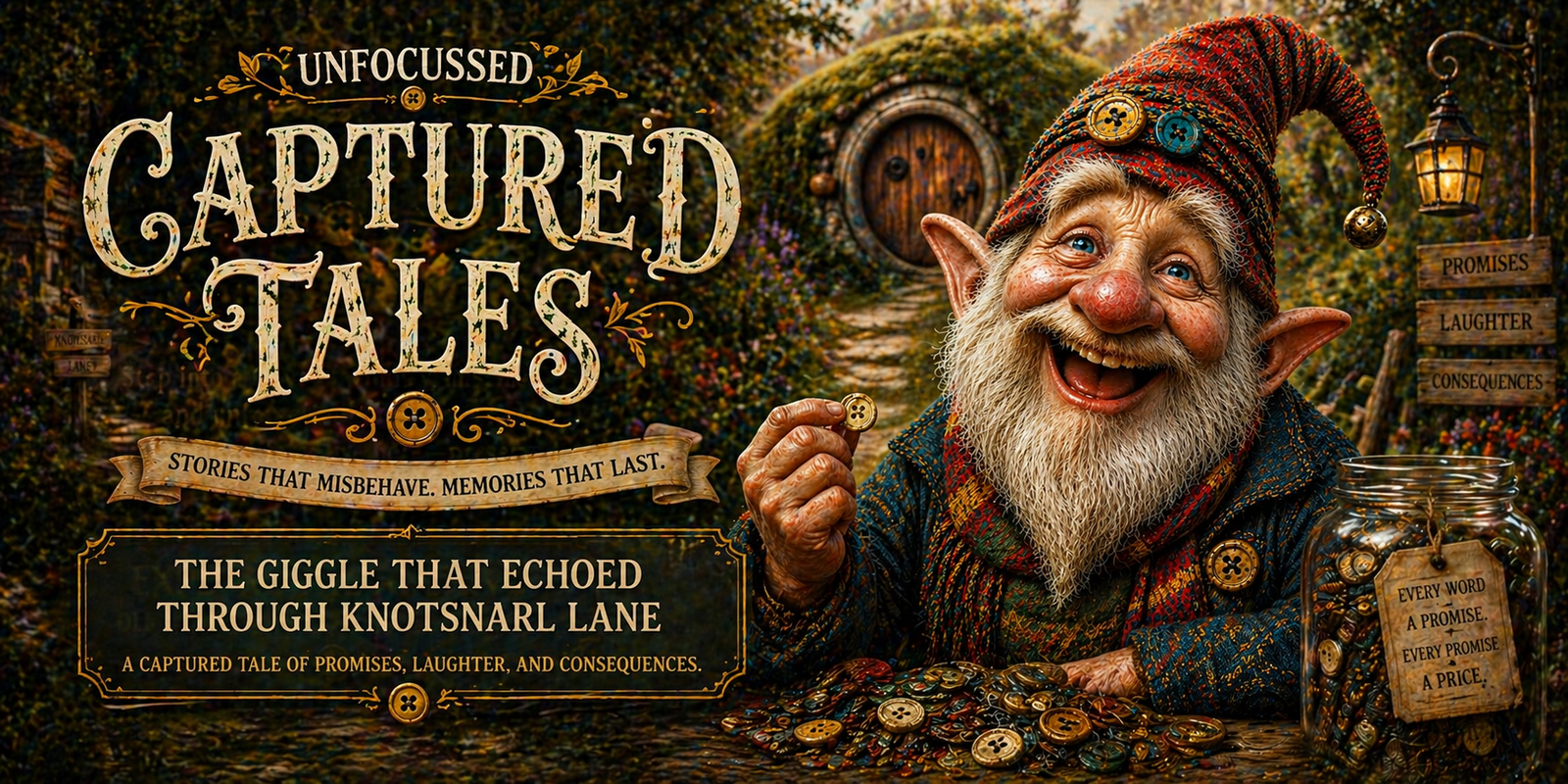
Bartholomew Figglebrass was three feet tall in boots, four feet tall in hat, and entirely too pleased with himself for a creature who had been banned from seven concert halls, three royal chapels, and one funeral for “unlicensed merriment.” He was an elderly gnome of great musical talent, questionable restraint, and a face that seemed permanently arranged around the punchline of a joke only he had survived.
His beard poured from his chin in a white cloud of theatrical neglect. His mustache curled outward in two proud spirals, the left one jaunty, the right one suspicious. His nose was red, round, and expressive enough to deserve billing. His eyes bulged with the shining intensity of a man who had seen the abyss, winked at it, and asked whether it knew any tavern songs.
On the night he came to Madame Velouria’s, he wore a tall crimson hat embroidered with vines, flowers, and tiny black flourishes so intricate they appeared to move whenever one looked away. A jewel dangled from its curling tip and swung beside his ear like a pendulum measuring how long society had left before he ruined it.
He arrived during the annual Winter Patron Recital, a solemn affair attended by counts, countesses, donors, critics, nervous prodigies, and old men who smelled faintly of money and cough drops.
The evening had been designed to be tasteful.
This was its first mistake.
Madame Velouria stood at the front of the main hall in a gown the color of expensive smoke, introducing a twelve-year-old violinist named Percival Glint, who was famous for playing with flawless precision and the emotional warmth of a boiled spoon.
“Tonight,” Madame Velouria announced, “we celebrate discipline, tradition, restraint, and the noble purity of music unsullied by vulgar display.”
At that exact moment, the front doors burst open.
Snow blew in. Candles guttered. Several patrons gasped in keys they had no business attempting.
Bartholomew Figglebrass stood in the doorway, grinning wide enough to alarm the architecture.
“Splendid!” he shouted. “I adore vulgar display. Where do you keep it?”
The hall went silent.
A woman in pearls fainted with the efficiency of long practice.
Madame Velouria narrowed her eyes. “Master Figglebrass.”
“Madame Velouria.” Bartholomew bowed so deeply his hat nearly swept the floor. The dangling jewel at its tip smacked him in the cheek. He did not acknowledge this. “You look as severe as ever. It suits you. Like frostbite on a swan.”
“You are not on the program.”
“I am rarely on programs. Programs are for people who know what they are doing.”
“You are not welcome.”
“Ah, but I am expected.”
That sent a ripple through the patrons.
Madame Velouria’s expression tightened. “By whom?”
Bartholomew lifted one gloved finger and pointed toward the back of the conservatory.
Not toward the stage.
Not toward the reception room.
Toward the locked hallway.
The one leading to the forbidden recital chamber.
“By the red bastard in the velvet room,” he said cheerfully.
Three people crossed themselves.
One critic swallowed his pencil.
Madame Velouria stepped down from the dais with the slow, controlled fury of a woman who had once slapped a bassoonist for improvising. “That chamber is closed.”
“Clearly. That is why it has been whining.”
“Pianos do not whine.”
“Yours does. Very dramatically, too. Like a baron after a gout diagnosis.”
The patrons murmured. They loved scandal, provided it was served at a safe distance with biscuits.
Madame Velouria lowered her voice. “You will leave this building at once.”
Bartholomew’s grin softened, though not enough to become trustworthy. “Not until I have played what it took from me.”
For the first time that evening, Madame Velouria looked afraid.
It was subtle. A flinch at the corner of the mouth. A flicker in the eyes. The kind of fear polished people hide behind posture.
Bartholomew saw it.
So did the piano.
From behind the locked doors at the end of the hall came a sound.
One note.
Low.
Soft.
Red.
It rolled through the conservatory like a velvet hand dragging one fingernail along the spine of everyone present.
Percival Glint dropped his violin.
A countess whispered, “Oh no.”
“Oh yes,” said Bartholomew, and clapped his little hands together. “It remembers me.”
Madame Velouria turned sharply to the servants. “Seal the rear hall.”
But the servants did not move.
Not because they were disobedient. Because the rear hall had already opened.
The locked double doors swung inward by themselves, revealing a narrow corridor lit with red candlelight that had not been there a moment before. Sheet music fluttered out first, pale and dry as moth wings. The pages circled above the guests, whispering in staff lines and sharp little notes.
One page drifted toward Bartholomew and hovered before his face.
He squinted at it.
His grin widened.
“Filthy little thing,” he said fondly.
“What does it say?” asked a patron before remembering fear was more fashionable than curiosity.
Bartholomew plucked the page from the air. “It says I owe a debt.”
Madame Velouria’s voice was cold. “You do.”
“And it says the piano is willing to negotiate.”
“It lies.”
“Of course it lies. It is a piano with carvings of demons on its legs. One does not expect moral clarity from furniture dressed like a brothel altar.”
A few patrons made choking noises that might have been outrage, laughter, or both fighting in a tight waistcoat.
Bartholomew tucked the page beneath his arm and marched toward the corridor.
Madame Velouria grabbed his sleeve.
“Do not,” she said.
The room heard the command.
Bartholomew heard the plea underneath it.
He paused.
For one thin second, the laughing gnome looked very old.
Not silly old. Not charmingly ancient. Truly old. Like someone who had outlived applause, enemies, lovers, and most of his better excuses.
“It took my sonata,” he said quietly.
Madame Velouria’s hand tightened. “It took more than that.”
“Yes.” His eyes shifted toward the red-lit hallway. “But the sonata is what I can steal back.”
Then his grin returned, terrible and bright.
“Besides,” he added, “I wore the fancy hat. It would be rude not to cause trouble.”
He slipped free and strutted into the corridor.
Against every instinct, every warning, and every shred of self-preservation they pretended to possess, the patrons followed.
There is a particular kind of person who, when told a room is cursed, thinks, Yes, but are there refreshments? Madame Velouria’s patrons were nearly all that kind of person. They whispered and crowded through the corridor in rustling silks and nervous cologne, eager to witness disaster so long as it happened to someone else.
The forbidden recital chamber waited at the end.
It was smaller than the main hall but grander, with dark green walls, red velvet curtains, and candle sconces shaped like hands reaching out of the plaster. The air smelled of old roses, burnt sugar, and something metallic beneath the sweetness.
And there it stood.
The crimson grand.
It was even more beautiful up close, which made it worse.
Beauty, Bartholomew had always believed, was at its most dangerous when it knew exactly what it was doing.
The piano’s lid curved like a raised wing. Its carved legs ended in clawed feet tipped with brass. Its keys were not pure white and black, but cream and deep garnet, as though each octave had been dipped in moonlight and sin. Above the music stand, two tiny carved faces grinned from the scrollwork.
One winked.
A baron screamed.
“Oh, hush,” said Bartholomew. “It only does that when it likes you or wants your teeth.”
The baron immediately closed his mouth.
Madame Velouria entered last. She shut the chamber doors behind her.
The sound was final.
“You cannot win against it,” she said.
Bartholomew climbed onto the red velvet bench. His boots dangled for a moment before he adjusted himself with considerable dignity and absolutely no grace.
“Winning is for chess players and men with boring eyebrows,” he said. “I intend to offend it into cooperation.”
The piano gave a low rumble.
Several candles turned blue.
Bartholomew leaned close to the keys. “Don’t you growl at me, you varnished harlot.”
The music stand snapped open.
A fresh sheet appeared.
Blank.
Then notes began writing themselves across the page in dark red ink.
Madame Velouria inhaled sharply.
“Do not read that,” she warned.
“Too late,” Bartholomew said. “It has excellent penmanship.”
He studied the page. His face twitched once, then twice, then settled into an expression of delighted horror.
“Well,” he said, “that is rude.”
“What is it asking?”
Bartholomew looked over his shoulder at the gathered patrons.
“An opening phrase.”
“That sounds harmless,” said Percival Glint, who was young enough to still believe words meant what they wore in public.
Bartholomew laughed.
It was not the wild cackle from the doorway. This laugh was smaller. Sharper. The laugh of a man recognizing a trap because he had once sold traps wholesale.
“Oh, my boy,” he said. “Nothing musical is harmless. A lullaby can ruin a tyrant. A waltz can undress a marriage. A hymn can put a knife in a hand and call it righteousness. Music is emotion with a skeleton key.”
The boy paled.
“This particular opening phrase,” Bartholomew continued, flexing his fingers, “belonged to me.”
Madame Velouria stepped closer. “Bartholomew.”
He did not turn around.
“You promised never to touch it again.”
“I promised never to play its song.”
“That distinction will get us all killed.”
“Nonsense. Possibly embarrassed. Maybe mildly possessed. Killed feels dramatic.”
The piano answered with one bright, mocking chord.
Bartholomew pointed at it. “You stay out of this.”
The chord repeated, louder.
Somewhere in the chamber, a portrait giggled.
The patrons huddled together, thrilled and terrified. That is to say, they were having the best evening of their empty little lives.
Bartholomew placed his hands above the keys.
He did not touch them yet.
His smile faded.
For the first time, the gnome looked not like a clown, nor a menace, nor a decorative old lunatic who had crawled out of a wine cellar and into formalwear.
He looked like a musician.
A real one.
The kind who understands that every performance is a door, and some doors open both ways.
“The first time I played this piano,” he said, “I was not old. I was not wise. I was not even interesting. I had talent, which is the most dangerous thing a fool can possess because it convinces him he has earned what luck merely lent.”
No one spoke.
Even the piano seemed to listen.
“I came here with a sonata in my pocket and arrogance in every bone. I believed I had written something immortal.”
He smiled faintly.
“I was right. That was the problem.”
Madame Velouria closed her eyes.
Bartholomew continued. “The piano heard it. Wanted it. Offered to make it greater. Offered applause that would never die, audiences that would weep, critics that would soil themselves in admiration, though admittedly that last part does happen naturally at a certain age.”
A nervous laugh escaped from someone in the back.
“I accepted,” he said.
The candles flickered.
“And what did it take?” whispered Percival.
Bartholomew looked at the boy, and his grin returned without joy.
“The ending.”
“Of the sonata?”
“Among other things.”
Madame Velouria turned away.
The sheet music above the stand fluttered although there was no breeze.
Bartholomew lowered his fingers to the keys.
The instant skin met ivory, the whole conservatory groaned.
Not the room.
The building.
From foundation stone to rooftop gargoyle, Madame Velouria’s Conservatory of Impeccable Noise shuddered like a dowager hearing profanity from a priest.
In the main hall, abandoned violins began tuning themselves. In the practice rooms, metronomes started ticking in unison. In the cellar, wine bottles popped their corks and arranged themselves by vintage, emotional baggage, and likelihood of being needed soon.
In the forbidden chamber, the crimson piano purred.
Bartholomew played the first note.
It was soft.
A single delicate tone.
It floated upward, sweet and trembling, carrying with it the scent of rain on cobblestones and the memory of someone laughing in another room long ago.
The patrons relaxed.
That was their second mistake.
The second note arrived lower, darker, and full of teeth.
Lady Brindleworth gasped and clutched her pearls as every lie she had told that week appeared as tiny glowing subtitles above her head.
I enjoyed your pudding.
Your baby is charming.
No, that hat is not too much.
The room stared.
Lady Brindleworth whispered, “Oh, damn.”
Bartholomew’s mouth twitched.
“Language, my lady. We are only two notes in.”
He played on.
The melody curled through the chamber, elegant and obscene in the way only truly powerful music can be. It did not sound loud, yet no one could hide from it. Each phrase seemed to know where the guests kept their vanity, guilt, hunger, and unspoken nonsense, and it went rummaging through those drawers with both hands.
A duke’s powdered wig lifted off his head and tried to flee.
A critic began sobbing because he realized he had used the word “luminous” 413 times in one season.
Percival Glint’s stiff little posture softened as his violin case snapped open by itself, the instrument inside humming eagerly.
Madame Velouria watched Bartholomew with one hand pressed against her chest.
The piano watched her back.
Bartholomew reached the fourth measure.
The carved demons on the piano legs opened their mouths and sang harmony.
It was gorgeous.
It was vulgar.
It was completely unacceptable.
Naturally, half the room leaned closer.
The notes on the page shifted as he played, rewriting themselves faster than any mortal hand could follow. Bartholomew’s fingers danced across the keys with astonishing speed. For all his ridiculousness, for all his jokes and jabs and weaponized cheer, he played like someone who had been born with music buried under his fingernails.
Then the piano changed the song.
Bartholomew caught it instantly.
His eyes widened.
His grin snapped open, huge and wild.
“Oh, you slippery tart.”
The left side of the keyboard sank beneath his hand. A hidden chord thundered through the room, shaking dust from the chandeliers. The melody turned richer, redder, hungrier.
Madame Velouria shouted, “Stop!”
Bartholomew tried.
His fingers would not lift.
The piano had him.
The keys pulled at his hands, not with ropes or claws, but with memory. That was its favorite trick. It did not force you with pain. It tempted you with the version of yourself you missed most.
Bartholomew saw it then.
A younger version of himself reflected in the piano’s lacquered surface. No beard yet. No lines around the eyes. No absurd hat. Just a sharp-faced young gnome with quick hands and quicker pride, sitting at this same bench decades earlier while Madame Velouria, then young and bright and furious, stood beside him begging him not to bargain.
The reflection smiled.
Bartholomew snarled.
“Do not show me that little idiot. I buried him in better shoes.”
The reflection played faster.
So did Bartholomew.
The chamber erupted.
Sheet music tore free from the stand and spun overhead. Notes lifted off the pages like insects made of ink. The candles flared red. The walls stretched taller. The floor tilted like the deck of a ship in a storm.
Patrons screamed.
Then, to their obvious horror, they began dancing.
Not well.
That would have been merciful.
The sonata seized them by their hidden impulses and dragged them into motion. Dukes kicked. Countesses spun. Critics shimmied with tragic commitment. Lady Brindleworth performed a surprisingly athletic series of hip movements that caused three marriages to reconsider their foundations.
“I have a condition!” she shouted.
“Apparently it has rhythm!” Bartholomew shouted back.
But sweat had appeared on his brow.
The piano was no longer purring.
It was laughing.
Not out loud.
Not in any way the guests could hear.
But Bartholomew felt it through the keys.
The Devil of the Crimson Keys remembered him. It remembered the bargain. It remembered the unfinished sonata. It remembered the ending it had stolen.
And now it wanted the rest.
Bartholomew’s fingers blurred.
He twisted the melody away from the piano’s pull, adding a rude little flourish in B-flat that made one of the carved demons cough. The instrument retaliated with a chord so lush and wicked that the chandelier dropped six inches from the ceiling as if overcome.
“Still dramatic, I see,” Bartholomew said through gritted teeth.
The keys warmed under his hands.
Too warm.
The red lacquer deepened. The carvings writhed. The blank page at the stand filled with a title written in dark, wet ink:
The Laughing Gnome Sonata
The room changed.
All at once the dancing stopped. The patrons froze mid-step, suspended in humiliating poses. One marquis hung in the air with both legs spread and an expression of confused patriotism. Percival stood with one arm raised, eyes wide, listening to something no one else could hear.
Madame Velouria alone remained free.
She stared at the title on the page.
“No,” she whispered.
Bartholomew’s voice came low. “It named it.”
“It claimed it.”
The piano struck a chord without him.
Every door in the chamber slammed shut.
The floating sheet music folded itself into the shape of a mouth and spoke in a dry, papery whisper.
“Play the ending.”
Bartholomew laughed then.
He could not help it.
It burst out of him bright and cracked and enormous, filling the cursed chamber, bouncing off the velvet walls, rattling the teeth of nobility and furniture alike.
It was the laugh from the portrait.
The laugh from the title.
The laugh everyone saw on his face but never understood.
The laugh of a gnome who had lost something precious and decided, out of spite, to become ridiculous enough that grief would be embarrassed to sit near him.
“The ending?” he said, eyes blazing. “You greedy red parasite. You think I came here because I still know the ending?”
The paper mouth trembled.
Bartholomew leaned closer to the keys, his grin widening into something almost dangerous.
“I came here because you do.”
The piano went silent.
For one perfect second, the Devil of the Crimson Keys seemed genuinely surprised.
Then every key sank at once.
The chamber exploded with sound.
Not music.
Not yet.
A challenge.
The force of it hurled the frozen dancers backward into chairs, curtains, and each other’s dignity. The chandelier swung wildly. The carved demons shrieked. Madame Velouria stumbled, caught herself against the piano, and cried out as the red lacquer flashed beneath her hand.
Bartholomew saw the mark appear on her palm.
A tiny crimson treble clef.
His smile vanished.
“No,” he said.
The piano answered with three notes.
Old notes.
His notes.
And beneath them, hidden like a knife under lace, was the beginning of the ending he had spent forty years pretending not to miss.
Bartholomew slowly turned toward Madame Velouria.
Her face had gone pale.
“You knew,” he said.
She did not answer.
The piano did.
It played a soft phrase, tender as a wound.
And behind Bartholomew’s reflection in the crimson lacquer, another figure appeared.
A woman seated beside his younger self.
Laughing.
Alive.
Wearing Madame Velouria’s face.
But not Madame Velouria’s eyes.
Bartholomew stopped breathing.
The sheet music fluttered.
The red piano whispered through the strings:
“Shall we begin again?”
The Crimson Bargain Deepens
There are moments in life when a person discovers that everything they believed about their own tragedy was not wrong exactly, but offensively incomplete.
Bartholomew Figglebrass had spent forty years believing the Devil of the Crimson Keys had stolen the ending of his sonata.
He had believed it took the last movement, the final phrase, the triumphant resolution that would have made him immortal in all the grand, insufferable ways young artists dream about before life kicks them directly in the metaphorical organ pipes.
He had believed that was the wound.
The theft.
The crime.
But now, staring into the crimson lacquer of the cursed piano, watching the reflection of a laughing woman who had Madame Velouria’s face and not Madame Velouria’s eyes, Bartholomew realized the piano had done something far worse.
It had not merely taken the ending.
It had hidden the beginning.
“No,” Bartholomew whispered.
It was an ugly little word in that beautiful room, but ugly words are often the only honest ones left standing after elegance has had its turn lying.
The reflection remained in the piano’s polished side: younger Bartholomew at the bench, wild-haired and sharp-jawed, wearing the expression of a genius who had not yet been punched enough by consequence. Beside him sat the woman, laughing as if the whole world were a joke and she knew the rude final line.
Her hand rested over his on the keys.
Not Madame Velouria.
Not quite.
“Who is she?” whispered Percival Glint from behind a toppled chair.
Bartholomew did not turn.
Madame Velouria stood with one hand curled against her chest, hiding the crimson treble clef now burned into her palm. Her face looked older in the red candlelight. Not aged by time, but by remembering. There is a difference. Time puts lines on the skin. Remembering puts stones in the pockets.
“Her name was Liora,” Madame Velouria said.
The piano gave a pleased little tremble.
Bartholomew’s fingers tightened over the keys.
“Do not say her name like that.”
Madame Velouria lifted her chin. “Like what?”
“Like a door you have already walked through.”
A few patrons, still recovering from their involuntary dance humiliation, exchanged glances. They did not understand what was happening, but they understood tone, and this tone had all the hallmarks of history, betrayal, and something that would pair beautifully with brandy.
Lady Brindleworth leaned toward a countess and whispered, “This is better than opera.”
The countess whispered back, “Everything is better than opera if one survives the first act.”
The piano struck a sharp chord.
Both women shut up.
Bartholomew slowly looked at Madame Velouria. “You told me she left.”
“She did.”
“You told me she left with my sonata.”
“She did.”
“You told me she never came back.”
Madame Velouria’s mouth opened, then closed.
Bartholomew’s laugh came out quiet and wrong. “Ah. There it is. The little crack in the porcelain. Careful, Madame. We can see the cheap clay underneath.”
Her eyes flashed. “Do not make me the villain because grief was easier for you when it had one face.”
The chamber shifted.
The velvet walls seemed to lean closer. The carved hands holding the candles curled their plaster fingers tighter around the flames. The crimson piano waited between them like a judge, a witness, and a criminal all dressed for the same dinner party.
“Then tell me,” Bartholomew said. “Tell me what I forgot.”
The piano purred.
Madame Velouria shook her head. “It does not work that way.”
“Of course it doesn’t. Nothing cursed ever does. A curse never says, ‘Here is a clear explanation, please initial beside the emotional damage.’”
“You cannot be told what was taken. You must play toward it.”
“Convenient.”
“Cruel,” she said. “But true.”
The blank sheet on the music stand fluttered and filled with fresh notation, red ink racing over the page in spirals and hooks. The title remained at the top:
The Laughing Gnome Sonata
Beneath it, a subtitle appeared in smaller script.
Second Movement: What the Fool Mislaid
Bartholomew glared at the page. “Smug stationery.”
The piano answered with a delicate trill that sounded suspiciously like snickering.
Percival crawled out from behind the chair, clutching his violin case like a shield. “Master Figglebrass, what happens if you play the second movement?”
“Almost certainly something tacky.”
“And if you don’t?”
The chamber doors groaned.
The candles dimmed.
The air tightened.
Every patron inhaled at once as invisible pressure closed around the room.
Bartholomew grimaced. “Then the furniture gets pushy.”
Madame Velouria stepped nearer. “It marked me. It will use me if you refuse.”
“Why?”
“Because I was there.”
The phrase landed heavily.
Bartholomew turned fully toward her now. His grin was gone. Without it, his face seemed smaller, sadder, more dangerous.
“Where?”
“At the first performance.”
“There was no first performance.”
Madame Velouria’s eyes glistened. “That is what it let you remember.”
The piano struck a chord, and the room vanished.
Not physically. The patrons remained sprawled across chairs, curtains, and each other’s wounded pride. The chamber remained around them. But over everything fell an illusion so vivid it stole the air from their lungs.
The walls brightened. The curtains became gold. The candles multiplied into a thousand points of soft amber light. The cursed recital chamber transformed into what it must have been decades earlier: a private salon filled with young musicians, critics, patrons, and hungry little social predators wearing silk.
At the center sat young Bartholomew Figglebrass, not yet ruined enough to be funny.
Beside him stood Liora.
She was astonishing.
Not in the polished, conventional way that makes portraits tolerable and people unbearable. She was alive in a manner that seemed almost rude to the rest of the room. Dark curls pinned badly because she had better things to do. A mouth built for laughter and argument. Eyes bright with danger, intelligence, and the specific look of a woman who has just decided the rules are flimsy and probably flammable.
Young Madame Velouria stood near the wall, watching them both.
“You were jealous,” Bartholomew said bitterly.
Madame Velouria did not flinch. “Yes.”
The honesty struck harder than denial would have.
“Of her?”
“Of both of you.”
The illusion continued.
Young Bartholomew bowed to the salon, all sharp charm and dangerous pride. Liora leaned down and whispered in his ear.
The room could not hear the words.
But older Bartholomew mouthed them with her.
“Play it like you stole it from thunder.”
His hands began to tremble.
“I thought I wrote that line,” he whispered.
“You wrote many things,” Madame Velouria said. “Not all of them alone.”
The first notes of the sonata filled the chamber again, but now they came from memory. Young Bartholomew played with ferocious beauty. The salon listeners sat stunned, trapped between awe and resentment. Nobody likes witnessing genius up close unless it belongs to them, and even then, they prefer it polite.
Liora watched him play, smiling.
But as the music built, she stepped closer to the piano.
Too close.
Her fingers brushed the crimson lacquer.
The carved demons opened their eyes.
Older Bartholomew surged to his feet, but the keys held him. “Liora, no!”
The illusion did not hear him.
Young Bartholomew kept playing. Faster. Brighter. Hungrier. The music became almost unbearably beautiful, a thing with wings and claws and a pulse. Liora’s smile changed. She heard something inside it before anyone else did.
Not triumph.
Appetite.
She grabbed young Bartholomew’s wrist.
He shoved her away.
The older gnome recoiled as if struck.
“No,” he whispered. “I didn’t.”
Madame Velouria’s voice was soft. “You did.”
The younger Bartholomew shouted something at Liora. The illusion refused to give them the words, but the shape was obvious enough. Pride has universal diction.
Liora shouted back. She pointed to the piano. To the keys. To the red ink spreading across the sheet music.
Young Bartholomew did not stop.
His sonata reached the final movement.
The air in the salon tore.
Not visibly, not like cloth, but emotionally — as if every person present felt something inside them split along an old seam. Guests began confessing. Laughing. Weeping. Kissing the wrong spouses. One baron punched his own reflection and declared it had been “asking for years.”
The crimson piano drank it in.
And Bartholomew played harder.
“I was young,” the old gnome said, barely audible.
“You were brilliant,” said Madame Velouria. “That was worse.”
The illusion twisted.
Liora forced her way to the bench. She shoved herself beside young Bartholomew, placed both hands on the keys, and began playing against him.
Not over him.
Not beneath him.
Against him.
Her melody collided with his, fierce and bright, not destroying the sonata but changing its course. Pulling it away from the piano’s hunger. Turning ambition into warning. Turning vanity into grief. Turning the final movement into something neither of them had written alone.
Older Bartholomew stared.
The laugh on his face in the portrait, in the image, in every story ever told of him — that mad open grin — seemed now like a mask painted over a scream.
“She wrote the ending,” he said.
Madame Velouria nodded.
“With me.”
“Yes.”
The piano snarled.
The illusion flickered.
Young Bartholomew and Liora played together, four hands on the crimson keys, battling the instrument from within its own song. The salon shook. Red candles guttered. The carved demons shrieked. Sheet music flew like birds fleeing a burning cathedral.
For one impossible moment, they were winning.
The sonata became laughter.
Not mockery.
Not madness.
Defiance.
A laugh hurled in the face of hunger.
A laugh that said: you may want our grief, our vanity, our love, our little secret shames, but you do not get to decide what they become.
Then the piano made its offer.
Everyone in the chamber heard it, though no voice spoke aloud.
Immortality.
Applause beyond death.
A name no century could bury.
Young Bartholomew faltered.
Only for a heartbeat.
Only for the smallest, most human fraction of time.
That was enough.
The piano struck.
Liora screamed.
The final notes tore themselves from the page and wrapped around her like red ribbons. Young Bartholomew reached for her, but his hands passed through smoke. Madame Velouria rushed forward from the wall, too late, always too late, and the crimson instrument swallowed the ending whole.
Liora vanished.
The salon went silent.
Young Bartholomew collapsed at the bench.
Then, slowly, he began to laugh.
Not because anything was funny.
Because the curse needed a shape.
Because grief too large for the body finds the mouth and breaks out wearing whatever mask it can.
Because the piano had not stolen his ending.
It had stolen hers.
The illusion snapped away.
The forbidden chamber returned: green walls, red curtains, trembling patrons, and Bartholomew sitting at the bench with tears caught in the white bristle of his mustache.
No one spoke.
Even Lady Brindleworth, who had never met a silence she did not wish to smother with commentary, kept her mouth shut.
The piano’s keys gleamed beneath Bartholomew’s hands.
Fresh notation crawled across the page.
Play the ending.
Bartholomew looked at Madame Velouria. “Why did you tell me she left?”
“Because you asked me to.”
He stared.
“No.”
“You did. Afterward. When the curse settled. When you realized what your ambition had cost. You begged me to make it bearable. You begged me to give you a smaller wound.”
The words hit him like stones.
“So you lied.”
“I obeyed.”
“You let me hate her.”
Madame Velouria’s voice cracked. “No. I let you survive.”
The piano hummed softly.
It was enjoying this.
Of course it was. Cursed objects adored emotional revelations. They fed on drama the way ordinary furniture fed on dust and being silently judged by cats.
Bartholomew wiped his face with the back of one sleeve and sniffed. “Well. That was unpleasant.”
Percival blinked. “That’s all?”
“I am elderly. If I properly unpack every traumatic revelation, we shall be here until spring.”
The young violinist looked uncertainly at the piano. “Can you save her?”
Bartholomew let out a slow breath.
The question was simple.
Simple questions are the cruelest kind because they rarely deserve simple answers.
“No,” said Madame Velouria.
Bartholomew turned.
She stepped into the candlelight and opened her marked hand. The crimson treble clef had spread, thin lines curling up her wrist like veins of music.
“It does not keep people whole,” she said. “It keeps what it can use. Her ending. Her laughter. Her final phrase. Pieces. Echoes.”
The piano struck a soft, tender chord.
Madame Velouria flinched.
“Do not make it sentimental,” she snapped at the instrument.
The chord soured.
Bartholomew’s eyebrows rose. “You’ve been arguing with it too?”
“For forty years.”
“And you never told me?”
“You were busy becoming insufferable.”
“That is a full-time craft.”
“You excelled.”
For half a second, something like their old friendship flickered between them — battered, bitter, but not dead.
Then the treble clef burned brighter on her wrist, and Madame Velouria gasped.
The piano had grown tired of waiting.
The chamber floor split with lines of red light, forming a circle around the instrument. The frozen sheet music above the room unfolded into long ribbons. Notes dripped from them like ink-blood and splattered onto the floor, where they crawled into place as musical notation.
The whole chamber was becoming a score.
“Oh, that’s new,” Bartholomew said.
“That is bad, isn’t it?” asked Percival.
“Generally, when the architecture starts composing, one should worry.”
The patrons began backing toward the doors, but the handles had vanished.
A marquis pawed at the smooth wood. “There is no exit!”
“For once,” Lady Brindleworth muttered, “your grasp of a room is accurate.”
The piano played three notes by itself.
The red mark on Madame Velouria’s arm pulsed in response.
Bartholomew understood then.
It did not need him willingly anymore.
It had his memory.
It had Liora’s ending.
And now, through Madame Velouria, it had a bridge.
“Madame,” he said slowly, “how much of the final phrase do you remember?”
Her face went still.
“Enough.”
“Why?”
“Because she sang it to me before she vanished.”
The chamber seemed to inhale.
Bartholomew’s mouth opened.
For once in his extravagantly noisy life, he had no immediate smart remark available. Somewhere, a demon probably took notes.
Madame Velouria looked away. “She knew you would forget. She knew the piano would leave you with guilt and not truth. So she gave me one thing. One phrase. One key.”
“You had it all this time?”
“I had enough to keep it locked away.”
“And now?”
Her marked hand curled into a fist. “Now it has found the lock.”
The piano struck another chord, and Madame Velouria cried out as her hand lifted against her will.
She moved toward the bench.
Bartholomew jumped down and blocked her path.
“No.”
Her feet dragged forward, scraping against the floor.
“Move,” she said through clenched teeth.
“I have been told that by better dressed threats.”
“It will use me.”
“Yes, I gathered. The glowing murder tattoo was subtle, but I am quick.”
“Bartholomew.”
Her voice broke around his name.
He looked up at her — really looked — and saw not the severe mistress of the conservatory, not the keeper of rules, not the elegant jailer of the cursed chamber, but the woman who had stood there forty years ago watching two people she loved create something too beautiful to survive.
He softened.
Only a little. He was still Bartholomew. Full softness would have required paperwork.
“I need you to sing it,” he said.
“No.”
“Yes.”
“If I sing it, the piano will hear.”
“The piano already hears everything. It is nosier than a church aunt with binoculars.”
“If I sing it, it may complete the sonata.”
“Or I may.”
Madame Velouria stared at him.
He climbed back onto the bench. His small boots swung once, then steadied. He flexed his fingers. His grin returned, but changed now — less mask, more blade.
“It stole her ending because I hesitated,” he said. “I will not hesitate twice.”
The piano rumbled with amusement.
Bartholomew leaned toward it. “Laugh while you can, you glossy red parasite. I have aged into spite, and spite has excellent stamina.”
Percival stepped forward. “Can I help?”
Bartholomew looked at him.
The boy stood trembling, violin case clutched tight, his pale face still carrying the residue of discipline and fear. But beneath that, something had awakened. Not rebellion exactly. Something healthier. Curiosity with teeth.
“Do you improvise?” Bartholomew asked.
Percival looked scandalized. “No.”
“Can you lie convincingly?”
“No.”
“Have you ever disappointed an authority figure?”
Percival glanced at Madame Velouria, then lowered his voice. “Once I played a note slightly warmer than instructed.”
Bartholomew sighed. “Saints preserve us, we are working with a hardened criminal.”
Despite everything, Madame Velouria almost smiled.
Bartholomew pointed at Percival’s violin. “Open it.”
The boy did.
The instrument inside glowed faintly, its strings humming in sympathy with the chamber’s red-lit score.
“When I begin,” Bartholomew said, “you play against me.”
Percival froze. “Against you?”
“Yes.”
“But what if I make a mistake?”
“Excellent. Make several. Mistakes are how music escapes manners.”
“I don’t know how.”
“Of course you don’t. That is why it might work.”
The piano growled.
Bartholomew laughed at it, huge and rude and dazzling. “You don’t like the boy? Marvelous. I’m suddenly fond of him.”
Lady Brindleworth rose from the floor, brushing dust from her skirt. “What about the rest of us?”
Bartholomew looked over the assembled patrons — powdered, perfumed, frightened, ridiculous, exposed by magic and still trying to stand as if class were a protective spell.
“You?” he said. “You will do the hardest thing asked of your kind.”
The room braced.
“Be honest.”
A horrified murmur passed through them.
“Surely there’s another way,” said a duke.
“For you? Unlikely.”
The floor notation brightened. The chamber-score was nearly complete now, lines and measures curling beneath everyone’s feet.
Bartholomew pointed at the guests. “This piano feeds on performance. Not music. Performance. False faces. Grand lies. Polished nonsense. Every time you pretend, it fattens itself on the difference between what you are and what you show.”
The piano slammed several bass notes in protest.
“Oh, don’t be precious,” Bartholomew snapped. “You’ve been dining on insecurity in formalwear for decades.”
Lady Brindleworth swallowed. “So what do we do?”
“Confess something true when the music takes hold. Not something theatrical. Not something useful. Something real.”
A baron raised one trembling hand. “Could mine be about taxes?”
“If it wounds you.”
“Deeply.”
“Then yes.”
Percival lifted his violin.
Madame Velouria stood beside the piano, clutching her marked wrist, her breath uneven.
The Devil of the Crimson Keys waited, all crimson shine and carved malice.
Bartholomew placed his hands on the keys.
“Second movement,” he said. “Everyone try not to die pretentious.”
Then he played.
The first phrase came like a knife wrapped in velvet — Liora’s melody, or what remained of it, threading through his old sonata with aching precision. The chamber responded instantly. The red notation on the floor flared. The patrons gasped as invisible pressure reached into them and tugged at every hidden lie.
Percival joined on violin.
The first note was awful.
Truly awful.
It scraped across the chamber like a fork being murdered by a plate.
Several patrons flinched.
One critic whispered, “Brave tonal choice,” because instinct is hard to kill.
Bartholomew shouted, “Again!”
Percival played again.
This time the note cracked, bent, and found something raw underneath. Not perfect. Not pretty. Alive.
The piano recoiled.
“There!” Bartholomew cried. “That! Do that ugly honest thing again!”
Percival did.
The sonata shifted.
Madame Velouria began to sing.
Her voice was not large. It was not young. It did not soar like a cathedral soloist or shimmer like a stage darling hunting applause. It trembled at first, worn thin by years of silence. But inside that tremble lived the phrase Liora had given her — a melody so simple it seemed almost impossible that anything cursed could fear it.
Bartholomew heard it.
And remembered.
Not everything.
Not yet.
But enough.
His fingers found the path beneath her voice. Percival’s violin wove crooked fire around them. The patrons, caught by the music, began to confess.
“I never understood fugues!” shouted a count.
“I married for the lake house!” cried his wife.
“My memoirs were ghostwritten by my valet!” sobbed a general.
“I only fund the arts because statues make me look generous!” wailed a banker.
“I hate my own pudding!” screamed Lady Brindleworth, then looked profoundly relieved.
With every confession, the red light on the floor dimmed.
The piano thrashed.
Chords crashed without hands touching them. The bench bucked beneath Bartholomew. The carved demons spat sparks. Sheet music dove at Percival like furious bats, but the boy kept playing, eyes squeezed shut, producing notes that would have gotten him expelled under normal circumstances and canonized under these.
Madame Velouria’s voice grew stronger.
Liora’s phrase rose through the chamber.
The piano fought harder.
The reflection returned in the lacquer: Liora, younger, laughing, then reaching through the red surface as if pressing her hand against glass.
Bartholomew saw her.
His playing faltered.
The piano seized the opening.
Madame Velouria screamed as the crimson mark shot up her arm to her throat.
Her song cut off.
The chamber plunged into silence.
Then Madame Velouria smiled.
But it was not her smile.
It was red and sharp and ancient.
When she spoke, her voice came layered with strings, hammers, and something dark vibrating beneath the floor.
“You always stop when she reaches for you,” said the piano through her mouth.
Bartholomew froze.
Liora’s reflection pressed both hands to the lacquer.
The piano-thing wearing Madame Velouria’s voice tilted its head.
“Shall I give her back?”
The room held its breath.
Bartholomew’s fingers hovered above the keys.
“What?”
“Play the ending,” it whispered, “and I will give you what remains.”
Madame Velouria’s body lifted one hand toward the red piano. The lacquer rippled like water.
Behind it, Liora’s reflection opened her mouth.
No sound came out.
But Bartholomew could read her lips.
Don’t.
The piano smiled with Madame Velouria’s stolen mouth.
“Choose, little maestro.”
The keys beneath Bartholomew’s hands glowed crimson.
The final movement appeared on the page.
Complete.
Perfect.
Immortal.
And at the very bottom, written in Liora’s hand, one last instruction curled across the staff:
Laugh louder than it can hunger.
The Final Laugh of the Crimson Keys
There are bargains so obviously terrible that only a fool would consider them.
Unfortunately, the world is built almost entirely by fools considering bargains while telling themselves they are being strategic.
Bartholomew Figglebrass stared at the final movement glowing on the music stand. It was complete. Perfect. Impossible. Every note he had hunted for across forty years of bitterness, tavern brawls, half-finished concerts, and increasingly offensive hats now sat before him in red ink, elegant as a confession and twice as dangerous.
It was the ending.
Liora’s ending.
The one the piano had swallowed.
The one he had forgotten because remembering would have broken him cleanly in half, and apparently even cursed instruments had standards about waste.
At the bottom of the page, in the hand he knew now better than his own, the instruction remained:
Laugh louder than it can hunger.
Bartholomew’s fingers hovered above the crimson-lit keys.
Across from him, Madame Velouria stood possessed by the Devil of the Crimson Keys, wearing her own face like a badly fitted mask. Her marked throat pulsed with red light. Her eyes glimmered like lacquer beneath candle flame.
Behind the piano’s polished surface, Liora’s reflection pressed one hand against the red glass.
Silent.
Trapped.
Still warning him.
The piano spoke through Madame Velouria again, every syllable vibrating with strings and old appetite.
“Play it,” it whispered. “Play the ending, and I will return what remains of her.”
The patrons were frozen around the chamber, some upright, some crouched, some tangled in curtains and regrets. Percival Glint clutched his violin with white knuckles, breathing too fast. Lady Brindleworth stood with both hands over her mouth, an unnatural state that surely terrified those who knew her well.
Bartholomew did not move.
The piano sweetened its voice.
That was how one knew it was lying.
“You wanted her back.”
“Yes,” Bartholomew said.
“You wanted the truth.”
“Yes.”
“You wanted your sonata restored.”
His eyes shifted to the music.
For a heartbeat, he was young again.
Not in body. There was no mercy that large in the world. His knees still ached, his back still made small treasonous clicking noises, and his nose still looked like a radish that had heard gossip. But inside, the old hunger opened one eye.
The hunger to be remembered.
Not liked. Not understood. Remembered.
Every artist has that ugly little candle burning somewhere inside them, no matter how much humility they throw over it like a damp towel. Bartholomew had spent decades pretending his candle was out. In truth, it had only gone feral in the basement.
The final movement shimmered.
If he played it, the world would know.
The Laughing Gnome Sonata would be complete. Critics would weep. Patrons would shudder. Historians would argue. Musicians would injure themselves attempting the third variation. Somewhere, a statue might be carved of him with a slightly more dignified nose.
The piano knew all this.
Of course it did.
Temptation is rarely creative. It simply reads your diary and speaks in your own handwriting.
“Play,” the piano murmured. “And be immortal.”
Bartholomew slowly looked into the crimson lacquer where Liora watched him.
Her lips moved again.
Don’t.
He laughed once under his breath.
“You always did give bossy advice.”
The piano’s borrowed smile widened. “She cannot hear you.”
“I wasn’t talking to you, you overvarnished parasite.”
The smile twitched.
Ah.
There it was.
A crack.
Not in the piano’s wood, but in its confidence.
Bartholomew had been many things in his life: prodigy, coward, drunk, clown, maestro, nuisance, and once, during a misunderstanding in Port Bristlewick, briefly a mayor. But above all, he had been a performer. He knew audiences. He knew monsters. He knew that anything hungry enough to manipulate applause was, at its core, insecure.
The Devil of the Crimson Keys did not merely want music.
It wanted the room to believe it owned music.
And belief, like pudding, could be ruined by one honest spoonful of something unpleasant.
Bartholomew placed both hands flat on the keys.
The piano shivered in triumph.
Madame Velouria’s possessed mouth opened.
“Yes.”
Bartholomew grinned.
Wide.
Wild.
Magnificent.
“No.”
Then he slammed both elbows down on the keyboard.
The sound was atrocious.
It was not music. It was a crime scene with rhythm. It was a cupboard of pans falling down a staircase while being heckled by geese. It was the sort of sound that made trained musicians instinctively apologize to their ancestors.
The piano screamed.
Not majestically.
Not demonically.
Petulantly.
“What are you doing?” it shrieked through Madame Velouria.
Bartholomew bashed another hideous chord with his elbow, then a third with the heel of his hand.
“Playing from the heart!”
“That is not the ending!”
“No, but it is emotionally available.”
Percival stared, horrified and amazed.
“Master Figglebrass?”
“Boy!” Bartholomew shouted. “Ugly honest thing! Now!”
Percival lifted the violin.
He hesitated only a moment, which was already a vast improvement from earlier, when hesitation had been his primary blood type.
Then he played.
The note came out raw and cracked and stubborn. It was not beautiful in the polished conservatory sense. It did not glide. It did not bow politely. It limped into the chamber with mud on its boots and an unpaid bar tab.
But it was true.
The piano recoiled.
Madame Velouria’s possessed body jerked backward. The red mark around her throat flared.
Bartholomew laughed louder.
“Again!”
Percival played again.
This time the note bent into something brighter. Still imperfect. Still dangerous. Still alive.
Bartholomew answered with a deliberately rude cascade of keys that danced around the forbidden final movement without touching it. He teased its shape. Mocked its grandeur. Turned its elegance inside out and shook the stuffing loose.
The chamber-score on the floor flickered.
The red light dimmed.
“Stop!” the piano snarled.
“Ah,” said Bartholomew, “there’s that refined artistic temperament. You sound just like a soprano who found out the understudy has cheekbones.”
Lady Brindleworth suddenly lowered her hands from her mouth.
“I have never loved my husband’s poetry!” she shouted.
The chamber jolted.
Her husband, Lord Brindleworth, who had been hiding behind a chair with the solemn dignity of a wet handkerchief, gasped. “My poems are beloved.”
“By whom?” she snapped. “Your mother is dead and the dog leaves the room.”
A burst of pale light cracked through the red notation under her feet.
Bartholomew pointed at her without stopping. “Excellent! Brutal, but useful!”
The banker stumbled forward next, face purple with terror. “I once donated to the conservatory only because I thought Madame Velouria fancied me!”
Madame Velouria, half-possessed and clearly fighting her own body, still managed a look of pure disgust.
“Never,” she croaked.
Another slash of pale light.
The duke ripped off his own wig, which had apparently returned out of obligation. “I am bald by choice!”
Silence.
Bartholomew squinted. “Is that true?”
The duke deflated. “No.”
“Then try again, chrome dome.”
The duke sobbed. “I am terrified no one would invite me anywhere if I stopped pretending to understand politics!”
The floor flashed.
“Better!”
One by one, the patrons began confessing. Not the grand sins they might polish into memoirs. Not the charming scandals one could recount after dessert. Smaller things. Realer things. The petty envies. The loneliness under jewels. The exhaustion behind manners. The absurd little griefs no one admits because they sound too ridiculous to hurt as much as they do.
“I miss my old garden more than my first husband!”
“I cannot tell the difference between a cello and a viola and at this point I’m afraid to ask!”
“I only sneer at modern music because it makes me feel old!”
“I paid a ghostwriter for my love letters!”
“I am the ghostwriter!”
That one caused a minor social collapse in the west corner, but there was no time to enjoy it properly.
The piano’s power buckled.
Its hunger had been feeding on performance, masks, polished lies, and the great exhausting theater of respectability. Now the chamber was filling with truth — messy, unmusical, embarrassing truth — and cursed glamour hated embarrassment. Embarrassment was truth wearing no pants.
Bartholomew played harder.
Not the final movement.
Never the final movement.
He played around it, beneath it, against it. He used pieces of his old sonata like bait and Liora’s phrase like a blade. Percival’s violin scraped and sang beside him, finding courage in every imperfect note.
Madame Velouria dropped to one knee, fighting the piano’s hold.
“Bartholomew!” she gasped.
He looked up.
The red mark had reached her jaw. The piano was dragging her voice open again.
“Sing!” he shouted.
“I can’t!”
“Then hum badly!”
Her eyes widened in outrage.
“Badly?”
“With feeling!”
Madame Velouria, who had built an entire life around flawless presentation, immaculate phrasing, and the moral superiority of proper posture, looked as though he had asked her to lick a doorknob in public.
Then she began to hum.
It was not pretty.
At first it was barely sound at all. A broken vibration trapped in her throat. The piano tried to twist it, deepen it, make it elegant enough to control.
Madame Velouria resisted.
She hummed uglier.
The red mark sputtered.
Bartholomew barked a laugh. “There she is!”
Her hum grew stronger. Raw. Defiant. Liora’s phrase returned through it, not as a polished memorial but as something living and bruised. Percival caught it on violin. Bartholomew answered at the keys.
Their three lines tangled together.
Piano.
Violin.
Voice.
Not perfect.
Better than perfect.
Human.
The Devil of the Crimson Keys thrashed beneath them.
The carved demons on its legs tried to sing harmony, but their mouths filled with dust. The lacquer bubbled. The garnet keys flashed. The lid slammed open and shut like a furious jaw.
“Play the ending!” it screamed.
Bartholomew leaned close. “Make me.”
The piano made one final move.
The crimson lacquer rippled, and Liora appeared not as a reflection but as a figure rising halfway through the piano’s surface. Smoke and red light shaped her shoulders, her hands, her face. Her eyes met Bartholomew’s.
The room stopped confessing.
Even Percival’s bow faltered.
She looked almost real.
Almost.
That is the cruelest distance.
“Bartholomew,” she said.
Her voice.
Not the piano’s imitation.
Not memory.
Hers.
He nearly broke.
The keys blurred beneath tears he refused to acknowledge because he was a gnome of dignity and also a catastrophic liar.
“Liora.”
She smiled faintly. “You got old.”
He laughed, and it cracked right down the middle. “You got trapped in furniture. I think we both made choices.”
Her smile trembled.
The piano whispered beneath her voice, threading temptation through every word.
“Finish it. Finish us.”
The final movement glowed brighter on the stand.
Bartholomew saw it then — the trick within the trick.
The piano could not complete the sonata on its own. It had Liora’s ending, but not the consent that gave the ending meaning. It needed him to play it willingly. To choose immortality again. To repeat the old hesitation in a grander costume.
Liora’s eyes sharpened.
“Do not make my last song its meal.”
The piano snarled, and her image flickered.
Bartholomew’s face changed.
The grin returned.
Not the mask.
Not the curse.
The weapon.
He looked at Liora, at Madame Velouria, at Percival, at the ridiculous trembling patrons, at the red piano that had fed for forty years on beauty corrupted into vanity.
Then he did what Bartholomew Figglebrass did best.
He ruined the mood.
He threw back his head and laughed.
It was enormous.
Indecent.
Glorious.
A full-bodied, open-mouthed, nose-reddening, mustache-quivering laugh that started in the belly and kicked the doors off every sorrow on its way out. It rolled through the chamber, over the red notation, under the velvet curtains, into the cracks in the walls and the seams of the cursed instrument.
It was not denial.
It was not madness.
It was refusal.
He laughed because grief had not killed him.
He laughed because guilt had lied badly.
He laughed because Liora had loved him enough to warn him and insult him in the same breath, which was how he knew it was truly her.
He laughed because the piano wanted reverence, and nothing starves reverence faster than mockery with excellent lung support.
Percival began laughing too.
Nervously at first, then with the wild relief of a boy discovering perfection was mostly a cage with good acoustics.
Madame Velouria’s hum broke into a laugh of her own, rusty from disuse and therefore magnificent. Lady Brindleworth followed with a braying cackle so socially destructive that three chandeliers would have resigned if given paperwork. The patrons laughed, not because they understood everything, but because fear had held their throats long enough and laughter found the gap.
The chamber filled with it.
Laughter layered over violin, over humming, over Bartholomew’s chaotic assault on the keys. The sound became music by accident, which is how some of the best music gets made.
The Devil of the Crimson Keys shrieked.
Red light poured from its seams.
The final movement on the page began to burn.
“No!” the piano howled. “That is mine!”
Bartholomew stopped playing with one hand long enough to snatch the sheet from the stand.
The page scorched his fingers.
He held it up.
Every note of the final movement crawled across it like terrified insects.
“No,” he said. “It was never yours.”
He looked at Liora.
She nodded.
Bartholomew shoved the burning page into his mouth.
The entire room screamed.
He chewed.
Once.
Twice.
Made a face.
“Needs salt.”
Then he swallowed.
The explosion was immediate.
Not fire. Not force. Sound.
A tremendous chord burst outward from Bartholomew’s chest, bright and ridiculous and unspeakably tender. It carried every fragment of the final movement, not as notation, not as property, not as bait for immortality, but as laughter released from a locked room.
The piano cracked.
A jagged line split its crimson lacquer from music stand to leg.
Madame Velouria collapsed as the red mark shattered off her skin in sparks. Percival dropped his bow and caught her before she struck the floor, which surprised everyone, especially Percival.
The carved demons screamed in tiny ornamental terror.
Liora’s half-formed figure rose higher from the piano, no longer held by the lacquer. For a moment she stood in the chamber as she had been: alive with light, dark curls wild, eyes bright, mouth curved in that beloved, troublesome grin.
Bartholomew slid down from the bench.
His knees buckled.
He would have fallen if she had not reached for him.
Her hand passed through his.
Of course it did.
Some cruelties remain committed to the bit.
He looked down at their almost-touch and laughed softly.
“Well. That’s rude.”
Liora smiled. “You always did complain during miracles.”
“Only poorly organized ones.”
Behind them, the piano groaned. Its red finish dulled. The garnet keys paled to ordinary ivory and black. The carved demons froze into harmless scrollwork, their smug little faces now permanently startled.
The Devil of the Crimson Keys was not gone.
Curses that old rarely die from one dramatic meal and a room full of aristocrats admitting they are emotionally constipated.
But it was wounded.
Starved.
Broken enough to become only an instrument again.
For now.
Liora turned to Madame Velouria, who had regained consciousness and was staring up with tears streaking her severe, elegant face.
“You kept it locked,” Liora said.
Madame Velouria tried to sit up. “I should have saved you.”
“You saved what you could.”
“It wasn’t enough.”
Liora’s expression softened. “It never is. That is why we call it love and not accounting.”
Madame Velouria laughed through a sob, which was an undignified sound and therefore the finest thing she had produced all evening.
Liora looked back to Bartholomew.
The light around her was thinning.
He saw it and pretended not to, because pretending briefly is sometimes mercy and not cowardice.
“So,” he said, “about the sonata.”
She folded her arms. “You ate it.”
“Yes, but interpretively.”
“It was my ending.”
“I panicked.”
“You seasoned it with spite.”
“Spite pairs well with forbidden composition.”
Her laugh filled the chamber, and this time it did not belong to the piano. It belonged to the air. To the walls. To every person who would remember this night and fail spectacularly to explain it at breakfast.
Bartholomew’s eyes shone.
“I’m sorry,” he said.
The words were small, and because they were small, they were finally large enough.
Liora stepped closer.
“I know.”
“I hesitated.”
“Yes.”
“I chose wrong.”
“Yes.”
He winced. “You could soften one of those.”
“I could.”
“But you won’t.”
“No.”
He laughed again, wiping at his face. “Gods, I missed you.”
Her smile trembled. “Then remember me properly this time. Not as the wound. Not as the ending. As the woman who told you when you were being an ass.”
“That narrows nothing. Many have tried.”
“But I had rhythm.”
“You did.”
The chamber lights dimmed.
Liora’s figure began to unravel into tiny notes of gold and red, rising like sparks from a dying fire.
Bartholomew reached for her again, knowing he could not hold her.
She reached back anyway.
Their hands almost met.
Almost.
And in that almost, something finished.
Not the sonata.
Something better.
The silence after.
Liora vanished laughing.
Not cursed laughter.
Not broken laughter.
Hers.
It lingered in the forbidden recital chamber like perfume, like candle smoke, like the last note of a song nobody owned anymore.
For a long time, no one moved.
Then Lady Brindleworth sniffed loudly.
“Well,” she said, “that was emotionally inconsiderate.”
The room exhaled.
Madame Velouria looked at the now-dim crimson piano. “It will have to be removed.”
The instrument gave a tiny, resentful plink.
Bartholomew turned slowly.
His grin sharpened.
“No.”
Everyone looked at him.
“No?” Madame Velouria repeated.
“No. Locking it away made it hungry. Letting snobs orbit it made it smug. It needs discipline.”
The piano made another small plink, this one offended.
“What sort of discipline?” asked Percival.
Bartholomew patted the piano lid.
“Children’s recitals.”
The chamber went silent.
The piano’s strings gave a horrified twang.
Bartholomew nodded solemnly. “Scales. Beginner duets. Sticky fingers. Wrong notes. Endless practice of ‘The Merry Turnip Waltz.’ Every Saturday morning.”
Percival’s eyes widened. “That’s cruel.”
“It ate my lover’s final movement. It can survive little Clementine learning tempo.”
Madame Velouria’s mouth twitched.
“And,” Bartholomew added, “once a year, we hold a public recital where every patron must confess something honest before entering.”
A collective groan filled the room.
“Mandatory?” asked the duke.
“Deeply.”
“Could mine be written?”
“Large font. No footnotes.”
Lady Brindleworth lifted her chin. “I shall attend.”
“I assumed you would.”
“And I shall bring my husband’s poetry.”
Lord Brindleworth brightened.
“To burn,” she clarified.
He dimmed.
Madame Velouria stood slowly, Percival helping her. The mark had vanished from her skin, leaving only a faint red shimmer like a healed scar remembering drama.
She looked at Bartholomew. “What will you do?”
He glanced once at the piano, then at the burned scraps of red notation scattered like dead leaves across the floor.
“Write something worse,” he said.
“Worse?”
“Less immortal. More annoying. Easier to dance to.”
“That sounds dreadful.”
“Thank you.”
Percival tucked his violin under his chin. “Could I learn it?”
Bartholomew studied the boy.
The child who had entered the evening as a polished little machine now stood rumpled, terrified, alive, and holding his instrument as if it might actually belong to him.
“Only if you promise to make mistakes,” Bartholomew said.
Percival smiled, small but real. “I think I can manage.”
“Good lad. Ruin yourself properly.”
By morning, the story had already become nonsense.
That is what stories do when aristocrats are involved. They put on gloves and lie.
According to one version, Bartholomew Figglebrass had challenged a demon piano to a duel and won by eating sheet music. According to another, Madame Velouria had hosted an experimental recital in which patrons were encouraged to confront their authentic selves, which sounded much more respectable and therefore fooled absolutely no one. A third version insisted Lady Brindleworth had invented a scandalous new dance called the Crimson Twitch, and unfortunately that version proved popular.
The conservatory changed after that night.
Not completely. Institutions never transform overnight unless fire or accountants are involved. But something loosened.
The main hall no longer prized flawless coldness above all else. Students were permitted to improvise on Thursdays. Mistakes were discussed rather than buried. The phrase “vulgar display” was quietly removed from the student handbook after Bartholomew wrote in the margin: Cowards.
As for the crimson grand, it was moved from the forbidden chamber to a sunny practice room where small children mangled melodies upon it with devastating enthusiasm.
It hated every second.
This was widely considered therapeutic.
Once a year, on the winter night of the old patron recital, Bartholomew returned wearing his tallest crimson hat and his most offensive grin. Madame Velouria would unlock the practice room, Percival would tune his violin badly on purpose, and the patrons — fewer now, but better — would gather with slips of honest confession tucked in their pockets.
No one ever played the final movement of The Laughing Gnome Sonata.
No one needed to.
Sometimes, when the candles burned low and the first rude notes stumbled into the air, people swore they heard a woman laughing beneath the melody.
Not trapped.
Not hungry.
Just amused.
And Bartholomew Figglebrass, elderly gnome, maestro of mischief, devourer of forbidden sheet music, would throw his head back and laugh with her until the rafters shook, the patrons blushed, and the crimson piano sulked in perfect pitch.
Because grief, he learned, does not always leave.
Sometimes it stays, takes a seat beside you, and waits for you to play something ridiculous enough that both of you can breathe again.
Bring home the deliciously unhinged charm of The Laughing Gnome Sonata, where one wildly expressive gnome, one cursed crimson piano, and one dangerously theatrical grin turn fine art into a full-blown musical incident. This richly detailed artwork is available as a framed print, canvas print, tapestry, greeting card, spiral notebook, and fleece blanket. Whether displayed on a wall, draped across a room, tucked into a note, or used to capture your own questionable musical genius, this piece brings a burst of fantasy mischief and crimson-keyed chaos wherever it lands.