The Fine Print of Starlight
Velvet Ridge had never been a sensible place to build anything.
The hills did not sit still, for one thing. They rolled and folded in moonlit ribbons of mauve, charcoal, silver, and blush, as though some enormous celestial seamstress had dropped her finest satin across the valley and then abandoned the whole project after three glasses of questionable comet wine. Paths shifted when ignored. Flowers bloomed in colors no botanist could name without sounding emotionally compromised. Even the wind had opinions, and it delivered them through the twisted pink-blossomed trees in a voice that suggested it had once attended finishing school and been expelled for biting.
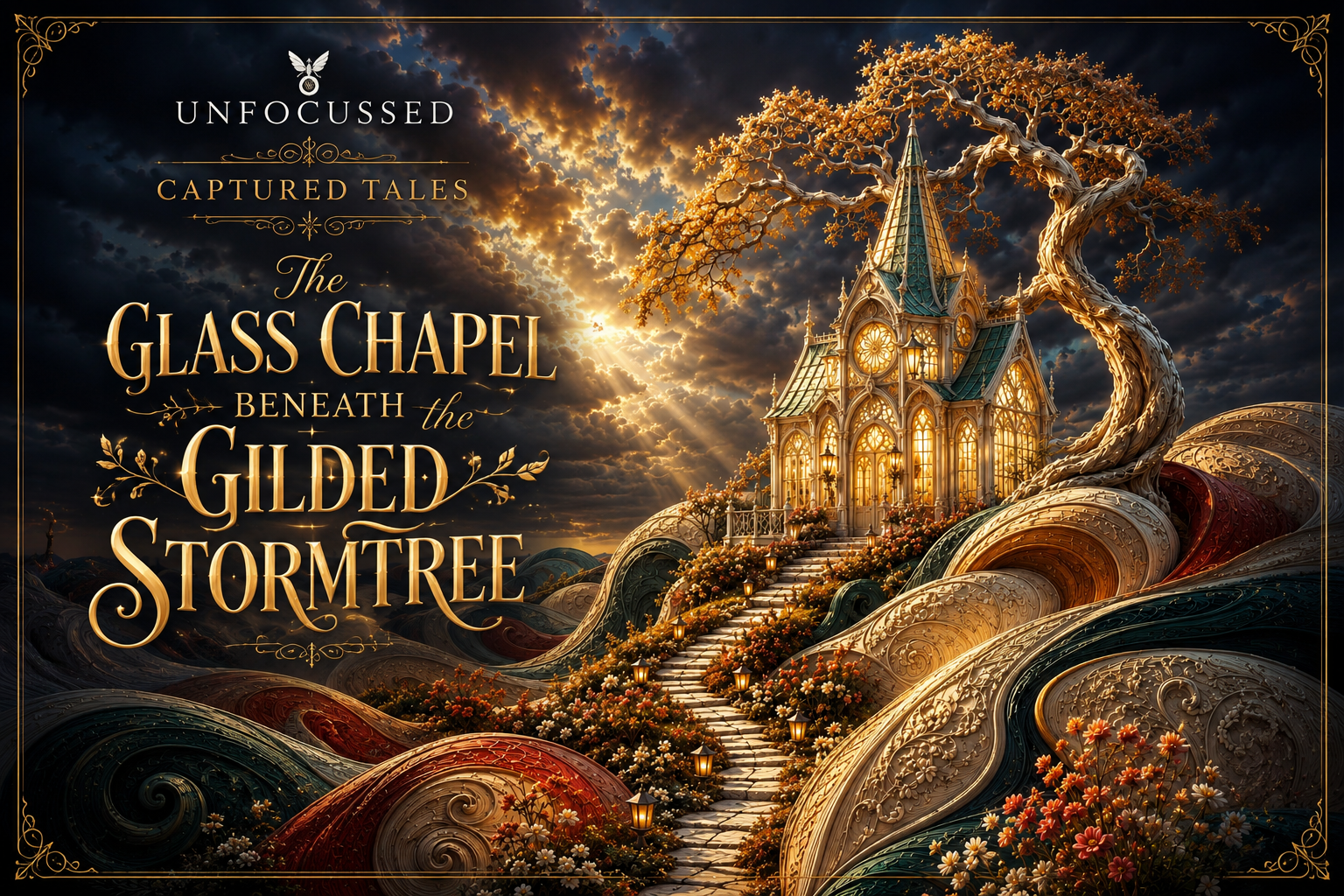
And yet, upon the highest hill, perched like an expensive secret, stood the Rose Quartz Observatory.
Its dome glowed a soft translucent pink beneath the moon, made of polished rose quartz panels held together by brass ribs, iron charmwork, and the sort of ancient engineering that made modern architects say things like, “That should not be possible,” shortly before the building politely refused to appear on their maps. A telescope crowned the dome, long and elegant and smug, forever aimed at the heavens as though waiting for the sky to finish embarrassing itself.
Warm lanterns lined the winding stone stairway that climbed the hill. Each flame burned gold, blue, or occasionally an alarming shade of gossip. Visitors found the path enchanting. Staff found the path tedious. Both were correct.
Inside the observatory, the air smelled of candle wax, old paper, polished brass, midnight rain, and the faint medicinal tang of crushed starlight. The main chamber was circular, lined with celestial ledgers, astrolabes, brass scales, locked cabinets, velvet curtains, and several portraits of dead astronomers who looked far too pleased with themselves for people who had left behind so much administrative chaos.
At the center of this chamber stood Mistress Morwenna Quill, Keeper of the Dome, High Cartographer of Unreasonable Skies, Acting Auditor of Celestial Nonsense, and the only person in three provinces who could make a room full of ancient star charts look as if they had disappointed her personally.
She was tall, sharp-eyed, and wrapped in a plum velvet dressing gown despite the fact that it was nearly midnight and she had announced six hours ago that she was “absolutely not working late.” Her silver-black hair was pinned up with two brass moon needles. One of them was functional. The other, according to rumor, contained a tiny emergency curse for men who explained telescopes to her.
Morwenna stood before the largest ledger in the observatory, a book bound in midnight leather and clasped with rose-gold hinges. Its title, stamped across the cover in flaking silver letters, read:
Accounts, Oaths, Transactions, Promises, Vows, Murmurs, Bargains, Offhand Comments, and Other Things One Should Not Have Said Beneath an Open Sky.
Morwenna hated the ledger with the clean, steady devotion usually reserved for tax law and relatives who brought casseroles to funerals.
“It is humming again,” said Corwin Vale, her assistant astronomer, from the other side of the chamber.
Corwin was twenty-seven, handsome in a way that suggested he had been assembled by candlelight during a moment of poor restraint, and forever one button away from being taken seriously by exactly nobody. He had a talent for mathematics, a tragic fondness for waistcoats, and the moral caution of a moth near a chandelier.
Morwenna did not look up. “Many things hum, Corwin. Bees hum. Kettles hum. Your brain hums when it meets a locked door and considers seducing it open.”
“This hum has harmonics.”
“So does your brain when the door has pretty hinges.”
Corwin crossed the chamber, carrying a tray with two cups of black tea and one saucer of cream for Duchess Nine, the observatory cat. Duchess Nine sat atop a stack of unpaid invoices, black as burned ink except for nine silver spots along her spine. She was older than any living employee and, according to several legally binding documents, held veto power over all hiring decisions, soup recipes, and marriages performed under the west dome.
Duchess Nine opened one eye at Corwin.
Corwin set down the saucer. “Your Grace.”
The cat blinked slowly, which meant either thank you or die elsewhere.
Morwenna placed one hand on the old ledger. It trembled beneath her palm.
“It has been doing this since moonrise,” she said.
Corwin leaned over her shoulder, smelling faintly of cedar, ink, and regrettable confidence. “Is it dangerous?”
“Everything in this building is dangerous. The question is whether it is dangerous in the usual charming way or dangerous in the way that requires forms.”
“Forms are worse.”
“Forms are always worse.”
The ledger gave a low, resonant thrum that shook dust from the portraits. A painted founder in a fur collar sneezed and muttered, “Not again.”
Morwenna’s eyes narrowed.
“What did you say?” she asked the portrait.
The founder froze in the theatrical manner of someone who had absolutely spoken and was now pretending to be decorative.
“I asked you a question, Lord Bellweather.”
The portrait adjusted his painted cravat. “I am but pigment.”
“You are about to be kindling.”
“A dreadful threat to make toward a family heirloom.”
“You are not a family heirloom. You are a man in a frame who once authorized the purchase of three hundred ceremonial spoons and no roof insulation.”
Lord Bellweather’s painted mouth pinched. “The spoons were symbolic.”
“So is arson.”
Corwin sipped his tea. “There is a tone developing in the room, and I support it.”
The ledger hummed louder.
Then the clasps sprang open.
A gust of cold starlight burst from the pages, scattering loose charts, lifting Morwenna’s hair, knocking Corwin’s teacup sideways, and causing Duchess Nine to flatten both ears with the disgust of a duchess whose cream had been emotionally disrupted.
The pages flipped themselves, faster and faster, until they landed near the beginning. The paper there was older than the rest, thick and creamy, with veins of silver running through it like moonlit roots. Across the page sprawled a contract written in looping, extravagant script.
Morwenna had seen that page before. Everyone who worked at the Rose Quartz Observatory had seen it before. It was part of the founding myth, recited to schoolchildren and gullible donors during the annual Mooncake Festival.
Long ago, when Velvet Ridge was only wilderness and storms came down from the heavens with teeth, the founders of the observatory had made a bargain with the night sky.
The sky would protect the ridge.
The sky would bless the land with beauty.
The sky would fill the dome with starlight enough to guide sailors, lovers, lunatics, poets, and other people not known for making sound decisions.
In return, the observatory would owe the stars one favor.
One little favor.
Nobody had ever worried about it much, because the founders had written the bargain at a banquet and apparently signed it sometime after dessert, when men in velvet became convinced that the universe admired them. For two hundred and eleven years, the favor had remained uncollected.
Morwenna had always considered this suspicious.
Generosity, in her experience, was simply debt wearing perfume.
The silver script on the ancient page began to glow.
Corwin leaned closer. “Is it supposed to do that?”
“Corwin,” Morwenna said, “if I knew what it was supposed to do, I would not currently be clenching my jaw hard enough to crack a walnut.”
The glowing words rearranged themselves.
The original contract faded, and new text appeared in letters bright enough to sting the eyes.
Notice of Collection.
Morwenna went very still.
Corwin set down his teacup with unusual care.
Duchess Nine placed one paw atop the ledger as though prepared to sue it.
The text continued writing itself.
To the current custodians, inheritors, occupiers, tenants, hangers-on, unauthorized romantics, and tolerated cats of the Rose Quartz Observatory:
The favor owed by the House of Velvet Ridge to the Starlit Consortium is hereby called due.
“The Starlit Consortium?” Corwin said. “That sounds dreadful.”
“It sounds like the kind of group that charges a cancellation fee for miracles,” Morwenna replied.
The words shimmered on.
Per Clause Seven, Subsection Thirteen, Glittering Addendum, and Wine-Stained Marginalia, the observatory shall host an Interstellar Tribunal concerning all unpaid wishes made beneath its dome, terraces, stairways, adjacent orchards, decorative balconies, and emotionally suggestive windows.
Morwenna closed her eyes.
“I beg your pardon,” Corwin said to the book. “Emotionally suggestive windows?”
The ledger flipped three pages ahead and displayed a diagram of the eastern balcony windows, which were indeed shaped in a way that suggested the original architect had either been deeply romantic or insufficiently supervised.
Corwin tilted his head. “Well.”
“Do not say it,” Morwenna said.
“I was only going to say they have admirable curvature.”
“You are still saying it.”
The ledger slapped itself shut, then opened again as if offended by the interruption.
The Tribunal shall commence at moonrise tomorrow.
Failure to comply will result in immediate repossession of the following assets: starlight, lunar privileges, cloud drama, rose quartz luminosity, poetic atmosphere, hill shimmer, blossom timing, and all remaining decorative mystery.
Corwin looked genuinely alarmed. “They can repossess decorative mystery?”
Morwenna stared at the glowing text. “Apparently.”
“But without decorative mystery, this place is just an oddly expensive building on a wet hill.”
“Thank you for identifying the stakes.”
“I live to assist.”
Duchess Nine hissed at the ledger.
The final line appeared in a blaze of silver:
Prepare the dome. Polish the witness rail. Do not serve raisins.
The glow vanished.
Silence fell.
Outside, thunder rolled across the heavens as if the clouds had read the notice and decided to add percussion.
Corwin folded his arms. “Why no raisins?”
Morwenna turned slowly toward him.
“Of all the possible questions available to you at this moment, you have chosen raisins.”
“It seems oddly specific.”
“The sky has just informed us that it intends to repossess our atmosphere.”
“Yes, but one expects the sky to be dramatic. A raisin prohibition suggests history.”
Morwenna hated that he had a point.
A bell rang deep within the observatory.
Not the hour bell. Not the storm bell. Not even the small silver bell in the pantry that rang whenever someone attempted to hide pastries behind the marmalade.
This bell had not rung in Morwenna’s lifetime.
It sounded once, low and vast, as though struck from the other side of the moon.
Every candle in the chamber bent toward the ceiling.
The rose quartz dome began to glow.
“We have company,” Morwenna said.
Corwin looked toward the spiral stairs leading up to the telescope platform. “At this hour?”
“No, Corwin, at this tax bracket.”
They climbed.
Duchess Nine followed, not because she was loyal, but because events were occurring in her house without her permission.
The stairs curled upward through the observatory’s heart, passing narrow windows where the landscape beyond flashed silver beneath storm clouds. The hills of Velvet Ridge rippled in the wind, their rose and lavender folds gleaming like silk underwater. Lanterns along the path below flickered one by one, as if bowing to something unseen.
When Morwenna reached the top platform, the dome had opened.
The great brass telescope stood beneath the exposed sky, its polished barrel angled toward the moon. Clouds churned overhead in towering charcoal masses, but at the center, directly above the observatory, the heavens had parted into a clean black aperture brilliant with stars.
And the stars were descending.
Not falling. Falling was crude. Falling was what apples and reputations did. The stars descended with the controlled poise of aristocrats entering a ballroom where everyone owed them money.
They arrived in a column of pale fire, touching down upon the telescope platform without heat or sound. Light gathered, folded, sharpened, and became a figure.
She was tall, silver-skinned, and dressed in a gown that appeared to be made of midnight, frost, and legal authority. Her hair flowed upward rather than down, a shimmering veil of constellations drifting in slow orbit around her head. Her eyes were white-gold. Her mouth held the faint smile of someone who had ruined several kingdoms politely.
Behind her appeared three attendants: one shaped like a blue flame in spectacles, one resembling a child-sized comet with a clipboard, and one enormous being composed entirely of rotating star charts.
Morwenna drew herself to full height.
Corwin immediately tried to do the same, but the effect was ruined by the wind lifting his hair in a way that made him look romantically available to weather.
Duchess Nine sat on the top stair and began washing one paw.
The silver woman inclined her head.
“Mistress Morwenna Quill,” she said. Her voice was cool and layered, like moonlight passing through crystal and finding fault with the curtains. “Current Keeper of the Rose Quartz Observatory.”
Morwenna gave a shallow nod. “And you are?”
“Seraphine of the Seventh Spark, Senior Claims Advocate of the Starlit Consortium, Binder of Comets, Witness to Vows, Collector of Radiant Debts, and temporary chair of tomorrow evening’s Interstellar Tribunal.”
Corwin murmured, “Of course she has better titles.”
Morwenna stepped lightly on his boot.
Seraphine’s glowing gaze moved to Corwin. “Corwin Vale. Assistant Astronomer. Maker of seven hundred and twelve wishes, four hundred and six of which involve improbable affection, unlikely hair outcomes, or access to locked rooms.”
Corwin paled. “That number feels inflated.”
“It has been audited.”
Morwenna looked at him. “Seven hundred and twelve?”
“Not all under the dome.”
“That is your defense?”
“Some were on the stairs.”
Seraphine continued, “Duchess Nine. Feline sovereign. Informal curse-broker. Author of forty-three wishes, all involving fish, fire, or the disgrace of enemies.”
Duchess Nine paused mid-lick and stared at Seraphine.
Seraphine bowed deeper to the cat than she had to either human.
“Your Grace.”
Duchess Nine accepted this as adequate.
Morwenna crossed her arms. “We received your notice.”
“Excellent. Then there should be no confusion.”
“There is almost nothing but confusion.”
“That is often the case with descendants of people who sign cosmic agreements beside dessert wine.”
Morwenna felt several ancestral portraits below become offended through the floorboards.
“The original bargain stated one favor,” she said. “Not a tribunal.”
Seraphine lifted one slender hand. The comet-child attendant slapped a scroll into her palm with professional enthusiasm.
Seraphine unrolled it. The bottom tumbled down the stairs, bounced once off Corwin’s knee, and continued unrolling into the chamber below.
“Clause Seven,” she read, “defines favor as any service, hosting obligation, ceremonial undertaking, custodial duty, moral inconvenience, logistical burden, or public embarrassment deemed necessary by the Starlit Consortium, hereafter referred to as the Lender, Sparkholder, or Injured Radiance.”
Corwin leaned toward Morwenna. “Injured Radiance is rather good.”
“Do not admire the enemy’s branding.”
Seraphine smiled. “The tribunal is required. For centuries, mortals have made wishes beneath this dome. Some were granted. Some were ignored. Some were granted badly due to poor phrasing, excessive wine, or emotional weather. Many remain unresolved. Your observatory served as the receiving house. Therefore, your observatory shall serve as the court.”
“We are not responsible for every fool who looked through a telescope and asked the universe for cheekbones,” Morwenna said.
Corwin shifted slightly.
Morwenna did not look at him. “Do not move like that.”
Seraphine’s eyes glinted. “Responsibility is a flexible garment. The founders of this house wore it loosely.”
“The founders of this house wore velvet in summer and made financial decisions with candied fruit in their beards.”
“Nevertheless.”
The star-chart being behind Seraphine rotated, revealing hundreds of glittering names spiraling across its surface.
Morwenna’s stomach tightened.
Names.
So many names.
Some belonged to the dead. Some to the living. Some to people who had visited only once, whispered a wish while holding a lover’s hand, and left believing the sky had not listened.
The sky had listened.
The sky, apparently, had kept receipts.
“How many claims?” Morwenna asked.
The blue flame attendant adjusted its spectacles. “Pending, disputed, malformed, misdirected, romantic, retaliatory, pastry-related, and legally actionable wishes currently total nine thousand, eight hundred and seventeen.”
Corwin choked. “Pastry-related?”
“Three hundred and two.”
“That is too many pastry wishes.”
Morwenna rubbed the bridge of her nose. “And you expect us to host all of this tomorrow?”
“Not all,” Seraphine said. “The tribunal will begin tomorrow. It may last hours, years, or generations, depending on procedural resistance.”
“Generations?”
“Your founders should have initialed the efficiency clause.”
Morwenna looked out across Velvet Ridge. The hills shimmered beneath the moon, beautiful beyond reason. Beauty was everywhere here, poured lavishly into every stone, flower, window, and cloud. The observatory’s lanterns glowed like little captured suns. The rose quartz dome shone above them all, impossible and beloved.
For two hundred and eleven years, the sky had protected this place.
Now the bill had arrived.
“What happens if we refuse?” she asked.
Seraphine’s smile faded.
The clouds overhead tightened. Starlight dimmed around the edges of the dome.
“Then the Consortium repossesses what was loaned.”
“Starlight,” Morwenna said.
“Yes.”
“Lunar privileges.”
“Naturally.”
“Decorative mystery.”
“Especially that. It is costly to maintain.”
Below, the rose quartz panels gave one soft pulse, as though frightened.
Morwenna felt it through her feet.
She had inherited the observatory from a line of keepers too stubborn to die conveniently. Her grandmother had taught her how to read star tremors, how to polish brass with salt and moon oil, how to threaten a thundercloud into passing politely around the herb garden. Her mother had taught her that beauty was not a luxury here. It was infrastructure. It held the ridge together. It kept grief from swallowing the valley whole. It gave people a reason to climb the long stairs in the dark and believe the universe might still have a sense of occasion.
Without it, Velvet Ridge would not simply become ordinary.
It would remember every storm it had been spared.
Morwenna turned back to Seraphine.
“We will host your tribunal,” she said.
Corwin inhaled sharply.
Duchess Nine made a small, offended sound.
Seraphine inclined her head. “Wise.”
“But understand this,” Morwenna continued. “This observatory is not a rented hall for celestial bureaucrats in glittering frocks. It is my house. My dome. My staff. My cat, to the extent that anyone can claim ownership of a creature who once blackmailed a bishop. If your tribunal is held here, it will be held according to observatory order.”
The comet-child attendant scribbled furiously.
Seraphine’s eyes brightened with interest. “Define observatory order.”
“No raisins.”
Corwin nodded solemnly.
“No smiting before breakfast. No haunting the east washroom; it already has issues. No turning visitors into constellations unless they sign a consent form. No celestial chanting after midnight without notice. No use of the phrase ‘mortal limitations’ in my hearing unless you are prepared to discuss your own astonishing failure to invent pockets.”
The blue flame attendant looked down at its own robe, startled.
Morwenna stepped closer. “And if any star, comet, moonbeam, advocate, witness, claimant, or self-important sparkle attempts to repossess a single petal, lantern, window, or spoon from this observatory before the proceedings are lawfully concluded, I will personally introduce them to the business end of our meteor rake.”
Corwin whispered, “We have a meteor rake?”
“We do now.”
For one long moment, the storm held its breath.
Then Seraphine laughed.
It was a beautiful sound and deeply annoying.
“You resemble your founding line.”
“I bathe more often.”
“Likely.”
Seraphine rolled up the scroll and handed it back to the comet-child. “Very well, Keeper Quill. Observatory order shall be provisionally recognized, pending review by the Tribunal.”
“How generous.”
“You will receive the claimant list at dawn. The witness rail must be polished by noon. The tribunal bell will manifest in the main chamber at three. Do not touch it unless you wish to hear every promise you have ever broken sung aloud by a choir of bitter planets.”
Corwin looked intrigued.
Morwenna pointed at him. “You will not touch the bell.”
“I had not yet decided to.”
“You were glowing with intent.”
Seraphine turned toward the open sky. Her attendants began dissolving back into light.
“One more thing,” she said.
Morwenna hated one more thing. One more thing was never good. One more thing was where consequences liked to hide wearing a little hat.
“What?”
Seraphine looked back over her shoulder.
“The first claim has already been selected.”
“By whom?”
“The stars.”
“That is not an answer. That is mood lighting with authority issues.”
The Senior Claims Advocate smiled again, softer this time, and somehow worse.
“It is an old wish. Made beneath this dome on the night the bargain was signed. It was never fulfilled, never dismissed, and never properly recorded.”
Morwenna felt the ledger’s hum vibrating up through the observatory stones below.
Seraphine’s gaze moved past her, toward the old portraits in the chamber beneath them.
“The claimant is Lord Arcturus Bellweather, first founder of the Rose Quartz Observatory.”
Below, somewhere in the main chamber, a portrait swore loudly enough to rattle its frame.
Morwenna closed her eyes.
“Of course it is.”
Corwin coughed into his fist, unconvincingly.
Duchess Nine sneezed.
Seraphine rose into the air on a column of starlight, her gown billowing like a night sky with excellent tailoring.
“Prepare well, Keeper Quill. Founder Bellweather’s unpaid wish is not small.”
“Naturally,” Morwenna said. “Men never haunt paperwork over small things.”
Seraphine vanished into the stars.
The clouds closed.
The dome sealed itself with a crystalline sigh.
For a moment, the telescope platform was still.
Then, from below, Lord Bellweather’s portrait shouted, “I was young!”
Morwenna turned toward the stairs.
“You were forty-nine.”
“Emotionally young!”
Corwin looked at Morwenna. “Do we go down?”
“Yes.”
“Do we interrogate the portrait?”
“Yes.”
“Do we make tea?”
Morwenna began descending, velvet robe snapping behind her like a battle flag.
“No,” she said. “We make stronger tea.”
And below, in the great circular chamber of the Rose Quartz Observatory, the ancient ledger opened once more, its pages turning by themselves until a single line of silver script appeared across the paper:
First Claim: The Wish to Unmake the Dawn.
Morwenna stopped on the stair.
Corwin nearly walked into her.
Duchess Nine hissed.
Outside, beyond the rose quartz dome, the moon slipped behind the storm clouds as though it wanted no part of the matter.
Which, Morwenna thought grimly, was typical.
Heavenly bodies adored drama until someone asked them to testify.
By dawn, the tribunal would begin.
Assuming, of course, dawn still intended to arrive.
The Tribunal of Unfortunate Wishes
Dawn arrived late, embarrassed, and in pieces.
At six in the morning, the eastern horizon attempted a pale gold blush, got halfway through the effort, reconsidered its life choices, and slid back behind the storm clouds like a debutante catching sight of her ex across the ballroom.
At six-thirty, a second attempt produced one weak beam of sunlight, which fell across the Rose Quartz Observatory’s eastern balcony, illuminated a gargoyle with suspicious cheekbones, and then immediately retreated.
At seven, the sky made a noise.
It was not thunder. Thunder had dignity. This was more of a celestial clearing of the throat, followed by a faint mutter from somewhere beyond the clouds that sounded very much like, “Absolutely not, I saw the paperwork.”
Mistress Morwenna Quill stood on the main chamber floor in yesterday’s velvet robe, today’s boots, and tomorrow’s mood.
She had not slept.
No one had slept.
Corwin Vale had tried to nap on a bench beneath the western star maps and had been awakened twenty minutes later by an antique compass whispering, “Coward,” into his ear. Duchess Nine had slept, of course, because cats respected neither cosmic emergencies nor human resentment. Lord Bellweather’s portrait had spent the night lying, revising his lies, becoming offended when his lies were challenged, and finally admitting that perhaps, under certain moonlit and beverage-adjacent conditions, he might have made “a poetic request” to “delay the vulgarity of morning.”
“You wished to unmake the dawn,” Morwenna said now, standing before his portrait with a cup of tea so strong it could have legally frightened horses.
Lord Arcturus Bellweather, first founder of the Rose Quartz Observatory, looked haggard for a man made of paint. His powdered wig sat slightly crooked. His fur collar appeared to be wilting. The painted background behind him, formerly a dignified library, had developed storm clouds.
“I phrased it with greater elegance,” he said.
“You wished to unmake the dawn.”
“I was speaking metaphorically.”
“To the sky.”
“A young man may make mistakes.”
“You were forty-nine.”
“A man of forty-nine may still feel things intensely.”
“A man of forty-nine may also shut up before signing contracts with celestial lenders.”
Corwin, standing beside the witness rail with a polishing cloth and a face full of poorly concealed fascination, raised one finger. “To be fair, intense feelings have ruined many otherwise functional evenings.”
Morwenna slowly turned her head.
Corwin lowered the finger. “I am polishing.”
“Polish silently.”
“The rail has opinions.”
The witness rail did, in fact, have opinions. It was a curved bar of black walnut and silver inlay that had appeared at three in the morning in the center of the chamber, along with a brass plaque reading: For Truth, Testimony, and Regrettable Clarifications. It had since complained about fingerprints, humidity, and Corwin’s technique.
“Circular motions,” the rail muttered.
Corwin glared at it. “I am using circular motions.”
“Those are ovals.”
“You are furniture.”
“And yet I know a circle.”
Morwenna pressed two fingers to her temple. “I am going to fling myself into the moon.”
“The moon has filed a statement declining visitors,” said a voice from the ledger.
The ancient book lay open on a stand beside the central dais, its pages glowing with fresh ink. It had begun providing procedural updates shortly after midnight and had only grown more smug since. The current page listed the morning’s preparations in silver script:
Witness Rail: polishing incomplete.
Tribunal Bell: manifested, do not touch.
Raisins: none detected.
Founder Bellweather: evasive, historically damp.
Keeper Quill: under-caffeinated.
Morwenna did not care for the ledger developing a personality. She especially did not care that the personality appeared to be hers.
“Explain the wish,” she said to Bellweather.
The portrait’s eyes drifted toward the eastern windows.
Outside, Velvet Ridge lay beneath a bruised lavender dawn that could not commit to becoming morning. The rose-colored hills held their night shimmer. Lanterns still burned along the path. The flowers, confused by the delay, had opened halfway and were now waiting in petaled irritation.
“It was the night of the founding,” Bellweather said.
“We know.”
“There was music.”
“Unfortunate.”
“Wine.”
“Evident.”
“The sky was alive. More alive than I had ever seen it. The ridge was raw wilderness then. No stairway. No lanterns. No dome. Only stone, wind, and the great storm above us. We had come to make our bargain. We believed ourselves bold.”
Morwenna folded her arms. “You believed yourselves handsome. History has been clear.”
Bellweather ignored her with the courage of a man protected by varnish.
“There was a woman there,” he said.
Corwin’s polishing slowed.
Morwenna’s eyes narrowed. “Of course there was.”
“Her name was Elianora Vey.”
The ledger flipped pages with a dry rustle.
Elianora Vey: glasswright, storm mathematician, maker of the original rose quartz panels, wearer of red boots, unpaid invoice outstanding.
Morwenna glanced down. “Unpaid invoice?”
Bellweather looked wounded. “We were founding an institution.”
“You stiffed the woman who built your roof?”
“Funds were complicated.”
“Funds are always complicated when men have already bought symbolic spoons.”
Corwin winced. “The spoons return.”
“They never left,” Morwenna said. “That is the problem with spoons and bad decisions.”
Bellweather drew himself up inside his frame. “Elianora was not merely a glasswright. She was brilliant. Impossible. She could calculate the angle of starlight through a raindrop and tell you whether the weather intended to be theatrical or merely damp. She designed the dome. She set the telescope’s first lens. She convinced the sky to listen.”
For once, Morwenna said nothing.
The observatory seemed to quiet around the name. Even the witness rail stopped judging Corwin’s ovals.
“She was leaving at dawn,” Bellweather continued. “She had fulfilled her contract. She had no reason to stay. I had asked her to, badly, and she had laughed in my face, which was cruel only because it was deserved.”
“Finally, a reliable testimony,” Morwenna said.
“So when the stars asked whether we had any further requests before sealing the bargain, I said…” He looked away. “I said I wished dawn would never come.”
“Because you were heartbroken?” Corwin asked, softer now.
Bellweather’s painted mouth twisted. “Because I was vain enough to mistake heartbreak for cosmic importance.”
Duchess Nine, seated atop the closed pastry cabinet, gave the smallest approving chirp.
Morwenna looked back at the ledger. “Was the wish granted?”
The page shimmered.
Deferred.
“Why?”
Insufficient collateral. Ambiguous scope. Potentially catastrophic implications. Witness Elianora Vey objected.
Bellweather flinched.
Morwenna seized on it. “She objected?”
“She may have expressed concern.”
The ledger snapped its pages together, then opened again.
Recorded objection: “Do not indulge that velvet-stuffed peacock. Morning is not a toy, and neither am I.”
Corwin inhaled reverently. “I like her.”
“Everyone with sense liked her,” Morwenna said.
Bellweather sighed. “She was correct, as she often was at intolerable length.”
“And yet the wish remains unresolved.”
The portrait did not answer.
Outside, the weak dawn dimmed further.
Morwenna turned toward the eastern windows. Beyond them, the ridge shimmered too brightly, still soaked in starlight. Beautiful, yes. But wrong. The kind of beautiful that came from a fever, a bruise, a farewell.
“The stars are not just collecting,” she said quietly. “They are testing whether the old wish can still be claimed.”
The ledger wrote one word:
Yes.
Corwin lowered the polishing cloth. “If the tribunal rules in favor of Bellweather…”
“Dawn may be unmade,” Morwenna said.
“Permanently?”
The ledger hesitated.
That was worse than an answer.
Bellweather gripped the painted arms of his chair. “I do not want that.”
“Then why file the claim?”
“I did not.”
Silence settled.
Morwenna stared at him. “What do you mean, you did not?”
“I did not ask for the wish to be heard. I did not call the stars. I have spent two centuries in this frame, Mistress Quill. Do you think I have enjoyed many pleasures? I have watched generations of keepers dust around my guilt. I have listened to schoolchildren mispronounce my name. I have endured being hung beside Lord Fenwick, who in life had breath like onion soup and in death retains the personality of a damp sock.”
A nearby portrait shouted, “I heard that!”
“You were intended to,” Bellweather snapped.
Morwenna stepped closer. “Who filed the claim?”
The ledger’s pages trembled.
Claimant: Lord Arcturus Bellweather.
“No,” Morwenna said. “Who submitted it?”
The ink flickered.
Submitted through authorized historical channel.
“That is not an answer.”
The ledger shut.
Morwenna smiled without warmth. “Do not start with me, book. I slept two hours less than sanity requires and have access to matches.”
The ledger opened again.
Submission sealed until Tribunal commencement.
“Coward.”
Administrator.
“Same thing in better shoes.”
Before the ledger could reply, the tribunal bell appeared.
It manifested in the exact center of the chamber, suspended in the air above the dais. It was enormous, silver-black, and etched with constellations that moved across its surface like living things. No rope hung from it. No clapper could be seen. It simply hovered there, radiating authority, resentment, and the unmistakable sense that it had been waiting centuries to ruin someone’s morning.
Corwin took one involuntary step toward it.
Morwenna caught him by the back of the waistcoat.
“I wasn’t going to touch it,” he said.
“Your hand was already composing a sonnet.”
“That is unfair.”
“It rhymed with bell.”
“Only internally.”
The bell rang.
Not loudly. Not exactly. Its sound did not move through the air so much as through memory. Every candle flame bowed. Every portrait stiffened. The brass instruments along the walls clicked into alignment. The great telescope above rotated with a groan, pointing straight down through the open aperture in the dome, as though the sky itself intended to observe the proceedings.
Then the front doors of the Rose Quartz Observatory opened.
Morwenna had locked them.
This did not matter.
The first visitors entered in a line of silver light.
Stars came as witnesses, each wrapped in a different form. Some were elegant figures in shimmering robes. Some were sparks in glass jars carried by invisible hands. Some were small, sharp-faced creatures with luminous eyes and hats far too large for their heads. One arrived as a column of blue fire and immediately requested a cushion. Another appeared as a flock of white moths that arranged themselves into the shape of a barrister with wings.
Behind them came the claimants.
Mortals, spirits, echoes, half-remembered lovers, old villagers, young fools, widowers, bakers, sailors, poets, and people who looked as if they had only just realized that wishing “for excitement” beneath a magically indebted observatory had perhaps lacked tactical precision.
They filled the chamber in murmuring waves.
An elderly woman in a moss-green shawl clutched a jar of preserved pears and glared at everyone. A baker with flour still in his eyebrows held a parchment reading Romantic Frosting Incident, Year 184. Three teenagers from the village stood together looking pale, guilty, and over-accessorized. A ghostly man in a naval coat drifted near the eastern windows, wringing his translucent hat. Two sisters argued beside the astrolabe about which of them had technically wished their mother-in-law into a shrub.
“It was not a shrub,” one hissed.
“It had berries, Maude.”
“Decorative berries.”
Duchess Nine watched from the pastry cabinet with the serene satisfaction of a creature witnessing humans finally being held accountable.
Morwenna looked at the crowd.
Then she looked at Corwin.
“Put on a better waistcoat.”
“This is my emergency waistcoat.”
“Then we are doomed.”
A column of starlight descended through the dome.
Seraphine of the Seventh Spark emerged from it, radiant, immaculate, and annoyingly well-rested. Her attendants followed: the blue flame in spectacles, the clipboard comet-child, and the enormous rotating star-chart being, now wearing what appeared to be a ceremonial sash made of eclipse.
Seraphine surveyed the room.
“The Tribunal of Unresolved Radiance is hereby assembled.”
The bell hummed.
Everyone went quiet except for one man near the back who whispered, “Does this include wishes made while drunk?”
The blue flame attendant replied, “Especially.”
The man sat down very slowly.
Seraphine glided to the dais. “Keeper Quill, is the chamber prepared?”
Morwenna looked at the polished rail, the hovering bell, the assembled witnesses, the cranky ledger, the offended portraits, the terrified villagers, the stars lounging in her chairs, and Corwin attempting to smooth his emergency waistcoat.
“Prepared is a strong word,” she said.
“Acceptable.”
“Barely.”
“Customary.”
“Don’t push me.”
Seraphine’s mouth curved. “Let the first claim be called.”
The ledger opened.
Its pages glowed bright enough to cast every face in silver.
First Claim: The Wish to Unmake the Dawn.
A collective murmur passed through the chamber.
The claimants shifted uneasily. Even the stars looked attentive now. Outside the windows, morning faltered again, neither night nor day, a suspended bruise of light over Velvet Ridge.
“Claimant,” Seraphine said, “Lord Arcturus Bellweather, first founder of the Rose Quartz Observatory.”
Bellweather’s portrait slid down the wall.
This caused an understandable amount of screaming.
The frame floated forward, carried by a ribbon of starlight, and settled beside the witness rail. Bellweather adjusted his painted cravat with the doomed dignity of a man attending his own consequences.
“Representative for the observatory?” Seraphine asked.
Morwenna stepped forward. “Me.”
Corwin stepped beside her. “And me.”
Morwenna glanced at him.
He lifted his chin. “I know things.”
“You know how to get locked in the south archive.”
“Which has made me familiar with old records.”
“You were trapped for six hours because you winked at a door knocker.”
“It winked first.”
Seraphine tapped one silver finger against the rail. “Assistant Vale may remain, provided he does not flirt with any evidentiary architecture.”
Corwin looked wounded. “That was one time.”
Three door hinges sighed from across the room.
Morwenna ignored him and addressed Seraphine. “Before this proceeds, we challenge the filing. Lord Bellweather claims he did not submit this request for hearing.”
A stir ran through the tribunal.
Seraphine’s expression did not change, but the constellation veil of her hair brightened. “The claim was submitted through authorized historical channel.”
“By whom?”
“The submission is sealed.”
“How convenient for whoever intends to stop morning.”
Gasps rose from the mortal claimants.
The baker with the frosting incident clutched his parchment to his chest.
“Stop morning?” he said. “But my ovens—”
“Yes,” Morwenna said. “Among other minor concerns such as crops, clocks, tides, sanity, and everyone who looks dreadful by lanternlight.”
Corwin murmured, “Some of us thrive.”
“You look haunted by tailoring.”
“It is a demanding silhouette.”
Seraphine raised one hand. “The tribunal will determine whether the wish remains valid, whether it can be fulfilled, and whether the debt attached to it must be paid.”
“And if the wish is fraudulent?” Morwenna asked.
“Then the tribunal will determine who benefits from fraud.”
“That sounds almost useful.”
“Try not to faint from gratitude.”
Morwenna’s brows rose. “Was that sass, Advocate?”
“Merely procedural texture.”
“I may grow to hate you less.”
“Control yourself.”
The bell rang once.
Bellweather’s painted eyes widened.
Seraphine turned to him. “Lord Arcturus Bellweather, did you or did you not wish to unmake the dawn on the night the Rose Quartz bargain was sealed?”
Bellweather swallowed. It was odd to watch a painted man swallow. It made the throat look like a brushstroke reconsidering itself.
“I did.”
The chamber stirred.
“Did you intend the wish literally?”
“At the time, perhaps.”
Morwenna snapped, “Do not perhaps at the sky.”
Bellweather looked miserable. “I wanted the night to continue.”
“Why?” Seraphine asked.
“Because I was afraid.”
The answer softened the room.
Even Morwenna, who distrusted softened rooms as a matter of policy, paused.
Bellweather looked toward the eastern windows. “I was afraid that everything we had built would fail. Afraid that the sky would take our bargain and laugh. Afraid that when dawn came, Elianora would leave, the storm would return, and I would be nothing but a vain man on a hill surrounded by men even vainer than myself, which is a lonely position despite the abundance of company.”
Lord Fenwick’s portrait muttered, “Rude.”
Bellweather continued, “So I wished dawn gone. Not because morning had wronged me, but because I wanted to keep one perfect night from ending.”
For a moment, the only sound was the wind against the glass.
Then Duchess Nine yawned loudly.
Morwenna exhaled. “Emotional, but still stupid.”
“Profoundly,” Bellweather said.
“Catastrophically.”
“Yes.”
“Historically stupid.”
“I concede the point.”
“Architecturally stupid, given what this building depends on.”
“Must we categorize?”
“I am building a legal argument.”
Corwin leaned toward the rail. “Also a personal one.”
“Both can be true.”
Seraphine gestured to the star-chart being. “Evidence of the wish.”
The being rotated. Its surface shimmered, and the chamber darkened.
Suddenly the observatory vanished.
Or rather, the chamber remained, but overlaid upon it was another night, two hundred and eleven years gone.
The hilltop appeared bare and wild. Rain hung in the air, each drop suspended by starlight. A half-built stone foundation marked where the observatory would stand. Men in velvet coats clustered around banquet tables dragged absurdly onto the ridge despite the weather. Servants chased napkins. Musicians huddled beneath a tarp, playing with the grim obedience of people not paid enough to object. Lightning stitched the clouds.
And there, at the center of it all, stood Elianora Vey.
She wore red boots, a black work dress, and a copper measuring chain wrapped twice around her waist. Her dark hair was braided back severely, though several curls had escaped and looked prepared to commit crimes. In one hand she held a rolled blueprint. In the other, a glass lens that caught the stars and split their light into rose, silver, and gold.
The younger Bellweather stood before her, flushed with wine, hope, and expensive stupidity.
“Stay,” he said.
The memory-Elianora looked at him with the exhausted patience of a woman who had already explained herself three times to a man hearing only the parts that flattered him.
“Pay me,” she said.
The modern chamber went very still.
Morwenna slowly turned toward the portrait.
Bellweather sank lower in his painted chair.
Memory-Bellweather blinked. “Naturally, naturally, the accounts—”
“Are empty because you bought spoons.”
Corwin whispered, “She knew.”
“Everyone knew,” Morwenna whispered back.
In the memory, Bellweather reached for Elianora’s hand. She moved the blueprint between them like a weapon.
“Do not,” she said.
He stopped.
That, at least, earned him half a point.
“I love you,” he said.
Elianora closed her eyes. “Arcturus, you love how you feel when brilliant women stand near your ambitions.”
Several women in the tribunal made appreciative noises.
The moss-shawl grandmother whispered, “Put that on a pillow.”
Memory-Bellweather looked as if he had been struck with a very accurate brick.
“That is cruel.”
“That is discounted. Cruel costs extra.”
Morwenna’s respect for Elianora Vey rose to a level approaching civic worship.
The memory shifted. The stars blazed overhead. A voice like the deep dark between worlds asked, “Is there any further request before this bargain is sealed?”
Young Bellweather looked at Elianora.
Elianora looked toward the horizon, where the first faint gray of dawn threatened the storm.
Then Bellweather whispered, “Let dawn never come.”
The stars flared.
Elianora spun toward him. “No.”
He seemed to realize, a second too late, that poetry had escaped into law.
“I meant—”
“You meant yourself,” she snapped. “As usual.”
She strode into the circle of starlight and lifted the rose lens.
“Objection,” she said.
The ancient sky seemed to lean down.
“On what grounds?” asked the voice.
“On the grounds that morning belongs to everyone, and no man gets to ruin breakfast because his feelings arrived overdressed.”
A ripple went through the tribunal.
Even Seraphine’s mouth twitched.
Elianora continued, “Defer the wish. Seal it if you must. But do not grant it while he is drunk, frightened, and confusing longing with jurisdiction.”
The memory flashed.
Stars became contracts. Contracts became light. The bargain sealed.
Then, just before the vision faded, Elianora turned toward someone beyond the edge of the memory.
Not Bellweather.
Not the founders.
Someone hidden in the dark.
She said, very clearly, “If they ever try to collect this, you know what to do.”
The vision vanished.
The chamber returned.
Every eye turned to the star-chart being.
Morwenna stepped forward. “Who was she speaking to?”
The being rotated once, silent.
“Show us.”
Seraphine’s gaze sharpened. “The evidence has concluded.”
“No, it has been edited.”
The tribunal murmured again.
Morwenna pointed at the space where the memory had shown Elianora’s face. “There was someone else on that hill. Someone she trusted. Someone who knew what to do if the stars came back for the dawn.”
Bellweather looked shaken. “I do not remember that.”
“You were busy being emotionally jurisdictional.”
Corwin moved to the ledger. “Could the omitted witness be in the founding records?”
The ledger clamped shut.
Morwenna and Corwin both stared at it.
“That,” Corwin said, “feels incriminating.”
“Book,” Morwenna said.
No response.
She leaned close. “Open, or I will replace your stand with something from the downstairs lavatory.”
The ledger opened one inch.
Records sealed by glasswright authority.
Morwenna felt a prickle at the back of her neck. “Elianora sealed them.”
Yes.
“Why?”
Insufficient clearance.
Morwenna laughed once. It was not a happy laugh. It was the laugh of a woman discovering a locked door inside a burning building.
“I am the Keeper of the Dome.”
Glasswright authority exceeds keeper authority in matters of dawn preservation.
Corwin blinked. “Dawn preservation is a category?”
“Apparently one of the categories men failed to mention while bragging about spoons,” Morwenna said.
Seraphine raised her hand again. “The tribunal recognizes the objection but cannot suspend proceedings without cause.”
“Fraud is cause.”
“Fraud is suspected, not demonstrated.”
“Then let us demonstrate it.”
“How?”
Morwenna looked toward the dome. Above them, the great telescope waited, angled downward like a giant brass eavesdropper.
“The telescope saw the founding night.”
Corwin frowned. “The telescope had not been installed.”
“Its first lens existed. Elianora held it in the memory.”
Bellweather whispered, “The rose lens.”
Morwenna turned sharply. “Where is it?”
The portrait said nothing.
“Bellweather.”
He looked toward the floor.
The ledger wrote:
Rose Lens: missing.
“Of course it is missing,” Morwenna said. “Why would the one useful object remain conveniently present when it could instead be missing in a narratively irritating manner?”
Corwin stepped around the dais, thinking quickly now. “If the rose lens preserved the full memory, and Elianora sealed records by glasswright authority, then whoever submitted the claim may be trying to force the tribunal before we can access her objection.”
“Yes.”
“Which means someone wants dawn unmade.”
“Yes.”
“Someone here?”
The room seemed to shrink.
The claimants looked at one another. Stars dimmed and brightened. Portraits stared from the walls with painted innocence of varying quality.
Duchess Nine rose from the pastry cabinet.
The cat jumped down, landed silently, and walked through the crowd. People moved aside. Stars moved aside faster. Duchess Nine went directly to the witness rail, leapt onto it despite the rail’s offended gasp, and stared at the ledger.
The ledger’s pages fluttered.
Morwenna watched carefully. “Your Grace?”
Duchess Nine lifted one paw and smacked the page.
The ledger flashed.
Ink spilled across the paper, forming words not in the ledger’s usual silver script but in deep rose-gold.
Authorized historical channel: Custodian bloodline.
Morwenna’s stomach dropped.
Corwin looked at her. “Custodian bloodline?”
The room turned toward the portraits.
Bellweather looked bewildered.
Lord Fenwick tried to slide behind his painted curtain.
Morwenna pointed. “Do not.”
“I have done nothing,” Fenwick said.
“Then stop looking like a curtain with secrets.”
The ledger continued writing.
Submission marked by living hand.
The chamber erupted.
“Living?” shouted the baker.
“Who?” cried Maude, shrub-adjacent sister.
“This is why I never wish for anything stronger than soup,” said the grandmother with the pears.
Seraphine’s voice cut through the noise. “Silence.”
The bell hummed. Everyone obeyed, including the moth-barrister, who had begun flapping in legal distress.
Morwenna felt every gaze settle on her.
Custodian bloodline.
Living hand.
The Quills had kept the Rose Quartz Observatory for five generations. Morwenna’s mother had died under the west dome. Her grandmother had been buried beneath the pink-blossomed tree near the lower stair. Her family had guarded the ridge, repaired the instruments, translated the skies, paid the invoices no founder had bothered to settle, and endured far too many visitors asking whether the telescope could see into their romantic futures.
And now the ledger had implied that someone of keeper blood had submitted the claim.
Corwin stepped closer to her, his expression suddenly stripped of all theatrical nonsense.
“Morwenna didn’t do this,” he said.
There was no flirtation in it. No flourish. Just certainty.
Morwenna, who had spent years refusing to be warmed by other people’s loyalty because warmth made one easier to manipulate, found this deeply inconvenient.
Seraphine studied her. “Keeper Quill, do you deny submitting the claim?”
“Completely.”
“Do you know of any other living member of the custodian bloodline?”
The question struck harder than Morwenna expected.
She saw, for an instant, her mother’s hands stained with ink. Her grandmother’s brass moon needles. The little family cemetery below the eastern orchard. Empty chairs. Closed rooms. Names in ledgers.
“No,” she said.
The ledger trembled.
Then it wrote:
Incorrect.
The word hung in the chamber like a knife.
Morwenna went cold.
“Explain.”
The ledger did not answer.
“Explain.”
The rose quartz dome pulsed once overhead.
Somewhere beneath the observatory, deep within its foundation, something clicked.
Corwin turned toward the sound. “Did anyone else hear that?”
“Unfortunately,” Morwenna said.
The floor beneath the central dais began to glow.
A circular seam appeared in the stone, one Morwenna had never seen before. Lines of rose-gold light traced themselves around the dais, forming symbols not of stars but of glasswork: angles, refractions, lens marks, flame notations, dawn equations.
Seraphine’s eyes widened for the first time.
“Glasswright seal,” she said.
The stone opened.
Not dramatically. Dramatic openings involved crashes, dust, screaming, and men feeling useful. This opening was precise, elegant, and deeply insulting to every locksmith who had ever lived. A section of floor slid aside, revealing a narrow stair descending into pink-gold darkness.
From below came the scent of warm glass, rain on stone, and something floral but sharp, like roses that had learned sarcasm.
Bellweather whispered, “Elianora.”
The tribunal leaned as one toward the hidden stair.
Morwenna did not move.
She knew every room in the Rose Quartz Observatory. Every cabinet, crack, passage, vent, and forbidden cupboard. She knew where the old wine was hidden and where the old bodies were rumored to be hidden and where, disappointingly, neither had ever been found. There was not supposed to be a chamber beneath the dais.
But the observatory had never cared for what was supposed to exist.
From the hidden stair rose a voice.
It was old and young at once. Dry as parchment. Bright as struck glass.
“If you are all finished making a legal casserole of my work,” it said, “someone may come down and fetch the lens.”
No one breathed.
Then Duchess Nine trotted down the stairs without hesitation.
Morwenna followed.
“Absolutely not,” Corwin said, and hurried after her.
Seraphine moved as if to join them.
The hidden stair flashed red.
The voice snapped, “No stars.”
Seraphine stopped.
Morwenna looked back at her.
The Senior Claims Advocate appeared offended, fascinated, and professionally aroused by jurisdictional complexity.
“Glasswright authority,” Morwenna said.
Seraphine’s smile sharpened. “Enjoy your descent, Keeper.”
“Enjoy not touching anything.”
“Control yourself.”
Morwenna descended.
The stair curled beneath the observatory farther than seemed possible. Its walls were not stone but glass—thick, smoky rose glass veined with gold. Images moved within it: stars being measured, storms being folded, the first dome panels cooling in moonlight, Elianora Vey laughing at a group of founders who looked both intimidated and aroused by competence.
Corwin ran one hand near the wall without touching it. “This is extraordinary.”
“Do not flirt with the architecture,” Morwenna said.
“I am admiring it scientifically.”
“Your science has dimples.”
“Only when underappreciated.”
At the bottom of the stair lay a hidden chamber.
It was small, circular, and breathtaking.
The walls were lined with rose quartz lenses of every size, each suspended in a brass ring. Some held memories. Some held constellations. Some held images of dawn from different years: pale gold over snow, peach light through rain, crimson over summer fields, soft gray behind mourning clouds. In the center of the room stood a worktable scattered with tools, notes, sealed bottles of starlight, and a single red boot preserved beneath glass.
Hovering above the table was Elianora Vey.
Not living. Not a ghost exactly. More like a recording that had become impatient with being dead.
She appeared as she had in the memory: dark braid, black dress, copper measuring chain, red boots. Her edges flickered with rose light. Her expression suggested that death had not improved her tolerance for fools.
Morwenna stopped.
Corwin nearly walked into her again.
Duchess Nine sat at Elianora’s feet and looked smug, as if she had known about the chamber the entire time, which she almost certainly had.
Elianora looked Morwenna up and down.
“Quill blood,” she said. “Finally.”
Morwenna found her voice. “You knew my family?”
“I hired them.”
“The Quills have kept the observatory for five generations.”
“Yes. After I determined founders could not be trusted with candles, keys, or women who owned tools.”
Corwin nodded faintly. “Sound assessment.”
Elianora’s gaze slid to him. “Who is this decorative emergency?”
“Corwin Vale,” Morwenna said. “Assistant astronomer.”
“Does he assist?”
“Occasionally.”
“Does he know he is pretty?”
“Devastatingly.”
Corwin looked between them. “I am also trained in celestial mathematics.”
Elianora and Morwenna answered together, “Of course you are.”
He wisely said nothing more.
Morwenna stepped toward the table. “We need the rose lens.”
“You need more than that.”
“That has become the general theme of my morning.”
Elianora drifted closer to a large lens suspended above the worktable. It was oval, hand-sized, and the exact color of the observatory dome at moonrise. Inside it flickered a tiny horizon caught between night and day.
“Bellweather’s wish was dangerous,” Elianora said. “Not because stars are cruel. They are not, mostly. Cruelty requires a personal investment they rarely bother with. Stars are transactional. They shine. Mortals wish. Debts form. Systems continue until someone romantic makes everything inconvenient.”
“So you sealed the wish.”
“I deferred it. I built this room to hold the full objection and the countermeasure.”
“Countermeasure?”
Elianora pointed to the lens. “Dawn cannot be unmade if someone speaks for it properly.”
Corwin frowned. “Properly how?”
“With standing. With evidence. With a debt greater than longing.”
Morwenna’s eyes narrowed. “What debt?”
The glasswright’s projection dimmed slightly.
“Mine.”
A low vibration moved through the chamber.
Above them, faintly, the tribunal bell rang once.
Elianora glanced upward. “They are impatient.”
“So am I,” Morwenna said. “Explain quickly.”
Elianora smiled. “I like you.”
“I am not currently accepting emotional complications.”
“You will have to. That is what dawn is.”
Morwenna hated beautiful answers when she needed practical ones.
Elianora touched the rose lens. The light inside it brightened.
“On the founding night, Bellweather wished dawn away because he feared an ending. I objected because dawn is not merely morning. It is consequence. It is renewal. It is the world refusing to become a museum for one man’s favorite hour. But objection alone was not enough. The stars required collateral.”
Morwenna’s throat tightened. “You offered yourself.”
“I offered my work. My name. My unpaid invoice. My right to be remembered.”
Corwin looked around the hidden chamber. “But you were remembered.”
“Was I?” Elianora asked softly.
Neither of them answered.
Above, in the main chamber, Lord Bellweather’s portrait hung in a place of honor. His name was carved above the entrance. His ridiculous spoons were probably still in a cabinet somewhere, symbolic and unpaid for.
Elianora Vey, who designed the dome, built the lens, challenged the stars, and preserved the dawn, had been reduced to a footnote about decorative glasswork and an outstanding invoice.
Morwenna felt shame flare hot and sharp in her chest. It was not personal shame, not exactly. It was inherited shame, which was worse because it arrived with dust on it and expected hospitality.
“The observatory forgot you,” she said.
“The observatory did not,” Elianora replied. “People did.”
The rose quartz walls pulsed gently.
Morwenna looked around at the lenses, the dawns, the hidden records. The building had kept Elianora everywhere. In its dome. In its light. In the way the stair opened only when needed. In the way morning had arrived safely for two centuries despite one vain man’s wish.
“What does that have to do with the claim being filed now?” Corwin asked.
Elianora’s expression hardened. “Someone has been stealing from the dawn reserve.”
Morwenna stared. “The what?”
“The dawn reserve. Every morning that rises over Velvet Ridge leaves a little light behind. I stored it here. A safeguard. Enough accumulated daybreak to answer Bellweather’s wish if it ever resurfaced.”
“And someone stole it?”
“Not all. Enough.”
Corwin moved to a shelf of small glass vials. Several were dark. Their stoppers had been removed and replaced poorly.
“Who could access this room?” he asked.
Elianora looked at Duchess Nine.
Duchess Nine began washing her paw with intense neutrality.
“The cat?” Corwin said.
“Do not be absurd,” Morwenna said. “She would steal fish, not dawn.”
“She knows the way,” Elianora said.
Duchess Nine’s tail twitched.
“Your Grace,” Morwenna said slowly, “who came down here?”
The cat looked up.
For a moment, Morwenna saw something old in Duchess Nine’s eyes. Not merely cat-old, which was already alarming, but observatory-old. Lantern-old. Bargain-old.
Duchess Nine walked to the far wall and tapped a lens with one paw.
The glass filled with an image.
The hidden chamber appeared, dimly lit by rose glow. A figure descended the stairs with a lantern in hand.
Morwenna leaned closer.
The figure wore a dark cloak. Their face was hidden. One hand reached for the dawn vials.
A living hand.
On the wrist was a bracelet of brass moon needles.
Morwenna stopped breathing.
Corwin whispered, “Morwenna?”
She knew that bracelet.
She had buried it with her mother.
The figure turned slightly toward the lens.
For one impossible second, Morwenna saw her mother’s face.
Then the image cracked into static.
The tribunal bell thundered above.
The hidden room shook.
Elianora’s projection flickered violently.
“The claim is moving,” she said.
Morwenna gripped the edge of the worktable. “My mother is dead.”
“Death,” Elianora said, “is often treated as a boundary by people with limited paperwork.”
Corwin’s face had gone pale. “Could her mother have submitted the claim before she died?”
“No,” Morwenna said. “She would never—”
But she stopped.
Her mother, Isolde Quill, had been brilliant. Stern. Secretive. The last year of her life, she had spent more time beneath the dome than anywhere else. She had spoken of storms that did not show on charts, of lights missing from the morning, of old debts scratching at the walls. Morwenna had been young then, angry at illness, angry at silence, angry at the way her mother kept smiling as if heartbreak were another instrument to be polished and put away.
One week before she died, Isolde had said, When the stars come collecting, do not trust the first debt they show you.
Morwenna had thought it fever talking.
Now the words returned with teeth.
Elianora placed one translucent hand over the rose lens.
“Take it. Return to the tribunal. Find who holds the missing dawn.”
“How?” Morwenna asked.
“Wishes leave residue.”
“That is disgusting.”
“Most law is.”
Corwin picked up the rose lens carefully. It glowed in his hands, reflecting sunrise across his face.
Elianora’s gaze softened. “Do not let them turn this into a hearing about Bellweather’s longing. That is the lure. The real debt is not his wish.”
Morwenna looked at her. “What is it?”
Above them, the bell rang again, louder.
Elianora’s projection began to fade.
“The real debt,” she said, “is what the observatory took from every person who believed the stars were listening.”
“That is not specific enough.”
“It never is, at first.”
“Elianora—”
The glasswright smiled, sharp and sad.
“Bring me dawn, Keeper Quill. And for heaven’s sake, make Bellweather admit he still owes me money.”
She vanished.
The hidden chamber went dark except for the rose lens in Corwin’s hands.
Morwenna stood very still.
Then she reached into her hair, pulled out one of her brass moon needles, and handed it to Corwin.
He stared. “What is this for?”
“Emergency curse.”
“You trust me with it?”
“No.”
“That feels fair.”
“But if anything tries to stop us on the stairs, stab it with the decorative end.”
“Which end is decorative?”
“The one that screams less.”
Duchess Nine darted ahead of them up the stair.
They climbed quickly, the rose lens pulsing brighter with every step. Halfway up, they heard voices from the tribunal chamber: rising, arguing, overlapping with the bell’s relentless hum.
By the time Morwenna emerged through the open floor, the room had changed.
The eastern windows were black.
Not darkened by cloud. Black.
Beyond them, dawn had vanished entirely.
Velvet Ridge lay under a star-choked sky, the hills gleaming too brightly, the lanterns burning with frantic gold. The claimants crowded together in fear. The stars stood motionless. Seraphine faced the tribunal bell, her expression hard as frost.
Lord Bellweather’s portrait hovered by the witness rail, shouting, “I withdraw the wish!”
The bell rang over him.
The ledger blazed with silver fire.
Withdrawal denied. Claim advanced by debt holder.
Morwenna stepped into the chamber. “Who is the debt holder?”
The bell gave a sound like glass cracking across the sky.
The claimant crowd parted.
At the back of the chamber, near the open doors, stood a woman in a dark cloak.
She held a lantern filled not with flame, but with stolen morning.
Her face was pale, familiar, and impossible.
Isolde Quill looked at her daughter across the crowded chamber of stars, wishes, and unpaid consequences.
“Hello, Morwenna,” she said.
“Mother,” Morwenna replied, in a tone so calm it frightened everyone who loved her.
Corwin lifted the emergency curse needle.
Duchess Nine arched her back.
Seraphine turned slowly toward the dead Keeper Quill and the lantern of stolen dawn.
Outside, the last edge of morning disappeared from the world.
And the Rose Quartz Observatory, glowing pink against an endless night, prepared to hear the debt no one had dared record.
The Debt No One Recorded
There are several awkward ways to discover that one’s dead mother has been hoarding sunrise in a lantern.
Mistress Morwenna Quill, Keeper of the Dome, High Cartographer of Unreasonable Skies, Acting Auditor of Celestial Nonsense, and newly unwilling daughter of a woman behaving very suspiciously for a corpse, decided almost immediately that all of them were beneath her dignity.
She therefore did not scream.
She did not faint.
She did not clutch Corwin’s sleeve, though his sleeve was close enough and had clearly expected drama.
Instead, Morwenna stood in the center of the Rose Quartz Observatory’s main chamber, surrounded by stars, spirits, villagers, claimants, portraits, one aggressively sentient ledger, one tribunal bell with delusions of grandeur, and one mother who had been buried eight years ago beneath a pink-blossomed tree in the eastern orchard.
“You look well,” Morwenna said.
The dead woman in the dark cloak lifted one eyebrow.
“That is a deeply inadequate first response.”
“I am editing myself.”
“You always did.”
“You always made it necessary.”
Isolde Quill smiled faintly.
She looked almost exactly as Morwenna remembered her from the year before the illness hollowed her: tall, severe, elegant, her black hair pinned with brass moon needles, her mouth shaped by years of refusing to flatter fools. But there was a translucence to her now, a thinness around the edges. Starlight showed through the hems of her cloak. Her eyes held the pale gold shimmer of dawn seen through rain.
In her right hand, she carried a lantern.
Inside it burned morning.
Not flame. Not candlelight. Morning. A small, living swirl of peach, gold, rose, and silver, bright enough to make every shadow in the room lean away. It smelled faintly of wet grass, bread ovens, opened windows, clean sheets, and second chances.
The mortal claimants stared at it with aching faces.
The stars stared at it with professional interest.
Duchess Nine stared at it as if she were considering whether sunrise could be killed and dragged beneath a chair.
Seraphine of the Seventh Spark stepped down from the dais, her gown of midnight frost whispering over the stone floor.
“Isolde Quill,” she said. “Former Keeper of the Rose Quartz Observatory.”
“Current inconvenience,” Isolde replied.
Morwenna’s mouth tightened despite herself.
Corwin, standing behind her with the rose lens in one hand and the emergency curse needle in the other, whispered, “That is where you get it.”
“Do not narrate my bloodline.”
“I am supporting the evidence.”
“You are supporting your own survival very poorly.”
The tribunal bell gave a low, irritated hum.
The ancient ledger slammed itself open on the central stand, pages flashing silver.
Debt holder present.
Claim advanced.
Dawn status: suspended.
General atmosphere: deteriorating.
Morwenna turned sharply toward the book. “You will not editorialize about my atmosphere.”
Correction: volatile.
“Better.”
Seraphine raised one silver hand. “This tribunal recognizes Isolde Quill as the submitting party of the first claim.”
The room erupted.
“She is dead!” cried the baker with the frosting incident.
“That does not stop half the administration in this valley!” snapped the grandmother with the jar of pears.
“Can dead people file claims?” whispered one of the shrub sisters.
Her sister replied, “In my experience, dead people file most of the complaints.”
Lord Bellweather’s portrait hovered near the witness rail, looking as though guilt had finally found a comfortable chair in his lap.
“Isolde,” he said, “why would you revive my wish? I withdrew it. I never wanted—”
“You never wanted consequences,” Isolde said.
Bellweather went silent.
It was the first sensible thing he had done all evening.
Morwenna stepped forward. “I buried you.”
Isolde’s gaze softened, and for a moment the impossible grandeur of the chamber narrowed into something painfully ordinary: a daughter, a mother, and all the words death had stolen and returned badly.
“Yes,” Isolde said.
“I stood in the rain.”
“I know.”
“I lowered the brass moon needles into the grave.”
“One of them, at least.”
Morwenna felt her hand move to the needle still pinned in her hair.
Isolde looked at it. “I wondered if you would keep the sharper one.”
“You trained me properly.”
“I tried.”
“You lied.”
That landed harder than any accusation Morwenna had meant to make. The chamber seemed to quiet around it. Even the tribunal bell, smug brass tyrant that it was, held its hum.
Isolde lowered her eyes. “Yes.”
The word was small.
Morwenna hated that. She had prepared herself for evasion, for riddles, for maternal superiority wrapped in funeral lace. She had not prepared herself for yes.
“Why?” Morwenna asked.
Isolde lifted the lantern of dawn.
“Because this place was built on more debt than anyone was allowed to know.”
The ledger’s pages fluttered angrily.
Seraphine’s expression became unreadable.
Morwenna glanced between them. “Explain.”
“The founders did not bargain only for starlight,” Isolde said. “That is what the public record says because the public record was written by men with excellent penmanship and a flexible relationship with shame.”
Bellweather flinched.
“They asked the sky for protection, beauty, and wonder,” Isolde continued. “But those gifts required fuel. Starlight does not simply pour itself into stone forever. The dome, the lanterns, the blooming trees, the shimmer in the hills, the atmospheric nonsense tourists overpay to experience—all of it is maintained by unresolved wishes.”
A ripple of unease passed through the claimants.
The grandmother with the pears narrowed her eyes. “What do you mean maintained?”
Isolde looked at her gently. “Every wish made beneath this dome carried longing. Hope. Grief. Vanity. Hunger. Love. Foolishness. All that bright human ache. When a wish was granted, the debt resolved. When it was denied, dismissed, deferred, or ignored, the residue remained.”
Corwin’s face paled. “And the observatory stored it.”
“Not deliberately at first,” Isolde said. “But yes. The bargain allowed it. The stars lent radiance. Mortals gave longing. The observatory became a beautiful machine powered by unfinished hope.”
The room went still.
Morwenna felt the words settle against the rose quartz walls.
A beautiful machine powered by unfinished hope.
It was obscene.
It was also, infuriatingly, recognizable.
She thought of all the visitors who climbed the long lantern path in the dark. Lovers. Widows. Children. Farmers. Sailors. The sick. The lonely. The vain. The brave. They came because the observatory made belief feel safe. It dressed the impossible in pink glass and brass and candlelight. It offered wonder with a velvet curtain and a view of the stars.
And all the while, if their wishes went unanswered, something remained behind.
Something useful.
Something unpaid.
Morwenna’s hands curled into fists.
“Who knew?” she asked.
Bellweather looked away.
Lord Fenwick pretended to inspect his painted cuff.
Several portraits developed the sudden stillness of guilty furniture.
Elianora’s rose lens pulsed in Corwin’s hand.
Seraphine answered before anyone else could lie creatively.
“The Starlit Consortium knew the terms of the original exchange.”
Morwenna turned on her. “And said nothing?”
“The contract was lawful.”
“Lawful is not the same as decent.”
“No,” Seraphine said. “It rarely is.”
That was not a defense. It was worse. It was recognition.
Morwenna stepped closer to the Senior Claims Advocate. “You came to collect from us.”
“Yes.”
“But the observatory has been collecting from them.”
She gestured to the claimants: the baker, the sisters, the ghost sailor, the villagers, the old woman with pears, the frightened teenagers, the countless mortals and echoes who had carried their private hungers up the hill and trusted the sky not to use them as kindling.
Seraphine’s eyes shifted toward the crowd.
“Yes,” she said again.
The word was quiet.
The tribunal bell began to hum louder, as if anxious that morality might interfere with procedure.
Morwenna looked back at Isolde. “You discovered this.”
“In my last year.”
“And instead of telling me, you faked death badly and became a lantern thief.”
“I did not fake death. I died very convincingly.”
“Mother.”
“My body died. My obligation did not.”
“That is the sort of distinction that makes people throw crockery.”
“I hid the good plates before I passed.”
Corwin murmured, “That is also where you get it.”
Morwenna did not turn around. “Corwin, beloved menace, I am one revelation away from feeding you to a procedural bell.”
He blinked.
She blinked.
Everyone blinked.
“Beloved?” said Corwin.
“Menace was the important noun.”
“But beloved was an adjective.”
“Focus or perish.”
“Focused.”
Isolde’s mouth twitched.
Morwenna pointed at her. “Do not enjoy this.”
“I am dead. Joy is rationed.”
“Then ration harder.”
The bell rang once.
Its tone tore through the chamber, and every unresolved wish trembled in response. The claimants gasped. The lantern in Isolde’s hand flickered. Outside the windows, the sky deepened into an unnatural velvet black. No horizon remained. No hint of dawn. The hills of Velvet Ridge glowed with borrowed starlight, beautiful and terrified.
The ledger’s silver script burned across the page:
Proceedings must advance.
First claim requires ruling.
Debt holder has standing.
Wish to Unmake the Dawn remains actionable.
Morwenna stared at the page.
“No.”
The ledger paused.
That one word from Morwenna Quill could make an ancient cosmic account book hesitate was, under other circumstances, the sort of achievement she might have embroidered on a cushion.
“No?” Seraphine asked.
“No,” Morwenna repeated. “We are not ruling on Bellweather’s melodramatic dawn tantrum as though it exists in isolation. If this tribunal wants a debt, it can hear the real one.”
The bell’s hum sharpened.
Seraphine lifted her chin. “The tribunal recognizes only filed claims.”
“Then I file one.”
Corwin inhaled.
Isolde’s eyes widened.
Seraphine went very still.
“On what authority?” she asked.
Morwenna walked to the witness rail.
The rail muttered, “Finally, someone with posture.”
“Hush,” Morwenna said.
“Respectfully hushed.”
Morwenna placed both hands on the rail and faced the assembled room.
“I am Morwenna Quill, Keeper of the Dome, legal custodian of the Rose Quartz Observatory, inheritor of five generations of unpaid maintenance, and temporary supervisor of what appears to be a criminally sentimental building.”
The dome pulsed in mild offense.
“I file a counterclaim on behalf of every mortal whose unresolved wish has been used to power this observatory without consent, compensation, or even a proper receipt.”
The chamber erupted again.
The mortal claimants shouted. The stars whispered. The portraits protested with the desperation of men who had just seen history glance in their direction holding a shovel.
Bellweather cried, “I object!”
Morwenna turned. “To what?”
“I do not know yet, but the tone alarms me.”
“Good.”
Seraphine raised her hand, but the room did not quiet.
The grandmother with the pears struck her walking stick on the floor. “I wish to hear this counterclaim.”
The baker lifted his parchment. “So do I. Especially if it explains why my romantic frosting incident remains legally unresolved.”
“Nobody wants that explained,” muttered one of the teenagers.
The ghost sailor floated forward, translucent hat clenched in both hands. “I wished for my wife to know I had not abandoned her. The observatory never answered. If it kept that wish, I would hear what was done with it.”
One by one, voices rose.
“I wished for my son’s fever to break.”
“I wished to stop loving a woman who kept my spoons.”
“I wished my mother-in-law would mind her own business.”
“You wished her into berries, Maude!”
“I wished for a sign.”
“I wished for courage.”
“I wished for beauty.”
“I wished to be remembered.”
At the last phrase, the rose lens in Corwin’s hand flared.
From beneath the floor came a distant sound like glass singing.
Seraphine looked toward the hidden stair. “The glasswright record responds.”
Morwenna did not take her hands off the rail. “Then let it respond publicly.”
The observatory shook.
The circular seam beneath the dais blazed again, but this time the floor did not open. Instead, rose-gold light rose through the stone, climbed the walls, and spread across the dome in luminous veins. Every quartz panel filled with images: faces, hands, candles, tears, laughter, ridiculous hats worn by hopeful men, children pressing noses to glass, old women whispering over folded notes, lovers pretending not to tremble, farmers with dirt beneath their nails, widows with rings on chains, sailors, bakers, sisters, cowards, fools, dreamers.
Every wish the observatory had kept appeared in the glass.
The chamber fell silent.
No one could look away.
Morwenna saw the building not as she had known it, but as it had been made: not stone and brass and rose quartz, but longing layered upon longing. The dome glowed because people had climbed the hill in darkness and offered the most fragile parts of themselves to the sky.
Some wishes were vain.
Some were petty.
Some were so foolish they deserved to be heckled by furniture.
But even the foolish ones were human.
Even the petty ones had come from wanting life to bend, just once, toward mercy.
The ledger’s pages turned frantically, trying to catalog what the walls now revealed.
Unauthorized evidentiary expansion.
Unauthorized evidentiary expansion.
Unauthorized—
Duchess Nine hopped onto the stand and sat on the page.
The ledger stopped.
Morwenna said, “Thank you, Your Grace.”
The cat began purring like a tiny corrupt engine.
Seraphine walked slowly around the chamber, watching the wishes move across the glass.
For the first time, she looked less like a representative of the stars and more like someone standing beneath them.
“This counterclaim is irregular,” she said.
“Everything worthwhile begins by annoying a clerk.”
“The Starlit Consortium does not answer to mortal class actions.”
“Then answer to the contract. The original bargain promised protection, beauty, and starlight to Velvet Ridge in exchange for one favor. It did not state that the observatory could harvest unresolved wishes as maintenance fuel.”
“It was implied.”
“By whom?”
Seraphine said nothing.
Morwenna leaned forward. “By the stars? By the founders? By men who left invoices unpaid and women unnamed? I am done with implied terms. They are just theft wearing perfume.”
The rose quartz dome brightened.
Isolde stepped closer, the lantern of stolen dawn flickering in her hand.
“I tried to force this hearing,” she said, her voice carrying through the chamber. “I stole enough dawn to become the debt holder. I revived Bellweather’s claim because it was the only one old enough, dangerous enough, and legally tangled enough to open Elianora’s seal.”
Morwenna turned toward her. “You risked unmaking morning.”
“I risked a false dawn to expose the real night.”
“That is exactly the kind of dramatic nonsense you scolded me for as a child.”
“You were using bedsheets as a cloak and declaring war on soup.”
“The soup knew what it did.”
Corwin whispered, “I need that story.”
“You will die without it,” Morwenna said.
“Many men have died with less motivation.”
Isolde raised the lantern higher. “I could not file the true claim while alive. Keeper blood is bound to preserve the observatory. Any attempt to accuse the bargain directly would have triggered repossession. When I died, I used the last brass needle to catch what remained of my living authority.”
Morwenna’s throat tightened. “You trapped yourself.”
“I stayed.”
“You trapped yourself,” Morwenna repeated.
Isolde looked at her daughter, and the sharpness faded from her face.
“Yes.”
The honesty was unbearable.
Morwenna looked away before grief could get ideas.
Seraphine returned to the dais. “Even if the tribunal admits the counterclaim, the debt must be resolved. The stars lent radiance. The observatory used mortal longing. The dawn reserve has been disturbed. A balance is required.”
“Of course it is,” Morwenna said. “The universe cannot stub its toe without invoicing someone.”
Seraphine ignored that with visible effort. “There are three possible remedies.”
The room held its breath.
“First,” Seraphine said, “the Starlit Consortium may repossess the gifts originally lent: starlight, lunar privileges, rose quartz luminosity, atmospheric flourish, and decorative mystery.”
The observatory shuddered.
Several villagers gasped.
Corwin muttered, “Not decorative mystery.”
“Second,” Seraphine continued, “the Wish to Unmake the Dawn may be granted in full, releasing the accumulated debt through permanent night.”
Bellweather moaned, “Absolutely not.”
“You are late to wisdom,” Morwenna said, “but do hover near it.”
“Third,” Seraphine said, “the observatory may repay the debt by returning all unresolved wish residue to its makers or heirs.”
Morwenna seized on it. “Then do that.”
“It would end the observatory as you know it.”
The words fell with cold precision.
Morwenna did not answer immediately.
Seraphine went on. “The dome’s glow would dim. The hill shimmer would fade. The lanterns would burn ordinary flame. The blossoms would follow seasons rather than mood. The telescope would lose certain prophetic capacities. The building would remain, but its borrowed enchantments would dissolve.”
A terrible hush followed.
Ordinary.
The word crept through the chamber like mildew.
The Rose Quartz Observatory had always been impossible. That was its first truth. It was why people climbed the hill. Why they whispered beneath its dome. Why they believed the universe might tilt toward them for one shining second.
Without its glow, what would be left?
Stone.
Glass.
Brass.
Memory.
Work.
Perhaps that should have sounded like less.
It did not.
Morwenna looked at the dome, at the moving faces within the rose quartz. She looked at Bellweather’s portrait, miserable and varnished. At Isolde, neither alive nor free. At Corwin, holding Elianora’s lens as if it were a sunrise fragile enough to break his heart. At Duchess Nine, who blinked once with the faintest air of do stop taking so long, there are pastries aging without supervision.
Then she looked at the claimants.
“What happens to the wishes if they are returned?” she asked.
Seraphine answered, “Their makers receive what remains of their own longing. Not fulfillment. Not always. But ownership.”
“And those whose makers are dead?”
“The wish may pass to heirs, dissolve into memory, or become blessing, depending on its nature.”
The ghost sailor lifted his head. “Could my wife know?”
Seraphine looked at him. “If enough of the wish remains, yes.”
The baker clutched his parchment. “Would the frosting incident resolve?”
“Possibly.”
“In my favor?”
“Unclear.”
He nodded gravely. “I accept the risk.”
Maude’s sister crossed her arms. “And my mother-in-law?”
Seraphine hesitated. “Shrub matters are notoriously complex.”
Morwenna exhaled.
There it was, then.
A choice.
Not between beauty and ugliness.
That would have been simple. Captured beauty was not the same as earned beauty. Borrowed wonder was not the same as wonder freely given.
The choice was between keeping the observatory as a glittering thief or letting it become whatever it could be without stolen light.
Morwenna stepped away from the witness rail.
“Return them.”
Isolde closed her eyes.
Corwin’s face softened.
Bellweather bowed his painted head.
Seraphine did not move. “As Keeper of the Dome, you understand what you are ordering?”
“Yes.”
“The Rose Quartz Observatory may never again appear as it has.”
Morwenna glanced around the chamber: the dramatic windows, the shimmering dome, the self-important bell, the frightened claimants, the guilty dead, the impossible mother.
“Good,” she said. “It has been getting away with far too much.”
The dome flashed.
The tribunal bell rang, but this time its sound cracked.
Not like breaking. Like releasing.
Seraphine lifted both hands. Her constellation hair rose around her in a bright, wheeling halo.
“The tribunal recognizes the Keeper’s counterclaim. The Wish to Unmake the Dawn is dismissed. The accumulated residue of unresolved mortal wishes shall be returned to its makers, inheritors, memories, or rightful endings. The Starlit Consortium shall revise the founding balance. The Rose Quartz Observatory shall retain only those enchantments freely gifted, lawfully earned, or personally maintained by cats of recognized sovereignty.”
Duchess Nine’s purr became thunderous.
Morwenna raised an eyebrow. “Cats?”
Seraphine’s expression remained perfectly solemn. “We do not antagonize feline clauses.”
“For once, the stars show sense.”
The ledger began writing furiously.
Counterclaim admitted.
Debt redistribution commencing.
Founder Bellweather invoice reopened.
Bellweather looked up sharply. “Which invoice?”
The ledger wrote in large, vicious script:
Elianora Vey: unpaid.
The entire chamber turned toward the portrait.
Bellweather’s painted face flushed, which should not have been possible but was deeply satisfying.
“I lack currency,” he said.
Morwenna smiled. “You have a place of honor above the main chamber.”
“I do.”
“Had.”
Bellweather blinked. “Had?”
“Elianora designed the dome, preserved the dawn, and left us a hidden room full of legal salvation. You bought spoons and endangered breakfast.”
Corwin nodded. “When summarized, the contrast is stark.”
“It is settled, then,” Morwenna said. “Your portrait moves to the lower cloakroom. Elianora’s name goes above the entrance.”
Bellweather opened his mouth.
Duchess Nine hissed.
He closed it.
“A reasonable adjustment,” he said.
The rose lens flared again.
From the hidden stair rose Elianora Vey’s voice, faint but delighted.
“And the spoons?”
Morwenna looked toward the old cabinets along the wall.
“Sold.”
“With interest,” Elianora said.
“With interest.”
“And a plaque.”
“A humiliating one.”
“Excellent.”
Bellweather looked as if he might dissolve from embarrassment.
“I am already dead,” he said.
“Then you are perfectly positioned to endure it,” Morwenna replied.
The bell rang again.
This time, the sound became light.
Every wish in the dome loosened.
They fell like stars.
Not downward exactly, but outward. Threads of rose, gold, blue, green, and silver streamed from the quartz panels and moved through the chamber, seeking their makers.
A golden thread wound around the ghost sailor’s hands. He gasped as if struck by wind. Far away, perhaps in a cottage near the sea, perhaps in some room of memory beyond death, an old woman would wake with the sudden certainty that she had been loved faithfully all along.
A blue thread drifted to the grandmother with the pears. She pressed it to her chest and laughed, young for one bright second.
A pink thread shot toward the baker, circled his head three times, and exploded into a small puff of sugar-scented glitter.
He looked down at his parchment.
The words Romantic Frosting Incident rearranged themselves into Mutual Foolishness, Fondly Remembered.
He wept.
“That is worse,” whispered one teenager.
“That is beautiful,” whispered another.
“It can be both,” said Corwin.
The shrub sisters received a green thread between them. It split in two, then formed the shape of a small leafy woman wagging one twig finger in each of their faces before dissolving into berries.
Maude swallowed. “I suppose she did have strong opinions.”
“She still does,” her sister said.
Wish after wish returned.
Some brought laughter. Some brought tears. Some brought relief. Some brought nothing but the quiet dignity of belonging again to the person who had made them.
The observatory dimmed.
Slowly.
Painfully.
The pink glow in the dome softened from impossible radiance to simple glass kissed by lanternlight. The brass instruments stopped moving by themselves and settled into ordinary stillness. The walls lost their shimmer. Outside, the hills of Velvet Ridge faded from luminous silk to damp earth and dark grass, still beautiful, but no longer enchanted into showing off.
The lanterns along the winding path flickered.
For a terrible moment, Morwenna thought they would go out.
Then one by one, they steadied.
Not blue, not gold, not gossip-colored.
Just warm.
Human warm.
Morwenna felt something in her chest loosen and ache at once.
Isolde stepped forward with the lantern of stolen dawn.
Its light had changed. No longer trapped, it pressed against the glass, eager as breath.
“This belongs outside,” Isolde said.
Morwenna faced her mother. “And you?”
Isolde’s fingers tightened around the lantern handle.
“I belong to the debt I made.”
“No.”
It came out before Morwenna could dress it properly.
Isolde’s expression softened in a way that made her look suddenly less like a keeper and more like the woman who had once taught a little girl how to identify Saturn through a storm cloud.
“Morwenna.”
“No,” Morwenna repeated, less steady now. “Absolutely not. You do not get to die, return, commit legal arson, reveal a generational conspiracy, and then float off with poetic timing. That is appalling structure.”
Corwin looked at Seraphine. “Can she object on narrative grounds?”
Seraphine considered. “In this observatory, apparently.”
Isolde reached toward Morwenna, then stopped just short of touching her face.
“I stayed because I was afraid you would have to face this alone.”
“I did face it alone.”
“No,” Isolde said gently. “You faced it without me. That is not the same thing.”
Morwenna hated that distinction almost as much as she needed it.
“You should have trusted me.”
“Yes.”
Again, that small yes.
It broke something cleaner than denial would have.
Morwenna swallowed. “I was angry with you for dying.”
“I know.”
“Then I was angry with myself for being angry.”
“I know that too.”
“Then I became very efficient.”
“Alarmingly.”
“It was either that or become sentimental.”
“A fate worse than paperwork.”
Morwenna laughed once, and it came out almost like a sob, which was rude of her own body and would be addressed later.
Isolde finally touched her cheek.
Her hand was cool, but not cold. Dawnlight flickered through her fingers.
“You are a better keeper than I was.”
“Obviously.”
“And humbler.”
“Do not ruin this.”
Isolde smiled.
The lantern in her hand cracked.
Light spilled between the seams.
Morwenna grabbed the handle instinctively. “What happens when we release it?”
Seraphine answered softly, “Dawn returns.”
Morwenna did not look away from her mother. “And her?”
No one answered.
That was answer enough.
Morwenna’s grip tightened.
Corwin stepped beside her, the rose lens still glowing in his hand.
“Elianora said dawn requires someone to speak for it properly,” he said.
Morwenna looked at him.
His expression was open, serious, and entirely without his usual defensive sparkle. It was unsettlingly handsome. A less disciplined woman might have been distracted.
Morwenna was distracted for exactly one and a half seconds and resented him for it.
“Yes,” she said.
“Then speak.”
The tribunal bell waited.
The stars waited.
Velvet Ridge waited in endless dark.
Morwenna took the rose lens from Corwin and held it before the cracked lantern. Inside the lens, every dawn Elianora had preserved flickered to life: gold over wet stone, pink across snow, amber through orchard blossoms, pale gray over graves, bright summer fire over windows thrown open after long illness.
Morwenna lifted her voice.
“Dawn is not owned by founders, stars, keepers, advocates, grief, longing, or men in velvet who panic near competent women.”
Bellweather bowed his head.
“Dawn is not payment. It is not collateral. It is not a sentimental loophole for people afraid of endings.”
The lantern cracked further.
“Dawn belongs to everyone who has survived the night. To those who wished wisely and those who wished like absolute idiots. To the grieving. To the vain. To the hungry. To the lonely. To the people who climbed the hill hoping the sky might listen, and to the people who stopped believing but climbed anyway.”
The rose quartz dome brightened—not with stolen wishlight now, but with reflection.
Every face in the chamber glowed.
“The Rose Quartz Observatory releases all claim to borrowed longing. It will stand by craft, care, memory, properly paid invoices, and whatever decorative mystery can be maintained without theft.”
Seraphine inclined her head.
Morwenna looked at Isolde.
“And this house releases its dead from debts they should not have had to carry alone.”
Isolde’s eyes filled with light.
The lantern broke.
Dawn exploded through the chamber.
It did not burn. It bloomed.
Rose-gold light rushed up through the dome, out through the telescope aperture, down the stairways, across the balconies, through the emotionally suggestive windows, around the old portraits, over Duchess Nine’s whiskers, and into the dark beyond the hill.
Velvet Ridge inhaled.
The eastern horizon split open.
Morning came.
Not timidly this time. Not late, embarrassed, or in pieces. It arrived with full theatrical confidence, spilling gold over the hills, setting every wet blade of grass alight, turning the clouds peach and lavender and fierce. The pink-blossomed trees shook themselves awake. Birds began shouting as though they had been personally inconvenienced by the delay. Far below, the village bells rang without anyone touching them.
The observatory stood in the new light.
Changed.
The dome no longer glowed from within like captured magic. Instead, the rose quartz caught the sunrise and answered it honestly. Softer. Clearer. Less impossible perhaps, but not less beautiful.
Morwenna blinked against the brightness.
Isolde stood before her, fading.
“No,” Morwenna said again, but this time the word had no command left in it.
Isolde smiled. “You always did hate mornings.”
“I hate being emotionally ambushed before breakfast.”
“Then eat properly.”
“That is your final advice?”
“Also pay Elianora.”
“Done.”
“Move Bellweather.”
“Already planning the plaque.”
“Do not let Corwin near the tribunal bell.”
“Obviously.”
Corwin placed one hand over his heart. “I am wounded by how reasonable that is.”
Isolde looked at him. “Take care with her.”
Morwenna stiffened. “Mother.”
“Not care of her. With her.”
Corwin bowed his head, suddenly serious. “I will.”
“And stop winking at architecture.”
“I will reduce the habit.”
“That is not a promise.”
“I am under intense supervision.”
Isolde seemed satisfied enough.
She turned back to Morwenna.
For one moment, mother and daughter stood in the full return of dawn, and there were no ledgers between them. No old contracts. No hidden chambers. No useful anger. Only love, badly timed and stubbornly present.
“I am proud of you,” Isolde said.
Morwenna nodded once, because anything more would have required collapsing into sincerity, and there were still witnesses.
“I know,” she said.
Isolde laughed softly.
Then she became light.
Not gone, exactly. Morwenna refused to accept simple words for complicated losses. Isolde dissolved into the dawn pouring through the dome, into the gold touching the brass instruments, into the warmth that settled over the witness rail and made it sigh like a sentimental bannister.
The brass moon needle in Morwenna’s hair glowed once and went still.
The tribunal bell cracked neatly in half.
“Excellent,” Morwenna said, wiping her face before anyone could develop commentary. “I disliked that bell.”
Seraphine stepped beside her. “It served its purpose.”
“So do chamber pots. We need not admire them.”
The Senior Claims Advocate’s mouth curved. “The Starlit Consortium will require amendments to the original bargain.”
“The Starlit Consortium can make an appointment.”
“It is the sky.”
“Then it has a large schedule and no excuse for poor manners.”
Seraphine laughed, just once.
It was less annoying this time.
“Very well, Keeper Quill. The tribunal recognizes the revised standing of the Rose Quartz Observatory. Its debts are redistributed. Its dawn restored. Its enchantments reduced to those freely given.”
Morwenna glanced at the dome. “Will the stars still answer wishes?”
Seraphine looked upward. Through the rose quartz, the first blue of morning began to overtake the last stars.
“Sometimes.”
“That is vague.”
“It is honest.”
“A dangerous innovation.”
“For all of us.”
The stars began to depart. Some vanished in sparks. Some folded into beams of light. The moth-barrister dissolved into a flurry of legal dust. The comet-child collected several forms, stole one biscuit, and winked out of existence before Duchess Nine could file a complaint.
The mortal claimants lingered.
One by one, they approached Morwenna—not to thank her exactly, because gratitude in large groups becomes uncomfortable and often results in commemorative pottery, but to nod, touch the witness rail, or leave behind small tokens: a pear jar, a sailor’s button, a scrap of ribbon, a folded recipe, a tiny carved spoon that Bellweather regarded with visible trauma.
Bellweather’s portrait was returned to the wall temporarily, though lower than before.
Much lower.
“This is near the draft,” he complained.
“That is the point,” Morwenna said.
“I was first founder.”
“You are now first cautionary example.”
Lord Fenwick snickered.
Morwenna turned toward him. “You are next.”
Fenwick became very interested in his painted curtain again.
By midmorning, the tribunal had dissolved. The hidden chamber remained open, though Elianora’s projection did not return. Instead, the rose lens rested on the central table, and beside it lay a fresh line of rose-gold script burned into the wood:
Name things properly. Pay women fully. Never trust velvet after midnight.
Morwenna had it copied immediately.
By noon, the old sign above the entrance was removed.
It had read:
The Rose Quartz Observatory, Founded by Lord Arcturus Bellweather and Companions.
The new sign was carved in brass and set beneath the archway before sunset:
The Rose Quartz Observatory
Dome designed, dawn preserved, and nonsense challenged by Elianora Vey.
Kept in trust by the Quill Line.
Founders tolerated historically, not endorsed.
Bellweather objected to the last line.
Duchess Nine sat beneath it until he stopped.
In the weeks that followed, visitors still climbed the winding stone path.
Some noticed the difference immediately. The observatory was quieter now. Less glittering. The hills did not shimmer on command. The lanterns did not whisper secrets unless one had eaten too much cheese. The telescope no longer promised visions of destiny to anyone who sighed attractively beneath it.
But the dome at sunrise was lovelier than it had ever been.
Because now, when dawn struck the rose quartz panels, the light did not look trapped.
It looked welcomed.
People still made wishes there.
They were warned first.
Morwenna had a plaque installed beside the main telescope:
WISHES MADE BENEATH THIS DOME ARE NOT GUARANTEED, HARVESTED, REPACKAGED, RESOLD, OR USED AS STRUCTURAL LIGHTING.
PLEASE PHRASE CAREFULLY.
NO RAISINS.
No one fully understood the raisin rule, but it was obeyed with reverence.
Corwin took charge of creating the new wish registry, a voluntary system involving clear consent, three copies, and fewer adjectives than he preferred. He also developed a habit of bringing Morwenna tea at dawn.
“This is unnecessary,” she told him on the first morning.
“Most civilized gestures are.”
“I am not sentimental before noon.”
“Then I shall be strategically tolerable.”
“Ambitious.”
“I live in hope.”
“Hope is no longer accepted as building fuel.”
“Then I will keep it personally.”
Morwenna looked at him over the rim of her cup.
The morning light through the dome turned his hair gold at the edges. The effect was unnecessary, and the universe knew it.
“You are very pleased with that answer,” she said.
“Moderately.”
“You should be less pleased.”
“I will file a reduction request.”
She almost smiled.
He noticed.
Wisely, he did not mention it.
Duchess Nine, meanwhile, claimed the broken tribunal bell as a bed.
No one argued.
Not because they feared her, though they did, but because from that day forward, whenever Duchess Nine slept inside the cracked silver-black bell, the observatory’s lanterns glowed a little warmer, the dome caught the sunrise a little better, and all procedural disputes resolved themselves with suspicious speed.
Feline clauses, Morwenna decided, were best left undisturbed.
As for the stars, they returned more carefully.
No longer as creditors.
Not quite as friends.
More like distant relatives with improved boundaries and a lingering weakness for drama.
Seraphine visited once each season to review the amended bargain, wearing a new gown every time and pretending not to enjoy the tea. She and Morwenna developed a relationship based on mutual irritation, grudging admiration, and the shared understanding that the universe functioned better when arrogant forces were regularly interrupted by women with ledgers.
“The Consortium finds your revised wish registry excessive,” Seraphine said during her first review.
“The Consortium can bite the telescope.”
“It also finds your raisin prohibition irregular.”
“The raisin prohibition stands.”
“On what grounds?”
Morwenna leaned back in her chair. “Historical discomfort.”
Seraphine considered. “Accepted.”
And so the Rose Quartz Observatory endured.
Not as it had been.
Better than that.
It became a place where wonder had to introduce itself properly. Where wishes were treated not as fuel but as fragile, foolish, necessary things. Where dawn arrived every morning with a bit of theatrical flair, because some habits could not be reformed and, frankly, no one wanted them to be.
On clear nights, the brass telescope still turned toward the heavens.
On stormy nights, the rose quartz dome held the candlelight close.
On certain mornings, when the sun rose just right over Velvet Ridge, the eastern windows flashed so brightly that villagers swore they could see a woman in red boots standing beneath the dome, arms crossed, watching the world begin again with an expression that dared it to be worth the effort.
Morwenna never confirmed the sightings.
She never denied them either.
She simply kept the observatory clean, the ledgers honest, the founders humbled, the spoons liquidated, and the dawn paid in full.
And whenever someone climbed the lantern path with a trembling wish cupped behind their ribs, she would meet them beneath the rose quartz dome and say, with all the warmth her reputation allowed:
“The sky may listen. It may not. Either way, keep your receipt.”
Which, at the Rose Quartz Observatory, was considered practically tender.
And every morning after, dawn came.
Not because it had been bought.
Not because it had been begged.
Not because some man in velvet had finally learned restraint two centuries too late.
Dawn came because endings were real, beginnings were stubborn, and somewhere in the bones of a hilltop observatory made of rose quartz, brass, grief, sass, and properly documented consequences, the world had remembered how to start over without stealing the light.
Which was, Morwenna thought, a perfectly adequate arrangement.
Though she still preferred tea first.
Obviously.
Bring the moonlit mischief of The Rose Quartz Observatory into your own corner of the universe with artwork that feels equal parts celestial drama, gothic charm, and beautifully lit cosmic paperwork. This glowing observatory scene is available as a framed print, metal print, or acrylic print for anyone who wants their walls to look like they’re quietly negotiating with the stars. For smaller gifts and delightfully suspicious correspondence, it’s also available as a greeting card. And for those who prefer their celestial mysteries in hands-on form, the scene can be enjoyed as a puzzle or a cozy fleece blanket, perfect for wrapping yourself in starlight while pretending you absolutely read the fine print.