gnome

Contes capturés

View

Laughter in the Dark

par Bill Tiepelman

Laughter in the Dark

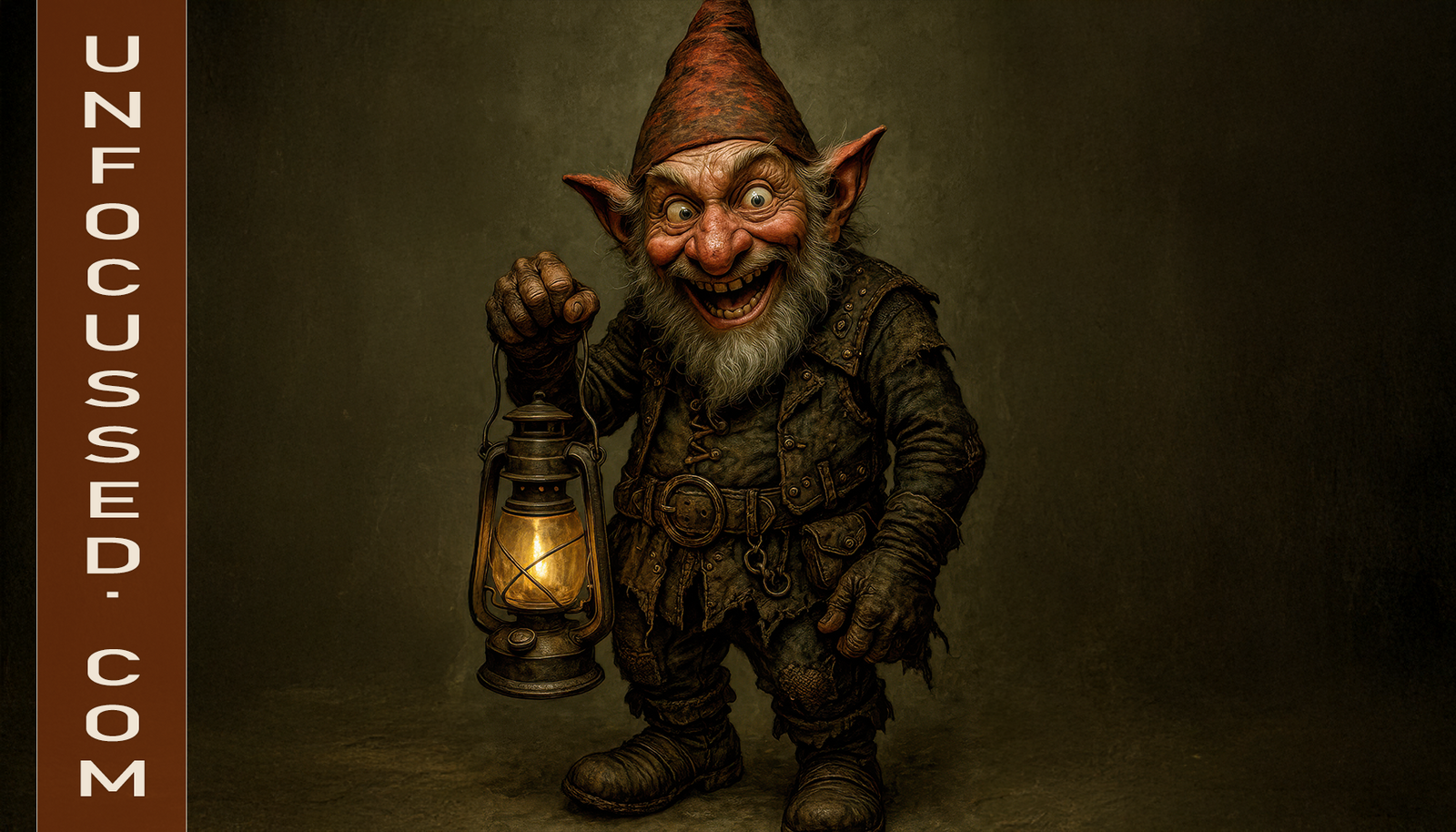
The Lantern-Bearer Appears Everyone in the village of Mirewood knew the rules about the forest. The elders taught them in school, the barkeep scrawled them on the back of ale-stained napkins, and old Grandmother Bipple would shout them at anyone walking too close to the edge of the trees. They were simple rules, easy enough to remember, though most ignored them until it was too late: Never whistle after dark. (It attracts unwanted attention.) Never follow the sound of laughter in the woods. (It is not your friends.) If you see a lantern swaying where no lantern should be—run. Of course, travelers passing through rarely knew these rules. And travelers, being what they are, tended to scoff at local superstition, right until the superstition waddled out of the bushes and introduced itself with a smile wide enough to make their teeth ache. That superstition had a name—or at least several variations of one. Some called him Grimble. Others called him Snagtooth. A few claimed his name was Darryl, but those people had been drinking heavily, and possibly had a habit of naming everything Darryl. Whatever his name, the truth remained: he was a lantern-bearer. Not a guide. Not a helper. Certainly not a friend. A lantern-bearer, and if you saw the light, you were already in trouble. The night our story begins was moonless, the sky clotted with heavy clouds, and the woods darker than the inside of a cow’s belly. A group of weary merchants, their donkeys sagging under bags of turnips, onions, and exactly one barrel of something suspiciously sloshy, were making their way down the Old Hollow Road. Their boots squelched in the mud, their tempers were thin, and their conversation had dwindled to muttered complaints about turnip prices. They didn’t notice it at first. A faint glow, like the last ember of a dying fire, bobbing between the trees. Perhaps it could have been a will-o’-the-wisp, perhaps moonlight glinting off wet bark—but then came the sound. The laugh. Oh, the laugh. It began as a hiccup, as though someone had swallowed a kazoo. Then it rose into a cackle that rattled the leaves, wheezed through the undergrowth, and echoed through the travelers’ bones until their spines tightened like violin strings. It was a laugh that said, Yes, I know exactly where you’re going. And no, you won’t like it when you get there. One of the donkeys brayed nervously. The youngest merchant whispered, “Did you hear that?” The oldest merchant pretended he hadn’t. Denial, after all, was cheaper than therapy. And then— He appeared. A squat figure, not more than four feet tall but twice as broad, stepping out of the trees as though the forest itself had coughed him up. His leather vest looked as though it had been stitched together by someone with poor eyesight and no sense of proportion. His boots sagged, patched so many times they had become more patch than boot. His gloves creaked with grime, and his belt buckle was bent in the shape of something that might once have been a circle. But the merchants weren’t staring at his outfit. They were staring at his face. At the pointed ears sticking out like dagger handles. At the eyes, round and bulging, that glistened with lunatic cheer. At the nose—red, bulbous, the sort of nose that spoke of centuries of bad life choices. And, of course, the mouth. That enormous, horrifying, magnificent mouth that stretched almost ear to ear and revealed a collection of teeth that looked like they had been borrowed from several different species and arranged without a clear plan. He grinned. The lantern in his hand swayed, casting a flicker of golden light that danced across the merchants’ pale, horrified faces. “HA! HA! HA! YOU’RE LOST, AREN’T YA?” The laugh that followed could not possibly have come from a creature of his size. It was thunderous, ridiculous, echoing through the trees like a drunk choir of demons trying to sing sea shanties. One of the donkeys sat down in protest. Another began chewing its reins. The merchants clutched their turnips for moral support. No one moved. The woods seemed to hold its breath. And then, in a voice far too chipper for the situation, the lantern-bearer said: “Don’t worry. I know a shortcut.” The Shortcut Now, in most tales, when a grinning goblin-like stranger pops out of the forest at midnight and offers you a shortcut, the sensible thing to do is refuse, bow politely, and run in the opposite direction until your shoes catch fire. Unfortunately, merchants are not known for their sense of adventure—or their sense of caution. They are, however, known for their greed and impatience. The youngest merchant cleared his throat nervously. “A shortcut, you say?” The lantern-bearer’s grin widened, which seemed medically impossible. “Oh aye. The quickest way to the village. Quick as a hiccup, quicker than a sneeze, quicker than a goose falling down a well.” “Goose falling down a—what?” the eldest merchant asked, eyebrows furrowing like angry caterpillars. The creature blinked at him, expression utterly serious, then threw back his head and howled with laughter so violent his hat nearly flew off. The woods joined in, the echoes clattering through the branches until it sounded as if the forest itself was giggling. That was the trouble with him: once he started laughing, everything laughed. The trees creaked in mirth. The wind wheezed. Even the donkeys let out startled, undignified hee-haws that sounded suspiciously like chuckles. The merchants shivered, because there is nothing more sinister than a donkey laughing at you. Still, the idea of shaving two days off their journey was too tempting. The merchants exchanged glances. Their boots were muddy, their tempers sour, and the barrel of suspiciously sloshy liquid was already half-empty. A shortcut would mean warmth, ale, and safety sooner. Surely, they reasoned, a creature with such excellent comedic timing couldn’t possibly be dangerous. “Lead on, good sir,” the youngest merchant said bravely, though his voice cracked in three different places. “Sir?” The lantern-bearer clutched his chest as if mortally wounded. “Do I look like a sir to you? My dear boy, I’m a professional!” “A professional…what?” the eldest merchant asked suspiciously. “A professional guide of lost things!” the creature bellowed, flourishing the lantern dramatically. “Lost sheep! Lost coins! Lost socks! Lost sense of direction! I find it all. Except virginity. That one tends to stay lost.” The merchants coughed uncomfortably. One donkey snorted. Somewhere in the distance, a crow cawed in disapproval.     And so, against the advice of every folktale ever written, the merchants followed the Lantern-Bearer off the main road. His lantern bobbed ahead of them like a firefly on caffeine, dipping and swaying, sometimes vanishing completely before popping up again with a sudden shout of “BOO!” that made the donkeys fart in terror. The path he led them on was no path at all. It twisted through undergrowth that snagged their clothes, across streams that soaked their boots, and under branches that seemed to duck too late on purpose. Each time they stumbled, each time they cursed, each time they tripped over a log that hadn’t been there a moment before—the Lantern-Bearer laughed. Loud, long, and wheezing, like a broken organ grinder trying to play itself to death. After what felt like hours, the merchants were panting, muddy, and less certain about their life choices. “Are you sure this is shorter?” one muttered. “Shorter than what?” the guide asked innocently, eyes gleaming. “Than the road!” “Oh aye,” he said, beaming. “Shorter than the road. Also shorter than eternity, shorter than a giraffe, shorter than—” he leaned in close, his nose nearly brushing the merchant’s cheek—“shorter than your patience.” He threw back his head and erupted into another gale of laughter. The sound was so loud and so infectious that the merchants found themselves chuckling nervously, then giggling, then outright cackling, though they couldn’t for the life of them explain why. Their laughter tangled with his, until the forest was a roaring carnival of giggles, howls, guffaws, and snorts. It went on and on, until they felt drunk on mirth, lightheaded and dizzy, stumbling through the dark with tears streaming down their cheeks. And then, just as abruptly, the laughter stopped. Silence. Heavy, suffocating silence. The kind of silence that pressed on your ears until you heard your own blood sloshing about like soup in a kettle. The merchants blinked, panting, and realized the lantern-bearer was no longer ahead of them. He was behind them. Grinning. Still. Always grinning. “Now,” he whispered, his voice sharp as a knife scraping bone. “Here we are.” The merchants looked around. They weren’t on a road. They weren’t anywhere near a village. They stood in a clearing ringed by trees with trunks warped and twisted into strange shapes. Knots in the bark seemed to watch them, faces frozen mid-laugh. Roots curled across the ground like skeletal fingers. And in the center of it all was a stone well, old and moss-eaten, its mouth blacker than the night sky. The Lantern-Bearer raised his light. His grin somehow grew wider. “The shortcut,” he declared proudly, “to exactly where you never wanted to be.” And then he laughed again. Louder than ever. The kind of laugh that promised Part Three of this story was going to get much, much worse. The Well of Echoes The clearing held its breath. The merchants stood huddled together, clutching their onions like holy relics, staring at the mossy stone well in the center. The air smelled damp and earthy, with a faint tang of iron, like the forest had been chewing on old nails. Somewhere far above, a crow cawed once, then thought better of it. Silence returned. “Well,” said the eldest merchant, forcing a laugh that sounded more like a hiccup, “thank you for your… services, friend. We’ll just, ah, be on our way now.” The Lantern-Bearer’s eyes bulged wider. His grin twitched. He leaned forward, lantern swinging, until the glow carved strange shadows across his face. “On your way? But you’ve only just arrived. Don’t you want to see what’s inside?” He jabbed a stubby finger toward the well. The moss shivered. The stones groaned as if they remembered something unpleasant. The youngest merchant squeaked. “Inside? No, no, we don’t—no time, really—” “INSIDE!” bellowed the Lantern-Bearer, and his laughter followed, booming, crashing, echoing off the trees until the roots quivered in glee. The merchants covered their ears, but it was no use. His laughter slid into their skulls, rattled around in their brains, and leaked out their noses like smoke. They couldn’t escape it. They couldn’t even think over it. The donkeys brayed in panic, tugging against their reins. One of them backed up, tripped over a root, and landed directly on the barrel of sloshy liquid. The barrel cracked, spilling a stream of something pungent that hissed as it hit the ground. The forest floor slurped it up hungrily, and the trees gave a collective shudder of delight. “Oh, that’s just lovely,” the Lantern-Bearer sighed dreamily, sniffing the fumes. “Reminds me of my childhood. Nothing like a good solvent to bring out the nostalgia.”     The eldest merchant, summoning what little courage remained in his wrinkled bones, stepped forward. “Look here, you little imp. We’ve had enough of your games. We demand—” He didn’t get to finish. The Lantern-Bearer’s lantern flared bright, dazzling white, so bright that the merchants staggered back, shielding their eyes. The clearing seemed to warp. The well stretched taller, wider, its stones groaning, until it loomed like a hungry mouth. From deep within, something shifted. Something giggled. Something very large, very old, and very awake. “You hear it?” whispered the Lantern-Bearer, suddenly quiet, reverent, almost tender. “That’s the Well of Echoes. It collects every laugh ever lost in the woods. Giggles from children who wandered too far. Chuckles from hunters who never came back. Even one or two cackles from priests who really should’ve known better.” The merchants shivered. The sound rose from the well—layered, overlapping laughter, hundreds of voices tangled together, some shrill, some guttural, some hysterical, some sobbing even as they laughed. It wasn’t just noise. It was hungry. The youngest merchant dropped his onion bag. The bulbs rolled across the clearing, tumbling toward the lip of the well. One onion tipped over the edge and fell. For a heartbeat, nothing happened. Then the laughter in the well swallowed it whole with a satisfied burp. “Well,” said the Lantern-Bearer, beaming proudly, “that’s dinner sorted.”     Panic set in. The merchants bolted for the trees, stumbling and shrieking. But no matter which way they ran, the clearing stretched with them. The well remained at the center. The trees curved back, folding the world like a cruel carnival tent. They were trapped inside a joke, and the punchline was coming fast. The Lantern-Bearer danced in circles, swinging his lantern, kicking his stubby legs, howling with mirth. His eyes glittered. His teeth gleamed. His voice rang out like a gleeful executioner. “Don’t you see? You’re part of it now! You came for a shortcut, and you’ll never leave! You’ll laugh, and laugh, and laugh, until there’s nothing left but echoes!” One by one, the merchants began to laugh. First a nervous chuckle. Then a wheeze. Then helpless, roaring hysteria. Their bodies doubled over, their faces twisted, tears streaming. They clutched their sides, unable to breathe, unable to stop. Their laughter tangled with the voices in the well, pulled downward, dragged into the hungry dark until their own echoes joined the eternal chorus. Even the donkeys giggled. A terrible, braying, soul-curdling laughter that would have been funny if it weren’t so horribly wrong. Their reins snapped as they bucked and rolled, their laughter tumbling down into the well, swallowed whole.     At last, silence fell again. The clearing was empty. Only the Lantern-Bearer remained, standing by the mossy stones, lantern glowing faintly gold. He hummed a little tune, tapping his foot, as if nothing strange had happened at all. “Well,” he said cheerfully, glancing around, “that was fun.” He adjusted his hat, burped, and wiped a tear from his bulging eye. “But I do hope the next lot brings better snacks. Onions, really? Pah.” He turned and waddled back into the forest, lantern bobbing. His laughter trailed behind him like smoke, curling through the trees, drifting down the Old Hollow Road toward the next group of travelers who thought superstition was just silly old stories. And the well waited. Always waiting. Hungry for the next laugh in the dark.     Bring the Lantern-Bearer Home (If You Dare) If the tale of Laughter in the Dark tickled your funny bone (or chilled it), you can invite the mischievous Lantern-Bearer into your own world. His eerie grin and glowing lantern live on in a series of high-quality art products—perfect for lovers of spooky whimsy and gothic humor. 🖼️ Framed Prints – Bring his unsettling charm to your walls in a beautifully crafted frame. ✨ Metal Prints – Make his lantern glow even brighter with bold, modern metal finishes. 💌 Greeting Cards – Send a little spooky cheer (and maybe a cackle or two) through the mail. 🔖 Stickers – Add a pop of creepy whimsy to your laptop, journal, or favorite potion bottle. Whichever form you choose, you’ll carry a piece of the Lantern-Bearer’s strange magic with you. Just… be careful when the lights go out. His laugh has a way of finding you.

En savoir plus

Acorn Express Airways

par Bill Tiepelman

Acorn Express Airways

Boarding & Questionable Safety Briefing Sprig Thistlewick, professional optimist and part-time mushroom taxidermist, had finally decided to launch his airline. Not a metaphorical airline. A literal one. His plan was simple: slap a hat on, grab a squirrel, and call it an enterprise. No paperwork, no infrastructure, just raw courage and a complete misunderstanding of physics. Now, to be fair, most gnomes lacked Sprig’s flair for disastrous entrepreneurship. The last time he tried to “modernize” gnome society, he had invented self-heating trousers. Unfortunately, they had worked too well, turning every family dinner into a small bonfire. The squirrels still referred to it as “the Winter of Screams.” And yet here he was, standing in the middle of a mossy runway—a fallen log painted with suspicious white stripes—preparing to launch his greatest venture yet: Acorn Express Airways, offering daily flights to “wherever the squirrel feels like going.” Helix, his squirrel pilot, had not signed a contract. In fact, Helix hadn’t even signed up. He was recruited at acorn-point (which is like gunpoint, but more adorable), bribed with promises of unlimited hazelnuts and a health insurance plan Sprig had scribbled on a leaf. The terms read: “If you die, you don’t have to pay premiums.” Helix considered this generous. The passengers—well, passenger—was also Sprig himself. “Every great airline begins with one brave traveler,” he announced, saluting the trees. “And also, technically, one brave mammal who doesn’t know what’s happening.” Mushrooms leaned out of the underbrush to watch. A pair of hedgehogs sold popcorn. Somewhere, a frog was taking bets. The entire forest knew this flight was a disaster waiting to happen, and they’d canceled their evening plans to spectate. Sprig climbed aboard Helix with all the dignity of a drunk librarian mounting a roller skate. His boots flopped, his beard snagged, his hat got caught on a twig and flung backward like a parachute that gave up halfway through deployment. “Preflight checklist!” he bellowed, gripping Helix’s fur like he was about to wrestle a particularly hairy pillow. “Tail: flamboyant. Whiskers: symmetrical. Nuts: accounted for.” Helix gave him a look. That look squirrels give when they’re not sure whether you’re about to feed them or ruin their entire bloodline. Sprig translated it generously as, “Permission granted.” With a solemn nod, he reached into his pocket and pulled out a rolled-up fern leaf. He cleared his throat and recited the safety briefing he’d written at 3 a.m. while delirious on dandelion wine: “In the unlikely event of a water landing, please scream loudly and hope a duck feels charitable.” “Acorns may drop from overhead compartments. These are for eating, not flotation.” “Please keep your arms and dignity inside the ride at all times.” “If you are seated next to an emergency exit, congratulations, you are also the emergency exit.” Helix twitched his whiskers and launched. Straight up. No runway, no build-up, just boom—vertical takeoff like a caffeinated rocket. Sprig’s scream ricocheted through the branches, equal parts thrill and bowel-loosening terror. Below, the fox ground crew waved fern fronds in professional arcs, guiding their ascent with the exaggerated confidence of someone who had absolutely no idea what air traffic control was. A badger in a neon vest blew a whistle. No one asked why. Through the canopy they burst, slicing through golden beams of morning light. Birds scattered. Leaves tore free. One owl muttered, “Unbelievable,” and went back to sleep. Sprig’s hat flapped behind him like a flag of questionable sovereignty. “Altitude: dramatic!” he shouted. “Dignity: postponed!” The forest below stretched into a dizzying swirl of fantasy woodland art, whimsical forest scene, and enchanted nature waiting to be marketed on Etsy. They whipped past a hawk who gave them the side-eye usually reserved for people who clap when the plane lands. A pair of sparrows debated filing a noise complaint. Helix ignored them all, laser-focused on the thrill of speed and the occasional possibility of spontaneous combustion. Then Sprig saw it: hanging impossibly in midair was a floating brass door, polished to a glow, stamped with an ornate sign: Gate A-Corn. Suspended by nothing, radiating authority, humming with magic, the doorway shimmered with the promise of destinations unknown. Sprig pointed dramatically. “There! First stop on the Acorn Express! Aim true, Helix, and mind the turbulence of existential dread!” Helix tightened his grip on physics, ignored several laws of aerodynamics, and arrowed straight toward the door. The air around them trembled, and Sprig’s grin stretched into the kind of manic expression only found on cult leaders and people who’ve had six espressos on an empty stomach. The adventure had begun, and neither gravity, reason, nor common sense was invited along for the ride.   The Turbulence of Utter Nonsense The brass door grew larger, looming like a bureaucratic nightmare in the middle of open sky. Helix, panting with the ferocity of a squirrel who’d once bitten into a chili pepper by mistake, powered forward. Sprig tightened his grip, shouting into the wind like a prophet who’d just discovered caffeine. “Gate A-Corn, our destiny!” he cried. “Or possibly our obituary headline!” The door creaked open midair. Not swung, not slid—creaked, as though it had hinges in the clouds themselves. From within, light spilled: golden, shimmering, and suspiciously judgmental. A sign above flickered in runes that translated, unhelpfully, to: “Now Boarding Group All.” Sprig adjusted his hat, which had migrated halfway down his back, and yelled at Helix, “This is it! Remember your training!” Helix, who had received no training beyond the words “don’t die,” chirped in squirrel profanity and barreled through. They shot into a void of impossible architecture. Corridors twisted like licorice sticks designed by an angry mathematician. Floors melted into ceilings, which politely excused themselves and became walls. A tannoy voice announced, “Welcome to Acorn Express Airways. Please abandon logic in the overhead compartment.” Sprig saluted. “Already did!” They weren’t alone. Passengers—other gnomes, pixies, at least one surprisingly well-dressed frog—floated in midair, clutching boarding passes made of bark. A centipede in a waistcoat offered complimentary peanuts (which were actually acorns, but the branding department insisted on calling them peanuts). “Can I get you a beverage, sir?” the centipede asked in a customer-service tone that implied violence. Sprig grinned. “Do you have dandelion wine?” “We have water that has looked at wine.” “Close enough.” Helix landed with a clumsy skid on what appeared to be carpeting woven from moss and gossip. A flight attendant—a raven in a bowtie—flapped forward, glaring. “Sir, your mount must be placed in an overhead compartment or under the seat in front of you.” Sprig snorted. “Do you see a seat in front of me?” The raven checked. The seats were currently in rebellion, galloping off toward the emergency exit while singing sea shanties. “Point taken,” the raven said, and handed him a complimentary sick bag labeled ‘Soul Leakage Only’. The tannoy boomed again: “This is your captain speaking. Captain Probability. Our cruising altitude will be approximately yes, and our estimated arrival time is don’t ask. Please enjoy your flight, and remember: if you feel turbulence, it’s probably emotional.” And turbulence there was. The corridor-airplane hybrid jolted violently, tossing passengers like dice in a cosmic gambling hall. A pixie lost her hat, which immediately filed for divorce. A goblin’s lunch turned into a live chicken mid-bite. Helix dug his claws into the moss carpet while Sprig flailed with the elegance of a man fighting off bees at a funeral. “Brace positions!” the tannoy announced. “Or just improvise. Honestly, no one cares.” The turbulence escalated into full chaos. Luggage compartments began spewing secrets: a suitcase burst open, releasing 47 unpaid parking tickets and a raccoon with diplomatic immunity. Another compartment exploded in confetti and existential dread. Sprig clung to Helix, shouting over the din, “THIS IS EXACTLY WHAT I EXPECTED!” which, frankly, made it worse. The gnome’s laughter blended with screams, creating a symphony of woodland absurdity that might’ve impressed Wagner if Wagner had been drunk and concussed. Then came the in-flight entertainment. A giant screen unfolded from thin air, flickering on to reveal a propaganda film: “Why Flying Squirrel Airlines Are the Future.” The narrator’s voice boomed with ominous cheer: “Tired of walking? Of course you are! Introducing high-speed, fur-lined, moderately rabid travel. Our pilots are trained in climbing trees and ignoring consequences. Book now, and you’ll receive a free hat you didn’t want.” Helix stared at the screen, tail twitching furiously. Sprig patted his neck. “Don’t take it personally, lad. You’re the pioneer. The Wright Brother. The… Wright Brother’s pet squirrel.” Helix squeaked indignantly, clearly offended at being demoted to sidekick status in his own narrative. But before Sprig could placate him with a bribe of candied pinecones, the tannoy blared once more: “Attention passengers: we are now entering the Anomalous Weather Zone. Please ensure your limbs are securely attached, and for the love of moss, don’t make eye contact with the sky.” The plane shook like a blender filled with bad decisions. Out the windows (which appeared and disappeared depending on mood), the sky warped into colors usually reserved for lava lamps and regrettable tattoos. Raindrops fell upward. Thunder clapped in Morse code, spelling out rude words. A lightning bolt high-fived another lightning bolt, then turned to wink at Sprig. “Friendly lot,” he muttered, before being slapped across the face by a passing cumulonimbus. The gnome realized this was no ordinary turbulence. This was orchestrated chaos. He sniffed the air. Yes—mischief. Sabotage. Possibly sabotage fueled by mushrooms, but sabotage nonetheless. Somewhere in this nightmare-aircraft, someone wanted them grounded. Literally. Sprig stood, wobbling like a marionette drunk on vinegar. “Helix!” he shouted over the madness. “Plot a course to the cockpit! Someone’s playing games with our lives, and it’s not even us this time!” Helix squeaked in agreement, lunged forward, and tore down the twisting corridor-airplane hybrid like a streak of vengeful fur. Gnomes, frogs, pixies, and at least one confused insurance salesman scattered out of the way. The journey to the cockpit was perilous. They dodged a stampede of seats still singing sea shanties, leapt over a snack cart staffed by an angry beetle demanding exact change, and sprinted through a cabin section where gravity had simply quit its job and gone home. Sprig clung on with the grim determination of a man who knew that heroism and idiocy were separated only by who wrote the history books. His beard streamed behind him like an untrustworthy flag. His heart pounded. The tannoy whispered seductively, “Please don’t die. It’s tacky.” Finally, at the end of a corridor that looped back on itself three times before giving up, they saw it: the cockpit door. Polished brass. Massive. Glowing faintly with the promise of answers. Sprig jabbed a finger toward it. “There, Helix! Destiny! Or perhaps indigestion!” The squirrel squealed, launched himself into a final sprint, and leapt for the handle. And that’s when the door began to laugh.   Cockpit of Chaos & the Final Boarding Call The cockpit door did not just laugh. It guffawed, a deep, rattling belly-laugh that shook the very air around it, as though someone had installed an entire comedy club into its hinges. Sprig froze mid-leap, dangling from Helix’s back like an accessory no one ordered. “Doors don’t laugh,” he muttered. “That’s page one of ‘How to Identify Things That Are Doors.’” Helix squeaked nervously, his tail puffing up like a feather duster in a thunderstorm. The brass rippled, and the handle twisted into a sneering smile. “You’ve come this far,” the door said, voice dripping with smugness. “But no gnome, squirrel, or tragically overdressed woodland creature has ever passed through me. I am the Cockpit Door, Guardian of Captain Probability, Keeper of the Flight Manifest, Judge of Carry-On Liquids!” Sprig puffed up his chest. “Listen here, you smug slab of hinges, I’ve faced trousers that spontaneously combusted and survived the aftertaste of mushroom brandy. I am not afraid of a talking door.” Helix, meanwhile, was quietly gnawing on the corner of the carpeting in stress. The door chuckled again. “To enter, you must answer my riddles three!” Sprig groaned. “Of course. Always three. Never two, never four, always three. Fine. Give me your worst, you squeaky furniture.” Riddle One: “What flies without wings, roars without a throat, and terrifies squirrels at picnics?” Sprig squinted. “That’s easy. Wind. Or my Aunt Maple after three cups of pine needle tea. But mostly wind.” The door shuddered. “Correct. Though your Aunt Maple is terrifying.” Riddle Two: “What is heavier than guilt, faster than gossip, and more unpredictable than your tax returns?” “Obviously time,” Sprig replied. “Or possibly Helix after eating fermented berries. But I’ll stick with time.” The door rattled angrily. “Correct again. But your tax returns remain suspicious.” Riddle Three: “What is both destination and journey, filled with laughter and terror, and only possible when logic takes a day off?” Sprig grinned, his eyes sparkling with manic triumph. “Flight. Specifically, Acorn Express Airways.” The door howled, cracked, and finally swung open with theatrical reluctance. “Ugh. Fine. Go on then. But don’t say I didn’t warn you when the captain gets weird.”     Inside, the cockpit defied comprehension. Buttons grew like mushrooms across every surface. Levers hung from the ceiling, dripping with condensation. The control panel was clearly designed by someone who had once seen an accordion and thought, “Yes, but angrier.” At the center sat Captain Probability, a massive owl wearing aviator goggles and a captain’s hat two sizes too small. His feathers gleamed like spilled ink. His eyes were orbs of mathematics gone rogue. “Ah,” Captain Probability hooted, voice a strange mix of dignified scholar and used-car salesman. “Welcome to my office. You’ve braved turbulence, riddles, and seating arrangements that defy Geneva Conventions. But why are you here? To fly? To question? To snack?” Sprig cleared his throat. “We’re here because the weather tried to eat us, the tannoy keeps flirting with me, and my squirrel has developed PTSD from peanuts.” Helix squeaked agreement, twitching his whiskers like an overstimulated antenna. “We demand answers!” Captain Probability leaned forward, his beak clicking ominously. “The truth is this: Acorn Express Airways is no mere airline. It is a crucible, a test of those who dare to reject the tyranny of logic. Each passenger is chosen, plucked from their quiet woodland lives, and hurled into chaos to see if they will laugh, cry, or order overpriced snacks.” “So it’s a cult,” Sprig said flatly. “Great. Knew it.” “Not a cult,” the owl corrected. “An adventure subscription service. Auto-renews every full moon. No refunds.” The cockpit lurched violently. Outside, the Anomalous Weather Zone roared with renewed fury. Clouds twisted into monstrous faces. Lightning spelled out, “HA HA NO.” The tannoy blared: “Brace yourselves! Or don’t. Honestly, mortality rates are included in the brochure.” Sprig gritted his teeth. “Helix, we’re taking over this flight.” The squirrel squealed, appalled but loyal, and scampered toward the controls. Captain Probability flared his wings. “You dare?” he bellowed. “Do you think you can outfly chaos itself?” “No,” Sprig said, grinning wildly. “But I can ride a squirrel into absolute nonsense, and that’s practically the same thing.”     Chaos erupted. Helix leapt onto the console, paws slamming random buttons with all the subtlety of a drunk orchestra conductor. Sirens wailed. Panels lit up with messages like ‘You Shouldn’t Press That’ and ‘Congratulations, You’ve Opened the Wormhole’. The floor tilted violently, sending Sprig skidding toward a lever labeled “Do Not Pull Unless You’re Feeling Spicy.” Naturally, he pulled it. The plane screamed, reality hiccupped, and suddenly they were no longer in sky or storm—they were in a tunnel of pure absurdity. Colors exploded. Acorns rained sideways. A choir of chipmunks sang “O Fortuna” while juggling flaming pinecones. Captain Probability flailed, hooting in outrage. “You’ll destroy everything!” Sprig whooped with joy, clinging to Helix as the squirrel steered them through collapsing geometry. “DESTROY? NO, MY FEATHERED FRIEND! THIS IS INNOVATION!” He slammed another button. The tannoy moaned sensually. The moss carpeting grew legs and began tap-dancing. Somewhere, a vending machine achieved enlightenment. At the end of the tunnel, a blinding light awaited. Not gentle, hopeful light. Blinding, obnoxious, migraine-inducing light, the kind that suggests a divine being really needs to adjust their dimmer switch. Sprig pointed. “That’s our exit, Helix! Take us home!” Helix gathered every ounce of rodent strength, tail blazing like a comet, and hurled them forward. Captain Probability lunged after them, screeching, “No passenger escapes probability!” But Sprig turned, hat askew, beard wild, and shouted back the most heroic nonsense ever uttered by a gnome: “MAYBE IS FOR COWARDS!”     They burst through the light— —and crash-landed on the forest floor with all the grace of a piano falling down stairs. Birds scattered. Trees groaned. A mushroom fainted dramatically. Sprig staggered to his feet, brushing moss from his beard, while Helix flopped onto his back, chest heaving. Silence reigned for a long moment. Then Sprig grinned, wide and maniacal. “Well, Helix, we’ve done it. We’ve survived the maiden voyage of Acorn Express Airways. I declare it a success!” He raised a triumphant fist, only to immediately collapse on his face. Helix chattered weakly, rolling his eyes. Behind them, the sky shimmered. The brass door flickered, laughed once more, and disappeared into nothing. The forest returned to normal—or at least as normal as a forest gets when one gnome and one squirrel have committed interdimensional hijinks. Sprig groaned, pushed himself upright, and looked at Helix. “Same time tomorrow?” The squirrel slapped him in the face with his tail. And thus ended the first and very possibly last official flight of Acorn Express Airways, an airline that operated for exactly forty-seven minutes, carried exactly one idiot and one reluctant squirrel, and somehow managed to change the fate of woodland absurdity forever.     Bring the Adventure Home If Sprig and Helix’s madcap maiden voyage made you laugh, gasp, or quietly worry about the state of gnome aviation safety, you can keep the magic alive with beautiful products featuring Acorn Express Airways. Perfect for adding whimsy to your space, gifting to a fellow daydreamer, or carrying a little absurd humor into everyday life. Framed Print — Elevate your walls with a polished, ready-to-hang piece that captures the soaring absurdity of Sprig and Helix’s adventure. Canvas Print — Bring texture and depth to your home with this gallery-style print, the perfect centerpiece for a whimsical space. Jigsaw Puzzle — Relive the chaos piece by piece, whether as a solo challenge or with friends who also enjoy gnomish nonsense. Greeting Card — Share a laugh and a touch of woodland magic with someone who could use a smile (or a squirrel-powered airline ticket). Weekender Tote Bag — Whether you’re packing for adventure or just grocery day, this bag lets you carry the absurd whimsy of the Acorn Express with you. Each product is crafted with care and high-quality printing, ensuring that the spirit of Acorn Express Airways shines bright—whether on your wall, your table, or over your shoulder. Because some journeys deserve to be remembered… even the ones powered by squirrels.

En savoir plus

Hammer of the High Skies

par Bill Tiepelman

Hammer of the High Skies

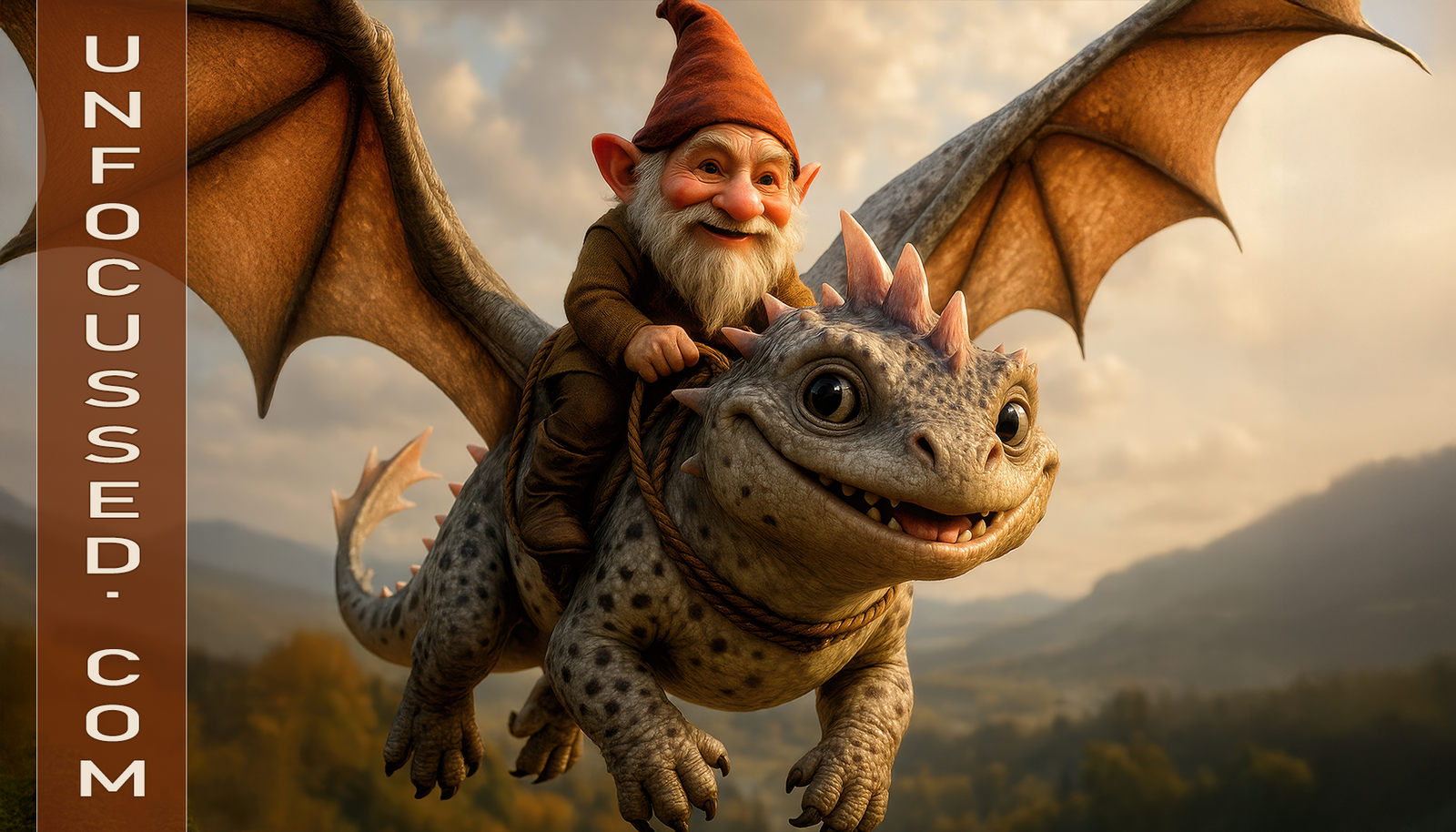
There are rules for gnomes. You don’t speak loudly in public unless you’re selling onions. You don’t drink before noon unless it’s mead (in which case it doesn’t count). And above all else, you don’t—under any circumstances—go around taming dragons. Dragons are for elves with cheekbones sharp enough to slice bread, or for dwarves who can drink molten iron and still belch politely afterward. Gnomes? Gnomes are supposed to tend gardens, paint doorframes cheerful colors, and keep their heads down when giants argue about who owns which mountain. Roderick Bramblehelm had never kept his head down in his life. At forty-three, he had the beard of a prophet, the patience of a mosquito, and the temper of a blacksmith whose anvil had just insulted his mother. He also had a hammer—a proper hammer, not one of those dainty mallets you use to hang shelves. This was forged steel with a handle of oak charred in dragonfire, the kind of hammer that made grown men step out of the way and priests start revising their wills. Roderick didn’t build with it. He didn’t fix with it. He raised it high as a promise to the world: if destiny won’t come knocking, I’ll bash the bloody door down myself. That philosophy is what led him into the Blacktooth Caverns on a storm-sick evening when most gnomes were at home, quietly admiring cabbages. The cavern was rumored to house something ancient and terrible. Villagers swore that every third Tuesday the mountains shuddered from within, as though the stones themselves had indigestion. Chickens went missing. Smoke rose where no fire had been lit. No one dared go inside—no one except Roderick, who had grown tired of hearing the elders whisper, “That one’s trouble,” whenever he entered the tavern. Trouble? He’d show them trouble. He’d show them wings slicing through thunder, jaws dripping with lightning, the kind of spectacle that made people drop tankards and soil breeches simultaneously. He found the beast curled among bones and broken wagons, snoring with the guttural rumble of earthquakes making love. The dragon was smaller than the legends promised, though “smaller” in this case meant only slightly less enormous than a cathedral. Its scales shimmered like wet stone, its horns were twisted corkscrews of ivory, and its teeth gleamed with the confidence of someone who had eaten several knights and found them bland. But the strangest thing of all was its grin—wide, feral, and utterly inappropriate for a creature that could end civilizations. The dragon’s name was Pickles. Roderick didn’t ask why; he suspected the answer would make his brain sprout mushrooms. “Oi, you scaly thunderchicken!” Roderick shouted, raising his hammer until it scraped the cavern roof. “Wake up, your nap’s over. The sky won’t conquer itself.” Pickles opened one saucer-sized eye, blinked once, and then let out a laugh so unholy that several bats dropped dead on the spot. It wasn’t a growl. It wasn’t a roar. It was the sound of madness having a tea party with chaos, and it rattled Roderick’s bones in the most satisfying way. “Finally,” the dragon croaked, its voice thick as burning tar. “A gnome with ambition. Do you know how long I’ve waited for one of you garden-tinkerers to grow a spine?” From that moment, their fates welded together like iron in a forge. Roderick climbed onto the beast’s back as if mounting a stubborn mule, and Pickles—after a ceremonial belch that scorched several stalactites—unfurled wings vast enough to slap the storm outside into submission. Together, they launched into the sky, shredding the night with fire and fury. The villagers of Cinderwhip, still sipping their weak ale and gossiping about the mayor’s suspicious mole, nearly dropped dead when they saw it: a gnome, of all things, astride a dragon the size of their bakery, laughing like a lunatic while waving a hammer that seemed far too big for his tiny arms. Their screams were immediate. Mothers dragged children indoors. Farmers dropped pitchforks. A priest fainted into his own soup. Yet there was no denying the magnificence of the spectacle. Pickles twisted through thunderheads, his wings scattering lightning like spilled jewels, while Roderick howled insults at the very clouds. “Is that all you’ve got?” he shouted into the storm, voice echoing across valleys. “I’ve seen scarier drizzle from a drunk donkey!” He slammed his hammer against his belt for emphasis, each clang like a war drum beating out the end of the old order. No one watching that night would forget it, no matter how hard they prayed. By dawn, the legend of Roderick Bramblehelm and Pickles the Dragon had been born. And legends, as everyone knows, are dangerous things. They don’t just change how others see you. They change what you are, and what you will have to face next. For the skies are never given freely—they are only won, and always at a price. The first night of flight was not graceful. Roderick Bramblehelm clung to Pickles’ scaly back like a barnacle strapped to a cannonball, his hammer raised high mostly because letting go meant falling to a very poetic death. The dragon’s wings pummeled the air with a sound like thunder being beaten into submission, and every dive threatened to eject the gnome into the clouds. But Roderick wasn’t afraid—not exactly. Fear, he’d decided long ago, was just excitement with poor posture. Besides, the view was intoxicating: lightning dancing through clouds, mountains carved in silver by the moon, and entire villages below, blissfully unaware that their future nightmares now came with a beard and a war hammer. Pickles was enjoying himself far too much. “Left, right, barrel roll!” he cackled, throwing his weight into aerial acrobatics that made falcons puke midflight. Roderick’s stomach lurched somewhere behind him, probably in a field. Yet he grinned, teeth bared against the wind, shouting back, “Is this all you’ve got, you overgrown newt? My aunt’s washing line gave me a rougher ride than this!” The insult delighted Pickles. He let out a wheezing, guttural laugh that sent sparks fizzing from his nostrils and set a cloud partially aflame. The cloud did not appreciate this and drifted off sulking, its edges smoldering like a badly rolled cigar. Their aerial chaos could not go unnoticed. By the second dawn, the news of a gnome atop a dragon spread faster than gossip about who’d been caught snogging behind the millhouse. Bards exaggerated, priests panicked, and kings muttered to their advisors, “Surely this is a joke, yes? A gnome? On a dragon?” Entire councils debated whether to laugh, declare war, or drink heavily until the memory passed. But memory does not pass when a dragon and rider scorch their names across the sky. And scorch they did. Their first target, entirely by accident, was a bandit camp nestled in the crook of the River Grell. Roderick had spotted their fire and, assuming it was a tavern, demanded a closer look. Pickles, never one to resist mischief, dove like a plummeting anvil. What followed was less a battle and more an extremely one-sided barbecue. Tents went up like parchment. Bandits screamed, scattering like cockroaches under divine judgment, while Roderick bellowed, “That’ll teach you to overcharge for ale!” He swung his hammer, obliterating a crate of stolen coins, sending silver raining into the dirt like divine confetti. The survivors later swore they had been attacked by the god of drunk lunatics and his pet apocalypse. From there, things escalated. Villages trembled when shadows darkened their skies. Noblemen soiled velvet trousers when Pickles swooped overhead, his grin a banner of impending chaos. Roderick found the whole affair intoxicating. He began inventing speeches to accompany their raids—grand, booming declarations that nobody could actually hear over the roaring wind but which made him feel dramatically important. “Citizens below!” he would shout into the gale, hammer aloft, “Your boring days are at an end! Behold your liberation in flame and glory!” To which Pickles would usually reply with a fart that set passing crows ablaze. Truly, they were poetry incarnate. But legends do not grow without enemies. Soon, the High Council of Stormwright Keep convened in their granite fortress. These were not sentimental people—they were the kind who measured morality in taxes and peace in tidy borders. A gnome with a dragon, unpredictable and ungovernable, was the sort of thing that sent their bowels into parliamentary panic. “This cannot stand,” decreed Archlord Velthram, a man whose face had all the warmth of a salted cod. “Summon the Knights of the Skyward Order. If a gnome believes he can own the clouds, then we shall remind him they are already under lease.” His advisors nodded gravely, though one or two scribbled furiously about whether they should trademark the phrase ‘lease of the skies’ for propaganda posters. Meanwhile, Roderick was utterly unaware that his name had become both battle cry and curse. He was too busy learning the mechanics of dragon flight. “Lean with me, you winged lunatic!” he barked during a sharp dive. “If I’m going to conquer the skies, I’ll not do it looking like a sack of potatoes flopping on your back.” Pickles snorted, amused, and adjusted his trajectory. Slowly, painfully, something resembling teamwork began to emerge from the chaos. Within a fortnight, they could slice through valleys like arrows, loop around storm spires with balletic grace, and terrify migrating geese for sport. Roderick even managed to stay in his saddle without swearing every third word. Progress. Their bond deepened not just through combat but through conversation. Around campfires of stolen logs, Roderick would drink bitter ale while Pickles roasted wild boars whole. “You know,” Roderick mused one night, “they’ll all come for us eventually. Kings, priests, heroes. They can’t stand the thought of a gnome rewriting their stories.” Pickles licked pork grease from his fangs and grinned. “Good. Let them come. I’ve been bored for centuries. Nothing tastes better than righteous indignation served on a silver spear.” And so the legend of Hammer and Dragon grew teeth. Songs carried their deeds across taverns. Children carved crude figures of a gnome with a hammer, standing triumphant atop a smiling beast. Merchants began selling counterfeit ‘dragon-scale charms’ and ‘authentic Bramblehelm beards’ at markets. For every cheer, though, there came a curse. Armies began to march. War horns blew across the realm. In storm clouds above, the first shadows of rival riders began to stir, knights with spears tipped in lightning, sworn to drag Roderick Bramblehelm screaming from the skies. But Roderick only laughed. He welcomed the challenge, hammer flashing in firelight. “Let them come,” he told Pickles, his eyes burning brighter than any dawn. “The skies were never meant for cowards. They were meant for us.” The first war horns sounded at dawn. Not the kind of dawn filled with rosy optimism and cheerful roosters, but the kind of dawn where the sun itself looked nervous about showing up. Across the valleys, banners unfurled—banners of lords, mercenaries, zealots, and anyone who thought killing a gnome on a dragon might look good on a résumé. The skies filled with armored gryphons, hawks so massive they could carry a cow in one talon, and the dreaded Knights of the Skyward Order: riders clad in polished steel, their spears tipped with bottled lightning. Their formation cut across the heavens like a razor. This was not a raid. This was an extermination. Pickles hovered at the edge of a storm, wings half-furled, grinning like a lunatic as always. His laughter boomed, rolling over the land like artillery. “Finally!” he crowed, sparks bursting from his teeth. “A proper audience!” His tail lashed through clouds, thunder growling like a hungry wolf. On his back, Roderick Bramblehelm tightened the straps of his saddle, the hammer across his shoulders heavy with promise. His beard whipped in the wind, his eyes gleamed with manic determination, and his grin matched his dragon’s. “That’s quite the reception,” he muttered. “I almost feel important.” “Almost?” Pickles snorted, then belched out a plume of fire so wide it startled a flock of starlings into immediate retirement. “You’re the most dangerous joke they’ve ever faced, hammer-boy. And jokes, when sharp enough, cut deeper than swords.” The enemy approached in waves. Trumpets shrieked. War drums thundered. Priests hurled curses into the gale, summoning holy fire and divine chains. But Roderick rose in his saddle, raised his hammer high, and bellowed a single word into the storm: “COME!” It wasn’t a plea. It was a command, and even the clouds flinched. The battle exploded like chaos uncaged. Gryphon riders dove, their beasts screaming, claws flashing in the stormlight. Pickles rolled, twisted, snapped one from the sky in his jaws, and spat the armored corpse into a village well three miles below. Roderick swung his hammer with glee, caving helmets, shattering shields, and occasionally smacking an unfortunate gryphon in the backside so hard it changed religions midflight. “Is that all?” he roared, laughter tearing from his throat. “My grandmother wrestled angrier chickens!” The Knights of the Skyward Order were no ordinary soldiers. They flew in flawless formations, their lightning-spears humming with captured storms. One spear struck Pickles square across the chest, sending sparks arcing over his scales. The dragon snarled, more annoyed than hurt, and let out a roar that cracked stone bridges below. Roderick nearly lost his grip, but instead of fear, his heart flooded with exhilaration. This was it—the storm he was born for. “Pickles!” he yelled, hammer aloft, “Let’s show these tin-plated pigeons how a gnome rewrites the sky!” What followed was not a battle. It was an opera of annihilation. Pickles spun through clouds, wings slicing wind into deadly vortices. His laugh—half shriek, half thunder—rolled over the field like doom itself. Roderick moved with lunatic precision, his hammer striking like punctuation in a poem written in blood and fire. He shattered the spear of one knight, dragged the rider from his saddle, and hurled him screaming into a thunderhead. Another knight lunged, only to find himself clotheslined by a gnome’s steel hammer in midair, which by all accounts should have been physically impossible. But legends care little for physics. Below, villagers stared upward, their lives frozen mid-task. Some prayed, some wept, some cheered. Children laughed at the absurdity of it—a tiny gnome slaying sky-knights while a dragon with a grin wider than the horizon shrieked in joy. Farmers swore they saw the gnome raise his hammer and strike lightning itself, splitting it into fragments that rained like molten silver. Entire churches would later form around the event, declaring Roderick Bramblehelm a prophet of chaos. Not that he’d ever attend a service. He thought sermons were dull unless someone caught fire halfway through. But legends always demand a price. The Archlord himself entered the fray atop a beast bred from nightmares—an obsidian wyvern, armored in spiked steel, eyes like black suns. Velthram was no fool. He carried no ordinary spear but the Spear of Dawnsbane, forged in storms older than empires, designed for a single purpose: killing dragons. His arrival hushed the battle for a breathless instant. Even Pickles’ grin faltered. “Ah,” the dragon hissed. “Finally, someone worth burping on.” The clash was cataclysmic. The wyvern slammed into Pickles midflight, talons tearing scales, tail smashing like a spiked whip. Roderick nearly flew from the saddle, clinging by one strap as the world spun into fire and shrieking metal. Velthram thrust the Dawnsbane, the spear’s lightning kissing Pickles’ ribs, carving a searing wound. The dragon roared in pain, fire exploding from his lungs, engulfing three unfortunate knights who had wandered too close. Roderick, dangling by one arm, swung his hammer with all the fury in his tiny body, smashing against Velthram’s armored face. The Archlord snarled, blood spraying, but did not fall. The battle raged across miles of sky. Villages below quaked as dragon and wyvern crashed through storm fronts, their roars louder than earthquakes. Roderick screamed insults with each swing—“Your wyvern smells like boiled cabbage!”—while Velthram countered with the cold silence of a man who hadn’t laughed since birth. Sparks rained, wings clashed, the very clouds tore apart beneath their fury. Finally, in a moment carved from madness, Roderick stood on Pickles’ neck, hammer raised, as the wyvern lunged in for the kill. Time slowed. The world held its breath. With a howl that shook heaven itself, Roderick leapt. He soared through the air—gnome beard streaming, hammer ablaze with stormlight—and brought it down upon Velthram’s spear. The impact cracked the Dawnsbane in two, thunder exploding outward in a wave that sent gryphons spiraling, shattered church bells across the realm, and split the storm into shreds of brilliant fire. Velthram, stunned, toppled from his saddle, his wyvern shrieking in panic as it dove to catch him. The sky was theirs. Pickles bellowed triumph, a laugh so wild it made the storm itself shudder into retreat. Roderick landed hard on his dragon’s back, barely clinging, lungs burning, body battered, but alive. Alive, and victorious. His hammer, cracked but unbroken, pulsed in his hands like a heartbeat. “That,” he rasped, spitting blood into the wind, “is how a gnome writes history.” The armies broke. The knights fled. The Council’s banners burned. Songs would be sung for centuries about the day a gnome and his dragon claimed the heavens. Some would call it madness. Others would call it legend. But for those who saw it with their own eyes, it was something greater: proof that the skies belonged not to kings, nor gods, nor armies, but to those mad enough to seize them. And so Roderick Bramblehelm and Pickles the Dragon carved their names into eternity, not as tyrants or saviors, but as chaos given wings. The hammer had fallen, the skies had been conquered, and the world—forever after—looked up in both terror and awe, waiting for the next roar of laughter to roll across the clouds.     Bring the Legend Home The tale of Roderick Bramblehelm and Pickles the Dragon doesn’t have to stay in the clouds. You can capture their chaos, triumph, and laughter in your own space. Hang their storm-scorched glory on your wall with a framed print or let the legend breathe boldly across a canvas that commands the room. Carry their madness wherever you go with a spiral notebook for your own daring plans, or slap their fearless grin onto your favorite surface with a battle-ready sticker. The skies may belong to legends, but the art can belong to you.

En savoir plus

Tooth & Twinkle

par Bill Tiepelman

Tooth & Twinkle

The Recruitment of Reginald Reginald the Gnome had always considered himself something of a specialist in doing as little as possible with as much flair as possible. While other gnomes were busy tending gardens, crafting fine tools, or running suspiciously profitable mushroom ale distilleries, Reginald preferred reclining beneath a toadstool, puffing on a pipe filled with herbs of questionable legality, and sighing dramatically whenever anyone asked him for help. His philosophy was simple: the world had more than enough heroes and martyrs, but a true master of loafing was a rare and valuable treasure. At least, that’s what he told himself as he dodged responsibility with the skill of an Olympic-level tax evader. So when a crooked-nosed wizard named Bartholomew appeared in his front yard one gray morning, waving a staff and muttering about “destiny” and “chosen companions,” Reginald naturally assumed he was being scammed. “Listen,” Reginald had said, clutching his tea with both hands, “if this is about signing me up for some ‘hero’s guild,’ forget it. I don’t do quests. I don’t fetch, I don’t fight, and I certainly don’t wear tights.” Bartholomew had only grinned in that unnerving way people do when they know something you don’t — or worse, when they think they’re funny. Before Reginald could protest further, the wizard had clapped his hands, shouted something about contracts, and introduced him to a creature that would change his life in ways he was not remotely ready for. Enter Twinkle: a baby dragon with eyes the size of soup bowls, wings like oversized laundry sheets, and the perpetually gleeful smile of a drunk bard who has just discovered free ale night. Twinkle’s scales shimmered faintly under the sun — not glittering like diamonds, but with the humble shine of a well-oiled frying pan. He was, in short, both ridiculous and terrifying. Reginald, on first sight, had uttered the words: “Absolutely not.” “Absolutely yes,” Bartholomew countered, already strapping a rope harness around the dragon’s chest. “You’ll fly together, bond together, and save something or other. Don’t worry about the details. Quests always sort themselves out in the middle. That’s the magic of narrative structure.” Now, Reginald was no scholar, but he knew when he was being railroaded into a plotline. And yet, despite all his protests, he found himself — ten minutes later — airborne, screaming into the wind as Twinkle flapped with all the grace of a goat learning ballet. The ground dropped away, and the landscape unfurled like a painted scroll beneath them: forests, rivers, hills, and, somewhere in the distance, the faint twinkle (no relation) of civilization. Reginald’s stomach, however, refused to be impressed. It preferred to lurch violently, reminding him that gnomes were creatures of burrows and soil, not open skies and feather-brained wizards. “If I fall to my death, I swear I will come back as a poltergeist and knock over all your soup pots,” Reginald bellowed, his voice whipped away by the wind. Twinkle turned his head slightly, flashing that infuriating, wide-mouthed grin that revealed rows of tiny, pearly teeth. There was no malice in it — only joy. Pure, unfiltered, puppy-like joy. And that, Reginald decided, was the most unsettling thing of all. “Stop smiling at me like that,” he hissed. “You’re not supposed to enjoy being the harbinger of doom!” The dragon’s wings dipped, then rose sharply, sending Reginald bouncing in the harness like a sack of turnips strapped to a catapult. He cursed in three languages (four, if you count the dialect of muttered gnomish reserved specifically for complaining). His hat nearly flew off, his beard whipped about like tangled yarn, and his grip on the rope tightened until his knuckles resembled pearl buttons. Somewhere in the back of his mind, he realized he had forgotten to lock his cottage door. “Brilliant,” he muttered. “I’ll come home to find raccoons playing cards in my kitchen. And if they’re anything like last time, they’ll cheat.” But for all his bellyaching, Reginald couldn’t entirely ignore the thrill crawling along his spine. The world below, usually so stubbornly out of reach, now lay like a map spread at his feet. The clouds parted, the sun caught Twinkle’s wings, and for one brief, treacherous moment, he felt something disturbingly close to… wonder. Of course, he smothered the feeling immediately. “Wonder is for poets and lunatics,” he said aloud, mostly to reassure himself. “I am neither. I am a sensible gnome in a highly insensible situation.” Twinkle, naturally, ignored him. The dragon flapped harder, dove with terrifying speed, then swooped upward in a maneuver that would have impressed any respectable knight but only made Reginald wheeze like an accordion dropped down a staircase. “By the beard of my ancestors,” he gasped, “if you break my spine, I will haunt you so relentlessly you’ll never nap again.” Twinkle chirped — yes, chirped — as though to say, deal. And so, the unlikely duo carried on: one gnome with the permanent expression of a man regretting all his life choices, and one dragon with the demeanor of an overeager puppy who had just discovered the concept of air travel. Together, they cut across the sky — not gracefully, not even competently, but loudly and with far too much enthusiasm from one side of the partnership. Reginald clung to the harness, muttering darkly, “This is how legends start: with someone else’s bad idea and my unpaid labor. Typical.” The Perils of Mid-Air Hospitality Reginald had always believed that traveling should involve two essential comforts: steady ground beneath one’s feet and a flask of something strong enough to burn regrets out of the bloodstream. Unfortunately, flying on the back of Twinkle offered neither. His backside was already numb, the rope harness dug into his ribs like a debt collector, and the flask he’d hidden in his pocket had sprung a leak sometime between the second nosedive and the third death spiral. The scent of elderberry brandy now drifted in the air behind them, forming a fragrant trail that would have made bees and bandits alike giddy. “Lovely,” he muttered, wringing out his sleeve. “Nothing says ‘professional adventurer’ like reeking of spilt liquor before the first crisis.” Twinkle, naturally, was having the time of his life. He banked, spun, and chirped in that oddly musical way, as though he were hosting an aerial cabaret. Reginald clutched the ropes tighter, his teeth rattling so hard they could’ve been used as castanets. “I know you think this is fun,” he grumbled into the wind, “but some of us are not equipped for spontaneous air acrobatics. Some of us have delicate spines, weak constitutions, and, might I remind you, absolutely no wings.” The dragon ignored him, of course, but Reginald wasn’t entirely alone. As they soared past a flock of geese, one particularly bold bird flew alarmingly close to Reginald’s face. He swatted at it half-heartedly. “Shoo! I don’t have time for avian harassment. I’m already being chauffeured by a reptilian maniac.” The goose honked indignantly, as if to say, your fashion sense offends us all, short one, before veering back to its flock. “Yes, well, take it up with the wizard,” Reginald snapped. “He’s the one who dressed me like a potato sack escaped from the laundry line.” As if things weren’t humiliating enough, Twinkle suddenly let out a sound suspiciously like a growling stomach. Reginald froze. “No,” he said firmly. “Absolutely not. We are not mid-flight snacking, not unless you’ve brought your own sandwiches.” Twinkle burbled happily and banked toward a small plateau sticking out of the forest below, wings flaring in what Reginald instantly recognized as the international signal for picnic landing. The dragon swooped down, wobbling slightly on his descent, and touched down with all the grace of a sack of flour being dropped from a barn roof. Reginald’s bones clattered, his beard went sideways, and when the dust settled, he slid off the dragon’s back like an exhausted potato peel. “Congratulations,” he wheezed. “You’ve invented the world’s least comfortable carriage ride.” Twinkle, meanwhile, sat happily on his haunches, panting like a dog and staring expectantly at Reginald. The gnome raised one bushy eyebrow. “What? You think I packed snacks? Do I look like your personal caterer? I barely remember to feed myself, and half the time that involves moldy bread and regret soup.” Twinkle tilted his enormous head, blinked twice, and let out the faintest, most pitiful whine imaginable. “Oh no,” Reginald groaned, covering his ears. “Don’t you dare weaponize cuteness against me. I have survived decades of guilt-tripping aunties and manipulative raccoons. I am immune.” He was not immune. Ten minutes later, Reginald was rooting around in his satchel, producing the sad remnants of his travel supplies: two crumbling biscuits, half a wheel of suspiciously sweaty cheese, and what might once have been an apple before time and neglect transformed it into a small weapon. Twinkle eyed the pile with such radiant joy you’d have thought Reginald had conjured a feast of roasted boar and honeycakes. “Don’t get too excited,” Reginald warned, snapping the apple in half and tossing it at him. “This is barely enough to feed a hungry hamster. You, meanwhile, are the size of a hay wagon.” Twinkle swallowed the apple whole, then burped, sending out a puff of smoke that singed the tips of Reginald’s beard. “Marvelous,” the gnome grumbled, patting out the sparks. “A flying furnace with indigestion. Just what I needed.” They sat in uneasy companionship on the plateau for a while. Twinkle gnawed happily on the stale cheese, while Reginald stretched his aching legs and muttered about how retirement had been within reach just yesterday. “I could be in my burrow right now, sipping tea, playing cards with badgers, and listening to the rain,” he complained to no one in particular. “Instead, I’m babysitting a dragon with the digestive habits of a goat.” Twinkle, finished with the cheese, scooted closer and nudged him with his snout, nearly knocking him into the dirt. “Yes, yes, I like you too,” Reginald said reluctantly, rubbing the dragon’s nose. “But if you keep looking at me like I’m your replacement mother, I’m buying you a nanny goat and calling it a day.” Before he could say more, the sky above them shifted. A shadow swept across the plateau, long and ominous. Reginald froze, squinting up. It wasn’t a cloud. It wasn’t a bird. It was something far larger, something with wings so vast they seemed stitched from night itself. Twinkle froze, too, his goofy grin vanishing, replaced by a wary flick of his tail. “Oh, splendid,” Reginald muttered, standing slowly. “Because what this day was missing was a larger, scarier dragon with a possible appetite for gnomes.” The shadow circled once, twice, and then descended in a slow, predatory spiral. Reginald felt the hairs on his neck bristle. He gripped the harness rope still dangling from Twinkle’s chest and whispered, “If this ends with me being swallowed whole, I just want it noted that I was right all along. Adventure is a racket.” Twinkle crouched, wings twitching, eyes wide, caught somewhere between terror and excitement — the look of a child about to meet a relative who may or may not bring candy. Reginald patted his scaly companion nervously. “Steady now, lad. Try not to look edible.” The massive figure landed with a ground-shaking thud just ten yards away. Dust billowed, pebbles rattled, and Reginald’s heart sank. Before him stood a dragon four times Twinkle’s size, scales black as obsidian, eyes glowing like molten gold. Its wings folded neatly with the calm precision of someone who knew they were in charge of every living thing within five miles. The elder dragon lowered its head, nostrils flaring as it sniffed Reginald first, then Twinkle. Finally, with a voice that rumbled like distant thunder, it spoke: “What… is this?” Reginald swallowed hard. “Oh, wonderful. It talks. Because it wasn’t intimidating enough already.” He straightened his hat, cleared his throat, and replied with all the bravado he could fake: “This is, uh… an apprenticeship program?” The Audition for Disaster The elder dragon’s molten eyes narrowed, flicking from Reginald to Twinkle and back again, as though trying to decide which looked more ridiculous. “An apprenticeship program,” it repeated, every syllable rumbling deep enough to rearrange Reginald’s organs. “This… is what the world has come to?” Reginald, being a gnome of resourceful cowardice, nodded vigorously. “Yes. That’s exactly it. Training the next generation. All very official. You know how it is — forms to fill, waivers to sign, nobody wants liability these days.” He gave a little laugh that sounded more like a cough, then glanced sideways at Twinkle, who wagged his tail like an overexcited puppy. “See? Enthusiastic recruit. Very promising. Could probably roast marshmallows with minimal collateral damage.” The elder dragon leaned in closer, nostrils flaring. The blast of hot breath nearly flattened Reginald’s beard. “This hatchling is weak,” it growled. “Its flame is untested. Its wings are clumsy. Its heart…” The golden eyes locked on Twinkle, who, instead of cowering, belched out a puff of smoke that came with a faint squeak — like a kettle left too long on the stove. The elder dragon blinked. “Its heart is absurd.” Reginald threw his arms wide. “Absurd, yes! But in an endearing way. Everyone loves absurd these days. It sells. Absurdity is the new black, haven’t you heard?” He was stalling, of course, desperately trying to keep from being fried, stomped, or eaten. “Give him a chance. He just needs… polish. Like an uncut gem. Or an un-housebroken goat. You know, potential.” The elder dragon tilted its massive head, clearly amused by the spectacle. “Very well. The hatchling may prove itself. But if it fails…” The golden eyes fixed on Reginald, glowing hotter. “…you will take its place.” “Take its place where?” Reginald asked nervously. “I should warn you, I’m not very good at laying eggs.” The elder dragon did not laugh. Dragons, it seemed, had a limited appreciation for gnomish humor. “There is a trial,” it rumbled. “The hatchling will demonstrate courage in the face of peril.” Its massive wings unfurled, blotting out the sun, before beating downward in a gale that nearly knocked Reginald on his backside. “Follow.” “Oh, splendid,” Reginald muttered, clambering back onto Twinkle with all the grace of a sack of disgruntled potatoes. “We’re off to prove your worth in some arbitrary dragon hazing ritual. Don’t worry, I’ll just be over here quietly dying of anxiety.” Twinkle chirped cheerfully, as if volunteering for a carnival ride. The trial site turned out to be a canyon split so deep into the earth that even sunlight seemed afraid to enter. The elder dragon landed on one side, its wings stirring whirlwinds of dust, while Reginald and Twinkle teetered on a narrow outcropping across the gap. Between them stretched a rope bridge so rickety it looked like it had last been maintained by squirrels with a death wish. “The hatchling must cross,” the elder dragon declared. “It must reach me, though the winds will fight it.” Reginald peered over the edge of the canyon. The abyss seemed bottomless. He could practically hear his ancestors shouting, we told you not to leave the burrow! He turned to Twinkle, whose wide grin had dimmed into something halfway between nervousness and excitement. “You realize,” Reginald said, adjusting his hat, “that I am not built for inspirational speeches. I don’t do ‘you can do it.’ I do ‘why are we doing it at all.’ But here we are. So… listen carefully. Do not look down, do not sneeze fire at the ropes, and for the love of all that is unholy, do not grin so hard you forget to flap.” Twinkle chirped, then waddled onto the bridge, the ropes creaking ominously under his weight. Reginald, of course, had no choice but to follow, clutching the ropes as though they were his last tether to sanity. The wind howled, tugging at his beard and hat, and somewhere far below came the echoing cackle of something that very much wanted to see them fall. “Perfect,” he muttered. “The canyon comes with an audience.” Halfway across, disaster struck — naturally, because stories thrive on disaster. A sudden gust of wind roared up, twisting the bridge so violently that Reginald found himself dangling sideways like laundry on a line. Twinkle screeched, flapping frantically, wings smacking against the canyon walls. Reginald yelled, “Flap UP, you lunatic, not SIDEWAYS!” Somehow — through sheer stubbornness and a good deal of physics-defying nonsense — Twinkle found his rhythm. He steadied himself, wings catching the air just right, propelling him forward with a grace that surprised even him. Reginald clung to the dragon’s harness, eyes squeezed shut, muttering every prayer he could remember and several he invented on the spot. (“Dear whoever runs the afterlife, please don’t assign me to raccoon duty again…”) At last, they reached the far side, tumbling into the dust at the elder dragon’s feet. Reginald lay on his back, gasping like a fish left out of water. Twinkle, on the other hand, puffed proudly, chest swelling, tail wagging like a flag of victory. The elder dragon studied them in silence, then let out a low rumble that might almost have been… approval. “The hatchling is reckless,” it said. “But brave. Its flame will grow.” A pause. “And the gnome… is irritating. But resourceful.” Reginald sat up, brushing dirt from his beard. “I’ll take that as a compliment, though I notice you didn’t say handsome.” The elder dragon ignored him. “Go. Train the hatchling well. The world will need such absurd courage sooner than you think.” With that, the great wings unfurled again, carrying the elder dragon skyward, its shadow shrinking as it vanished into the clouds. Silence settled over the canyon. Reginald glanced at Twinkle, who beamed at him with uncontainable joy. Against his better judgment, the gnome chuckled. “Well,” he said, adjusting his hat, “looks like we didn’t die. That’s new.” Twinkle nuzzled him affectionately, nearly knocking him over again. “Fine, fine,” Reginald said, patting the dragon’s snout. “You did well, you ridiculous furnace. Perhaps we’ll make something of you yet.” They climbed back onto the harness. Twinkle leapt into the air, wings beating steadily now, confidence growing with each flap. Reginald clutched the ropes, grumbling as usual, but this time there was the faintest trace of a smile hiding in his beard. “Adventure,” he muttered. “A racket, sure. But maybe… not entirely a waste of time.” Below them, the canyon faded into shadow. Ahead, the horizon stretched, wide and waiting. And somewhere in the distance, Reginald swore he could already hear the wizard laughing. “Bartholomew,” he muttered darkly. “If this ends with me fighting trolls before breakfast, I’m sending you the bill.” Twinkle chirped brightly, banking toward the sunrise. Their absurd journey had only begun.     Bring a piece of "Tooth & Twinkle" into your own world. Reginald and Twinkle’s absurd, sky-high adventure doesn’t have to live only in words — you can capture the whimsy, the humor, and the magic in your home. Whether you want to hang their tale on your wall, piece it together slowly, or send a little joy in the mail, there’s a perfect option waiting for you: Framed Print – Add character and charm to any room with this enchanting artwork, ready to hang and brimming with storybook spirit. Acrylic Print – Bold, glossy, and luminous, perfect for showcasing every detail of Reginald’s exasperation and Twinkle’s irrepressible grin. Jigsaw Puzzle – Relive the adventure piece by piece, with a puzzle as whimsical (and occasionally frustrating) as the journey itself. Greeting Card – Send a smile, a laugh, or a spark of magic to someone you love — Reginald and Twinkle make unforgettable messengers. Sticker – Take the absurdity with you anywhere: laptops, water bottles, journals — a little dragon-fueled cheer for everyday life. However you choose to enjoy it, “Tooth & Twinkle” is ready to bring a dash of adventure and humor to your day. Because every home — and every heart — deserves a touch of the ridiculous.

En savoir plus

The Acorn Avenger

par Bill Tiepelman

The Acorn Avenger

The Gnome, The Nut, and the Nonsense Somewhere in the leafy middle of nowhere, between the edge of “don’t go in there” and “oh hell, why did we come in here,” lived a legend. Not a tall legend. Not even an average-sized legend. No, this one came in just under three feet if you didn’t count the hat. And you had to count the hat, because it was about the only thing that gave him presence. He was The Acorn Avenger, and if you were expecting heroics involving dragons, maidens, or great bloody quests, you’ve come to the wrong wood. This was a gnome whose most daring battle to date had been against indigestion. But oh, did he strut. Bark armor clanked around his stubby frame like an overenthusiastic child wearing too many Lego pieces, while his face—ruddy cheeks, twinkling eyes, and a beard the exact shade of spilled cream ale—beamed with dangerous self-confidence. On his chest, slung by ropes that looked like they’d been borrowed from an old clothesline, bounced his closest companion: Nibbs the Acorn. And no, not just an ordinary acorn. Nibbs had a face. A wide-eyed, perpetually startled, wooden face. Worse yet, it talked sometimes. Or sang. Or squeaked. Depending on the mood. The locals called it cursed. The Avenger called it “backup vocals.” On this particular morning, The Acorn Avenger was stomping through the forest with the air of someone who believed the trees were secretly applauding him. His boots squelched in the mud, his bark armor creaked like an old door hinge, and Nibbs bounced merrily with every step. “Onward, noble steed!” he shouted at no one, since he owned no horse and was, in fact, simply walking. “I don’t think I like being referred to as a steed,” Nibbs muttered. His voice was somewhere between a kazoo and a squeaky drawer hinge. “I’m more of a sidekick. Or a tambourine.” “Sidekicks don’t usually hang off my sternum,” the Avenger replied, puffing his chest proudly. “Besides, you’re lucky. Some gnomes lug around pocket watches. Or shovels. You get to be the chosen nut.” “You say that like it’s a promotion,” Nibbs grumbled, then fell silent as a squirrel scampered past. The squirrel gave them both the kind of side-eye usually reserved for drunk relatives at weddings. You see, the animals of the forest had learned to endure The Acorn Avenger. He wasn’t malicious. He wasn’t cruel. He was just… loud. He once spent three consecutive nights challenging owls to staring contests. He accused raccoons of plotting against him because they wore “bandit masks.” And once, he drew his bark sword against a deer, declaring, “Unhand the grass, villain!” The deer continued chewing and, as expected, won the duel by default. Still, the gnome was tolerated. Mostly. Until the mushrooms began to organize. But I’m getting ahead of myself. That morning, the Avenger climbed atop a mossy rock, striking what he believed to be a heroic pose. His hat drooped left in protest, but otherwise it was magnificent. “Hear me, Whispering Wood!” he cried, his voice echoing weakly through the mist. “I am the Acorn Avenger, defender of twigs, scourge of beetles, the bane of damp socks, and—most importantly—the only one here with a musical nut!” Nibbs squeaked like a deflating balloon to punctuate the moment. Somewhere in the underbrush, a rabbit muttered something rude in Lapine. Birds ruffled their feathers and muttered to each other like gossipy grandmothers. Even the trees seemed unimpressed. But The Acorn Avenger didn’t notice—or chose not to. Confidence, after all, is the art of ignoring reality with enthusiasm. “Adventure awaits, Nibbs!” he boomed, hopping off the rock and immediately landing ankle-deep in a puddle. Bark armor is not waterproof. He squelched forward anyway, determined. “Today, destiny calls!” “Destiny sounds damp,” Nibbs said dryly. “And smells like wet bark.” “Nonsense,” the Avenger snapped. “Destiny smells like victory! And perhaps roasted chestnuts. But mostly victory!” They trudged deeper into the forest, unaware that something small, spongy, and deeply offended was already watching them from the shadows. Something that had had enough of his nonsense. Something… fungal. The Fungus Among Us Every great hero has a nemesis. Achilles had Hector. Sherlock had Moriarty. The Acorn Avenger? Well, he had mushrooms. Yes, mushrooms. Don’t laugh—it’s terribly rude. These weren’t your harmless “toss them on pizza” kind of mushrooms. These were the puffed-up, resentful, perpetually damp kind, with little round heads and a grudge against anyone who stepped on them (which, in fairness, the Avenger did frequently and with dramatic flair). Our gnome had a habit of kicking at toadstools whenever he wanted to “make an entrance.” He once leapt from behind a log shouting “Prepare to be astonished!” and stomped squarely onto a mushroom ring, scattering spores everywhere. To him, this was harmless fun. To the fungi, it was an act of war. And fungi, unlike squirrels or deer, didn’t forget. They multiplied. They whispered in damp corners. They waited. On this damp morning, as the Avenger sloshed deeper into the trees, an entire conclave of mushrooms gathered in the shadows. Puffballs, shiitakes, chanterelles, even a terrifyingly pompous porcini—all arranged in a circle that looked suspiciously like a committee meeting. Their leader, a massive, sulking morel with a voice like wet corduroy, cleared his nonexistent throat. “The gnome must go.” Gasps echoed around the ring. A portly button mushroom fainted. A deadly-looking Amanita tried to clap but succeeded only in wobbling. “He mocks us,” the morel continued, darkly. “He tramples our rings. He spreads our spores without consent. Worst of all, he makes jokes about ‘mushroom puns.’” The mushrooms shuddered collectively. One piped up timidly: “But… what if he’s the chosen one? You know, foretold by the prophecy?” “Prophecy?” the morel snapped. “That was just graffiti on the side of a log. It said ‘Fun Guys Rule.’ It wasn’t divine, it was vandalism.” Meanwhile, blissfully unaware of the fungal plot, The Acorn Avenger continued tromping through the wood, narrating loudly to himself like a bard who’d been fired for excessive enthusiasm. “Mark my words, Nibbs, today we shall encounter great peril, test our courage, and maybe—just maybe—find that legendary tavern with the half-priced mead pitchers!” “I’d settle for finding a towel,” Nibbs muttered, still squeaky with damp. The gnome paused. “Do you hear that?” “Hear what?” “Exactly. Silence. Too silent. The kind of silence that suggests dramatic tension.” He narrowed his eyes. His bark armor groaned like a cranky chair. “This can only mean one thing… ambush.” Of course, he was correct. But not in the way he thought. He expected goblins, maybe wolves, possibly tax collectors. What he got was… mushrooms. Dozens of them. They emerged slowly from the underbrush, wobbling like damp cupcakes, forming a circle around him. Some glowed faintly. Some spat spores into the air like smoke bombs. It was less intimidating than the Avenger’s imagination had promised, but still—he had to admit—eerily organized. “Oh no,” Nibbs groaned. “Not them again.” “Aha!” The Avenger puffed out his chest. “Villains! Foes! Fungus fiends!” He raised his barky fist. “You dare stand against the Acorn Avenger?” “We dare,” said the morel leader, his voice damp and gurgling, like soup simmering resentfully. “We are the Mycelium Collective. And you, sir, are a menace to soil stability, spore sovereignty, and good taste in general.” “I’ll have you know I am beloved by all creatures of the forest!” The Avenger shouted, though the birds, squirrels, and one deeply unimpressed fox nearby rolled their eyes in unison. “Beloved?!” scoffed the Amanita, wobbling forward dramatically. “You’ve urinated in no fewer than three fairy rings.” “That was ONE TIME!” the Avenger shouted. “And technically, twice. But who keeps count?” “We do,” the mushrooms intoned together. It was like a choir of damp towels. Nibbs sighed. “You’ve really done it now. You don’t anger mushrooms. You don’t mock mushrooms. And above all, you don’t step on mushrooms. You should’ve known better. You’re basically at war with a salad bar.” “Silence, acorn!” the morel roared. “You, too, are complicit. You hang upon the chest of this fool, squeaking your support.” “Oh, don’t drag me into this,” Nibbs snapped. “I’ve been trying to unionize for years. He doesn’t listen.” The Avenger gasped. “Unionize? You… you traitor!” Before Nibbs could respond, the mushrooms began to advance. Slowly, yes, because they were mushrooms and their legs—well, they didn’t technically have legs, but they sort of shuffled in a way that implied locomotion. Still, there were many of them, and they encircled the gnome with grim determination. Spores drifted into the air, glowing faintly in the morning light. It looked less like a battle and more like an aggressively weird festival. “This is your end, Acorn Avenger,” the morel declared. “The forest will no longer suffer your antics. Prepare to be… composted.” The Avenger tightened his fists, bark creaking. His hat twitched heroically in the breeze. “Very well. If it is war you want, it is war you shall have.” He grinned madly. “I’ll make mulch of the lot of you!” “That’s a terrible pun,” Nibbs whispered. “Please don’t say that again.” And with that, the battle of gnome versus fungus officially began—though whether it would end in glory, disaster, or the world’s weirdest soup recipe remained to be seen. The Spores of War The air grew thick with spores, glowing like fireflies on a drunken bender. The mushrooms shuffled closer, their damp caps glistening with menace. To the casual observer, it might have looked like a salad slowly closing in on a man who really should’ve stayed home. But to the Acorn Avenger, this was destiny. Finally, a battle worthy of his legend—or at least a battle that would look impressive in his memoirs if he exaggerated the details (which, of course, he would). “Nibbs!” he barked, striking a pose so heroic that his bark armor immediately squealed in protest. “Today we make history. Today we show these fungal fiends what it means to face the power of gnome-kind!” “Power of gnome-kind?” Nibbs muttered. “The last time you flexed that power, you lost an arm-wrestling contest to a dandelion stem.” “That stem had been working out,” the Avenger snapped back. He unslung his bark sword—really just a sharpened plank he’d stolen from a picnic table—and brandished it with wild confidence. “Face me, spongy scoundrels!” The Mycelium Collective advanced, puffing spores like disgruntled chimneys. The morel leader stepped forward dramatically. “You will fall, gnome. You will rot beneath our caps. The forest shall sprout from your foolish remains.” “Over my hat!” the Avenger bellowed. He leapt forward, which was impressive in spirit if not in distance (gnomes don’t leap very far). His sword came down with a thwack, cleaving a puffball in two. Spores exploded everywhere like someone had shaken a bag of flour in a sauna. He coughed, sneezed, and shouted, “First blood!” “That’s not blood,” Nibbs squeaked, muffled by spores. “That’s fungus dust. You’re basically sneezing on your enemies.” “Sneezing is my weapon!” the Avenger declared proudly, before unleashing an almighty sneeze that blew three button mushrooms onto their backs. The mushrooms retaliated. One Amanita hurled spores like a smoke bomb, filling the clearing with a choking haze. Another launched itself bodily at the gnome, smacking into his armor with a wet splut. The Avenger staggered but remained upright, laughing maniacally. “Is that all you’ve got?!” “This is getting ridiculous,” muttered a fox, watching from the sidelines. “I came here for a quiet breakfast and now I’m in the middle of a fungal circus.” The Avenger swung his sword in wild arcs, chopping down mushrooms left and right. But for every one that fell, three more shuffled forward. The forest floor pulsed with life, the hidden network of mycelium beneath the soil whispering, summoning reinforcements. Tiny mushrooms sprouted instantly at his feet, tripping him. He fell backward with a grunt, his hat sliding sideways. “Victory… is slipping…!” he groaned dramatically, flailing like an upturned turtle. Nibbs swung against his chest with each movement, squeaking in protest. “Stop rolling, you idiot, you’re crushing my face!” Just as the mushrooms prepared to bury him beneath a tide of damp caps, the gnome’s eyes lit up. “Of course!” he cried. “Their weakness!” He yanked Nibbs free from his chest straps and held the acorn aloft like a divine relic. “Nibbs, unleash your secret weapon!” “What secret weapon?!” Nibbs squealed. “The one I’ve been saving for this very moment! You know, the… uh… thing!” “I don’t have a thing!” “Yes, you do! Do the… squeaky scream!” Nibbs blinked his wooden eyes, then sighed. “Fine.” He opened his tiny acorn mouth and let out a noise so shrill, so piercing, it made bats drop from the treetops and worms evacuate the soil in protest. The mushrooms froze. The spores quivered in midair. The forest itself seemed to pause, as though embarrassed to witness such a sound. The gnome seized the moment. He scrambled to his feet, sword raised, and shouted, “Behold! The power of the Acorn Avenger—and his terrible, terrible nut!” With one final, heroic sneeze (it was mostly phlegm, honestly), he charged through the stunned mushrooms, scattering them like bowling pins. Caps flew, spores popped, and the morel leader toppled into a puddle with an indignant splush. When the spores finally cleared, the battlefield was a mess of trampled fungi and damp gnome footprints. The Avenger stood panting, his hat askew, his armor smeared with questionable goo. He raised his sword triumphantly. “Victory!” “You’re covered in fungus,” Nibbs observed flatly. “You smell like a compost bin. And I think you have mold in your beard.” “All part of the heroic aesthetic,” the gnome replied, striking a pose despite his dripping state. “From this day forth, let it be known: The Acorn Avenger fears no fungus! I am the champion of the Whispering Wood! Protector of squirrels! Defender of damp places!” The fox watching nearby rolled its eyes. “Congratulations,” it muttered. “You’ve won a war against side salad.” Then it trotted off, unimpressed. And so the forest quieted again, the Mycelium Collective scattered but not entirely defeated. Somewhere beneath the soil, spores whispered their vows of revenge. But for now, the Acorn Avenger strutted home, squeaky nut in tow, already planning how he’d embellish this tale at the tavern. And if anyone doubted him? Well, he’d simply shout louder until they gave up. That, after all, was the true power of the Acorn Avenger: unstoppable confidence, questionable hygiene, and an acorn with lungs strong enough to wake the dead.     Bring The Acorn Avenger Home If you enjoyed the absurd saga of bark armor, squeaky nuts, and mushroom mayhem, you don’t have to leave it in the forest. The Acorn Avenger can march straight into your life with a range of whimsical treasures. Dress up your walls with a Framed Print or a bold Metal Print, perfect for adding a splash of fantasy and humor to your décor. Prefer something more personal? Jot down your own epic gnome-versus-fungus chronicles in a handy Spiral Notebook, or carry a piece of his mischief everywhere with a quirky Sticker. Each item features the playful, richly detailed imagery of The Acorn Avenger—perfect for fans of fantasy art, woodland whimsy, or anyone who just really, really hates mushrooms.

En savoir plus

Ritualist of the Forgotten Forge

par Bill Tiepelman

Ritualist of the Forgotten Forge

The Circle No One Sweeps The village had long since stopped asking why their forge was haunted. Honestly, it was easier to pretend that the glowing sigil carved into the soot-stained floor was just “decorative rustic lighting.” Everyone knew better, of course. They whispered about the little figure who appeared only at midnight: a gnome, pale as moonlight, with chains jingling around his tattered boots. He had the kind of beard that screamed, “I’ve got secrets,” and eyes that glowed as though he’d mainlined battery acid. They called him the Ritualist, though behind closed doors they also called him less flattering things—like “that cranky little goth garden statue reject.” No one dared sweep the forge anymore. The glowing circle on the ground? Untouched. The puddle of neon goo dripping endlessly from nowhere? Nobody even mopped. It was simply understood that those were the Ritualist’s toys, and tampering with them meant your cows went dry or your husband suddenly started reciting poetry about toenail fungus. The Ritualist didn’t mess around with subtle curses. He went straight for the weird and humiliating. Some swore he had once been a smith—back when the forge actually forged, before it became a paranormal Airbnb for things with too many teeth. They said he hammered armor so sharp it sliced shadows, swords that bled smoke, and helmets that whispered to their owners at night, telling them secrets about who farted in the tavern. But that was centuries ago. Now he sat in the dust, crouched low, muttering over runes that pulsed in colors even the rainbow didn’t claim. The strangest part wasn’t his magic, though. It was his attitude. The Ritualist wasn’t your solemn, robe-wrapped mystic. He was snark incarnate. Villagers swore they’d heard him heckle wandering spirits. “Boo? Really? That’s the best you’ve got?” he’d sneer, or worse, “Wow, Casper, I’m shaking in my boots—oh wait, those are YOUR boots, nice try.” His reputation as the village’s resident paranormal troll was both feared and begrudgingly respected. No ghost dared linger, no demon dared pout—he roasted them harder than the forge’s old flames. Yet, beneath all the eye-rolling bravado, there was something else. A mystery thicker than his beard oils. Why did he keep that circle glowing? Why did he never leave the forge, never step into daylight? And why—on that particular midnight—did he look up from the circle with an expression that wasn’t snarky at all, but genuinely… afraid? Forge Gossip, Bad Omens, and a Gnome Who Knows Too Much Midnight again, and the forge was already humming like a drunk monk chanting off-key. The sigil burned hotter, violet sparks shooting into the air like the world’s most pretentious fireworks display. The Ritualist crouched at its center, muttering in a language that sounded half like incantation and half like he was trying to beatbox with bronchitis. His beard swayed with each whispered syllable, and the chains on his boots rattled in rhythm, giving him the vibe of an off-brand gothic metronome. What no villager ever knew—because they valued their lives too much to peek—was that the Ritualist didn’t just sit there looking spooky for kicks. He was working. Sort of. Every night he argued with the circle. Yes, argued. The runes hissed at him, the neon goo sloshed with disapproval, and occasionally a voice would bubble up from beneath the floor with the passive-aggressive tone of someone’s dead aunt. “You should have cleaned up better when you had the chance,” the voice would say. “You were always so lazy.” The Ritualist would snarl back, “Oh, put a rune in it, Agnes. Your casseroles were terrible.” He wasn’t entirely wrong—the runes were haunted. Each stroke of glowing script was an IOU signed in blood and sass centuries ago. The Forgotten Forge had been the playground of entities that thought blacksmiths were the best kind of pen pals: they sent anvils in exchange for souls, hammers for promises, tongs for secrets. And the Ritualist? He was the last smith standing. He kept the debts balanced—or at least juggled them long enough to keep the forge from imploding into an interdimensional sinkhole. Glamorous, it was not. And yet, for someone whose job was essentially to babysit eldritch graffiti, he had style. He leaned into the goth aesthetic so hard it practically squeaked. Black leather jacket stitched with runes no one could read? Check. Tall, pointed hat that looked like it could stab a squirrel at twenty paces? Double check. Boots heavy enough to stomp through the bones of the damned? Triple check, plus steel toes. The Ritualist didn’t half-ass his look, not even when summoning things that could liquify him faster than an overripe tomato in a blender. On this night, however, the look wasn’t enough to hide the twitch in his eye. The circle was glowing wrong. Too bright. Too… needy. Like a cat at 3 a.m. demanding snacks. He could feel the forge floor thrumming under his palms, the metal veins in the stone vibrating as though something beneath was stretching after a long nap. He didn’t like it. He didn’t like it one damn bit. “Oh, you’ve got to be kidding me,” he muttered, squinting at the neon goo now bubbling like a pot of suspicious soup. “Not tonight. I’ve got things to do. I’ve got beard oil to apply, curses to polish. Do you even realize how much unpaid overtime I’ve got stacked up?” The circle hissed louder, like a chorus of angry snakes. Sparks showered the air, scorching little burn marks into the rafters. A shadow slithered along the forge walls, longer than it should’ve been, sharper, hungrier. The Ritualist pulled a jagged little knife from his belt and pointed it lazily, like he was too tired for this nonsense but still willing to stab something if it ruined his evening. “Don’t test me,” he growled. “You know I’m cranky after midnight. You wouldn’t like me when I’m cranky.” But the thing did test him. From the circle rose a figure: not demon, not ghost, but something worse—the village gossip. Or, more precisely, the spirit of every bit of gossip the village had ever spewed. The thing formed from whispers and rumors, stitched together with petty envy and judgmental eyebrow raises. It oozed into shape like smoke made of disapproving sighs. It was hideous. It was relentless. It was the kind of entity that didn’t just eat souls—it ate your self-esteem. “Oh look at you,” the whisper-spirit crooned in a thousand voices. “All alone. Playing witch-doctor with chalk scribbles. Not even a real gnome—more like a washed-up lawn ornament with a hot topic gift card.” The Ritualist snarled, jabbing his knife at the thing. “Say that again, you whispering pile of mildew.” “Oh, we’ll say more,” it hissed, circling him. “We’ll say everything. We’ll tell them you’re scared. That you’re failing. That the forge is breaking, and you’re too busy being dramatic to fix it. We’ll tell them you wear eyeliner in the dark even though no one’s watching.” He squinted. “First off, eyeliner is a mood, not an audience event. Second—” He slashed the knife through the air, sending a spark of violet lightning across the circle. The gossip-wraith recoiled, shrieking in overlapping voices. But it didn’t vanish. Not yet. The Ritualist stood straighter now, his pale skin aglow with the circle’s fire, his beard practically sparkling with static. “Listen, you pile of spectral trash,” he said, voice dripping with mockery. “I’ve dealt with banshees who sang off-key, revenants with bad breath, and one very angry ghost donkey. Do you think a walking pile of rumor-mill nonsense is going to rattle me?” He grinned, baring teeth too sharp for a gnome. “Newsflash: I am the rumor. I am the punchline. And I’m not afraid to burn your little whispering ass back to whatever cosmic sewing circle you crawled out of.” The wraith hissed again, but the forge itself shook this time—rafters groaning, iron chains rattling, embers bursting like fireworks. The Ritualist’s grin faltered. Just a little. Because behind the gossip-thing, something bigger was pressing against the circle, something too large for words, too old for jokes. And for the first time in a very long while, his sarcasm didn’t feel like enough. The Forge Throws a Tantrum The gossip-wraith shimmered like static, circling the Ritualist with the smugness of a cat that just knocked over your last glass of wine. It was annoying enough, but the real problem was what was happening behind it. The forge floor was cracking. The neon sigil pulsed like a diseased heartbeat, veins of glowing violet spiderwebbing through the stone. Whatever was pressing from below was no polite house spirit—it was old, it was hungry, and it was stretching like it hadn’t had a snack since the Dark Ages. “Well,” the Ritualist muttered, shoving his knife back into its sheath, “this is officially above my pay grade. And I don’t even get paid. You’d think babysitting a haunted forge would come with benefits. Dental? A retirement plan? Hell, I’d settle for a beer tab.” The gossip-wraith cackled in overlapping voices. “You’re slipping. They’ll see it. They’ll whisper it. They’ll laugh.” He scowled, then jabbed a finger at it. “Do me a favor and choke on your own smug. I’ve got bigger problems than your commentary track.” That’s when the floor gave out. A crack split the circle wide open, neon goo splattering like someone tipped over a vat of radioactive jam. From the fissure rose a claw—gnarled, metallic, dripping molten sparks. Then another. Then something enormous heaved itself halfway out of the earth, forcing the rafters to quake and the iron beams to groan. It was like the forge itself had decided it was done being a workplace and wanted to be a boss monster instead. And what emerged wasn’t exactly a demon. Or a ghost. Or even something describable in polite company. It was all of them, a mashup of nightmare tropes rolled into one hideous, jaw-dropping monstrosity. Think dragon made out of chainmail and resentment, stitched together with the bad attitude of every villain who ever monologued too long. Its eyes blazed with the light of exploding suns. Its teeth looked like they’d flossed with barbed wire. And its voice—when it opened its maw—sounded like a garbage disposal trying to sing opera. “Well, shit,” said the Ritualist, dusting off his hands. “Guess I’m working overtime.” The gossip-wraith, now reduced to a shadow clinging to the forge wall, squeaked, “You can’t stop it!” “Oh honey,” the Ritualist drawled, pulling a jagged black hammer from behind the anvil, “I don’t need to stop it. I just need to piss it off enough that it leaves me alone for another hundred years.” The hammer wasn’t just a hammer—it was the hammer. The last artifact of the Forgotten Forge, etched with runes so ancient even the gossip-thing shut up for a moment. When he swung it, it didn’t just hit metal. It hit concepts. You could bash someone’s hope with it. You could smash irony across the jaw. Once, legend said, he had flattened an entire bureaucracy just by tapping their paperwork with it. True story. The Ritualist raised the hammer as the monstrous thing hauled itself higher, its claws gouging trenches into the floor. “Alright, Stretch,” he called out, voice sharp as a whip. “You woke up on the wrong side of the apocalypse. I get it. But here’s the deal—this is my forge. My circle. My neon goo puddle. And if you think you’re going to waltz in here like you own the place, well…” He smirked, baring sharp teeth. “You’re about to get hammered.” The fight that followed would’ve made the gods lean in with popcorn. The creature lunged, jaws snapping, molten spit sizzling on the stone. The Ritualist swung, hammer connecting with a roar that rippled through dimensions. Sparks flew, each one a memory burned into existence, each one stinging like sarcasm flung at the wrong time. The monster reeled back, screeching. The circle pulsed harder, trying to contain the chaos, but cracks spread wider, glowing brighter, like a rave held by tectonic plates. “You can’t win!” the gossip-wraith shrieked. “You’re just one cranky gnome with eyeliner!” “Correction,” the Ritualist snarled, dodging a claw swipe that nearly took his hat, “I’m the crankiest gnome with eyeliner, and that makes me unstoppable.” Another swing of the hammer cracked one of the beast’s claws clean off. It hit the floor with a clang, rattling the rafters. The monster screamed, retaliating with a wave of molten sparks that lit the forge in blinding firelight. Shadows danced across the walls, and for a moment the Ritualist looked less like a gnome and more like a god—a tiny, furious god in black boots, standing defiant against something ten times his size. The villagers outside woke to the sound of explosions, groaning metal, and one very loud gnome screaming things like, “I SAID NO TRESPASSING!” and “GET YOUR OVERGROWN ASS OUT OF MY CIRCLE!” Windows rattled. Cows panicked. Someone tried to pray, but their words got drowned out by a particularly nasty clang followed by the monster’s howl of defeat. By dawn, the forge was quiet again. The villagers crept up, peeking from behind fences, half-expecting to find nothing but rubble. Instead, they found the forge intact, glowing faintly. The Ritualist sat in the middle of it all, cross-legged, hammer resting across his lap, beard singed at the edges, boots steaming. His hat was crooked, his jacket torn, and his glare dared anyone to ask questions. “What happened?” one brave idiot finally asked. The Ritualist looked up slowly, eyes glowing with leftover fire. “What happened,” he said dryly, “is that you owe me a beer. Actually, three. No, make it five. And if anyone so much as thinks about sweeping this forge, I swear I’ll curse your entire family tree with flatulence until the seventh generation.” And that was that. The forge remained standing, the circle glowing. The villagers never asked again. Because they knew better. The Ritualist of the Forgotten Forge wasn’t just a guardian. He was a professional problem, and sometimes—just sometimes—he was the only thing standing between their little world and complete annihilation. With sarcasm as sharp as his hammer, and eyeliner dark enough to shame the night, he would keep the circle burning, one snarky midnight at a time.     Epilogue: Beard Oil and Beer Tabs Days passed, and the villagers noticed something odd. The forge wasn’t just glowing anymore—it was purring. A low, steady hum, like the sound of a very smug cat that had eaten its fill of eldritch horrors. The Ritualist himself was seen less often, mostly because he spent more time napping in the forge with his hammer across his chest like a gnome-sized guard dog. When questioned, he’d wave them off with a grunt. “Circle’s fine. Big ugly went back to sleep. Don’t touch my goo puddle. That’s all you need to know.” The gossip-wraith? Still lurking in the rafters, but quieter now. Occasionally it would whisper mean things, but the Ritualist had perfected the art of flipping it off without even opening his eyes. He claimed he’d “domesticated it,” like one might with a raccoon or a very rude parrot. Nobody wanted to test him on that. Legend spread. Children dared each other to peek at the forge windows at night, hoping to see sparks of violet lightning or hear the gnome muttering insults at unseen enemies. Merchants made jokes about bottling the neon goo as a tonic—though no one had the guts to try. The Ritualist, meanwhile, enjoyed the attention only in the sense that it annoyed him. “Great,” he said, rolling his eyes. “I’m a tourist attraction now. Next thing you know, you’ll want to put me on a damn postcard.” And yet, every night at midnight, he still crouched over the circle. Still muttered his strange half-incantations, half-insults. Still kept the balance. Because deep down—even beneath the eyeliner, the sarcasm, and the layers of cranky attitude—he knew what the villagers would never admit: that without him, their world would’ve cracked open long ago. He didn’t need their gratitude. He just needed their beer. And maybe, on a good day, someone to bring him a new bottle of beard oil. So the forge burned, the circle glowed, and the Ritualist endured—snark, curses, neon goo puddle and all. Because sometimes the world doesn’t need a hero. Sometimes it just needs a goth gnome with attitude and a hammer that can smack concepts in the teeth.   Bring the Ritual Home If the Ritualist of the Forgotten Forge made you laugh, cringe, or secretly wish you had your own goo puddle of eldritch neon power, you can bring a piece of his world into yours. Whether you want a bold statement for your walls, a cozy snark-filled blanket, or even a notebook to scribble your own questionable runes, we’ve got you covered. Hang the Ritualist’s midnight snarl in your living room with a Framed Print, or go sleek and modern with a fiery Metal Print. Need a sidekick for your ideas (or curses)? Grab the Spiral Notebook and jot down every sarcastic prophecy that pops into your head. For those who like their goth gnomes portable, slap him anywhere with a Sticker—on your laptop, your water bottle, or straight onto your neighbor’s broom (no judgment). And when the night grows long, curl up under the dark comfort of a Fleece Blanket glowing with his mysterious energy. Because sometimes the world doesn’t need a hero. It just needs a goth gnome with an attitude—and now, so do you.

En savoir plus

The Agave Whisperer

par Bill Tiepelman

The Agave Whisperer

The Barrel-Bottom Prophet It was said in the whisperiest of taverns — between shots of regret and beers of poor decisions — that somewhere deep in the groves of Tuscagave, there lived a gnome who could speak to tequila. Not about tequila. To it. And worse still... it whispered back. His name was Bartó the Brash, and legend had it he was born in a bootleg still, cradled in blue agave husks, and teethed on fermented lime peels. The midwife had slapped his ass, and he belched a perfect margarita mist. His mother passed out from pride. Or mezcal. Or both. Bartó lived alone, if you didn’t count the raccoons (whom he called his “spirit consultants”) and the near-empty bottle of Tequila Yore N. Abort he carried like a talisman. He claimed the bottle contained the voice of an ancient agave god named Chuchululululul — or “Chu” for short — who had chosen him as the last Tequilamancer, a sacred order long disbanded due to liver failure and questionable pants choices. “I don’t drink to forget,” Bartó would slur at passing squirrels, “I drink to remember what the hell I’m meant to be doing.” Then he’d usually pass out face-first into a cactus and have visions of the future, or at least hallucinate himself into a screaming match with a talking gecko wearing a fedora. But fate — that wobbly barstool of destiny — was about to spin beneath him. On a morning dripping in sun and hangover dew, Bartó squinted into the olive grove horizon and saw it: a caravan of bureaucrats in beige capes, clipboards clenched like holy relics. The Department of Magical Overreach and Beverage Regulation (DMOBR) had arrived — and they were pissed. “Unauthorized intoximancy! Public incantation while under the influence! Summoning of unlicensed limes!” barked the lead official, a sour-faced elf named Sandra with a severe bob and the moral flexibility of a corkscrew. “You, sir, are a fermenting menace!” “Oh please,” Bartó scoffed, adjusting his mossy, sagging hat. “I’ve fermented things that would make your clipboard cry.” Sandra raised a pen. “By the authority of subsection 3B of the Intoxicating Enchantments Code, I hereby revoke your right to whisper to any agave-derived spirit for a period not less than—” CRACK! Lightning struck a nearby clay jug. A sizzling bolt carved the words “BITE ME” into the side of an olive tree. Chu, the bottle god, was awake. “OH SH*T,” Bartó grinned. “He’s back.” The tequila began to glow. The raccoons began to chant. The olives rolled uphill. Somewhere, a mariachi band formed out of thin air. And just like that, our story — soaked in alcohol, mischief, and prophecy — had begun. The Rise of the Drunken Oracle As the tequila bottle pulsed with a holy light that smelled vaguely of lime zest and bad decisions, the air around Bartó the Brash thickened like a triple-distilled vision quest. The gnome stood — or rather, teetered confidently — on the barrel like a demented squirrel messiah, arms raised high, eyes crossed but determined. “Chu has spoken,” he announced, “and he says you’re all a bunch of cork-sniffing, oak-aged fun vampires.” Sandra, lead pencil-pusher of DMOBR, adjusted her clipboard with bureaucratic menace. “That bottle is unauthorized and unregistered. Its mouthpiece—you—are in direct violation of thirteen beverage communion laws, four forbidden fermentation rites, and one very specific restraining order involving a sacred cactus.” “That cactus liked it,” Bartó muttered under his breath, then belched out a tiny lightning bolt. A nearby stone frog sculpture twitched and winked. The raccoons began circling in a loose formation resembling a pentagram made entirely of bad intentions and spilled mezcal. Their eyes glowed with a dangerous mix of mysticism and dumpster trauma. One was wearing a tiny cape made from a bar mat that said "Lick, Sip, Regret." From the tequila bottle came the rumbling voice of Chu — ancient, boozy, and oddly flirtatious. “THE AGAVE AWAKENS. THE TIME OF DISTILLED PROPHECY IS NIGH. BRING ME TACOS.” Bartó gasped. “It’s the Prophecy of the Blistered Tongue!” Sandra rolled her eyes so hard they almost filed a complaint. “There is no such prophecy. That was debunked in a 2007 memo titled ‘Delirium-Driven Distillery Delusions.’” “Delusions?! You bureaucratic bottle cap!” Bartó roared. “I have seen visions in the foam of my beer, heard sermons in the slosh of a margarita! I AM THE AGAVE WHISPERER!” He chugged from the bottle like a man possessed by both the divine and several questionable life choices. The sky dimmed. Olive trees trembled. Somewhere in the distance, a goat screamed in what might have been Latin. BOOM! A wave of golden vapor exploded from the bottle and blasted across the grove. Everyone within a fifty-foot radius was hit with a sudden wave of intoxicated clairvoyance. One elf dropped to his knees sobbing about his childhood toothbrush. Another began giggling and drawing phallic doodles in the dirt with his wand. Sandra’s clipboard snapped in half. “This… this is unauthorized revelatory broadcasting!” “This,” Bartó grinned, “is happy hour at the end of the f*cking world.” And with that, he flung the bottle skyward. It hovered. Hovered! Swirling with magical carbonation, it began to rotate, casting symbols in the air — ancient agave runes, each one glowing and dripping with tequila logic. The runes formed into a flaming piñata goat, which promptly exploded into glitter and regret confetti. The raccoons began to chant in tongues. Literal tongues. They had stolen some from a taco truck. “We are the Chosen Few!” Bartó shouted. “We are the Drunk, the Damned, the Slightly Sticky! Rise, my festive minions! The world must be unbuttoned!” At this, the caravan of DMOBR agents began to panic. Their enchanted clipboards were now possessed by spirits (both bureaucratic and alcoholic), their regulation sashes turned into salsa-scented snakes, and several of them had started twerking involuntarily to an invisible mariachi band echoing through the hills. Sandra screamed. “Code Vermouth! I repeat, Code Vermouth!” Bartó, now somehow riding a summoned barrel like a tequila-powered chariot, pointed at her dramatically. “You wanna regulate joy? License laughter? Tax my farts? Over my pickled body!” Chu’s voice thundered once more. “ONE AMONG YOU SHALL SQUEEZE THE SACRED LIME. THEY SHALL UNCORK THE FINAL FIESTA.” A hush fell. Even the raccoons stopped licking their toes. Everyone stared at Bartó. His eyes sparkled. His beard blew dramatically in the wind. He dropped the tequila bottle into the crook of his arm like a baby made of danger. “I must find the Sacred Lime,” he whispered. “Only it can complete the Rite of the Salty Rim.” “That’s not a real thing,” Sandra snapped. “It is now,” Bartó said, then mounted his raccoon-pulled barrel chariot and disappeared into the grove at full squeaky wheel speed, laughing like a gremlin who just farted in a cathedral. The DMOBR team was left in stunned silence. Sandra stared at the bottle, now lying innocently in the dirt, leaking a faint trail of glowing liquid that spelled the word “WHEEEE” in cursive. The prophecy had begun. And Bartó the Brash? He was off to save the world — armed with only a bottle, some cursed citrus, and the unwavering belief that destiny was best pursued while hammered. The Sacred Lime & the End of the Pour Deep in the sunburnt olive groves of Tuscagave, under skies marbled with hangover clouds and divine indecision, Bartó the Brash thundered through the underbrush on his raccoon-powered barrel-chariot of destiny. His eyes were bloodshot with purpose. His beard? Windswept. His bottle? Glowing like a disco ball in a frat house bathroom. “THE SACRED LIME!” he cried, yanking hard on the reins (which were actually shoelaces tied to raccoon tails). “It calls to me!” “SQUEEEEE!” squealed the lead raccoon, who had been mainlining moonshine since breakfast and was now entirely committed to whatever this mission was. He tore through a grove of enchanted citrus trees, where oranges screamed motivational quotes and grapefruits sobbed about their father issues. But there, on a mossy pedestal carved from a petrified margarita glass, pulsed the Sacred Lime — the one foretold in soggy bar napkin prophecies and whispered about in inebriated dreams. It was perfect. Glossy. Green. Slightly smug. And guarded by a beast of legend: a giant horned badger with a salt-rimmed collar and a body carved from hardened party fouls. It reeked of expired guacamole and regret. Its name was only spoken in the lost language of Jell-O shots. “BEHOLD!” Bartó yelled, drawing forth his corkscrew wand. “I demand tequila-based trial by combat!” The badger hissed like a shaken can of LaCroix and lunged. Bartó countered with a savage swirl of his tequila bottle, spraying a hypnotic mist that hit the beast right in the dignity. It staggered, disoriented, and tripped over a lime wedge from 1983. “Chug, raccoons, chug!” Bartó bellowed. The raccoons formed a circle, chanting and doing something that looked suspiciously like a conga line of doom. He seized the Sacred Lime and held it aloft. The heavens parted. Trumpets farted a triumphant tune. Somewhere, a mariachi band combusted into pure joy. Chu’s voice echoed once more from the tequila bottle: “YOU HAVE THE LIME. NOW UNCORK THE FINAL FIESTA.” “Oh, we’re about to fiesta so hard the gods will need aspirin,” Bartó whispered with a drunken reverence only achievable at blood-alcohol levels considered biologically implausible. He rolled back into town like a legend carved from leftover nachos, raccoons flanking him like intoxicated bodyguards. The villagers of Tuscagave were already halfway through their annual Tax-Free Liquor Festival and thus barely blinked at the sight of their drunken savior astride a squeaky wheel of destiny. Sandra, DMOBR’s fun-hating elf enforcer, awaited him at the gates, looking slightly more frazzled and extremely more sticky than last we saw her. “You’ve violated more ordinances than the Great Whiskey Riots of 1824,” she spat. “What say you in your defense, gnome?” “I say this,” Bartó declared. He raised the Sacred Lime in one hand, the tequila bottle in the other. “Let the world know: regulation without celebration is just constipation in a cocktail glass.” He squeezed the lime into the bottle. Time stopped. Reality hiccupped. A geyser of fluorescent tequila shot into the air like a golden volcano of freedom. It rained down on Tuscagave like divine margarita mist. People screamed. People stripped. One man achieved enlightenment while motorboating a vat of salsa. The olive trees danced. The raccoons ascended. Sandra’s clipboard melted into a poem about forgiveness and nachos. The Final Fiesta had begun. And what a fiesta it was. For seven days and six blurry nights, the world paused for celebration. Debts were forgiven, enemies made out in alleyways, and the moon was replaced with a glowing disco lime. Bartó became both messiah and cautionary tale, immortalized in limericks, bar songs, and a regrettable tattoo on someone’s buttock in a village far away. When the fog of booze and prophecy finally cleared, the town was different. Happier. Wilder. Sticky. Bartó the Brash? He vanished into the hills, bottle in hand, raccoons in tow. His final words to Sandra (who, by then, had retired from DMOBR to open a margarita spa for burned-out auditors) were simple: “If the lime fits… squeeze it.” And from that day forward, bartenders in every realm would raise their glasses to the sky and whisper a toast to the Agave Whisperer — gnome, oracle, and sacred party goblin. May your salt be fine, your lime be sacred, and your hangovers blessed with purpose. Fin.     Take Bartó home with you! Immortalize the legendary Agave Whisperer on something equally bold and occasionally questionable. Whether you're sipping inspiration or summoning chaos, we've bottled his mischievous magic into a wood print worthy of a cantina wall, or a sleek acrylic print that glows with prophecy and poor decisions. Need something for your wild journeys? Sling the tote bag over your shoulder and smuggle sacred limes like a true believer. Prefer your revelations in doodle form? The spiral notebook is perfect for recording drunken prophecies and raccoon conspiracy theories. And if you just want to slap Bartó’s face somewhere totally inappropriate, there’s always the sticker. Go ahead — join the cult of Chu. Tequila not included… but strongly encouraged.

En savoir plus

How to Lose a Dragon in 10 Hugs

par Bill Tiepelman

How to Lose a Dragon in 10 Hugs

The Hug Heard 'Round the Forest There once lived a gnome named Brambletug who had two core beliefs: that all creatures secretly longed for his affection, and that personal space was a myth perpetuated by introverts and elves. He wore a hat the color of fermented cherries, a smile that bordered on litigation, and had the emotional intelligence of a wet rock. One fine morning — the kind where the sun peeks through the trees just enough to blind you and a squirrel poops on your head for luck — Brambletug set out to do something noble. “Today,” he declared to absolutely no one, “I shall befriend a dragon.” He even brought a friendship starter pack: a pinecone (gift-wrapped in moss), a cinnamon-scented hug, and three wildly outdated knock-knock jokes. Meanwhile, not far from where Brambletug was rehearsing his icebreakers, lurked a dragon. Not a fire-breathing, village-burning sort of dragon. No, this one was more... emotionally scorched. His name was Krivven, and he had the perpetual expression of someone who just discovered oat milk in their coffee after asking for cream. He had scales the color of swamp envy, horns that curved like a passive-aggressive eyebrow, and the aura of a grumpy librarian who was denied tenure. Krivven wasn’t *technically* evil — just very, very tired. He’d moved to the quiet forest glade after centuries of babysitting unstable sorcerers and being summoned by teenagers with bad Latin and worse tattoos. All he wanted now was to sulk in peace and maybe binge-watch the sun setting through the trees. Alone. Unhugged. So when Brambletug crept into his clearing, arms wide and teeth bared in what was legally considered a smile, Krivven knew — with a deep, resigned exhale — that his day had just gone to hell. “GREETINGS!” Brambletug hollered, as if the dragon were hard of hearing or hard of tolerating nonsense. “My name is Brambletug Bartholomew Bramblewhack the Third, and you, sir, are my destined bestie.” Krivven blinked. Once. Slowly. In a tone that could curdle sap, he responded, “No.” “A classic!” Brambletug giggled. “You're funny! That’s good. Friendships should be built on humor. Also: hugging. Prepare yourself.” Before Krivven could retract into his sulky little safe space (read: three perfectly arranged rocks and a Do Not Disturb sign carved into a tree), Brambletug lunged like a caffeinated chipmunk on a sugar bender and latched onto his scaly midsection. And there it was — the first hug. Krivven’s soul sighed. Birds scattered. Somewhere, a butterfly died out of secondhand embarrassment. “You smell like toasted anxiety,” Brambletug whispered, delighted. “We’re going to be *so* good for each other.” Krivven began counting backward from ten. And then forward. And then in Elvish. None of it helped. Of Singed Moss and Questionable Boundaries Krivven, to his credit, didn’t immediately immolate Brambletug. It was a close call — his nostrils flared, a single puff of smoke leaked out, and he did momentarily imagine the gnome roasting like a festive meatball — but ultimately, he decided against it. Not out of mercy, mind you. He simply didn’t want to get gnome stench in his nostril vents. Again. “You are... still here,” the dragon said, half observation, half prayer for this to be a hallucination caused by expired toadstools. “Of course I’m still here! Hugging is not a one-time event. It’s a lifestyle,” Brambletug chirped, still firmly attached to Krivven’s side like a burr with daddy issues. Krivven sighed and attempted to peel the gnome off. Unfortunately, Brambletug had the cling strength of a raccoon on Adderall. “We are not friends,” Krivven growled. “Oh Krivvy,” the gnome said with a wink so aggressive it should’ve come with a warning label, “that’s just your trauma talking.” The dragon’s left eye twitched. “My what?” “Don’t worry,” Brambletug said, patting Krivven’s chest like he was a wounded house cat, “I read a scroll once about emotional baggage. I’m basically your life coach now.” It was around this time Krivven made a mental list of potential witnesses, legal consequences, and whether gnome meat counted as poultry. The math didn’t add up in his favor. Yet. Over the next three days, Brambletug launched a full-scale, unsolicited friendship offensive. He moved into Krivven’s territory with all the subtlety of a bard in heat. First came the *"snack bonding."* Brambletug brought marshmallows, mushrooms, and something he called “squirrel crack”—a suspiciously crunchy trail mix that made Krivven mildly paranoid. The gnome insisted they roast things together “like real adventuring bros.” “I do not eat marshmallows,” Krivven said, as Brambletug jammed one onto the tip of his horn like a skewered confection of shame. “Not yet you don’t!” the gnome chirped. “But give it time. You’ll be licking caramel off your claws and asking for seconds, Krivvy-doodle.” “Never call me that again.” “Okay, Krivster.” Krivven's eye twitched again. Harder. The marshmallow did, against his better instincts, catch fire — spectacularly. Brambletug squealed with glee and shouted, “YES! CHARRED OUTSIDE, GOOEY SOUL. Just like you!” Krivven, too stunned to reply, simply watched as Brambletug proceeded to eat the flaming lump directly from his claw, singing his tongue and squealing, “PAIN IS JUST SPICY FRIENDSHIP.” Then came the *"trust-building games,"* which included: falling backward off a log while expecting Krivven to catch him (“It builds vulnerability!”), shadow puppets in the firelight (“Look, it’s you... being sad!”), and a roleplaying exercise where Brambletug played a “sad forest orphan” and Krivven was expected to “adopt him emotionally.” Krivven, staring blankly, responded, “I am this close to developing a new hobby that involves gnome launch velocity and trebuchets.” “Awwwwww! You’re thinking of crafts! That’s progress!” One night, Brambletug declared they needed a **Friendship Manifesto**, and tried to tattoo it on a tree using Krivven’s claw while the dragon was asleep. Krivven woke to find the word “CUDDLEPACT” etched into bark and Brambletug humming what suspiciously sounded like a duet. From both parts. “Are you... singing with yourself?” “No, I’m harmonizing with your inner child,” Brambletug said, deadpan. Krivven reconsidered his moral stance on gnome-flicking. Hard. Despite all this, something bizarre began to happen. A shift. A crack — not in Krivven’s emotional carapace (that thing was still fortified like a dwarven panic room), but in his routine. He was... less bored. More annoyed, yes. But that was technically a form of engagement. And every now and then — between the monologues, the unsolicited riddles, and the horrifying “hug sneak attacks” — Brambletug would say something... almost profound. Like the time they watched a snail cross the path for 45 minutes and Brambletug said, “You know, we’re all just goo-filled meat tubes pretending we have direction.” Or when he sat on Krivven’s tail and whispered, “Everyone wants to be a dragon, but no one wants to be misunderstood.” It was annoying. It was invasive. It was kind of true. And now, Krivven couldn’t help but wonder if maybe, just *maybe*, this annoying, clingy, wildly codependent fuzzball... wasn’t trying to change him. Just... annoy him into healing. Which was worse, really. And then, on the fourth day, Brambletug said the most horrifying thing yet: “I’ve planned a group picnic. For your social skills.” Krivven froze. “A what.” “I invited some unicorns, a banshee, two dryads, and a sentient puddle named Dave. It’s going to be adorable.” The dragon began to quake. “There will be snacks,” Brambletug added, “and a group activity called ‘Affirmation Volleyball.’” Krivven’s left eye twitched so hard it dislocated a horn ridge. Somewhere in the forest, birds paused in terror. Somewhere else, Dave the puddle prepared emotionally for volleyball. The Picnic of the Damned (and Slightly Moist) Krivven tried to flee. Not metaphorically. Literally. He spread his wings, launched six feet into the air, and was immediately tackled mid-lift-off by a gnome clutching a wicker basket full of “snack bonding opportunities.” “WE HAVE TO MAKE AN ENTRANCE TOGETHER,” Brambletug yelled, riding him like a therapy gremlin. “LIKE A POWER COUPLE. YOU'RE THE GRUMPY ONE, I’M THE CHAOTIC OPTIMIST. IT’S OUR BRAND!” “This is a hostage situation,” Krivven muttered as they crash-landed beside a checkered blanket and a crowd of creatures who looked like they deeply regretted RSVPing ‘yes’ to the tiny scroll that had been left under their respective mossy doorsteps. The picnic was a fever dream. A banshee in a sunhat handed out herbal tea and screamed compliments at everyone. The dryads brought “root-based tapas” and spent twenty minutes arguing about whether hummus had ethical implications. Dave the sentient puddle kept trying to infiltrate the fruit bowl and flirted openly with Krivven’s tail. Unicorns — plural — stood off to the side, quietly judging everything with the passive-aggressive elegance of wine moms at a PTA meeting. One wore horn glitter. Another smoked something suspicious and kept muttering about “manifesting stable energy.” “This,” Krivven hissed, “is social terrorism.” “This,” Brambletug corrected, “is growth.” The nightmare crescendoed with **Affirmation Volleyball**, a team sport in which you could only spike the ball after shouting a compliment at someone across the field. If the compliment was “lazy,” the ball turned to custard. (That was Dave’s rule. Don’t ask.) Krivven was cornered, emotionally and literally, as Brambletug served him a volleyball and screamed, “YOUR EMOTIONAL WALLS ARE JUST A SIGN OF VULNERABILITY MASKED AS STRENGTH!” The ball hit Krivven in the snout. No custard. Which meant the compliment was, by this game’s logic, valid. He stared down at it, then at Brambletug, who beamed like the world’s most self-satisfied anxiety demon. And for one fleeting moment — just a flicker — Krivven... almost smiled. Not a full smile, of course. It was more of a muscle spasm. But it terrified the unicorns and made Dave do a sexy ripple. Progress! The picnic eventually dissolved into chaos. The banshee got wine drunk and started singing breakup ballads from the cliffside. One of the dryads turned into a shrub and refused to leave. The unicorns gentrified the nearest field. Dave split into three smaller puddles and declared himself a commune. Amidst it all, Brambletug sat next to Krivven, gnawing contentedly on a cookie shaped like a dragon butt. “So... what did we learn today?” he asked, crumbs flaking down his tunic like snow from a cursed bakery. Krivven exhaled — not a sigh, not smoke, just... air. “I learned that hugs are a form of magical assault,” he said flatly. “And?” “...That sometimes being annoyed is better than being alone.” “BOOM!” Brambletug shouted, launching himself into Krivven’s lap. “THAT, MY SCALY DUDE, IS CHARACTER ARC.” Krivven did not incinerate him. Instead, with a noise that was not a growl but could pass for one at parties, he muttered, “You may continue... existing. In my vicinity.” Brambletug gasped. “That’s the nicest thing anyone’s ever said to me! Quick! Someone write it on a mug!” And from that day on — against every law of nature and common sense — the gnome and the dragon became companions. Not friends. Not exactly. But... tolerable cohabitants with joint custody of a cursed picnic blanket and a banshee who now slept on their porch. Every few days, Brambletug would initiate a new hug, call it “installment number whatever,” and Krivven would groan and accept it with all the grace of a barbed-wire hug vest. He’d never admit it, but by the tenth hug — the one with the extra sparkles and a sarcastic unicorn DJ playing Enya — Krivven actually leaned in for half a second. Not long. Just enough. And Brambletug, bless his deranged heart, whispered, “See? Told you I’d wear you down.” Krivven rolled his eyes. “You’re insufferable.” “And yet... hugged.” The moral of the story? If you ever find yourself emotionally constipated in a forest, just wait. A gnome will show up eventually. Probably uninvited. Definitely holding marshmallows. And absolutely ready to violate your boundaries into emotional progress.     Need a daily reminder that unsolicited gnome affection is the purest form of emotional growth? Bring Brambletug and Krivven’s chaotic friendship to your own world with beautifully crafted collectibles from the Unfocussed shop. Whether you're decorating your lair, scribbling questionable poetry, or just want to send a passive-aggressive greeting to your favorite introvert, we've got you covered: Metal Print: Give your walls the grumpy, glossy dragon energy they never knew they needed. Framed Print: Because every magical forest disaster deserves a place of honor in your home gallery. Greeting Card: Perfect for birthdays, breakups, and emotionally unavailable cryptids. Spiral Notebook: Jot down your trauma, sketch your inner gnome, or track your personal hug quota. Shop the full lineup now and carry a little enchanted chaos wherever you go. Brambletug approved. Krivven… tolerated.

En savoir plus

The Laughing Grovekeeper

par Bill Tiepelman

The Laughing Grovekeeper

There are two types of gnomes in the deepwood wilds: the silent, mysterious kind who guard ancient secrets and never speak above a whisper… and then there’s Bimble. Bimble was, by most measurements, a disaster of a gnome. His hat was perpetually askew, like it had fought a raven and lost. His boots were tied with spaghetti vines (which, yes, eventually molded and had to be replaced with slightly more practical slugs), and his beard looked like it had been combed with a squirrel in heat. But what truly set him apart was his laugh—a high-pitched, rusty-kettle wheeze that could startle owls off branches and make fairies reconsider immortality. He lived atop a mushroom throne so large and suspiciously squishy that it probably had its own zip code. The cap was dotted with tiny, bioluminescent freckles—because of course it was—and the stem occasionally sighed under his weight, which was concerning, because fungi aren’t known to breathe. To the untrained eye, Bimble’s job title might have been something lofty like “Steward of the Grove” or “Elder Guardian of Mossy Things.” But in truth, his primary responsibilities included the following: Laughing at nothing in particular Terrifying squirrels into paying “mushroom taxes” And licking rocks to “see what decade they taste like” Still, the forest tolerated Bimble. Mostly because no one else wanted the job. Ever since the Great Leaf Pile Incident of '08 (don’t ask), the grove had struggled to recruit competent leadership. Bimble, with his complete lack of dignity and a knack for repelling centaurs with his natural musk, had been reluctantly voted in by a council of depressed badgers and one stoned fox. And honestly? It kind of worked. Every morning, he sat on his mushroom throne, sipping lukewarm pine-needle tea from a chipped acorn cap and cackling like a lunatic at the sunrise. Occasionally, he’d shout unsolicited advice at passing deer (“Stop dating does who don’t text back, Greg!”) or wave at trees that definitely weren’t waving back. Yet, somehow, the forest thrived under his watch. The moss grew thicker, the mushrooms puffier, and the vibes? Immaculate. Creatures came from miles around just to bask in his chaotic neutrality. He wasn’t good. He wasn’t evil. He was just... vibing. Until one day, he wasn’t. Because on the fourth Tuesday of Springleak, something stomped into his grove that wasn’t supposed to exist anymore. Something that hadn’t been seen since the War of the Wandering Toenails. Something large. Something loud. Something wearing a name tag that read: “Hi, I’m Dennis.” Bimble squinted into the foliage, his smile slowly spreading into the kind of grin that made fungi wilt out of fear. “Well, piss on a possum. It’s finally happening,” he said. And with that, the Laughing Grovekeeper rose—creaking like a haunted accordion—and adjusted his hat with all the regal grace of a raccoon unhinging a trash can lid. The grove held its breath. The mushroom trembled. The squirrels armed themselves with acorns sharpened into tiny shivs. Whatever Dennis was, Bimble was about to meet it. Possibly fight it. Possibly flirt with it. Possibly offer it tea made of moss and sarcasm. And thus began the weirdest week the forest had ever known. Dennis, Destroyer of Vibes Dennis was, and this is putting it gently, a lot. He crashed into the grove like a drunken minotaur at a yoga retreat. Birds evacuated. Moss curled up like it didn’t want to be perceived. Even the notoriously unbothered toads let out little amphibian swear words and flopped off into the underbrush. He was seven feet of horned fury, with arms like tree trunks and the emotional intelligence of a toaster oven. His armor clanked like a marching band falling down a well, and his breath smelled like someone had boiled onions in regret. And yet, somehow, his name tag still gleamed with a wholesome cheerfulness that just screamed, “I’m here for the icebreaker games and free granola bars!” Bimble didn’t move. He just sipped his tea, still grinning like the world’s oldest toddler who just found scissors. The mushroom squelched softly beneath him. It hated confrontation. “Dennis,” Bimble said, dragging the name out like it owed him money. “I thought you got banished to the Realm of Extremely Moist Things.” Dennis shrugged, sending a cascade of rust flakes from his shoulder plates into a nearby fern that immediately turned brown and died of sheer inconvenience. “They let me out early. Said I’d been ‘reflective.’” Bimble snorted. “Reflective? You tried to teach a pack of nymphs how to do CrossFit using actual centaur corpses.” “Character building,” Dennis replied, flexing a bicep. It made a sound like a creaking drawbridge and an old sandwich being stepped on at the same time. “But I’m not here for the past. I’ve found purpose.” “Oh no,” Bimble said. “You’re not selling essential oils again, are you?” “No,” Dennis said with alarming solemnity. “I’m building a wellness retreat.” A squirrel gasped audibly from a nearby tree. Somewhere, a pixie dropped her latte. Bimble’s left eye twitched. “A wellness retreat,” the Grovekeeper repeated slowly, like he was tasting a new kind of poison. “In my grove.” “Oh, not just in the grove,” Dennis said, pulling out a scroll so long it unrolled across half a clearing and landed in a puddle of salamanders. “We’re gonna rebrand the whole forest. It’s gonna be called… Tranquil Pines™.” Bimble made a noise somewhere between a gag and a bark. “This isn’t Aspen, Dennis. You can’t just gentrify a biome.” “There’ll be juice cleanses, crystal balancing, and meditation circles led by raccoons,” Dennis said dreamily. “Also, a goat that screams motivational quotes.” “That’s Brenda,” Bimble muttered. “She already lives here. And she screams because she hates you.” Dennis knelt dramatically, nearly flattening a mushroom colony. “Bimble, I’m offering you a chance to be part of something bigger. Picture it: branded robes. Organic pinecone foot soaks. Gnome-themed retreats with hashtags. You could be the Mindfulness Wizard.” “I once stuck my finger in a beehive to find out if honey could ferment,” Bimble replied. “I’m not qualified for inner peace.” “All the better,” Dennis beamed. “People love authenticity.” The mushroom let out a despairing gurgle as Bimble stood up slowly, dusted off his tunic (which accomplished nothing except releasing a cloud of glitter spores), and exhaled through his nose like a dragon who just found out the princess eloped with a blacksmith. “Alright, Dennis,” he said. “You can have one trial event. One. No tiki torches. No vibe consultants. No spiritual tax forms.” Dennis squealed like a man twice his size and half his sanity. “YES! You won’t regret this, Bimbobuddy.” “Don’t call me that,” Bimble said, already regretting this. “You won’t regret this, Lord Vibe-A-Lot,” Dennis tried again. “I swear on my spores, Dennis…” — One week later — The grove was chaos. Absolute, glorious chaos. There were 47 self-proclaimed influencers, all arguing over who had exclusive rights to film near the ancient wishing stump. A group of elves was stuck in a group therapy circle, sobbing over how nobody respected their leaf arrangement skills. Three bears had started a kombucha stand, and one raccoon had declared himself “The Guru of Trash,” charging six acorns per enlightened dumpster dive. Bimble, meanwhile, sat on his mushroom throne wearing sunglasses carved from smoked quartz and a shirt that read “Namaste Outta My Grove.” He was surrounded by candles made of scented wax and bad decisions, while a lizard in a crop top played ambient didgeridoo next to him. “This,” he muttered to himself, sipping something green and suspiciously chunky, “is why we don’t say yes to Dennis.” Just then, a goat trotted by screaming “YOU’RE ENOUGH, BITCH!” and somersaulted into a moss pile. “Alright,” Bimble said, standing up and cracking his knuckles. “It’s time to end the retreat.” “With fire?” asked a chipmunk assistant who had been documenting the whole thing for his upcoming memoir, ‘Nuts and Nonsense: My Time Under Bimble.’ “No,” Bimble said with a grin, “with performance art.” The grove would never be the same. The Great De-influencing Bimble’s performance art piece was called “The Untethering of the Grove’s Colon.” And no, it wasn’t metaphorical. At precisely dawn-o-clock, Bimble rose atop his mushroom throne—which he had dramatically dragged to the center of Dennis’s crystal-tent-studded “serenity glade”—and clanged two ladles together like a possessed dinner bell. This immediately startled five “forest wellness coaches” into dropping their sage bundles into a communal smoothie vat, which began smoking ominously. “LADIES, LICHES, AND PEOPLE WHO HAVE NOT POOPED SINCE STARTING THIS DETOX,” he bellowed, “welcome to your final lesson in gnome-led spiritual reclamation.” Someone in tie-dye raised a hand and asked if there would be gluten-free seating. Bimble stared into the middle distance and didn’t blink for a full thirty seconds. “You’ve colonized my glade,” he said finally, “with your hollow laughter, your ring lights, your whispery-voiced content reels about ‘staying grounded.’ You’re standing on literal ground. How much more grounded do you want to be, Fern?” “It’s Fernë,” she corrected, because of course it was. Bimble ignored her. “You took a wild, chaotic, fart-scented miracle of a forest and tried to brand it. You named a wasps’ nest ‘The Self-Care Pod.’ You’re microdosing pine needles and calling it ‘nectar ascension.’ And you’ve turned my goat Brenda into a cult leader.” Brenda, nearby, stomped dramatically on a vintage yoga mat and screamed “SURRENDER TO THE CRUMBLE!” A dozen acolytes collapsed into grateful sobs. “So,” Bimble continued, “as Grovekeeper, I have one last gift for you. It’s called: Reality.” He snapped his fingers. From the underbrush, a hundred forest critters poured out—squirrels, opossums, an owl wearing a monocle, and something that may have once been a porcupine but now identified as a ‘sentient pincushion named Carl.’ They weren’t violent. Not at first. They simply began un-decorating. Lamps were chewed. Tents were deflated. Sound bowls were rolled down hills and into a creek. A raccoon found a ring light and wore it like a hula hoop of shame. The kombucha bears were tranquilized with valerian root and tucked gently into hammocks. Bimble approached Dennis, who had climbed onto a meditation swing that was now hanging from a birch tree by a single desperate rope. “Dennis,” Bimble said, arms folded, beard billowing in the gentle breeze of justified fury, “you took something sacred and turned it into… into influencer brunch.” Dennis looked up, dazed, and sniffed. “But the hashtags were trending…” “No one trends in the deepwoods, Dennis. Out here, the only algorithm is survival. The only filter is dirt. And the only juice cleanse is getting chased by a boar until you puke berries.” There was a long pause. A wind rustled the leaves. Somewhere in the distance, Brenda screamed “EGO IS A WEED, AND I AM THE FLAME.” “I don’t understand nature anymore,” Dennis whispered. “You never did,” Bimble replied gently, patting his metal-clad shoulder. “Now go. Tell your people. Let the woods heal.” And with that, Dennis was given a backpack filled with granola, a canteen of mushroom tea, and a firm slap on the behind from a very aggressive chipmunk named Larry. He was last seen stumbling out of the forest muttering something about chakra parasites and losing followers in real time. The grove took weeks to recover. Brenda stepped down from her goat cult, citing exhaustion and a newfound passion for interpretive screaming in private. The influencers scattered back to their podcasts and patchouli farms. The mushroom throne grew back its natural glisten. Even the air smelled less of sandalwood disappointment. Bimble returned to his duties with a little more grey in his beard and a renewed appreciation for silence. The animals resumed their non-taxed existence. Moss thrived. And the sun once again rose each day to the sound of gnome laughter echoing through the trees—not hollow, not recorded, not hashtagged. Just real. One day, a small sign appeared at the entrance to the grove. It read: “Welcome to the Grove. No Wi-Fi. No smoothies. No bullshit.” Below it, scrawled in crayon, someone had added: “But yes to Brenda, if you bring snacks.” And thus, the Laughing Grovekeeper remained. Slightly weirder. Slightly wiser. And forever, delightfully, unfollowable.     Love Bimble’s vibes? Carry a little Grovekeeper mischief into your world! From a poster that immortalizes his chaotic smirk, to a tapestry that'll make your walls 73% weirder (in the best way), we’ve got you covered. Snuggle up with a fleece blanket woven with woodland nonsense, or take notes on your own gnome encounters in this handy spiral notebook. Each item is a little wink from the woods, guaranteed to confuse at least one guest per week.

En savoir plus

Sassy Shroom Shenanigans

par Bill Tiepelman

Sassy Shroom Shenanigans

Tongue Wars and the Forest Code of Sass In the deepest thicket of the Glibbergrove, where mushrooms grew big enough to get parking tickets and squirrels wore monocles unironically, there perched a gnome with absolutely no chill. His name? Grimbold Butterbuttons. His vibe? Absolute chaos in wool socks. Grimbold wasn't your average gnome. While the others busied themselves polishing snail shells or whittling toothbrushes from elder twigs, Grimbold had an entire *reputation* for being the forest’s number one instigator. He made faces at butterflies. He photobombed the Council of Owls. Once, he’d even replaced the Queen Badger’s royal tea with flat root beer just to watch her snort. So naturally, it made perfect sense that Grimbold had a pet dragon. A tiny pet dragon. One that barely came up to his belt buckle but acted like she ruled the canopy. Her name was Zilch, short for Zilcharia Flameyfangs the Third, but no one called her that unless they wanted to get singed eyebrows. That morning, the two of them were doing what they did best—being complete little shits. "Bet you can't hold that face for longer than me," Grimbold snorted, sticking out his tongue like a drunken goose and widening his eyes so far they looked like boiled turnips. Zilch, wings flaring, narrowed her gold-slitted eyes. "I INVENTED this face," she rasped, then mimicked him with such perfect deranged accuracy that even the birds stopped mid-tweet. The two locked in a battle of absurdity atop a giant red-capped mushroom—their usual morning perch-slash-stage. Tongues out. Eyes bugged. Nostrils flaring like melodramatic llamas. It was a face-off of epic immaturity, and they were both thriving. "You’re creasing your eyebrows wrong!" Zilch barked. "You’re blinking too much, cheater!" Grimbold fired back. A fat beetle waddled by with a judgmental glance, muttering, "Honestly, I preferred the mime duel last week." But they didn’t care. These two lived for this kind of nonsense. Where others saw an ancient, mysterious forest full of magic and mystery, they saw a playground. A sass-ground, if you will. And so began their day of shenanigans, with their sacred forest motto etched in mushroom spores and glitter glue: “Mock first. Ask questions never.” Only they didn’t realize that today’s game of tongue wars would unlock an accidental spell, open an interdimensional portal, and quite possibly awaken a mushroom warlord who’d once been banned for excessive pettiness. But hey—that’s a problem for later. The Portal of Pfft and the Rise of Lord Sporesnort Grimbold Butterbuttons’ tongue was still proudly extended when it happened. A *wet* sound split the air, somewhere between a cosmic zipper and a squirrel flatulating through a didgeridoo. Zilch’s pupils dilated to the size of acorns. “Grim,” she croaked, “did you just... open a thing?” The gnome didn’t answer. Mostly because his face was frozen mid-snarl, one eye twitching and tongue still glued to his chin like a sweaty stamp. Behind them, the mushroom shivered. Not metaphorically. Like, the actual mushroom. It quivered with a noise that sounded like giggling algae. And from its spore-speckled surface, a jagged tear opened in the air, like reality had been cut with blunt safety scissors. From within, a purple light pulsed like an angry disco ball. "...Oh," said Grimbold finally, blinking. "Oopsie-tootsie." Zilch smacked her forehead with a tiny claw. "You broke space again! That’s the third time this week! Do you even read the warnings in the moss tomes?" "No one reads the moss tomes," Grimbold said, shrugging. "They smell like foot soup." With a moist belch of spores and questionable glitter, something began to emerge from the portal. First came a cloud of lavender steam, then a large floppy hat. Then—very slowly—a pair of glowing green eyes, slitted like a grumpy cat that hadn’t had its brunch pâté. “I AM THE MIGHTY LORD SPORESNORT,” boomed a voice that somehow smelled like truffle oil and unwashed gym socks. “HE WHO WAS BANISHED FOR EXCESSIVE PETTINESS. HE WHO ONCE CURSED AN ENTIRE KINGDOM WITH ITCHY NIPPLES OVER A GRAMMAR MISTAKE.” Zilch gave Grimbold the longest side-eye in the history of side-eyes. "Did you just summon the ancient fungal sass-demon of legend?" "To be fair," Grimbold muttered, "I was aiming for a fart with echo." Out stepped Lord Sporesnort in full regalia—moss robes, mycelium boots, and a walking staff shaped like a passive-aggressive spatula. His beard was made entirely of mold. And not the cool, forest-sorcerer kind. The fuzzy fridge kind. He radiated judgment and lingering disappointment. "BEHOLD MY REVENGE!" Sporesnort roared. "I SHALL COVER THIS FOREST IN SPORE-MODED MISCHIEF. ALL SHALL BE IRRITATED BY THE SLIGHTEST INCONVENIENCES!" With a dramatic swirl, he cast his first spell: “Itchicus Everlasting!” Suddenly, a thousand woodland creatures began scratching themselves uncontrollably. Squirrels tumbled from branches in mid-itch. A badger ran by shrieking about chafing. Even the bees looked uncomfortable. "Okay, no. This won’t do," said Zilch, cracking her knuckles with tiny thunderclaps. "This is our forest. We annoy the locals. You don’t get to roll in with your ancient mushroom face and out-sass us." "Hear hear!" shouted Grimbold, standing proudly with one foot on a suspicious mushroom that squelched like an angry pudding. "We may be chaotic, bratty, and tragically underqualified for any real leadership, but this is our turf, you decomposing jockstrap." Lord Sporesnort laughed—an echoing wheeze that smelled of old salad. “Very well, tiny fools. Then I challenge you... to the TRIAL OF THE TRIPLE-TIERED TONGUE!” A hush fell across the glade. Somewhere, a duck dropped its sandwich. "Uh, is that a real thing?" Zilch whispered. "It is now," Sporesnort grinned, raising three slimy mushroom caps into the air. "You must perform the ultimate display of synchronized facial sass—a three-round tongue duel. Lose, and I take over Glibbergrove. Win, and I shall return to the Sporeshade Realms to wallow in my own tragic flamboyance." "You're on," said Grimbold, his face twitching with a growing smirk. "But if we win, you also have to admit that your cloak makes your butt look wide." "I—FINE," Sporesnort spat, turning slightly to cover his rear fungus flare. And thus the stage was set. Creatures gathered. Leaves rustled with gossip. A beetle vendor set up a stand selling roasted aphids on sticks and “I ♥ Sporesnort” foam fingers. Even the wind paused to see what the hell was about to happen. Grimbold and Zilch, side by side on their mushroom stage, cracked their necks, stretched their cheeks, and waggled their tongues. A hush fell. Sporesnort’s fungal beard trembled in anticipation. "Let the tongue games begin!" shouted a squirrel with a referee whistle. The Final Tongue-Off and the Scandal of the Sassy Underwear The crowd leaned in. A snail fell off its mushroom seat in suspense. Somewhere in the distance, a fungus chime rang out one somber, reverberating note. The *Trial of the Triple-Tiered Tongue* had officially begun. Round One was a classic: The Eyeball Stretch & Tongue Combo. Lord Sporesnort made the first move, his eyes bugging out like a pair of grapefruit on springs as he whipped out his tongue with such velocity it created a mild sonic pop. The crowd gasped. A field mouse fainted. “BEHOLD!” he roared, his voice echoing through the mushroom caps. “THIS IS THE ANCIENT FORM KNOWN AS ‘GORGON’S SURPRISE’!” Zilch narrowed her eyes. “That’s just ‘Monday Morning Face’ in dragon preschool.” She casually blew a tiny flame to toast a passing marshmallow on a stick, then locked eyes with Grimbold. They nodded. The duo launched into their countermove: synchronized bug-eyes, nostril flares, and tongues waggling side to side like possessed metronomes. It was elegant. It was chaotic. A raccoon dropped its pipe and screamed, “SWEET GRUBS, I’VE SEEN THE TRUTH!” “ROUND ONE: TIED,” announced the squirrel referee, his whistle now glowing from sheer stress.     Round Two: The Sass Spiral For this, the goal was to layer expressions with insult-level flair. Bonus points for eyebrow choreography. Lord Sporesnort twisted his fungal lips into a smug, upturned frown and performed what could only be described as a sassy interpretive dance using only his eyebrows. He finished by flipping his cloak, revealing fungus-embroidered briefs with the words “BITTER BUT CUTE” stitched across the rear in glowing mycelium thread. The crowd lost their collective minds. The beetle vendor passed out. A hedgehog screamed and launched into a bush. “I call that,” Sporesnort said smugly, “the Sporeshake 9000.” Grimbold stepped forward slowly. Too slowly. Suspense dripped off him like condensation off a cold goblet of forest grog. Then he struck. He wiggled his ears. He furrowed one brow. His tongue spiraled into a perfect helix, and he puffed out his cheeks until he looked like an emotionally unstable turnip. Then, with a slow, dramatic flourish, he turned around and revealed a patch sewn into the seat of his corduroy trousers. It read, in shimmering gold thread: “YOU JUST GOT GNOMED.” The forest exploded. Not literally, but close enough. Owls fainted. Mushrooms combusted from joy. A badger couple started a slow chant. “Gnome’d! Gnome’d! Gnome’d!” Zilch, not to be outdone, reared back and made the universal hand-and-claw gesture for *“Your fungus ain’t funky, babe.”* Her tail flicked with weaponized sass. The moment was perfect. "ROUND TWO: ADVANTAGE — GNOME & DRAGON!" the referee squeaked, tears running down his cheeks as he blew the whistle like it was possessed.     Final Round: Wildcard Mayhem Sporesnort snarled, spores puffing from his ears. “Fine. No more cute. No more coy. I invoke... the SACRED MUSHUNDERWEAR TECHNIQUE!” He ripped open his robes to reveal undergarments enchanted with wriggling fungal runes and vines that wove his sass into the very fabric of the universe. “This,” he bellowed, “is FUNGIFLEX™ — powered by enchanted stretch and interdimensional attitude.” The forest fell into a hush of pure, horrified admiration. Grimbold simply looked at Zilch and smirked. “We break reality now?” “Break it so hard it apologizes,” she growled. The gnome clambered atop the dragon’s back. Zilch flared her wings, eyes burning gold. Together they launched into the air with a mighty WHEEEEEEE and a burst of glitter confetti summoned from a leftover prank spell. As they twirled through the sky, they performed their final move: a dual loop-de-loop followed by simultaneous tongue-wagging, face-contorting, and butt-shaking. From Grimbold’s trousers, a secret pocket opened, revealing a banner that read, in flashing enchanted letters: “GNOME SWEAT DON’T QUIT.” They landed with a thump, Zilch belching sparkles. The crowd was in chaos. Tears. Screaming. An impromptu interpretive dance broke out. The forest was on the brink of a vibe collapse. “FINE!” Sporesnort yelled, voice cracking. “YOU WIN! I’LL GO! BUT YOU... YOU SHALL RUE THIS DAY. I’LL BE BACK. WITH MORE UNDERWEAR.” He swirled into his own portal of shame and unresolved mushroom trauma, leaving behind only the faint scent of garlic and regret. Zilch and Grimbold collapsed atop their favorite mushroom. The glade shimmered under the setting sun. Birds chirped again. The badger couple kissed. Someone started roasting victory marshmallows. "Well," said Grimbold, licking his thumb and smearing moss off his cheek. "That was... probably the third weirdest Tuesday we’ve had." "Easily," Zilch agreed, biting into a celebratory beetle snack. "Next time we prank a warlord, can we avoid the fungal lingerie?" "No promises." And so, with tongues dry and reputations elevated to mythical status, the gnome and the dragon resumed their sacred morning ritual: laughing at absolutely everything and being gloriously, unapologetically weird together. The end. Probably.     Want to bring the sass home? Whether you're a certified mischief-maker or just deeply appreciate the sacred art of tongue-based warfare, you can now take a piece of Grimbold and Zilch’s legendary moment into your own lair. Frame the chaos with a gallery-quality print, wrap yourself in their ridiculousness with this fleece blanket, or go full forest-chic with a wood print that'll make even Lord Sporesnort jealous. Send cheeky greetings with a whimsical card, or slap some mushroom-powered attitude onto your stuff with this top-tier Sassy Shroom Shenanigans sticker. Because let’s be honest—your life could use more dragons and fewer boring walls.

En savoir plus

The Keeper of My Love

par Bill Tiepelman

The Keeper of My Love

The Lock, the Key, and the Gnome Who Knew Too Much The wedding was at exactly 4:04 PM. Because gnomes are not known for being punctual, but they are known for symmetry. And according to the elders, nothing locks love in place like a pair of mirrored numbers. So 4:04 it was, in a glade so dripping with blossoms and fairy perfume that even the mushrooms were a bit tipsy. She stood there in lace and defiance—Lunella Fernwhistle, third daughter of the Fernwhistle clan, known across the gardens for her spellbinding florals and her tendency to spike the compost punch. Her hair was a tempest of silver ringlets, wrapped in a crown of fresh-cut gardenia and chaos. Her bouquet? Hand-forged from freshly liberated blooms and whatever hadn’t been eaten by snails that morning. She smelled like honeysuckle, mystery, and maybe a dash of moonshine. On purpose. And he? Well. Bolliver Thatchroot was the most unlikely catch in all the grove. Not because he wasn’t handsome—in a rotund, knobby-kneed sort of way—but because Bolliver had once been a confirmed bachelor with a key to everything: the pantry, the wine cellar, the council’s emergency beer cache, even old Ma Muddlefoot’s diary vault (don’t ask). If it locked, Bolliver had opened it. And if it didn’t lock, he fixed that immediately. He was a locksmith, a trickster, and a soft-touch all rolled into one biscuit-loving bundle of beard and plaid. But on this day, in this moment, Bolliver held just one key—slightly oversized, unmistakably symbolic—and wrapped his tiny fingers around it like it was the most fragile, precious thing he’d ever known. It swung from a silver ring at his belt, catching the filtered sunlight as he leaned in to meet Lunella’s lips with a kiss so gentle, the bees blushed and the squirrels politely looked away. The crowd sighed. Somewhere, a flute player missed a note. A petal fell in slow motion. And the officiant, a cranky but beloved toad named Sir Splotsworth, wiped a tear from his warted cheek and croaked, “Get on with it, lovebirds. Some of us have tadpoles to get home to.” But Lunella didn’t hear him. She only heard the beat of her own heart, the rustle of wind through the foxgloves, and the little squeaky “eep!” that Bolliver always made when he was about to do something bold. And sure enough, bold he was. The kiss, though brief, came with a whisper. “This key? It’s not just for our cottage door,” he murmured. “It’s for you. All of you. Even the compost-wine parts.” Lunella smiled. “Then you’d best be ready for a lifetime of weird fermentations and midnight barefoot gardening, my love.” The petals rained down like applause. The crowd erupted in claps and root-stomps. Bolliver gave a dramatic bow, then accidentally dropped the keyring into the punch bowl. It fizzed. It glowed. A small explosion might have followed. No one cared. The kiss had been perfect. The bride was glowing. And the groom—well, he still smelled vaguely of rust and raspberries, which Lunella found alarmingly arousing. The wedding may have ended, but the real mischief was only just beginning... The Cottage, the Curses, and the Unexpected Furniture Arrangement The cottage was a hand-me-down from Bolliver’s great-aunt Twibbin, who had allegedly once dated a hedgehog. It sat at the bend of Sweetroot Creek, just out of earshot from the local knitting circle (which doubled as the town’s rumor mill), and was covered in climbing ivy, expired wind chimes, and one surprisingly opinionated weather vane shaped like a goose. It squawked “rain” every day, regardless of the forecast. Bolliver carried Lunella over the threshold, as was tradition, but misjudged the height of the doorframe and bonked both their heads in the process. They laughed, rubbing their foreheads while stepping inside to a scene of charming chaos: toadstool chairs, an armchair that burped when sat on, and a chandelier made entirely of melted teaspoons and stubborn pixie spit. Lunella wrinkled her nose and immediately opened every window. “Smells like three decades of bachelor stew and bad decisions in here.” “That’s how you know it’s home,” Bolliver beamed, already unlocking the cabinets with his master key. Inside: two jars of pickled turnips (labelled “emergency snack – 1998”), one mothball masquerading as a cinnamon bun, and something that might have once been cheese but now had its own legs. Lunella sighed. “We’re going to have to bless this entire space with sage. Possibly fire.” But before the decontamination began, she noticed something peculiar. Bolliver’s keyring—now free of punch bowl fizz—was glowing softly. Not aggressively. More like a friendly hum. A hum that said, *“Hey, I open weird stuff. Wanna find out what?”* “Why is your key doing that?” she asked, her fingers brushing the metal. Warm. Tingly. Slightly arousing. Bolliver blinked. “Oh. That. Might be the honeymoon key.” “The what now?” “It’s an ancient Thatchroot family heirloom. Legend says if you use it on the right door, it opens a secret chamber of marital delight. Full of silken pillows, romantic lighting, and... adjustable furniture.” He wiggled his eyebrows. “But we haven’t found the door yet.” Challenge. Accepted. Over the next three hours, Lunella and Bolliver ran amok through the cottage, testing every nook and cranny. Behind the armoire? Nope. Under the rug? Just dust and a worm that glared at them like they'd interrupted something intimate. The fireplace? Not unless “hot soot shower” was a turn-on. Even the outhouse got tested—though that led to a mild plumbing incident and one deeply confused raccoon. Finally, they stood before the last untouched place: the closet in the attic. Ancient, slightly warped, and oozing the scent of cedar and suspicion. The key vibrated in Bolliver’s hand like a giddy puppy. Lunella, undeterred, yanked the door open with a flourish— And vanished. “LUNELLA?!” Bolliver shouted, diving in after her. The door slammed. The goose-shaped weather vane outside screamed “RAIN!” and the wind laughed like a gossiping banshee. They tumbled not into a storage space, but into a full-blown enchanted chamber of sensual nonsense. The lighting was dim and flattering. Music—somehow a cross between harps and slow banjo—drifted through the air. Heart-shaped lanterns floated lazily overhead. And the furniture? Oh, the furniture. Plush, velvety, covered in vaguely romantic embroidery like “Kiss Me Again” and “Nice Beard.” One chair had a cupholder and a suggestive glint in its carving. Another reclined with a dramatic sigh and released a chocolate truffle from its drawer. Lunella sat, testing the bounce of a particularly provocative settee. “Okay. I admit. This is... impressive.” Bolliver slid beside her, the key now glowing like a smug candle. “Told you. The Keeper of My Love doesn’t just hold doors. He opens experiences.” She rolled her eyes so hard they nearly left orbit. “Please tell me you didn’t rehearse that.” “A little.” He leaned in. “But mostly I just knew that someday, somewhere, I’d find the one who fit the lock.” “You sappy bastard,” Lunella whispered, before tackling him into the velvet. The room sealed itself gently. The lanterns dimmed. Outside, the weather vane honked in celebration. Somewhere, far off, the town’s knitting circle paused mid-gossip, all of them suddenly sensing that something saucy was unfolding in the Thatchroot attic. And they were right. But that’s not where the story ends. Oh no. Because while Bolliver was very good at unlocking doors, it turns out Lunella had some secrets of her own—and not all of them were the “sugar and spice” kind. Let’s just say the honeymoon suite wouldn’t stay private for long... Secrets, Scandals, and the Great Gnome Glare-Off The next morning, Lunella awoke in a tangle of velvet and limbs and a cushion embroidered with “Thatchroot It to Me.” She blinked. The enchanted suite was still purring contentedly around her. Bolliver snored beside her like a gentle foghorn, one hand still wrapped protectively around his jangly keyring, the other flopped across her bare hip like he was claiming territory. Which, to be fair, he kind of was. She smiled, mussed his beard just to make him grumble in his sleep, and quietly rose to investigate. The door behind them had vanished. Again. Typical honeymoon suite behavior. But what concerned her wasn’t the disappearing door — it was the faint sound of voices... and the smell of scones. Voices. Plural. Scones. Unmistakable. She scrambled into her dressing robe (which was apparently made of hummingbird feathers and light sarcasm) and tiptoed down the enchanted stairwell that had appeared where a broom closet used to be. As she opened the final door, she was greeted with the last thing any newlywed wants to see the day after magical lovemaking: The entire Fernwhistle-Figpocket neighborhood standing in her kitchen. And every one of them holding a baked good. “Surprise!” they chorused. A pie crust flung itself across the room in excitement. “Wha—how—why—” Lunella stammered. “Well,” said Mrs. Wimpletush, a high-ranking gossip general and the only known gnome with glitter allergies, “we smelled the honeymoon.” “The what?” “Dear, you activated the chamber of marital delight. That thing hasn’t been opened since 1743. There was a newsletter about it. It's basically gnome legend.” She adjusted her spectacles. “And, well, the scent markers go off like fireworks. Made my begonias blush.” Lunella groaned. “So you broke into our home?” “We brought muffins!” Before she could retort, Bolliver appeared at the top of the stairwell, gloriously rumpled, wearing only his plaid trousers and confidence. “Ah,” he said. “It appears my reputation has once again preceded me.” He strutted down the stairs with the air of a man who’d seen some things and enjoyed every last one of them. The crowd parted respectfully. Even the goose-shaped weather vane outside briefly nodded. Mrs. Wimpletush sniffed. “So. The rumors are true. The key has returned.” “The key’s been busy,” Lunella muttered, yanking a muffin from someone’s tray and eating it spitefully. But the muffins were just the beginning. Over the next few days, the cottage became the talk of the township. Visitors came by under the guise of bringing “blessing stones” and “carrot jam,” but mostly they wanted a peek at the newlyweds and their infamous love chamber. Lunella didn’t mind the attention — she thrived on spectacle — but she drew the line when two nosy spinster gnomes from Upper Fernclump tried to bribe Bolliver for a tour. “Absolutely not,” Lunella snapped, barring the door with a shovel. “This is our magical sex attic. Not a garden attraction.” Bolliver, for once, looked sheepish. “They offered twenty gold acorns.” “You can’t sell our honeymoon suite experience!” “But what if I offer upgrades?” Lunella slapped him with a lavender sachet and stormed into the garden. Things were tense for a few hours. He brought her apology scones. She responded with passive-aggressive weeding. Eventually, he left a note attached to the key: I only want to open doors if you’re behind them. Sorry. Also, I waxed the spoon chandelier. That thing was a nightmare. She forgave him. Mostly because no one waxed cursed cutlery like Bolliver. Weeks passed. The gossip waned. Mrs. Wimpletush got distracted by a new scandal involving someone’s dragon-sized zucchini. The honeymoon chamber returned to hibernation. The furniture settled into occasional moaning and dramatic sighs, as furniture does. The key, now worn smooth from adventures, lived in a place of honor beside the teacups and the misbehaving teapot that wouldn’t stop singing sea shanties. Lunella and Bolliver settled into marriage like they did everything else: with sass, sweetness, and a hint of chaos. They danced barefoot in moonlit gardens. They brewed mushroom wine with suspicious side effects. They hosted parties where furniture gave unsolicited relationship advice. And once, they even let the goose weather vane officiate a vow renewal ceremony for two snails. It was beautiful. Wet, but beautiful. And every night, just before bed, Bolliver would jangle the keyring and wink. “Still the keeper of my love,” he’d say. “Damn right you are,” Lunella would smirk, dragging him upstairs by the belt loop. And so they lived happily, mischievously, romantically, and thoroughly ever after—reminding everyone in Fernwhistle-Figpocket that love doesn’t just unlock doors… it also occasionally explodes punch bowls, breaks magical thresholds, and smells just a little like burnt sage and sin.     Bring a little mischief and magic home… If Bolliver and Lunella’s love story made you laugh, swoon, or seriously reconsider the romantic potential of attic furniture — don’t let the magic stop here. You can capture their enchanted moment in your own realm with a canvas print that glows with whimsical romance, or wrap yourself up in their mischief with a soft and vibrant tapestry worthy of the honeymoon suite itself. For cozy cuddles, there’s the charming throw pillow, or spread a little gnome-ance far and wide with an adorable greeting card — perfect for weddings, anniversaries, or mildly inappropriate love notes. And if you’re feeling bold (or mildly chaotic), test your patience and devotion with a magical puzzle featuring the duo’s dreamy kiss and keyring of destiny. Whether you're team velvet-furniture or team sarcastic goose weather vane, there's a little something for everyone in this collection. Because let’s be honest — love like this deserves a place on your wall, your couch, and your coffee table.

En savoir plus

Last Call at Gnome O’Clock

par Bill Tiepelman

Last Call at Gnome O’Clock

The Pint-Sized Provocateur There are taverns, and then there’s The Pickled Toadstool, a place so off-the-grid not even Google Maps could find it. Buried beneath a crooked willow stump at the far edge of Hooten Hollow, this snug little den of wooden stools, sticky floors, and questionable liqueurs was a well-kept secret among woodland folk. It had only two rules: no goblins on Thursdays, and if Old Finn the gnome is drinking tequila—just let him. Old Finn wasn’t just a regular. He was the reason the barkeep kept lime wedges in stock and the wallpaper perpetually smelled of salt and bad decisions. Clad in a lopsided red cap and a waistcoat that hadn't seen a button in decades, Finn was a legend, a cautionary tale, and a frequent health violation all rolled into one. He wasn't technically old—gnomes lived forever if they stayed away from lawnmowers—but he sure drank like he had nothing left to prove. On the night in question, Finn stumbled into The Pickled Toadstool with a swagger only the irreparably inebriated could pull off. He kicked open the acorn-hinged door, paused dramatically under the threshold like some kind of pointy-shoed gunslinger, and belched a wordless threat into the room. A hush fell. Even the pixies stopped mid-flutter. "I want," he said, pointing a stubby, gnarled finger at nobody in particular, "your finest bottle of whatever makes me forget the mating call of the red-breasted swamp goose." Jilly the bar-maiden, a flirty mushroom sprite with an eyebrow ring and zero patience, rolled her eyes and reached beneath the bar. Out came a bottle of Murkwood Gold—gnome-grade tequila, aged three months in a chipmunk skull and rumored to be illegal in three realms. She didn’t even bother pouring. She just handed it over like it was a loaded weapon. Finn grinned, popped the cork with his teeth, and took a swig so violent it made the tavern’s only decorative fern faint. He thumped his shot glass on the table (though he'd brought his own from a previous bar fight), sliced a lime with a blade he kept in his boot, and shouted, “TO BAD DECISIONS AND IRRITABLE BOWELS!” The cheer that followed shook the roots of the tree overhead. A hedgehog slurred something about streaking, a satyr passed out before he could object, and someone (no one ever admits who) summoned a conga line that trampled an entire chess game in progress. Chaos bloomed like a moldy turnip—and Finn was at the center, drunker than a troll at Oktoberfest, eyes twinkling like a raccoon who just found an unlocked dumpster. But as the night pressed on, the tequila ran low, the music got weirder, and Finn started asking existential questions no one was prepared to answer, like “Have you ever seen a squirrel cry?” and “What’s the moral weight of drinking pickle brine for money?” And that’s when things took a turn… Tequila Revelations and Mushroom Revelry Now, let’s be clear about something: when a gnome starts philosophizing with a half-empty bottle of Murkwood Gold and a lime wedge clutched in one hand like it’s an emotional support citrus, it’s time to either run or record the whole damn thing for folklore. But none of the drunken degenerates in The Pickled Toadstool had the good sense—or sobriety—for either. So instead, they leaned in. Finn had planted himself atop the bar like a prophet of the porcelain throne, beard stained with tequila dribbles, one boot missing, the other mysteriously containing a goldfish. He pointed to a confused possum wearing a monocle—Sir Slinksworth, who was mostly there for the free peanuts—and bellowed, “YOU. If mushrooms can talk, why don’t they ever text back?” Sir Slinksworth blinked once, adjusted his monocle, and slowly backed away into a broom closet, where he’d remain for the rest of the evening pretending to be a coat rack. Finn’s gaze swept the bar. He grabbed a nearby spoon and raised it like a conductor’s wand. “Ladies. Gentlefolk. Illegally sapient fungi. It’s time... for stories.” A cricket played a dramatic sting on a nearby leaf. Someone farted. And with that, the bar fell silent again as Finn leaned into his legend. “Once,” he began, wobbling slightly, “I kissed a troll under a bridge. She was beautiful in a ‘will definitely murder me’ kind of way. Hair like seaweed and breath like fermented cabbage. Mmm. I was young. I was stupid. I was... unemployed.” Jilly, wiping down the counter with something that might have once been a towel, muttered, “You’re still unemployed.” “Technically,” he countered, “I’m a freelance beverage tester and spiritual consultant.” “Spiritual consultant?” “I consult the spirits. They say, ‘drink more.’” The tavern erupted in cackles. A pixie fell off her stool and knocked over a bowl of glowing slugnuts. A squirrel danced on the bar with two acorns strategically placed where no acorns should be. The conga line had long since devolved into interpretive crawling, and a raccoon was vomiting behind a potted plant named Carl. But then came the lime. No one knows who started it. Some say it was Old Gertie, the barkeep’s pet newt. Others blame the twins—two bipedal weasels named Fizz and Gnarle who’d been banned from three fairy communes for “excessive nibbling.” But what’s certain is this: the lime fight began with one innocent toss... and escalated into full-blown citrus warfare. Finn took a lime square to the forehead and didn't flinch. Instead, he popped it in his mouth and spat the rind out like a watermelon seed, hitting a unicorn in the ear. That unicorn had rage issues. Chaos leveled up. Glass shattered. Someone pulled out a kazoo. The tavern’s chandelier—actually just a tangled wad of spider silk and glowworms—collapsed onto a group of druids who were too busy singing Fleetwood Mac backwards to notice. The air turned thick with lime pulp and salt spray. Finn was hoisted onto the shoulders of two inebriated field mice and declared, by popular vote, the “Minister of Bad Timing.” He waved regally. “I accept this non-consensual nomination with grace and the promise of moderate destruction!” And so, Minister Finn presided over what became known in local legend as The Great Lime Rebellion of Hooten Hollow. By midnight, the bar was a war zone. By 2 a.m., it had become an impromptu poetry slam featuring a drunken centaur who rhymed everything with “butt.” By 3:30, the entire establishment had run out of tequila, salt, limes, and patience. That’s when Jilly rang the bell. A single clang that cut through the noise like a knife through overripe brie. “Last call, you creatures of chaos. Finish your drinks, kiss someone questionable, and get the hell out before I start turning people into decorative mushrooms.” Everyone groaned. Someone actually wept. Finn, still wobbling, now wearing a pirate hat that was definitely a lettuce leaf, raised his shot glass for one final toast. “To terrible choices!” he shouted. “To memories we won’t remember and regrets we’ll enthusiastically repeat!” And with that, the entire bar echoed him back with drunken reverence: “TO GNOME O’CLOCK!” Outside, dawn was beginning to pink the sky. The first birds chirped sweet songs of impending hangovers. The revelers stumbled out, glitter-covered, grass-stained, and partially pantsless—but deeply, sincerely content. Except Finn. Finn wasn’t done yet. He had one more idea. One more terrible, beautiful, lime-soaked idea. And it involved a wheelbarrow, a jug of honey, and the mayor’s prized goose... The Goose, the Glory, and the Gnome Morning dew shimmered on the blades of grass like the universe itself was hungover. A foggy mist rolled across Hooten Hollow, disturbed only by the faint wobble of a single squeaky wheel. That wheel belonged to a rusted, slightly bloodstained wheelbarrow, careening down a slope with all the grace of a goat in roller skates. And at its helm? You guessed it—Finn the gnome, grinning like a maniac who had absolutely no business operating farm equipment. The honey jug was strapped to his chest with twine. The mayor’s goose—Lady Featherstone the Third—was tucked under his arm like an indignant accordion. And the plan? Well, “plan” is a generous word. It was more of a tequila-induced vision involving revenge, animal pageantry, and a deeply misguided attempt to start a new religion centered around fermented agave and poultry-based wisdom. Let’s rewind five minutes. After being ceremoniously ejected from The Pickled Toadstool via slingshot (an annual tradition), Finn had landed squarely in a hedge and muttered something about “divine enlightenment via waterfowl.” He emerged covered in burrs, wild-eyed, and on a mission. That mission, as far as anyone could tell, involved honey-glazing the mayor’s prized goose and declaring her the reincarnation of a forgotten gnome goddess named Quacklarella. Now, Lady Featherstone was not your average goose. She was a biter. A seasoned one. Rumor had it she once chased a dwarf through three provinces for insulting her plumage. She’d survived two magical floods, a karaoke night gone wrong, and a brief stint as an underground fight club champion. She was not, in any realm, fit for religious exploitation. But Finn, drunk on ego and corn liquor he found behind a log, disagreed. He slathered the goose in honey, placed a crown made of cocktail umbrellas on her head, and stood atop a stump to deliver his sermon. “Fellow forest beings!” he declared to a bewildered audience of chipmunks and two hungover dryads. “Behold your sticky savior! Quacklarella demands respect, snacks, and exactly two minutes of synchronized honking in her honor!” The goose, now furious and glistening like a honey-glazed ham, honked once—an unholy, vengeful sound that triggered several squirrels into fight-or-flight responses. Then she snapped her beak shut around Finn’s beard and yanked. What followed was chaos, pure and sweet like the honey still clinging to his socks. The wheelbarrow overturned. Finn tumbled into a patch of stinging nettles. The goose ran off flapping into the sunrise, trailing cocktail umbrellas and gnome curses. The townsfolk woke to find feathers everywhere, the town bell ringing (no one knew how), and a pamphlet nailed to the mayor’s door entitled “Ten Spiritual Lessons from a Goose Who Knew Too Much.” It was mostly blank except for a drawing of a martini glass and a deeply unsettling haiku about egg salad. Later that day, Finn was found passed out in the town fountain wearing nothing but a monocle and a boot filled with mashed peas. He was smiling. When asked what the hell had happened, he opened one eye and whispered, “Revolution… tastes like poultry and shame.” Then he belched, rolled over, and began humming a slow, melodic version of “Livin’ on a Prayer.” That week, the mayor passed a motion banning both goose coronations and gnome-led sermons within town limits. Finn was put on probation, which meant nothing, as he hadn’t followed rules since the invention of pickled turnips. Still, to this day, when the moon is full and the lime trees bloom, whispers travel through Hooten Hollow. They say you can hear the flapping of honey-soaked wings and the faint sound of a shot glass being slammed on ancient oak. And if you’re very quiet... you might just catch a glimpse of a bearded figure staggering through the woods, muttering about limes and lost royalty. Because some legends wear crowns. Others ride noble steeds. And some? Some wear a lettuce hat and rule the night... one bad decision at a time.     Bring the legend home: If Finn’s tequila-fueled chaos made you snort, giggle, or question your life choices, you're in good company. Commemorate this tipsy tale with exclusive merch from our Last Call at Gnome O’Clock collection. Whether you're into crisp metal prints, cozy wood prints, a cheeky greeting card to send to your drinking buddy, or a spiral notebook for your own questionable ideas—this collection captures every ounce of forest-fueled mischief and lime-soaked nonsense. Warning: may inspire spontaneous conga lines and unsolicited sermons.

En savoir plus

The Howling Hat of Hooten Hollow

par Bill Tiepelman

The Howling Hat of Hooten Hollow

The Hat That Bit Back By the time Glumbella Fernwhistle turned ninety-seven-and-a-half, she’d stopped pretending her hat wasn’t alive. It gurgled when she yawned, belched when she ate lentils, and once slapped a squirrel clean out of a tree for looking at her mushrooms the wrong way. And not metaphorical mushrooms, mind you—actual fungi sprouting from the side of her floppy, overgrown headpiece. She called it Carl. Carl the Hat. Carl did not approve of sobriety, shame, or squirrels. This suited Glumbella just fine. She lived in a cobbled mushroom cottage on the edge of Hooten Hollow, a place so full of mischief that the trees had mood swings and the moss had opinions. Glumbella was the kind of gnome you didn’t visit unless you brought both a bottle and an apology—for what, you weren’t always sure. She had a cackle like a goat in therapy and a tongue so frequently stuck out it had developed a tan. But what really made Glumbella infamous was the night she made the moon blush. It started, as most regrettable triumphs do, with a dare. Her neighbor, Tildy Grizzleblum—renowned inventor of the self-stirring gravy cauldron—bet Glumbella ten copper buttons she couldn’t seduce the moon. Glumbella, three elderberry wines in and barefoot, had climbed to the top of Flasher’s Bluff, bared one spectacularly unfiltered grin, and shouted, “OI! MOON! You big glowing tease! Show us yer craters!” The moon, previously considered emotionally distant, turned pink for the first time in recorded history. Tildy never paid up. Claimed the blush was atmospheric disturbance. Glumbella hexed her gravy to taste like regret for a week. It was the talk of the Hollow until the time Glumbella accidentally married a toad. But that’s a whole other issue involving a cursed wedding veil and a case of mistaken identity during mating season. Still, nothing in her long, outrageously inappropriate life prepared her for the arrival of HIM. A forest path, a suspicious breeze, and one very disheveled male gnome with eyes like drunken chestnuts. She could smell trouble. And a hint of old socks. Her favorite combination. “You lost, sweetcheeks?” she asked, lips curled, Carl twitching with interest. He didn’t blink. Just grinned with a mouth full of crooked charm and said, “Only if you say no.” And just like that, the Hollow was no longer the weirdest thing in Glumbella’s life. He was. Spells, Sass, and One Regrettable Pickle He called himself Bramble. No last name. Just Bramble. Which was, of course, either suspicious or sexy. Possibly both. Glumbella squinted at him the way one examines mold on cheese—trying to decide if it added flavor or would cause hallucinations. Carl the Hat drooped slightly in what might’ve been approval. Or gas. No one could ever tell with Carl. “So,” Glumbella said, leaning against a crooked fencepost with all the grace of a drunk poetry critic, “you show up here with those boots—muddy, charming, criminally well-worn—and that beard that’s clearly never met a comb, and expect me not to ask where you’re hiding your motives?” Bramble chuckled, a low, gravel-smooth sound that tickled her mossy instincts. “I’m just a wanderer,” he said, “looking for trouble.” “You found it,” she grinned. “And she bites.” They traded words like potions—some bubbling with innuendo, others fizzing with sarcasm. The gnomes of Hooten Hollow weren’t known for subtlety, but even Glumbella’s porch toad stopped sunbathing to observe the sparks flying. Within the hour, Bramble had accepted an invitation into her kitchen, where the mugs were mismatched, the wine was elderberry and defiant, and every single piece of furniture had at least one embarrassing story attached to it. “That chair over there,” she said, pointing with a ladle, “once hosted an orgy of pixies during a midsummer moon rave. Still smells like glitter and fermented rose hips.” Bramble sat in it without hesitation. “Now I’m even more comfortable.” Carl let out a low hum. The hat was always a little jealous. It had once hexed a suitor’s beard into a nest for furious hummingbirds. But Carl… Carl liked Bramble. Not trust, not yet. But interest. Carl only drooled on things he wanted to keep. Bramble got drooled on. A lot. As the wine flowed, the conversation turned slippery. Spells were swapped like dirty jokes. Glumbella showed off her prized collection of cursed socks—each one stolen from mysterious laundry disappearances across dimensions. Bramble, in turn, revealed a tattoo on his hip that could whisper insults in seventeen languages. “Say something in Gobbledygroan,” she purred. “It just called you a ‘shimmer-skulled minx with wild cabbage energy.’” She nearly choked on her wine. “That’s the nicest thing anyone’s said to me this decade.” Their evening escalated into potion pong (she won), a one-on-one broom jousting match (she also won, but he looked great falling), and a heated debate over whether moonlight was better for hexes or skinny-dipping (jury's still out). At some point, Bramble dared her to let Carl cast a spell unsupervised. “Are you mad?” she cried. “Carl once tried to turn a goose into a loaf of bread and ended up with a squawking baguette that still haunts my pantry.” “I live dangerously,” Bramble grinned. “And you’re obviously into chaos.” “Well,” she said, standing dramatically and knocking over a bottle of sparkle tonic, “I suppose it’s not a proper Tuesday until something catches fire or someone gets kissed.” And that was how Bramble ended up stuck to the ceiling. Carl, in a rare mood of cooperation, had tried to conjure a “romantic levitation spell.” It worked. Too well. Bramble hovered upside down, flailing, one sock falling off while Glumbella roared with laughter and took notes on a napkin titled “future foreplay ideas.” “How long does this last?” Bramble asked from above, spinning slowly. “Oh, I’d guess until the hat gets bored or until you compliment my knees,” she smirked. He eyed her legs. “Sturdy as a spellbound oak and twice as enchanting.” With a dramatic “fwoomp,” he fell directly into her arms. She dropped him, naturally, because she was built for insults and wine, not bridal carries. They landed in a heap of limbs, lace, and one rather smug hat who casually slithered off Glumbella’s head to claim the wine bottle for itself. “Carl’s gone rogue,” she muttered. “Does this mean the date’s going well?” Bramble asked, breathless. “Sweetcheeks,” she said, brushing leaf confetti from his beard, “if this were going badly, you’d already be a frog wearing a tutu and begging for flies.” And just like that, a new kind of trouble rooted itself in Hooten Hollow—a mischievous, magnetic, absolutely inadvisable connection between a gnome witch with no filter and a rogue wanderer who smiled like he knew how to start fires with compliments. Toads began gossiping. The trees leaned closer. Carl sharpened his brim. The Hangover, The Hex, and The Honeymoon (Not Necessarily In That Order) The next morning smelled like regret, roasted acorns, and singed beard hair. Bramble awoke dangling upside-down in a hammock made entirely of enchanted laundry, his left eyebrow missing and his right one twitching in Morse code. Carl was perched beside him with an empty flask and a threatening gleam in his brim. “Good morning, you rakish woodland degenerate,” Glumbella chirped from the garden, dressed in a scandalously mossy robe and wielding a trowel like a sword. “You shrieked in your sleep. Either you were dreaming of tax audits or you’re allergic to flirtation.” “I dreamed I was a zucchini,” he groaned. “Being judged. By squirrels.” She cackled so hard a tomato blushed. “Then we’re progressing nicely.” The Hollow was in full gossip bloom. Gnomelings whispered of a courtship forged in chaos. The Elder Council sent Glumbella a strongly worded scroll urging “discretion, decency, and pants.” She framed it above her loo. Bramble, now semi-resident and fully shirtless 60% of the time, fit into the ecosystem like a charming virus. Plants leaned toward him. Crickets composed sonnets about his butt. Carl hissed when they kissed, but only out of habit. And then came the Pickle Incident. It started with a potion. Always does. Glumbella had been experimenting with a “Love Me, Loathe Me, Lick Me” elixir—allegedly a mild flirtation enhancer. She left it on the kitchen shelf labeled Not For Bramble, which of course ensured that Bramble would absolutely drink it by accident while trying to pickle beets. The result? He fell desperately, dramatically in love with a jar of fermented cucumbers. “She understands me,” he declared, cradling the jar, eyes misty. “She’s complex. Salty. A little spicy.” Glumbella responded with a hex so potent it briefly turned him into a sentient sandwich. He still has nightmares about mayonnaise therapy. Once the elixir wore off (with the help of two sarcastic fairies, one slap from Carl, and a kiss so aggressive it startled a flock of crows), Bramble regained his senses. He apologized by crafting her a love letter out of enchanted leaves that screamed compliments when read aloud. The neighbors complained. Glumbella cried once—silently, while pouring wine into her boots. Eventually, the Hollow began to accept the duo as a necessary evil. Like seasonal flooding or emotionally unstable hedgehogs. The town bakery started selling “Carl Crust” sourdough. The local tavern offered a cocktail called the “Witch’s Whiplash”—two parts elderberry brandy, one part seductive regret. Tourists wandered into the woods hoping to see the infamous hat-witch and her dangerously handsome consort. Most of them got lost. One married a tree. It happens. But Glumbella and Bramble? They simply… thrived. Like fungus in a damp drawer. They didn’t marry in any traditional sense. There were no doves or rings or solemn declarations. Instead, one foggy morning, Glumbella woke to find Bramble had carved their initials into the moon using a stolen weather spell and a goat with anxiety issues. The moon blinked twice. Carl sang a sea shanty. And that was that. They celebrated by getting drunk in a treehouse, racing leaf-boats in the river, and aggressively ignoring the concept of monogamy for six months straight. It was perfect. Some say their laughter still echoes through the Hollow. Others claim Carl runs a poker game on Wednesdays and cheats with his brim. One thing’s for certain: if you ever find yourself lost in Hooten Hollow and stumble upon a wild-haired witch with a wicked grin and a man beside her who looks like he just kissed a tornado, you’ve found them. Don’t stare. Don’t judge. And absolutely do not touch the hat. It bites.     Bring the Magic Home If Glumbella’s sass, Bramble’s charm, and Carl’s unpredictable brim made you laugh, blush, or consider abandoning your career for a life of enchanted chaos—why not invite their mischief into your space? Explore a range of beautifully printed keepsakes inspired by The Howling Hat of Hooten Hollow—each crafted with care to bring a touch of forest whimsy and gnomish delight into your everyday world: Tapestry – Transform any room with this richly detailed woven tapestry featuring Glumbella in all her wild glory. Wood Print – Add rustic charm to your walls with this vibrant artwork printed on smooth wood grain—just like Carl would want (assuming he approved). Framed Print – A classic option for lovers of fantasy art and chaotic gnome energy—framed, ready to hang, and guaranteed to make guests ask questions. Fleece Blanket – Cozy up with a blanket that captures the warmth, whimsy, and low-key seduction of a magical night in Hooten Hollow. Greeting Card – Send a giggle, a wink, or a mild hex in the mail with a card featuring this unforgettable scene. Each item is perfect for fans of whimsical fantasy, mischievous storytelling, and the kind of art that feels alive (possibly sentient, definitely opinionated). Find your favorite at shop.unfocussed.com and let the spirit of Hooten Hollow haunt your heart—and maybe your guest room.

En savoir plus

The Woodland Wisecracker

par Bill Tiepelman

The Woodland Wisecracker

The Bark Behind the Giggle Deep in the rustling bowels of Elderbark Woods—where the ferns gossip louder than the crows and the mushrooms have cliques—there lives a gnome with a laugh like a strangled squirrel and a tongue quicker than a squirrel on mead. His name? No one really knows. Most call him “That Damned Gnome” or, more respectfully, The Woodland Wisecracker. He’s ancient in gnome years, which is already saying something, because gnomes start sprouting gray whiskers before they’re out of diapers. But this one’s been around long enough to prank a dryad’s sacred tree, live to tell about it, and then prank it again just because he didn’t like the sap tone she used when she caught him the first time. His hat is a collage of past indiscretions—berries he stole from witch-purses, mushrooms “borrowed” from faerie circles, and a tuft of dire squirrel tail he claims was won in a poker game (no one believes him, especially not the squirrels). His days are a tapestry of mischief. Today, he had rigged a family of tree frogs to croak in unison every time someone passed the old cedar latrine. Yesterday, he spelled the badger’s burrow to smell like elderflower perfume—an incident still being litigated in the unofficial woodland court of “WTF Did You Just Do, Gary?” But it wasn’t always like this. The Wisecracker had once been a promising woodland historian, with impeccable footnotes and a genuine fondness for moss classification. That was until the Great Incident—a scholarly disagreement over whether blue moss was just green moss with sass. It ended with a symposium ruined by glitterbombs, an angry dryad boycott, and one furious troll with sparkles in places no troll should sparkle. Since then, the Wisecracker had chosen a more... recreational route through life. He lived in a hollowed-out stump stacked with scrolls, frog jokes, and an ever-replenishing jar of fermented beet liquor. Nobody knew where it came from. It was just there. Like his opinions. Loud. Uninvited. And usually followed by a prank involving slippery root polish or magically animated underpants. It was on a bright, dew-fresh morning—one of those disgustingly poetic ones that inspires woodland critters to hum showtunes—that the Wisecracker decided it was time to raise the stakes. The forest had gotten too cozy. Too polite. Even the weasels were organizing book clubs. “Unacceptable,” he muttered to his toadstool seat, scratching his chin with a twig he’d sharpened purely for dramatic effect. “If they want wholesome... I’ll give them wholesome. With a side of explosive berry jam.” And so began the Grand Forest Prank War of the Season—a campaign destined to scandalize nymphs, enrage beetles, and firmly cement the Wisecracker’s legacy as the most unrepentant little bastard the woodland had ever loved to hate. Of Pranks, Pheromones, and Poorly Timed Potion Eruptions The Wisecracker, being a gnome of refined nonsense, knew the key to a truly memorable prank wasn’t mere humiliation—it was poetic humiliation. There had to be timing. Artistry. A dramatic arc. Ideally, pantslessness. And so, the first phase of the Grand Forest Prank War of the Season began at dawn... with a basket of enchanted berries and a pheromone spell so potent it could make a rock pine for a cuddle. He left the basket at the foot of the Council Glade, where forestfolk gathered for their weekly “Mediation and Mutual Squeaking” circle. Inside were berries infused with giggleleaf oil, tickle spores, and just a pinch of something he called “pixie pheroblaster”—a substance banned in at least seven counties and one very traumatized fairy convent. By noon, the glade had descended into full chaos. An elderly squirrel began slow-dancing with a pinecone. Two wood nymphs started a vigorous debate on the ethics of licking tree sap straight from the bark—with full demonstration. And one unfortunate owl began hooting at its own reflection in a puddle, proclaiming it “the only bird who understands me.” When the Council tried to investigate, they found nothing but a calling card left under the basket: a crude drawing of a gnome mooning a pine tree with “KISS THIS, TREE-HUGGERS” written in aggressive mushroom ink. “It’s him again,” groaned Elder Wyrmbark, a centuries-old talking stump with the patience of a Buddhist snail and the libido of a very lonely log. “The Wisecracker’s struck again.” As expected, the forest community was split. Half declared war. The other half requested recipe tips. Meanwhile, the gnome himself was busy working on Phase Two: Operation Hot-Buns. This involved rerouting the fae hot spring using a system of enchanted hoses (which he had borrowed—permanently—from a disgraced water elemental with intimacy issues). By midafternoon, the pixies’ annual Full Moon Tan-athon was a steamy, bubbling geyser of screeches and rapidly evaporating modesty. “They were this close to inventing bikini lines,” he whispered proudly to a nearby beetle, who stared back with the thousand-yard gaze of someone who’d seen things no beetle should. But not every scheme went perfectly. Take, for instance, the romantic detour. You see, the Wisecracker had a complicated relationship with one Miss Bramblevine—a half-sprite, half-briar bush enchantress who had once kissed him, slapped him, then enchanted his eyebrows to grow in reverse. He still hadn’t forgiven her. Or stopped writing letters he never sent. One evening, he found her in a clearing, muttering incantations and plucking suspiciously romantic-sounding harp chords. She was conjuring a love aura for woodland speed dating. Naturally, he couldn’t let this travesty of intimacy unfold un-messed-with. He approached her with his usual charm—wearing nothing but a smile, a leaf thong, and one boot (the other was being used by a family of hedgehogs for tax reasons). “Fancy seeing you here,” he winked, leaning seductively against a log that immediately crumbled. “Care to sample a little homemade ‘gnomebrew’? It’s got notes of regret and wild raspberry.” “Still trying to seduce the entire underbrush with your fermented nonsense?” she smirked, but took the flask. She sniffed, gagged, and downed it in one swig. “Still tastes like broken promises and bat piss.” “You always said I was consistent.” There was a moment. A dangerous, sparkling, “should-we-or-should-we-not-do-this-again” kind of moment. Then her hair caught fire. Gently. Softly. Because the gnome had, regrettably, spiced the batch with firefern for “zest.” “DID YOU JUST—” “I panicked! It was supposed to be seductive! Do NOT explode the frogs again!” It was too late. Her rage spell detonated the decorative frog choir he’d hidden in the nearby bush. The explosion scattered musical amphibians across the glade. One of them croaked the opening bars of a Barry White song before going silent forever. The Wisecracker fled, his one boot flapping, hair full of harp strings, heart beating to the tempo of his own mischief. He’d have to lay low—maybe in the badger tunnels. Maybe in Bramblevine’s heart. Maybe both. He liked it complicated. And yet, the forest was now alive with energy. Pranks were spreading like spores in springtime. Hedgehog street art. Raccoon rap battles. A mysterious new trend where squirrels wore tiny mustaches and conducted acorn inspections. The Wisecracker’s influence was seeping through the roots themselves. It wasn’t just about giggles anymore. It was an uprising. A forest-wide movement of snark and subversion. And at the center of it all, the little gnome with the too-wide grin, a dangerously overstocked arsenal of practical jokes, and absolutely no sense of when to stop. He climbed atop his mossy throne that night, arms wide to the stars, and bellowed into the canopy: “LET THE THIRD PHASE COMMENCE!” Somewhere in the dark, an owl pooped itself. A frog sang again. And the trees braced themselves for what came next. Mayhem, Moss, and the Moonlit Tribunal of Shenanigans The forest had reached critical silliness. The squirrels had unionized. The frogs had formed a jazz trio. A fox began charging admission to watch a raccoon and a badger fight in interpretive dance. Everywhere, everywhere, the Wisecracker’s influence oozed like glittery tree sap—mischief, whimsy, chaos, and just a splash of low-grade arson. It was time. Not for another prank. No. This was beyond mischief. This was legacy. This... was The Final Gag. But first, he needed a diversion. And so he called upon his most loyal allies: the Truffle Dancers—a group of rotund, semi-retired badgers who owed him a favor from that one time he helped hide their mushroom moonshine still from the ranger fauns. “I need you to stage a performance,” he said, adjusting his ceremonial prank hat (a regular hat, but covered in feathers, jam stains, and live beetles trained to spell rude words). “Interpretive?” asked Bunt, the lead badger, already oiling his hip joints with pine resin. “Explosive,” said the gnome. “There will be glitter. There will be jazz. There may be screams.” By twilight, the clearing behind the Elderbark Grove was filled with an audience of questionable sobriety and wildly varying consent levels. Bramblevine was there, arms crossed, eyes narrowed, already holding a small fireball in one hand and a healing salve in the other. Duality. The performance began. Fog. Dramatic torchlight. Bunt spinning like an angry cinnamon roll. The badgers twerked. A ferret wept. Somewhere, a crow squawked the Wilhelm scream. But just as the grand finale began—with a chorus of frogs launching bottle rockets from their mouths—everything froze. A thunderclap echoed across the forest. The glade went dead silent. Even the beetles spelling out “FLAPSACK” paused mid-A. From the sky descended a giant pair of moss-covered sandals, attached to the spectral form of Grandfather Spriggan, the ancient forest spirit and reluctant enforcer of natural order (and, regrettably, trousers). “ENOUGH,” the spirit bellowed, voice like thunder wrapped in nettles. “THE BALANCE HAS BEEN UNPRANKED.” The forest tribunal convened on the spot. Spectators transformed into a jury of woodland peers: a stork, three indignant squirrels, one disapproving mole with bifocals, and a toad who seemed entirely too into the drama. The charge? Crimes against quietude, reckless charm, unauthorized enchantment of raccoon tail accessories, and the willful violation of Article 7B of the Woodland Code: “Thou shalt not install fart noises in sacred glens.” The Wisecracker stood accused. Shirtless. Glorious. Holding a bottle of homemade sparkling bogwater and still slightly singed from a previous glitter incident. “How do you plead?” asked the Grandfather, his sandals creaking ominously. “I plead... absolutely fabulous,” the gnome said, performing a pirouette and releasing a smoke bomb shaped like a duck. The duck quacked. Dramatically. Gasps echoed through the clearing. Somewhere, a pinecone fainted. The tribunal descended into chaos. The jury broke into argument. The squirrels wanted exile. The mole demanded public shaming. The toad proposed something involving marmalade and a haunted bidet. Bramblevine watched it all with a look that blended admiration and homicidal irritation. But then... silence. The Grandfather raised one hand. “Let the accused make a final statement.” The Wisecracker took the stand—a stump with a suspiciously familiar frog perched on it—and cleared his throat. “Friends. Foes. Sap-suckers of all types. I do not deny my pranks. I embrace them. I curate them. This forest was growing dull. The squirrels were starting to quote Plato. The moss had formed a jazz quartet called 'Soft & Moist.' We were becoming... tasteful.” He shuddered. So did the jazz moss. “Yes, I spiced your spring festivals with nude raccoons and enchanted whistles. Yes, I bewitched an entire weasel choir to sing bawdy limericks in front of the Sacred Hollow. But I did it because I love this forest. And because I’m just the right kind of emotionally stunted chaos goblin to think it’s funny.” A pause. A silence thicker than badger gravy. Then... the toad applauded. Slowly. Then maniacally. The crowd followed. A frog exploded in joy (literally—he was part balloon). Even Grandfather Spriggan cracked what might have been a mossy smirk. “Very well,” the old spirit said. “Your punishment... is to continue.” “...Wait, what?” said the gnome. “You are hereby appointed the Official Prank Warden of Elderbark Woods. You will balance mischief with magic. Bring chaos where there is order. And order where there is too much bean stew. You shall report directly to me—and to Bramblevine, because someone has to keep you from dying in a frog-related accident.” “I accept,” the gnome said, straightening his beetle-feather hat with surprising gravity. Then he turned to Bramblevine. “So... drinks?” She rolled her eyes. “One. But if your flask smells like regret again, I’m setting your left nipple on fire.” “Deal.” And so it was that the Woodland Wisecracker ascended—not to glory, but to legend. A gnome of gags, a prophet of prankery, a messiah of magical mischief whose deeds would echo through the roots and leaves for ages. The frogs would sing songs. The beetles would spell tributes. And somewhere, in the warm belly of the woods, a badger would shake its hips... just for him. Long live the Wisecracker.     Bring the mischief home! If the antics of the Woodland Wisecracker made you snort, chuckle, or question the life choices of certain amphibians, you can now immortalize his chaos in your own realm. Whether you’re decorating a den worthy of enchanted badgers or searching for the perfect gift for that lovable troublemaker in your life, we’ve got you covered: Adorn your walls with a vibrant tapestry that captures his gnomey glory in full chaotic bloom, or go bold with a glossy metal print or dazzling acrylic display worthy of a tribunal hall. For cozy nights of mischief planning (or regretful introspection), wrap yourself in our luxuriously soft fleece blanket. And don’t forget to send someone a laugh (or a gentle warning) with our delightfully irreverent greeting card featuring the Wisecracker himself. Claim a piece of the prankster’s legacy—and let your decor cackle with character.

En savoir plus

Florals and Folklore

par Bill Tiepelman

Florals and Folklore

The Bloomfather Spring had officially sprung in the hamlet of Mossbottom, and the pollen was drunk on its own power. Birds were tweeting unsolicited advice, bees were aggressively speed-dating every flower, and squirrels were shaking their fuzzy behinds at anyone who looked remotely annoyed by joy. And right in the thick of this blossoming madness stood the one gnome to rule them all—Magnus Bloomwhiff, known in underground gardening circles as The Bloomfather. Magnus was not your average garden gnome. For one thing, he refused to wear red hats, calling them “flamboyant clichés.” Instead, he sported a knitted mustard beanie he’d allegedly stolen off a confused hipster in Portland during a tulip festival gone rogue. His beard? Braided like a Norse saga with tiny sprigs of lavender and rogue glitter, the kind that haunts your home until Yule. Today was The Day. The Equinox Bloom-Off. A sacred, slightly drunken tradition where every forest-dwelling creature with a green thumb, paw, or tentacle brought their best bouquet to the Great Mossy Stump of Judgment. Magnus, never one to half-ass his florals, had been preparing for this since late February, when most of the other gnomes were still curled up in cinnamon-scented hibernation blankets binge-watching cryptid soap operas. “You’re overdoing it again,” muttered his cousin Fizzle, a gnome whose default expression was a judgmental squint and who believed basil was “too spicy.” “You can’t overdo spring, Fizzle,” Magnus replied, cradling his creation with the tender awe of a midwife catching a glowing unicorn placenta. “You can only rise to meet her, like a brave soldier charging a field made entirely of seasonal allergies and bees who want to date you.” The bouquet was glorious. Not just tulips—no no, that would be predictable. Magnus’s bouquet was an **experience**: orange tulips kissed with gold shimmer powder, purple freesia twisted into a spiral of seduction, daffodils that literally giggled when touched, and something suspiciously magical that sparkled when nobody was looking directly at it. By the time he waddled to the stump, the competition was already in full bloom. Fern fairies in leaf-sequined leggings glared at each other over pansy arrangements like they were prepping for a dance battle. A badger in a cravat presented a bouquet arranged in the shape of Queen Barkliza III. Someone had even entered with a carnivorous display titled “Spring Eats Back.” Magnus stepped up. The crowd went hushed. Even the aggressively horny bees stopped mid-thrust. He held the bouquet aloft like a garden-born Excalibur and cried out in his famously scandalous voice, “Behold! The Bloomination!” Gasps. Applause. A spontaneous haiku composed by a chipmunk with a lute. It was going swimmingly—until the bouquet let out a sneeze and a puff of glitter-fused pollen exploded in every direction, sending fairies into allergic fits and temporarily turning the badger’s cravat into a tulip-themed parasol. “Oops,” Magnus whispered. “Might’ve used too much ent-pollen.” “You idiot!” hissed Fizzle, now sparkling against his will. “You weaponized your florals!” But it was too late. The Bloomfather’s bouquet was... evolving. And the forest, so fond of order and pollen-permitted debauchery, was about to get a serious makeover. The Petalpocalypse The air shimmered with an unnatural hue—somewhere between rose gold and “whoops.” Magnus Bloomwhiff, still clutching his mutinous bouquet, stared in dumbstruck awe as the ent-pollen supercharged his flowers into what could only be described as sentient botanical theater. The tulips grew mouths. Beautiful ones, pouty and smirking, whispering garden secrets in French-accented nonsense. The freesia began reciting Shakespeare. Backwards. The daffodils? Now had legs. Several pairs. And they were tapping. “Sweet seed of Sunroot,” Fizzle moaned, hiding under a compostable umbrella. “They’re forming... a chorus line.” Magnus, on the other hand, was gleeful. “I KNEW spring would break into song eventually.” It was around that time the Mossbottom Bloom-Off devolved from lighthearted competition into a full-scale Petalpocalypse. Pollen clouds mushroomed into the sky. Vines shot from the bouquet like gossip from a pixie’s lips, entangling judges, contestants, and a few poor squirrels trying to discreetly pee behind a fern. The enchanted bouquet levitated, spinning slowly like a diva making a slow-motion entrance on a reality show. The crowd panicked. Fairies screamed and flew into each other. A wood sprite hyperventilated into a toadstool. Someone accused the bouquet of being an agent of the Spring Rebellion—a radical underground movement demanding longer mating seasons and petal-based universal income. “This is exactly how the Blossom Riots of ’09 started,” groaned an elderly mushroom. But Magnus, ever the showman, climbed on top of the Great Mossy Stump with all the calm of a gnome who once dated a dryad with anger issues and had nothing left to fear. “Everyone, relax!” he boomed. “This is simply a manifestation of spring’s wild, fertile chaos. We asked her to bloom. Well—she did. Now let her speak!” The bouquet, now spinning in place and glittering with pollen like a botanical disco ball, spoke in a collective whispery harmony: “Prepare yourselves for the Age of Bloom. All shall petal, none shall prune.” “A talking bouquet?” a goblin scoffed. “Next thing you know, my begonias’ll be unionizing.” But they did. Not just his. Every plant in a 300-yard radius perked up, shimmied like they’d heard gossip, and began to dance. Moss waved. Ivy wrapped itself into cursive and started spelling dirty limericks. Even the lichen had opinions now, and most of them were sarcastic. Somewhere in the chaos, Magnus and Fizzle were pulled into an impromptu conga line led by a tap-dancing trillium named Bev. “We should probably fix this,” Fizzle grumbled, ducking a flirtatious fern’s advance. “Or lean in,” Magnus said, eyes alight. “We could broker peace between plant and gnome. Be the bridge! The bloom whisperers! The chlorophyll diplomats!” “You just want to be king of the dancing flowers.” “Not king. Emperor.” After three hours of conga-ing, pollen burlesque, and one awkward group marriage between a pinecone, a pansy, and a confused raccoon, the bouquet began to wilt—its power fading with the setting sun. With a sigh and a glittery puff, the magical chaos ebbed away. Flowers returned to their usual non-verbal selves. Moss returned to being soft and judgmental. Even the tap-dancing daffodils bowed and politely ceased existing, as if they knew their time was done. Magnus stood on the stump, shirtless (when had that happened?), chest heaving, beard full of blossoms and two confused ladybugs. The crowd—bedraggled, bewildered, and blinking glitter out of their eyelashes—stared in silence. And then, thunderous applause. Confetti. A badger sobbing into a bouquet of crocuses. A fairy fainted and fell directly into the punch bowl, where she remained sipping through a straw for the rest of the evening. Magnus, still high on the intoxicating mix of pollen and approval, turned to the crowd. “Spring is not a season, my friends. It is a state of chaotic, blooming, feral glory. And I, Magnus Bloomwhiff, am her ambassador!” The mayor of Mossbottom, an ancient hedgehog in a monocle, grudgingly handed Magnus a sash reading “Bloom-Off Grand Champion and Reluctant Floral Messiah.” Fizzle, sipping something suspiciously fizzy, raised an eyebrow. “So what now?” Magnus smirked. “Now we rest. We bloom again tomorrow.” And with that, he strutted home barefoot through a field of daisies that somehow parted in reverence, leaving behind sparkles, scandal, and a legend that would live on in the petals of every mischievous bloom for generations to come. And somewhere in the background, the tulip bouquet quietly giggled… plotting.     If the chaotic charm of Magnus Bloomwhiff and his legendary bouquet made you giggle, grin, or crave a tap-dancing daffodil of your own, don’t worry—you can now bring that springtime sass to your own home. “Florals and Folklore” is available in a variety of enchanting formats. Adorn your walls with a Framed Art Print or a sleek Metal Print, perfect for capturing every glitter-dusted wrinkle in glorious detail. Take Magnus on the go with a vibrant Tote Bag that screams “chaotic garden energy,” or send some spring mischief in the mail with a collectible Greeting Card. Each item is infused with that same playful magic—minus the allergy-triggering ent-pollen, we promise.

En savoir plus

Corona and Companions

par Bill Tiepelman

Corona and Companions

The Suds Before the Storm It all began on a Tuesday, which was problematic, because Mortimer the Gnome had promised himself he’d stay sober at least until Wednesday. But Tuesday had other plans. Specifically, the kind of plans that involved a case of Corona, a slightly moldy wedge of lime, and a lab puppy named Tater Tot with the attention span of a goldfish on caffeine. Mortimer had once been a proud garden gnome. You know the type — stoic, cheerful, always pointing at invisible butterflies. But those days were long gone, buried under layers of mulch and emotional trauma from one too many weed whacker incidents. After faking his own lawn-mower-related death and fleeing suburbia, he now lived behind a condemned Taco Bell, which he called “La Casita de Chillin’.” “#CHILLIN’” read the tank top he hadn’t washed since Cinco de Mayo 2011. The hashtag had faded, but the attitude had fermented like the warm bottle he now cradled like a newborn. Next to him sat his ride-or-die, Tater Tot, the golden retriever pup with a passion for limes and absolutely no sense of personal boundaries. “You bring daddy another lime, you little citrus gremlin?” Mortimer slurred with affection, sloshing beer onto his lap for the fifth time. Tater Tot dropped the wedge in his lap like a proud sommelier. Mortimer, of course, missed his mouth entirely and shoved the lime dramatically into his left nostril. It was that kind of day. Somewhere between the sixth bottle and a very confused conversation with a spider named Cheryl, Mortimer began outlining his master plan to create the world’s first Gnome-Pup Influencer Duo. “We’ll call it Gnome & Tots,” he hiccuped. “Merch. TikToks. An NFT of your butt. We’ll be legends, Tater.” Tater Tot blinked. Then burped. The room smelled of lime zest and regret. But before Mortimer could draft a business plan on the back of a stale tortilla, a shadow darkened the cracked stucco wall behind him. A tall figure loomed, carrying something that sloshed ominously. Mortimer’s bloodshot eyes squinted upward. “Well, well,” said the voice, laced with menace and mild nasal congestion. “If it isn’t the lawn gnome who stiffed me three beer runs ago.” Mortimer's mustache twitched. “Clarence?” Clarence. The garden flamingo Mortimer once left at a truck stop in Yuma. Back. Angry. With a handle of tequila and vengeance in his tiny plastic heart. The lime slipped from Mortimer’s nose and landed with a plop in his bottle. “Tater,” he whispered, rising slowly, “fetch me… the emergency sombrero.” Flamingo Vengeance and the Lime Wars of ’25 Tater Tot leapt into action, skidding across the sticky floor like a four-legged Roomba with a mission. From behind a half-eaten churro and an empty salsa jar, he retrieved Mortimer’s prized Emergency Sombrero — a battered, oversized hat covered in glitter, nacho cheese stains, and three rusted bottle openers sewn onto the brim like medals of war. “Good boy,” Mortimer wheezed, slapping the sombrero onto his head with the dramatic flair of a man who'd seen too many telenovelas and too few therapy sessions. Clarence took a step forward. His hot pink plastic legs creaked with rage. “You left me, Morty. In the Arizona sun. Melting. Watching truckers eat gas station burritos and contemplate their ex-wives.” “You said you needed space!” Mortimer protested, using the lime in his Corona like a stress ball. “I said I needed sunscreen!” Before the confrontation could devolve into sobbing and flamingo-on-gnome violence, a bottle rolled across the floor — unopened, full, cold. The room fell silent. Clarence blinked. “Is that... is that a chilled Modelo?” “It’s yours if you sit your feathery ass down and chill the hell out,” Mortimer said, voice gravelly and noble, like a drunk Clint Eastwood doing a beer commercial. Clarence hesitated. His beady eyes narrowed. Then, slowly, he tucked his tequila bottle under his wing and flopped his flamingo self onto the cushion of a crusty beanbag chair, sighing like a diva finally given her spotlight. Tater Tot, now donning a mini-sombrero of his own (don’t ask where he got it), pranced over and flopped beside him. Peace was restored. But not for long. Three raccoons burst in through the broken window like tiny furry ninjas, all wearing bandanas and reeking of fermented fruit. “Where’s the tequila, Clarence?” the leader squeaked, claws twitching. “We’re out of lime!” another raccoon wailed, noticing the dog with the last wedge. Tater growled softly, tucking his citrus treasure beneath his paw like a dragon guarding a hoard. “No one’s takin’ my pup’s lime!” Mortimer bellowed, rising unsteadily and brandishing a broken flip-flop like a katana. The room erupted. Raccoons shrieked. Clarence screamed. Tater barked like a drunk pirate. The beanbag chair exploded under the stress of flamingo weight. A wrestling match broke out involving three shot glasses, two beers, and someone yelling “AY CARAMBA!” from the alley. After 18 minutes of chaos and two calls to the local churro stand for backup, the brawl ended with everyone passed out in a tangled heap. Mortimer lay snoring on top of Clarence, Tater Tot curled up on a pile of limes like a citrus-scented loaf of bread. One raccoon was using a Corona bottle as a pillow, another wore Mortimer’s tank top as a cape. The third was inexplicably cuddling a garden gnome figurine and whispering “Forgive me, Papa.” The sun rose gently the next day over “La Casita de Chillin’.” Birds chirped. A mariachi ringtone echoed from under a pile of tacos. Mortimer stirred, blinking one crusty eye. “Tater,” he rasped. “Did we… win?” Tater burped in response, the unmistakable scent of lime zest and low-stakes victory wafting through the room. Clarence opened one eye. “I think I peed in your beer.” Mortimer considered this for a long moment, then shrugged. “Adds character.” And thus, the legend of the Great Lime Wars of ‘25 was born. They never did become influencers. But they did get banned from three liquor stores and somehow ended up on a T-shirt sold exclusively at gas stations in New Mexico. As for the sombrero? It now sits atop a barbed-wire fence, flapping nobly in the breeze, watching over drunkards, dogs, and vengeance-seeking flamingos everywhere. #Chillin', forevermore.     If the lime-loving chaos of "Corona and Companions" made you snort-laugh, cry tequila tears, or just deeply relate to a gnome in a crusty tank top, you can snag a piece of this legendary mess for yourself. Whether you're decking out your bar with a metal print, puzzling through your poor life choices with a hilarious jigsaw puzzle, or just need a sticker to slap on your cooler that says “I, too, once fought off lime-thirsty raccoons,” we’ve got you covered. Send gnome-themed greetings to your weirdest friend with a greeting card, or class up your bathroom (questionably) with a rustic wood print. Mortimer would be proud. Tater Tot would wag. And Clarence? He'd demand royalties.

En savoir plus

Soaked in Sunshine and Mischief

par Bill Tiepelman

Soaked in Sunshine and Mischief

It was the kind of rain that made the world smell alive — damp earth, crushed leaves, and that heady perfume of mushrooms fermenting secrets into the soil. Most creatures ran for cover. But not Marlow and Trixie. They were gnomes, after all. And gnomes were either born with good sense or born with absolutely none at all — depending on whether you asked the village elders or the village bartenders. Today, barefoot in the thick puddled glade, Marlow and Trixie were every definition of joyful stupidity. "C'mon, lovebug, before your knickers rust shut!" Marlow hooted, his tie-dye shirt sagging and clinging to his potbelly like a soggy rainbow. He grabbed Trixie's mud-slicked hand and spun her with a flourish that nearly toppled them both into the deepest puddle. Water splashed high, drenching them anew. "Ha! Says the man whose beard is growing mold!" Trixie giggled, the flowers in her crown shedding petals like confetti. Her blue hair, heavy with rain, stuck to her cheeks in sticky strands, framing a grin mischievous enough to make a nun blush. Their giddy shrieks echoed through the clearing as they stomped and spun, feet splashing puddles the size of small ponds. Every step flung mud higher until they looked less like gnomes and more like muddy garden ornaments — the kind even grandmothers would hesitate to put out front. Above them, giant mushrooms sagged under the weight of water, dribbling fat droplets that hit Marlow squarely in the bald spot, causing Trixie to nearly choke with laughter. Somewhere nearby, a disgruntled frog croaked his annoyance before diving headfirst into a puddle with the dramatic flair of a soap opera actor. "Rain's got nuthin' on us!" Marlow bellowed, flexing what he still proudly referred to as his 'love muscles'—mostly held together these days by stubbornness and beer. Trixie twirled, dress plastered to her, delightfully scandalous in the way only forest creatures with very liberal views on clothing considered normal. She struck a pose like a fashion model, one hip popped and arms thrown to the sky, shouting, "Make it rain, baby! Make it raunchy!" Marlow doubled over with laughter, nearly falling into a puddle himself. "You keep flouncing like that and the entire woodland's gonna think it's gnome mating season!" At that, Trixie gave him a wink that could have powered a lighthouse and sauntered close enough for him to smell the rain in her hair. She tugged him by his soggy collar, their noses almost touching. "Maybe," she whispered, the innuendo dripping thicker than the rain, "that's exactly what I had in mind." Before he could answer — likely something very ungentlemanly and very amusing — the ground beneath them squelched ominously. With a wild, cartoonish yelp, the pair slid backwards, arms flailing, and landed with a monumental SPLAT in the biggest puddle of the meadow. They lay there blinking up at the grey, drizzling sky, rain pattering against their faces, laughter bubbling up from somewhere deep inside the muddy mess they'd become. "Best. Date. Ever." Trixie sighed dreamily, smacking her mud-smeared hand into Marlow’s equally ruined shirt in a sloppy pat-pat-pat. "You ain't seen nothin' yet, sugar sprout," Marlow crooned, waggling his thick eyebrows, which now sported their own tiny puddles. Above them, the clouds swirled and the mist thickened, hinting that their soggy adventure was far from over — and the mischief was only just beginning. The puddle squelched around them as they finally peeled themselves apart, each trying unsuccessfully to look dignified while dripping from eyebrows to toes. Marlow pushed himself up on one elbow, squinting dramatically like some swashbuckling hero — if swashbuckling heroes wore rain-soaked tie-dye and smelled faintly of wet mushrooms. "You know what this calls for?" he said, giving Trixie a grin so wide it could have fit a third gnome between his teeth. "An emergency pint?" she guessed, trying and failing to wring out her dress. Water sprayed from the hem like a poorly-behaved hosepipe, soaking his boots, not that they could get any wetter. "Close." He wagged a thick finger at her. "Emergency puddle sliding contest." Trixie's eyes lit up like a tavern sign at happy hour. "You're on, you muddy rascal." Without another word, she hurled herself belly-first onto the slick grass and shot forward with a whoop that startled a flock of birds out of the canopy. Marlow, never one to back down from a challenge — or from an opportunity to impress a lady with absolutely no sense of shame — launched after her, arms flailing and belly jiggling. They skidded across the clearing in glorious, muddy chaos, colliding with a startled hedgehog who, after an indignant squeak, decided he'd seen worse and waddled off muttering under his breath about "bloody gnomes and their bloody love games." When they finally came to a soggy, breathless stop at the base of a large mushroom, Marlow was half on top of Trixie, and Trixie was laughing so hard her flower crown slid down over one eye. He pushed it back up gently, his rough thumb smearing a line of mud across her cheek. "You are," he panted, "the most beautiful mud-covered nymph I've ever had the pleasure of nearly drowning beside." "Flatterer," she teased, poking him in the ribs. "Careful, Marlow, keep sweet-talking me like that and you might just get lucky." He leaned closer, water dripping from the end of his nose. "Lucky like... another puddle race?" "Lucky like..." She arched an eyebrow and smirked, "…getting to help me out of these wet clothes before they chafe all my best bits." Marlow blinked. Somewhere deep inside, he could swear a choir of drunk angels started singing. Either that or he was about to pass out from excitement. "Help?" he croaked, voice an octave higher than normal. "Help," she confirmed, sliding her hand into his, a wicked sparkle in her rain-speckled eyes. "But first, you have to catch me!" With a squeal and a splash, she darted up, her bare feet kicking up sprays of water as she raced toward the deeper woods. Marlow, fueled by adrenaline, romance, and about eight too many pints of ale stored in reserve, staggered upright and lumbered after her like a lovesick buffalo. The chase was a glorious mess. Trixie weaving through trees, laughing breathlessly, Marlow crashing after her, getting clotheslined by low branches and slipping on treacherous patches of moss. "You're fast for a little squirt!" he gasped, nearly tripping over a root the size of his pride. "You're slow for a big show-off!" she shouted over her shoulder, throwing him a saucy wink that nearly sent him face-first into a patch of suspiciously grinning mushrooms. Finally, she paused by a tiny brook, water sparkling like liquid jewels, and waited, arms crossed, dress clinging to every wicked curve like nature's most scandalous painting. "You made it," she said mockingly, as Marlow staggered up, wheezing like an accordion in distress. "Told... ya... still got it..." he puffed, chest heaving, beard dripping. Trixie stepped forward slowly, seductively, tracing a line down his muddy shirt with one finger. "Good," she whispered. "Because you're gonna need it." In one swift, daring motion, she grabbed the hem of her soaked dress and yanked it over her head, tossing it onto a nearby branch where it dripped raindrops like applause. Beneath, she wore... absolutely nothing but a devilish grin and a whole lotta rain-kissed skin. Marlow's brain short-circuited. Somewhere deep inside, his inner voice — the sensible one that usually suggested things like "Maybe don't drink the questionable mushroom wine" — muttered, "We’re doomed," and quietly packed a suitcase to leave. But his heart (and frankly, several other parts of him) cheered loudly. With a growl that made nearby squirrels avert their eyes and one particularly bold beetle offer a slow clap, he yanked off his shirt and charged into the brook, scooping Trixie into his arms with a splash that soaked them both anew. They tumbled into the shallow water, kissing fiercely, laughing between kisses, the rain coming harder now as if the sky itself was rooting for them. Somewhere in the forest, the frogs struck up a ribbiting chorus. The trees leaned in close, the mushrooms positively beamed, and even the grumpy hedgehog paused to shake his head and mutter, "Well, I suppose it's about bloody time." Long after the rain stopped, after the last drop clung stubbornly to leaf and blade, Marlow and Trixie stayed tangled together, soaked in mischief, soaked in sunshine, and soaked most of all — in love. The End. (Or the beginning, depending on who you ask.)     Bring a little "Sunshine and Mischief" into your world! If you loved Marlow and Trixie's wild rain dance as much as we did, why not take a piece of their story home? Our vibrant tapestry lets you drape that joyful energy across your walls, while a stunning metal print adds bold, glossy magic to any room. Feeling a little mischievous on the go? Grab our colorful tote bag — perfect for puddle-hopping or shopping misadventures! Want to send a smile? Our charming greeting card lets you share a little mischief by mail. And for those extra-sunny days (or surprise rainstorms), wrap yourself up in joy with our soft, playful beach towel. However you celebrate, let Marlow and Trixie remind you: life's better when you're soaked in sunshine — and a little bit of mischief.

En savoir plus

Grin and Gnome It

par Bill Tiepelman

Grin and Gnome It

The Mushy Affair In the heart of the Blushblossom Grove, where the mushrooms grew as tall as gossip and twice as colorful, lived a gnome couple whose love was as loud as a frog orgy in springtime. Bucklebeard “Buck” Mossbottom, the jolliest mischief-maker in the glade, had a laugh so powerful it once caused a fairy to drop her pants mid-flight. And then there was Petalina “Pet” Thistlewhip, the sharpest tongue east of Toadstool Bend and proud owner of the only apron in the forest banned for ‘excessive sass’ by the Gnome Gardeners Guild. Now, Buck and Pet were not your dainty, storybook gnomes who spent their days knitting socks or watching moss grow. No, these two were infamous for their woodland hijinks, nightly howls of laughter, and the strange but oddly sensual way they buttered each other’s mushrooms. Every morning, Pet would pick him a daisy the size of his butt and wink like a wench in a bard’s bawdy tune. Buck, in return, would swing by her mushroom workshop with a bouquet of dew-drenched fern fronds and a smirk that practically screamed, “I brought pollens and I know how to use them.” One foggy spring morning, Buck stomped into their mushroom-stump kitchen, cheeks already flushed like he'd been caught with his pants tangled in honeysuckle. "Pet, love of my life, wrinkle in my suspenders," he boomed, "today, I’m takin’ you out! A real date! No toad races. No spore-counting competitions. I made us reservations at Fung du Licious." Pet arched an eyebrow so high it nearly poked a squirrel. “You mean that scandalous place where they serve soup in snail shells and their waiters wear nothing but rose petals and a confident grin?” “Exactly! We deserve it. I want wine. I want weird. I want you and me in candlelight, whispering dirty mushroom jokes ‘til the waiter begs us to leave.” Pet giggled, her eyes gleaming with devious delight. “You’re lucky I shaved my legs with a pinecone yesterday. Let me get my corset — the itchy one with the embroidered raccoon scandal." That night, the gnome couple turned heads all the way down the mosswalk. Buck wore his best checkered shirt, with buttons so shiny even the fireflies got jealous. Pet strutted beside him in a skirt that practically yodeled with flirtation and a flower crown so aggressive it nearly declared war on a wasp hive. As they entered Fung du Licious, holding hands and smirks, the entire forest seemed to hold its breath. They were seated under a glowing fungus chandelier, served glowing beetle juice cocktails, and serenaded by a quartet of horned newts with suspiciously sensual saxophones. Every dish that came out got more suggestive — the ‘Stuffed Moaning Morels’ nearly led to an indecent groping incident, and Buck’s attempt to describe the ‘Saucy Root Pile’ earned them a stern glance from a dainty hedgehog couple in the corner. But it was during dessert — a steamy tart named “The Creamy Puff Puff of Lust” — that Pet looked at Buck and said, “Darling, let’s go home. I need to jump your spores so hard we’ll fertilize the next zip code.” And Buck, wiping pudding off his beard, whispered back with all the subtlety of a thunderclap, “Grin and gnome it, baby.” They didn’t even finish their second puff puff. Pet flung some coins at the petal-clad waiter, who winked and handed them a complimentary bottle of dewberry wine, whispering, “For what comes next... hydrate." They burst out into the night air, giddy and slightly sticky, making a mad dash through the glowing shrooms, tripping on moss, and tearing petals out of their own crowns like love-drunk forest lunatics. But just as they reached their stump home, something unexpected was waiting on their doorstep… Sporeplay & Shenanigans Standing on their mossy front porch, slightly wine-soaked and whispering innuendos about puff pastry and sap-sticky nibbles, Buck and Pet froze. Because sitting atop their doormat was not a raccoon, a rogue snail, or even that judgmental owl from down the lane — no, this was something far more terrifying. A basket. “It’s not ticking,” Pet said warily, poking it with a spoon she kept in her corset for emergencies both romantic and violent. “It’s not farting either,” Buck added. “So it’s not my Uncle Sput.” Pet untied the gingham bow with the same grace and caution she used when undressing Buck — which is to say, she ripped it off like it owed her money. Inside lay a note and a large, squirming puff of fluff with two oversized ears and a tail that twitched like it had opinions. “Congratulations! It’s a Fuzzle!” They stared at the creature. The creature sneezed, and a cloud of sparkles hit Buck square in the beard, coating him in a fine dusting of glitter and pheromones. “A… Fuzzle?” Pet blinked. “Who the hell drops off a semi-sentient emotional support beast when we’re two drinks away from a night of rumpy-pumpy?” “It’s blinking in Morse code,” Buck said. “I think it’s judging our life choices.” “It’s about to watch us make more.” They carried the Fuzzle inside and dropped it into the cuddle-cushion pit, where it promptly fell asleep snoring like a hedgehog in a harmonica. Buck locked the door. Pet unpinned her crown with the flair of a gnome ready to sin. They locked eyes. They held hands. They grinned… And then the Fuzzle exploded. Not violently, but dramatically — a puff of spores erupted from its fuzzy little body, filling the air with a scent like cinnamon, vanilla, and poorly suppressed kinks. Buck staggered. Pet swayed. The room went pink. The candles flickered into little hearts. Their reflection in the mirror suddenly wore matching lingerie. “Buck…” Pet whispered, her voice suddenly several octaves lower and suggestively damp. “What… the... glittery shroom is happening?” “I think the Fuzzle is a Lustspore Familiar,” he gasped. “Those things were banned after the Great Groin Fire of ‘62!” They collapsed into the mushroom-mattress in a tangle of limbs, laughter, and pheromone-fueled silliness. Pet’s corset somehow snapped itself off. Buck’s pants disintegrated into a fine powder, possibly due to age or spellwork — no one cared. The next hour was a blur of kisses, tickles, giggles, and one moment involving whipped honey, a ladle, and the phrase “CALL ME FUNGUS DADDY.” Later, sweaty and exhausted, they lay side by side as the Fuzzle purred between them, now glowing faintly and wearing Buck’s sock like a cape. “That was… something,” Pet sighed, running fingers through her flower-tangled hair. “I saw colors I don’t have names for,” Buck wheezed. “Also, you bit my thigh. I liked it.” “I know.” They dozed off in a pile of warm limbs and snoring spores, tangled in love and mischief and the kind of magic only found deep in enchanted woods — the kind of love story that never makes it into bedtime books but is whispered by naughty pixies behind toadstools for generations. By morning, the Fuzzle had redecorated. Their living room was now a heart-shaped mushroom lounge. Everything smelled like wine and unspoken secrets. Buck woke up with a raccoon curled around his foot and no idea how it got there. Pet, now wrapped in a throw blanket made of moss and bad decisions, sipped dewberry tea and smiled. “Well, my darling,” she said, “we grinned. We gnomed it. And next time, we check the basket before dinner.” Buck raised his mug, sloshing tea all over a fern. “To mushroom madness, Fuzzle-fueled fornication, and loving you ‘til my beard turns to bramble.” And the Fuzzle, still glowing, farted a love heart into the air. THE END (until they get a second Fuzzle…)     Bring the giggles home! If Buck and Pet made you laugh, blush, or crave a puff-puff tart of your own, why not capture their enchanted chaos for yourself? From the heart of the whimsical woods to your cozy corner, “Giggling in Gnomeland” is now available on a curated selection of charming gifts and home decor. Snuggle up with a Throw Pillow bursting with fairy-tale feels, take your mischief on the go with a Tote Bag, or pen your own saucy gnome tales in a Spiral Notebook. For those who want a magical visual punch, hang a Canvas Print or a sleek Metal Print and let the laughter of the forest light up your space. Whether you’re a woodland romantic or a mischievous soul, these treasures are for anyone who believes love should always come with a grin… and maybe a Fuzzle.

En savoir plus

Striped Socks & Secret Smiles

par Bill Tiepelman

Striped Socks & Secret Smiles

On the edge of Whimblewood, just where the tulips start gossiping about the daffodils, there lived a tiny gnome girl named Tilly Twinklenthistle. Tilly wasn’t your average mushroom-sitting, dewdrop-sipping garden sprite. No, Tilly had ambition. Big ambition. The kind that didn’t fit inside your average toadstool or fit in your mouth when a bee flew too close and you tried to look dignified. Tilly’s mornings began with stretching her toes toward the sun while perched atop a stump she’d claimed as her "Throne of General Mayhem." Her favorite pastime was sitting still as a frog statue, smiling just wide enough to get the nearby butterflies suspicious. You see, Tilly was famous in these parts for two things: the uncrackable mystery of her secret smile... and booby-trapping flower beds with honey-soaked pebbles. The smile? No one ever quite figured it out. The traps? Oh, they were legendary. One poor hedgehog ended up with five ladybugs stuck to his nose and a complex about tulips. The therapy bills were outrageous. Today was no ordinary day, however. Today was the Vernal Equinox Gnome Games — a celebration of all things muddy, petal-scented, and vaguely inappropriate. There were contests for “Most Impressive Moss Hat,” “Longest Tulip Nap,” and the notorious “Soggy Boot Toss.” Tilly had a different plan entirely. While everyone else was fluffing their dandelion wigs and preparing interpretive pollen dances, she was gearing up for a caper the likes of which would echo through the root systems of the forest for generations. You see, tucked beneath her cap — hidden behind daisies, tucked below the tulips, and camouflaged with cunning buttercups — was the legendary **Whoopee Thorn**. A prank device so potent, so scandalously snort-inducing, that even the elves banned it after the incident with the unicorn and the mayor’s wig. Tilly’s plan? Wait until the Gnome Games' closing speech, delivered by the uptight and tragically flatulent Chancellor Greebeldorf... and let the Whoopee Thorn do its symphonic work right as he bent to accept his ceremonial ladle. Of course, plans this glorious never go smoothly. Just as Tilly leaned forward, chin resting on her tiny fists, a rustle came from behind a tulip. Not a breeze. Not a beetle. A rustle... with intent. The kind of sound that makes a gnome’s ears twitch and their instincts scream, “Someone’s about to out-prank you.” And that, dear reader, is where things start to spiral gloriously out of control. The rustle behind the tulip turned out to be—of all the ill-timed interlopers—Spriggle Fernflick, the self-declared “Mirth Minister of Whimblewood.” Spriggle, with his pinecone shoulder pads and the eternal smell of fermented elderberry juice clinging to his beard, had one singular passion: ruining Tilly’s best-laid plans by accidentally improving them. “TILLLLYYY!” he whisper-yelled in the shrillest voice known to elf or gnome, “Did you remember to polish the Whoopee Thorn? You can’t unleash audible joy on a dry nozzle! It wheezes instead of parps. You’ll end up with more embarrassment than explosion!” Tilly, eyes still fixed on the stage where Chancellor Greebeldorf was clearing his throat and adjusting his ceremonial garters, did not flinch. “Spriggle, I swear on my striped socks, if you make one more peep I’ll bury you under a pile of disobedient dandelions.” But Spriggle, undeterred and unable to respect the sacred art of comedic timing, tripped on a daisy root and went sprawling into the center aisle — right in front of the Chancellor’s podium. A collective inhale swept the crowd. Somewhere, a mushroom fainted. Tilly face-palmed so hard she momentarily blacked out and imagined herself in a quiet life of snail-herding somewhere far, far away. But here’s where fate, that glittery rascal, stepped in. As Spriggle scrambled upright, he stepped squarely on the **Whoopee Thorn**, which had fallen from Tilly’s hat during the kerfuffle. The Thorn, offended by its early deployment, unleashed a gassy crescendo so majestic and unrelenting that even the clouds above paused their drifting to listen. It began as a honk, evolved into a gargle, and ended in what gnome scholars would later describe as “the sound of a goose fighting for dominance in a tuba factory.” Chancellor Greebeldorf dropped his ladle. A nearby faun burst into tears. Someone's enchanted frog screamed in French. The meadow erupted into chaos. Laughter. Applause. Two gnomes fainted in ecstasy. The local dryad filed a noise complaint with a pinecone. Even the notoriously humorless mushroom council cracked. One of them giggled so hard he split his cap and had to be ushered away with a parasol and a shot of bark whiskey. Tilly, initially mortified, realized something beautiful: it didn’t matter that her plan had gone sideways, or that Spriggle had accidentally become the hero of the hour. What mattered was that joy had bloomed—louder, stinkier, and funnier than even she could’ve orchestrated. So she stood. Climbed onto her tree stump. Took off her floral hat with a sweeping bow, daisies tumbling like confetti. And she declared, with a grin wide enough to shame a fox in a henhouse: “Let it be known henceforth across the thistle-thickened hills and all petal-strewn plains of Whimblewood... that today, laughter reigned supreme. That today, our Chancellor farted — and it echoed in our hearts.” Thunderous applause. Spriggle passed out from joy. Greebeldorf resigned on the spot and became a beekeeper. And Tilly? She returned to her stump the next morning, a daisy between her teeth and her Whoopee Thorn safely stashed in a tulip vase. She had new ideas. Big ones. Possibly involving beetles in bow ties and a barrel of custard. But that, dear reader, is another mischievous tale for another wild spring day.     Epilogue: The Aftermath of a Glorious Toot In the weeks that followed, tales of “The Gnome Who Made the Chancellor Blow Brass” spread through Whimblewood faster than a squirrel on sassafras. Tilly became a local legend, her image etched onto pastries, pebble mosaics, and a limited-edition mushroom ale that tasted vaguely of regret and chamomile. Spriggle Fernflick gained cult status too—accidentally, of course. He tried giving inspirational speeches about “embracing the stumble,” but usually tripped off the podium by the third sentence. The forest loved him more for it. As for Chancellor Greebeldorf? He now lived in a quiet glade with bees, his ceremonial ladle repurposed into a honey dipper. He claimed he was happier, though the bees reported he still tooted nervously during thunderstorms. And our mischievous heroine? Tilly Twinklenthistle kept to her stump, her hat always freshly decorated with blooms and secrets. Each morning, she greeted the sunrise with the same knowing smirk, striped socks snug around her ankles, ready for the next glorious mess of a day. Because in Whimblewood, spring didn’t just mean new growth. It meant laughter that echoed through mossy halls and tiny hearts that beat a little faster when they saw her grin. And somewhere, deep in the soil beneath the stump, the Whoopee Thorn pulsed gently… waiting for its encore.     💫 Bring a Touch of Tilly's Mischief Home If Tilly Twinklenthistle's springtime antics made you smile (or snort tea through your nose), you can now bring her giggle-worthy charm into your everyday life. Whether you're daydreaming in a sunny nook or planning your next prank, these delightful products inspired by “Striped Socks & Secret Smiles” are ready to add a splash of whimsy and wonder to your world: 🌟 Metal Print: A vibrant, gallery-worthy print with rich details and colors sharp enough to make tulips jealous. 🌿 Tapestry: Drape your walls in springtime enchantment and bring the meadow to your space. 💌 Greeting Card: Send a chuckle and a cheeky wink through the mail — perfect for birthdays, pranks, or just-because gnome joy. ☀️ Beach Towel: Bring Tilly to the shore and dry off in full mischief-mode style. 📝 Spiral Notebook: Ideal for recording suspicious giggles, prank blueprints, or heartfelt poetry under petal-dappled sunlight. Because let’s be honest — your world could use a little more striped sock magic and a lot more secret smiles.

En savoir plus

Flirtation Under the Fungi

par Bill Tiepelman

Flirtation Under the Fungi

Mushrooms, Mischief, and Maybe? It was the kind of forest where the mushrooms were suspiciously large, the squirrels wore monocles, and you could smell the flirtation in the air like pine and pheromones. The elves called it *Glimmergrove*, but the gnomes had a far less poetic name: *That Place Where We Once Got Really Lost and Accidentally Married a Tree*. Long story. In the middle of this magical mess was Bunther Wobblepot, a gnome with a grin like he knew something you didn’t—and he usually did. Rugged in a plaid shirt and suspenders barely holding on after a poorly executed cartwheel competition, Bunther was what you'd call “sturdy with confidence.” And a beard so lush, even the moss was jealous. He sat on a mossy log, boots dusted with fairy pollen and pride, watching her. Lyliandra Blushleaf was all curves and curls and coy little smirks that could turn a frog prince right back into a toad if he got too cocky. Dressed in a laced-up corset and a skirt that swished like whispers in a tavern, she had a flower crown so extravagant, it required its own zip code. “You come here often?” Bunther asked, plucking a mushroom cap and pretending it was a fedora. “Only when the fungi are in full bloom,” she replied, her voice smooth as honeyed mead. “They say they grow better around... warm company.” Bunther wiggled his bushy brows. “Well, I’m practically a compost pile of charisma.” Lyliandra giggled—a sound that made a nearby patch of clover blush—and leaned in just a bit closer. “Funny. You don’t smell like compost. More like... woodsmoke and questionable decisions.” He puffed out his chest. “That’s my cologne. It’s called ‘Poor Life Choices, Volume III.’” Just then, a firefly landed on Bunther’s beard, twinkling like nature’s approval. He didn’t swat it away. He winked at it. “So,” Lyliandra purred, “what brings a gnome like you to a glade like this?” “Oh, you know,” Bunther said, scratching his knee thoughtfully. “Foraging for mushrooms, avoiding exes, maybe meeting a beautiful elf who doesn't mind a little chest hair and a lot of emotional baggage.” She laughed. “Well lucky you. I have a thing for emotionally complex garden décor.” The forest paused in anticipation. Even the mushrooms leaned in. “So,” Lyliandra said, “you wanna... spore together sometime?” Bunther’s eyes widened. “Elves don’t mess around with innuendo, do they?” She leaned in close, her breath warm with hints of lilac and mischief. “No, darling. We mess around with gnomes.” Arousal by Agaricus Bunther Wobblepot was not unfamiliar with risk. He once tried to impress a nymph by juggling hedgehogs. He’d moonwalked across troll bridges. He’d eaten glowing berries on a dare (and briefly thought he was married to a fern). But nothing had quite prepared him for this. “You’re really not like the other gnomes,” Lyliandra whispered, tracing a delicate finger down the rough bark of a nearby tree—one she was using, rather suggestively, as a backrest. “You’ve got... a vibe.” Bunther’s beard twitched with pride. “Ah, yes. That would be my signature move: unfiltered charm and forest musk. A potent combination. Like wine and regret.” She laughed, tossing her hair so dramatically a nearby chipmunk fainted. “So what’s your game, Wobblepot? You trying to woo me with fungal facts and aggressive whimsy?” “Maybe,” he said, scooting closer. “Did you know that certain mushroom spores can only grow in pairs?” “Is that a scientific fact or a pickup line?” “Darling,” he said, his voice husky with the weight of unsaid nonsense, “in this forest, science and seduction are practically the same thing.” As he reached out, offering a vibrant blue mushroom like a bouquet, she plucked it from his hand—slowly—then bit the edge like it was a truffle in a romantic comedy. Bunther nearly short-circuited. “Careful,” he warned. “That one causes mild hallucinations and vivid dreams of intimacy with woodland creatures.” “That explains why I suddenly want to kiss a gnome,” she purred. Bunther looked around. “Listen, if there are dryads watching, they can pay extra.” They inched closer, a symphony of crickets rising in tempo like an overenthusiastic romance soundtrack. Her knee brushed his. His eyebrow arched like a woodland bridge about to collapse under romantic pressure. “You ever... danced under bioluminescent mushrooms?” she asked. “No, but I’ve slow-danced in a puddle with a raccoon once. I’m versatile.” “Good. Because I don’t do half-hearted courtships. If we’re doing this, we’re doing it full fairy tale.” “Do I need to slay something? Or maybe serenade you badly with a mandolin?” “No,” she said, standing suddenly and offering her hand. “You need to come mushroom-hopping with me. And if you survive that... maybe I’ll let you braid my hair. Or touch my wings.” “Wait—you have wings?” She winked. “That’s for me to know and for you to flirt your way into finding out.” Bunther took her hand, ignoring the suspiciously vibrating moss beneath them, and followed her into the glowing grove, where the mushrooms pulsed gently with a light that whispered, *someone’s getting lucky tonight.* They hopped. They twirled. They laughed. They fell—twice. Mostly on each other. And somewhere between dodging enchanted spores and getting tangled in each other’s accessories, Bunther realized he might actually be falling for this ridiculous, radiant elf who smelled like moonlight and poor decision-making. As they collapsed, breathless and giggling, into a pile of fragrant moss, she looked into his eyes and whispered: “You know, Bunther... I think we’re the perfect mix of fantasy and fungus.” He grinned. “And a touch of forest friskiness.” “Exactly. Now hush. The mushrooms are watching.” And under the wide caps of the glowing fungi, the forest sighed in contentment. A new tale had begun—one full of snark, spores, and scandalous spooning positions only known to woodland beings with high flexibility and lower moral standards. The End (until they run out of mushrooms...)     If Bunther and Lyliandra’s cheeky charm made you laugh, swoon, or question your relationship standards, you can take a piece of their magical mischief home! Shop acrylic prints that glow like the forest, canvas art worthy of a gnome’s love cave, throw pillows soft enough for post-flirtation naps, and a whimsical puzzle that’s just complicated enough to do with someone you kinda want to kiss. Mushrooms sold separately.

En savoir plus

Trippy Gnomads

par Bill Tiepelman

Trippy Gnomads

Shrooms, Shenanigans, and Soulmates Somewhere between the mossy roots of logic and the leafy canopy of “what the hell,” lived a pair of gnomes so groovy they made Woodstock look like a church bake sale. Their names were Bodhi and Lark, and they didn’t just live in the forest — they vibed with it. Every mushroom cap was a dance floor, every breeze a backing vocal, every squirrel a potential tambourine player in their daily jam session with existence. Bodhi had the beard of a wizard, the belly of a well-fed mystic, and the aura of someone who once tried to meditate inside a beehive “for the buzz.” He wore tie-dye like it was sacred armor and claimed he’d once levitated during a particularly potent batch of lavender tea (Lark said he just fell off the hammock and bounced). Lark, meanwhile, was a radiant chaos goddess in gnome form. Her hair changed color depending on the moon, the tea, or her mood. Her wardrobe was 80% flowy rainbow fabric, 15% bangles that jingled with intention, and 5% whatever she'd bedazzled while “channeling divine glitter.” She was the kind of woman who could make a peace sign look like a mic drop — and often did. The two of them weren’t just a couple — they were a cosmic alignment of snorts, incense, and undeniable soul-meld. They met decades ago at the annual Shroomstock Festival when Bodhi accidentally danced into Lark’s pop-up tea temple mid-spell. The resulting explosion of chamomile, glitter, and bass frequencies knocked both of them into a pile of enchanted moss... and love. Deep, sparkly, sometimes-kinda-illegal-in-some-realms love. Now, decades later, they’d made a cozy life in a hollowed-out toadstool mansion just off the main trail behind a portal disguised as an aggressively judgmental raccoon. They spent their days brewing questionable elixirs, hosting nude drum circles for squirrels, and writing poetry inspired by bark patterns and beetles. But something peculiar had stirred the peace of their technicolor utopia. It started subtly — mushrooms that glowed even when uninvited, birds chirping backwards, and their favorite talking fern suddenly developing a French accent. Bodhi, naturally, blamed Mercury retrograde. Lark suspected the cosmic equilibrium had hiccuped. The real cause? Neither of them knew — yet. But it was definitely about to turn their blissful forest frolic into an unexpected trip of the wildest kind. Cosmic Detours and Glorious Confusions Bodhi woke up to find his beard tied in knots around a mandolin. This wasn’t entirely unusual. What was unusual was the mandolin playing itself, softly humming something suspiciously close to “Stairway to Heaven” in gnomish minor. Lark was levitating six inches above her pillow with a satisfied grin, arms spread like she was doing trust falls with the universe. The air smelled like burnt cinnamon, ozone, and one of their questionable experiments in "emotional aromatherapy." Something was very not-normal in the glade. “Lark, babe,” Bodhi muttered, rubbing sleep from eyes that still glowed faintly from last night’s herbal inhalation, “did we finally crack open the veil between dimensions or did I lick that one too-happy mushroom again?” Lark floated down slowly, her hair swirling like galaxy tendrils. “Neither,” she said, yawning. “I think the forest’s having a midlife crisis. Either that or the earth spirit is trying to vibe-check us.” Before either could dive deeper into spiritual diagnostics, a series of thuds echoed through the glade. A line of mushrooms — fat, bioluminescent, and increasingly annoyed-looking — were marching toward their mushroom house. Not walking. Marching. One of them had a tiny protest sign that read, “WE ARE NOT CHAIRS.” Another had spray-painted itself with the words “FUNGUS ISN’T FREE.” “It’s the spores,” Lark said, eyes widening. “Remember the empathy tea blend we dumped last week because it turned our armpit hair into moss? I think it seeped into the root web. They’re woke now.” “You mean sentient?” “No. Woke. Like, unionizing and emotionally intelligent. Look — they’re forming a drum circle.” Sure enough, a ring of mushrooms had gathered, some tapping on stones with sticks, one chanting in rhythm, “We are more than footstools! We are more than footstools!” Bodhi looked around nervously. “Should we apologize?” “Absolutely not,” Lark said, already pulling out her ceremonial ukulele. “We collaborate.” And thus began the most psychedelic, passive-aggressive negotiation ceremony in woodland history. Lark led the chant. Bodhi rolled joints the size of acorns filled with apology herbs. The mushrooms demanded an annual celebration called Mycelium Appreciation Day and one day off per week from being sat on. Bodhi, overwhelmed by the sincerity of a portobello named Dennis, broke down crying and offered them full sentient citizenship under the Glade’s Common Law of Whoa Dude That’s Fair. As the moon rose and painted everything in a silvery hue, the newly formed G.A.M.E. (Gnomes And Mycelium Entente) signed their Peace Pledge on bark parchment, sealed with glitter and mushroom spore kisses. Bodhi and Lark fell back into their rainbow hammock, emotionally exhausted, and giddy from what might have been historical diplomacy or just a shared hallucination — it was hard to tell anymore. “Do you think we’re... like, actually good at this?” Bodhi asked, snuggling into her shoulder. “Diplomacy?” “No. Life. Loving. Floating with the weird and riding the vibe.” Lark looked up at the stars, one of which winked back at her in obvious approval. “I think we’re nailing it. Especially the part where we mess up just enough to keep learning.” “You’re my favorite mistake,” Bodhi said, kissing her forehead. “You’re my recurring fever dream.” And with that, they faded into sleep, surrounded by a softly snoring circle of sentient mushrooms, the forest finally at peace — for now. Because tomorrow, a sentient pinecone with a ukulele and political ambitions was scheduled to arrive. But that’s a trip for another tale.     Epilogue: Of Spores and Soulmates In the weeks that followed the Great Mushroom Awakening, the forest pulsed with an odd but joyful harmony. Animals began leaving handwritten notes (and mildly passive-aggressive Yelp reviews) on Bodhi and Lark’s door. The sentient fungi launched a twice-weekly improv troupe called “Spores of Thought.” The raccoon portal guardian began charging cover fees for dimension-hoppers, using the proceeds to fund interpretive dance classes for possums. Bodhi built a new meditation space shaped like a peace sign, only to have it claimed by the newly unionized chipmunks as a “creative grievance nest.” Lark started a ‘Gnomic Astrology’ podcast that became wildly popular with owls and rogue squirrels looking to “find their moon-beam alignment.” Life had never been more chaotic. Or more complete. And through it all, Bodhi and Lark danced. In the morning mist. Beneath moon-soaked leaves. On treetops. On tabletops. On mushrooms that now required enthusiastic consent and a signed waiver. They danced like gnomes who understood the world wasn’t meant to be perfect — just passionately weird, deliciously flawed, and infinitely alive. Love, after all, wasn’t about finishing each other’s sentences. It was about starting new ones. With laughter. With glitter. With the kind of kiss that smells faintly of rosemary and rebellion. And in the heart of the forest, where logic took long naps and joy wore bells on its toes, two trippy gnomads kept dancing. Forever just a little off-beat, and absolutely in tune.     Bring the Vibe Home If you felt the funk, the freedom, or maybe just fell a little in love with Lark and Bodhi’s kaleidoscopic chaos, you can invite their spirit into your space. Wrap yourself in the magic with a super-soft fleece blanket that practically hums peace signs. Let the art take over your walls with a forest-sized tapestry or a vibrant canvas print that turns any room into a glade of good vibes. And for those who still believe in snail mail and soul notes, there’s even a greeting card ready to deliver whimsy with a wink. Celebrate weird love. Honor magical mayhem. Support the unionized mushrooms. And most of all, stay trippy, friend.

En savoir plus

The Ale and the Argument

par Bill Tiepelman

The Ale and the Argument

It started, as most disasters do, with a pint too many and pants too few. Old Fernbeard — retired mushroom forager, self-declared “Alethlete,” and wearer of suspiciously tight suspenders — was three steins deep into his celebratory "It's Tuesday" routine when trouble stomped into the clearing in the form of his wife, Beryl. Beryl Toadflinger wasn’t just any gnome wife. No, she was a capital-W Wife. The kind who could sew lace with one hand while hurling a shoe with the other. She had cheeks like winter apples, a gaze that could sterilize moss, and a voice known to shatter acorns at fifty paces. Her flower-crowned hat wobbled with every stomp, like a dainty warning flare. “Fernbeard!” she shrieked, sending a nearby butterfly into cardiac arrest. “What in the fungus-sucking hell are you doing?! I told you to fix the roof, not fix your blood-alcohol content!” “Beryl, my sweet portobello,” Fernbeard slurred, grinning around his foam-flecked beard. “I’m maintaining hydration. You want me dehydrated on a roof? What if I fainted mid-shingle?” “You fainted into a ditch last week after drinking elderberry schnapps and trying to pole dance with a cattail!” “I was honoring tradition!” he cried, puffing up like a drunk squirrel. “The Summer Solstice requires movement and moisture. I brought both.” “You brought shame and a rash. We’re still not allowed back in the fern glade!” As Beryl launched into a fiery monologue about “mature responsibilities” and “decades of lawn flamingo trauma,” Fernbeard, still smiling, tried to sneak a swig of his fourth pint. It didn’t work. Her hand shot out like a hawk snatching a vole, snatched the mug, and flung it — foam first — into a mushroom with a wet *thwap*. “That was my last barrel of Beardbanger Brew!” Fernbeard howled. “Do you know what I had to do to trade for that?! I danced for a badger. A badger, Beryl!” “Then maybe that badger can help you regrout the mushroom toilet!” Gnomes from neighboring stumps began peeking from behind mossy curtains, watching with the kind of interest usually reserved for lightning storms and nude trolls. Word was already spreading that “Toadflinger’s hit DEFCON Daisy.” Fernbeard’s eyes narrowed. “You know what, Beryl? Maybe I’d get things done if I weren’t being nagged more than a squirrel at nut tax season!” Beryl blinked. Slowly. Like a predator processing its next move. “Well maybe I wouldn’t nag if I had a husband who could tell the difference between a wrench and a garden gnome’s left nut!” “One time, Beryl! One time I fixed the wheelbarrow with a reproductive artifact and suddenly I’m banned from Gnome Depot!” The shouting crescendoed, their floral hats vibrating with rage. A squirrel passed out from stress. Somewhere, a pixie took notes for a future stage play. And then, silence. Pregnant, awkward silence. The kind that only occurs when two people simultaneously realize: they're standing in the woods, shouting about nuts and badgers, wearing floral crowns like angry garden center mascots. Fernbeard scratched his beard. Beryl rubbed her temples. A single beer burp escaped into the air like a fragile dove of peace. “So…” he began, “Dinner?” “Not unless you want it served with a side of shovel.” Beryl stormed off, trailing flower petals and rage like a floral hurricane. Fernbeard stood in the clearing for a moment, swaying in existential dread and ale-induced vertigo. He muttered something about “emotional terrorism via tulips” and kicked a pinecone with the gusto of a tipsy toddler in boots. Back at their stump-home, Beryl was elbow-deep in passive-aggressive rearranging. She flung Fernbeard’s “lucky bark chunk” out the window, relocated his novelty spoon collection to the privy, and scribbled a grocery list that included “eggs, milk, and a new husband.” Meanwhile, Fernbeard had retreated to his Thinking Log — a mossy perch by the creek where he often solved important problems, like “What if worms are just noodles with anxiety?” and “Can I ferment dandelions without another explosion?” He needed a plan. A big one. Bigger than the time he tried to build her a spa and accidentally flooded the mole parliament. He pondered. He farted. He pondered again. “Right,” he muttered. “We need the three R’s: Romance, Regret… and Ridiculousness.” First stop? The forbidden glade. The one they were technically banned from after Fernbeard tried to impress Beryl with interpretive gnome ballet. He’d landed in a bush, exposed himself to a hedgehog, and traumatized three ladybugs into therapy. But today, it was the site of Operation: Make-Up Or Die Trying. He set the scene: fairy lights made from fireflies (consensually borrowed), a blanket made from repurposed moth capes, and a feast of Beryl’s favorite things — acorn bread, candied snail curls, and that weird cheese she always pretended not to like but devoured at 3 a.m. To top it off, he brought out the Secret Weapon: a hand-carved mug inscribed with “To My Wife: You’re Hotter Than Troll Sweat” surrounded by tiny hearts and a questionable drawing of a mushroom. Inside? Beardbanger Brew, aged one week in a haunted thimble. Fernbeard stood there waiting, nervous as a pixie in a knitting shop, until Beryl finally arrived — arms crossed, eyebrow cocked so high it nearly snagged a cloud. “You dragged me out here to what? Beg?” she asked, eyeing the setup. “Begging? Nah. Pleading? Maybe. Offering emotional vulnerability disguised as cheese and beer? Definitely.” She tried to stay annoyed, but her nose twitched at the scent of the candied snail curls. “This better not be another trap like the time you ‘surprised’ me with a romantic tunnel and it turned out to be a badger den.” “That was a navigational error,” he said solemnly. “And they loved us. Invited us to their solstice orgy.” “Which we left in five minutes flat.” “Because you were allergic to the scented moss! I made that call for your safety!” Beryl snorted. But her arms dropped. And her foot stopped tapping. A good sign. “You made all this?” she asked, poking the moth-cape blanket. “And you used the mug. The... mushroom mug.” “Every gnome needs a little shame to grow strong,” Fernbeard replied, gently pushing the mug toward her. “Like fertilizer, but for your soul.” She took it. Sipped. Licked the foam from her lip in a way that made his beard quiver. “You’re an idiot,” she said softly. “A drunken, mushroom-brained, bark-snoring idiot.” “But I’m your idiot.” She sighed. Sat. Tore a piece of acorn bread like it had personally wronged her. Then, without ceremony, leaned against him. They sat there in the glow of stolen fireflies, sipping bad beer and better silence. He reached out, unsure, and laced his fingers through hers. She let him. “We’re not right, you and me,” she murmured, “but we’re just wrong enough to fit.” “Like moss and mold,” he agreed, a bit too proudly. “Don’t push it.” The glade, formerly the site of great scandal and one accidental gnome streaking incident, witnessed something far rarer that night: a truce between two wonderfully wild creatures who fought hard, loved harder, and forgave with the same passion they yelled about roof shingles and fermented socks. Later, when they stumbled home slightly tipsy and totally reconciled, Fernbeard grinned at Beryl in the moonlight. “So… about that pole dancing cattail?” “Try it again,” she said, smirking, “and I’ll shove it so far up your compost chute, you’ll sneeze pollen through autumn.” And just like that, the love story of The Ale and the Argument brewed another batch of chaos, crass affection, and one very lucky gnome who always knew the best arguments ended with dessert and a bruised ego.     Love the riotous romance of Fernbeard and Beryl? Keep their tale alive with artful keepsakes from our Captured Tales collection — perfect for those who believe that love is loud, laughter is messy, and every argument deserves a second round (of beer or kisses, your call). Frame the chaos with a vibrant framed print or metal print, and let these gnomes grace your walls with woodland wit. Puzzle out their problems — literally — with a charming jigsaw puzzle, or send a cheeky greeting card to the mushroom in your life who puts up with your nonsense. Explore more chaotic love and gnome-grown giggles at shop.unfocussed.com — because some tales are too weird not to frame.

En savoir plus

The Eggcellent Trio

par Bill Tiepelman

The Eggcellent Trio

In the heart of the Whimwood Glen, nestled between mossy tree trunks and wild cherry blossoms, lived three eccentric gnome siblings: Bramble, Tilly, and Pip. Known collectively (and proudly) as “The Eggcellent Trio,” their reputation stretched far beyond their size — which was roughly two and a half carrots high. They weren’t famous for being wise, nor particularly helpful. No, their fame came from a very specific seasonal skill: Easter egg smuggling. Not smuggling *from* anyone, mind you — smuggling *to*. Their mission? Delivering mysterious, oddly magical eggs to unsuspecting woodland residents who clearly didn’t ask for them. “It’s called surprise joy, Pip,” Bramble would say, polishing a particularly glittery teal egg while his beard twitched with excitement. “The best kind of joy is the unsolicited kind.” “Like mushrooms in your tea,” Tilly added, cheerfully placing a glow-in-the-dark egg inside a squirrel’s sock drawer. She wasn’t quite sure the squirrel even wore socks, but the drawer had a hinge and that was reason enough. Each egg was a work of odd art: some chirped when opened, others puffed confetti laced with giggles, and one memorable creation laid a tiny marshmallow every full moon. They weren’t practical, but practicality was rarely on the menu in Whimwood. The trio coordinated with military-level precision. Pip was in charge of reconnaissance — mostly because he was sneaky and once accidentally dated a vole for two weeks without anyone noticing. Bramble crafted the eggs using recipes that may or may not have included fermented jelly beans. And Tilly? She was the getaway driver, using her handmade leaf-cart which only occasionally caught fire on downhill slopes. This year’s mission was different. Bigger. Bolder. Borderline illegal in three counties (if gnome law were ever enforced, which, thankfully, it wasn’t). They had set their sights on High Hare Haven — the elite burrow community of the Easter Bunny himself. “We’re going to sneak into the Bunny’s personal egg vault,” Bramble declared, nose twitching with anticipation, “and leave our eggs there. Reverse robbery. Joy-burglary. Egg-bomb of happiness.” “That’s… bold,” Pip said, already halfway into a bush for surveillance. “Also, we might die. But like… in a festive way.” “Imagine the Bunny’s face,” Tilly sighed dreamily, tucking a giggle-egg under her bonnet. “He’ll open his vault and be confused and delighted. Or mildly concussed. Either way, a memory.” So they plotted. And packed. And possibly had too much elderflower wine. At dawn, with cheeks rosy and hats lopsided, the Eggcellent Trio rolled toward legend, wobbling in their little leaf-cart full of chaos, glitter, and cheer. The sun had barely yawned over Whimwood Glen when the Eggcellent Trio rolled to a halt behind a suspiciously large mushroom that Tilly claimed had “excellent acoustics for eavesdropping.” Before them loomed High Hare Haven — a sprawling underground compound disguised as a hill, complete with a topiary shaped like a smug-looking rabbit and a "No Solicitors" sign that Pip was certain had once been a gnome. “Alright,” Bramble whispered, adjusting his oversized pom-pom hat like a war general donning his helmet. “We’re going in quiet, fast, and as delightfully illegal as gnome-ly possible.” “Are we sure this isn’t just trespassing?” Tilly asked, adjusting her knitted bloomers. “Like, Eastery trespassing, sure. But still…” “No. It’s reverse burglary,” Bramble insisted. “Totally different. We’re leaving things. That’s gifting with flair.” High Hare Haven was guarded by a platoon of overly serious bunnies wearing aviator goggles and fitted vests embroidered with “EggSec.” Pip, the smallest and sneakiest of the three, executed his signature move: the Hop ’n’ Drop. It involved hopping like a bunny, dropping like a gnome, and generally confusing everyone within a 10-foot radius. He slipped past the guards using a cardboard decoy shaped like a motivational quote about carrots. Inside, the halls shimmered with magical wards — pastel runes glowing faintly, whispering phrases like “Access Denied,” “Hippity Hop No,” and “Don’t Even Try It, Chad.” Pip snorted and picked the lock with a candy cane sharpened to a felony-level point. He was in. Meanwhile, Bramble and Tilly made their approach from the rear, scaling a jellybean drainage chute. It was slick. It was sticky. It was absolutely not up to code. “Why is everything in here edible and also a death trap?” Tilly hissed, chewing absently on her sleeve. “That’s called branding,” Bramble replied. “Now climb.” After what felt like a lifetime of crawling through a licorice-scented wind tunnel, they reached the vault: a massive golden egg embossed with the words “BunVault 9000 – Authorized Whiskers Only.” Pip was already there, munching nervously on a marshmallow decoy egg. “Bad news,” he whispered. “The Bunny’s in there. Like, in the vault. Napping. On a pile of Fabergé backups and Cadbury prototypes. He looks very… serene.” “So we stealth it,” Bramble said, wide-eyed. “Drop the eggs, don’t wake the bun, get out. Like folklore ninjas.” “With hats,” Tilly added. They crept in, balancing their carefully curated chaos-eggs in gloved hands. Pip tiptoed over a glowing carrot-shaped alarm, while Tilly used her scarf to muffle the sound of glitter spilling from her surprise-bomb egg. Bramble, too round to be stealthy, rolled like an oddly soft cannonball behind a stack of commemorative Peep dispensers. Then it happened. Someone — and historians would never agree on who — sneezed. It was not a small sneeze. It was a gnome-sized, pollen-induced, allergy-fueled kaboom of a sneeze that echoed off the vault walls like a jazz solo on bath salts. The Bunny stirred. His left ear twitched. One eye fluttered open… and locked onto Pip, who froze mid-egg placement like a tiny Easter-themed criminal caught mid-gift. “...The fluff,” the Bunny growled, voice deep and oddly seductive for a rabbit. “Who the fluff are you?” The trio panicked. Bramble launched a Confetti Egg of Tactical Distraction™. It exploded in a blast of rose-scented streamers and faint giggling noises. Tilly dove under a velvet table. Pip did a cartwheel so perfect it nearly earned him a sponsor. “We’re joy insurgents!” Bramble cried, crawling toward the exit. “We come bearing unsolicited delight!” “And artisan eggery!” added Tilly, throwing a marshmallow grenade that fizzled with the smell of nostalgia. The Bunny blinked. Then blinked again. He stood slowly, brushing glitter off his tail with dramatic flair. “You… … to give me eggs?” “Well, we weren’t going to just keep them,” Pip muttered, somewhat insulted. For a long moment, the room held its breath. The Bunny stared at the chaos. At the rainbow of odd eggs now nestled among his curated collection. At the gnomes—wide-eyed, covered in sparkles, one of them chewing his own hat out of nerves. Then the Bunny… laughed. A soft, huffy kind of chuckle at first, which soon snowballed into a deep, belly-hopping cackle. “You’re all certifiably insane,” he said. “And possibly my new favorite people.” He offered them a cup of carrot espresso and a chocolate cigar. “No one’s surprised me in a hundred years,” he admitted. “I’d forgotten what nonsense felt like. It’s delightful. Dangerous, but delightful.” The Eggcellent Trio beamed. Bramble wept a little, blaming it on the espresso. Pip tried to pickpocket a Fabergé just for old time’s sake. Tilly gifted the Bunny a “Tickle Egg” which snorted every time someone walked past it. They didn’t get arrested. They got invited back. Officially. As chaos consultants. From that day forward, every Easter morning in Whimwood and beyond, odd little eggs would appear where none had been — on doorknobs, in shoes, under teacups. They didn’t hatch anything living, but they often hissed compliments or whispered off-key songs. No one knew where they came from. Except everyone did. And they smiled. Because somewhere out there, three gnomes in knitted clothes were probably giggling behind a bush, cartwheeling through danger, and redefining what it meant to deliver joy… one wildly unnecessary egg at a time.     Spring turned to summer, and summer to cider-season, but the whispers of *The Eggcellent Trio* only grew louder. Children would wake to find eggs that burped haikus. Grandmothers discovered pastel spheres in their breadboxes that told scandalous jokes in Old Gnomish. One bishop swore his sermon notes were replaced by a talking yolk that recited Shakespeare, backwards. The Bunny — now their greatest accomplice — commissioned them as official “Agents of Anarchy & Cheer,” complete with embroidered sashes they never wore because Pip used his to smuggle tarts. Their leaf-cart was upgraded to a licorice-fueled hover-sled, which exploded often and to great applause. Occasionally, other gnomes tried to copy them. One trio attempted a "Maypole Mayhem" stunt with explosive taffy. It ended in melted shoes and a goat with trust issues. The truth was simple: only Bramble, Tilly, and Pip had the right balance of heart, humor, and total disregard for sensible planning. Now and then, on especially magical mornings, if you follow a trail of giggles and candy wrappers deep into Whimwood Glen, you might stumble upon a scene beneath a cherry blossom tree — three gnomes, bellies full of laughter, arms full of nonsense, and eyes twinkling with plans they probably shouldn't share. And somewhere in a vault, in the heart of High Hare Haven, a single egg sits on a velvet pillow. It hums softly. It smells faintly of cookies. And once a year, it cracks open — not with a chick, but with a new idea. An idea wild enough to earn its place in the legend of the Eggcellent Trio… ...the only gnomes to ever break into a vault to break out a holiday.     Love the tale of Bramble, Tilly, and Pip? Bring their mischievous charm into your home with artful keepsakes from our Captured Tales collection. Whether you’re looking to smile every morning with a cozy throw pillow, puzzle your way into gnome-lore with a delightful jigsaw puzzle, or send joy in the mail with a whimsical greeting card — this trio’s legendary spirit is ready to hop into your heart and your space. Adorn your walls with the magic of mischief using our vibrant metal print or turn a plain space into a giggle-worthy nook with our enchanting tapestry. It’s not just art — it’s an egg-ceptional adventure, waiting to be displayed. Explore more Captured Tales Art at shop.unfocussed.com and let the legend live on... one egg, one giggle, one gnome at a time.

En savoir plus

Explorez nos blogs, actualités et FAQ

Vous cherchez toujours quelque chose ?