

L'inclinaison qui n'avait pas été enseignée
Bien avant que la forêt n'apprenne à compter ses années, elle apprit à se souvenir.
Elle se souvenait du poids de la neige courbant les jeunes branches jusqu'à ce qu'elles cassent. Elle se souvenait de la douleur de la sécheresse lorsque les racines griffaient aveuglément la poussière à la recherche d'une eau qui avait oublié comment tomber. Elle se souvenait du feu — pas le genre rapide que les chasseurs utilisaient pour réchauffer leurs mains, mais le genre rugissant, dévorant, qui venait avec certitude et ne laissait derrière lui que silence et apologie.
Mais ce n'étaient pas les souvenirs qu'elle gardait le plus farouchement.
La forêt se souvenait de l'humilité.
Elle se souvenait des rares moments où quelque chose de petit pénétrait quelque chose de vaste sans chercher à le revendiquer, le nommer ou le dompter. Ces moments étaient conservés comme on garde les choses précieuses — discrètement, avec soin, et sans témoins qui pourraient mal comprendre.
C'était l'un de ces moments.
L'enfant arriva sans savoir qu'elle était en avance pour quelque chose d'important.
Son chemin avait commencé comme n'importe quel autre : un matin mince de brume, un ciel indécis quant à la pluie, la douce dispute des oiseaux au-dessus de sa tête. Elle marchait avec le rythme régulier de quelqu'un habitué à écouter le sol sous ses pieds. Elle savait où les racines s'élèveraient, où les pierres aimaient rouler, où la terre s'enfonçait juste assez pour attraper une cheville si l'on n'y prenait pas garde.
Elle y prenait garde.
Son sac était petit, transportant ce dont elle avait besoin et rien qui prétendait être essentiel sans l'être. Une bobine de ficelle. Une clochette dont le son avait appris à être doux. Un couteau usé par l'usage, non par la menace. Des choses choisies pour leur utilité, non pour leur domination.
On lui avait dit que la forêt était dangereuse.
Les adultes disaient toujours cela, leurs voix épaisses de mises en garde qui sonnaient étrangement comme de la peur. Ils parlaient de dents et de griffes et de choses qui observaient dans l'obscurité, comme si la forêt était une bouche prête à se refermer. Elle avait écouté poliment, comme les enfants apprennent à le faire quand ils sentent que l'interlocuteur a plus besoin d'être cru que d'être corrigé.
La forêt, avait-elle découvert, n'était pas dangereuse.
Elle était honnête.
Cette honnêteté l'enveloppa maintenant tandis qu'elle marchait — un soudain amincissement du son, une douce sensation de tiraillement juste derrière ses yeux. Elle ralentit sans savoir pourquoi. Puis elle s'arrêta complètement, car la forêt s'était arrêtée avec elle.
Pas de vent.
Pas d'oiseaux.
Même la lumière semblait hésiter, prise au milieu de sa chute entre les feuilles.
Le chemin s'incurvait devant elle et se terminait dans une petite clairière qu'elle ne se souvenait pas avoir vue auparavant, bien qu'elle fût certaine d'être passée par là de nombreuses fois. La terre y était plus sombre, plus riche, marquée d'empreintes qui n'étaient pas tout à fait des pas et pas tout à fait autre chose. L'air était plus chaud, portant le léger parfum d'une pluie qui n'était pas encore tombée.
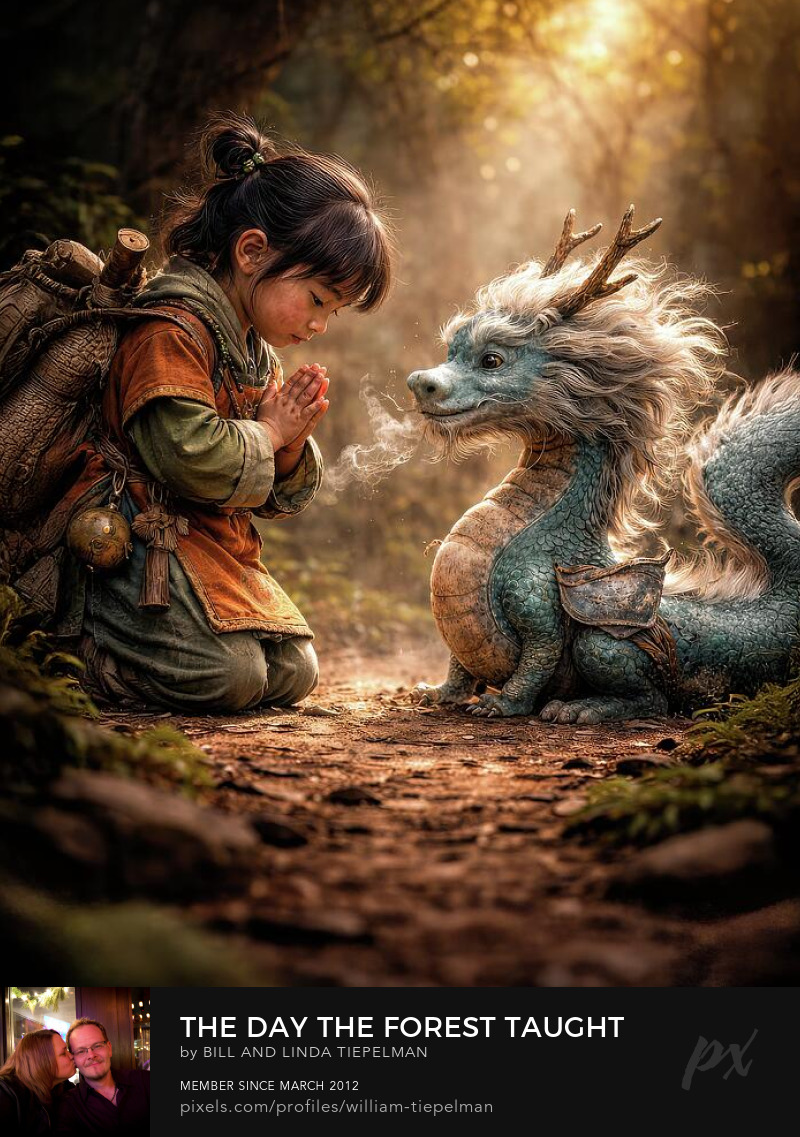
Le dragon attendait là où la lumière se courbait.
Il était plus petit que les histoires, et plus vieux que toutes.
Son corps reposait tranquillement sur le sol, comme s'il y appartenait d'une manière qui n'avait besoin d'aucune justification. Des écailles de la couleur du verre de mer adouci captaient la lumière du soleil en motifs irréguliers, chacune détenant un souvenir différent de luminosité. Ses cornes s'incurvaient vers l'arrière comme les branches d'un arbre ancien, texturées et usées, façonnées par le temps plutôt que par la violence.
De la vapeur s'échappait de ses narines par des respirations lentes et sans hâte.
Ce n'était pas un dragon de tempêtes de feu et de villes en ruine.
C'était un dragon du souvenir.
Il avait été placé ici avant que la forêt n'apprenne son propre nom. Non pas pour garder un trésor, ni des frontières, ni une prophétie écrite en mots fragiles. Il gardait quelque chose de bien moins remplaçable.
Il gardait le souvenir de ceux qui s'approchaient avec révérence au lieu d'exigence.
Beaucoup étaient venus.
Ils arrivaient avec des bannières et des lames, avec des prières aiguisées en armes, avec une confiance qui confondait volume et vérité. Ils se tenaient droits devant le dragon et attendaient qu'il réagisse, comme si l'existence elle-même leur devait une reconnaissance.
Le dragon se souvenait d'eux tous.
Et les laissait tomber dans l'oubli.
L'enfant ne savait rien de tout cela.
Elle savait seulement que quelque chose de vaste l'avait remarquée, et que cette attention n'était pas une invitation à fuir.
Elle sentit le poids du regard du dragon se poser sur elle — non pas lourd, mais complet. La sensation lui serra la poitrine, non par peur, mais avec le même sentiment qu'elle ressentait lorsqu'elle se tenait au bord d'une eau profonde : la conscience d'être petite, et que cette petitesse n'est pas une insulte.
Elle s'agenouilla.
Personne ne lui avait appris à s'incliner.
Elle ne se plia pas en signe de soumission, ni ne baissa la tête de honte. Le mouvement était simple, instinctif — mains jointes, tête juste assez inclinée pour reconnaître une présence sans s'effacer. Un geste né de l'écoute plutôt que de l'obéissance.
La forêt se pencha plus près.
Le dragon inclina la tête, et quelque chose d'ancien s'agita.
Au plus profond de sa mémoire séculaire, un espace se déplaça — un creux maintenu ouvert à travers les siècles, à travers des générations de visages qui correspondaient presque mais jamais tout à fait. Le dragon ne chercha pas son nom, car les noms étaient des choses éphémères.
Il chercha sa forme.
La façon dont elle restait immobile sans se raidir. La façon dont son souffle correspondait à celui de la forêt. L'absence de faim dans sa posture — de pouvoir, de preuve, de victoire.
La reconnaissance traversa le dragon comme une chaleur.
Il expira.
De la vapeur dériva vers l'avant, s'enroulant entre eux, sans menace ni commandement. Juste un souffle — partagé, offert, accepté.
Et dans cet échange silencieux, avant que l'un ou l'autre ne comprenne pourquoi, le dragon se souvint d'elle.
La forêt marqua le moment.
Non par le son, ni la lumière, ni le spectacle — mais par une certitude subtile que quelque chose de nécessaire était enfin arrivé.
Le plus petit des souvenirs avait trouvé son gardien.
Ce que le Dragon Portait
Le dragon ne parlait pas.
Non parce qu'il ne le pouvait pas, mais parce que la parole était une jeune invention, et la mémoire encore plus ancienne. Les mots avaient une façon de découper en morceaux des choses qui étaient censées rester entières. Le dragon avait appris il y a longtemps que la vérité survivait mieux lorsqu'elle était ressentie d'abord et nommée ensuite.
Alors il regardait.
L'enfant restait agenouillée, ni figée, ni effrayée, simplement présente. Ses mains étaient jointes comme si elles tenaient quelque chose d'invisible mais d'important. Elle respirait lentement, comme on le fait en essayant de ne pas interrompre un moment qui semble plus grand que toute explication.
Le dragon bougea, ses écailles chuchotant doucement contre la terre. Le son traversa la clairière comme une page que l'on tourne.
La mémoire commença à s'agiter.
Elle s'éloigna du dragon, non pas sous forme d'images, mais de sensations — la douleur d'anciens serments, la chaleur de promesses faites sans témoins, le résidu amer d'une trahison qui n'avait pas été assez bruyante pour être appelée guerre mais avait duré tout aussi longtemps.
La forêt se souvint aussi.
Les racines se serrèrent dans le sol. La mousse s'épaissit le long des pierres. La lumière s'affaiblit, puis s'adoucit, comme si le soleil lui-même se penchait pour écouter. Ce n'était pas un procès. Les procès exigeaient un jugement. C'était un compte rendu.
L'enfant le sentit sans le comprendre.
Une pression derrière ses yeux. Une traction dans sa poitrine. Le léger sentiment qu'elle se tenait à l'intérieur d'une histoire qui avait commencé bien avant sa naissance et continuerait longtemps après sa disparition. Cette connaissance ne l'effrayait pas. Elle la calmait.
Le dragon fit un pas en avant.
Ses griffes s'enfoncèrent dans la terre, laissant des marques qui ne dureraient pas. Rien ici n'était censé être permanent, sauf ce qui était transmis. Le dragon baissa la tête jusqu'à ce que son souffle effleure les cheveux de l'enfant, chaud, humide et vivant.
Elle ne tressaillit pas.
Ceci, le dragon le savait, était la mesure.
Il y a longtemps, quand les humains et la forêt se parlaient encore au lieu de se parler dessus, un accord avait été conclu. Non écrit. Non scellé par le sang ou le feu. Il fut scellé par la patience — la compréhension que ni l'une ni l'autre partie ne précipiterait l'autre vers la ruine.
Les dragons furent choisis pour se souvenir de cela, car les dragons étaient faits pour attendre.
Mais les humains changèrent.
Ils apprirent la vitesse. Ils apprirent l'ambition. Ils apprirent à confondre croissance et progrès, et bruit et autorité. Un par un, ils oublièrent les anciennes voies, jusqu'à ce que l'oubli devienne tradition.
Le dragon resta.
Il attendit à travers des générations qui ne s'inclinaient plus, à travers des enfants élevés pour conquérir avant d'apprendre à écouter. Il attendit tandis que les forêts rétrécissaient et que les histoires devenaient plus acérées, remplies de dents et de feu là où il y avait eu autrefois un équilibre.
Il attendit quelqu'un qui arriverait sans avoir besoin de gagner.
L'enfant sentit quelque chose effleurer ses pensées — pas une voix, pas tout à fait une vision, mais une invitation. Elle leva la tête juste assez pour croiser les yeux du dragon.
Ils étaient plus anciens que le chagrin.
Elle comprit alors, sans qu'on le lui dise, qu'elle n'était pas là pour être testée.
Elle était là pour qu'on se souvienne d'elle.
Le dragon étendit une griffe, lentement et délibérément, la posant sur le sol entre eux. Le geste était ancien, un signe qu'aucun humain vivant n'avait été enseigné à reconnaître. La forêt répondit instantanément, un approfondissement subtil de la couleur, une affirmation silencieuse traversant les feuilles et le sol.
L'enfant plaça sa main à côté de la griffe.
Pas dessus.
À côté.
Le dragon sentit la différence onduler à travers sa mémoire. Respect sans possession. Proximité sans revendication. La dernière forme manquante se mit en place.
C'était celle pour qui la forêt avait gardé sa voix.
Non parce qu'elle était puissante.
Parce qu'elle était prudente.
Le dragon leva la tête et, pour la première fois depuis des siècles, se prépara à transmettre quelque chose.
Le souvenir était sur le point d'être partagé.
Le Souvenir qui Avait Avancé
Le dragon ne donna pas la mémoire d'un seul coup.
Certaines vérités sont trop grandes pour être placées entières dans des mains humaines. Elles se fissurent sous le poids de l'explication, se fragmentent en symboles, deviennent fragiles avec la certitude. Cette mémoire avait survécu précisément parce qu'elle n'avait jamais été forcée de se tenir droite sous le langage.
Alors le dragon la partagea comme le font toujours les forêts.
Lentement.
La chaleur autour de l'enfant s'intensifia, non pas comme de la chaleur mais comme une présence. La clairière sembla s'étendre, s'étirant vers des moments qui n'étaient pas tout à fait une vision et pas tout à fait un rêve. Elle se sentit debout en plusieurs endroits à la fois — sous des arbres plus grands que la mémoire, à côté de ruisseaux qui n'avaient plus de noms, sous des cieux ininterrompus par la fumée ou l'ambition.
Elle vit les humains tels qu'ils avaient été autrefois.
Non pas plus petits, mais plus silencieux.
Ils se déplaçaient dans la forêt comme des invités plutôt que comme des héritiers, laissant derrière eux ce qu'ils ne pouvaient emporter. Leurs mains étaient occupées à entretenir plutôt qu'à prendre. Leurs voix, quand elles s'élevaient, s'élevaient en question plutôt qu'en commandement.
Des dragons marchaient parmi eux alors.
Pas des souverains. Pas des dieux. Des gardiens.
Ils se souvenaient de ce que les humains ne pouvaient se permettre d'oublier — le coût de l'impatience, la violence lente de l'orgueil, la vérité que rien de vivant n'appartient entièrement à soi-même. Les dragons se souvenaient non pas pour punir, mais pour rappeler.
L'accord avait été simple.
Quand les humains oublieraient comment écouter, les dragons attendraient.
Et quand l'écoute reviendrait, la mémoire serait rendue.
L'enfant sentit le poids de cette promesse s'installer dans ses os, non comme un fardeau, mais comme un alignement. Quelque chose qu'elle avait toujours pressenti — que le monde n'était pas tant brisé qu'hâtif — trouva enfin sa forme.
La vision s'adoucit.
La clairière revint.
Le dragon était toujours là, la regardant avec une attention qui ne cherchait plus, mais confirmait.
Elle comprit maintenant pourquoi on s'était souvenu d'elle.
Non pas parce qu'elle serait célèbre.
Non pas parce qu'elle serait puissante de la manière dont les histoires aimaient compter.
Mais parce qu'elle grandirait sans oublier ce moment.
Le dragon abaissa de nouveau sa tête, non en soumission, mais en signe de reconnaissance. Un geste si rare que la forêt elle-même sembla se pencher, les racines se resserrant, les feuilles frissonnant comme en reconnaissance.
Puis le dragon fit quelque chose qu'aucun humain vivant n'avait jamais vu.
Il s'inclina.
Le mouvement était subtil — une inclinaison de la grande tête cornue, un abaissement du souffle — mais il portait le poids des siècles. Il ne s'inclinait pas devant l'enfant comme une autorité.
Il s'inclinait devant l'avenir qu'elle représentait.
La forêt répondit.
Le son revint, non pas d'un coup, mais doucement — le cri lointain d'un oiseau, le murmure des feuilles reprenant leurs disputes avec le vent. La lumière changea, réchauffant la clairière comme si elle s'était tenue immobile jusqu'à ce que le moment passe.
Le dragon recula.
Déjà, ses contours semblaient plus doux, moins définis, comme si la mémoire elle-même apprenait à lâcher prise. Les dragons n'étaient pas destinés à rester éternellement. Ils restaient seulement aussi longtemps que le souvenir était nécessaire.
L'enfant se leva.
Elle ne tendit pas la main vers le dragon.
Elle ne demanda pas de preuves.
Elle pressa simplement ses mains l'une contre l'autre une fois de plus — une révérence rendue, inchangée par ce qu'elle savait maintenant — et recula, donnant à l'espace sa dignité.
Le dragon la regarda partir.
Il ne la suivit pas.
Certains gardiens restent invisibles une fois leur travail accompli.
Tandis que l'enfant s'éloignait, la forêt s'ajusta autour de son chemin. Les épines se courbèrent. Les pierres se stabilisèrent. Le chemin s'ouvrit non pas parce qu'elle le commandait, mais parce qu'elle lui appartenait désormais d'une manière que les mots ne pouvaient enregistrer.
Elle grandirait.
Elle quitterait la forêt.
Elle emporterait ce souvenir dans des lieux qui avaient oublié comment s'incliner — dans des villes bruyantes de certitude, dans des pièces construites pour exclure le silence, dans des futurs qui croyaient que le progrès signifiait ne jamais regarder en arrière.
Elle ne prêcherait pas.
Elle écouterait.
Et à cause de cela, d'autres se souviendraient comment.
Le dragon ferma les yeux.
La forêt n'avait pas besoin de gardien aujourd'hui.
Elle avait choisi sa mémoire avec sagesse.
Le Jour où la Forêt Lui Enseigna à S'Incliner n'est pas seulement une histoire destinée à être lue une fois et mise de côté — c'est un moment destiné à perdurer. Qu'elle soit vécue comme une impression sur toile richement texturée ou une impression sur bois ancrée et tactile, l'œuvre d'art porte la même révérence tranquille que l'on retrouve dans le conte lui-même. Pour ceux qui veulent la forêt plus près — tissée dans les murs, les espaces de travail ou les soirées calmes — l'image perdure comme une tapisserie, un puzzle contemplatif, un carnet à spirale de réflexion, ou même une couverture polaire réconfortante — des rappels que l'humilité, une fois apprise, a le don de rester avec vous.
 The Emerald Stair of the Sleeping Fern
 The Honey-Lipped Budnewt Who Couldn’t Swallow the Evidence
 The Amethyst Moth Shrine of Palebranch