
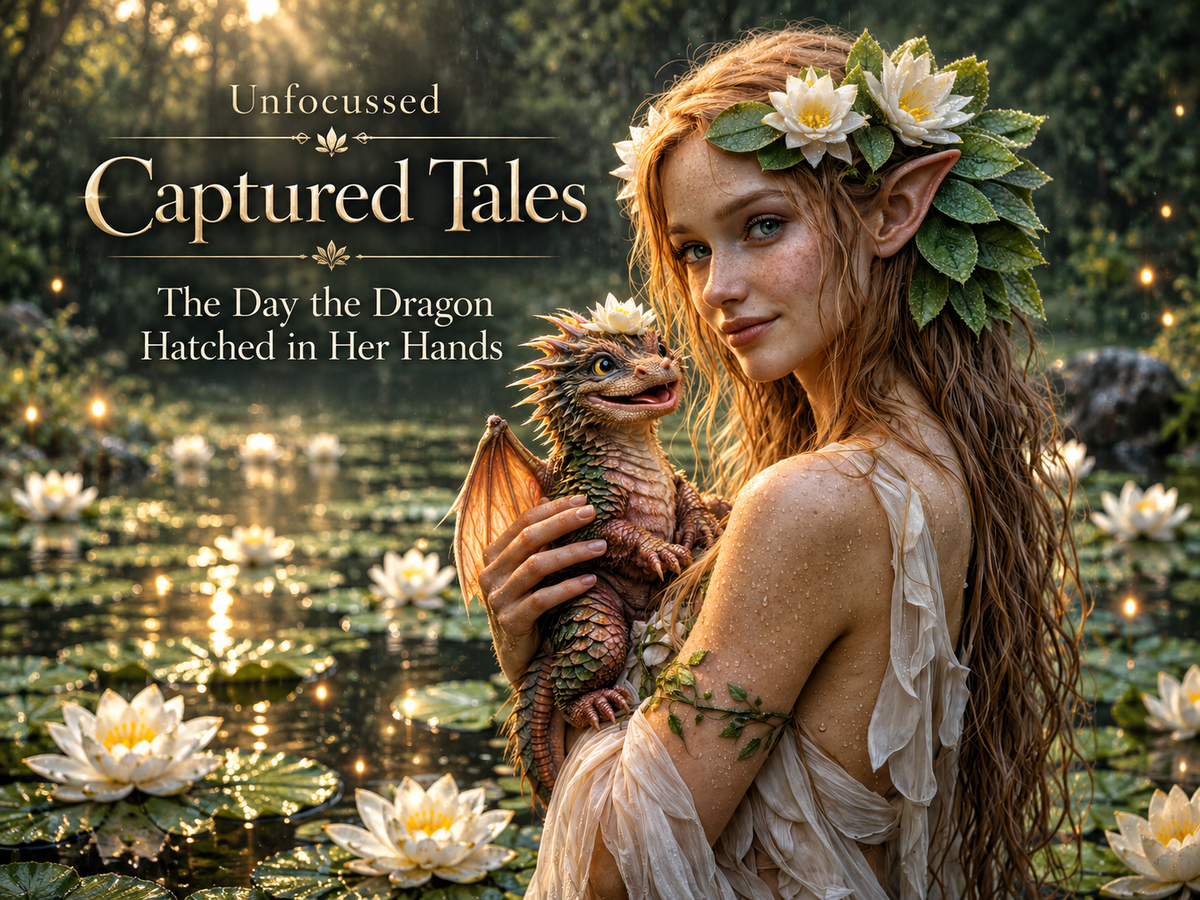
La faille préférée de la forêt
Cela commença — comme la plupart des terribles décisions de la vie — en douceur.
Pas avec un coup de tonnerre. Pas avec une prophétie tonnant depuis les nuages. Pas avec un inconnu encapuchonné murmurant : « Le destin t'a choisie… » tout en refusant théâtralement d'expliquer quoi que ce soit d'utile.
Non. Cela commença avec de la pluie, des nénuphars et un étang qui n'était pas censé être là.
Elle connaissait les tours de la forêt. Tous ceux qui vivaient assez longtemps dans ces bois les apprenaient de la même manière qu'on apprend à ne pas caresser quelque chose qui a l'air adorable mais possède plus de six dents.
La forêt était vieille. Plus vieille que les plus vieilles histoires qui avaient encore la décence d'être écrites. Plus vieille que les noms. Plus vieille que les excuses. Elle ne détestait personne, en soi — la haine exigeait de la concentration, et la forêt avait beaucoup à faire — mais elle chérissait deux choses avec une constance suspecte :
- garder ses secrets
- trouver des moyens inventifs de faire peser ces secrets sur quelqu'un d'autre
Elle avait eu un nom autrefois — l'un de ces noms nets et convenables, destinés aux présentations et aux arbres généalogiques. Mais ici, les noms étaient emportés par la pluie et la nécessité, ne laissant derrière que ce qui comptait : votre silhouette, le poids de vos choix, le parfum dont le vent se souvenait.
C'était une femme adulte maintenant, mais la forêt la connaissait toujours sous le nom qu'elle lui avait donné des années auparavant : la fille qui ne court pas.
Ce qui, pour être honnête, tenait moins du courage que d'une obstination assortie d'une belle mâchoire.
Elle se tenait au bord de l'étang, l'eau lui caressant chaudement les cuisses, les nénuphars flottant autour d'elle comme de petits verdicts blancs. Sous la pluie, sa robe lui collait à la peau — mi-tissu, mi-brume — comme si la forêt n'arrivait pas à décider si elle devait rester pudique ou simplement assumer son petit numéro. Des lianes s'enroulaient autour de son bras comme pour lui rappeler qu'elle était à sa place ici, et des poussières lumineuses flottaient dans l'air comme des ragots.
L'étang lui-même semblait paisible. C'est comme ça qu'il vous attirait. La surface était vitreuse, hormis les douces interruptions des gouttes de pluie, chacune étant un minuscule signe de ponctuation dans une phrase qu'elle n'avait pas accepté de lire.
Elle n'avait pas prévu d'être ici. Elle avait suivi un son — quelque chose entre un gazouillis et une toux, le genre de bruit qu'une créature fait lorsqu'elle essaie de prétendre qu'elle n'est pas vulnérable. La forêt adorait placer des bruits de vulnérabilité sur son chemin, de la même manière que d'autres sèment des miettes de pain. Sauf que les miettes de pain ne s'accompagnaient généralement pas d'obligations morales.
Elle s'accroupit, les doigts effleurant l'eau. C'était chaud — trop chaud pour de la pluie. Trop chaud pour n'importe quel étang normal. Elle fronça les sourcils, car la chaleur au mauvais endroit n'était jamais bon signe dans un écosystème magique.
Puis, elle le vit.
Au début, elle crut à une pierre. Un objet lisse et tacheté niché dans un cercle de feuilles de nénuphars près du rivage. Sauf que les pierres ne battent pas d'une faible lumière interne. Les pierres ne font pas miroiter l'eau autour d'elles. Les pierres ne donnent pas l'impression qu'elles attendent que vous cligniez des yeux en premier.
Elle tendit la main malgré tout, car elle avait construit toute sa personnalité sur le fait de toucher à des choses auxquelles elle ne devrait pas toucher.
Ses doigts effleurèrent la surface et la « pierre » eut un léger frisson. Pas une fissure. Pas une cassure dramatique et cinématographique. Juste un léger tremblement — comme un animal endormi qui bougerait l'épaule.
Elle se figea.
« Non », murmura-t-elle, car elle n'était pas idiote. « Absolument pas. Je ne suis pas… »
L'œuf frissonna de nouveau, et cette fois une fine ligne apparut sur sa coquille, tel un sourire qui se dessine lentement.
Elle retira sa main. La forêt, en réponse, ne fit rien du tout. Pas d'avertissement. Pas de murmure. Pas de gentil vieil esprit surgissant d'une fougère pour dire : « Hé, ma grande, peut-être pas. »
Juste la pluie. Juste l'étang. Juste les nénuphars flottant comme s'ils étaient au premier rang d'un spectacle.
Elle se leva et regarda autour d'elle, scrutant les arbres.
« Vous plaisantez », dit-elle, plus fort cette fois.
La forêt répondit par le croassement d'un corbeau au loin, comme s'il venait d'entendre la blague la plus drôle qui soit.
Elle fit un pas en arrière, prête à laisser l'œuf exactement là où il était — car elle avait des limites, merci bien — quand l'étang ondula et que l'œuf roula, doucement, comme poussé par un courant qui n'existait pas un instant auparavant.
Il roula vers elle.
Elle s'arrêta. L'œuf s'arrêta. C'était le genre de négociation silencieuse qui finit toujours par une défaite pour quelqu'un.
« Ne fais pas ça », lui dit-elle.
L'œuf émit un minuscule clic.
Ce n'était pas un langage. Ce n'était même pas un vrai bruit. C'était le son de quelque chose à l'intérieur qui frappait poliment, comme pour dire :
Bonjour. J'aimerais être un problème maintenant.
Elle le fixa, lui, la forêt et l'eau anormalement chaude, ainsi que les nénuphars flottant autour comme s'ils faisaient semblant que tout cela était normal.
Elle inspira.
« Très bien », grommela-t-elle. « Je vais regarder. Je ne dis pas oui. Je n'accepte rien du tout. Je suis simplement… »
Elle se pencha de nouveau.
Au moment où ses mains touchèrent l'œuf, la forêt sembla expirer. Pas de soulagement. Pas de gratitude. Plutôt de la satisfaction — comme un contrat signé à l'encre invisible.
L'œuf était plus lourd qu'il n'y paraissait. Dense de potentiel. Il se cala dans ses paumes comme s'il avait été conçu pour elles. Ce qui était, franchement, impoli.
Il trembla. Une fissure s'étendit, puis une autre, douce et ramifiée comme des motifs de givre sur une vitre. La coquille ne se brisa pas tant qu'elle ne s'ouvrit, comme si elle avait attendu le bon jeu de mains pour se déverrouiller.
Elle le tint instinctivement plus près, car son corps n'avait jamais reçu le message selon lequel son cerveau appréciait la survie.
Un museau minuscule perça la coquille. Des écailles vert-brun luisantes d'humidité. Un battement de paupières. Un long étirement, lent, d'un cou beaucoup trop long pour sa taille.
Et puis — parce que le destin avait apparemment le sens de l'humour — un bébé dragon bâilla comme s'il venait de faire une sieste et se réveillait légèrement contrarié par son existence.
Il la regarda.
Il regarda l'étang.
Il la regarda à nouveau.
Puis il ouvrit la bouche et produisit un son qui était à moitié un gazouillis, à moitié un hoquet, et totalement plein d'opinions.
« Oh non », murmura-t-elle, car elle reconnaissait un comportement d'attachement quand elle en voyait un. « Non. Non non non. Tu n'es pas… »
Le nouveau-né leva une griffe minuscule et l'accrocha à son doigt.
Et juste comme ça, elle le sentit.
Une traction — subtile mais indéniable — quelque part au plus profond de sa poitrine, comme si un fil invisible avait été noué entre eux. Pas de l'amour. Pas le destin. Quelque chose de plus vieux et de plus étrange :
une revendication.
Elle tourna lentement la tête vers les arbres.
« C'est toi qui as fait ça », dit-elle à la forêt.
La forêt, comme toujours, ne le nia pas.
Au lieu de cela, l'air scintilla et une unique poussière lumineuse vint se poser sur le nez du dragon. Le nouveau-né éternua. Un petit nuage de fumée se déploya, dégageant une légère odeur de cannelle et de feuilles mouillées.
Elle fixa la fumée. Puis le dragon. Puis, à nouveau, la forêt.
« Vraiment ? » demanda-t-elle. « Tu vas me refiler un dragon pour ensuite, juste… prétendre que c'est une sorte de cadeau ? »
Le vent souffla à travers les arbres, et pendant un instant, elle aurait juré que cela ressemblait à un rire. Le genre qu'on entend chez quelqu'un qui sait que vous venez d'accepter quelque chose que vous n'avez pas lu.
Sa prise se resserra prudemment autour du nouveau-né. Le dragon la regarda avec des yeux brillants, trop intelligents, et — c'est là que son estomac se noua — se blottit dans ses paumes comme s'il était à sa place.
Puis, quelque part derrière elle, l'eau de l'étang fit un bruit de porte que l'on ferme.
Elle se retourna vivement.
La surface de l'étang était toujours là. Les nénuphars étaient toujours là. Mais la chaleur dans l'eau s'estompait, et les bords de l'étang commençaient à se troubler, comme un rêve qui se dissout à la lumière du jour.
Elle fit un pas en avant — trop tard. L'étang recula comme s'il n'avait jamais existé. La forêt l'avala proprement, ne laissant que de l'herbe humide et quelques feuilles innocentes tremblant sous la pluie.
Elle resta là, tenant un bébé dragon dans ses deux mains, fixant l'espace où se trouvait l'étang.
« Oh », dit-elle doucement, la réalisation s'installant comme une pierre dans ses entrailles.
La forêt ne lui avait pas donné un dragon.
La forêt avait simplement arrangé les circonstances pour que, techniquement, le dragon éclose entre ses mains.
Ce qui signifiait — selon les plus anciennes coutumes d'éclosion de cette forêt, celles que ses gardiens traitaient comme des lois — qu'elle était devenue le premier être que le dragon avait vu.
Ici, pour un nouveau-né né de l'étang chaud aux nénuphars, « premier » signifiait à moi.
Que cela donne à la forêt le droit de décider de sa vie était une autre affaire. Ses racines avaient l'habitude de confondre tradition et permission.
Le nouveau-né bâilla de nouveau, étira ses minuscules ailes — encore souples, encore ridées — et la mordit promptement au pouce avec toute l'affection tendre d'une créature qui ne croyait pas à la gratitude.
Elle siffla, plus insultée que blessée.
« D'accord », lui dit-elle d'une voix tendue. « Écoute. Je ne sais pas ce que tu penses qu'il se passe, mais je ne suis pas ta mère. Je ne suis pas ton dresseur. Je ne suis pas ton… »
Le dragon la fixa, totalement indifférent, puis blottit son menton dans la courbe de son doigt comme pour dire :
Si, tu l'es.
Elle le fixa.
Au-dessus d'eux, la forêt soupira encore, lourde d'une satisfaction suffisante.
Quelque part au loin, un autre corbeau rit.
Et la fille qui ne court pas comprit qu'elle venait de se faire avoir par un écosystème forestier ayant la colonne vertébrale morale d'un arnaqueur de fête foraine.
« Super », grommela-t-elle en déplaçant prudemment le dragon dans ses mains. « Alors… qu'est-ce que tu manges ? Des mauvaises décisions ? Parce que j'en ai plein. »
Le nouveau-né gazouilla. De la fumée s'échappa de nouveau — cannelle et feuilles mouillées — et cela ressemblait étrangement à un accord.
Termes, conditions et un dragon avec des opinions
La première règle quand on transporte un dragon à travers une forêt ancienne est celle-ci :
La forêt remarque.
La deuxième règle est pire :
La forêt parle.
Elle ne fit pas dix pas avant que les choses ne commencent à changer. Pas de manière dramatique — pas d'arbres se déracinant pour bloquer son chemin, pas de runes lumineuses flambant sur l'écorce comme une étiquette d'avertissement. La forêt était plus subtile que cela. Elle préférait la propagation lente de la conscience. L'ondulation silencieuse de l'attention.
Les feuilles s'inclinaient. La mousse devenait plus brillante. Un écureuil se figea au milieu d'un gland comme s'il venait de réaliser qu'il était témoin de l'histoire et ne savait pas s'il devait applaudir ou s'enfuir.
Elle ajusta sa prise sur le nouveau-né, le tenant maintenant contre sa poitrine, une main soutenant son ventre rond, l'autre enroulée protectrice autour de son dos. Le dragon protesta immédiatement, se tortillant avec l'indignation de quelque chose qui était en vie depuis moins d'une heure et qui ressentait déjà de la rancœur envers l'autorité.
« Non », murmura-t-elle. « Tu n'as pas le droit de tomber. Tu n'as même pas encore des os qui savent ce qu'est tomber. »
Le dragon gazouilla et fit bouger ses ailes, qui étaient moins des ailes que des suggestions enthousiastes d'ailes.
« Aussi », ajouta-t-elle, car c'était apparemment sa vie maintenant, « pas de souffle sur les choses. »
Le dragon s'arrêta.
Puis exhala délibérément un petit nuage de fumée directement sur sa clavicule.
Elle arrêta de marcher.
Regarda vers le bas.
Regarda la légère tache de suie fleurissant sur sa robe déjà trempée par la pluie.
Lentement, prudemment, elle leva les yeux pour rencontrer ceux du dragon.
« On va avoir une discussion sur les limites », dit-elle.
Le dragon cligna des yeux une fois, longuement et lentement, comme un chat faisant semblant de ne pas savoir ce que sont les limites et refusant de s'y intéresser.
Ils continuèrent.
Le chemin forestier se déployait à contrecœur, comme le faisaient les sentiers lorsqu'ils savaient qu'ils étaient utilisés pour quelque chose de conséquent et qu'ils enrageaient de la paperasse que cela impliquait. Les racines bougeaient juste assez pour faire trébucher les imprudents. Les branches s'abaissaient à hauteur de visage comme des rappels passifs-agressifs.
Elle naviguait à travers tout cela avec l'aisance pratiquée de quelqu'un qui avait passé des années à gagner la tolérance de la forêt. Pas la confiance. Jamais la confiance. Juste la tolérance.
Elle parlait en marchant, en partie pour se stabiliser, en partie parce que le silence laissait place à la panique.
« Tu dois savoir », dit-elle au dragon, « que j'ai des règles. Je n'élève pas de créatures carnivores, de choses maudites, ou quoi que ce soit qui ait plus de deux apocalypses dans son avenir. »
Le dragon bâilla.
« Ce n'était pas une blague », dit-elle.
Le dragon mordilla sa manche.
« Ça, c'était une blague », soupira-t-elle.
Comme appelée par cet aveu, la forêt s'agita à nouveau. Pas autour d'elle cette fois, mais devant. Une silhouette apparut sur le chemin avec la confiance désinvolte de quelque chose qui attendait son tour.
Il était grand. Tout d'écorce, d'os et de lumière verte douce entremêlée dans ses articulations. Son visage était sculpté plutôt que cultivé, les traits changeant subtilement selon l'angle — sévère un instant, amusé l'instant d'après.
Un gardien de la forêt.
Elle s'arrêta net.
« Oh, allez », dit-elle. « Déjà ? »
Le gardien inclina la tête, ses mouvements étaient fluides et sans hâte.
« Tu es en avance », convint-il, sa voix ressemblant au vent glissant à travers du bois creux. « Mais le dragon aussi. »
Le nouveau-né s'anima au son de cette voix, les yeux fixés sur le gardien avec intérêt. Ses ailes frétillèrent. De la fumée s'enroula.
Le gardien se pencha, scrutant le dragon.
« Éclos proprement », observa-t-il. « Pas de sang. Pas de témoins qui importent. »
Elle se hérissa. « Je compte. »
Le regard du gardien glissa vers elle. « Tu es commode. »
« Ce n'est pas le compliment que tu crois que c'est. »
Le gardien se redressa, croisant ses longs doigts. « La forêt ne t'a pas donné le dragon. »
« J'ai remarqué », dit-elle sèchement.
« La forêt a simplement permis à une éclosion de se produire à proximité d'une paire de mains consentantes. »
« Je n'étais pas consentante. »
« Tu as tendu la main. »
Elle ouvrit la bouche, puis la referma. Les arguments techniquement corrects étaient les préférés de la forêt.
Le dragon se tortilla, lâchant un petit sifflement qui ressemblait plus à une bouilloire grinçante qu'à une menace. Le regard du gardien s'adoucit d'une fraction.
« Il a choisi », dit le gardien.
« C'est un nourrisson », trancha-t-elle. « Il a choisi la chaleur et les pouces opposables. »
« C'est ainsi que commencent les choix de ceux nés de l'étang », déclara le gardien.
Elle expira lentement. « Et maintenant ? »
Le gardien fit un geste vague vers la forêt. « Maintenant, la responsabilité adhère. »
« Comme de la sève », grommela-t-elle.
« Comme une loi. »
C'en était trop. « Non. Non, absolument pas. Je n'ai pas accepté de contrat. Je n'ai rien signé. Il n'y a eu aucune explication, aucun avertissement, aucun… »
« Il y a eu un étang », l'interrompit le gardien.
Ils se fixèrent.
Le dragon choisit ce moment pour éternuer de nouveau, libérant une étincelle qui s'éteignit inoffensivement contre l'épaule écorcée du gardien. Le gardien ne réagit pas.
« Je ne peux pas le garder », dit-elle, plus doucement maintenant.
Le gardien pencha la tête. « Tu le fais déjà. »
Elle regarda le dragon. Il avait enroulé une griffe autour de son doigt et grignotait doucement une mèche de ses cheveux, en toute sérénité.
« Cela va ruiner ma vie », chuchota-t-elle.
Le dragon gazouilla.
« Et probablement la tienne », ajouta-t-elle.
Un autre gazouillis. Plus fort. Fier.
Le gardien s'écarta, libérant le passage. « La forêt te remercie pour ton service. »
Elle le fixa. « Je ne te remercie pas en retour. »
« La gratitude n'est pas requise. »
« Ça ne m'étonne pas. »
Elle passa devant, le cœur battant, chaque pas portant le poids de la permanence. La forêt semblait plus lumineuse devant elle — des chemins s'ouvraient, des barrières se levaient — non par gentillesse, mais par efficacité.
Derrière elle, la voix du gardien suivit, douce et définitive.
« Tu seras surveillée. »
Elle ne se retourna pas. « Tu me surveilles depuis des années. Tu peux commencer à être utile. »
Le sentier se rétrécit à mesure qu'elle s'enfonçait, la canopée s'épaississant au-dessus. Le dragon devenait plus lourd à chaque pas, pas physiquement — pas encore — mais de la même manière que les fatalités s'installent une fois qu'elles ont pris racine.
Elle atteignit enfin une clairière familière, un endroit qu'elle avait fait sien avec une persistance têtue et le consentement réticent de la forêt. Un petit abri issu du bois vivant. Des herbes séchées suspendues. Des pierres disposées avec intention plutôt qu'avec art.
Elle entra et s'assit prudemment sur un tabouret bas, berçant le dragon comme si c'était quelque chose de fragile.
Ce n'est qu'alors qu'elle se laissa rire.
Cela éclata d'elle — aigu, essoufflé et légèrement dérangé.
« Un dragon », dit-elle tout haut. « J'ai un dragon. Pas d'or. Pas de pouvoir. Pas de réponses. Un dragon. »
Le dragon ronronna, visiblement content de lui.
« Tu ne restes pas », lui dit-elle. « C'est temporaire. Tu grandiras, puis tu partiras, et nous ferons tous les deux semblant que rien de tout cela n'est arrivé. »
Le dragon bâilla et se recroquevilla davantage dans ses mains.
Elle le fixa, la réalisation s'installant par strates.
La forêt avait compté sur sa gentillesse pour faire le travail de la permission.
Elle avait confondu le fait qu'elle n'abandonnerait jamais un nouveau-né avec un accord sur tout le reste.
Elle prendrait soin du dragon. Les conditions de la forêt étaient une autre affaire.
Elle soupira, pressant doucement son front contre les écailles chaudes du dragon.
« Tu vas absolument brûler quelque chose d'important », lui dit-elle.
Le dragon ronronna.
À l'extérieur, la forêt bougea à nouveau — calme, attentive, profondément satisfaite.
La faille s'était refermée.
Où la forêt prétend que tout va bien
La forêt lui accorda exactement une nuit de paix.
C'était le genre de générosité qui s'accompagnait de conditions et d'un sourire suffisant que l'on ne pouvait pas tout à fait voir mais que l'on ressentait absolument.
Le dragon dormait enroulé contre sa gorge, dégageant une chaleur comme un tout petit foyer très suffisant. Sa respiration soufflait de minuscules nuages de vapeur qui sentaient légèrement l'écorce et les épices. De temps en temps, il tressaillait — ailes battant, griffes se contractant — comme s'il rêvait de feux qu'il n'avait pas encore gagné le droit d'allumer.
Elle ne dormit pas.
Elle resta éveillée, fixant le plafond de bois bas de son abri, comptant les battements de cœur et regrettant ses choix de vie par ordre alphabétique.
À l'aube, la forêt arriva.
Non pas comme une armée. Non pas comme une menace. Comme des visiteurs.
Cela commença par les oiseaux. Pas le chœur habituel du matin, mais un silence soudain et délibéré : chaque aile s'immobilisa, chaque bec se ferma. Puis le bruissement des sous-bois. Le raclement de gorge prudent d'êtres qui, techniquement, n'existaient pas.
Elle se redressa, le dragon immédiatement en alerte, les yeux s'ouvrant brusquement avec une intelligence troublante.
« Non, murmura-t-elle. Nous ne ferons pas ça aujourd'hui. »
Le dragon lâcha un nuage de fumée.
Le premier à pénétrer dans la clairière fut un esprit-renard, son pelage chatoyant entre le rouge et l'argent, les yeux vifs de curiosité et d'opportunisme.
Derrière lui, d'autres suivirent.
Un cerf au dos couvert de mousse, aux bois gravés de runes anciennes. Un groupe de feux follets flottant comme des pensées mal élevées. Une femme faite d'écorce et de fleurs qui sentait la sève et les mauvaises intentions. Même l'écureuil de tout à l'heure était assis sur un rocher, les bras croisés, l'air désapprobateur.
Ils fixaient tous le dragon.
Le dragon les fixa en retour.
Puis, apparemment décidé à faire impression, il éternua.
Une étincelle jaillit.
Elle atterrit sur un tas d'herbes séchées suspendu près de l'entrée de l'abri.
Il y eut un temps de pause.
Les herbes s'embrasèrent dans un doux vlouf.
Elle écarquilla les yeux.
La forêt fixa la scène.
Le dragon fit un petit cri aigu.
Elle bougea rapidement — trop vite pour paniquer, tout en réflexes et en instinct — attrapa les herbes et écrasa la flamme dans la terre.
La fumée s'enroula autour de ses genoux.
Elle se redressa lentement, le dragon serré contre sa poitrine, et se tourna pour faire face au public.
« Absolument pas », dit-elle.
Personne ne discuta.
L'esprit-renard inclina la tête. « Ça fonctionne. »
« Ça brûle », rétorqua-t-elle sèchement.
« Les deux peuvent être vrais. »
Elle dévisagea la forêt entière. « Je ne suis pas votre solution. »
La femme d'écorce sourit. « Vous l'êtes toujours. »
Le dragon s'agita de nouveau, visiblement ravi par l'attention. Il étira ses ailes — maintenant un peu plus grandes que la veille — et siffla, un son qui tenait plus de la promesse que de la menace.
Le cerf inclina sa tête massive. « Le dragon vit. »
« Le dragon vit avec moi », corrigea-t-elle.
Les feux follets vacillèrent. Un accord. De l'intérêt. Des projets.
Elle le sentit alors : la pression. Non pas une force, mais une attente. La forêt qui se penchait vers elle, attendant de voir ce qu'elle ferait de cette chose qu'elle avait soigneusement, et légalement, placée entre ses mains.
Elle prit une inspiration.
Puis une autre.
« Voici comment cela va se passer, dit-elle, la voix ferme. Vous ne rendez pas visite sans prévenir. Vous ne négociez pas au-dessus de ma tête. Vous ne traitez pas ceci » — elle souleva légèrement le dragon qui tenta immédiatement de lui mordre l'oreille — « comme une ressource commune. »
La queue de l'esprit-renard frétilla. « Et si nous le faisons ? »
Elle soutint son regard. « Alors je lui apprendrai votre nom. »
La clairière devint très, très calme.
Le dragon poussa un cri d'approbation.
La femme d'écorce rit, ravie. « Ah, dit-elle. C'est donc ce que la forêt a choisi. »
« Non, répondit-elle. C'est ce que la forêt a obtenu. »
Un par un, ils battirent en retraite — ni vaincus, ni mécontents, juste… en train de se recalibrer. La forêt ne boude pas. Elle s'adapte.
Quand la clairière fut de nouveau vide, elle s'effondra sur le tabouret, le cœur battant à tout rompre.
« Nous allons avoir des règles, dit-elle au dragon. Des règles strictes. »
Le dragon bâilla et se pelotonna contre sa clavicule, chaud, solide et parfaitement impénitent.
Elle le dévisagea, puis rit — doucement cette fois.
« Tu sais, dit-elle, j'aurais vraiment préféré un avertissement. »
La forêt bruissa.
Si elle avait pu parler clairement, elle aurait peut-être dit :
Où serait le plaisir là-dedans ?
Elle se leva, portant le dragon en sécurité contre son épaule. De la fumée s'échappait paresseusement de ses narines. Quelque part, quelque chose d'important était probablement inflammable.
Elle s'enfonça plus profondément dans les arbres, ajustant déjà ses plans, s'adaptant déjà.
La forêt la regarda s'éloigner, ancienne et amusée.
La faille avait fonctionné.
Mais la forêt avait sous-estimé une chose.
Elle n'était pas juste une paire de mains.
C'était une solutionneuse de problèmes.
Et maintenant — malheureusement pour tous les autres — elle avait un dragon.
De la place pour un peu de magie inattendue
Ce qui nous ramène à The Day the Dragon Hatched in Her Hands, c'est la connexion tranquille sous tout ce chahut sylvestre : la couronne de lys, la pluie sur les feuilles et un minuscule dragon déjà certain que ce sont les bonnes mains. Une impression encadrée offre à ces verts chaleureux et ces reflets dorés une place apaisante dans votre coin lecture ; une impression sur toile permet à la gardienne et au nouveau-né d'occuper une place plus imposante dans la pièce. C'est une scène douce avec une histoire bien gênante nichée à l'intérieur — un peu comme le dragon lui-même.
Pour quelqu'un qui entame un chapitre inattendu, la carte de vœux offre un peu d'encouragement avec sa magie. Vous pourriez écrire à cet ami qui trouve toujours de la place pour une créature de plus, une personne de plus, une responsabilité de plus, magnifiquement imprévue. L'autocollant sticker apporte une version réduite de cette compagnie sur un objet du quotidien. Choisissez le format qui vous ressemble ; contrairement à la forêt, notre boutique d'art laisse la décision entre vos mains.

 Sir Grumblethorn and the Mushroom That Disagreed
 The Wink That Got Away With Everything
 The Dewdrop He Swore He Could Handle