
The Color Beneath the Door
The storm had passed hours ago, but the forest still trembled in its wake. Mist curled around the oaks, and rain-soaked moss swallowed the sound of Elara's footsteps. She pulled her crimson hood tighter. The map in her hand had become a disagreement between ink and water. At its center, somebody had drawn a rainbow.
“A heart of fire sleeps beneath it,” the old woman at the tollhouse had said. “Bring me that, and your brother will have what he needs.”
Elara had asked whether it was a stone.
“Something precious.”
That was not an answer. She knew it now. She had known it then, too, but her brother had been shivering so hard that morning that his cup rattled against his teeth. Fear made room for certain questions by pushing others out.
The village healer had gone to the flood shelters beyond the broken bridge. A messenger had followed the longer ridge road to fetch her. He might return by morning. He might be delayed. Their neighbor sat beside the sickbed while Elara went looking for something she could do with her own hands.
The tollhouse woman had given her a small sleeping draught, a second vial labeled dragonbane and instructions that became less reassuring every time she remembered them.
“For difficulties,” the woman had said, sliding the dark vial across the counter.
Elara had not asked what sort.
Now the trees parted around the ruins of an old weaving house. Its chimney leaned. Its roof had lost an argument with a beech tree. Yet light lay beneath the remaining door: red, gold, green and a blue so deep it seemed impossible that the same shabby building could contain it.
She stepped onto the threshold.
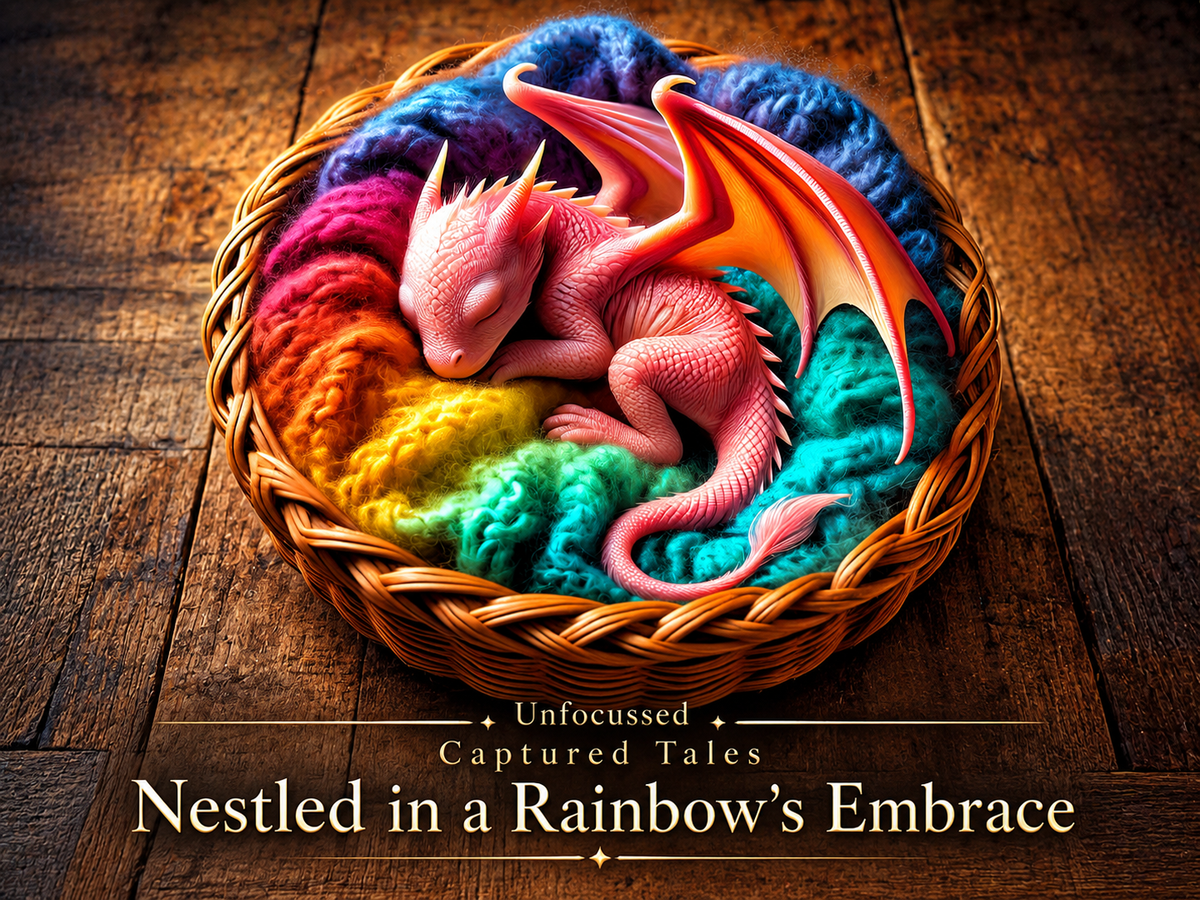
Inside, beyond the fallen loom, a wicker basket rested on dry wooden boards. It was lined with thick, curling wool in all the colors of a rainbow. The fibers caught the last light through the broken roof, turning ordinary strands into little rivers of brightness.
In their center slept a dragon.
Not a grand beast from a shield or a warning song. A pink dragonling, no larger than a housecat, curled nose to tail. Fine scales covered its brow. Pale horns rose above its closed eyes. Its orange wings folded into tall, delicate arches, and the tip of its tail rested on a turquoise tuft as if someone had arranged it with extraordinary care.
It made a small bubbling noise in its sleep.
Elara stood very still.
She had expected a dangerous treasure. She had brought a sack for it. The sack now hung at her side with the appalling simplicity of an object that did not understand what it was for.
“Heart of Fire,” she whispered.
The dragonling tucked its nose more deeply into the yellow wool.
Her brother used to sleep like that, pushing his face into the blanket whenever she opened the shutters. Even now, grown nearly as tall as she was, he complained about mornings as if she personally invented them.
She took out the sleeping draught.
It was already asleep. Perhaps the extra sleep would keep it from being frightened. Perhaps she could bring it back after the woman gave her the cure. Perhaps a great many things could be made to sound kind if she avoided saying the word take.
She loosened the cork.
A floorboard creaked behind the ruined loom.
Elara looked up into two golden eyes.
The mother dragon filled the space between the broken wall and the beech trunk. Her deeper rose scales were wet from the storm. One wing curved protectively along the outside of the weaving house, sheltering the surviving floor. She had not suddenly appeared. She had been there while Elara decided what sort of person desperation permitted her to become.
A low growl traveled through the boards.
The little dragon opened one eye.
It looked at Elara, at the bottle, then at its mother. Its sleepy expression changed. Both wings drew tight, and its tail disappeared beneath the blanket.
Elara put the cork back.
“I haven't given it anything.”
“I know,” said the mother.
Her voice was quiet enough that Elara had to listen. That was worse than a roar.
“Put it down.”
Elara set the sealed bottle on the floor and stepped away from the basket. The dragonling pressed against its mother's lowered jaw. The mother did not move it toward her. Whatever happened next, the little creature would have somewhere safe to stay.
What Could Be Given
“There is another bottle,” the mother said.
Elara's hand went to the pouch at her waist.
The golden eyes narrowed.
“Slowly.”
She drew out the dragonbane. The label had peeled at one corner. Beneath it, the glass was the color of old smoke.
“She said it would stop a dragon.”
“Did she tell you what was in it?”
“No.”
“Then you do not know what it will do.”
Elara placed it beside the first bottle. Her fingers shook. She had carried both through the rain as if certainty could be purchased in glass.
The mother nudged an overturned clay pot over them. Then she placed one broad claw against its rim.
“They stay there.”
Elara nodded.
“Now tell me why you came.”
The words arrived untidily. Her brother. The fever. The flooded road. The tollhouse woman with her little drawers and her collection of things that glowed. The promise of a cure, if Elara brought back a Heart of Fire.
“I thought she meant something you guarded.”
“And when you saw my child?”
Elara looked at the basket.
The hatchling's head had reappeared. It watched her over a ridge of blue wool, one forepaw resting on the wicker edge. Its fear had not vanished merely because she had begun to regret causing it.
“I started making excuses.”
The mother let the answer stand.
Outside, water dripped from a broken gutter. Somewhere beneath the floor, a beetle scraped industriously at a problem much smaller than theirs.
“I was going to carry your baby away,” Elara said at last. “I wanted my brother to live badly enough that I stopped thinking about what that would mean to you.”
“You thought of it.”
Elara lowered her eyes.
“You continued anyway.”
There was no cruelty in the correction. Elara would almost have preferred some. Anger could be argued with. The truth simply sat beside her in the ruined room.
“Yes.”
The hatchling sniffed. A single gold spark escaped its nose and died on the bare board. It looked mildly offended by the interruption.
“Is that why she calls it a Heart of Fire?” Elara asked.
“She calls things by the price she hopes someone will pay for them.”
The mother glanced toward the covered bottles. “She has come to the edge of these woods before.”
Elara imagined the woman's shelves differently now. Not curiosities gathered by a harmless collector. Locks. Cages. The narrow space beneath a counter where something had scratched while they spoke.
“Does she have a cure?”
“I do not know.”
The answer frightened Elara more than anything else the dragon had said. She had wanted the whole journey to be a terrible mistake with a simple solution waiting behind it. Instead, her brother was still sick, the healer was still on the road, and she had wasted hours frightening a child.
She sat on the lowest step. The mother allowed it. Rainwater seeped from the hem of her cloak.
“Then I have nothing to take home.”
The little dragon made a questioning sound.
Its mother turned. The hatchling had found a loose scale caught in a loop of green wool. It worried the edge with one claw, freed it and held it against the light. Thin as a petal, it glowed softly between its toes.
“That one is already shed,” the mother told it.
The baby looked at Elara again. Then it pushed the scale across the basket's rim.
It fell short and landed on the boards with a faint click.
Both dragons watched it.
The hatchling gave an indignant chirp, apparently dissatisfied with the limits of its own generosity.
Its mother lifted the scale and laid it on the step, between herself and Elara.
“It keeps a little of our warmth,” she said. “For a little while. That is all I can promise.”
“Will it cure him?”
“No promise of mine can tell you that. Take it to the person who knows his illness. Do not feed it to him. Do not trade it to the woman who sent you.”
Elara did not reach immediately.
“Why would you help me?”
“Because your brother did not come here with those bottles.”
The words struck without force, which made them land more deeply.
“And because,” the mother added, looking at the small creature now trying to retrieve a wool strand from its own horn, “my child has offered you something.”
Elara held out her empty hand. The hatchling leaned forward, considered her fingers and nudged the scale the last few inches with its nose.
She accepted it.
“Thank you.”
“Help him,” said the mother. “Then decide what you will do about the person who sent you here.”
At the doorway, Elara stopped.
“The bottles—”
“Bring your healer back for them. In daylight. Announce yourselves at the clearing.”
The hatchling had begun settling into its rainbow again. One wing rose, then folded. Its eyes closed only after Elara stepped outside.
She carried away a scale freely given, and the knowledge that this was not the same thing as being forgiven.
The Road Back with Empty Hands
Elara reached the village as the first gray light touched its chimneys. She did not go to the tollhouse. She went straight home, running the last stretch so hard that she struck the door with her shoulder before remembering the latch.
The healer sat beside her brother's bed.
Her boots were caked in ridge-road mud. The messenger slept upright against the wall, still holding his cap. Their neighbor had a kettle in one hand and the exhausted expression of someone who had spent the night doing everything except despair.
“Where have you been?” the healer asked.
Elara opened her hand.
Then she told the truth, badly at first and better when nobody interrupted.
The healer listened to the whole account before touching the scale. She examined it, wrapped it in a cloth and held it against the inside of her own wrist.
“Warm,” she said. “Steady, too.”
“The mother said it wasn't a cure.”
“Then she is the first person in your account who has described what she knows without adding a sales pitch.”
Elara looked toward the bed. Her brother's eyes were half open. His breathing sounded painfully thin.
“Can you help him?”
“I have begun. I wish I could promise you more than that.”
She asked their neighbor for fresh cloths. She checked the medicine she had brought, asked Elara when the shaking had started and listened carefully to the answers. The scale stayed wrapped beside the bed until she was satisfied its gentle warmth could ease his chills without making him uncomfortable. It was an aid to his care, not a substitute for it.
There was no sudden blaze. No golden light filling the room. Her brother did not sit up healed and demand breakfast.
Elara had to remain beside him while the morning passed.
She changed water. She answered questions. She held the cup when the healer asked her to, and stopped when he needed rest. These tasks were small and repetitive and offered no heroic bargain. They were also what he needed.
At noon, he recognized her.
“You look dreadful,” he whispered.
She began to cry so abruptly that he frowned.
“Not that dreadful.”
The healer let them have a moment, then sent Elara to eat something. Their neighbor took her place. Keeping vigil, she learned, did not mean proving that she could be the most exhausted person in the room.
The fever eased that evening. It returned during the night, less fiercely, and Elara's hope contracted to the size of the next breath. The healer stayed. By the following afternoon her brother could drink without help. On the third day, he complained about the soup.
Nobody had ever been so grateful to hear an opinion about turnips.
The scale's glow faded over those days. When its warmth was gone, Elara placed it on the windowsill. It looked like a small piece of pink glass. She did not tell anyone that it had cured him. The healer had worked, their neighbors had helped, and the gift had made a frightened person a little more comfortable while his body struggled back toward health. That was enough to be thankful for.
When he was safely recovering, she went with the healer and two village wardens to the forest clearing. They called out before entering. Elara carried no sack.
The mother met them at the threshold. Her hatchling peered from behind her foreleg, noticed the unfamiliar people and withdrew again.
Elara stayed where she was.
“He is getting better,” she said.
The mother's shoulders settled, almost imperceptibly.
The healer recovered the two sealed bottles. She did not uncork them in the house. The wardens listened while Elara repeated the tollhouse woman's words, including the parts that made her own choices look worst. They examined the map, the labels and the distinctive red thread around the stoppers.
“We will speak to her,” one said.
“She will say I misunderstood.”
“Then we will ask why a misunderstanding came with a sleeping draught, an unknown poison and a map to somebody's child.”
The investigation took longer than a satisfying story might prefer. The tollhouse woman denied almost everything and explained the rest so elaborately that the wardens began writing faster. A locked storeroom held cages, trapping nets and records of buyers seeking rare creatures. Those discoveries mattered more than rumors about her drawers. Her trade was suspended while the magistrate heard the evidence, and the forest crossing received a watch.
Elara gave testimony. She did not ask the wardens to leave out her part.
Nor did she turn the weaving house into a village attraction. When people asked where the dragon slept, she told them it was a home, not a destination.
Several weeks later, she returned to the clearing with a bundle of dry wool. She called from the path and waited.
The mother emerged. The little dragon followed at a dignified waddle, spoiled only by the tuft of blue fiber attached to its tail.
“A gift?” the mother asked.
“If you would like it. Nothing in return.”
The hatchling sniffed the bundle, seized a yellow strand and attempted to walk off with considerably more wool than it could manage. Its mother caught the trailing end before it unraveled down the slope.
For the first time, Elara heard her laugh.
“You may leave it on the step.”
She did. Then she stood back.
Inside, the basket had been moved beneath the soundest part of the roof. Sunlight warmed the wooden floor. The hatchling climbed into its rainbow, kneaded the new wool with serious little paws and turned twice before settling. One orange wing remained raised as though it had forgotten the final instruction for being asleep.
Elara thought of her brother at home, arguing with their neighbor about whether he was well enough to carry firewood. She thought of the sack she had brought on her first visit.
There were things she could not make untrue.
There were also things she could choose never to do again.
At the path, she looked back once. The mother watched from the doorway. Between them lay no debt, no bargain and no promise of instant trust—only a small, carefully respected distance.
In the basket, the dragonling slept.
A Rainbow You Can Come Home To
The softness in Nestled in a Rainbow's Embrace comes from the small things: a pink tail curled across turquoise wool, orange wings catching the light, and a wicker basket that makes room for a very unusual sleeper. A canvas print brings those warm textures and bright colors into a reading corner, where the image can offer a quiet pause even on a noisy day.
If you would rather spend time among the details, the artwork's puzzle turns that rainbow blanket into a leisurely evening's company. A greeting card carries the same wish for comfort to someone else. Explore the matching prints and gifts and choose the way this little sleeper belongs in your day. No forest bargain required.

 The Seedpod That Fired Before Anyone Was Ready
 The Blossom That Left a Mark
 The Witching Hour Went Sideways