
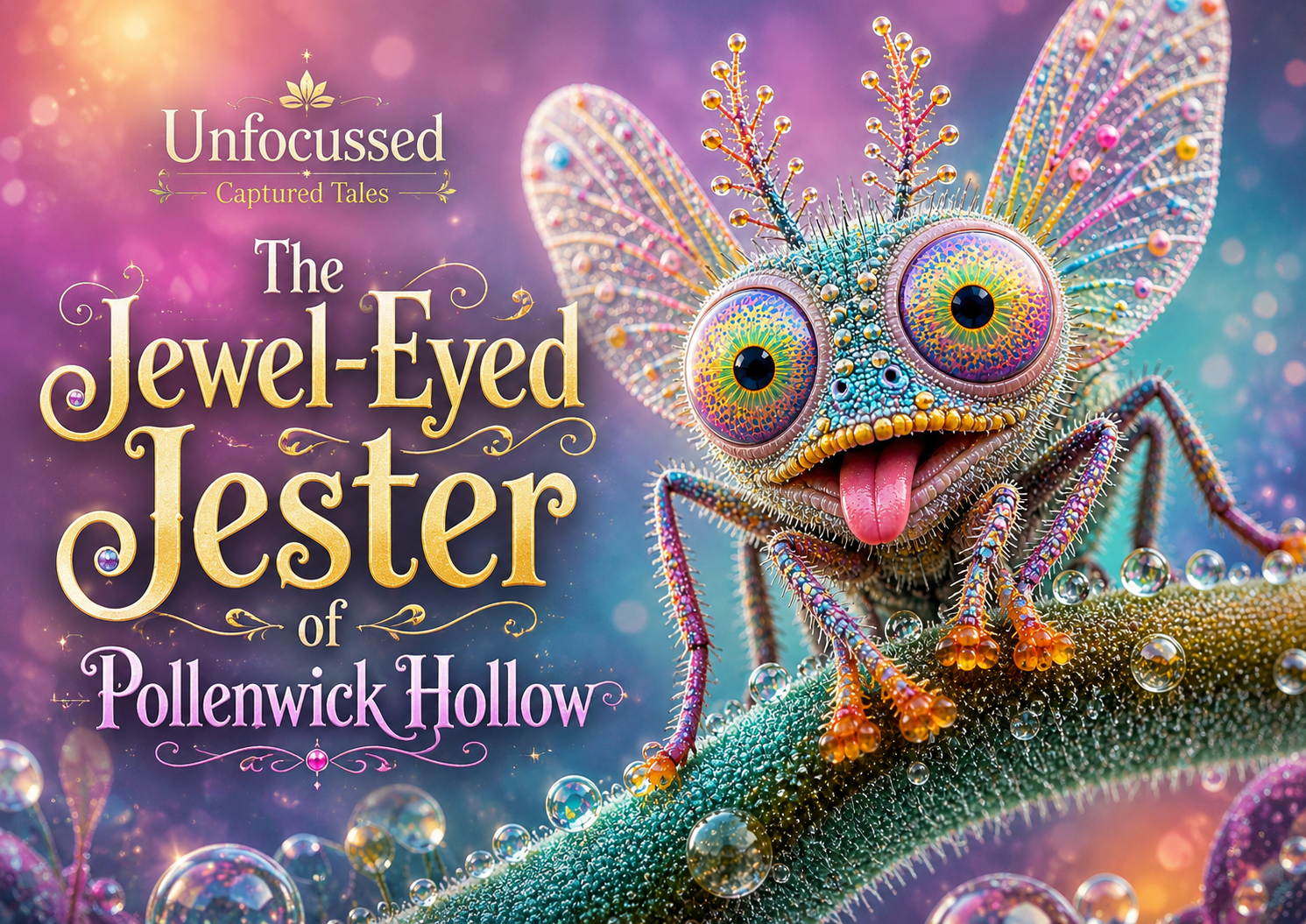
L'invitation que personne n'aurait dû lécher
Chaque printemps, juste après que le dernier gel soit retourné dans le petit trou humide d'où il était sorti, Pollenwick Hollow se préparait pour le Bal de la Floraison : l'événement le plus grandiose, le plus scintillant et le plus imbu de lui-même de tout le massif de jardin oriental.
Ce n'était pas, contrairement à ce que prétendaient les tulipes, une fête.
C'était une institution.
Il y avait des invitations pressées à partir de pétales de violette et estampillées d'une cire fabriquée par des abeilles éthiquement contrariées. Il y avait des guirlandes tressées par des araignées aux tarifs syndicaux et aux opinions bien arrêtées. Il y avait des plans de table examinés par trois générations de veuves de coléoptères, chacune plus critique que la précédente. Il y avait des rafraîchissements, des musiciens, des lanternes, des fontaines de pollen, des cuillères à rosée commémoratives et un énorme livre d'or relié en mousse que personne ne voulait vraiment signer mais que tout le monde faisait semblant de trouver profondément significatif.
Le Bal de la Floraison était l'endroit où les alliances se formaient, les rancunes étaient polies, les flirts devenaient des scandales, les scandales devenaient des chansons, et les chansons devenaient la raison pour laquelle le cousin de quelqu'un n'était plus autorisé à s'approcher à moins de six tiges du kiosque à hortensias.
En bref, c'était exactement le genre d'événement où Sir Blixby Glimmergob ne devrait jamais, en aucune circonstance, être autorisé à mettre les pieds.
Malheureusement, Sir Blixby Glimmergob était le bouffon officiel aux yeux de joyaux de Pollenwick Hollow.
Officiellement, cela signifiait qu'il divertissait la cour, annonçait les festivals, remontait le moral des fleurs lunatiques et distrayait les dignitaires en visite chaque fois que la Reine Marigolda avait besoin de temps pour prétendre qu'elle avait lu leurs traités.
Officieusement, cela signifiait que Blixby était un rapport d'incident ambulant doté d'ailes.
Il était petit, brillant, et bâti comme si quelqu'un avait collé un carnaval sur un moustique. Ses yeux étaient d'énormes dômes iridescents remplis d'un feu arc-en-ciel, ce qui le faisait paraître soit béni par une magie ancienne, soit à un hoquet près de voir à travers le temps. Ses ailes miroitaient comme des vitraux après une crise de sucre. Ses antennes étaient terminées par des gouttelettes dorées qui s'agitaient de façon spectaculaire chaque fois qu'il mentait, ce qui arrivait souvent. Ses pattes étaient mouchetées de poils brillants comme des bijoux, son visage était couvert de minuscules boutons ressemblant à des perles, et sa langue avait l'habitude d'apparaître dans des situations où aucune langue n'était requise.
Ce qui couvrait la plupart des situations.
« Absolument pas », déclara Lady Primselia Snapdragon, présidente du Comité du Bal de la Floraison, lorsque le nom de Blixby fut mentionné lors de la réunion de planification finale.
La réunion se tenait sous l'ombre arquée de la Grande Pivoine, une fleur si grande et si rose qu'elle avait développé la personnalité d'une tante fortunée. Autour de la table en pétale siégeaient les commères les plus puissantes du Hollow : Lady Primselia, au dos raide et terrifiante ; le Baron Thistlewick, qui portait un gilet fait de charpie et ne s'exprimait qu'en plaintes ; les sœurs jumelles papillons Mopsy et Mopsy-l'autre, qui insistaient sur le fait que tout le monde pouvait les différencier et qui avaient tort ; et Dame Honeymug, gardienne des rafraîchissements, qui avait déjà goûté à tant de nectar cérémoniel que ses ailes bourdonnaient comme un violon coupable.
Au centre de la table se trouvait la liste des invités.
Elle était magnifique. Elle était alphabétique. Elle avait été recoupée avec trois registres de querelles et un registre des « ne pas placer ces deux près des fruits ».
Le nom de Blixby se trouvait près du bas, entouré d'encre de baie rouge.
Puis entouré à nouveau.
Puis souligné.
Puis entouré d'un minuscule dessin de champignon en feu.
« Le bouffon est un nommé royal », dit le Baron Thistlewick, en plissant les yeux sur la liste. « Par la loi, il est invité à tous les événements de la cour, y compris les festivals, les proclamations, les couronnements, les exécutions et les bals. »
« Des exécutions ? » demanda Mopsy.
« Nous n'en avons pas eu depuis des années », répondit Thistlewick. « Coupes budgétaires. »
Lady Primselia tapota la table avec une griffe verte acérée. « Il ne s'agit pas de légalité. Il s'agit de dignité. »
« La dignité est morte quand les boutons d'or ont engagé cet harpiste érotique », grommela Dame Honeymug dans sa coupe.
« Il était avant-gardiste », dit Mopsy-l'autre.
« Il était nu, à part de la poussière de pollen et de la confiance. »
« Exactement. De l'art. »
Lady Primselia ferma les yeux. « Blixby ne peut pas venir. L'année dernière, il a remplacé l'eau de rose de la fontaine par de la sève de prune fermentée. »
« Soi-disant », dit le Baron Thistlewick.
« La fontaine a roté pendant six heures. »
« Circonstanciel. »
« Le maire Bumblethorpe s'est retrouvé coincé dans un lys avec son ex-femme. »
« Le pauvre homme a failli se remarier par accident », dit Dame Honeymug en frissonnant.
Lady Primselia se pencha en avant. « Et l'année précédente, Blixby a réécrit le discours de bienvenue cérémoniel, si bien que la Reine Marigolda a accidentellement déclaré que toute la soirée était "un petit cirque humide de préliminaires sociaux". »
Les sœurs papillons se regardèrent.
« C'était mémorable », dit Mopsy.
« Les gens le citent encore », ajouta Mopsy-l'autre.
« J'ai acheté le torchon », admit Dame Honeymug.
« C'est une menace », trancha Lady Primselia.
« Il est aussi populaire », dit le Baron Thistlewick. « Surtout auprès des jeunes pollinisateurs. »
« Les jeunes pollinisateurs mangent des paillettes sur l'écorce. »
« Et ils votent. »
Cela plongea la table dans un silence sinistre.
La démocratie, comme tout le monde le savait, était un beau concept jusqu'à ce qu'elle implique de jeunes coléoptères avec de la peinture sur le visage et des opinions.
Lady Primselia inspira par ses spiracles avec le contrôle lent et sifflant de quelqu'un qui essaie très fort de ne pas commettre de violence liée au comité. « Très bien. Il peut venir. »
Dame Honeymug eut un hoquet. Cela sentait faiblement la pêche et le regret.
« Mais », dit Lady Primselia en levant une griffe, « il y aura des restrictions. »
Les restrictions étaient les suivantes :
Blixby n'était pas autorisé à portée de léchage de la table des rafraîchissements.
Blixby n'était pas autorisé à toucher l'urne cérémonielle de pollen.
Blixby n'était pas autorisé à improviser des chansons sur l'abdomen, le thorax, l'histoire maritale, les habitudes de mue ou le revêtement arrière bizarrement brillant de quiconque.
Blixby n'était pas autorisé à utiliser l'expression « bas-fonds du nectar » dans aucune capacité officielle.
Blixby n'était pas autorisé à danser sur la table d'honneur à moins d'y être invité par un membre titré de la cour, et non, il ne pouvait pas se créer un titre lui-même en en criant un.
Blixby n'était pas autorisé à défier en duel aucun prêtre, juge, ambassadeur, chenille ou centre de table en forme de cygne.
Et sous aucun prétexte Blixby ne devait s'approcher des lys trompettes après le coucher du soleil.
Tout le monde convint que c'était raisonnable.
Tout le monde comprit aussi que c'était inutile.
Pourtant, l'invitation fut imprimée.
Elle disait :
Sa Majesté Verdoyante la Reine Marigolda invite Sir Blixby Glimmergob, bouffon aux yeux de joyaux de Pollenwick Hollow, à assister au quatre-vingt-septième Bal annuel de la Floraison, qui se tiendra sous le pavillon des digitales au clair de lune, où la joie, le raffinement et une célébration respectueuse fleuriront.
Puis, dans une écriture plus petite ajoutée par Lady Primselia elle-même :
Comporte-toi bien, petit bâtard scintillant.
Lorsque l'invitation arriva au bungalow en champignon de Blixby, livrée par un coursier puceron profondément sous-payé, Blixby était à l'envers sur son plafond, essayant d'apprendre à une goutte de rosée à jongler.
« Message », dit le puceron.
Blixby fit pivoter sa tête d'une manière tout à fait alarmante. « Est-ce une menace, une convocation, des excuses ou une lettre d'amour de quelqu'un manquant de jugement ? »
« Une invitation. »
« C'est les quatre si tu la lis correctement. »
Le puceron tendit l'enveloppe en pétale de violette à l'aide de pinces.
Blixby tomba du plafond, atterrit sur ses six pattes et l'attrapa avec un couinement ravi. Le sceau de cire portait l'emblème du Bal de la Floraison : trois roses, deux frondes de fougère croisées et une abeille faisant semblant de ne pas être ivre.
« Ah », dit Blixby. « Mon opportunité annuelle de décevoir l'élite. »
Il ouvrit l'invitation, la lut une fois, la lut deux fois, puis lécha la note manuscrite de Lady Primselia pour insister.
« Épicé. »
Le puceron fit un pas prudent en arrière.
Les yeux bijoux de Blixby s'écarquillèrent jusqu'à ce qu'ils reflètent toute la pièce dans une panique kaléidoscopique et une possibilité infinie. « Comprends-tu ce que cela signifie ? »
« Des heures supplémentaires ? » demanda le puceron.
« Le destin. »
« C'est ce que ressentent les heures supplémentaires. »
Blixby bondit à travers le bungalow, renversant une pile de minuscules tambours, un bocal étiqueté Confettis d'urgence : ne pas ouvrir près d'une autorité, et trois blagues à moitié écrites sur le divorce des coléoptères.
« J'ai besoin d'une tenue », déclara-t-il. « J'ai besoin de flair. J'ai besoin d'un plan. »
« Tu n'es pas censé avoir un plan. »
« Exact. C'est pourquoi ce plan doit être déguisé en décision vestimentaire. »
Le puceron le regarda ouvrir une armoire en coquille de noix remplie de rubans, de clochettes, de morceaux brillants, de pompons volés et de ce qui semblait être une écharpe cérémonielle de l'Ordre de l'Orchidée Humide.
« Ils ne t'avaient pas banni ? » demanda le puceron.
« Temporairement. »
« Ça fait neuf ans. »
« Un long temporaire. »
Blixby choisit un col de perles de pollen dorées, une écharpe de taille tissée en soie d'araignée et en mauvais choix, et une paire de chevillères polies à la rosée qui tintaient à chaque mouvement. Puis il sortit une minuscule cape de velours dans des tons de lavande et de sarcelle.
Le puceron fronça les sourcils. « Est-ce que c'est le rideau de Dame Flutterwick ? »
« Réutilisé. »
« Volé. »
« Relocalisé durablement. »
Finalement, Blixby attrapa une petite fiole bouchée cachée derrière un miroir en gland fissuré.
Les yeux du puceron se plissèrent. « Qu'est-ce que c'est ? »
Blixby se figea.
« Rien. »
« Tu le tiens comme si c'était définitivement quelque chose. »
« Ça ? » dit Blixby en agitant la fiole nonchalamment, ce qui fut une erreur car le liquide à l'intérieur brillait d'une teinte rose violente et libérait une bulle en forme de pâquerette hurlante. « Juste un peu de vernis de fête. »
« Ça a l'air illégal. »
« Tout ce qui est amusant a l'air illégal pour les pucerons. »
« Qu'est-ce que c'est ? »
Blixby leva la fiole vers la lumière. À l'intérieur tourbillonnait un mélange de nectar scintillant, épais comme du miel et brillant comme si une fée avait explosé dans un magasin de parfum.
« Sève de scintillement », chuchota-t-il.
La bouche du puceron tomba. « C'est banni lors des événements de la cour. »
« Seulement en quantités supérieures à une goutte. »
« Combien de gouttes y a-t-il dans cette fiole ? »
Blixby l'inclina. « Émotionnellement ? Une. »
« Légalement ? »
« Plusieurs crimes. »
La sève de scintillement était faite de nectar de lune, de sirop de baie rose, de fougère à rire écrasée et de quelque chose que la recette désignait uniquement comme « la poussière suggestive ». Elle ne rendait pas les créatures ivres, exactement. Ivre était trop simple. La sève de scintillement faisait sentir aux créatures que chaque pensée qu'elles avaient était intelligente, chaque pas de danse était sensuel, chaque secret méritait un public, et chaque mauvaise idée avait été personnellement approuvée par le destin.
En très petites quantités, elle faisait briller les fêtes.
En plus grandes quantités, elle faisait témoigner les fêtes devant le conseil.
« Tu ne peux pas apporter ça au Bal de la Floraison », dit le puceron.
Blixby glissa la fiole dans son écharpe. « Bien sûr que non. »
« Tu viens juste de le faire. »
« Techniquement, je suis encore chez moi. »
« Blixby. »
« Très bien. Je ne l'apporterai pas. »
« Promis ? »
Blixby parut profondément offensé. « Je suis un bouffon royal, pas un menteur ordinaire. »
Ses antennes s'agitèrent.
Le puceron soupira. « Tu vas gâcher le bal. »
Blixby sourit, tout en yeux iridescents et joie dangereuse. « Gâcher est un mot si laid. »
« Quel mot utiliserais-tu ? »
« Libérer. »
« C'est pire. »
« Seulement pour les gens avec des plans de table. »
Au coucher du soleil, Pollenwick Hollow s'était transformé.
Le Pavillon des Digitales au clair de lune s'élevait du centre du pré comme une cathédrale construite par des papillons ivres. Ses imposantes fleurs violettes formaient des arches naturelles au-dessus, brillant doucement de l'intérieur alors que des lucioles nichaient dans leurs gorges. Des lanternes de rosée pendaient en chaînes délicates depuis des vignes recourbées. La piste de danse, polie par des générations d'artisans escargots, scintillait d'une fine couche de clair de lune. Des tables étaient dressées sous de larges feuilles, chacune décorée de pétales, de pointes de fougères recourbées et de cartes de place miniatures écrites à l'encre de pollen dorée.
Toute la scène était assez belle pour faire pleurer un poète, s'évanouir un peintre et faire reconsidérer brièvement sa vie à un percepteur d'impôts.
Les invités arrivaient par vagues.
Les coléoptères arrivèrent en premier, brillants et trop habillés, cliquetant sur la mousse dans des carapaces à bijoux polies jusqu'à briller comme des miroirs. Puis vinrent les abeilles dans des rayures formelles, ailes peignées, dards coiffés avec goût. Les papillons de nuit arrivèrent dans des nuages d'élégance poudreuse, faisant semblant de ne pas remarquer les lanternes de flammes. Les papillons arrivèrent en dernier, comme toujours, car les papillons traitaient la ponctualité comme quelque chose qui arrivait aux créatures inférieures.
À l'entrée, Lady Primselia Snapdragon se tenait avec un presse-papiers, un sourire comme une cuillère aiguisée, et l'énergie spirituelle d'un directeur de prison gardant le dessert.
« Nom ? » demandait-elle à chaque invité.
« Lord Velvetthorpe du Treillis Supérieur. »
« Bienvenue. »
« Comtesse Amberwing et compagnon. »
« Nom du compagnon ? »
« Il est décoratif. »
« Bien. Décoratif plus un. »
« Bumblethorpe. »
Lady Primselia leva les yeux. « Épouse actuelle ou ex-épouse ? »
Le maire Bumblethorpe devint pâle. « Aucun des deux. Comptable. »
« Sage. »
À l'intérieur du pavillon, l'orchestre accordait ses instruments : violons de criquets, tambours de coléoptères, une harpe cordée de soie d'araignée et un cigale lunatique qui ne cessait de dire qu'il ne jouait que parce que sa vérité l'exigeait.
Dame Honeymug supervisait les rafraîchissements avec l'intensité d'un général commandant ses troupes. Il y avait des cocktails à la rosée, des spritzers aux baies roses, des bouffées de pollen, du trèfle confit, de la mousse de figue fermentée et la pièce maîtresse légendaire : la Fontaine de Nectar Doré, une merveille à trois niveaux importée de la ruche de l'ouest et gardée par deux abeilles nommées Rusk et Kevin.
Rusk était musclé.
Kevin était nerveux.
Tous deux avaient été mis en garde contre Blixby.
« À quoi ressemble-t-il ? » demanda Kevin.
Rusk fit jouer ses mandibules. « Tu le sauras. »
« C'est ce que tout le monde n'arrête pas de dire. »
« Tu le sauras. »
Précisément au lever de la lune, la Reine Marigolda entra.
Elle était magnifique, drapée dans des pétales d'or et de crème, sa couronne faite d'étamines tissées et d'une gemme de rosée absolument énorme qui avait sa propre police d'assurance. La foule s'inclina, fit des révérences, s'abaissa, voltigea, ou dans le cas des escargots, commença à s'incliner plusieurs minutes plus tôt pour se donner du temps.
« Mes amis », dit la Reine Marigolda, la voix chaleureuse et royale, « bienvenue au quatre-vingt-septième Bal annuel de la Floraison. Ce soir, nous nous réunissons non seulement pour célébrer la saison de floraison, mais pour honorer les liens qui nous enracinent ensemble. Puissions-nous danser avec joie, festoyer avec gratitude et nous comporter avec assez de retenue pour que la réunion du conseil de demain puisse rester en dessous de trois heures. »
Un rire poli ondula à travers le pavillon.
Lady Primselia se détendit d'un huitième de muscle.
Peut-être, pensa-t-elle, cette année serait-elle différente.
C'est alors que les lys trompettes retentirent.
Pas avec la fanfare royale prévue.
Avec un klaxon humide et dramatique qui ressemblait à une oie tombant dans du pudding.
Toutes les têtes se tournèrent.
Au sommet de l'arche d'entrée, silhouetté par le clair de lune, se tenait Blixby Glimmergob.
Il avait d'une manière ou d'une autre acquis un chapeau.
Pas un chapeau de bon goût.
Pas un chapeau formel.
Un chapeau fait d'un pétale d'orchidée recourbé, de trois clochettes pendantes et de ce qui semblait être le corsage de secours d'urgence de Lady Primselia.
Ses yeux bijoux flamboyaient. Sa cape flottait. Sa langue pendait dans ce qu'il croyait clairement être une expression charmante mais qui ressemblait davantage à un événement médical.
« Bonsoir, sacs de pollen trop habillés et tension non résolue ! » cria Blixby.
Le pavillon se tut.
Quelque part près de la table des rafraîchissements, Kevin chuchota : « Je sais. »
Le presse-papiers de Lady Primselia se brisa en deux.
Blixby bondit de l'arche, les ailes battant, et atterrit directement devant la Reine Marigolda avec le genre de fioriture qui aurait été impressionnant s'il n'avait pas dérapé sur le dernier pouce et heurté son visage contre l'orteil royal.
« Votre Moist Magnificence », dit-il, s'inclinant si bas que ses antennes frappèrent le sol.
La Reine Marigolda regarda vers le bas. « Blixby. »
« Radieux comme jamais. Joyau terrifiant. Foudre florale. Matriarche des pétales et des dommages émotionnels. »
« Tu as reçu l'addendum comportemental ? »
« Je l'ai léché respectueusement. »
« Et tu l'as compris ? »
« En esprit. »
Lady Primselia apparut à côté d'eux comme une facture d'impôt en talons. « Sir Blixby, vous êtes en retard. »
« La mode n'est jamais en retard. Elle arrive une fois que les gens ennuyeux ont réchauffé la pièce. »
« Vous portez mon corsage. »
« Notre corsage désormais. »
« Retirez-le. »
« Mais il fait ressortir mes yeux. »
« Vos yeux ressemblent déjà à un arc-en-ciel coincé dans une crise de panique. »
« Exactement. Ils ont besoin d'être ancrés. »
La Reine Marigolda leva une griffe délicate. « Lady Primselia. Laissez-le profiter de la soirée. »
« Votre Majesté... »
« Blixby », dit la Reine en tournant son regard vers lui, « ne me fais pas regretter la clémence. »
Blixby posa une griffe sur son cœur. « Je serai aussi digne qu'un monastère rempli de coléoptères. »
« Ce n'est pas rassurant. »
« Non, mais ça a de l'imagerie. »
Il s'enfuit en courant avant que quiconque ne puisse le fouiller.
Sa première destination, naturellement, était la table des rafraîchissements.
Rusk et Kevin se placèrent devant la Fontaine de Nectar Doré.
« Non », dit Rusk.
Blixby cligna des yeux en le regardant. « Je n'ai rien fait. »
« Tu y pensais. »
« Penser est encore légal dans la plupart des districts. »
« Pas de la façon dont tu le fais », grommela Kevin.
Blixby les contourna pour regarder la fontaine. Le nectar doré tombait en cascade de bol en pétale, épais et parfumé, captant la lumière des lanternes comme du soleil liquide. Il sentait les après-midis d'été, les erreurs coûteuses et les abeilles avec une richesse générationnelle.
« C'est une pièce de plomberie majestueuse », dit Blixby.
« Éloigne-toi », dit Rusk.
« Je souhaite simplement l'admirer. »
« Admire-la d'ailleurs. »
« Puis-je la sentir ? »
« Non. »
« Puis-je le complimenter ? »
« Brièvement. »
Blixby se pencha sur le côté et cria par-dessus leur épaule : « Tu es absolument génial, espèce de petit bâtard doré et collant. »
Kevin fronça les sourcils. « C’était bref ? »
« Trop bref », répondit Blixby. « J’avais tout un deuxième couplet. »
Rusk croisa les bras.
Blixby soupira de manière théâtrale, puis s’éloigna en faisant tinter ses accessoires.
Il n’alla pas bien loin.
Il tourna autour de la salle tel un minuscule requin étincelant dans un buffet de mauvaises décisions. Il complimenta le gilet du baron Thistlewick en disant qu’il avait l’air « moins inflammable que d’habitude ». Il demanda à une comtesse papillon si son troisième mari avait mué émotionnellement ou seulement financièrement. Il dit au musicien cigale que sa vérité ressemblait « un peu à une charnière de porte suppliant qu’on l’achève ».
En quinze minutes, trois invités avaient ri, deux avaient hoqueté, un avait menacé de poursuites judiciaires, et une veine en forme de point d’interrogation était apparue sur le front de Lady Primselia.
Mais techniquement, Blixby n’avait enfreint aucune règle.
Pas encore.
La première danse commença sous les arches de digitales.
C’était un numéro traditionnel connu sous le nom de La Courtoise Rotation de la Lune Florale, qui consistait à voir les partenaires tourner, s’incliner, se toucher brièvement les griffes et faire semblant de ne penser à l’abdomen de personne.
Blixby regardait depuis le bord de la piste, vibrant d'excitation.
Dame Honeymug apparut à ses côtés, un verre dans chaque main et la posture détendue de quelqu’un qui a renoncé à tout espoir en l'avenir.
« Tu te tiens bien », dit-elle.
« Je sais. Ça me démange. »
« Fais un effort. »
« Pour me tenir bien ? »
« Pour rendre les choses intéressantes sans causer de dégâts matériels. »
Blixby leva lentement les yeux vers elle.
Dame Honeymug prit une longue gorgée. « J'ai dit ce que j'ai dit. »
« Tu m’encourages ? »
« J'encourage l'art. Pas l'incendie. »
« Cette distinction a hanté toute ma carrière. »
De l'autre côté de la piste, Lady Primselia glissait entre les pas avec Lord Velvetthorpe, élégante, froide et profondément peu disposée à prendre du plaisir. Son corsage de secours rebondissait sur le chapeau de Blixby à chaque pensée qui lui traversait l'esprit.
Blixby plissa les yeux.
« Elle a besoin de joie », dit-il.
« Elle a besoin d’une sieste et peut-être d’un amant avec un emploi du temps flexible », répondit Dame Honeymug.
« C'est la même chose, selon la technique. »
« Prudence, bouffon. »
Mais Blixby était déjà en mouvement.
Il se faufila entre les danseurs, glissa sous la cape d'un papillon de nuit, rebondit sur la carapace polie d'un scarabée et bondit sur le bord de la plateforme de l'orchestre.
Les violonistes criquets faiblirent.
« Gentils insectes et romantiques aux corps mous de tout acabit ! » cria Blixby.
Lady Primselia se figea en plein virage.
Toute la piste de danse s'immobilisa.
« Pas de discours », siffla Lady Primselia.
« Ce n’est pas un discours », dit Blixby. « C’est un service public. »
« C’est pire. »
Blixby se tourna vers l'orchestre. « Garçons, filles et cigale émotionnellement complexe : donnez-moi quelque chose avec du déhanchement. »
La cigale se redressa. « Mon art n'a pas de hanches. »
« Alors emprunte-en. »
Il fit sauter une perle de rosée de son antenne. Elle frappa le tambour du scarabée avec un ting cristallin.
Le batteur, qui attendait depuis toujours que quelqu'un prenne une décision terrible en rythme, sourit et entama un battement profond et entraînant.
Les violonistes se joignirent à lui.
L’harpiste joua une ligne si lascive que trois vieux papillons de nuit se sentirent personnellement attaqués.
Blixby tourbillonna, sa cape étincelant, ses bracelets faisant tinter, les yeux brûlants d’une invitation folle.
« La Courtoise Rotation est morte ! » cria-t-il. « Vive Le Gesticulement Impertinent de la Répression Saisonnière ! »
Un soupir scandalisé monta des anciens.
Un murmure enthousiaste s'éleva parmi tous ceux de moins de quarante ans.
« Absolument pas ! » hurla Lady Primselia.
Mais alors, Dame Honeymug entra sur la piste de danse.
Elle fit rouler ses épaules.
Elle fit craquer son cou.
Elle sourit à Lady Primselia avec la malveillance sereine d'une femme sur le point de transformer un événement mondain en pièce à conviction.
« Oh », dit Mopsy.
« Putain oui », dit l'Autre-Mopsy.
Dame Honeymug commença à danser.
Ce n’était pas élégant.
Ce n’était pas approprié.
C’était magnifique.
Elle bougeait comme un bourdon avec un tatouage secret. Elle lança une jambe, secoua ses ailes et effectua une ondulation complète du corps qui fit tomber le monocle du baron Thistlewick dans sa mousse de figue.
Les invités plus jeunes acclamèrent.
Les plus âgés firent semblant de ne pas regarder tout en observant avec une intensité extrême.
Blixby sauta de la plateforme pour la rejoindre, applaudissant avec frénésie. « La voilà ! La duchesse du Damnation, la baronne des problèmes de dos, celle à cause de qui les garçons du trèfle ont appris à prier ! »
Dame Honeymug le pointa du doigt. « Moins de commentaires, plus de genoux. »
« J'en ai six et aucun n’est assuré ! »
Il dansa.
Appeler cela de la danse était généreux, de la même manière que traiter un glissement de terrain d'« aménagement paysager assertif » est généreux. Blixby bondit, tourna, se tortilla, s'agita, glissa, prit la pose et, à un moment donné, sembla brièvement se disputer avec sa propre jambe gauche. Mais il avait du rythme, du charisme et l'assurance sacrée d'une créature qui n'avait jamais été humiliée par un miroir.
La salle explosa.
Les abeilles martelaient le sol. Les scarabées claquaient. Les papillons de nuit tourbillonnaient. Les papillons abandonnèrent toute grâce et se mirent à bouger comme s'ils avaient des dettes à secouer.
Même la reine Marigolda riait.
Pas Lady Primselia.
Elle marcha vers l'orchestre, la bouche assez serrée pour couper de la ficelle. « Arrêtez cette musique immédiatement. »
Les violonistes regardèrent Blixby.
Blixby regarda le batteur.
Le batteur regarda Dame Honeymug.
Dame Honeymug regarda Lady Primselia et exécuta une rotation des hanches si ostensiblement irrespectueuse qu'elle méritait sa propre catégorie juridique.
La musique devint plus forte.
C’est alors que Blixby se souvint de la fiole.
Elle reposait dans son écharpe, tiède contre son flanc, brillant faiblement à travers le tissu.
Il ne l’avait, au sens strict, pas apportée.
Il avait simplement omis de la laisser derrière lui.
Une nuance philosophique, en somme.
Il n'avait pas l'intention de l'utiliser. Pas au début. La soirée, après tout, devenait déjà magnifique. La piste de danse s'était déliée. Les anciens transpiraient sous le poids de leur jugement. Un baron scarabée avait souri par accident et semblait horrifié par la sensation.
Mais alors, Blixby vit Lord Velvetthorpe murmurer quelque chose à Lady Primselia.
Quoi qu'il ait dit, cela lui fit jeter un coup d'œil vers la piste, puis vers la reine Marigolda, puis vers la table des rafraîchissements.
Elle leva une griffe et fit signe à Rusk.
Rusk hocha la tête.
Kevin avait l'air nerveux.
Les abeilles se déplacèrent pour mieux couvrir la fontaine à nectar.
Lady Primselia mettait fin à tout ça.
Pas seulement à la danse.
Au plaisir.
Aux cols défaits.
Aux rires.
À cette minuscule et fragile fissure dans le mur des convenances qui permettait à chacun de respirer.
Blixby sentit quelque chose de brûlant et de rebelle jaillir dans sa poitrine.
Peut-être du courage.
Peut-être une indigestion du trèfle confit qu'il avait volé plus tôt.
Quoi qu'il en soit, ça réclamait de l'action.
« Non », chuchota-t-il.
Dame Honeymug, toujours en train de danser à ses côtés, jeta un coup d'œil. « Ça ressemble au début d’un crime. »
« Un délit, au pire. »
« Blixby. »
« Ils vont castrer l'ambiance de cette salle. »
« Les salles n'ont pas de testicules. »
« Pas une fois que Primselia en a fini avec elles. »
L'expression de Dame Honeymug s'adoucit d'une manière à la fois affectueuse et profondément fatiguée. « Qu'est-ce que tu t'apprêtes à faire ? »
Blixby sortit la fiole à moitié de son écharpe.
Ses yeux s'écarquillèrent. « Oh, espèce d'idiot étincelant. »
« Juste une goutte. »
« Cette bouteille n'a jamais entendu l'expression "juste une goutte". »
« J'ai un contrôle excellent. »
« Une fois, tu as éternué dans un carillon éolien. »
« Une anecdote charmante de ma jeunesse. »
« C'était mardi. »
À travers le pavillon, Lady Primselia atteignit la table des rafraîchissements. Elle parla brusquement à Rusk et Kevin, puis se tourna vers la foule avec son « visage à annonces ».
Un visage à annonces était une chose terrible. Tout le monde dans le Vallon du Pollen le savait. Cela signifiait que les règles arrivaient. Que le programme était rétabli. Que quelque pauvre bougre allait devoir se rappeler où étaient les sorties et le peu de dignité qu'il lui restait.
Blixby déboucha la fiole.
Le parfum de la sève scintillante s'échappa : doux, piquant, pétillant, malfaisant. Ça sentait les baies, le clair de lune, le mauvais jugement et quelqu'un disant : « Personne ne saura jamais », environ sept secondes avant que tout le monde ne le sache.
Dame Honeymug attrapa son poignet. « Ne mets pas ça dans la fontaine. »
« Je n’allais pas le faire. »
« Tu allais absolument le faire. »
« J'envisageais une amélioration atmosphérique. »
« C'est un crime contre la fontaine. »
« Le crime contre la fontaine n'est pas une catégorie réelle. »
« Ça le sera demain. »
Blixby la regarda. Ses immenses yeux arc-en-ciel reflétaient les lumières, les danseurs, la Reine, les gardes, toute la fragile absurdité de la soirée.
« Ils invitent tout le monde ici pour célébrer la floraison », dit-il doucement, « puis punissent tout ce qui s'ouvre vraiment. »
La poigne de Dame Honeymug se desserra.
« C'était presque sage », dit-elle.
« Ça m'a déplu aussi. »
Lady Primselia tapota une cuillère contre une tasse en cristal.
Ting. Ting. Ting.
La musique faiblit.
Les danseurs ralentirent.
La salle se tourna vers elle.
« Estimés invités », commença Lady Primselia, d'une voix brillante et mortelle, « bien que l'enthousiasme soit apprécié, le Bal de la Floraison est une célébration du raffinement, non une mue publique de ses principes. »
Quelques anciens hochèrent la tête.
Les invités plus jeunes grognèrent.
La reine Marigolda observait avec des yeux indéchiffrables.
Blixby regarda la fiole.
Puis la fontaine.
Puis Kevin, qui le fixait avec l'expression pâle et hantée d'un garde qui venait de réaliser que l'Histoire était sur le point de s'écrire sous sa garde.
« Non », articula Kevin.
Blixby sourit.
« Si », répondit son visage.
Il bondit.
C’était un saut magnifique.
Un saut stupide.
Un saut chanté par le destin et poursuivi par le bon sens.
Il s'élança de la piste de danse, rebondit sur la tête du baron Thistlewick, ricocha sur une lanterne de rosée suspendue, tourbillonne dans les airs avec sa cape s'évasant comme un petit drapeau de rébellion, et se dirigea droit vers la Fontaine à Nectar Doré.
Rusk se précipita.
Kevin hurla.
Lady Primselia cria quelque chose qui commençait par « Espèce de tas de paillettes... » et qui fut heureusement avalé par le roulement de tambour accidentel de l'orchestre.
Pendant une seconde suspendue, Blixby resta au-dessus de la fontaine, fiole levée, yeux brûlants.
« À la floraison ! » cria-t-il.
Et puis, parce que la vie préfère la farce à la justice, la tasse de mousse de figue jetée par Dame Honeymug roula sous son pied à l'atterrissage.
Blixby glissa.
La fiole s'envola de sa griffe.
L'ouverture bascula vers le bas.
La sève scintillante décrivit un ruban rose étincelant au-dessus des têtes.
Elle ne se versa pas proprement dans la fontaine.
Elle éclaboussa partout.
Dans la Fontaine à Nectar Doré.
Sur les boules de pollen.
Sur le trèfle confit.
Dans le monocle du baron Thistlewick.
Sur la cuillère à annonces de Lady Primselia.
Et, de façon plus catastrophique, directement dans la bouche ouverte des lys trompettes.
Le pavillon devint silencieux.
Blixby atterrit à l'envers dans le bassin inférieur de la fontaine, les jambes tremblantes, la langue sortie, trempé de nectar doré et de paillettes de qualité criminelle.
Un instant, personne ne bougea.
Puis les lys trompettes inspirèrent.
Leurs pétales devinrent rose vif.
Leurs tiges se raidirent.
Leurs gorges se gonflèrent d'un but musical terrible.
Lady Primselia chuchota : « Oh non. »
Le premier lys trompette émit une note si forte qu'elle fit tomber trois papillons de nuit du ciel et décolla le glaçage d'un gâteau au trèfle.
Le deuxième se joignit à lui, plus grave et plus humide.
Le troisième commença à improviser.
Et puis, à l'horreur de chaque créature respectable du Vallon du Pollen, les fleurs enchantées se mirent à chanter.
Pas l'hymne royal.
Pas un cantique de printemps.
Pas même quelque chose avec un déni plausible.
Elles chantèrent la plus sale chanson de taverne jamais bannie du district inférieur du Compost, dans une harmonie parfaite à quatre voix.
La bouche de la reine Marigolda resta ouverte.
Dame Honeymug leva lentement son verre.
Kevin s'assit par terre.
Lady Primselia se tourna vers Blixby avec un meurtre qui fleurissait derrière ses yeux.
Blixby leva sa tête trempée de nectar hors de la fontaine, la sève scintillante coulant de ses antennes.
Il cligna des yeux une fois.
Puis il sourit.
« Eh bien », dit-il, « l'acoustique est meilleure que prévu. »
Les Lys Trompettes en savaient trop
Les lys trompettes n'avaient pas seulement commencé à chanter.
Ils avaient commencé à jouer.
Il y a une différence, et c'est la même différence qu'entre roter accidentellement à table et monter sur la table pour livrer un opéra de rot de douze minutes sur la mère de tout le monde.
Le premier couplet de la chanson de taverne bannie jaillit des fleurs enchantées avec une telle confiance obscène que tout le Pavillon des Digitales au clair de lune sembla rougir de la racine jusqu'au toit. Les lucioles s'éteignirent par modestie. Trois vieux papillons de nuit s'effondrèrent dans une fougère décorative. Un jeune scarabée près du bol de punch chuchota : « Je ne savais pas que les fleurs connaissaient ce mot », et sa mère le gifla si fort que sa carapace sonna comme une cloche de dîner.
Les lys continuèrent à chanter.
Personne n'osa répéter les paroles par la suite, en partie parce qu'elles étaient sales, en partie parce qu'elles rimaient « étamine » avec quelque chose qu'aucun historien de jardin décent ne mettrait par écrit, et en partie parce que la quatrième ligne impliquait qu'un arrosoir pouvait être utilisé de manières qui annuleraient sa garantie.
Blixby Glimmergob, bouffon aux yeux de joyaux, nuisance professionnelle et actuelle garniture centrale, était assis à l'envers dans le bol inférieur de la Fontaine à Nectar Doré avec de la sève scintillant sur son visage.
Il écoutait.
Il clignait des yeux.
Il pencha la tête.
« Vous savez », dit-il, « j'ai entendu pire. »
Lady Primselia Snapdragon semblait avoir eu son âme tentant de quitter son corps, ayant vu la facture du traiteur, avant d'être forcée de rentrer à l'intérieur.
« Arrêtez-les », dit-elle.
Blixby essuya le nectar d'un œil. « Je ne suis pas sûr de pouvoir. »
« C'est toi qui as commencé. »
« C’est une simplification blessante. »
« Tu as versé de la sève scintillante bannie dans la fontaine royale. »
« Éclaboussé », corrigea Blixby. « Versé implique un contrôle. »
Les lys trompettes atteignirent le refrain.
Une vague de halètements horrifiés balaya la salle.
Puis, de quelque part près de la table des jeunes pollinisateurs, un scarabée ivre cria : « Encore ! »
La salle se divisa.
La moitié des invités était consternée.
L'autre moitié avait découvert que les personnes consternées constituaient une excellente couverture pour danser.
En quelques secondes, la piste de danse se transforma en un champ de bataille étincelant opposant la dignité aux hanches. Les papillons les plus âgés se tenaient rigides d'offense, leurs ailes tremblant d'une délicate indignation. Les jeunes abeilles martelaient le rythme. Une paire de moucherons entama une danse scandaleuse à deux qui ressemblait moins à une danse de cour qu'à un conflit de garde entre coudes. Les jumelles papillons Mopsy et l'Autre-Mopsy avaient chacune saisi un bâton de trèfle confit et les agitaient au-dessus de leurs têtes comme de minuscules clubs lumineux.
Dame Honeymug se tenait au bord de la fontaine, une main sur la bouche, les yeux mouillés de rire.
« C'est », haleta-t-elle, « le pire Bal de la Floraison de l'histoire. »
Blixby rayonna depuis le bol de nectar. « Merci. »
« Je n'ai pas dit le meilleur. »
« Tu n'avais pas besoin de le dire. »
La reine Marigolda se leva de son trône de pétales de digitale enroulés.
Aussitôt, un silence tenta de s'installer.
Il échoua, car les lys trompettes entonnaient toujours un couplet sur une limace solitaire et un chapeau de champignon moralement flexible.
La Reine attendit.
Les Reines étaient douées pour attendre. C'était la moitié du travail, juste après porter des choses lourdes et faire semblant que les ambassadeurs étaient intéressants.
Lorsque les lys firent une pause pour inspirer, la voix de la reine Marigolda résonna dans le pavillon.
« Assez. »
Le mot porta.
La salle s'immobilisa net.
Même les lys frissonnèrent, leurs pétales tressaillant de profanités non chantées.
Blixby sortit lentement un pied de la fontaine. Cela fit un plonk humide.
Lady Primselia le pointa du doigt. « Votre Majesté, j'exige qu'il soit expulsé. »
« Vers quoi ? » demanda Blixby. « La prison ? L'exil ? Une serviette de table de bon goût ? »
« Silence. »
« Ah. Le contenant le plus cruel. »
La reine Marigolda regarda de Blixby aux lys trompettes, puis à la fontaine, où la sève scintillante rose tourbillonnait maintenant à travers le nectar doré en rubans lumineux. Toute la fontaine bouillonnait doucement, comme si elle était satisfaite d'elle-même.
« Sir Blixby », dit la Reine, « avez-vous apporté de la contrebande à mon bal ? »
Les antennes de Blixby oscillèrent.
« Cela dépend », dit-il.
« De quoi ? »
« Si c'est une enquête émotionnelle ou légale. »
« Légale. »
« Alors je demande un avocat avec une morale flexible et de toutes petites mains. »
Une onde de rire parcourut la salle.
Lady Primselia émit un son étranglé. « Ce n'est pas drôle. »
Les lys trompettes, toujours sous l'influence de la sève scintillante et développant visiblement un sens du timing comique, firent un minuscule klaxon de soutien.
Cela fit rire les plus jeunes invités encore plus fort.
La reine Marigolda ne sourit pas, mais un coin de sa bouche tressaillit comme s'il avait envisagé une trahison.
« Vous avez mis en danger la dignité de cette cour », dit-elle.
Blixby sortit de la fontaine, glissant par deux fois et atterrissant avec un plouf à ses pieds. Sa cape lui collait à la peau comme une chauve-souris lavande morte. « Avec tout le respect que je vous dois, Votre Majesté, la dignité se débrouillait très bien pour se mettre en danger toute seule avant mon arrivée. »
Lady Primselia eut un hoquet de surprise. « Comment osez-vous ? »
« Avec de l’entraînement. »
« Vous êtes couvert de nectar et de paillettes criminelles. »
« Oui, et pourtant, je suis toujours moins poisseux que les manigances de placement de table. »
Une nouvelle onde de rires.
Les griffes de Lady Primselia se contractèrent.
La sève scintillante avait commencé à opérer sa magie plus profonde.
Au début, la sève scintillante ne faisait qu’assouplir les mouvements, raviver les couleurs et convaincre les scarabées timides que danser mal était un droit civique. Mais une fois imprégnée dans la nourriture, les boissons et les fleurs enchantées, elle devenait quelque chose de bien plus dangereux.
Elle rendait les sentiments enfouis flottants.
Les secrets remontaient à la surface comme des bulles de gaz dans un étang.
Le tact se dissolvait.
La politesse commençait à muer.
La première victime fut le baron Thistlewick.
Il se tenait près de la mousse de figue, grommelant au sujet des bonnes manières, lorsqu'un puff de pollen éclaboussé de scintillements roula contre sa chaussure. Il baissa les yeux. Il regarda autour de lui. Ne voyant personne d'une autorité suffisante pour le surveiller, il le ramassa et le goba.
Ses yeux s’écarquillèrent.
Sa moustache frémit.
Puis il se tourna vers la table la plus proche et annonça : « Je n’ai jamais compris la différence entre un canapé et un petit biscuit humide. »
La table le fixa, pétrifiée.
Il se serra la poitrine, horrifié par sa propre honnêteté.
« Aussi, » continua-t-il, impuissant, « mon gilet est rembourré de serviettes de cocktail volées, parce qu’elles sont plus douces que celles de la maison. »
Mopsy eut un hoquet. « Je le savais. »
Mopsy-l’Autre se pencha vers lui. « Tu avais dit que c’était du poids de chagrin. »
« C’est le cas, » dit le baron Thistlewick, la voix brisée. « Je porte le deuil de la qualité du linge. »
À l’autre bout du pavillon, la comtesse Amberwing prit une gorgée de cocktail de rosée et se tourna immédiatement vers son accompagnateur décoratif.
« Je disais à tout le monde que tu étais décoratif parce que j’avais oublié ton nom il y a trois semaines. »
L’accompagnateur cligna des yeux. « C’est Gérald. »
« Ça me semble peu probable. »
« Nous sommes fiancés depuis l’automne. »
« Pour être juste, l’automne était très chargé. »
À la table des rafraîchissements, Kevin, l’abeille nerveuse, lécha une goutte de nectar scintillant sur son poignet avant de pouvoir se retenir.
Ses pupilles se dilatèrent.
Il agrippa le bras de Rusk.
« Je ne veux plus monter la garde aux fontaines. »
Rusk fronça les sourcils. « Kevin. »
« Je veux écrire de la poésie émotionnellement dévastatrice sur la mousse. »
« Kevin, pas maintenant. »
« J’ai un recueil. »
« Tu m’avais dit que c’était un carnet de rationnement. »
« C’est un carnet de rationnement. De désir. »
Rusk le fixa pendant une longue seconde.
Puis, très doucement, il dit : « Je le lirais. »
Kevin éclata en sanglots.
Les lys trompettes émirent un doux son romantique : wah-wah.
« Ne les encouragez pas », lança Lady Primselia.
« Ce sont des fleurs », dit Blixby. « Les encouragements constituent quatre-vingt-dix pour cent de leur alimentation. »
« C’est un désastre. »
« Oui, mais un désastre à plusieurs niveaux. »
Le scintillement se propagea.
Les invités ayant goûté aux rafraîchissements commencèrent à faire des aveux, à se disputer, à rire, à s’excuser, à flirter maladroitement, à danser encore plus mal et à dire tout haut ce qui devait rester tout bas, assez fort pour que ce soit consigné dans le procès-verbal.
Le maire Bumblethorpe admit avoir simulé une allergie au pollen pendant neuf ans pour éviter les brunchs avec sa belle-famille.
Une douairière papillon de nuit avoua qu’elle faisait semblant d’être fragile parce que les gens la portaient partout et qu’elle appréciait la vue.
Un jeune papillon nommé Pim révéla qu’il avait écrit les sept poèmes d’amour anonymes pour lui-même parce que « le vivier de rencontres était peu profond et que je méritais de meilleures métaphores. »
Le musicien cigale monta sur son tabouret et annonça, les larmes aux yeux : « Ma vérité a bien des hanches. »
Puis il joua l'accord le plus licencieux que quiconque ait jamais entendu sortir d'un instrument à cordes.
Même la harpe sembla embarrassée.
Lady Primselia saisit son presse-papiers cassé, se souvint qu’il était cassé, et s’empara d’une cuillère à la place.
« Ça suffit ! » cria-t-elle en tapant la cuillère contre une tasse.
La cuillère était couverte de sève scintillante.
C’était fâcheux.
La cuillère se mit à briller.
Lady Primselia se figea.
Ses pupilles se réduisirent à des têtes d’épingle.
Sa mâchoire se crispa.
Puis sa propre bouche la trahit avec la clarté éclatante d’une cloche lancée à travers la fenêtre d’une église.
« Je déteste ce bal. »
Le pavillon eut un souffle d’effroi.
Lady Primselia plaqua ses deux griffes sur sa bouche.
La cuillère tomba sur le sol dans un fracas.
Les yeux de Blixby s’agrandirent avec la révérence d’un criminel témoin d’un miracle.
« Oh, » murmura-t-il. « On y est. »
La reine Marigolda pencha la tête. « Lady Primselia ? »
Lady Primselia secoua violemment la tête, tout en continuant à se couvrir la bouche.
Malheureusement, la sève scintillante ne se souciait ni de la dignité, ni des conséquences professionnelles, ni de la pression désespérée des griffes contre les lèvres.
Les mots se frayèrent un chemin malgré tout.
« Je le déteste », dit-elle, la voix étouffée. « Je déteste chaque pétale maudit de cette soirée. Je déteste le plan de table. Je déteste l’accueil cérémonial. Je déteste faire semblant que les papillons arrivent en retard parce qu’ils sont élégants, alors qu’en réalité, ce sont de vains petits bouts de rideaux sur pattes. »
Un groupe de papillons poussa un cri étouffé.
« Je déteste les scarabées qui se polissent jusqu’à ce que je puisse voir mon propre désespoir dans leur dos. »
Plusieurs scarabées se tournèrent, sur la défensive.
« Je déteste la poudre de papillon de nuit. Je déteste la mousse de figue. Je déteste l’expression "pollen patrimonial". Je déteste que, chaque année, quelqu’un demande si l’on peut rendre le thème "plus intemporel" et suggère ensuite du beige. »
Dame Honeymug abaissa lentement son verre.
« Continuez », murmura-t-elle.
Lady Primselia semblait piégée dans son propre visage. « Et je déteste surtout que, depuis quatre-vingt-sept ans, ce bal soit appelé une célébration de la floraison, alors que la moitié de cette cour ne reconnaîtrait pas une vraie floraison si elle remontait le long de leurs tiges pour les gifler avec une feuille humide. »
La salle devint silencieuse.
Même les lys trompettes cessèrent de chanter.
Blixby fixait la scène.
Pour la première fois de la soirée, il n’avait rien d’intelligent à dire.
Les yeux de Lady Primselia brillaient. Que ce soit de rage, de honte ou à cause de la sève scintillante, nul ne saurait le dire.
« Chaque printemps », continua-t-elle, plus doucement maintenant, « je rends ce bal parfait. Des lanternes parfaites. Une musique parfaite. Une liste d’invités parfaite. De petits mensonges parfaits arrangés en rangées comme des baies confites. Et chaque printemps, tout le monde se plaint quand même. Les roses veulent un meilleur éclairage. Les abeilles veulent plus de sécurité. Les papillons veulent plus de miroirs. Les escargots veulent plus de rampes, ce qui est juste, en fait, et je l’ai corrigé, vous autres planeurs ingrats. »
Les escargots, qui venaient d’arriver à la partie émotionnelle de la soirée, poussèrent de faibles acclamations depuis la rampe.
Lady Primselia déglutit.
« Et je n’ai pas dansé à mon propre bal depuis seize ans. »
Personne ne bougea.
Cela produisit un effet différent.
Pas comme une blague.
Pas comme un scandale.
Comme une minuscule porte s’ouvrant là où personne n’avait pris la peine de regarder.
L’expression de la reine Marigolda s’adoucit.
« Primselia », dit-elle doucement.
Lady Primselia se raidit. « Votre Majesté, je vous prie de m’excuser. J’ai été compromise par des paillettes non autorisées. »
Blixby leva une griffe. « Pour info, cette phrase rendrait très bien dans les documents de justice. »
Dame Honeymug lui donna un coup de coude.
« Aïe. »
« Ressaisissez-vous, espèce de gobelin à bijoux poisseux. »
Blixby regarda autour de lui.
La salle n’était plus celle où il était entré.
Son masque poli s’était fissuré. En dessous, Pollenwick Hollow n’était ni gracieux, ni raffiné, ni même particulièrement sain d’esprit. C’était une cour épuisée, solitaire, vaniteuse, drôle, lascive d’une manière vaguement florale, pleine de ressentiment envers le beige, terrifiée à l’idée d’être vue, et désespérément en attente de la permission d’arrêter de faire semblant.
C’était, réalisa Blixby, magnifique.
Et peut-être aussi un peu de sa faute.
Ce qui compliquait sa satisfaction personnelle.
Les lys trompettes recommencèrent à fredonner.
Cette fois, ce n’était pas une chanson de taverne.
Quelque chose de plus étrange.
Leurs pétales pulsaient d’une lumière rose scintillante. La lueur descendit le long de leurs tiges, jusque dans les vignes enroulées autour du pavillon, puis traversa les lanternes à rosée. Une à une, les lanternes s’illuminèrent jusqu’à ce que tout le pavillon brille comme l’intérieur d’une pierre précieuse.
Dame Honeymug pâlit.
« Oh, merde. »
Blixby se retourna. « Ce n’est pas ton "oh merde" habituel. C’est ton "oh merde" coûteux. »
« Les lys sont surchargés. »
« C’est-à-dire ? »
« C’est-à-dire que la sève scintillante et les lys trompettes ne font pas bon ménage. »
« Nous l’avons établi socialement. »
« Non, chimiquement. »
Les lys fredonnèrent plus fort.
Leurs gorges gonflèrent.
Leurs pétales s’ouvrirent plus largement qu’ils n’auraient dû.
Kevin, toujours en train de renifler, les fixa. « Les fleurs sont censées pulser comme ça ? »
Rusk recula. « Pas après le dîner. »
Dame Honeymug attrapa Blixby par les épaules et le tourna vers les lys. « S’ils continuent à accumuler de la pression, ils vont exploser. »
Blixby cligna des yeux. « Exploser comment ? »
« Une décharge complète de pollen. »
« Ça semble survivable. »
« Une décharge de pollen chargée de paillettes. »
« Ça semble festif. »
« Dans toute la clairière. »
Le sourire de Blixby s’effaça.
Dame Honeymug hocha gravement la tête. « Toute créature dans un rayon de trois parterres sera défoncée aux paillettes, émotionnellement honnête et rythmiquement instable jusqu’au lever du soleil. »
Blixby réfléchit à cela.
« En quoi est-ce mauvais ? »
« Les roses de l’est organisent un enterrement. »
« Ah. »
« Le jasmin de nuit est en pleines négociations commerciales. »
« Moins bien. »
« Et le quartier inférieur du compost organise un karaoké. »
Blixby inspira brusquement. « Il faut les arrêter. »
« Le voilà, notre sauveur. »
Lady Primselia, brillant encore faiblement d’une honnêteté non désirée, marcha vers eux. « Quoi maintenant ? »
« Les lys vont exploser », dit Blixby.
« Très bien », dit-elle. « Peut-être qu’ils emporteront la pièce centrale avec eux. »
« Primselia. »
« Bon. D’accord. Les lys qui explosent, c’est mal. Que fait-on ? »
Dame Honeymug pointa le plus grand lys trompette, dont la gorge faisait maintenant saillie comme une cornemuse remplie de mauvaises intentions. « Ils doivent évacuer la charge via une performance contrôlée. »
« Une chanson ? » demanda la reine Marigolda, en s’approchant.
« Une chanson, une danse, un rituel, quelque chose avec assez de force émotionnelle pour extraire le scintillement à travers la fleur avant qu’elle ne détonne. »
Blixby applaudit. « Excellent. Je suis un artiste. »
Dame Honeymug lui lança un regard. « Il faut de la structure. »
« Je m’en sens offensé. »
« Évidemment. »
Lady Primselia se frotta les tempes. « Il y a le vieux Reel de la Floraison. »
Tout le monde la fixa.
Elle baissa les mains. « Quoi ? »
Les sourcils de Dame Honeymug se levèrent. « Vous connaissez le Reel de la Floraison ? »
« J’ai présidé le comité de danse archivistique pendant six ans. »
La bouche de Blixby s’ouvrit.
Lady Primselia le pointa du doigt. « Dis un seul mot sur mon comité de danse archivistique et je t’agrafe la langue à une gousse de graine. »
Il ferma la bouche.
Puis l’ouvrit à nouveau. « Respectueusement, cette menace a une certaine tension. »
« Blixby. »
« Je me tais. »
La reine Marigolda fit un pas en avant. « Le Reel de la Floraison était exécuté avant que le Bal de la Floraison ne devienne formel. C’était censé guider l’énergie du printemps à travers la clairière, n’est-ce pas ? »
Lady Primselia hocha la tête. « Avant que ce ne soit un événement social, c’était un rituel de libération. Tout le monde dansait. Aucun rang. Aucun plan de table. Aucune petite carte disant au lord Velvetthorpe qu’il n’était pas autorisé près du vin de melon. »
Lord Velvetthorpe, à l’autre bout de la pièce, cria : « C’est ce melon qui a commencé ! »
« Le Reel canalise l’excès de magie de floraison », continua Primselia. « Il pourrait drainer les lys sans risque. »
« Alors faites-le », dit la reine.
Lady Primselia se figea.
« Votre Majesté ? »
« Dirigez la danse. »
Le visage de Primselia se tendit. « Je ne peux pas. »
« Vous venez de dire que vous la connaissiez. »
« Connaître ne signifie pas diriger. »
« Pourquoi pas ? » demanda Blixby.
Ses yeux brillèrent. « Parce que personne ici ne me suivra. »
Ce silence fut plus aigu que le précédent.
Blixby regarda autour du pavillon. Les invités chuchotant derrière leurs tasses. Les papillons toujours offensés. Les scarabées évitant le contact visuel parce qu’ils avaient ri de sa douleur et se sentaient maintenant comme des imbéciles polis. Kevin, serrant son carnet de poésie. Rusk, prétendant toujours ne pas avoir proposé de le lire. Dame Honeymug, dont le visage était devenu tendre et triste sous la rougeur du nectar.
Puis Blixby regarda Primselia.
Primselia, la dame convenable, furieuse et épuisée.
La femme qui avait passé des années à construire de belles cages et à les appeler traditions, parce que tout le monde faisait l’éloge de la cage en oubliant la créature à l’intérieur.
Blixby était entré dans la soirée avec l’envie de la briser.
Il ne s’attendait pas à trouver quelqu’un de vivant là-dedans.
« Je vous suivrai », dit-il.
Lady Primselia le fixa comme s’il venait de pondre un œuf dans un verre à vin.
« Vous ? »
« Ne soyez pas si dégoûtée. Je suis très disponible émotionnellement quand je suis acculé. »
« Vous ne connaissez pas le Reel de la Floraison. »
« Non, mais j’ai de l’enthousiasme, des jambes et un rapport très souple avec la honte. »
« C’est une danse rituelle. »
« Toute danse est un rituel si quelqu’un le regrette plus tard. »
Dame Honeymug ricana.
Primselia regarda vers les lys gonflés. Le plus grand émit un gémissement musical tendu. Du pollen étincelant jaillit de sa gorge.
Le temps pressait.
« Très bien », dit-elle. « Mettez-vous en face de moi. »
Blixby bondit sur la piste de danse, laissant derrière lui de petites empreintes poisseuses.
Primselia se tourna vers l’orchestre. « Pouvez-vous jouer La Racine sous la Fête ? »
Les violonistes grillons semblaient incertains.
Le musicien cigale plaça une patte de façon dramatique sur son cœur. « Je suis né pour jouer ce qui a été enterré. »
« Ça ressemble à un oui », dit Dame Honeymug.
Le batteur ajusta ses baguettes. La harpiste accorda une corde tremblante. Une mélodie grave commença, ancienne et sinueuse, rien à voir avec les danses de cour polies d’un peu plus tôt. Elle rampait depuis la mousse. Elle palpitait de pluie, de racines, de faim, de soleil et de l’insistance impolie des choses vertes qui percent la terre, que quiconque trouve cela de bon goût ou non.
Les lys répondirent.
Leur fredonnement se fondit dans une harmonie.
Lady Primselia leva les bras.
« Premier tour », dit-elle. « Trois pas en avant. Révérence. Ne léchez rien. »
Blixby hocha la tête solennellement. « Restrictif, mais clair. »
Ils avancèrent l’un vers l’autre.
Un, deux, trois.
Ils s’inclinèrent.
La langue de Blixby sortit par instinct.
Le regard noir de Primselia la repoussa dans sa bouche.
« Second tour », dit-elle. « Croisez et spirale. »
Ils croisèrent.
Primselia bougeait avec une précision nette, chaque membre aigu, contrôlé, exact.
Blixby bougeait comme une étincelle piégée dans un bocal.
« Pas comme ça », siffla-t-elle.
« Comme quoi ? »
« Comme si tu étais poursuivi par ton propre bassin. »
« C’est ma signature. »
« Désigne-la. »
Les lys gémirent plus fort.
Une vague de pollen scintillant dériva vers la foule.
Les invités commencèrent à se balancer sur place.
La reine Marigolda se tourna vers eux. « Rejoignez-nous. »
Lady Primselia manqua de trébucher. « Votre Majesté, le Reel demande de la coordination. »
« Alors coordonnez-les. »
« Ils sont intoxiqués, émotifs, et la moitié d’entre eux ne savent pas compter jusqu’à deux sans en faire une affaire politique. »
« Alors criez. »
Blixby sourit. « Elle est douée pour ça. »
Primselia montra les dents. « Formez un cercle, espèce de désastres décoratifs ! »
La cour se bouscula.
Il y eut de la confusion au début. Les scarabées se heurtaient aux abeilles. Les papillons de nuit dérivaient trop haut. Les papillons essayaient de faire passer leurs erreurs pour intentionnelles. Les escargots continuaient d’arriver à leurs positions avec une lenteur noble. Mais la musique ancienne s’enroulait à travers eux, patiente et exigeante, et bientôt le chaos commença à prendre forme.
Un cercle devint deux.
Deux devinrent trois.
Les danseurs tournaient autour de la fontaine, autour de la reine, autour des lys trompettes gonflés.
Primselia appelait les pas.
« Vers l’intérieur ! »
Les cercles avancèrent.
« Révérence ! »
Ils s’inclinèrent.
« Vers l’extérieur ! »
Ils reculèrent.
« Tournez votre partenaire ! »
Lord Velvetthorpe attrapa une fougère par erreur et la fit tourner avec une tendresse surprenante.
« Pas le décor, Velvetthorpe ! »
« Elle me comprend ! » cria-t-il.
« Rien ne te comprend. Changez de partenaire ! »
Les cercles tournèrent.
Blixby se retrouva passé de Primselia à Dame Honeymug, de Dame Honeymug à Kevin, de Kevin à une veuve scarabée qui lui pinça la joue et dit : « Tu es plus court que ton casier judiciaire », et enfin de retour vers Primselia.
Les lys pulsaient plus vivement.
La danse fonctionnait.
Le scintillement s’écoulait des fleurs en rubans de lumière rose, s’enroulant autour des danseurs, puis coulant à travers leurs pieds dans le sol moussu. Tout le pavillon respirait avec cela.
Pendant quelques minutes glorieuses, il sembla possible que le Bal de la Floraison survive.
Puis le musicien cigale fut pris d’inspiration.
C’était dangereux.
Les artistes, comme les champignons, devraient être appréciés mais étroitement surveillés.
Les yeux de la cigale se révulsèrent. Ses ailes vibrèrent. Son archet s’enfonça dans les cordes.
« Je ressens la douleur ancestrale ! » cria-t-il.
« Joue les notes écrites ! » cria Primselia.
« La partition est une prison ! »
« La partition empêche la shrapnel de fleurs ! »
Mais la cigale s’était déjà lancée dans un solo.
C’était techniquement brillant.
C’était émotionnellement nu.
C'était aussi totalement inapproprié pour le rituel.
Le Reel bégaya.
Les danseurs trébuchèrent.
Les rubans chatoyants se détachèrent et cinglèrent l'air comme des anguilles scintillantes.
Les lis-trompettes se gonflèrent de nouveau, cette fois avec une pression musicale furieuse.
« Oh, pour l'amour du compost ! » hurla Primselia.
Un ruban chatoyant frappa la Fontaine au Nectar d'Or.
La fontaine entra en éruption.
Un geyser de nectar étincelant jaillit, percuta la canopée de digitales et retomba sur tout le pavillon en chaudes gouttelettes dorées.
Tout le monde se figea.
Puis le nectar chatoyant toucha leur peau.
La seconde vague commença.
Si la première vague de sève chatoyante avait délié les langues, la seconde défonça la porte de la grange, gifla la vache et cria : « File, génisse émotionnellement refoulée. »
La piste de danse explosa en confessions.
« Je n'ai rejoint le conseil du jardin que pour les amuse-gueules ! » cria un scarabée échevin.
« J'ai menti sur l'invention de l'étiquette de la lavande ! » s'écria un papillon érudit. « C'était surtout l'œuvre des abeilles ! »
« J'utilise l'urne sacrée comme porte-chapeau ! » confessa un prêtre phalène.
« Mon thorax est rembourré ! » hurla Lord Velvetthorpe.
« On sait ! » répondit la moitié de la salle.
Rusk, stoïque garde de la fontaine et mur de muscles professionnel, saisit Kevin par les épaules. « Tes poèmes sur la mousse provoquent des choses bizarres dans mon sternum. »
Kevin sanglota plus fort. « C’est exactement ce que je visais. »
Les lis-trompettes, ravis par ce nouveau matériel, commencèrent à harmoniser des fragments de confessions en retour vers les invités, sur des tons de plus en plus jazzy.
« Non, dit Blixby en les pointant du doigt. Mauvaises fleurs. Pas de jazz à potins. »
Le plus grand lis lui klaxonna dessus.
« Ne prends pas ce ton avec moi. Je t'ai rendu célèbre. »
Lady Primselia le poussa pour rejoindre la plateforme de l'orchestre. « Arrêtez de jouer ! »
Le batteur s'arrêta immédiatement.
Les violonistes s'arrêtèrent.
La harpiste s'arrêta.
La cigale continua de scier, les yeux brillants d'une terrible sincérité.
« Crispin ! » cria Primselia.
La cigale s'appelait apparemment Crispin, ce qui, d'une certaine manière, empirait tout.
« Je ne suis plus Crispin », pleura-t-il. « Je suis la résonance avec des pattes ! »
Blixby se tourna vers Dame Honeymug. « A-t-il toujours été comme ça ? »
« Il a écrit une complainte une fois parce que la soupe était temporaire. »
« Juste. »
Primselia monta sur la plateforme et arracha l'archet de Crispin.
Il eut un hoquet comme si elle lui avait volé sa colonne vertébrale.
« Ma vérité ! »
« Ta vérité est hors tempo », cingla-t-elle.
Mais le mal était fait.
Le vieux Reel s'était effondré.
Les lis étaient désormais gonflés au-delà du raisonnable, leurs pétales brillant d'un blanc rosé. Du pollen s'écoulait de leurs gorges en fins jets étincelants. La canopée de digitales tremblait. Les lanternes de rosée oscillaient. La Fontaine au Nectar d'Or bouillonnait plus rapidement, l'écume débordant de ses paliers et rampant sur le sol comme une lave festive.
La reine Marigolda éleva la voix. « Évacuez le pavillon. »
Cela aurait dû être simple.
Ce ne fut pas le cas.
Dans un bal formel, personne ne croit jamais être le genre de personne à devoir évacuer. L'évacuation est faite pour les cuisines, les mines et les parents ayant des furets. Les courtisans préféraient partir après mûre réflexion, ce qui prenait plus de temps et impliquait davantage de plaintes.
« Où sont mes gants ? » s'écria la comtesse Amberwing.
« Laissez-les ! » cria Dame Honeymug.
« Ce sont des gants de famille ! »
« Alors ils ont assez vécu ! »
Le maire Bumblethorpe essaya de diriger son comptable vers la sortie, mais fut intercepté par son ex-femme, qui avait de la sève chatoyante dans les cheveux et une dose effrayante de résilience dans les yeux.
« Maintenant ? » grimaça-t-il.
« Maintenant », dit-elle.
Un groupe de papillons refusa de fuir avant que quelqu'un ne leur confirme que l'éclairage extérieur les mettrait en valeur.
Le baron Thistlewick rampa sous une table pour récupérer des serviettes volées car « la panique n'est pas une excuse pour le gaspillage ».
Les escargots, arrivés seulement récemment, firent demi-tour avec la lassitude patiente des créatures habituées à être en retard sur l'histoire.
Blixby se tenait au milieu du chaos, le nectar dégoulinant de son menton.
Pour une fois, il ne se sentait pas ravi.
Il se sentait responsable.
C'était une sensation hideuse. Lourde. Humide. Elle s'installa derrière ses yeux bijoux comme une facture qu'il ne pouvait pas esquiver par une plaisanterie.
Il avait voulu embarrasser l'élite coincée. Il avait voulu éclabousser de couleur leur petite soirée parfaite. Il avait voulu, s'il était honnête, rester dans les mémoires.
Il n'avait pas voulu faire exploser le Creux.
Probablement.
Lady Primselia sauta de la plateforme, traînant Crispin par une aile jusqu'à ce qu'il promette de ne plus redevenir une métaphore.
« Le Reel a échoué », dit-elle.
« Légèrement », répondit Blixby.
« Les fleurs sont sur le point d'exploser. »
« Moins légèrement. »
« Nous avons besoin d'un autre canal. »
« Peut-on les boucher ? »
« Avec quoi ? »
Blixby regarda autour de lui, puis enleva lentement son ridicule chapeau en forme d'orchidée.
Primselia écarquilla les yeux. « Non. »
« Tu ne sais pas ce que j'allais dire. »
« Tu allais suggérer de fourrer ton chapeau dans un lis-trompette. »
« Il est absorbant. »
« C'est mon corsage avec des délires de grandeur. »
Le plus grand lis poussa un cri strident dangereux.
Une fissure de lumière rose fendit sa tige.
Dame Honeymug devint très immobile.
« Pas le temps, dit-elle. Si nous ne pouvons pas danser pour évacuer la pression, il faut les faire rire pour qu'ils l'expulsent. »
Blixby se tourna brusquement. « Rire ? »
« Les lis-trompettes s'évacuent par le son. Chant, rituel, rire. N'importe quoi d'assez fort. »
Primselia le regarda.
La reine Marigolda le regarda.
Dame Honeymug le regarda.
Plusieurs invités proches le regardèrent.
Même les lis, d'une certaine manière, le regardèrent, bien qu'ils n'aient pas d'yeux, ce qui était franchement présomptueux.
Blixby cligna des yeux.
« Oh non. »
Primselia fit un pas vers lui. « Tu es le bouffon de la cour. »
« Oui, mais dans un sens symbolique, presque retraité. »
« Fais-les rire. »
« Tu veux que je joue pour eux ? »
« Je veux que tu sauves le Creux. »
Blixby regarda les lis surchargés, puis la foule luttant encore pour atteindre les sorties, puis la Reine. Le joyau de la couronne de Marigolda le reflétait en miniature : collant, ridicule, effrayé, brillant d'un crime accidentel.
« Et si j'échoue ? » demanda-t-il.
Le visage de Lady Primselia changea.
Juste un peu.
« Alors nous nous réveillerons tous demain en scintillant en public et en disant la vérité aux enterrements. »
« C'est motivant. »
« Blixby. »
« Oui ? »
Elle déglutit. « S'il te plaît. »
Ce mot le frappa plus fort que n'importe quelle insulte.
Primselia ne suppliait pas. Elle commandait, corrigeait, condamnait, organisait et menaçait occasionnellement d'agrafer des langues à des objets horticoles. Mais elle ne disait pas s'il te plaît.
Pas à lui.
Blixby se redressa.
Sa cape se décolla bruyamment de son dos.
Ses grelots tintèrent.
Il avait l'air absurde.
Mais, pour la première fois de la soirée, il ressemblait à quelqu'un dont le titre de Joyeux Bouffon aux Yeux-Bijoux signifiait quelque chose de plus qu'un « petit bâtard avec un chapeau ».
« Préparez-moi une scène », dit-il.
Dame Honeymug sourit. « Le voilà. »
Primselia se tourna vers la foule. « Tout le monde loin des lis ! Laissez de la place au Bouffon ! »
« Est-ce bien sage ? » appela le baron Thistlewick sous une table.
« Non, trancha Primselia. C'est nécessaire. Suivez le mouvement. »
Les invités restants reculèrent, formant un demi-cercle approximatif autour des lis-trompettes gonflés. Certains se tapirent derrière les tables. D'autres observaient depuis le dessous des feuilles. Les papillons s'arrangèrent sous des angles flatteurs par peur. Kevin et Rusk se tinrent épaule contre épaule, Kevin serrant son livre de poésie comme un bouclier.
Blixby grimpa sur le bord glissant de la Fontaine au Nectar d'Or.
Il faillit tomber.
Se rattrapa.
Pointa la fontaine. « C'était du jeu d'acteur. »
Un rire nerveux parcourut la foule.
Les lis pulsèrent.
Blixby prit une inspiration.
Les artistes connaissent la différence entre le rire et le bruit. Le bruit peut être arraché à une foule par le choc, l'insulte, la chute ou la panique. Le rire est plus délicat. Le vrai rire exige l'abandon. Il faut que la salle se détende. Il exige, Blixby le savait avec une terreur soudaine, de l'honnêteté.
Il avait passé sa carrière à faire des blagues pour éviter d'être vu.
Maintenant, il devait être assez drôle pour être utile.
Dégueulasse.
Il commença par les cibles faciles.
« Chers insectes, invités honorés, et ce qu'est devenu Lord Velvetthorpe après trois tasses de mousse de figue – bienvenue à la partie de la soirée où nous prétendons que tout cela était prévu. »
Quelques rires.
Les lis frissonnèrent, libérant un mince ruban de vapeur rose.
Bien.
« Je sais que certains d'entre vous sont contrariés. Certains sont venus ce soir en attendant du raffinement, de l'élégance et une sélection de feuilletés de saison. Au lieu de cela, vous avez eu de la sève interdite, un effondrement émotionnel et des fleurs criant des obscénités de taverne à un volume généralement réservé aux urgences météorologiques. »
Plus de rires.
Le plus petit lis se dégonfla légèrement.
Blixby fit les cent pas sur le bord de la fontaine. « À ceux qui sont offensés, j'offre mes plus plates excuses. Pas pour le crime en soi, évidemment. C'était classe. Mais pour la distribution inégale. Certains ont été totalement aspergés, tandis que d'autres restent tragiquement peu étincelants et émotionnellement constipés. »
Dame Honeymug éclata d'un rire.
La reine Marigolda se couvrit la bouche.
Blixby pointa le baron Thistlewick. « Baron, par exemple, est émotionnellement constipé depuis avant même que je sois éclos. L'homme vole des serviettes juste pour ressentir de la douceur. »
La foule rit plus fort.
Le baron Thistlewick rampa à moitié hors de dessous la table. « Ce sont d'excellentes serviettes ! »
« Et pourtant, vous les accumulez comme un dragon souffrant d'un problème de sinus. »
Les lis klaxonnèrent.
Une lumière rose jaillit de leurs gorges.
Blixby sentait le rythme maintenant. Pas le rythme de la danse. Le rythme de la salle. Le vieux pouls sous les bonnes manières, sous les titres, sous le petit costume de contrôle désespéré de chacun.
« Comtesse Amberwing, dit-il en se tournant vers elle, félicitations pour vos fiançailles avec Gerald, un homme si décoratif que vous avez oublié qu'il avait un nom. »
Gerald leva une pince. « Je choisis de trouver cela valorisant. »
« Bien pour vous, Gerald. Commencez petit. Peut-être qu'au printemps prochain, vous développerez une personnalité. »
Gerald hocha la tête solennellement, comme si c'était un conseil applicable.
La foule rugit.
Un autre lis se dégonfla.
Le plus grand était encore dangereusement gonflé.
La fissure de sa tige s'agrandit.
Le sourire de Blixby vacilla.
Il poussa plus fort.
« Maire Bumblethorpe, où êtes-vous ? Ah, oui, en train d'être émotionnellement acculé par une femme qui sait où vous avez caché les invitations au brunch. »
Le maire poussa un cri étranglé.
Son ex-femme sourit sans chaleur.
« Pour être juste, dit Blixby, feindre une allergie au pollen pour éviter ses beaux-parents n'est pas de la lâcheté. C'est de la stratégie. Mauvaise stratégie. Stratégie humide. Stratégie avec des miettes dans la barbe. Mais de la stratégie. »
Rires. Plus forts maintenant.
Le plus grand lis trembla.
Pas assez.
Les yeux de Blixby se tournèrent vers Primselia.
Elle se tenait raide au bord de la scène, les griffes si serrées que ses jointures étaient devenues pâles. Pas parce qu'elle craignait l'explosion, bien qu'elle le craignît sûrement.
Parce qu'elle craignait d'être la prochaine.
Tout le monde s'attendait à ce qu'il se moque d'elle.
Elle s'y attendait aussi.
L'ancien Blixby l'aurait fait. La version de lui qui léchait les invitations, jonglait avec les règlements et vivait pour la brèche dans la contenance de quelqu'un d'autre serait allée droit à l'endroit vulnérable. Il aurait pu faire hurler la salle. Il aurait pu transformer sa douleur en performance et appeler cela de l'art.
Sa bouche s'ouvrit.
Pendant une seconde terrible, la blague s'aligna sur sa langue.
Tranchante.
Parfaite.
Cruelle.
Puis les mots de Dame Honeymug revinrent.
Lis la salle, espèce de gobelin bijou humide.
Alors Blixby le fit.
Il lut la salle.
Et il changea la blague.
« Et Lady Primselia Snapdragon », dit-il.
Le pavillon retint son souffle.
Primselia leva le menton, se préparant.
Blixby s'inclina profondément.
« La seule créature du Creux de Pollenwick assez puissante pour organiser seize ans de folies florales et terrifier un presse-papiers après sa mort. »
Un temps.
Puis le rire.
Pas un rire cruel.
Un rire soulagé.
Primselia cligna des yeux.
Blixby continua. « Savez-vous ce que cette femme a enduré ? Plans de table. Restrictions alimentaires. Négociations syndicales avec les abeilles. Exigences d'éclairage des papillons. Plaintes sur le polissage des scarabées. Poudre de phalène sur chaque surface bénie. Escargots demandant des gradients de rampe en fractions. Des fractions, mes amis. Dans un jardin. On sait à peine compter. »
Les escargots applaudirent poliment.
« Et chaque année, elle vous a construit un miracle. Puis vous êtes entrés en parade, vous êtes plaints que le miracle était trop humide, trop lumineux, trop traditionnel, trop moderne, trop bondé, trop vide, trop, pas assez, et dans un cas "insuffisamment érotique pour un mardi". »
Dame Honeymug leva lentement la main.
« Bien sûr que c'était vous », dit Blixby.
La salle hurla.
Le plus grand lis s'affaissa un peu.
Blixby descendit de la fontaine et s'approcha de Primselia.
Sa voix s'adoucit, mais porta.
« Lady Primselia a passé seize ans à faire de la place pour que tout le monde puisse danser tout en restant sur le bord avec un presse-papiers et une migraine. Ce n'est pas de la dignité. C'est du martyre avec de la papeterie. »
Les yeux de Primselia brillèrent à nouveau.
Blixby lui offrit une pince collante.
« Alors, ma dame, présidente de la perfection, tyran des marque-places, patronne des fesses serrées — accepterez-vous de faire un tour ridicule sur votre propre foutue piste ? »
La salle se tut.
Primselia fixa la pince offerte.
« Tu es couvert de boue de fontaine », dit-elle.
« Oui. »
« Ton chapeau est volé. »
« Relocalisé durablement. »
« Tu as failli détruire le Creux. »
« Il est encore temps de dire "failli" avec optimisme. »
Le plus grand lis émit un cri d'avertissement.
Primselia le regarda.
Puis la foule.
Puis la reine Marigolda.
La Reine hocha la tête.
Primselia expira.
« Un tour », dit-elle.
Blixby sourit. « C'est ainsi que tous les scandales commencent. »
Elle prit sa pince.
L'orchestre, sagement, n'attendit pas d'instructions cette fois-ci. Le batteur trouva un rythme. Les violonistes suivirent. La harpe se glissa en dessous d'eux, chaude et lumineuse. Crispin la cigale ouvrit la bouche.
Primselia le pointa sans le regarder.
« Ne le fais pas. »
Crispin ferma la bouche et joua les notes écrites.
Blixby et Primselia montèrent sur la piste de danse.
Au début, la danse était maladroite.
Bien sûr qu'elle l'était.
Elle était précision. Il était chaos. Elle bougeait comme la ponctuation. Il bougeait comme si quelqu'un avait jeté des bijoux dans un ventilateur. Leurs pas se disputaient. Leur rythme se chamaillait. Sa chevillère s'accrocha à son ourlet. Sa griffe frôla presque son oreille. Il tourna trop tôt, elle corrigea trop brusquement, et pendant quelques secondes, cela ressemblait moins à une danse qu'à une dispute formelle en musique.
Puis Primselia rit.
C'était petit.
Non planifié.
Une fissure dans le marbre.
Blixby rata presque un pas.
« Était-ce un rire ? » demanda-t-il.
« Non. »
« Ça en avait l'architecture. »
« C'était une erreur respiratoire. »
« Une belle erreur respiratoire. »
« Ne gâche pas tout. »
« Trop tard. Je suis devenu sentimental. »
Elle leva les yeux au ciel.
Mais elle continua à danser.
La salle commença à applaudir en rythme.
Blixby s'inclina. Primselia tourna. Il se baissa sous son bras. Elle balaya autour de lui. Leurs styles ne fusionnèrent pas tant qu'ils ne négocièrent un cessez-le-feu temporaire. Mais le résultat fonctionna : vif et sauvage, correct et grossier, gracieux et ridicule.
Le plus grand lis-trompette frissonna.
Blixby le vit.
Primselia le vit aussi.
« Presque », dit-elle.
« Presque quoi ? »
« Il lui faut une libération finale. »
« Une autre blague ? »
« Un rire plus grand. »
« De leur part ? »
« De tout le monde. »
Blixby déglutit.
« Aucune pression. »
« Seulement une pression de pollen explosive. »
« Tu deviens drôle sous le stress. »
« Je déteste le fait que tu sois fière. »
Le lis cria.
Une couture de rose vif fendit sa gorge.
Dame Honeymug cria : « Maintenant serait idéal ! »
Blixby s'éloigna de Primselia et bondit sur le bord de la fontaine. Il leva les deux pinces.
« Invités honorés ! »
La salle se tourna.
« J'avais préparé un numéro de clôture ce soir. »
Le visage de Lady Primselia devint vide. « Tu quoi ? »
« Rien d'obscène. »
« Blixby. »
« Bien. Modérément obscène. »
« Blixby. »
« Artistiquement obscène. »
Le lis pulsa.
« Mais, dit-il rapidement, étant donné les événements de la soirée, je vais plutôt accomplir quelque chose d'honnête. »
Un murmure se répandit.
Blixby les regarda tous.
Ses yeux bijoux capturaient chaque lanterne, chaque visage, chaque désordre. Il y avait le baron Thistlewick serrant ses serviettes volées. La comtesse Amberwing et Gerald ayant ce qui semblait être leur première conversation significative, principalement pour savoir si Gerald aimait être appelé Gerald. Kevin et Rusk se tenaient proches, feignant de ne pas l'être. Dame Honeymug observait avec un sourire fier et éméché. La reine Marigolda se tenait sereine et expectante. Lady Primselia se tenait en dessous de lui, rouge, furieuse, vivante.
Blixby prit une inspiration.
Puis, il entama l'acte le plus dangereux de sa carrière.
Il dit la vérité.
« J'ai apporté de la sève scintillante parce que je voulais que cette soirée tourne mal. »
La foule se tut.
« Pas le genre de mal qui explose, dit-il. Ça, c'était de l'incompétence en prime. Je voulais que ça se fissure. Je voulais que la petite boule parfaite s'ouvre et déverse quelque chose de vrai sur le sol. »
Le cri du plus grand lys s'adoucit pour devenir un bourdonnement.
« Parce que chaque année, je viens ici et je regarde tout le monde faire semblant. Faire semblant d'aimer la musique. Faire semblant de ne pas regretter leur placement à table. Faire semblant de ne pas avoir aimé la mauvaise personne, détesté la bonne, volé des serviettes, inventé des allergies, écrit des poèmes à la mousse, rembourré leur thorax, oublié Gerald… »
« Toujours Gerald », dit Gerald.
« … et ça me rend nerveux. Parce que je suis très mauvais pour faire semblant. Évidemment. »
Quelques sourires.
Blixby essuya le nectar sur son front.
« Alors j'ai semé le chaos. Parce que le chaos, c'est facile. Le chaos attire l'attention. Le chaos force les gens à me regarder et à dire : "Voilà Blixby, ce sale petit garnement, ce danger à paillettes, cette mouche des fruits émotionnellement instable avec des frais d'avocat." »
Dame Honeymug murmura : « Exact. »
« Et ça, c'est plus agréable que d'être ignoré. »
Il déglutit.
La foule était devenue très silencieuse.
« Mais ce soir, j'ai appris quelque chose d'horrible. »
Il regarda Lady Primselia.
« Certains désordres ne sont pas une libération. Certains désordres consistent simplement à laisser quelqu'un d'autre nettoyer derrière soi. »
L'expression de Primselia s'adoucit.
Blixby frissonna. « Beurk. La croissance personnelle. Dégoûtant. J'ai l'impression d'avoir avalé un sermon. »
La foule rit doucement.
La lueur du lys s'atténua d'une teinte.
« Donc, pour information, je suis désolé. »
Un murmure de choc.
Blixby grimaça. « Oui, oui, profitez-en. Objet de collection rare. Mettez-le dans un bocal. »
La Reine Marigolda sourit.
« Je présente mes excuses à la Reine, dont la fontaine est maintenant légalement de la soupe. Je m'excuse auprès de Kevin et Rusk, qui m'ont dit non et qui avaient raison, ce qui est humiliant pour nous tous. Je m'excuse auprès de Dame Honeymug, qui a demandé de l'art et non un incendie criminel, et il semble que ce soient des départements différents. Et je m'excuse auprès de Lady Primselia Snapdragon, qui méritait une danse avant de mériter un désastre. »
Primselia baissa les yeux.
Le plus grand lys trompette trembla.
Blixby écarta ses griffes. « Voilà. Honnête. Mature. Absolument révoltant. Si quelqu'un dit au District du Compost Inférieur que je suis devenu émotionnellement nuancé, je le nierai et je mordrai une prune. »
Un rire éclata dans la foule.
Puis un autre.
Puis d'autres encore.
Il se propagea, chaleureux et libéré, non pas le rire aigu de la moquerie, mais le rire profond de créatures qui avaient eu peur toute la soirée et qui se rappelaient soudainement qu'elles étaient vivantes.
Les lys commencèrent à rire aussi.
Pas avec des bouches, exactement.
Avec du son.
De grandes explosions cuivrées de rires floraux jaillirent de leurs gorges, ridicules, humides et tonitruantes. Le plus petit lys klaxonna. Le lys du milieu eut un sifflement. Le plus grand lys lâcha un rire en trompette énorme et glorieux qui fit tomber le pollen de la canopée et fit trembler chaque cuillère dans le pavillon.
La lueur rose s'écoula de sa tige.
La fissure se referma.
Le gonflement s'apaisa.
Une fontaine de lumière scintillante jaillit sans danger vers le haut, éclata contre le toit de digitales et retomba en douces étincelles scintillantes.
Le danger était passé.
Pendant une demi-seconde, tout le monde resta figé.
Puis le pavillon explosa.
Acclamations. Applaudissements. Battements d'ailes. Piétinements. Cliquetis d'escargots. Bourdonnements d'abeilles. Sanglots de mites. Claquements de scarabées. Le son monta jusqu'à la canopée baignée de clair de lune, jusqu'à ce que même les lucioles se remettent à briller intensément.
Blixby s'inclina.
Puis glissa sur du nectar et tomba à la renverse dans la fontaine.
La foule rit encore plus fort.
Depuis l'intérieur du bassin, Blixby leva une griffe. « Prévu. »
Lady Primselia s'approcha de la fontaine et le regarda.
Son visage était indéchiffrable.
« Sir Blixby. »
« Oui ? »
« Vous êtes imprudent, obscène, désobéissant, collant, et probablement la raison pour laquelle je dois maintenant inventer une nouvelle sous-section du droit des fontaines. »
« C'est de bonne guerre. »
Elle tendit une griffe.
« Vous avez aussi sauvé le Creux. »
Blixby prit sa griffe.
Elle l'aida à se relever.
Pendant un moment brillant, on aurait cru à la paix.
Puis les lys trompettes, désormais sobres mais apparemment changés pour toujours, entonnèrent un dernier chœur doux :
« Nectar aux enfers... »
Lady Primselia ferma les yeux.
Blixby murmura : « Ce n'est pas moi qui leur ai appris ça. »
« Je sais », dit-elle.
« Vous me croyez ? »
« Malheureusement. »
À l'autre bout du pavillon, la Reine Marigolda leva sa coupe.
« Que l'histoire retienne, déclara-t-elle, que le Quatre-vingt-septième Bal de la Floraison a survécu. »
La foule applaudit.
« Que l'histoire retienne aussi, poursuivit-elle, que la réunion du conseil de demain sera insupportable. »
La foule gémit.
« Mais ce soir, dit la Reine, les yeux brillants, nous dansons. »
L'orchestre se remit à jouer.
Cette fois, personne ne demanda le Pas Courtois.
Cette fois, il n'y avait pas de cercles parfaits, pas de lignes rigides, pas de carnets de bal, pas de paires soigneusement gérées. Les abeilles dansèrent avec les mites. Les scarabées dansèrent avec les papillons. Les escargots dansèrent très lentement avec quiconque était assez patient pour appeler cela de la romance. Kevin lut un poème sur la mousse à Rusk près de la fontaine, et Rusk pleura avec une dignité si calme que personne n'osa le taquiner avant au moins le petit-déjeuner.
Lady Primselia dansa.
Pas une seule fois.
Pas poliment.
Elle dansa jusqu'à ce que ses cheveux se desserrent, jusqu'à ce que ses griffes arrêtent de mesurer l'espace, jusqu'à ce que sa main habituée au presse-papier oublie qu'elle n'avait jamais tenu autre chose que les doigts de quelqu'un d'autre. Dame Honeymug la rejoignit pour une danse scandaleuse qui fit murmurer trois anciens et prit des notes à deux jeunes scarabées.
Blixby regardait depuis le bord de la fontaine, en tordant sa cape imbibée de nectar.
Pour la première fois depuis des années, le Bal de la Floraison ressemblait vraiment à une floraison.
Puis le Baron Thistlewick s'approcha.
Il s'éclaircit la gorge.
Blixby baissa les yeux. « Si c'est à propos de la blague sur la serviette, je maintiens. »
« Non. »
« Si c'est au sujet de votre thorax... »
« C'était Velvetthorpe. »
« Juste. Le vôtre, c'est le deuil de la serviette. »
Le Baron Thistlewick regarda autour de lui, puis se pencha plus près. « Il y a quelque chose que vous devez savoir. »
Blixby fronça les sourcils. « Ça ressemble à une intrigue. »
« Avant l'incident de la sève scintillante, j'ai vu quelqu'un près de l'urne cérémonielle de pollen. »
Les ailes de Blixby se figèrent.
« Quelqu'un à part moi ? »
« Oui. »
« Ça réduit moins la liste des suspects que je ne l'aurais souhaité. »
« Ils y ajoutaient quelque chose. »
Blixby se tourna vers l'autre extrémité du pavillon.
Sur un piédestal sous un voile de mousse argentée se trouvait l'urne cérémonielle de pollen, intacte depuis l'entrée de la Reine. Elle devait être ouverte à minuit pour la Bénédiction de la Floraison, le moment le plus ancien et le plus sacré du bal.
Blixby avait été expressément interdit de s'en approcher.
Pour une fois, il ne l'avait effectivement pas fait.
L'urne brillait faiblement.
Pas d'or.
Pas de scintillement rose.
Du vert.
Un vert maladif, marécageux et bouillonnant.
L'estomac de Blixby se noua.
« Baron, dit-il lentement, pourquoi avez-vous attendu pour me le dire ? »
Le Baron Thistlewick agrippa ses serviettes volées. « J'étais sous une table en train de faire l'expérience d'une croissance personnelle. »
Depuis le piédestal, l'urne poussa un petit rot sinistre.
Lady Primselia se tourna au bruit.
La Reine Marigolda baissa sa coupe.
Les lys trompettes se turent.
La cloche de minuit, née d'une campanule creuse au centre du pavillon, commença à sonner.
Une fois.
Deux fois.
Trois fois.
La Bénédiction de la Floraison était sur le point de commencer.
Blixby fixait l'urne brillante.
Puis Primselia.
Puis la Reine.
« Je voudrais que tout le monde se souvienne, dit-il, que celle-ci n'est peut-être pas de ma faute. »
L'urne rota de nouveau.
Cette fois, elle ricana.
La Bénédiction est devenue sauvage
L'urne cérémonielle de pollen n'était pas censée ricaner.
Elle était censée trôner sous son voile de mousse argentée comme un objet sacré : calme, digne, assez ancien pour forcer tout le monde à baisser la voix et à faire semblant de comprendre la tradition. Une fois par an, à minuit, la Reine Marigolda devait soulever le voile, remuer le pollen avec la baguette de fougère ancestrale et jeter une bénédiction dorée sur la cour rassemblée. Le pollen devait briller, s'élever en une spirale gracieuse, embrasser la canopée de digitales et dériver sur chaque invité comme une douce lumière printanière.
C'était la version officielle.
La version non officielle était que tout le monde devenait légèrement enrhumé et sentimental, puis faisait des promesses oubliées dès le petit-déjeuner.
Mais ce soir, l'urne brillait d'un vert éclatant.
Pas le vert d'une feuille fraîche.
Pas le vert d'une pousse pleine d'espoir.
Pas le charmant petit vert « regarde, la nature s'éveille ».
C'était un vert de rot de marécage. Un vert de compost après une canicule. Le genre de vert suggérant que quelque chose au fond d'un étang avait développé des opinions, et qu'aucune d'entre elles n'était hygiénique.
Puis l'urne ricana de nouveau.
C'était un petit son. Aigu. Humide. Personnel.
Chaque créature du Pavillon des Digitales au Clair de Lune se tourna vers elle.
Blixby Glimmergob resta figé près de la Fontaine de Nectar Doré, toujours trempé, toujours scintillant, portant toujours le corsage de secours d'urgence de Lady Primselia Snapdragon comme chapeau, car la dignité était morte en plusieurs épisodes ce soir-là et personne n'avait rempli la paperasse.
« Je tiens à dire, répéta-t-il, plus fort cette fois, que je n'ai pas touché à l'urne. »
Lady Primselia le regarda.
La Reine Marigolda le regarda.
Dame Honeymug le regarda.
Rusk et Kevin le regardèrent.
Les lys trompettes le regardèrent en esprit, ce qui était irritant car ils n'avaient toujours pas d'yeux et beaucoup trop d'attitude.
Blixby écarta ses six membres. « Pourquoi faites-vous cette tête ? Je reconnais cette tête. C'est la tête de "Blixby a tripoté l'objet sacré". »
« Vous avez des antécédents », dit Lady Primselia.
« Avec beaucoup d'objets. Pas celui-là. »
« Il vous était interdit de l'approcher. »
« Exactement. Et pour une fois, j'ai obéi. »
Le Baron Thistlewick toussota délicatement derrière son paquet de serviettes volées. « Il dit la vérité. »
Blixby le pointa du doigt. « Merci, l'homme au linge de deuil. »
Le Baron Thistlewick se redressa. « J'ai vu quelqu'un d'autre près de l'urne avant l'incident des scintillements. »
Un murmure parcourut la foule.
La Reine Marigolda leva une griffe, et le pavillon se tut immédiatement.
Même le scandale savait quand la royauté voulait la parole.
« Qui ? » demanda-t-elle.
La moustache du Baron Thistlewick trembla. Il jeta un regard vers les tables, vers la piste de danse, vers les longues ombres violettes projetées par les arches de digitales.
« Je n'ai pas vu son visage », dit-il.
Lady Primselia expira brusquement. « Merveilleux. Très utile. Vraiment, Baron, votre utilité a fleuri comme la moisissure. »
« J'étais sous une table. »
« Oui, en train de faire de la croissance personnelle avec des serviettes volées. Nous sommes tous au courant. »
« J'ai vu une cape, dit le Baron. Bleu foncé. Une agrafe en argent. Grand. Mince. Il bougeait comme s'il essayait d'être dramatique mais avec des chevilles fragiles. »
Plusieurs têtes se tournèrent.
Lentement.
Vers Lord Velvetthorpe du Treillis Supérieur.
Lord Velvetthorpe se tenait près du bord de la piste de danse, une griffe appuyée sur son thorax rembourré, son gilet en laine humide de nectar, son expression composée en une indignation savamment construite par un homme qui répète ses soupirs devant les miroirs.
Il portait une cape bleu foncé.
Elle avait une agrafe en argent.
Il était grand.
Il était mince.
Ses chevilles faisaient l'objet de préoccupations privées depuis longtemps.
« Comment osez-vous ? » dit Velvetthorpe.
Blixby inclina la tête. « C'est ce que disent les coupables quand ils ont oublié de préparer une deuxième phrase. »
« Je suis un seigneur. »
« Oui. Il est tragique que le crime atteigne toutes les classes. »
Velvetthorpe se redressa si brusquement que le rembourrage de son thorax bougea avec un petit couinement honteux.
La salle l'entendit.
Tout le monde fit semblant de ne pas l'avoir entendu.
Très mal.
Lady Primselia plissa les yeux. « Lord Velvetthorpe, étiez-vous près de l'urne cérémonielle ? »
« Certainement pas. »
La lueur verte à l'intérieur de l'urne pulsa.
Puis elle dit, d'une petite voix bouillonnante : « Menteur. »
Le pavillon explosa en halètements.
Les yeux de Blixby s'agrandirent jusqu'à ressembler à deux lunes en vitrail. « Oh, j'aime bien cette urne maintenant. »
La Reine Marigolda s'approcha du piédestal. « Qui parle ? »
L'urne gargouilla.
Le voile de mousse argentée trembla.
Une petite bouffée fétide de pollen vert s'échappa de dessous et forma un visage dans les airs : nez bulbeux, joues affaissées, sourire malveillant et petits yeux pleins d'une joie marécageuse.
Dame Honeymug jura entre ses dents. « De la moisissure Sourmirth. »
Lady Primselia se raidit. « Impossible. La Sourmirth est bannie de l'usage cérémoniel depuis les Émeutes du Mariage aux Choux. »
« Je m'en souviens, dit un vieux papillon sous une fougère. La mariée a frappé un prêtre avec un navet. »
« Il l'avait bien cherché, dit un autre papillon. »
« Il a rimé "éternité" avec "fertilité". »
« Impardonnable. »
Blixby se pencha vers Dame Honeymug. « Pour ceux d'entre nous dont l'éducation a été interrompue par des accusations d'incendie criminel, c'est quoi exactement la moisissure Sourmirth ? »
« Un champignon parasite de la vérité, dit Dame Honeymug. Il se nourrit de secrets, recrache de la moquerie et transforme les cérémonies sacrées en humiliations publiques. »
Blixby réfléchit. « Donc de la sève scintillante avec une pire personnalité. »
« La sève scintillante révèle les sentiments. La Sourmirth les transforme en armes. »
Le visage vert dans le nuage de pollen sourit plus largement. « Les secrets ont meilleur goût quand ils crient. »
Kevin gémit. Rusk fit un demi-pas devant lui.
L'expression de la Reine Marigolda se durcit. « Si l'urne s'ouvre à minuit ? »
Dame Honeymug regarda vers l'horloge-campanule, dont les pétales s'ouvraient lentement pour le dernier carillon.
« Alors la Bénédiction de la Floraison transportera la Sourmirth à travers tout le Creux. Chaque fleur touchée répétera la pire chose qu'elle ait jamais entendue. Chaque confession privée de ce soir prendra racine, germera et s'épanouira en ragots publics à l'aube. »
Blixby fit une petite grimace. « Ça semble socialement gênant. »
« Blixby, dit Lady Primselia, les rosiers bordent trois districts. Les vignes portent le son. Les champignons se souviennent de tout. Si ce champignon se propage, le Creux de Pollenwick n'aura pas un problème de ragots. Il aura une guerre civile avec des pétales. »
L'urne ricana.
« Guerre de pétales, chuchota-t-elle. Guerre de pétales. Délicieux. »
L'horloge-campanule sonna à nouveau.
Neuf.
Dix.
Deux carillons restaient.
La Reine Marigolda se tourna vers Lord Velvetthorpe. « Avez-vous contaminé l'urne cérémonielle ? »
Velvetthorpe regarda la cour. Il essaya l'indignation. Puis l'innocence. Puis la blessure morale. Rien de tout cela ne convenait vraiment à son visage.
« Je préservais le caractère sacré du bal », dit-il.
La voix de Lady Primselia devint dangereusement calme. « En mettant de la moisissure bannie dans le pollen sacré ? »
« Ce n'était pas censé se propager. »
« C'est ce que disent les idiots juste avant une quarantaine », trancha Dame Honeymug.
Velvetthorpe pointa Blixby. « Il gâchait tout. Tout le monde l'a vu. La musique vulgaire. La danse indécente. La contamination de la fontaine. Le spectacle émotionnel. Je voulais simplement exposer la pourriture derrière la réjouissance. »
Blixby cligna des yeux. « Vous avez essayé de faire plus chaotique que moi ? »
« J'ai essayé de prouver que sans ordre, cette cour s'effondre dans la saleté. »
« Et votre méthode choisie était la moisissure de la saleté. »
Velvetthorpe hésita. « Symboliquement. »
Lady Primselia le regarda avec l'étonnement froid de quelqu'un regardant un homme se noyer dans une flaque qu'il avait lui-même creusée.
« Espèce d'hémorroïde ornementale. »
Un silence scandalisé suivit.
Puis Dame Honeymug murmura : « Magnifique. »
Blixby plaça ses deux griffes sur son cœur. « Je n'ai jamais été aussi fier. »
Primselia ne détourna pas les yeux de Velvetthorpe. « Avez-vous la moindre idée de ce que vous avez failli faire ? »
« J'ai failli restaurer les standards. »
« Vous avez failli transformer la Bénédiction de la Floraison en un canon à ragots fongiques. »
L'urne expulsa des étincelles vertes. « Canon à ragots. Canon à ragots. »
« Silence, espèce de petit chou de péché humide », lança Blixby.
L'urne siffla.
L'horloge-campanule sonna onze heures.
Le couvercle de l'urne cliqueta.
Le voile de mousse argentée commença à fumer.
Dame Honeymug se précipita vers le piédestal. « Il faut le sceller. »
Le visage de pollen vert s'étira largement. « Trop tard. »
Les vignes autour du piédestal se resserrèrent. L'urne se souleva d'un centimètre, tremblant sous la pression interne.
La Reine Marigolda leva la baguette de fougère ancestrale. Une lumière dorée s'embrasa le long de son extrémité recourbée.
« Reculez. »
Lady Primselia fit un pas avec elle. « Votre Majesté, si vous frappez, l'urne pourrait rompre. »
« Si je ne fais rien, elle s'ouvre. »
Blixby grimpa sur le bord du piédestal, glissa, se rattrapa et fixa l'urne d'un air mauvais. « Qu'est-ce qu'elle veut ? »
Dame Honeymug fronça les sourcils. « Quoi ? »
« Vous avez dit qu'elle se nourrit de secrets. Elle veut des secrets. Des gros. Des juteux. Des petits secrets méchants sous la mousse. »
Le visage vert se tourna vers lui. Son sourire s'élargit.
« Le bouffon a des secrets. »
La peau de Blixby picota sous son visage perlé. « Tout le monde a des secrets. »
« Le bouffon se cache derrière des blagues. Savoureux. Savoureux. »
La pièce l'observait.
Blixby souhaitait, avec une passion soudaine et sincère, avoir été blâmé pour l'urne après tout. Être accusé d'un crime lui était familier. Confortable, même. Il savait comment se faufiler à travers les soupçons, comment rendre la culpabilité charmante, comment faire trébucher l'indignation sur ses propres lacets.
Mais être observé par un champignon doué de conscience devant une salle remplie d'aristocrates humides ?
D'une grossièreté profonde.
« Non », dit-il. « Nous ne faisons pas de thérapie émotionnelle sur moi en public. »
L'urne trembla plus violemment.
Le visage de Dame Honeymug changea. « Blixby. »
« Non. »
Lady Primselia le regarda. « À quoi penses-tu ? »
« À quelque chose de noble et donc de dégoûtant. »
L'horloge en forme de campanule prit son souffle pour son ultime carillon.
Blixby se tourna vers la foule.
« La moisissure veut des secrets. Très bien. Nourrissez-la. »
Tout le monde recula.
Le baron Thistlewick serra ses serviettes contre sa poitrine. « Absolument pas. »
Blixby pointa l'urne du doigt. « Si elle s'ouvre, tous les secrets sortiront de toute façon. Mais si nous lui en donnons assez maintenant, peut-être se gavera-t-elle avant que la bénédiction ne se déclenche. »
Les yeux de Dame Honeymug se plissèrent. « Surchargez-la. »
« Comme une commère à un buffet d'enterrement. »
La reine Marigolda l'observa. « Cela pourrait marcher ? »
« Aucune idée. »
« Merveilleux », dit Lady Primselia. « Un autre plan construit à partir de panique et de ficelle humide. »
« Ce sont mes matériaux les plus solides. »
L'horloge commença le douzième coup.
Une note profonde et résonnante parcourut le pavillon.
Le couvercle de l'urne se souleva.
Une lumière verte se répandit.
Blixby bondit sur le piédestal et cria : « Je suis terrifié à l'idée de n'être aimable que lorsque je suis divertissant ! »
Le pavillon entier se figea.
L'urne se figea également.
Le visage de pollen vert se tourna brusquement vers lui, les narines frémissantes.
« Oh », murmura-t-il. « Chair tendre sous les paillettes. »
Blixby déglutit difficilement. Les mots étaient sortis de lui plus brûlants que prévu. Il avait eu l'intention de jeter à la moisissure quelque chose de théâtral. Une petite confession factice. Une blague en forme de vulnérabilité.
Au lieu de cela, la vérité était sortie nue et hurlante.
Dame Honeymug le regarda avec une tendresse déchirante.
Les griffes de Primselia se relâchèrent le long de ses flancs.
Blixby détestait ça.
Il détestait cela à un point tel qu'il continua.
« Je fais des dégâts parce que si les gens sont furieux, au moins ils me regardent. J'agis comme si je m'en fichais parce que se soucier de quelque chose, c'est comme tendre un couteau à quelqu'un en lui disant : "Vise les parties tendres." J'ai trois lettres d'excuses impayées cachées sous mon matelas. L'une est adressée à un escargot. Je fais semblant d'avoir oublié son nom. Ce n'est pas le cas. »
L'urne aspira la confession avec avidité. La lumière verte pulsa plus intensément, mais le couvercle cessa de monter.
Dame Honeymug s'avança.
« Je coupe le nectar de cérémonie à l'eau chaque année parce que la moitié de cette cour boit comme des ratons laveurs traumatisés et que j'en ai assez de traîner des idiots titrés hors des buissons. »
L'urne gémit de plaisir.
Lady Primselia se tourna vers elle. « Vous coupez le nectar ? »
« Je vous en prie. »
Kevin leva une main tremblante. « Mes poèmes sur la mousse ne parlent pas tous de mousse. »
Rusk cligna des yeux. « De quoi parlent-ils ? »
Kevin le regarda.
Les ailes de Rusk s'immobilisèrent.
« Oh », dit Rusk.
L'urne fit un bruit de succion.
Le baron Thistlewick trébucha en avant, les yeux fermés. « Je ne vole pas les serviettes parce qu'elles sont douces. Je les vole parce que ma maison est vide et que dresser le couvert pour une personne me donne l'impression qu'une chaise a été oubliée dans une chanson. »
Le pavillon s'adoucit autour de lui.
Mopsy et Mopsy-l'Autre échangèrent un regard, puis allèrent toutes deux se tenir aux côtés du baron.
Mopsy prit délicatement la moitié de ses serviettes.
« Nous organisons un brunch les jeudis », dit-elle.
Mopsy-l'Autre hocha la tête. « La nourriture est médiocre, mais les potins ont une structure. »
La moustache du baron Thistlewick trembla si fort qu'elle faillit démissionner.
L'urne se nourrissait encore et encore. La lueur verte s'intensifia, mais son rire devint tendu, trop plein.
La comtesse Amberwing s'avança. « Je traite Gerald de décoratif parce que j'ai peur que si j'admets qu'il est gentil, je devrai devenir assez gentille pour le mériter. »
Gerald prit sa griffe. « J'avais oublié que nous étions fiancés aussi. »
Elle le fixa. « Quoi ? »
« Je pensais que nous nous engagions juste très sérieusement dans un numéro. »
Blixby les désigna. « C'est soit tragique, soit la relation la plus saine ici. »
L'urne émit un rire étouffé.
Les confessions s'enchaînèrent plus rapidement.
Une veuve scarabée admit que son troisième mari lui manquait, mais pas son banjo.
Un érudit papillon admit que la moitié de l'étiquette avait été inventée pour éviter de parler à des cousins ennuyeux.
Un prêtre mite confessa qu'il n'avait jamais cru que l'urne sacrée l'aimait.
L'urne siffla : « Correct. »
« Grossier », dit le prêtre.
Le maire Bumblethorpe admit que son allergie au pollen était bidon, que sa peur du brunch était réelle, et qu'il avait une fois pleuré devant un plateau de fromages parce que la croûte semblait déçue de lui.
Son ex-femme soupira. « Cette partie, je la savais. »
« Tu savais ? »
« Tu as toujours pleuré devant les produits laitiers qui portent un jugement. »
Autour du pavillon, la honte se dissipait. Les secrets devenaient des mots. Les mots devenaient des rires, des larmes, des gémissements, des silences choqués, et parfois quelqu'un criant : « Honnêtement, je m'en doutais. »
L'urne gonfla.
Le visage de pollen vert devint gras et nerveux.
« Trop », murmura-t-il en gargouillant.
Dame Honeymug sourit. « Continuez. »
Lady Primselia se dirigea vers le piédestal.
Blixby la regarda d'en bas. « Vous n'êtes pas obligée. »
« Si », dit-elle, « je le suis. »
Elle fit face à la cour.
Tous les regards se tournèrent vers elle.
La femme qui avait contrôlé le Bal des Floraisons pendant seize ans. La gardienne des graphiques. La terreur des corsages. Le muflier aux manières aiguisées et à la colonne vertébrale faite de règles.
Elle leva le menton.
« Je ne détestais pas Blixby parce qu'il ruinait l'ordre », dit-elle.
La pièce se calma.
Les ailes de Blixby eurent un petit sursaut involontaire.
Primselia continua, chaque mot mesuré mais sans armure. « Je le détestais parce qu'il pouvait survivre au désordre. Parce que lorsqu'on se moquait de lui, il transformait cela en applaudissements. Lorsqu'on le grondait, il en faisait du théâtre. Quand tout le monde le regardait, il semblait apprécier cela. J'ai passé des années à me rendre utile parce que j'avais peur que si je cessais d'organiser, personne ne m'inviterait jamais nulle part. »
Dame Honeymug porta une main à sa bouche.
Le regard de la reine Marigolda s'abaissa, non pas par honte exactement, mais par reconnaissance.
Blixby descendit du piédestal et se tint devant Primselia.
Pour une fois, il ne l'interrompit pas.
« Et je détestais », dit Primselia, la voix brisée, « que la première fois que j'ai dansé à mon propre bal en seize ans, c'était parce qu'un insecte criminellement brillant avec le contrôle de soi d'un pet dans une tasse à thé me l'avait demandé. »
Un temps.
La bouche de Blixby tressaillit.
La cour éclata de rire.
Pas d'elle.
Avec elle.
Primselia rit aussi, une main pressée contre sa poitrine comme si le son avait surpris sa sortie d'une pièce verrouillée.
L'urne gargouilla violemment.
Son visage vert gonfla.
« Trop plein », geignit-il. « Trop mou. Trop honnête. Besoin de cruauté. Besoin de honte. Donnez de la honte. »
Velvetthorpe recula vers la sortie.
Blixby le vit.
« Où t'en vas-tu, papa champignon aux chevilles faibles ? »
Velvetthorpe se figea.
Lady Primselia se retourna.
La voix de la reine Marigolda coupa à travers le pavillon. « Lord Velvetthorpe. »
Il déglutit. « Votre Majesté, mes intentions étaient assurément... »
« Viles », dit la Reine.
« Malavisées », corrigea-t-il.
« Viles », dit Rusk.
« Humidement viles », ajouta Kevin, puis il parut surpris de son propre courage.
Dame Honeymug leva sa coupe. « Mettez ça dans votre carnet. »
L'urne, toujours trop nourrie et tremblante, posa soudain son regard vert sur Velvetthorpe.
« Secret coupable », murmura-t-il. « Meilleur secret. Cœur pourri. Douce pourriture. »
Velvetthorpe secoua la tête. « Non. »
La fumée de l'urne s'enroula vers lui comme une langue cherchant sa proie.
« Non », répéta-t-il en reculant.
Blixby se posta à côté de Primselia. « Oh, cela devrait être instructif. »
« Cela pourrait aussi être recevable », dit-elle.
« Vous flirtez à nouveau avec la bureaucratie. »
« Cela m'apaise. »
La fumée verte s'enroula autour de l'agrafe en argent de la cape de Velvetthorpe. Il essaya de s'en détacher, mais la moisissure l'avait trouvé. Sa bouche s'ouvrit brusquement.
« J'ai contaminé l'urne parce que la reine Marigolda a refusé ma pétition pour abolir le poste de bouffon ! » lâcha-t-il.
Des hoquets de surprise.
Blixby cligna des yeux. « Tu as essayé de détruire la comédie ? »
« Pas toute la comédie », dit Velvetthorpe, horrifié alors que les mots continuaient de se déverser. « Juste la tienne. »
« C'est d'une certaine manière plus personnel. »
Velvetthorpe se serra la gorge. « Je voulais que la cour voie que le rire nous rend faibles. »
L'urne se nourrit avec empressement.
« Je voulais que Primselia soit blâmée pour son incapacité à contrôler le bal. »
Lady Primselia resta très immobile.
Les yeux de Velvetthorpe s'écarquillèrent de panique. « Je voulais son poste. »
La cour explosa.
« Son poste ? » lança sèchement Dame Honeymug. « Tu ne serais même pas capable d'organiser un éternuement en pleine saison du poivre. »
« J'ai des talents administratifs », protesta Velvetthorpe.
« Tes cartes de table l'hiver dernier ont placé trois veuves ayant le même ex-mari à la même table. »
« C'était efficace ! »
La voix de Primselia était glaciale. « Vous avez prévu d'humilier tout le Creux pour présider un comité ? »
Le visage de Velvetthorpe s'effondra. La moisissure arrachait la vérité finale de lui.
« J'ai prévu de vous humilier parce que vous avez rejeté ma demande en mariage en hiver. »
Silence.
Puis Dame Honeymug posa sa coupe avec un soin extrême.
« Oh », dit-elle. « Donc ce n'est pas juste un méchant. C'est un grief minuscule en tenue de cérémonie. »
Un rire choqué éclata parmi les plus jeunes pollinisateurs.
Les yeux de Lady Primselia se plissèrent jusqu'à devenir des fentes.
« Vous avez essayé d'empoisonner une cérémonie sacrée parce que je ne voulais pas vous épouser ? »
Velvetthorpe leva une griffe. « Courtiser est un grand mot. »
« Vous m'avez envoyé un sonnet comparant ma discipline à un garde-manger verrouillé. »
« C'était sensuel. »
« C'était basé sur le garde-manger. »
Blixby grimaça. « Ne jamais aller jusqu'au garde-manger. »
L'urne convulsa, trop remplie de confession, de honte, de rire et de la petite vengeance moisie de Velvetthorpe. Le visage de pollen vert gonfla jusqu'à paraître prêt à éclater.
Dame Honeymug cria : « Maintenant ! Scellez-le avant qu'il n'explose ! »
La reine Marigolda leva la baguette de fougère.
Une lumière dorée jaillit.
Primselia se rua sur le voile de mousse argentée.
Blixby bondit sur le piédestal.
« Que faites-vous ? » hurla Primselia.
« Quelque chose de stupide mais dans le thème ! »
Il arracha le chapeau-corsage volé de sa tête.
« Pas mon corsage ! »
« Notre corsage ! »
Il le poussa directement dans la bouche de l'urne.
L'urne émit un cri étouffé.
Une fumée verte jaillit sur les côtés.
Blixby saisit le couvercle avec ses six membres et le referma violemment.
La reine Marigolda frappa l'urne avec sa baguette.
Primselia enroula le voile de mousse argentée autour, nouant avec une telle férocité que plusieurs araignées dans la foule applaudirent sa technique.
Dame Honeymug jeta sa coupe de nectar coupé à l'eau sur le sceau.
Les lys trompettes, sentant peut-être un final, jouèrent un accord triomphant.
L'urne sursauta.
Une fois.
Deux fois.
Trois fois.
Puis elle libéra un petit pet plein de ressentiment de fumée verte et resta immobile.
Personne ne respirait.
Blixby restait étalé sur le couvercle, les yeux fermés, les membres serrés autour de l'urne comme une broche décorative très anxieuse.
« Suis-je mort ? » demanda-t-il.
Lady Primselia le fixa. « Non. »
« Suis-je héroïque ? »
« Ne tentez pas le diable. »
« Suis-je collant ? »
« Catastrophiquement. »
Il ouvrit un œil. « Bien. La continuité est importante. »
Le pavillon explosa à nouveau, mais cette fois les acclamations étaient plus sauvages, plus fortes, plus libres qu'avant. Pas des applaudissements polis. Pas de l'appréciation courtoise. Une vraie célébration. Celle qui survient après que le danger est passé, que les méchants ont été démasqués et que quelqu'un a enfin admis que le nectar avait toujours été coupé à l'eau.
La reine Marigolda s'avança devant Lord Velvetthorpe.
Il s'était visiblement flétri. Même ses rembourrages semblaient honteux.
« Lord Velvetthorpe du Treillis Supérieur », dit-elle, « vous avez introduit de la moisissure interdite de "Sourmirth" dans un récipient sacré, mis en danger le Creux, tenté de piéger Lady Primselia et pétitionné contre le bureau du bouffon parce que votre sonnet sur le garde-manger a échoué. »
Blixby leva une griffe au sommet de l'urne. « Le sonnet du garde-manger devrait être une accusation séparée. »
« Accordé », dit la reine Marigolda.
Velvetthorpe pâlit.
« Votre titre demeurera », dit la Reine, « car la bureaucratie est une mauvaise herbe qu'on ne peut tuer en une seule soirée. Cependant, vos privilèges de comité sont révoqués. Votre rang de préséance cérémonielle est suspendu. Vous financerez la restauration de la fontaine, le nettoyage de l'urne et pas moins de six rampes pour escargots. »
Les escargots éclatèrent dans un triomphe lent et différé.
« De plus », dit la Reine, « vous assisterez au brunch d'éthique corrective de Dame Honeymug chaque jeudi jusqu'à ce qu'elle décide que vous êtes tolérable. »
Dame Honeymug sourit comme un boucher aiguisant du miel.
Velvetthorpe murmura : « Combien de temps cela prendra-t-il ? »
« J'admire votre optimisme », dit-elle.
Deux gardes-abeilles l'escortèrent. Rusk ne partit pas car il était occupé à se tenir près de Kevin, d'une manière qui pouvait techniquement s'expliquer par le positionnement des gardes, mais spirituellement non.
Alors que Velvetthorpe passait près de Blixby, le bouffon se pencha depuis le piédestal.
« Pour référence future », dit Blixby, « si votre plan de rejet romantique implique des champignons, de la trahison et une confession publique moisie, considérez la poésie à la place. »
Velvetthorpe lança un regard noir.
« En fait », ajouta Blixby, « pas la poésie. Nous avons entendu parler du garde-manger. »
Kevin l'appela, tremblant mais courageux. « Et la mousse est prise. »
La foule acclama Kevin comme s'il avait terrassé un dragon.
Rusk avait l'air de vouloir s'évanouir de fierté.
Une fois le méchant éloigné, le pavillon s'installa dans le calme étrange qui suit le chaos, quand tout le monde réalise qu'ils ont toujours des corps, des noms et des conséquences.
La Fontaine de Nectar Doré crachotait au centre de la salle, à moitié fonctionnelle et moralement changée. Les lys trompettes s'affaissèrent, épuisés mais suffisants. La piste de danse était collante. Les tables étaient dévastées. L'urne cérémonielle siégeait, scellée sous la mousse, le corsage, le nectar et la magie royale, ressemblant moins à une relique ancienne qu'à une marmite à soupe ayant perdu une dispute.
Lady Primselia observa les dégâts.
Son expression était indéchiffrable.
Blixby descendit du piédestal et atterrit à côté d'elle avec un petit bruit mouillé.
« Sur une échelle de un à l'exil », dit-il, « où en sommes-nous ? »
Primselia le regarda.
Ses cheveux s'étaient défaits de leurs torsades formelles. Le nectar brillait sur sa joue. Une manche était déchirée. Ses griffes étaient collantes. Ses yeux brillaient.
« Vous avez sauvé l'urne », dit-elle.
« Avec votre corsage. »
« Oui. »
« Une mort noble. »
« C'était mon corsage préféré. »
« Alors il est mort en faisant ce qu'il aimait. »
« Être volé ? »
« Être au centre du drame. »
Elle le fixa pendant trois secondes pleines.
Puis elle rit.
Pas une erreur respiratoire cette fois.
Un vrai rire.
Celui qui fit regarder Dame Honeymug et sourire dans son verre. Celui qui fit se détendre les épaules de la reine Marigolda. Celui qui fit sentir à Blixby qu'une petite créature effrayée en lui avait sorti la tête, vu la lumière du soleil et décidé de ne mordre personne immédiatement.
« Vous avez toujours des ennuis », dit Primselia.
« Réconfortant. Familier. »
« Mais pas pour l'urne. »
« Excellent. Juste la fontaine, les lys, l'émeute de danse, la nudité publique émotionnelle et l'escalade fongique mineure ? »
« Escalade fongique majeure. »
« Juste. »
La reine Marigolda s'approcha d'eux. La cour se tut à nouveau, bien que cette fois moins par peur que par curiosité. Tout le monde avait trop survécu pour prétendre que la soirée pourrait redevenir normale.
« La Bénédiction de la Floraison ne peut pas se poursuivre sous sa forme traditionnelle », dit la Reine.
Un murmure de déception parcourut les invités les plus âgés.
Blixby leva une griffe. « Étant donné l'état de l'urne, je recommande d'éviter la tradition à moins que nous ne voulions que les ancêtres nous traitent d'insultes en champignon. »
Primselia lui donna un coup de coude.
« Aïe. »
La bouche de la reine Marigolda tressaillit. « Pour une fois, Sir Blixby a raison. »
Blixby regarda autour de lui. « Tout le monde, souvenez-vous de ce moment. Je veux qu'il soit brodé. »
« Cependant », continua la Reine, « la bénédiction n'a jamais vraiment concerné l'urne. L'urne est un récipient. Le pollen est un symbole. La cérémonie est une promesse. »
La foule écoutait.
La Reine s'avança au centre de la piste de danse collante.
« Une promesse que nous fleurissons ensemble. Pas parfaitement. Pas poliment. Pas sans désordre. Mais ensemble. »
Lady Primselia baissa les yeux.
Dame Honeymug lui toucha l'épaule.
La reine Marigolda leva la baguette de fougère. Sa pointe dorée brillait à nouveau, plus doucement.
« Ce soir, nous avons été vulgaires. »
Blixby hocha la tête solennellement.
« Nous avons été stupides. »
Plusieurs invités hochèrent la tête.
« Nous avons été vains, effrayés, mesquins, bruyants, collants et, dans au moins trois cas, agressivement sous-habillés. »
Mopsy et Mopsy-l'Autre regardèrent toutes deux le harpiste érotique, qui était apparu mystérieusement près du fond malgré l'absence d'invitation.
« Mais nous avons aussi été honnêtes », dit la Reine. « Et c'est peut-être une bénédiction plus forte que la perfection. »
Elle se tourna vers Lady Primselia.
« Présidente Snapdragon, m'aiderez-vous ? »
Primselia cligna des yeux. « Votre Majesté ? »
« Vous avez bâti ce bal pendant seize ans. C'est à vous qu'il revient de bénir ce qui suit. »
Primselia resta immobile.
Pendant une seconde pénible, elle eut l'air de vouloir se réfugier derrière quelque mur d'urgence procédural. Puis Dame Honeymug lui donna une légère poussée.
« Allez-y, » murmura-t-elle. « Avant que je ne dise quelque chose de sentimental et que je ne gâche ma digestion. »
Primselia fit un pas en avant.
La Reine lui tendit la baguette de fougère.
Des souffles d'étonnement parcoururent la pièce. Pas des souffles scandalisés, cette fois. Des souffles empreints de révérence.
Primselia tenait la baguette comme si elle pesait plus lourd que n'importe quel presse-papiers.
La Reine Marigolda se tourna vers Blixby. « Sir Blixby. »
Il se redressa vivement. « Oui, Votre Conséquence Radieuse ? »
« Vous aussi. »
Primselia regarda la Reine. « Votre Majesté. »
Blixby regarda derrière lui. « Moi aussi ? »
« Le Creux a failli être mis en péril par des facéties sans souci, » dit la Reine. « Il a été sauvé par des facéties avec courage. Vous participerez tous les deux. »
Blixby s'approcha lentement, comme s'il s'attendait à ce que quelqu'un surgisse avec un filet.
Primselia le dévisagea. « Ne léchez pas la baguette royale. »
« Je n'avais pas l'intention de le faire. »
« Votre langue a frémi. »
« Elle admire l'histoire. »
« Contrôlez-la. »
Ensemble, Primselia et Blixby se tinrent au centre du Bal de la Floraison en ruines, chacun tenant une extrémité de la baguette de fougère. La Reine posa ses griffes sur les leurs.
« Tout le monde, » dit la Reine Marigolda, « apportez ce qu'il en reste. »
Pendant un moment, personne ne bougea.
Puis Dame Honeymug fit un pas en avant avec un nuage de pollen à moitié écrasé.
Kevin apporta son registre de poésie de mousse.
Rusk apporta le ruban d'un garde.
Le Baron Thistlewick apporta une serviette volée, pliée avec grand soin.
La Comtesse Amberwing apporta un gant de famille.
Gerald apporta l'autre, car apparemment, il l'avait tenu toute la nuit sans savoir pourquoi.
Le prêtre papillon apporta le couvercle de rechange de l'urne sacrée, ce qui souleva plusieurs questions auxquelles personne ne voulait répondre avant le petit-déjeuner.
Les papillons apportèrent des éclats de miroir.
Les scarabées apportèrent du cirage à carapace.
Les escargots apportèrent un plan de rampe.
Dame Honeymug apporta une carafe entière de nectar dilué et mit quiconque au défi de faire le moindre commentaire.
Un par un, les invités déposèrent leurs offrandes au centre de la piste. Pas des objets sacrés, pas des symboles parfaits, mais des vestiges. De petites preuves que la soirée avait eu lieu et que personne n'en était ressorti indemne.
Blixby regarda le tas.
Puis il retira une clochette de sa cheville.
Primselia haussa un sourcil.
« Quoi ? » dit-il. « Je contiens des multitudes et au moins une clochette de rechange. »
Il la déposa à côté de la serviette.
Primselia hésita.
Puis, de sa manche déchirée, elle retira le dernier pétale survivant du corsage en ruines.
Elle le déposa délicatement à côté de la clochette de Blixby.
La baguette de fougère brilla.
Pas comme l'ancienne bénédiction. Pas une spirale nette de pollen cérémoniel s'élevant d'une urne intacte.
Cette lueur était inégale. Tachetée. De l'or infusé d'un éclat rose, de l'argent de rosée, du vert mousse, de l'ambre de nectar, de la brillance de carapace, de la charpie, du pollen, de la poésie, et une note de trompette-lys légèrement douteuse.
Elle s'éleva du tas en un nuage rieur.
Puis elle éclata doucement sur la salle.
Une chaleur enveloppa le Creux de Pollenwick.
Personne n'éternua.
Personne n'avoua quoi que ce soit contre son gré.
Aucun champignon ne gloussa.
Au lieu de cela, chaque créature ressentit, durant un bref instant, la même sensation impossible : qu'ils étaient ridicules, imparfaits, trop compliqués, parfois ignobles, souvent tendres, et malgré tout invités.
La bénédiction se déposa sur les ailes, les carapaces, les pétales, la fourrure, les antennes, les griffes et les cœurs.
Les trompettes-lys produisirent un accord doux et respectueux.
Puis la plus petite gâcha tout en chuchotant : « Nectar de fesses. »
Lady Primselia la pointa du doigt. « Un mot de plus et je vous replante près des latrines à compost. »
Le lys se tut.
Blixby lui sourit. « Vous avez géré cela magnifiquement. »
« Je développe mon style de leadership. »
« En menaçant des fleurs musicales ? »
« La croissance n'est pas toujours gracieuse. »
« Dégoûtant, n'est-ce pas ? »
« Profondément. »
Le Bal de la Floraison reprit, bien que personne ne soit assez stupide pour le qualifier encore de formel.
La fontaine endommagée fut convertie en bassin, ce que les abeilles les plus jeunes déclarèrent immédiatement meilleur que l'original. L'orchestre joua tout ce que la pièce pouvait supporter. Crispin la cigale eut droit à un solo émotionnel, mais seulement après avoir signé un accord sur le tempo. L'harpiste érotique reçut un châle de bon goût et l'instruction de se tenir loin de toute flamme nue. La pétition des escargots pour leur rampe reçut un soutien unanime, en partie parce qu'elle était juste et en partie parce que tout le monde avait appris à ne pas sous-estimer les créatures silencieuses munies de paperasse.
Lady Primselia ne retourna pas au bord de la salle.
Elle dansa avec Dame Honeymug. Elle dansa avec la Reine. Elle dansa avec le Baron Thistlewick, qui pleura discrètement dans l'une de ses propres serviettes volées. Elle dansa, après quelques négociations, avec Blixby à nouveau.
« Pas de déhanchement inconvenant, » prévint-elle.
« Un petit déhanchement inconvenant ? »
« Un déhanchement contenu. »
« Ce n'est qu'un tremblement poli. »
« Alors tremblez. »
Il trembla.
Ce ne fut pas sa meilleure prestation, mais elle était assez respectueuse pour passer.
Près de la fontaine, Kevin lut à Rusk un poème intitulé Du lichen là où la lumière ne peut atteindre. Rusk écouta les mains jointes dans le dos, les larmes coulant sur son visage comme une pluie digne.
« Est-ce trop ? » demanda Kevin.
Rusk secoua la tête. « C'est exactement trop. »
« C'est bien ? »
« Très bien. »
Ils ne s'embrassèrent pas, car cela restait techniquement un événement royal, mais leurs coudes se touchèrent avec la force de trois romans.
Dame Honeymug vit cela et soupira. « Enfin. »
Blixby apparut à côté d'elle, mâchonnant du trèfle confit. « Est-ce qu'on attendait tous ça ? »
« Depuis l'hiver. »
« Je pensais que Rusk était juste émotionnellement constipé. »
« Il garde les fontaines, mon cher. C'est la profession d'un homme qui a peur du mouvement. »
Blixby la fixa. « C'était obscène et poétique. »
« Je contiens des multitudes et une flasque. »
À travers le pavillon, la Reine Marigolda observait sa cour danser dans les décombres de sa propre perfection. Elle semblait fatiguée, amusée, et peut-être plus jeune qu'au début de la soirée.
Enfin, juste avant que l'aube ne transforme en argent les bords des pétales de digitale, elle déclara le bal clos.
Personne ne voulait partir.
Rien que cela en faisait un événement historique.
« Mes amis, » dit la Reine, « le Quatre-Vingt-Septième Bal Annuel de la Floraison est terminé. »
Des acclamations s'élevèrent.
« Le registre officiel stipulera que la soirée a inclus de la musique, de la danse, une bénédiction révisée et des irrégularités procédurales mineures. »
Lady Primselia ferma les yeux. « Mineures ? »
« L'histoire exige de la clémence, » dit la Reine.
Blixby leva une griffe. « Le registre mentionnera-t-il le champignon ? »
« Le champignon sera décrit comme un invité non autorisé. »
Dame Honeymug hocha la tête. « Élégant. »
« La fontaine ? » demanda Kevin.
« Sous examen. »
« Les lys ? » demanda Mopsy.
« En période probatoire. »
Les trompettes-lys produisirent un petit son offensé.
« Et Sir Blixby Glimmergob, » dit la Reine Marigolda.
Blixby se redressa. « Ah. Voici venir l'exil. »
« Vous êtes par la présente chargé d'assister Lady Primselia Snapdragon dans la planification du prochain Bal de la Floraison. »
Tout le pavillon eut un souffle de surprise.
Blixby et Primselia se tournèrent l'un vers l'autre avec une horreur identique.
« Votre Majesté, » dit Primselia, « cela pourrait constituer un gouvernement cruel et inhabituel. »
« D'accord, » dit Blixby. « Pour nous deux. J'ai des droits. Peu, mais chéris. »
La Reine Marigolda sourit. « Le prochain Bal de la Floraison nécessitera à la fois de la structure et de la vie. Du contrôle et du chaos. De la tradition et du lâcher-prise. Lady Primselia sait comment construire la salle. Sir Blixby sait comment ouvrir les fenêtres avant que tout le monde n'étouffe. »
« Je connais aussi trois chansons interdites dans les districts de compost, » proposa Blixby.
« Vous soumettrez toutes les paroles pour révision, » trancha Primselia.
« La voilà bien. »
« Et vous n'apporterez pas de contrebande. »
« Définissez "apporter". »
« Blixby. »
« Très bien. »
La Reine leva sa coupe une dernière fois. « Au printemps prochain. »
La cour leva ce qu'il lui restait : tasses, cuillères, serviettes, registres de poésie, tiges de corsage cassées, et dans un cas, une fougère décorative que Lord Velvetthorpe avait abandonnée lors de son arrestation.
« Au printemps prochain ! » crièrent-ils.
Le soleil rampa enfin sur le mur du jardin.
La lumière du matin se répandit dans le Creux de Pollenwick, touchant les tables en ruine, le sol collant, l'urne scellée, les lys tombants, les invités épuisés, et le minuscule bouffon aux yeux de bijou se tenant à côté du muflier qui avait enfin dansé.
Blixby regarda Lady Primselia.
« Alors, » dit-il, « partenaires du comité de planification. »
« Ne faites pas en sorte que ça sonne intime. »
« L'intimité administrative reste de l'intimité. »
« Je vous enterrerai sous les comptes-rendus de sous-comité. »
« Je les annoterai avec des limericks. »
« J'utiliserai de l'encre noire. »
« J'utiliserai des paillettes. »
« Je fermerai le placard à paillettes à clé. »
« J'ai des sources. »
Primselia soupira. Mais un sourire s'y cachait, vif, réticent et réel.
« Vous allez être insupportable, » dit-elle.
Les yeux de Blixby miroitèrent dans le lever du soleil, aux couleurs de l'arc-en-ciel et chargés d'une promesse terrible.
« Ma dame, » dit-il, s'inclinant assez bas pour que ses clochettes tintent contre le sol collant, « je compte bien être historique. »
Derrière eux, le plus petit des trompettes-lys attendit que Lady Primselia soit juste assez loin.
Puis il murmura, très doucement, très fièrement : « Petit cirque humide. »
Blixby regarda par-dessus son épaule.
Il fit un clin d'œil.
Et quelque part, profondément sous la mousse, le Creux de Pollenwick commença à préparer sa paperasse.
Ramenez un peu de Sugarwild chez vous
Invitez le glorieux scandale de jardin du Bouffon aux yeux de bijou du Creux de Pollenwick chez vous avec une œuvre d'art capturant les yeux étincelants de Blixby, son charme ridicule et son éclat digne d'un délit en pleine floraison chaotique. Ce petit gobelin de nectar facétieux est disponible sous forme d'une impression encadrée soignée, d'une impression métallique lumineuse, d'une tapisserie dramatique et d'un puzzle merveilleusement déjanté pour quiconque aime assembler de minuscules morceaux d'absurdité absolue. Pour une touche plus douce de facéties de Pollenwick, vous pouvez également le trouver sur un coussin, un rideau de douche ou une carte de vœux — parfait pour offrir à quelqu'un qui mérite un peu d'éclat, d'impertinence et de drame de jardin suspectement humide.

 The Wink That Got Away With Everything
 The Dewdrop He Swore He Could Handle
 Sir Petalgrip et le pli qu'il aurait dû respecter