
L'Incident du Premier Pétale
Il y a beaucoup de choses qu'un jardin civilisé peut pardonner.
Une abeille qui s'endort au cœur d'une tulipe après avoir consommé trop de pollen fermenté ? Pardonnable. Un escargot laissant derrière lui une poésie suggestive en bave sur la vitre de la serre ? Déplaisant, mais pardonnable. Un couple de papillons de nuit s'emmêlant dans une belle-de-nuit pendant la cérémonie annuelle de floraison de minuit et insistant pour dire qu'il s'agissait de « performance artistique » ? Extrêmement agaçant, mais techniquement protégé par la définition généreuse de l'expression créative inscrite dans la Charte du Jardin.
Mais Madame Goutte-de-Rosée ?
Madame Goutte-de-Rosée était apparemment là où le jardin fixait la limite.
À son avis, c'était non seulement déraisonnable, mais aussi terriblement peu flatteur pour le jardin.
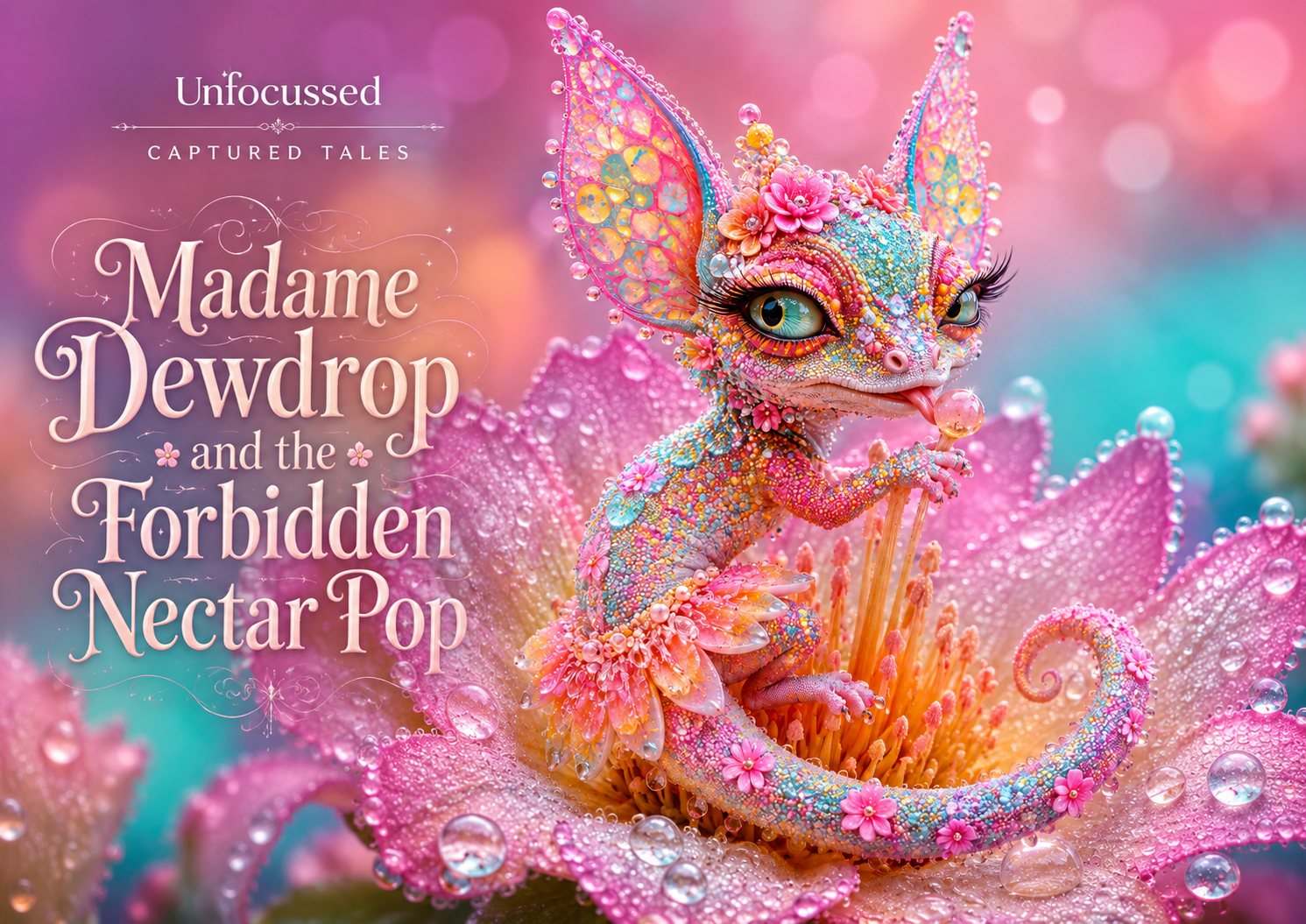
Ce matin-là, elle était assise au beau milieu de sa fleur rose poudré préférée, une jambe croisée sur l'autre, sa queue scintillante enroulée autour d'une étamine comme si elle avait été conçue uniquement pour une pose dramatique. Des perles de rosée s'accrochaient à ses oreilles translucides comme des pierres précieuses, captant les premiers rayons du soleil et dispersant de petits éclats de couleur sur les pétales. Ses yeux étaient immenses, étincelants, et bordés de cils qui avaient causé pas moins de trois collisions de colibris contre des feuilles.
Entre deux griffes délicates, elle tenait la preuve du délit.
Une sucette au nectar interdite.
Ronde, brillante, rose et chatoyant avec un léger tourbillon doré, la sucette était collée sur un minuscule bâtonnet en roseau et dégageait une douceur telle qu'elle faisait remettre en question leurs choix de vie aux insectes les plus sensés. Techniquement, elle appartenait aux réserves cérémonielles du Conseil des Fleurs. Techniquement, elle était réservée aux « ambassadeurs de pollinisation approuvés, aux officiants royaux de floraison et aux invités de rang digne ».
Techniquement, Madame Goutte-de-Rosée l'avait trouvée sans surveillance.
« Abandonnée », corrigea-t-elle à haute voix, en lui donnant un coup de langue pensif. « Seule. Pratiquement en train de mendier de la compagnie. »
Un scarabée en gilet bleu passant le long du bord du pétale s'arrêta net. Ses antennes se dressèrent.
« Madame Goutte-de-Rosée », chuchota-t-il, horrifié. « Est-ce que c'est... »
« Le petit-déjeuner », dit-elle.
« C'est une confiserie au nectar réglementée. »
« Et pourtant », dit-elle en la faisant tourner lentement pour qu'elle étincelle au soleil, « elle s'accorde avec mon teint. »
La petite bouche du scarabée s'ouvrit et se ferma plusieurs fois.
« Je dois le signaler. »
« Portez le chapeau bleu quand vous le ferez », dit Madame Goutte-de-Rosée en lui adressant un petit salut charmant. « Cela vous donne moins l'air d'un raisin sec avec de la paperasse. »
Le scarabée eut un hoquet de surprise si violent qu'il manqua de basculer en arrière du pétale.
En quelques minutes, la nouvelle s'était répandue.
À l'heure de la brume du matin, chaque créature, des bancs de mousse aux arches de lavande, avait entendu dire que Madame Goutte-de-Rosée avait une fois de plus enfreint une règle, offensé un comité, insulté un accessoire ou léché quelque chose qui aurait été béni par sept moines du pollen ordonnés. Les détails changeaient à chaque fois qu'ils étaient racontés, comme c'est souvent le cas quand ils sont colportés par des moucherons aux limites floues.
À la mi-journée, l'histoire était devenue celle d'une Madame Goutte-de-Rosée ayant pris d'assaut le garde-manger cérémoniel vêtue seulement de rosée et d'audace, saisissant la sucette au nectar sacrée des mains d'une reine des abeilles endormie et se déclarant Impératrice Suprême de Toutes les Choses Collantes.
Madame Goutte-de-Rosée ne démentit pas cette version.
Elle avait du style.
Elle était encore en train de savourer sa sucette quand la convocation arriva.
Trois papillons hérauts descendirent du ciel, leurs ailes portant des marques officielles en argent qui signifiaient que le Conseil des Fleurs voulait paraître important. Ils atterrirent sur le pétale dans une formation synchronisée qui aurait été impressionnante si le plus petit n'avait pas légèrement trébuché en faisant semblant que cela faisait partie de la chorégraphie.
Le papillon en tête déploya un parchemin pas plus grand qu'une graine de fougère.
« Madame Goutte-de-Rosée de la Baie des Pétales Rouges », annonça-t-il, « vous êtes par la présente convoquée devant le Haut Conseil des Fleurs pour des chefs d'accusation de perturbation persistante, consommation de douceur non autorisée, spectacle excessif, flirt incendiaire, inconduite décorative, et pour être... »
Il fit une pause.
Ses antennes frémirent.
Madame Goutte-de-Rosée se pencha en avant, ravie. « Pour être quoi ? »
Le papillon déglutit.
« Trop. »
Le jardin devint silencieux.
Même la sucette sembla cesser de briller pendant une seconde.
Puis Madame Goutte-de-Rosée rit.
Pas un rire modeste. Pas un petit gloussement de clochette poli, convenable pour prendre le thé parmi les violettes. Non, c'était un rire plein, étincelant, scandaleux, qui roula à travers les parterres de fleurs et fit se refermer prématurément trois lys coincés.
« Trop ? » répéta-t-elle. « Chéri, je suis à peine assez avant midi. »
Les papillons ne semblaient pas amusés.
C'était un autre problème avec les insectes officiels. De jolies ailes, un sens du plaisir tragique.
« Vous êtes attendue au Conseil de la Floraison immédiatement », dit le papillon en chef.
« Suis-je autorisée à apporter mon petit-déjeuner ? »
« L'objet interdit sera confisqué. »
Madame Goutte-de-Rosée ramena lentement la sucette au nectar contre sa poitrine.
« Essayez, et je crierai en lettres cursives. »
Le plus petit papillon fit un pas en arrière.
« Très bien », dit le héraut en chef, la voix tendue. « Apportez la confiserie. Mais ne la léchez pas pendant la séance. »
Madame Goutte-de-Rosée sourit de cette manière dangereuse propre à quelqu'un à qui l'on vient de lancer un défi devant un public captif.
« Je ne promets rien. »
Le Conseil de la Floraison siégeait au centre du jardin, là où les fleurs les plus anciennes poussaient en cercle autour d'une pierre plate réchauffée par des générations d'importance personnelle. Des digitales s'élevaient comme des tours pourpres. Des roses s'enroulaient en spirales suffisantes. Des mufliers se tenaient au garde-à-vous, comme s'ils attendaient que quelqu'un commette un crime de vocabulaire.
À la tête du cercle siégeait la Haute Matriarche des Pétales, Lady Primrose Prunella Thistledown, une fleur jaune pâle aux feuilles sévères et à l'expression généralement réservée à la découverte de pucerons dans le beau linge.
À ses côtés se trouvaient les autres membres du conseil : Lord Snapdragon, qui criait même en chuchotant ; l'Ancien Mosswick, qui avait oublié la moitié des lois mais insistait sur le fait qu'elles étaient toutes très importantes ; Dame Violet Vex, qui croyait que le plaisir était un champignon parasite ; et Frère Marigold, qui souriait doucement tout en gâchant la journée de chacun par le protocole.
Le public s'était rassemblé sur les bords, car rien ne rassemble mieux un jardin que la possibilité de regarder quelqu'un d'autre se faire réprimander.
Madame Goutte-de-Rosée arriva portée par un pétale de magnolia flottant, non pas parce qu'elle avait besoin de transport, mais parce qu'arriver à pied à une audience disciplinaire était pour les amateurs et les sauterelles émotionnellement réprimées.
Elle s'allongea au centre du pétale comme une souveraine revenant d'un scandale épuisant à l'étranger. Ses oreilles brillaient. Ses écailles scintillaient. La sucette au nectar interdite reposait dans ses griffes, intacte depuis la convocation, ce que tout le monde semblait trouver suspect.
Ils avaient raison.
Elle la gardait pour le bon moment.
Lady Primrose tapota une épine contre la pierre.
« Madame Goutte-de-Rosée », dit-elle, « ce conseil tolère vos frasques depuis de nombreuses saisons. »
« Je vous en prie », répondit Madame Goutte-de-Rosée.
Lord Snapdragon se gonfla. « Ce n'est pas une cérémonie de remerciement ! »
« Alors pourquoi y a-t-il tant de fleurs ? »
Quelques créatures gloussèrent. Dame Violet les fixa jusqu'à ce qu'ils se souviennent de leur mortalité.
Lady Primrose continua. « Vous avez perturbé à plusieurs reprises l'ordre et la dignité de ce jardin. Vous avez utilisé les bassins de rosée du matin comme miroirs pendant l'heure de réflexion sacrée. »
« Ils me reflétaient », dit Madame Goutte-de-Rosée. « J'ai simplement respecté leur usage. »
« Vous avez teint les chapeaux des champignons avec du brillant aux baies. »
« Ils avaient l'air fatigués. »
« Vous avez convaincu une chorale de grillons de chanter une ballade intitulée "Son Thorax était un Problème". »
« Une étape culturelle importante. »
« Vous avez remplacé l'hymne officiel de la pollinisation par quelque chose intitulé "Secoue Ton Petit Panier à Pollen". »
La foule bruissa.
Quelque part au fond, une abeille marmonna doucement : « C'était entraînant. »
Les pétales de Lady Primrose se tendirent. « Et maintenant, vous avez volé une sucette au nectar interdite dans les réserves cérémonielles. »
Madame Goutte-de-Rosée souleva la sucette entre deux griffes.
« Soi-disant. »
« Vous la tenez. »
« Je me tiens moi-même aussi dans des conditions profondément hostiles, mais personne n'applaudit pour ça. »
Frère Marigold se racla la gorge. « Madame Goutte-de-Rosée, niez-vous avoir pris sciemment une confiserie réglementée ? »
Elle pencha la tête. « Définissez "sciemment". »
« Avec conscience. »
« Alors non. J'avais conscience qu'elle semblait délicieuse. »
« Et réglementée. »
« Tout ce qui vaut la peine d'être goûté l'est généralement. »
Une nouvelle vague de rires parcourut la foule. Cette fois, elle était plus forte. Le conseil l'entendit aussi, et leur inconfort collectif était si satisfaisant que Madame Goutte-de-Rosée faillit ronronner.
Lady Primrose leva à nouveau son épine.
« Assez. C'est précisément le problème. Vous transformez chaque affaire en spectacle. Vous pliez chaque règle en théâtre. Vous tournez la tradition en dérision. »
Madame Goutte-de-Rosée se redressa légèrement.
Pour la première fois de la matinée, son sourire se fit plus mince.
« Non, chérie », dit-elle. « Je révèle quand la tradition est déjà ridicule. Il y a une différence. »
Le jardin bougea.
Cela marqua les esprits.
Car sous tout le brillant, le léchage de sucette et la couture insultante, Madame Goutte-de-Rosée avait frappé à la racine même du problème. Le Conseil des Fleurs aimait prétendre qu'il protégeait l'harmonie, mais en pratique, il protégeait surtout le calme. Le calme prévisible. Le calme poli. Le genre de calme où personne ne rit trop fort, ne fleurit trop brillamment, ne danse trop près des urnes à pollen ou ne demande pourquoi les « confiseries cérémonielles sacrées » étaient toujours enfermées jusqu'au banquet du conseil.
Madame Goutte-de-Rosée n'était pas calme.
Elle n'avait jamais été calme.
Elle avait éclos dans une explosion de brume scintillante pendant un orage de printemps et avait immédiatement mordu le doigt de la sage-femme parce qu'il bloquait sa lumière. En tant que jeune éclose, elle arrangeait des épines de rose en couronnes et exigeait des compliments. En tant qu'adulte, elle était devenue l'ennui le plus éblouissant du jardin, adorée par ceux qu'on négligeait et méprisée par tous ceux dont la personnalité dépendait de presse-papiers.
Les marginaux l'adoraient.
Le conseil craignait ce qu'elle représentait.
Car si une minuscule créature bijoux pouvait s'asseoir au milieu d'une fleur avec une sucette au nectar interdite et rire d'eux, alors peut-être que les règles n'étaient pas des racines du tout.
Peut-être étaient-ce simplement des mauvaises herbes avec de la meilleure papeterie.
Lady Primrose sembla sentir le changement et réagit rapidement.
« Madame Goutte-de-Rosée, ce conseil est parvenu à une décision. »
« Déjà ? » dit Madame Goutte-de-Rosée. « Mais je n'ai même pas encore livré mon deuxième acte. »
« Il n'y aura pas de deuxième acte. »
« Il y a toujours un deuxième acte. »
Lady Primrose l'ignora. « Par l'autorité du Haut Conseil des Fleurs, vous êtes par la présente placée sous réforme comportementale immédiate. »
Un souffle parcourut la foule.
Madame Goutte-de-Rosée cligna des yeux.
« Comportementale quoi maintenant ? »
Frère Marigold déroula un parchemin plus long. Ce n'était jamais bon signe.
« Vous suivrez des séances quotidiennes de modestie avec Dame Violet Vex. Vous remettrez tous les accessoires non autorisés, y compris, mais sans s'y limiter, les corsets en pétales, les boucles d'oreilles en perles de rosée, le brillant à baies, la poudre scintillante, les bracelets de cheville suggestifs et tout article classé comme "dramatiquement inutile". »
Madame Goutte-de-Rosée s'agrippa la poitrine. « Des bracelets de cheville suggestifs ? Ce sont des bijoux de famille. »
« Vous cesserez toutes les performances publiques, commentaires flirteurs, chants non autorisés, ingérences décoratives et flânages inutiles. »
« Flâner inutilement est la colonne vertébrale de la civilisation. »
« Vous vous présenterez chaque semaine pour une évaluation de vos progrès. »
« Par qui ? Ce morceau de moisissure avec un complexe de supériorité ? »
L'Ancien Mosswick se réveilla en sursaut. « Je m'oppose à être correctement identifié. »
Lady Primrose se pencha en avant.
« Et jusqu'à ce que vous prouviez que vous êtes capable de retenue, vous êtes bannie des parterres de fleurs centraux, des bassins de rosée au clair de lune, du garde-manger cérémoniel, de toutes les plateformes de festival et de toute fleur avec plus de quatre spectateurs à proximité. »
Le silence qui suivit fut cinglant.
Madame Goutte-de-Rosée regarda autour du cercle.
Les visages satisfaits du conseil.
Les yeux écarquillés de la foule.
Les abeilles qui feignaient de s'en moquer mais qui se penchaient pour mieux entendre.
Les scarabées, les papillons de nuit, les escargots, les champignons étranges, les papillons aux ailes tordues, les grillons trop bruyants, la libellule qui portait une cosse de graine craquelée en guise de casque et qui lui avait dit un jour qu'elle faisait que le jardin semblait moins solitaire.
Trop.
C'était ce qu'ils avaient dit d'elle.
Pas dangereuse. Pas cruelle. Pas nuisible.
Trop.
Trop brillante. Trop drôle. Trop étrange. Trop bruyante. Trop jolie d'une manière qui les mettait mal à l'aise. Trop désireuse de profiter d'elle-même sans demander aux comités appropriés si le plaisir avait été budgété pour la saison.
Madame Goutte-de-Rosée se leva lentement.
Le pétale de magnolia flottant s'enfonça sous son poids minuscule.
Ses écailles scintillantes captèrent la lumière du soleil. Ses oreilles translucides se déployèrent, projetant des reflets roses et dorés sur la pierre. Elle souleva la sucette au nectar interdite.
Lady Primrose plissa les yeux.
« Ne faites pas ça. »
Madame Goutte-de-Rosée sourit.
Puis elle prit le coup de langue le plus lent, le plus délibéré, le plus scandaleusement théâtral que le jardin eût jamais vu.
Un colibri s'évanouit.
Dame Violet fit un bruit de bouilloire pleine de jugement.
Lord Snapdragon cria « DÉCORUM ! » si fort que deux pissenlits libérèrent prématurément leur duvet.
Madame Goutte-de-Rosée baissa la sucette et laissa le silence s'étirer jusqu'à ce qu'il devienne une scène.
« Vous voulez une réforme ? » dit-elle.
Sa voix n'était plus joueuse.
Elle étincelait, oui, parce que tout chez elle étincelait, mais il y avait maintenant une chaleur en dessous. Une vraie chaleur. Pas une chaleur de caprice. Pas une chaleur mesquine.
Une chaleur de révolution.
« Alors réformons quelque chose. »
Elle se tourna vers les créatures rassemblées.
« Combien d'entre vous ont entendu dire qu'ils étaient "trop" ? »
Personne ne bougea au début.
Les membres du conseil échangèrent des regards inquiets.
Puis, près du banc de mousse, un grillon leva une patte.
« Ils ont dit que mes solos de violon étaient émotionnellement excessifs. »
Un papillon de nuit leva une aile. « Ils ont dit que ma danse sous la lune mettait les lys mal à l'aise. »
Un escargot se racla la gorge. « Ils ont dit que ma poésie en bave était inappropriée pour une compagnie mixte. »
« Cela rimait "fougère" avec "désir", » lança Dame Violet. « Il y a des normes. »
Plus de pattes, d'ailes, de griffes, d'antennes et de vrilles s'élevèrent.
Une coccinelle qui peignait ses points en or.
Un bourdon qui préférait la pollinisation jazz.
Un champignon qui brillait en turquoise à des heures indues.
Une chenille qui portait douze écharpes et refusait de s'excuser pour son volume.
Une libellule qui avait été condamnée à une amende pour « vol stationnaire excessif avec intention d'éblouir ».
Madame Goutte-de-Rosée les regarda se lever, un par un, et quelque chose en elle changea.
Elle avait toujours su qu'elle était admirée. L'adoration n'était pas exactement subtile quand les créatures continuaient à nommer des cocktails d'après vos scandales. Mais c'était différent. Ce n'étaient pas des applaudissements.
C'était de la reconnaissance.
Tous les originaux du jardin. Tous ses marginaux scintillants. Toutes ses tiges courbées et ses ailes bruyantes et ses petits cœurs tordus.
Ils étaient fatigués.
Pas fatigués des règles, exactement.
Fatigués des règles qui ne semblaient s'appliquer que lorsque la joie devenait gênante.
Lady Primrose se leva de son siège. « Cette assemblée n'est pas autorisée pour un témoignage public. »
Madame Goutte-de-Rosée se tourna vers elle.
« Mon petit-déjeuner ne l'était pas non plus, apparemment, et pourtant, nous sommes en pleine prospérité ici. »
Lord Snapdragon trépigna. « Vous incitez au désordre ! »
« Non », dit Madame Goutte-de-Rosée. « J'invite à la personnalité. »
La foule murmura son approbation.
La sucette au nectar interdite brillait plus fort dans sa main, réchauffée par le soleil et le drame. Madame Goutte-de-Rosée la leva haut comme un minuscule sceptre précieux.
« À partir de cet instant », déclara-t-elle, « je refuse d'être réformée par quiconque dont l'idée de la dignité consiste à s'asseoir en cercle pour faire remplir de la paperasse à la joie. »
Une acclamation éclata du fond. C'étaient probablement les grillons. Ils étaient toujours à un coup de tambour près d'une émeute.
« En outre », poursuivit-elle, « j'annonce par la présente la création de la Société de l'Épanouissement Excessif. »
Un autre souffle.
Celui-ci avait du goût.
« L'adhésion est ouverte à toutes les créatures accusées d'être trop bruyantes, trop brillantes, trop étranges, trop dramatiques, trop étincelantes, trop émotionnelles, trop flirteuses, trop ridicules, trop sincères, trop colorées, ou trop friandes de collations avec accès restreint. »
L'abeille d'un peu plus tôt cria : « Et les "trop ronds" ? »
Madame Goutte-de-Rosée pointa la sucette vers lui. « Surtout les trop ronds. »
L'abeille essuya une larme.
Les pétales de Lady Primrose tremblèrent de rage. « Vous ne pouvez pas simplement déclarer une société. »
« Je viens de le faire. Essayez de suivre. »
Frère Marigold semblait sincèrement en détresse. « Il y a des formulaires. »
« Brûlez-les. »
La foule rugit.
Et juste comme ça, le jardin changea.
Pas complètement. Pas encore. Les conseils ne s'effondrent pas en un discours, peu importe la fabulosité des oreilles impliquées. Les vieux systèmes s'accrochent comme des bardanes, et le Conseil des Fleurs avait des racines profondes enchevêtrées dans chaque cérémonie, garde-manger, plateforme et permis de pétale du royaume.
Mais quelque chose s'était fissuré.
Une fracture capillaire dans la pierre de la respectabilité.
Une minuscule rébellion scintillante s'était glissée à travers.
Madame Goutte-de-Rosée descendit du pétale de magnolia et marcha directement sur la pierre du conseil, chaque pas minuscule étant incroyablement gracieux et profondément irritant pour tous ceux qui voulaient la voir humiliée.
Elle s'arrêta devant Lady Primrose.
« Vous pouvez me bannir des parterres de fleurs centraux », dit-elle doucement. « Vous pouvez confisquer mon brillant à baies, bien que je vous prévienne qu'il mord. Vous pouvez programmer autant de séances de modestie que vos tristes petites racines le désirent. »
Elle se pencha davantage.
« Mais vous ne pouvez pas me rendre moins. »
Puis elle se tourna, souleva à nouveau son nectar à la sucette interdit et s'adressa à la foule qui l'observait.
« Maintenant, dit-elle, qui veut être spectaculairement inutile ? »
La première créature à s'avancer fut le champignon luminescent.
Puis l'abeille jazz.
Puis la chenille écharpe.
Puis la moitié des grillons, tous les papillons de nuit, deux fées des tulipes scandalisées mais curieuses, et un escargot qui avait déjà commencé à composer quelque chose de salace et de sincère sur une feuille voisine.
Au coucher du soleil, la Société de la Floraison Excessive comptait vingt-sept membres, aucune charte, trois chansons à thème et un gâteau aux baies de sucre volé qui refroidissait derrière une fougère.
Au lever de la lune, le Conseil des Fleurs avait émis douze déclarations d'urgence.
À minuit, Madame Goutte-de-Rosée avait forcé l'ancienne plateforme du festival, suspendu des lanternes de gouttes de rosée à chaque rambarde et déclaré le premier rassemblement officiel de la société.
Et au moment où la lune s'éleva haut au-dessus de la baie de Blushpetal, chaque marginal du jardin savait où aller.
Ils sont venus doucement au début.
Puis en riant.
Puis en brillant.
Puis en chantant des chansons que le conseil n'avait absolument pas approuvées.
Madame Goutte-de-Rosée se tenait au centre de tout cela, son nectar à la sucette interdit à la main, les oreilles éclatantes comme du vitrail sous le clair de lune, regardant les créatures négligées du jardin fleurir d'une manière qu'aucun conseil ne pouvait prévoir.
Pour la première fois de la journée, elle ne se sentait pas comme le spectacle.
Elle se sentait comme l'étincelle.
Et quelque part au-delà de la plateforme du festival, sous l'ombre sévère de la Fleur du Conseil, Lady Primevère Prunelle Chardon-du-Nord regardait les lumières vaciller à travers les feuilles.
Son expression était froide.
Ses pétales étaient serrés.
Et dans l'obscurité derrière elle, les portes verrouillées du garde-manger cérémoniel brillaient faiblement de la vieille magie de toutes les douceurs que le conseil avait toujours gardées pour lui-même.
La rébellion avait commencé avec un nectar à la sucette interdit.
Mais Madame Goutte-de-Rosée était sur le point de découvrir que le conseil avait caché bien plus que des bonbons.
La Société de la Floraison Excessive
À l'aube, le jardin était devenu insupportable.
Pas dangereux. Pas ruiné. Pas plongé dans le genre de chaos décrit dans les brochures du Conseil des Fleurs, où une règle trop lâche menait inévitablement au pourrissement des racines, à la décadence morale, à la danse en public, et à quelqu'un utilisant l'arrosoir sacré sans permis.
Non.
Le jardin était devenu insupportable de la manière précise dont la joie devient insupportable pour les gens qui ont passé trop de saisons à confondre le contrôle et la paix.
Il y avait des rubans dans la lavande.
Il y avait de la musique dans la mousse.
Il y avait des lanternes de rosée accrochées entre les digitales, chacune captant la lumière du matin et la faisant rebondir comme si le soleil avait été invité à une fête et qu'on lui avait montré où étaient les amuse-gueules.
Une procession d'escargots avait écrit de la poésie sur les pierres plates près de la Fleur du Conseil dans des traînées de bave scintillantes. Une partie était romantique. Une partie était politique. Une partie était les deux, ce qui, tout le monde en convenait, était un territoire dangereux avant le petit-déjeuner.
Une ligne particulièrement audacieuse disait :
Nous ne sommes pas des mauvaises herbes parce que vous n'avez pas réussi à comprendre notre floraison.
En dessous, en plus petits caractères, un autre escargot avait ajouté :
De plus, Lord Muflier a la profondeur émotionnelle d'un paillis humide.
Cette seconde ligne a reçu bien plus d'appréciation du public.
Madame Goutte-de-Rosée l'admirait alors qu'elle était assise sur un chapeau de champignon fraîchement peint avec un vernis aux baies et un scintillement de pollen en poudre. Son nectar à la sucette interdit avait été réduit à un trognon brillant, mais elle refusait de lâcher le bâton. Il était devenu, par le cours naturel de la rébellion, un symbole.
Elle le faisait tournoyer entre deux griffes comme s'il s'agissait d'un bâton royal.
« Il manque un peu de fioriture près de l'insulte », dit-elle en plissant les yeux devant le poème de bave. « Si tu dois le comparer à du paillis, rends-le personnel. Le paillis sert au moins à quelque chose. »
L'escargot poète, Barthélemy Gliss, tremblait de gratitude artistique.
« Madame, votre cruauté est une lanterne. »
« J'ai beaucoup de dons. »
Autour d'elle, la Société de la Floraison Excessive tenait sa première réunion matinale officielle, bien que « réunion » soit généreux. C'était moins une réunion qu'une déversement de paillettes avec des opinions.
L'abeille jazz, dont le nom était Bourdon Bourdonnant, avait amené six cousins et une trompette de la taille d'un dé fabriquée à partir d'une tige de chèvrefeuille recourbée. Il insistait sur le fait que la société avait besoin d'un hymne avec « du cuivre, du rebond et un rythme qui fait bouger les fesses ». Personne n'a objecté parce que personne ne voulait admettre qu'ils ne comprenaient pas la logistique des fesses d'abeille.
La chenille écharpe, Marnie Maintes-Écharpes, était arrivée en portant quatorze écharpes, trois châles et ce qui semblait être une frange de rideau volée à un gazebo de fées. Elle était chargée du moral, principalement parce qu'à chaque fois que quelqu'un semblait triste, elle l'enveloppait dans quelque chose de dramatique et lui disait qu'il avait l'air riche.
Le champignon luminescent turquoise, Sir Glimmick des Spores, fournissait l'éclairage, que quelqu'un le demande ou non.
« Je suis ambiant par nature », expliqua-t-il.
Une paire de papillons de nuit jumeaux nommés Luma et Lilt s'étaient portés volontaires pour les annonces aériennes, ce qui devint rapidement du vol interprétatif avec quelques mots occasionnels.
Une libellule avec un casque en graine fissurée tournait sans cesse au-dessus en criant « FORMATION ! » malgré l'absence de formation, de plan et de preuve que quiconque l'ait chargé de quoi que ce soit.
Madame Goutte-de-Rosée les a tous aimés immédiatement et l'a regretté tout aussi vite.
« Écoutez, mes petites catastrophes, dit-elle en frappant des griffes une fois. Nous avons besoin de structure. »
Tout le monde la regarda.
« Pas une structure de conseil, ajouta-t-elle rapidement. Ne fais pas cette tête, Barthélemy. Je veux dire une structure amusante. Celle avec moins de formulaires et plus d'entrées. »
« Des entrées ? » demanda Bourdon.
« Chaque mouvement a besoin d'une entrée. »
« Et qu'en est-il d'un but ? » demanda Marnie.
Madame Goutte-de-Rosée fit une pause.
Elle avait espéré que personne ne demanderait cela avant qu'elle ait fini de prendre la pose.
Un but, malheureusement, était plus difficile qu'une chanson à thème.
Il était facile de se rebeller contre le fait d'être qualifiée de « trop ». Il était facile de se tenir devant le conseil, brillant au soleil, et d'utiliser une sucette au nectar comme arme devant la moitié du jardin. Il était facile de transformer l'humiliation en théâtre, car Madame Goutte-de-Rosée faisait cela depuis qu'elle était assez vieille pour réaliser que pleurer faisait briller ses yeux.
Mais maintenant, il y avait des créatures qui la regardaient comme si elle n'avait pas seulement lancé un club.
Elles la regardaient comme si elle avait ouvert une porte.
C'était considérablement moins pratique.
Les portes mènent quelque part.
Et les endroits nécessitent une planification.
La planification nécessite des responsabilités.
La responsabilité était, selon l'opinion de Madame Goutte-de-Rosée, ce qui se passe quand le chaos a la gueule de bois.
Elle souleva le bâton de sucette au nectar et pointa vers la Fleur du Conseil.
« Notre but, dit-elle, espérant que la confiance construirait le pont avant que la vérité ne remarque le fossé, est de rappeler à ce jardin que la floraison n'est pas un privilège accordé par des comités. »
La société murmura son approbation.
Bien. Cela semblait assez officiel pour être brodé.
« Nous serons visibles, continua-t-elle. Nous serons ridicules. Nous serons impossibles à ignorer. Nous décorerons là où la décoration est interdite, chanterons là où le silence a été trop arrosé, et nous prélasserons partout où le prélassage a été jugé inutile par des légumes sans joie dans des feuilles formelles. »
Des acclamations éclatèrent.
Lord Muflier, qui rôdait derrière une haie en faisant semblant de ne pas écouter, fit un bruit de pétarade offensé et se retira.
Madame Goutte-de-Rosée sourit.
« Et, ajouta-t-elle, nous découvrirons ce que le conseil cache. »
Les acclamations s'estompèrent en un bruissement intrigué.
Sir Glimmick brilla plus fort. « Cache ? »
« Le garde-manger cérémoniel. » Madame Goutte-de-Rosée regarda vers l'arche de pierre lointaine à moitié couverte de lierre et de vieilles épines de rose. « La nuit dernière, après notre rassemblement, je l'ai vu briller. »
Bourdon vrombit plus bas. « Le garde-manger brille toujours un peu. Ils y gardent des sucres bénis. »
« Ce n'était pas une lueur de sucre. »
« Quel genre de lueur était-ce ? » demanda Luma.
Madame Goutte-de-Rosée plissa ses yeux énormes.
« Une lueur coupable. »
Tout le monde hocha la tête comme s'il s'agissait d'une catégorie reconnue de luminescence.
Ce n'était, en fait, pas le cas. Mais Madame Goutte-de-Rosée avait découvert il y a longtemps que la plupart des créatures accepteraient n'importe quelle phrase prononcée avec suffisamment d'audace.
Barthélemy glissa en avant, laissant une virgule nerveuse derrière lui. « Le garde-manger cérémoniel est verrouillé depuis des générations, sauf pendant les banquets du conseil et les rites de floraison. »
« Exactement. »
« Peut-être contient-il des reliques sacrées. »
« Peut-être contient-il des collations volées. »
« Ou de la vieille magie », chuchota Marnie.
Cela s'installa parmi eux.
La vieille magie n'était pas quelque chose dont le jardin plaisantait à la légère. La nouvelle magie était partout : dans la rosée, dans le pollen, dans les fleurs qui s'ouvraient lorsqu'elles étaient correctement louées, dans les champignons qui brillaient turquoise à des heures inappropriées. La nouvelle magie était ludique, saisonnière et généralement disposée à participer à un festival si elle était corrompue avec de l'eau sucrée.
La vieille magie était différente.
La vieille magie vivait dans des racines trop profondes pour être nommées. Elle s'enroulait sous le jardin dans des veines endormies. Elle se souvenait des tempêtes qui n'avaient jamais touché le ciel et des fleurs qui avaient fleuri avant que les abeilles n'apprennent les bonnes manières. Elle était puissante, étrange et notoirement grincheuse lorsqu'elle était mal utilisée.
Le Conseil des Fleurs prétendait protéger le jardin contre la vieille magie.
Madame Goutte-de-Rosée commençait à soupçonner qu'ils protégeaient surtout la vieille magie contre quiconque aurait de meilleures idées.
« Ce soir, dit-elle, nous enquêtons. »
La libellule au casque de graine salua si fort qu'elle tourna sur le côté. « Enfin. Une mission. »
« Une mission silencieuse », dit Madame Goutte-de-Rosée.
La société se dégonfla collectivement.
« Silencieuse ? » demanda Bourdon, horrifié.
« Temporairement. »
« Définissez temporairement. »
« Jusqu'à ce qu'il devienne plus utile d'être bruyant. »
Tout le monde s'illumina.
« La voilà bien », dit Marnie.
Madame Goutte-de-Rosée glissa du chapeau de champignon et atterrit légèrement sur un pétale en contrebas. « Aujourd'hui, nous nous comportons normalement. »
Un silence terrible suivit.
« Normalement pour nous », clarifia-t-elle.
Le soulagement balaya le groupe.
« Nous distrayons le conseil, dit-elle. Nous dispersons leur attention. Rien de trop évident. »
À midi, quelqu'un avait accroché une guirlande de gousses suggestives à l'entrée de la Fleur du Conseil.
À une heure, les grillons avaient commencé à répéter une chanson de protestation intitulée Mettez ce permis là où le tournesol ne brille pas.
À deux heures, un groupe de coccinelles s'était peint avec des couleurs métalliques non autorisées et avait organisé ce qu'elles appelaient un « défilé de libération des points ».
À trois heures, Marnie Maintes-Écharpes avait enveloppé la statue de Sainte Pétunia la Convenable dans sept écharpes et une minuscule ceinture portant l'inscription Demandez-moi à propos de mon drame caché.
À quatre heures, Madame Goutte-de-Rosée avait conclu que la subtilité était un instrument délicat et que son peuple l'utilisait comme une louche à soupe.
Pourtant, les distractions fonctionnaient.
Le Conseil des Fleurs passa la journée dans un état de détresse administrative croissante. Lady Primevère émit des proclamations. Frère Souci rédigea des conseils d'urgence. Dame Violette Vex tenta de confisquer la guirlande de gousses et s'y empêtra pendant onze minutes humiliantes. Lord Muflier cria sur un groupe de champignons jusqu'à ce qu'ils brillent plus fort par dépit.
L'Ancien Mousse-de-Bois fit la sieste pendant la majeure partie, ce dont tout le monde convint en privé qu'il s'agissait de sa meilleure contribution à la gouvernance.
Madame Goutte-de-Rosée observait depuis le bord d'une rose, cachée sous un voile de pétales et de satisfaction.
Le conseil était secoué.
Les conseils secoués font des erreurs.
Au crépuscule, Lady Primevère fit la sienne.
Elle quitta la Fleur du Conseil flanquée de deux gardes épineux et traversa le jardin vers le garde-manger cérémoniel. Madame Goutte-de-Rosée suivit depuis le haut, sautant entre les fleurs avec sa queue enroulée près d'elle et ses oreilles atténuées sous une cape de feuilles de violette humides. Derrière elle venait le groupe de mission qu'elle avait sélectionné avec grand soin et regret modéré.
Bourdon Bourdonnant, parce qu'il pouvait se faufiler dans les petits espaces et mentir de manière convaincante s'il était corrompu avec du sirop de trèfle.
Marnie Maintes-Écharpes, parce qu'elle pouvait produire une corde, des bandages, des rideaux ou un soutien émotionnel à partir de n'importe laquelle de ses écharpes.
Sir Glimmick des Spores, parce que les endroits sombres avaient besoin de lumière et qu'il était légalement impossible de l'atténuer.
Luma et Lilt, parce que la reconnaissance aérienne comptait, même s'ils insistaient pour la faire avec une chorégraphie.
Et Barthélemy Gliss, parce qu'il avait trop entendu, se déplaçait silencieusement et pouvait écrire une accusation sur n'importe quelle surface si les choses devenaient légalement épicées.
La libellule au casque de graine n'était pas invitée, mais apparut quand même.
« Je suis le soutien de l'ombre », murmura-t-elle bruyamment.
Madame Goutte-de-Rosée pressa une griffe sur son front. « Tu es un tambourin volant avec de l'anxiété. »
« Reçu. »
« Reste derrière la fougère. »
« Soutien de la fougère de l'ombre. »
« Très bien. »
Le garde-manger cérémoniel était à moitié enterré derrière un mur de lierre ancien. Sa porte était sculptée dans de l'écorce pétrifiée et liée avec une racine d'argent. Des symboles s'incurvaient à travers elle en vieille écriture d'épines, brillant faiblement lorsque Lady Primevère s'approchait. Les gardes épineux s'arrêtèrent à quelques pas, s'inclinèrent et se détournèrent comme s'il leur était interdit de regarder.
Intéressant.
Lady Primevère retira quelque chose de dessous une feuille pliée.
Une clé.
Pas de métal. Pas de bois. Elle ressemblait à un éclat de miel cristallisé enveloppé dans une veine de racine noire. Elle pulsait avec une douce lumière ambrée.
Bourdon fit un petit bruit de faim.
Madame Goutte-de-Rosée pinça son aile.
« Pas de la nourriture. »
« Tout est nourriture avec de l'imagination. »
« C'est pour ça que tu es sur une liste de surveillance. »
Lady Primevère inséra la clé dans un nœud au centre de la porte. Les vieux symboles s'embrasèrent. Les fixations de racine d'argent se dénouèrent avec un doux sifflement. La porte s'ouvrit juste assez pour qu'elle puisse se glisser à l'intérieur.
Madame Goutte-de-Rosée attendit.
Comptant.
Un scintillement.
Deux souffles.
Trois antennes frémissantes.
Puis la porte commença à se fermer.
« Bougez », murmura-t-elle.
Ils se précipitèrent en avant.
Bourdon se faufila le premier. Luma et Lilt se glissèrent après lui, ailes repliées. Marnie se faufila sous la racine la plus basse avec une grâce surprenante pour quelqu'un habillé comme une explosion de tissu ambulante. Sir Glimmick se dandina de côté, marmonnant des excuses au chambranle. Barthélemy s'aplatit en un ruban brillant et glissa sous le bord.
Madame Goutte-de-Rosée passa en dernier, franchissant à peine l'ouverture qui se rétrécissait avant que la porte ne se scelle derrière elle avec un bruit comme l'histoire avalant un secret.
À l'intérieur, l'air était frais.
Et doux.
Trop doux.
Pas la douceur simple du nectar ou du fruit. C'était une douceur ancienne et stratifiée : résine miellée, pollen sucré, violettes écrasées, sirop de lune, et quelque chose de plus sombre en dessous de tout cela, comme du caramel laissé trop longtemps sur une flamme.
La lueur turquoise de Sir Glimmick s'élargit à travers la chambre.
Le garde-manger cérémoniel était énorme.
Impossible, en réalité. De l'extérieur, il n'aurait dû pas être plus grand qu'une souche creuse. À l'intérieur, il s'étendait vers le bas dans une cave à racines voûtée, des étagères s'enroulant le long des murs et disparaissant dans l'ombre. Des bocaux bordaient chaque surface. Bouteilles. Gousses de cristal. Bols scellés à la cire. Paquets suspendus de pétales séchés. Cabinets verrouillés. Minuscules tonneaux estampillés avec les sceaux du conseil.
Et au centre de la chambre se dressait une fontaine.
Pas d'eau.
Nectar.
Un nectar doré et lumineux coulait silencieusement de la bouche ouverte d'une fleur de pierre sculptée dans un bassin en forme de main en coupe. Il brillait avec la même vieille magie que Madame Goutte-de-Rosée avait vue la veille.
Marnie murmura : « Ce n'est pas un comportement de garde-manger. »
« Non, dit Madame Goutte-de-Rosée. C'est définitivement un comportement de repaire secret. »
Bourdon plana vers la fontaine, hébété. « Je peux l'entendre chanter. »
« Ne bois pas la fontaine lumineuse suspecte », siffla Madame Goutte-de-Rosée.
« Mais elle connaît mon nom. »
« Tout connaît ton nom. Tu t'es présenté à un caillou hier. »
Ils se cachèrent derrière une pile de caisses de baies de sucre alors que Lady Primevère émergeait d'une alcôve latérale portant une petite fiole. Elle la tint soigneusement sous le bec de la fontaine et la remplit de nectar brillant. Pendant qu'elle travaillait, une autre porte s'ouvrit à travers la chambre.
Frère Souci entra.
Puis Dame Violette.
Puis Lord Muflier.
L'Ancien Mousse-de-Bois arriva en dernier, l'air irrité d'être réveillé et vaguement surpris d'être impliqué.
Le Conseil des Fleurs au complet se rassembla autour de la fontaine.
Madame Goutte-de-Rosée sentit sa queue se tendre.
« Les perturbations se propagent », dit Lady Primevère.
« Parce que vous ne l'avez pas exilée immédiatement », rétorqua Dame Violette.
Lord Muflier frappa d'un poing feuillu contre le bassin. « J'ai dit que nous aurions dû la placer dans un terrarium calme. »
Les yeux de Madame Goutte-de-Rosée s'agrandirent.
Marnie enveloppa silencieusement une écharpe autour de sa bouche pour empêcher toute réponse qui essayait de s'échapper.
Frère Souci soupira. « Le confinement aurait nécessité un vote aux deux tiers et une évaluation de l'humidité. »
« Le problème est plus vaste que Goutte-de-Rosée maintenant, dit Lady Primevère. Elle a réveillé l'insatisfaction parmi les créatures moins importantes du jardin. »
Moins importantes.
Le mot atterrit comme une épine dans l'obscurité.
Les ailes de Bourdon ralentirent.
Les pédoncules oculaires de Barthélemy s'abaissèrent.
Sir Glimmick s'assombrit sans le vouloir.
Madame Goutte-de-Rosée resta très immobile.
C'était là.
Pas enterré sous l'étiquette. Pas habillé dans le langage du conseil. Pas adouci par les discussions sur l'harmonie, la dignité ou la tradition.
Moins importantes.
C'est ce qu'ils voulaient dire quand ils disaient « trop ».
Trop pour des créatures qui devraient être moins.
Lady Primevère souleva la fiole de nectar brillant. « Nous allons procéder à l'Apaisement de la Floraison. »
Frère Souci semblait mal à l'aise. « Matriarche, l'Apaisement n'a pas été effectué depuis de nombreuses saisons. »
« Alors le jardin a profité de nombreuses saisons de patience du conseil. »
Dame Violet fit un signe de tête sec. « Les créatures inférieures sont agitées. Les festivals deviennent vulgaires. Les jeunes pousses remettent la tradition en question. Même les abeilles improvisent maintenant. »
Bumbleton articula silencieusement : Le jazz n'est pas un crime.
Lord Snapdragon se pencha près de la fontaine à nectar. « Dans combien de temps cela peut-il être préparé ? »
Lady Primrose fit tourner la fiole dans la lumière. « Pour demain soir. Pendant le Rassemblement de la Rosée. Nous vaporiserons d'abord les parterres de fleurs centraux. Le nectar calmera l'expression excessive, réduira les impulsions perturbatrices et rétablira l'harmonie sociale. »
« L'harmonie sociale », murmura Bartholomew. « On dirait un meurtre qui porte du parfum. »
Les griffes de Madame Dewdrop s'enfoncèrent dans la caisse.
Elle connaissait l'Apaisement des Floraisons. Tout le monde le connaissait, bien que la plupart considèrent cela comme un vieux conte moralisateur raconté aux éclos qui refusaient de faire la sieste. Il y a longtemps, pendant la Sécheresse Épineuse, le conseil avait utilisé une ancienne magie du nectar pour supprimer la panique dans le jardin. Cela avait fonctionné, selon les annales officielles.
Cela avait également laissé toute une génération de fleurs nocturnes incapables de chanter.
Le conseil prétendait que cette partie était une légende.
Les fleurs nocturnes ne l'ont jamais fait.
Madame Dewdrop pensait que la magie était perdue.
Au lieu de cela, elle avait été enfermée dans le garde-manger à côté des sucreries coûteuses.
Bien sûr que oui.
Le pouvoir et le dessert ont toujours tendance à s'asseoir à la même table.
« Nous devons agir avec prudence », dit Brother Marigold. « Si le jardin apprend que nous possédons toujours du nectar Apaisant... »
« Le jardin nous remerciera une fois la paix rétablie », dit Lady Primrose.
« La paix ? » murmura Madame Dewdrop si doucement que seule Marnie l'entendit.
Sa voix tremblait d'une émotion plus tranchante que la colère.
La paix, c'était ainsi que les conseils appelaient le silence après avoir fait rentrer toute chanson dans la gorge par la terreur.
Lady Primrose tendit la fiole à Dame Violet. « Préparez les roseaux vaporisateurs. Gardez-les cachés jusqu'au début du rassemblement. Snapdragon, augmentez les patrouilles près de la plateforme du festival. Marigold, rédigez une déclaration condamnant les sociétés non autorisées. »
« Dois-je mentionner Dewdrop nommément ? »
L'expression de Lady Primrose se durcit.
« Non. Cela lui donne de l'importance. »
Madame Dewdrop faillit rire.
Presque.
Mais cette fois, le rire aurait eu des dents.
Le conseil se dispersa dans des alcôves séparées, chaque membre récoltant fournitures, registres, contenants scellés et petits instruments de contrôle déguisés en outils de jardinage.
Madame Dewdrop attendit que leurs voix s'évanouissent.
Puis elle se tourna vers son équipe de mission.
« On le vole. »
« La fiole ? » demanda Lilt.
« Tout. »
Bumbleton fixa la fontaine. « Tout le nectar ancien qui supprime la personnalité ? »
« Oui. »
« Ça semble ambitieux. »
« Merci. »
Sir Glimmick leva un petit chapeau brillant. « Comment vole-t-on une fontaine ? »
Madame Dewdrop regarda les étagères en spirale, les bocaux scellés, les bouquets suspendus, les armoires enracinées et le bassin brillant de magie ancienne assez puissante pour aplatir l'âme d'un jardin entier.
Elle envisagea la stratégie.
Elle envisagea la retenue.
Elle envisagea la réalité du fait qu'elle avait amené une abeille de jazz, une chenille foulard, un champignon lumineux, deux papillons de nuit interprétatifs, un escargot poète et une libellule non autorisée à un braquage magique.
Puis elle sourit.
« Maladroitement », dit-elle. « Mais avec style. »
Ils se déplacèrent rapidement.
Marnie déroula trois foulards en corde et fixa une extrémité autour d'un support d'étagère en forme de rose épineuse. Luma et Lilt volèrent vers le haut pour repérer les étagères plus hautes. Bumbleton inspecta le mécanisme de la fontaine, principalement en le reniflant et en émettant des bruits que Madame Dewdrop jugea médicalement préoccupants. Sir Glimmick illumina les inscriptions gravées dans le bassin tandis que Bartholomew les copiait sur le sol avec de la bave.
La libellule, qui était entrée par miracle après tout, apparut derrière un tonneau.
« Soutien de l'ombre au rapport. »
Madame Dewdrop fixa le vide. « Comment es-tu entré ? »
« Fissure de ventilation. »
« Il n'y avait pas de fissure de ventilation. »
« Il y en a une maintenant. »
Quelque part au-dessus, un faible courant d'air siffla.
Madame Dewdrop prit note d'être furieuse plus tard.
« Très bien. Surveille la porte. »
« Soutien de porte. »
« Discrètement. »
« Soutien de porte silencieux. »
Il salua et renversa un bocal de la taille d'un dé.
Tout le monde se figea.
Le bocal roula sur le sol en pierre.
Une fois.
Deux fois.
Trois fois.
Puis il tomba d'un rebord et se fracassa dans l'obscurité en bas.
Un nuage de poudre violette scintillante jaillit du niveau inférieur.
Quelque chose éternua.
Quelque chose de grand.
Madame Dewdrop se tourna lentement vers le précipice.
« S'il vous plaît », chuchota-t-elle, « laissez cela être le garde-manger qui se tasse. »
Un grognement sourd s'éleva de dessous les étagères.
Pas en colère.
Somnolent.
Ancien.
Légèrement encombré.
Bumbleton recula loin de la fontaine. « Le conseil garde-t-il un monstre de garde-manger ? »
« Bien sûr qu'ils gardent un monstre de garde-manger », dit Madame Dewdrop. « Pourquoi cette soirée deviendrait-elle raisonnable maintenant ? »
Deux yeux énormes s'ouvrirent en bas.
Ils brillaient d'un or ambré.
Une tête s'éleva lentement de l'obscurité inférieure : écailleuse comme de l'écorce, moustachue de racines, couronnée de pétales bouclés devenus pâles par manque de soleil. Elle avait la taille d'une citrouille et la forme vaguement d'une salamandre, si une salamandre avait été conçue par un arbre ancien après avoir mangé trop de miel et rêvé de vengeance.
Il cligna des yeux vers eux.
Puis il éternua encore.
Le pollen explosa dans toute la chambre.
Tout le monde se baissa.
Sir Glimmick roula derrière un bocal de cynorhodons confits.
Marnie disparut sous ses propres foulards.
Bartholomew laissa une ponctuation de terreur sur le sol.
Madame Dewdrop tint bon, car les divas comprenaient que battre en retraite devant une entrée dramatique ruinait l'énergie.
La créature renifla.
Son regard se posa sur elle.
« Qui », gronda-t-il, « a léché le nectar sacré ? »
Madame Dewdrop leva une griffe.
« Pour ma défense, il était émotionnellement disponible. »
La créature fixa.
Puis elle rit.
Le rire secoua la poussière des chevrons et fit vibrer les bocaux. Il était chaud, rugueux et vieux comme des racines enterrées.
« Enfin », dit-il. « Quelqu'un avec du goût. »
Madame Dewdrop se redressa.
« Je vous demande pardon, bête de garde-manger, mais je vais avoir besoin de votre nom, de vos intentions, et de savoir si vous prévoyez ou non de manger quelqu'un d'essentiel à ma soirée. »
La créature s'éleva davantage, révélant un long corps enroulé autour des étagères inférieures. Sa queue disparaissait derrière des tours de bocaux scellés. Des fleurs minuscules poussaient le long de sa colonne vertébrale, chacune brillant faiblement.
« Je suis Nectarex », dit-il, « Gardien de la Première Douceur, Dernier Témoin de la Floraison Inquiète, Gardien du Puits de Racine, et selon Lady Primrose, une complication de stockage regrettable. »
Les yeux de Madame Dewdrop brillèrent.
« Un plaisir. Je suis Madame Dewdrop, étincelle de rébellion, criminelle de teint, enthousiaste du nectar interdit, et selon Lady Primrose, trop. »
Nectarex baissa la tête jusqu'à ce qu'un œil brillant soit au niveau du sien.
« Trop ? »
« Apparemment. »
« Bien. »
Le mot roula à travers la chambre.
Nectarex regarda au-delà d'elle vers l'équipe de mission. « Et ceux-là ? »
« Ma société. »
« Votre armée ? »
Madame Dewdrop jeta un coup d'œil à Bumbleton, qui avait brièvement coincé sa tête dans un bouchon de sirop vide, et Marnie, qui essayait de réconforter Bartholomew avec un foulard étiqueté élégance d'urgence.
« N'utilisons pas de mots qui créent des attentes injustes. »
Nectarex ricana encore.
Madame Dewdrop s'avança. « Le conseil prévoit d'utiliser l'Apaisement des Floraisons demain soir. »
L'amusement de la créature s'évanouit.
La chambre sembla s'assombrir autour de ses yeux.
« Non. »
« Donc vous savez ce que c'est. »
« Je sais ce que cela a coûté. »
Nectarex planta ses griffes dans la pierre. « L'Apaisement n'a jamais été destiné à diriger un jardin. Il a été fait dans le désespoir, pendant la sécheresse et la panique, quand la peur se propageait plus vite que la pourriture. L'ancien nectar peut calmer la terreur, oui. Mais utilisé sur la joie, sur la colère, sur la sauvagerie, sur le deuil, sur le désir, sur le pouls brillant et indiscipliné des choses vivantes… »
Il secoua la tête.
« Il ne les calme pas. Il les vide. »
Personne ne parla.
Même la libellule arrêta de saluer les choses.
Nectarex regarda vers la fontaine. « Le conseil a promis : plus jamais. »
La voix de Madame Dewdrop s'adoucit. « Les conseils adorent les promesses. Ils les empilent soigneusement à côté des choses qu'ils prévoient de faire de toute façon. »
La vieille créature l'étudia.
« Pourquoi vous souciez-vous ? »
La question frappa plus fort qu'elle ne l'avait prévu.
Madame Dewdrop regarda la fontaine. Le nectar brillant glissant silencieusement dans le bassin. Toute la douceur cachée, thésaurisée et enfermée. Ses amis, ridicules, effrayés et loyaux bien qu'ils se connaissent à peine depuis un jour.
Pourquoi se souciait-elle ?
Hier, elle aurait pu dire que c'était parce que personne ne lui disait quoi faire. Parce que le conseil l'avait insultée. Parce qu'une interdiction dramatique méritait une réponse dramatique. Parce qu'il était personnellement offensant d'être qualifiée de « trop » par un groupe de fleurs ayant le charisme de tiges bouillies.
Tout cela était vrai.
Mais pas suffisant.
Elle pensa au grillon levant une patte.
Au papillon de nuit admettant que sa danse mettait les lys mal à l'aise.
À l'abeille demandant si le fait d'être trop ronde comptait.
Au champignon s'assombrissant au mot inférieur.
Et sous ces pensées, quelque chose de plus ancien en elle s'éveilla : un souvenir d'être petite, nouvellement éclose, brillant trop fort pour les feuilles de la pouponnière, entendant des murmures des fleurs convenables.
Difficile à gérer.
En quête d'attention.
À corriger tôt.
Elle avait mordu une sage-femme ce jour-là, oui.
Mais seulement parce que personne ne lui avait encore appris la différence entre la cruauté et l'attention déguisée en taille.
Madame Dewdrop leva le menton.
« Parce qu'ils ne nous veulent pas paisibles », dit-elle. « Ils nous veulent plus petits. Et je ne suis pas dans le métier de me rendre plus facile à ignorer. »
Nectarex la fixa pendant un long moment.
Puis il inclina sa grande tête.
« Alors nous les arrêtons. »
Madame Dewdrop sourit lentement.
« Charmant. Pouvez-vous détruire la fontaine ? »
« Non. »
« Moins charmant. »
« Le Puits de Racine l'alimente. Détruire la fontaine empoisonnerait les parterres de fleurs. »
« Pouvez-vous le boire ? » demanda Bumbleton.
Nectarex lui jeta un regard.
« J'explore juste les options », marmonna l'abeille.
« L'ancien nectar doit être transformé », dit Nectarex. « Pas supprimé. Pas caché. Pas utilisé pour faire taire. Il doit être éveillé dans sa véritable nature. »
Marnie leva un pied minuscule. « Et sa véritable nature est… ? »
« L'expression. »
Les oreilles de Madame Dewdrop brillèrent.
Nectarex continua. « Avant que la peur ne le transforme en Apaisement, la Première Douceur était un nectar de festival. Il amplifiait ce qui vivait à l'intérieur d'une créature. La chanson devenait assez forte pour faire ouvrir les pétales. La couleur devenait assez intense pour tacher l'aube. L'amour devenait courageux. Le deuil devenait pluie. La colère devenait changement. »
Sir Glimmick brilla d'un turquoise plein d'espoir. « Donc, au lieu de rendre tout le monde moins… »
« Il peut les rendre plus », dit Madame Dewdrop.
Nectarex hocha la tête.
« Mais la transformation nécessite trois choses : de la rosée au clair de lune recueillie librement, du pollen d'une fleur non réduite au silence, et une étincelle d'excès consentante. »
Chaque visage se tourna lentement vers Madame Dewdrop.
Elle plaça une griffe sur sa poitrine.
« Quel choc. L'intrigue m'a remarquée. »
Avant que quiconque ne puisse répondre, la porte au-dessus d'eux gémit.
Des voix résonnèrent depuis l'entrée.
« Le sceau du garde-manger a été perturbé », trancha Dame Violet.
« Je vous ai dit que j'avais entendu quelque chose », dit Lord Snapdragon.
« Vous entendez toujours quelque chose », marmonna Brother Marigold. « Habituellement vous-même. »
Madame Dewdrop regarda Nectarex.
« Sortie ? »
Nectarex pointa une griffe vers les étagères inférieures. « Tunnel de racines. Étroit. Désagréable. Ça sent les vieux oignons. »
« Tout le monde », murmura Madame Dewdrop, « préparez-vous à devenir humble. »
« Je déteste le développement de personnage », dit Marnie.
Ils grimpèrent le long de la corde de foulards alors que le conseil entrait dans la chambre supérieure.
La voix de Lady Primrose trancha le garde-manger. « Quelqu'un est venu ici. »
Bumbleton fonça dans le tunnel. Luma et Lilt suivirent, les ailes serrées. Sir Glimmick se faufila avec un doux bruit sec. Marnie poussa Bartholomew en avant puis se tourna vers Madame Dewdrop.
« Et toi ? »
Madame Dewdrop regarda la fontaine.
Les étagères.
La station de fioles.
La vieille douceur brillante attendant d'être utilisée contre chaque créature qui avait osé devenir visible.
Puis elle regarda le bâton de sucette au nectar encore dans sa griffe.
Un symbole, oui.
Mais aussi, peut-être, une clé d'un autre genre.
Elle courut vers la fontaine et trempa le bâton dans le courant brillant.
L'ancien nectar grimpa dessus comme de la lumière liquide.
Nectarex siffla depuis le tunnel. « Dewdrop ! »
Au-dessus, Lady Primrose haleta.
« Toi. »
Madame Dewdrop se tourna.
Tout le Conseil des Fleurs se tenait à l'autre bout de la chambre.
Le visage de Lady Primrose était pâle de fureur.
Dame Violet serrait la fiole de nectar Apaisant.
Lord Snapdragon se gonfla si violemment qu'une feuille éclata.
Brother Marigold avait l'air de venir de réaliser que la paperasse pouvait devenir une preuve.
Madame Dewdrop leva le bâton enduit de nectar en salut.
« Je dirais que ce n'est pas ce que cela semble être », lança-t-elle, « mais honnêtement, pour une fois, ça l'est absolument. »
« Saisissez-la ! » cria Lady Primrose.
Madame Dewdrop courut.
Une épine frappa la pierre à côté de son pied. Une autre trancha l'air près de son oreille. Elle plongea, roula et glissa sous une chaîne de cosses de cristal suspendues, les dispersant derrière elle. Elles éclatèrent sur le sol en douches de fumée de sucre scintillante.
Lord Snapdragon chargea à travers la brume et éternua immédiatement dans un tonneau.
Bien.
La comédie physique était toujours de leur côté.
Madame Dewdrop atteignit le tunnel juste au moment où Nectarex abaissait une griffe massive pour protéger l'ouverture.
« Va », grogna la vieille créature.
« Viens avec nous. »
« Je ne peux pas abandonner le Puits de Racine tant qu'ils le contrôlent encore. Quelqu'un doit les empêcher de le drainer après vous. »
Madame Dewdrop hésita.
L'œil ambré de Nectarex s'adoucit. « Étincelle de rébellion, ne gaspille pas le drame en adieux. Dépense-le là où il peut faire des dégâts. »
C'était, pensa Madame Dewdrop, un excellent conseil.
Elle glissa dans le tunnel.
Derrière elle, Nectarex rugit.
Le garde-manger trembla.
Les racines se tordirent à l'entrée du tunnel alors que le conseil criait d'alarme. La dernière chose que Madame Dewdrop vit avant que l'obscurité ne l'avale fut Lady Primrose regardant à travers les racines qui se fermaient, son expression n'étant plus seulement froide.
Elle était effrayée.
Le tunnel était tout aussi désagréable qu'annoncé.
Il sentait les vieux oignons, l'écorce humide et les secrets qui avaient tourné. La société rampa, se faufila, glissa et maudit son chemin à travers l'obscurité pendant que Sir Glimmick fournissait assez de lumière pour que tout le monde voie exactement à quel point ils avaient l'air peu dignes.
Madame Dewdrop émergea la dernière, couverte de boue du bout des oreilles jusqu'à la pointe de la queue, serrant le bâton de sucette enduit de nectar comme une torche.
Ils dégringolèrent sous les racines d'un vieux saule près des bassins de rosée au clair de lune.
Pendant un moment, personne ne bougea.
Puis Bumbleton roula sur le dos et siffla : « Je crois que j'ai touché l'histoire avec mon derrière. »
« Nous l'avons tous fait », dit Marnie. « Certains d'entre nous avec plus de grâce. »
Madame Dewdrop s'assit et essuya la boue de sa joue.
Ses écailles étaient ternies. Ses accents de pétales étaient ruinés. L'une de ses boucles d'oreilles en goutte de rosée ne tenait plus qu'à un fil. Ses oreilles magnifiques étaient maculées de boue racinaire.
Elle ressemblait, selon toute mesure raisonnable, à un désastre.
Tout le monde la fixa.
Elle fixa en retour.
« Quoi ? »
Bartholomew s'éclaircit la gorge. « Madame, pardonnez-moi, mais vous avez l'air… »
« Attention. »
« Héroïque. »
Cela la fit taire.
Le mot se posa étrangement sur ses épaules.
Elle était habituée à belle. Scandaleuse. Excessive. Impossible. Superbe. Exaspérante. C'étaient des vêtements familiers. Elle les portait bien.
Héroïque ne lui allait pas tout à fait.
Ça pinçait par endroits.
Elle regarda le bâton brillant dans ses griffes.
Le clair de lune glissait sur les bassins de rosée à proximité. Rosée gratuite, recueillie par personne, n'appartenant à aucun conseil. Autour d'eux, les fleurs nocturnes s'ouvraient lentement, leurs pétales pâles tremblant dans le noir.
Une fleur non réduite au silence.
Une étincelle d'excès consentante.
Les ingrédients étaient là.
Le danger aussi.
Demain soir, le conseil vaporiserait le jardin avec du nectar Apaisant. Ils appelleraient cela de l'harmonie. Ils appelleraient cela de la sécurité. Ils appelleraient cela rétablir l'ordre.
Et s'ils réussissaient, la Société de la Floraison Excessive deviendrait une blague dont personne ne se souviendrait comment rire.
Madame Dewdrop se leva.
Sa queue boueuse se déroula.
Ses boucles d'oreilles ruinées scintillaient faiblement.
Ses oreilles se levèrent, tachées de terre et de clair de lune.
« Rassemblez tout le monde », dit-elle.
Les yeux de Marnie s'agrandirent. « Tout le monde tout le monde ? »
« Chaque grillon, papillon de nuit, escargot, abeille, scarabée, champignon, chenille, esprit des fleurs, libellule et poète de mousse douteux désireux d'être plus que ce que le conseil permet. »
Bumbleton bourdonna jusqu'à ses pieds. « Et après ? »
Madame Dewdrop regarda en direction du lointain Conseil de Floraison, où des lanternes de secours rougeoyaient déjà entre les pétales.
Elle sourit.
Pas doucement.
Pas joliment.
Ce sourire avait des racines.
« Alors, nous allons faire irruption au Rassemblement de la Rosée. »
Sir Glimmick brilla si intensément que les racines du saule devinrent turquoise.
« Avec de la musique ? » demanda Luma.
« Avec de la musique. »
« Avec des écharpes ? » demanda Marnie.
« Des quantités obscènes. »
« Avec de la poésie ? » demanda Bartholomew.
« Armée. »
La libellule abaissa son casque de graine. « En formation ? »
Madame Dewdrop soupira.
« Très bien. Une seule formation. »
Il pleura ouvertement.
Elle leva haut le bâton de nectar lumineux. Le clair de lune l'effleura et, le temps d'un souffle, la vieille magie irradia en rose et or à travers la clairière, illuminant chaque visage boueux, effrayé et ridicule devant elle.
« Demain soir », dit Madame Dewdrop, « ils essaieront de faire taire ce jardin. »
Les fleurs de nuit se penchèrent davantage.
Les flaques de rosée tremblèrent.
Bien plus bas, dans des racines plus anciennes que la loi, quelque chose commença à fredonner.
« Alors nous », poursuivit-elle, « nous allons devenir impossibles à réduire au silence. »
Et à travers la baie de Blushpetal, sous les feuilles, les pétales et les proclamations de plus en plus nerveuses du Conseil des Fleurs, les marginaux commencèrent à se rassembler.
La Rébellion de la Rosée
Dès le lendemain soir, le Conseil des Fleurs avait fait ce que les autorités effrayées font toujours quand la joie s'organise.
Ils ont fait des affiches.
Des proclamations officielles fleurirent sur chaque surface autorisée de la baie de Blushpetal, chacune écrite en écriture d'épine sévère et tamponnée du sceau du conseil : une rose de bon goût enroulée autour d'un marteau, car apparemment, même les fleurs pouvaient développer un fétichisme pour la paperasse si on les laissait sans surveillance assez longtemps.
Les affiches déclaraient la Société du Florissement Excessif comme une assemblée non autorisée.
Elles déclaraient Madame Dewdrop une influence perturbatrice.
Elles déclaraient la défiance décorative comme une menace pour la stabilité du jardin.
Elles déclaraient que toutes les créatures étaient censées assister au Rassemblement de la Rosée d'une manière calme, respectueuse et approuvée par le conseil, ce qui signifiait surtout rester immobile pendant que Dame Primrose expliquait pourquoi tout le monde serait plus heureux s'ils arrêtaient d'être eux-mêmes si bruyamment.
En moins d'une heure, chaque affiche avait été amendée.
Pas retirée.
Amendée.
Parce que la rébellion, insistait Madame Dewdrop, ne devrait jamais gaspiller de la bonne papeterie.
Sur une proclamation, Bartholomew Gliss avait ajouté une note de bas de page en bave scintillante sous « influence perturbatrice » qui disait :
Au moins, elle a de l'influence.
Sur une autre, les coccinelles avaient peint des halos dorés métalliques autour des mots « défiance décorative » jusqu'à ce que cela ressemble moins à un avertissement qu'à une campagne de parfum de luxe.
Un champignon particulièrement audacieux avait barré « assemblée non autorisée » et l'avait remplacé par :
Festival Surprise.
Celui-là a fait florès rapidement.
À la tombée de la nuit, plus personne n'appelait cela le Rassemblement de la Rosée.
Ils l'appelaient le Festival Surprise.
Dame Primrose détestait cela à un point tel que l'un de ses pétales développa une ride de stress.
Madame Dewdrop considéra cela comme un début prometteur.
Elle se tenait sous l'ancien saule au bord des flaques de rosée éclairées par la lune, tandis que la Société du Florissement Excessif se rassemblait autour d'elle en vagues glorieuses et ingérables. Ils étaient beaucoup plus nombreux maintenant que la veille. La nouvelle avait voyagé à travers le jardin comme les potins interdits voyagent toujours : mal, rapidement et avec plusieurs embellissements inutiles.
Au coucher du soleil, Madame Dewdrop aurait soi-disant combattu douze monstres de garde-manger, séduit une orchidée carnivore, volé la cuillère à soupe de la lune et menacé de gifler Lord Snapdragon avec sa propre personnalité.
Une seule de ces choses était même spirituellement vraie.
Pourtant, les rumeurs aidaient.
Des créatures venaient de tous les coins de la baie de Blushpetal.
Les grillons arrivaient avec des violons, des tambours et un kazoo douteux fabriqué à partir d'un roseau creux qui sonnait comme un canard ayant des problèmes financiers. Les papillons de nuit descendaient dans des voiles de poussière d'argent. Les scarabées polissaient leurs carapaces jusqu'à ce qu'elles reflètent les étoiles. Les escargots apportaient de la poésie, des bannières et des stations d'humidification d'urgence. Les abeilles fredonnaient des gammes d'échauffement en grappes jazzy. Les chenilles portaient des écharpes en quantités suggérant soit de la confiance, soit une légère condition médicale liée au tissu.
Même certaines fleurs se joignirent à elles.
Pas les fleurs du conseil, bien sûr. Pas les roses raides, ni les digitales sévères ou les mufliers qui croyaient encore que le volume était du leadership.
Mais les timides fleurs de nuit s'ouvrirent en avance.
Les marguerites tordues se penchèrent vers le rassemblement.
Le trèfle sauvage leva ses minuscules têtes depuis la pelouse.
Et du bord ombragé du jardin, un groupe de vieilles fleurs de lune se déplia une à une, pâles et tremblantes, leurs pétales minces comme un souffle.
Madame Dewdrop les vit et se figea.
Les fleurs de nuit.
Celles dont les grands-parents avaient perdu leurs chansons après le premier Apaisement de la Floraison.
Celles que le conseil qualifiait de « délicates ».
Ce qui, Madame Dewdrop l'avait appris, était souvent ce que les créatures puissantes appelaient quelqu'un après l'avoir brisé.
Marnie Manywraps s'approcha avec plusieurs écharpes jetées sur ses épaules, une bobine de corde de vigne autour de sa taille et une expression bien trop sérieuse pour quelqu'un portant une cape à pompons.
« Elles sont venues », murmura Marnie, en jetant un coup d'œil vers les fleurs de lune.
« Je vois ça. »
« Penses-tu qu'elles vont aider ? »
Madame Dewdrop observa les fleurs pâles frissonner dans l'air qui se rafraîchissait.
« Non », dit-elle doucement. « Je pense qu'elles en ont déjà assez fait en se montrant. »
Marnie la regarda.
Il y eut une pause.
« C'était dangereusement sincère. »
« Répète-le à quelqu'un et je le nierai avec des accessoires. »
« Naturellement. »
Au centre de la clairière, le vieux nectar volé brillait encore le long du bâtonnet que Madame Dewdrop avait trempé dans la fontaine de Rootwell. Il reposait maintenant en travers d'un bol à fleurs peu profond rempli de rosée au clair de lune. Autour du bol, du pollen d'une fleur de nuit non réduite au silence scintillait comme de la poussière d'étoiles.
Les trois ingrédients que Nectarex avait nommés.
De la rosée au clair de lune récoltée librement.
Du pollen d'une floraison non réduite au silence.
Une étincelle volontaire d'excès.
Les deux premiers avaient été simples, bien que délicats.
Le troisième, c'était Madame Dewdrop.
Ce qui était gênant, flatteur et inquiétant en égale mesure.
Elle avait passé une grande partie de l'après-midi à faire semblant de ne pas y penser. Cela avait impliqué de donner des ordres, d'insulter des bannières, de rejeter quatre brouillons d'hymne, d'approuver le cinquième sous protestation et de faire une conférence très ferme à Bumbleton sur le fait de ne pas essayer de « tester » la magie ancienne de transformation juste parce qu'elle « sentait émotionnellement encourageant ».
Mais maintenant, la clairière était devenue plus silencieuse.
Pas le calme du conseil.
Un calme vivant.
Celui qui précède les tempêtes, la musique, les baisers, les décisions terribles et les discours que personne n'avait correctement répétés.
Madame Dewdrop grimpa sur une pierre plate près du bol à rosée.
La société se tourna vers elle.
Les fleurs aussi.
Les ombres aussi.
Ses oreilles, encore légèrement tachées par le tunnel de racines, attrapèrent la première vague argentée du clair de lune. Ses écailles avaient été nettoyées, pour la plupart, bien que des éclats de boue subsistent près d'une cheville et sous sa queue. Marnie avait proposé de les couvrir avec des rubans, mais Madame Dewdrop avait refusé.
Pour une fois, elle voulait que le désordre soit visible.
Elle voulait qu'ils voient qu'elle avait rampé à travers la pourriture, le secret et la vieille puanteur d'oignon pour cela.
Le glamour était charmant.
La preuve était meilleure.
« Mes petits désastres excessifs », commença-t-elle.
La foule applaudit.
« Mes scandaleuses floraisons, mes nuisances rayonnantes, mes poètes suspectement humides, mes abeilles jazz, mes accumulatrices d'écharpes, mes voltigeuses non autorisées, mes champignons avec des opinions sur l'éclairage... »
Sir Glimmick brilla fièrement.
« ... ce soir, le Conseil des Fleurs essaiera de calmer ce jardin. »
Les acclamations s'estompèrent.
« Ils appelleront cela de l'ordre. Ils appelleront cela de l'harmonie. Ils appelleront cela la paix, parce que la paix sonne mieux que l'obéissance et tient mieux sur une bannière. »
Elle leva le bâtonnet de nectar du bol de rosée. Il brillait plus fort maintenant, une lumière rose et dorée dégoulinant de sa pointe dans l'eau au clair de lune.
« Mais nous connaissons la vérité. Ils ne craignent pas le désordre. Ils craignent que nous réalisions que nous n'avons jamais été des mauvaises herbes. »
Un murmure parcourut la clairière.
Les fleurs de lune se penchèrent davantage.
La voix de Madame Dewdrop s'aiguisa.
« Ils craignent le grillon qui joue avec trop de passion. Ils craignent l'abeille qui improvise. Ils craignent l'escargot qui écrit le désir sur les trottoirs publics avec une excellente calligraphie. »
Bartholomew baissa ses pédoncules oculaires avec modestie.
« Ils craignent le champignon qui brille à la mauvaise heure, la chenille qui s'habille comme si un rideau avait fait une dépression nerveuse, le papillon de nuit qui danse au clair de lune sans demander la permission à un comité de tiges desséchées. »
Marnie renifla. « Cette réplique sur le rideau était inutile. »
« Et pourtant exacte. »
Madame Dewdrop se tourna vers les pâles fleurs de lune.
Son ton s'adoucit.
« Et ils craignent les chansons qu'ils ont volées autrefois. »
La clairière retint son souffle.
Les fleurs de lune ne bougèrent pas.
Pendant un moment, Madame Dewdrop se demanda si elle était allée trop loin. Elle excellait dans le « trop loin », d'habitude. Le « trop loin » était pratiquement sa résidence d'été. Mais c'était différent. Ce n'était pas taquiner Dame Violet sur le fait qu'elle ressemblait à un contrôle fiscal en pleine floraison.
C'était toucher une blessure assez ancienne pour avoir fait pousser des racines.
Puis une fleur de lune s'ouvrit un peu plus.
Ses pétales pâles tremblèrent.
Un son émergea.
Mince.
Faible.
À peine plus qu'un souffle sur l'argent.
Mais c'était une chanson.
Une autre fleur de lune répondit.
Puis une autre.
Les notes ne s'élevèrent pas complètement. Elles vacillèrent. Elles se brisèrent. Elles portaient la douleur de générations à qui l'on avait dit que leur silence était naturel.
Madame Dewdrop sentit quelque chose de chaud piquer derrière ses yeux.
Elle blâma immédiatement l'humidité.
Bumbleton retira sa minuscule trompette sous une aile, mais pour une fois, il ne joua pas. Il inclina simplement la tête.
La chanson des fleurs de lune dériva sur le bol à rosée.
Le vieux nectar s'enflamma.
Madame Dewdrop baissa les yeux.
Le liquide dans le bol avait commencé à tourbillonner.
Pas vers l'extérieur.
Vers le haut.
Des fils d'or et de rose s'élevèrent de la rosée comme des vignes lumineuses, s'enroulant autour du bâtonnet de nectar, autour de ses griffes, autour de ses poignets.
Marnie fit un pas en avant. « Madame ? »
Madame Dewdrop inspira.
La magie était chaude.
Trop chaude.
Elle glissa à travers ses écailles comme de la lumière du soleil versée directement dans les os. Chaque couleur de son corps s'éclaircit. Chaque perle de rosée près d'elle trembla. Ses oreilles s'élargirent, captant le clair de lune et le projetant à travers la clairière en éclats de rose, d'or, de turquoise et de violet.
Le vieux nectar voulait quelque chose.
Non, pas voulait.
Demandait.
C'était la différence entre la Première Douceur et le nectar d'Apaisement, réalisa-t-elle. La version du conseil prenait. Elle pressait, lissait, émoussait les bords vifs de la vie jusqu'à ce que personne ne mette personne mal à l'aise.
Cette magie demandait.
Serez-vous vus ?
Serez-vous entendus ?
Serez-vous davantage, sachant que « davantage » ne peut être contrôlé proprement ?
Madame Dewdrop regarda la société.
Bartholomew, tremblant à côté de sa bannière inachevée.
Bumbleton, ailes repliées et yeux brillants.
Marnie, agrippée à une écharpe comme si c'était une armure.
Sir Glimmick, brillant assez doucement pour ne pas déranger les fleurs de lune.
Toutes les créatures qui étaient venues parce que quelqu'un avait enfin dit qu'être trop ne constituait pas un défaut.
La magie s'enroula plus haut autour de ses bras.
Madame Dewdrop sourit.
« Oh chéri », murmura-t-elle, « je suis née pour être vue. »
Puis la clairière explosa de lumière.
Pas de lumière destructrice.
Pas aveuglante.
De la lumière florissante.
Elle jaillit du bol à rosée en rubans et en spirales, balayant les racines du saule, à travers la mousse, sur chaque créature rassemblée sous la lune. Elle toucha les ailes, les carapaces, les antennes et les pétales. Elle glissa sur les écharpes, les instruments et les taches de coccinelle peintes. Elle se prit dans les traces d'escargots et les transforma en calligraphie brillante.
Là où elle toucha Bumbleton, ses ailes sonnèrent comme de petites clochettes en laiton.
Là où elle toucha Marnie, chaque écharpe qu'elle portait scintilla avec des motifs qui racontaient des histoires que personne ne lui avait donné la permission de se souvenir.
Là où elle toucha Sir Glimmick, son éclat turquoise s'intensifia jusqu'à ce que de minuscules étoiles semblent dériver sous son chapeau.
Là où elle toucha Bartholomew, sa poésie en bave s'éleva brièvement dans les airs, formant des mots lumineux qui dansaient au-dessus de la clairière :
Nous fleurissons mal uniquement pour ceux qui exigent des tiges droites.
Madame Dewdrop plana au centre, soulevée légèrement de la pierre, les oreilles brillant comme des vitraux dans une cathédrale construite par des écureuils flamboyants.
Elle aurait dû être terrifiée.
Au lieu de cela, elle se sentait immense.
Pas physiquement. Elle était toujours minuscule, aux écailles précieuses, tachée de boue et à peu près de la taille d'une fraise grossière.
Mais à l'intérieur ?
À l'intérieur, elle sentait que chaque insulte jamais lancée contre elle était devenue du bois d'allumage.
Trop.
Trop bruyante.
Trop étincelante.
Trop étrange.
Trop dramatique.
Trop difficile.
Trop vivante.
Les mots brûlèrent jusqu'à devenir de l'or.
Quand la lumière s'est finalement installée, chaque créature dans la clairière se tenait transformée — non pas en quelque chose d'autre, mais plus pleinement en elle-même.
Les instruments des grillons brillaient.
Les abeilles fredonnaient dans des harmonies qui faisaient rougir le trèfle.
Les ailes des papillons de nuit portaient de douces constellations.
Les écharpes des chenilles traînaient derrière elles comme des bannières royales.
Les escargots laissaient des poèmes avec une ponctuation assez tranchante pour blesser les réputations.
Et les fleurs de lune —
Les fleurs de lune chantaient.
Pas faiblement maintenant.
Pleinement.
Leurs voix s'élevaient dans la nuit, argentées, tremblantes et fortes, un chœur de vieille douleur devenant quelque chose de trop beau pour rester enterré.
Madame Dewdrop atterrit doucement sur la pierre.
Pour une fois, elle n'avait aucune remarque spirituelle.
C'était profondément gênant.
Heureusement, la libellule au casque de graine gâcha le moment en criant : « FORMATION ? »
Madame Dewdrop s'essuya un œil. « Oui, très bien, formation. »
Il sanglota avec détermination.
Et ainsi, ils marchèrent.
Pas en silence.
Pas respectueusement.
Pas avec un niveau mesurable de coordination.
Ils marchèrent vers le Conseil de Floraison dans un défilé glorieux de soi-mêmes amplifiés. Les grillons jouaient. Les abeilles balançaient du jazz. Les papillons de nuit dansaient au-dessus dans des rubans en spirale de clair de lune. Les escargots écrivaient des slogans à travers les feuilles à leur passage. Les champignons brillaient. Les fleurs chantaient. Les chenilles déployaient des écharpes de branche en branche jusqu'à ce que tout le chemin semble habillé pour un mariage scandaleux.
Madame Dewdrop les menait, le bâtonnet de nectar levé comme un sceptre, les oreilles brillant, la queue haute.
Elle avait l'air magnifique.
Elle avait aussi l'air boueuse.
Les deux étaient importants.
Au Conseil de Floraison, le Rassemblement de la Rosée avait déjà commencé.
Les fleurs du conseil étaient assises en cercle sous des roseaux brumisateurs suspendus, chaque roseau rempli de nectar d'Apaisement volé à la fontaine de Rootwell. Des gardes épineux bordaient la pierre. Les participants approuvés se tenaient en rangées ordonnées, raides et nerveux sous des bannières qui disaient :
L'Harmonie par la Retenue.
Madame Dewdrop jeta un coup d'œil à la bannière et manqua de vomir.
« Brûlez ce drap de lit émotionnellement constipé », dit-elle.
Un papillon de nuit salua et s'en occupa immédiatement.
Le défilé fit irruption dans le rassemblement comme un rêve fiévreux avec un meilleur éclairage.
Lord Snapdragon bondit sur ses pieds. « ARRÊTEZ CELA IMMÉDIATEMENT ! »
Les abeilles jazz lancèrent un riff de trompette si impoli qu'il amena trois roses à reconsidérer leurs mariages.
Dame Violet hurla : « Ceci est une cérémonie officielle ! »
Bartholomew écrivit Plus maintenant à travers la pierre du conseil en bave lumineuse.
Frère Marigold serra ses parchemins. « Il y a des procédures ! »
Marnie Manywraps lui jeta une écharpe autour, le fit tournoyer une fois et dit : « Félicitations, maintenant tu es festif. »
Il avait l'air horrifié.
Mais pas entièrement non flatté.
Lady Primrose se leva lentement de son siège.
Elle ne cria pas.
C'était pire.
Ses pétales étaient pâles et serrés, ses feuilles pliées brusquement le long de sa tige. Dans une vrille recourbée, elle tenait une vigne déclencheuse en argent reliée aux roseaux brumisateurs au-dessus.
« Madame Dewdrop », dit-elle. « Vous n'avez aucune idée de ce avec quoi vous interférez. »
Madame Dewdrop monta sur la pierre du conseil.
« Si, en fait. Ce qui est rafraîchissant, car hier j'ai principalement improvisé et accessoirisé ma route vers la trahison. »
Les yeux de Lady Primrose se plissèrent devant la foule brillante derrière elle.
« Vous avez utilisé le Rootwell. »
« J'ai demandé gentiment. Il a aimé mon attitude. »
« Espèce de petite créature imprudente. »
« Attention », dit Madame Dewdrop. « Je me suis beaucoup attachée aux petites créatures ces derniers temps. »
La société se rassembla derrière elle.
Pas comme une armée.
Comme des témoins.
Lady Primrose leva la vigne déclencheuse. Les roseaux brumisateurs tremblèrent au-dessus.
« Ce jardin s'effondre dans la vulgarité. »
« Ce jardin rit. »
« Il devient indiscipliné. »
« Il devient vivant. »
« Il a besoin d'ordre. »
Madame Dewdrop inclina la tête. « Non, il a besoin de confiance. Vous devriez essayer un jour. Cela s'accorde magnifiquement avec le fait de ne pas stocker du sirop d'âme ancien dans un donjon de garde-manger. »
Un murmure horrifié parcourut les rangs des participants autorisés.
Frère Souci tressaillit.
Dame Violette lança, sèchement : « C’est classé secret ! »
« Mon petit-déjeuner aussi. »
Bumbleton murmura : « Excellente répartie. »
Le calme de Dame Primevère se fissura.
« Tu penses que la brillance est une forme de sagesse ? Que le vacarme est une liberté ? Que chaque créature devrait simplement faire ce qui lui plaît ? »
Le sourire de Madame Goutte-de-Rosée s'effaça.
« Non. »
La réponse surprit même Dame Primevère.
Madame Goutte-de-Rosée fit un pas en avant.
« Je pense que la cruauté ne devrait pas pouvoir se targuer d'être de la dignité. Je pense que le silence ne devrait pas être confondu avec la paix. Je pense que les règles devraient protéger le jardin, et non protéger les bien-pensants de l’embarras. »
Elle tourna son regard vers les créatures rassemblées.
« Et je pense que si votre harmonie exige que chaque être intéressant se fasse tout petit, alors votre harmonie n'est que de la peur avec des manières de table. »
Le jardin devint immobile.
Le chant des fleurs de lune s'enroula autour des franges du silence.
Dame Primevère la fixa.
Pendant un bref instant, quelque chose comme de la douleur passa sur le visage de la matriarche. Ce fut vite effacé, relégué sous une autorité ancienne et une fierté plus vieille encore.
« Tu ne sais pas ce qui arrive quand les jardins perdent le contrôle », dit doucement Dame Primevère.
Madame Goutte-de-Rosée s'adoucit, juste un peu.
« Peut-être pas. »
Puis, elle leva son bâton de nectar étincelant.
« Mais je sais ce qui arrive quand ils se perdent eux-mêmes. »
Dame Primevère tira sur la liane de déclenchement.
Les roseaux brumisateurs s'ouvrirent.
Le nectar apaisant tomba.
Des gouttelettes doré argenté descendirent sur la Floraison du Conseil, scintillant magnifiquement sous le clair de lune. Pendant un battement de cœur, tout le monde les regarda tomber.
Puis, Madame Goutte-de-Rosée s'élança.
Elle bondit de la pierre jusque dans la brume tombante, les oreilles grandes ouvertes, son bâton de nectar flamboyant. La Première Douceur transformée en elle jaillit vers le haut dans une explosion de lumière rose doré.
Les gouttelettes frappèrent la lumière et furent altérées.
La magie apaisante rencontra la magie de l'expression.
L'air se fendit comme une graine qui s'ouvre.
Chaque goutte de brume se transforma en une minuscule fleur luminescente.
Elles firent pleuvoir sur l'assemblée, non pas en guise de répression, mais comme des étincelles. Elles atterrirent sur les pétales, les coquilles, les ailes, la mousse, la pierre, les écharpes, la vase et les tiges. Partout où elles touchaient, elles éveillaient ce qui était caché sous la retenue.
Une rose austère fleurit soudain deux tons plus rouge et murmura qu'elle avait toujours voulu apprendre la batterie.
Un garde digitale abaissa sa lance d'épines et admit qu'il détestait rester immobile.
Trois scarabées autorisés se mirent à faire des claquettes sans savoir comment.
Les parchemins de Frère Souci éclatèrent en petites fleurs de papier, chacune tamponnée de la phrase :
Formulaire refusé en raison d'une joie excessive.
Il semblait dévasté.
Puis, il rit.
C'était petit, au début.
Puis plus fort.
Puis si délicieusement impuissant que Dame Violette le fixa comme s'il avait mué en public.
La brume transformée balaya le cercle du conseil.
Dame Violette essaya de se protéger sous une feuille, mais une fleur lumineuse atterrit en plein milieu de son front. Elle se raidit.
Ses yeux s'écarquillèrent.
Puis, d'une voix pleine d'horreur, elle chuchota : « J’... aime les maracas. »
Madame Goutte-de-Rosée, toujours suspendue dans un tourbillon de lumière, eut un souffle court.
« Oh, c'est regrettable pour tout le monde. »
Lord Muflier fut frappé par trois fleurs à la fois. Ses pétales rigides s'ouvrirent en grand, révélant un motif intérieur étonnamment délicat de taches de rousseur lavande.
Le jardin fixa la scène.
Il se couvrit. « Ne regardez pas ! »
« Chéri, dit Madame Goutte-de-Rosée en atterrissant légèrement devant lui, ces taches de rousseur dirigent bien mieux que tu ne l'as jamais fait. »
La foule rugit.
Lord Muflier devint pourpre.
Mais il ne se referma pas.
Alors la dernière fleur dériva vers Dame Primevère.
Elle recula.
Madame Goutte-de-Rosée vit une peur réelle, cette fois. Pas la peur de la rébellion. Pas la peur du désordre.
La peur d'être touchée par ce qu'elle avait enfoui.
La fleur plana devant la matriarche.
Dame Primevère la regarda.
Puis regarda Madame Goutte-de-Rosée.
« Je les ai gardés en sécurité », murmura-t-elle.
Madame Goutte-de-Rosée fit un pas vers elle.
« Peut-être, autrefois. »
Les feuilles de Dame Primevère tremblèrent.
« Je me souviens de la sécheresse. Je me souviens de la panique. Des racines qui hurlaient. Des pétales qui tombaient avant l'aube. Tout le monde voulait que quelque chose soit fait. Tout le monde implorait le calme. »
« Et tu le leur as donné. »
« Je les ai sauvés. »
« Tu les as aussi blessés. »
Cela fit son effet.
Dame Primevère regarda vers les fleurs de lune, qui chantaient toujours au bord du rassemblement. Leurs voix ne l'accusaient pas.
C'était, en un sens, pire encore.
La fleur lumineuse toucha son pétale.
Dame Primevère ferma les yeux.
La magie se propagea lentement à travers elle. Pas de feux d'artifice. Pas d'explosion dramatique. Pas de claquettes impromptues, ce que Madame Goutte-de-Rosée considérait, en privé, comme une occasion manquée.
Au lieu de cela, les pétales serrés de la matriarche se détendirent.
Pas complètement.
Juste assez.
Assez pour que le jardin puisse voir la rougeur fanée cachée sous le jaune sévère. Assez pour révéler que, jadis, Dame Primevère Prunella Chardon n'était pas née austère.
Personne ne l'est jamais.
Elle ouvrit les yeux.
Ils étaient humides.
Madame Goutte-de-Rosée ne fit pas de plaisanterie.
C'était héroïque de sa part, et cela aurait dû être consigné dans un document officiel.
Dame Primevère regarda à travers l'assemblée transformée. Vers les créatures lumineuses. Vers les fleurs de lune qui chantaient. Vers Frère Souci riant doucement de ses paperasses en ruine. Vers Dame Violette fixant le vide, remettant clairement en question plusieurs décennies de suppression des maracas.
Puis elle regarda Madame Goutte-de-Rosée.
« Et maintenant ? » demanda-t-elle.
La question n'était pas un défi.
C'était une reddition, mais pas de la version faible.
C'était celle de l'épuisement.
Ce qui arrive quand quelqu'un réalise enfin que le contrôle l'a entraîné vers le bas aussi.
Madame Goutte-de-Rosée jeta un regard derrière elle.
La société attendait.
Le conseil aussi.
Le jardin de même.
Pendant un moment profondément désagréable, tout le monde attendit qu'elle soit sage.
Elle détestait quand cela arrivait.
« Maintenant, dit-elle lentement, nous cessons de priver de douceur les créatures qui font pousser cet endroit. »
Bumbleton murmura : « Oui. »
« Nous ouvrons les registres du garde-manger. Nous disons la vérité sur l'Apaisement de la Floraison. Nous laissons les fleurs de lune dire ce qui a été confisqué. »
Le chant des fleurs de lune s'intensifia.
« Nous gardons les règles qui protègent les plus vulnérables, et nous brûlons celles qui protègent les egos à systèmes racinaires. »
Bartholomew nota cela immédiatement.
« Et, ajouta Madame Goutte-de-Rosée, parce qu'elle restait elle-même, nous établissons un comité de festival tournant avec une transparence obligatoire sur les en-cas. »
Les abeilles éclatèrent en signe d'approbation.
Frère Souci leva une feuille hésitante. « Il faudra quand même un peu de paperasse. »
Madame Goutte-de-Rosée pointa son bâton de nectar vers lui. « Très bien. Mais il faut que ça brille. »
Il y réfléchit.
« Je peux travailler avec du brillant. »
Marnie se pencha vers Bumbleton. « Il n'est plus qu'à une écharpe de nous rejoindre. »
« Je lui donne deux jours », répondit Bumbleton.
Dame Primevère abaissa la liane d'argent.
« Le conseil devra changer. »
« Profondément », dit Madame Goutte-de-Rosée.
« Certains résisteront. »
« Merveilleux. Je suis déjà habillée pour le conflit. »
Dame Primevère faillit sourire.
Presque.
Madame Goutte-de-Rosée fit semblant de ne pas le voir. Certaines floraisons nécessitaient de l'intimité lors de leur croissance précoce.
À minuit, le Rassemblement de la Rosée s'était complètement transformé en Festival Surprise, et franchement, c'était mieux pour tout le monde.
Les roseaux brumisateurs furent démantelés et reconvertis en canons à confettis. Les bannières du conseil furent repeintes avec de meilleurs slogans. La pierre sacrée devint une piste de danse. Le garde-manger cérémoniel fut ouvert sous la supervision de Nectarex, qui émergea des racines sous des tonnerres d'applaudissements et exigea immédiatement qu'on lui apporte une poire au miel et un siège assez grand pour ses rancœurs ancestrales.
Aucun siège n'était assez grand.
Ils se contentèrent d'un monticule de mousse.
Les registres du garde-manger étaient pires que prévu et plus drôles qu'ils n'auraient dû l'être. Il s'avéra que le conseil ne stockait pas seulement du nectar apaisant et des sodas interdits, mais aussi des sirops de festival, du pollen rare, des conserves de baies de lune et quarante-sept bocaux de « crème dessert morale d'urgence » étiquetés pour l'usage exclusif du conseil.
Madame Goutte-de-Rosée fixa les bocaux de crème très longtemps.
« Je veux des arrestations », dit-elle.
Dame Primevère soupira. « Pour de la crème dessert ? »
« Surtout pour de la crème dessert. »
Ils finirent par faire un compromis : redistribution publique et une cérémonie d'excuses extrêmement humiliante.
À l'aube, chaque créature de la Baie Pétale-Blush avait goûté à quelque chose de sucré provenant du garde-manger, non pas par charité, non pas par permission, mais en signe de restauration.
Les fleurs de lune chantèrent jusqu'à ce que le ciel blanchisse.
Certaines des plus vieilles fleurs pleurèrent. Certaines des plus jeunes apprirent les paroles. Certaines écoutèrent simplement, ce qui constituait aussi une forme d'excuses quand c'était fait sans interruption.
Madame Goutte-de-Rosée passa le début de la matinée perchée sur la vieille pierre du conseil, épuisée, collante, étincelante, et entourée des débris de la révolution : bannières déchirées, bocaux de crème vides, guirlandes d'écharpes, roseaux trompettes, pétales, pollen, et un décret officiel qui avait été plié en chapeau et posé sur Lord Muflier pendant qu'il dormait.
Il le portait encore.
Il avait meilleure mine.
Marnie grimpa sur la pierre à côté d'elle.
« Tu l'as fait. »
Madame Goutte-de-Rosée s'appuya sur ses griffes. « Nous l'avons fait. »
Marnie plissa les yeux. « Encore cette sincérité. »
« Je sais. Ça devient une éruption. »
Bumbleton bourdonna et atterrit à proximité, visiblement collant à cause de la crème dessert illégale. « Les abeilles ont voté. »
« Sur quoi ? »
« Tu es désormais l'Étincelle Officielle de la Baie Pétale-Blush. »
Madame Goutte-de-Rosée haussa un sourcil. « Officielle ? »
Frère Souci apparut derrière une tulipe, tenant un parchemin bordé de paillettes.
« Techniquement provisoire, dans l'attente d'une restructuration du cadre du conseil. »
Madame Goutte-de-Rosée le fixa.
Il portait une des écharpes de Marnie.
Elle était pêche.
Cela lui allait bien.
« Souci, dit-elle, est-ce que tu es excessif maintenant ? »
Il ajusta son écharpe. « J'explore la flamboyance procédurale. »
Madame Goutte-de-Rosée posa une griffe sur son cœur. « La croissance. »
Bartholomew glissa sur la pierre et déploya une inscription fraîche de bave sur sa surface :
L'excès est souvent la première mesure honnête du suffisant.
Madame Goutte-de-Rosée la lut deux fois.
Puis elle acquiesça.
« Celle-là peut rester. »
La Société de la Floraison Excessive ne fut pas dissoute après la rébellion.
Bien sûr que non.
Au contraire, elle devint pire.
Pire de la meilleure des manières possibles.
Elle devint à la fois comité de festival, organisation de surveillance, émeute de soutien émotionnel, et désastre de mode avec procès-verbaux. Ils examinèrent les règles injustes. Ils organisèrent des soirées « floraison ouverte ». Ils créèrent une politique de garde-manger public avec des dispositions de transparence sur les en-cas si exhaustives que même Bumbleton admit que c'était « un peu intense, mais dans un style de responsabilité sexy. »
Le conseil changea aussi.
Lentement.
Dans le désordre.
Avec des disputes, des retraites, des révisions, des excuses, et plusieurs incidents impliquant l'enthousiasme nouvellement découvert de Dame Violette pour les maracas.
Dame Primevère ne devint pas amusante du jour au lendemain. Cela aurait été irréaliste et médicalement suspect. Mais elle écouta. Elle ouvrit des registres. Elle se tint devant les fleurs de lune et s'excusa sans rapporter cela à la procédure, ce que Frère Souci décrivit plus tard comme « émotionnellement sans précédent ».
Et une fois, trois semaines après le Festival Surprise, Madame Goutte-de-Rosée surprit la matriarche en train de fredonner sous son souffle à côté des bassins de rosée.
Madame Goutte-de-Rosée ne dit rien.
Encore une fois, héroïque.
Quant à Nectarex, il resta le Gardien de la Première Douceur, bien que le garde-manger ne soit plus interdit au jardin. Il devint un conteur terrifiant de popularité, principalement parce que chaque histoire qu'il racontait impliquait au moins une trahison ancienne, un ingrédient magique, et une insulte détaillée sur la structure racinaire de quelqu'un.
La libellule au casque en graine fut finalement chargée des formations de parade, une décision qui causa un chaos logistique mais un moral formidable.
Sir Glimmick commença à offrir des consultations d'éclairage d'ambiance.
Marnie ouvrit un stand de thérapie par l'écharpe.
Bartholomew publia son premier recueil de poésie politique en bave, intitulé Défiance Humide, qui fut épuisé avant midi et immédiatement interdit par trois mufliers, ce qui le rendit immensément populaire.
Et Madame Goutte-de-Rosée ?
Madame Goutte-de-Rosée revint souvent vers sa fleur rose pâle au cœur de la Baie Pétale-Blush.
Elle se prélassait toujours inutilement.
Elle portait toujours des boucles d'oreilles en gouttelettes de rosée qui frisaient l'ingénierie structurelle.
Elle flirtait toujours avec les ennuis, insultait les mauvais chapeaux, léchait des choses restreintes quand elles semblaient seules, et faisait transpirer le pollen aux comités chaque fois qu'elle entrait dans une pièce.
Mais quelque chose en elle avait changé.
Pas adouci.
Non, non. Ne soyons pas ridicules.
Madame Goutte-de-Rosée ne devint pas moins vive, moins étincelante, moins dramatique, ou moins susceptible de traiter un scarabée de raisin sec avec autorité légale. Elle ne se réduisit pas elle-même pour devenir « bonne ». Elle n'échangea pas le spectacle contre la respectabilité, ni la malice contre la sainteté.
Elle apprit simplement qu'être le centre de l'attention n'était pas aussi satisfaisant que de devenir l'étincelle qui aidait les autres à se voir eux-mêmes.
Ce qui était agaçant, car cela ressemblait à de la maturité.
Elle choisit d'appeler cela du glamour avancé.
Un matin, de nombreuses saisons plus tard, un jeune papillon aux ailes inégales s'approcha de sa fleur tandis que Madame Goutte-de-Rosée se prélassait sous une canopée de pétales roses, sirotant la rosée dans une tasse en dé à coudre et jugeant le manque de forme des nuages.
Le papillon plana nerveusement au bord du pétale.
« Madame Goutte-de-Rosée ? »
« Si c'est à propos de la statue en crème dessert, je n'étais qu'indirectement impliquée. »
« Non, je... » Le papillon déglutit. « On m'a dit que je danse trop bizarrement. »
Madame Goutte-de-Rosée posa sa tasse.
Le jardin sembla se calmer autour d'eux.
Les ailes du papillon tremblèrent. « Ils ont dit que c'était trop. »
Madame Goutte-de-Rosée regarda cette petite créature tremblante, faite de bords inégaux et de musique étouffée.
Puis elle sourit.
Chaleureusement, d'abord.
Dangereusement, ensuite.
« Chéri, dit-elle en tapotant le pétale à côté d'elle, assieds-toi. »
Le papillon obéit.
Madame Goutte-de-Rosée passa la main derrière elle et produisit, de nulle part, une glace au nectar interdite toute fraîche.
Le papillon eut un souffle court. « Est-ce autorisé ? »
Madame Goutte-de-Rosée considéra la question.
À travers le jardin, la Société de la Floraison Excessive se préparait pour le Festival Surprise annuel. Les abeilles accordaient les trompettes. Les escargots polissaient les chemins publics pour la poésie. Les fleurs de lune dormaient paisiblement après avoir chanté toute la nuit. Dame Primevère, désormais un peu moins sévère et portant une minuscule épingle en or en forme de bocal de crème, fit semblant de ne pas remarquer l'en-cas illégal.
Madame Goutte-de-Rosée fit un clin d'œil.
« "Autorisé" est un mot bien terne. »
Elle tendit la glace au nectar au papillon.
« Essaie plutôt : "délicieux". »
Et sous les pétales rose pâle de la Baie Pétale-Blush, où la rosée brillait comme des bijoux et où chaque petite âme étrange avait appris à fleurir un peu plus fort, Madame Goutte-de-Rosée se renversa, croisa une jambe étincelante sur l'autre, et regarda une autre chose excessive commencer.
Emportez un peu de Sugarwild chez vous
Emportez un éclat de scandale à la maison avec Madame Dewdrop and the Forbidden Nectar Pop, une fantaisie florale et fantaisiste mettant en scène une minuscule diva qui n'a manifestement jamais rencontré de règle qu'elle ne puisse lécher de manière spectaculaire. Cette œuvre d'art est disponible sous forme de tirage sur toile, tirage sur métal, tirage acrylique, tapisserie, puzzle, carte de vœux, autocollant et coussin. Qu'elle soit exposée au mur, résolue pièce par pièce étincelante, ou jetée sur un canapé comme une petite rébellion en forme de coussin, Madame Goutte-de-Rosée apporte toute l'ambiance des Contes Capturés : mignonne, chaotique et absolument excessive de la meilleure façon possible.

 The Wink That Got Away With Everything
 The Dewdrop He Swore He Could Handle
 Sir Petalgrip et le pli qu'il aurait dû respecter