
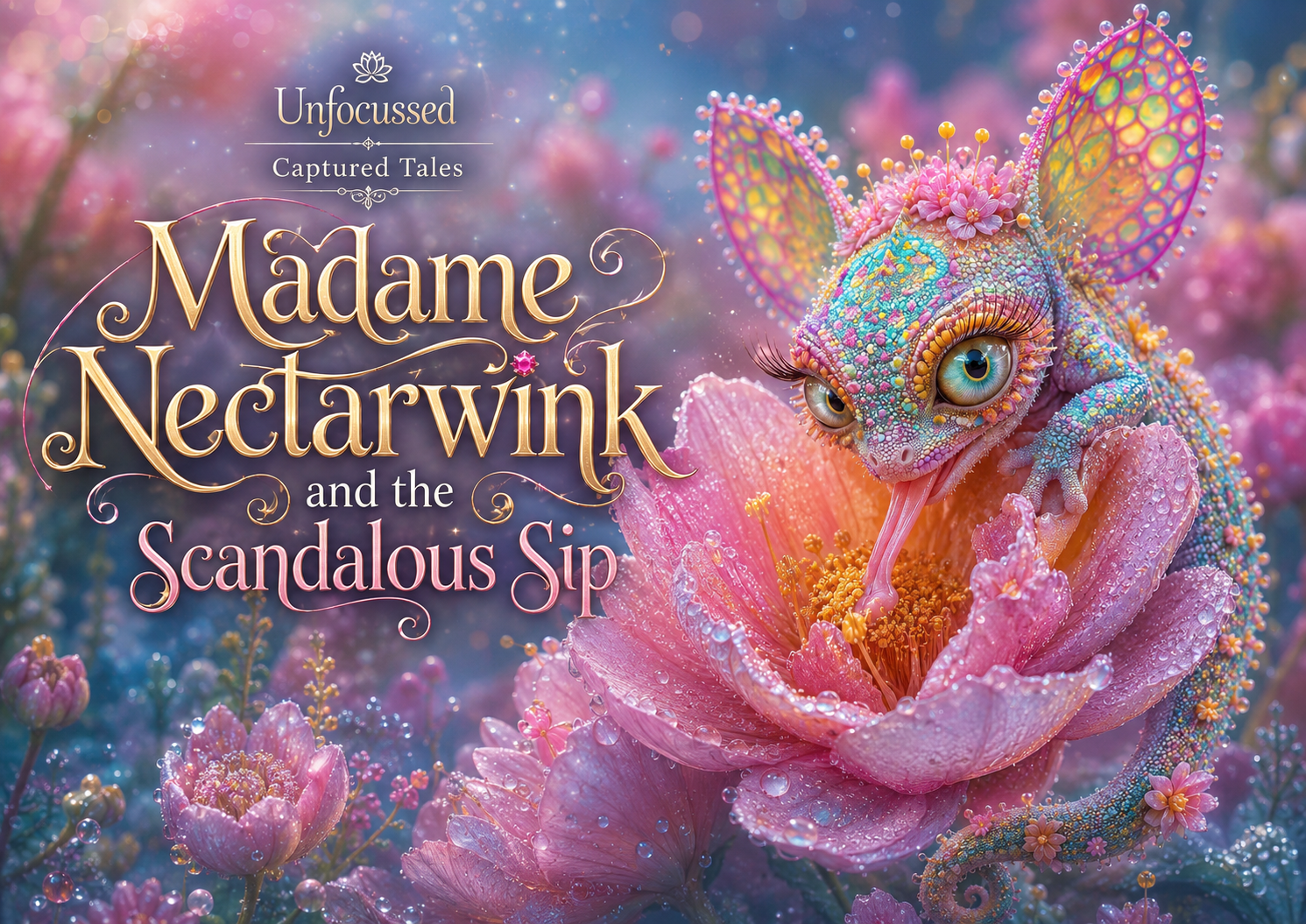
La première gorgée qui fit trembler le jardin
À Creux-des-Papillons, là où la rosée se rassemblait chaque matin telle une rumeur n’attendant qu’une oreille attentive, vivait une créature d’un éclat si spectaculaire et au charme si effronté que même les libellules faisaient semblant de ne pas la regarder, tout en ne pouvant s’empêcher de le faire.
Son nom était Madame Nectarwink.
Elle était petite pour les standards habituels de la forêt, à peine la longueur d’une tige de tulipe si l’on ne comptait pas sa queue — ce qu’elle exigeait pourtant toujours que l’on fasse, car c’était « partie intégrante de la présentation ». Sa peau chatoyait de couleurs impossibles : lavande, corail, sarcelle, pêche et un petit doré impertinent qui captait la lumière chaque fois qu’elle tournait la tête pour juger autrui. Ses écailles donnaient l’impression que quelqu’un avait renversé une boîte à bijoux dans un magasin de bonbons, pour ensuite décider que tout ce méli-mélo avait besoin de cils.
Et oh, ces cils.
Ils se courbaient au-dessus de ses yeux immenses comme de minuscules bannières noires annonçant : Oui, je sais ce que je fais. Non, je ne regrette rien.
Madame Nectarwink habitait dans les pétales inférieurs de la Fleur-Sifflet, une fleur si large, rose et luxuriante que les abeilles l’appelaient « la capitonnée ». Elle se dressait près du centre de Creux-des-Papillons, juste à côté de l’étang à rosée, là où toutes les créatures respectables venaient boire, faire leur toilette, surprendre des indiscrétions et prétendre qu’elles « ne faisaient que passer ».
C’était un mensonge. Personne à Creux-des-Papillons ne faisait jamais « que passer ». Ils passaient avec les oreilles grandes ouvertes.
Le creux avait une longue tradition de politesse, de faste et de commérages absolument vicieux. Lady Mumblerose, le plus vieux papillon de nuit de la vallée, l’avait un jour décrit comme « une communauté d’esprits raffinés », ce qui semblait charmant jusqu’à ce qu’on apprenne qu’elle avait dit cela tout en propageant la rumeur selon laquelle l’antenne gauche du maire était artificielle. Les fourmis avaient des comités. Les scarabées avaient des clubs. Les papillons avaient des brunchs qui nécessitaient mystérieusement six jours de préparation et laissaient tout le monde émotionnellement épuisé. Même les escargots tenaient des agendas sociaux, bien que les leurs eussent environ trois semaines de retard.
Madame Nectarwink adorait tout cela.
Pas parce qu’elle se souciait des règles, évidemment. Grands dieux, non. Les règles n’étaient que des obstacles décoratifs placés sur le chemin d’un comportement intéressant. Elle adorait Creux-des-Papillons parce qu’il était rempli de créatures qui prétendaient chérir la dignité tout en se comportant comme des figurants de théâtre non rémunérés dans une tragédie sur le placement des sièges.
Et Madame Nectarwink, étant à la fois observatrice et terrible, trouvait cela délicieux.
Les ennuis commencèrent un mardi matin.
Les mardis matin à Creux-des-Papillons étaient généralement calmes. Les abeilles faisaient leur ronde. Les scarabées polissaient leurs carapaces. Les papillons s’étiraient théâtralement sur les feuilles et annonçaient avoir mal dormi, même si personne ne leur avait rien demandé. Les fleurs s’ouvraient au soleil avec la confiance suffisante de créatures qui savent que tout le monde convoite ce qu’elles possèdent.
Parmi ces fleurs se trouvait la Grande Columbina Rose, une floraison imposante aux pétales de velours, à la gorge dorée et à la réputation établie.
Pas une mauvaise réputation, exactement. Pire.
Une réputation importante.
La Grande Columbina Rose se dressait au bord de l’étang à rosée, légèrement surélevée sur une racine moussue, comme si la nature elle-même avait prévu une scène parce qu’elle avait compris sa mission. Son nectar était célèbre dans tout le creux : épais, parfumé, brillant comme le soleil, et réputé avoir un léger goût de baies, de clair de lune et de décisions que l’on pourrait regretter, mais que l’on répéterait sans hésiter.
Traditionnellement, le nectar de la Columbina était réservé au Premier Pollinisateur du Jour, un rôle honorifique choisi chaque aube selon une coutume ancestrale, une étiquette compliquée et un panel rotatif d’insectes portant des chapeaux qu’ils n’auraient jamais dû mettre. Le Premier Pollinisateur était autorisé à prendre une gorgée cérémonielle avant que le reste du jardin ne commence à se nourrir.
Il en avait toujours été ainsi.
Jusqu’à ce que Madame Nectarwink se réveille affamée.
Elle émergea de son recoin pétalaire peu après le lever du soleil, clignant des yeux pour chasser la rosée de ses cils. Autour d’elle, le creux scintillait sous une douce lumière violette. De minuscules gouttelettes s’accrochaient aux pétales et aux brins d’herbe comme si le monde avait été saupoudré de perles de verre. Une brise chaude traversait le jardin, transportant des odeurs de mousse, de sucre, de pollen et la panique légère des abeilles réalisant qu’elles étaient déjà en retard sur leur emploi du temps.
Madame Nectarwink s’étira, enroulant sa queue sous elle avec un petit tortillement luxueux.
« Je me sens », annonça-t-elle à personne en particulier, « d’humeur à prendre une décision douteuse avant le petit-déjeuner. »
Une coccinelle qui passait par là se figea net.
« Cela semble imprudent », dit la coccinelle.
« Oui », répondit Madame Nectarwink en souriant. « C’est justement ce qui est séduisant. »
Elle bondit de sa fleur, atterrissant sur une large feuille avec la grâce d’une danseuse et l’assurance de quelqu’un qui n’avait jamais eu à subir les conséquences de ses actes assez rapidement pour en tirer une leçon. Ses nageoires auriculaires en forme d’ailes miroitaient dans la lumière matinale. Elle renifla l’air.
C’était là.
La Grande Columbina Rose.
Son parfum dérivait sur l’étang par vagues : doux, chaud, succulent et indécemment suffisant. C’était le genre d’odeur qui poussait les créatures sensées à revoir leur emploi du temps et les créatures insensées à escalader des choses.
Madame Nectarwink pencha la tête.
« Oh, tu appelles les ennuis, toi », murmura-t-elle.
La fleur, étant une fleur, ne répondit pas. Mais elle brilla.
C’était suffisant.
À la base de la Columbina, le comité du Premier Pollinisateur s’était déjà rassemblé. Sir Bumblethorp, une abeille dorée et ronde avec une voix de petit tuba, planait à côté d’un parchemin de fougère enroulé. À côté de lui se tenait Lady Priscilla Winglace, un papillon bleu qui traitait chaque respiration comme une opportunité de supériorité morale. Deux scarabées greffiers attendaient avec des tablettes marquées au pollen. Un grillon accordait un violon cérémoniel fort maladroitement.
« De l’ordre », bourdonna Sir Bumblethorp. « De l’ordre, s’il vous plaît. Le choix du Premier Pollinisateur commencera une fois que nous aurons confirmé la présence, le quorum, les conditions météorologiques, le consentement floral, la clarté de la rosée et... »
« Oh, pour l’amour d’un pétale », chuchota quelqu’un dans la foule.
Madame Nectarwink arriva sur une tige proche juste à temps pour entendre l’expression « allocation procédurale de nectar ».
Elle recula.
« Ça », dit-elle, « c’est la chose la plus aride qu’on ait jamais dite près d’un endroit aussi humide. »
Quelques scarabées ricanèrent. Lady Priscilla Winglace se tourna, les yeux plissés.
« Madame Nectarwink », dit-elle, sa voix polie comme une perle et deux fois plus dure. « Quelle inattendue présence. »
« Priscilla », dit chaleureusement Madame Nectarwink. « Tu es magnifiquement bien repassée. Quelqu’un a-t-il refermé un livre sur toi pendant la nuit ? »
Un léger frisson parcourut la foule.
Les ailes de Lady Priscilla tremblèrent. « Nous menons un rituel sacré. »
« J’ai remarqué. Il a le rythme trépidant de la sève. »
Sir Bumblethorp s’éclaircit la gorge. « Madame, à moins que vous n’ayez des affaires officielles avec le comité... »
« J’ai une affaire avec mon petit-déjeuner. »
C’est alors que tout le monde réalisa qu’elle regardait la Columbina.
Un silence tomba.
Pas un silence normal. Un silence de Creux-des-Papillons. Le genre rempli de jugements, d’anticipation et d’au moins trois créatures mentalement en train de rédiger comment elles raconteraient l’histoire plus tard, en se plaçant elles-mêmes au plus près du scandale.
Sir Bumblethorp descendit d’un pouce. « Madame Nectarwink, la Grande Columbina Rose est réservée jusqu’à ce que le Premier Pollinisateur ait été officiellement choisi. »
« Quelle émotion pour le Premier Pollinisateur. »
« Vous n’avez pas le droit de siroter. »
Madame Nectarwink cligna de ses yeux immenses.
« Pas le droit ? »
Lady Priscilla esquissa un sourire pincé. « Exactement. »
« Ah », dit Madame Nectarwink. « Les deux mots les plus séduisants du jardin. »
Avant que quiconque ne puisse l’arrêter, elle s’élança.
La foule eut un haut-le-corps alors qu’elle volait de la tige jusqu’au pétale extérieur de la Grande Columbina Rose, atterrissant dans une gerbe de rosée qui étincela autour d’elle comme des feux d’artifice miniatures. La fleur plia sous son poids, pas assez pour s’effondrer, mais assez pour faire osciller la floraison entière d’une manière qui fit se cramponner plusieurs papillons de nuit âgés les uns aux autres et murmurer à un scarabée : « Je le savais. »
Madame Nectarwink se tint sur la courbe douce du pétale, leva le menton et regarda le comité assemblé en contrebas.
« Vous savez », dit-elle, « pour des créatures qui vénèrent les fleurs, vous êtes tous sacrément déterminés à les ennuyer jusqu’à la mort. »
« Éloignez-vous de la gorge ! » cria Sir Bumblethorp.
« Ce n’est pas une phrase que je m’attendais à entendre avant le petit-déjeuner », grommela une jeune sauterelle.
Lady Priscilla s’avança en voletant. « C’est une violation de la tradition ! »
« La tradition n’est que la pression sociale des insectes morts. »
La foule émit un autre frémissement sonore. Celui-ci était plus ample.
Madame Nectarwink se tourna vers le centre de la Columbina. La gorge dorée luisait sous elle, lourde de nectar, riche et parfumée, et visiblement peu soucieuse de paperasse. La rosée perlait le long du bord des pétales. La lumière du soleil frappa ses écailles, la transformant en un joyau vivant accroupi dans le cœur rose tendre de la tentation.
Quelqu’un chuchota : « Elle ne ferait pas ça. »
Quelqu’un d’autre chuchota : « Elle va absolument le faire. »
Madame Nectarwink se pencha davantage.
Sir Bumblethorp émit un bourdonnement horrifié. « Madame ! Le décorum ! »
Elle jeta un coup d’œil par-dessus son épaule.
« Sir Bumblethorp, si le décorum avait meilleur goût, peut-être que je le considérerais. »
Puis elle étendit sa longue langue recourbée et prit une gorgée lente et scandaleuse.
Le jardin explosa.
Pas littéralement, bien que plusieurs papillons se soient comportés comme si c’était le cas. Les ailes battaient. Les scarabées lâchèrent leurs tablettes. Le grillon cérémoniel joua un accord de panique avant de prétendre que c’était intentionnel. Lady Mumblerose, bien qu’elle n’ait pas été près de la scène cinq secondes plus tôt, apparut sur une fougère et chuchota : « J’ai tout vu », avec l’assurance d’une menteuse chevronnée.
Madame Nectarwink ne se pressa pas.
C’était là le pire.
Si elle s’était précipitée, le creux aurait pu appeler cela du vol. Si elle avait glissé, trébuché, s’était excusée ou avait montré la moindre miette de honte, l’incident aurait pu être atténué en un malheureux malentendu.
Mais non.
Elle savoura.
Ses yeux étaient à demi clos. Sa queue enroulée. Son petit corps orné de bijoux scintillait sous la lumière du matin alors qu’elle extrayait le nectar de la Columbina avec la satisfaction sereine de quelqu’un qui goûte une soupe lors d’un banquet royal et la trouve adéquatement coupable.
« Oh », dit-elle enfin, en se retirant. « C’est indécent. »
Un scarabée s’évanouit.
Madame Nectarwink lécha une gouttelette dorée au coin de sa bouche.
« Mes compliments au chef. »
La Grande Columbina Rose oscilla une fois dans la brise, ayant l’air — selon qui raconterait l’histoire plus tard — soit violée, soit ravie, soit complice et suffisante.
Sir Bumblethorp vola en cercles frénétiques. « C’est sans précédent ! C’est illégal ! C’est un assaut direct contre la sainteté rotationnelle de l’accès au nectar du matin ! »
« Mettez ça sur une plaque », dit Madame Nectarwink. « Ça fera peur aux enfants. »
Lady Priscilla Winglace était devenue très immobile. Quand un papillon de son pedigree devenait immobile, cela signifiait deux choses : soit elle avait atteint l’illumination, soit elle se préparait à ruiner socialement quelqu’un.
Étant donné que l’illumination exigeait de l’humilité, le pari le plus sûr était sur la ruine.
« Madame Nectarwink », dit-elle, assez fort pour que la foule qui s’assemblait puisse entendre, « vous avez déshonoré ce creux. »
Madame Nectarwink réfléchit à cela.
« Avant le petit-déjeuner ? Impressionnant. »
« Vous nous tournez en dérision. »
« Seulement quand vous rendez cela facile. »
Les ailes de Lady Priscilla se soulevèrent. « Vous avez insulté la tradition, manqué de respect à la cérémonie et placé votre langue là où aucune langue n’avait été officiellement autorisée. »
Plusieurs créatures réagirent à cette phrase avec divers degrés de délice scandalisé.
Madame Nectarwink sourit.
« Priscilla, ma chérie, la moitié du jardin attend depuis des années de dire ça à quelqu’un. »
Le rire commença timidement, avec les sauterelles. Puis vinrent les scarabées, qui tentèrent de le dissimuler en toussant. Une paire d’abeilles perdit le contrôle et s’entrechoqua en plein vol. Même l’un des escargots émit un sifflement étouffé, bien qu’il soit arrivé en retard et que personne ne sache s’il riait de la blague ou de quelque chose datant de lundi.
Le visage de Lady Priscilla se durcit.
À Creux-des-Papillons, le rire public était dangereux. Le rire public à l’encontre de la mauvaise personne était pratiquement une déclaration de guerre.
Et Madame Nectarwink, perchée dans la fleur interdite avec du nectar sur la bouche et la malice dans les yeux, venait de tirer le premier coup.
« Très bien », dit Lady Priscilla.
Le jardin se tut.
« Puisque Madame Nectarwink se croit au-dessus des coutumes qui lient cette communauté, peut-être que la communauté devrait reconsidérer son égard pour Madame Nectarwink. »
Un murmure parcourut la foule. C’était sérieux. À Creux-des-Papillons, « reconsidérer son égard » était ce que les créatures polies disaient quand elles voulaient dire : Nous sommes sur le point de dire des horreurs dans votre dos tout en faisant semblant que cela nous peine.
Sir Bumblethorp hocha la tête gravement. « Un blâme officiel pourrait être approprié. »
« Une interdiction de nectar », dit un scarabée greffier, soudain excité par le potentiel de paperasse.
« Une restriction de fleur ! » cria un autre.
« Un permis de langue ! » cria quelqu’un au fond.
Tout le monde se tourna.
La jeune sauterelle baissa la tête. « Désolé. Je me suis laissé emporter. »
Madame Nectarwink se leva lentement, étirant un pied délicat le long du bord du pétale. Elle regarda la foule, les comités, les greffiers, les papillons tremblants, les abeilles faisant semblant de ne pas apprécier le drame, et l’ancien papillon de nuit préparant déjà trois versions contradictoires de l’incident.
Puis elle rit.
Pas fort. Pas cruellement. Juste assez.
« Mes chers petits givrés », dit-elle, « vous pouvez potiner autant que vous voulez. Vous alliez le faire de toute façon. Au moins, maintenant, j’ai donné un peu de saveur à votre matinée. »
Sur ce, elle prit une deuxième gorgée.
Une deuxième gorgée.
Si la première était un scandale, la seconde était de la poésie avec sa robe retroussée.
Lady Priscilla émit un son semblable à celui d’un rideau de dentelle qui prend feu.
« Cela signifie la guerre », murmura-t-elle.
Malheureusement pour elle, Lady Mumblerose l’entendit.
Heureusement pour le reste du creux, Lady Mumblerose le raconta à tout le monde.
À midi, la Grande Guerre des Commérages du Jardin avait commencé.
Le premier front s’ouvrit à l’étang à rosée, où les papillons établirent ce qu’ils appelèrent un « Cercle de Préoccupation ». C’était, en réalité, un stand de jugement portatif. Lady Priscilla présidait depuis un nénuphar courbé, flanquée de deux papillons de nuit pâles qui hochaient la tête à tout ce qu’elle disait comme si hocher la tête était un devoir civique.
« Nous ne sommes pas en colère », annonça Lady Priscilla.
Toutes les créatures présentes comprirent que cela signifiait qu’elles étaient magnifiquement en colère.
« Nous sommes déçus. »
Cela signifiait plus en colère.
« Nous sommes préoccupés par le parfum moral de Creux-des-Papillons. »
Cela signifiait qu’ils étaient à court d’arguments réels et qu’ils étaient maintenant en train d’assaisonner l’air.
Pendant ce temps, les scarabées commençaient à rédiger des résolutions. Ils proposèrent la création du Comité pour le Séquençage Correct des Gorgées, le Sous-comité pour la Conduite Pétalaire et, après quelques débats, la Force d’Intervention d’Urgence pour les Violations Liées à la Langue. Personne ne voulait servir dans ce dernier, mais tout le monde convenait qu’il avait l’air important.
Les abeilles, pour leur part, tentèrent de rester neutres. Cela dura onze minutes.
« La neutralité », dit la reine Buzzibelle de la Ruche Trois, « est facile jusqu’à ce que quelqu’un menace l’accès au nectar. »
L’après-midi venu, la ruche s’était divisée en factions. Les Traditionalistes du Miel soutenaient que les actions de Madame Nectarwink minaient l’ordre partagé des pollinisateurs. La Coalition du Sirotage Libre soutenait que si une fleur produisait du nectar, prétendre qu’il fallait une autorisation cérémonielle était « une absurdité bureaucratique ailée ». Un troisième groupe, composé principalement d’abeilles plus jeunes, soutenait Madame Nectarwink parce qu’elles la trouvaient drôle et parce que la rébellion rendait bien sur les affiches.
Ces affiches apparurent au coucher du soleil.
LAISSEZ-LA SIROTER.
PAS DE GORGE SANS VOTE.
LE NECTAR EST LA SAUCE DE LA NATURE.
Cette dernière fut retirée par les fourmis pour « ton inapproprié ».
Madame Nectarwink regardait tout cela se dérouler depuis une fougère enroulée au-dessus de la Fleur-Sifflet, grignotant une baie de rosée et semblant profondément satisfaite.
À ses côtés se tenait Pipthistle, un minuscule scarabée tacheté aux pieds anxieux et au rôle malheureux d’être son plus proche ami.
« Tu te rends compte », dit Pipthistle, « que le creux entier se délite parce que tu n’as pas pu attendre vingt minutes pour ton petit-déjeuner. »
Madame Nectarwink soupira. « Vingt minutes ? Pip, ils discutaient encore de la clarté de la rosée. »
« Tu aurais pu choisir une autre fleur. »
« J’aurais pu choisir une autre vie. Pourtant, nous voilà. »
Pipthistle se frotta le visage. « Priscilla est en train d’organiser. »
« Priscilla organise quand une feuille tombe en diagonale. »
« C’est différent. Elle appelle ça une crise morale. »
Les yeux de Madame Nectarwink s’illuminèrent. « Oh, j’ai été promue. »
« Nectarwink. »
« Quoi ? »
« Ils sont sérieux. »
Pour la première fois de la journée, elle détourna les yeux du spectacle en contrebas. Son expression s’adoucit juste un peu — pas en regret, certainement pas, mais en quelque chose de plus aigu et de plus réfléchi.
À travers le creux, les factions se formaient avec une rapidité alarmante. Les papillons s’agglutinaient sous les bannières en nénuphar de Priscilla. Les abeilles se disputaient les droits de floraison. Les scarabées affichaient des avis sur les chapeaux des champignons. Les sauterelles chantaient des chansons grossières et en niaient immédiatement la paternité. Les escargots, une fois qu’ils comprirent ce qui s’était passé, commencèrent à porter de minuscules panneaux qui n’arriveraient nulle part d’utile avant vendredi.
Madame Nectarwink pencha la tête.
« Ils ne sont pas sérieux à propos de la gorgée », dit-elle doucement.
Pipthistle cligna des yeux. « Quoi ? »
« Ils sont sérieux à propos de la permission. »
En bas, Lady Priscilla se tenait devant une foule grandissante, ses ailes brillant sous la lumière de fin de journée.
« L’indulgence d’une créature », déclara-t-elle, « ne peut être autorisée à mettre en danger la dignité de tous. »
La foule murmura son approbation.
La queue de Madame Nectarwink s’enroula plus étroitement autour de la fougère.
« La dignité », dit-elle. « Ce vieux corset. »
« Tu pourrais t’excuser », suggéra Pipthistle.
Elle le regarda comme s’il avait suggéré qu’elle porte du beige.
« Je pourrais aussi mâcher de la mousse et prétendre que c’est un gâteau. »
« Une petite excuse ? »
« Pip. »
« Une excuse décorative ? »
« Pip. »
« Une insulte en forme d’excuse ? »
Madame Nectarwink marqua une pause.
« Continue. »
Avant que Pipthistle ne puisse répondre, un messager scarabée arriva en gravissant la fougère, à bout de souffle. Il portait une minuscule écharpe marquée du nouvel emblème de Priscilla : une fleur fermée enroulée dans un ruban.
Madame Nectarwink le fixa.
« Est-ce une tulipe constipée ? »
Le messager déglutit. « Madame Nectarwink, par ordre du Cercle de Préoccupation et des comités alliés du Creux de Flutterfen, vous êtes sommée d'assister à une audience publique au lever de la lune. »
Pipthistle gémit.
Madame Nectarwink eut un sourire lent.
« Une audience publique ? »
« Oui. »
« À propos de ma langue ? »
Le messager rougit, ce qui était difficile pour un scarabée, mais il y parvint malgré tout.
« À propos de votre conduite. »
« Ma conduite a toujours été très populaire auprès de tous ceux qui sont intéressants. »
« Votre présence est exigée. »
Madame Nectarwink accepta le minuscule parchemin. Il était noué d’un fil blanc et dégageait une légère odeur de lavande, de panique et d’agressivité cléricale.
Elle le déroula et parcourut les chefs d’accusation.
Sirotage non autorisé. Perturbation cérémonielle. Moquerie publique. Posture de pétale inappropriée. Engagement de gorge répété après avertissement.
Elle s’arrêta là.
« Engagement de gorge répété », lut-elle à voix haute. « Eh bien, je vais mettre ça sur mes cartes de vœux. »
Pipthistle émit un bruit étranglé.
Le messager tenta de faire preuve de dignité. « L’audience déterminera si des sanctions sont nécessaires. »
« Merveilleux », dit Madame Nectarwink. « Dites à Lady Priscilla que j’y assisterai. »
Le messager parut surpris. « Vous viendrez ? »
« Bien entendu. »
« Et vous vous comporterez de manière respectueuse ? »
Les cils de Madame Nectarwink s’abaissèrent.
« Ne chargeons pas la soirée de fantasmes. »
Le scarabée s’enfuit.
Pipthistle se tourna vers elle. « S’il te plaît, dis-moi que tu as un plan. »
Madame Nectarwink regarda vers la Grande Colombine Rose, qui brillait maintenant doucement sous le coucher du soleil. Autour d’elle, les créatures discutaient, chuchotaient, se ralliaient, fronçaient les sourcils, flirtaient, exagéraient et faisaient semblant de ne pas s’amuser.
Le creux s’était réveillé.
Pas poliment. Pas pacifiquement. Mais pleinement.
Et sous toute cette indignation ridicule, sous les parchemins de censure et les ailes crispées de crainte, Madame Nectarwink pouvait sentir quelque chose se libérer. Quelque chose de vieux, de tendu et enveloppé dans trop de règles. Le Creux de Flutterfen avait passé des années à confondre obéissance et harmonie. Peut-être qu’il n’avait eu besoin que d’une menace aux écailles de joyaux, dotée d’excellents cils et d’une terrible retenue.
Elle sourit.
« Mon cher Pip », dit-elle, « au lever de la lune, j’ai l’intention de leur donner matière à commérages. »
« C’est exactement ce que je craignais. »
En contrebas, les partisans de Lady Priscilla brandirent une autre bannière.
LA DÉCENCE NOUS DÉFEND.
Madame Nectarwink la lut, fit jouer sa langue avec réflexion et rit.
« Pas ce soir, en tout cas. »
Et alors que le crépuscule s’installait sur le Creux de Flutterfen, avec la rosée commençant à se rassembler de nouveau comme des secrets sur chaque feuille, le jardin se préparait à sa première audience publique depuis vingt-sept ans.
La dernière impliquait un champignon, trois grillons mariés et un malentendu sur des spores.
Celle-ci, tout le monde en convenait, promettait d’être bien pire.
Ce qui, dans le Creux de Flutterfen, signifiait bien meilleure.
L’Audience du Lever de Lune sur la Posture Inappropriée des Pétales
Au moment où la lune se leva, le Creux de Flutterfen était devenu insupportable d’anticipation.
Pas excité, bien sûr. Aucune créature respectable n’admettait être excitée par une audience publique impliquant un accès non autorisé au nectar, un effondrement social et une langue extrêmement assurée. Elles étaient « préoccupées ». Elles étaient « civiquement engagées ». Elles étaient « présentes par devoir ».
Elles arrivaient aussi en avance, réservaient des places et chuchotaient si agressivement que les fougères avaient commencé à se pencher pour plus d’intimité.
L’audience se tenait dans l’amphithéâtre Mooncap, un vieux cercle de champignons pâles qui brillaient d’un bleu léger sous le ciel nocturne. Il n’avait pas accueilli de véritable assemblée publique depuis des décennies, principalement parce que le Creux de Flutterfen préférait résoudre les conflits par des invitations à bruncher passives-agressives et des arrangements de pollen extrêmement pointus. Mais ce soir, tout le jardin était réuni : des abeilles en rangs serrés, des papillons perchés comme des ornements en vitrail, des scarabées polis pour un éclat formel, des papillons de nuit emmitouflés dans des châles, des sauterelles fredonnant des chansons grossières entre leurs dents, et des escargots arrivant encore d’un avis de réunion affiché quatre heures plus tôt.
Au centre du cercle se tenait Lady Priscilla Winglace.
Elle s’était habillée pour triompher.
Ses ailes bleues scintillaient comme de la soie givrée, et autour de son thorax, elle portait une délicate écharpe brodée de l’emblème du Cercle de Préoccupation : une fleur fermée enroulée dans un ruban. Le symbole avait déjà été tourné en dérision sous les noms de « tulipe de chasteté », « artichaut effrayé » et, par un poète sauterelle anonyme, « une fleur portant une gaine amincissante émotionnelle ».
Priscilla ignorait ces remarques, car ignorer les choses était l’une de ses armes. Elle se tenait au sommet d’un podium en pierre plate, le visage solennel, la posture parfaite, le menton levé à un angle suggérant qu’elle avait inventé le clair de lune elle-même et qu’elle était déçue de ce que les autres en avaient fait.
À côté d’elle, Sir Bumblethorp triait une pile de documents si épaisse qu’ils semblaient avoir été cultivés plutôt qu’écrits.
« Tout cela est-il nécessaire ? » demanda un clerc scarabée.
Sir Bumblethorp ajusta ses lunettes. « C’est une affaire de grave conséquence civique. »
« C’était le petit-déjeuner. »
« C’était un petit-déjeuner symbolique. »
Le clerc scarabée réfléchit à cela, puis le nota parce que cela semblait officiel et pourrait être utile plus tard.
Pipthistle était assis près du fond sur une feuille enroulée, se tordant les pattes avant. Il avait passé la dernière heure à supplier Madame Nectarwink de faire une déclaration calme, brève et n’incluant pas l’expression « absurdités de gorge cérémonielles ». Elle l’avait écouté gentiment, tapoté sa carapace et dit : « J’apprécie à quel point ton optimisme est adorable. »
Maintenant, elle était en retard.
Ce qui n’aidait pas sa digestion.
Lady Priscilla tapota un pied délicat contre le podium. « Où est-elle ? »
« Peut-être », dit l’un des papillons de nuit à côté d’elle, « a-t-elle choisi la honte. »
« Peu probable », grommela Sir Bumblethorp. « Je n’ai vu aucune preuve qu’elle reconnaisse cette catégorie. »
Une ondulation parcourut la foule.
Puis vint le parfum.
Nectar chaud. Mûre. Menthe écrasée. Parfum de fleur de lune. Et sous tout cela, l’indubitable douceur épicée de l’ennui portant un peu trop d’assurance.
La foule se tourna.
Madame Nectarwink entra dans l’amphithéâtre le long d’un ruban de mousse comme s’il s’agissait d’un tapis rouge et que tout le jardin avait payé son entrée. Ses écailles incrustées de joyaux brillaient dans la lueur bleue des champignons. Des gouttelettes de rosée s’accrochaient à ses joues et à sa queue comme des ornements délibérés. Autour de son cou, elle portait un collier de minuscules perles de pollen doré, chacune captant le clair de lune.
Et dans sa bouche se trouvait une tige florale.
Pas la Grande Colombine Rose, Dieu merci. Cela aurait pu provoquer des évanouissements réels. Il s’agissait d’une fleur violette plus petite, tenue négligemment entre ses dents, absurdement théâtrale et très certainement choisie parce qu’elle irriterait Priscilla.
Ce fut le cas.
« Madame Nectarwink », dit Lady Priscilla, d’une voix assez froide pour glacer les pétales. « Vous êtes en retard. »
Madame Nectarwink retira la tige de fleur de sa bouche et s’inclina.
« Je préfère "chronométrée de façon dramatique". »
Les sauterelles applaudirent. Les scarabées sifflèrent pour réclamer le silence. Les abeilles échouèrent encore une fois à rester neutres.
Sir Bumblethorp bourdonna en avant. « Cette audience va commencer. »
« Vraiment ? » demanda Madame Nectarwink. « Quelle ambition. »
Pipthistle se couvrit le visage.
« Madame », avertit Sir Bumblethorp, « vous êtes accusée de sirotage non autorisé, perturbation cérémonielle, moquerie publique, posture de pétale inappropriée et engagement de gorge répété après avertissement. »
Un murmure parcourut la foule à la lecture du dernier chef d’accusation, car chaque fois que quelqu’un le disait à voix haute, le jardin redevenait collectivement âgé de douze ans.
Madame Nectarwink posa une petite main sur sa poitrine. « Répété ? Monsieur, je suis blessée. Je pensais que le second sirotage témoignait d’un engagement certain. »
Quelqu’un au fond s’étouffa avec une graine de rosée.
Les ailes de Priscilla s’ouvrirent brusquement. « C’est précisément le problème. Vous traitez une coutume sacrée comme un divertissement. »
« Non, ma chère », dit Madame Nectarwink. « Vous traitez le divertissement comme un crime. »
La foule s’agita à nouveau. Quelques abeilles hochèrent la tête. Plusieurs papillons se raidirent. Un escargot près du cercle extérieur chuchota : « Qu’est-ce qui s’est passé ? » et un autre répondit : « Pas sûr encore, mais je soutiens le drame. »
Sir Bumblethorp s’éclaircit la gorge. « Nous allons entendre les témoignages. »
« Oh, adorable », dit Madame Nectarwink. « J’adore le courrier des fans. »
Le premier témoin fut Lady Mumblerose, qui s’était positionnée près du devant malgré son insistance antérieure à dire qu’elle « ne voulait rien avoir à faire avec des affaires laides ». Lady Mumblerose voulait prendre part à toutes les affaires, laides ou non. C’était une vieille mite pâle aux épaules duveteuses, aux yeux couleur de perle et à la voix qui ressemblait à de la dentelle traînée sur des secrets.
Elle voleta jusqu’à la feuille du témoin et posa un pied sur une goutte de rosée comme si elle prêtait serment.
« J’ai vu tout l’incident », déclara-t-elle.
« D’où ? » demanda Madame Nectarwink.
Lady Mumblerose cligna des yeux. « De tout près. »
« De quelle proximité ? »
« Assez près. »
« Derrière la fougère d’où vous prétendez ne pas espionner le sauna des scarabées ? »
Le duvet de Lady Mumblerose sembla s’expanser.
« C’est une accusation sans fondement. »
« Bien sûr. Le sauna a d’excellents murs. »
Plus de rires. Priscilla frappa le podium avec le bout d’une aile.
« Madame Nectarwink s’abstiendra de harceler les témoins. »
« Je ne la harcèle pas. Je l’aide à se situer. »
Sir Bumblethorp se tourna vers Lady Mumblerose. « Veuillez décrire ce dont vous avez été témoin. »
Lady Mumblerose inspira avec délectation. « L’accusée est montée sur la fleur d’une manière que je ne peux décrire que comme provocante. »
« J’ai atterri », dit Madame Nectarwink.
« Provocamment. »
« J’ai des chevilles. Elles arrivent avec moi. »
« Elle s’est ensuite abaissée au centre de la fleur. »
« Vers le petit-déjeuner. »
« Et elle a étendu sa langue d’une façon qui a causé de la détresse parmi plusieurs insectes respectables. »
Madame Nectarwink regarda l’audience. « Insectes respectables, s’il vous plaît, levez les pattes si vous avez été personnellement victimisés par ma langue. »
La moitié de la foule rit. L’autre moitié essaya de ne pas le faire, ce qui aggrava les choses.
Sir Bumblethorp frappa avec son marteau-gousse. « Silence ! »
« Voilà », dit Madame Nectarwink. « Vous en avez trouvé quelques-uns. »
Lady Mumblerose fut congédiée, non sans avoir chuchoté à trois créatures différentes sur le chemin du retour que Madame Nectarwink avait « pratiquement avoué ».
Le deuxième témoin était une jeune abeille nommée Tumble, représentant la Coalition du Sirotage Libre. Elle voletait nerveusement, ses ailes bourdonnant trop vite.
« Dites votre point de vue », dit Sir Bumblethorp.
Tumble déglutit. « Je pense peut-être que la fleur n’appartient pas au comité. »
Les abeilles traditionalistes poussèrent des cris de surprise. Un papillon laissa tomber son éventail.
Lady Priscilla plissa les yeux. « Expliquez-vous. »
« Eh bien », dit Tumble, la voix tremblante, « la Colombine pousse à partir du sol. Le sol est nourri par la pluie. La pluie tombe sur nous tous. Le nectar est fait par la fleur, pas par un clerc. Alors peut-être que faire attendre tout le monde pour obtenir la permission, c’est… stupide ? »
Le mot tomba comme un caillou lancé à travers un vitrail.
Stupide.
Pas faux. Pas démodé. Pas injuste.
Stupide.
C’était une accusation dévastatrice dans le Creux de Flutterfen, car une grande partie de son autorité dépendait du fait que personne ne dise cela.
Madame Nectarwink observait Priscilla attentivement.
L’expression du papillon changea à peine, mais le bord de ses ailes se tendit.
« Les coutumes préservent l’harmonie », dit Priscilla.
« Est-ce le cas ? » demanda Tumble, devenant courageuse par accident. « Ou préservent-elles ceux qui expliquent les coutumes ? »
Un silence tomba.
Un vrai, cette fois.
Pipthistle retira ses pattes de son visage.
Madame Nectarwink sourit, mais seulement légèrement.
C’était là.
La fissure sous les commérages.
Il ne s’agissait plus simplement d’un sirotage scandaleux. Il s’agissait de savoir qui décidait quand la douceur devenait acceptable. Qui y avait accès en premier. Qui devait attendre. Qui écrivait les règles au nom de l’harmonie, puis s’asseyait au plus près de la fleur.
Lady Priscilla sentit le basculement. Sa voix se fit plus tranchante.
« Ce n’est pas un débat sur la gouvernance. C’est une audience sur l’inconduite. »
« Pratique », dit doucement Madame Nectarwink.
Priscilla se tourna vers elle. « Vous aurez votre chance de parler. »
« Je grignote le suspense. »
Après Tumble vinrent les clercs scarabées, qui présentèrent des diagrammes de la fleur, l’angle d’approche et un regrettable croquis au fusain intitulé Trajectoire Approximative de la Langue. Cela causa un tel chaos que Sir Bumblethorp dut suspendre l’audience pendant trois minutes, le temps que le croquis soit recouvert par une fougère.
Lorsque l’ordre revint, Lady Priscilla descendit du podium et se déplaça au centre du cercle. Ses ailes brillaient pâlement sous le clair de lune, belles et sévères.
« Le Creux de Flutterfen », dit-elle, « a survécu parce que nous comprenons la retenue. Nous honorons la séquence. Nous respectons les limites. Nous ne prenons pas simplement parce que nous désirons. Nous attendons notre tour parce que la civilisation dépend de l’espace entre l’appétit et l’action. »
Il y eut des hochements de tête dans la foule. Beaucoup d’entre eux sincères.
Madame Nectarwink n’interrompit pas.
La voix de Priscilla s’adoucit, devenant plus dangereuse. « Madame Nectarwink voudrait vous faire croire que c’est une blague. Elle voudrait vous faire croire que toutes les règles sont de petites chaînes poussiéreuses, que le désir est la sagesse, que le spectacle est la liberté. Mais si chaque créature agit comme elle, que reste-t-il de nous ? Un creux sans ordre. Un jardin sans grâce. Une bousculade de bouches. »
Cette phrase marqua les esprits.
Même certaines abeilles du Sirotage Libre semblaient mal à l’aise. Personne ne voulait être accusé de soutenir une bousculade de bouches. Cela semblait humide et bondé.
Priscilla se tourna vers Madame Nectarwink.
« Vous êtes charmante. Je vous l’accorde. Mais le charme ne vous donne pas raison. »
L’amphithéâtre se tut.
Pendant un instant, Madame Nectarwink ne vit pas un papillon pompeux avec une écharpe, mais une créature craignant que quelque chose ne glisse hors de son contrôle. Priscilla s’était construite à partir de l’ordre. Sans lui, peut-être ne savait-elle pas où se percher.
Cela fit presque regretter à Madame Nectarwink de ne pas l’aimer.
Presque.
Sir Bumblethorp ajusta ses papiers. « Madame Nectarwink, vous pouvez maintenant répondre aux accusations. »
Pipthistle se pencha en avant, suppliant silencieusement à travers le cercle : Bref. Calme. S’il te plaît, ne lance pas une religion.
Madame Nectarwink s’avança au centre.
Elle était minuscule par rapport à la foule rassemblée, minuscule par rapport à la Grande Colombine Rose dont on pouvait voir la silhouette au-delà de l’amphithéâtre, brillant sous le clair de lune. Pourtant, d’une certaine manière, le cercle sembla plus petit une fois qu’elle y entra.
Elle regarda d’abord Sir Bumblethorp, puis les scarabées, les abeilles, les papillons, les papillons de nuit, les escargots, les sauterelles, et enfin Priscilla.
« J’ai siroté », dit-elle.
La foule murmura.
« De manière non autorisée », ajouta Sir Bumblethorp.
« De manière enthousiaste », corrigea Madame Nectarwink. « Si nous sommes attachés à l’exactitude. »
Quelques rires. Pas beaucoup. Elle les laissa s’estomper.
« J’ai tourné en dérision la cérémonie. J’ai tourné en dérision le comité. J’ai tourné en dérision Priscilla, bien qu’en toute justice, elle soit arrivée polie et inflammable. »
Les lèvres de Priscilla se serrèrent.
« Et oui », continua Madame Nectarwink, « je me suis placée dans cette fleur sans attendre qu’un panel d’insectes anxieux approuve l’angle de mon petit-déjeuner. »
Sir Bumblethorp leva le marteau.
Elle leva une main. « Mais arrêtons de prétendre que le jardin s’est fissuré parce que j’ai goûté au nectar. Le jardin s’est fissuré parce que la moitié d’entre vous avait envie de rire et avait peur de le faire. Parce que la moitié d’entre vous voulait demander pourquoi une fleur a besoin d’une liste d’attente mais ne voulait pas que Priscilla vous regarde au-dessus du brunch. Parce que chaque matin, vous vous rassemblez autour de la douceur et laissez les créatures les plus nerveuses décider qui la mérite en premier. »
Le silence s’approfondit.
La voix de Madame Nectarwink devint plus chaleureuse, toujours enjouée, mais avec un tranchant qui fit que les champignons semblèrent briller davantage.
« Vous appelez cela l’harmonie parce que ça sonne plus joli que l’habitude. Vous appelez cela la retenue parce que ça sonne plus noble que la peur. Et vous m’appelez scandaleuse parce que c’est plus facile que d’admettre que vous avez pris plaisir à regarder quelqu’un ignorer la petite clôture que vous avez tous construite autour du désir. »
Un papillon chuchota : « Eh bien. »
« Je ne dis pas que chaque créature devrait enfoncer sa face dans chaque fleur à l’aube. »
« Dieu merci », grommela un scarabée.
« Certains d’entre vous ont une visée terrible. »
Les sauterelles éclatèrent de rire. Même Sir Bumblethorp fit un bruit de bourdonnement qui aurait pu être une toux si l’on était généreux.
Madame Nectarwink sourit, puis s’adoucit à nouveau.
« Mais une règle devrait protéger quelque chose de réel. Pas la fierté. Pas l’accès. Pas le confort émotionnel de celui qui a eu une écharpe en premier. »
Les ailes de Priscilla se contractèrent.
« La Grande Colombine Rose fleurit pour tout le creux », dit Madame Nectarwink. « Pas pour les comités. Pas pour le statut. Pas pour les créatures qui cachent leur appétit derrière les bonnes manières et traitent tous les autres de vulgaires. »
Lady Priscilla s’avança. « Vous parlez magnifiquement pour quelqu’un qui voulait simplement ce qu’elle voulait. »
Madame Nectarwink croisa son regard. « Et vous parlez sévèrement pour quelqu’un terrifiée à l’idée que les autres puissent vouloir des choses aussi. »
Les mots frappèrent fort.
Priscilla se figea.
Pendant un souffle, l’amphithéâtre éclairé par la lune sembla suspendu. Chaque créature attendit que le papillon réponde.
Mais avant qu’elle ne le puisse, un craquement sourd s’éleva du bord du creux.
Au début, tout le monde supposa qu’il s’agissait d’un escargot se déplaçant avec émotion.
Puis le sol trembla.
L’amphithéâtre se tourna vers la Grande Colombine Rose.
La grande fleur était en train de bouger.
Sa tige se courba lentement. Ses pétales se déployèrent plus largement que personne ne les avait jamais vus, brillant d'un éclat rose et doré sous la lune. La gorge dorée miroitait, non pas de nectar, mais de lumière. De la rosée s'éleva de ses pétales en minuscules perles scintillantes, tournoyant comme des lucioles.
Sir Bumblethorp laissa tomber ses papiers.
Lady Priscilla murmura : « Ce n'est pas procédural. »
Madame Nectarwink restait bouche bée.
La Columbina avait toujours été magnifique. Elle avait toujours semblé importante. Mais là, sous la lune, elle avait l'air éveillée.
Une voix emplit le creux.
Pas forte. Pas exactement prononcée. Elle bruissa à travers les pétales, les racines, les pointes de fougères, les chapeaux de champignons, les ailes, les carapaces et tous ces petits recoins humides où les secrets aimaient vivre.
Enfin.
Toute créature se figea.
Pipthistle tomba de sa feuille.
La voix reprit, chaude, ancienne et légèrement amusée.
Je me demandais combien d'années vous alliez passer à vous disputer devant ma bouche.
Madame Nectarwink cligna des yeux.
Puis, ne pouvant s'en empêcher, elle dit : « Pour être juste, votre bouche a été lourdement réglementée. »
Les pétales de la Columbina tremblèrent.
C'était un rire.
Un vrai rire floral.
Le Cercle de la Préoccupation donna collectivement l'impression que la réalité venait d'arriver mal habillée.
Petite nuisance parée de bijoux, dit la fleur, vous êtes impolie.
Madame Nectarwink s'inclina. « Mais mémorable. »
Malheureusement, oui.
Lady Priscilla retrouva sa voix. « Grande Columbina, avec tout le respect que je vous dois, nous n'avons cherché qu'à vous honorer. »
La fleur se tourna — d'une manière ou d'une autre, impossiblement — vers elle.
Vous avez cherché à me gérer.
Personne ne bougea.
Vous avez enveloppé ma douceur de cérémonies jusqu'à ce que la cérémonie compte plus que la douceur. Vous avez construit une échelle jusqu'à ma gorge et appelé le sommet sacré.
Sir Bumblethorp s'assit lourdement sur un champignon.
Je fleurie. Je nourris. J'invite. C'est tout.
Lady Priscilla semblait accablée. Malgré toute son acidité, elle avait sincèrement cru être la gardienne de quelque chose de sacré. Découvrir qu'elle avait gardé un buffet avec des délires parlementaires était visiblement déplaisant.
L'expression de Madame Nectarwink s'adoucit à nouveau, juste un instant.
La gorge rayonnante de la fleur devint plus brillante.
Mais le jardin n'a pas tort de craindre la faim sans soin. Une douceur partagée sans réflexion devient un piétinement. Des règles sans joie deviennent des cages. Vous êtes tous ridicules.
Le creux absorba cela solennellement, principalement parce qu'être grondé par une fleur était une nouveauté et que personne ne connaissait l'étiquette.
Alors, dit la Columbina, nous réglerons cela comme les jardins le faisaient autrefois.
Priscilla releva la tête. « Comment ? »
Les pétales de la fleur s'ouvrirent davantage. Le nectar scintillait comme de l'or en son centre.
À l'aube, chaque faction pourra envoyer un champion. Ils ne débattront pas. Ils ne rempliront pas de formulaires. Ils s'affronteront lors du vieux rite.
Sir Bumblethorp pâlit. « Le vieux rite ? »
Lady Mumblerose murmura : « Oh, ça va être sale. »
La Ruée vers la Floraison, dit la Columbina.
Une vague de choc parcourut la foule.
Pipthistle, toujours à l'envers, couina : « La quoi ? »
Les yeux de Madame Nectarwink brillaient.
Elle n'avait entendu parler de la Ruée vers la Floraison que dans des histoires à moitié chantées : un concours antique, absurde et dangereux mêlant agilité, esprit, charme, retenue, et une gorgée finale prise non par droit, mais par invitation. Personne ne l'avait tenté depuis des générations. Principalement parce qu'il impliquait de courir à travers des pétales couverts de rosée tandis que les fleurs chahutaient les concurrents.
La voix de la Columbina devint riche d'amusement.
À l'aube, le jardin décidera non pas qui contrôle le nectar, mais qui le comprend.
Lady Priscilla se tourna lentement vers Madame Nectarwink.
Madame Nectarwink lui sourit en retour.
Inutile de parler. La guerre avait changé de forme.
Fini les audiences. Fini les comités. Fini les discours du Cercle de la Préoccupation sur la fragrance morale.
Au lever du soleil, Priscilla aurait son ordre.
Madame Nectarwink aurait sa malice.
Et Flutterfen Hollow aurait la première Ruée vers la Floraison depuis un siècle.
La Grande Columbina Rose se réinstalla sous la lune, brillant doucement comme si elle était satisfaite du chaos qu'elle avait irrigué.
Puis elle ajouta, presque nonchalamment :
Et essayez de ne pas rendre ça ennuyeux.
Madame Nectarwink rit, d'un rire clair et malicieux.
« Oh, chère fleur, dit-elle, l'ennui, c'est le rayon de Priscilla. »
Les ailes de Lady Priscilla se déployèrent.
« Demain, dit-elle, nous verrons. »
La foule explosa — questions, acclamations, accusations, prédictions, paris, avertissements, et au moins un escargot demandant si l'aube était déjà arrivée.
Pipthistle se précipita aux côtés de Madame Nectarwink. « S'il te plaît, dis-moi que tu ne vas pas concourir. »
Elle le regarda, lumineuse sous l'éclat des champignons, avec un clair de lune couleur nectar dans les yeux.
« Mon cher Pip, dit-elle, j'ai été accusée, convoquée, illustrée, réglementée et évaluée spirituellement par une fleur bavarde. Si je ne concours pas maintenant, les gens vont croire que j'ai mûri. »
Pipthistle gémit.
Au-dessus d'eux, la lune s'élevait.
Partout à Flutterfen Hollow, les banderoles furent arrachées, repeintes, réécrites. Le Cercle de la Préoccupation devint la Ligue du Décorum. La Coalition du Libre Nectar devint l'Alliance de la Floraison Ouverte. Les coléoptères tentèrent de former un Conseil de Surveillance et furent rabroués par un rosier. Les sauterelles commencèrent à composer un hymne intitulé Donnez-nous du nectar ou donnez-nous des en-cas.
Et au centre de tout cela, Madame Nectarwink regarda la Columbina endormie et tira une fois la langue par anticipation.
La Grande Guerre des Commérages du Jardin n'était plus une guerre de murmures.
À l'aube, elle deviendrait un spectacle.
Et si Flutterfen Hollow voulait du spectacle, Madame Nectarwink avait l'intention de leur offrir une performance si scandaleusement splendide que la rosée en aurait besoin d'une cigarette après.
La Ruée vers la Floraison et le glorieux effondrement du décorum
L'aube arriva à Flutterfen Hollow vêtue d'un ciel rose poudré, d'un collier de rosée tremblant et de l'expression indéniable d'une matinée qui savait qu'elle était sur le point d'assister à des inepties de proportions historiques.
Chaque créature du creux était réveillée avant le lever du soleil.
Cela seul aurait dû alerter la nature.
Les abeilles planaient en groupes tendus au-dessus de la mousse. Les papillons s'organisèrent par faction, ce qui était difficile car ils feignaient que le placement par faction était indigne d'eux tout en comptant clairement combien il y en avait de chaque côté. Les coléoptères avaient construit un tableau de score à partir d'écorce, de brindilles et d'une confiance excessive. Les papillons de nuit portaient des châles malgré la chaleur, car rien ne dit mieux « conséquence publique » que de s'habiller comme si la tragédie avait un courant d'air.
Même les escargots étaient arrivés à l'heure, bien que plusieurs aient commencé leur voyage immédiatement après l'audience du lever de lune et que l'un d'eux se soit accidentellement rendu au mauvais cercle de champignons en premier.
Au centre du creux se dressait la Grande Columbina Rose, brillant sous la lumière matinale comme un scandale royal peint en pétales. Ses courbes de velours scintillaient de rosée. Sa gorge dorée contenait une mare de nectar si brillante et épaisse qu'elle ressemblait moins à un liquide qu'à du soleil ayant fait de mauvais choix.
À côté de la fleur, une rangée de feuilles championnes avait été disposée.
Chaque faction avait envoyé un concurrent.
Pour la Ligue du Décorum, naturellement, il y avait Lady Priscilla Winglace.
Elle arriva polie jusqu'à une brillance dangereuse, ses ailes bleues brossées de pollen argenté, son expression sereine à la manière des créatures qui avaient crié dans une feuille roulée plus tôt et qui se considéraient maintenant remises. Autour de son corps se trouvait une nouvelle écharpe, brodée de minuscules fleurs fermées avec la devise : La grâce avant l'appétit.
Il avait fallu six papillons de nuit toute la nuit pour la broder.
Madame Nectarwink l'avait vue et avait immédiatement demandé si l'écharpe existait en version « moins émotionnellement constipée ».
Pour l'Alliance de la Floraison Ouverte, il y avait Madame Nectarwink elle-même.
Elle ne portait ni écharpe, ni insigne, ni marque officielle de loyauté envers une faction. À la place, elle s'était parée de trois perles de rosée, d'une minuscule couronne de perles de pollen jaune, et du calme profondément irritant de quelqu'un qui avait merveilleusement dormi pendant que les autres rédigeaient des déclarations.
Pipthistle se tenait à ses côtés, serrant une fougère roulée pleine de notes.
« Souviens-toi, dit-il, la Ruée vers la Floraison n'est pas simplement une course. C'est un test d'équilibre, d'esprit, de retenue, d'écoute et d'invitation finale. Tu ne peux pas simplement te jeter sur le nectar. »
Madame Nectarwink cligna lentement des yeux.
« Je t'entends. »
« Vraiment ? »
« J'entends plusieurs des mots. »
« Nectarwink. »
Elle tapota sa carapace. « Doux Pip, détends-toi. Je comprends parfaitement. Ne pas se jeter. Se pavaner avec détermination. »
Pipthistle émit le son épuisé d'un ami qui aimait énormément quelqu'un et qui avait déjà mentalement préparé des excuses au coroner.
Les autres concurrents incluaient Tumble, la jeune abeille nerveuse, représentant les pollinisateurs les plus jeunes ; Brindleback, un coléoptère au torse large représentant les Cueilleurs Traditionnels ; et Mosswick le grillon, qui prétendait représenter « la communauté artistique indépendante » mais qui était surtout là parce qu'il pensait que quelqu'un pourrait chanter sur lui après.
La Grande Columbina Rose bruissa.
Toute créature se tut.
Champions, dit la fleur, sa voix coulant à travers le creux comme un vent chaud à travers la soie, la Ruée vers la Floraison ne concerne pas celui qui m'atteint le premier.
Brindleback parut immédiatement déçu.
Il ne s'agit pas de savoir qui parle le plus fort.
Lady Priscilla restait immobile, mais ses antennes frémirent.
Il ne s'agit pas de savoir qui a le plus faim.
Madame Nectarwink sourit faiblement, comme si cela lui était adressé et qu'elle appréciait la personnalisation.
Il s'agit de savoir qui peut se déplacer dans le jardin sans transformer la douceur en possession.
Un silence solennel s'installa sur la foule.
Puis Mosswick leva une patte. « Y aura-t-il des en-cas après ? »
Oui.
« Alors je comprends les enjeux. »
Les règles furent annoncées par Sir Bumblethorp, bien que la Grande Columbina Rose ait dû le corriger deux fois car il essayait de rajouter des « directives supplémentaires ». Le parcours commencerait à l'Étang de Rosée, traverserait le Pont de Roseaux Argentés, passerait par le Buisson d'Herbe-Chatouille, gravirait la tige en spirale de la Vigne de Lune, sauterait sur trois nénuphars flottants et se terminerait aux pétales inférieurs de la Columbina. À la floraison finale, le champion ne prendrait pas de nectar. Il attendrait. Si la fleur offrait, il pourrait siroter.
« Donc, murmura Madame Nectarwink à Pipthistle, de la séduction, mais botanique. »
« Arrête de narrer la réalité comme ça, s'il te plaît. »
Les champions s'alignèrent à l'étang de rosée.
Sir Bumblethorp leva une gousse.
« À mon signal. »
La foule se pencha en avant.
« Puisse la Ruée vers la Floraison honorer notre ancien… »
La Grande Columbina Rose toussa poliment.
Sir Bumblethorp soupira.
« Très bien. Partez. »
La gousse tomba.
Le chaos se lança dans la matinée.
Tumble s'élança le premier, ses ailes bourdonnant dans un flou doré. Brindleback tonna derrière lui sur la mousse, tout en carapace et détermination. Mosswick fit un bond en hauteur, atterrit à l'envers, fit semblant que c'était voulu et continua de côté. Lady Priscilla glissa avec une maîtrise sans faille, effleurant à peine la rosée, ses ailes brillant comme du verre bleu.
Madame Nectarwink ne se précipita pas.
Elle gambada.
Il y avait une différence, et elle y aurait insisté sous serment. Se précipiter suggérait le désespoir. Gambader suggérait une intention théâtrale avec un excellent jeu de jambes.
Elle atteignit le Pont de Roseaux Argentés au moment même où Brindleback tentait de le traverser à pleine vitesse. Le pont, étant un simple roseau incurvé glissant de rosée, n'apprécia pas la confiance masculine. Brindleback fit la moitié du chemin avant que ses jambes ne partent dans six directions et que son expression ne devienne une prière.
« Assistance ? » appela Madame Nectarwink.
« Non ! » grogna-t-il, en glissant.
« Dignité ? »
« Pas ça non plus ! »
Il bascula dans l'étang avec un plongeon.
La foule rugit.
Lady Priscilla traversa le roseau avec élégance, sans baisser les yeux vers lui. Tumble plana au-dessus, incertain si survoler l'obstacle comptait comme tricher.
Utilise ce que tu es, petite abeille, murmura la Columbina.
Tumble s'éclaira et fila vers l'avant.
Madame Nectarwink traversa la dernière, s'arrêtant au milieu pour lécher une goutte de rosée sur le roseau.
« Vraiment ? » cria Pipthistle depuis les coulisses.
« L'hydratation est importante ! »
Le Buisson d'Herbe-Chatouille venait ensuite.
Ce n'était pas dangereux, précisément. C'était pire. C'était humiliant.
Les longues frondes d'herbe argentée effleuraient chaque concurrent qui entrait, chatouillant pieds, ventres, ailes et fierté. Mosswick rit si fort qu'il s'effondra. Brindleback, fraîchement trempé par l'étang et furieux, essaya de piétiner à travers et finit par proférer des menaces en gloussant. Tumble éternua du pollen en minuscules éclats dorés.
Lady Priscilla entra avec sang-froid.
Pendant six pas, elle fut magnifique.
Au septième, une lame d'herbe se courba sous son aile.
Son visage changea.
Pas beaucoup. Juste assez.
Ses lèvres se serrèrent. Ses yeux s'agrandirent. Tout son corps trembla de la discipline violente d'une créature refusant le rire pour des raisons morales.
Madame Nectarwink le vit.
« Oh, Priscilla, dit-elle, ravie. Tu es vivante là-dedans. »
« Ne me parle pas. »
« Tu es chatouilleuse. »
« Je suis digne sous l'assaut sensoriel. »
Une fronde d'herbe effleura à nouveau le côté de Priscilla.
Elle fit un bruit.
C'était petit. C'était aigu. C'était indéniablement idiot.
La foule eut un haut-le-cœur.
Madame Nectarwink la regarda avec une joie révérencieuse. « C'était un couinement ? »
« Non. »
« Ça avait des moustaches. »
Priscilla s'élança, les joues en feu, et sortit du buisson avant tout le monde, sauf Tumble. Madame Nectarwink suivit en riant, mais son rire changea à mesure qu'elle émergeait.
Car Priscilla n'avait pas moqué les tombés. Elle n'avait pas saboté. Elle avait enduré le ridicule et continué à avancer. Il y avait, dut admettre Madame Nectarwink, quelque chose d'admirable là-dedans.
Agaçant, certes. Mais admirable.
La Vigne de Lune s'élevait ensuite : une tige verte en spirale qui grimpait haut au-dessus du creux avant de se pencher vers les nénuphars en dessous. Les concurrents devaient l'ascensionner sans endommager les tendres pousses ni déloger les bourgeons de lune endormis. Brindleback était désavantagé ici ; chaque pas qu'il faisait faisait gémir la vigne.
« Sois plus léger, » pressa Tumble d'en haut.
« Je suis un coléoptère, » rétorqua Brindleback. « C'est léger. »
Mosswick tenta un bond dramatique, rata complètement la vigne et atterrit dans une fougère avec la phrase lancinante : « Raconte ma ballade honnêtement. »
Madame Nectarwink grimpa bien. Ses minuscules griffes trouvèrent des prises dans les arêtes de la vigne, sa queue s'équilibrant derrière elle comme un ruban de bijoux. Lady Priscilla avança, ailes repliées, pieds précis, visage verrouillé en concentration.
À mi-chemin, un bourgeon de lune trembla près de l'épaule de Priscilla.
Elle se figea.
Madame Nectarwink grimpa derrière elle. « Problème ? »
« Le bourgeon est coincé sous une vrille recourbée, » dit Priscilla doucement. « Si j'avance, je risque de le déchirer. »
« Alors recule. »
« Si je recule, je perds ma position. »
Madame Nectarwink regarda le bourgeon. Il était petit, pâle et étroitement enroulé, pas encore prêt pour la journée. La vrille pressant contre lui pourrait meurtrir la fleur avant qu'elle ne s'ouvre.
En bas, la foule criait ses encouragements. Tumble tournoyait au-dessus, incertain de ce qui se passait. Brindleback continuait de négocier avec la gravité.
La mâchoire de Priscilla se resserra.
Madame Nectarwink soupira.
« Oh, ne prends pas cet air si noble. Ça me fait démanger les écailles. »
Elle étira sa queue prudemment au-delà de Priscilla et accrocha la vrille. D'une courbure lente, elle l'écarta du bourgeon.
« Maintenant, » dit-elle.
Priscilla cligna des yeux devant elle.
« Tu m'aides ? »
« Non. J'aide le bourgeon. Tu es adjacente à la bonne action. Essaie de ne pas devenir suffisante à ce sujet. »
Priscilla passa sans endommager la fleur. Alors qu'elle grimpait au-dessus, elle regarda en bas.
« Merci. »
Madame Nectarwink parut offensée. « Attention. Nous sommes en guerre. »
« Apparemment. »
Elles atteignirent le sommet presque ensemble.
De là, le parcours descendait vers trois nénuphars flottant dans l'étang de rosée. Tumble traversa l'air facilement, bien qu'il ait touché chaque nénuphar pour respecter les règles. Brindleback atteignit le sommet derrière elles, en sifflant. Mosswick était toujours dans la fougère, composant un refrain sur la trahison.
Priscilla sauta en premier.
Elle atterrit sur le premier nénuphar parfaitement, bondit sur le deuxième, puis le troisième. La foule acclama. La Ligue du Décorum agita des rubans. Lady Mumblerose clama bruyamment qu'elle avait toujours cru en l'athlétisme quand il était de bon goût.
Madame Nectarwink sauta ensuite.
Le premier nénuphar plongea brusquement sous elle. Elle récupéra. Le deuxième tourna. Elle rit. Le troisième s'inclina alors qu'elle atterrissait, et pendant une seconde suspendue, elle se retrouva à l'envers, queue enroulée autour d'un roseau, fixant l'étang en dessous.
Pipthistle hurla : « C'est pour ça que je t'ai demandé de t'étirer ! »
Madame Nectarwink se balança et atterrit sur la rive dans un tourbillon de rosée et de paillettes.
« Gracieuse, » dit Priscilla.
« Mémorable, » corrigea Madame Nectarwink.
Maintenant, il ne restait plus que la dernière ligne droite.
La Grande Columbina Rose attendait, énorme et brillante. Ses pétales s'ouvrirent bas, invitant les champions sur sa floraison extérieure. Tumble arriva le premier, tremblant d'effort. Priscilla vint ensuite. Madame Nectarwink grimpa à côté d'eux, respirant fort, les yeux brillants.
Brindleback, toujours derrière, s'arrêta à la base et s'inclina.
« Je me retire, » dit-il, surprenant tout le monde. « Je voulais défendre la tradition. Mais la vigne me haïssait, et j'ai appris l'humilité. »
La Grande Columbina Rose bruissa.
La vigne ne vous haïssait pas. Elle vous a trouvé excessif.
« Juste », dit Brindleback.
Mosswick, depuis la fougère, cria : « Je me retire aussi, artistiquement ! »
Ce qui en laissait trois.
Tumble, Priscilla et Madame Nectarwink se tenaient sur les pétales inférieurs de la Columbina, chacune face à la gorge dorée.
Les anciennes règles stipulaient qu’ils devaient attendre.
Pas d'atteinte. Pas d'exigence. Pas de langue théâtrale avant d'y être invité.
Cette dernière partie n'avait pas été spécifiée, mais tout le monde savait à qui elle s'adressait.
Tumble s'inclina le premier.
« Je n'ai pas besoin d'être le premier », dit-il doucement. « Je voulais juste que quelqu'un dise que nous pouvions demander pourquoi. »
Les pétales de la fleur l'effleurèrent délicatement.
Alors tu as déjà goûté quelque chose de plus doux que le nectar.
Une minuscule gouttelette dorée apparut devant lui. Tumble sirota, les yeux écarquillés, et retourna vers la foule en rayonnant de joie.
Priscilla s'avança ensuite.
Ses ailes se replièrent derrière elle. Sans la foule, sans le podium, sans l'écharpe qui semblait soudain moins importante, elle paraissait plus petite. Pas faible. Juste réelle.
« Je croyais vous protéger », dit-elle à la fleur.
Je sais.
« J'aimais aussi être nécessaire. »
La foule devint douloureusement silencieuse.
Priscilla déglutit. « Et obéie. »
La Columbina ne se moqua pas d'elle. Elle ouvrit simplement un pétale sous ses pieds.
L'ordre n'est pas un poison, petite aile bleue. Mais il doit respirer.
Une goutte de nectar s'éleva devant elle. Priscilla sirota. Ses yeux se fermèrent. Lorsqu'elle les rouvrit, il y avait des larmes, bien qu'elle insisterait plus tard sur le fait qu'il s'agissait d'une irritation causée par le pollen et qu'elle menacerait quiconque dirait le contraire.
Puis vint le tour de Madame Nectarwink.
Le vallon se pencha.
C’était le moment que tout le monde attendait : le clin d'œil, la blague, la fioriture scandaleuse. Certains l’espéraient même. Une fin digne de ce nom méritait, après tout, un peu d'impropriété.
Madame Nectarwink s'avança vers la gorge lumineuse, puis s'arrêta.
Pour une fois, elle ne fit pas de numéro.
Elle regarda la fleur. Elle regarda la foule. Elle regarda Tumble, rayonnant de soulagement, et Priscilla, debout, le visage découvert, à ses côtés dans la lumière du matin. Elle regarda Pipthistle, qui serrait ses notes comme une veuve en mer.
Puis elle s'inclina.
Profondément.
Pas par moquerie. Pas de manière théâtrale. Sincèrement.
« J'avais faim », dit-elle. « Et je m'ennuyais. Et oui, j'étais un peu ravie de voir à quel point vous êtes tous faciles à déstabiliser. »
Quelques rires réticents parcoururent la foule.
« Mais je n'avais pas compris, au début, combien de choses attendaient sous le poids des règles. Combien de peur. Combien de désir. Combien d'entre vous avaient confondu le silence avec la paix. »
Elle jeta un regard à Priscilla.
« Et peut-être combien avaient confondu le contrôle avec le soin. »
Priscilla baissa légèrement la tête.
Madame Nectarwink se tourna à nouveau vers la Columbina. « Alors je ne prendrai pas. J'attendrai. »
La Grande Columbina Rose brilla plus intensément.
Enfin, dit-elle, dans un souffle amusé, la trouble-fête apprend la patience.
Madame Nectarwink sourit. « Ne devenez pas sentimentale. Ça rend ma langue inconfortable. »
La fleur rit, et le son roula à travers le vallon, secouant la rosée de chaque feuille. Une perle de nectar se forma au bord de la gorge dorée, plus grosse et plus brillante que les autres. Elle flotta vers Madame Nectarwink comme un minuscule soleil.
Sirote, alors.
Elle le fit.
Cette fois, personne n'eut le souffle coupé.
Personne ne s'évanouit.
Aucun comité ne griffonna de reproches.
Le vallon regarda Madame Nectarwink prendre le nectar offert, avec lenteur, déférence, et seulement une pointe de suggestion, car elle avait tout de même une réputation à tenir.
Lorsqu'elle releva la tête, une douceur dorée scintillait au coin de sa bouche.
Elle se tourna vers la foule.
« Eh bien », dit-elle, « c'était bien meilleur avec un consentement. »
Le silence dura un battement de cœur stupéfait.
Puis Flutterfen Hollow explosa.
D'abord les rires. Des vrais rires. Pas cruels, pas nerveux, pas déguisés en quintes de toux. Puis les acclamations. Les abeilles tourbillonnèrent en cercles dorés. Les sauterelles se mirent à chanter. Les scarabées mirent à jour le tableau des scores pour afficher TOUT LE MONDE : UN PEU MOINS STUPIDE. Les papillons de nuit pleurèrent dans leurs châles. Les escargots commencèrent à applaudir quelques minutes plus tard et continuèrent bien après que tout le monde soit passé à autre chose.
Lady Priscilla retira son écharpe.
La foule se calma légèrement lorsqu'elle s'avança. Elle la tint dans ses pieds délicats, regarda la devise brodée, puis Madame Nectarwink.
« La grâce avant l'appétit », dit-elle.
Madame Nectarwink inclina la tête. « Pas terrible. »
Priscilla eut un léger sourire. « Mais incomplet. »
Elle se tourna vers Sir Bumblethorp. « La cérémonie du Premier Pollinisateur est par la présente abolie. »
Sir Bumblethorp parut alarmé. « Pouvez-vous faire ça ? »
Priscilla regarda la fleur parlante.
La fleur bruissa.
Oui.
« Apparemment », dit Priscilla.
À la mi-journée, Flutterfen Hollow s'était transformé.
Le Cercle de Préoccupation s'auto-dissolut, bien que Lady Mumblerose fonda immédiatement la Société des Témoins Historiques, vouée à préserver des « récits exacts » d'événements qu'elle avait elle-même embellis. Les scarabées reconvertirent leurs comités en véritables équipes d'entretien du jardin, découvrant avec horreur que le travail utile nécessitait moins de formulaires et plus d'efforts physiques. Les abeilles instaurèrent des Heures de Floraison Ouverte, laissant place à la tradition, aux besoins et au bon sens. Les papillons commencèrent à organiser des brunchs où les questions étaient autorisées, bien que Priscilla corrigeât toujours la posture en cas de stress.
Quant à Madame Nectarwink, elle devint une héroïne, une menace ou une nuisance spirituellement nécessaire, selon qui racontait l'histoire.
Elle accepta les trois titres.
Ce soir-là, elle s'assit à nouveau dans Blushwhistle Blossom avec Pipthistle à ses côtés. Le vallon resplendissait aux couleurs du coucher de soleil. Des rires flottaient depuis l'étang de rosée. Quelque part, Mosswick interprétait une ballade qui faisait rimer « nectar » avec « respecter », ce que tout le monde s'accorda à qualifier de crime, sans être techniquement un crime de guerre.
Pipthistle s'appuya contre un pétale. « Tu sais, pour un désastre, ça a plutôt bien tourné. »
Madame Nectarwink s'étira luxueusement. « La plupart des bonnes choses commencent comme des désastres avec un meilleur éclairage. »
« Penses-tu que Priscilla changera vraiment ? »
À travers le vallon, Lady Priscilla aidait Tumble à organiser un nouveau planning de partage des floraisons. Elle avait l'air fatiguée, embarrassée et étrangement plus légère.
« Oui », dit Madame Nectarwink. « Mais lentement. Personne ne se débarrasse d'autant d'amidon en un seul jour. »
Pipthistle rit.
En contrebas, la Grande Columbina Rose se balançait dans la brise tiède. Ses pétales brillaient doucement, ouverts sur le vallon sans gardes, sans rubans, sans bureaucrates mesurant la moralité de la soif.
Madame Nectarwink l'observa un long moment.
« Regrettes-tu la première gorgée ? » demanda Pipthistle.
Elle réfléchit à la question.
« Non. »
« Bien sûr que non. »
« Mais j'apprécie la seconde leçon. »
« Laquelle ? »
Madame Nectarwink sourit, les yeux scintillants dans la lumière déclinante.
« Si tu dois scandaliser un jardin, assure-toi de le laisser plus libre que tu ne l'as trouvé. »
Pipthistle hocha la tête. « C'est presque sage. »
« Attention. Tu vas abîmer ma réputation. »
La nuit s'installa doucement sur Flutterfen Hollow. La rosée se déposa sur les pétales. Les abeilles rentrèrent chez elles en fredonnant. Les papillons desserrèrent leurs ailes. Les scarabées empilèrent la paperasse inutilisée dans un tas de compost, où elle servirait enfin à quelque chose. Les escargots, arrivant à la fin de la célébration, la déclarèrent excellente et demandèrent quand commencerait l'audience.
Et au cœur de Blushwhistle Blossom, Madame Nectarwink se recroquevilla dans les pétales de velours, brillante comme un bijou et satisfaite comme une pensée interdite.
Au matin, il y aurait de nouveaux potins.
Il y en avait toujours.
Quelqu'un prétendrait que Priscilla avait ri dans l'Herbe-Chatouilleuse. Quelqu'un insisterait sur le fait que Tumble avait lancé une révolution. Quelqu'un jurerait que la Grande Columbina Rose leur avait fait un clin d'œil personnellement. Lady Mumblerose raconterait sept versions, chacune moins précise et plus divertissante que la précédente.
Mais une vérité resterait enracinée sous toutes les autres :
Flutterfen Hollow avait changé parce qu'une petite créature aux yeux lumineux, au timing scandaleux et à la langue beaucoup trop mémorable avait osé goûter ce que tous les autres attendaient poliment de désirer.
Et à partir de ce jour, chaque fois qu'une créature essayerait d'envelopper la douceur dans trop de règles, quelqu'un se raclerait la gorge, jetterait un coup d'œil vers la fleur rose et chuchoterait la phrase devenue à la fois mise en garde et bénédiction :
Laissez-la siroter.
Ramenez un peu de Sugarwild à la maison
Madame Nectarwink and the Scandalous Sip apporte toute la malice ornée de bijoux, le drame floral et l'énergie du nectar interdit de Flutterfen Hollow dans une pièce qui exige pratiquement d'être exposée avec un clin d'œil. L'œuvre est disponible en impression sur toile, impression encadrée et impression sur métal pour tous ceux qui veulent l'éclat scandaleux de Madame Nectarwink sur leur mur. Pour une touche plus douce de potins de jardin, elle est également disponible en tapisserie, serviette de bain ou drap de plage—car honnêtement, si une créature appartient à un endroit où il est question d'humidité douteuse, c'est bien elle. Vous pouvez aussi envoyer un peu de malice florale avec la carte de vœux ou garder vos propres notes scandaleuses cachées dans le carnet à spirales.

 The Wink That Got Away With Everything
 The Dewdrop He Swore He Could Handle
 Sir Petalgrip et le pli qu'il aurait dû respecter