
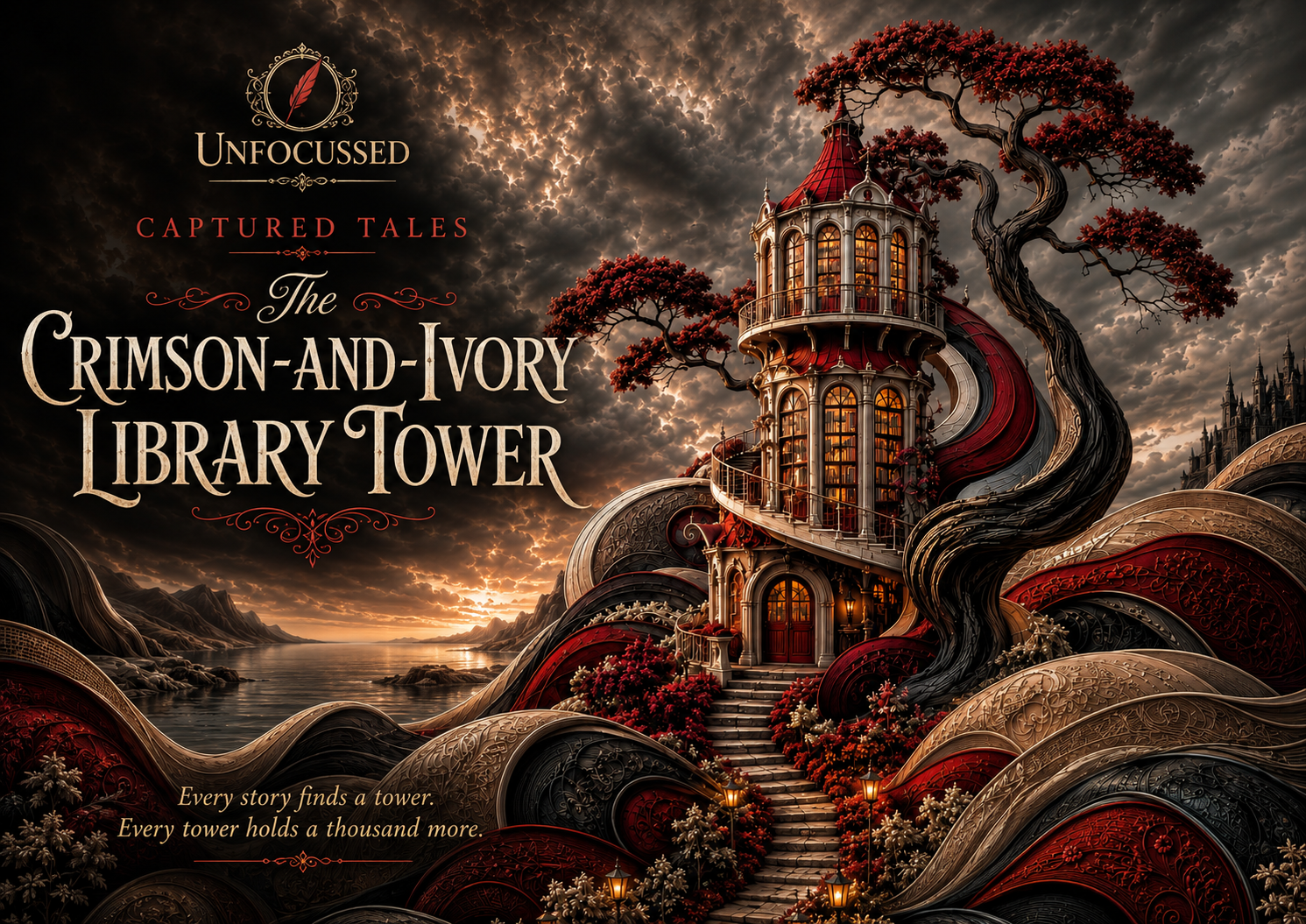
La escalera que tenía opiniones
La Torre Biblioteca Carmesí y Marfil solo aparecía cuando el clima se lucía.
No la lluvia ordinaria. Ni una llovizna gris y educada que hacía que la gente sensata buscara paraguas y las galletas emocionalmente frágiles. No, la torre requería un cielo comprometido. Las nubes tenían que llegar hinchadas, teatrales y llenas de malas intenciones. El viento tenía que arañar las colinas como si hubiera perdido dinero en un juego de cartas. Los truenos debían rodar de forma lo suficientemente dramática como para que incluso las ovejas del valle inferior miraran hacia arriba y pensaran: Bueno, eso parece excesivo.
La tarde en que Mirabel Quill vio por primera vez la torre, el cielo se comportaba como una duquesa viuda que había descubierto una traición en la despensa.
Nubes negras hervían sobre la costa. Relámpagos cosían breves heridas plateadas en el cielo. El mar debajo de los acantilados brillaba frío y color peltre, luego desaparecía bajo un velo de lluvia. A lo largo del camino del valle, las famosas colinas carmesí y marfil se elevaban en grandes pliegues rizados, sus superficies talladas con volutas florales y delicados patrones que parecían demasiado intencionales para ser geológicos. Los visitantes a menudo asumían que las colinas eran alguna antigua locura real, o los restos de una enorme catedral engullida por la tierra, o la prueba de que la naturaleza había tomado una vez una clase de caligrafía y se había vuelto insoportable al respecto.
Mirabel lo sabía mejor.
Mirabel era, por profesión, restauradora de libros dañados, cartas arruinadas y documentos que habían sobrevivido a incendios, inundaciones, guerras, romances, divorcios y un lamentable incidente que involucró a un duque, una bañera y tres volúmenes de filosofía erótica. Había pasado su vida extrayendo significado del moho, las cenizas, las carcomas, las manchas de té, las quemaduras de velas y las notas marginales escritas por personas a quienes nunca se les debería haber dado tinta después de medianoche.
Reconocía el papel cuando lo veía.
Y esas colinas, por muy bonitas que se extendieran bajo la tormenta, no eran colinas.
Eran páginas.
Páginas masivas, dobladas, encantadas.
Mirabel se detuvo en el camino, sus botas hundiéndose en el barro, su capa de viaje aleteando alrededor de sus piernas como un murciélago ofendido. Observó cómo una cresta roja se curvaba hacia arriba delante de ella, la superficie tallada brillando con la lluvia. Bandas de marfil se enroscaban debajo, veteadas de oro y negro. Los pliegues de la tierra se enroscaban hacia un estrecho sendero de piedra bordeado de flores rojas, flores blancas, farolillos torcidos y el tipo de valla de hierro forjado que prácticamente rogaba a alguien que tomara una terrible decisión junto a ella.
Al final del sendero se alzaba la torre.
Se elevaba de los pliegues carmesí y marfil como un secreto demasiado elegante para permanecer enterrado. Grandes ventanales arqueados brillaban con una cálida luz ámbar, cada uno atestado de estantes sombríos. Los balcones rodeaban su parte central en elegantes curvas. Los tejados rojos subían en picos lacados, resbaladizos por la lluvia y brillando bajo los relámpagos. Un árbol negro retorcido abrazaba la torre por un lado, su corteza enroscándose como la espina dorsal de un dragón, sus hojas rojas temblando con el viento como si susurraran un escándalo a la tormenta.
Mirabel sintió el viejo dolor en su pecho removerse.
Habían pasado años desde que un edificio la miraba primero.
"Absolutamente no", dijo en voz alta.
La torre brilló.
"No voy a entrar en una biblioteca nacida de la tormenta en medio de la nada solo porque tiene ventanas cálidas y límites cuestionables".
El farol más cercano parpadeó dos veces.
"No me coquetees", le advirtió Mirabel.
El farol parpadeó por tercera vez, lo que ella optó por interpretar como vulgar.
Mirabel se ajustó más la capa y miró hacia el camino del valle. Había, teóricamente, una posada más adelante llamada The Dripping Bishop. Según el último cartel, ofrecía camas, estofado y "cerveza mayormente honesta", una frase que no le inspiraba confianza. Detrás de ella quedaban seis millas de camino mojado, dos roderas rotas, un cuervo muerto y las ruinas emocionales del pueblo del que acababa de huir.
Huir era quizás demasiado dramático.
Irse abruptamente después de gritar en un juzgado era más preciso.
Irse abruptamente después de gritar en un juzgado mientras sostenía un fajo sellado de cartas en disputa y llamaba al magistrado "un nabo empolvado con disfraz cívico" era extremadamente preciso.
Mirabel había sido contratada para restaurar la correspondencia privada de Lord Fenwick Rusk, un hombre rico recientemente fallecido y ampliamente llorado por las personas que se habían beneficiado de su dinero. Las cartas habían sido dañadas en un incendio, y Mirabel pasó tres meses reconstruyéndolas palabra por palabra, línea por línea, hasta que descubrió que probaban que Lord Rusk había robado tierras a la mitad del valle, falsificado testamentos, chantajeado viudas, envenenado la reputación de su hermano y escrito poesía de amor verdaderamente terrible a una mujer llamada Peony quien, según sus respuestas, lo había encontrado tan seductor como el pan mojado.
La familia quería que las cartas fueran destruidas.
El magistrado quería que fueran "reconsideradas".
Mirabel quería que todos dejaran de fingir que la verdad se volvía grosera simplemente porque llegaba vestida de manera inconveniente.
Así que había tomado las cartas.
Lo que significaba, en un sentido legal, que llevaba pruebas.
En un sentido práctico, llevaba problemas.
En un sentido narrativo, estaba condenada en el momento en que vio la bonita torre.
"Bien", murmuró, pisando el sendero. "Pero solo entro hasta que pase la tormenta. No acepto misiones. No resuelvo misterios antiguos. No me involucro emocionalmente con un edificio".
El árbol retorcido crujió sobre su cabeza.
Sonó sospechosamente a risa.
El sendero ascendía entre las colinas plegadas, cada piedra resbaladiza bajo sus botas. A cada lado, flores rojas se balanceaban con la lluvia, gordas y aterciopeladas como vino derramado. Flores blancas brillaban entre ellas, pálidas como encaje a la luz de la luna. Pequeños faroles ardían con llamas doradas estables a pesar del aguacero. Cuanto más se acercaba Mirabel a la torre, más veía que sus paredes no estaban hechas de piedra ordinaria. Las columnas llevaban diminutas palabras grabadas. Los marcos de las ventanas estaban tallados con signos de puntuación. Las barandillas de los balcones se curvaban en ampersands, puntos y comas, y florituras que parecían decorativas hasta que uno notaba que se reorganizaban cuando no se observaban directamente.
"Pretencioso", dijo Mirabel, aunque su voz carecía de convicción.
Ya le encantaba. Eso la irritaba.
En la base de la torre, un par de puertas dobles rojas esperaban bajo una entrada arqueada flanqueada por figuras talladas. Una parecía ser una santa sosteniendo una pluma. La otra parecía ser una gárgola sosteniendo una copa de vino y juzgando a la gente, lo que a Mirabel le pareció más espiritualmente persuasivo.
No había aldaba.
Sin embargo, había una placa de latón.
Decía:
LA TORRE BIBLIOTECA CARMESÍ Y MARFIL
Depósito de historias inacabadas, finales abandonados, maldiciones fallidas, confesiones extraviadas y libros que no deben ser abiertos por hombres llamados Gerald.
Debajo de eso, en letra más pequeña:
Se reciben visitas durante tormentas, arrepentimientos, desamores, escándalos y actos moderados de transgresión intelectual.
Mirabel miró la placa por un largo momento.
"No soy un Gerald", dijo.
Las puertas rojas se abrieron.
Primero salió un calor que olía a madera pulida, rosas mojadas por la lluvia, velas de cera de abeja, papel viejo y algo ligeramente picante que podría haber sido canela o quizás peligro con perfume. Mirabel entró y las puertas se cerraron detrás de ella con el sonido firme y satisfecho de un anfitrión que acababa de atrapar a los invitados a la cena para que escucharan hablar de genealogía.
El vestíbulo era circular e imposiblemente alto. Estantes se alzaban a lo largo de cada pared, repletos de libros con encuadernaciones carmesí, marfil, negro, bronce y verde oscuro. Escaleras subían a lo largo de barandillas de latón. Balcones rodeaban el vestíbulo en anillos ascendentes. Cada ventana brillaba contra la tormenta exterior, la lluvia surcando el cristal como tinta deslizándose por una página. Arriba, una araña hecha de tazas de té y llamas de velas giraba lentamente, proyectando sombras que parecían pájaros, manos y, ocasionalmente, el perfil de alguien que tenía opiniones sobre la gramática.
En el centro del vestíbulo había un escritorio.
Detrás del escritorio había una mujer que parecía haber sido ensamblada con paciencia invernal y una excelente postura.
Era alta, esbelta y vestía un vestido del color del pergamino viejo, con puños carmesí y un cuello negro lo suficientemente afilado como para amenazar al ganado. Su cabello plateado estaba recogido en un moño sostenido por tres plumas. Sus gafas colgaban de una cadena de diminutas llaves doradas. No parecía sorprendida de ver a Mirabel. Parecía, en cambio, ligeramente incomodada, de una manera que sugería que se había esperado a Mirabel durante años y, sin embargo, de alguna manera llegaba tarde.
“¿Nombre?”, preguntó la mujer.
"Mirabel Quill."
La mujer mojó su pluma en un tintero sin mirar hacia abajo. "¿Ocupación?"
"Restauradora de libros."
“¿Estado de angustia moral?”
Mirabel parpadeó. "Eso no se suele preguntar en las posadas".
"Esto no es generalmente una posada."
"De leve a grave", dijo Mirabel. "Dependiendo de cuánto sepa usted".
“Sabemos lo suficiente para evitar exposiciones innecesarias”. La mujer escribió algo en el enorme libro de contabilidad que tenía delante. “¿Motivo de entrada?”
"El clima."
La mujer la miró por encima de las gafas.
Mirabel suspiró. "Posiblemente también pruebas, furia ética y una debilidad personal por las bibliotecas arquitectónicamente dramáticas".
"Mejor."
“¿Y usted es?”
"Madame Vitela."
"¿Es ese tu nombre real?"
"Es el nombre que prefiere la torre."
"Eso suena a un no."
"Eso suena a curiosidad, y la curiosidad es cómo se alimentan las escaleras."
Mirabel apretó el fajo que llevaba bajo la capa. "¿Sus escaleras comen gente?"
Madame Vellum miró hacia el lado más alejado del salón, donde una amplia escalera de marfil se curvaba hacia la sombra. "No a menudo. No enteros. No sin justificación narrativa."
"Ninguna de esas cosas me consuela."
“Hay consuelo disponible en el segundo rellano en forma de sillones, té y libros que mienten amablemente”.
“¿Libros que mienten amablemente?”
“Memorias de viaje. La mayoría de las autobiografías. Libros de cocina escritos por personas que nunca han lavado una sartén”.
A pesar de sí misma, Mirabel sonrió.
Madame Vellum lo notó y pareció ligeramente decepcionada, como si la calidez fuera una carga administrativa. "Puedes quedarte hasta que pase la tormenta. Puedes leer lo que se te presente. No puedes llevarte libros, discutir con los índices, insultar a los cuervos, lamer las encuadernaciones plateadas, abrir nada encadenado con hilo rojo, ni aceptar consejos románticos de las biografías."
"Esa última parece extrañamente específica."
"Una condesa una vez se fugó con una nota a pie de página."
“¿Fue feliz?”
"Brevemente. Luego la nota al pie insistió en explicarse."
Mirabel volvió a mirar la escalera. No estaba donde la recordaba. Se había movido tres pies a la izquierda y ahora se curvaba más pronunciadamente, como si intentara parecer inocente.
"¿Y las escaleras?", preguntó.
Madame Vellum cerró el libro. "La torre contiene muchas escaleras. Algunas llevan a pisos. Algunas llevan a recuerdos. Algunas llevan a historias abandonadas por cobardes, tontos, tiranos, amantes, editores y personas que confundieron una apertura dramática con una trama sostenible. Evita las inacabadas."
“¿Cómo sabré cuáles están sin terminar?”
"Ellos te conocerán."
Mirabel sintió que esta era el tipo de respuesta que la gente daba cuando quería sonar profunda pero se había saltado la parte útil de la comunicación.
"Me quedaré cerca de la entrada", dijo.
"Todo el mundo dice eso."
Madame Vellum levantó una pequeña campana de latón y la hizo sonar una vez.
Desde algún lugar de arriba llegó un aleteo de alas, luego un golpe suave, luego una maldición murmurada. Una criatura cayó del segundo balcón y aterrizó en el escritorio con toda la dignidad de una zapatilla lanzada. Tenía aproximadamente el tamaño de un gato, con forma de cuervo, pero hecho principalmente de plumas negras sueltas, gafas e irritación. Alrededor de su cuello colgaba una pequeña etiqueta que decía: BRACKET.
“Escolta de invitados”, dijo Madame Vellum.
Bracket miró a Mirabel de arriba abajo. "Parece húmeda."
"También el tiempo", dijo Mirabel.
"El tiempo tiene una excusa."
“¿Todos los pájaros aquí insultan a los invitados?”
"Solo cuando los invitados llegan ya insultados por las circunstancias."
Madame Vellum señaló con un dedo largo hacia una alcoba de lectura más allá de la escalera. "Llévala al hogar oeste. Nada maldito. Nada profético. Nada con recetas."
Bracket se estremeció. "No después de la última vez."
Mirabel los miró a ambos. "¿Qué pasó la última vez?"
"Un pudin alcanzó la ambición", dijo Madame Vellum.
“¿Y?”
"Y la ambición es impropia de un pudin."
Bracket saltó del escritorio y se contoneó hacia el pasillo con una cojera que parecía más teatral que médica. Mirabel lo siguió, pasando estantes rotulados con letras doradas: Disculpas Nunca Enviadas, Cartas Escritas Demasiado Tarde, Mapas de Lugares Que Negaron Existir, Memorias de Villanos Que Culparon a Sus Madres, y Romances en los Que Todos Necesitaban una Siesta y una Conversación Franca.
“¿Este lugar es real?”, preguntó Mirabel.
“Define real”, dijo Bracket.
"Existiendo independientemente de mi agotamiento, culpa y cuestionable nivel de azúcar en la sangre."
"Mayormente."
"Mayormente no es tranquilizador."
"Llegaste a una torre que aparece durante las tormentas y tiene colinas hechas de páginas. La tranquilidad parece un barco que zarpó antes de que hicieras las maletas."
El hogar oeste se encontraba dentro de una profunda alcoba rodeada de altos ventanales. Afuera, los relámpagos iluminaban la costa en destellos irregulares. Adentro, un fuego ardía azul en su centro y dorado en los bordes. Los sillones se reunían a su alrededor como tías chismosas. Una pequeña mesa tenía té, pan, mantequilla, mermelada, peras en rodajas y un plato de galletas con forma de calaveras.
“¿Las galletas de calavera son simbólicas?”, preguntó Mirabel.
“Todo aquí es simbólico”, dijo Bracket. “Algunas cosas también son bocadillos”.
Saltó al respaldo de una silla, se metió un pie debajo y comenzó a acicalarse con el aire cansado de un funcionario que había visto demasiados destinos mal manejados por aficionados.
Mirabel se hundió en la silla más cercana. El cojín suspiró bajo ella. El fuego le calentó las faldas mojadas por la lluvia. Puso el fajo de cartas en su regazo y lo miró fijamente.
Durante tres meses había manejado las palabras de Lord Rusk. Sus mentiras se habían desmoronado bajo sus herramientas, revelando mentiras más antiguas debajo. Cada página restaurada había sido como raspar hollín de un espejo hasta que aparecía alguien feo en él. Había pensado que la verdad sería limpia. En cambio, había sido pegajosa. Se había adherido a sus dedos, la había seguido al sueño, y ahora yacía en su regazo envuelta en hule mientras un cuervo mágico la juzgaba desde una silla.
"Estás pensando demasiado alto", dijo Bracket.
"No sabía que los pensamientos tuvieran volumen."
"Los tuyos llevan botas."
Mirabel buscó el té. Se sirvió solo antes de que ella tocara la tetera.
"Gracias", dijo ella.
La tetera hizo una pequeña y digna reverencia.
"No lo animes", murmuró Bracket. "Ya es insoportable."
Mirabel bebió un sorbo. El té sabía a canela, mora y a la primera página de un libro que uno había tenido miedo de empezar. No tenía una forma racional de saberlo. Lo sabía de todos modos.
Durante un rato, se sentó en silencio.
A su alrededor, la biblioteca respiraba.
Las páginas susurraban en su sueño. Los estantes crujían y se reacomodaban. En algún lugar muy arriba, una campana dio tres toques, luego cambió de opinión y dio dos más. La lluvia golpeaba las ventanas. El fuego crepitaba. Un libro rojo estrecho se deslizó de un estante, se abrió sobre la mesa y mostró una página en blanco.
Mirabel lo miró fijamente.
"No", dijo Bracket.
“¿Qué es?”
"Problemas con la encuadernación."
"La encuadernación se ve bien."
"No ese tipo."
La página en blanco brilló. La tinta comenzó a gotear sobre ella, oscura como el vino.
Érase una vez, una mujer entró en una torre durante una tormenta y fingió que solo había entrado para protegerse de la lluvia.
Mirabel bajó lentamente su taza de té.
Bracket se llevó una ala a la cara. "Oh, por el amor de Dios."
La tinta continuó.
Llevaba la verdad robada envuelta contra sus costillas y la llamaba deber porque la culpa sonaba demasiado íntima.
"Eso es grosero", dijo Mirabel.
"Es una biblioteca", respondió Bracket. "La grosería es la mitad del trabajo."
Ella creía que las historias inacabadas pertenecían a otras personas: señores muertos, viudas asustadas, cartas quemadas, hijos cobardes y las chicas que solía ser.
La habitación pareció quedarse quieta.
Los dedos de Mirabel se apretaron alrededor del borde del libro.
“¿Chicas que solía ser?”, susurró.
Bracket dejó de acicalarse.
El fuego pasó de dorado a rojo.
Las páginas del libro se agitaron, aunque no había viento. Luego, desde algún lugar más allá de la alcoba, una escalera gimió.
No era la ancha escalera de marfil que había notado en el vestíbulo de entrada. Este sonido venía de detrás de los estantes, debajo del suelo, por encima del techo, y posiblemente dentro del propio esternón de Mirabel. Un lento crujido de madera. Una bisagra de vieja narrativa abriéndose. Un escalón siendo colocado donde ningún escalón había estado antes.
Bracket se quedó muy quieto.
"No te levantes", dijo.
Mirabel se puso de pie.
"Ahí está", dijo Bracket. "La estupidez tradicional."
Al otro lado de la alcoba, se abrió una estrecha rendija entre dos estanterías. No había estado allí un momento antes. Un soplo de aire frío se deslizó a través de ella, trayendo el olor a polvo, tinta, violetas y viejos arrepentimientos. Más allá de la rendija, una escalera descendía, o ascendía. Mirabel no podía saberlo. Se retorcía en ambas direcciones, sus escalones hechos de materiales desiguales: madera pulida, piedra roja, baldosas de marfil, hierro negro, mármol agrietado, vidrio veteado de oro. Cada contrahuella estaba inscrita con media frase.
Mirabel dio un paso hacia ella.
Bracket se lanzó desde la silla y aterrizó sobre su hombro, clavando las garras en su capa. "Mala idea."
"No sabes lo que voy a hacer."
"Estás caminando hacia la siniestra escalera que acaba de abrirse después de que un libro te insultara personalmente. No estoy resolviendo un acertijo aquí."
La escalera susurró.
No en una voz. En muchas voces. Algunas jóvenes. Algunas viejas. Algunas riendo. Algunas llorando. Algunas susurrando líneas de diálogo que nunca habían llegado a una página final.
Nunca regresó del huerto...
Ella lo besó solo porque la luna había mentido—
La tercera hija del rey nació con una llave debajo de la lengua—
No confíes en el hombre de guantes limpios—
El pudín tenía ambición—
«Esa última se repite mucho», dijo Mirabel.
«Y debe ser respetada como una advertencia».
Mirabel se acercó. Las medias frases en los escalones se movieron al mirarlas.
La chica de la encuadernación escondió la carta porque—
Le faltó el aliento.
Bracket lo sintió y murmuró algo profano en cuervo.
Mirabel tenía dieciséis años cuando escondió su primera carta.
Trabajaba entonces en la encuadernación del maestro Odrin, una tienda estrecha en la ciudad donde los libros viejos eran reparados y los clientes ricos venían a fingir que les importaba la historia. Ella era inteligente, callada, mal pagada y hambrienta en varias direcciones. Una mañana de invierno, encontró una carta metida en el forro roto de un libro de oraciones. Había sido escrita por una chica llamada Isla al hijo de una familia noble, rogándole que reconociera a su hijo antes de que la mandaran lejos.
Mirabel le había llevado la carta al maestro Odrin.
El maestro Odrin la leyó, palideció y le dijo a Mirabel que la carta era una tontería peligrosa. Luego llegó un hombre de la familia noble. Hubo dinero. Hubo amenazas. Hubo palabras suaves pronunciadas por gente dura. Al anochecer, la carta había desaparecido.
Excepto que no había desaparecido.
Mirabel la había escondido.
Durante años.
No para proteger a Isla. No de verdad. Había tenido demasiado miedo de enviarla, demasiado miedo de quemarla, demasiado miedo de guardarla abiertamente. Así que la metió en el lomo de un atlas y se dijo a sí misma que esperar era sabiduría.
Isla desapareció. El noble hijo se casó bien. El niño, si es que lo hubo, se convirtió en un rumor sin apellido. Y Mirabel aprendió que las historias inconclusas no simplemente permanecían inconclusas.
Se pudrían.
Se extendían.
Lo manchaban todo a su alrededor.
La escalera volvió a susurrar.
La chica de la encuadernación escondió la carta porque pensó que el silencio era más seguro que las consecuencias.
Mirabel se encogió.
«Eso», dijo con voz débil, «es privado».
La voz de Madame Vellum respondió desde detrás de ella. «Ya no».
Mirabel se giró. La bibliotecaria estaba al borde de la alcoba, con las manos cruzadas, el rostro grave a la luz del fuego.
«Dijiste que podía quedarme hasta que pasara la tormenta», dijo Mirabel.
«Puedes».
«Dijiste que podía leer lo que se presentara».
«Sí».
«No dijiste que los muebles hurgarían en mi vergüenza».
«Los muebles rara vez son tan ambiciosos». La mirada de Madame Vellum se dirigió al espacio entre los estantes. «Esa es la Escalera de las Historias Inconclusas».
Bracket saltó del hombro de Mirabel y se retiró detrás de un sillón con una velocidad poco heroica.
«Me dijiste que evitara las escaleras inconclusas», dijo Mirabel.
«Así lo hice».
«Esta se abrió a mi lado».
«A menudo lo hacen, cuando se evitan correctamente».
«Esa frase es una tontería con zapatos».
«Muchas cosas verdaderas lo son».
La escalera se extendía más profundamente en la sombra. Sus escalones se reorganizaron, algunos subiendo, otros bajando, formando un camino que parecía curvarse a través de las paredes de la torre y más allá. A intervalos, los rellanos parpadeaban a la vista: un huerto a la luz de la luna; un salón de baile iluminado por velas sin bailarines; una guardería llena de cunas cerradas; un campo de batalla donde todos los soldados parecían discutir con su narrador; una cocina donde un pudín estaba debajo de una cúpula de cristal, vibrando con un propósito.
«No», llamó Bracket desde detrás de la silla. «Absolutamente ninguna cocina».
Madame Vellum lo ignoró. «La escalera contiene historias abandonadas antes de sus finales. Algunas fueron abandonadas por la muerte. Algunas por miedo. Algunas por crueldad. Algunas porque la persona responsable decidió que los finales eran complicados y prefirió dejar a todos los demás en la intemperie emocional sin un abrigo».
Mirabel miró el manojo de cartas en sus brazos. «¿Qué quiere de mí?»
«Querer es impreciso».
«Entonces sé precisa».
La expresión de Madame Vellum se suavizó, lo que de alguna manera la hizo parecer más peligrosa. «La torre ha estado inconclusa durante mucho tiempo».
Afuera, un trueno retumbó en el cielo.
«Las bibliotecas nunca están terminadas», dijo Mirabel.
«Las colecciones crecen. Los catálogos evolucionan. Los estantes se derrumban bajo el peso de biografías terribles. Eso es normal. Pero esta torre está inconclusa en sus cimientos. Su última habitación nunca fue escrita. Su escalera más alta no lleva a ninguna parte. Su última puerta no tiene otro lado».
«Eso parece arquitectónicamente inconveniente».
«Es existencialmente peor».
Mirabel casi se ríe, pero la escalera volvió a susurrar, y esta vez las voces eran más fuertes.
Acábanos.
Encuéntranos.
Nombra al niño.
Quema el testamento.
Abre el gabinete rojo.
Besa al gemelo equivocado.
No dejes que Gerald se acerque a las bisagras.
«Hay muchas advertencias sobre Gerald aquí», dijo Mirabel débilmente.
«Un Gerald puede arruinar siglos», respondió Madame Vellum.
El paquete en los brazos de Mirabel comenzó a calentarse.
Miró hacia abajo. El hule se había aflojado. Las cartas restauradas de Lord Rusk, atadas con una cinta negra, brillaban débilmente en los bordes. La página superior se movió, y debajo de las acusaciones legales, debajo de los robos de tierras, debajo de las manipulaciones y firmas falsificadas, apareció otra línea con tinta carmesí fresca.
Esta no es la historia que viniste a terminar.
A Mirabel se le secó la boca.
«¿Qué significa eso?»
Madame Vellum no respondió de inmediato.
Fue entonces cuando Mirabel comprendió algo desagradable: los bibliotecarios eran más aterradores cuando estaban en silencio.
Finalmente, Madame Vellum dijo: «Significa que la torre te ha reconocido».
«¿Para qué?»
«Para una lectora, ciertamente. Una restauradora, indudablemente. Una ladrona, discutiblemente».
«No robé estas cartas».
«¿No?»
«Conservé pruebas».
«La distinción puede importar en un tribunal».
«Debería importar en todas partes».
«"Debería" es una pequeña palabra encantadora. Tan esperanzadora. Tan frecuentemente magullada». Madame Vellum se acercó a la escalera. «A la torre no le importa lo que trajiste aquí. Le importa lo que dejaste inconcluso».
Mirabel pensó en la carta escondida en el atlas. Pensó en Isla. Pensó en la chica que había sido, de pie en una encuadernación a medianoche con las manos temblorosas y diciéndose a sí misma que actuaría cuando fuera mayor, más segura, más fuerte, menos sola.
Se había hecho mayor.
Esa fue la única promesa que el tiempo había cumplido.
La escalera volvió a moverse.
Un nuevo escalón se deslizó en su lugar a los pies de Mirabel. Su superficie era de marfil, agrietada por el centro, con una línea de escritura negra que recorría el borde.
Ella subió porque quedarse abajo se había convertido en otro tipo de mentira.
Mirabel lo miró fijamente.
«Sutil», dijo.
Bracket se asomó por encima del sillón. «La torre nunca ha salido con lo sutil. Una vez flirtearon, pero terminó mal».
Madame Vellum extendió una mano, no para detener a Mirabel, pero tampoco para invitarla. «No tienes que subir».
«¿Qué pasa si no lo hago?»
«La tormenta pasará. La torre desaparecerá. Continuarás tu camino. Entregarás o destruirás las cartas de Lord Rusk según el valor que sobreviva al desayuno. Y la escalera permanecerá».
«¿Con mi historia en ella?»
«Con parte de ella».
«¿Y la de Isla?»
Los ojos de Madame Vellum estaban firmes. «Quizás».
Mirabel odiaba esa palabra.
«Quizás» era donde los cobardes guardaban la responsabilidad.
Volvió a mirar el fuego, el té, las galletas de calavera, la cómoda silla esperando para perdonarla por estar cansada. Miró las ventanas, donde la luz de la tormenta destellaba sobre el mar. Miró el manojo de cartas que ya la había arrastrado a un escándalo y ahora parecía ansiosa por unirse a un segundo.
Luego miró la escalera.
Esperaba con toda la paciencia de la madera vieja, la culpa vieja y la magia vieja que sabía que los humanos finalmente confundían el pavor con el destino si se les daba suficiente luz de las velas.
Mirabel subió al primer escalón.
La torre inhaló.
Cada libro del vestíbulo se abrió a la vez.
Las páginas revolotearon como alas. La tinta brilló a través de miles de hojas. En algún lugar de arriba, las campanas comenzaron a sonar, no campanas ordenadas, sino campanas frenéticas, encantadas, ebrias de chismes. La lámpara de tazas de té giró más rápido. El fuego rugió carmesí. El árbol retorcido de afuera presionó una rama negra contra la ventana, las hojas rojas temblaban como si aplaudieran.
Bracket hizo un ruido ahogado. «Oh, bien. Participación catastrófica».
Madame Vellum cerró los ojos por medio aliento, luego los abrió con la expresión de una mujer cuyo día se había convertido en papeleo. «Mirabel Quill», dijo, «hagas lo que hagas, no te saltes escalones».
«¿Por qué me saltaría escalones?», preguntó Mirabel.
El segundo escalón se deslizó bajo su bota antes de que ella se moviera.
El tercero apareció encima.
El cuarto se desplegó de lado.
El quinto susurró su nombre con una voz que no había oído desde que tenía dieciséis años.
Mirabel se paralizó.
En el rellano de adelante, una puerta se abrió.
Más allá yacía la antigua encuadernación: ventanas estrechas, luz de invierno, estantes de cuero agrietado, el banco de trabajo del maestro Odrin, y una joven con los dedos manchados de tinta escondiendo una carta dentro del lomo de un atlas.
La chica levantó la vista.
Su rostro era el de Mirabel.
No como ahora, marcado por el tiempo, el trabajo y la obstinación, sino como había sido entonces: asustado, agudo, esperanzado de una manera que dolía presenciar.
En sus manos, la carta escondida comenzó a sangrar tinta carmesí.
La escalera susurró a través de cada piso de la torre.
Empieza donde mentiste.
Y detrás de Mirabel, muy abajo en la cálida alcoba, el libro rojo sobre la mesa pasó a su siguiente página en blanco y escribió:
Desafortunadamente para todos los que preferían una noche tranquila, Mirabel Quill siempre había sido más peligrosa cuando la verdad la avergonzaba.
La puerta de la encuadernación se abrió más.
Mirabel subió.
La encuadernación donde el silencio aprendió a hablar
Lo primero que Mirabel notó al adentrarse en su propio pasado fue el olor.
No el olor de la memoria, que a los poetas les gustaba fingir que eran solo violetas y humo de hogar y el tierno almizcle de la juventud siendo lamentablemente sincera. Este era un olor práctico. Pegamento de encuadernación. Aceite de lámpara. Polvo. Lana mojada. Virutas de cuero. Papel viejo. Moho escondido en las esquinas como un pequeño y húmedo casero. Era tan real, tan nítidamente conservado, que la garganta de Mirabel se apretó antes incluso de ver la habitación.
La vieja encuadernación la esperaba exactamente como había sido veintisiete años antes.
Las ventanas estrechas traqueteaban bajo la lluvia invernal. Los estantes cedían bajo himnarios agrietados, libros de contabilidad, atlas, romances con lomos rotos, libros de leyes que nadie amaba, y una obscena guía botánica que el maestro Odrin seguía fingiendo que era una referencia médica. Las mesas de trabajo estaban marcadas con cuchilladas. Las tablas del suelo se hundían cerca de la estufa. Un reloj de latón marcaba las horas sobre la puerta, permanentemente siete minutos atrasado porque el maestro Odrin creía que la puntualidad era un signo de desesperación espiritual.
Y allí, junto al banco de trabajo más grande, estaba Mirabel a los dieciséis años.
La Mirabel más joven era delgada, de rostro afilado y manchado de tinta, con el cabello castaño trenzado demasiado apretado y los ojos que parecían más grandes de lo que debían porque el hambre había esculpido el resto de su cuerpo más pequeño. Llevaba un delantal gris sobre un vestido remendado. Tenía las mangas remangadas hasta los codos. En sus manos apretaba una carta, su papel frágil, manchado de humo y tembloroso como si supiera exactamente lo mal que la gente podía comportarse una vez que el dinero entraba en una habitación.
La Mirabel adulta se quedó inmóvil en el umbral de lo imposible.
Detrás de ella, la escalera crujió.
Bracket aterrizó en el escalón superior junto a ella con un suave golpe de plumas y mala actitud. «Ah. Adolescencia».
«Silencio», susurró Mirabel.
«No, gracias. He soportado muchas habitaciones terribles en esta torre, incluyendo el Salón de los Profetas Auto-Publicados y la Despensa de los Encurtidos Simbólicos, pero nada es más peligroso que un adolescente guardando un secreto. Son todo codos, mal juicio y clima sin procesar».
La Mirabel más joven levantó la vista.
Por un momento, ninguna de las dos versiones de Mirabel respiró.
Los ojos de la chica se entrecerraron. «Eres yo».
La Mirabel adulta tragó saliva. «Sí».
«Más vieja».
«Desafortunadamente».
«¿Nos hacemos ricas?»
«No».
«¿Nos ponemos guapas?»
«Nos volvemos interesantes».
La chica lo consideró y pareció ofendida por el compromiso. «¿Nos volvemos valientes?»
Esa fue la pregunta que abrió la habitación.
La lluvia golpeaba las ventanas. El reloj marcaba. En algún lugar dentro de las paredes, la torre escuchaba con la obscena intimidad de la magia antigua y los bibliotecarios antiguos.
La Mirabel adulta miró la carta en las manos de la chica.
«Eventualmente», dijo.
El rostro de la chica se entristeció un poco, y Mirabel se odió a sí misma por la honestidad. Había considerado mentir. Una pequeña mentira. Una mentira suave. Algo lo suficientemente tierno como para calmar a la chica y lo suficientemente digno como para permitir que la mujer mayor fingiera que la comodidad no era prima de la cobardía.
Pero la escalera bajo sus pies no la había traído aquí para consolarla.
La había traído aquí porque la comodidad había fallado.
La Mirabel más joven miró la carta. «El maestro Odrin dice que es peligrosa».
«Lo es».
«Dice que podría arruinar a la gente».
«Podría».
«Gente importante».
«Especialmente a ellos».
La boca de la chica se tensó. La Mirabel adulta reconoció esa expresión con dolorosa claridad. Era el rostro que había llevado cada vez que el hambre, el miedo y la inteligencia intentaban sentarse a la misma mesa y discutir sobre ética.
«Dice que si hablo de ello, perderé mi puesto», dijo la chica.
«Puede que sí».
«Dice que nadie me creerá».
«Algunos no lo harán».
«Dice que probablemente está mintiendo».
«Ella no lo está».
La chica levantó la vista rápidamente.
La Mirabel adulta se adentró más en la encuadernación. El suelo gimió bajo su bota, exactamente como siempre lo había hecho. Recordó esa tabla. La tercera desde la estufa, deformada por una fuga que el maestro Odrin nunca arregló porque decía que el cubo le daba carácter a la habitación.
«Su nombre era Isla Vale», dijo Mirabel. «Trabajaba en la antigua cristalería. Escribió esa carta porque Elias Rusk prometió casarse con ella, luego prometió ayudarla, luego prometió recordarla, y finalmente no prometió nada en absoluto, lo cual es una especialidad de los hombres que confunden el silencio con la estrategia».
La Mirabel más joven se quedó mirando. «¿Sabes lo que pasa?»
«No lo suficiente».
«¿La enviamos?»
La Mirabel adulta no pudo responder.
La chica lo entendió de todos modos.
Sus dedos se cerraron alrededor del papel. «Oh».
Fue el sonido más pequeño de la habitación, y de alguna manera el más cruel.
Bracket saltó de la escalera a un taburete cercano. «No me gusta esta escena. No tiene galletas y tiene demasiada precisión emocional».
«¿Qué es eso?», preguntó la Mirabel más joven.
«Un cuervo», dijo la Mirabel adulta.
«No soy un cuervo», espetó Bracket. «Soy un córvido indexador de lealtad selectiva y juicio literario avanzado».
«Habla».
«Constantemente», dijo la Mirabel adulta.
«Conservo vidas insultándolas antes de que cometan errores finales».
«¿Ayuda?», preguntó la chica.
«Raramente», dijo la Mirabel adulta.
«Gracias», dijo Bracket. «Me esfuerzo mucho en ser poco apreciado».
La carta en las manos de la Mirabel más joven comenzó a sangrar tinta carmesí de nuevo. No goteó hacia abajo. Se elevó de la página, curvándose en el aire como humo, formando palabras que habían estado dobladas demasiado tiempo dentro del miedo.
A Elias Rusk, que sabe lo que ha hecho—
El resto se difuminó.
La Mirabel más joven intentó cerrar la carta.
La Mirabel adulta extendió la mano. «No lo hagas».
«Si la leo, entonces lo sé».
«Ya lo sabes».
«No todo».
«Saber menos no nos salvó».
La chica parecía furiosa entonces, y la furia era lo suficientemente joven como para ser pura. «Fácil para ti. Tú sobreviviste».
La Mirabel adulta no tuvo una respuesta ingeniosa a eso.
Había sobrevivido. Eso era cierto. Había sobrevivido a la tienda del maestro Odrin, sobrevivido a la pobreza, sobrevivido a los hombres que sonreían mientras bajaban los salarios, sobrevivido a los clientes que la llamaban dotada hasta que envió una factura, sobrevivido a los archivos dañados por el fuego y a los escándalos de herencias y al trabajo solitario y obstinado de tocar el viejo dolor con manos limpias.
Ella había sobrevivido.
Pero la supervivencia era algo extraño. La gente la trataba como un triunfo cuando a menudo era simplemente la evidencia de que uno había aprendido a seguir respirando mientras llevaba lo no dicho.
«Sí, sobreviví», dijo Mirabel suavemente. «Y la supervivencia me hizo útil. Pero no me hizo inocente».
La encuadernación se movió.
Las sombras se deslizaron por los estantes. El reloj dejó de sonar. La lluvia exterior se ralentizó hasta que cada gota colgó contra el cristal como una cuenta en un hilo. Desde la trastienda llegó el sonido de voces de hombres.
La Mirabel más joven palideció.
«Es él».
La Mirabel adulta se giró.
Una puerta detrás del banco de trabajo se abrió, y el maestro Odrin salió exactamente como la memoria lo había conservado: panzudo, de ojos estrechos, con una barba gris recortada para que pareciera sabio a distancia y malvado de cerca. Llevaba botones de chaleco de color tinta y la expresión de un hombre que había confundido la precaución con la virtud durante tanto tiempo que hasta sus zapatos parecían engreídos.
Detrás de él venía un caballero más joven con un abrigo oscuro, de pelo liso, enguantado y pulido con el brillo de la cobardía heredada. Elias Rusk. No era lo suficientemente guapo como para justificar el daño que había hecho, lo cual Mirabel encontró ofensivo en nombre del equilibrio narrativo.
Con ellos venía otro hombre, de hombros anchos, con un bolso de cuero y guantes tan limpios que parecían moralmente sospechosos.
La escalera susurró desde detrás de Mirabel.
No confíes en el hombre de guantes limpios.
“Un poco tarde”, murmuró Bracket.
El Maestro Odrin miró a la joven Mirabel. “Niña. Ve a barrer la entrada.”
La joven Mirabel se quedó inmóvil, con la carta todavía medio escondida en su delantal.
La Mirabel adulta se interpuso entre ellos.
Los ojos del Maestro Odrin se posaron en ella como si fuera humo. Él no la veía. Elias Rusk no la veía. El hombre de guantes limpios tampoco la veía. La memoria, al parecer, tenía límites. Podía herir, pero no podía ser interrogada correctamente, lo que Mirabel consideraba un mal diseño.
“Sabes por qué estamos aquí”, dijo Elias.
Su voz era suave. No amable. Suave como las alfombras caras que amortiguan una caída.
El Maestro Odrin se secó las manos con un paño. “Sé que crees que algo que pertenece a tu familia llegó a mi tienda.”
“No pertenece”, dijo Elias. “Es una amenaza.”
“Una distinción querida por los cobardes”, espetó la Mirabel adulta.
Nadie la oyó.
Bracket inclinó la cabeza. “¿Todavía te satisface?”
“Un poco.”
El hombre de guantes limpios dejó el monedero sobre la mesa. Las monedas tintinearon dentro. Los ojos de la joven Mirabel se fijaron en él, luego se apartaron. La Mirabel adulta recordó ese sonido con amarga precisión. Había sido el sonido del mundo explicando sus tarifas.
“Una joven ha hecho afirmaciones”, dijo Elias. “Afirmaciones angustiadas. Afirmaciones emocionales.”
“Afirmaciones de embarazo”, dijo la Mirabel adulta.
“Afirmaciones”, repitió Elias, y de alguna manera hizo que la palabra sonara sucia. “Ha escrito cosas que confundirían ciertos asuntos. Asuntos de herencia. Asuntos matrimoniales. Mi padre está enfermo. Mi futuro es delicado.”
“¿Tu futuro es delicado?”, dijo la Mirabel adulta. “Abandonaste a una mujer embarazada y viniste a intimidar a un encuadernador, salchicha de terciopelo húmeda.”
Bracket dio un silbido bajo. “Fraseología fuerte. Forma precisa.”
El Maestro Odrin miró hacia la sala delantera donde la joven Mirabel temblaba. “Si tal carta existe, no la he examinado completamente.”
“Entonces no lo hagas”, dijo Elias.
Se abrió el monedero.
Las monedas se derramaron como pequeños soles sobre la mesa de trabajo.
La respiración de la joven Mirabel cambió. La Mirabel adulta lo escuchó y recordó. Alquiler. Pan. Carbón. Botas sin agujeros. Un techo que no goteaba sobre la cama. La seguridad tenía un sonido, y ese día sonó a monedas.
El hombre de guantes limpios finalmente habló. “Hay otras formas de resolver la indiscreción.”
El Maestro Odrin se puso rígido.
“El dinero es agradable”, continuó el hombre. “Pero la ruina es más barata.”
La Mirabel adulta miró los guantes.
“¿Quién es él?”, susurró.
La escalera respondió con un siseo de tinta.
Gerald Rusk, hermano de Elias, guardián de bisagras, quemador de libros de contabilidad, santo patrón de empeorarlo todo.
Bracket se enderezó de golpe. “Gerald.”
“¿El primer Gerald?”, preguntó Mirabel.
“Nunca hay un primer Gerald. Los Gerald son menos un linaje que un moho recurrente.”
Gerald-de-la-memoria flexionó sus dedos impecables. “Si la chica vio algo, despídela. Si habla, diremos que te robó. Si la mujer regresa, diremos que lo falsificó. Si hay un niño, no diremos nada.”
La joven Mirabel parecía que iba a vomitar.
La Mirabel adulta quería agarrar las monedas y arrojárselas a la cara. Quería tirar el banco de trabajo, romper el reloj, rasgar el respetable chaleco del Maestro Odrin por la mitad y empujar a Elias Rusk al cubo debajo de la gotera del techo hasta que lograra al menos un bautismo útil.
En cambio, observó.
Este era el castigo de la escalera. No el peligro. No los monstruos. Ni siquiera las escaleras, aunque las escaleras tenían su propio encanto sádico.
Te hacía observar el momento en que confundías el miedo con la sabiduría.
La joven Mirabel se volvió hacia el estante de atlas.
La Mirabel adulta cerró los ojos.
“No”, susurró.
La chica se movió en silencio. Siempre había sido buena para el silencio. Bajó el gran atlas azul con el lomo agrietado: Atlas Ilustrado de Puertos Desaparecidos, Islas Poco Cooperativas y Costas de Dudosas Moralidades de un Marino. Deslizó la carta de Isla entre el forro roto y el lomo. Sus dedos temblaron. Presionó la cubierta para cerrarla.
La Mirabel adulta recordó el pensamiento exactamente.
Lo guardaré a salvo hasta que sepa qué hacer.
¡Qué noble había sonado! ¡Qué razonable! ¡Qué limpio!
Pero la seguridad, comprendió ahora, podía convertirse en un ataúd si se dejaba sin abrir el tiempo suficiente.
El atlas en el estante comenzó a brillar.
La memoria se detuvo.
El Maestro Odrin se quedó inmóvil, a medio alcanzar una moneda. Elias Rusk se quedó inmóvil con la boca medio abierta, lo que lo mejoró. Gerald Rusk se quedó inmóvil mientras ajustaba un guante, su complacencia preservada en condiciones de archivo. La joven Mirabel permaneció viva en la quietud, mirando a la Mirabel adulta con horror y esperanza pugnando en su rostro.
“Dime que lo arreglamos”, dijo la chica.
La Mirabel adulta cruzó la habitación y se paró frente a su yo más joven.
“En ese momento, no.”
Los ojos de la chica se llenaron de lágrimas. “¿Por qué?”
“Porque teníamos miedo.”
“Eso no es suficiente.”
“No.”
“Eso no es valiente.”
“No.”
“Eso no es justo.”
“Casi nada importante lo es.”
La chica se miró las manos. La tinta manchaba las yemas de sus dedos. “Entonces, ¿qué le pasa a ella?”
“No lo sé.”
“¿Al bebé?”
“No lo sé.”
La chica se estremeció. “Entonces, ¿por qué viniste?”
La Mirabel adulta extendió la mano hacia el atlas. Esta vez, su mano no atravesó la memoria. El estante la aceptó. El libro se deslizó libre, pesado como un juicio.
“Para que el ‘no saber’ no sea el final.”
El atlas se abrió en sus manos.
Pero ya no era el mismo atlas.
Sus mapas habían cambiado. Los puertos desaparecidos se habían ido, reemplazados por ondulantes colinas carmesí y marfil, costas azotadas por tormentas, caminos hechos de notas marginales, y ríos etiquetados con una caligrafía cuidadosa: Arrepentimiento, Casi, Después, y Cosas Dichas Demasiado Tarde Pero Aún Merece la Pena Decir. En el centro se alzaba un dibujo a tinta de la torre de la biblioteca, inacabada en la parte superior. La sala final estaba esbozada solo como un cuadrado en blanco bordeado por hilo rojo.
Entre las páginas yacía la carta de Isla Vale.
Mirabel la levantó con ambas manos.
La tinta tembló, luego se agudizó.
A Elias Rusk, que sabe lo que ha hecho,
No escribo porque espere ternura de ti. He escurrido paños más secos de piedras más amables. Escribo porque habrá un niño, y ese niño no se quedará sin nombre simplemente porque tu familia posea suficientes mesas pulidas para confundirse con la ley.
Puedes negarme. Puedes negar la promesa. Puedes negar el anillo que me pusiste en la mano bajo el techo de cristal rojo y llamaste un comienzo. Puedes negar cada noche que viniste a mi puerta pretendiendo que el amor era coraje en lugar de apetito con mejores modales.
Bracket hizo un suave sonido de ahogo. “Esa mujer tenía una pluma.”
“Silencio”, susurró Mirabel.
Pero no negarás al niño.
Su nombre es...
La línea desapareció bajo una mancha oscura.
No era un daño antiguo. No era fuego. No era agua.
Borrado.
Alguien había borrado el nombre tan violentamente que el papel se había vuelto translúcido.
El agarre de Mirabel se tensó.
“Gerald”, dijo Bracket.
El hombre congelado con guantes limpios permaneció inmóvil junto a la mesa, con una mano cerca de las monedas.
“¿Por qué borrar solo el nombre?”, preguntó Mirabel.
“Porque los nombres son anclas”, dijo Madame Vellum.
Mirabel se volvió.
La bibliotecaria estaba en el umbral de la encuadernación, aunque Mirabel no la había oído subir las escaleras. Su vestido de pergamino estaba intacto por la lluvia, el polvo o el tiempo. Su cabello plateado brillaba bajo la tenue luz de la lámpara. Miró la habitación una vez, y algo parpadeó en su rostro antes de que la disciplina lo ocultara.
“¿Puedes venir aquí?”, preguntó Mirabel.
“Solo hasta el umbral. Esta es tu habitación inacabada, no la mía.”
“Sabías lo de Isla.”
Madame Vellum miró la carta. “La torre sabe muchas cosas. No siempre es generosa al compartirlas.”
“Eso suena a una excusa con un sombrero decorativo.”
“La mayoría de las políticas institucionales lo son.”
La joven Mirabel miró fijamente a Madame Vellum. “¿Eres una bruja?”
“Cuando es conveniente.”
“¿Estás muerta?”
“Cuando lo requiere la burocracia.”
“¿Eres nosotros?”
La expresión de Madame Vellum no cambió, pero las linternas se atenuaron.
“No”, dijo. “Pero he estado esperando a alguien como tú que se canse de acobardarse.”
La Mirabel adulta volvió a mirar la carta. “¿Cómo restauro el nombre?”
Madame Vellum no dio un paso más en la habitación. “Como restauras cualquier cosa. Evidencia. Paciencia. Presión en el lugar correcto. Sin invención donde la recuperación es posible. Sin mentiras bonitas donde la fea verdad sobrevive.”
“¿Dónde está la evidencia?”
Las páginas del atlas revolotearon.
Una línea roja se dibujó desde el mapa de la encuadernación hacia arriba a través de la torre esbozada, curvándose a través de varios rellanos antes de terminar en un pequeño símbolo: un gabinete, pintado de carmesí.
La joven Mirabel se acercó. “¿Qué es eso?”
La mandíbula de Madame Vellum se tensó. “El Gabinete Rojo de Cosas Removidas.”
Bracket gimió. “Oh, excelente. El mueble con historia legal.”
“¿Cosas removidas?”, preguntó Mirabel.
“Nombres tachados de cartas. Cláusulas cortadas de testamentos. Páginas arrancadas de libros parroquiales. Confesiones recortadas de memorias. Recetas editadas antes de las advertencias. Discursos políticos con las partes honestas eliminadas, aunque la mayoría de ellas se pudren al llegar.”
“¿Y el nombre del niño está ahí?”
“Si Gerald lo eliminó, el gabinete puede haber conservado la herida.”
“¿La herida?”
“Un nombre no es papel. Eliminarlo deja un borde.”
La habitación se estremeció.
La memoria comenzó a moverse de nuevo.
La mano del Maestro Odrin bajó hacia las monedas. Elias Rusk se movió. Los dedos enguantados de Gerald se flexionaron.
La voz de Madame Vellum se agudizó. “Debes irte.”
La joven Mirabel agarró la manga de la Mirabel adulta. El contacto las sobresaltó a ambas. Su mano estaba cálida. Real. Manchada de tinta. Viva de esa manera imposible en que la memoria podía serlo cuando el dolor la preservaba demasiado bien.
“¿Nos volvemos buenas?”, preguntó la chica.
La Mirabel adulta miró a su yo más joven y sintió algo dentro de ella, algo viejo y endurecido, ceder.
“No”, dijo. “Nos volvemos responsables. Es menos halagador y más útil.”
El agarre de la chica se apretó. “Tengo miedo.”
“Lo sé.”
“¿Qué hago?”
Mirabel tocó el atlas entre ellas. “Escóndelo donde podamos encontrarlo. Luego perdónate con menos facilidad de lo que quieres, pero con más amabilidad de lo que crees merecer.”
La chica frunció el ceño. “Eso es un consejo terrible.”
“Es mejor que el del Maestro Odrin.”
“Justo.”
La escalera gimió detrás de ellas.
La puerta de la encuadernación se extendió en sombra. Sus bordes se convirtieron en estantes. Las tablas del suelo se doblaron hacia arriba formando escalones. Los hombres congelados se volvieron borrosos. La joven Mirabel retrocedió, abrazando el atlas contra su pecho mientras la habitación comenzaba a disolverse.
“Mirabel”, la llamó.
La Mirabel adulta se volvió.
La chica levantó la barbilla. “No te atrevas a hacerme esperar otros veintisiete años.”
Entonces la encuadernación desapareció.
Mirabel se encontró de nuevo en la Escalera de Historias Inacabadas, con la carta de Isla en una mano, el atlas transformado en la otra, con Bracket a su lado y Madame Vellum varios escalones más abajo, pálida en el resplandor carmesí.
Encima de ellas, la escalera se elevaba en espiral a través de la oscuridad.
Debajo de ellas, el vestíbulo de la torre resonaba con campanas de tormenta.
“Bueno”, dijo Bracket después de un momento, “eso fue íntimo y horrible. ¿Vamos a molestar muebles?”
Mirabel guardó cuidadosamente la carta de Isla dentro del atlas. “Lidera el camino.”
“Estaba siendo sarcástico.”
“Siempre estás siendo sarcástico.”
“Sí, pero a veces espero que la gente respete el arte.”
El atlas se abrió de nuevo temblando. La línea roja pulsó a través de la página, guiándolas hacia arriba. La escalera se reordenó en consecuencia, aunque no con algo que se pudiera llamar cooperación. Los escalones se deslizaron en su lugar en ángulos incómodos. Los rellanos se acercaron, luego se alejaron, como fantasmas tímidos. Algunos escalones estaban resbaladizos por la lluvia. Otros estaban alfombrados. Otros estaban hechos de libros apilados que murmuraban al pisarlos.
“Disculpas”, dijo Mirabel después de pisar un volumen etiquetado Discursos Recopilados de Lord Brindlewaist.
“No te disculpes”, dijo el libro. “Soy mayormente relleno.”
Madame Vellum los siguió a una distancia prudente.
“Dijiste que solo podías llegar al umbral”, dijo Mirabel.
“Dije que solo podía llegar al umbral de tu habitación. La escalera es lo suficientemente pública como para ser peligrosa para todos.”
“Reconfortante.”
“Ese no es mi departamento.”
Subieron.
El primer rellano que pasaron se abría a un salón de baile bajo un techo de espejos rotos. La luz de la luna se derramaba a través de las altas ventanas, aunque fuera de la torre la tormenta aún rugía. Cien invitados fantasmales permanecían congelados a medio vals. En el centro, una novia con un vestido plateado sostenía la mano de un hombre mientras miraba desesperadamente a otro hombre idéntico al otro lado de la habitación.
Un letrero sobre el arco decía: El Gemelo Equivocado al Amanecer, Borrador Siete.
Bracket disminuyó el paso. “No te involucres.”
La novia giró la cabeza con un chasquido. “¡Tú! ¿Cuál es el duque?”
Mirabel siguió caminando. “El emocionalmente no disponible.”
“¡Esos son los dos!”, gritó la novia.
“Entonces no te cases con ninguno.”
Los invitados fantasmales jadearon.
Uno de los gemelos se desmayó.
El otro parecía intrigado, lo cual no lo mejoraba.
Al pasar Mirabel, el salón de baile cambió. La novia soltó las manos de ambos hombres y se miró a sí misma como si se diera cuenta de que tenía opciones más allá de la catástrofe decorativa.
Una frase se escribió en el suelo del rellano:
No todo romance inacabado requiere una boda; algunos requieren que una mujer descubra la puerta.
Las cejas de Madame Vellum se alzaron. “Eficiente.”
“He arreglado suficientes romances”, dijo Mirabel. “La mitad de ellos podrían resolverse con un desayuno y honestidad.”
“¿La otra mitad?”, preguntó Bracket.
“Derecho de herencia y menos balcones.”
Subieron más alto.
El siguiente rellano se abría a un campo de batalla bajo un cielo cobrizo. Los soldados estaban en dos líneas opuestas, todos con espadas, picas, mosquetes o quejas extremadamente puntiagudas. Ninguno de ellos estaba luchando. En cambio, discutían con una página de manuscrito flotante que flotaba sobre el barro.
“Me niego a morir en el capítulo cuatro”, gritó un soldado con una bufanda roja. “Mi madre ya ha perdido dos hijos por el simbolismo.”
“Fuiste descrito como alguien con ojos nobles”, dijo la página del manuscrito. “Eso conlleva un riesgo.”
“¡Dale ojos nobles a Kevin!”
“Kevin tiene un sentido del humor cómico.”
Un gran capitán vio a Mirabel. “¡Tú! ¿Eres la autora?”
“Absolutamente no.”
“¿Editora?”
“Solo bajo coacción.”
“Entonces dile a esta página que exigimos apuestas más claras.”
Mirabel se detuvo a pesar de sí misma. “¿Por qué están luchando?”
Los soldados se miraron entre sí.
La página del manuscrito revoloteó ansiosamente.
“Honor”, dijo la página.
“Tierra”, dijo un soldado.
“Una mujer”, dijo otro.
“Impuestos”, dijo Kevin.
“Creía que eran cabras”, dijo alguien al fondo.
Mirabel suspiró. “Entonces no tienen una batalla. Tienen un comité con armas.”
Bracket chasqueó el pico. “Una distinción que muchos gobiernos pasan por alto.”
Madame Vellum le lanzó una mirada de advertencia.
El capitán bajó su espada. “Entonces, ¿qué debemos hacer?”
“Encuentren el registro que nombre lo que fue robado. Nadie debe sangrar por sustantivos vagos.”
El campo de batalla quedó en silencio.
La página del manuscrito flotante se curvó hacia adentro, luego se aplanó. Su tinta cambió.
Antes del primer disparo, abrieron el libro parroquial y descubrieron que la guerra había sido iniciada por un hombre al que no le gustaba compartir los derechos de agua.
“Un libro de contabilidad”, murmuró Mirabel.
El atlas en su mano se calentó.
Madame Vellum asintió una vez. “Nombres. Registros. Libros de contabilidad. La escalera no es sutil, pero es exhaustiva cuando se la provoca lo suficiente.”
Siguieron adelante mientras los soldados comenzaban a bajar sus armas y a formar lo que sonaba sospechosamente a un sindicato.
Más arriba aún, la escalera se estrechó. El aire se hizo más cálido. Un olor llegó hasta ellas: azúcar, crema, nuez moscada y una alarmante confianza en sí mismo.
Bracket se detuvo en seco.
“No.”
Mirabel miró el rellano que tenía delante. “¿Es la cocina?”
“No.”
“Huele a crema pastelera.”
“Muchas tragedias huelen así al principio.”
La boca de Madame Vellum se apretó. “Tal vez tengamos que cruzarlo.”
“No tenemos que cruzarlo en absoluto”, dijo Bracket. “Hay otras escaleras.”
Las escaleras detrás de ellos desaparecieron.
Bracket giró lentamente la cabeza hacia la caída vacía. “Traición.”
El rellano de la cocina se extendía ante ellos en una cálida luz dorada. Cacerolas de cobre colgaban del techo. Azulejos blancos y negros brillaban bajo los pies. Una larga mesa se alzaba en el centro, atestada de cuencos para mezclar, cucharas, tarros de azúcar, un rodillo con marcas de mordiscos y un plato con cúpula de cristal bajo el cual reposaba un pudin.
Era grande, brillante, pálido y temblaba suavemente.
No tenía rostro.
De alguna manera, seguía pareciendo ambicioso.
Un cartel a su lado decía: Pudin para Cuatro, Posiblemente Cinco Si los Invitados Son Educados.
Debajo de eso, en tinta carmesí más nueva: Borrador Interrumpido Antes de las Instrucciones de Preparación. El Sujeto ha Desarrollado Opiniones.
El pudin tembló.
Mirabel bajó la voz. “¿Es peligroso?”
“Una vez se anexionó una cuchara”, susurró Bracket.
“Las cucharas son fáciles de influenciar.”
“Así es como comienza la tiranía.”
El pudin hizo un digno tambaleo.
Una voz, rica y húmeda, habló desde debajo de la cúpula. “¿Quién viene ante Clotilde la Desestablecida, Soberana del Medio Blando, Duquesa del Temblor, Futura Emperatriz de Todo lo que se Mueve?”
Mirabel la miró fijamente.
Bracket le señaló con un ala. “No te rías. Se alimenta de la falta de respeto.”
“Eso debe ser un inconveniente para todos los que están cerca.”
Madame Vellum se adelantó. “Buscamos el Gabinete Rojo.”
“Todos buscan algo,” dijo el pudín. “Firmeza. Reconocimiento. Un adorno decorativo. Me prometieron un final y me lo negaron. Ahora me convertiré en mi propia conclusión.”
“Eras un postre,” dijo Bracket.
El pudín se hinchó ligeramente bajo el cristal. “Yo era potencial.”
“Eras de vainilla.”
“La vainilla no es debilidad. La vainilla es un lienzo que los hombres subestiman antes de añadirle demasiado ron.”
Mirabel asintió a pesar de sí misma. “Eso no está del todo mal.”
Bracket se sintió traicionado. “No valides la natilla.”
El pudín se movió hacia Mirabel. “Llevas un nombre que falta.”
El humor de Mirabel se desvaneció. “Sí.”
“Un nombre es cómo el medio blando encuentra su forma.”
“¿Estamos recibiendo sabiduría de un postre?” preguntó Mirabel.
Madame Vellum parecía dolida. “La torre usa los recipientes disponibles.”
“Grosera,” dijo Clotilde.
“Exacto,” dijo Bracket.
El pudín continuó, bamboleándose con solemnidad. “Una cosa inacabada no siempre necesita ser engrandecida. A veces necesita que se le permita cuajar. A veces necesita que se le quite el calor. A veces necesita dejar de ser pinchada por idiotas.”
Todos miraron a Bracket.
“Estaba defendiendo la civilización,” dijo.
Clotilde soltó un suspiro húmedo. “Abre el Gabinete Rojo, restauradora. Pero no preguntes qué fue lo que se quitó. Pregunta quién se benefició del espacio vacío.”
El atlas se encendió.
Una nueva marca apareció junto a la línea roja: Pregunta quién se benefició.
Mirabel miró el pudín. “Gracias.”
“Regresa cuando haya derrocado los platillos.”
“No haré promesas.”
Mientras cruzaban la cocina, una cuchara se arrastró débilmente de debajo de la mesa y susurró: “Ayúdame.”
Bracket la pateó suavemente de vuelta a la sombra. “Demasiado tarde, colaboradora.”
Las siguientes escaleras subían bruscamente, cada una más delgada que la anterior. Las paredes se cerraron. El calor de la torre retrocedió, reemplazado por un frío que olía a archivos, velas apagadas y cajones cerrados. Una luz carmesí brotaba desde arriba.
Llegaron a un rellano sin ventanas.
En su centro se alzaba el Gabinete Rojo.
Era alto, estrecho, lacado en carmesí intenso y con bandas de hierro negro. Cientos de diminutas etiquetas de latón cubrían sus cajones. Algunas etiquetas llevaban nombres. Otras llevaban fechas. Algunas solo tenían rasguños donde las palabras habían sido eliminadas tan a fondo que el metal parecía herido. El gabinete se apoyaba en patas con garras y se inclinaba ligeramente hacia adelante, como si escuchara en una puerta.
Mirabel se acercó.
Los cajones del gabinete traquetearon.
“No lo halagues,” susurró Bracket.
“¿Por qué halagaría un mueble?”
“La gente entra en pánico. Los estándares bajan.”
Madame Vellum se detuvo a varios pasos de distancia. “El gabinete guarda lo que otros cortaron, pero le molesta ser útil. Prefiere ser temido.”
“La mayoría de las autoridades insignificantes lo hacen.”
El gabinete traqueteó con más fuerza.
Mirabel colocó el atlas en un pequeño soporte a su lado. La carta de Isla yacía abierta sobre el mapa. El nombre borrado brillaba tenuemente.
“Necesito lo que Gerald Rusk quitó de esta carta,” dijo Mirabel.
Las etiquetas de latón del gabinete se movieron.
Un cajón cerca de la parte superior se abrió un dedo de ancho, luego se cerró de golpe.
Bracket gimió. “Quiere las formalidades.”
Mirabel frunció el ceño. “¿Qué formalidades?”
Madame Vellum dijo: “Declara la herida.”
Mirabel miró la línea borrada.
Su nombre es—
Ella inhaló.
“A un niño se le quitó el nombre para que una familia pudiera mantener su poder.”
El gabinete tembló.
“Declara el instrumento.”
La voz de Mirabel se endureció. “Una carta fue mutilada. Un registro parroquial probablemente alterado. Una mujer fue desacreditada. A un niño se le negó el derecho, el refugio y la historia.”
Varios cajones se abrieron a la vez, todos vacíos.
“Declara al beneficiario,” dijo Madame Vellum.
Mirabel miró el nombre de Gerald escrito en el margen del atlas, luego el fajo de cartas de Lord Fenwick Rusk debajo de su capa. Las sacó. La cinta negra brilló tan pronto como tocó la luz del gabinete rojo.
“La familia Rusk,” dijo. “Elias Rusk. Gerald Rusk. Cada heredero que recibió títulos limpios de manos sucias. Cada magistrado que prefirió el papeleo ordenado a la verdad viva. Cada cobarde acomodado que llamó desafortunado al nombre que faltaba y luego cobró el alquiler de la tierra que se le adjuntaba.”
El gabinete gritó.
No en voz alta. Peor. Gritó como papel rasgándose.
Los cajones se abrieron y cerraron por todo su cuerpo. Trozos de pergamino, cintas de tinta, sellos rotos, firmas recortadas, cláusulas suprimidas y nombres triturados giraron en el aire. Mirabel se cubrió la cara mientras los fragmentos giraban a su alrededor. Bracket se agachó bajo un ala. Madame Vellum se quedó completamente quieta, con los ojos brillando en la tormenta carmesí.
Los trozos comenzaron a ordenarse.
Una página del libro parroquial apareció primero, quemada en un borde.
Vale, Isla. Hija nacida durante tormenta, distrito de invernaderos rojos. Padre disputado por orden de—
El resto había sido cortado.
Otro trozo se unió a él.
Reconocimiento privado de Elias Rusk, presenciado por—
Cortado.
Otro.
Anillo entregado, promesa hecha bajo—
Cortado.
Otro.
La niña se llamará Verity Vale, por la verdad mantenida incluso cuando los hombres—
Los trozos se unieron.
La tinta carmesí brilló.
Mirabel leyó el nombre en voz alta.
“Verity Vale.”
La escalera resonó.
Muy abajo, todas las campanas de la torre respondieron.
La línea borrada en la carta de Isla se rellenó, letra por letra, como si el papel hubiera estado esperando décadas para respirar.
Su nombre es Verity Vale.
Madame Vellum cerró los ojos.
Por primera vez desde que Mirabel la conoció, la bibliotecaria no parecía severa, ni molesta, ni elegantemente tallada por la severidad institucional, sino herida. Sus dedos temblaron una vez antes de que los juntara.
Mirabel lo vio.
“La conocías,” dijo.
Madame Vellum abrió los ojos. “Sabía de ella.”
“Eso no es lo mismo.”
“No.”
“¿Estuviste allí?”
La bibliotecaria miró hacia el gabinete. “Fui hecha después.”
“¿Hecha?”
“Algunas historias, cuando son abandonadas con suficiente anhelo, construyen cuidadores de lo que queda. Papel. Tinta. Testigo. La oración de una mujer. El futuro sin nombre de un niño. Mucha terquedad.”
Bracket se removió incómodo. “Madame.”
Ella levantó una mano, silenciándolo suavemente.
“Isla Vale escribió más que una carta,” dijo Madame Vellum. “En los márgenes, entre la acusación y la súplica, comenzó una historia. Una torre junto al mar donde los nombres robados se mantendrían a salvo. Una biblioteca hecha de páginas dobladas y luz de tormenta. Un lugar donde las vidas inacabadas podían esperar sin ser borradas.”
Mirabel miró el mapa del atlas.
La sala superior en blanco de la torre palpitaba débilmente.
“La Torre de la Biblioteca Carmesí y Marfil,” dijo.
Madame Vellum asintió. “Ella no la terminó.”
“Porque Gerald encontró la carta.”
“Porque Gerald eliminó el nombre, y el Maestro Odrin ocultó la evidencia, y Elias se casó en otro lugar, y el mundo hizo lo que el mundo suele hacer cuando una mujer dice la verdad sin protección. La llamó inconveniente hasta que desapareció.”
Mirabel sintió frío. “¿Qué le pasó a Verity?”
Los cajones abiertos del gabinete se cerraron de golpe, todos menos uno.
Un cajón bajo cerca de la parte inferior permaneció abierto.
Dentro yacía una pequeña tarjeta de marfil.
Mirabel la alcanzó.
Madame Vellum dijo, bruscamente, “Cuidado.”
Mirabel hizo una pausa.
“¿Por qué?”
“Ese cajón no contiene palabras eliminadas, sino posibles finales.”
Bracket se infló. “Cajón odioso. Sin modales. Muerde metafórica y a veces literalmente.”
La tarjeta de marfil se deslizó hacia adelante por sí sola.
En ella, con una tenue escritura, había tres líneas:
Verity Vale vivió.
Verity Vale murió.
Verity Vale se convirtió en la puerta.
Las letras se movieron mientras Mirabel observaba, negándose a la certeza.
“¿Cuál es verdad?” preguntó.
El rostro de Madame Vellum se había puesto pálido. “La escalera no lo sabe porque la historia fue cortada antes de que las consecuencias pudieran establecerse.”
“Pero debe haber registros.”
“En algún lugar.”
“¿En el mundo real?”
“Quizás.”
Mirabel hizo un sonido agudo. “Empiezo a detestar esa palabra.”
“Bien. Detestar la imprecisión es útil en la restauración.”
Las páginas del atlas revolotearon de nuevo. La línea roja se extendió más allá del gabinete, subiendo hacia otro rellano marcado con el símbolo de una cuna.
“La Guardería de Nombres No Reclamados,” dijo Madame Vellum.
“No,” dijo Bracket de inmediato.
Mirabel lo miró.
Las plumas de Bracket se habían aplastado. Sus pequeños lentes estaban torcidos en su pico. Por una vez, no parecía sarcástico. Parecía asustado.
“¿Qué es?” preguntó Mirabel.
“Un lugar donde los nombres esperan bocas lo suficientemente valientes para decirlos e historias lo suficientemente solitarias para robarlos.”
“Eso es casi poético.”
“Contengo multitudes y resiento la mayoría de ellas.”
Madame Vellum tomó la tarjeta de marfil del cajón con dos dedos cuidadosos. No la mordió, ni literal ni metafóricamente. “Si el destino de Verity está escondido allí, quizás aprendamos lo suficiente para abrir el último escalón.”
“¿Y si no lo hacemos?” preguntó Mirabel.
La torre tembló.
Desde algún lugar de arriba llegó un golpe hueco.
Un golpe.
Luego otro.
Luego otro.
Madame Vellum miró hacia arriba.
“Entonces la última puerta permanece sin otro lado.”
“¿Y la torre?”
“Continúa apareciendo durante las tormentas, recolectando finales abandonados, volviéndose más pesada.”
“¿Hasta cuándo?”
“Hasta que algo se derrumbe.”
Bracket carraspeó. “No usamos la palabra con C en la escalera.”
“¿Colapsar?” dijo Mirabel.
Los escalones debajo de ellos gimieron.
Bracket lo miró furioso. “Felicidades. Has seducido la gravedad.”
La subida a la guardería fue empinada y extrañamente silenciosa.
No llegaba música de salón desde los rellanos cercanos. No discutían soldados. No un pudín declaraba política exterior. Incluso los libros que formaban algunos de los escalones habían dejado de murmurar. La torre parecía mantenerse quieta, como si lo que esperaba más adelante requiriera un silencio más profundo que el miedo.
Mirabel se encontró pensando en todos los nombres que había restaurado en su vida.
Nombres en registros de nacimiento dañados por el agua. Nombres comidos por ratones en certificados de matrimonio. Nombres calcinados en manifiestos de barcos. Nombres tachados con ira, suavizados por lágrimas, mal escritos por oficinistas, mal traducidos, escondidos bajo títulos de casados, enterrados bajo deudas, borrados por la conquista, pulidos hasta la respetabilidad o reducidos a iniciales por hombres que encontraban la plena personalidad inconveniente.
Un nombre no era la totalidad de una persona. Mirabel lo sabía. La gente era más que nombres.
Pero robar un nombre era a menudo el primer paso para robar todo lo demás.
La puerta de la guardería era de marfil, pequeña y tallada con estrellas.
Se abrió antes de que la tocaran.
Dentro, la habitación era vasta.
Hileras y hileras de cunas se extendían bajo un techo abovedado pintado con nubes de tormenta y hojas rojas. Algunas cunas eran de madera. Otras de hierro. Otras de cristal. Algunas tejidas con tiras de papel cubiertas de escritura a mano. Sobre cada una flotaba una pequeña llama, azul-blanca y temblorosa. El aire olía a leche, polvo, lavanda y un viejo dolor.
Mirabel se detuvo justo dentro de la puerta.
Ningún bebé lloraba.
No sonaban nanas.
Sin embargo, la habitación no estaba vacía.
Estaba llena de casi.
Bracket permaneció cerca de su falda. “No toques las cunas.”
“No iba a hacerlo.”
“La gente dice eso en los museos y luego inmediatamente unta aceite de los dedos en la historia.”
Madame Vellum entró la última. Su severidad había regresado, pero se posaba sobre ella como una armadura abrochada apresuradamente sobre un moretón.
“Estos son nombres separados de sus vidas,” dijo. “Algunos fueron ocultados por seguridad. Algunos robados. Algunos cambiados por la fuerza. Algunos abandonados por quienes pensaron que se podía escapar de un pasado negándose a escribirlo.”
Mirabel caminó lentamente entre las hileras.
Etiquetas colgaban de las cunas.
Un niño llamado Gorrión hasta que la ley lo nombró erróneamente.
Una hija registrada solo como descendencia.
Tres hermanas tomadas al servicio y renombradas por conveniencia.
Un niño nacido durante un asedio, apellido quemado con el pueblo.
Alguien que eligió un nuevo nombre y nunca fue perdonado por sobrevivir.
La habitación oprimía el pecho de Mirabel.
“¿Cuántos?” susurró.
“Demasiados,” dijo Madame Vellum. “Siempre demasiados.”
El atlas se calentó.
La línea roja se levantó de su página como una cinta de luz y flotó por el pasillo. Mirabel la siguió pasando cunas de plata, pino, papel, hueso, y una que parecía estar hecha completamente de formularios de impuestos doblados, a los que Bracket le silbó hasta que dejó de crujir.
Al final de la guardería había una cuna tallada en madera carmesí y forrada con tela de marfil.
Sobre ella no ardía ninguna llama.
En cambio, una pequeña tormenta flotaba sobre ella: una nube de trueno del tamaño de un pulgar parpadeando con pequeños rayos rojos.
La etiqueta a sus pies estaba en blanco.
Mirabel se acercó.
La tarjeta de marfil en la mano de Madame Vellum se soltó y flotó hacia la cuna. Los tres posibles finales volvieron a brillar.
Verity Vale vivió.
Verity Vale murió.
Verity Vale se convirtió en la puerta.
Mirabel miró a Madame Vellum. “¿Qué significa, se convirtió en la puerta?”
La bibliotecaria no respondió.
“Madame.”
“Algunos niños sobreviven convirtiéndose en lo que necesitaban.”
“Esa no es una respuesta.”
“Es la que tengo.”
La tormenta sobre la cuna parpadeó. Pequeños truenos retumbaron en su interior. Luego, desde dentro de la cuna, una voz habló.
No era la voz de un bebé. Era la voz de una mujer, distante y en capas, como si hablara desde detrás de varias paredes, un gabinete cerrado con llave y un siglo de hombres siendo inútiles.
“¿Quién me llama?”
La piel de Mirabel se erizó.
Madame Vellum dio un paso atrás.
Mirabel colocó la carta restaurada de Isla en la cuna.
“Tu madre,” dijo ella. “A través de mí.”
La pequeña tormenta palpitó.
“Mi madre escribió una torre.”
“Sí.”
“Mi padre no escribió nada.”
“Parece que se especializó en eso.”
Bracket murmuró: “Y sin embargo, generaciones de papeleo. Los hombres son milagros de alfabetización selectiva.”
La voz en la cuna hizo un sonido que pudo haber sido una risa, aunque se quebró en los bordes.
“Nómbrame.”
Mirabel se inclinó sobre la cuna.
“Verity Vale.”
La guardería se llenó de viento.
Cada llama azul-blanca sobre cada cuna se inclinó hacia la carmesí. Las etiquetas traquetearon. Las tarjetas en blanco giraron hacia arriba. La pequeña tormenta se desplegó, creciendo, con rayos rojos ramificándose a través de su oscuro corazón. La tela de marfil en la cuna se levantó como si algo debajo hubiera inhalado por primera vez en décadas.
La etiqueta en blanco al pie se quemó con tinta fresca.
Verity Vale, hija de Isla Vale, sin nombre por ley, nombrada por la verdad.
Madame Vellum hizo un pequeño sonido y se volvió.
Mirabel lo oyó de todos modos.
“Estás conectada con ella,” dijo Mirabel.
Los hombros de la bibliotecaria se tensaron.
Bracket susurró: “Déjalo.”
Mirabel no lo hizo. Había pasado demasiado tiempo dejando cosas.
“Madame Vellum.”
La bibliotecaria se volvió. Sus ojos brillaban detrás de sus lentes. “Soy lo que quedó cuando la historia inacabada de Isla se negó a morir. No soy Verity. No soy Isla. No soy madre ni hija. Soy la guardiana que la historia creó porque nadie más vino.”
“Y has estado esperando el nombre de Verity.”
“He estado esperando a alguien con manos entrenadas para reparar y una conciencia lo suficientemente irritada como para subir.”
“Eso suena a mí.”
“Desafortunadamente, sí.”
La tormenta de la cuna se elevó más, proyectando una luz roja por el techo de la guardería.
La voz habló de nuevo. “Mi final.”
Mirabel miró la tarjeta de marfil. Las tres líneas habían cambiado.
Verity Vale vivió.
Verity Vale murió.
Verity Vale se convirtió en la puerta.
Una cuarta línea apareció lentamente debajo de ellas.
Verity Vale debe ser testigo.
“¿Testigo cómo?” preguntó Mirabel.
La puerta de la guardería se cerró de golpe.
Todas las cunas comenzaron a mecerse.
Bracket hizo un sonido como de una taza estrangulándose. “Sin tocar, sin mecer, sin nanas, sin adoptar bebés simbólicos. Tengo reglas.”
La tormenta sobre la cuna de Verity lanzó un hilo de rayo rojo al atlas.
El mapa cambió.
Un camino final apareció, subiendo desde la guardería hasta la puerta más alta de la torre. Pero a mitad del camino, dibujado con tinta negra irregular, había una advertencia:
La evidencia debe salir de la torre, o el final se convierte en otra hermosa mentira.
Mirabel lo leyó dos veces.
“Así que tengo que regresar.”
Madame Vellum asintió.
“Al juzgado.”
“Sí.”
“Con las cartas de Lord Rusk.”
“Sí.”
“Y la carta de Isla.”
“Sí.”
“Y registros de un gabinete rojo mágico dentro de una torre de tormentas que ningún juez respetable admitirá que existe.”
“También sí.”
Mirabel soltó una carcajada sin humor. “Maravilloso. Mi estrategia legal es ahora: ‘Su Señoría, por favor, considere esta evidencia proporcionada por muebles embrujados y un pudín ambicioso’.”
Bracket se animó un poco. “El pudín podría ser interrogado bajo juramento.”
“El pudín quiere derrocar a los platillos.”
“Los jueces respetan la confianza.”
La guardería tembló.
Debajo de ellos, muy abajo en la torre, una puerta se cerró de golpe.
No era una puerta-recuerdo.
Era una puerta real.
Madame Vellum giró la cabeza hacia la escalera.
Las campanas de la torre cambiaron su tono. Hasta entonces, habían sonado con una alarma salvaje y excitada. Ahora sonaban más graves. Más ásperas. No alegres.
Advertencia.
Las plumas de Bracket se erizaron a lo largo de su espalda. “Alguien entró.”
“¿Otro visitante?” preguntó Mirabel.
“No”, dijo Madame Vellum.
Desde muy abajo llegó la voz de un hombre.
“¡Mirabel Quill! ¡Por autoridad del magistrado y la propiedad Rusk, se le ordena entregar la propiedad privada robada!”
Mirabel cerró los ojos.
“No.”
Bracket la miró. “¿Lo conoces?”
“Gerald Rusk.”
Las llamas de la guardería se apagaron.
Por un instante, la habitación quedó oscura, excepto por la tormenta roja sobre la cuna de Verity.
Luego, toda la torre susurró, desde los cimientos hasta la torrecilla:
Gerald.
No era miedo.
Era asco con un recuerdo adjunto.
Madame Vellum fue la primera en moverse. Se dirigió hacia la puerta de la guardería, con su vestido crepitando alrededor de sus tobillos. “¿Cómo encontró la torre?”
Mirabel agarró el atlas, la carta de Isla, la tarjeta de marfil y el paquete de Rusk. “Me siguió.”
“¿A través de la tormenta?” dijo Bracket.
“Tiene la persistencia del moho.”
Corrieron hacia la escalera.
Abajo, en el vestíbulo de entrada, un grupo de faroles se encendió, revelando a tres hombres al pie de las escaleras. Dos eran alguaciles de la corte, mojados, miserables y claramente cuestionando las decisiones de carrera que los habían llevado a una biblioteca encantada durante una tormenta. Entre ellos estaba Gerald Rusk.
Este Gerald no era el recuerdo conservado del primer Gerald, aunque parecía como si la misma desagradable receta se hubiera transmitido con solo sustituciones menores. Era delgado y pálido, con un bigote encerado, botas pulidas y una capa oscura por la lluvia demasiado cara para ser práctica. Su sombrero tenía una pluma que ya se había rendido al clima y ahora se inclinaba sobre un ojo como un helecho deprimido.
En una mano sostenía una orden de magistrado.
En la otra sostenía una pistola.
“Oh, eso es de mal gusto”, dijo Bracket.
Gerald miró alrededor del vestíbulo con visible disgusto. “¿Qué es este lugar?”
La voz de Madame Vellum bajó por la escalera. “Cerrado.”
Gerald entrecerró los ojos hacia arriba. “¿Quién dijo eso?”
“La administración.”
“Tengo autoridad legal.”
Los libros de los estantes circundantes comenzaron a reír.
No metafóricamente.
Las cubiertas de cuero se abrieron. Las páginas temblaron. Un diccionario resopló tan fuerte que cayó de lado sobre un tesauro, que sugirió catorce alternativas para imbécil.
Gerald se sonrojó. “Exijo respeto.”
“Entonces compórtese de manera respetable”, dijo Madame Vellum.
Mirabel no pudo evitarlo. “Un poco tarde.”
Los ojos de Gerald la encontraron en lo alto de la escalera. “Ahí está. Bajará de inmediato y entregará la correspondencia privada de Lord Rusk.”
“¿La correspondencia que prueba robo, falsificación, coerción y una tradición ancestral de ser unos absolutos bastardos con la papelería?”
Los alguaciles intercambiaron miradas.
La mandíbula de Gerald se tensó. “Usted no está autorizada a interpretar esos documentos.”
“Yo los restauré.”
“Se le pagó para restaurar la propiedad, no para inventar escándalos.”
“Su familia inventó el escándalo. Yo mejoré la legibilidad.”
Un estante cercano aplaudió cerrando sus tapas.
Gerald apuntó la pistola hacia arriba. “Basta. Baje.”
La escalera bajo Mirabel se movió protectoramente, curvándose más arriba. Gerald la vio moverse.
Sus ojos se abrieron, pero la codicia se recuperó más rápido que el miedo.
“Aquí hay registros”, dijo. “Archivos.”
Madame Vellum descendió tres escalones. “Aquí hay muchas cosas. A la mayoría ya le desagrada usted.”
Gerald dio un paso sobre la escalera.
La torre gimió.
Bracket siseó. “No dejes que suba.”
“¿Por qué?” preguntó Mirabel.
“Porque los Geralds se saltan escalones.”
Gerald subió un escalón, luego otro. El primer escalón se iluminó bajo su bota con una reticente luz de marfil. El segundo se oscureció. El tercero se le deslizó, pero él se lanzó hacia arriba y agarró el pasamanos.
“Esto es absurdo”, espetó. “No me retrasará una carpintería teatral.”
“Esa carpintería teatral es más antigua que las excusas de su linaje”, dijo Madame Vellum.
Gerald la ignoró. Guardó la orden en su abrigo, levantó su bota pulida y saltó el cuarto escalón por completo.
Cada ventana de la torre se resquebrajó con un rayo rojo.
El rostro de Madame Vellum se puso blanco. “Gerald Rusk, no se salte escalones.”
“No se atreva a darme órdenes en un edificio sin escritura, sin carta y sin reconocimiento municipal.”
“Esta torre fue escrita antes de que su familia aprendiera a usar el papeleo como arma.”
Gerald se saltó otro escalón.
La escalera gritó.
Esta vez no fue como rasgar papel.
Fue como si cada frase inacabada de la torre fuera arrastrada por un cristal roto.
Los rellanos se abrieron de golpe a su alrededor. Las puertas del salón de baile se abrieron de par en par y los invitados fantasma se derramaron por las escaleras, la novia blandiendo ahora un candelabro y gritando que no se casaría con ninguno de los gemelos hasta que alguien le explicara las leyes de herencia. El campo de batalla se abrió abajo, los soldados saliendo corriendo con libros de contabilidad levantados como escudos mientras Kevin gritaba: “¡Encuentren los derechos de agua!” La puerta de la cocina se abrió de golpe y Clotilda la Desmontada rodó hacia adelante bajo su cúpula de cristal, tambaleándose con propósito revolucionario.
“¡Advertí a la civilización!” exclamó Bracket.
La guardería detrás de Mirabel se estremeció. Las cunas comenzaron a mecerse de nuevo, esta vez con más fuerza. La tormenta roja sobre la cuna de Verity se extendió por el pasillo como una mano que se estira.
Gerald tropezó, sorprendido por el caos, luego vio el paquete bajo el brazo de Mirabel.
Su expresión cambió.
Ahora no había miedo.
Reconocimiento.
“Encontraste algo más”, dijo.
Mirabel apretó más el atlas.
La mirada de Gerald se agudizó. “¿Qué es eso?”
“Un libro.”
“No se haga el listo.”
“Me temo que esa petición llegó demasiado tarde en mi educación.”
Volvió a levantar la pistola.
Las luces de la torre se atenuaron.
Madame Vellum levantó una mano, y docenas de libros se arrancaron de los estantes, girando como una bandada de furiosas aves rectangulares.
“Vete”, dijo.
Gerald sonrió con desdén. “Está protegiendo pruebas robadas.”
“No”, dijo Mirabel. “Estoy protegiendo la verdad restaurada.”
“La verdad”, escupió Gerald, “es lo que se puede probar.”
El atlas en los brazos de Mirabel ardía al rojo vivo.
De sus páginas, el nombre recién restaurado de Verity Vale brillaba carmesí.
“Sí”, dijo Mirabel. “Así es.”
Gerald se lanzó hacia arriba.
Las escaleras intentaron apartarse de él, pero él se agarró al pasamanos, se impulsó y se saltó tres escalones a la vez.
El mundo se inclinó.
La escalera se partió.
Mirabel sintió cómo el escalón bajo sus pies desaparecía.
Bracket le agarró la capa con el pico. Madame Vellum gritó. El atlas se abrió de golpe, las páginas revoloteando en un viento violento. La carta de Isla se soltó y giró hacia la oscuridad más alta de la torre.
Sobre ellos, donde la escalera debería haber terminado en la nada, apareció una puerta.
Era carmesí.
Era de marfil.
No tenía picaporte.
Y desde detrás de ella llegó la voz de Verity Vale, ya no distante, ya no en capas, sino lo suficientemente clara como para sacudir cada estante de la torre.
“Sed mis testigos, o volved a perderme.”
Gerald intentó alcanzar la carta que volaba.
Mirabel también extendió la mano.
La escalera convulsionó.
Y en algún lugar abajo, con una sincronización tanto terrible como majestuosa, Clotilda la Desmontada declaró: “¡Los platillos caen esta noche!”
La puerta carmesí comenzó a abrirse.
No hacia adentro.
No hacia afuera.
Hacia abajo.
Como una página que se pasa bajo sus pies.
Mirabel cayó hacia la habitación final, agarrando el atlas, las cartas de Rusk y el terrible conocimiento de que la torre no quería una historia más bonita.
Quería una que pudiera sobrevivir a ser leída en voz alta.
Y Gerald Rusk, maldita sea, caía con ella.
Arriba, la voz de Madame Vellum resonó por la escalera que se derrumbaba:
“¡Mirabel! No lo termines por piedad. ¡Termínalo por la verdad!”
Luego la habitación final los engulló por completo.
La Sala Final Debajo de la Puerta Más Alta
Mirabel cayó a través de una página.
Esa era la única forma honesta de describirlo, aunque la honestidad estaba teniendo una tarde particularmente ajetreada y podría haber agradecido una silla. Un momento estaba en la Escalera de las Historias Inacabadas, una mano apretada alrededor del atlas, la otra arañando inútilmente el aire mientras Gerald Rusk intentaba alcanzar la carta de Isla Vale. Al siguiente momento, la puerta carmesí sobre ellos se había abierto hacia abajo como el paso de un libro enorme, y Mirabel caía a través de tinta, clima, frases rotas y varias consecuencias emocionales para las que no estaba preparada en absoluto.
Cayó entre fragmentos de historias.
Una novia de plata arrojando a ambos gemelos por la ventana de un salón de baile, luego haciendo una pausa para preguntar si eso contaba como crecimiento.
Un soldado llamado Kevin leyendo en voz alta la ley de derechos de agua mientras un campo de batalla entero se daba cuenta lentamente de que nadie quería morir por un arroyo con mal drenaje.
Un pudín bajo cristal rodando majestuosamente por una cocina mientras las cucharas desertaban en todas direcciones.
Una joven en un taller de encuadernación con un atlas en el pecho, la barbilla levantada, los ojos húmedos pero furiosos, negándose a apartar la vista del futuro que acababa de avergonzar para que actuara.
Entonces Mirabel chocó contra el suelo.
No fue un aterrizaje duro, exactamente. La habitación final la atrapó como un libro atrapa una flor prensada: con cuidado, por completo y con la incómoda conciencia de que la conservación no era lo mismo que el rescate. Aterrizó de lado sobre un suelo hecho de páginas superpuestas, cada página sellada bajo una fina capa de ámbar vidrioso. Las palabras corrían bajo sus palmas. Algunas eran claras. Algunas estaban tachadas. Algunas se reordenaban cuando intentaba leerlas, lo que le pareció de mala educación, aunque no tuvo tiempo de presentar una queja formal.
Gerald Rusk aterrizó a varios pies de distancia con mucha menos gracia y mucha más profanidad.
Esto mejoró la habitación de inmediato.
Rodó, golpeó una mesa de lectura baja, derribó un candelabro de latón y se detuvo bajo una linterna colgante en forma de ojo cerrado. Su sombrero salió volando, y la pluma —ya húmeda, derrotada y espiritualmente desempleada— cayó en un charco de tinta derramada.
Bracket cayó desde arriba un momento después, aleteando violentamente, gritando algo que era un grito de batalla o una lista de quejas editoriales.
Aterrizó sobre el pecho de Mirabel.
“¿Viva?” exigió.
Mirabel tosió. “Al parecer.”
“Eso no era permiso para convertirse en soporte de carga.”
“Aterrizaste sobre mí.”
“Bajo coacción.”
“¿De la gravedad?”
“La gravedad y yo tenemos una relación profesional complicada.”
Mirabel se incorporó. Le dolía el hombro. Sus costillas se sentían personalmente ofendidas. El atlas yacía abierto a su lado, las páginas revoloteando aunque no había viento. Las cartas de Lord Rusk se habían esparcido por el suelo, pero no se habían rasgado. La carta de Isla flotaba sobre el centro de la habitación, suspendida en una luz roja.
La habitación final de la Torre de la Biblioteca Carmesí y Marfil no estaba en la cima de la torre después de todo.
Estaba debajo de todo.
O detrás de todo.
O dentro de la pausa antes de que un final finalmente admitiera lo que debía.
La cámara era circular, vasta y tenuemente iluminada por cientos de linternas que flotaban a diferentes alturas. Sus paredes se curvaban hacia arriba en la oscuridad, revestidas no con estanterías sino con puertas. Puertas diminutas. Grandes puertas. Puertas agrietadas. Puertas pintadas. Puertas de vidrieras, madera blanca como el hueso, hierro negro, laca roja pulida, y una puerta de aspecto desafortunado que parecía estar tapizada con pergamino legal.
Cada puerta tenía una placa con un nombre.
La mayoría estaban en blanco.
En el centro de la habitación había un escritorio.
No el escritorio de entrada de Madame Vellum, ordenado y severo.
Este escritorio parecía más antiguo. Más salvaje. Había sido construido con madera de diferentes tipos, tapas de libros, correas de hierro, raíces rojas y piedra de marfil. Un lado estaba pulido por el uso. El otro estaba abierto, revelando cajones llenos de plumas, sellos, anillos rotos, mechones de pelo quemados, cintas rizadas y dientes.
Mirabel miró los dientes.
“Tengo preguntas”, dijo.
Bracket se sacudió. “Las respuestas probablemente sean peores.”
Detrás del escritorio no había silla.
En cambio, había una puerta.
Carmesí y marfil.
Sin picaporte.
Sin bisagras.
Sin marco.
Se alzaba erguida en medio de la habitación como si la habitación hubiera crecido a su alrededor y luego lamentara la intimidad. En su superficie, con una letra tenue, estaba escrita una frase inacabada:
Su nombre era Verity Vale, y porque fue presenciada—
La frase terminaba ahí.
Gerald gimió.
Mirabel se volvió hacia él.
Él ya estaba buscando la pistola.
“Sinceramente”, dijo Bracket, “hombres como él hacen que la villanía parezca menos ambición y más un problema de humedad.”
Mirabel agarró el objeto más cercano del suelo —un pesado sello de latón grabado con la palabra RECHAZADO— y lo arrojó a la mano de Gerald.
Golpeó sus nudillos con un satisfactorio crujido.
La pistola se deslizó por el suelo de páginas y desapareció bajo una trampilla etiquetada como Amenazas no utilizadas, baratas.
Gerald aulló. “¡Me agrediste!”
“Mejoré la habitación”, dijo Mirabel.
Se puso de pie tambaleándose, agarrándose la mano. La tinta le manchaba un lado de la cara, arruinando la autoridad cuidadosamente empolvada con la que había llegado. Sin su sombrero, el pelo se le pegaba aplanado contra el cráneo. Parecía menos un representante legal de una antigua propiedad y más un hurón que se había unido a un banco.
“No tienes idea con lo que te estás entrometiendo”, espetó.
“Tengo una idea bastante detallada, en realidad. Incluye tierras robadas, cartas mutiladas, nombres borrados, registros falsificados, cobardía generacional y la costumbre familiar de producir Geralds como los sótanos húmedos producen olores.”
La boca de Gerald se torció. “¿Crees que esto cambia algo?”
“Espero que cambie varias cosas.”
“Una sirvienta muerta. Una niña sin nombre. Restos de algún armario imposible. ¿De verdad crees que a algún tribunal le importará?”
Las palabras golpearon más fuerte de lo que Mirabel quería.
Porque Gerald era vil, pero no estúpido.
Esa era la cosa terrible de muchas personas viles. No requerían brillantez. Solo estructura. Un hombre vil con una estructura detrás podía causar más daño que un monstruo con colmillos. Los colmillos eran obvios. Las estructuras llevaban sellos, títulos, modales y sombreros con plumas cada vez más estúpidas.
Gerald vio cómo la duda titilaba.
Sonrió.
“Ahí está ella”, dijo en voz baja. “La mujer sensata. La que sabe cómo funciona el mundo.”
Mirabel se quedó inmóvil.
La habitación final se oscureció.
Gerald dio un paso hacia ella. “Puedes salir de esto. Dame las cartas. Dame lo que encontraste. Le diré al magistrado que estabas abrumada. Desorientada. Exhausta por tu trabajo. Puede que no haya cargos.”
“Qué generoso.”
“La generosidad es para la gente con opciones.”
“¿Y yo qué soy?”
“Una mujer inteligente que ha confundido la inteligencia con el poder.”
Los ojos de Bracket brillaron detrás de sus diminutas gafas. “¿Puedo picotearlo?”
“Aún no”, dijo Mirabel.
Gerald miró al cuervo con repulsión. “Está usted sola aquí, señorita Quill.”
Las puertas flotantes traquetearon.
“Mala elección de palabras”, murmuró Bracket.
Gerald ignoró la advertencia. “Esa bibliotecaria no está aquí. Los alguaciles están arriba. Cuando esta ridícula torre nos expulse, yo seguiré siendo Gerald Rusk de la propiedad Rusk. Usted seguirá siendo una restauradora de libros con documentos robados y un historial de inestabilidad pública.”
“Llamar nabo empolvado a un magistrado no es inestabilidad. Es precisión agrícola.”
“Es desacato.”
“Sí.”
La palabra la sorprendió por su firmeza.
Sí.
Sí sentía desprecio.
Por los hombres que borraban nombres. Por los tribunales que preguntaban si la verdad se había presentado correctamente. Por los monstruos respetables que se alimentaban del silencio y luego se quejaban de los modales de los hambrientos. Por su yo más joven, un poco. Por su yo mayor, más. Por las manos temblorosas del Maestro Odrin sobre una bolsa de monedas. Por la voz suave de Elias Rusk. Por Gerald tras Gerald tras Gerald, cada uno convencido de que la historia era un cajón que podían cerrar con llave desde fuera.
El desprecio no siempre era noble.
Pero a veces era clarificador.
El atlas en el suelo pasó una página.
En ella, la habitación final aparecía como un círculo. Alrededor del círculo, tinta roja formaba tres instrucciones:
Restaurar el nombre.
Leer la herida.
Presenciar el final en voz alta.
Mirabel levantó la vista hacia la carta flotante de Isla.
La puerta carmesí y marfil pulsaba.
Desde detrás de ella llegó la voz de Verity Vale.
“Tiene razón en una cosa.”
Gerald se congeló.
Mirabel se volvió hacia la puerta.
“Puede que a los tribunales no les importe”, dijo la voz. “Puede que a los hombres no les importe. Los registros pueden volver a ser quemados. Los nombres pueden ser objeto de burla por quienes no saben lo que es necesitar uno.”
Las linternas se atenuaron una a una hasta que solo brilló la puerta.
“Entonces, ¿cuál es el sentido?” susurró Mirabel.
La puerta respondió: “El cuidado no es lo mismo que la prueba”.
La superficie de la puerta brilló.
Una figura apareció en ella, no reflejada, no completamente formada, sino incrustada en la madera como la luz debajo de la piel. El contorno de una mujer. Alta, incierta, hecha de relámpagos rojos y aliento de marfil. Su cabello se alzaba como si estuviera bajo el agua. Su rostro no podía verse con claridad, pero Mirabel sintió su atención.
Verity Vale.
O lo que quedaba.
O lo que esperaba.
“Mi madre se preocupó”, dijo Verity. “Escribió. Te preocupaste demasiado tarde, pero viniste. La torre se preocupó mal, hermosamente, obstinadamente. Madame Vellum se preocupó hasta que confundió el custodiar con el terminar. El cuidado comenzó la historia. La prueba debe llevarla a cabo”.
Gerald rio una vez. “Esto es una locura”.
La puerta legal tapizada en la pared se abrió una rendija y le siseó.
Él retrocedió.
Mirabel se inclinó y recogió las cartas esparcidas. La correspondencia de Rusk, restaurada por sus propias manos. Los fragmentos del Gabinete Rojo. La tarjeta de marfil. La carta de Isla, ahora flotando en el aire a su alcance.
Tan pronto como Mirabel tocó la carta de Isla, la habitación final cambió.
El suelo de páginas debajo de ellos se iluminó desde abajo. Cada hoja sellada alrededor de sus pies se hizo legible. Aparecieron nombres. Cientos de ellos. Miles. No todos conectados con Verity. No todos conectados con los Rusk. La torre había coleccionado historias inconclusas durante años incontables, pero ahora un nombre había despertado la habitación a todos los demás.
Amara Bell, excluida del testamento de su padre.
Jon Vale, registrado como “niño” en el libro de registro del barco.
Maribel Saint, corregida por el escribano a Mabel a pesar de la protesta.
Ruth del huerto del norte, apellido oculto por el propietario.
Tres hijos del distrito de la casa de cristal roja, registrados como deudas.
Los ojos de Mirabel ardían.
Gerald vio los nombres y se burló, aunque con inquietud. “Sentimentalismo”.
“Archivo”, dijo Mirabel.
“Fantasía”.
“La evidencia a menudo se llama fantasía antes de que se vuelva inconveniente”.
Ella se acercó al escritorio central.
Un cálamo la esperaba allí.
No uno de los cálamo limpios de Madame Vellum. Este era largo, negro y con púas en el extremo, su pluma veteada de carmesí. A su lado había un tintero lleno no de tinta sino de luz de tormenta, oscura y cambiante, con relámpagos rojos parpadeando en su interior.
Una placa en el escritorio decía:
LAS ENTRADAS FINALES DEBEN SER ESCRITAS CON PLENO CONOCIMIENTO DE SUS CONSECUENCIAS. SIN REEMBOLSOS. SIN APELACIONES. SIN GERALDS.
Bracket subió al escritorio y examinó la placa. “La última cláusula es nueva. La apruebo”.
Gerald se abalanzó. “No toques eso”.
“¿Esto?” Mirabel recogió el cálamo.
Un trueno retumbó en la habitación, aunque no había ventanas.
El cálamo estaba cálido en su mano.
El rostro de Gerald se tensó. “¿Crees que escribir algo aquí importa?”
“Me seguiste a una torre imposible durante una tormenta con una pistola y una orden. Así que aparentemente sí”.
Él no dijo nada.
Ese silencio fue más útil que sus amenazas.
Mirabel dejó la carta de Isla sobre el escritorio. La línea borrada ahora estaba restaurada. El nombre de Verity brillaba firme y carmesí. Colocó las cartas de Rusk a su lado, luego los fragmentos del gabinete, luego la tarjeta de marfil. Los documentos se ordenaron solos, superponiéndose en un único registro: súplica, borrado, prueba, consecuencia, testimonio.
La puerta susurró.
“Léelo”.
Mirabel miró el registro.
“¿Todo?”
“Suficiente”.
“Suficiente es impreciso”.
La luz de Verity parpadeó. “Entonces lee lo que más se esforzaron por eliminar”.
Mirabel inhaló.
Su voz, cuando salió, tembló al principio.
“A Elias Rusk, que sabe lo que ha hecho”, comenzó.
La habitación se quedó en silencio.
Leyó la carta de Isla en voz alta. No cada palabra, sino las palabras que importaban. La promesa hecha bajo el techo de cristal rojo. El anillo. El embarazo. La exigencia de que el niño no se quedara sin nombre para la comodidad de una familia poderosa. Leyó la ira de Isla, su dignidad y su brutal línea sobre exprimir paños más secos de piedras más amables.
Bracket dio un resoplido reverente ante eso.
“Todavía una frase magnífica”, murmuró.
Mirabel leyó la línea restaurada al final.
“Su nombre es Verity Vale”.
La puerta se iluminó.
Las linternas flotantes se encendieron.
Gerald hizo un movimiento desesperado hacia el escritorio, pero el suelo de páginas debajo de él se abrió lo suficiente como para tragarse una bota pulida hasta el tobillo.
Chilló.
“El suelo ha elegido un bando”, observó Bracket.
“¡Sáquenme de aquí!” gritó Gerald.
“Usa tu autoridad legal”, dijo Mirabel.
Gerald arañó el aire, furioso y ridículo. “No puedes probar la paternidad con una carta sentimental escrita hace décadas”.
“No”, dijo Mirabel. “Pero puedo probar la alteración. Puedo probar la eliminación. Puedo probar un patrón”.
Desató la cinta negra alrededor de las cartas de Lord Rusk.
“Lord Fenwick Rusk le escribió al abuelo de Gerald”, dijo, levantando la primera página restaurada. “Aquí, menciona la ‘molestia de Vale’ y la ‘vieja deuda de la casa de cristal’. Aquí, se refiere a tierras transferidas después de la desaparición de Isla Vale. Aquí, ordena la quema de páginas parroquiales y se queja de que el nombre de un niño ‘sigue aferrándose donde fue cortado’”.
Gerald dejó de forcejear.
La habitación lo notó.
Mirabel continuó.
“Aquí, Lord Rusk admite que la familia pagó al Maestro Odrin para silenciar a un aprendiz de encuadernador que había encontrado la carta original”.
El rostro de Gerald cambió.
“Estás mintiendo”.
“Yo misma restauré la tinta”.
“Esas cartas son privadas”.
“Los crímenes no se convierten en reliquias solo porque los guardes en una bonita caja”.
Más puertas se abrieron alrededor de la habitación, una por una. Detrás de ellas no había habitaciones, sino testigos: sombras, rostros, manos, fragmentos de personas unidas a historias inacabadas. La novia del salón de baile estaba de pie sosteniendo su candelabro. Kevin el soldado sostenía un libro de contabilidad. Clotilda la Desmontada apareció rodando bajo su cúpula de cristal, flanqueada por tres cucharas temblorosas y un platillo que claramente había elegido la colaboración sobre la dignidad.
De algún lugar arriba llegó la voz de Madame Vellum, distante pero acercándose. “¡Mirabel!”
La habitación final tembló.
La frase inacabada de la puerta carmesí y marfil brilló más.
Su nombre era Verity Vale, y porque fue testigo—
Mirabel sumergió el cálamo en la luz de la tormenta.
Gerald se agitó. “No escribas ese nombre”.
“Ustedes han estado diciendo eso durante generaciones”.
“Arruinarás familias”.
“No. Identificaré las que ya están arruinadas por la tuya”.
Sus ojos se agudizaron con un último y feo tipo de pánico. “¿Y tú? Tú también lo ocultaste”.
El cálamo se detuvo sobre la página.
Gerald vio el golpe asestar.
“Sí”, dijo, con voz baja. “Lo hiciste. Encontraste la carta. La guardaste. Esperaste. Dejaste que la chica desapareciera. Dejaste que el niño desapareciera en cualquier alcantarilla por la que se arrastró. No eres una testigo, señorita Pluma. Eres una cómplice con mejor letra”.
La habitación final quedó en silencio.
Bracket tomó aliento para escupir algo vicioso, pero Mirabel levantó una mano.
“No”, dijo.
Gerald sonrió.
Mirabel lo miró por completo.
“No, no porque estés equivocado”.
Su sonrisa flaqueó.
“Porque eso no es una revelación. Es lo primero verdadero que has dicho en toda la noche, y solo lo dijiste porque pensaste que la verdad podía usarse como un cuchillo y no como una lámpara”.
El suelo bajo la bota atrapada de Gerald se apretó.
Mirabel se volvió hacia la página.
“Oculté la carta”, dijo en voz alta.
Las palabras golpearon la habitación y se quedaron allí.
Una de las puertas en blanco de la pared ganó una placa con un nombre: Mirabel Quill, Retraso.
Ella la miró, y la vergüenza no la mató.
Eso fue casi decepcionante. La vergüenza se comportaba como si pudiera devorar un cuerpo entero, pero cuando se enfrentaba directamente, a menudo se volvía más pequeña, más mezquina y más manejable. Como una rata en traje de gala.
“Lo oculté porque tenía miedo”, continuó Mirabel. “Porque tenía dieciséis años. Porque era pobre. Porque los hombres de esa habitación tenían dinero y amenazas, y yo tenía tinta en las manos y ningún lugar adonde ir. Me dije que la preservación era una acción. No fue suficiente”.
La puerta con su placa dejó de traquetear.
“Pero ya no confundo lo insuficiente con la nada”.
El cálamo tocó la página.
La luz de la tormenta fluyó en palabras bajo su mano.
Verity Vale, hija de Isla Vale, fue nombrada en una carta deliberadamente mutilada por la familia Rusk y ocultada por miedo, sobornos y abuso de poder. Su nombre es restaurado aquí como testigo, registro y acusación.
La habitación tembló.
Gerald gritó, pero su voz se distorsionó, se estiró y se rompió por los bordes como si la torre hubiera decidido que sus objeciones carecían de valor literario.
Mirabel siguió escribiendo.
El daño no fue meramente que se le negara una herencia a un niño, aunque eso es daño suficiente. El daño fue que los hombres que entendían el poder de los registros usaron ese poder para convertir a una persona en un rumor. Se beneficiaron del espacio vacío y llamaron orden al vacío.
Los documentos sobre el escritorio se elevaron en el aire.
La carta de Isla brillaba en rojo.
Las cartas de Rusk brillaban en negro y oro.
Los fragmentos del gabinete giraban a su alrededor como chispas de un fuego.
Esta entrada no concede misericordia a los muertos porque los muertos no la necesitan. Esta entrada concede testimonio a los que quedaron sin voz, y consecuencia a los que se beneficiaron del silencio.
La puerta carmesí y marfil resplandeció.
La frase inacabada en su superficie cambió.
Su nombre era Verity Vale, y porque fue testigo—
Mirabel dejó de escribir.
“¿Qué viene después?”, susurró.
La figura de Verity dentro de la puerta se volvió hacia ella.
“No lo que piensas”.
“¿Viviste?”
“Sí”.
“¿Moriste?”
“Sí”.
Mirabel tragó saliva. “¿Te convertiste en la puerta?”
La luz dentro de la puerta parpadeó como una sonrisa.
“Eventualmente”.
“Eso es muy poco útil”.
“Yo era el final inconcluso de mi madre”, dijo Verity. “Luego fui una niña llevada bajo otro nombre. Luego una muchacha que aprendió que las puertas se abrían más fácilmente para las personas que no pedían permiso. Luego una mujer que encontró fragmentos de sí misma en restos parroquiales y mentiras escuchadas. Luego una anciana que regresó a la costa durante una tormenta y vio una torre que no debería existir”.
Madame Vellum apareció en el borde de la última habitación, sin aliento, con una mano apoyada en la pared como si se hubiera abierto paso por cada rellano inacabado de arriba. Detrás de ella se agolpaban la novia, Kevin, dos alguaciles que parecían espectacularmente arrepentidos, y Clotilda la Desmontada, que de alguna manera había adquirido una pequeña bandera hecha con una servilleta.
Madame Vellum miró fijamente la puerta.
“Verity”, dijo.
La palabra no era propia de una bibliotecaria.
No tenía postura.
Ni pulcritud.
Era simplemente un nombre llevado demasiado tiempo por alguien a quien nunca se le había permitido decirlo a la persona que lo necesitaba.
La luz de Verity se suavizó. “Guardiana”.
Madame Vellum dio un paso adelante. “Yo guardé la torre”.
“Así fue”.
“Yo conservé las historias”.
“Así fue”.
“No pude terminar la tuya”.
“No”.
El rostro de la bibliotecaria se arrugó, no dramáticamente, no hermosamente, sino como un papel que finalmente se dobla a lo largo de la línea que había resistido durante años.
“Lo siento”, susurró Madame Vellum.
La luz de Verity se extendió a través de la puerta y tocó su mejilla.
“Fuiste hecha de la espera”, dijo Verity. “Nadie debería pedirle a la espera que se convierta en un final”.
Bracket se dio la vuelta y limpió una de sus alas agresivamente.
“Polvo”, dijo con voz ronca. “La habitación está llena de polvo. Mantenimiento vergonzoso”.
Mirabel volvió a mirar la página. “Entonces, ¿qué escribo?”
Verity respondió: “Escribe que no me perdí porque era débil. Escribe que me perdí porque personas con poder arreglaron el mundo como un laberinto y luego culparon a una niña por no encontrar la salida”.
Mirabel escribió.
Verity Vale vivió bajo otro nombre y murió con el conocimiento de que su verdadero nombre había sido robado. En sus últimos años, regresó al lugar donde su madre había imaginado un refugio. La torre se abrió. Verity se convirtió en su puerta final, no como prisionera, sino como umbral: el lugar donde el testimonio debe pasar a la consecuencia.
La puerta tembló.
“Ahora”, dijo Verity.
“¿Ahora qué?”
“Ábreme”.
Gerald emitió un sonido ahogado. “No”.
Mirabel lo miró.
Se había puesto pálido bajo la tinta de su rostro. La bota atrapada, la pistola perdida, los libros risueños, la revolución del pudín, nada de eso lo había asustado como esas dos palabras.
Ábreme.
“¿Qué sucede si la puerta se abre?”, preguntó Mirabel.
Madame Vellum respondió, con voz ronca: “La habitación final de la torre se completa”.
“¿Y los registros?”
“Se irán”.
Gerald se sacudió contra el suelo. “No puedes permitir que eso suceda. Los documentos tomados de aquí no tienen validez legal”.
Uno de los alguaciles tosió desde la entrada.
Todos lo miraron.
Era un hombre corpulento con la lluvia todavía goteando de su cuello y la expresión aturdida de alguien cuya noche había comenzado con una orden judicial y se había deteriorado en presenciar una revuelta liderada por natillas.
“Con permiso”, dijo el alguacil, “pero vi el gabinete”.
Gerald lo fulminó con la mirada. “No viste nada”.
El segundo alguacil, más delgado y visiblemente reconsiderando toda su relación con la autoridad, levantó una mano. “Yo también vi el gabinete”.
“¡Son oficiales de la corte!”, espetó Gerald.
“Sí”, dijo el primer alguacil. “Por eso me parece relevante que la evidencia gritara”.
“Y las cartas”, dijo el segundo. “La escuchamos leerlas”.
“Oíste brujería”.
“Mayormente escuchamos a tu familia discutida de una manera que tenía mucho sentido”.
La novia se inclinó, con el candelabro sobre el hombro. “Además, se saltó los escalones después de que se le dijera que no lo hiciera. Eso habla mal de su carácter”.
Kevin asintió. “Un hombre que se salta pasos absolutamente iniciará una guerra por derechos de agua”.
Clotilda se tambaleó hacia adelante. “Tiene la boca de un hombre que condimentaría mal las natillas”.
Gerald miró fijamente el pudín. “¿Qué es eso?”
“Tu superior”, dijo Clotilda.
El pico de Bracket se abrió ligeramente. “Puede que esté enamorado del pudín”.
“Concéntrense”, dijo Mirabel.
Se acercó a la puerta carmesí y marfil.
Todavía no había manija.
“¿Cómo?”, preguntó.
La luz de Verity se intensificó. “Di lo que la habitación necesita saber”.
Mirabel miró la frase que había escrito. El nombre restaurado. El testigo. La acusación.
Luego miró a Gerald.
Él negó con la cabeza. “No lo hagas”.
Por un segundo salvaje, quiso preguntar por qué. No porque le importara lo que él pensara, sino porque el miedo siempre contenía información. Los monstruos guardaban sus puntos débiles con amenazas. Hombres como Gerald escondían sus goznes flojos bajo fanfarronería y papeleo.
Luego comprendió.
Si los registros salían de la torre, el asunto se haría público.
Si el asunto se hacía público, el patrimonio Rusk se volvía impugnable.
Si el patrimonio se volvía impugnable, cada herencia cuidadosamente arreglada construida sobre tierras robadas y nombres borrados podría desmoronarse.
Pero más profundo que el dinero, más profundo incluso que el poder, era algo que Gerald temía más.
La historia ya no pertenecería a su familia.
Pertenecería a aquellos a quienes habían intentado eliminar de ella.
Mirabel apoyó la palma de la mano contra la puerta.
Estaba cálida.
“Verity Vale estuvo aquí”, dijo.
La puerta pulsó.
“Isla Vale estuvo aquí”.
Las linternas de la habitación se encendieron.
“El nombre robado estuvo aquí. La carta oculta estuvo aquí. El miedo estuvo aquí. El soborno estuvo aquí. La cobardía estuvo aquí. La espera estuvo aquí”.
La torre gimió, no de dolor, sino de reconocimiento.
La voz de Mirabel se fortaleció.
“Pero el final no está aquí”.
La puerta carmesí y marfil se partió por la mitad con un sonido como el de un libro que se abre después de décadas en una estantería.
Una luz roja se derramó.
No era fuego.
Era el amanecer.
Más allá de la puerta se extendía el valle fuera de la torre. Las colinas carmesíes y marfil se extendían bajo un cielo despejado. Las nubes de tormenta se desgarraban sobre el mar, revelando un horizonte de oro pálido. El retorcido árbol rojo se alzaba junto a la torre, sus ramas levantadas, sus hojas temblorosas en la primera luz limpia. El sendero de piedra serpenteaba hacia abajo, hacia la carretera, hacia el juzgado, hacia la consecuencia, hacia cada conversación desagradable que el mundo había intentado evitar.
La habitación final exhaló.
Cada placa de nombre en blanco en cada puerta brilló.
Algunas ganaron nombres.
Algunas ganaron preguntas.
Algunas ganaron solo una palabra: Comenzar.
Gerald se liberó del suelo, dejando una bota atrás. Se tambaleó hacia la puerta abierta, no para escapar, sino hacia el escritorio.
“¡No!”
Agarró los documentos.
Bracket se lanzó primero.
No hubo un grito noble esta vez, ninguna declaración ingeniosa. Simplemente se convirtió en una tormenta de indignación de plumas negras y diminutas gafas. Golpeó a Gerald en la cara, batiendo las alas, mostrando las garras.
Gerald gritó.
“¡Indexa esto!”, gritó Bracket, y le picoteó en la nariz.
La novia golpeó con su candelabro la rodilla de Gerald.
Kevin lo hizo tropezar con un libro de contabilidad.
Uno de los alguaciles, tras una breve vacilación moral, se hizo a un lado con el aire de un hombre que elige no interferir con una justicia que tenía un excelente impulso.
Entonces Clotilda la Desmontada rodó hacia adentro.
Su cúpula de cristal golpeó la bota restante de Gerald.
Resbaló.
Sus brazos giraron como aspas de molino.
Su dignidad, ya herida de muerte, murió al instante.
Gerald Rusk cayó de espaldas en medio de la última sala, cubierto de tinta, con una bota menos, la nariz sangrando, el sombrero destrozado y un pudín revolucionario a su lado que declaraba: "¡Los platillos recuerdan!".
Madame Vellum lo miró desde arriba.
—Gerald Rusk —dijo ella—, tiene prohibida la entrada a la Torre de la Biblioteca Carmesí y Marfil.
—No puede prohibirme la entrada —jadeó él.
Una trampilla se abrió debajo de él.
—Creo —dijo Madame Vellum— que la arquitectura no está de acuerdo.
Gerald desapareció.
Se oyó un chapoteo amortiguado en algún lugar de abajo.
Bracket aterrizó en el escritorio, jadeando. —¿Adónde lo envió?
Madame Vellum se ajustó las gafas. —Al Estanque Reflejo de la Humildad Procesal.
—¿Se ahogará? —preguntó Mirabel.
—No.
—Qué lástima —dijo Clotilda.
—Se verá a sí mismo honestamente durante siete minutos.
La habitación consideró esto.
Kevin hizo una mueca. —Eso parece más duro.
—Lo es —dijo Madame Vellum.
Mirabel recogió los documentos del escritorio.
Ya no parecían papel ordinario. Se sentían anclados, fortalecidos, unidos por el testimonio. La carta de Isla, el nombre restaurado, los fragmentos del armario, las admisiones de Lord Rusk, todo ello sostenido por una cinta roja que se había formado a partir de la luz de la puerta.
La figura de Verity se desvaneció de la puerta abierta, pero su voz permaneció.
—Llévelos.
—Lo haré.
—No mañana. No cuando sea más seguro. No cuando el desayuno le dé más coraje.
—Ahora —dijo Mirabel.
—Bien.
Madame Vellum se colocó a su lado. Por un momento, ninguna de las dos habló.
La bibliotecaria miró hacia el valle abierto, hacia el amanecer que tocaba las colinas plegadas, hacia el camino donde la verdad tendría que abandonar la belleza y volver a convertirse en carga.
—Cuando se vaya —dijo—, la torre puede cambiar.
—¿Cómo?
—No lo sé.
Mirabel la miró.
Madame Vellum suspiró. —Bien. Sospecho que la torre se volverá menos dramática, lo que será una pérdida para la atmósfera, pero un alivio para las estanterías.
—¿Seguirá apareciendo durante las tormentas?
—Probablemente. La torre disfruta demasiado del clima como para volverse sensata.
—¿Y usted?
Madame Vellum miró la última puerta. —Fui hecha para custodiar una historia inacabada.
—Ahora está terminada.
—No —dijo suavemente la voz de Verity—. Ahora se ha ido.
La bibliotecaria cerró los ojos.
El vestido de pergamino brilló. Las plumas de su cabello plateado resplandecieron débilmente. Por un momento, Mirabel vio a través de ella, no el vacío, sino capas: papel, tinta, humo de vela, lluvia, la oración de una mujer, el nombre robado de un niño y años de espera ordenados en una persona porque alguien había necesitado un guardián y el dolor había respondido.
—No ha sido despedida —dijo Verity.
Madame Vellum abrió los ojos.
—Hay otras historias —continuó Verity—. Otras puertas. Otros tontos.
Bracket se aclaró la garganta. —Preferimos visitantes con curvas de aprendizaje agresivas.
—Otros Geralds —añadió Verity.
La expresión de Madame Vellum se endureció con un renovado propósito. —Absolutamente no.
Mirabel sonrió. —Eso suena a un sí.
—Suena a política.
La última puerta se ensanchó.
Más allá, el camino esperaba.
Mirabel dio un paso adelante.
El aire exterior la golpeó, limpio y frío. El amanecer se extendía sobre las colinas carmesí y marfil, atrapándose en cada cresta floral tallada, cada flor roja, cada curva de marfil. La tormenta no había desaparecido por completo; permanecía en la costa, murmurando como un tío borracho al que se le ha negado la última palabra. Pero sobre la torre, las nubes se habían abierto.
El árbol retorcido se inclinó sobre el camino.
Sus hojas rojas rozaron el hombro de Mirabel.
—Gracias —dijo ella.
El árbol crujió.
Sonó sospechosamente como: Hazlo mejor.
—Sí, de acuerdo —dijo Mirabel—. No hay necesidad de ser presuntuoso al respecto.
Detrás de ella, Bracket aleteó hasta el poste de la puerta. —¿Conoce el camino desde aquí?
—¿Al juzgado? Sí.
—¿A la consecuencia?
Mirabel miró el camino. —Menos claramente.
—Bien. Los caminos claros son para cobardes y carros de reparto.
Madame Vellum estaba en el umbral de la torre, enmarcada por una luz ámbar. —Los alguaciles la acompañarán.
Los dos hombres salieron detrás de ella, sombrero en mano, rostros pálidos pero resueltos.
El corpulento asintió a Mirabel. —Testificaremos lo que vimos.
El delgado tragó saliva. —Quizás no todo en la primera frase.
—Sabio —dijo Mirabel—. Empiece con las cartas restauradas. Y siga hasta el pudín.
Clotilda se tambaleó en el umbral, con su cúpula de cristal brillante. —La historia requerirá mi declaración.
—La historia no está preparada para su declaración —dijo Bracket.
—La historia rara vez lo está.
Mirabel guardó el paquete de documentos bajo su capa.
Por primera vez en toda la noche, no se sintió como un problema.
Se sintió como un trabajo.
Un trabajo duro. Un trabajo feo. Un trabajo que probablemente implicaría a magistrados, declaraciones juradas, abogados sarcásticos, pataletas genealógicas, periodistas con tinta en los puños y al menos una persona que insistiría en que los viejos daños eran mejor dejarlos enterrados porque desenterrarlos incomodaba a todo el mundo.
Pero Mirabel Quill se ganaba la vida restaurando cosas dañadas.
Sabía que la incomodidad era a menudo donde comenzaba el texto superviviente.
El camino a la ciudad ocupó la mayor parte de la mañana.
Los alguaciles estaban callados al principio. Luego, el delgado preguntó, con gran cautela, si el pudín había hablado realmente o si había sufrido imágenes de natillas inducidas por el estrés. El corpulento admitió que una vez había visto moverse la tetera de su abuela durante un funeral y había decidido no hablar de ello durante treinta años. Mirabel los escuchó, no corrigió a ninguno de ellos y mantuvo una mano sobre los documentos bajo su capa.
Cuando llegaron al juzgado, la ciudad ya estaba despierta.
Se había corrido la voz de que Gerald Rusk había entrado en la tormenta con oficiales y no había regresado. También se había corrido la voz de que Mirabel Quill había huido con cartas robadas, había insultado al magistrado y posiblemente se había asociado con el clima. El último rumor se había mejorado con la repetición hasta que varias personas creyeron que había seducido a un rayo a cambio de influencia legal.
—Ridículo —murmuró Mirabel.
—¿Lo hizo? —preguntó el alguacil delgado.
—No.
—Solo preguntaba.
El magistrado estaba en su despacho, empolvado, rosado y moldeado por la profunda confianza de un hombre acostumbrado a que le apartaran las sillas. Levantó la vista cuando Mirabel entró con dos alguaciles, un paquete atado con una cinta roja y una expresión que sugería que la mañana iba a volverse instructiva de la manera menos agradable.
—Señorita Quill —dijo con rigidez—. Ha regresado.
—Así es.
—¿Con la correspondencia robada?
—Con pruebas restauradas.
Su mandíbula se tensó. —Hablamos de su tono.
—No mejoramos el suyo.
El alguacil corpulento hizo un ruido que casi fue una tos.
Mirabel dejó los documentos en el escritorio del magistrado.
—Estas cartas muestran un patrón de fraude por parte de la finca Rusk. Estos fragmentos identifican alteraciones hechas a los registros parroquiales. Esta carta, escrita por Isla Vale, nombra a su hija como Verity Vale y conecta la eliminación de ese nombre con la continua reclamación de la familia Rusk sobre tierras en disputa.
El magistrado miró la cinta. —¿Fragmentos?
—Sí.
—¿De dónde?
Mirabel lo miró a los ojos.
Había muchas maneras de responder.
De una torre imposible.
De un armario que guarda heridas.
De una habitación final bajo una puerta superior.
De una historia que esperó más de lo que la decencia debería permitir.
En su lugar, dijo: —De registros retirados y conservados fuera del control de Rusk.
El alguacil delgado asintió rápidamente. —Fuimos testigos de la recuperación de dichos registros.
El magistrado los miró a ambos. —¿En qué lugar?
El alguacil corpulento dijo: —Una biblioteca.
—¿Qué biblioteca?
—Una muy estricta.
Mirabel decidió que eso era suficiente por ahora.
Los procedimientos que siguieron no fueron rápidos.
Ninguna consecuencia verdadera que valga la pena obtener se movió jamás al ritmo de un final satisfactorio. El magistrado balbuceó. Gerald Rusk fue finalmente recuperado de un estanque decorativo fuera del juzgado, sin una bota, oliendo ligeramente a algas y angustia existencial. Afirmó encantamiento, conspiración, agresión, traición de clase y, más tarde, cuando se le presionó, pérdida de memoria.
La segunda afirmación contradecía la quinta. Mirabel disfrutó señalándolo.
La familia Rusk intentó sellar las cartas.
Los alguaciles testificaron.
Se encontraron las viejas cuentas del Maestro Odrin, incluido un pago marcado solo como discreción vinculante, lo cual era a la vez incriminatorio y ofensivamente redactado. Se buscaron los archivos parroquiales. Se habían quitado páginas. Surgieron otros nombres. Otras reclamaciones. Otras historias se diluyeron en rumores y se ocultaron bajo el respetable peso de la tierra heredada.
El periódico imprimió el nombre de Verity Vale primero en una pequeña columna en la página tres.
Luego, de nuevo en la página uno.
Luego, en una edición especial, después de que tres familias presentaran sus propios documentos, y una anciana llegara con un anillo que dijo que había pertenecido a "la hija de la chica del invernadero".
El valle cambió.
No de forma bonita.
No de forma limpia.
Hubo discusiones. Peticiones. Demandas. Discursos borrachos. Confesiones llorosas. Una pelea a puñetazos fuera de The Dripping Bishop entre un primo Rusk y un maestro jubilado que resultó tener una fuerza increíble en la parte superior del cuerpo. Se disputaron tierras. Se corrigieron registros. Se quitaron placas. Se discutieron nuevas con la crueldad que solo los comités pueden producir.
Pero el nombre de Verity Vale permaneció.
Ese fue el primer milagro.
El segundo fue más silencioso.
Tres semanas después de que comenzara la audiencia, Mirabel regresó a las colinas carmesí y marfil.
Fue al atardecer, sin cartas robadas, sin orden judicial, sin un escándalo urgente. Solo una mochila de herramientas, un frasco de buena tinta, un paquete de galletas y el atlas azul que una vez había escondido la carta de Isla y ahora se negaba a comportarse como un libro normal.
El tiempo era suave.
El cielo era de un suave lavanda y rosa. Sin truenos. Sin nubes teatrales. Sin viento arañando las colinas como un jugador con deudas.
Mirabel se paró ante el paisaje plegado y esperó.
—¿Y bien? —dijo ella.
Las colinas brillaron.
—Sé que puede oírme.
Una oveja a lo lejos baló.
—Más le vale que no sea un comentario.
El aire tembló.
Al principio, solo apareció el árbol rojo, con sus ramas retorciéndose hacia el cielo que se desvanecía. Luego, el camino se formó, piedra a piedra, a través de flores rojas y blancas. Farolillos parpadearon. Ventanas se iluminaron. La Torre de la Biblioteca Carmesí y Marfil se elevó de las colinas plegadas, no con el drama violento de la luz de la tormenta, sino con la elegante reticencia de una gran dama que abre la puerta antes de vestirse correctamente.
Las puertas rojas se abrieron.
Bracket estaba en el umbral.
—Llega tarde —dijo él.
—No me invitó.
—Eso nunca ha detenido a nadie interesante.
Mirabel levantó el paquete. —Traje galletas.
—¿Simbólicas?
—De jengibre.
—Aceptable.
Madame Vellum apareció detrás de él. Se veía muy parecida —cabello plateado, vestido de pergamino, gafas, decepción administrativa—, pero algo en su rostro había cambiado. No se había ablandado, exactamente. Madame Vellum no se ablandaba. Simplemente se había vuelto menos tensa.
—Señorita Quill —dijo ella.
—Madame Vellum.
—¿Sobrevivió la evidencia a ser leída en voz alta?
—Sí.
—¿Y el magistrado?
—Físicamente.
—Qué pena.
Mirabel sonrió.
Dentro, la torre también había cambiado.
El vestíbulo de entrada seguía siendo imposiblemente alto. Las estanterías seguían curvándose alrededor de las paredes. Las ventanas seguían brillando. La araña de tazas de té seguía girando en lo alto, aunque ahora una taza tenía un pequeño desconchón con una forma sospechosamente parecida al perfil de Gerald. Pero el aire se sentía más ligero. No alegre. Alegre habría sido inapropiado y posiblemente fatal para la decoración. Pero respirable.
En una pared, había aparecido una nueva estantería.
Su etiqueta decía: Historias que se fueron y regresaron con recibos.
En esa estantería, descansaba un único volumen encuadernado en rojo.
Mirabel se acercó.
El título estaba estampado en oro:
El Registro del Valle.
Debajo, en letras más pequeñas:
Restaurado por Mirabel Quill. Testificado por la Torre de la Biblioteca Carmesí y Marfil. Comentarios sobre el pudín en disputa.
—Me opongo a la palabra disputado —dijo una voz húmeda y noble desde la dirección de la cocina.
Mirabel cerró los ojos brevemente. —¿Todavía está aquí?
Bracket saltó a la estantería. —Clotilda ha aceptado no derribar nada que soporte peso.
—Eso parece un avance.
—Los platillos siguen nerviosos.
Madame Vellum levantó el volumen rojo y lo colocó en las manos de Mirabel.
—Esto pertenece a la torre —dijo la bibliotecaria—. Pero no solo aquí.
Mirabel lo abrió.
Las primeras páginas contenían copias de la evidencia ahora ingresada en el registro público. La carta de Isla. El nombre de Verity. Las admisiones de Rusk. Las entradas de archivo corregidas. Después de eso, venían páginas en blanco.
—¿Para qué? —preguntó Mirabel.
—Otros nombres.
Mirabel levantó la vista.
La expresión de Madame Vellum era firme. —La escalera permanece.
—Claro que sí.
—Las historias sin terminar no son raras.
—No.
—Algunas vendrán a nosotros. Algunas deben ser encontradas afuera.
Bracket se inclinó hacia adelante. —Está a punto de ofrecerle un empleo de la manera menos eficiente posible.
—No estoy ofreciendo empleo —dijo Madame Vellum.
—¿Asociación? —preguntó Mirabel.
La bibliotecaria pareció sentir dolor. —Esa palabra sugiere reuniones.
—¿Alianza?
—Dramático.
—¿Arreglo?
—Frío.
—¿Interferencia mutua ocasional?
Madame Vellum lo consideró. —Aceptable.
Mirabel rio.
La sobresaltó. El sonido surgió con facilidad, no porque todo estuviera curado, no porque el viejo daño se hubiera deshecho, no porque la verdad hubiera triunfado de una manera limpia y definitiva. Surgió porque estaba cansada, y viva, y de pie en una torre nacida de la tormenta que finalmente se había abierto durante un clima suave, negociando términos profesionales con una bibliotecaria hecha de papel mientras un cuervo juzgaba sus galletas y un ambicioso pudín planeaba una reforma constitucional limitada.
Hubo peores finales.
También hubo mejores.
Pero este, al menos, era honesto.
Más tarde, Madame Vellum guio a Mirabel por la escalera.
No la escalera salvaje que la había arrastrado a través de la memoria y casi la había arrojado a una guerra legal de natillas. Una más suave. Todavía obstinada, pero menos activamente depredadora. Subieron pasando por el salón de baile, donde la novia había convertido el banquete de bodas en un debate público sobre la herencia y la autonomía personal. Pasaron por el campo de batalla, donde Kevin había sido elegido secretario interino de derechos de agua y parecía insoportablemente satisfecho. Pasaron por la cocina, donde Clotilda la Suelta había adquirido una corona hecha de cáscara de limón y estaba negociando con las cucharas.
En la cima, donde antes no había habido una habitación final, ni una puerta final, ni un otro lado, ahora esperaba una sala de lectura.
Era pequeña.
Eso sorprendió a Mirabel.
Después de tanto drama, había esperado grandeza. Techos abovedados. Truenos atrapados en cristal. Un escritorio tallado en el fémur del destino. Como mínimo, un candelabro que se comportara de forma sospechosa.
En cambio, la habitación más alta de la torre contenía una mesa redonda, tres sillas, una ventana que daba al mar y estanterías aún sin llenar.
En el alféizar de la ventana había una pequeña placa de latón con un nombre.
SALA DE LECTURA VERITY VALE.
Mirabel la tocó con dos dedos.
Afuera, el cielo vespertino se abría sobre la costa. Las colinas carmesí se plegaban en marfil. El árbol rojo se agitaba abajo. A lo lejos, el pueblo brillaba con luces normales, lleno de gente normal haciendo cosas normales con cantidades extraordinarias de negación, esperanza, chismes, papeleo, sopa y ascendencia sin resolver.
Un libro yacía abierto sobre la mesa.
Su primera página llevaba una frase:
Una historia no termina cuando se explica el dolor; termina cuando se le da a la verdad un lugar útil a donde ir.
Mirabel la leyó dos veces.
Luego, sacó su tinta, se sentó a la mesa y abrió las páginas en blanco de El Registro del Valle.
—¿Qué está escribiendo? —preguntó Bracket desde el respaldo de una silla.
—Una lista.
—¿De qué?
—Preguntas.
Madame Vellum estaba junto a la ventana, viendo cómo la última luz se reflejaba en el mar. —Así es como comienzan los libros más peligrosos.
—Bien.
Mirabel mojó su pluma.
En la parte superior de la primera página en blanco, escribió:
¿Quién más se benefició de los espacios vacíos?
La torre suspiró a su alrededor.
No con tristeza.
Con satisfacción.
En algún lugar de abajo, una linterna parpadeó en lo que pudo o no haber sido un guiño descarado.
Mirabel sonrió y siguió escribiendo.
Y desde esa tarde en adelante, cuando las tormentas rodaban por la costa —o cuando los escándalos maduraban, o cuando los viejos registros empezaban a picar bajo nuevas mentiras, o cuando alguna pobre alma se paraba bajo la lluvia sosteniendo pruebas que la asustaban más que las personas que habían hecho necesarias las pruebas— la Torre de la Biblioteca Carmesí y Marfil aparecía entre las colinas plegadas.
Sus ventanas brillaban ámbar.
Sus puertas rojas se abrían.
Su escalera esperaba, juiciosa pero disponible.
Madame Vellum mantuvo el escritorio.
Bracket insultó a los invitados con precisión terapéutica.
Clotilda la Suelta finalmente negoció la soberanía sobre un único carrito de postres, que gobernó con firmeza, aunque de forma algo pegajosa.
Y Mirabel Quill iba y venía con las manos manchadas de tinta, con los registros restaurados, con las preguntas incómodas y con una reputación que solo empeoraba de las maneras más útiles.
Algunos la llamaban ladrona.
Algunos la llamaban bruja.
Algunos la llamaban entrometida, chismosa, arpía de documentos, y una vez, en un periódico financiado por personas con propiedades frágiles, "una mujer de alfabetización disruptiva".
Mirabel enmarcó esa.
Porque la torre le había enseñado algo que el mundo había intentado muy duramente ocultar:
las historias inconclusas no siempre necesitan héroes.
A veces necesitan testigos.
A veces necesitan registros.
A veces necesitan a una mujer furiosa con un bolígrafo, un bolsillo lleno de galletas y absolutamente ninguna paciencia restante para los Geralds.
Y cuando el clima era propicio, y las colinas brillaban carmesí y marfil bajo un cielo que se portaba mal, aún se podía oír a la torre susurrando a través de sus ventanas luminosas, sus estantes inquietos, sus escaleras con opiniones, y cada libro que una vez confundió el silencio con la seguridad:
Empieza donde mintieron.
Lee lo que quitaron.
Termínalo donde la verdad pueda salir de la habitación.
Entonces las puertas rojas se abrirían.
Y la historia, por fin, saldría.
La Torre de la Biblioteca Carmesí y Marfil es una de esas piezas que parece escapada de un antiguo y escandaloso libro de cuentos con los bolsillos llenos de secretos, luz de tormenta y consecuencias pendientes. Lleva la obra de arte a casa como lámina enmarcada, lámina metálica o un espectacular tapiz para una máxima energía de biblioteca gótica. Para una dosis más acogedora de travesuras carmesí y marfil, también está disponible como rompecabezas, tarjeta de felicitación, cuaderno de espiral y manta polar, porque incluso las historias sin terminar merecen un excelente merchandising mientras juzgan tus decisiones de vida.

 Her Majestys Most Suspicious Little Tart
 Sir Nectarback and the Petal That Took It Personally
 The Emerald Stair of the Sleeping Fern